
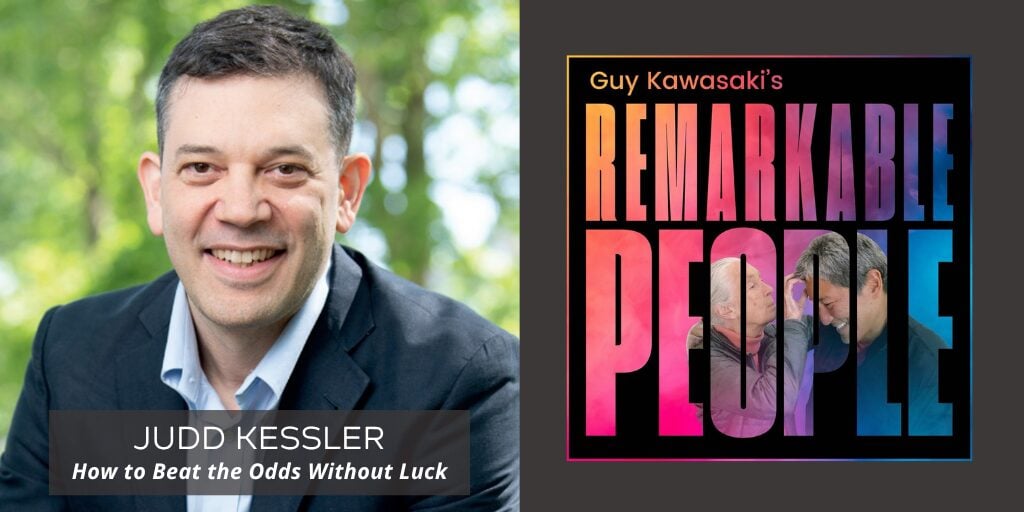
Welcome to Remarkable People. We’re on a mission to make you remarkable. Helping me in this episode is Judd Kessler.
Judd is a professor at Wharton and a leading voice in the world of market design. His work explores how scarce resources—from school seats to concert tickets—are allocated when price isn’t the deciding factor. But that’s not all—he’s also the author of Lucky By Design, a book that reveals how understanding these systems can give you a powerful edge in everyday life.
In this episode, we dive into the hidden markets shaping who gets what—and why outcomes that seem like luck are often anything but.
Most of us assume that getting ahead comes down to timing or chance. Judd dismantles that idea by showing how structured rules quietly govern access to opportunities. Whether it’s first-come-first-serve races, lotteries, or competitive “choose me” environments like hiring and admissions, each system rewards a different kind of behavior. Once you understand the rules, you stop guessing and start strategizing.
One of the most eye-opening ideas is that effort alone isn’t enough—you need the right kind of effort. In some cases, speed wins. In others, persistence or probability stacking matters more. And in “choose me” markets, success hinges on signaling—not just proving you’re qualified, but proving you’re committed. Judd argues that people consistently underestimate how much their signals of enthusiasm and intent influence outcomes.
We also explore the three forces behind every allocation system: efficiency, equity, and ease. There’s no perfect system that balances all three, which means every market involves trade-offs. Understanding those trade-offs helps you decide how to play—and when to push back against the system itself.
By the end of this conversation, you’ll see everyday competition differently. What used to feel random starts to look predictable. And what felt out of your control becomes something you can design around—just like Judd explains in Lucky By Design.
Please enjoy this remarkable episode, How to Win in a World of Limited Opportunities with Judd Kessler.
If you enjoyed this episode of the Remarkable People podcast, please leave a rating, write a review, and subscribe. Thank you!
Transcript of Guy Kawasaki’s Remarkable People podcast: How to Win in a World of Limited Opportunities with Judd Kessler.
Guy Kawasaki:
Good morning everybody. I'm Guy Kawasaki. This is the Remarkable People Podcast. And for the umpteenth time, we're looking for remarkable people to inspire and inform you. And for the umpteenth time, we found another remarkable person.
His name is Judd Kessler, and he's a professor at Wharton. He's an economist, and he's going to tell us how to skip the line and get tickets and do all kinds of good stuff. I got to tell you, Judd, though, someday your daughters are going to read your book and say, “Dad, why did you mention me so much in that book? Oh my God.”
They should get a piece of the royalty, but that's a different discussion. So listen, he's the author of this very interesting book, and if you're an entrepreneur, you really should read this book. As you look at his background, you can see he has about fifty copies behind him, but I only have one copy, and it's called Lucky by Design.
Welcome to Remarkable People, Judd.
Judd Kessler:
Thanks so much for having me.
Guy Kawasaki:
So Judd, first I have to ask you. So the title, Lucky by Design, I must admit that after I read your book, I said, “What does luck have to do with it?” You have so much about how you can optimize these things and optimize this. So is this a pun?
Is this like an IQ test? You say, “I'm going to make a title that is contrary to the book, and I want to see which podcasters are sharp enough to figure out that the title is a contradiction.”
Judd Kessler:
You won the game. It is a contradiction. No, this is my first book. And the titling was an interesting process because when I sold the book to the publisher, the book was called Market Rules. Because the idea was there are these hidden markets, you're playing in them all the time.
And it is very important to understand the rules that are dictating them so that you can understand those rules, develop a good strategy, navigate through them. And the publisher at some point was like, “Look, Market Rules, it reads as too like econ heavy. Like maybe it's going to be about financial markets,” which the book is not about.
My joke, because I understood it was not a perfect title, is, “Are people going to hear me say, ‘Market Rules,’ and think it's rules with a ‘Z?’ Like Market Rulez!” But what the publisher said was, “Look, the book at its heart is trying to help people have agency in these markets that they play in all the time.”
And folks who don't have that agency, who don't understand the rules that they're trying to navigate might think that the outcomes are based entirely on luck.
That this person got lucky that they got the seat in the elementary school that I wanted my kid to go to, or they got lucky that they were able to get Taylor Swift tickets when I didn’t or get that reservation at that restaurant or that lifesaving organ transplant, so wouldn't it be nice to kind of give people the recognition that this isn't just luck.
That they actually have more agency that they can succeed in these markets by understanding them better. I was trying to figure out what would be a good title that has the word “luck” and communicates that.
And my wife said, “Oh, the subfield of economics is called market design. So won’t you call it like, Lucky by Design?” It's like, “Oh man, thank God, thank you. Thank you for solving that problem for me.” And so sure enough, that’s where it came from and the idea being that it is not based on luck. It's luck you've designed yourself.
Guy Kawasaki:
I've gone through the process of naming about eighteen books, and in my humble opinion, once you get the title down, it's easy to write the book. Sometimes getting the title is the hardest part. All right, so we're going to skip near to the very end because it is top of mind for me. I want you to explain, maybe you've even updated it, your current email strategy.
Judd Kessler:
Yes. So in the book I talk about how we often are the market designers of our own hidden markets, in this case for my time and attention, a scarce resource that I do not just let people pay for. I use other methods besides price to decide who gets what. My email strategy at the moment is basically ignore anything that isn't important and time sensitive.
And those emails get handled in the kind of opposite order in which they came in. So a last in, first out kind of process. And the reason for that, it’s convenient because that's how a lot of inboxes are structured, where the new messages get put at the very top, but it's about the efficiency of my time in terms of how it's helpful for the people emailing me.
Because if you have just emailed me a question about a project we're working on or a request, and I can respond in short order, that actually might be the most effective use of my time because you are thinking about that question. You're actively working on the project. If I respond to you now, that will have big returns.
If I look at the email that came in earliest, and I respond to that first, by the time I work my way to yours, it might be an hour and a half or two hours later depending on the day and how many emails I've gotten, but that will be less helpful for you if you've moved on to something else or taken a lunch break.
But thinking about how other people are using the rules I've set up is what allows me to develop strategies that I find effective for me and for them, right? I want the people emailing me to be treated fairly. I want all my students who are asking for responses to get equal treatment.
But I also want to make sure that my time and attention is being used as efficiently as possible.
Guy Kawasaki:
So the consequence of your algorithm is that if someone sends you an email and it's not responded to in a few hours, they should send you another one to get to the top of the inbox again.
Judd Kessler:
That is a strategy they could play. The threading of emails in Gmail lets me see if they're in fact doing that or if they're sending me another email. But I triage at the beginning, so I will catch on to that because that is a thing that I was, for a long time, using the number of emails that I received as a measure of the importance of responding to something.
And I learned pretty quickly that was gameable. And in my book, I would advise people if they were trying to get the attention of somebody who followed that rule to send more follow up emails. But I realized that was not serving anybody.
It was not serving me because I was getting all these random follow up emails and it was not serving the folks trying to get my attention because it's a lot of work to send follow up emails rather than know that the person will get back to you.
So the very first thing I do is triage. And when I said I go through and figure out what's time sensitive and important, that process will reveal if somebody is trying that trick you just described.
Guy Kawasaki:
I promise you, Judd, that we will get more relevant to your book. This is really fascinating to me. So I have a story to tell you and then I have a strategy I want to explain to you to get the Wharton perspective.
Judd Kessler:
Please.
Guy Kawasaki:
So about fifteen years ago, one of my good friends, he went to France to some kind of bike trip that kind of follows the Tour de France and all this, right?
And on this trip he had a heart attack, and he died and when this news occurred, I said to myself, “At least he died doing something he loved.” And I thought, Guy, you spend hours every day answering emails. So as a tribute to this man, this friend, I took my inbox and I threw everything out.
I had zero in my inbox, okay? And I figured, let's just see what happens. So now thirty, forty days go by. Not one person said, “I sent you an email, you never answered.” So I concluded that most people send an email, they don't expect to get an answer. So if they don't expect to get an answer, why am I bothering to answer?
So that's data point for you, number one. Now, as I was reading your book about allocation in an economic model of my attention, once you get your email address out there, everybody feels free to just drop you an email. So I have a theory and I promise you, we will get relevant to your book.
I know we're trying to sell your book, not answer email questions. So I have a new theory. I am thinking, unless you tell me it's brain dead. I am thinking that from now on, I'm going to put out an automatic response to my email that says, “If you want to get in touch with Guy, his address is GuyKawasaki.404 on Signal.”
So if you don't have Signal, you got to get Signal to write to me. If you're on Signal, you have to use Signal to write to me and I can accept or reject the message. And I thought that is just a little barrier. So all these people who you know, Judd, get ready for this. This is going to happen to you.
You're going to get five emails a day that said, “I read Lucky By Design. It just changed my life. It was so impactful. I run a small book group. We have a hundred dedicated readers, and from time to time we feature a book that I find interesting and is relevant to my 100 members. If you would like to participate, just let me know and I'll let you know the detail.”
You're going to get five of those a day. Now, if that person got an email response automated that said, “If you really want to reach Guy, it's GuyKawasaki.404 at Signal.” I bet you 99 percent of those people are not going to do that. Right?
Judd Kessler:
Look, this is a strategic decision you can make, which in the terms that I use in my book, where allocation mechanisms, we care about their efficiency, we care about their equity, and we care about their ease. For market participants, what you are doing is making it harder, so you're lowering the ease of getting in touch with you. But as I described in the book, there's these three goals.
There's always trade-offs between them. So when you make it harder for people to get in touch with you, the folks who find that it's worthwhile to go through that process, download Signal if they don't have it. Create an account, use it. That cost means that the only people who are getting in touch with you are people who really value your time.
So the efficiency of that system improves and whether you want to have it be easier for folks to get in touch with you or have the folks who get in touch with you have jumped through more hoops so that you know the time you're spending responding to their email or Signal message is worth it.
You know that they think it's worth spending all that time and energy to get your attention. It must be worth it for you to reply, right? You get to make that trade off based on how much time you have, and if you're not finding that you want to live your life responding to emails, then make it hard for people to get in touch with you.
Guy Kawasaki:
My greatest fear is that Katy Milkman or Angela Duckworth sends me an email saying, “Guy, I want to come back on your show.” And they get a message that says, “Send me a Signal,” and say, “What is Signal? We're not going to bother. There are other podcasts to go on.”
Okay, enough about my email triage. I want you to bring the rest of the audience up to speed here. So let us just get into this. What is a hidden market? I'd never heard that term before.
Judd Kessler:
That is good because I am, I wouldn't say inventor of the term, but I'm the one who's using it, trying to proselytize it. So a hidden market is a market that is allocating a scarce resource. So we talked about your time and attention, but the scarce resource could be a limited number of reservations at a restaurant or a limited number of desirable products or seats in schools.
Guy Kawasaki:
Or livers.
Judd Kessler:
Or livers or Taylor Swift tickets or whatever it is. There's a limited number and rather than having the price adjust, so like the price gets very high to buy a ticket or get a reservation, or buy, we don't do this or, you know, let people buy livers instead of price moving around, there is another set of rules that determines who gets what.
And so this is what I call a hidden market because it's trying to do the same thing that a visible kind of normal market that you would see in an econ class or an econ textbook, right? It's trying to do that same task. Limited number of resources, bunch of people who want them. We have to decide who gets what.
But it is doing it in some other way besides letting price rise. And that happens a lot of cases where we don't want to let price do that job.
Guy Kawasaki:
So in a sense, you cite the example of Taylor Swift, where she did, you know, just set a price of tens of thousands of dollars for her concert tickets because there was demand. She could have pulled that off in the short term, but it depends on how you want to look at it. But you could say Taylor Swift was good to her fans.
She fostered loyalty, long-term, bada bing, bada bang, all that. But you could also say that she is just more sly than more people, and she optimized the finance, not for the short term, but for the long term. So when she does something like that, is she being super sly or super nice?
Judd Kessler:
I don't think they're mutually exclusive. There's two types of settings where these hidden markets crop up. Sometimes there is a seller who's setting a price and they are setting the price below what standard econ theory says would clear the market, what we might advise in an econ class.
So let's talk about those because there's another set where the government is trying to give away a service, or we've decided as a society that we don't want people paying for livers. We want to do a different allocation mechanism, but there's no one trying to maximize short-term or long-term profit there.
It's a totally different kind of situation, but for the sellers, I think many sellers do create hidden markets for longer term goals, for bolstering future demand.
I think about restaurants that have lines around the block, and they could raise their prices to capture more money today from those folks who are willing to pay the menu prices and wait for an hour outside, so clearly, maybe you could charge them a few dollars more per item and they would still want to come if you could shorten the line.
But the goal of having the line around the block is serving the restaurant because as people walk by, see the line, they learn, oh, this restaurant must be really good.
I don't want to wait in a line today, but maybe next month or, in a few months I'll come and get a table then. And so as a result, you can see that these sellers are making strategic decisions. I thought of this also a lot this summer when the fad product of the summer were Labubus, the little ugly, cute stuffed animals.
You're giving me the look like you haven't heard of them, which is good for you, but I could not avoid them. But they're like Beanie Babies or Cabbage Patch dolls. It's like one of these products that, for some reason this summer everybody wanted them and they were very hard to get hands on, and that was good for the seller.
That was good for them because it meant there was like an attraction to the product. And that may have made it the sensation that it was this summer. I don't think Taylor Swift has to do that. I don't think Taylor Swift needs us to learn that she's a good artist or kind of create scarcity to make it more desirable to see her perform.
She has tons of fans who would happily pay those prices. So I think a little bit of it is just she actually wants those fans to be treated well. And then there's the possibility that it does not look good if you are charging thousands of dollars for tickets to your fans who might only make a few thousand dollars in a month.
And that might be particularly unsettling given that you are a billionaire and that contrast, right? So I could see somebody saying, “Hey, maybe don't charge 3,000 dollars for a ticket.”
But what ends up happening is the average price of tickets on the Eras tour was 204 dollars, and there were tickets that were being sold at face value at forty-nine dollars, and that is well below the price necessary to clear the market.
At those prices, every ticket could have been sold a hundred times. I'm exaggerating. I don't know the real number, but certainly it could have been sold many, many times over. And as a result, you're just going to have a flood of people trying to buy a limited number of this scarce resource at a price that can't support that.
Guy Kawasaki:
Listen, once in my life I'd like to have a Taylor Swift problem, but, okay, so now you introduce a discipline within economics called a market design. So what is market design?
Judd Kessler:
Yeah, so market design is a subfield of economics that kind of like behavioral economics before it has been building interest and research over the last kind of few decades, and the underlying ideas that we can allocate scarce resources in ways that sometimes rely on prices.
But even in these hidden markets that don't rely on prices, we want to understand these markets, and we want to allocate the resources in ways that are equitable, efficient, and easy for market participants.
And the field of market design is working on how to design the markets better, how to understand how people play in those markets. But in this book, I would describe it as a pop econ book, but it's really a pop market design book. It's like that's the subfield that it lives in.
Guy Kawasaki:
Can you give us some examples of successful market designs?
Judd Kessler:
So a lot of the successful market designs that academics have been involved in are centralized clearing houses. So they're taking a set of market rules or institutions that are very disorganized and adding structure to it that allows the system to work better. So I live in New York City despite teaching at Wharton.
So I spend a lot of time on Amtrak. In New York, I send my kids to elementary school and New York City has lots of great elementary schools, and we have opportunities for folks to choose which schools they want to send their kids to.
And over time, the city developed a mechanism to allow parent preferences and priorities that you might have based on where you live and whether you have siblings that attend the school and things like that to generate an allocation of students into seats in a way that is as efficient and equitable and easy for parents and the district as possible.
And so this particular mechanism has us rank the school options that we want from the one we like the best to the one we would send our kids to, but don't love.
And we rank those preferences and then the system runs lottery that combines our priorities with a lottery number and gives everybody kind of the best option on their list that is feasible given everybody else's preferences. So it's a different mechanism than me having to show up at every school and do an application and go through the process at that school.
And maybe every school has a different system and maybe some are first come, first serve or summer lottery, like the whole thing, if left in a decentralized way, would be a nightmare. This centralizes things, makes things easier and that kind of mechanism has been very successful for markets.
Guy Kawasaki:
So hypothetically in such a system, let's say you ranked the school your first preference, and I ranked the school's second preference and there's one seat available. Arguably, even if I was luckier and got that seat, you ranked it higher so you would actually get the position, even though I was luckier.
Judd Kessler:
So it actually depends. So in New York City, the system that they put in place is one that is what we call strategy proof. And what this means is a very important concept in market design. What it means is that there's no way for you to game the system. The best thing that you can do is rank your true preferences first, second, third, fourth, and so on.
That ability to do that, to safely say, “This is what I actually want most. Actually want second. Actually want third.” That is not a feature of most hidden markets. Most hidden markets, you have to strategize. You have to potentially misrepresent what it is that you want.
And as a consequence of that, if I rank a school my first choice and you rank a school second, third, fourth, somewhere lower on your list, but you have better priority than I do, or you have a better lottery number than I do. If it's between you and I, you will get that seat rather than me.
And this is one of these kind of counterintuitive ways of thinking because hey, I said that that was my first choice. Wouldn't it be better if we gave that spot to me saying it's my first choice, rather than you who said it was your second choice?
But it turns out that if you set up the rules that way, then all of a sudden people start to strategize about what they say is their first choice. So imagine the school that's my true first choice. I don't have great priority at because I don't live in that zone.
Even though it's my true first choice and if a seat did open up, I would go there, and in a heartbeat, I might decide not to rank it first because if I don't have priority there and lots of other parents like that school, then I will not get to go there. I will be blocked by the folks who live in the zone.
And then when I turn around to the school that is my second choice that's nearby, that school might have gotten filled up by people who ranked at first if you're going to prioritize that over the fact that I live close by. And so all of a sudden it became risky for me to say my true preference.
I have to start thinking, Okay, do I say I really want the school I really want the most? Or do I say I want the school near me as my first choice, even though it's actually my second choice, just so that I don't get pushed out by folks who say it's their first choice?
And so then it turns out that actually the kind of better system and the system that over time has replaced that system that has is winning market share, so to speak, among school choice and other settings is the one where you can safely tell the truth.
And as a result, if you have a better lottery number or a better priority, you can take the spot from me, even though you said it was your third or fourth or fifth choice, and I said it was my first choice.
Guy Kawasaki:
So when I asked the question, I completely got it wrong, right?
Judd Kessler:
It is a first instinct that most people have, and it's one that when you dive into the underlying theory of these markets, you see why it's problematic, but it's not immediately problematic, right? If I had everybody's preferences and I knew that they were true, then your instinct of saying, “Okay, I want to give as many people their first choice as possible,” makes a ton of sense.
The problem is that these mechanisms are played dynamically, or if I understand the rules in advance, I'm going to change what I say my first choice is because I know that will potentially generate a better outcome.
And if you aren't thinking about that feedback loop, about that response that folks have to the rules then you will design a system that has bad properties, but you are not the only one that does it.
I was talking to a school that had an afterschool program that was oversubscribed. I talk about this example in my book. My kids go to an afterschool program, and they use a first come, first serve system to allocate slots.
It's a nightmare because all the parents have to be there at ten o’clock in the morning and it's like you're trying to get Taylor Swift tickets. You're trying to click faster than all of your kids' friends' parents that are in front of their computers and you're all racing for these desirable spots.
So, a better solution is a more centralized mechanism, like the one I described for the schools where people rank their preferences. I'd like this class first choice on this day, this class second choice on this day. And I was talking to a bunch of schools that have adopted or are thinking about adopting centralized procedures.
And one of them said, “Oh, our registration company that we use has built software to try to do that.” And they're not trained in market design. They got asked to solve this problem and they did exactly what you did. They designed a flawed system that has the incentives for folks to misrepresent what they want.
But it is a natural thing, which is why we need to think more carefully about the design that we put into place. And when we have a chance to change them, make sure that we're doing it the right way.
Guy Kawasaki:
Wow. God forbid I get a bunch of email or Signal mail from New Yorkers who are saying, “I listened to that whole podcast, Guy, and I like, I am confused.” So for the people in New York who are trying to get their kids into a public school, what's the bottom line, Judd? What should they do?
Judd Kessler:
Yeah. The bottom line is that they should rank their preferences as honestly as possible. It is hard work to figure out what schools you like the best, what schools you like second best, and so on. But we do the work behind the scenes to make sure that is all you have to think about rather than think about strategizing.
So again, for these strategy proof mechanisms, most school districts now use a strategy proof mechanism. So that's true in New York. It's true in Chicago. It's true in Boston, which famously used the wrong mechanism for many years, and they've since switched.
Most cities that have this kind of process now use a mechanism where it's safe to tell the truth, but if you think about other markets, you see immediately that's not the case. So I talk in the book a bit about college admissions.
So think about a student who's a high school senior applying to college, and they have the opportunity to apply early decision to a school or early action, but the way that these early applications work is that you are restricting yourself.
You can only apply early decision to one school because if you are admitted, you're committing to go. So you can't make that kind of application to more than one school. The implicit deal is if you apply early, your chances of getting in are better.
So the schools won't say this, but researchers who've looked at the data say applying early is worth about a hundred SAT points, so it's helpful to apply. When you are deciding to which school to apply early to, you recognize that you may need to strategize.
Or if you're not recognizing that, let me encourage you to think about it or advise the children that's high school seniors in your life to think about it because your instinct might be, “I would like to apply to the school that is my dream school that I like the most. That's my gold medal option. That's my true first choice. That's what I want to go for.”
The problem is that if you send your one early decision application to that school, and even with the extra a hundred SAT points, you are still well below their cutoff to get in, then they'll defer you or reject you.
And you will have missed out on the chance to apply early to your second or third favorite school on your list, which maybe if you had the a hundred extra points would have been attainable for you, but now when you're turning around applying in the regular decision pool, maybe you're below the bar now.
And so you have to be very thoughtful when you're deciding where am I going to apply early to a place that you want to go to, but that you actually have a chance of getting into if you apply early.
That's where the biggest bang for the buck is on that early decision application. That is not a strategy proof mechanism. That's a mechanism where you have to understand what it is that you want and then figure out, okay, what am I going to do in this market when going for the thing I want the most actually might be a mistake? What is the best strategic decision I can make?
That's going to require researching. What are the admissions cutoffs at all of the schools? My friends who've applied in prior years, what scores did they need to get in? There's a lot more work that you have to do in those markets to navigate and make sure you can succeed.
Guy Kawasaki:
Wow. I'm glad all my kids are either beyond or already in college at this point. So listen, now that we've had these examples, I want to get to something really tangible here.
I'm going to ask you to give us the gist of your optimization strategies for first come, first serve lines, for waiting lists for lotteries, and “choose-me” market. Just give us the bottom line, you know, hidden markets for dummies. Give us the bottom line for these most common markets here.
Judd Kessler:
Yeah. First come, first serve, as you mentioned, has a variety of forms. So there's first come, first serve races where whoever clicks the fastest or claims something first gets it. There's first come, first serve lines where you have to wait and the longer you're willing to wait, the more likely you are to eventually get to the front.
But waiting is costly and there's waiting lists. First come, serve waiting lists that are in the middle, like you have to be quick to get on the waiting list, but then you don't have to physically be present. You can walk away and get called back when it's your turn. So the strategies for races and to a certain extent for waiting lists are about being fast.
So the main thing is like you have to know that a race is happening and you have to be ready to run when the starting gun goes off. So for my kids’ after school classes, there is a moment in time when registration opens, and all of the good classes get taken within a minute of registration opening.
For certain restaurants, that's how the reservations for an entire month are doled out for certain live events. Same thing, so in those situations, you have to know that the race is happening. You have to learn when it starts. If you don't know when it starts, you have to stay vigilant. I just signed up for parent-teacher conferences for my kids.
That's a first come, first serve race. But nobody tells you when it's going to start. You just get an email in your inbox, you would never get it if you had your Signal thing set up right, telling you now is the time to sign up for parent-teacher conferences. That's a race to get a desirable spot so you don't have to rearrange your whole day to get some minutes with your kids' teacher.
So those are the strategies for first come, first serve races is about recognizing it. With waiting lists, it's the same thing. You want to get on early because usually they contact you in the order in which you've joined the waiting list, but there's also strategies involving how many lists can you join at once.
When you get to the top of the list, do you take what's offered or do you wait around? Sometimes you can say, “You know what, I don't want the thing that is currently being offered to me,” but they will let you stay at the top of the list, and more options will come along.
This is how a lot of organs are allocated where, and in that case you have a surgeon who's helping you decide which option to take, but if a kidney comes along, you're at the top of the waiting list, you might get offered that kidney.
You have to decide, should I take it? Often people have been waiting for years. Should I take this one? Or actually if I wait another week, maybe an even better one that's a better match for me, healthier donor will become available.
So you have to start thinking about that strategy. And then with the line, it's a slightly different decision because you have to decide when to join the line, how long you're going to be willing to wait there.
And that does require a little bit of both research about how much demand will there be. Like if you're trying to get tickets for Shakespeare in the Park and you know that the first thousand people will get seats, but everybody else won't, right? You don't want to show up at four in the morning if you're going to be able to get a ticket if you show up at ten in the morning, right?
You want to figure out the timing so you're not waiting an extra six hours. So there's some research there. And then I think there's also how can you make the time waiting less costly for you? Can you multitask? Can you wait with a friend?
Can you, you know, do some work while you're on the line, so it's not a complete waste. So those are first come, first serve. And obviously there's more in the book, but I’m trying to give tips of the waves, give you the high level insights.
Actually with lotteries, I was worried when I started writing the book because I want to give practical advice like bottom line. I want to give advice in every chapter. A lottery we think of as like the one where you have the least agency, you just enter and hope you're selected.
Turns out, lot of lotteries have opportunities for you to effectively enter multiple times. So sometimes you're just allowed to do that. You can use a different email address and register again. And those are sometimes allowed by the rules, and more dedicated people who value the outcome more will do those kinds of strategies.
Sometimes you can enter with friends or family members. There's lotteries where if somebody in your family wins, the whole family gets the prize. Like the Diversity Visa lottery program that the U.S. historically used to get folks from certain countries come to the U.S. and potentially get green cards.
That's a case where, you know, you and your partner should both enter the lottery so that if either of you wins, the whole family gets to go. And then there's some lotteries that have rules where if you win, you can defer for another year.
So if you want to run in the London Marathon, and you can't run this year, but you'd like to run next year, you should be entering the lottery this year and next year because the chance you win is very small.
But if you win this year, you can defer your win and run next year. If you're pregnant or planning to be, you can defer for up to three years. And so you can apply this year, the year after, and, four years from now all to run in that fourth year.
So there are strategies like that and those types of strategies, what makes sense to play really depend on the specific rules. So that's why the process has three steps. Understand that there's a hidden market, learn the rules of the market, and then figure out the strategies to succeed in them.
Guy Kawasaki:
You forgot the “choose-me” one.
Judd Kessler:
I didn't forget, I was you giving a break so you could, you know, chime in.
Guy Kawasaki:
I'm paying attention, Judd.
Judd Kessler:
It's a lot of my voice and people like to hear yours too. The “choose-me” markets are a little structured, a little differently, so it's not rhythmic deciding who gets selected and who doesn't.
First come, first serve race, it's an algorithm. Whoever clicks faster wins with the lottery, whoever's numbers randomly picked wins. With the “choose-me” market, there's two sides.
I am trying to get something that I want, but the other side of the market is assessing me as an individual. And so the strategy with these markets, and this is like labor markets, dating markets, markets for college admissions to a certain extent, right?
We talked about early decision is a way of getting the college to give you extra consideration when they're making selections. The reason they do that is that they are actually looking for something as well. What they're looking for is folks who are very eager to attend, they're looking for high yield, the fraction of folks who are admitted, who matriculate.
And so there's something that they are interested in. They're willing to trade off priority in admissions for your promise to come.
But all of these “choose-me” markets have this kind of two-sided feature where both sides of the market are doing what they can, and in this type of market, kind of my main piece of advice relates to the signals that you send in these markets and be more precise about that.
In a lot of these cases, think about labor markets or dating markets worry a lot about the signals that we send about how good we are, like whether we are good enough. It's something that we spend a lot of time focusing on and it's the kind of thing you might be insecure about.
Am I going to be a good fit for this firm, or am I going to be attractive enough to this dating partner? As a result, I think we undervalue the other side of the equation, which is what signals do we send to the other side of the market about how excited we are in them, not about what they think about us, but about what we think about them.
That's something that we can communicate credibly and that the other side of the market cares about, and they care about it because they are interested in finding matches where the folks are going to be happy to be in the match. That they're going to stay in the match for a long time, be productive.
So you can think about this as dating partners, right? I don't want somebody to go on a date with tonight. I want somebody to have a relationship with for a long time. I want to know when I'm deciding who to go on a date with. I should say I'm married, yeah.
Not me personally, but when you're deciding about that, you are interested not just in whether they are great, but about whether they're going to find you great.
Because that's the only way that a successful match works is if both sides of the market are excited. If you're a firm looking at workers, you care about whether the worker is going to accept your job offer if you make them one, is going to be at the firm for a long time, invest in firm specific human capital.
You're going to be less keen to hire somebody who's going to come to the firm but then be looking over their shoulder trying to get their next job opportunity. That's going to be a less desirable candidate.
And somebody you might not pursue as heavily if you were given the option. And the college wants to admit folks who are actually going to come because they care about their yield. They want to be able to say, “Most of the people we admit actually matriculate.”
And so in all of these cases, you have a lot of power as a market participant in your communicating to those dating partners, job firms, and schools that you are excited about them. And that's something I think we systematically undervalue, our ability to communicate those messages and how valuable they are.
Guy Kawasaki:
Just to make sure I'm understanding this right. Let's take a hypothetical example.
Let's say that you're joining thousands of others and you're applying for an internship at Apple. So in this “choose-me” market, you say something like, “I use an iPhone, an iPod, an iPad. I have a MacBook Air. My father worked for Apple. He has been telling me about Apple his whole life, how he worked for Steve Jobs. My mother worked for Apple. She also was telling me how great a place Apple is.”
And so you're holding up these signs that you're an Apple lover, you're an Apple evangelist, “Please choose me as opposed to your random schmuck from Harvard or something.”
Judd Kessler:
Right. There's a question of whether how credible those signals are, and if that was in fact your background, I would suggest different strategy. So everyone can say, “Oh, I really love Apple. I have all the Apple products.”
Most presuming you do have all the Apple products that you might want to say that those are what we would call cheap talk in the sense of, yeah, everybody can say they really want to work for Apple, that they love Apple.
The question is what are the signals that are more costly that some people are willing to send because they really do want to work at Apple and other people who have other options, they can work at Meta, or they could work at Google, or they could work somewhere else, right?
That those people who are less single-mindedly focused on Apple would not be willing to send. The extreme one would be you say, “Hey, I noticed that there's opportunity to interview at my home institution or to come and interview in person in California and I'd love to come to California and interview.”
That's like a very extreme, I'm flying to California to prove that I actually want this when other people wouldn't do that, but it could also be that Apple's coming to campus to do on campus recruiting for this internship. And Apple is having their meet and greet at the same time as a bunch of other firms.
But you chose to go to Apple's meet and greet. You went to their coffee chat or met with their representatives who were on campus, even though there was a ton of other stuff going on. Maybe your engaging with their posts on LinkedIn or doing things in the real world that are costly for you to do because they forego other opportunities.
But you are networking and taking out to coffee people who work at Apple or in the group that you're hoping to join.
And the reason I said if the profile you described was the one that I had, the strategy I would use is, oh, if my mom and dad both worked at Apple, that's one where I'd ask them to start making some phone calls for me because that's a very credible signal to have somebody who was in the organization, presumably knows people say, “Look, you and I worked together for twenty years when I was there. I want to tell you, my son is really interested in working there.”
I feel like the way I'm describing it, it sounds like it could be nepotism, right? But if it's two equally qualified candidates, then the fact that I'm willing to say to my colleague, “Listen, my kid actually is interested and if you pursue them, they will be a good match for the firm just like I was.”
That turns out to be very powerful because you're not going to say that if it's going to burn that relationship, if it's not true, if your son's going to go for the month and then bounce, right? You only get to say that once when my daughter wants to work at Apple and really wants to work there, right?
You can't use the same statement. So you're going to be careful about making that claim.
Guy Kawasaki:
Okay. I know my strategy now. I can't exactly ask Steve to intercede for me at this point.
Judd Kessler:
A little late for that.
Guy Kawasaki:
Yeah, it is a little late for that, but Judd, I think you could write a book just called Choose-Me because of the first in line strategy, the first waiting list strategy, the lottery, all of that. That's easy to understand, but “choose-me.” There's lots of ways.
First of all, you wipe out the cheap talk because you point out every schmuck says they love Apple. Nobody writes saying, “I really want a job at Apple, but I never use your products.” That's probably not a good opening line. So I think you should write a book called Choose-Me. I see I already did the hard part. I got you the title.
Judd Kessler:
I like that. I wanted the first book to cover all sorts of markets, but you're right. The “choose-me” setting is one that is particularly hard to navigate. And so maybe there's more advice that could be given.
Guy Kawasaki:
I can tell you every Asian American mother will buy that book. I guarantee it.
Judd Kessler:
I would love that, both quantity and quality of sales.
Guy Kawasaki:
So you mentioned earlier the three E's of this allocation, so please explain the three E's and why they are important.
Judd Kessler:
So we just went through a whole list of different rules for allocating scarce resources in markets. And the question is, how should we think about whether these are working well or badly?
There's one thing which is as a market participant, you want to know the strategy to get what you want in this market, but if you zoom out a little bit and you're looking at this market asking, “Why is it set up this way?” Or “How could we make it better?”
Or “What should I be complaining about to the people who get to design the market?” It's nice to have a framework for thinking about when these markets work well and badly. And so this is my framework for that. It's the three E's where the E’s are efficiency, equity, and ease for market participants.
How easy is it or difficult? So efficiency is about are we allocating the scarce resources to the people who value them the most? Are the Taylor Swift tickets going to her most diehard fans? Are the seats in the elementary school going to parents who really value them? Are we wasting resources?
A lot of mechanisms might be set up, and as a result, fail to fully allocate all of the available resources that can be a real problem. That means you're leaving potential benefit on the table. So that's efficiency. Equity is about fairness. If there's a bunch of people who we want to give equal access to the scarce resource, is the rules that we're picking, is it achieving that?
If we want to favor one group over the other, kind of level of playing field, say, we have one group that historically has had a disadvantage in this market. We want to give them a boost. Is our allocation mechanism allowing us to achieve those equity aims? And then the third one is ease for market participants.
How hard is it to get what you want or to try to get what you want in this market and think about standing in line for hours to get a live event ticket or to get a seat at a restaurant. That is time and energy that you spend that nobody benefits from. It's just wasted. And so that's a case where you might be particularly unhappy that the mechanism forced all of these people to wait all of this time.
That might be disappointment for folks who are participating in that market. You might say that makes the rules problematic. And so those are the three that we like to evaluate mechanisms on.
And I will say one of the things we learned from market design, which you could look at it as a negative or a positive, is that there is no mechanism that succeeds at getting all three of the E’s all of the time.
There is no perfect solution that achieves everything in a guaranteed way. The original sets of research on this are called impossibility theorems, shows that you can't achieve everything all the time. And that is disappointing because there isn't one solution that will automatically work.
But it's exciting and good news because it means that lots of different mechanisms crop up and a lot of them can be innovated upon to do a little bit better on one or the other. And so there's lots of opportunities for improvement given where we are.
Guy Kawasaki:
So if somebody said to you, Judd, “Who is in the Judd Kessler Hall of Fame for market design? Who do you hold up as this person or this company really understands market design.”
Judd Kessler:
Who is in my Hall of Fame? They're mostly academics because these are the ones who have spent a lot of time thinking about these questions. And so I talk in the book about my advisor from graduate school, Alvin Roth, who won a Nobel Prize in part for this work. He helped design the New York City Public Schools system that I earlier described that makes it strategy proof.
He also helped for folks who are doctors or know doctors. The National Residency Matching Program is the way that doctors who are coming out of medical school get assigned their residency programs. And it's the same kind of rules where you rank your preferences over hospitals and then you get matched to hospitals who are ranking preferences over candidates.
And these types of innovations, these types of markets, the work both showed theoretically that these were improvements over the existing mechanisms, but they also laid the groundwork for folks like me, the next generation of market designers, to come in and propose solutions. Also in the Hall of Fame is one of my co-authors, a guy named to Eric Budish.
He, for his dissertation, developed a solution to what we call the Combinatorial Assignment Problem. Yeah, it's got a little bit of a mouthful, but the way to think about this is when I want a school for my kid, I just want one school. I just want one elementary school seat.
Combinatorial Assignment is when, what I want is a bundle of things. So like when I'm a student at Wharton, I want a bundle of classes that makes my schedule for that semester and that is an even more complicated problem because which classes I want might depend on what other classes I have in my bundle, right?
If I have an accounting class already, maybe I don't want another accounting class, or if I have a class at nine o’clock in the morning, maybe I want to have a class at ten-thirty o’clock in the morning so that I can go from one class to the other.
And so his dissertation was about how do you design a mechanism that can as efficiently, equitably, and easily as possible, allocate bundles of items to market participants.
And so one of my earliest projects when I got to Wharton was with Eric and some other folks take his dissertation work and actually get it to be used at Wharton for how we allocate the classes to students. And so for the last maybe it's ten years now, we've been using a version of his mechanism to assign students to classes.
Guy Kawasaki:
Dare I ask, is there such a thing as a Judd Kessler Hall of Shame, where you say, “These are the dumb asses the way they allocate this?” I mean it might limit your future consulting contracts.
Judd Kessler:
No. I mean, look, there's a lot of market rules that get implemented for one reason or another that are just not ideal and it's opportunities. I don't want to call it a Hall of Shame. I'd call it a Hall of Opportunity, but one of the big ones is for live event tickets, which we've talked about a few times already.
But this is one where I think there's lots of opportunity for improvement because there are artists who want their scarce resources, their seats in their concerts, or their musicals or their sporting events, they want those to be given to real fans for affordable prices.
And what happens instead is that the tickets get bought up by speculators who are using bots that can click faster than anybody else to claim the tickets. They're being bought by those bots.
They're being turned around and sold on secondary markets for much higher prices, like the kind of prices that would clear the market because they don't care about the things that Taylor Swift cares about. They just care about making profit in the short term. And as a result, we are paying, as fans, very high prices effectively.
The big chunk of that money is going to the speculators and to the secondary platforms that take a big cut of the ticket price. When I buy tickets on a secondary market platform, if I spend a thousand dollars on tickets to something, it very well could be the 30 percent of that is going to the platform that facilitated the sale.
And so, there’s lots of people who are wetting their beaks, so to speak, on the secondary markets that are coming on top of the primary market, and so that's a case where we should be fixing that primary market. We should be redesigning it so that we don't let the speculators take so much when they've contributed nothing to the production that we're going to see.
Guy Kawasaki:
I read a story in your book that was so counterintuitive to me, and I had a hard time wrapping my mind around it. And it is the story that during COVID telling the world that medical personnel would get first priority on treatment was a very good thing to do.
And I read that, I said, “How can that be a good thing to do? It smacks a favoritism, nepotism, all these ‘-tisms,’ but why was that a such a great thing to do?” And I'd like you to explain that because I would've never, ever thought of this.
Judd Kessler:
Yeah, so this is a situation where you have a scarce resource that you're trying to give out, in this case life-saving care during COVID. And the question is, who gets access to that scarce resource?
And the thing that is helpful to keep in mind, and every time we have an opportunity to do this with hidden markets, I think we should think about it as a tool in our toolbox that we may ignore to our detriment.
You can ask, is there a way to allocate this scarce resource so the resource itself becomes less scarce? Can we allocate the scarce resource so that there is more of it to go around?
And that is effectively what folks were doing when they were saying if there's limited COVID care, limited hospital beds, limited ventilators, things like that, we should be prioritizing the nurses and the doctors and the first responders who are the ones providing that care.
Why should we do that? We should do that because if we're able to make them healthier faster. They can get back into the hospitals and continue to offer care. But also because if we make that promise to them, then the folks who might be afraid to come in because they're worried about exposure, become less afraid.
They know that they will be taken care of if and when they need it. And that will actually make it so that more people show up to the hospital to provide the kind of care that we need. And this is a tool that's making scarce resources less scarce. It's a tool that we can use much more widely.
I've done a bunch of research on organ allocation about how we allocate scarce resources like lifesaving organ transplants. And one thing that a bunch of countries do that the U.S. currently does not is give priority on organ donor waiting lists, so priority to folks who are waiting, if they had agreed when they were young and healthy to be organ donors in the event of their death.
So I'm eighteen, I don't yet know whether I'm going to be an organ donor or need an organ. But at eighteen, I say, “You know what? If I am in a position to donate, if I, God forbid, die in a way that makes my organs available for transplant, I would love for those organs to be given to other people.”
If we looked at those folks and said, “You know what, we appreciate that. If you end up needing an organ instead, we're going to put you a little bit higher on the list than someone who is eighteen and said, ‘No, screw that. I don't want to help. I don't want to give my organs to help people.’”
Like then we're creating an incentive for folks and in the research we've done looking at this in other countries and looking at it in a laboratory environment, we find that in fact it encourages people to donate or to register to donate more often.
Guy Kawasaki:
Tell me Richard Thaler or Danny Kahneman thought of that. That is so clever.
Judd Kessler:
I think they like it. It's not mutually exclusive from some of the other stuff that Richard Thaler talks about in Nudge, which is also on my bookshelf somewhere hidden among my books, right? In that, they talk about how to allocate, how to increase the number of people who register as organ donors.
But there it's a lot more about how we ask, where we ask, but these are not mutually exclusive. You could do both of them. You could ask more often. You could make it easier to say yes, but you could also reward folks who register with increased chance of getting an organ if they need it.
Guy Kawasaki:
All right. My last question and potentially the most impactful in many people's lives is the Judd Kessler algorithm for allocating domestic chores. I want to hear how you do, I might have to ask your wife if it's bullshit or not but explain how domestic chores are optimally allocated.
Judd Kessler:
Okay, so this is a big one. This was also COVID era thing for us. So one of the last things my wife and I did before COVID shutdowns was we went to a book talk for an author named Eve Rodsky, who wrote a book called Fair Play. And I remember sitting in her talk thinking, Wow, she is proposing a very interesting way to allocate chores in the household.
And I'll describe the way that she said they should be done, she said, “You should think about tasks as having three parts, the conception of the task, the planning of the task, and the execution of the task,” and her solution to household chores is that one person is responsible for all three parts of the task.
You conceive of the task, you plan the task, you execute the task. So for summer camp, you recognize the kids need to be signed up for summer camp, you research the summer camps, you register them for summer camp. You do all of the paperwork, and you buy the stuff that they need. Whoever's in charge of summer camp does all of that.
And her reason for having this framework of having the same person do everything is about equity or it was articulated as about equity, and there's lots of good research on this. And my colleague at Wharton, Corinne Low wrote a great book on it as well. Women in heterosexual couples are often doing much more of the conception and planning of tasks that might be jointly executed.
So the reason that Eve Rodsky describes this as helping with equity is like when you get the husband and a heterosexual couple to start doing conception and planning of tasks, they end up taking on more of the responsibilities in the household. You can split household responsibilities more equitably.
But as an economist listening, I immediately thought, Wait a second, this conception planning executing framework, this actually is improving efficiency of household production.
The equity we can deal with in a second, but the efficiency is achieved by the fact that when one person does all three parts, you avoid duplication of effort that you might get in conception and planning because conception and planning are invisible labor.
It's done in people's heads. I'm thinking about it. I'm doing it on the internet where my wife can't necessarily observe that I'm doing the research. And so in our household, my wife and I were both doing conception and planning.
This is where she might call the BS on me because I'm sure she was doing much more than I was. But I was also worried about whether the snacks got into the kids' backpacks before we took them to school. And if we're both thinking about that, that is wasteful. So the way I describe it, or I've described it in the past is, I might think I'm doing 50 percent of the tasks around the house.
My wife might think she's doing 80 percent of the tasks around the house. We might both be right if we are creating 30 percent extra stuff that we have to do, that's making it be inefficient in our allocation. The conception, planning, execution framework helps with that.
And then the second thing, and this is where the market design comes in, is how do we assign who gets which tasks, right? Because you're going to be doing the conception, planning, and execution of a task.
I have to do some of those tasks. My wife has to do some of those tasks. And in our household, we did this book talk and then COVID shut everything down, so then we had to like basically redesign our lives.
And so we applied this framework there. We used a concept called envy-freeness. Allocation is envy-free, is free of envy. If I look at what you get from the allocation and I do not envy you, and you look at what I get from the allocation, and you do not envy me.
If we both see what we got and like it better than what anybody else gets that is a useful way of saying we have achieved equity in this allocation. If everybody looks at one person that thinks, Oh, that person got the best, everybody likes what they got. That's not fair. That treated that one person better. So how do we achieve envy-freeness in the allocation of tasks?
So we kind of rearrange who's doing what until we look at what the other person is doing and say, “I do not envy you. I'll clean the dishes. I'll do the laundry. If you're waking up with the kids in the morning, and I freaking hate that, like I would not want to trade with you.”
And if I feel that way and my wife looks at what I'm doing and says, “I wouldn't want to trade with you,” then we have achieved envy-freeness, and we can rest assured that we're being at least somewhat equitable in our allocation of tasks.
Guy Kawasaki:
That is going to be my new buzzword, envy-freeness. I think I'm going to apply that concept to the relationship of Madisun and I, that I don't envy what she's doing, and she doesn't envy what I'm doing.
Judd Kessler:
It's a good rule to follow.
I will say in my relationship, it’s not just that you're achieving equity in the tasks, but when I am doing the tasks, it's very hard to be resentful from somebody if you can appreciate everything that they're doing and say, “I wouldn't want to take that off their hands. I wouldn't want to be responsible for that.”
I actually feel better about what I do knowing that what my wife does seems like an even harder lift.
Guy Kawasaki:
Okay, so now we are now in the business of helping people have remarkable domestic chore allocation. You're not going to get that on any other podcast. I don't care, Guy Raz, I don't know if it's Joe Rogan or Terry Gross. Nobody has addressed this problem.
And then I really think you should write a book called Choose-Me.
Judd Kessler:
The book writes itself at this point.
Guy Kawasaki:
If you write that book, the first thing I'm going to do is check the acknowledgements to see.
Judd Kessler:
You'll be in there.
Guy Kawasaki:
That's all I ask. All righty. Thank you so much for this. It's been most eye-opening and definitely you've changed my perspective on a lot of things. So thank you very much for doing this.
Judd Kessler:
Thanks so much for having me.
Guy Kawasaki:
Yeah, and let me hold the book up one more time here since you might not be able to see it, the five copies on the shelf behind him. It's called Lucky by Design, which is a misnomer as a title. It's nothing about luck, it's all about design.
And I want to thank the people on the team, all of whom do things that I do not envy. So there is Madisun Nuismer, who's the co-producer. There's Jeff Sieh, co-producer on the technology side.
There's Shannon Hernandez, sound design, and there's Tessa Nuismer doing research. I do not envy anything of what they do, and I'm sure they see what I do and they're not envying me. So we're in a perfect state here at the Remarkable People Podcast.
Sign up to receive email updates
Enter your name and email address below and I'll send you periodic updates about the podcast.

Leave a Reply