
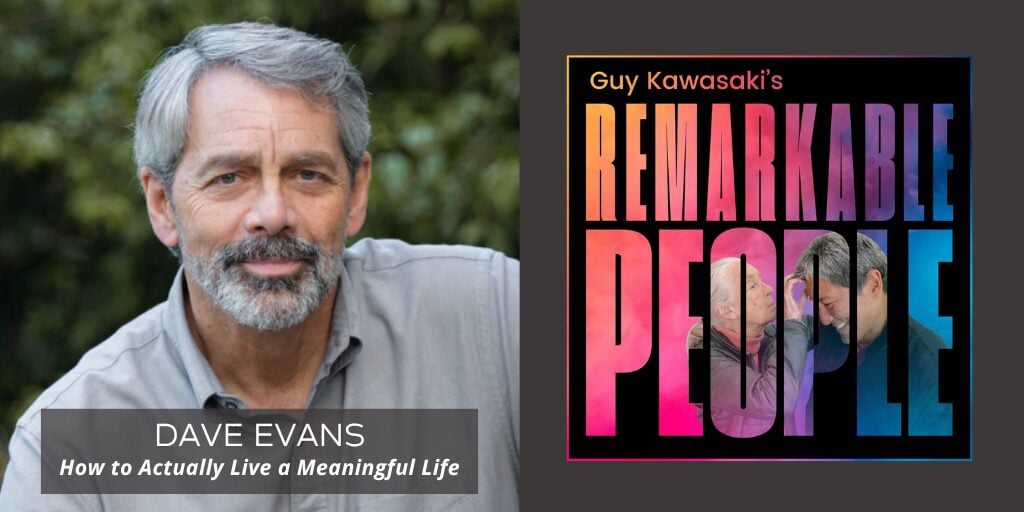
Welcome to Remarkable People. We’re on a mission to make you remarkable. Helping me in this episode is Dave Evans.
Dave is a Stanford educator, Silicon Valley pioneer, and co-creator of one of the most popular life design courses in the world. He helped design Apple’s first mouse, co-founded Electronic Arts, and later shifted his focus to helping people navigate life’s biggest questions. But that’s not all—he’s also the co-author of Designing Your Life and now brings a deeper, more philosophical lens in his latest book, How to Live a Meaningful Life. Dave doesn’t just explore meaning—he challenges how we’ve been asking the question altogether.
In this episode, we unpack a critical distinction: the difference between the “meaning of life” and “meaning in life.” Dave argues that while the first is an interesting philosophical question, it’s not a useful one for actually improving your life. Instead, he focuses on how people can experience more meaning right now—and why so many people feel like something is missing, even after chasing success. He explains how the post-pandemic “Great Resignation” exposed a widespread hunger for meaning that traditional ideas like impact and fulfillment fail to satisfy.
What replaces those ideas is a more immediate, experience-based approach. Dave introduces the concept of the “flow world” versus the “transactional world,” showing how most people spend their time chasing results instead of actually being present. He also outlines five key mindsets—wonder, radical acceptance, availability, full engagement with detachment, and creating your internal narrative—that help unlock meaning in everyday life. The takeaway is simple but challenging: meaning isn’t something you solve once—it’s something you continuously practice.
Please enjoy this remarkable episode, What Actually Makes Life Feel Meaningful Day to Day with Dave Evans.
If you enjoyed this episode of the Remarkable People podcast, please leave a rating, write a review, and subscribe. Thank you!
Transcript of Guy Kawasaki’s Remarkable People podcast: What Actually Makes Life Feel Meaningful Day to Day with Dave Evans.
Guy Kawasaki:
Good morning everybody. This is Guy Kawasaki. This is the Remarkable People Podcast, and we have yet another remarkable person for you and of course, here's an interesting thing, this is your second appearance, right?
Dave Evans:
Second time. Yeah.
Guy Kawasaki:
Yeah, so you're in rare company there.
Dave Evans:
Thank you very much. Feel quite privileged.
Guy Kawasaki:
So Dave is a Stanford educator. He's a Silicon Valley pioneer, and he's co-author of a brand new book called How to Live a Meaningful Life. Of course, the book before that was a million copy bestseller called Designing Your Life. So basically he's killed a lot of trees.
Dave Evans:
I'm killing a lot of trees.
Guy Kawasaki:
He helped design Apple's first mouse, and he co-founded Electronic Arts. Then he pivoted. And he turned to education and design thinking. So he has one of the most popular courses at Stanford. And now without further ado, here is Dave Evans.
Dave Evans:
Thanks Guy. Good to be here again.
Guy Kawasaki:
I think the people who have been here multiple times are you, Jane Goodall, Julia Cameron. Oh, Bob Cialdini, Mr. Influence.
Dave Evans:
Boy, pays to be a local.
Guy Kawasaki:
Especially when we're recording virtually. Yeah. It really pays to be local. So listen, let's get everybody on the same page here. So first of all, just explain what's the meaning of meaning.
Dave Evans:
It depends which version of the meaning question you're asking. You're talking about killing trees. We actually discussed amongst ourselves, Bill, my partner and I, for the better part of two years, whether or not we deserve to write this book or we're just killing trees because the meaning questions have been around since we crawled out of a slime, right?
Viktor Frankl's Man’s Search for Meaning is a great classic. He defined a whole new category of psychological inquiry called logotherapy because he defined the human person as being a meaning seeking animal.
A ‘logo’ is looking for the meaning of life, has been around a long time. So the reason we did this is after the pandemic, and especially after the Great Resignation, fifty-two million people walk off the job looking for something more meaningful.
Most of them, I don’t know if they found it by the way, but that question arose and people came back to us, like, “We did all this stuff, we read the books and it's still not as fulfilling, as meaningful as we had hoped. What did we do wrong?”
So that question pounded us pretty hard, and as we leaned into it, we quickly realized there's two very different questions. What's the meaning of my life? This great existential aspiration. Or how do I get more meaning in my life? Now the first question might be worthwhile, but it's not the one we're going to answer because it's not a good design question.
Might be a good existential question, but it's not a good design question. So we're helping people with how do I get more meaning in life? Because currently right now in the present day, it's not working for me as well as I want. And then so what's that kind of meaning? Well, it comes in a variety of forms, but I'll stop right there. And looking at what people were looking for was the next thing we did.
Guy Kawasaki:
Okay, so well then what's the gist of the meaning in life?
Dave Evans:
It turns out where people weren't getting enough of it, they came to us with really only two answers. Like, okay, what's not working for you? What I'm looking for is impact. Am I making an impact? Am I making a difference? Does my life matter? Am I changing the world? Will this create a legacy?
We heard that probably eight times out of ten. The other two times, like I'm just not as fulfilled as I was. So the two versions of meaning making that people were presenting as being not adequate to their appetite was impact and fulfillment. And as we dove into that, what we like to do as design thinkers, well, problem finding precedes problem solving. Work on the right problem if you want to have a good answer.
And the problem with impact, impact is a good thing. It can be meaningful, but it doesn't last. It's a thing, you're not a thing, it's just a productive result. And even Olympic winners, I worked with the U.S. Olympic Committee because there's nothing as exciting as ascending the Olympic platform and nothing as terrifying as descending it afterward.
Now what do I do? And so the whole question of impact is what have you done for us lately? And even if frankly you work on a worthwhile impact, you do everything right, it still may not work. So impact is a risky business, and it's a short lived business, so you can't put all your eggs in that basket.
And fulfillment doesn't even work at all because Maslow defined fulfillment self-actualization as becoming all that one can be, which later in the life he decided was wrong. And we'll come back to that, I'm sure. But you can't be all that you can be because we know each of us contains more aliveness than one lifetime permits us to live out.
There's more than one of you in there, so of course you can't be all you can be. You can't fully manifest. You're bigger than your lifetime, so impact doesn't last. Fulfillment is a dead end. Other than that, we're doing great, and there's this whole other category of experiences we emphasize in what we call the flow world in the present moment.
It's another experience of meaning, we say, “Any experience that animates your sense of humanity, and your personhood can be meaningful.” So it isn't just results called production and impact, but it can be experiences of things like wonder, flow, coherency, feeling like an authentic person or having a meaningful encounter with other people, we called formative communities.
We picked four areas of experiences that people report regularly as meaningful. Am I in wonder, am I in flow? Am I coherent and am I in deep community? Those are four places where come and get it, there's a lot more waiting for you.
Guy Kawasaki:
So if you have enough meaning in life, does it mean that you're not going to be sitting around wondering about the meaning of life because you're living too much in the moment to be like staring at your navel.
Dave Evans:
You're getting right after one of the cracks in the like, wait a minute, is this just a noble version of hedonism? “I'm having a great time having lots of meaning. Who cares about the meaning of my life?” No. It turns out, and we say this in the conclusion actually, if you get good at the meaning in life thing, then it turns out you're probably going to be more discerning around the question of the meaning of life.
But also it's a dynamic. One of the reasons we don't want to go after the meaning of life or the purpose for your life or the calling to your life is as though there is an answer. Now I found it. Well, that depends on what you think a person is. So we think a person is a becoming. You're a constantly evolving, embodied intelligence.
You're not a brain on a transport system. You're not an engineering problem to be solved. You don't get solved with meaning. You grow continually into it. So if I'm going to become a growingly different person called the New and Improved Dave, how could the current Dave know what the future Dave would think the fullness of meaning really means?
So I want to live meaningfully as a dynamic process or purposefully as moving toward an aspirational goal. But I'm never done with that question. So the whole thing of what's the meaning of, frankly, I think the ultimate meaning of life is to live more and more meaningfully along the way.
Guy Kawasaki:
All right, so now from the outside looking in, if you dare answer this question, what do you think people like Elon Musk and Peter Thiel and Stephen Miller say is the meaning in life or of life? Like what is driving those people?
Dave Evans:
They're not my personal friends though. I'm probably one click removed from Peter Thiel a couple of times. A couple of people I'm pretty close to are pretty close to Peter. I think for most of them, first and foremost, they're looking for life's a win-lose game, and I want to be a winner. And frankly, for some of them who think, Life's a win lose game, and I really need you to be a loser, and that's not my definition of the human person.
So I think where I disagree with some of those people, if I end up on the other side of a conversation, it's really at the anthropology. What does it mean to be a person? And if what it means to be a person, I think is a becoming. And I think we're all in this together. I believe with Dan Siegel, that consciousness is collective, and if I harm my neighbor, I'm ultimately harming myself.
So the win-lose thing, a true win-lose person, any other person on the planet's win is at my expense because life's a zero sum game. There are not enough resources to go around. Everything you get, I could have gotten. If you got it, I don't get it. That means I lost, screw you. I want it back.
So I think white nationalism was about that. I think hyper economic inequality is about that. That's not my definition of anthropologically who we are.
Guy Kawasaki:
Alrighty. I think I can intuit where you're coming from there Dave. Thank you. So you mentioned Maslow's hierarchy of needs, and it starts with physiological needs about water and food and then safety needs, and then love and belonging, and then esteem, and then self-actualization. And then I learned in your book towards the end, Maslow added self-transcendence.
So just explain those last three steps, esteem, actualization, and transcendence.
Dave Evans:
So esteem is a I want to be respected, which is really about the first half of like, have I established credibility as a person. And esteem is one of the ways I really need to believe. It's very hard to believe yourself about that. So esteem is in the eyes of other persons, I deserve to be regarded as a worthwhile human. So now I'm worthwhile. Now am I fully actualized? Am I all I could be?
So his hierarchy in this, according to the NIH, the National Institutes of Health, one of those most contagious ideas of the social sciences started 1943, that first pyramid, 1943, we're still talking about it. And that the peak was self-actualizing and literally in the paper, “To become all that one can be is how you attain self-actualization.”
And the result, if you attain self-actualization, is I will experience fulfillment. That's Maslow's model. And he ran with that for years, so that's a really worthwhile thing to pursue. People might say today, we would say, “Have I been completely manifested? Have I had a chance to manifest all of the wonderfulness of me?”
One of the reasons that lasted for people as a lifelong aspiration is there's no freaking way in the world you're going to get there. Bill and I know, and I think most people just know intuitively, I'm way bigger than my own lifetime.
There's no way I'm going to get there. I'm turning seventy-three in a couple of weeks. I have buried a bunch of people, including my late wife, Claudia. And trust me, I have never buried a single person who was done. You're never done. That's the good news, by the way. So the fulfillment thing didn't work, and Maslow long suspected he was wrong and he was wrong.
So in his journal notes, he posits the idea of the new top layer, which is self-transcendency, the attainment of which by the way is meaning making. So you go from fulfillment, it's all about me and ego, didn't I do a great job of becoming me? How wonderful was that to, oh, if I get beyond myself that's really where it becomes meaningful.
So if I want to have the deepest human experience of my own life, it turns out the irony is best way to enjoy being you is to get beyond you. Whether that's an experience of nature and beauty, whether that's an experience of service, whether that's an experience of profound intellectual and having huge ideas, but something bigger than you is actually what makes you feel like a real person.
And oh, by the way, he's still wrong because he called that the top layer hierarchically. And it's not hierarchical. Transcendence is available to all. I mean, why do poor people in refugee camps have this experience? They're having a meaningful experience of self-transcending helping one another.
Viktor Frankl, the Man’s Search for Meaning, he was in a group trying to escape from the Holocaust prison camp he was in, and the escape was finally ready to go. And one of his colleagues comes to him in one of the barracks and says, “We're going, you got to go right now.”
And he is sitting next to another inmate who's ill because not only is he a psychiatrist, but he is also an MD. So he is a doctor of the inmates, and he looks at the patient, and he looks at the escapee, and he goes, “Go ahead. I'm staying, I'm going to suffer well here.” Even in that incredibly contained area, he's got no self-actualization happening at all.
They're beating the living crap out of him all day long. He can still self-transcend. So the opportunity for meaning making is actually available to everybody all the time.
Guy Kawasaki:
So the bottom line is the Maslow model is utterly and completely broken. It's not a hierarchy, it's not a ladder, it's not a pyramid, right?
Dave Evans:
No. I think it's fair to say because I work a lot in people who are trying to solve homelessness or people suffering homelessness. If you're freezing cold and hungry and terrified. You're not thinking a lot about meaning, you're pretty preoccupied. Now, you might be able to have a moment of kindness when the guy next to you overdoses on Fentanyl and somebody at the help center gave you a Narcan canister.
You might shoot it up his nose and save his life. And you'll take a moment to do that. And a friend of mine just went through that two days ago. So sure. But yeah, when you're really not surviving very well as a human being, you're pretty preoccupied. So there's probably some hierarchy going on, but once you get into the upper layers, no, it's not hierarchical.
Guy Kawasaki:
I would make the case, Dave, that esteem and self-actualization are barriers to self-transcendence, right?
Dave Evans:
I don't think I would argue with you. If you get stuck on thinking, I got to be me, which is the anthem of the self-actualize, you're going to miss a bunch of stuff.
Guy Kawasaki:
Most people, well in Silicon Valley, they're in the esteem and actualization stage, right? I don't know many people thinking about transcendence.
Dave Evans:
Gen Z, who are demanding more meaning making, you know the, “Hey, we're not going to live the ruined lives you all got in order to hit that prize.” I think they're looking elsewhere. So I think there's a teachable moment going on there.
Now, I will say one of the problems Bill and I argued about for a year and a half because if you take the book and shake it up upside down real hard and get everything out of its pockets, what you're going to find is, it's overwhelmingly this thing about be in the present moment. Ram Dass wasn't wrong. Be Here Now. So we talk about the flow world, which happens in the present moment.
It's all about getting into the present moment. Wisdom of traditions have known this forever. So we said, “Do we really have anything new to say here? Do we have anything to add?” And the conclusion was either no, we're wasting paper, killing trees, or yes, a new take on an old idea that people need to hear.
And the publishing industry said, “We think it's the latter. We'd like to publish the book.” So we wrote it. That's why we wrote the book. And if it does well, we're right. If it does badly, we're wrong. We'll see, but what's going on is the human cry around this isn't good enough. This chasing after the gold ring is just not enough.
It is a good thing. And we heard it loud and clear right after the Great Resignation of the pandemic. The whole world had an existential crisis of, oh my god, COVID, I might die. Or I know somebody who did. And I think it forced people to go, “What am I doing? Is this really worth it?” So there's a big question that being asked right now, and that's probably a good thing.
Guy Kawasaki:
And do you ever ponder the complexity that, here's a book and you have all these case studies about Stanford graduates and they're working in tech. They have seemingly perfectly wonderful lives, and they're not feeling actualized and transcendent, but then much of the world, they're stuck in the level of physiological and safety needs.
Are we just a bunch of West coast liberals living in a bubble, and we don't even know what the hell's really happening in the rest of the world?
Dave Evans:
A totally fair question. Not to bring up competitors or comparison, we just did the Mel Robbins show, and I did something I never do. It aired two weeks ago. I read all the comments.
I read all the comments, and they're overwhelmingly, “Oh, this is so helpful. Thank you so much,” because everybody loves Mel, and she likes us, so we must be good guys. And one, exactly one, I think probably older person from the Midwest. It's a two line comment like, “Moral elite, Silicon Valley bullshit.” And I went, “I think that's the tip of an iceberg.”
So it's a totally fair critique. I am an older, reasonably successful white guy on the left coast. It's like, who cares? But that's why in addition to the Stanford class examples in the book, there's, I think we call her Allison, the forty-two-year-old CPA who runs a small business at a finance conference I spoke at. She's got a couple of used cars and a decent enough life, and she's bored to tears, like, “What did I do wrong?”
Or the in a wheelchair, poor as a church mouse artist living in a garret warehouse converted apartment. The real person of whom died, by the way, between the time the book was manuscript and the book was released. And asking questions or trying to give examples of real people in real time.
Because we really do have to own the fact that Bill and I are pretty privileged people, but beyond the Stanford class, those between one or two million books and the 6,000 educators in 600 universities, including land-grant universities talking to kids in the middle of nowhere who are on their way to become maybe an assistant nurse.
So hopefully the stuff we're saying is accessible to average people. But hands up. I can't be the poster boy for what we're doing because I'm certainly not in the top 1 percent, but certainly in the top ten. So let's just be honest about that.
Guy Kawasaki:
I would make the case that some immigrant family who's struggling to make a living, who's afraid to go out now because of ICE and all that, they may not be cogitating the meaning of life, but I believe they are actually achieving meaning maybe more so than.
Dave Evans:
Oh, absolutely. And particularly being good at grabbing that present moment. Just yesterday, young family I know live way up in the mountains behind you because they can't afford to live in town commute forty-five minutes. He's a stay at home mom. She's working in a barely making it situation.
Water heater blew up, twenty-five fucking hundred dollars, blew the budget for two months, living right on the edge. And we're having this conversation. So I sit down to dinner with them in their little cabin in the woods. And what do we do? Dad made teriyaki sauce because buying it's too much money and, “Hey dad, this is really good teriyaki. We actually enjoyed the meal. We actually paid attention to what's going on.”
They weren't sitting around worrying about the IPO or whether or not, they could leverage one account against another in the Caribbean. They're talking about whether or not the chicken tastes good and “Hey, we got some chicken here,” so I think not only might some of these ideas be available to those people, I think we got a lot to learn from them.
Guy Kawasaki:
Yeah. Do you think that there is a unit of measure, not necessarily quantifiable, but is there a way of measuring meaning?
Dave Evans:
What are we looking for here? I'm very fond of, and, I think it's in the book, the Joseph Campbell, the philosopher and historian, in a series PBS did long, long ago, called The Power of Myth, was being interviewed about this topic. And he says, “You know, the meaning thing, I know Viktor Frankl, all that we talk about all the time.
I don't think that's really it. I don't think meanings really,” I'm paraphrasing. “I don't think meaning's really what it is we're after. I think what people are talking about is simply the rapture of being alive.” So if there were a measure that I'm looking for, a little dial I want to see, is that in the green or the red?
Is your sense of aliveness, your sense of am I actually here, I'm actually experiencing being alive, am I sitting here right now? Actually enjoying talking to you about these issues, and I'm actually picking up as you're asking the question, your head goes down a little bit, and you close your eyes a little bit and you put your hand on your forehead a little bit.
But what about these other people? So there's some compassion, not just curious, what are those other people don't like me? I'm actually picking up some compassion from you about the fact that there are other people who are not having a good time right now.
What about these people? Am I present to what you're actually feeling, or am I going, “I wonder how many people are going to listen to this live versus streaming and is the needle going to move on my sales?” Okay, that's all transaction about me future crap. As opposed to, am I willing to be with Guy for an hour? That's the decision we're making.
Guy Kawasaki:
I guess the answer is yes, right?
Dave Evans:
So if there was an aliveness meter, particularly in the present mode, real time aliveness meter, that's what I'm after.
Guy Kawasaki:
Okay, so now flipping completely to the other extreme, maybe you can help me wrap my mind around this. I know about Ro Khanna and this billionaires’ tax and in California there are 200 billionaires and they're all threatening to move to, I don't know, Texas and Florida because of this tax.
And I'm sitting here, David, I'm thinking, You are thinking of uprooting your life to move because of a 5 percent tax and the stock market could go up and down in a day and affect your net worth by 5 percent easily? But you are threatening to leave California and to leave wherever you are because of this tax?
I do not understand that. I don't understand it at all. If you're worth a hundred billion dollars, what freaking difference does it make if you're now worth ninety-five billion dollars?
Dave Evans:
Okay. A long, long time ago, the last time I was on the show, remember when we started telling Steve stories and we never came back, so at the risk of doing that again, I remember I was at Apple in the very, very early days. I arrived six weeks before the IPO.
And then at one point people were watching Bill Gates versus Steve Jobs, and there was a report that Steve Jobs’ personal net worth had just exceeded Bill Gates' during the time that I was at Apple.
They went back and forth, and my wife turns to me, she goes, “Oh, now that Steve has beat Bill, do you think he'll back off?” And I go, “Oh, you don't get it. There's no backing off.” If I'm a billionaire, first of all, I think at the end of the day for some of them it is just about the money. For some of them it's this egotism, and “I really do believe I'm a different class of person and those rules do not deserve to apply to me.” Some of them believe that.
And then some of them have this rationale, which is, I think Peter Thiel will sound like this, by the way, that “I trust me to do efficacious things with this on behalf of society more than I trust the government, so anything I can do to delegate responsibility for the stewardship of these funds to me rather than some governmental entity is a good thing.”
“I'm doing a fundamentally good thing. I'm going to move my residence to appear to be in Alabama or Texas or Washington state in order to empower me to do more good for society.” I think they may even believe themselves. Underneath that, my suspicion is, “I have so believed the feedback loop called capitalism, that I'm a better class of person.”
“It just deeply offends the crap out of me when somebody tries to exert anything over me at all and ‘f’ those people, I'm out of here.” I think that's what's really going on. Yeah, but the objective rationale, the thing that's making you sigh right now, like really, they're willing for the market to screw with them, but not a person who's face they can see.
Guy Kawasaki:
Yeah. If Donald Trump says, “There's a tariff on iPhone parts,” you know that's okay, they don't want to contribute more to society. I do not understand. Dave, I have made a decision that I am going to limit my net worth to 999,000,999 dollars and ninety-nine cents.
Luckily, I'm not anywhere close to that problem, but should it ever occur, I am not going to get billionaire's disease. Not at all.
Dave Evans:
I think you have to work at it really, really, really hard. I think, fiscal destitution is not unlike moral or sexual destitution. You need to erect barriers. What's his name? The guy that wrote The Purpose Driven Life. He’s one of those really successful TV pastors, keep falling down because they get a ‘zipper problem.’
And, I was talking to, what was his name? This mega pastor who wrote a massive successful book. I can't remember his name, and he said he had learned from Billy Graham to absolutely believe that you too are made of the same dirt as everybody else, and you better watch out.
So this guy had a file drawer in his desk full of articles about fallen leaders, sexual fallen leaders, and his responsibility was to read one article every week to remind him there, but by the act of stupidity, go you, fool.
And so he erected a practice to keep his brain in this thing called humanity, not egotism, and I think fiscally it's a similar thing. It's very, very, very difficult.
Guy Kawasaki:
When I even hear the term prosperity gospel, to me that's an oxymoron. That is an oxymoron.
Dave Evans:
It’s complete crap. Sorry. I happen to have a seminary degree. I can, I will win that argument. We could go down that pathway. By the way, you know the Jesus' conversation with the rich young ruler and he says, “Obey the law.” “What must I do?”
Jesus says, “Obey the law and the prophecy.” He goes, “I've done that since I was a kid.” “Oh, so you got that problem. You did everything right and you're still not feeling. Probably what's happening is your material wealth is in the way. Why don’t you sell all that crap and give it away and get that burden off your back?”
And then the young man walks away sad because he doesn't like the counsel he's getting. And people I think misread what happens next. Jesus says, “It's easier for a camel to pass through the eye of a needle than a rich man to enter the kingdom of heaven.” And people go, “I.e. he just means it's impossible.”
No, that's not what they mean. The Needle was the nickname of the smallest gate through the wall of the city of Jerusalem. And a camel had to get on its knees to go through that gate because of a low lintel. And camels don't like getting on their knees. Their belly aches, and they scream and they whine like crazy.
It's very difficult. So it's not impossible for a camel, an actual camel, to go through the actual gates called the Needle, but boy, do they not like it. They will resist it with every bone in their body. That's what he's talking about.
So if you are a rich person and you want to enter this kingdom of humanity, this presence of the wonderfulness of being a member of this collective consciousness called people, and this enjoyer of this thing called creation in this life nobody gave you, you did not make, but somebody gave you. You got to humble yourself.
And rich people have a really powerful capability to avoid that humility. And in so doing, dehumanize themselves.
Guy Kawasaki:
And I guess the complexity is that maybe that ability enabled them to be rich, right?
Dave Evans:
Oh yeah. I think if you throw all of your capability at winning that external game, you will have a greater chance of winning it. Let's be clear. The people who are willing to give everything they've got and everything everybody else has got at winning at any cost are more likely to win. But the results have a huge, huge boomerang of negative effect.
Guy Kawasaki:
Yeah. Okay, let's get off that topic.
Dave Evans:
Okay.
Guy Kawasaki:
Okay. So now, no wait. One more thing I want to say.
Dave Evans:
Sure.
Guy Kawasaki:
Will you explain the story of how you came up with the term ‘evangelist’ for Apple? Because everybody, not everybody, but many people believe that Guy either invented or personify the concept of secular evangelism. And I keep telling them, first of all, there was Jesus, and then there was a 2000 year gap.
Dave Evans:
Yeah.
Guy Kawasaki:
And then there was Mike Boich. And then there was Guy. But then I interviewed you and I found out, man, you preceded Boich and I. And so just tell this story.
Dave Evans:
The story is true. The speculative conclusion is this is where the term ‘evangelism’ started to sneak into at least the Apple lexicon, and then eventually the business lexicon. I don't know that for a fact, but I happened to have been in the room before you were in the room, and I used the word ‘evangelism’ and got in some near trouble for it.
So once upon a time, shortly after the IPO, in the first year that I was at Apple back in 1979, 1980, the company grew from 800 to 5,000 people in one year. Kind of fast, which meant the newbies outnumbered the tried and true six to one.
And Steve and Ann Bowers, the head of HR, wife of Bob Noyce, the CEO of Intel, now there's a power couple, were very worried that with all these National Semiconductor and Hewlett Packard and God knows what other people running around the campus, that they would outnumber the real Apple people and they wouldn't get it.
And suddenly when you wake up and be some other company, and so we formed the Apple Corporate Culture Committee, to my knowledge, the first corporate culture committee, maybe the first time we discussed corporate culture as a term in 1979, 1980.
And there was a conversation, about twelve people in the room. And we should have trainings, we should have a video, we should have posters and this kind of stuff, and at one point, I've only been there a couple of weeks. My boss, Trip, dragged me in, and I go, “Hey. None of that's going to work because you guys are talking about programming and curriculum and this isn't programming curriculum, it's evangelism.”
And Steve leans over and goes, “What the fuck did he just say?” And my boss, Trip, goes, “Hey Steve, wait a minute. He talks like this all the time. It's usually pretty interesting. Give him a minute and if it’s interesting, great. If not, we'll just fire his ass.” And Steve goes, “Okay, you got a minute. Go.” True story.
And I go, “So evangelism is about giving away what's true of you. It's caught not taught. It's the disease model. You guys are talking about training and education, and that's just content that can be transferred by anybody. We're talking about culture, which is actually something you embody.”
“So the only way you can actually have Apple keep being Apple is that the people who get Apple, who've got the Apple disease, come into relational proximity with the people who don't, so they can actually transmit the disease through contact.”
“It's a cultural experience. It's not a content information delivery system. It's a personal exposure system. You got to get people to get the disease from the people who are infected with it. That's what evangelism means.”
And then a couple years later, I come back as a software developer and there's a guy named Guy Kawasaki, who's got the word ‘Apple evangelist’ on his business. I think you were the first person to have evangelist on the business card.
Guy Kawasaki:
No, Mike Boich was the first.
Dave Evans:
Oh, was he? Okay.
Guy Kawasaki:
Yeah.
Dave Evans:
You are the coolest one though. You got the brand value for it.
Guy Kawasaki:
Well, I would say Mike Boich was the first one, but I got all the credit. I was self-actualizing.
Dave Evans:
You go. That's right. Yeah.
Guy Kawasaki:
I was being all the evangelists I could be. Yeah. So now that we straighten that out, and it's clear that you're the father of evangelism. Yes.
Dave Evans:
As I know, I didn't get fired. It didn't get fired that day.
Guy Kawasaki:
Yeah. All righty. So now let us talk about, you have a section of the book where you talk about the five mindsets that are necessary for achieving meaning. So what are those five mindsets? And please explain that to us.
Dave Evans:
Okay, so the book has kind of three sections. There are a couple of reframes up front, like, hey, maybe the fulfillment thing, you could think about that differently. So some reframes, so we work on a better problem. Then in the middle we got the mindsets, which is the posture and the stance it would take if you want to live a meaningful life, this approach to life is going to help.
And then four areas you can go give it a try. So I'm glad you picked the mindsets because frankly, if you get those right, the rest kind of comes for free. And the mindsets are first wonder, having a mindset of wonder, seeing the world with a wonder bias. Second is radical acceptance, then availability.
Then next is fully engaged and calmly detached. And last is create your world, which really means write your internal narrative. Create the world in which you're living in. So the five mindsets are wonder, radical acceptance, availability, full engagement with calm detachment, and create your world with your story. So do you want me to go down one at a time?
Guy Kawasaki:
I think wonder is self-evident. I think the most difficult one for people to just hear and understand is, what the hell is radical acceptance?
Dave Evans:
Radical acceptance, first of all, we've been teaching design at Stanford since 1963 and there's the five step design process in a little hexagons, have been on slides for fifty odd years. And step one is empathy, understand deeply what's going on, and then define the right problem to work on.
Then have ideas about it, well known for ideation. Then prototype a bunch of things before you finally design. Those are the steps, but steps zero that precedes empathy is acceptance. You can't solve a problem, you're not willing to have. You can't be in a place other than reality. Design, which is a bottom up empirical approach to trying things through behavioral prototyping, not an analytic approach, only works in reality.
And so Bill and I have been saying, “Acceptance is step zero,” for a long time. In this book, we realized if I'm going to experience meaning in the present moment, I have to be in the present moment. I can't be going, “Well, it's okay talking to Guy, but I really wish I was talking to Rainn Wilson,” which I did last week, so that doesn't work.
Guy Kawasaki:
I wish I was talking to Peter Thiel.
Dave Evans:
Yeah, I wish I was talking to Peter Thiel, that doesn't work. And then so we see a got to accept and we added radical in the sense of make a deep philosophical, personal, ideological commitment to acceptance, like reality is the place I am going to live. And something suddenly changes on you, some news arrives and you kind of go, “Oh God, here we go.”
Like I want to get my transition time from a reality update to accepting that reality update down to as close to zero as I possibly can.
So I want to radically accept meaning constantly, readily, frictionlessly, update to reality. You're sitting in the airport like, “Oh, I'm so sorry, the wing just fell off the plane. We're going to be delayed four hours.”
Okay. It's like, “Oh, okay, maybe I get two seconds.” That's radical acceptance. And radical acceptance is particularly handy when you add it to the next one, availability. In fact, we call that the power twofer. The power twofer is radical acceptance plus availability. So let's say I'm an accepting person. Okay, fine, the plane's delayed. I accept that.
That's a neutral acceptance. It's full acceptance, but it's neutral. No, I want more than that. I want availability, which is leaning in and what's here for me in this reality? What's the invitation? There's got to be some like, “Hey, there's a little museum in SFO. There’s a museum in SFO. I've got time to go to the museum. Let's go have a great time.”
As opposed to, “Well, I guess I can get some more email done. My battery's, oh man, I can't. Oh that guy's got the chair next to the power plug. Shit.” That's not available. I'm not doing availability there.
So I'm doing, “Oh, I'm going to go to the museum. I'm going to have a great time.” So that's what radical acceptance is about, and it's surprisingly unpopular. Most people's experience of happiness is the gap between the way things are and the way they had in mind. There's this gap, that's what the Buddhists talk about, is suffering.
Mostly I'm coming from what I had in mind, not what actually is. Radical acceptance means what's in my mind and what's in reality are the same thing, which means my chance of being happy with it goes way up.
Guy Kawasaki:
Who among us has not been at the airport or on a flight where somebody's copping this attitude, “Do you know who I am? Of course I should be upgraded. How dare you?” Blah, blah, blah. “Turn this plane around. Oh, we forgot my wife's blanket on the other plane. I'm going to go fire the pilot.”
Dave Evans:
Quick sidebar story. One of my favorite versions of that actually happening and years ago, back when I flew enough that I kept getting upgraded. I'm sitting in business class, not bad, big wide body, everybody's filling in, full plane.
And these two young professionals, very nicely dressed, having a nasty argument. And she's in front and she's carping back at him and then she goes back, she's in economy, he's in business class.
So he's clearly the boss, he is the last guy in, and of course, sure enough, he's right next to me because there's two seats left in business class, and he's in the one next to me, and he stuffs his thing in the overhead. And he finally sits down and he kind of, and he goes, “Ugh.”
I go, “So are you having a bad day?” He goes, “Yeah, I am.” I said, “Yeah, you got to get a life.” And he goes, “What?” I said, “You got to get a life.” He goes, “I do, don't I?” I said, “Oh, yeah.” He said, “What do you think the problem is?” I said, “The problem is you're an asshole.” And he goes, “I am, aren’t I.” I said, “Oh, everybody in this class knows you're an asshole and you got some work to do.” He goes, “Can we talk about that?” I said, “Sure.”
True story. I'm either going to get punched out or we're going to have a really interesting conversation. I have no idea if he followed up on it because he was pretty committed to being the coolest guy he had ever met.
Guy Kawasaki:
It could have been a long flight, Dave. It could have been a long flight.
Dave Evans:
I was younger. I was stupid. I took the risk. I probably should’ve just put my headphones on. But anyway.
Guy Kawasaki:
I can use that story to tell you a funny spinoff on my interpretation of that story. I don't know if you know this, but I am deaf.
Dave Evans:
I do know that. I learned that at the Digital NEST Gala. We were trying to have a conversation, and I wasn't looking at you properly. Oh my gosh, Guy is deaf.
Guy Kawasaki:
So I have radical acceptance of my deafness. I don't hide it. I don't give a shit and all that. So now, so that's radical acceptance.
Dave Evans:
I want to affirm that, by the way, because when you explained it to me at the NEST in that cous cocktail scene where it's really tough to be a deaf person, even with a cochlear implant, I went, “Man, he is carrying this beautifully.” So I just want to affirm you for that.
Guy Kawasaki:
Oh, thank you. Thank you.
So now I have radically accepted my deafness, but I've gone beyond acceptance. I've gone to radical flaunting, which is if I sat next to an asshole like this, I would just tell them, “I'm deaf. You can say whatever you want.” And it's like a superpower of mine. I can literally not hear assholes.
Dave Evans:
Yeah. There you go. I find, not only acceptance out loud, radical acceptance out loud, some people find a little confrontational if you're just telling the truth quickly. But I think it's incredibly freeing. I'm thinking of a young man I know who has survived being bipolar, and as a young man thought a good way to handle that was to become a meth addict.
That would be a really brilliant way to handle it. So five rehabs later, he finally gets his act together, and he is now married and he has kids. He is doing great. Now he is still bipolar. He is dragging a heavy bag, somebody kind of goes, “Well, how's it going?”
And he goes, “I'm having kind of a hard day.” “Oh, what's up?” He said, “Well, I'm bipolar and I'm currently on a long depressive trough, and my meds aren't working very well, but I'm doing best I can.”
They kind of go, “Oh, oh, oh, oh, okay,” and some people think he's oversharing, but what he's finding is, look, I'm just living in this place called reality. Would you like to join me here? So, “Hey, I'm deaf. Please move your mouth. That's great. Go for it, man.”
Guy Kawasaki:
I would predict Dave that that asshole in business class, he went to his company or his spouse and he said, “I fly fifty-two times a year. I sit next to people fifty-two times a year. The first time somebody ever told me I'm an asshole was this guy, and he was right. And why didn't the other fifty-one people tell me I'm an asshole? It would've helped me come to this realization.”
Dave Evans:
The part of what we're trying to give people an invitation to do in this book is pay enough attention to their lives, to wake up to, is this actually working for you? A guy named John O'Neill was the youngest ever VP at AT&T long ago. He's in the corporate limo being driven to the private jet again, and on the way to the plane, he asks his driver, you know Rodrigo.
He says, “Rodrigo talk to me.” He goes, ‘What?” He says, “I'm in the car with you all the time. You never talk to me.” He goes, “No, that's not my job.” He goes, “Why don't you talk to me?” He said, “Do you really want to know?” He goes, “Yeah, why don't you talk?”
He says, “I don't want to talk to you. You're incredibly boring. All you do is sit there and read these numbers and get on planes. And I hear you on the phone. There's nothing you're saying I find interesting. I have no desire to talk to you.”
He says, “Why do you do this job you do? You seem like you hate it. Why are you doing this?” And they arrive at the airplane, and John goes, “That's a really good question. Why do I do this? I’ll have an answer for you when I get back.” So he gets on the airplane, goes off to this meeting, comes back three days later, Rodrigo picks him up for the airplane.
He, John, true story. John gets in, in the back of the limo, he goes, “Drive me to headquarters. I have to quit.” He goes, “What?” “I've spent three days trying to answer your question. Why do I do this? And I have no idea. I got to figure out what the heck my life is for. I'm going to go back and quit so I can get enough time to figure out what am I doing.”
Guy Kawasaki:
Oh my God.
Dave Evans:
And he starts the school of alternative parapsychology, trying to figure out how the brain works, but nonetheless, like, “Why am I doing this?” That's a good question.
Guy Kawasaki:
Okay. You're taking me down another rabbit hole. So do you know who Carol Dweck is?
Dave Evans:
Yeah.
Guy Kawasaki:
Okay, so Carol Dweck and I, there is a link to the Rodrigo story. So Carol Dweck and I, we shared the same limo service. It's this guy named Chris Webster. So she used to use Chris Webster. I used to use Chris Webster.
So Chris Webster dies, and I know that Chris Webster was always taking Stanford professors and venture capitalists and CXOs to the airport. Yeah. So Chris Webster dies and my son and I, because he knew him too, we go to his funeral, right? And I'm thinking, I'm going to go to his funeral. Oh my God.
There's going to be like all these venture capitalists, all these professors, all these CXOs, and I go there and it's all family except for Carol Dweck. So it was me and Carol Dweck went to his funeral and all those other assholes who probably were just reading numbers and not engaging Chris Webster in any conversation, they were nowhere to be found.
And so that is the day I fell even more in love with Carol Dweck and the growth mindset.
Dave Evans:
Yeah, I mean, do you want to actually be a member of this thing called the human race and participate in the human experience?
Guy Kawasaki:
Yeah.
Dave Evans:
So my aunt Helen dies at ninety-nine, outlived everybody very well to do. She had married into money, go to the service, go to the wake at the house, and there are two different rooms.
There's the family room in the kitchen full of all the rich people bragging about their new boat and drinking a lot of bourbon. And there's the Filipino family. The people she had hired for the past twenty years to live in her home and take care of her. So she had this care taking Filipino family, which had gone through two generations taking care of her.
There are eight Filipinos, none of whom have any blood relationship to her whatsoever in the living room going through the photo albums, crying. And I literally walked back in front. I walk in the Filipino room, walk in the kitchen, the relative's drinking and bragging, and the Filipinos was crying, kind of going like “sniffle,” I'm with these guys. It's a choice.
Guy Kawasaki:
I would be with the Filipinos, and we would be eating lumpia. I guarantee you that.
Dave Evans:
And telling stories.
Guy Kawasaki:
I guarantee you that. All right, so now we got to talk about one more big topic, which is flow.
Let us talk about flow. And you can start off by answering the question, what's the difference between the transactional world and the flow world?
Dave Evans:
So we came up with this alternative model where you did a reframe called the flow world versus the transactional world. We conceived that because when we heard people's complaint about not getting the meaning they were looking for, and they were looking for either fulfillment or impact, both of which are these accomplishment oriented things, all of that occurs in the get stuff done world, and this missing the present moment.
And they're not in flow. And we ask ourselves the question, wait, what else is going on here? So Lisa Miller out of Columbia, neurologist who's the whole left brain, right brain model thing has gotten much more sophisticated. We understand that much better than we used to. She calls it the achieving brain versus the awakened brain.
Jill Bolte Taylor's famous TEDx talk about “My stroke of insight,” when a neurologist had a huge tumor and literally her left brain died, she nearly did, took eight years to recover, but she lived entirely out of her right awakened brain and went, “Oh wow. This is a completely different version of humanity. It's really cool. We should get back to that.”
So we came up with this because people are living in the transactional achievement place all the time, and they're missing a big part of reality. Not because it's a different world really, but because consciously you can't attend to those two things at the same time typically.
And people are living only in the get stuff done world. We call it the transactional world, which is the part of your brain you're in too much of the time. And in the present moment, in an experience of humanity and experience of beauty, you're in this other world, which we call the flow world. Like where does the flow state?
You know, Mihaly Csikszentmihalyi's psychology of optimal experience. When I'm fully engaged and totally involved in what I'm doing, I am entirely in the present moment. That's the flow state. Where does the flow state happen?
It happens in what we're calling the flow world. So the easiest way to start having more meaning is tapping into these other forms of meaning, these other forms of aliveness and humanity that are present in the flow world, i.e. the moment that we're in right now. So the chief task of meaning design. A meaning designer is a moment maker by making more flow in the moment.
Guy Kawasaki:
I truly believe that when I am in the middle of a podcast interview and when I am making a speech, I lose all track of time. This is my flow environment.
Dave Evans:
You are clearly, you're really good at it. You're really enjoying it. And the thing we're advocating for people is look the way Csikszentmihalyi studied this thing, identifies flow, the experience of flow being pretty elusive. It's where the challenge of the task and my skillset meet almost perfectly.
Meaning it takes everything I've got to be present of this task. And the way we look at that is we say, “Oh, what you've done is you've delegated to the task. I got to go find a task that's hard enough I can just barely do it. Then I might be able to fall in flow.” That's the way the system as originally defined works.
We're going, “Whoa, whoa, whoa. Take your agency back. You get to be in charge. You can decide that chopping onions is something you deserve to flow in.” Like, oh, it doesn't take much of my brain. I should be bouncing on my feet, getting in 10,000 steps while listening to two podcasts, one in one ear, one in the other, while chopping onions because I'm so bored.
Okay. No, how about just enjoy the heck out it, be fully present, have the mental discipline to see I'm doing this now. I'm doing this now, so we think the ability to more deeply engage with what you're doing at the time is readily available to way more people, way more of the time.
We call that simple flow, may not be the same as when you're totally maxing out, getting the gold medal in figure skating, at the apex of your experience. Those are lovely when they occur, but don't wait for them. You can be in flow just doing a podcast.
Guy Kawasaki:
Yeah, Dave, we discussed this before we started recording, but I want you to trust me and I want you to go and find the video of Alysa Liu.
Dave Evans:
Right?
Guy Kawasaki:
Her gold medal performance. I have seen a lot of things in my life. I cannot think of a person who more exemplified being in the flow state than Alysa Liu when she did that performance at the Olympics, oh my God.
I go surfing almost every day and I always think to myself, I have to surf like she was skating. I'm not even close. But anyway, just trust me, Dave. Invest five minutes of your life and watch it is the most freaking amazing example of flow ever.
Dave Evans:
I'm going to predict what I'm going to see because I've had that experience before, and from surfing, jazz music is another good example of this by the way, where you have to attain an incredible level of mastery in order to become self-forgetting.
Yeah. My guess is that what I'm going to see on that video is she is entirely in the movement. You can't see her thinking about it. You can't see her executing it. She just is it. With the movement and the person, and the intention are all simply one thing. That's what complete engagement looks like. And that's profoundly alive because it's all there to be seen. It's all right there.
Guy Kawasaki:
And that's exactly how I do not surf.
Dave Evans:
But wait, okay. This brings us up to the scandal of particularity, which is terribly important. I'll bet there are moments when you do.
Guy Kawasaki:
That's true.
Dave Evans:
You actually, maybe by accident, were in exactly the right place for the takeoff. You were in exactly the right place on the curl. You dropped in beautifully and just coming down the face that, maybe a second and a half coming down the face, it was like totally in the zone. And you were so astonished you fell off the board and crash. You pearled right at the bottom, right?
Guy Kawasaki:
Oh, so you have seen me surf.
Dave Evans:
I used to be a really bad surfer, and I had maybe two seconds.
Guy Kawasaki:
Surfing has brought many things into my life, including Madisun Nuismer, that's how we met.
Dave Evans:
Oh great.
Guy Kawasaki:
She can tell you what a lousy surfer I am. Okay. My very last question for you is, I think one of the best ways to learn about a new topic, such as flow or meaning or self-transcendence is examples. So I want to know who is in the Dave Evans Hall of Fame of living a meaningful life and achieving transcendence.
Dave Evans:
I'll answer that two ways. First of all, being authentically around anyone who's getting closer to it animates my own move. We call this formative community. People get together three different ways, have a social gathering, have a good time, collaborative gathering, go get something done together.
Those are both very wonderful human experiences. One of the reasons that being in a startup or being in the military is so life-giving to people is that deep collaboration. But there's another kind called formative community, we called it, which is where I'm getting together not to do something together, but just to become, I want to become more like Dave.
You want to become more like Guy. Guy becoming Guy actually animates Dave becoming Dave. I don't want to run a podcast, not necessarily, but we both write books. You're into surfing. I'm in a motorcycling kind of different. He can't help me be a better motorcyclist because that's not the same as surfing.
I don't want to talk to him. No, no. You tell me how Guy turns more into Guy and I actually am around you Guy-ing more deeply in your surf story that will animate the same thing in my psyche. So anybody who's moving in the right direction can keep you moving in the right direction, doesn't have to be the world class Olympian.
Now, but your question was, who's the poster boy for me? A couple of people I'm going to mention. One in the book. There's a person we call him Arnie, and we claim that he lives in Atlanta. His name is Ronald and he lived in San Francisco till a couple of weeks ago when he died. Arnie was at the end of his life, wheelchair bound, poor as a church mouse, longstanding artist.
And Ronald, bless his heart, literally we saw him just thirty-six hours before he died, was living into what was available to him. He was incredibly present all the time. He's sitting there in his little garret apartment in his little wheelchair, very little going on, and you walk in the door and he goes, “David, have you read Balzac? It’s amazing.”
Now there's a whole bunch of stuff he couldn't do, but what he could, he leaned all the way into, and I sat with him one time privately, just the two of us. I met him through my fiancé, who's known him for twenty years. I said, “Ronald, what is it with you anyway? How'd you get like this?” He said, “I think I know what you're talking about.”
He said, “You know, long, long ago when I decided to be an artist, I was really struggling. And then I suddenly realized, oh, if I want to be an artist, I just have to accept the fact that I'm going to be abjectly poor for the rest of my life. I can do that. So I did,” and he was happy and he did this radical acceptance thing and availability thing like no one I have ever met.
I've got a slide in one of my decks that says, you know W-W-R-D, what would Ronald do? So Ronald's kind of my poster boy right now. He had this tiny little life, you would think from a distance.
If you look at the view master pictures of his life. But man, the aliveness he had in that life, shames those assholes on the airplane.
Guy Kawasaki:
Especially the assholes on the private planes.
Dave Evans:
I've been on a couple of those actually, and sat there thinking to myself, Thank God I'm not you people
Guy Kawasaki:
Dave, I think we've been in flow long enough and we've trashed enough people enough.
Dave Evans:
Unkindly. I'm sorry.
Guy Kawasaki:
No. This has been wonderful. So just let me thank the team behind me who, you know, deal with my flow.
So I would like to thank Madisun Nuismer co-producer. She's the brains behind the outfit. Jeff Sieh, co-producer. He's the technology behind the outfit. Shannon Hernandez is a sound design engineer. Tessa Nuismer is a researcher. This is the Remarkable People team, and we all are searching for people like Dave so that we can inform and inspire you.
So thank you very much for joining us on the Remarkable People Podcast, Dave and everybody listening. Until next time, Mahalo and Aloha.
Sign up to receive email updates
Enter your name and email address below and I'll send you periodic updates about the podcast.

Leave a Reply