
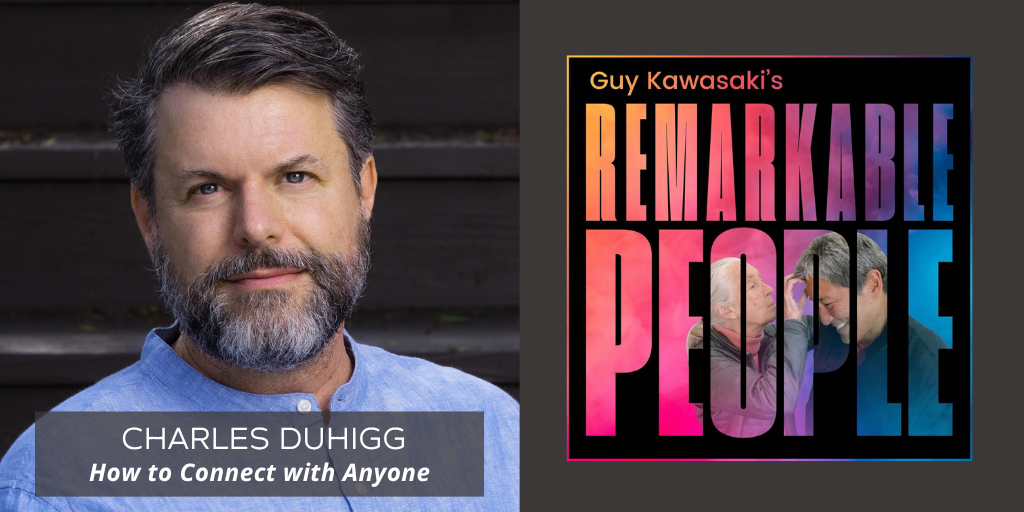
Welcome to Remarkable People. We’re on a mission to make you remarkable. Helping me in this episode is Charles Duhigg.
Charles is a Pulitzer Prize-winning investigative journalist, staff writer at The New Yorker, and the bestselling author of The Power of Habit, Smarter Faster Better, and his latest book, Supercommunicators. His work explores why people behave the way they do—and more importantly, how we can change those behaviors to improve our work, relationships, and everyday lives.
This conversation centers on one of the most important skills any of us can develop: communication. Drawing from Supercommunicators, Charles explains why the best communicators aren’t necessarily the loudest or most charismatic. They’re the people who know how to ask thoughtful questions, recognize what kind of conversation they’re having, and make others feel genuinely heard.
One idea immediately changed how I think about conversations. Charles explains that every discussion contains one of three conversations: practical, emotional, or social. Problems arise when two people think they’re talking about the same thing but are actually having different conversations. Maybe one person wants advice while the other simply wants empathy. Learning to recognize the difference can completely change the outcome of a discussion.
Charles also shares one of my favorite takeaways from the interview: before responding, ask yourself whether someone wants to be helped, heard, or hugged. It’s a deceptively simple question that keeps us from jumping straight into problem-solving when what someone really needs is understanding. It’s advice that’s just as valuable in the boardroom as it is around the dinner table.
The episode is packed with unforgettable stories. You’ll hear how NASA discovered an unexpected way to identify emotionally intelligent astronauts, why the famous “Fast Friends” experiment can turn strangers into lifelong friends, and what CIA operatives, marriage counselors, and even sitcom writers can teach us about building trust. Charles has a remarkable talent for translating fascinating research into practical lessons you can immediately apply.
If you want stronger relationships, better meetings, more productive disagreements, or simply richer conversations with the people you care about, this episode is worth your time. Charles reminds us that great communication isn’t an innate gift—it’s a skill that improves with curiosity, practice, and a willingness to listen just a little more deeply.
Please enjoy this remarkable episode, What Makes Someone a Supercommunicator with Charles Duhigg.
If you enjoyed this episode of the Remarkable People podcast, please leave a rating, write a review, and subscribe. Thank you!
Transcript of Guy Kawasaki’s Remarkable People podcast: What Makes Someone a Supercommunicator with Charles Duhigg.
Guy Kawasaki:
Hello, everybody. It's Guy Kawasaki, and I'm coming to you from Watsonville, California, and our guest, I just learned, is in Santa Cruz, California. I always thought he was an East Coast kind of elite intellectual, but no. My guest is Charles Duhigg, and he's a Pulitzer Prize-winning investigative journalist.
If I have my facts right, he's now at The New Yorker, right, Charles?
Charles Duhigg:
Yeah, that's exactly right.
Guy Kawasaki:
And he has written two great books. One is called The Power of Habit, and the other is Smarter Faster Better. I actually said that wrong because I implied that he wrote two great books, but he has a third great book, and that third great book is about Supercommunicators, and that's what we're going to discuss today. Welcome to the show.
Charles Duhigg:
I love it. Thank you for having me on, Guy. It's so good to see you. It's been a long time since we've seen each other, so this is a real treat for me.
Guy Kawasaki:
So we got to start it this way. Hi, Charles.
Charles Duhigg:
Hey, how are you guys? Good to see you.
Guy Kawasaki:
No, Charles. Charles, oh man. This was my lead joke.
Charles Duhigg:
Oh yeah. Oh wait, what was I supposed to say?
Guy Kawasaki:
You're supposed to say, “Hi,” and then I'm going to say, “Hi,” and then you're going to say, “Hi,” and then I'm going to say, “Hi.”
Charles Duhigg:
Because we are matching each other? Should we try again? Hi.
Guy Kawasaki:
We are matching each other. Hi.
Charles Duhigg:
Hi.
Guy Kawasaki:
Hi.
Charles Duhigg:
This could go on for a while.
Guy Kawasaki:
Now, people are wondering, what the hell are these two people talking about? In part of this book, he talks about "The Big Bang" and the development of The Big Bang Theory as a sitcom, and one of the most, I don't know, quintessential The Big Bang Theory scenes is when neighbors meet each other.
And these physicists, tech weenies, they don't know how to socially engage and have a good conversation, so it's, “Hi.” “Hi.” “Hi.” “Hi.” “Hi.” “Hi.” I was trying to give you that lead.
Charles Duhigg:
I like it. I think the problem is both of us are two good supercommunicators to actually fall into the trap of The Big Bang Theory characters.
Guy Kawasaki:
So I just want to establish, Charles, that I really read this fricking book, man. It's not like Madisun just gave me a Wikipedia entry and said, "Hey Guy, have at it." I read this book from cover to cover.
Charles Duhigg:
Thank you. I really appreciate it.
Guy Kawasaki:
All right, so let's start off with the basics. How do you define a supercommunicator?
Charles Duhigg:
I'll actually ask you a question. So if you were having a bad day and you came home and you wanted to call someone that just talking to them would make you feel better, do you know who that person is? Does that person pop into your head who you would call?
Guy Kawasaki:
Well, a seemingly simple question, Charles, is very complicated. I don't know if you know, but I am deaf, and because I'm deaf, I use the phone as little as possible. So the question might be, who would I message?
Charles Duhigg:
Yeah. So I did not know that.
Guy Kawasaki:
Yeah.
Charles Duhigg:
Has that been true for a long time?
Guy Kawasaki:
It's been true about five years. I have two cochlear implants, so I can hear.
Obviously we're doing an interview, but I wouldn't say that my preferred method of communication is audio. Obviously there's my wife, and also there is a small group of friends that I have that I text so much. It’s ridiculous.
Charles Duhigg:
Yeah. I want to ask you about what it's like as someone who's become deaf, asking about communication because it's fascinating to me. But I'll answer your question, which is the people that you reach out to when you want someone just to chat with by text or any other way, those people are supercommunicators for you, right?
They talk to you in a certain way. They know to ask you certain kinds of questions. They know when you're looking for empathy or when you're looking for them to actually help you solve a problem. They prove to you that they're paying attention and that they're listening.
And you probably do the exact same thing back to them. When you're talking to your wife or when you're texting with your friends, you're doing these things almost subconsciously to show them that you want to connect with them, to show them that you want to be in conversation with them.
So we're all supercommunicators at one point or another, but the difference is that some people are consistent supercommunicators.
Some people recognize these skills that you use with your friends and with your wife, and they use with you, and they say, "You know what? I could use those all the time. They're just skills I can practice and make into habits. I could use them with strangers on the bus. I could use them with people at work."
And what we find is that those people through, just again, a small handful of skills, they learn how to connect with others much faster and much more deeply in important ways.
Guy Kawasaki:
You know, you reference Nick Epley in your book, and we just had him on, we know about the woman on the train with the red hat, so Nick Epley is another supercommunicator.
Charles Duhigg:
Wonderful. He's just a wonderful person. And he actually introduced me to this question.
So I give a lot of speeches, and one of the things that I do from the stage is I turn to the audience and I say, "Look, in about thirty minutes, I'm going to force you to turn to the person next to you and ask and answer one question. And that question is: When is the last time you cried in front of another person?”
And then I ask, usually, "Who's excited about this?" And no one raises their hand, right? Nick is the guy who introduced me to this idea. But then I explain why questions like that are so powerful, and we do the experiment, and people end up saying things like, “This is the best conversation I've had in the last week."
So I think when Nick talks about that we do a bad job sometimes of forecasting how a conversation's going to go, and it's always almost better than we think it's going to be. He's touching on something really true, which is we have the ability to connect with other people if we want to use it.
Guy Kawasaki:
When I interviewed Nick, I really felt convicted because he was talking about all these opportunities you have to start these conversations and I relayed to him a story. I was sitting at this coffee shop, and when I work at a coffee shop, I use this Keychron mechanical keyboard, and I use it because it's mechanical and it's really clacky, and I love the clackiness of this keyboard.
So people often ask me, "What's that keyboard?" And I could engage them in this conversation about why I have a clacky keyboard, but I never do. I felt convicted.
Charles Duhigg:
You never have to have any conversation you don't want to have, right? That's the other important thing, is that sometimes you get in the Uber, and you just want to check your email. You don't want to have a chat with the driver, and that's okay. But having the skills to have the conversation when you want to have it, that's really valuable.
Guy Kawasaki:
Yeah. The complication for me, Charles, is that I am intellectually curious. I love to learn about people. But if you're in an Uber and you're going on a highway and there's road noise and you're deaf and you're using a cochlear implant, it is not a trivial task.
Charles Duhigg:
Yeah. I imagine.
Guy Kawasaki:
I must be a super, supercommunicator because I have to overcome deafness to communicate.
Charles Duhigg:
Can I actually ask you a question about it? What have you noticed about other people's communication and your own communication since you haven't been able to hear with high fidelity what they're saying?
Guy Kawasaki:
For one thing, people talk way too fast. I wish they would just slow down. I think even with people with hearing, they would appreciate if people would slow down, so that's one thing. It's also very interesting, Charles, that my family obviously knows that I'm deaf.
I've been telling them that for five freaking years, and yet they insist on calling me, and they're calling me on a speakerphone inside a car on a freeway with their boyfriend or girlfriend next to them.
And for the life of me, I freaking cannot understand them. I want to say, "Do you understand I am deaf? Do you understand that? If I was blind, would you be sending me text messages? I am deaf. I am deaf. Read my lips. I am deaf.” Anyways.
Charles Duhigg:
I think this is a testament though to how good a supercommunicator you are that people forget that you can't hear them. Do you find that you're much more sensitive to nonverbal communication now? Do you pick up more on people's expressions or gestures?
Guy Kawasaki:
I think you have no choice but to do that. Yeah. So listen, Charles, being deaf is not the worst thing in the world. It sure as hell beats pancreatic cancer, right? Nobody ever died from being deaf.
Charles Duhigg:
Yeah. No, that's absolutely true.
Guy Kawasaki:
I totally lost control of this interview already.
Charles Duhigg:
No, but it's fascinating. Thank you for sharing it with me. It's just it's so interesting to hear that perspective.
Guy Kawasaki:
Here we are. Let's see. We are ten minutes into this, and I have asked one question of my list. All right, so next question is, some people who are alive and listeners can relate to, who's in the Charles Duhigg Hall of Fame of supercommunicators as examples?
Charles Duhigg:
So a lot of them, like I mentioned, like when we talk about friends being supercommunicators, a lot of them are friends of mine, so people who wouldn't be publicly known. Now, I will say that if you look at politicians, so if you look at Bill Clinton, for instance, or you look at Barack Obama, or you look at Ronald Reagan, they are famously good communicators.
And what's interesting though is that if you look at their backgrounds, what you'll see is one consistent thing, and we hear this from talking to supercommunicators all the time, is that if you ask them, "Were you always good at communication?"
They will inevitably say, “No.” They will say something like, “I had trouble making friends when I was in high school, so I really had to study how kids talk to each other," or "My parents got divorced when I was young, and I had to be the peacemaker between them."
This is probably true for you, right? That as your ability to communicate has changed, you think much more about communication. And it's that thinking about communication that makes us good at it.
This is what we know is that the best communicators are people who just think half an inch deeper about what they're saying and how the words are coming out of their mouth and proving to the other person that they're listening to them. It's the desire to communicate that oftentimes makes us a supercommunicator.
Guy Kawasaki:
May I point out to you that you did not exactly mention Donald Trump, Pete Hegseth, JD Vance?
Charles Duhigg:
For Donald Trump, I'll actually say, because I'm a reporter, I've been to a number of Trump rallies. And anyone who's never been to a Trump rally, I guess they probably won't happen anymore because he's not running for re-election, but a Trump rally is an amazing thing.
And one of the things that you see is that in that setting, Donald Trump is in fact a supercommunicator. He's also very different one-on-one than you would imagine. He asks a lot of questions. Now, the questions are all sort of self-centered questions. The questions are like, "What did you think of my speech?"
Or “Am I doing a great job?" But at the same time, he is asking questions. He's engaging people, and one of the things we know is that supercommunicators ask more questions than the average person. They ask ten to twenty times as many questions as the average person.
And we do see those characteristics in Donald Trump. Which also gets to something else, which is being a good communicator is literally just a skill. It doesn't mean you're a good person or a bad person. It doesn't mean you're a good president or a bad president. It's a skill all of us can learn, and it's important to separate that skill away from who the person is.
I'm not saying any of these folks are good or bad.
Guy Kawasaki:
I have three Republican subscribers and I just lost them, Charles. Oh my God.
Charles Duhigg:
Tell them I'll email them personally to apologize
Guy Kawasaki:
Now, are there different kinds of supercommunicators? Are there one-on-one, one on a handful, one on many, real life versus virtual? Or is it you either are or you aren't?
Charles Duhigg:
I think we can get practiced and more comfortable in different settings. So one of the big ideas within Supercommunicators, and I got this from talking to neuroscientists, that when we're having a discussion, we think we know what that discussion is about.
We're talking about surfing, or we're talking about where we're going to go on vacation, or we're talking about the budget for next quarter. But now that neuroscientists can look inside our heads as we're having these discussions, what they see is that we're having many different kinds of conversations all at the same time.
And these conversations tend to fall into one of three buckets. There's these practical conversations where we're solving problems together or we're making plans. But then there's emotional conversations where I tell you what I'm feeling, and I don't want you to solve my feelings, I want you to empathize with me.
And then there's social conversations, which is about how we relate to each other. And I think that there are some people who get very practiced in one of those kinds of conversations, and it becomes very comfortable to them. So we've all had that situation where somebody comes to us with a problem and they're obviously feeling upset about this problem.
And instead of empathizing with them, we try and solve their problem, and then they're like, "Look, I don't want you to solve this for me. I want you, like, just to listen and understand that I'm having a hard time." I think what's happening there is that oftentimes the person who's trying to solve the problem, they're very comfortable in practical conversations.
And so as a result, that's their default. So it's not that people are particularly good one-on-one or with a group. It's that oftentimes what we practice is the thing that we fall back on because it feels more comfortable and safer to us.
Guy Kawasaki:
Now, are you saying with these three kinds of conversations, which is the organizing principle of your book? Are you saying that there are three kinds of conversations or there are three kinds of things happening in any given moment in any conversation?
Charles Duhigg:
So it's a really good question, and to explain, I should mention what the neuroscientists see, which is that those three kinds of conversations I mentioned, they use different parts of our brains.
So whether it's a kind of conversation or whether it's the activity of what's happening inside the conversation, the question is it using the prefrontal cortex, which is where that kind of practical conversation takes place, that planning and decision-making?
Is it using the interior of the brain, the amygdala, which is where the emotional conversation happens? Or is it using what's known as the medial network, which is where the social conversation happens, and it's sort of at the periphery of your skull.
And the reason why that question is important is because when you are in a discussion with someone, your body and your brain starts to change to match them.
So like even in this conversation, without us realizing it, our heart rates have started to match each other. Our breath patterns have started to match each other. Equally importantly, the activity within our brains is looking more and more similar. If we actually were in like an MRI, an fMRI, we would see that our brains are becoming more synchronized.
Within neuroscience, this is known as neural entrainment, and it's the goal of communication. It makes us feel closer to each other. It makes us trust each other more.
And so when I am discussing something emotional and I'm using the amygdala, the center of my brain, if you come back trying to give me a solution, solve the problem for me, and you're using your prefrontal cortex, it's very hard for us to feel connected because we're actually using different parts of our brains.
It's hard for us to achieve that neural entrainment. And so underlying all of this is this idea of the matching principle, which is what it's called in psychology, which is that successful communication requires having the same kind of conversation at the same moment so that we can become entrained, and then we can move from emotional to practical to social, back to emotional all together.
But it's that entrainment that matters.
Guy Kawasaki:
Your book had a very intriguing tricolon, and not only was it a tricolon, what is the word when things start with the same letter?
Charles Duhigg:
Oh, alliteration.
Guy Kawasaki:
Oh, yeah. So you had an alliterative tricolon, which is, "Do you want a conversation for help, heard, or hugged?"
I love that.
Charles Duhigg:
I love it too. And of course, that's the practical, the emotional, and the social, and what's amazing, anyone who's listening who has young kids at home because this phrase, "Do you want to be helped, hugged, or heard?" actually comes out of teaching.
Teachers use this all the time because if you have a young kid at home, and they come up to you, and there's something they really want to talk to you about, and you ask them, “Wait, before you tell me, do you want to be helped, do you want to be hugged, or do you want to be heard?" They know exactly what they want. They will tell you immediately what they want.
They'll say something like, "No, I don't need you to help me. I just want you to know that Jimmy's being mean to me." They just need to be heard in that case. And it is really powerful because oftentimes we know what we need out of a conversation. We have trouble sometimes expressing that to the other person.
But when the other person asks, like, "Look, do you want me to help you solve this problem, or do you just need to get this off your chest and tell me about it?" That's actually really empowering to have someone ask you what you want.
Guy Kawasaki:
So the next time I'm in the coffee shop and I'm using my mechanical keyboard clacking away and somebody strikes a conversation up, I'm going to say, "Do you want to be helped? What keyboard is this? Do you want to be heard because you don't like the sound? Or do you want to be hugged because you appreciate my appreciation of mechanical keyboards?"
Charles Duhigg:
Totally, and that would be a little weird if it was someone you just met, but I'll bet you that they would be into it. I bet you that they would be like, "Oh, thanks for asking."
Guy Kawasaki:
Alright. Is your observation that wealth and success helps or retards communication skills?
Charles Duhigg:
That's a really good question. No one's ever asked me that before.
I think that the answer is, so certainly we know that wealth, in particular intense wealth, is negatively correlated with actually having real conversations, right?
And I don't think it's the wealth. I think what happens is that once someone is a hundred millionaire or more, you start getting surrounded by all these people who don't want to offend you, right? They don't want to disagree with you. They want to be yes men or yes women.
And so I think in those cases, that can actually hurt communication because you don't have the feedback in your life to tell you when you're communicating well and when you're communicating poorly.
That being said, there are a number of people who become wealthy and successful because they're good communicators, and I think they lean into that communication.
I had a friend who worked in the Obama White House, and he said that one of the things that really struck him, and he was there for all eight years, he said Obama, over those eight years, rather than becoming more self-certain and more dismissive, did exactly the opposite.
That, it was in his second term that he was asking more questions, and he was admitting his uncertainties even more vocally. So I think for some people, when we are successful financially or career-wise, there's a self-confidence that comes from it that allows us to be humble and allows us to recognize our faults more readily.
And that's part of being a supercommunicator, is being open to hearing from people the things that you might otherwise overlook.
Guy Kawasaki:
I got to tell you that I know some very wealthy people, and I would not consider any of them supercommunicators. Super dictators, maybe.
Charles Duhigg:
We both lived in Silicon Valley where there's a lot of other stuff going on there too, right? I think within the large companies, like at Google and Apple, there is a premium placed on communication. I've been covering the AI companies. I would say a number of them are not great communicators, and that's not something that they esteem.
They esteem technical skills much more than communicative skills, but over time, if you look at all the studies about what helps people get promoted, inevitably, and it doesn't matter which field people are in, the number one thing that's correlated with promotion into senior levels is communication skills.
And this is true whether you're in a law firm or whether you're in an engineering firm or whether you're in an arts organization. You would think that the technical skills of that profession would be valued, and they are up to a point.
But then at some point, everyone has technical skills, and it's the people who can communicate with others who are the ones who end up succeeding the most.
Guy Kawasaki:
In the middle of my career, I came to this realization that I always thought the hard stuff was the technical skills, whether it's programming or accounting or finance. And then come to find out that's the easy stuff. The hard stuff is the soft skills. And you never get taught that, right?
Charles Duhigg:
No. I actually got an MBA, and it was a school that focused on the soft skills. Like they said, "We're training leaders." I think in part because the soft skills are harder to define. That's one of the reasons I wrote Supercommunicators was because I said, "Look, there's a real science to communication."
There's a way for us to come up with a framework and explain to you what the skills are that you ought to learn because so much of communication or so much of all the soft skills of leadership, they're fuzzier. The rules are less set in stone, and so as a result, it's learning the rules and then learning the art of applying those rules that makes you successful.
Guy Kawasaki:
So if I'm listening to this and I'm like, "Oh, you got me. You got me, Charles. I am fascinated by this," just give me the freaking gist right now. Just tell me, how do I become a supercommunicator?
Charles Duhigg:
Yeah. So there's a handful of skills, and we've referenced some of them. The first one is paying attention to what kind of conversation is going on.
Paying attention to, this person who's talking to me, does it seem like they're using words about how they feel? Even if they're talking about budgets and they come up and they say, "We got to figure out budget for next year, I have the spreadsheet ready," that could sound like a practical conversation.
But if I listen more closely, what I hear them saying is, “You know because the reason we got to get this right is I don't want to do layoffs. If we screw up the budget, I'm going to have to do layoffs, and I would feel terrible about having to lay anyone off.”
So actually, when I'm listening to that person, what I'm hearing is they're using emotional words, and they might not be like an alarm bell around those emotional words, but they're talking about how they feel.
They're talking about their anxiety. So this person appears they're having a practical conversation, but actually they're having an emotional conversation, and I have to connect with them on that level before we can talk about budgets.
I have to say something like, "I hear exactly what you're saying. I feel exactly the same way. I am also anxious that we have to get this right because I also would feel terrible if we had to do layoffs. Can we look at the numbers together?"
Guy Kawasaki:
This is a heard conversation.
Charles Duhigg:
This is a heard, yeah. So this is definitely a heard conversation where I'm telling you, "I understand what you are saying, and I understand what you're feeling. And with your permission, I'd like to move into a practical conversation where we start talking about the numbers. But we're going to move together.”
So that's the first skill, is that really trying to just spend again, it's like 1 percent of your brain just trying to ask yourself, "Does it seem like this person is actually talking to me about things that are emotional or things that are social or things that are practical?"
That's going to make you much better as a communicator. But then there's a couple of other skills that make people supercommunicators. Number one, the next one that we discussed is asking more questions, right? As I mentioned, supercommunicators ask many more questions than the average person, and some of those questions are throwaway questions.
So, “Oh, what'd you think about that movie?" Or "Oh, did you like that restaurant last night?" They're basically just invitations into the conversation, “I want you to participate in the conversation.” But supercommunicators also ask a fair number of what are known within psychology as deep questions, and we were talking about this with Nick Epley.
A deep question is something that asks me about my values, my beliefs, or my experiences, and that can sound kind of intimidating, but it's as simple as if you meet someone who's a doctor, instead of saying, "Oh, what hospital do you work at?" You could ask them, "Oh, what made you decide to go to medical school?"
That second question, it invites that person to tell you who they are. They might talk about the fact that they saw their dad get sick, or they might talk about the fact that they love being a healer. They love being able to help people. So they're telling me about their experiences and their values and that's going to be a much more real conversation.
We're going to feel more connected to each other. We're going to achieve that neural entrainment I mentioned. So that's the second skill, is ask more questions, and in particular, ask deep questions. And then the third skill is to understand that listening has to be an active process. That we have to prove to people that we're listening to them.
There's this kind of myth that listening is about closing your mouth and opening your ears. And that's a good first step, we should actually give the other person a chance to speak. But what we do next is really important. Are we asking them follow-up questions?
Are we proving that we're paying attention? Are we really trying to process what they're saying, or are we just waiting our own turn to speak? Because if they believe that we're just waiting our own turn to speak, they're not going to listen to us any more than we're listening to them. So those are three skills that supercommunicators are good at, that all of us can practice and get better at.
Guy Kawasaki:
Vis-a-vis the third skill, I believe this is the context in which you use this. You have a whole explanation about, I call it laughter for dummies. And you cite this case about, I think this guy's name was Terry McGuire, and he worked for NASA, and he was trying to figure out, who can we put in this little capsule, and they got to hang out with each other for twelve months?
And, who's going to be full of conflict and who can handle that? And if I'm paraphrasing it right, he found that one of the variables was laughter, right? Tell me how laughter can show that you're paying attention.
Charles Duhigg:
So if you think about it, most of the time when you laugh, it is not in response to anything funny, right? People aren't telling you jokes. You and I have laughed, what, half a dozen, a dozen times in the conversation. Neither of us are comedians. We're not, like, doing bits and dropping one-liners.
So why does laughter exist? Laughter exists in most cases as a way of showing the other person that we want to connect with them. And so when we laugh, and then they do the most natural thing on earth, they laugh back. They're showing that they want to connect with us in return. And so you're exactly right.
NASA had this basic problem, which is what they said, "Look, we need to start finding astronauts who have emotional intelligence." But the problem is, it's really hard to determine who has emotional intelligence in an interview. Because particularly if you make it to the final rounds of a NASA interview to become an astronaut, you're, like, a pro at interviews, right?
You've been doing interviews your entire life. You know how to say your greatest weakness in a way that the person thinks, "You know what? That's not actually a weakness. That's a strength." You know how to fake emotional intelligence.
And so this guy, Terry McQuire, as you pointed out, who, he was the lead psychiatrist for manned space flight at NASA, and they said to him, "Try and figure out who has emotional intelligence. What's the right interview question to ask?"
And he worked on this for, like, nine months, and then one night he's listening to old recordings of the interviews he had done with candidates, and he knew which of them had gone on to get hired and become great leaders inside NASA, and which of them had washed out because they couldn't get along with anyone.
And as he's listening, he realizes that the people who went on to be great leaders, they laugh differently in the interview than everyone else. And so he starts doing this new thing with interviews.
This is what he does. He'll ask the candidate to come in and have a seat. He'll walk into the room with a big stack of papers in his hands, and he would trip as if on accident and spill the papers everywhere.
And then he would do this weird thing. He would laugh in this big, boisterous laugh. He'd go, "Ha. I cannot believe I did that. I am such a klutz." And then he would pay attention to how the candidate reacted because everyone reacted in one of two ways. Some people were like, "That's really silly. Let me give you a hand with that."
And some people matched his big, boisterous laugh, and they went, "Ha. That's really silly. Let me give you a hand with that." And it's the people who matched him were showing him, "Look, I understand what you're feeling," right?
The ones who were quiet and wanted to put it under the rug, they were like, "Oh, look, you seem embarrassed right now. I'm going to pretend like this didn't happen."
But the ones with emotional intelligence are the ones who say, "Look, You seem embarrassed right now. I'm going to show you it's okay to be embarrassed. I'm going to make this big, boisterous laugh the same way you do because I'm going to show you that I'm in the canoe with you."
And so this is one of the things that we know is that oftentimes nonverbal communication, like laughter, plays a really important role when it matches the people we're talking to. The same way that when you laugh, if I laugh in response, we feel closer. We feel like we like each other. That's true of many different kinds of nonverbal communication.
Guy Kawasaki:
That sounds like a lot better test than, if you do an interview and does the candidate take the dirty coffee cup back to the sink? I like that test better. Yeah.
Charles Duhigg:
Yeah. This is more fun.
Guy Kawasaki:
I have to ask because I have to prepare for a conversation fifty-two times a year. Every one of these is a preparation. And so I heard your three suggestions there about how to be a better communicator, but it just strikes me as odd that one of the things is not to prepare for a conversation because I spent hours preparing for this conversation.
So is that just like a podcasting thing, or can people prepare for a conversation?
Charles Duhigg:
Yeah, no, absolutely. The more you prepare for a conversation, the better that conversation's going to go, and the fact that you have prepared, the fact that you read the book, it makes me feel heard and listened to and seen. It makes me want to be a good conversation partner. So that is definitely really important.
The question is, what kind of preparation matters for what kinds of conversations? Because this is a podcast interview, right? We're talking about my book, and so having preparation around knowing the ideas in the book and what might be interesting questions, that's useful.
But if you and I saw each other just on the street, we wouldn't necessarily have to prepare quite as much just to say, "Hey, how you doing? You want to get a cup of coffee?" But there are kinds of preparations we can do that matter, particularly for important conversations.
Particularly for conversations when we're talking about something that matters to us a lot or something that might be tense to talk about. There was this really interesting study done by a researcher who's now at Dartmouth, who she found friends where one person in the friendship was Black and one person in the friendship was white, and she asked them, "Do you guys ever talk about race?"
And inevitably, the answer was basically, “No,” right? “We don't talk about race. Even though we obviously have different racial experiences, we don't really talk about it."
And so she said, "Look, what I'd like you to do is I'd like you to have a conversation about race. But for some of you, what I'm going to ask you to do is before you have that conversation, just write down really quickly one thing that you hope your friend hears from you and one question you want to ask. And then when you start the conversation, start it this way.
Start it by saying, ‘Look, I know we're going to talk about race. I know this can be an awkward topic, and this might be a little bit of an awkward conversation, and I want you to know if I say the wrong thing, I hope you'll forgive me because sometimes my lips move faster than my brain. And if you say the wrong thing, I will definitely forgive you.’"
And what she found is that the people who did this, who just jotted something down ahead of time, and who prefaced the conversation by engaging in what's known as meta communication, talking about the conversation itself, they had much better dialogues with each other.
They felt much more comfortable with each other. And so sometimes preparation is just a matter of taking just a couple of seconds and saying, "What do I want to accomplish here?" There's actually a really interesting experiment out of Harvard Business School where they told a bunch of students, “You're about to have a conversation with a stranger."
And they said, "Before you do, write down three things you want to ask or tell this person on an index card and then stick it in your pocket." And so people did that. It took ten seconds for them to write those down. Then they went and they had their conversation with a stranger.
They asked, "Did those three topics ever come up?" And people said, "Look, that conversation went a lot better than I thought it was going to go. And no, the things that I wrote down, they never actually came up. But I just felt so much more comfortable because I knew I had them in my back pocket. Like I knew I had something to fall back on."
So that's like ten seconds of preparation that makes a conversation better and all of us can do that. You and I both do it habitually, right? And it's part of what makes us good communicators.
Guy Kawasaki:
According to your book, there's a few people at Netflix who could've used this advice, but that's a different discussion. Yeah, but you'll have to read the book to find out what that alludes to. So let me ask you something. So the book is organized around these three kinds of conversations, but you also have four rules, right?
So there's three kinds of conversations and four rules, right? So give us the four rules.
Charles Duhigg:
So the first rule is try and determine what kind of conversation is occurring. Look for those clues that tell us whether this person is in an emotional mindset or a practical mindset or a social mindset. The next one is it's okay to ask what this conversation is about.
You can turn to someone, and you can say to them, "Thank you so much for coming in and visiting with me today. What is it you want to talk about?" Like even if you call up a friend and you're just chatting with a friend to say, "Hey, why'd you call today? What's going on?"
Or to announce your own intentions, to say something like, "Look, the reason I called you is because I really need to talk this problem through, and I'm hoping you can help me with it," right? That's the second rule.
The third rule is around those emotional conversations, which is when someone says something emotional, the best thing that we can do is empathize or match their emotion, and matching their emotion doesn't mean that if they say, “I'm really sad because my aunt just died," to say, "Oh, I know exactly what that feels like. Like I had a dog that died seven years ago and I'm still sad about it."
That's not really matching emotions. That's stealing the spotlight from someone else onto yourself, but you can say "Oh, I'm so sorry to hear about that. I know how hard it is to lose someone who matters to you. Tell me what you're feeling. Tell me what your aunt was like. What do you miss about her?"
When somebody says something emotional, the best thing that we can do is we can make space for that emotion because what they're really telling us is, "I have a feeling that I want to share. I want to get out there."
And the way that we empathize is by listening to it. And then finally, the last rule is basically listen to see if identities are playing a role in this discussion, so for instance, earlier in this conversation, you mentioned, after I asked you who you would telephone, and you mentioned that you're deaf.
And like obviously, that's an identity that's important to you. It's an identity that shapes how you behave every day. It's an identity that gives you unique perspectives on the world that people around you don't have. It gives you unique experiences.
And so one of the things that's important is when someone shares with us what their identity is, whether that's as profound as saying, “As a white man, this is how I live in America," to someone who just says, “As someone who likes to read science fiction," when we announce our identities, what we're really looking for from the other person is just acknowledgement that we've heard it.
To say "Oh, it's really interesting, Guy, that you've gone through this experience that I haven't, and I'm sure that you have learned something incredibly important from it that I want to know about, that I want to learn about." That is really ennobling.
Guy Kawasaki:
Regarding rule four, the question I had when I read rule four was I'm trying to come up with a case when identity is not important. Is it going to be important every time?
Charles Duhigg:
Yes, it definitely will be. I think that there's times that it's less present and more present, so I think that, if you and I were on a wave together, the fact that we're both surfers might almost be something that wouldn't even have to be referenced because it's a shared experience that we both understand about each other.
On the other hand, if we're talking about having kids, and I have kids and you don't have kids, or you have kids and I don't have kids, then when those identities are different, sometimes announcing them, they have more salience because of the differences. And just acknowledging those differences is really powerful.
Guy Kawasaki:
I can see it. I don't know how to make a book successful anymore because as you say, if somebody wanted to read and learn how to make a great pitch for venture capital, you don't need to read an entire book anymore. You just go to Claude or ChatGPT and cross my fingers, I get cited.
But I will say that if I went to Claude or ChatGPT and asked, "How do I become a supercommunicator?" The probability of reading that very entertaining story about how NASA measures laughter would never have come up in the summary. And the story of the CIA guy who tried to recruit Yasmin or whatever her name was, those stories would've never come up in any AI LLM.
Charles Duhigg:
And this gets to something important, which is that when we are using AI for this knowledge gathering, even if AI gets all the advice right, one of the things that we know is that the way that we remember advice and we make advice usable is not just by learning the advice.
It's usually by embedding it in some type of narrative because the narrative is so much easier to remember, right? And also just sitting with an idea.
If I read about an idea over thirty or forty pages, like how to pitch a VC, versus an idea that Claude gave me that I can absorb in seven or eight minutes, I guarantee you that thirty or forty minute interaction, that thirty to forty pages, I'm going to walk away with something deeper.
The act of reading and writing is the act of thinking, and when we deny ourselves the opportunities to write and when we deny ourselves the opportunity to read, we're denying ourselves the opportunity to think.
And that is one of my concerns with AI, is that there might be costs to it that we're not aware of because you don't know that you missed a story about NASA. You don't know that you missed a story about the CIA. Claude never says like, "Oh, there's some great stories that I'm not telling you."
It's only when you pick up a book that you kind of realize it.
Guy Kawasaki:
If someone were to ask, what motivates people, any LLM will give you a nice bullet list, but on the other hand, if you read my book, you'll hear a story about how I was once at an intersection and I was sitting in a Porsche, and I looked over to my left and I saw this car with four teenage girls, and they were smiling, giggling, making eye contact with me.
And I thought, "Yeah, Guy, you're so freaking famous now. You're sitting in your Porsche, Apple, you got this hot.com, you're an author, you're a speaker," blah, blah, blah. The girl rolls down her window and sticks out her head, and I expect her to just like shed fawning praise about my work, and she asked me instead, "Are you Jackie Chan?"
And so you're wondering, what the hell does this have with motivation, so the story is that ever since that day, it's been one of my goals, Charles, that Jackie Chan is in his Bentley or his S-Class in Hong Kong or Shanghai or wherever the hell he lives, and teenage girls in a car asks him if he's Guy Kawasaki. That's motivation.
Charles Duhigg:
I like that. And see, I'm going to remember that story so much longer than I'm going to remember the bullet points that Claude gives me about motivation.
Guy Kawasaki:
Another topic I want to cover, which I found very useful and so fascinating, and I don't know how I got seventy-two years into life without ever hearing this, is what's called the Fast Friends procedure. You have got to explain the fast friends procedure because if nothing else, it could revolutionize dating.
Charles Duhigg:
Yes, absolutely. Thank you for asking about this. I love this story. So there's this couple named Arthur and Elaine Aron, who are both research psychologists. And they're both professors. And at one point they come up with this task for themselves.
They want to try and figure out if they can come up with a method that will take any two strangers and make them into friends. And so they try all these different things. They have people solve puzzles together or go on hikes together. They pair people because they have similar religious backgrounds or similar political beliefs.
They even had one where they would have people hum and sing songs together, another one where they would tap their fingers together, and basically none of it worked. What they found was that some people became friends and some people didn't. The same normal distribution you would see from any kind of intervention.
And so they come up with one last attempt. What they do is they write out a list of thirty-six questions, and they tell people to come in and sit down in a room, just two people at a time sit down, total strangers, and they would hand them this list of questions, and they would say, "Okay, go back and forth asking and answering these questions."
And the questions start pretty easy. The first one is, "If you could have dinner with anyone from history, who would you have dinner with?" Okay, that's interesting, and it's not too personal. But they get personal pretty quickly. Question number seven is, "Do you have a secret hunch about how you will die?"
Question twenty-three is, "Tell me about your mother." And question thirty-five, the second to last question, is the one that we mentioned earlier: "When is the last time you cried in front of another person?" So it only took about forty-five minutes. People would go back and forth, ask the question, answer, ask and answer, back and forth, back and forth.
And then they would excuse all of the participants, and the participants assumed that the experiment was over. But actually, the experiment was just beginning because seven weeks later, they would contact everyone who'd sat in that room, and they would ask them, "Just out of curiosity, did you ever talk to that person again?"
And people would say things like, “I knew his name was John, and I knew his last name started with an ‘R,’ and I didn't get his last name. So instead, I got out the directory, and I called every John R. in the directory until I found him." One guy said that afterwards, he went and he had a beer with the person he had done the experiment with, and then a week later they saw a movie together.
And when they got married a year after that, they invited everyone in the lab to come to the ceremony because that's how they had met each other. The researchers found that 70 percent of people who had sat in that room sought out the person that they had done this thing with afterwards. So these thirty-six questions have become known as the Fast Friends procedure.
And what we found about them is that it tells us something important about reciprocal vulnerability, that when I tell you something that's meaningful to me, and then you respond by telling me something that's meaningful to you, that we feel closer to each other. We actually trust each other more. We like each other more.
Because they've done this experiment in other ways where they hand one person the list of questions and they say, "Okay, answer all thirty-six questions." And then the other person takes the list, and they answer all thirty-six questions. So it's not back and forth, and they find that people don't feel close to each other at all afterwards.
In fact, they feel annoyed with each other.
Guy Kawasaki:
What a surprise.
Charles Duhigg:
Yeah. So there's something about this reciprocity that's at the core of how we feel connected to other people, and that's really, really powerful because it means that when you're in a conversation with someone, if they say something vulnerable, if they say something you could judge, if instead of judging them, you share something about yourself, then even if you voted for different people, you go to different churches or mosques or synagogues, you will feel connected to each other.
And that connection is how we are pro-social animals and how we become happy.
Guy Kawasaki:
I would love for you to prove this, but I think that if you ask people to have this thirty-six question conversation, even virtually, it would work virtually.
Charles Duhigg:
Oh, absolutely.
Guy Kawasaki:
I think people at about the third or fourth question would forget they're virtual and just ask the question and discuss it.
Charles Duhigg:
100 percent. I do this with my kids in the car all the time. We've gone through the thirty-six questions dozens of times because their answers change over time. And as you know, because you have sons, sometimes when they're teenagers it's a little hard to connect with them, right?
Guy Kawasaki:
No.
Charles Duhigg:
It was always easy for you?
Guy Kawasaki:
As long as they need money they’re connecting.
Charles Duhigg:
Yes, that's true. That's true, as long as they need money. But I do find that asking these questions, and anyone can find them online, if you just type in the Fast Friends procedure or the Thirty-Six Questions That Lead to Love is what they called it in The New York Times.
If you look them up, the list of questions is there. They're really powerful, and I think you're exactly right. It doesn't matter if I'm face-to-face. It doesn't matter if I'm doing this virtually. It doesn't matter if I'm on the telephone. What matters is asking a question and being genuinely curious in what the person says and then sharing something about yourself.
Once that reciprocity occurs, we will feel more connected to each other
Guy Kawasaki:
I suggest we add a thirty-seventh question, which is: how do you feel about mechanical typewriter, mechanical keyboards?
Charles Duhigg:
I love it. That is a great one, but you're the only one allowed to ask it.
Guy Kawasaki:
I got two last questions for you.
Charles Duhigg:
Okay.
Guy Kawasaki:
Second to the last question is, how does one prepare for a conversation that you know is going to be difficult?
Charles Duhigg:
So the number one thing to do is to sit down and try and figure out what's the one thing that I really hope this person hears from me, and what's the one thing that I absolutely want to ask this person and understand about them? Now, you'll notice I didn't say, "What's the one thing I want to say?"
Because there's a difference between what I want to say and what I want you to hear. If I start thinking about it in terms of I need to tell Guy something hard, like, instead of focusing on what I'm going to say, let me focus on how do I speak in a way that he hears what I'm actually trying to get across, right?
But equally, I don't want it to be one-sided. Like a one-sided conversation is not a conversation. He needs to be a participant in this. What question can I ask him that will help me understand where they're coming from? That's the most important thing we can do.
And then also, as I mentioned, just acknowledging at the outset of the conversation, “I'm kind of nervous about bringing this up because this is a tough thing to discuss, but if it's okay, I think it's important because I really want to understand how you're feeling about this thing."
That does a lot of work for you.
Guy Kawasaki:
I was just thinking about that. Someday you might come up to me, Charles, and say, "Guy, why do you always take other people's waves?"
Charles Duhigg:
In our case, because we surf the same breaks, whenever I steal someone's wave, I feel so bad about it, and it's not because I meant to. It's because literally I'm such a bad surfer that once I'm on a wave, I can't stop it.
Guy Kawasaki:
This is one of the advantages of being deaf, Charles. You can't hear anybody yelling at you when you take their wave.
Charles Duhigg:
It's true. That's true.
Guy Kawasaki:
The last question for you is how can people click with each other? How do you make yourself more clickable?
Charles Duhigg:
Yeah. The number one way to do it is to ask those deep questions. So Nick Epley, who you mentioned, who we were talking about, Nick, once a month gets on a bus in Chicago, and he basically sits down next to a stranger, and his goal is to get them talking about their hopes and dreams within three questions.
And so the only way you do that is by asking deep questions. And the deep question doesn't have to be like, "What are your hopes and dreams?" The deep question could be like, "What do you do for a living?" "Oh, I'm an accountant." "Oh, did you always want to be an accountant? Was that your dream as a kid?"
At which point they'll say, “No kid wants to be an accountant. I wanted to be an astronaut. That seemed like more fun." But now you're having a real conversation. Now you're talking about why you didn't become an astronaut. You fell in love in college.
Guy Kawasaki:
I wanted to be an astronaut, but I didn't laugh the right way.
Charles Duhigg:
Exactly. I didn't train myself how to laugh.
So I would say the number one thing that we can do to click with other people is just focus on asking one question, one deep question that we might not have asked otherwise.
And it can be as simple as "Oh, do you like living in the Heights?" Or "Do you like being a journalist?" Just asking them, who they are and why they do the things they do, that's going to help you connect with someone.
Guy Kawasaki:
Okay. Charles, this has been a most enjoyable and communicative episode.
Charles Duhigg:
I agree. Thank you so much for having me on. This has been so much fun.
Guy Kawasaki:
It was pleasure. I learned a lot, and I am going to go up to many, many people and say to them, "I am deaf, so we got to be efficient about this. Do you want to be helped, heard, or hugged?” And let's just get to the root of it.
Charles Duhigg:
I like it. Tell me how it works. I'm very curious.
Guy Kawasaki:
Okay. Thank you, Charles, so much for being on my podcast. And again, this is his book, Charles Duhigg, Supercommunicators.
I guarantee you, you will be a better communicator if you read this book. Thank you, Charles. Thank you, Madisun. Thank you, Tessa Nuismer for research and transcription. Thank you, Jeff Sieh, co-producer. Thank you, Shannon Hernandez. This is the digital team. There's a lot of people on the Remarkable People team, so they empower the communication skills in me.
Thank you very much everyone. And Charles, the next time that the waves are too big on the east side, so I have to come to the west side and surf at Cowell's, I will be there at low tide, and I will let you know.
Charles Duhigg:
I love it. Yes, let me know. This has been such a pleasure.
Guy Kawasaki:
Oh, it's my pleasure.
Charles Duhigg:
And let's get together sometime soon.
Guy Kawasaki:
All right. I want to go into the Charles Duhigg Hall of Fame of super communicative podcasters. It’s my goal in life.
Charles Duhigg:
I love it. You are already there. You made it. Fantastic. Thank you so much.
Guy Kawasaki:
Thank you. Bye.
Sign up to receive email updates
Enter your name and email address below and I'll send you periodic updates about the podcast.


Leave a Reply