
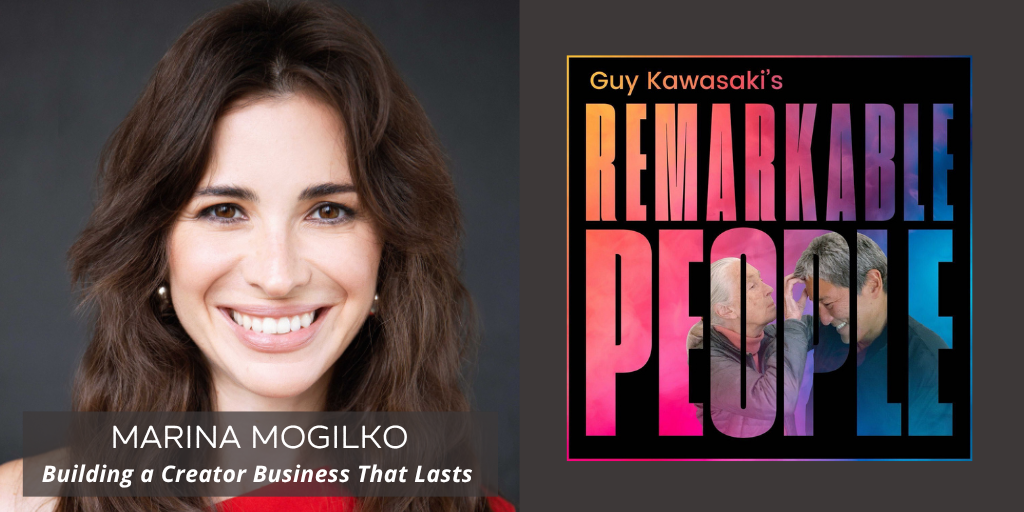
Welcome to Remarkable People. We’re on a mission to make you remarkable. Helping me in this episode is Marina Mogilko.
Marina Mogilko has built a career by following her interests wherever they lead, from learning languages as a child to becoming an entrepreneur, content creator, and Silicon Valley commentator. Through multiple YouTube channels, a language business, a podcast, and a growing newsletter, she has created an ecosystem where her different interests reinforce one another. Rather than chasing a single professional identity, Marina says she needs to change gears every few years and finds energy in having multiple things to focus on.
A major theme of Marina’s work is using technology without losing the human element. She sees AI as a powerful productivity tool that can analyze transcripts, identify patterns, suggest promising clips, help with research, and turn her ideas into written content. But she draws a firm line at fully automated content: AI can point toward interesting ideas and generate possibilities, while humans still need to decide what is worth saying, how to tell the story, and whether the finished piece actually has something to offer. For Marina, the value remains in our ideas, our voice, our story, and the judgment we bring to the tools.
That same philosophy shapes her advice for people entering the workforce. Marina encourages young people not to obsess over predicting which jobs AI will eliminate, but to double down on what interests them and experiment as much as possible. She believes strategic thinking, judgment, and taste will become increasingly valuable, and that developing those qualities requires exposure to different projects, disciplines, people, art, and ideas. For Marina, the goal isn’t to compete with technology at what technology does well; it’s to become better at the uniquely human decisions that determine how technology gets used.
Marina’s story ultimately comes back to curiosity, experimentation, and knowing yourself. Whether she’s discussing creator marketing, newsletters, AI, entrepreneurship, or moving from Eastern Europe to Silicon Valley, she keeps returning to the same idea: try things, learn what works for you, and keep adapting as the world changes. Her advice is particularly relevant in a moment when technology is evolving faster than any one career plan can keep up with. As Marina puts it, the key to happiness is understanding who you are and what works best for you.
Please enjoy this remarkable episode, AI, Creativity, and the Future of Work with Marina Mogilko.
If you enjoyed this episode of the Remarkable People podcast, please leave a rating, write a review, and subscribe. Thank you!
Transcript of Guy Kawasaki’s Remarkable People podcast: AI, Creativity, and the Future of Work with Marina Mogilko.
Guy Kawasaki:
Hello, everyone. It's Guy Kawasaki. This is the Remarkable People podcast, and as you know, we're on a quest to find remarkable people so they can inform and inspire you. And as you know, we found another one, and her name is Marina Mogilko. And she's many things.
I'm going to actually ask her; how does she position herself these days? But she's got three YouTube channels, I don't know, seventeen, twenty million followers. She has a company that teaches language skills. She's a lot of things. I don't think the sun ever sets on the empire of Marina. So Marina, welcome to Remarkable People.
Marina Mogilko:
Thank you so much for having me, and a great name for a podcast. I feel really good about being here. Thank you so much.
Guy Kawasaki:
So Marina, you got this language school founder, you got this immigrant explainer of countries, you're a Silicon Valley influencer, you're an AI commentator. How do you define yourself these days?
Marina Mogilko:
I think there's no definition. I'm just following my pure interests. So I was passionate about learning languages, I think, since I was four. This is when I was first introduced to a concept of a foreign language by my parents who took me to an English class. And then I started learning German, and then I started learning Italian.
Because when you learn languages, it's like you're separating yourself from your personality, and you're rediscovering yourself in the new language because the countries are so different. What people talk about is so different, and I'm just fascinated by languages. So this is passion number one, and it's reflected in my company and in my channel called Linguamarina.
Then there's another passion. I studied mathematics and economics at school, and I was always fascinated by technology. It seemed so far away. I was just at Apple's presentation. They present new iPhones, and I remember nineteen years ago, I was on a bus in St. Petersburg. It was a gloomy, dark morning, and Steve Jobs was presenting the first iPhone.
And for me, that was, oh my God, this is another planet happening somewhere else. But there's this technology that just gives us endless possibilities, and I would never imagine that I would move to Silicon Valley. What is it? Ugh, is it 2007 and then 2015 is when we moved. It's just such a wild ride.
So Silicon Valley Girl reflects that interest. And then there is a vlogging channel because I'm a mom, an immigrant, and with all the things that come with it, I just want to document that for other immigrants and moms. Yeah, so I'm just following my passions. And I just call myself, I think, content creator and entrepreneur.
Guy Kawasaki:
By the very way that you've just explained that it's kind of clear that you didn't exactly in your youth say, "All right, so this is the linear plan for me." It was serendipitous, and what tickled your fancy, you pursued, and bada bing, bada bang, pretty soon it's a business?
Marina Mogilko:
Yeah, absolutely. Some people can stay focused on one particular thing for a very, very long time. I think my personality is slightly different. I need to change gears every, I think, six years. And having multiple things gives me different things to focus on throughout my career.
Guy Kawasaki:
From the outside looking in, I have nothing but admiration for what you've done with content.
Marina Mogilko:
Thank you so much.
Guy Kawasaki:
And it seems to me that basically your superpower is you somehow turn people's attention into money. And I want to know, how do you do that? What's your current business model?
Marina Mogilko:
I don't think that's my superpower. I think my superpower is executing on my passion in many different ways and working hard. So through all the years, like having kids and still continuing to work, I think that's something that sets me apart. I don't think I'm that good at making money.
I just had a dinner with top AI podcasters, and I felt the dumbest in the room and the poorest in the room when I learned about their numbers. So I don't think I'm that good at that. But I think, again, for me, it's like longevity, consistency, being able to do something for six-plus years and maintaining interest.
Talking about the business model, right now 90 percent of my income is brand deals, and that changed last year. I started working with a manager. I changed my Instagram handle from @LinguaMarina to @SiliconValleyGirl, which really helped.
And I still have my businesses, but it's just I always wanted to work with large companies and see how their marketing works, talk to people inside large corporations, and see how they think about marketing their products. I feel so privileged to be able to just talk to people from my favorite companies. So that's what I'm doubling down on right now.
Guy Kawasaki:
So for people who might not understand what the term means, including myself, what does it mean when you say you have these brand deals and you're working with brands?
Marina Mogilko:
So when I record a podcast right there, we record with a guest, and then after the guest leaves, I record a two or three-minute segment talking about a brand that is sponsoring that podcast. So for example, we're working a lot with HubSpot, and we've been working with them for five years.
And if I'm talking to someone who's very practical in AI, I don't know, like someone who created this AI app, and then HubSpot will create a PDF with top prompts that people can use to become more productive.
And my ad read is basically presenting that PDF so that people download, HubSpot gets their email, this is their lead capture, and I get paid for that. On Instagram it's slightly different. So Instagram is mostly sixty-second videos, reels, and sometimes I make reels just because I'm just telling a story.
Sometimes it's a story tied to a brand, and that's a brand deal. What else do we do? Sometimes we do integrations in our newsletters, like a small fragment of the newsletter will be an ad.
But my newsletter is only one year old. We don't have that many subscribers, but I really love it as the practical part of my content where I show how exactly I use AI. Sometimes I do public speaking, but rarely.
Guy Kawasaki:
And does somebody at HubSpot say to you, "Listen, this was the click-through rate. This is how many people, leads turned into business"? Is it really, you know, they're going to hold your feet to the fire for you to generate viable leads and actual dollars of revenue?
Marina Mogilko:
Not really. That's a great question. I think when it comes to influencer marketing and creator marketing, especially if you're a company like HubSpot or I don't know, SAP, like large corporations, you can't just rely on a creator converting huge corporations for you as clients.
So when it comes to working with creators, they're working with a big amount of creators, and they've realized that when people had this touch with a company while watching their favorite podcast, if they have a call with this company in two weeks, that touchpoint is going to influence their decision.
So when corporations are measuring the impact of creators, it's not like, "Oh, I gave you this amount of money. You produce one video. I have to get this money back." No, we have certain weights in the whole process of converting leads. We build trust. We raise awareness about the company.
Of course, I think, if they've renewed for so many years, they see that conversion working for them, and one client for them is worth, I think, thousands of dollars because it's a CRM, like a lead management platform.
So some people put me in the B2B creator space, basically creators talking about B2B products. So more and more corporations are realizing that creators play a huge role in marketing.
And I was at Cannes Lions this year, which is a marketing conference, and I was talking to a lot of CMOs, and they said a few years ago, creators were always like this experimental budget, "Let's try and buy some ads."
This year, every company has a fixed budget for creators, and it's an essential part of their marketing mix. And again, the way they measure it is, yes, they look at the views, they look at conversions, but also they do realize that creators influence decision-making on every step of the sales process.
Guy Kawasaki:
Now when you say creators, what kind of content are we talking about?
Marina Mogilko:
So creators is this word for people who create content. When we talk about B2B creators, there's a lot of women, a lot of men. LinkedIn might be the best platform for it right now, and you've probably seen how there are so many videos now on LinkedIn.
But they also maybe have a podcast, could also be Instagram. I have some friends who are, like, they are dressing up and talking about their outfit, but they're also talking about raising money for their startup.
I think it's where you are still yourself, but because you're an entrepreneur or maybe you work as a marketing manager at a large company, you're talking about your work experience as well.
So I think we're past that era where most viral videos on the platforms are girls putting on their makeup. I think it's just this huge variety of creators, and recently, like in the past two years, a lot of professionals entered the space, which is great to see.
Guy Kawasaki:
Yeah, I kind of missed that window of hot young person putting on makeup.
Marina Mogilko:
I think that was COVID for those videos. I was also not very good at jumping on this trend.
Guy Kawasaki:
A funny Guy Kawasaki story is way back when, when I was hot and when I was popular and influential, which all of which are not true now. There was a time where Kim Kardashian contacted us and said, “Would Guy like to meet?" And I said to my person, "Who is Kim Kardashian? Why would I want to meet with her?" So I declined to meet with her, and the rest is history. What can I say?
Marina Mogilko:
Yeah. It's amazing how they're still relevant. Through all these years, they maintain their relevance, and I think it's a great business skill.
Guy Kawasaki:
You mentioned that you have a newsletter, and I am curious here. So theoretically, very theoretically, I have about, I don't know, six or eight million followers, and for the life of me, I can't figure out how to use them to move the needle. So do you think social media moves the needle anymore?
Marina Mogilko:
Oh, absolutely. I think it's just, you can't expect people to convert from just one post, like having all six million to instantly subscribe to your newsletter. It's going to happen in maybe tens, maybe hundreds, but you have to be consistent with it.
So to give you some numbers, I think we're at 20,000 subscribers now, and we mostly use my podcast and my Instagram to convert, but it's step by step. For example, I just did a post on how to create an agent that's going to take your podcast and create different formats of output.
Let's take the podcast transcript and create a LinkedIn post, a script for your Instagram reel. And so I put a step-by-step instruction on how to create that agent into my newsletter, and then I went on my stories and said "Hey, this piece just went out. I created it using this agent. If you want to build the same agent for yourself, subscribe to my free newsletter."
So it has to be very intentional. Not like, "Oh, I have this weekly newsletter, subscribe." That doesn't work anymore. It has to be something very practical. Or for example, we had a podcast with Allie Miller, who's very practical when it comes to AI.
We talk about all the .md files that you need to create your strategy. And then, I think the call to action was, "Subscribe to my newsletter and you can download my .md files." Like, how do you describe my tone of voice?
So you can just upload this .md file to Claude and ask Claude to interview you to figure out your tone of voice and how you train your Claude to understand your business strategy and use it in every decision that you ask it to make for you.
Guy Kawasaki:
All right.
Marina Mogilko:
Probably bad way to put it, like when you consult with Claude, so it takes into account your business strategy. So it has to be very practical that people are like, "Oh, if I read this newsletter, I'm going to get these files, and I can start doing something." That's always my goal, to make it super practical, and also just make it connected to the content that you're actually creating.
Guy Kawasaki:
Okay, so now you have 20,000 and rising subscribers to your newsletter, what is the eventual way that you're going to monetize those 20,000 and growing people? What's the end game for a newsletter these days?
Marina Mogilko:
I think there are several end games. First of all, it's a platform where you can sell ads, and if it's a B2B newsletter where you have small business owners reading or other creators, so people who run small businesses, that's a great platform to monetize with ads. We've seen so many acquisition stories.
HubSpot bought a couple of newsletters for ten-plus million dollars. Don't quote me on that, but there were some great acquisitions. I know that there is a guy, Rowan Cheung. He has a newsletter called The Rundown AI.
He's been growing it mostly with X, and he just sold part of his company to Electrify and Electrify basically buys a big stake in your media company and helps you run it, and that's a way for you to cash out.
Actually, newsletters, like, this is first of all the asset that you own because there is no algorithm behind it, and if your open rate is healthy, well, people can tell if it's you or not your writing. But eventually, you can introduce an editor, and for example, The Rundown AI, I think it's mostly AI news, so it's not just Rowan writing those newsletters.
You can introduce editors, and this is how you can eventually sell the newsletter. I think it's the only thing that's sellable without you. When it comes to a YouTube podcast or an Instagram, people subscribe because of your face. It's harder to sell.
Guy Kawasaki:
So would you rather have someone who manually and voluntarily gave you their email address, or would you rather have a newsletter subscriber? Which is a more valuable thing for you?
Marina Mogilko:
Oh, newsletter subscriber because if they just give me their email address, if I just put it into the system, if I do that too many times, it's going to trigger the system, and I can be marked as spam. They have to consent. When they subscribe to the newsletter, they consent to receiving future newsletters.
If I just get someone's email and just put it into my system, and a lot of systems would not allow it because of the law. And even if they allow it, then if you just send out your newsletter to emails that you got from somewhere, I think the deliverability rate will be really low, and then your domain will get flagged. Like, don't do this.
Guy Kawasaki:
Yeah, so if you were starting today, Marina, you could have a YouTube channel where you could pull off the audio and deploy it to podcast platforms, or you could record a podcast like we're doing now with video and repurpose it to YouTube, what would the center of the universe be? Your YouTube channel or your podcast?
Marina Mogilko:
I actually think both because when you go on Spotify, it's mostly video now, and they're pushing podcasts that have video. So I'll go video first, ideally in person if possible, just because it's just a different type of connection. And once you have video, then you hire editors.
For example, I have five different editors, the teams that we work with. They take the video version of my podcast, and they create short clips from it, and every team has to create at least five videos from each podcast. And we post it into trial reels on Instagram, and if something is performing, like it's getting tens of thousands of views, then it goes into the main feed.
If it's getting hundreds of thousands of views, it goes into my main Instagram that has one million three hundred thousand followers. So there is so much content that you can create if you have video, and those short videos, they also go on YouTube Shorts, they go on TikTok, and all of that has your branding so that people scroll.
Most of them don't go and listen to the whole thing, but they're like, "Oh, Silicon Valley Girl. Oh, I've heard this name. It sounds familiar." So the next time they're scrolling through their YouTube feed or Spotify, they see Silicon Valley Girl, they're like, "Oh, I remember. I saw her somewhere online, like a short video. Let me listen."
So again, when we talked about marketing and weights of creators in the marketing mix, that's the same. It weighs in. Each short doesn't necessarily convert into a lot of listeners, but it builds this trust, and we're more likely to tap on the face that we've seen before. So that helps you with trust and recognition.
Guy Kawasaki:
Oh my God, Marina. My head is exploding, Marina. You have five teams creating content for you?
Marina Mogilko:
Yeah. You know, we just look for short-form editors, and they're like contractors working for us, I think. And it's something that took us a while to figure out because we thought maybe we just hire one person who does all the shorts. But the problem with one person is that they see your podcast in a certain way.
And when it comes to shorts, it's all about creativity and experimenting with angles. And we're like, "Okay, if we have five teams, then we have five different points of view."
And then sometimes you create a podcast and you're like, "Oh, my takeaways are this, this, and this." But then you post a short video, and people react to a completely different thing, and you're like, "Oh, okay. Good to know. I should ask more about this versus that in my next podcast." So it's also a great learning experience.
Guy Kawasaki:
So Marina, do you think the day is coming where we let Claude pick the places where the shorts should come? Do you think that day is coming?
Marina Mogilko:
Oh, it's already here. That's what we do all the time.
Guy Kawasaki:
If you do that, why do you have five teams then?
Marina Mogilko:
Oh, because Claude is really good at pointing out the segments, but then human touch, it is 90 percent of work. So figuring out which fragment could go viral, yes, is great. Claude can do, Gemini, anything can do that. I have this going on right now. This is my Granola, recording every single podcast I go on or I do.
And after this, my Perplexity is going to take this transcript and tell me, did I do well, what I could have done better, and then some segments that could make a great short video. And then my team will take those short videos, but there are so many extra things that go to short video.
You don't start with a question, you start with something that grabs people's attention, like, first two seconds, that's all. Like, you have less than a second to grab people's attention. And then we add branding, and then maybe we cut out some things to make it faster paced for constantly scrolling.
So AI's great at pointing out things. We never, ever post a piece of content that's 100 percent created by AI because it's really bad. It's really good at pointing out different directions and figuring out what you can do, like giving you five different versions of hooks. But at the end of the day, there's a human responsible for every single piece of content that goes out.
And maybe it's me who trained it that way. Maybe we haven't trained it enough. But it just looks like an AI-created piece of content, so we just don't let it post automatically.
Guy Kawasaki:
So if this were your podcast instead of mine, you would take these two video feeds, you'd upload it to Perplexity or something, and you would let it take the first pass of what are the most interesting moments of this podcast?
Marina Mogilko:
Not the feeds, just the transcript. So this is making a transcript in real time, and we have the hub of all the transcripts of all the podcasts. And you can use your videos. You can go to Trend, upload your video podcast, it's going to create a script.
There are so many things you can do with all these scripts. First of all, you connect them to analytics, and you see where people drop off, AI is really good at spotting patterns, and if there are several podcasts that did really well, we ask AI why it thinks they're so good for my audience.
And I feel it, of course. I know that my audience loves practical things, et cetera. But when you see numbers and correlations, and AI is pointing you at those patterns, you're like, "Oh, okay, this is great. And this is where people drop off.”
And if we're evaluating a new guest, it knows how previous similar guests performed, and it would tell me, "Hey, don't go that direction because you had this guest, and you went this direction, didn't perform. You should do more of this because you had this guest, and these are the questions you ask."
It is so much information that is so hard for us humans to process. And in the past, ideally you'd have a separate person for that, like an analyst. Now AI empowers the whole team to spot these patterns.
But I think there's a lot you can do on top for these short views and repurposing, but at the end of the day, it's the idea and the human connection. And I think the technology helps us amplify it and not have one hundred people on the team to produce all this content.
Guy Kawasaki:
Okay. I got to ask you about AI, okay?
Marina Mogilko:
Absolutely.
Guy Kawasaki:
All right. So lately we see all these people like Elon Musk and Sam Altman and Dario, and they're all saying, ah, it seems like they just got this religion like, "Oh my God, we didn't know this would happen. AI is dangerous. AI could end the world. We need regulation."
What is your reaction to that when you see them, like, all of a sudden they're like, "Oh, lo and behold, there's something dangerous here"?
Marina Mogilko:
Yeah, it's an interesting question because I don't see what's happening inside those labs. Maybe they are seeing something we're not seeing, and there is no way for us to see it. So maybe there is something going on that is dangerous.
From my perspective as a user, I see it as a great productivity tool because I don't see those dangers. I think it's up to them to explain what it really means and what they're seeing and making it more transparent for everyone because one thing is that they say, "Oh my God, it's dangerous. There's 10 percent chance it's going to end humanity in the next ten years."
Another thing is showing what actually happened, what they're seeing, and why all of these researchers are quitting. So yeah, you can't really comment on something you haven't seen. And again, as a user, I see it as a great productivity tool.
Guy Kawasaki:
Marina, my take on this would be that these three men are running the three most powerful AI companies, and if they're saying that they never foresaw this, they're either lying or they're stupid. They should have seen this years ago. And to have this sudden revelation, I just don't buy it.
To use a metaphor, let's say we had the CEOs of three companies that made guns, and all of a sudden, the three CEOs says, “Guns are dangerous. Guns can kill people. We need to regulate guns." You've been making guns for the last 200 years and now you have this revelation?
Don't get me started on this. Do you think that self-directed evolution where AI can improve itself without human intervention, do you think it is the best or the worst thing ever?
Marina Mogilko:
Great question. So a lot of people are working on self-improving AI, but like, when it's improving itself independently, I don't think it's happened yet. We don't have a full version of it.
People are still helping it improve itself. I think, again, if it's a specialized AI, like if we talk healthcare, if it's analyzing our DNA and analyzing our cell and learning what's working for each particular cell, I think it's great.
If it's some other use, like military that you've mentioned, of course, it's not good. So I think when it comes to self-improving AI, it is great to have some specialty for it and double down on those areas.
Guy Kawasaki:
Honestly, I don't know how we could slow it down at this point. It seems to me like it's impossible at this point.
Marina Mogilko:
Oh, it's impossible. Yeah, and with all the IPOs, China, there's no slowing down really.
Guy Kawasaki:
Yeah, and to call for government regulation, in my mind I say, "All right, so you're telling me that Mitch McConnell is going to regulate AI?" I would like to see how this would work. We have these people that we're not even sure they're alive, and you're telling us politicians in D.C. are going to regulate AI. This is going to be interesting.
Marina Mogilko:
There was an opinion one of the guests expressed on my podcast, and I tend to believe him. He draw the parallel with nuclear. So when there was a real danger, and when everybody realized it's an immediate danger for a lot of us, this is when all the governments united, and they started regulating it.
Unfortunately, it looks like that with AI, we will have to have something that's as strong, as immediate as nuclear, and then governments will unite. But it's an interesting opinion, and I think, it sounds like it might be true.
Guy Kawasaki:
Yes. What do you think of this concept? I think the only thing powerful enough to regulate AI is AI. I don't think man can regulate AI at this point, and when I say man, the human race, not males. Males for sure can't handle it, but the human race can't regulate AI at this point.
Marina Mogilko:
All like philosophical conversations, unfortunately for us, since we don't have access to all the models and we're not seeing stuff, it's just speculation for now.
And as someone who's super practical, I tend to focus on what I can do with AI today and just make most out of it and stay positive about the future because, you know, I have small kids I have to raise, and we have to enjoy every single day because otherwise if we just fear future, it's going to make us miserable today, and today is what matters. That's how I prefer to live.
Guy Kawasaki:
Oh, Marina, I am in complete agreement with you. I understand these high-level theoretical and often bullshit discussions, but at the end of the day, does AI make me a better writer and podcaster? And without question, it does.
So let us get more low level in day-to-day AI, so first of all, do you anticipate the job apocalypse where people are unemployed because of AI?
Marina Mogilko:
Not really, no. Again, I'm judging from my own point of view. We're hiring more people. Are we looking for more senior roles? Yes, we are, but also I've been doing this for fourteen years, so it's time we start hiring more senior people.
And also, because AI can produce content and the job of a human is to strategize and select the right angle and lead with the right story and navigate this choice, we're still hiring.
And I think we're only going to hire more people, but AI helps with onboarding. AI helps with structuring everything inside our company. Again, I see it as a great productivity tool. I don't see it as any replacement. And by the way, I didn't have my newsletter and my LinkedIn two years ago because I don't like writing.
First of all, I'm not a native speaker, and I just genuinely don't like writing in any language. I'm a video person. I like to be in front of the camera. I like talking. So I didn't do LinkedIn and newsletter for many, many years, and then AI came around, and now I can just talk to my AI, and it's going to create a beautiful newsletter, and it's still my ideas and my voice.
It's just it helps me do this thing now. So we started producing more content, hence we need more people.
Guy Kawasaki:
Yeah. I think if you just said what you said on Threads about AI, you would get attacked by dozens of people saying, "I'm never going to read your newsletter. I'm never going to watch your blah, blah, blah."
Marina Mogilko:
I do understand them. You don't want to read AI slop. But the thing is, there's the algorithm, and the algorithm sees if it's AI slop because it sees people's reaction, and we can spot AI text right away. It's not this, it's that. It's over-amplified and over-emotional.
We can spot AI slop, and if it's AI slop, the algorithm is just not going to show it to you. See, there you can create as much content as you can with AI, but does it mean it's going to get traction? Of course not. And I think the algorithm is doing its job brilliantly filtering that content away from you.
And there is great AI-generated content. When we talk about AI-generated movies, there is so much work that's going into a one, like, sixty-second clip. It's days of work. And I've talked to all these people creating these AI miniseries. There is so much work going on there. This is just another medium to create content.
And same as with a camera, you can create really bad content that doesn't bring any value. Same with AI. You can create a lot of bad content that doesn't bring any value.
Guy Kawasaki:
Well, it seems to me that when a content creator says they use AI, next thing out of your mouth should not be, "I will never, ever watch your movie or read your book." The next question should be, "How do you use AI?" Because if these people ask me, "How do you use AI to write, Guy?"
I would tell them that I would use it as a copy editor and a research assistant. But they got it in their brain that the way Guy writes a book is he goes to ChatGPT and he says, "Give me a 75,000-word book on how to start a company," and thirty seconds later, I have the book. And they just don't understand how the tool's used.
Marina Mogilko:
Oh yeah. I think it's because not a lot of people are using AI seriously in their work, and once they realize the power of how it's enhancing them and it is not replacing them, it is helping them do more research, be more knowledgeable about the topic. I remember back at school when I had to do a project, I would write it by hand.
We didn't have printers. We didn't have computers. And then in university, I was typing everything. Does that mean it was less authentic? Of course not. It was just faster and more efficient. I think it's just the tools evolve, but the value is in our ideas and our voice and our story.
Guy Kawasaki:
Yeah, so hypothetically, let's suppose that you had a niece or a nephew that was, I don't know, sixteen, seventeen years old. What would you tell her or him at this point, "Don't study this anymore. The future will not require this"? Is it computer science? Is it psychology? What would you tell them not to worry about anymore?
Marina Mogilko:
I would tell them the opposite. Instead of saying, "Don't do this," I would say, "Double down on what you're passionate about and try as many things as possible." I think computer science is an amazing subject to study because you want to understand everything that's going on behind the scenes when it comes to AI.
We are entering an era where your strategic thinking, your judgment skills, your taste is going to matter most, so whatever you can do to develop your taste. And I think developing your taste in a particular niche means trying as many projects as possible, showing them to as many people as possible, or working with somebody who has great taste.
I take my kids to museums to enjoy art. They don't enjoy it yet, but I know they're going to enjoy it because this is what happened to me when my mom used to take me to museums and show me Monet, and I would be, "I don't understand this." But now I do, and I appreciate it.
So whatever you can do to work on your taste, even like, when it comes to theater, fashion, art, even if you're interested in computer science, I think it all comes together in your head, and the more things you can show to other people, maybe it's on social media or maybe you're working in a company, the better it is in developing your taste.
Read as much as possible. So it's the taste thing. It's the judgment. It's the strategy that you can come up with.
Guy Kawasaki:
Okay, so now hypothetical niece or nephew asks "Auntie Marina, how do I even get a job these days? There's thousands of resumes coming for each position. Everybody has LinkedIn. Everybody's optimizing with AI. How do I get a job these days?"
Marina Mogilko:
That's also a great question. First of all, as a content creator, I would say if you could start writing on LinkedIn that will help you land some opportunities depending on how big you are. But LinkedIn is where a lot of hiring is happening, and not because of your resume, but because of the thoughts that you're putting out.
And whenever we're hiring someone, if they have an active LinkedIn, my agent will go and summarize what are their thoughts on what's going on in the industry. So it's really important that you highlight that. And the thing that I hire for, again, I'm just talking from my standpoint, I love hiring people who position themselves as entrepreneurs on their workplace.
By that I mean having the culture of trying to constantly improve, going beyond, being like a 120 percent player, where if you notice something is broken in the process and that process does not belong to you, you go and maybe improve it and ask if you can suggest something. I think it's really important to be proactive.
And great people with positive approach proactivity and passion for what they're doing, they will find their place under the sun. I think it all comes down to being a great person as well. That's what I notice a lot in the U.S. If you're a great person, if you're kind, people will want to work with you.
Guy Kawasaki:
Okay, so backing up sixty seconds, you said your agent will check out people on LinkedIn. So I want to understand that more. So are you saying that you have created a Marina agent that is reflecting your perspective, and you turn that agent loose on LinkedIn, and the agent goes and finds promising people? Or do you have this agent react to people who have applied? How broad is the search?
Marina Mogilko:
The second, so what you mentioned in the first thing, that's actually a built-in LinkedIn feature now. So if you just say, "I'm looking for that person who's done this, and that," there's an agent that will go and match you with those people. They have this as a paid feature.
What we have is when people apply for our job, for a job in our company, they fill in a Google form or whatever form they're filling in, and then, our agent is going to go and check out if they're posting on LinkedIn or any press that's about them and do the research so that at the end of the day, we see like a spreadsheet, and it does automatic ranking based on our weights, what we value in our company.
And it will tell us like, "Hey, I think this candidate is great because this, this, this, and that, and here is the ranking of all the candidates, and I think you should be talking to this person but ask them this."
Like just this research intelligence agent behind the scenes because you want to go through all the applications in an efficient manner, and my COO does it, and sometimes it takes two days to just go through all the resumes. But now with this agent and this research, she can save hours.
Guy Kawasaki:
So are you saying that the cover letter and the resume don't matter anymore? We just need your LinkedIn profile and we're good.
Marina Mogilko:
Oh, no, they do. It's all together. Of course, we want to see what you've done before. Of course, we want to see where you worked, what projects you did because we're also looking for a certain type of personality as a cultural fit, so it all gives us more information to make decisions.
Guy Kawasaki:
Okay. Seems to me that you're an AI goddess here. So if you could only use one LLM, which one would it be?
Marina Mogilko:
You know what? I think models are so amazing now. It doesn't have to be a particular model. It just comes to how you store your information and how it's structured, and then you put any model on top of it, and it works great.
And I keep switching all the time. I think it's very important that you have all your context in one place, and we have Notion as a database for everything that's going on, all the transcripts, analytics, tone of voice, strategy, and then we can connect any LLM to it, and it's going to do its magic.
Guy Kawasaki:
Okay, so Marina, what you just said, in my humble opinion, should be a CMO's worst nightmare because what you just said is you have no brand loyalty. You don't care if it's Claude or ChatGPT or whatever.
Marina Mogilko:
I think nobody has brand loyalty these days. Corporations have brand loyalty. If they signed up for one thing that they're paying, and their employees are allowed to use, I think, well, we use Claude for everything that's going on with the podcast. I use a lot of Perplexity and ChatGPT in my day-to-day, And also, there is this thing.
So Gemini has access to all my YouTube analytics, so there is no model that's better in analyzing my YouTube content because they have this feature called Ask Studio that has access to every single data point when it comes to my podcast on YouTube.
So of course, I'm going to use Gemini for YouTube. When it comes to Instagram, there is this new Muse model, sorry, Muse app, that has access to all my Instagram data, and no other model has access to that depth of data.
So for my Instagram questions, I tend to use Muse. For all the other things, it depends on how I feel today. Perplexity is great for research, and when it's a medical question or a financial question, I go to Perplexity. But then ChatGPT, like, these are interchangeable, but I think for company usage, we started using Claude a year ago, and it's kind of there.
But if you're just starting out and you're trying to find the best model, I think just pay more attention to organizing your data first so that you can switch to different apps really quickly and see which one works best for you.
Guy Kawasaki:
So I will repeat myself. I think what you just said is a CMO's nightmare. This week, I don't know, I started getting messages from ChatGPT that you've reached your token limit. You know, what did I do? I just started using Claude until my token limits is not reached anymore.
It is kind of frightening from a marketing perspective about trying to create brand loyalty to any particular LLM these days.
Marina Mogilko:
Yeah. No, it's hard. It's what you build on top of that LLM.
Guy Kawasaki:
All right. So now switching topics, I want to talk about Silicon Valley because you have a unique perspective on Silicon Valley. Question, tough love, has Silicon Valley lost its soul?
Marina Mogilko:
Oh, no. No. And I love this place. I absolutely love this place, and I've never, ever been in a place where people can just help you without asking for anything in return.
When I came here in 2015, there were so many people who just took meetings with us, and they were amazing people. And when they were helping us and introducing us to investors, I'm like, "Do I owe you shares in my company?"
They're like, "Of course not. Just go and talk to them." And I was so fascinated by this culture when you give without expecting anything in return, and I think this culture still exists, and they are the kindest people who want to help out a beginner entrepreneur, a beginner creator.
And I do a lot of things with big companies, and I see how much freedom there is. Google has this 20 percent time project. I don't know. Again, I come from a very different culture. Not saying that people are mean there. It's just different. And I'm just fascinated by Silicon Valley, so I can only say good things.
Guy Kawasaki:
So going back to your theoretical niece and nephew, let's say they're living in Eastern Europe they ask you, "Auntie Marina, should I still come to United States to go to university?" What do you say?
Marina Mogilko:
Yeah, I think it's the best country for building something. It's the country of entrepreneurs. I call it Disneyland of entrepreneurship. It has a huge market. It has the most brilliant minds, and whenever you talk to people here, if they're running a company, you're like, "Oh, I see this."
Like, you see a company in a particular way, and then you start talking to those entrepreneurs, and you realize that what you see is just peak of the iceberg, and they have this whole big idea underneath it. For example, I'm friends with Sampriti who's building Navier, which is a boat that raises above the water and you don't shake, even if it's wavy.
And so you might see her company as just building those boats, but she's actually mapping the ocean because we have so much traffic happening on land, and if you want to go from Marin County to SFO, it's going to take you a couple of hours with traffic.
If you go by her boat, it's thirty minutes, and we're underutilizing that. And I think when you talk to great entrepreneurs here, there's always this underlying idea that is just so fascinating. And I interviewed Steve Jurvetson in June, and he backed a lot of Elon Musk's companies very early on, and he said something that really represents the spirit of Silicon Valley.
He says the entrepreneurs that he backs, they really love the question: how do you see your business in fifty years? Because that's his investment strategy.
He wants to back entrepreneurs who have a fifty-year vision, and the best entrepreneurs, in his opinion, answer this question in a way that, "Oh my God, thank you for asking me this question. Here's my actual vision. We're going to start with this, but in fifty years, it's a completely different thing."
And again, it's just so fascinating people can think long term here without focusing on what am I getting today? But let's think about how we can change the world in fifty years. That's really fascinating.
Guy Kawasaki:
Okay, so my last question for you, because I am just fascinated with your whole story here is, with hindsight, what are the things you wish you had known about America before you got to America?
Marina Mogilko:
You know what? I think kids who grew up in the 1990s in Russia, we had so much exposure to the U.S. because we watched American movies, American cartoons, and the best thing is you come here and you're in that movie, and it's just so fascinating. I remember going to the movie theater for the first time in the U.S. and exiting the movie theater and realizing I'm still in the movie.
That's so fascinating because I grew up playing Barbie. I had this one doll that I absolutely loved, and I had so much connection with American culture. Something that worries me here as a mom is the food. I've heard, like, that you can't trust the food here. And tomatoes don't really taste like tomatoes if you buy them in the wrong place, but I think that's worldwide now.
Something that I would tell myself, learn how to cook more and steal all your grandma's recipes. That's something that I'm worried about raising kids here because I see what they eat at school and all the processed foods and everything, and I try to teach them how to eat healthy because that's their long-term health.
That's maybe the one thing, but other than that, I think I came culturally prepared. Also, in my English classes, every year we'd have maybe a few months dedicated to American history and American culture, so I learned a lot. I did my research before coming here.
Guy Kawasaki:
And if I may paraphrase, this hypothetical niece or nephew in an Eastern European country asked you, you would still tell them to come to America to study and start a company, yes?
Marina Mogilko:
The thing is you need to try it for yourself. There are so many people who moved to the U.S. and left, and it's okay. It's a different type of personality. I'm the person who loves working. I can work a lot, and I think America is built for people who love to work.
Some people don't like the race. They want to chill. They want to go to Bali and meditate, and it's fine. You need to try a lot of things to figure out who you are and then find the right place. My parents, they live in Thailand, and they love Thailand. And whenever I mention, “Do you guys want to move here to the U.S.?"
They're like, " No, we love Thailand. It's cheap. It's warm. We're chill there. If we're in the U.S., we will need to start making more money, and we will have to depend on you. No, we're good. We're going to stay in Asia." And that's great that they understand that about themselves, and I think the key to happiness in life is to understand who you are and what works best for you.
Guy Kawasaki:
I don't need Claude to tell me that is the way to end this podcast with that statement. Marina, thank you very much for being on Remarkable People.
Marina Mogilko:
Thank you so much for having me.
Guy Kawasaki:
I also want to thank my staff. I need to thank Madisun Nismer, who's the co-producer; Jeff Sieh, also co-producer, and Shannon Hernandez and Tessa Nuismer. So we are four or five people on this Remarkable People team.
Marina Mogilko:
That's amazing.
Guy Kawasaki:
And yeah, we take great joy in finding people like you and bringing them to more people. So thank you for being on this podcast.
Marina Mogilko:
Thank you so much for having me, really enjoyed it. And I think I read that you said that your podcast is the most underappreciated thing that you're doing. I'm really hoping that it gets more views and more exposure, and I think it's a great podcast, and thank you so much for having me on it.
Guy Kawasaki:
Well, you know, I will take all suggestions on how to increase the downloads and subscribers.
Marina Mogilko:
The world is moving too fast. The problem is you learn one thing, in a week it's a different thing, and you have to adapt. Yeah, and it's only getting faster from here. That's the problem with marketing.
Guy Kawasaki:
All the best to you, Marina.
Marina Mogilko:
Thank you so much.
Sign up to receive email updates
Enter your name and email address below and I'll send you periodic updates about the podcast.

Leave A Comment