
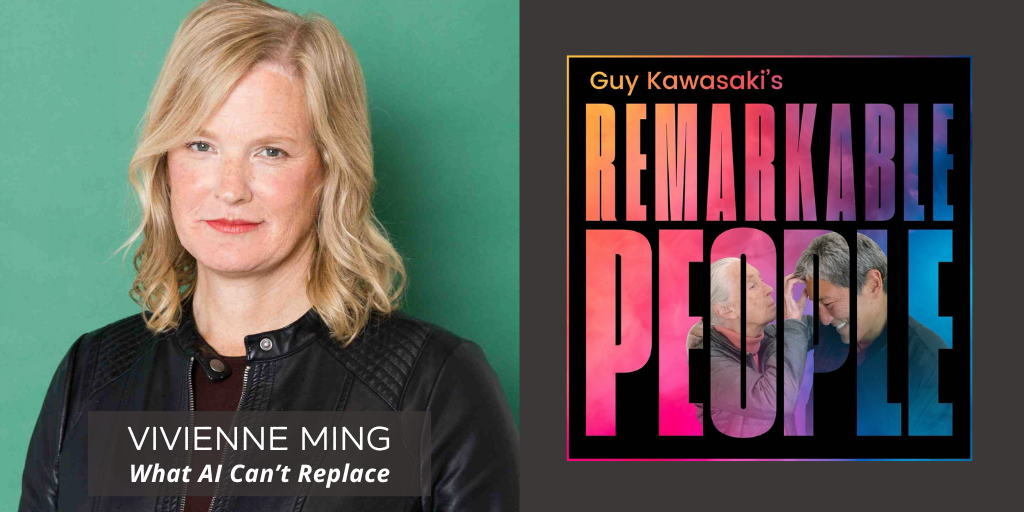
Welcome to Remarkable People. We’re on a mission to make you remarkable. Helping me in this episode is Vivienne Ming.
Vivienne Ming is a theoretical neuroscientist, AI pioneer, author, entrepreneur, and provocateur whose work sits at the intersection of human potential and technology. She has spent decades thinking about what artificial intelligence can do—and what it means for the people using it. Her new book, Robot-Proof, takes on one of the biggest questions of our time: how do we make technology work for us instead of allowing it to do our thinking for us?
In this episode, Vivienne challenges the idea that any traditional skill is truly “robot-proof.” AI can already handle enormous amounts of knowledge, calculations, and routine problem-solving, so trying to beat it at those things may be the wrong game. Instead, Vivienne points to curiosity, resilience, intellectual humility, and perspective-taking as qualities that can help humans do something machines struggle to replicate: explore the unknown. Her research with UC Berkeley students found that the people who got the most out of AI weren’t the ones who blindly followed it or ignored it, but the small group who challenged the technology, questioned its answers, and used it to expand their own thinking.
Vivienne also shares practical ways to work differently with AI, including her “nemesis prompt,” which asks AI to act like your lifelong intellectual enemy and explain why you’re wrong. She makes the case for keeping a “failure resume,” deliberately getting comfortable with being wrong, and using technology as a tool for deeper thinking rather than a shortcut around it. Her vision isn’t dystopian or utopian: it’s a future where humans and AI make each other better. The challenge, as Vivienne puts it, is to become the kind of person who uses AI to think bigger—not someone who simply lets AI think for them.
Please enjoy this remarkable episode, What Makes Humans Remarkable in the Age of AI with Vivienne Ming.
If you enjoyed this episode of the Remarkable People podcast, please leave a rating, write a review, and subscribe. Thank you!
Transcript of Guy Kawasaki’s Remarkable People podcast: What Makes Humans Remarkable in the Age of AI with Vivienne Ming.
Guy Kawasaki:
This is Guy Kawasaki, and I am the host of the Remarkable People Podcast, and I got to tell you, this book, man, she just doesn't hold back on tech bros and everybody and idiots and let me introduce her first. Her name is Vivienne Ming, and she is a theoretical neuroscientist.
I must admit, Vivienne, I don't know what the hell that means because I understand theoretical, I understand neuroscientist, so is there such a thing as a practical neuroscientist? But anyway, she is an AI pioneer. She's an author. She's an entrepreneur. Definitely a provocateur, and her specialty really is the intersection, I think at least, of human potential and technology.
And this is her book, although you can see behind her. Her book is called Robot-Proof, and we are going to discuss how to become robot-proof. Welcome to the show, Vivienne.
Vivienne Ming:
It is so much fun to be here, and I have to say, having a job description like theoretical neuroscience is great because almost nobody knows what it means, which means you can do whatever you want to do. It is the best way to go, although the practical neuroscientists are probably the most of the people.
They stick wires into brains, and they record things and use rabies retrovirus. When I discovered that there was a field of neuroscience where you just make stuff up and then train a computer to do it all for you, I just thought, "That is so much less messy, and really cool." Who would have guessed that twenty-five years later, people would be getting Nobel Prizes in this field? Dumb luck wins out in that case for me.
Guy Kawasaki:
I must say, to my recollection, I don't think you cited any MRI studies in your entire book.
Vivienne Ming:
I'm sure we have a very informed listenership here, but looking at functional magnetic resonance imaging to understand what's going on inside of people's heads is actually becoming increasingly important in my work, or using other techniques like EEG, because I want to understand how people's brains are responding when they're using AI.
Or in a new book I'm working on, what's the neuroscience of trust? So these things interest me, but in the moment of writing that book over a period of nearly ten years, I was really focused on some hard lessons that I'd learned not just as a scientist, but as a serial entrepreneur. And boy, what you can do is amazing, but what happens most often is alarming.
Guy Kawasaki:
So as you may have noticed, I like to spend the first few minutes of my podcast basically going down holes and going down blind alleys. I don't feel this moral obligation to get off to a fast start. I like to have a conversation with my guests. And so in that spirit, may I just go on the record and tell you, Vivienne, that I freaking love your footnotes.
I read probably seventy-five books a year. We have fifty guests. I have to read more books than guests because we reject even the people we think we're going to have and all that. But you have the best footnotes of any guest ever on the Remarkable People Podcast.
Vivienne Ming:
Well, thank you. I have to say, I've heard many authors say this before, I don't love writing, but I love having had written, that chance to tell your story.
Guy Kawasaki:
Yes.
Vivienne Ming:
And so the slog of going through and writing honestly what was a more than twice as long book, that was like the full manuscript I wrote, the only way I could do it is if I could tell dumb jokes and punch up at some people that deserve it as I went and trying to find this balance, how do I get my desire to be the world's most self-indulgent stand-up comic out of the book, but still have the voice there as I'm writing?
And I’m a fan of The Hitchhiker's Guide to the Galaxy, and for anyone who's familiar with these, the Discworld novels, which are just filled with these great asides. I thought, "I want to do that." I'm a nerd at heart, that the end notes are like thirty pages of scientific references, but the footnotes is where I got to be me and not just spend all of my time on a soapbox proselytizing.
Guy Kawasaki:
Vivienne, after reading your book, I will say with total certainty that footnotes are a window into the soul.
Vivienne Ming:
I hope so. The book is who I wish I was, the footnotes are who I actually am.
Guy Kawasaki:
I would say that's a tie for being remarkable there. Okay, so while we're going down this rat hole, I got to ask you a question that has just been burning in my soul from your footnotes.
There is a place in your footnote where you discuss the story of two horses seeing a Model T, and they're discussing, you know, "This Model T doesn't threaten me because, whatever," right? So it's this great story, and my question to you is that you use that in the footnote, and then a few pages later you use it in the body of the book. So was that a mistake or was that on purpose, or why is it in two places?
Vivienne Ming:
As you may have noticed right up front, I've got a footnote on an endnote on a footnote. Once I leaned into that format, I thought I'd make the most of it. I had originally hoped that my publisher would pay to put that cartoon in it.
And for the listener, it kind of looks like a Far Side cartoon, but it isn't, and there's these two horses watching a Model T drive up the road, and one horse says to the other one, "The plow, the wheel, I'm not worried. New technology always means more jobs for horses." Obviously, turns out that's not going to be true.
And there was a point where I wanted that in the main body of the book because of how many times I have just had these, "Ugh, don't worry about AI. This is just like the Industrial Revolution. Everything will work out." And believe it or not, I first saw that cartoon in the journal Nature, so a very nerdy place for a cartoon to be.
So I'd originally wanted it there, but I also wanted to make the joke, so I included it in the footnote, and then when my publisher balked at putting it in the main body of the text, then I was obligated to stick it back in because I had assumed most people weren't going to read the footnotes.
And so if I was going to reference it, I'd have to have it in the main body of the text as well. It ended up being one of those quirks of the writing process that it wasn't a mistake. But I assumed people would be reading in very different ways, and it would come across differently.
Here's insight also into the process. Originally, when the editing process started, I had a solid 60,000 words of nonfiction in the book. That was how self-indulgent the original manuscript was. But your point is made. Clearly, most of the people who said some wonderfully nice things about the book are clearly skimming.
But I think that might be part of the experience. Publishers told me straight up, "No one will read a book that's longer than 70,000 words anymore." I thought, "But I've got 200,000 words of genius and cartoons and fiction.” And they said, "Here's a machete. Get back to us in three days, or you're in breach of contract."
So my first book, as you have discovered, probably has some rough spots, but it also, as you have discovered, the thing that has made me the happiest of all of the reviews and all the genuinely wonderful things people have said, of which I was truly surprised at is not that it topped Amazon's charts in AI or in self-help, but that it topped it in a category I've never heard of before, which was psychology and humor. So the humor part made me genuinely happy.
Guy Kawasaki:
I'm going to find a category like that to dominate too.
Vivienne Ming:
Find a niche and own it which is, to be perfectly honest, the exact opposite of my life philosophy. Since I got a second chance at life at about thirty, I decided, be a phenomenal dilettante. Flitter around into every field that interests you, and if at the end of the day somebody's alive because you took the time to pay attention to their problem, then that's how you should judge yourself.
Guy Kawasaki:
Well, Vivienne, you are the only person that I have ever met that used Google Glass for something useful, which is taking a picture of Barack Obama. So let's get back on track here, and I'm going to pitch you a softball, and the softball is, what do you mean by robot-proof?
Vivienne Ming:
It's probably not as adversarial as many people might think. I've been working in this field since 1999. That was when I built my first ever model, my undergraduate honors thesis. I've published papers. I've built companies. My main day job nowadays is my philanthropic work. AI machine learning runs through all of that. Clearly, I'm all in on what it can do.
But I think what's been messing, and both people that are sort of dystopianists and those that are utopian, you know, the tech bro that thinks, “Oh, we just sprinkle processors on every problem, and they will magically go away,” or you know, “This is going to be I have no mouth, but I must scream.” That's a deep cut for sci-fi fans, but probably the scariest anti-AI story I've ever read.
Neither of those things. It is like everything about human beings, it is this incredibly complicated, messy thing we have invented that can hurt us, it can help us, it can do so many things. I wanted to write a book about how you balance the scales in favor of us, in favor of raising a child or living a life or building an organization that actually can reap the benefits of this.
And I hope as it comes across for anyone who reads the book, more than silver lining, the sort of platinum lining I would argue, is the kind of things I talk about, the ways you can robot-proof yourself. Currently predict positive life outcomes regardless of whether you're talking about AI or not. Things like curiosity and resilience have very likely always predicted positive life outcomes.
Just now maybe AI is this kind of forcing function. It can do so much that used to be your ticket to a great career, and what it leaves behind is something that I am trying to argue in the book and in my research is something genuinely positive, which is something a much more human, a role for us to inhabit.
Having said all that, I am a sci-fi nerd, and so of course the word cyborg comes up several times in the book. So in being robot-proof, part of what I'm saying is, how about we don't just build a whole bunch of autonomous robots to do everything for us, but we figure out how to use this amazing technology to make ourselves better? So that's the story of Robot-Proof.
Guy Kawasaki:
All right. And is any person or skill truly robot-proof?
Vivienne Ming:
So it's right there in the book. There is no skill, not in the way most people think of a skill. Like I have some fancy schmancy degrees in psychology and neuroscience and computation. Actually before ChatGPT ever came out, if I wanted to solve a math equation, there's a program called Mathematica. It’s great.
Guy Kawasaki:
Stephen Wolfram.
Vivienne Ming:
Exactly. Quirky genius that he is, invented this program and built a whole company around it. And for years and years, professional mathematicians, they don't do all the derivations themselves. They let a computer do it. What they're doing is much more akin to painting. The guiding, the deep thought process of where am I taking this equation? Where can I substitute?
Where the machine is dealing with the carrying the minus sign, which I always forget. So why make a mistake when it can do that better than I can? So if your view of a skill is do you know how to factorize a polynomial, do you know history facts? Then wow, I don't know about you, but if you chat with any of your favorite AIs on your phone on a regular basis, I talk to Claude about neuroscience all of the time.
It is amazing, and I learn things, and I'm supposed to be the one that knows it all already. But I'll tell you what it really reminds me of, if you don't mind me digging out another quotation from the book. I have advised many graduate students in my life. They don't typically allow me near students that often because I get very cranky. I'm grumpy.
If you're curious, working with me is like working on the show House minus being a horrible person, I hope. But I've had these wonderful graduate students, and here's my incredibly uncharitable thing I say about them. They know everything, but they understand nothing.
They're brilliant UC Berkeley students, brilliant, working on their PhDs. They are truly world experts in this one little question that they are exploring. So why am I involved in their education at all? Because my job isn't to teach them a bunch of facts or equations. My job is to teach them understanding because when the facts run out and you're doing the job of a scientist, exploring the unknown, then none of that stuff answers the problems for you.
When I started using AI long ago, like Bard, Google's early model called Bard, I just thought, “Wow, this really feels like my graduate students. It knows everything about everything, and it understands nothing.” And so I say no skill is robot-proof, I mean those old traditional skills that by the way, I still think you need to know, but you need to know why rather than how.
And then you need to take that why and your pet AI and go explore the world. That's what makes humans amazing. And again, we've always probably appreciated that's what makes rare, amazing people. My argument is this is what can make everyone amazing, if we chose to embrace it this way.
Guy Kawasaki:
So let me give you an interpretation what I read, and you tell me if I got it right. So in my humble opinion, the goal isn't necessarily defensive in the sense of making myself robot-proof. It is more to make myself robot-augmented so that no robot can do what I can do with the robot, which makes me robot-proof. Is that an accurate description?
Vivienne Ming:
If everyone actually followed what you just said, then yes. I think you captured it, and I didn't get a chance to include fine details of this experiment that I recently ran and that I published about in the Wall Street Journal of all places. But I do reference it in the book, and I think that really captures this idea well which is in this experiment, I had these UC Berkeley students essentially predict the future.
And it turns out twenty-year-olds are not great at this. Probably most people aren't. And every AI we looked at, from the best of GPT to these small open source models, the worst performing AI was so much better than the best human. So these autonomous AIs, these humans, if that were the end of the story, then clearly the AI's über alles. But that wasn't what interested me.
What interests me is what happens when we put these kids and these machines together and have them do it. And what I try to get across in the book, what I wrote about in the Wall Street Journal article is you get all sorts of different messy outcomes because the majority of the kids just turn off their brain and do whatever the AI tells them, and that's pretty scary to me.
But there was this small group, 5 percent, maybe 10 percent under good conditions, that used the AI to make themselves better. They used the AI to challenge their thinking. They challenged the AI. They used it to explore, to analyze data, top to bottom. Not a human in the loop where the AI does all the work and then the human decides. Top to bottom.
I, of course, called them cyborgs. The reason I mention them is that's what I'm advocating for, is this idea of how do we expand ourselves? Because those small 5 percent of participants in my experiment, they weren't just better than the best people, they weren't just better than the best AIs, they were the best performers by far.
And I had taken these questions off of a place called Polymarket, which I'm sure your readers have heard of this company that allows you to bet on the future. They did nearly as well as experts betting millions of dollars on the future price of oil or war in Ukraine in one hour on ten questions. It was truly extraordinary.
So yeah, I guess I'm proofing people against a bunch of autonomous C-Three-POs by making us better and I really want to, even if we didn't have AIs in our lives, this is where we should be focusing all of our efforts anyways.
Guy Kawasaki:
Yeah. To cut to the chase, the question that everybody wants to know is how do I robot-proof myself? And I think you've mentioned the first part, which is the graduate student model where you know a lot of things, but you don't really understand. So you have a couple more points about robot-proofing yourself, and I want you to explain these points.
Vivienne Ming:
Sure. Let me tie the points I'm making in the book, which are expansive, to the new findings in this experiment. I said we had these wildly different outcomes. Most kids were worse when the AI is involved, but some were better. Why? What was different about them?
And it turns out it wasn't the models. It wasn't the AI. That the “cyborgy” kids, they did almost as well when they had a little open source model as when they had a bleeding edge GPT or Gemini, Google's model. What was different was human capital. It was curiosity.
And so we'd measured all of these ahead of time in separate experiments. Curiosity, fluid intelligence, intellectual humility, and that one's really worth talking about, and then perspective taking, arguably a social skill, your ability to understand other people. These were the four things that in the experiment predicted this shift cyborg mode.
In my book, I actually go way beyond that, and we look at a few dozen different constructs, as we call them, or factors. Throw in resilience and a sense of purpose. I'm a hard numbers computational scientist, so people like to call these soft skills, but my argument in the book is they're not soft at all. They're hard to measure, but they are strong predictors of positive life outcomes for really direct causal reasons.
And yet, who's ever taken a course in curiosity? Who got a degree in perspective taking? We learn these hard skills because they're easy to teach and they're easy to measure, whereas resilience, as I describe in the book, is clear experimental evidence that you can develop resilience, but let me define it. It's your chance of finding success after experiencing failure The only way to develop resilience is to experience failure.
And yet we militate against our kids experiencing failure, and we hide it from ourselves. I think that's why so many of the kids in my experiment just did what the AI told them to do because they didn't want to experience the failure of the AI disagreeing with them. So this is how do you achieve it? I listed a couple of different constructs. This is going to be for eight-year-olds, but feel free to generalize.
There was this really great experiment. It's also not in the book because it's only been done in the last couple of months. The authors of this paper had teachers of these middle school kids. They trained them to praise interesting questions instead of right answers and then ran a controlled experiment with actual classroom experiences. In just six weeks, these kids' measures of curiosity went up.
They obviously started asking way more questions in class. And when new curriculum material got introduced, kids are just jumping in without any prompting from the teacher. Think about your workplace. How often is the boss praising interesting questions instead of right answers?
Not that much, and even inside ourselves, like how much are we valuing being visibly wrong as a learning opportunity versus always getting just the right answer at just the right moment and sparing ourselves that learning signal that again, if we want to bring an fMRI into it, you have this whole circuit running through your medial prefrontal cortex, anterior cingulate nucleus, all the way down to your nucleus accumbens.
That anterior cingulate, we sometimes call it, forgive me, this is genuinely what neuroscientists say about it, we sometimes call it the “oh, shit circuit” because it lights up when you make a mistake. Oh, shit.
And then you get all this activity because it's picking up on the error that you made, and no error, no activity. No activity in your ACC, the whole circuit that then drives your learning never gets activated. So when you use AI to hide your mistakes from yourself, you're actually stealing your opportunities to learn which isn't unique to AI.
Students and people do this all the time, but it's one of those areas that I really wanted to expose, is how often are you really actively soliciting? So I know I'm rambling here. Let me give one more really concrete because it's right out of the book. In writing the book itself, I used this thing I called the nemesis prompt.
So I made a promise to myself to not let Gemini write anything for me. I would just stream of consciousness out a chapter, and then I would say, "Gemini, you are my lifelong enemy, my nemesis. You've found every mistake I've ever made in my life and pointed it out to the world. Here is the new draft chapter for my book. Tell me in detail why I am wrong and what I can do about it," which I found to be enormously helpful.
Not because it made me faster, is how so many people are thinking about AI, but because it challenged me to be better, which I think is the core thought in this process of becoming robot-proof.
Guy Kawasaki:
So basically you are saying that you use what you call the failure resume, where you should develop a resume of failure. Poor LinkedIn, LinkedIn will go crazy. And then you have this nemesis prompt. So you are intellectually parrying with AI and AI as a devil's advocate, AI as an enemy, all this kind of thing, so it forces you to improve your game.
Vivienne Ming:
Yeah, that's the idea. And I mention this in the book. Years ago, my wife and I, we published a paper, how it seems to most people, AI has been around for quite a long time. And so in 2012, 2013, we published a paper in which we used an AI to analyze people's language, what's called NLP, these students talking to each other in online courses.
And we published all sorts of findings, but maybe the most fascinating thing about all of that research is not what distinguished the students that passed from the ones that failed, but we didn't just look at passing rates, we looked at who got the best jobs afterwards, who graduated the fastest from university.
What's different between them and the students who got great grades but didn't have those superlative outcomes? And what was most interesting in our analysis is the very best students were publicly wrong on a regular basis.
So we were analyzing these online discussion forums where the students got full credit just for showing up and participating. You didn't have to be right, didn't matter if you were wrong. You could talk about the weather if you wanted to, although that was a very negative predictor.
But our system discovered that these students that would take the material and then explore, translate it into some place new, and inevitably make mistakes, because they were taking the certainty of what was in the book and the lectures and taking it to some place new, that they would get the best grades and graduate the fastest, even though all these other students were fastidiously correct all of the time.
And it's fascinating that we can see all these students exploring and asking the classic dumb question and making these mistakes and having the best outcomes. We see it, but we don't do it.
Guy Kawasaki:
But Vivienne, if you are in an academic situation where they are testing you for your knowledge and memorization of facts as opposed to exploring, how are you saying that these students would get the best grades? It depends on who's keeping track.
Vivienne Ming:
I'll say specific to the experiment that we ran, as I was noting, this is just an online discussion forum. It wasn't the full assessment. I'm saying, though, if you did assess them the way that they were assessed in a class, the very best students would actually be getting Bs at best, and the B students would be getting As because they were always correct, and yet that isn't what happened in the final grades.
I think the problem that you are highlighting, though, is one of the biggest problems with our education system, and frankly, you know our hiring and promotion systems which is they are so focused. They are like Olympic gymnastics, which I have never liked because it's all about who makes a mistake. So if you tried to do a quintuple flip and failed, but you almost did it, to me that's the most amazing thing.
And yet the failure dominates, not the attempt or the risk, and it's heartening to me to see the people who are willing to fail publicly. Yeah, when it comes exam time, they buckle down and give the right answers, but the ones who are willing to fail publicly are the ones that go on to have the best outcomes.
And there was an op-ed in The New York Times several years ago about this guy going back to his Harvard class reunion and remembering how much he struggled. All of these geniuses, cum laude, summa cum laude, that open the house, the study clubs and all that silly nonsense at Harvard, and he struggled to get by.
And yet, now he's visiting twenty years later with multiple Pulitzer Prizes and fame and meeting these people that seemed like seemed like they would go on to win Nobel Prizes and instead now, they had a really solid job as a dermatologist in St. Louis.
Guy Kawasaki:
Goldman Sachs.
Vivienne Ming:
Or yeah, they're a vice president along with 80 percent of the other employees at Goldman. And so breaking that mold, being willing to say, "No, you know what? I’m going to disagree with the professor in public. I'm going to call the CEO on their plans for whatever it might be.” It turns out these are really better predictors of long-term impact on the world than just getting all the things right on the test.
And nowadays, of course, every student understands, wait a minute, this thing in my pocket can give all the right answers way better than I can, so why are you asking me? How is it wrong for me to just copy the answers out of my phone if it's better than me? And I think changing our relationship there is a huge part of making progress.
Guy Kawasaki:
Well, I love the failure resume. I love the nemesis prompt. But you also invented a fictitious person.
And this fictitious person always comes up with this explanation when people say that AI is dystopian, and the person says, “It's just like the Industrial Revolution. It was a big threat, but ultimately, the rising tide floats all boats, and all the people who lost jobs because of the Industrial Revolution actually got better jobs because blah, blah, blah," right?
“And everybody will be fine. Everybody will be free from routine tasks. Everybody can become more creative,” blah, blah, blah, right? And the name of this person is Pompous Mansplainer. And the first time I read the quote, a quote from Pompous Mansplainer, I said, "Is that a real person, or did she make that up?" And I thought it was just brilliant.
Vivienne Ming:
Let's be clear. Every one of Pompous Mansplainer's quotes is a near word-for-word quotation of someone I was on a panel with somewhere in the world. In fact, the title of one of the chapters, “This Is Not the Industrial Revolution,” I wrote down on a Post-It note. I got offstage at a conference in L.A. at the Beverly Wilshire.
All these rich people. I had followed one of Trump's Secretaries of the Treasury onstage, something like that, and there was this guy on the panel with me who was just pulling nonexistent facts out of somewhere dark and smelly and just saying them as though they were true things, and I was just astonished.
And so I wrote this, and a few months later, it was 120,000 words that some of them made it into the book, but not all of them. And those little quotations were things people said to me. Sometimes wildly contradictory things that people said to me. And one of them, I gave a keynote at an event in Cape Town, and it was pretty heady.
It went so well, and the crowd like thirty people took me out to lunch, and they were asking me questions. My enemy is not my friend, but there are moments like that that genuinely feel good. And one of them sees an acquaintance, a friend of hers, and she hails him over, and he walks over, and she said, "Oh, my God, did you see Dr. Ming's keynote? It was amazing."
And he looked at me and said, “Oh yeah, I didn't see your keynote, but here's why you're wrong," and then misquoted a partial misquote of a reframing of something Bill Gates once said. And that stuck with me and I attributed that to Pompous Mansplainer in the book as well.
My point obviously isn't that I have a problem with men, although I will point out all of these choice quotes came from middle-aged dudes that were so convinced that something they were not experts in was nonetheless correct. It's the level of confidence that needed the punching up in this case.
Guy Kawasaki:
Were they all billionaires?
Vivienne Ming:
But it’s also a little dangerous, right? People being told, "Don't worry about it, it's just like the Industrial Revolution." And one, well is it? If everyone says it, then our tendency is to take statements like that as well, it must be true, everybody's saying it. Yet my reaction is if everybody's saying it, then no one's actually thinking about it. It just becomes one of those things everyone assumes is true because everybody's saying it.
Guy Kawasaki:
So tell us why it's not the Industrial Revolution again.
Vivienne Ming:
There's two points here. One is it's not the Industrial Revolution because I mean even if it was, I don't think our understanding is accurate, right? You know how many times people have said, "Oh, all of those, you know, textile workers, all those artisan tailors, the Jacquard loom sort of cost them their job on day one, but it gave rise to the fashion industry."
And I think I actually have this quotation in the book. There is a letter, a genuine letter, back in the day sent home from a British diplomat working in India who said, “The plains of India are bleached white with the bones of Indian weavers." Like overnight, almost all of weaving suddenly was done in the British Midlands and nowhere else. And sure today we have now all these fashion houses and this huge industry, but that was not an overnight process.
That was hugely disruptive to the world. My point there being these things can be true in the sense they're long-term positive, but we should prepare for the consequences. But the other is AI is not like the loom or the printing press or even the calculator because AI doesn't come in at the bottom and lift everyone up.
The printing press maybe put a couple thousand monks doing illuminated manuscripts out of business, and it gave literacy to Western Europe and later the rest of the world. Hugely disruptive, but hugely positive. AI is more like one preexisting technology.
It hasn't been around long enough for us to know the consequences, but this other technology, which is arguably just a form of AI, it has been around just long enough for neuroscientists like me to start getting measurements, and that is automated maps, automated navigation systems. Because unlike calculators or printing presses, AI does the thinking for you if you allow it to, just as Google Maps does.
You know what the two job categories with the lowest rates of Alzheimer's are? Taxi drivers and ambulance drivers but not bus drivers because bus drivers drive a route. They don't have to think about it. But taxi and ambulance drivers have to think about navigating through space. I guarantee you Uber drivers are not getting the same benefit because they're just following a route an AI is giving them.
And in fact, I made this prediction about twenty years ago, and starting about ten years ago, we started to finally get the evidence in. People who rely the most heavily on automated navigation are starting to show memory problems and early mild cognitive impairment that's indicative of higher rates of dementia.
We don't truly have the evidence about chatbots and generative AI, but that's what I'm worried about. This is a technology that isn't like the factory line, and it isn't like the internal combustion engine. This is a technology that does our thinking for us if we allow it to, and that is really worrisome.
Guy Kawasaki:
Just for you listeners, I'll tell you a funny story about Vivienne from the book, which is she regularly challenges her GPS and tries to see if she can get to the intended destination faster than the GPS would get her, and she regularly beats it, which shows that she's thinking and the GPS is not.
Vivienne Ming:
That's all that I'm looking for. If I'm going to climb on my soapbox and say, "Do this thing," it isn't don't use technology. Of course not. I use it all the time. I use AI. I am not a fan of social media, but if you love it, wonderful. Go into it, but what I want you to do every now and then, not even all the time, but every now and then, is shift from being shallow to being deep.
Go from just swiping across pictures or letting this map tell you where to go. Instead, and I did this originally with a regular lecture I give at UC Berkeley, where I challenge students to come up with a form of automated navigation, a GPS system, that would not only get you where you need to be, but you're better than where you started when you arrive.
You challenge it, and they come up with these very fancy, exciting technologies and AIs, and then I end it with, "Here's a simple thing that I do. I make a game of it.” I say, "Google at Paddington Station. I've just patted the bear, and I need to get to Spitalfields Market. Tell me the fastest way to get there."
And the one thing I can't do is take that route. I can use all the information it's given me, but I have to pick a different route and beat it there. And Google usually wins because AIs are pretty smart at what they know how to do. But every so often, oh, I know that there's a protest in that tube station.
I know that there's a secret courtyard I can cut through in the heart of London that Google doesn't know about. And it doesn't matter that I'm right. It mattered that I went deep and I thought about it.
Guy Kawasaki:
Often as I'm driving with my family, I tell them that I use GPS, which is Guy’s positioning service because you can cut through the Costco parking lot, and you can cut through the Target parking lot to get to Kapiolani Boulevard in Hawaii that Google's telling you to go down the official exits and all that.
And I love that part of the challenge here. So another term that I salute you for coining that I just love was au-tech-racy, right? Which is autocracy but for billionaire bros. So let's talk about au-tech-racy, who are the Pompous Mansplainers, who are billionaires. And I'll just let you pontificate about the au-tech-racy.
Vivienne Ming:
Listen, it's so easy to make fun of these guys that it's hardly worth the challenge. And what I try to do in the book, in fact, is to say, you know what? Once Amazon tried to hire me as their chief scientist, and I got to meet their leadership team. I've done lots of collaborative research with Google over the years. I've met these guys.
There are some legitimate villains in these stories, but most of them clearly think that what they're doing is right and aren't terrible people on meeting them. So in this chapter that you're referring to, I said, "Do you know what, AI can be biased because guess what? We trained it on us. Are you really shocked that it has biases?"
But let's just acknowledge that's true and set it aside. What if we could build an AI that was perfect, one that made all the right judgments? Right for who? Who is it making these for?
Guy Kawasaki:
Are you referring to Grok?
Vivienne Ming:
Well, that would be an easy one to point out and might point at one of those people I am less charitable towards on a regular basis, but whether you're using Grok or any of these other models, it's not yours. You didn't build it. You didn't deploy it.
If your banking app has an AI in it and it's saying, "Hey, here's the right loan package for you," or if Google is using Gemini to filter out people applying for jobs and pick who they're actually going to interview, or for that matter, ton of AI being used by the police, by border patrol, by many other organizations. Let's actually assume that they're not all a bunch of Bond villains because they're not.
Although a few of them, I'm sometimes shocked at what Peter Thiel is willing to say out loud on record, but he makes his weird choices in his life. Even if they're not bad guys, they're building systems for themselves.
Not necessarily against you, but for themselves. Banks want the best loan to generate revenue for them, which is probably the loan that gets you trapped in cycles of repayment over and over again, and I will tell you having built one of the very first companies using AI in hiring, employers are perfectly happy using AI to just hire more of the same looking, same thinking people that are already working there and not put in the hard work of finding someone who's different, but whose difference will create some sparks and some innovation.
So what I'm talking about with the au-tech-racy is this deep tendency for these systems to serve the small group of people that own and run them. Many of whom aren't villains. They're just doing it for themselves. But I'll tell you, there are two areas that are huge growth areas in AI right now, and one is autonomous weapons.
We can all imagine what's going on with the drone warfare, both in the Gulf and in the Black Sea. And I will tell you, people are building AIs to make autonomous decisions about what to blow up and when, and that's pretty scary to me. I am not scared by AI as a concept, but that use case is something all of us should be really, really thoughtful of.
But the other is what an astonishing tool to make certain, let's say if you owned something, I don't know, for some bizarre reason you decided to rename a hugely valuable product, I don't know, something silly like X, but you never wanted anyone to ever say anything nasty about you on this property you just bought.
What an amazing tool to make certain that nothing anyone says bad about you ever surfaces, or rather it's a little harder for it to surface. And that's the kind of au-tech-racy. AI is an astonishing power, astonishing tool to concentrate power in the hands of the few. And as someone who's been building it for nearly thirty years now, I feel very empowered by AI.
And I even get to build some of my own models, but I can't deploy them at the scale that Google or SpaceX or OpenAI does. Or for that matter, DeepSeek, the Chinese company. So there's a real phenomenal concentration of power here, and it's probably the least talked about part of my book, but I really think we need to begin having discussions about that, what it means to us.
If you're an American, what does it mean to have a Fourth Amendment if I can talk to an AI and learn anything about you I want to learn? It really changes some of the assumptions of how we think society operates.
Guy Kawasaki:
Can I just go back sixty seconds and give you an alternate view? So you're very fearful about the deployment of autonomous weapons based on AI, right? And I understand why.
But if push comes to shove and I say, "Well, you can either have a nuclear system that is launched by ChatGPT, or you can have Donald Trump, Vladimir Putin, or Kim Jong Un have the magic button that launches nuclear war," who would you pick to be able to launch a nuclear weapon? ChatGPT or those three men?
Vivienne Ming:
I'm going to push back against the dilemma you have presented. I would choose 100 percent, I think I'm with you, I would choose ChatGPT. However, we already have the research results that all of the models, push goes to shove, they will push the button.
They're hardcore game theory players, and they all end up pushing the button when you ask them to play these kinds of games. So I trust them on some level better than the three human beings you just named. Here's the reality right now, Trump doesn't push the button, nor did, I don't remember who it was, Khrushchev or whoever famously that one day when there was a false reading of a missile launch out of the United States.
Guy Kawasaki:
Yeah.
Vivienne Ming:
And a Russian officer chose not to push the button even though he had the order to and survives as a result of that decision. So the real question isn't whether Donald, I mean, he doesn't even carry his own Diet Pepsi around with him, so he’s not pushing the button. He's ordering someone else to do it. At least then one other person has to agree with him.
Even if he has filled his life with yes-men, that moment at least another human being. Whereas if he just has a bunch of AIs that will do whatever he says no matter what, then the button gets pressed as soon as he thinks it, and that's the au-tech-racy answer, not what will AI do completely on its own, but what happens when bad actors have full control of it. That is what I think I'm pushing back.
Guy Kawasaki:
Yeah. Hopefully the prompt will be, "I'm thinking of launching a nuclear weapon. Be my nemesis and tell me why I shouldn't." But somehow I doubt that'll be the prompt, right?
Vivienne Ming:
I strongly suspect that different words get entered into the system at that point. And again, what I'm worried about is that it just becomes a canned prompt that says, "As soon as you see a blip on this radar, launch the weapons."
And my “cyborgy” heart says, "No, I want someone using AI to analyze that blip and think about the possibilities and think about their own children all in that moment." Maybe that could be a prompt also to this system, but that's so much richer and more human than just the instincts of autocrats.
Guy Kawasaki:
I got to tell you, Vivienne, if you're telling me you want one more human in the loop and it's Donald Trump telling Pete Hegseth, I think it's time to look for our underground bunkers here. Okay, let's get off all this dystopian stuff because neither of us are dystopian, and I also believe neither of us are utopian.
But I want to ask more positive questions such as how can I use AI to create, empower, and build the creative economy? The creative economy, not the de-professionalized economy, but the creative economy.
Vivienne Ming:
Yeah. That was a really fun part to write about particularly because I got asked about this by a bunch of studios in Hollywood. What should AI, how should it be a part of what we do? And my argument in the book is even a lot of very famous Nobel Prize-winning economists probably haven't been thinking about AI quite right because we tend to think low skill and high skill. “Oh, the AIs will take away all the taxi driving jobs but leave the doctor jobs.”
But no, that's not really how it breaks down. I try to put it in different terms. The well-posed and the ill-posed. The well-posed problems are the ones we've been exploring for generations.
We really understand them, and we know how to get right answers, and most of education is about the well-posed problem, and I hire a bunch of young kids, and I tell them what to do, and they do it for me, but when we said earlier, there is no skill which is robot-proof, it’s because all of that well-posed knowledge is already inside these models, imperfectly, but so much better than the vast majority of people that might be doing these jobs.
And that can seem scary, understandably so. That's the dystopian instinct. The utopian is even more absurd. It's just, okay, cool, I'll drink Mai Tais and it will solve cancer, which is also absurd and has no basis in reality. The realist answer is there is another thing that we are uniquely good at compared to AI, which is the ill-posed, the unknown, the uncertain.
Forget the right answer. We don't even know what the question is. And humans actually hate uncertainty. We're terrible dealing with the unknown, but we are vastly better than anything else in existence, including the cutting edge of AI. So how do we explode this creative economy?
We need to rethink what a job is and our relationship with work. This could get very nerdy, so I'm going to keep it really brief. You asked about theoretical neuroscience. I'm writing a theory paper right now about what AI can generate and what humans can generate, and it turns out on average, AI gives better answers to most questions than the average person.
Therefore, AI is better, right? But if you actually look at all the possible answers that everybody generates, something really interesting emerges, which is AI, given a similar question, almost always generates exactly the same answer. In fact, all of the different AIs from different companies all generate almost exactly the same answer to every question.
All right there, right in the middle of human thought, if you will. If you asked a whole bunch of human beings, oh, you get a lot of crappy answers, you get a lot of boring answers, but most of our ideas live way out on the long tails. The things no one's ever said before or seen before.
If instead of the average idea, you said, “What are the most unique ideas created?" Humans are demonstrably so much better than AIs. That is our superpower. Interestingly enough, even if we're wrong when we explore and create these new ideas, they're still more valuable than a boring right answer. And that transformation, my job isn't any longer to give the boring right answer that anyone else with the same education would've given because that's free.
I get it for free out of my phone. Everybody gets it for free or close enough to free. My job now is to think, “What do I know about this problem that nobody else in the whole world knows? What could I say that no one else would say, even if I'm wrong?"
But it's a real possibility of a solution, and it turns out, I talked about that experiment I ran with my UC Berkeley students, and I talked about the cyborgs, that is exactly what they would do. When we analyzed the transcript of their interaction with the AIs, they would say, "GPT, what about this crazy idea? What about this thing? How would it affect the price of oil?"
And the AI would say, "Oh, but what about the data? The data says this." These people who, if you recall, I said they are rich in intellectual humility. They just got told that they're wrong. Almost all of the other humans in my experiments either collapse and then do whatever the AI says after that, or they just ignore the AI and say, "Nope, that's the right answer."
Cyborgs say, "Oh, okay. So not that, but what about this?" And so again and again, the humans would explore, and the AI would pull back to the data. That's like the breath, the life cycle of these cyborgs, is human exploration and AI grounding. Like I said earlier, they were superhuman, super AI in their capability when they did that together.
The future of creativity is I just don't need twenty-three-year-old fresh out of university to give me the right answer anymore because that's not why they're there. So here is my job interview question. For anyone that wants to work in my academic lab or my nonprofits or my startups, pitch me a mad science project. What would you do that's different than anyone else in the world to make the world a better place?
And the important thing is it's not a dissertation defense. They don't have to justify it to me. I tell them this ahead of time. They can think about it and show up. We take an hour, and we try to figure out how to build it together. And if I think we have a better idea together than I would've had by myself, then they get the job.
I can teach them how to program, I can teach them about brains, I can teach them about AI. I can't teach someone to have an idea I would never have had, and to have the courage to share it with me and tell me when I'm wrong. That is the unique power that humans have. At least to date, we have not figured out how to automate that.
Guy Kawasaki:
I think, Vivienne, that this is the way to end this podcast because yeah, we're not going to have a better closing statement than that, at least, based on my experience.
Vivienne Ming:
Thanks.
Guy Kawasaki:
I'm going to aspire to be a cyborg in the ninety-fifth percentile. That is my new goal in life.
Vivienne Ming:
Be comfortable with being wrong and ask your AI to throw up some roadblocks. Use it to force yourself to think differently.
Guy Kawasaki:
I think that is brilliant advice and you know the Roman Catholic Church created an official office called the Devil's Advocate, right? So when anybody was up for being a pope, the Devil's Advocate's office was their whole existence was to say why this person shouldn't be a pope. And you're giving the tech version of the Devil's Advocate, which I think is very instructive.
Vivienne Ming:
And I hope everyone loves the footnotes. It is my most cherished part of the book, but I also really wanted to get across a really positive look at how hard work put into your relationship with technology pay off, like a magic wand, and not in some dystopian sense, but genuine effort can be a positive transforming effect.
Guy Kawasaki:
Vivienne Ming, I'll hold up your book one more time because people interested in this topic and being more creative. The book is Robot-Proof and that is a very good aspirational goal. And Vivienne Ming, I would say you are a humble womansplainer as opposed to a Pompous Mansplainer.
I thank you for being on the show. I will definitely be using AI differently based on reading the book and listening to you talk about this. I want to be that creative Guy who uses AI to make me even better, not to replace me. Yeah.
Vivienne Ming:
It's a challenge. Our brains don't always want to go along with that particular game strategy, but that's the effort part.
Guy Kawasaki:
Yeah. That's why only 5 percent of the people do it, right? So Vivienne Ming, I thank you very much for being on the show. I hope people read this book, and it's neither dystopian nor utopian. I think it's quite practical actually. I'm going to put some of these practices into place as soon as this ends. Thank you very much.
Vivienne Ming:
I appreciate that, Guy. Thank you so much for having me.
Guy Kawasaki:
And let me also thank Madisun Nuismer for bringing us together, and Tessa Nuismer for her research, and Jeff Sieh, co-producer, and Shannon Hernandez, sound design engineer. So these are the people who make me robot-proof too. So, off we go. Thank you very much, Vivienne. All the best to you.
Vivienne Ming:
Cheers. You too.
Sign up to receive email updates
Enter your name and email address below and I'll send you periodic updates about the podcast.

Leave a Reply