
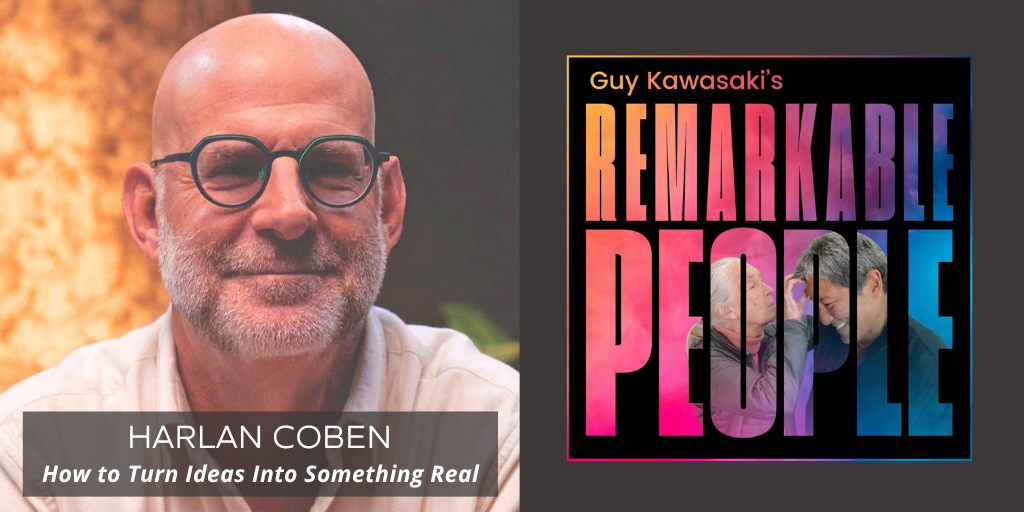
Welcome to Remarkable People. We’re on a mission to make you remarkable. Helping me in this episode is Harlan Coben.
Harlan Coben has sold more than 100 million copies of his books and built a remarkable career turning thrillers into books, television series, and movies. His stories keep readers guessing, but his approach to writing is surprisingly practical: notice the world around you, do the work, and keep moving. He sees every person as a potential story, because everyone has hopes, dreams, disappointments, and surprises hiding beneath the surface. For Coben, developing a “writer’s mind frame” means staying curious and treating the world as an endless collection of prompts.
He also has little patience for the excuses that creative people often make. Inspiration matters, but so does perspiration—and Coben adds a third ingredient: desperation. You don’t need to quit your job, wait for the perfect workspace, or finish all your research before you begin; you need to fight for the time and put words on the page. His philosophy of “incremental ambition” offers another useful way forward: set the next attainable goal, accomplish it, enjoy it, and then move on to the next one. That approach helped Coben build his career one milestone at a time rather than obsessing over becoming a bestselling author before he had written the next sentence.
Coben’s creative process runs against plenty of conventional writing advice. He doesn’t outline every chapter, but he does know where his story is going, comparing his approach to using a GPS: know the destination, then let the route change along the way. He also believes research can become a remarkably sophisticated way of procrastinating, and that you should write the story first and fact-check what needs fixing later. His advice is blunt but useful: you can fix bad pages, but you can’t fix no pages.
Coben’s new book, Plot Twist, expands these ideas into a memoir and guide to writing, life, and the messy first draft. But the lessons reach far beyond novelists: entrepreneurs, artists, musicians, and anyone trying to create something can benefit from his willingness to ignore convention and focus on what actually moves the work forward. The common thread is simple: don’t wait for perfect conditions, don’t confuse preparation with progress, and don’t let fear of a bad first version keep you from creating. As Coben puts it, chase the heart, not the dollar.
Please enjoy this remarkable episode, What Writers Can Teach Entrepreneurs About Creating with Harlan Coben.
If you enjoyed this episode of the Remarkable People podcast, please leave a rating, write a review, and subscribe. Thank you!
Transcript of Guy Kawasaki’s Remarkable People podcast: What Writers Can Teach Entrepreneurs About Creating with Harlan Coben.
Guy Kawasaki:
Good morning, everybody. I'm Guy Kawasaki. This is the Remarkable People Podcast, and I got to tell you, I love mysteries and I love thrillers, and the guest today is Harlan Coben, and oh my God, he has published one hundred million copies of his books, which is roughly one hundred times more than me.
And if you have Netflix, he has a Netflix series out called I Will Find You right now, and I'm not going to say what it's about, but it's definitely something you should actually see. And he has a book coming out, and it's called Plot Twist. So welcome to the show, Harlan Coben.
Harlan Coben:
Guy, an honor to be here. Thanks very much for having me.
Guy Kawasaki:
The honor is all mine, and you have consumed hours and hours of my life with your books and your videos.
Harlan Coben:
I’m so happy to hear that. I hope consumed like in a positive way, not like waiting at a dentist office kind of a thing, but yeah.
Guy Kawasaki:
Absolutely. No, you are not a dental implant in my life. Maybe you're flossing, but you're not an implant. Okay, so the first question I have to ask you.
Harlan Coben:
Sure.
Guy Kawasaki:
Why did you call this Plot Twist? Is it because you usually are a mystery and thriller writer and this is nonfiction, or is it because many of your recommendations are probably the opposite of what writing experts say to do? What's the twist in this plot?
Harlan Coben:
Yeah, both. I think, it’s a plot twist, a memoir on writing Life, Craft, and the Messy First Draft. So Plot Twist is what I think I'm probably most known for as a writer and a TV producer and stuff like that. So that's the one thing, and I hope the advice that I'm giving you, while learning about my life at the same time, is going to be surprising.
And I'm always looking for the plot twist. That's how I live my life pretty much. So I thought that would be a pretty good title.
Guy Kawasaki:
It's a very good title.
Harlan Coben:
Thanks.
Guy Kawasaki:
Until yesterday, my favorite book about writing was by Brenda Ueland, and it's called If You Want to Write. But as of this morning, this is my favorite book about writing.
Harlan Coben:
Thank you, Guy.
Guy Kawasaki:
Unlike you, who has written forty books, I've only written nineteen. Although some people say I have written one book nineteen times.
Harlan Coben:
They say that about me too, so don't worry about it.
Guy Kawasaki:
Is it our fault that most people haven't figured out how to leverage what they do? This is a 1 percent problem. And I have to fanboy a little bit here. So I have written nineteen books or one book nineteen times. They're all nonfiction, although I've been accused of writing fiction, too, inadvertently.
But I have to tell you that I look at someone like you and how you come up with these plots and these characters, I think is utter magic. I don't understand how your mind works, Harlan. So perhaps you could start off with some insights into this, what makes a writer? What makes a novelist?
Harlan Coben:
Well first of all, thank you. Secondly, I try to describe this in the book and talk about how to do it, but I live with the writer's mind frame. It's always there front and center. And even if you're not a writer, I sort of think it's a healthy way to live and be and question.
So like I teach my kids when they're growing up, I taught them every single person that you see on the street, richest man, poorest man, women, men, whatever, everybody has hopes and dreams. It's such a small thought, but it just gives everybody a bit of humanity, a bit of empathy, and in this case, a bit of story, right?
What are those hopes and dreams? Did they accomplish them? Do they still hope to accomplish them? Did it happen and it wasn't what they thought? Did it happen and it was what they thought? And just making stuff up in your head, giving people agency in that kind of way. And I try living my life that way.
Everything is like a writer's prompt. That's part of the writer's mind frame. So first and foremost, if I'm giving advice to people on how to be a writer or how to come up with these ideas, and for every hundred that I have, probably more, maybe one day will be used in a book.
Of every three hundred, maybe one will actually be a full book idea. And that's just how I look at the world, and it's kind of an enjoyable way to go through the day.
Guy Kawasaki:
Yeah. I have to say that I think that your three-page paragraph about the degradation of Millie into a murderer, starting as a volunteer. It is the longest paragraph in the history of nonfiction, and I absolutely loved it. And you talk about how she like borrows ten dollars to pay for the sandwich, and then, she has to catch a ride home, so she borrows money for Uber or Lyft or whatever. And the next thing you know, she's murdering somebody.
People are wondering, "What the hell is Guy talking about?" That's why you need to buy this book. Just for those three pages, it's worth it.
Harlan Coben:
Thanks.
Guy Kawasaki:
I love headings, I love subheadings, I love bullet lists, but I got to tell you, that's the first time I love a three-page paragraph. That is history for me.
Harlan Coben:
I almost didn't punctuate it. That was stream of consciousness, and I didn't change one word of it after I did it, intentionally. So it was can I actually do this? Can I create somebody who you start off liking and explain because I don't like the villain that's obvious.
I like the villain that we can almost see ourselves being. And I think when you read Millie, you see the incremental steps that leads to real-life evil. But it doesn't start with rubbing your hands and woo-hoo, ah, evil. It starts with something small like that. That's the most interesting kind of evil.
Guy Kawasaki:
You whip up a great tricolon, and I kind of think you're a tricolon kind of guy because you talk about inspiration, perspiration, and desperation. So would you explain those three factors in being a writer? And before you do that, I just want to point out that I love tricolons, and the fact that you have a tricolon and it rhymes and they're all four-word syllables is like, oh, Harlan, that's why you're Harlan Coben and I'm Guy Kawasaki. I am not worthy.
Harlan Coben:
That's your thing, not mine really. Yeah. So I said three things make up a writer. Two are obvious, and one isn't so obvious. So the two obvious ones are inspiration, you have to be inspired to write and really want to do it, and okay, that's obvious.
Let's just put that aside. Second is perspiration. That is, you have to do the work of writing, and this is the unsexy part that people really need to understand. You have to write. You have to get your butt in a chair and produce words on page or screen. Everything else is flotsam and jetsam.
Coming up with ideas is not writing. Creating characters is not writing. Hanging out with your friends at Starbucks is not writing. Only writing is writing. So we have inspiration, we have perspiration. But the third, and maybe most important, is desperation, and that is I'm not fit to do anything else, like hold a real job.
I'm disorganized. I'm forgetful. I almost forgot that I was supposed to come on with you right now. I have no other marketable skills. And so the fact that if I didn't do this, I would have to actually maybe get a real job and wake up early and work in a pharmacy and sell lip liner, whatever, that terrifies me.
And that desperation, I think, is one of the things that leads you to I have to write because otherwise, what would I be?
Guy Kawasaki:
But Harlan, at this point, forty books in, all these Netflix specials and all this kind of stuff, are you still desperate? It’s not a financial desperation?
Harlan Coben:
Right.
Guy Kawasaki:
It’s an emotional desperation.
Harlan Coben:
That's a really good point. I don't want to sound “Pollyanna,” but I've never written for money. I write commercial fiction. I want big audiences. But I've always believed that I chase the reader or the viewer. I chase your heart, and the dollars will follow.
I don't chase your dollars and then hope everything works out. I don't worry about the money side of it because I know that if the book is good enough or if the TV series is good enough, the money's going to follow, but I don't really have the financial motives, as you point out, are not what they were when I was young and starting out.
But even when they were, you know, four young kids. The first day I hit The New York Times bestseller list, my fourth kid was born. I had a seven-year-old, a four-year-old, a two-year-old, and a newborn. So back in those days, it was a little different. But even then, I try not to focus on those aspects. Chase the heart, don't chase the dollar. That's my advice on it.
Guy Kawasaki:
Yeah, what were you doing when you were working for your grandfather's tour company in Spain? That's when you wrote your first two books, right?
Harlan Coben:
Yes. I wrote two books while I was still there, and here's the other thing if you're trying to be a writer, and I assume some people out there hope to, part of why I wrote this book is we as human beings are meant to create, not just consume.
And I hope that Plot Twist not just teaches you but motivates you to whatever your art is or creation is. If you’re a musician, if you want to write music, if you want to sculpt, if you want to paint, if you're creating, if you're an entrepreneur trying to create a business, I don't like the term art.
I like the term creation. To me, that's just more apt. So I hope this book does all of that. But the key thing I'm trying to explain right now is that you don't have to quit your job to do that. My first two books that I wrote and the three that weren't published, I wrote while having real jobs.
I didn't quit my job, and the difference was, okay, maybe it would've taken me instead of one year to write those books, I would've been able to write them in nine months or ten months. So what? The idea is just do it now. Don't think you have to completely alter and change your life. You have to fight for the time.
Yes, of course, but I think a lot of people feel like that's their excuse. Don't make any excuses. So one of the excuses is, "Oh, I have a full-time job. I have a kid I have to watch out for." No. If you can't find time to write, then your life is filled with things more important than writing, and you're not a writer.
That's fine. But don't say, "I don't have time to write." I never say I don't have time to do something. I don't have time to work out. I don't have time to write. I say it's not a priority in terms of my time. We all get twenty-four hours in a day, right? This is more your stuck guide than mine.
But we all get twenty-four hours in a day, and how you use those twenty-four hours, if you're too busy to write, then writing is not a priority. Maybe your other priorities are better and worthy and all that. I'm not questioning those. But if you don't make writing a priority, then it's not a priority, and you're not a writer. Move on.
Guy Kawasaki:
For you listeners, it should be very obvious right now that this book is full of tough love. There's not a lot of bullshit in this book so if you want one of these touchy feely, get in touch with your inner writer and wait for the muse, this is not the book for you, not at all. I'll give you a tricolon that I have loved in my career because I'm into tricolons.
It's like, so Constantin Brâncuși, the sculptor, his tricolon was, "Create like a god, command like a king, and work like a slave," which is kind of along the theme of yours.
Harlan Coben:
That’s great.
Guy Kawasaki:
So, you know, beyond an Amherst liberal education, does one need training to be a writer?
Harlan Coben:
If so, I'm in trouble. I learn by writing. As I mentioned to you, I wrote three novels that were never published, and some people may look at that as, wow, that was kind of a waste of time. Each one took about a year. But that was my apprenticeship, and that's how I learned to write.
I may have read a book or two on it, but really, the only way to write, to learn to write, is to write, and that's how it should be. So many people will write a novel and think, "Oh, I'm great at this. It should get published." And it's like to use a basketball analogy, and I use this in the book, you could have the skill level of LeBron James, but if LeBron James has never been on a basketball court, he's going to suck.
You're going to be able to kick his ass if you know anything about the game. So it's the same thing with writing. There's natural ability. There's no other skill really in the world that we think we get right right away, right? There's very few things, but for some reason, writing, we think we should master that.
In fact, you being an eye surgeon, you wouldn't say, "I'm going to cut somebody's eye open. I'll probably get it right the first time without much training." No. You have to work at these things. And so the same thing with writing. Give yourself a break.
Here's where I'll be nice to people. It doesn't have to be good right away. It shouldn't be good right away. What are you good at right away that's worthwhile? Nothing.
Guy Kawasaki:
This is the concept of this incremental improvement, right?
Harlan Coben:
Incremental ambition.
Guy Kawasaki:
Yeah. You got to explain that concept because I think it's so powerful.
Harlan Coben:
Thank you. So incremental ambition is how I took on my writing life. When I first started and first wanted to be a writer, this is in the 1980s. This is the days before there was Amazon or really self-publishing or independent publishing was a thing. The only way to get published was to be with a major publishing house for the most part.
And so my dream, my goal, my incremental ambition was to, oh God, if I could just one day have a book published. If I could just one day walk past a bookstore and see one of my books on the shelf. It doesn't have to sell well. It doesn't have to happen again, just once, then that accomplished it. And I go, "Okay, twice."
I just want to prove it wasn't a fluke. I just want to have a second book published. I don't care if it sells. I just want to prove it wasn't a fluke. Okay, if I could just scratch out like a non-embarrassing living. I think my first couple books I was making a few thousand dollars.
If I could just make like enough so I can say this is my career. Okay, if I could just skim a bestseller list just for an hour, if I could be number fifteen out of fifteen on The New York Times. Oh, if I could be in the top ten, or if I could be in the top five, or if I could one day hit one. And that's what I call incremental ambition.
So I didn't write a book saying, “I'm going to be number one New York Times bestseller." No. I enjoyed every one of those steps along the way, and they were attainable so that I could also feel like I was accomplishing something, and I could enjoy that moment while looking ahead at the next one. I call that incremental ambition. That's my own little term for it, and that I came up with when I was writing this book.
Guy Kawasaki:
You tell a story in the book about Richard Gere, and you end the story with something like, you don't know what the moral of that story is, right? So I am going to give you an outsider's perspective on that story.
Harlan Coben:
Go ahead.
Guy Kawasaki:
But to do that I have to tell you my story first.
Harlan Coben:
Please, I want to hear it.
Guy Kawasaki:
So this is about twenty years ago, and I'm in Silicon Valley, and I had a Porsche 911.
And when you drive a Porsche 911, I don't care what anybody says, you're basically an asshole. So anyway, I was an asshole in a 911, and I was at a stopped light in Menlo Park. We're going to come back to Menlo Park on something else, too, later.
So I'm in Menlo Park. I'm at the stoplight. I look to my left. There's a car with four teenage girls. They're making eye contact. They're giggling. They're laughing, the girl motions to me to roll down the window.
I roll down the window, and I think she's going to say, "Are you Guy Kawasaki? You worked at Apple. You started Garage.com. You're an author. You're a speaker," blah, blah, blah. And instead, she says to me, “Are you Jackie Chan?" Okay, so now you're going, "What the hell does that have to do with Richard Gere?"
Yeah, so the story you tell about Richard Gere, and your agent or somebody's telling you how much Richard Gere wants to work with you on a Netflix series or something. And then by chance, you bump into Richard Gere at the Brown University orientation meeting, and you get introduced. And come to find out Gere didn't know who you were, right?
Harlan Coben:
No idea.
Guy Kawasaki:
Yeah, okay.
Harlan Coben:
The person said, "Oh, Richard, have you read Harlan's book? You must've read Harlan's books." “No, never heard of it.”
Guy Kawasaki:
This is the moral of the story of Richard Gere.
Harlan Coben:
Go ahead.
Guy Kawasaki:
Your incremental ambition is that someday Richard Gere begs to be in one of your series. That's the next ambition. How’s that?
Harlan Coben:
That’s the next one. That would be good. That would be working all the way around though, actually do end up working with Richard Gere. We were both parents having our kids go to Brown at that time, so yeah. I figured that would be a fun little tale to tell. It seems like everything works out too easily, so yeah.
That's also, really it is a story about agents and all the bullshit you sometimes get from agents.
Guy Kawasaki:
Yeah, Jerry Maguire was an accurate movie after all. All right, so as you are writing these books, are you thinking in your mind, you're writing this book for a reader? Are you writing it for The New York Times fiction reviewer? Are you writing it for the random customer on Amazon? Are you writing it for your wife? Are you writing it for your kids? Who are you writing in your mind when you're writing?
Harlan Coben:
Yeah, I've thought about this question a lot, and I don't have an answer. I don't think I write for anybody specific. I have a friend who said, “I write for this person specifically or I write for this audience.” I just try to tell the best story that I can. I don't really have a picture in my mind of a specific person or viewer or reader.
I just say, "What's going to be the most compelling story? What's going to keep you hanging on? What's going to move you?" It's always, I think, the key to writing a thriller that sticks with you or you want to keep going through. You were just mentioning, before we came on the air, you mentioned I Will Find You, which is on Netflix now.
And if you don't care about Sam Worthington's character, David, trying to find what happened to his son. If there's not the heart that you can't wait for him to find Matthew, his son, then I can do all the twists and turns. It's like owning your expensive Porsche car, but there's no fuel in it. It ain't going nowhere. The fuel is the emotion and the heart, and that's what you need.
Guy Kawasaki:
So you say in your book that fiction has to follow rules, but reality does not. Could you please explain that?
Harlan Coben:
Yep. Sure. So right now I'm actually, just yesterday, I'm filming a show for CBS called Harlan Coben's Final Twist, which is a true crime series. It'll be on Monday nights at ten o’clock in the evening in October, so I hope you watch. And the first episode, there are twists and turns that if I had put in a novel, you would've taken that novel and hurled it at my head and said, "There's no way this could happen."
And if you think of most true crimes, I was thinking the other day, I was hearing the story about Elizabeth Smart, who was kidnapped many years ago, a tragic story. And I remember when she was found, it was like no one thought to look for the nutty guy with the God complex who was working in her house.
How could they not have thought of him earlier? If I had written that in a book, you would throw the book at me saying, "That can't be." So fiction has to follow rules. I hope you guys watch this first episode on October Fifth of Harlan Coben's Final Twist on CBS.
But the very last twist in the story, or the twist involving the second murder, just when you're thinking that if I had written that in the book, you'd go, "There's no way somebody would be that dumb or that foolish.”
But people are. So in fiction, I can't have that. Fiction has to actually follow rules. Almost every real-life case that I have does not. So when someone says to me, "Oh, the cops would never do that," you can't believe what the cops would do. You can't believe what people would do. So I have to actually follow more rules in my fiction than reality has to follow.
Guy Kawasaki:
So you could have a future novel where the President of the United States gets on Air Force One, sneaks out through the catering truck, goes onto another plane. The Iranians shoot down Air Force One. All his staff and the press are killed, but the president is in another airplane.
Harlan Coben:
Right?
Guy Kawasaki:
You can't make that shit up, right?
Harlan Coben:
How often do we say now in reality? Almost every day. If I had told you any of this ten years ago or before you know 2015, this is going to be happening, you would've laughed at me. Also there's the old Yiddish expression that in English is man plans, God laughs, which I love. I think that fits all of our lives. Man plans, God laughs, and the same thing. So I think you have to understand that.
Guy Kawasaki:
Writer to writer, I'm going to ask you some questions now.
Harlan Coben:
Sure.
Guy Kawasaki:
So, first of all, do you have any writing rituals? Are you writing pages in the morning like Julia Cameron or you have your favorite Montblanc pen, and what are your rituals?
Harlan Coben:
I explain this in quite some detail in the book, I'm the opposite of that. And I don't recommend the way necessarily I do it. I don't have a routine. I'm a serial routinist. So I find something that works, I do it until it stops working, and then I find something else. It's like I found a horse. I'm riding that horse as hard and fast as I can.
Not to be too grim, the horse dies. I look for another horse. I just get off that horse and look for another one. So most of my life I've written outside of my house because I have the four children, and it's very hard to write at home. Writing at home is hard, anyway, I find.
Other people, my friend John Grisham, for example, he has a cottage behind his house. He gets there the same time every morning. There's no internet hooked up. He works from X hour to Y hour, the same every day. I wish I had that kind of discipline, but I don't. I use up places.
And you know this, Guy, you'll find any excuse not to write. So it's like, "I'm going to write, but first, you know what? My basement needs wood paneling. Let's wood panel the basement." You'll find any excuse, even something horrible like that, not to write.
Guy Kawasaki:
I unload the dishwasher every day.
Harlan Coben:
Yeah. All of a sudden it's like, "Honey, is there any errand I can do?" Even something mundane. So I find when I'm out of the house, it's better for me. And then a place will work for a while, and then it won't, and I'll look for something else. One of the credos in the book I live my life is, does this help me produce pages? Good. Does this not help me produce pages? Bad. And that changes up for me.
So what I always have, and I'm going to show this, like I mention this in the book, I always have this backpack next to me, and in it I have pens of different kinds. I have notebooks of different kinds. I have laptops. Right now the laptop's being used for this thing. I even have electronic notepads, those kind of Kindle-y things or iPad-y things.
And I have never had an excuse not to write. Some days it's a ballpoint, some days it's the Montblanc, some days it's a felt pen. Whatever it is, I'm going to do it. I'm always ready, and I try to use every available moment to keep that open.
And so you can't be precious. We were mentioning earlier one of my other favorite writing quotes, which is credit to a lot of people, so I don't really know who to credit it to today, but "Amateurs wait for their inspiration to arrive. The rest of us just get to work," which is a bit like your tricone, right?
The rest of us just get to work. So you have to treat it like a job, and you have to have that kind of discipline when you're trying to write.
Guy Kawasaki:
I have an ancient, you can attribute it to any culture you want. It can be Japanese, Chinese, or Hawaiian or Jewish and the saying is, “You have to wait by the side of a river for a very long time before the Peking duck will fly into your mouth.”
Harlan Coben:
Now I'm getting a little hungry.
Guy Kawasaki:
Alright, I got to know, do you outline your books?
Harlan Coben:
I do not. There's two schools of thoughts on this. And I, again, go through this in quite some detail. There are what we call pantsers and what we call plotters. So the plotters, yes, they outline, they know a lot of different things. They know the ending, they know stuff in the middle, and they outline.
The pantsers, as implies, flies by the seat of their pants. They just start and they go. And I would actually say it's like fifty-fifty when I talk to writers of who's at one school and who's at another. And most of us, including myself, are somewhere in the middle. So I know the beginning. If you watched I Will Find You, for example, on Netflix or any of the shows on Netflix, I know that initial hook.
I knew that this man is in prison for murdering his son, and he's going to find out very early on that maybe his son is still alive. And if you watched Fool Me Once, I knew in the beginning she was going to see her dead husband on a nanny cam and go from there. So I know that beginning, and I also know the answer.
A lot of writers do not. I would say more than two-thirds do not. I need to know that answer beforehand. And now it's like almost like a GPS where I'm driving from New Jersey, where I live, to L.A. out in California, where you guys are, and I put the GPS on a spot in L.A., and what's great about the GPS thing is I can now go off-road.
I can go visit Mount Rushmore. I can go to that great restaurant that I heard about in Houston. I can go wherever, and there'll be a gentle voice that will lead me back on the road so that I'm able to get to that ending.
Guy Kawasaki:
But just to be clear, in a sense, you are a plotter because you know the end, right?
Harlan Coben:
Yep.
Guy Kawasaki:
I mean, you’re not just making shit up as you go?
Harlan Coben:
Oh, I'm making a lot of shit up as I go. There's another great quote on writing from E.L. Doctorow, who says that "Writing is like driving at night, in the fog, with just your headlights on. You can only see a little bit ahead of you, but you can make the whole journey that way."
My thing that I would caveat is I do know where that journey's going to end, but what happens in the middle, how I'm going to get there, who's going to reveal it, who's going to live and die, what's going to happen in his personal life, that I don't know before I start.
But it's enough for me to know the ending. Now, other people that are more outline-y guys will actually go through it, and chapter one's going to have this, and chapter two's going to have this, and chapter three. And that's not me. I don't do that. I can only see maybe ten or fifteen pages ahead and the ending. Maybe a couple twists.
Guy Kawasaki:
If you'll let me fanboy a little more again.
Harlan Coben:
Please.
Guy Kawasaki:
When I read the GPS metaphor, and I kept thinking, “He's absolutely right. If I'm in Santa Cruz and I know I want to be in San Francisco, but I may take Highway One, I may take Highway Seventeen, and then the GPS immediately recalculates, right? And it sees traffic, it recalculates.” I just love the GPS analogy. It's just another time you changed my life, Harlan.
Harlan Coben:
Thank you, Guy. Thanks, man.
Guy Kawasaki:
Which is more important, plot or character? And I already know what you're going to say, but I want you to say it.
Harlan Coben:
The answer is yes. But no, I answer plot, and I answer plot because everybody else answers character, but the real answer is that you shouldn't think that way, and this is the problem with most other writing guides that I find. And when I taught a writing course, it's BBC Maestro, they divide it up this way, too.
There's a chapter on plot, there's a chapter on character, there's a chapter on setting, and that implies that they are separate and unique, and they are not. They all inform one another. It all bleeds. It all blends together. If you think too much of just plot or character or setting or whatever it is.
It's almost like when you're applying to colleges. I don't know if you have a kid who applies to college, anybody out there, you hear them talk about the holistic approach to your admissions. It's the same thing with a book. So plot should inform character, character should inform plot. If you just think of one or the other, you're going to sacrifice it.
And when I answer plot, that does not, as somebody will jump and say, "Oh, you don't care as much about character." No. My argument is, the more you think about plot, the better your character is going to be. The more I think, “Oh, my character's an alcoholic and he had a divorce.” No. I'm going to put my character through things, that's plot, and by showing him going through things, I'm going to develop his character.
That's how you're going to find out he was an alcoholic who was divorced, not me telling you because I know what the character is about. So put your character through things, plot, in order to enhance your character and vice versa. The way your character acts is going to make your plot. Don't think of them as separate.
And even settings. I'm right now in New York City. If I see a little boy walking across the street in New York City and I want to create a character for him, it's going to be a different character than if I saw him in a loincloth walking, the same boy, walking out of the woods in the middle of a forest, right?
Because the setting is different. So I don't have to think about setting and character and plot differently and separately. Try to think of it all as one thing. That's my advice on that. Quick advice. It's a lot longer, but that's the short answer.
Guy Kawasaki:
That's okay. That's why we want people to read the book, right?
Harlan Coben:
We hope.
Guy Kawasaki:
It seems to me, and correct me if I'm wrong, that you kind of have a beef with doing research. And I found that a little surprising. I fully expected you to say, "If you want to know how an Asian hitman would paralyze somebody, you talk to an orthopedic surgeon and you find out, between vertebrae four and five, you press it," and all that.
And you kind of did that, and you found out that Eric Wu cannot do what he does in the book, but yet, you still made Eric Wu do that. So what is your beef with research?
Harlan Coben:
First of all, again, I'm trying to be a little bit contrarian in the book. So I'm taking a lot of what you've been told all the time and tell you, "No, you don't have to do that," and in fact, sometimes it's wrong. So every other book I've ever read on writing and every time you see a writer speak, they will stress the importance of research, and here's my argument against research.
First of all, research is more fun than writing. As we just pointed out, you and I will wood panel before we want to write the book.
Right now I'm in New York City, so I'll be like, "Oh, I'm going to write a scene that takes place in Park Avenue. Oh, but I have to go visit Park Avenue because I'm a researcher, and I have to watch the people walk by and I have to smell the hot dog stands for myself, and blah, blah, blah, blah, blah, blah" because you're making excuse not to write.
You're not writing. No, no, no. You have an imagination, people. Write the scene now. You can always go back later and get the research right and check it. But don't use research, which so many people do, to make an excuse not to write. Can't tell you how many friends of mine are like, "I'm writing a book, but first I'm doing all this research."
Then you're not writing a book. You're doing research. Write the book. I'm not saying write about Eighteenth century Afghanistan if you don't know anything about it, but I wouldn't do that anyway if I didn't know anything about it. No research is going to help you with that. So if you're a writer, don't use research.
Understand when research is an excuse not to write. The second reason is that have you ever read the novel where the author has fallen in love with his research, so he keeps slowing down the plot to tell you what he thinks is a cute factoid? That's not a problem with me because I don't know anything.
I'm on a need-to-know basis. I tell the story. And also lastly on this, I'm from the hum-a-few-bars-and-fake-it school of research, which is where I sound like I know what I'm talking about a lot more. So I describe how to paralyze somebody, but I don't want to teach you how to paralyze somebody. So the way I describe it in the book, you really can't do.
It sounds good. Like I say, get between the fourth and fifth vertebrae, and you stick the finger here, and you twist this way. That's all baloney. I just made it up based on real words and real technical terms. So that's my argument, which I don't think you'll hear too often. And you also know, some of you out there are kind of smiling to yourself, yeah, and saying, "Yeah, I do that. I do that."
Don't do the research. Write the damn story. And then if you want to go, like if you want to have somebody eating at Le Bernardin, you could look on the menu online and pretend you know what it tastes like, and that's fine. But if you want to go do it after you write the scene, then go to Le Bernardin and change it around.
It's not your first draft. Not the end game anyway, so do it that way.
Guy Kawasaki:
But did any surgeons reach out to you and say, "You know what Eric Wu did in the book won't work. You don't know what you're talking about." Does it impugn you at any point, or they're just so caught up in the Harlan reality distortion field they could care less?
Harlan Coben:
Not once. The only time people will comment, they're always wrong. People will watch the TV show and they'll say, "Oh, the cops don't do that. The cops would never do that." And of course, people don't understand this with TV. We actually have real cops that go through all this and tell us what we can and can't do and what's right and not.
And also, by the way, then you say, how are you an expert on police? “Oh, I watch Law & Order a lot.” That doesn't make you an expert on police. Trust me, it doesn't really make you that much of an expert, but we all think we know. So the one that always drives me the most crazy is when people think they spot a plot hole, and it's normally not a plot hole, not to knock the audience, but it's usually something, a lack of imagination.
They haven't thought of every kind of way around it. But I've never once had somebody call and say, "You got that wrong," when I made it up. So there you go. I must be good at it. I've had people tell me they loved how did I capture their hometown, and I've never been to their hometown. I just saw it on a map.
I maybe looked it up online, and I wrote about it.
Guy Kawasaki:
Can I tell you, this is a Margaret Atwood story. Okay? Believe it or not, Margaret Atwood is the first person who ever dropped an F-bomb on my podcast.
Harlan Coben:
Oh, I believe it.
Guy Kawasaki:
It wasn't Gary Vaynerchuk or anybody like that. No tech bro. So I'm talking to Margaret Atwood just like I'm talking to you, and I'm asking her about, “Do you use a Montblanc pen? Do you draft on parchment?” Blah, blah, blah.
And I finally say to her, "So how do you test your novels? How do you make sure that what you're saying is accurate and all that?" And she says, “Guy, what I do is I find a character in real life who's like a character in my book. I send that person my draft, and I let them comment."
And she then proceeds to tell me the story. "So I found this guy who was just like a character in my book. I sent him the draft, and he wrote back to me and he said, 'Margaret, the phrase is what the fuck, not what in fuck. And Margaret, also, this is how you really roll a joint, not the way you described it in your books.'" So one of my great claims to fame is that Margaret Atwood dropped an F-bomb on my podcast.
Harlan Coben:
That's great. I’m not surprised, but that's a great story.
Guy Kawasaki:
So when you're writing this book you know, you use the analogy of you found this big rock and you got to move everything off of it, and then pretty soon there's a diamond inside. But are you basically puking out the whole book and then you're refining? Or do you write, refine, write, refine, write, refine?
Are you trying to perfect every chapter before you get to the next chapter, or are you just trying to get it all out and then work backwards?
Harlan Coben:
Somewhere in between. So I'm a firm believer in what Anne Lamott, whose book Bird by Bird is a great writing book, and I highly recommend it, called the shitty first draft. Am I the first to say shitty? I doubt it. But the shitty first draft, which is turn off the voice of doom. We all have it in our head.
I still have it. Stephen King still has it. We all have to turn the voice of doom off in our head that says we suck. It's there. It's going to stay there, it's fine, but you have to ignore it or let it fuel you. Fear can either paralyze you or it can fuel you. So let it fuel you to write. But I like to do it where every ten or fifteen or twenty pages, I go back and rewrite it a little bit.
So I don't necessarily write in a straight line across. I go back every day, and I rewrite what I wrote the day before just to get a running start. Every seventy-five pages or so, I go back to the beginning, and I read it again and do another one. So by the time the book is done, chapter one may have been written five to ten times already. And that's in my quote unquote first draft. Again, that's my method of doing it.
I like working on it, but the editing is actually a great deal of the fun part of writing and make sure you know you're going to do that because, so then when I'm writing, I'm like, "Oh, don't worry that this dialogue doesn't sing right now. You'll make it sing later. Don't worry that you have the wrong verb now, it's not active enough. You'll come up with that later. Just get that story down. Just get it down."
One of the quotes that's my own is, "You can always fix bad pages. You can't fix no pages."
Guy Kawasaki:
Yeah.
Harlan Coben:
So just write. And also the pages usually aren't as bad as you think the next day when you look at them. That's the great joy. It's usually not as bad as you think.
Guy Kawasaki:
And do you print out the entire manuscript and sit down with a pen and reread the whole manuscript over and over? I figured out when I write a book, I probably print it out thirty times and do that.
Harlan Coben:
Wow.
Guy Kawasaki:
So do you do that? Or once you've gone ten times over that first chapter, that's it, then it's in the can?
Harlan Coben:
I don't think I do thirty, but I probably do between seven and ten drafts. Again, not separately. By the time the first draft is done, I maybe will do two more after that. And so then eventually you get what's called a copy edited version, and then you get the typeset version, which was what looks like the book in loose pages.
And on that day, I will go into a room alone, and I will read the entire book out loud to myself. And that's like the equivalent of playing a musical piece out loud, and so you can hear false notes when you say it out loud sometimes. And that's usually the last step that I do before I'm like, "Okay, I'm letting the book go.”
Guy Kawasaki:
I really love that idea. I use Microsoft Word, and I have Microsoft Word read the book to me.
Harlan Coben:
That's a good idea.
Guy Kawasaki:
When the book is read to me, I can say, "That doesn't make sense," or "That verb doesn't agree." It's something about when you read something over and over and over again, you get blind to it. But when you hear it, it doesn't make sense. That has always been helpful.
Harlan Coben:
That's excellent advice. I'm going to try that. That's really good.
Guy Kawasaki:
I never create the audio version of my book because I know if I do the recording, as I am recording it, not only does it take six hours to get one hour of finished product, but I know if I'm reading what's final, I will find more mistakes, and it's going to drive me crazy. So I just never look back here.
Harlan Coben:
I did the same thing. I read the memoir. It's my memoir. It's in my voice, so I had to be the audio reader. And as I'm reading it, every once in a while, I'm like, "Oh my God, did I really write that sentence? Can I change it? Damn, the book's already printed? All right, I'll just have to live with it."
It's not easy. I know exactly what you mean. But that's a sign you're a writer. You could read it a million times. You're going to have the same thing. That's just part of it. And so eventually, you have to let it go. It’s like letting a child go.
A kid's going to go to kindergarten, and you're like, "Maybe one more year with mommy. Stay home with mommy and daddy for one more year." They're never going to be ready. Just let them go. You have to let it go. Take some hits. It's okay. They'll be all right.
Guy Kawasaki:
Okay. I have a question that will just show you how OCD I am. This is on page 182 of the galleys, okay?
Harlan Coben:
Okay.
Guy Kawasaki:
You start off the book Darkest Fear with this sentence, and the sentence is, "An hour before his world exploded like a ripe tomato under a stiletto heel." And when I read that, I said to myself, "It seems to me that if you stepped on a tomato with a stiletto heel, it wouldn't explode."
A stiletto heel, by definition, is a very sharp point. It's going to pierce the tomato. It's not going to explode the tomato. So am I an asshole and the first asshole who's ever pointed this out, or did you never think of this?
Harlan Coben:
First of all, your stiletto heels are definitely thinner than mine. Okay, your stiletto heel is definitely a lot thinner. Your stiletto heel's almost a needle. Mine's a little thicker. I have a big foot, maybe that's it. I'm six feet four inches, so maybe that's it. But yes, Guy, you are the first actually to have mentioned that anal part.
But you know what we should do? Let's get a ripe tomato, let's get somebody in a stiletto heel to step on it, and I guarantee you it's going to explode. I don't think it's going to go clean through, so I think I'm still going to be right. I love it. I'm making you ask a question on the first sentence of the book. I'm doing my job. That's how I look at it.
Guy Kawasaki:
So now, you have mastered two media forms. One is writing and the other is video. And I have to say to you, when somebody buys the rights to your book, it just bada bing, bada bang, send me the check? Or are you there? Are you on set? Are you telling them, "No, this is not what that person would do, and this is not how the sister-in-law would go to the prison." How much control are you worried about in this thing?
Harlan Coben:
So my deal is unique. I'm in a very unique position. Most of my stuff is with Netflix. Either my twelfth or my thirteenth show is I Will Find You, the one that's currently out. And so my relationship with Netflix is that I am an executive producer and creator on all the shows, and so I have quite a lot of say, which is good and bad.
So in other words, I can't be one of those writers who say, "Hey, it didn't work out. It's not my fault. Those guys screwed it up." If you want to blame somebody, you can rightly blame me.
A lot of writers will say, and I used to say the same thing, it's like, "Oh, I just care about the money. We drive to a barbed wire fence in a desert, and I throw the book over, and Hollywood throws the money over, and then I run away, and they run away." And I think we say that as a defense mechanism because Hollywood is so heartbreaking, and it's so hard to get anything made. And it's almost like a defense mechanism.
It's like, "Oh, that girl I didn't really like her anyway. She wasn't really for me anyway," when you get rejected. It's the same thing, I think, a little bit like they protest too much, methinks. And so I've really enjoyed the experience. Some shows I have a lot to do with it, some I don't.
Right now we're filming a series based off my series character, Myron Bolitar, called Myron Bolitar. I'm working on it with David E. Kelley, who's one of the top guys, so I don't really need to be quite as active. But as soon as we finish this, I'm going to be going downtown to watch a scene being filmed that's kind of important one that I want to make sure goes right.
But you also have to trust people. It's a collaborative process. It's been really enjoyable. I've really been proud of the work we've done. I still like the books better. When people sometimes write me saying, “The book's a lot better than the show," I'm like, "That's not an insult. I wrote the book."
But they should be different and yeah, so everybody's different. There's a lot of writers who really do sell it and don't want to hear about it and don't care and realize it's not their skill set. I think it is my skill set, so I like being involved.
Guy Kawasaki:
When you see David E. Kelley next time, tell him I said hello. We used to play hockey together.
Harlan Coben:
Oh yeah, he's a big hockey guy, yeah.
Guy Kawasaki:
He is a great hockey player. Yeah.
Harlan Coben:
Yeah, I've heard that.
Guy Kawasaki:
I always used to think, "Oh, Michelle Pfeiffer came to watch me play hockey," but come find out that wasn't true. That wasn't true. Okay, so now going back to this video control here.
Now suppose that you're Lee Child and some Hollywood studio says, "Yeah, we're going to cast a five feet seven inches tall Scientologist as Jack Reacher." How does that happen? What do you say? You say, "All right, money's money," or "Yeah, Tom Cruise could be an excellent Jack Reacher."
Harlan Coben:
First of all, again, I never chase the dollars, so for me, it's not really about money. One, you have to understand compromise. So at the time, Lee Child, you have a major star attached, and somebody that Lee, I think, felt did press a lot of the buttons, but he didn't press every single one.
I'm doing the Myron Bolitar series now, and there's a character in the book that's blonde. Everybody loves him being blonde. He's not going to be blonde in the show, but I love the actor that we have. I'm always willing to rewrite it for that. It also depends. So a lot of the standalone people, again, I'll use I Will Find You, so Sam Worthington.
If you don't really like Sam Worthington as David, not as an actor. Sam Worthington's an unbelievable actor, so that's not the question. But if he's not the David that you picture, it's one book. I'm not quite as worried about it. A series character like Reacher or in my case, Myron Bolitar, or in Michael Connelly's case, Bosch, those guys, you want them, I think, have a little bit more ownership of them.
You're going to write them again. People have lived with them book after book after book. But I'm also shocked when people tell me what they think they look like. They sometimes have pictures that I wouldn't have imagined on the loftiest of LSD trips.
So it's a little bit of both. I think in Lee's case, it was a chance to, and I don't want to speak for Lee, who's a great friend of mine, and Reacher's an unbelievable series of books. It's some of my favorites. I think it was, you know, wow, it's a big movie star.
It's going to be a huge movie, and Tom Cruise is going to get it noticed. And the other thing we think about is it's going to make a lot more people read my book. That's important. And then they'll see into my world. You don't have to have the exact same experience on the screen as you have in a book.
I don't really understand that. There's a lot of reasons why I would say okay, and there'd be a lot of reasons I would say, "Eh, not for me."
Guy Kawasaki:
Okay. In case any of my books ever become videos, I'll have the right.
Harlan Coben:
There you go.
Guy Kawasaki:
They can have Joe Pesci can play me for all I care.
Harlan Coben:
That's right. That's right. I think Hugh Jackman is more likely for you, Guy, but we can go with Joe Pesci too.
Guy Kawasaki:
Or Jackie Chan. Completely different subject. Do you think at this point that The New York Times and Publishers Weekly and those kind of reviews, do they matter anymore? Or is it more important to have four and a half stars on Amazon?
Harlan Coben:
I don't know. I don't know the marketing thing. I assume that having four and a half stars is probably more important because Publishers Weekly, no one reads those reviews. No offense to Publishers Weekly, who's been kind to me during my career, and The New York Times.
They've both been kind to me during my career. Reviewing is not a thing as much anymore. They're being cut, staffs being cut. It's really too bad, but I would probably say if I had to pick one, it's probably Goodreads and Amazon and those sort of online sites now that are more important.
Again, I don't watch them. I try not to look at them too often. And I care, but I've also learned I've had some of the greatest reviews in the world in The New York Times, and I've had some of the crappiest reviews you can imagine, and they don't really change your life.
You wake up the next day. Your eggs still taste the same. It's all fine. I've had stuff that I thought was great get reviewed terribly and do well, and I've had stuff that I thought was awful, not awful. None of my stuff I think is awful, but I think this maybe is not going to be as popular with critics.
So you also can't predict it. Again, man plans, God laughs. Just go with it. Ignore it. Write the next thing.
Guy Kawasaki:
There have been times in my life, not to your scale, but I think I was a New York Times bestseller once, and the next day my kids and wife didn't give a shit. And then, I got invited to the Davos, that World Economic Forum.
Harlan Coben:
Yeah, sure.
Guy Kawasaki:
And I'm taking a piss next to the president of Croatia and all that. I come back, I tell my family little stories, and they don't give a shit about that. Yeah.
Harlan Coben:
Families are great for that. I have two daughters. They're a little older now, but when I was first on like Instagram or whatever else, and I would post a picture of myself, one of them would comment, "Ew," E-W, and the other would comment, "Can you not?" They keep you nice and humble, your kids.
Guy Kawasaki:
Okay, now I have some other trivia for you. I want you to know we share something in common, but you are smarter than me because I got into law school and I actually attended, and I quit after two weeks. You are smarter than me because you just deferred and you never went.
Harlan Coben:
That's true.
Guy Kawasaki:
Also, you know in the section where you talk about hubris and the imposter syndrome, and you make this very funny line about, "Yeah, I'm putting this in italics and bold and underlining and adding em dashes." And when I read that, I said, "That's ironic because now one of the signs of AI generated writing is adding em dashes, and Harlan is saying he's adding em dashes to show human emphasis.” You had to be there, Harlan, but I thought that was very ironic.
Harlan Coben:
No. I've always been a big em dash guy.
Guy Kawasaki:
Me too.
Harlan Coben:
Someone told me that recently that AI does a lot of em dashes. I also think as a writer, we're lucky that are already out there. You're going to know it's me. I just don't think an AI would work for me even if I wanted to do it, which I don't, and I don't really understand at all.
I'm really stupid with it all, and I'm happy to be stupid with it all. But there is a unique voice. When you read this book, you're going to know it's me, there's no way, I think, that an AI can imitate that yet. We'll see. We hope.
Guy Kawasaki:
I want to know if you asked Anne Lamott for a blurb for this book.
Harlan Coben:
I did not. I don't have any way to contact Anne. We've like Twitter exchanged in the past or Threads exchanged or one of those. She's made a comment to mine, and I've made a comment to her, but we've never actually met and I don't really have her contact information. I hope she reads the book, but no, I did not ask Anne Lamott for a blurb.
Guy Kawasaki:
Yeah. Of all people I thought, "Man, Anne Lamott is the perfect person for this book."
Harlan Coben:
Yeah. I hope she reads it. I hope she enjoys it. A lot of it was inspired by her, so I hope she does.
Guy Kawasaki:
It's not like she's my best friend either.
Harlan Coben:
If you know her, send it to her, Guy. Give her your copy, damn it. You already finished it.
Guy Kawasaki:
No, my copy is too precious here.
Harlan Coben:
Ah, thanks.
Guy Kawasaki:
Now I'm going to fanboy one last time. So as I read this book, I took a lot of notes, and I got to tell you that, I don't know if this is at all appealing to you or meaningful to you, but man, there is absolutely a management book or a management article, or if you ever wanted to get published by the Harvard Business Review Press, just let me read some things that I think that what you say about writing can be applied to entrepreneurship. All right?
Harlan Coben:
Please.
Guy Kawasaki:
So, first of all, you don't need education or permission. You should not divvy up the process. It's a holistic thing to start a company. You should have parts of your life being regular and orderly so you can be violently innovative. You need to embrace the entrepreneur's or writer's mind frame, where you always see things and you're curious and, all that.
Being an entrepreneur is inspiration, perspiration, and desperation. Absolutely, 100 percent. You also, I'm paraphrasing you, but you're basically saying, "Fuck the muse. Muse is bullshit. You just get your ass and start writing." It's the same thing, Entrepreneurs, they're like, "Oh, I got to work on my PowerPoint pitch and blah, blah, blah," and just shut up and start writing the program. I love the quote about bring your own weather to the picnic.
That is so true about a startup. You also say basically all that matters is what works, right? Whether it's Starbucks or a Montblanc pen with parchment. You also say, “Get version one out, ship then test. Don't sweat about this first version being perfect.” You also say, “Don't sweat about being embarrassed by version one.”
Oh, my first book, I am embarrassed by my first book, as you say you are by your first book. Then you know this quote about, you cannot edit a blank page. Basically, you can debug a prototype, but you cannot debug PowerPoint slides, which is basically what you're saying, right?
You talk about how you cannot let perfection stand in the way of the very good, which that is a fundamental distinction from how you usually say that. Your GPS thing, every entrepreneur is a GPS. You know where you want to go, but the GPS is going to have to recalculate as to get there. I think that entrepreneurs should innovate for the reader, not the reviewer.
An entrepreneur creating a company, I think it's really the plot that matters. It's not the characters. And the final thing that Steve Jobs would absolutely love about this book is that you're supposed to chase hearts, not dollars, and Steve Jobs absolutely believed in that.
So that is a tech guy from Silicon Valley who's only written nonfiction books because he doesn't have the imagination to be a Harlan Coben interpretation of your book and how it can be applied to business.
Harlan Coben:
I love that, man. Wow. As I said earlier, it's part of my goal is that, yes, it's a writer's guide, but I hope it also works if you're writing music, if you're painting, if you're an entrepreneur, if you're inventing.
Guy Kawasaki:
Absolutely.
Harlan Coben:
Anything creative. Anything where there was nothing there before and now there's something, I hope that Plot Twist helps you with that stuff and motivates you.
Guy Kawasaki:
You can substitute any verb having to do with creativity for the verb write and your book will work.
Harlan Coben:
That’s true. Thank you.
Guy Kawasaki:
Yeah.
Harlan Coben:
Thank you so much. I appreciate that. Thank you.
Guy Kawasaki:
It really is a brilliant book. And then in the last chapter where it's like the gospel according to Harlan, I love that chapter.
Harlan Coben:
Thank you so much, man.
Guy Kawasaki:
I’ll stop being a fanboy right now.
Harlan Coben:
No, I love it. Thank you.
Guy Kawasaki:
I hope every podcast interview goes like this for you.
Harlan Coben:
That would be nice, yeah.
Guy Kawasaki:
All righty.
Harlan Coben:
Thanks. Thank you so much.
Guy Kawasaki:
Thank you so much for being on my podcast. I am so honored and flattered to have you.
Harlan Coben:
Me too, Guy. I really enjoyed it. Thank you so much, man. It's really been a blast. I love talking to you.
Guy Kawasaki:
So let me thank Madisun Nuismer, she's the co-producer with Jeff Sieh. I got ace co-producers. I have Shannon Hernandez, sound design engineer, and Tessa Nuismer, researcher, and she makes sure the transcription is good because I'm deaf, and I appreciate being able to read things.
And so that's my crew. And again, the book is called Plot Twist. And if you do anything creative, and quite frankly, everybody does something creative, you should read this book. This book is liberating, is truly liberating for anybody trying to do anything creative. So Harlan Coben, thank you so much, and I look forward to the Netflix series where four teenage girls recognizes a guy in a car and thinks it's Jackie Chan.
Harlan Coben:
I don’t know many episodes that'll be, but we'll give it a try, Guy. We'll give it a try. Thanks so much, man.
Guy Kawasaki:
Yeah.
Harlan Coben:
Lot of fun.
Guy Kawasaki:
Alright, all the best to you. Thank you so much.
Harlan Coben:
Take care.
Sign up to receive email updates
Enter your name and email address below and I'll send you periodic updates about the podcast.

Leave a Reply