
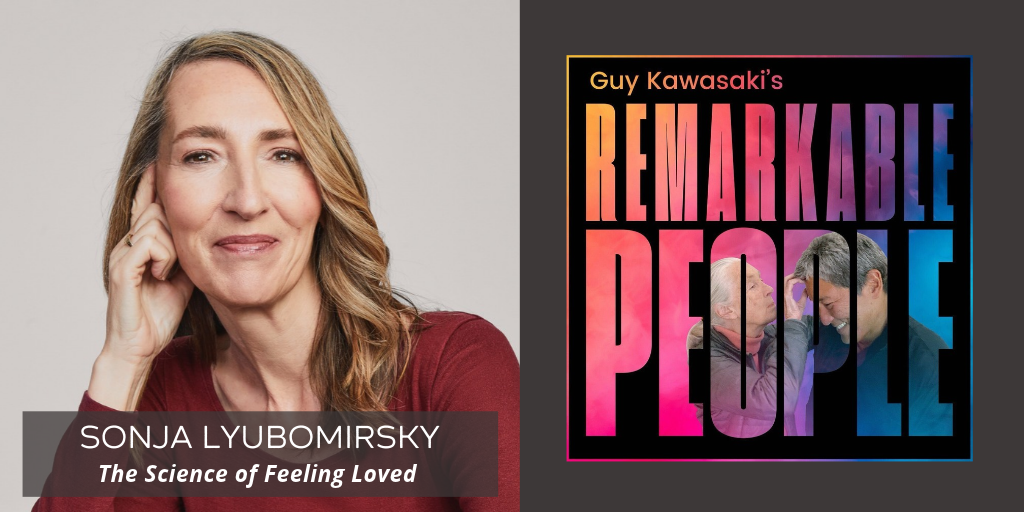
Welcome to Remarkable People. We’re on a mission to make you remarkable. Helping me in this episode is Sonja Lyubomirsky.
Sonja is a professor of psychology at the University of California, Riverside and one of the leading researchers in the science of happiness. Her work explores what makes people happier, how our relationships shape our well-being, and why social connection matters so much. She is also the author of the new book, How to Feel Loved, which takes on a deceptively simple question: what does it actually mean to feel loved? Her answer is less about grand gestures and more about how we show up in the conversations that make up our relationships.
One of Sonja’s most compelling points is that being loved and feeling loved are not necessarily the same thing. Someone can be showing you affection, helping you, buying you gifts, or doing everything they think should communicate love, and yet somehow the message never lands. Sonja argues that feeling loved starts with being known, which means getting curious about another person’s inner life and really listening when they share it. She describes five mindsets that help create that connection: radical curiosity, listening to learn, an open heart, multiplicity, and sharing.
The conversation also gets into one of the most memorable ideas from the book: Sonja’s “sea-saw” metaphor for connection. We tend to walk around with parts of ourselves hidden, but genuine curiosity, warmth, acceptance, and attentive listening can help someone reveal more of who they really are. When they do the same for us, the relationship becomes a back-and-forth process of knowing and being known. Sonja ultimately reduces the whole idea to a formula that Guy can get behind: feeling loved equals asking plus listening plus sharing.
That idea reaches far beyond romantic relationships. Sonja argues that the same habits can strengthen friendships, families, workplaces, and even conversations across political divides. She also pushes back on the idea that technology automatically makes us less connected, pointing out that meaningful curiosity, listening, and sharing can happen through a phone call, FaceTime, or even a thoughtful text. The challenge is not simply to find more love, but to participate in the conversations that allow people to give and receive it.
Please enjoy this remarkable episode, How to Feel Loved in a World That Feels Lonely with Sonja Lyubomirsky.
If you enjoyed this episode of the Remarkable People podcast, please leave a rating, write a review, and subscribe. Thank you!
Transcript of Guy Kawasaki’s Remarkable People podcast: How to Feel Loved in a World That Feels Lonely with Sonja Lyubomirsky.
Guy Kawasaki:
Hello, everybody. It's Guy Kawasaki. This is the Remarkable People podcast, and you know we're on a mission to make you remarkable, and we found another person who's going to make you remarkably loved.
So this is Professor Sonja Lyubomirsky. And she's a kickass professor at UC Riverside. She is an expert in love and an expert in happiness. Man, what was your PhD dissertation about?
Sonja Lyubomirsky:
I'll tell you, it was showed that people who are happier are less likely to compare themselves to others and are less affected by social comparisons.
Guy Kawasaki:
Wow. I need to read that dissertation. Oh. And listen, in addition to being a professor, she's also an author, of course, and her latest book is called How to Feel Loved, which is a really great title. I really like this title. And people who listen to my podcast, they know that sometimes I just go off the rails.
And I have to say, to start off, there's several places in the book where you say, "Yeah, this guy, he was the most prepared. He was the most, you know, sharing and the most open," and all that. So when I read that, I took notes. His name was Shankar.
Sonja Lyubomirsky:
You're competitive, aren't you?
Guy Kawasaki:
I am a very competitive person,
Sonja Lyubomirsky:
That's funny.
Guy Kawasaki:
I want to leave Shankar and Terry Gross in the dust.
Sonja Lyubomirsky:
Hilarious. Yeah. No, but I was talking about friends and former romantic partners who are, like, the best listeners I've ever had, that kind of thing. So yeah, no worries. No, you're not competing with them.
Guy Kawasaki:
Oh, rats, so continuing the theme of going down rat holes, in the middle of the book, you dropped a little factoid that I stopped and I read that, I said, "What?" So we're going to start there, and that little factoid is you dropped the fact that the United Kingdom has a Minister of Loneliness. And I said, "No, that just cannot be. There is no Minister of Loneliness."
Of course, I checked, and there really is a Minister of Loneliness. And then my warped mind said, "So you're telling me the country with a Minister of Loneliness is the one that exited the European Union?” Is that irony or what? So tell us about this.
Sonja Lyubomirsky:
It's definitely ironic. First of all, I love that we're starting “in medias res.” Yeah, I think there's other countries that have Ministers of Loneliness, too. I would vote for having Ministers of Happiness, which a couple of countries, I believe, have because what do we really care about?
Most of the government is concerned about making money, right? But why do we make money? Because it makes us happier. Presumably, that's why we think it's going to make all the citizens happier, and more connected, less lonely, but yeah, I think it's cool to have ministers of something psychological.
Guy Kawasaki:
Yeah. I think you're also channeling Vivek Murthy because Vivek Murthy, when he was surgeon general, was very concerned about the effects of loneliness on Americans, right?
Sonja Lyubomirsky:
Exactly. He wasn't the first, but he had a platform, which was excellent, that he used to highlight this problem that is sort of this loneliness epidemic. Yeah, absolutely.
Guy Kawasaki:
All right, so let's get into the topic. We have to start at a base, which is what is it like to feel loved? What are we looking for here?
Sonja Lyubomirsky:
Great question. What does it even mean to feel love? We define love, by the way, my co-author Harry Reis and I, we define love very broadly, right? So we're not just talking about romantic love, we're talking about love with friends and neighbors and family and even strangers sometimes.
And when you feel love, you basically feel a sense of warmth and connection and affection, and you feel like you matter to the other person and they matter to you. I think that's really the critical component.
Guy Kawasaki:
And to use the book's old title, which is Men Are from Mars, Women Are from Venus? Are they different about what it takes a man and a women to feel loved?
Sonja Lyubomirsky:
There are some gender differences. We actually have a chapter on individual differences, gender differences, cultural differences. And of course there are individual differences. There's this great quote that's attributed to Jane Fonda, I think, and the quote is something like, "Women's friendships are face-to-face, and men's friendships are side-by-side."
Yeah, isn't that nice? And you can kind of apply that to feeling loved, that men kind of do activities together. They're not necessarily as sharing and conversing as much as women do. But my book is really about conversations and how to have conversations in which you feel loved, and you make the other person feel loved.
Guy Kawasaki:
Maybe this is a male perspective, but now I'm listening to this, I'm thinking, so can you just tell me like what is the evidence that I'm looking for to prove to myself that I'm feeling love? What am I looking for?
Sonja Lyubomirsky:
Again, that's a great question because many people are loved but they don't feel loved. Here's a metaphor. Here's my cup of love, okay? And let's say the other person, let's say it's a family member, and they're pouring love on top of you, and that's the evidence that you're talking about.
It could be they're saying something or they're behaving. They're washing your car or they're saying, "I love you," or they're really truly listening to you, but sometimes they're pouring the love into the cup, but maybe there's a hole on the bottom and it's leaking out. Or maybe there's not much of an opening on the top and it's not even getting in.
So that could happen as well, or you don't trust the evidence. You think it's inauthentic. Maybe you don't even notice it. You maybe are not even aware of it. That happens sometimes. So lots of reasons why people might be loved but not really feel loved, right? Not really trust the evidence.
Guy Kawasaki:
If there's somebody listening to this and they're saying, "I think I'm being loved, but Sonya, what does it mean? What am I looking for? Is it communication? Is it gifts for Christmas? Is it flowers? Is it remembering my birthday? What are the things that would help me conclude that, “Yes, Guy, you are loved?"
Sonja Lyubomirsky:
I can't answer that question because it's going to differ for everyone. We can invoke the love languages, which by the way, the idea that there are these five love languages that predict how strong your relationship is going to be, we actually debunk that in our book in case you're interested.
But the love languages are a nice heuristic because some people like when they receive gifts, they feel loved, and other people, when they receive words of affirmation, they feel loved. Actually, I have an anecdote that I had someone I was dating who would send me gifts in the mail, and they were like really cute things, and they actually came in the mail in a package.
There'd be like a book with a little note, and it was nice, but I didn't realize that like gifts were his love language. So I didn't interpret it as signs of love. What I really wanted was for him to say, "I love you," right? Which he didn't, which he wasn't doing.
So yeah, our love languages could be different. So yeah, there's no one way to feel love. People are going to feel it differently. But there's some universals, and that's what we talk about in the book. So for example, we start with curiosity, and when you show genuine interest and curiosity in the other person, that makes them feel known and understood and ultimately loved.
So I think there's some kind of, we call them universals, almost universals, right?
Guy Kawasaki:
So Sonya, what if I'm listening to this and I'm just totally exasperated and I effectively say to you, and this is in a marriage, right?
And you say, “I provide a good income. I take the kids to the school. I pick them up. I perform any kind of sex you want. I make sure the cars are running. I file the income taxes. I cook. I clean. I bought you a Porsche for your birthday, and you tell me you don't feel loved. Oh my God, what do you want out of my life?" So what do you say to this person?
Sonja Lyubomirsky:
Well, this is exactly why we wrote the book because people still don't feel loved no matter what you do. And actually, when I give talks about this, I'll ask the audience, I'll say, "Has that ever happened to you, where you feel like you're doing everything that you can to make the other person feel loved, and they still don't feel loved?"
Okay, so this is what the book is about. So what do you do? I just mentioned, first, you think about what really matters to that person. You know what? Because maybe that Porsche is not really what they were looking for, right? And so we say, “The key to feeling loved is being known, is to know and to be known.”
Okay, so you're doing all these things for your wife, okay? But do you really know her? And does she really know you? And so I would start with trying to get to really know her and think about what really matters to her. What is it like to be her on the inside?
What is her inner life like? And then ask about it. Ask about her passions. Ask her what she's thinking about when she wakes up in the morning and when she goes to bed at night and keep following up. And then when she answers you, to truly listen and not just to try to fix or try to, whatever, think about what you want to say.
And that's what really makes people feel loved. That's, again, a near universal.
Guy Kawasaki:
Okay.
Sonja Lyubomirsky:
Not the Porsche.
Guy Kawasaki:
So Sonya, as I read the book, I thought to myself, the whole premise of the book is that I am not feeling loved. But what if you actually are not loved, and that's why you're not feeling love? I'm in Silicon Valley. I can appreciate this. So what if I'm just a detached, egocentric, isolated billionaire asshole, and I'm not feeling the love? Maybe it's because you're not loved.
Sonja Lyubomirsky:
I know. It's a great question.
Guy Kawasaki:
Is there a presumption that you are loved?
Sonja Lyubomirsky:
I've never been asked this question before, so thank you for surprising me. I asked you to surprise me. Okay. It's true. Some people, when they don't feel loved, it's because they really are not loved, and that's actually not really what the book is about.
It's really about most of us, or I would say almost all of us, are loved in at least some of our relationships. But let's take your premise. You're a billionaire asshole in Silicon Valley. By the way, I travel to the Bay Area all the time. In fact, I'm going there this weekend, so I love it, but I get your question.
Then, again, I'm going to go back to what do you do? You put effort into making the people in your life to feel more loved by you. That's the first step. You don't just sit around and be like, "Oh, I want to feel more loved." By the way, what do we usually do when we want to feel more loved? What we do is we try to impress others, right?
Like that billionaire guy. "Look at the car I'm driving." Again, I've anecdotes like that of guys who are like, "Look at this amazing car I'm driving." I'm like, "Okay, that might impress me, but it doesn't make me feel loved."
Mostly what we try to do for if we don't feel loved, we think, "I must not be lovable enough. I need to tell the other person how wonderful I am and show off my wonderful qualities."
And by the way, this happens a lot on first dates or business meetings or even right now, Guy, right? We're talking for the first time, right? I think it's the first time we're talking, and I want you to think that I'm interesting and expert and kind and funny.
I want to impress you, and maybe you want to impress me or maybe not, but impressing you is not going to make us feel loved. It's not going to forge a connection, so that billionaire Silicon Valley guy, if he wants to feel more loved, he needs to put effort into making other people feel more loved. How do you do that?
To know them and to be known. To ask questions. Ask them deep, real questions about their lives. When they answer, listen to learn. We have this chapter called “Listening to Learn.” Listen to learn as opposed to listen to respond and then share about yourself. Share vulnerably. Show warmth to the other person.
Show kindness. Actually, listening is really interesting because listening is not just like, you know, you remember being in college, and you're, like, listening to a lecture. You want to get an A on the test, so you're, like, a very good listener, but you're not really curious, right?
So listening is not enough. You want to be curious, and you also want to have what's called positive intent, towards the other person. They need to feel like you care. You want them to be happy. You care about what matters to them. So that's what that guy needs to do, is to show authentic interest in others.
Guy Kawasaki:
It seems to me, after that explanation and reading the book, this is a rare instance where, in a sense, what you're saying is words speak louder than actions because most of the time we're saying actions speak louder than words, but this time it may be the opposite, right?
Sonja Lyubomirsky:
It's such a great point, actually. Such a great point. And what's interesting is there's a gender difference. So this book, it does have a kind of little bit of a feminine tint to it. I think you are trying to get at that because I think there's this gender difference.
I think this research is old, so I don't know if it's replicable. Men are a little bit more likely to show love by action, like I'm going to wash your car. Women are a little bit more likely to show love by words. But this book really is about words. Yeah, it is about how to have a conversation that makes you and the other person feel loved.
And our take home point is, if you don't feel loved, you don't have to change yourself necessarily. By the way, it's always good to work on yourself, but it's not really about changing yourself. You don't have to change the other person. You just have to change the conversation.
You have to show up differently in your conversations with the other person. Because when you think about it, Guy, and maybe as a guy, you don't agree with this as much as I do, but a relationship is basically a series of conversations. Even when you're not talking, you're communicating.
Guy Kawasaki:
Is it a mutual responsibility for the lover and the lovee, or where is the burden here?
Sonja Lyubomirsky:
The burden starts with the person who's not feeling loved because the first step, which is a little bit counterintuitive, if you don't feel loved enough, the first step is to try to make the other person feel more loved. And I had this happen with a family member who I didn't feel as loved by as I wanted to, and so I was thinking, "Oh, what, I need to somehow make myself more lovable."
And then I realized, no, I need to show an interest in them. And so I tried to think about what are they really passionate about and then ask them questions about it. And that kind of worked. They were responsive. So the burden's really on you, but we are assuming that the other person is eventually going to reciprocate.
Now, the reciprocity principle or the reciprocity norm is one of the most powerful norms of social behavior, right? We probably wouldn't survive as a species if we didn't have that powerful norm.
So Guy, if I'm really curious about you, I'm asking you questions about things that really matter to you, and then I'm listening to your stories, I'm assuming you're going to reciprocate eventually, and you're going to also show interest in me and ask me questions about my life and inspire me to share. So it's this dynamic two-way process.
Guy Kawasaki:
Bob Cialdini will be proud.
Sonja Lyubomirsky:
Of course, yes. I love Bob. yes. Thank you.
Guy Kawasaki:
Yeah, Bob is a great guy. I am so glad that he didn't try to become a professional baseball player and he went with the academic path because his influence and persuasion is a very big deal here.
Sonja Lyubomirsky:
No pun intended.
Guy Kawasaki:
Yeah, and you know what? One of his latest theories is preciprocation, right? As opposed to reciprocation. So in preciprocation, you would be asking this person about their interests and all that before to set it all.
Sonja Lyubomirsky:
Yeah, interesting. I'm taking notes on this. This is really what we're doing in our book is to teach people preciprocation. I just haven't used that word before. Yeah, thank you for that. I'm taking notes. Yeah, I'm your student today apparently.
By the way, podcast hosts, they don't have to read this book, right? Because already your job is to be curious about the other person and to truly listen to them, right? You're already doing that for a living. Yeah, kudos to you.
Guy Kawasaki:
Okay, can I give you another point where I said, "Oh my God, that is such a great analogy," which is when you basically said, “You need less dopamine and more oxytocin.” And I read that, I said, "Oh my God, that is so interesting. She has it down to the chemical level about being loved." So would you explain?
Sonja Lyubomirsky:
So dopamine is associated with positive emotion, but especially associated with motivation, and oxytocin is called the cuddle hormone, it's associated with loving warm feelings.
Now there's a lot more nuance than that, but also in a funny way, dopamine is the hit you get with cocaine. Oxytocin is what you get with MDMA. So I guess if we're saying MDMA is better than cocaine for you, but you don't have to actually take, the drugs are just shortcuts, right?
These are sort of natural ways when I cuddle with my kids, I literally feel high. I feel high. I'm just like, "Ah." And I tell them that. And the reason is because my body's releasing oxytocin and serotonin. Also, sort of other neurohormones that are making me feel like I'm on drugs, but really I'm just cuddling.
Guy Kawasaki:
Since I'm talking to a scientist, so do you believe that the oxytocin causes the cuddling or the cuddling causes the oxytocin? What direction are we going?
Sonja Lyubomirsky:
Great question. I think it's both, but I would vote more for the cuddling leading to the release of oxytocin, but I'm not a neuroscientist. These are not really questions for me, although I have read some of that research.
Guy Kawasaki:
So now that we've established the need for being loved, will you just kind of go down the list and say what are the benefits of feeling love? What's the upside?
Sonja Lyubomirsky:
Sure, sure. It almost seems obvious, right? People who feel loved are happier and they have better relationships, they have stronger relationships, they're more creative, they're physically healthier, they experience less stress. It's basically all the relationships with happiness that occur with feeling loved.
When you don't feel loved, when you're feeling lonely, you have kind of the opposite, right? Like physical health suffers, there's more anger and hostility. Some people think a lot of the world's problems could be reduced or eliminated if we only just made people feel more loved.
No, when you think about people joining gangs, there's a lot written about this by people other than me, you know, that these are people who really want, like, a sense of belonging and connection with others.
I was at a dinner, and they were an expert on terrorism, and they're saying these terrorist organizations are almost all young men who really do not have families, and they don't have wives and children.
Of course, some of them do, but most of them don't. And I guess the question is if they had families that really made them feel loved, maybe they would be less likely to join a terrorist organization. Again, this is a speculation on my part, but some people have written about that. Feeling loved is very important.
Guy Kawasaki:
My next question is, it’s actually not a question, it's a request. I would like you to explain your brilliant sea-saw metaphor. S-E-A saw, not S-E-E saw.
Sonja Lyubomirsky:
Yeah. We changed the spelling. So the sea-saw metaphor, we're already talking about it, is this dynamic process where I make you, Guy, feel loved, and you make me feel loved. So imagine you and I, we're sitting in a sea-saw, but it's partially underwater.
That's why it's called the sea-saw, S-E-A. It's partially underwater, and the idea is we're both partially submerged underwater, and what that means is we don't really show our full selves to each other, and that's true for most people. Most people, they're kind of hiding a lot of themselves, and that does not lead to feeling connected and loved.
And so then what the first step, as I mentioned, is I show real, true, authentic curiosity in you, and by doing that, it's as though I'm pressing on my side of the sea-saw, and I help lift you up out of the water.
And basically, the metaphor is I'm going to help you reveal more of your full self, share more about who you truly are on the inside by showing genuine curiosity, warmth, acceptance, and really listening to your story.
And then hopefully you reciprocate, and then you push down on your end of the sea-saw, and then you lift me up a little bit, and then you ask about my story and what matters to me, and then I share vulnerably or more fully. And it's kind of this dynamic process where we're getting to know each other.
Again, knowing and being known and knowing the other is really the key to feeling loved, and that's how we do it, by asking questions and by sharing and by listening.
Guy Kawasaki:
Okay, so now, we've been skirting the issue, we’ve touched upon it, but I just want to lay it out, and I want you to just lay out these five mindsets and just give us the gist of these five mindsets because it is the key to your book.
Sonja Lyubomirsky:
Yeah. And we've already mentioned them all. So this now I'll just say them out loud. So the idea is if you want to feel more loved, if you want to make other people feel more loved, embrace these five mindsets, okay? And I'm going to go a little bit out of order of the book.
The first one we call Radical Curiosity. We already talked about this. You show genuine interest in the other person. You ask them questions, you ask them intimate questions. You know what we don't do often enough? We don't ask each other deep questions because we think it's going to be awkward. We think it's going to be perceived as being nosy.
And sometimes it is. We have to read the room. The pacing is really important. But yeah, ask questions. Okay, so that's Radical Curiosity. Then you guys start telling your story, and then I need to listen, and that's called the Listening-to-Learn mindset. Listening to learn as opposed to listening to respond.
Listen like you're going to be tested tomorrow on what the other person is saying, right? Very important. And then how do you listen? We actually have two more mindsets, and one is called the Open-Heart mindset. You listen with warmth and kindness, like you really like the person. You want them to be happy.
That's very important. And you also listen with acceptance, and recognition that we're all kind of messy and complex. This is actually one of my favorite mindsets called the Multiplicity mindset. This idea that we all contain multitudes, like the Walt Whitman quote. We're all like a quilt of positive and negative qualities, of positive and negative behaviors, good and bad things.
Sometimes I'm kind and sometimes I'm selfish. Sometimes I'm loyal and sometimes I'm narcissistic. I'm talking about myself. It's true. And I bet you're like that too, right? You're laughing. I bet there's times you've been both sometimes kind and sometimes selfish, right? We've all been all those things.
And so seeing other people in their full messy complexity is part of that as well because when you're sharing your story, you might be sharing something a little negative about yourself. So we just mentioned the Radical Curiosity mindset, the Listening-to-Learn mindset, and then you listen with an open heart, the Open-Heart mindset, and Multiplicity mindset.
You listen with multiplicity, with acceptance, forgiveness, recognition. And I'm leaving one out, which is really important, maybe the most important, which is the Sharing mindset, is that if I want to feel loved, I need to be known.
I need to let you know me. I need to lower my walls. I need to share because if I don't share, Guy, if you don't really know me, I'll always wonder, does he really love me?
Like would he still love me if he knew me? So it's very important to share more of your full self with the other person. And pacing is very important, so you don't just dump your traumas and secrets on the person right away, right? You have to share just at the right time and place, but the sharing mindset is very important and very interesting.
Guy Kawasaki:
So are you wiping off the map the concept of introversion? Can Susan Cain feel love, but she's an introvert.
Sonja Lyubomirsky:
Of course. I love Susan Cain. Actually, I did an interview with her, and I love her book. But this is, I think, a misconception, introverts don't just sit there alone, never talking to anyone. Actually, I think extroverts are better at sharing and listening.
I call myself an extrovert introvert, but I love going to parties, and I love telling stories to a group of people. That's not really sharing and listening that much, right? Introverts are very good at one-on-one deep conversations, but they need to recharge.
I'm also someone who needs to recharge and have my quiet alone time. I call it my woman cave when my kids are at home. I'm like, "Kids, I'm going into my woman cave now," as opposed to the man cave. And they're like, "Okay, Mom." I'm like, "Don't talk to me unless it's an emergency." So anyway, yes, I don't agree with that.
Both introverts and extroverts are capable of all of these mindsets and could be very, very good at all of these mindsets.
Guy Kawasaki:
If I were to talk to your spouse or talk to your kids, would they say, "Oh my God, my mom, my spouse is just a loving beast. I feel loved every day by her." Or does the shoemaker's kids have no shoes?
Sonja Lyubomirsky:
Okay, so here's the thing, and I'm telling the truth. I have a lot of faults. I have a lot of shortcomings and weaknesses like we all do, but love is not one of them. I am extremely loving. No, really, I am so loving, almost like too loving. By the way, physical touch is my main love language too.
I'm constantly, like, all cuddling with my kids. My friends and I are very affectionate. We tell each other we love each other. In fact, my kids will get confused because I'll be on the phone and I'll be like, "I love you so much." "Oh, yeah, me too." And they're like, "Mom, who are you talking to?"
And I'll say, "Oh, this is my friend.” Because why aren’t we? Why don't we use the word love more often in our every day, at work, with our friends, with our neighbors even. I think love is a beautiful thing. We should use that word more. So yeah, I have to admit, I'm a very loving person.
I have other faults, but that's not one of them. Don't ask me about the other faults though. Just kidding.
Guy Kawasaki:
Yeah. Let's not push multiplicity too far here.
Sonja Lyubomirsky:
By the way, we do want to turn multiplicity not only onto other people, but onto ourselves as well, right? And be compassionate about ourselves because we all make mistakes and we all do things we regret.
Guy Kawasaki:
All right, so now it's 2026. We have AI, we have social media, we have text messages, we have email, we have Zoom, we have all this stuff. So can you teach me how to use these kinds of tools when I'm not face to face? How can I make those things help me give love and feel loved?
Sonja Lyubomirsky:
I love how you asked that question because most people just assume that that technology is bad for connection, and it's not, of course, it's not necessarily bad. Have you ever received a text message that's just so beautiful and made you feel understood and loved and you're like, "Oh," of course you can do that.
And I would say that use the same mindsets, you know, curiosity. You can ask important, meaningful questions of the people in your life, whether it's on Zoom or text or, whatever, FaceTime or even social media. I don't love social media because it's just not as personal.
But anything that can be done one-on-one, show curiosity, truly listen, share. It's a little bit harder to gauge. For example, sharing, right? Like, how do you gauge how much to share with someone when you're not necessarily face-to-face?
I think if you have voice, we actually have a study that showed that any medium where you have voice, like including phone call or FaceTime or video call or face-to-face, that's more connecting than when you don't have a voice.
I think the theory is we humans, we're hardwired to respond to each other's voices, right? Not to screens. And so we can tell so much by a voice. Like right now, actually, I can't see your face, but I can hear you, and I feel like I know what you're thinking.
So voice is 90 percent. So yeah, sharing, listening, curiosity, acceptance, warmth. We can do all of that even with new technologies.
Guy Kawasaki:
Yeah, because it seems to me that some so-called experts, they have completely written off digital communication, and saying it's nothing but bad and we need to limit time, and kids up till, I don't know, twenty-one shouldn't use any phones or anything. And I look at my use of social media, and I guarantee you, I have relationships all over the world. It could not be possible without this. Not at all.
Sonja Lyubomirsky:
Absolutely. Actually, here's an example. I've had an au pair. I have four children, and so we've had au pairs for many, many years. I think for nineteen years we had au pairs. And they're mostly from Germany. And for the first, like, ten, fifteen years, they were really homesick.
And then something magical happened. One year they stopped being homesick, and it's because they were connected with their friend on WhatsApp, on social media. They were connected with their friends and family, like, all day long, every day.
So yeah, it's really magical. But like with anything, yeah, I'll make an analogy with money. Money makes people happy. Money makes people feel loved when it's spent on the right things. Same thing, of course, with social media and digital media. When done right, it absolutely can be beneficial to your connection, and to your happiness.
Guy Kawasaki:
Hallelujah because that is not a popular opinion when I express it. Okay, so I have three more questions for you. So question number one is, and this may be duplicative, not in a Todd Blanche sense, but this is duplicative in the sense that the question is, let's say I buy into all this, and now I am feeling that I want to improve being love and giving love, and so what is the roadmap?
Okay, I bought into it, Sonja, now tell me again, what do I do? What's step one, two, and three?
Sonja Lyubomirsky:
You show genuine interest in the other person. You find out what the other person is about, and then you really listen to them, and then you share. So actually, I'll tell you two things. I have this friend who's in marketing, and for years he used to tell me, "Sonya, you got to condense everything you do into a simple formula."
And I'd be like, "No, I can't do that. I'm a scientist. It's more nuanced than that. There are a lot of factors." And he kept saying to me, "No, you got to distill things into a formula." And finally I did, and here's the formula: feeling loved equals asking plus listening plus sharing.
Feeling loved equals asking plus listening plus sharing. Asking with curiosity, listening with warmth and acceptance, sharing vulnerably. So that's it.
Guy Kawasaki:
I can deal with it. I love tricolons, so you know, yeah. Three is magical.
Sonja Lyubomirsky:
I love threes. All my writing's all threes. And if I can add one little thing. My thirteen-year-old, or I guess maybe when she was eleven, eleven-year-old daughter, she said to me, "Mom, I have this classmate," and she was interested in some really obscure sport, okay? I've never heard of it.
And she's like, "Mom," she told me about this obscure thing she's interested in, and a month later I remembered, and I asked her about it. And this girl, she was so happy. She just kind of went crazy, and she went on and on telling her about this obscure interest. But the point is to find out what truly matters to the other person, and then ask them about it, that will make them feel loved. Yeah.
Guy Kawasaki:
Okay, so now let's pretend and the word is pretend. Let's pretend that now we decide that there's a Secretary of Feeling Loved for the United States.
Sonja Lyubomirsky:
I love it.
Guy Kawasaki:
What do you do?
Sonja Lyubomirsky:
Okay, first of all, appoint me as that secretary, okay?
Guy Kawasaki:
Right.
Sonja Lyubomirsky:
Yeah, I'll be that secretary. What I do, first of all, is I tell people about this concept, and I feel like everyone is walking around with walls around them all over the United States, all over the world, but I'll just keep it to the U.S.
Look at that. Look outside your window. I'm looking at all these people outside my window. They're walking around with walls around them. Go to the grocery store, go to your workplace, go to your house where your family is. People have walls around them. And you know what? Try to expand or lower those walls by asking, listening, and sharing, and that's what I was going to do.
And maybe I'll create workshops or some kind of like media promotion to encourage everyone to do this more. Ask, listen, and share. It's so simple, and it'll just make the world a better place.
And by the way, all this polarization that we have where people on opposite sides of the political spectrum like won't talk to each other, you know, hate each other, that's going to be reduced if we show curiosity, really listen, and share about our personal lives. I promise you, studies have shown it reduces polarization, it reduces prejudice, reduces hostility and hate.
Guy Kawasaki:
Yeah. Oh, man. I second that motion.
I cannot remember who said it, but we had a guest on this show from the political sphere, and he said, until recently, the members of Congress all lived in one area, so you could have a Democrat, a Republican, a Democrat, a Republican, and when their kids played Little League or soccer or hockey or whatever, they would all be on the sidelines, not separated by party affiliations.
And that's when Congress worked well, but now everybody lives in separate little areas, and they're not at the same softball games and all that, and they're not asking and they're not sharing and they're not listening because physically they're elsewhere.
Sonja Lyubomirsky:
Oh, what a great anecdote. I just wrote that down. There's a study that was done where they had people wearing different hats, so to speak, talking to each other, and they were asked to share vulnerably. And it was amazing. Like one guy would say, "Hey, I'm really struggling with my kid, this is what's happening."
And the other guy would say, “I'm really struggling with my kid too." And that lowered their prejudices against each other because they realized that they both have actually a lot more in common than they thought they did. Like those Democrats and Republicans on the sidelines of the soccer game.
Guy Kawasaki:
Okay, now I'm going down a little bit of a rat hole to end this. So actually I lied. I had four questions when I said I had three.
Sonja Lyubomirsky:
Okay.
Guy Kawasaki:
So second to the last question, I have to tell you, you know how I began this podcast and I said I read fifty-two books a year and you have the best introduction of all the books I've read in six years. I will also say that you have a book that has more sources and stories and epigraphs than any book I have read in the last six years.
And these are studies. There’s like Dalai Lama, there’s psychiatrists, there’s social psychologists. There's like everything. There's movie references. My God, you must watch every movie and remember the plot of every movie because there's so many movie stories.
Sonja Lyubomirsky:
No, just the ones we mentioned. Yeah.
Guy Kawasaki:
I just want to know how the hell, as a writer to a writer, how did you find so many stories and quotes and studies and all this? What's your methodology here?
Sonja Lyubomirsky:
I'll tell you, first of all, for this particular book, I also had a co-author, Harry Reis, who also had lots of stories. But you know what, Guy? You have those stories. Think about all these conversations. You've already mentioned a bunch of stories to me just in the last hour. They're in you.
You have them, and those are the stories that are going to go into your next book, or the films or the TV shows or the quotes that stand out to you. You don't really have to go that far. It's not like I'm like, "Oh my God, I have to think of six stories." You're experiencing them every day.
But I do have to say, I do have a lot of friends, and I talk a lot, so you get a lot of stories. And this is my secret is I keep a little journal, but the journal is not like, "Dear diary, this happened today." It's more every day I write down. It could be anything. It could be, "This person said this to me. This quote is great."
These notes from our podcast today, I'm going to put in my journal, and so that's very useful. They're kind of like lines or like this funny thing my daughter told me yesterday, I wrote that down. So that's one of my secrets is write things down.
Guy Kawasaki:
I forget who said it, but when asked what is writing a book like, the response was, "It's opening a vein and pouring your blood onto a page." And that is a very good example.
Sonja Lyubomirsky:
I like that. It’s a little bit like having a baby too. Yeah. It's our baby, right?
Guy Kawasaki:
I can’t relate to that, but yeah. I have oxytocin. I don't have Pitocin. But anyway, thank you very much. And I'm going to go communicate with my spouse. I'm going to go communicate and share.
Sonja Lyubomirsky:
Asking, listening, and sharing. Go ask, listen, and share.
Guy Kawasaki:
Well, thank you so much, Sonja. It's just been remarkable and delightful having you on my podcast.
Sonja Lyubomirsky:
You're a remarkable person. Thank you.
Guy Kawasaki:
This is so fun, and it's so useful. We will give you a plug one more time. This is the name of the book. It's right here, How to Feel Loved, and it's remarkable. Let me thank my team. Let me show them some love.
So let me thank Madisun Nuismer, co-producer and the brains behind the outfit. There’s Tessa Nuismer, who helps us with research as well as transcription. There's Jeff Sieh, co-producer and sound design engineer, and Shannon Hernandez, second sound design engineer.
So that is the remarkable team, and we are on a mission to make you not only be remarkable, but now also to feel loved. Thank you very much.
Sign up to receive email updates
Enter your name and email address below and I'll send you periodic updates about the podcast.



Leave A Comment