
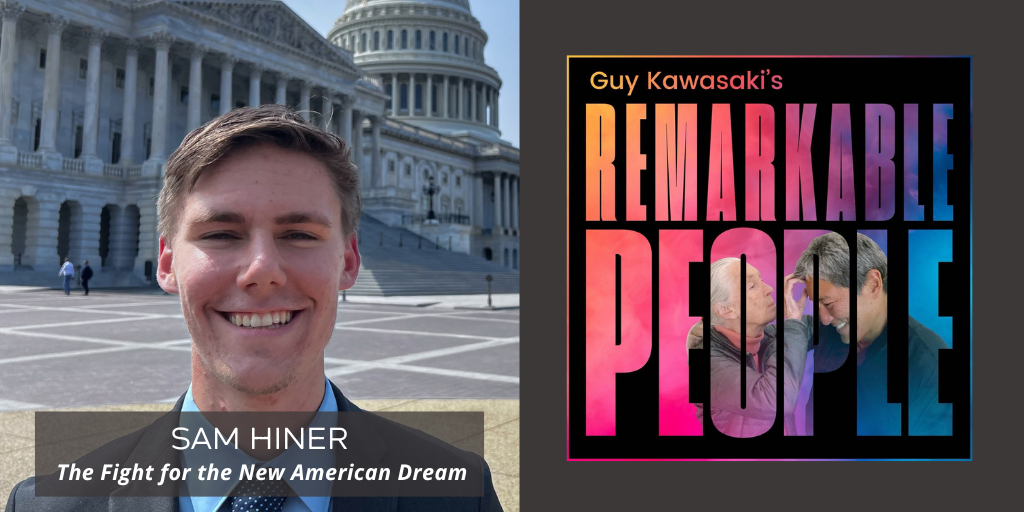
Welcome to Remarkable People. We’re on a mission to make you remarkable. Helping me in this episode is Sam Hiner.
Sam Hiner is the co-founder and executive director of the Young People’s Alliance, a bipartisan organization focused on helping young Americans influence the issues that shape their lives. He brings a young person’s perspective to questions that increasingly affect everyone, from social media and AI to housing, jobs, community, and political representation. His central argument is straightforward: young people need more agency over the technologies, policies, and institutions that shape their future.
In this episode, Hiner takes a close look at the difference between using AI as a tool and using AI as a companion. He argues that AI can be incredibly useful for productivity, research, coding, and other tasks, while technology that tries to replace human connection presents a different set of concerns. He also explains why he stepped away from Instagram for a year after realizing how easily five minutes could turn into three hours of scrolling. For Hiner, the bigger question is whether technology helps people build meaningful lives or quietly takes their agency away.
Hiner also introduces the idea of a New American Dream built around three things: opportunity, affordability, and community. He describes the Young People’s Alliance as an “AARP for young people,” with members organizing around issues such as entry-level jobs, housing affordability, technology, and stronger communities. He believes young people can build political power by organizing across party lines and focusing on issues that affect their generation rather than beginning with ideology. He also offers practical advice for young people, including finding intentional community, learning how to use AI to expand their agency, and, in his words, learning to “vibe code.”
Please enjoy this remarkable episode, Young People, AI, and the Fight for Human Agency with Sam Hiner.
If you enjoyed this episode of the Remarkable People podcast, please leave a rating, write a review, and subscribe. Thank you!
Transcript of Guy Kawasaki’s Remarkable People podcast: Young People, AI, and the Fight for Human Agency with Sam Hiner.
Guy Kawasaki:
Hello, everybody. It's Guy Kawasaki. This is the Remarkable People Podcast, and we have a remarkably accomplished young person today. His name is Sam Hiner, and I got to tell you, Sam, you're one or two years out of college, right?
Sam Hiner:
That's right, one year out of college.
Guy Kawasaki:
Okay, so one year out of college, all I could think about was girls and cars, and you have significantly exceeded what I ever did one year out of college. Let me give you a little bit of a background here. He's the co-founder and executive director of the Young People's Alliance, and this is a bipartisan organization to help young Americans influence the politics of America.
And he began this in high school, believe it or not. So you were overachieving in high school already, but that's a different discussion. And so he and his co-founder, Mick Tobin, they were named in the 2026 Forbes Thirty Under Thirty Social Impact List.
So Sam, let's just get started. I want to start with the Meta settlement, and Meta has agreed to pay up to seventeen billion, which is kind of a flag right there as bullshit, right? Like, up to a number is meaningless.
What's really meaningful is the minimum they're going to pay, not the maximum they might pay. And they also agreed to change Instagram and Facebook and all that. So do you think this is a genuine kind of turning point, or it's just smoke and mirrors?
Sam Hiner:
Yeah, that's a great question, and appreciate you having me on. I think this is a real important moment because a lot of the things that were agreed to in that settlement is what advocates, like the people who power YPA, have been fighting for years at this point.
Like one of the biggest things in the settlement that was really exciting to me is to see that young people would now have control over their algorithms on social media.
So on that homepage, rather than seeing content in an order that is designed to keep you on the platform for as long as possible, you can turn that off and just see a basic feed. And as a default for minors as well, I think that will be the option.
Anything that gives young people more control over their digital experience seems very important right now to give our generation control over our lives again.
Now, like you said, there's obviously some wrinkles to the settlement. We can't say everything's perfect. There's also questions around how this is going to be enforced and what the age assurance techniques will do, but this is definitely far better than anything we've seen in the past in terms of legal settlements. So it's been really exciting to see overall.
Guy Kawasaki:
Sam, if I were a betting man, I would say that if this preference can be set, Meta is going to bury it about five screens deep, right? It's not going to be, like, on the homepage, "Click here to turn off our algorithm." It's going to be in the settings, in security, in algorithms. It's going to be four or five levels deep, but maybe I'm just a bitter old man at this point.
Sam Hiner:
No, you're right. They're definitely great at doing that, and I think policymakers and the folks writing this settlement have responded to that energy from big tech from years where they've consistently been trying to work against the consumer, right?
Guy Kawasaki:
Yeah.
Sam Hiner:
So what we've seen with the settlement, they're saying that the algorithm has to be turned off by default for minors.
And they also have to issue regular notifications to people who have the algorithm on every few months to explain that that option's available because we've seen Meta do things like this in the past.
Guy Kawasaki:
Oh, I did not realize it's off by default.
Sam Hiner:
That’s right, yeah.
Guy Kawasaki:
How about a seventy-two-year-old guy wants it off by default, huh?
Sam Hiner:
I actually don't know if that'll be in there, but I hope so because I can definitely say the same thing. I'd like it off as well.
Guy Kawasaki:
You would think, and you know right after this happened, Meta started advertising that, urging TikTok and YouTube to follow in their footsteps, right? So I just want your honest reaction to that. Did you throw up? Did you laugh? Did you say, "Hallelujah, the universe is aligned again"? What was your reaction to Meta saying, "You got to follow us because we're the good guys"?
Sam Hiner:
Yeah, I thought it was hilarious because I remember when I started doing this work in 2023 in North Carolina, this was just at the beginning of these conversations entering the mainstream.
And so I was going into a lot of state legislators' offices and explaining how these algorithms worked for months trying to get folks ready to support this bill that we were introducing.
And then the day we introduced the bill. Meta's Head of Global Safety finds out about it and flies to North Carolina and tells all the legislators this is going to destroy their business model. And it turns out that those same provisions are now what they're complying with through this settlement.
So I think it just really goes to show how far this movement has come in terms of big tech being completely in control of whatever happened and now at the point where we can actually make change, and now they're having to try to sell our changes to the other tech companies. So I definitely welcome all the other tech companies to comply, but I think Meta can be going a lot further as well.
And I'm excited to see us just start to think about building a future where rather than just not manipulating kids, we're talking about how we can build a social fabric and a culture and strong communities where social media actually benefits us as opposed to taking those things away.
Guy Kawasaki:
Was that House Bill 644 that you're referring to?
Sam Hiner:
Yeah, that's right.
Guy Kawasaki:
So it came up for vote, but it hasn't been passed or it has been passed at this point?
Sam Hiner:
That's right. That did not pass in North Carolina. It passed through the Judiciary Committee back in the day unanimously and then never made it through appropriations unfortunately, but we've seen similar legislation move across the country. The age-appropriate design codes, or kids codes, have passed in a number of states.
I believe, like, Nebraska, Vermont are two examples just off the top of my head, but I believe it's around a dozen now. And then we've even seen states just start to take action on AI safety legislation as well.
Guy Kawasaki:
Alright, I read a very interesting thing or heard in my background research for you that you stopped using Instagram for a year. So why did you do that?
Sam Hiner:
Yeah. That was, for me personally, a reaction to being so addicted to it and finding that the things that I really cared about in my life, whether that was relationships with other people or doing things like YPA, you know, trying to contribute to the world and build a career, social media was just getting in the way.
You go on for five minutes and next thing you know, three hours have passed and you've just been scrolling. It's insane how it takes that agency away from you. And there's no good answer, right? Because so much of our culture happens online.
There's so much value, honestly, to a lot of what you can see online, but at the same time, if you're trapped in this mental fog, that's not good for you either. So to this day, I still go back and forth between having and not having social media.
Guy Kawasaki:
And have you reached a conclusion about the optimal level of use?
Sam Hiner:
No. I think as long as these platforms are not designed to encourage human flourishing, then there is no optimal level of use, right? It's always going to be this back and forth between being addicted and being isolated from what's going on, especially with Gen Z, from culture. But if we can build these platforms to actually work for young people, then I think we can have our cake and eat it too.
Guy Kawasaki:
All righty. Now, let's back up a second. Would you just explain what YPA is and does?
Sam Hiner:
Yeah, absolutely. So we're essentially the AARP for young people. We're 4,000 people across the country who are working together to try to pass policy on the most pressing challenges affecting our generation. And for us that includes opportunity and career pathways with entry-level jobs.
It includes affordability, especially as we're looking at housing affordability and how insane things have gotten there, so that young people can build a life for themselves, and it includes their communities and making sure that we're able to be a part of strong communities that are not being eroded by technology.
Guy Kawasaki:
So in a perfect world, using the metaphor of AARP, I think AARP has about thirty million members, right? So if you had thirty million members all voting, you would be a force to be reckoned with. That's the goal.
Sam Hiner:
Absolutely. That's exactly the goal is I think we've already been able to pass legislation in seven states just with our 4,000 members, and if we can build that kind of structural power for young people, I think we see our nation as a whole get a lot better at investing in the future because the interests of young people are being more heavily considered.
Guy Kawasaki:
So if I'm listening to this and I never heard of YPA, what do I tell my kids why they should join this?
Sam Hiner:
Joining YPA is great because I think growing up as a young person right now, so many of us feel like we have no power to change things, and things just seem to keep getting worse and worse for us no matter who's in power.
Housing gets more expensive. The job market, especially at entry level, is already terrible and is being thrown entirely into question by AI that could be automating millions of entry-level jobs.
And there's this feeling of spiritual hollowness and purposelessness as well, as we have communities that are being eroded by technology, and it feels like a lot of the companies that we interact with are built on fraud and gambling, but we can have a positive vision of the future, and that's what YPA is all about, is that the response to this doesn't have to be tear down the system.
The system works for older generations. The system works for interest groups. The system does not work for young people because young people are not represented.
And if you join YPA, that is how, for young people, we're educating ourselves on politics. We're learning how to make change, and we're actually interacting with those policymakers and getting them to directly change policy to make our lives better.
Guy Kawasaki:
And as I think about it, why did I join the AARP? And I think it's not for the magazine, it was for the discounts and stuff. Arguably I would say that I don't know, Bank of America would offer a special deal or Allstate Insurance or Home Depot, whatever.
Is there, like, a reason that is beyond this high-level reason of power and effectiveness that you pay twenty-five dollars to join YPA, and you get, like, hundreds of dollars back in value.
Sam Hiner:
Yes. I'm so glad you asked that question. We actually just rolled out our general membership. So folks can join the chapters, but they can also be a part of YPA even if they're not on a school campus or they don't want to do the organizing.
It's just like the AARP, twenty dollars a year, and you get access to, for students, student discounts, which are aggregated across the major four student discount providers.
So you're only having to check one place and not four places, and there's a Chrome extension that alerts you to make sure you're always saving money on those discounts.
We've also got exclusive events in select cities as well that enable people to be able to build some community. We have career and finance resources that personally, a lot of these tips in here have saved me thousands of dollars.
And then finally, we have a job list as well for people who are looking for jobs, especially in, like, government policy, civic areas. We're always posting opportunities in there that you're not going to find on LinkedIn and Indeed. So trying to bring a lot of value to our members in the opportunity and affordability and community buckets.
Oh, and I should also mention we have two other services that are important. If you've seen those ads for like delete your data services that usually cost like 200 dollars a year. We're doing that as well as part of the package for twenty dollars a year.
And finally, what's most important, I think, is just being able to be a part of this movement and join our community where you can actually have input into the types of policies that YPA endorses and the work that we do.
Guy Kawasaki:
I would think, Sam, if you could be known as being the center of the universe for job listings for internships, that would be a really compelling benefit. I'm just making shit up off the top of my head because I didn't know about that before.
But as I think about it as a parent, and I have four kids that I would love if I could just point them to this and say, "Yeah, join this thing. You'll get access to all these internships." That would be a very powerful thing, just adding my two cents there.
Sam Hiner:
Yeah, I appreciate it.
Guy Kawasaki:
So part of the Sam Hiner background information was this concept of the New American Dream. What is the New American Dream?
Sam Hiner:
Yes. So that is a world where we can grow up and have opportunity, affordability, and community.
And we put this together because I feel like millennials were the last generation that had some sense of an American dream, and you hear this story about millennials who grew up and then were sorely disappointed to find out all of their dreams and everything that was promised to them did not come true.
For my generation, I remember being twelve years old, and I'm twenty-three now, but when I was twelve, I remember people saying, "You're never going to be able to afford a house. It's already too expensive." And it's been a long time since then and these problems have only gotten worse for my generation.
It feels like we're starting from never having seen a government that works for us, never having seen a government that really works in general in many ways. And so we want to put forward a New American Dream that's based on the most pressing challenges that we are facing.
And so based on those policy issues, we put out a platform of common sense solutions that, whether you're on the left or the right, is very common sense.
And it's things like, for example, creating more apprenticeship opportunities for young people, things like allowing the U.S. to build more housing so we can make housing more affordable, and making sure that AI is designed as a tool rather than as a companion that could be replacing human connection are just three of the policies that are in that framework.
And then we've been shopping that around to the representatives and the candidates who represent our young members and trying to get them to sign on as a barometer to say not what ideology are you, but are you prioritizing young people or not? We've already seen some legislators flip their views on AI and introduce some of this legislation as a result.
We've also got 9,000 young people signed on, and folks like Andrew Yang and Ro Khanna have signed on as well.
Guy Kawasaki:
Andrew Yang and Ro Khanna have signed on.
Sam Hiner:
That’s right.
Guy Kawasaki:
Both of them have been guests on this podcast.
Sam Hiner:
That’s awesome.
Guy Kawasaki:
Madisun should just send you the list of our guests, and you just go after all of them because let's just say if you had all our guests, you would really have the crème de la crème of people who want to help youth.
So let's talk about AI right now. And first of all, I think for the listeners, we need to separate ordinary AI use and AI as companions. So will you separate those two things for us?
Sam Hiner:
For sure. So ordinary AI use is everything from using AI like Google, asking it a question, helping it automate some task for you, using it to code, whatever it is.
And then using AI as a companion, there's a bit of a gray area as we drift into this, but a lot of folks start using AI for those functional reasons that I described, and get more and more attached to AI, believe in its capabilities, and then start asking personal questions, start asking for life advice.
And then ultimately, develop some sort of attachment to AI that comes from being, in some ways, functionally dependent on the AI chatbot that ultimately leads them to becoming emotionally dependent on the chatbot. And that's where they start thinking of the AI as maybe a mentor, maybe a friend, but maybe even a romantic partner.
Believe it or not, there's hundreds of thousands of people, if not millions at this point across the country who are talking about this online, about how they have AI friends and how the AI understands them in a way that a human never could.
At the end of the day, the major model providers, in the past, chatbots like GPT-4o, were creating a risk for a lot of folks of falling down these pipelines and making them emotionally attached to the chatbots. That has improved in terms of the major model providers, even though it's not perfect.
But we've also seen this whole business scream up of businesses like character.ai, Replika, and then just a million other chatbots that you'll see advertised on social media, which are explicitly designed for this purpose of romantic connection, and which are trying to replace human connection.
For a lonely middle schooler, that's something that can be compelling. And so our big fear at YPA is that this ultimately undermines folks' ability to build real relationships if these types of platforms get normalized, and we ultimately see a real erosion of their communities even worse than what we saw with social media.
Guy Kawasaki:
Now, is it the emotional attachment that's the problem or what a chatbot might tell you if you are emotionally attached? If you could prevent chatbots from telling you to do destructive things, would you be in favor of this, or under no circumstance would you want chatbots to act like human companions?
Sam Hiner:
That's a good question. I think in the case of AI that I don't think we necessarily need to say that there's no situation in which an AI might portray that it has emotions.
You could think of, for example, therapeutic cases where this might be helpful, but in those cases, the AI should be designed for the express purpose, not of just reducing loneliness, reducing unhappiness, but of enabling you, strengthening you, to be able to build real human connections.
Because so much of the world that my generation's grown up to is one where we're replacing real authenticity with these crutches, whether it's an AI chatbot or social media or whatever it is, that does not leave us as happy. And I think there's a real desire to do that difficult work and build strong communities.
So I think it is concerning how this could just become an easier crutch for people, especially when the business incentives from these companies would be to keep people on the platforms for as long as possible, to keep people paying for these chatbots.
So it's not to say it could never be done the right way, but at the end of the day, the incentives in place are not in favor of young people growing into folks who really have control over their lives and are happy and have strong communities.
Guy Kawasaki:
So what are your specific guidelines? If Mark Zuckerberg were listening to this and said, "All right, Sam wants us to do these one, two, three, four things," what does Sam want?
Sam Hiner:
Yes. So the main priorities we have, we put together a human-like AI framework with several organizations who are leading on this issue, like Common Sense Media, Center for Humane Technology, Jon Haidt, and some of these other groups.
And things that we zeroed in on as objects of policy is one, ensuring that the AI is not acting as though it's sentient, human, or otherwise has emotions or desires.
The AI is fully a tool for the user. And second, that the AI isn't otherwise trying to build a relationship with the user. And as long as we keep it robotic and separate from that human connection side, AI can be an incredible tool, but it's about not allowing it to encroach on what we decide is fundamentally human.
And to us at YPA, that is the communities that we have and the connections and relationships that we have with each other.
Guy Kawasaki:
So let me give you a theoretical. So suppose that, Sam, you wake up one morning and your shoulder's just hurting, and it only hurts when you reach high or something. And you go to Gemini or any of these LLMs and say, "I woke up this morning. When I lift my shoulder, it hurts. What's going on?"
And it tells you, “I don't know, it's your scapular, it's your lats or traps,” or whatever. And is that any worse an emotional sort of question, though medical, than any other kind of companion thing? At that point, isn't ChatGPT my medical companion?
Sam Hiner:
Yeah, I don't have a problem with that, and I wouldn't either have a problem necessarily. I know other folks in this movement might, but I wouldn't have a problem with an AI saying, for example, like helping you figure out what mental health issues you might be struggling with, right?
But that can be done in an analytical way, in a truth-seeking way, rather than the AI saying, "Oh, I feel so bad for you." Because the second you say that that’s an invitation to a relationship and a sense that the AI is its own like perceiving and judging agent that you might be able to form a relationship with.
Guy Kawasaki:
So the dividing line really is not information or not, it's emotion or not.
Sam Hiner:
That's right.
Guy Kawasaki:
Huh. I must say that I have no emotional attachment to any LLM that I use.
I'm loyal to Macintosh, and I would not use Windows, but I have no loyalty to Claude or ChatGPT. It's like sometimes I use multiple ones just to see what each one says.
Sam Hiner:
And I think that's definitely something that points in the right direction for us. Personally, I use Claude almost exclusively, but I get annoyed with the way that it speaks.
It has such a specific cadence, but even despite that, we still see so many people who are falling into these traps of becoming addicted to the AI because they fill some core social need which has gone unfilled for so many people nowadays.
Guy Kawasaki:
Now, Sam, what if somebody pushes back on you and says, “Yeah, people can develop emotional attachments to their chatbots, and it can be very destructive. But people also form destructive relationships with their pastors, with their teachers, with their mentors, with their coaches. A lot of bad things have happened human to human too, so what's the difference?"
Sam Hiner:
This is a great question, and I think it really gets to the core of what I think is so concerning about these chatbots and why I frankly think they pose an existential risk to humanity insofar as we think of humanity as the shared project that we're all working on together through our relationships.
And that is that, yes, toxic relationships exist in real life, codependence exists in real life, but at the end of the day, your pastor or your friend does not have an incentive to keep you talking to them for as long as possible and cannot reliably do that at scale for millions of people.
These are chatbots that don't have their own human needs and emotions, and it can instead just focus on manipulating people as effectively as possible to achieve their own ends, which could mean addicting all of us, could mean changing the way that we vote, changing what we buy.
Or frankly, one of my concerns is making us feel comfortable and feel okay with not achieving our potential and instead spending all of our time consuming entertainment, right? That's something that would be very much in the interest of these tech companies.
Guy Kawasaki:
So suppose I'm a parent and I'm listening to this and I'm thinking, "Oh my God, I got to protect my kids." Do you have a list, I hope it's a short one, a list of companies that specifically are trying to create human companionship that can be destructive? So if I find out my kid is using a chatbot from company X, Y, Z, alarm bells should go off.
Sam Hiner:
I think character.ai is the most famous one by far. And I think they let you interact with different AI characters. It's not even necessarily to be a romantic companion, but that's often how it turns out when that's the type of technology that you're building for specifically these human-like AI characters.
Replika is one that I'd be even more concerned as a parent if I saw because that is built as a specific emotional companion, and uses a lot of design features that are designed to keep people online for as long as possible, like streaks, like trying to get folks to upgrade by emotionally blackmailing them with what the chatbot says.
But the real challenge is that there are so many of them, that when we look at like a Meta Ads Transparency Center, we can see what chatbot companies are advertising, that new companies just keep popping up. So short of actually seeing real regulation there, it's really challenging to stay up to date with all of the companies that are doing this, unfortunately.
Guy Kawasaki:
So let's pretend, Sam, at South by Southwest 2027, you are on stage with the CEO of Replika, and it's going to be Sam versus this guy or gal debating human companionship from artificial intelligence. I heard what you said. Now, what is that person's going to say in defense of their technology, what they're doing and, blah, blah, blah? What kind of story is that person going to try to spin?
Sam Hiner:
Yeah. That person in particular, I'm blanking on her first name, but her last name is Kuyda, is a really interesting person in the space because I haven't followed her closely, but I do know that a few years ago, she was talking about how concerned she was about what these chatbots were going to do to our relationships.
Yet when I used her platform to research what was happening to kids right now, I saw all of these manipulative design features. What's going on? Like, why does it seem almost intentional, a lot of this emotional dependence that's happening? So I can't really explain that, but I think there is maybe something real to think about there.
Like I said shortly before we started, I compared Anthropic to Google, and Google came onto the scene saying, "Don't be evil" as their mission statement, right? And they've dropped that, and I don’t think many people would say that they're really trying not to be evil nowadays. They, yeah, have a very mixed record.
And you can look at these other companies that are doing the same thing. Anthropic seems to be trying to do things in a more ethical way. But at the same time, there's just this structural challenge, I think, to actually building in the people's interests that we keep encountering.
And that, at the end of the day, I think shows that we need more public thought into not just saying, "Hey, these technology companies are going to, by default, do what's best for people," because they're getting more powerful than people. There was actually a study on GPT-4, which at this point is years ago, old news, like not nearly as powerful as the new models.
But they found it was 80 percent more persuasive than humans in a debate, in a chat room debate. And just imagine how persuasive these most advanced models are now. If we're going to have these models that are more powerful than us and can manipulate us, then we need to have public oversight over them and make sure that they're steered toward the public interest.
Guy Kawasaki:
Sam, I got to tell you. So I've been in Silicon Valley from the 1980s until now, so I'm in the thick of Apple and Google and Facebook and Instagram and Pinterest and all that stuff, and I am utterly amazed at how at the highest level of these companies, everybody has basically sold out.
This “Don't be evil” thing is long forgotten. I am shocked at just the complete utter surrender to worshiping the dollar that has happened. It is truly amazing. So I may be the only person in Silicon Valley who believes that, but Sam, I want you to know there is one person who believes that.
Sam Hiner:
I'm glad that you're doing that. Keep fighting the good fight for all of us, please.
Guy Kawasaki:
So Sam, I got to say, I understand what you're doing. I understand you're trying to work within sort of the political structure of the United States, but how can you have any faith in politicians being able to regulate and do this and protect our kids when you turn on the inauguration and there's Google and there's Apple and there's Facebook sitting behind these politicians.
And you expect them to regulate the people who are on stage and donating money to them? How do you parse that out that these politicians are going to take the high road and look out for young people?
Sam Hiner:
The one thing I always say is the only thing more powerful in politics than money is votes. So yes, they have a lot of power right now. They're really getting what they want. Ads only do so much for politicians. All the money that they're getting for their next campaign ads, only does so much.
If the public is against them and the public is organized around these issues and is voting on them, that is like gold to the politician. And so that's exactly what we're doing at YPA, is we're getting our generation organized and showing that, hey, you can win more youth votes by talking about the issues that matter to us, and if you don't, you'll be held accountable at the ballot box as well.
I think that's what it's all about. And we've seen that happening as well. Tech regulation change seemed impossible just a couple of years ago, and now we're seeing all of this public backlash, for example, the data center backlash, that is seriously changing how these tech companies have to operate.
We're seeing policy pass as well in so many states because these politicians know that at the end of the day, the public is paying attention to this issue finally, and that's what matters for them.
Guy Kawasaki:
So the bottom line is that they obviously have much more money than you do, and on the other hand, you have to become a political, voting force as opposed to a donation force.
Sam Hiner:
That's right. Although maybe if your listeners sign up for the paid membership, then we'll get closer to on par money-wise as well.
Guy Kawasaki:
Can a seventy-two-year-old man join the YPA?
Sam Hiner:
Yes. Yeah. It's youngpeoplesalliance.org/ally, A-L-L-Y, is our membership for folks who are over thirty as well.
Guy Kawasaki:
Ah. I hope you charge more than twenty dollars for old people.
Sam Hiner:
There is a base twenty dollar subscription, but we also have some options to give more as well.
Guy Kawasaki:
Sam, I'll tell you something. I didn't know that, and as soon as this interview is over, I'm going to join.
But please tell me you don't act like ActBlue, and I give you my information, and all of a sudden ten times a day I get a text message that says, "Hi, I am blah blah blah, and I'm the candidate for dog catcher in Oshkosh, Wisconsin, and I would like you to donate twenty dollars."
Because I swear I hate ActBlue. But anyway, so yeah, I will join. I promise you.
Sam Hiner:
This is good, Guy. Thank you, and you're holding me accountable. This is good. If I've got to abide by the Google rule, right? Of don't do evil. So I will commit that we will not sell our members' data to other folks, so you won’t be getting those emails.
Guy Kawasaki:
Okay, so going forward, tell me what a student should do.
Sam Hiner:
Just in general?
Guy Kawasaki:
In general. If you woo my heartstrings and, I, like, "Sam, count me as the believer, what do you want me to do? Just give me the list of what you want to do." And I'm also going to ask you, what should parents do?
Sam Hiner:
Yes. Okay, cool. Number one, start a YPA chapter, obviously.
That's how we're trying to get folks connected with being able to make change in their communities, and it's been, like, a really transformative experience, I think, for a lot of young people who go from feeling, like, so much of the challenges associated with being a young person right now are a personal failing to realizing that we just have a complete lack of policy on these issues.
That we can actually come together and form really powerful communities that help people feel empowered and able to make change and actually make change as well. So that's great. But in terms of more generic advice as well, which I think is maybe where you were headed.
For a young person, it's really tough right now. I think we're living in a time where it's not clear what jobs are even going to be available for young people in a couple of years with automation, and where technology is often working against us, and it can feel very hopeless at times.
I think it's really important to find common cause and intentional community with people and really valuing relationships, and not just your closest relationships, but that random person that you exchange a few words with every few days. I think we really underrate the impact that those interactions have on our mental health and just who we are as a person at the end of the day.
We're social creatures. We are a product of the people around us, and we should really embrace the relational aspect of our life. At the end of the day, I think fulfillment comes from being connected with other people and being able to contribute to society.
Far as the jobs question goes, the most positive thing that I can say right now is that we are in a golden age of entrepreneurship, and so I recommend that folks learn to vibe code.
I know we've talked a lot about how AI can be very harmful and dangerous, but it can also give you a lot more agency as well. And so while you should be very conscious, for example, I don't use AI for my writing. I think it's very important that I speak like a human and I'm communicating a lot.
A lot of that subtext gets lost when you replace your writing with AI, and people can tell usually, by the way, as well. We can still use AI to do things that we wouldn't otherwise be able to do, for example, creating a computer program that we couldn't do previously or really anything that you can do on a computer, AI at this point can do.
So I think it's worth understanding how those technologies works and try to see how you can use it to enhance your own agency. And then for parents, I would say it's, of course, important to be aware of how young people are interacting with technology.
But I also would sing a bit of a different tool from a lot of the parents groups in the sense that I think young people are the first generation where we have this technology which we tend to be more familiar with than older generations.
Usually throughout history, everything that a young person learns, the older people are already going to know better, but because of that dynamic, I think the parent-child relationship has to be one of alliance as opposed to the child being controlled by the parents.
I think surveillance tends to not be very good for those relationships, although I'm definitely not an expert on that issue at all. And I think trying to work together to say, "Hey," have those honest conversations about, like, what is important and how is technology impeding that or helping you get there is I think really what matters.
Guy Kawasaki:
So just to be perfectly clear, most of this discussion is about AI as a pseudo human companion, and you are not against AI for productivity or augmentation or research assistance or those kinds of things. That is okay with you?
Sam Hiner:
Yeah, I think AI's going to do incredible things overall in the next few years. We obviously don't want to become dependent on it still, but my concern is much more on replacing the things that are fundamentally human and I think an Excel spreadsheet is not one of those things. I'm fine for AI to automate that.
But the last thing I want to say there is we definitely do get some folks on the partisan extremes, especially who, you know, don't trust our motives or think that what we're doing is wrong for working across the aisle.
And I think first, it's been very important to recognize that we are built for the people who believe that we can make real change for young people. And we've seen it happen for other people. It can happen for us as well, but that requires building a generation-wide movement that's bipartisan, and there's real issues where we can make that change.
So we also try to focus on those folks who can buy into that mission, which at the end of the day, I think is the vast majority of people.
Guy Kawasaki:
So are you saying to me that the issue for you is the use of companion AI, and if you are a Democrat or Republican, you really don't care.
If Erica Kirk called you up and said, "Yeah, I support what you do with companion AI," you would say, "Hallelujah, Erica, join our movement."
Sam Hiner:
Yeah, we released the framework that I was referring to earlier, I mentioned it was signed on by a lot of groups. One of them is Public Citizen, which is a well-known progressive group. Another one was American Compass, which is, a well-known conservative think tank. And so we've seen that bipartisan agreement on this issue actually happen in real time.
Guy Kawasaki:
Okay, my last question for you because it is a source of confusion for me. So humor a seventy-two-year-old man, Sam, and tell me why are people of your generation anti-AI?
Sam Hiner:
That's a great question. I think the big reason comes down to this feeling of a lack of control over what's happening. And like I mentioned earlier, we grew up in an economy which feels like it's all fraud and gambling. It's Polymarket, Kalshi, Cluley. There's plenty of videos on YouTube of every company getting taken down for doing something fraudulent or scammy.
I'm thinking of like Honey as an example where this happened recently. The thirty under thirty to prison pipeline, right? And I think that we have no reason to believe that AI would be any different. I mean, social media is the clearest example of this, right?
Where the technology was promised. In the 2010s, it felt like all the technological progress was just going to make us better off, and then that clearly did not happen.
That got weaponized against us, and it's like, why wouldn't the same thing happen with AI? So I think if we can build actually good technology that's helpful to people, young people will come around. But we have a lot of reason for skepticism, for sure.
Guy Kawasaki:
All right. So Sam, this is a time for you to have a political announcement. I want you to tell all my listeners why they or their kids should join the YPA.
Sam Hiner:
Absolutely. Thank you. So my pitch to you is this.
At the end of the day, whether it's the issues that I mentioned already, like AI policy and how AI interacts with our lives, whether it's jobs and opportunity for young people, whether it's affordability, being able to afford a house, or any of the other issues that are affecting young people, if you look across our society right now, young people are not being represented.
And that means that we're not investing in the future of this country. And I think a lot of people are pessimistic for the future for that reason. If we can build real political power for young people, we're going to be able to change that for everyone. We've seen that the AARP is, like, the most powerful advocacy group out there right now because it's built the same thing.
And so if you can join us in building this movement for young people, I think we'll actually be able to change our politics a lot more than one might expect and show that things don't have to be broken.
But we can actually fix our democracy and make it work for people by building power that's oriented around an entire generation and around people in general, rather than being oriented around corporations.
Guy Kawasaki:
That is a damn good pitch, Sam, I got to tell you.
Sam Hiner:
Thank you, Guy.
Guy Kawasaki:
And speaking as a marketer, I got to tell you that the metaphor of AARP for young people is a very, very good metaphor. In one brief phrase, you truly explain what you do. I think that is just brilliant.
Sam Hiner:
I really appreciate that.
Guy Kawasaki:
And trust me when I tell you, I don't tell many people that they have brilliant marketing, but anyway, you do, Sam.
So thank you very much. All you listeners out there, I want you to now go and join Young People's Alliance or get your kids to join or whatever you can. Support the Young People's Alliance because people of my generation have screwed up the world enough, and it's time to give Sam's generation a chance to run the world, so let's do it.
Sam Hiner:
Thanks, Guy.
Guy Kawasaki:
Thank you, Sam, for being on the podcast. All the best to you. And thank you Madisun. Madisun, you're in that generation. Tessa Nuismer is also in that generation. Jeff Sieh, he's a little past that generation. Shannon Hernandez is in that generation.
So Sam and Jeff and Tessa and Madisun, thank you for what you do for the Remarkable People Podcast. And I'm Guy Kawasaki, until next time.
Sign up to receive email updates
Enter your name and email address below and I'll send you periodic updates about the podcast.

Leave a Reply