
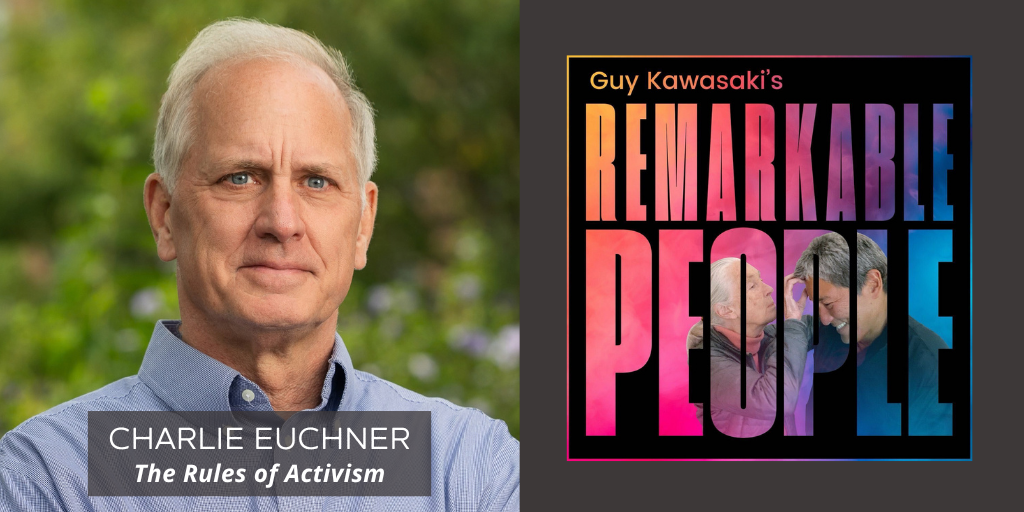
Welcome to Remarkable People. We’re on a mission to make you remarkable. Helping me in this episode is Charlie Euchner.
Charlie Euchner has spent years studying activism, political movements, journalism, and the people who turn ideas into action. He has taught at Yale and Columbia and has written extensively about major movements and moments in American history. His latest book, Rules of Activism, distills lessons from organizers and activists into practical rules for building movements that can actually accomplish something.
So what separates a memorable protest from a movement that lasts? Charlie argues that it starts with people, particularly with listening to them one at a time. He shares the story of Marian Dixon, a Baltimore teacher who initially insisted she wasn’t a leader or activist, but whose repeated conversations with an organizer revealed a remarkable history of challenging segregation and improving her community. That relationship eventually helped lead Dixon into a larger leadership role, illustrating Charlie’s larger point: effective organizing begins by asking people what matters to them rather than arriving with a predetermined agenda.
Charlie also explores why movements need a clear focus. He discusses the historical Nonpartisan League, the importance of identifying a small number of priorities, and the danger of trying to chase too many goals at once. He argues that social media, marches, and large public events can play an important role, but they become much more meaningful when organizers use them to build relationships and create specific next steps. His advice extends beyond activists themselves: Charlie suggests that leaders, companies, and institutions facing protest should listen, engage directly, and look for ways to become part of the solution.
Throughout the conversation, Charlie returns to the people who have influenced his understanding of activism, including Martin Luther King Jr., Bayard Rustin, Ella Baker, and Fannie Lou Hamer. He describes King’s relentless curiosity and evolution, Rustin’s ability to combine strategy with hands-on work, Baker’s commitment to grassroots leadership, and Hamer’s persistence in challenging established power. The larger lesson is straightforward: movements don’t sustain themselves through slogans alone. They grow when people listen to one another, find common ground, organize around specific goals, and keep showing up.
Please enjoy this remarkable episode, How Ordinary People Become Activists with Charlie Euchner.
If you enjoyed this episode of the Remarkable People podcast, please leave a rating, write a review, and subscribe. Thank you!
Transcript of Guy Kawasaki’s Remarkable People podcast: How Ordinary People Become Activists with Charlie Euchner.
Guy Kawasaki:
Hello, everybody. It's Guy Kawasaki. I am still in Honolulu, Hawaii, so when you see that background, it means that I'm not in California, I'm in Hawaii. And we have another remarkable guest for you. His name is Charlie Euchner, and Charlie, you have done so much in so many different places.
But, we are going to focus on his latest book, and it's called Rules of Activism. And when I saw this book, I said, "Oh, we got to have Charlie on." I just love this. I was a big fan of Saul Alinsky, and now, we got the man.
So you've covered a lot of topics, and you've also taught at Yale and Columbia, and your body of work is really quite impressive. When I grow up, Charlie, I want to be like you.
Charlie Euchner:
Be careful what you wish for.
Guy Kawasaki:
Yeah. So welcome to Remarkable People. I don't even know where to start, man. If you had told me that America would be where it is today a few years ago, I would've said, "You're kidding. You've been reading too much of Margaret Atwood's works. This is just not going to happen."
But here we are, let's fire away. Let's just get the big question that I want to ask you off the table, which is what should a Democratic presidential candidate focus on in 2028? And then we'll get into the details of how you came to this but just give me that answer so I can get it in my brain.
Charlie Euchner:
You already referenced Saul Alinsky, and so I'll tell you one of Saul Alinsky's greatest distinctions. He said that there's two sources of power: there's money, and there's people. And we are in a system right now that is overloaded with money, and the money doesn't come from a vast number of people.
It actually does, but the vast number produce only a little bit of it. There’s a torrent of money coming out from billionaires and people like Elon Musk and others, who really want to turn our country into a corporate system to the extent that it isn't already, and the masses don't have that kind of money.
But what the masses have is the masses. That is to say, what they have is people. They have people power. Every once in a while, people power gets aroused, it gets organized, it gets signed up, it gets deployed, and that's when the greatest things happen for democracy. And in fact, I would argue, as I do in the preface, that democracy is impossible.
By definition, it is impossible without activism, without arousing the people from the lowest levels of the system into the vast middle and into allies at the higher levels. And so my advice to the Democratic nominee, whoever that might be, is, look, I know you got to raise money.
You don't want to unilaterally give the money advantage to the other side. But your real power lies in the grassroots. Your real power lies in everyday concerns of fairness and equity and opportunity and protecting the environment, protecting the community, keeping people safe, avoiding unnecessary wars, and so forth.
And the vast majority of the American public is for all that. And so if you can somehow tap into that grassroots strength, then you not only have a chance to win, that's just step one, you also have a chance to govern. And Carville put on everybody's desk in the 1992 campaign, "It's the economy, stupid." I would say, "It's the people, stupid," you know?
And as soon as you forget that, as soon as you forget not only that's your mission, but that is your greatest resource, that's when you lose. That's when you give the advantage to the other side.
Guy Kawasaki:
Okay, so that's the big idea. “It's the people, stupid,” but going one level lower, are you supposed to talk about, "I'm the anti-Trump candidate. It's the economy, it's the immigration, it's LGBTQ+ rights." There's a lot of things on there you can pick from, or are you saying you pick from all of that? What do I do?
Charlie Euchner:
Right. I think what you do is you say, “What do ordinary people want, and what do ordinary people need?" Ordinary people need healthcare. There are so many people in this country, literally tens of millions, who would go absolutely broke if they got in a car accident tomorrow or if something more serious happened.
That's wrong. There are people whose jobs are being driven out or they're being de-skilled or they're being replaced and they don't have a career path. That's wrong. That has broad support for thinking about that, for doing something about that. So we could go down the line.
One of the greatest issues these days is with the centers for AI, and a lot of communities are rising up and saying, "You know what? This is ruining our water supply. It's ruining our electric grid. It's ruining our sense of community. We're not getting many jobs. We're bearing all the costs."
And so that's another rally round issue, but what they all have in mind is that ordinary people deserve to live their lives as well as they can, and they deserve to have the resources, or at least have the resources not taken away from them, not have all the negative externalities dumped on them while other people walk away with the big profits.
Guy Kawasaki:
Just FYI, for another podcast interview I had to do, I had to do the background research on data centers. And, if a data center is using an evaporative system where the water keeps recycling, it does not use that much water. Certainly less than an almond tree. But anyway, and the interesting thing is a golf course uses a lot of water, yeah. And guess who owns fourteen golf courses?
Charlie Euchner:
That’s true, yeah. Golf courses, almonds, avocados, there's a lot of things that use undue amounts of water and that's a whole issue of allocation of what really should be a common resource, but that's what the emphasis should be on is what's common? What do we have in common, and how should we think about what we have in common?
It doesn't mean that everybody's going to be happy. It doesn't mean that everybody is going to get what they want, but there needs to be a conversation. One of the little passages in philosophy that I like to quote is from Hannah Arendt and her book The Human Condition, and she talks about the public sphere, and I talk about politics as like being around a table.
People gathered around the table, and they're all looking at issues from different vantage points. They come from different backgrounds. They come with different interests.
They come with different skills and knowledge and different things to add to the conversation. But from these different vantage points, they have the opportunity to contribute to something common, and that's what we got to be thinking about.
We got to be thinking about how can we create situations where people come together and where they all have a say and they all can focus not just on getting their own needs met or opportunity to meet their own needs? But also, there are times when the public interest matters as well.
And so I think of politics, and one of the reasons I'm so fascinated by activism is that it creates this unique opportunity to bring people together around a table that have not been around that table before or who have been excluded or who have felt incapable of being part of that table.
Guy Kawasaki:
Do you think that a concept like democracy is, let's say, not tactical and practical enough? That, if you're campaigning on, "I'm going to preserve democracy," that is very different than saying, "I'm going to make your life better," right? So do you think democracy would be the wrong sort of topic?
Charlie Euchner:
No, but you have to put it in context. Look, I was just reading this wonderful book about the brain, and the author points out that when you use abstract terms, only the language processing networks of the brain get activated. But when you're able to connect that abstract idea to something physical and real, it connects to other parts of the brain, to other networks in the brain.
So if you just say, "Democracy, democracy, democracy," that could arouse some people, that could interest some people. We have all been raised in one way or another to bow to the altar of democracy, some more than others. But what it really means is real people getting together and having a say.
And so when there is a data center being located in your community, and it's sprung on you without any notice, without any public process, that's a failure of democracy.
That's really tangible. When the state of Texas reduces the number of ballot boxes dramatically, that is cutting ordinary, real, physical people out of the action. In the 2020 election, the governor of Texas decided that he was only going to have the mail-in boxes one per county.
And so Harris County, which has a population of whatever it is, six million or whatever, has one mail-in box, whereas another dinky little rural community, which I'm all for, but they get that same one mail-in box.
The courts overruled that, but that's something you can feel kind of tangibly and physically, that's just not right. Why should I have to travel two and a half hours and wait on a long line for something that other people can walk down the street? That’s just not fair, and you feel it in your bones when an idea like democracy is translated into real world challenges.
Guy Kawasaki:
All right. So do you think that the current two-party system, is it a matter of interpretation of democracy? So we fundamentally are all bought into this overarching concept, and it's just shades of how we implement it, or it's fundamentally different. It's like democracy versus fascism.
Charlie Euchner:
I think there are shades to everything. There's shades of democracy and there's shades of fascism. I hate to kind of be a broken record, but I'm going to come back to the people part of it again. The reason that the two parties are failing us, and they are both failing us, is that they pay more attention to elites than they pay attention to ordinary people.
So the question is, what mechanisms might there be out there in order to force them or give them incentive to pay more attention to their concerns? One of my answers I state in the preface of Rules of Activism. One of my answers is activism, but there's some very specific models that could work incredibly well, and in fact, they have worked. Let me talk about just one of them.
I'm finishing a book right now about Woodrow Wilson and his campaign for the League of Nations back in 1919.
One of the most fascinating stories that I've encountered, and I didn't know about it before, was an organization called the Nonpartisan League, and it was an organization that was started in South Dakota, and it eventually made its headquarters in Minnesota, and then it spread to Montana and Iowa and Missouri and Arkansas and some other places.
What the Nonpartisan League did, the NPL, is it took that nonpartisan part really seriously.
It said, "Look, we are not being paid attention to. We are not being treated well by the elites of both the Democratic and the Republican parties. So we're going to come up with a list of things that we think are absolutely essential for the fairness and the prosperity and the well-being of farmers."
They later added working people, factory workers and others to their coalition. And they said, "Here's our to-do wish. We want this, this, this, this, and this. And whichever candidate is willing to endorse that and commit to seeing it through, whichever candidate is willing to do, we're going to throw our mass grassroots organization behind them."
And for a very brief time, they managed to take control of South Dakota government and to gain some major positions in other states as well.
And actually, they gave a lot of their support to Republican candidates because the Republican candidates, at least the non-conventional Republican candidates, were willing to step up and say, "Yeah, I'll take that. I'll take your support in exchange for getting behind your agenda."
And right now, with this two-party system that we have, some people call it a kind of mono-party system, there's not enough incentive for either party to rally behind a real agenda for real working class, middle class, poor, minority, all of these groups that deserve to play an equal, that's not to say an oversized, but an equal role in their communities.
And I think that really what we need is a groundswell from the bottom. I don't know if you know Chris Hedges, this really wonderful author living in Princeton, New Jersey. He argues that we're so far gone that only radical activism can save us. He believes in the mass strike, as we've seen in many other countries, right?
Where people just walk off the job, they walk out of school, they walk out of everything in order to confront the government and get the government to either ensure fair elections or protect the environment or whatever the issue of the day might be.
But one thing is sure, is that if you leave it to these two parties the way they are right now, you're going to be waiting a very long time, and you're going to be enduring an awful lot of really unnecessary losses along the way.
Guy Kawasaki:
All right. I'm going to be a fanboy for a second here. This podcast has fifty-two episodes a year, which means I roughly have to do fifty-two research projects, which usually means reading fifty-two books a year at least.
And I have to tell you that of all the books that I've read in six years, nobody has more quotes and more high-quality quotes, and more quotes that reflect like really, really selective, selection of these quotes. What I'm trying to say is, goddamn, your book uses such great quotes. There must be hundreds of quotes. How did you find all those quotes?
Charlie Euchner:
Well, nobody's ever said that before, but I'll take it. As Abigail says in my favorite Columbo episode, "I accept all superlatives," but really it's constant reading, constant archive diving.
For some of the feminists that I talk about in one of the chapters, I'd never heard of two of them before, and I went to these oral histories at various universities and just read oral history after oral history till I found some people who told me stories that I had not heard before, and they gave me dimensions on the issue that I had not experienced before, and they happened to also be super articulate.
And then I also interviewed a bunch of people for this, and I've interviewed people on issues of activism and civil rights for years. It's been fifteen years now, but I wrote a book about the March on Washington, and I interviewed about 130 people who were there and were involved in the organizing and bringing people to it and so on.
And it's really important, especially if you're going to talk about popular causes to hear the voices of as many people as possible. I am not the one who matters. Nobody at the end of the day really cares what my hobby horse is, but I can be a conveyor of a lot of more brilliant and active and engaged people, so I'm really thrilled that stuck out to you.
Guy Kawasaki:
It was like after the first few chapters I said, "How the hell did this guy do this?” I'm not worthy, Charlie. I'm not worthy.
Charlie Euchner:
Oh, stop it.
Guy Kawasaki:
So you have these fourteen or fifteen rules, and I just want to discuss some of them. And the first rule you start off with is you have to “Connect, Listen, and Share.” So the underlying question there is, how do you have a good conversation?
Charlie Euchner:
I was lucky there too because I managed to talk to this really wonderful guy named Arnie Graf, who is a lifetime organizer. In fact, he worked with Barack Obama in Chicago when Obama was getting his start. And he works for this organization that was founded by Saul Alinsky called the Industrial Areas Foundation.
And over the years, the IAF has evolved a methodology for reaching out to people. The way that activists or people who are just kind of learning about, "Boy, I want to get involved in local affairs," or "I really want to get involved on the nuclear issue," or "I really want to get involved in the anti-war issue," or whatever, the first instinct is to go with your answers. And you know what?
Your answers might be 100 percent valid and well-thought and emotionally grounded, but if they don't resonate with the people at the grassroots, the people that we've been talking about in this conversation, then it doesn't really matter. And so eventually what evolved in the IAF is a method known as one-on-one or relational interviewing.
And so Arnie was telling me about how he would go from city to city, Chicago, New York, Boston, and he gave me a much more detailed story about Baltimore, where I went to graduate school. And, he talked about getting to Baltimore, and what's the first thing you do? You go to the local IAF organizers.
It happened that there weren't a whole lot of them in Baltimore at this time. The organization that he was trying to revive called BUILD was very much on the decline. His job was to actually revive it. And so he talks to the few people that he knows there, and the last question he asks is "Give me the names of two or three other people who are leaders, whether they know it or not."
And then so he goes and talks to them, and then at the end of that conversation, he says, "Give me the names of two or three leaders who I should talk to. They might not think of themselves as leaders, but they really are." The one story that I tell, and I love this story, I get kind of goosebumps when I talk about it, is meeting this woman named Marian Dixon.
And one of the people in the local Catholic church told him about this elementary school teacher, an older Black woman named Marian Dixon who grew up in St. Mary's County, Maryland, which at the time was intensely racially segregated and violent. She eventually moved to Baltimore, became a teacher.
She was recommended because she had helped create and develop and expand a youth education program in this church. So the preacher said, "Yeah, talk to Marian. She'll be great." He goes to her and he says, “Your priest says I should talk to you."
And she says, "Oh, no, no, no, no. I'm not a leader. I'm not involved in this kind of stuff. You got the wrong person." And he says, “Would you mind me even just talking to you?" And she says, "Yeah, sure. Why not?" So she invites him over. They have coffee and biscuits in her living room, and they talk about her teaching career.
They talk about her defiance of segregation in St. Mary's County. And they talk about teaching and learning and young people and all the usual topics that you discuss in a get-to-know-you meeting. And he says, "Can I talk to you again, Ms. Dixon?" And she says, "Sure. But remember, not an activist and I'm not a leader."
And he says, "That's okay. But you can have another conversation, right?" And she says, "Okay." And so they do it again and again, he learns about her activism in St. Mary's, which she did not consider to be activism. When she was a young girl, the Blacks had to sit at the back of the church. She thought that was ridiculous and marched herself up to the front.
The priest had the deacons carry her back, and that was the end of it. But then the next week, she went straight to the front, priest got involved, told the deacons to carry her back. They did it. That was the end of that. And then finally they talked to her parents about their unruly child. The parents said, "Don't talk to us. Marian is Marian."
And so finally, after several weeks of this, the priest just said, “Okay, you can sit wherever you want." And so from that point on, everybody, Blacks and whites, could sit wherever they wanted. That's a really heroic moment of leadership and activism, but it doesn't get you headlines.
And so Arnie explained to Ms. Dixon that this is actually a really supreme example of leadership, as was her work in the classroom, as was her work in the school. Finally he said, "Would you like to attend an ‘action?’"
An “action” is the IAF term for when you directly engage somebody in authority, and you usually confront them, and you usually confront them with a list of demands and a deadline and an implied consequence if they don't come through.
And she said, "Oh, no, no, no." And he says, "Don't worry. You don't have to say a word." And so she goes. At this first “action” that she attended, the group managed to get a promise from a Baltimore City housing official to do some things that had been resisting for years.
Basically change the way houses got boarded up so that wood didn't get pulled off and burned for fires and that kind of stuff.
Guy Kawasaki:
This is the plexiglass story.
Charlie Euchner:
Exactly, so she left the meeting and she said, "Wow, we've been trying to get something done on that forever, and you did it in one meeting." And he said, “Pretty impressive what the power of numbers and the power of confrontation can do." Eventually, he asks her to participate in one, and then he asks her to lead one.
To go to the end of the story, she ends up being the head of BUILD, Baltimoreans United in Leadership Development, and she ends up being a major force in Baltimore politics.
And by the time she finished this work, BUILD had annual meetings of thousands of people where every elected official felt bound to go and to be responsive and to be put on the spot, to promise this or promise that. And a lot of very tangible benefits came out of that.
And this all comes from that one-on-one methodology, is that you talk to one person at a time, and you ask them what matters to them. You ask them what the issues are. You don't go in with big abstract ideas. The issue is poverty or housing fairness or something like that.
You ask them, "What's bothering you?" So with that housing issue, the first action that Marian Dixon went to, that issue didn't come from some leader somewhere saying, "It's ridiculous that these boarded-up houses end up being set on fire in the middle of the winter for drug dealers," right? That didn't come from some top-level organizer.
It came from the people below, and that's really the magic. Although it's not magic, it's just common sense and hard work. But we'll call it magic for now. That's the magic of this one-on-one style of organizing.
Guy Kawasaki:
But you know, Charlie, there is some intern or there is some beltway consultant listening to this and saying, "Yeah, that was fine one-on-one, but this a different world, Charlie. It's social media. We're dealing with millions of people. We cannot do it this way anymore." To which you say what?
Charlie Euchner:
Which I say that social media and any form of outreach is certainly a useful tool to have in your toolbox. One of many useful tools, but don't mistake it for the whole process.
And don't mistake depending on parties for the whole process, and don't mistake depending on unions for the whole process, or environmental groups, or public interest groups, or anybody else. In the long run, it's a lot easier to do things the right way.
It's a lot easier to get people mobilized across the board, community by community, than it is to blast out these general missions and statements and so forth, and hope they get involved. Now, I'll tell you that sometimes this mass action, this kind of internet organized action can be really great.
I remember going to the first Women's March, was it the day after Trump's inauguration in 2017? And I remember that like a few days in my life because it was the first time since election day that I actually breathed, and I actually felt that I was connected to people who had the same values that I do, and that were willing to stand up and say, "Me too."
And that's really valuable because it takes away some of the tension. It creates a sense of possibility. And later on, just less than a week later, in fact, it became a key part of turning back the Muslim travel ban, you might remember.
Guy Kawasaki:
Yeah.
Charlie Euchner:
When the same activists who were in the streets all across America were showing up at airports saying, "No, you're not going to get away with arresting people or blocking people because of the fact that they're Muslim." The impact is not in that specific moment, but the impact is in what it enables, and that's why the follow-up in this grassroots one-on-one organizing is so important.
And by the way, I'm not talking to you guys specifically, but whoever is saying this, right? This voice that you are channeling, don't you ever think that it can't be done because it's been done.
And if you look at the history of The Labor Movement, The Women's Movement, The Civil Rights Movement, The Gay Rights Movement, just go down the line, it happened with these small meetings that enabled people to hear their voices heard, if that makes sense, and to encounter others who had similar interests, and to discover things that you wouldn't have discovered otherwise, and that's how it all starts.
I remember talking to this woman whose mother was active in the feminist movement, and they would have people for consciousness-raising meetings in her living room. And as a little girl, she would sit on the steps and kind of watch these women unburden themselves with all of the issues they had because of their chromosome makeup, right?
And the pervasive discrimination against women. This was an awakening for everybody, and if that awakening didn't happen, first of all, the email blasts aren't going to happen. The podcasts aren't going to happen. The organizing for the Women's March isn't going to happen. So it's really got to go both ways.
It has to go top down and bottom up, but if you're not bottom up, top down isn't going to incorporate you into their agenda.
Guy Kawasaki:
You know, Charlie, I got to tell you that, you could not be more of a liberal. But anyway, in almost every interaction that I have with politicians, it is not for them to listen. It is for them to tell me why I should give them money. Absolutely.
Charlie Euchner:
Absolutely. And there’s no doubt about that.
Guy Kawasaki:
Yeah.
Charlie Euchner:
But by the way, I might remind you of the definition of liberal, where that word came from. First of all, it came from liberty, right?
Guy Kawasaki:
Right.
Charlie Euchner:
The desire to have liberty for all. That is to say, rights for individuals to act as they seek to build the lives that they want to build because that's what their passions, that's what their interests, that's what their abilities, entice them to do.
Isaiah Berlin wrote this classic essay many years ago called “Two Concepts of Liberty,” and one was negative liberty and one was positive liberty. And negative liberty is about absence of constraints.
Positive liberty is about absence of constraints, but also with the capacity to pursue those visions and values and projects, rather than just to not have somebody block them.
So this is why a public realm is so important. It's why we need to have people in the streets, not just for protests, but for public celebrations and for events that bring people together, for mutual aid and so forth. That's what liberalism is. Liberalism is about finding a way to experiment with solving problems.
It's not an ideology as much as it's a practice. My old professor at Johns Hopkins, he said that liberalism is not a philosophy, it's a practice.
His name is George Armstrong Kelly, the most brilliant, well-read person I've ever met, for whatever that is, but it is a practice, and it is a practice of inclusion and inviting people in, not just fellow liberals, not just radicals, not just professors, not just progressives, but also conservatives.
Anybody who wants to have a serious conversation about what do we do to make education work for everybody? What do we do to make housing available for everybody? And there are some very important conservative solutions for this.
When I was at a think tank at Harvard called the Rappaport Institute, I wrote a paper basically saying that the primary problem of housing affordability is supply, and the primary reason that supply is held down is regulation.
And so my report called for a vast overhaul of regulation. Is that liberal? Is that conservative? To me, it's all about creating the kind of conditions where people can create their own solutions.
Guy Kawasaki:
Here we are, and we have talked about one rule. We got about fourteen more to go, Charlie. We're not going to make it, which is actually pretty good. So now you want to read the other rules, you got to buy the book, all right?
Okay, second rule, and we're not going to go through all of them. Second rule is to “Identify Gaps and Contradictions.” And I just got to ask you, is Iran the new Vietnam?
Charlie Euchner:
I hope not. I don't think it will be because Vietnam was a slow burn. Opposition to the Vietnam War didn't really reach majority levels until college deferments and the ability to basically beg out was restricted.
When the need for manpower grew so great that certain privileged people who were able to opt out could no longer opt out, that's what was the big tipping point. And I don't think that the Iran war is like that.
But I do think it could be like Iran in the sense that it could be a long, expensive, useless, wasteful experience that really rips us apart, undermines our position in the world, and really doesn't solve anything, makes the world dislike us more than it does.
By the way, the world happens to love us, or at least they happen to love you and me. They don't like our leadership system that produces these catastrophes, but they like the American people, and they like the American spirit, as I'm sure you could probably speak more to that than I could, being more well-traveled.
But it could be another Vietnam in the sense that it's this long, slow, inconclusive thing that everybody agrees is a bad idea, but once you get stuck, getting out is incredibly hard, mostly because of egos and interests.
Guy Kawasaki:
What I do not fundamentally understand is if you have even a modest level of the understanding of history, how can you not conclude that war is not a good idea? It's not like we're ten and one or five and two or six and three. We're like, I don't know, two for twenty or something like that.
What is it? Do we not have the capacity to learn? We're so obsessed with saving face. How many people have died to save face?
Charlie Euchner:
Millions is the quick answer to that, and it's where the disconnect between the leaders and the led is so pronounced because the vast majority of Americans right now are against this war. I think the latest poll I read had something like 70 percent or more, they believe it's a stupid idea.
They can see the immediate impact on gas prices and fertilizer prices and so on. But beyond that, what's the purpose of this thing? What do we aim to do? Do you aim to take out a regime with bombs? You know what? History tells you that that doesn't work out very well.
It makes sense when you think about it. Bombs do a lot of damage. If that's your definition of winning, see a psychiatrist. But bombs do a lot of damage. Bombs do a lot of damage, but they don't necessarily get anything to change on the ground. In Vietnam, I hate to keep repeating this, which I do in conversation, first time with you.
In Vietnam, the U.S. dropped more tonnage of bombs than all the combatants in all of World War Two, and they didn't win. Bombs don't win. Bombs might clear the way for a ground campaign, which is also dubious morally, legally, and otherwise. Bombs alone cannot win, and I think it's obvious to everybody, and President Trump was told directly.
There was an article, I think it's in The Wall Street Journal a few days ago, where Gabbard, the former intelligence person from Hawaii.
Guy Kawasaki:
Tulsi Gabbard.
Charlie Euchner:
Tulsi Gabbard, right. Tulsi Gabbard told him directly that bombs aren't going to win, ground campaigns are impossible. You could lose the Strait of Hormuz, and then what?
And his decision was not to listen to people who actually had access to expertise and knowledge and information, that's the situation we've put ourselves in, and that's a whole different topic of conversation, which is why do we choose to turn politics into frivolity?
Why do we choose to turn politics into got you and owning the libs and all that other nonsense? Why do we turn it into a game show? They say that when you invite a clown to the palace, the clown does not become a king, the palace becomes a circus. So that's what's going on.
Guy Kawasaki:
Oh my God. And yeah, Pete Hegseth fits right into the circus, right?
Charlie Euchner:
Yeah.
Guy Kawasaki:
Continuing on this particular rule here. So what is your reaction to what has happened after two people were killed in Minnesota?
There was a lot of action, and a lot of stuff happened, but do you think there's a sort of long-term effect? Or are we just so bludgeoned with this kind of news that it just disappears from our consciousness?
Charlie Euchner:
Well, it's a twofold thing, and it's up to us to focus on one and mitigate against the other. First of all, what happened in Minnesota was that people rallied to drive ICE out.
It took two deaths, which is two too many, obviously, brutal deaths for which nobody has been held accountable, and the families of these victims have not gotten their decent response. So that's tragic and awful and, period, end of discussion of that.
But there was a kind of mass rallying in the streets, not only in Minneapolis, but elsewhere as well across the country, that helped to blunt the force of these renegade rogue elements that the federal government sent into our communities.
They armed them, they equipped them with war gear, and they basically instructed them to be as provocative as they possibly could, to grab people off the street and throw them into trucks and to carry them away. And so the good news is that people can rally.
Bad news is, as you point out, is that when this stuff keeps happening again and again and again and again and again, it's hard to even remember what happened a week ago, much less what happened a month ago or two months or three months, and that's the real challenge.
And that's why, I'm going to return to my earlier comments about the Nonpartisan League in the Upper Midwest in the 1910s and 1920s, is what it was is permanent organization built from the grassroots up with a very specific agenda, "We want X, Y, and Z, and if you are willing to commit to it, you've got our support. You got our money, you got our people, you got our time knocking on doors."
And to me, that's what this country needs. It doesn't have to be one organization. I'm not calling for a national nonpartisan league. It could be multifaceted, but there needs to be some coordination, and there needs to be some clarity about the point.
One of the Rules of Activism is to identify the one idea that's going to rally all of your people. It's got to be as simple as house the homeless, clothe the naked, feed the hungry, care for the ill. You can come up with a very simple agenda and some very simple policies.
You know, there’s an answer for everything. One of the things I learned about when I was involved in public policy work is there's a lot of brilliant people who are working on every issue under the sun, and they've come up with brilliant ideas.
And what we need to do is rather than say, "That's a great idea, let's put it on the shelf," we need to say, "All right, which of these ideas makes the most sense and is most achievable?" And that takes a certain amount of modesty, it takes leaving our ego at the door.
Because the tendency now with our very fragmented politics is for people to hold fast to their solution to their issue, rather than say, "How can I be part of a larger movement, a larger support structure, where I might not get the exact policy that I'm looking for, but I can at least get the beginning of an answer to the problem that I care about?"
I think the problems that Americans care about are really simple: jobs, community safety, inflation, education, healthcare. We could stop there. We could also add five more, and it wouldn't overcomplicate things.
But what happens with these policy elites is somebody will mention an idea, and then someone else, especially on cable TV, right? Someone else will immediately jump in and say, "Oh, you can't do that because of X, Y, Z." And then the conversation just kind of dissolves at that moment. You can't do that.
You need to have some kind of vehicle, and it can be plural vehicles, and it probably should be plural vehicles, to say, "What can we achieve? What's our three to five-point priorities for 2026? What's our three to five top priorities for 2028?"
And the exact parts of this don't come to mind at the right moment, but when FDR talked about the “Four Freedoms,” that's what he was doing. Freedom from want, freedom from hunger, freedom to worship, and I forget the other freedom, but that's what it takes.
It says, "This is what we stand for. We stand for the freedom of people to have a place in a community that they can build a life. Get the education and healthcare they need to stay in the game. The freedom to build long-term infrastructure that will help us be more productive and that will bring us together, and the freedom from unnecessary, stupid wars and foreign adventures.”
Okay? I just gave you my four-point agenda, and I guarantee that at least 70 percent of the country could get behind that, but it has to be articulated, it has to be repeated, and it has to be flexible enough, but not craven, as in giving into the most connected special interests.
Repetition is a key part of this. I have this memory of the 2016 campaign, and I was watching one of the cable stations, CNN, whatever it was, they're all the same, right? And Donald Trump was going to be the guest, and they said, "After these commercial messages, candidate Donald Trump will be joining us."
And so as they're saying this, they show Donald Trump in the green room, and they kind of linger on him, and he's saying to himself, “ Make America Great Again. Make America Great Again. Make America Great Again. Make America Great Again. Make America Great Again."
It was his mantra, and he'll say it thirty, forty times in an hour speech, and it connects, it gets you to, first of all, think that he has an idea, which he doesn't, and second of all, to believe the falsehood that America was once some kind of great that we should be trying to recover.
A fun parlor game is, when was America great? Was it in the 1950s when women and Blacks and Latinos and other minorities had no rights? Is that great? Or was it in the 1960s when there was this awful Vietnam War, and everybody hated everybody, and kids were ducking under desks to prepare for nuclear war? Is that the great period you would want to return to?
So the reason I mention this is that the insidiousness, the awfulness, but also the effectiveness of this trope, this “Make America Great Again” thing, is it subtly gets us to think that America was once better than it is now.
And of course, in many ways it was, and in many ways it wasn't, but it locks us into a very narrow way of thinking where we have to be defensive about every positive thing that we have done in the last fifty years. And that leads to basically unilateral disarmament because he's the guy to make it great, we're the people who don't want to make it great.
That’s a bad position to put yourself in, but you know, repetition, repetition, repetition, just like Jim Carville with, “It's the economy, stupid." And we have to put on our desks, “It’s the four-point plan, stupid," or "It's the people, stupid," or whatever. This might be the point, Guy.
We need to know what we're for in a way that extends the conversation rather than pretending to settle the conversation. And so if I repeat that four-point agenda that I just laid out for you on the spot, if I laid it out, we can start to have a conversation about what that means without crippling the desire to have those things.
And one thing that I kind of miss, which we got in our last two Democratic presidents, and I think from Bush Jr. at some point, was these big roundtables where Clinton had them in for healthcare, Obama had them in for the post-2008 economic crisis, right?
Where you bring in all these experts, which include a labor guy and a corporate guy and an advertising person and a community organizer, et cetera. You know the drill, right? But that's literally getting people around Hannah Arendt's table, so that once we decide, "Okay, we need to figure out something about housing," let's see what we can do by bringing the best minds together.
Again, that's not the answer, but it's furthering the conversation, and that's what matters most. The Women's March didn't solve anything, but it gave people a chance to breathe and to prepare for the next two years, and to respond, so that the damage could be limited.
Guy Kawasaki:
So let's pretend, not that it's happening, that I'm a presidential candidate listening to this podcast. You're saying focus on these three or four things.
Charlie Euchner:
Right.
Guy Kawasaki:
And the flip side of that, it means that to the exclusion of some other things. Now, personally, it would build my faith and sort of credibility of a candidate if a candidate not only said, "These are the three or four things, but I believe it's important, but these are not the priorities right now."
It's like when somebody says, "I don't know the answer to that question." In my mind, it means that when the person does answer a question, he or she does know the answer, right? So sometimes by saying you don't know, it builds your credibility.
So do you think a candidate could say, “These are my three or four priorities. What you're talking about is very important, but I am sorry, we have got to get these three things"? Because I would say most candidates would say, "No, I cannot say no to anybody. I have to say yes, everything is important."
Charlie Euchner:
Right, but then this comes down to my rule about identify the one idea, right? But by the way, when we talk about identify one idea, we're not saying we can only talk about one thing or four things or whatever, because they can be broken down into pieces, right? To base action on. But there's an old Russian proverb which is, "Chase two rabbits, catch none."
And the problem with having a twenty-three-point agenda is that you're chasing twenty-three things and you're catching none of them. Now, when I identify these four pillars, or it could be eight pillars, whatever, we're just spit balling right now. But when we identify our core pillars, it doesn't mean we don't care about other things.
What it means is that we need to build a foundation before we can ensure up the basic foundation of who we are, before we can go all in on some other things. It doesn't mean, for example, if you have, let's say a Department of the Interior, you have a new interior secretary. It doesn't mean “Don’t worry, bub, you don't have to show up."
It means you get the very best people for that, the very best people who understand the importance of public lands and public resources, and you understand their commitment to protecting things that belong to us all.
And it doesn't mean that you as president are going to be dealing with it day in and day out because you're going to have someone else who is decent, and intelligent, and has integrity, and has administrative capacity, and ability to build coalitions and so forth.
You're going to have that person. What it means is that an agenda that is everything is an agenda with nothing, and that's a losing proposition. And by the way, the proof is on our screens blasted day because how did Trump do it? He said, "Inflation, immigration, inflation, immigration, inflation, immigration."
Then sometimes he said, "No more stupid wars." So he talked about three things. Three things. It didn't mean that he didn't care about other stuff, and it didn't mean he wasn't going to put people into place who would pursue those other things. It meant that in order to rally his coalition, he wasn't going to diffuse his message by trying to say everything.
Now of course, these days he seems to be declining mentally, and he kind of does say everything, but look at his poll numbers. They're down in the low thirties or upper twenties at the moment. But the key thing is to have a conversation, you have to know what the conversation is.
And to know what the conversation is, you can't overwhelm people with things that they frankly don't care about and don't know about. There's another thing that's really important here, and you alluded to it a moment ago, that when you were talking about somebody's willingness to say, "I don't know."
When somebody says, "I don't know," it means they don't speak unless they know, and that's a big brownie point in my opinion and yours also. And the same thing is true for this. What's the answer to what's going on our reservations? I don't know. The answer to what's going on with the underfunding of public parks? Besides funding them correctly, I don't know.
There's probably a lot of best practices out there that I don't know about. But while I'm pursuing my top four, five, whatever priorities, I do know how to find the best people from those fields who will help me think that through, and who I can trust to move when they need to move.
Guy Kawasaki:
Yeah. Imagine if Donald Trump was asked about the reflecting pool and said, "I don't know. My secretary, Doug Burgum, will take care of that." He would be in a lot better position today.
But anyway, I got to ask you, one of the ways I think people can learn the most from a guest like you is I ask them what I call the Hall of Fame question. So I want to know who or what organizations are in the Charlie Euchner Hall of Fame for activism so I can look at these other people or organizations and say, "All right, this is what I can learn, and this is who I should learn it from."
So who's in your Hall of Fame of activism?
Charlie Euchner:
It's a very big Hall of Fame, so let me talk about one little corner of the civil rights wing of the Hall of Fame. Obviously, Martin Luther King is amazing.
I was at a book event, and someone once asked me what surprised me most about him, and I had actually never thought of that, but on the spot I came up with it, and I think it's right, and I think it's the key to this whole thing, and that's that he was relentlessly curious, and he was relentlessly evolving, and he was willing to grow.
And so the Martin Luther King that we first met in nineteen fifty-four, fifty-five is not the King that we buried in nineteen sixty-eight. The one that we buried in nineteen sixty-eight was much more evolved, much more deep, much more thoughtful, much more realistic, much more brave and daring than he was at the beginning. So he's obviously in it.
But I want to talk about three other people. One is Bayard Rustin, who was, I would argue, the most important single activist of the twentieth century. He was not only the key figure in The Civil Rights Movement, because he's the one who basically put the non-violent action into the DNA of The Civil Rights Movement, and he's the one who trained Martin Luther King in the tactic of non-violence.
But he was also involved in anti-war movements, anti-nuke movements, peace movements, The Women's Movement, and then finally, toward the end of his life, The Gay Rights Movement. He himself was a gay who had been excluded from the top leadership positions for that one fact alone.
But even with that kind of system-wide exclusion, he found an incredible place for himself. And one of the people who worked with him, a woman named Rachelle. What's her last name? It'll come to me in a minute.
Rachelle told me she first met him when she was in college at Brooklyn College. She met him through somebody else, and she went to his office where he was sitting with Ella Baker, who's also in my Hall of Fame. Sitting with Ella Baker, crossing out the wrong date for an event, writing in the new date, and then pushing it along.
He was not too big for any activity, but he was capable of the most high-level strategy and action at the same time. Let me mention two other people. One is Ella Baker, who I just mentioned was with Bayard that day.
And Ella Baker was the first head of the SCLC, Southern Christian Leadership group, started by Martin King. And her attitude was that politics has to be at the grassroots. She ultimately had a falling out with King and his men, emphasis on the men there, and she left and helped start the Student Nonviolent Coordinating Committee.
The third person that I would like to add to my Hall of Fame is Fannie Lou Hamer, and she was the organizer of the Mississippi Democratic Freedom Party and actually had the first primary campaign that welcomed both Blacks and whites.
And she sent a delegation, which she was part of, to the 1964 Democratic Convention in Atlantic City, and she gave an impassioned speech, look it up on YouTube, Fannie Lou Hamer. She gave an impassioned speech about, "If this is not America, then where are we?"
And the very next election cycle, the Democratic Party was open to any member who wanted to be part of it, Black, white, whatever. And it's this grassroots orientation that enabled this incredible turnaround. It seems impossible that it happened so fast, but it did.
But of course, it also didn't, because it happened one hundred years too late, right? But it was timing, it was her persistence, it was her unwillingness to care what people thought or what she looked like or what she sounded like or whether she was obnoxious.
She didn't care about any of that stuff. She wanted to confront the powers in the Democratic Party, including President Lyndon Johnson, who wanted a landslide victory and didn't want this embarrassment at his renomination convention.
She was willing to say what had to be said, the result was the transformation of the Democratic Party. And for that alone, she deserves a place in the Hall of Fame, but of course, she did much more.
Guy Kawasaki:
Oh, Charlie, I consider myself fairly well-educated about activism and stuff, and Saul Alinsky's book was called Rules for Radicals, right? And one of the books I wrote, I paid a little homage to Saul. I called it Rules for Revolutionaries.
Charlie Euchner:
Right. I remember that.
Guy Kawasaki:
So anyway, I'm telling you all this because of the four people you just mentioned, I only heard of Martin Luther King until five minutes ago.
So thank you for broadening my horizons here. I have two last questions for you. So question number one, all your book is about how to be an activist and how to be on that side of the equation.
But let's just suppose that you're a mayor of Seattle, or you're the police chief of Seattle, or you're the CEO of Procter & Gamble, and they ask you, “What do I do when activists are coming after me, or they're going to protest in Seattle for the WTO?" What do you tell the police chief or the mayor or the CEO?
Charlie Euchner:
I tell them two things. I say that “Be decent. Treat people well.” That will do more. If you want to neutralize the other side, that will do more to neutralize it than anything else. So if that's your aim, that's the winning strategy. Be decent.
But the second part of the strategy is, kind of, growth-oriented and development-oriented, which is talk to them. One of the failures of the Seattle establishment, the mayor and the police chief, and so forth, is that they were unwilling to talk to these people.
So they had no idea what these people were doing. The organizers were quite open about what their plans were, but the leadership in Seattle was so myopic and so narrow in its orientation that it was unwilling to even have a one-on-one human conversation.
By the way, you didn't mention another chapter in this book, which is about Greenpeace, and Greenpeace has really aggressive confrontation, and you might think that would lead nowhere except for antipathy.
But guess what? Greenpeace's magic move is what happens afterwards, which is negotiating with its corporate targets and its governmental targets and its military targets to come up with something that's mutually doable. Jesse Jackson was also good at that.
Jesse Jackson, who just died earlier this year, and so were the mayor of Seattle or the police chief in Seattle at this time, I would say redefine yourself as part of the conversation.
Redefine yourself as part of the solution, and at the very least, you will remove the fangs from your face in the public images. And even better, you'll have the chance to do something that's in your interest as well as in others' interests.
Guy Kawasaki:
Okay, my last question. So let's now pretend that the organizers of the No Kings Rally in the middle of October are listening to this, and I want you to give them your advice for how to make this No Kings event as successful long-term and short-term as possible.
Charlie Euchner:
Okay. That one's actually easy because it's been done before. One of the people I interviewed for my book on the March on Washington, which is called Nobody Turned Me Around, was a guy named Walter Fauntroy, who later became mayor of Washington.
And Fauntroy told me that his proudest achievement, he was the Washington organizer for Martin King and Bayard Rustin and the March on Washington, so he was the Washington captain, if you will.
And he said that on his own ambition, on his own call, he decided to distribute pledge cards the march, and the pledge cards were to continue work in the March on Washington, and phone number and address so that he could get in touch.
Not long after that, he was involved in the movement for Home Rule in Washington. Until this time, Washington was ruled by Southern segregationist committees in Congress. There was no vote for anything in Washington. The local government of Washington was run by the federal government, which was actively hostile to the people of Washington.
So Fauntroy used these pledge cards in his drive to get Home Rule in Washington, which succeeded fairly quickly after that. The moral of the story is, don't think that No Kings march or any other kind of march is the point of it.
The point of it is to gather, get to know each other, get names, follow up, have things for people to do. In this case, there is an absolute moral imperative to get people at these voting stations around the country, to get people to the polls, and to protect the voting process.
If let's just say every tenth person who goes to a No Kings rally, every tenth person is willing to volunteer for the last week of the campaign, or maybe just Election Day itself, when they're getting in a van and they're taking people to the polls, or they're being witness with cameras to what's going on at the polls, or whatever is decided is necessary, by people like, Norm Eisen and other protectors of elections.
Get those people involved. The point is not to have clever, you know, pussy hats and slogans and bound-up Statue of Liberty against immigrants entering the country.
That's all great theater, but the real purpose of it to get people to commit to doing something very specific and doable and then follow up and get them to do it and get them to bring their friend or their wife or their neighbor or somebody else.
Guy Kawasaki:
Well, Charlie, we have come to the end of our podcast, and I can tell you listeners that we have discussed about four of fourteen or fifteen topics. And if you are an activist, if you care about democracy, if you care about society, this is the book. It's called Rules of Activism, and I found it fascinating.
I have pages and pages of notes. I could interview for another hour if we had the time. I want to thank you, Charlie. The work you're doing is so important for the future of America and society in general. I thank you for those efforts.
Charlie Euchner:
Thank you.
Guy Kawasaki:
And just let me thank my staff. It's Madisun Nuismer, who is co-producer with another remarkable person named Jeff Sieh, the other producer, and there's Tessa Nuismer and Shannon Hernandez.
So there's about five of us working on this podcast, and we're honored to have you, Charlie. Thank you very much for being on this.
Charlie Euchner:
I'm honored to meet you. And as they say, first time, long time. Longtime fan, first time I've had the pleasure to meet you.
Guy Kawasaki:
Oh, thank you. You flatter me.
Sign up to receive email updates
Enter your name and email address below and I'll send you periodic updates about the podcast.

Leave a Reply