
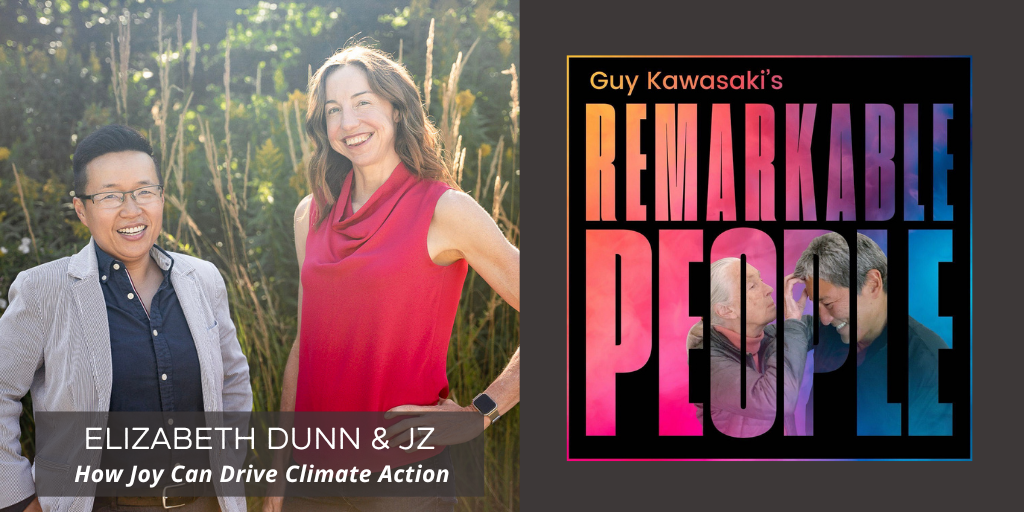
Welcome to Remarkable People. We’re on a mission to make you remarkable. Helping me in this episode are Elizabeth Dunn and Jiaying Zhao.
Elizabeth Dunn and Jiaying Zhao are highly respected psychology professors at the University of British Columbia. Their research explores happiness, social relationships, behavior, and the choices that shape our lives. But they’re also tackling a question that can feel almost contradictory: can fighting climate change actually make us happier?
In their new book, Leave the Lights On, Dunn and Zhao argue that climate action doesn’t have to revolve around guilt, shame, fear, and sacrifice. Instead, positive emotions can help us adopt changes that we actually enjoy and therefore stick with, whether that’s biking to work, eating more fruits and vegetables, driving an EV, or making certain foods an occasional treat. They also explain why some of the environmental choices we obsess over matter far less than bigger decisions such as where we live, where we keep our money, and how often we drive. Their approach is about using our limited time and attention where they can make the greatest difference.
The conversation is full of counterintuitive examples. A reusable organic cotton tote may need to be used 20,000 times to offset the environmental impact of producing it, while eating less beef can make a substantial difference in emissions. They discuss the EASE framework for making better habits easy, attractive, social, and eye-catching, and explain why putting fruits and vegetables at the front of the refrigerator can make them more likely to get eaten. They also explore why working from home every day isn’t necessarily the perfect answer when social connection and collaboration matter for happiness and organizations.
Dunn and Zhao ultimately offer a different way to think about environmental responsibility: focus less on perfection and more on meaningful action. Joy can make sustainable behaviors easier to maintain, and our behavior can influence the people around us, creating what Dunn calls an “upward spiral of joy.” Listen to Elizabeth Dunn and Jiaying Zhao for a fresh perspective on happiness, climate change, and the surprisingly enjoyable ways the two can work together.
Please enjoy this remarkable episode, Rethinking the Way We Fight Climate Change with Elizabeth & Jiaying Zhao.
If you enjoyed this episode of the Remarkable People podcast, please leave a rating, write a review, and subscribe. Thank you!
Transcript of Guy Kawasaki’s Remarkable People podcast: Rethinking the Way We Fight Climate Change with Elizabeth & Jiaying Zhao.
Guy Kawasaki:
Hello, everybody. It's Guy Kawasaki. This is the Remarkable People Podcast. Today, in particular, I want you to notice this hat. This hat is the Royal Canadian Air Force hat because we have two remarkable guests from Canada, one of my favorite countries in the world. So these two guests are both professors at the University of British Columbia.
The guests' name are Elizabeth Dunn and Jiaying Zhao. They are psychology professors, and they are going to discuss a seemingly oxymoronic, completely hard to grasp, the concept of joy combined with climate change behavior. So yeah, we are going to thread the needle, and we're going to talk about saving the planet and making you happier.
They have written a book. This is the book. It's called Leave the Lights On, and we will get into why they named this book this book. But welcome to the show, JZ and Elizabeth.
Elizabeth Dunn:
Thanks so much for having us. Great to be here.
Jiaying Zhao:
Yeah, great to be here.
Guy Kawasaki:
Seriously, I cannot think of a Canadian that I've met that I did not like. I just love Canadians. You know, I love Canadians already. Imagine when you become our fifty-first state. Oh my God.
Jiaying Zhao:
Too soon.
Elizabeth Dunn:
Too soon.
Guy Kawasaki:
I bet you cannot say that every American you've ever met you liked, but we won't go down that path. So before we get into this climate discussion with joy, backing up a little bit, both of you are kind of experts in what makes people happy. So can we just start off with that base question of what makes people happy?
Elizabeth Dunn:
Yeah, so I've really spent my career studying this question. And I think one of the key answers is social relationships. So our feelings of connection to other people seem to be one of the really paramount factors that shapes our happiness, but what I love about this topic is that it's something people talk about late at night.
Everybody has opinions about what matters for happiness. But it's actually something we can study rigorously and scientifically, and that's what I love to do.
Guy Kawasaki:
So are you basically reinforcing, oh God, I cannot remember his name right now, but he's the current director of the Harvard Happiness Project, this longitudinal study, and I think his kind of conclusion is what makes you happy over the course of your lifetime is your social relationships.
It's not money or cars or houses or anything like this.
Elizabeth Dunn:
Yeah, I would say money matters too. So my first book was called Happy Money, and in that book we talked about actually how you can use your money better in order to promote happiness. I don't think anyone should turn down raises, but I think the message is it's worth taking some extra time to prioritize our social relationships.
Guy Kawasaki:
Also, do both of you buy the concept that after 75,000 dollars or so, there's like a rapid decline in the marginal value of money, and I really wonder how happy Daniel Kahneman was. But, what's the latest on that kind of theory that after this relatively low minimum, money doesn't matter as much?
Elizabeth Dunn:
That specific finding has actually been debunked. So Danny Kahneman did an adversarial collaboration with another researcher named Matt Killingsworth, and together they actually found evidence that more money does continue to provide more happiness. You just need to have enough data on really rich people to be able to see that.
And you have to look with a very, very kind of fine microscope, metaphorically speaking, because the effects are smaller as you have more money. So for example, if I could hand you 10,000 dollars, that would make probably some difference for your happiness. You'd probably feel good, like right after the podcast.
But I could make a much bigger impact on somebody else's happiness if I gave it to somebody who was just starting out and struggling to make ends meet. And we've actually done research where we literally did that, where we gave people 10,000 dollars each and looked at how much of a difference it made for their happiness.
So I can say with scientific confidence that how much money you have does matter for your happiness, but the impact of additional money matters much more at the lower rungs of the income ladder.
Guy Kawasaki:
I got to tell you that I would not put Elon Musk at the top of the list of people who I think are happy, but that's a different discussion. So JZ, you've just alluded to this study where people gave homeless people 10,000 dollars or 7,500 dollars, I guess it matters whether it's Canadian or U.S., and what did they spend it on?
Because a lot of people assume that if you give these homeless people ten grand, they're going to buy drugs and alcohol and just institutionalize grifting, and what really happened when you did that?
Jiaying Zhao:
They spent it on rent, so they were able to move out of homelessness and get into housing right away. They also spent a lot on clothing, food, public transit, so they can travel more. The mothers with dependents spent more on their kids, which makes a lot of sense. And their spending on temptation goods, so what you mentioned, drugs, alcohol, cigarettes, that spending did not increase.
So that's contrary to what we assumed, or actually, this is a bad stereotype that we have about people in homelessness. They actually didn't spend more on drugs or cigarettes or alcohol after getting the seventy-five hundred dollar cash transfer.
Guy Kawasaki:
There's an entire political party in the United States that assumes if you give money away, like in this kind of situation, they're going to spend it on drugs, alcohol, and cigarettes. So why do people come to that conclusion when the data is completely contrary to that?
Jiaying Zhao:
Well, there are many reasons. The first one is, I think, is visibility. So many North American cities are going through a homelessness crisis right now. In Vancouver, we do see a lot of people hunched over, lumped over, or even using drugs on the street. That's the visible minority that we see, and then that gets stuck in our memory.
The vast majority of people who are unhoused don't use drugs or drink, but we don't see them because they're hidden. They're in shelters. They're couch surfing and sleeping in their cars. So that's not the homelessness idea we have in our mind. So that's, I think, one of the biggest factors for that misperception.
Guy Kawasaki:
So now, would you therefore say that the concept of universal basic income is something worth considering and doing?
Jiaying Zhao:
Oh, yes. I'm actively working on basic income, I don't want to take more time, but yes, it's definitely worth doing. It saves government money actually in the end.
Guy Kawasaki:
How does it save government money? Because if you give people universal basic income, then they require less help later?
Jiaying Zhao:
Yes. It actually boosts the economy in many ways. It saves on healthcare, on crime, on justice services. So overall, the net savings are positive.
Guy Kawasaki:
Oh, I wish we would try that. Why not try it? There have been experiments, and I think every experiment I've ever read about has come back with similar findings to you. Okay, now onto joy and climate. So first of all, do you buy the argument that Sam Altman is making that one almond takes as much water as 38,000 ChatGPT queries or prompts?
Jiaying Zhao:
I'm not going to go with his numbers, but we've looked into this number ourselves. First of all, AI data centers are switching to closed loop cooling systems, which means it actually doesn't need to use additional water for every data query that you have. It's a closed loop system, so the water circulates, and so it doesn't actually consume more water by using AI.
That's number one. Number two, almond is highly water intensive to produce. Well, I love almond, but I'm now cutting back on my consumption. One almond grown in California uses about three gallons of water to produce. That's a lot of water. That number has been published in scientific studies, not a number I just made up.
So in that regard, if we care about water consumption and saving water, we probably shouldn't look at AI data centers but maybe looking at other practices that we do. Yeah.
Guy Kawasaki:
Since you're both from Canada, where does syrup line up on this, from almonds to ChatGPT prompts? Where is maple syrup?
Elizabeth Dunn:
Well, maple syrup is like the ultimate sweet spot for happiness and climate change. Maple syrup, of course, is delicious. It certainly makes me happy, but also it turns out it's one of the few carbon negative foods.
Guy Kawasaki:
What?
Elizabeth Dunn:
Where because maple trees actually kind of suck up carbon, producing more maple syrup is actually good news for climate change. And in fact, if you had an additional, I think it's a teaspoon.
Jiaying Zhao:
One teaspoon a day. Yep.
Elizabeth Dunn:
Yes, an additional teaspoon a day of maple syrup, you would put a whole other maple tree into production. And in particular, we've been talking about Canada, Quebec maple syrup is really great.
A nice, sweet spot for fighting climate change and finding joy is pour some maple syrup.
Guy Kawasaki:
Oh my God. So now you're telling me that it's socially responsible to eat pancakes. I mean we can stop this podcast right now. There is no more important thing that I've heard in six years of this podcast that eating pancakes or waffles with syrup is a good thing.
So one last semi-serious, but I think it really opens up a sort of different perspective is if you had a choice either having a data center or a golf course being built in Vancouver, which would you pick? Because golf courses use a lot of water, and it is not a circulating system.
Jiaying Zhao:
Well, I will pick data center, but Google is actually exploring this option. They're trying to put data centers in the ocean along the BC coast. That's one idea.
Guy Kawasaki:
Oh, okay. So I'm not hearing a ringing endorsement for golf courses that old white men play at right? And JZ, guess who owns fourteen golf courses?
Jiaying Zhao:
I don’t know. Not me.
Guy Kawasaki:
All right. I got to admit when I got this book, it kind of takes a leap of faith that, you know, everything I associate with being a more responsible citizen is a negative or a chore. I cannot eat steak. I got to eat more vegetables. I cannot drive a car with a big engine, blah, blah, blah.
And yet, you make a really great case where all these things that are kind of double bottom line where it's enjoyable, it's joyous, it's delicious, but it also helps the environment. So what is the big picture message of your book?
Elizabeth Dunn:
I would say the big picture message of our book is that we can fight climate change in ways that actually make our lives more joyful.
And I think climate movement has emphasized emotions like guilt and shame and fear and anxiety and there are good reasons for this, and I think, negative emotions are powerful, and they can mobilize people and get people to look up and take notice, but they're very exhausting over time.
And so positive emotions can actually help make us more resilient, and happiness is like nature's reinforcer. If we adopt a new lifestyle change that we actually enjoy, we're going to be much more likely to stick with it, which is exactly what we need in tackling the grand challenge of climate change.
Guy Kawasaki:
Okay, so other than eating pancakes, give me some examples of happy and joyful things that can both make me happy and help the environment.
Elizabeth Dunn:
For me, a big one is biking. I bike to work because I arrive in a much better mood than if I drive. But of course, biking is also one of the most sustainable forms of transportation.
And actually just last week I got my very first e-bike, which was quite exciting. And e-bikes are making it possible to cover so much more ground, so my hope is to really cut out a lot of the car trips that I take and replace those trips with my e-bike.
And one of the things actually that inspired me to buy this e-bike was a study that we learned about it in researching the book, which showed that people who own e-bikes actually get just as much exercise as people who own traditional bikes, and that's because they end up biking more.
So that's really my goal for this coming school year is be on my e-bike all the time, and that's something that makes me feel happy and is also a good move for climate change.
Guy Kawasaki:
Okay, JZ, can you top that?
Jiaying Zhao:
Oh, I know I can. I actually got an EV to replace our gas car. And I think this is something that I did not anticipate. The EV is such a pleasure to drive. It's so much better than a gas car. So actually, I've been working on Liz to get her to get a new EV, but she got something way better, which is a e-bike.
So I would love to maybe consider getting a e-bike as well at some point, but if you're thinking of switching to a new car or getting a new car, think EVs.
Elizabeth Dunn:
I would say, you know, you don't have to spend a lot of money either to make some of these changes. JZ and I really decided to put our money where our mouths are and invest in these new technologies. But you can also make much smaller changes. So for example, just eating more fruits and vegetables is a great move in terms of climate change.
Plants are pretty uniformly low carbon, in terms of different foods that we can choose. And not only that, but there's actually recent research showing that when people start eating more fruits and vegetables, they actually get happier over time.
And we all know fruits and vegetables are good for our health, but actually the psychological benefits of eating fruits and vegetables can appear more quickly than those physical health benefits.
Guy Kawasaki:
Wait, so just because I am among scientists, are you saying that there's a causative relationship that if you eat fruits and vegetables, you become more happy? Or are you saying that happy people happen to also eat more fruits and vegetables? Is there a causation or is it post hoc ergo propter hoc, or whatever that saying is?
Elizabeth Dunn:
Yeah, that's a great question because you can easily imagine how happier people might make healthier food choices. And at first there was just correlational research showing this link, and then some longitudinal research showing that after people started eating more fruits and vegetables, they got happier.
But now there's actually really cool experimental work where people are randomly assigned to, for example, eat more kiwis. There's a great study from New Zealand showing this. And we do see that there does appear to be a genuine causal benefit in terms of our psychological wellbeing from eating more fruits and vegetables.
Guy Kawasaki:
While we're on the subject of fruits and vegetables, I love the analysis that you did in the book, which really opened my eyes. In California, we all go to farmers' markets, and we take our little cotton bag because we don't want to introduce any more plastic in the world, and we don't want to use a paper bag because that paper bag caused a tree to be cut down, and blah, blah, blah.
And you go through this analysis, and it's not too clear that using an organic cotton bag is exactly the best thing. Can you explain the sort of complexities there?
Jiaying Zhao:
Yeah. So to produce the organic cotton bag, the environmental input is huge. And in fact, to offset that environmental impact, that bag needs to be used 20,000 times to reach parity with a single plastic bag which is if you just assume you use it twice a week for your life, that's 200 years.
That's like you have to pass it down for generations. So I would say if you're using a tote bag, get one or two and use them repeatedly over time, and don't have too many lying around. That's actually bad for the environment.
Guy Kawasaki:
Yeah, I'm going to go look for all the cotton bags that I have and I'm going to put them in my will, so they go to specific people. They're not just thrown out.
So you have a part of your book where you say there are sort of four characteristics to encourage people to eat good food, and I love a good acronym, and your acronym is E.A.S.E., which is easy, attractive, social, and eye-catching. So can you explain those four variables, and you also use E.A.S.E. later in the book, so let's just get E.A.S.E. off the table, so to speak.
Elizabeth Dunn:
Yeah, so I'll start with the “E.” “E” being for easy. Humans like easy things. In fact, this is something that we share with pretty much all creatures right down to cockroaches. So the principle of least effort tells us that people find the easiest way to do something.
And if we want to stick with a new habit, like eating more fruits and vegetables, we want to make it really easy for ourselves. So one way to do that is meal prep services. So choosing a meal prep service that's going to bring you all those fruits and vegetables already peeled and cut and diced, that's one way that's going to make it a lot easier to stick with the habit.
“A” is for attractive. So we like appealing, attractive things as humans. And if you want to stick with try to eat more fruits and vegetables, then making sure that they actually look good.
And that seems obvious, but back in the day, I remember my friends dragging me to vegetarian restaurants where the food did not look appealing at all, and I think that's actually something really wonderful that's changed, is that you can find absolutely beautiful vegetarian foods nowadays.
“S” is for social. So we want to make this experience social. We want to take others along with us. It's easier to change our own behavior if others are changing with us. And so one thing we really encourage people to do is if they want to make some of these changes in their own lives, get other friends on board.
We'd love for people to form a book club and talk through some of these changes that they might want to make. You know, share recipes, for example. Go in on this together. And then finally, the last “E” is for eye-catching. So we want to make things easy to see. We want them to catch our eyes.
And maybe I'll let JZ explain this one because she's done a great job integrating this in her life.
Jiaying Zhao:
So eye-catching in my life means the EV we got is now hot pink. So I can show you a photo of our hot pink EV that we drive around.
Guy Kawasaki:
What is it? What model? What car?
Jiaying Zhao:
It's a Model Y that we got earlier this year. And yeah, you will see it if it's driving down the road. You can't miss it. So then what I try to do there is try to spread the message and try to highlight this EV on the road.
Guy Kawasaki:
And in this acronym, and I said I love a good acronym, but I have a little bit of a problem. What's the difference between attractive and eye-catching? It's pretty close, right?
Jiaying Zhao:
No, something can be really eye-catching, but it's an eyesore, right? It’s something that catches your eye.
Guy Kawasaki:
You mean like a pink Ford 150?
Jiaying Zhao:
Or a pink Hummer. Yeah, it doesn't need to be attractive. Attractive, there's some, you know, kind of valence to it. Eye-catching just, it's visual. It's just salience. Whatever that catches your eye, right?
Elizabeth Dunn:
Yeah, and it really captured the eye-catching piece with her own fridge.
Jiaying Zhao:
Oh yeah. To reduce food waste in our house, I put fruits and vegetables at the door so they don't go bad, so that every time I open the fridge, I see the fruits and vegetables, the produce, right away, and I consume them right away, as opposed to putting fruits and vegetables in the drawers that I don't see, and then I forget, and then they mold, and ugh.
So I made plant-based or fruits and vegetables way more, it's not more attractive, it's just more salient, more eye-catching.
Guy Kawasaki:
So what do you put in the drawers in your refrigerator?
Jiaying Zhao:
So containers, condiments, anything that will last. Mayo.
Guy Kawasaki:
Okay, so while we're on the subject of your refrigerator, another epiphany that I had reading your book is it's okay to eat bacon. Chicken is much less worse. Pork is much less worse. Tell all the bacon lovers who are listening to this why bacon is okay.
Jiaying Zhao:
Yeah, bacon's not bad. Beef is the worst. Lamb is second. Pork and chicken, not that bad. Seafood is really not that bad. So if you want to eat meat, go with the low carbon meat options instead of beef and lamb.
Guy Kawasaki:
So basically, if I go to Tim Horton's and I order a pancake with syrup and bacon, I'm good to go in Canada?
Elizabeth Dunn:
You're doing great. You're winning.
Guy Kawasaki:
One of the things that you introduce, a concept that I think my listeners will enjoy learning about is the concept of hedonic adaptation. Is it hedonic or hedonic or whatever? What does that mean?
Elizabeth Dunn:
Yeah, so hedonic adaptation means that we adapt emotionally or hedonically to whatever happens to us. The way some scientists might study gravity, happiness researchers study hedonic adaptation because it's what sort of pulls us back to Earth. When we get happier because maybe we get married or some other great event happens, we kind of adjust to it over time.
So it's the reason why when you walk down the aisle to marry your spouse, you're filled with delight. When they walk down the stairs for breakfast in the morning, you don't have that same burst of, like, incredible joy, or maybe you do, but that would be unusual. And, in a way, hedonic adaptation is helpful, right?
Because we want to be able to focus. It was good this morning that I could get ready for the podcast rather than just being overjoyed to see my husband. So hedonic adaptation isn't necessarily a bad thing, but it's something that we want to find little ways to work against if we want to be happier.
And actually, it turns out that having high-carbon foods we enjoy a little bit less often can actually enhance our capacity to appreciate them. For example, steak, like JZ said, is probably the worst thing you can eat in terms of climate change. I happen to love steak, and I have not given it up, but I do have it a lot less often.
And now that I have it quite rarely as a treat, I really savor and appreciate it. So having that food less often has helped me fight back against hedonic adaptation. Instead of just taking the steak for granted and not really noticing it, I really appreciate it and get a lot of joy from eating it on those occasions when I do indulge.
Guy Kawasaki:
So just so I have a data point, you're the rockstar scientist and professor. How often do you eat a steak?
Jiaying Zhao:
Well, I had my first steak in three years after finishing writing the book with Liz. That was the best steak I ever had. But yeah, you don't have to go once every three years. That's maybe too much. But eating beef just once a week as opposed to every day can cut emissions by three tons.
Three tons of carbon dioxide is equivalent to three people in the continent of Africa's annual emissions. It's a huge impact by just cutting back on beef.
Guy Kawasaki:
Elizabeth, I'm not letting you off the hook. I want to know how often you eat steak.
Elizabeth Dunn:
So we used to have it every week as just, like, one of our standard family meals, and then maybe I'd order a burger or something while I was out. Now it's not that I say, "Oh, it's been nine days, I can have steak again." So I'm not policing myself in that way, but instead what I try to do is have it when I know it's going to be really good.
So if I'm out at a nice restaurant, then I'll order a steak and have a nice glass of red wine with it and really appreciate it. I've really tried to move away from just like scarfing down a burger at an airport restaurant. Instead make beef something special to be enjoyed.
Guy Kawasaki:
Okay, so one of the concepts that I learned in your book is it's very difficult and complicated to make a decision. So just as I was reading your book, we needed toilet paper, maybe I have too much time on my hands, but you can help me, so let's say that I need a case of toilet paper.
I can get in my car, which is a hybrid but not electric. I can get in my car, I can drive a few miles, I can go to Target or Walmart, I can buy a case and come back. So that's one way. I could also go online and order it from Amazon.
Now, if you say you ordered it from Amazon, then you think, oh, so Amazon is going to load a case of toilet paper. It's going to go on an airplane. The airplane is going to fly across from California to Hawaii. Hawaii, it's going into a warehouse. The warehouse is going to put it in a truck. The truck is coming to your apartment.
Then I thought, I live in a thirty-story apartment. There's 750 people living here. We're all ordering stuff from Amazon. So when the Amazon truck comes, it's not just for one case of toilet paper for me, it's the whole building. And then I thought, maybe I can eliminate toilet paper.
I'll just install a bidet. But then if I install a bidet, it took plastic to build the bidet. It's like my mind is boggled just to buy toilet paper. So how do you make a decision like this?
Jiaying Zhao:
In this case, I would say order online. Do not feel bad about online orders. Online orders actually can reduce emissions from shopping as opposed to increasing it. The key there is just minimize returns, how much stuff you want to return. But yeah, otherwise, if you want to keep it, do online orders.
Elizabeth Dunn:
I would also say there are probably better ways that you can use your time than stressing about this toilet paper decision. One thing that I really learned from doing the research for this book and spending so much time with JZ is that these little consumer decisions don't really matter all that much.
And instead of worrying so much about how we spend our money, it's actually better to think about where you keep your money.
I was very surprised to learn that every 1,000 dollars that you have in a typical major U.S. bank generates about as much carbon as if you flew that money from New York to Seattle one way, and that's because most major banks are so heavily invested in the fossil fuel industry.
So just switching where you keep your money, which you can do once, in all that time you spent on the toilet paper decision, spending some of that time on the where should I keep my money decision matters much more, and just like letting yourself off the hook a little bit with some of those consumer decisions.
Guy Kawasaki:
Which brings us to the title of your book, why it's okay to leave the lights on, right?
I got to tell you though, when I read your book and I looked at that title, I understand what you're trying to do there, but isn't there a sort of opposite concept that, you know, every little bit counts if you shut off the lights, if you eat maple syrup, if you do all these little things and billions of people do little things, it'll all add up.
But isn't there a downside to the title of your book when people say, "Ah, Elizabeth and JZ said I can leave the lights on. It doesn't matter." Are you cognizant of that possibility?
Elizabeth Dunn:
Yeah, the thing is that people don't have unlimited bandwidth, right? As much time as you spent on that toilet paper decision, you could have spent that time on something else, right? The time in our lives is finite. We have a lot going on.
And so what we would like to help people do is use that limited time and bandwidth in the ways that actually do make the biggest difference.
And so that's really what we're trying to do is redirect people a little bit because there are things that individuals can do that have a surprisingly big impact, but many of the things that we've heard about the most, like turning the lights off, it turns out don't particularly matter, and especially they don't matter in places like where we live in British Columbia where we have clean energy.
JZ calculated that I could leave all of the lights on in my two-bedroom condo for the rest of my life, and the carbon emissions would be equivalent to eating thirteen hamburgers.
It matters a little bit, but there's a lot of other things I could do than, "Oh, no, I didn't turn the lights off," running back into the house before I'm, like, trying to get my kid off to soccer practice, that would be a better use of my time and my bandwidth.
Guy Kawasaki:
So tell me, how do you feel about this convention called carbon offsets? Is that bullshit or is that real constructive?
Jiaying Zhao:
Yeah, most carbon offsets don't work. They actually don't offset carbon because those carbon offsetting projects are going to happen anyway regardless of your contribution. But there are only a few carbon offset programs that do reduce carbon emissions, and those tend to be funding clean cookstoves in low-income countries in the world.
So if you're interested, go to Gold Standard. That's an organization that sells a lot of carbon credits but only buy carbon credits from clean cookstove programs.
Guy Kawasaki:
Okay, so let me understand this. So in my mind, carbon offset seems to be like an accounting function where if you're a car manufacturer and you have nothing but internal combustion engine cars and you have to meet a certain standard, you use money instead of social responsibility and you buy carbon credits, right?
So that's what I thought a carbon credit was. But then I go to your website and it's like stoves for people in Africa and all this kind of stuff. So isn’t that just donating to socially responsible organizations, which in my mind is not at all like a carbon credit, a carbon offset. What am I missing here?
Jiaying Zhao:
No, it is a carbon credit because your money is funding a clean cookstove. So instead of burning wood in their home, you are literally going to fund a gas burning or even an electric stove for these households. Otherwise, the project wouldn't happen. So it is a donation, but I just found out you can't actually write it off your tax.
But you are giving money away to reduce emissions that would otherwise happen or be emitted without your money.
Guy Kawasaki:
So now let's go on to clothes, I just go down the line, and I just get convicted right and left. I love to eat steak and all this stuff. I wasn't a big syrup consumer until about fifteen minutes ago. Tell me about the impact of buying a pair of jeans because I have lots of jeans.
Jiaying Zhao:
Oh, so a pair of jeans is very carbon intensive to produce and actually has more carbon emissions than an iPhone. I would maybe purchase jeans carefully and then wear them as much as you can before buying a new pair.
Guy Kawasaki:
And is it because of the production of the cotton, the dyes, the transportation, just everything adds up?
Jiaying Zhao:
There's that, and also the turnaround. A lot of people buy new jeans every season or so. That's fast fashion which is also carbon intensive.
Elizabeth Dunn:
But again, this doesn't mean you have to give up wearing clothes that you like, right? The idea here is invest in really nice pairs of jeans that will last and that will stand the test of time as opposed to flipping with the latest seasonal pair.
Guy Kawasaki:
Oh my God. A few days ago, I went to the steakhouse in my jeans, and I had a rib eye. I went, "Oh, okay.”
Elizabeth Dunn:
Well, just move your money and then you'll more than compensate for all of it.
Guy Kawasaki:
Okay. And you will be proud of me. I showed my wife Thread Up, and I joined Buy Nothing just because of your book, and I am going to find something that I can give to Buy Nothing. And my wife was sitting next to me as I joined Buy Nothing, and she said, "You joined Buy Nothing?" And she thought that was the funniest thing she's ever seen.
So now let's move on to another topic, which was also eye-opening for me, which is donations. How do we do donations joyously and responsibly?
Elizabeth Dunn:
Yeah, so a lot of my work is focused on spending money on others, giving money away, and one of the things that we find is that using our money to benefit others can actually be a really great source of joy, but it matters how we do it. And in particular, we're much more likely to find giving money away joyfully if we can understand how our dollars are actually making a difference.
And so one way to do that is to give locally. Sometimes that can enable you to really see how your generosity is actually changing things in your own community. But another way is to find a charity that allows you to have a specific window into how you're helping. So actually, I do think of carbon offsets as being a form of charitable donation.
And I just did some offsets the other day. Having flown around a bit this summer promoting the book, I wanted to offset that travel. And I invested in some clean cookstoves for people in Uganda, and that made me feel good because I've been to Uganda. I could envision how this was going to make a difference.
And so finding those opportunities to give where we can either directly see or vividly imagine how our dollars are making a difference is a pretty good strategy. And then, of course, we want to think about taking actions that do have a real impact. And again, that's where I've been so happy to learn from JZ about the kinds of donation opportunities that really move the needle.
Guy Kawasaki:
So if people want to do this and they go to the Gold Standard page, which is under the more page or the deeper page, there's about, I think, a dozen of those things about stoves and stuff like that. So that's truly vetted. I can truly trust that and give them money.
Jiaying Zhao:
It's legitimate, yeah.
Guy Kawasaki:
That's good to know. It's good to know. Alright, so now, if I get a job, am I helping the world by it being a commuting, telecommuting job versus in person, and I don't ever have to go in the office or it’s a four-day work week or something? What's the impact of how work is structured today?
Jiaying Zhao:
Yeah, commuting is one of the biggest share for carbon emissions for North Americans because we drive so much to and from work on a regular basis. If you can work from home a couple days a week, like two days a week, that would be great. That saves a lot of carbon. So Guy, you said you work from home anyway. Is that right?
Guy Kawasaki:
Yeah, I'm not commuting to Sydney.
Jiaying Zhao:
So that helps. Yeah, if working from home is great, but that's also how much in-person time you're having with your staff. That also matters. So have some, you know, intentional social gatherings. I think that's great for wellbeing and cohesion as well for the organization.
Elizabeth Dunn:
I'll just share a story of where this can go too far. Again, I think if all we wanted to do was minimize emissions, then we should all just work from home 100 percent of the time. That's clearly the right answer. But again, what we're trying to do is say, “Where's the sweet spots where actually these changes are going to be good for the climate, but also good for our own happiness?"
And there, I think, the answer is a little bit more nuanced. During COVID we, of course, moved all of our faculty meetings online, and then in the wake of COVID, faculty members had the option to just Zoom in for these department meetings. We could go in person or we could Zoom in.
And just for people who don't know what faculty meetings are, they're where a bunch of professors get together and talk about issues in the department, and they're really boring. Nobody wants to go to them, but actually they're super important because these are where decisions that shape everybody's experience, including students, get made.
And it turned out that when we started having the option to do these meetings on Zoom, people didn't bother going in. I literally downhill skied during one faculty meeting. I was, like, listening to the meeting from Whistler. JZ has cleaned bunny litter while listening to these department meetings.
And on an individual level it seemed good, but what happened was that over time tensions really developed in our department because Zoom doesn't have hallways, and hallways really matter.
And it's in those sort of hallways after the department meeting where people smooth ruffled feathers and talk through misunderstandings, and those conversations weren't happening, and it actually undermined some of the closeness in our department.
So now actually we're back in person for faculty meetings, and I think that's actually really important. Meanwhile, we experience that in our own lives, but research has also shown that there does seem to be a sweet spot where going into the office two or three days per week seems to be kind of optimal.
Of course, this depends on the job that you have. There's so many incredibly important first responders and nurses and everyone out there who we need them at work, and I'm so grateful that they do that.
For those of us who are fortunate enough to not necessarily be required in the office all the time, it seems like being in two or three days a week is enough to give us that feeling of connection with our colleagues, which again, is so important for our happiness and so important for the success of an organization.
But at the same time, having those couple days at home can give us a little room to think, a little quiet space, and can really cut back on our emissions.
Guy Kawasaki:
So if you were in person or in the office two or three times a week and you got there by your bike or your electric car, not wearing jeans, eating pancakes and bacon, you would just hit the sweet spot, right?
Elizabeth Dunn:
That's exactly right. And again, I'm not saying don't wear pants. You can definitely wear pants. I like this new beach ball blue color that's popular right now, so I bought a little tank top in that color. But I'm sticking with my same jeans and just getting that little tank top that doesn't cost so much in terms of carbon emissions.
And I'm going to be riding my e-bike to school later today, enjoying the sunshine. So again, I think there's so many ways to tackle climate change joyfully.
Guy Kawasaki:
Oh, man, my entire lifestyle is changing today. Okay, one more very interesting angle that I found in your book was just fascinating, which is you rank the carbon footprint of various pets. And as I understood it, the order going from worse to less worse is dogs are the worst, then cats, and then bunnies. So explain to me dogs, cats, and bunnies.
Jiaying Zhao:
Yeah, it's actually big dogs followed by small dogs. The reason dog is first is because of their diet. They're mostly carnivore. They eat a lot of beef in their diet. But it doesn't mean that you can't change that. So I have a dog, a small one, who eats fish and turkey. So her carbon footprint is actually a lot lower than a regular dog on a regular diet.
It doesn't mean that you have to give up dogs. I love dogs. Actually, dog owners appear happier than cat owners in a study. Oh, sorry, cats or people without pets. So dogs and cats are similar. But, bunnies, they're vegan. They eat grass, and green leafy vegetables, so they are good.
They're the model citizens in the world. But, yeah, I would say don't give up pets. Pets are a huge source of joy, certainly for me, and if you have a dog, feed your dog a low carbon diet with good protein. I think that's the way to go.
Elizabeth Dunn:
Yeah, I have a thirty pound golden doodle, and she does not eat very much food, but she does bring so much joy into our lives. And there's this study I really appreciate where a researcher walked around for a week either with or without a dog in tow, and she measured or recorded each time a stranger interacted with her in any way.
And over the course of the week, strangers interacted with her, smiling, saying, “Hi,” or whatever, sixty-eight times during the week. Sixty-five of the sixty-eight times were when she was with the dog.
So dogs really change our social experience. I think they're a great source of happiness. But again, when we were choosing a doodle, we had a choice of size, and we did choose a smaller doodle who's got a smaller carbon paw print.
Guy Kawasaki:
All right, so we're coming to the end of this interview, and if you could just pick out, all right, there are things you said that it's not that important. You don't have to shut off all the lights all the time. But if you had a magic wand and everybody listening to this, and you say, "All right, push comes to shove, if you just did these three things, it would just have this fundamental good effect."
Instead of trying to do everything like Guy and eat more maple syrup, the magic wand says, "All right, boom, everybody's going to do these three things," What would those three things be?
Elizabeth Dunn:
One of the biggest things that you can do is move to a place with clean energy. And it might seem unrealistic, of course, for many people to make a big move, but we're waving a magic wand here.
And anyway, the average American actually moves about a dozen times in their lives. So if you're going to move, thinking about the energy source of the place that you're considering is really important.
So just to make this concrete, if you run an air conditioner in a typical living room in Vermont, which has mostly clean energy, for one week, you will burn about eight pounds of carbon. The weight of a newborn baby. You run that same air conditioner in Wyoming. You're going to burn 1,000 pounds of carbon. The weight of a full-grown horse.
And so where you live just makes a massive difference, and you can really enjoy a very lovely lifestyle without a lot of sacrifice. You really can go ahead and leave the lights on if you choose to live in a place that has clean energy.
Guy Kawasaki:
Okay, so that's one.
Jiaying Zhao:
My magic wand would be everybody votes.
Guy Kawasaki:
Everybody votes, and why is that?
Jiaying Zhao:
Because a lot of people who care about climate, care about the environmental issues don't vote, so their voices are never heard. They're invisible to politicians. Whereas if we vote, if every one of us vote in every election, then our voices will be heard. Maybe we'll have different people in government. So yeah, vote.
Guy Kawasaki:
But what if people who, shall I say, don't exactly agree with things we've been talking about all vote? We could go the opposite way.
Jiaying Zhao:
That's a minority. The fact is most Americans, Canadians, most people in the world care about climate change. They want government to do more on climate change, not less. Whereas right now the minority are loud, they're in power, they don't represent the country.
Guy Kawasaki:
Okay, so I gave you three wishes. You got one more.
Elizabeth Dunn:
Okay, my third wish, and again, this is big wishes here, but I would love for people to think about both climate change and happiness in considering what job to take or what career to pursue. And that doesn't necessarily mean you have to go work for an environmental organization.
In fact, almost whatever job you do, you can find a way to make a difference on climate. And in our book, we actually feature a lot of really inspiring stories from people working in all different fields, including a surgeon who made a massive change in the way that the hospital here operates in order to reduce emissions and make things better for patients.
And as a happiness researcher, I want people to really enjoy their jobs, but it turns out that having a sense of purpose at work is really important for our overall happiness. And if you're somebody who cares about climate change, then finding an opportunity to work on this issue and make a real difference at work can potentially enhance your sense of purpose and your overall happiness.
So that's what I'd do with your magic wand.
Guy Kawasaki:
All right. So I promise you the next time I have an operation, I'm going to specify what kind of gas they use to knock me out because I learned, this is your book, right? I read so many books, I get confused. You had a whole section about using this wrong kind of gas.
Elizabeth Dunn:
That's fluorine.
Guy Kawasaki:
Okay. Yeah. All right. And I just thought of something. So when you mentioned about your first wish is where you live, so as you say, it's Vermont that is the most renewable, which is 99 percent. I have to say, to my utter amazement, number two is the state of South Dakota, which is 82 percent renewable.
And I actually had to fact-check you because I thought, "You're telling me the state that produced Kristi Noem is the second-best state in the United States?" I cannot believe that. So I did the research, and I found out that South Dakota has a lot of wind, and so they have a lot of electricity generated by wind.
So if you're from South Dakota and you're listening to this, congratulations. You have a really, really good state. And then, I went deep into depression because I spend half the time in Hawaii, and Hawaii is twenty-second.
And, if you think about it, Hawaii has geothermal. It has sun. It has wave action. Why is Hawaii so low? And I go out on my balcony here, and I'm in the middle of Waikiki, and I would say it's, like, one out of ten roofs have solar panels on it. I just don't get it.
I'm going off on a tangent now, so I'm going to give you one last question because so much of your book is about this, and I want people to be able to do this, and I think you know how. It's not an easy question to answer, but I want you to talk about, as my final question, how to create an upward spiral of joy. How do you make joy feed upon itself?
Elizabeth Dunn:
The good news is that joy is contagious, and behavior is contagious. So when you take an action, other people are likely to copy you. And I think this is really empowering because we don't actually realize how much of an impact our own choices can have on others. And I'll just share. This was illustrated in a really cool study done right on our campus at UBC.
Our colleagues observed people as they were ordering dishes at a little café, and people could order either a meat dish or a vegetarian dish. And what our colleagues discovered was that people ordered the exact same dish as the random stranger standing in front of them in line 72 percent of the time.
So your own little choice to order a vegetarian meal actually can have an impact on the person you don't even know, you're not even watching them, standing behind you in line. Similarly, if you install solar panels, people who can see them from their own homes are more likely to install solar panels themselves.
There's very good evidence that solar panels are contagious. So our own actions that make a little bit of a difference on climate actually have these beautiful ripple effects that can make us happier and can make other people around us happier.
Guy Kawasaki:
That's great advice. So I'll be very cognizant of what I order the next time I go to a place. And JZ, if you have solar panels and you have an electric car, you're really doing everything right, right?
Jiaying Zhao:
Yeah, I just have to move my money. I haven't done that yet. I am in the process of moving my bank. It's my next big to-do.
Guy Kawasaki:
Okay, so on that subject, my mind is boggled here. What bank am I going to use in the United States?
Jiaying Zhao:
Go to Bank.Green. It will tell you based on where you live, here are the climate-friendly banks available to you.
Guy Kawasaki:
Oh. You guys have an answer for everything. So yeah, thank you so much here. And, I got to tell you, I love Vancouver. I played hockey in Vancouver in several rinks, and what's that island that's underneath the bridge when you go over the water?
Elizabeth Dunn:
Granville Island.
Guy Kawasaki:
I love that island. So now please join me in thanking my two guests, JZ and Elizabeth, and what a joyous episode this has been. And if you had told me, "Yeah, we're going to have a joyous episode about climate change," I would say that's an oxymoron and not possible.
But I think we've done that. And here is to using your jeans for a long time, eating more maple syrup, eating more chicken and pork and less beef, and driving an electric car, having a bike, and doing all this joyous things.
And I would move to Vermont, but the surfing's not that great there, and there's no surfing at all in South Dakota, so some of those things are off the table for me, Elizabeth, I hate to tell you.
But thank you so much, and if I ever get a dog, I'll get a bunny instead. So thank you very much for being on our podcast, JZ and Elizabeth.
And I also want to thank Madisun. Madison, maybe we should meet in real life more often because we need our faculty meetings, Madisun. So we have Madisun Nuismer, co-producer. Jeff Sieh, co-producer. Tessa Nuismer, researcher. Shannon Hernandez, who's sound design. So that's my team.
We have a very low carbon footprint. Well actually, we probably all wear jeans though. But anyway, but we wear the same jeans for 20,000 years. So anyway, thank you very much, and yeah, I look forward to when we're the next province for Canada.
Elizabeth Dunn:
Thank you so much for having us, and you'll have to come surf with me in Tofino, British Columbia someday.
Guy Kawasaki:
You know what? All right, so I think the way you do that is you fly into Vancouver and then you catch a little puddle jumper to Tofino, right?
Elizabeth Dunn:
That's right. Yeah.
Guy Kawasaki:
Have you ever done that? What's it like surfing in Tofino?
Elizabeth Dunn:
Oh, I do it all the time. I was just there a few weeks ago. We just take a ferry and then drive across the island. But I've surfed all over the world, and it's my favorite.
Guy Kawasaki:
Wait a second here. Time out here. We got to keep this recording going. So are you a longboarder or a shortboarder?
Elizabeth Dunn:
My board is seven feet six inches, so it's kind of in between.
Guy Kawasaki:
And is it a beach break or is it a point break? Is it a long rolling wave or is it like, you do two quick turns and you're off?
Elizabeth Dunn:
It’s a beautiful beach break with long rolling wave that you can just ride up and down the wave, and if you come crashing down, you're not going to hit any coral or sharp rocks. It's really beautiful. You just need a very thick wetsuit. But it is worth a good investment in a nice warm wetsuit, and then you can enjoy the magic of the Canadian surf.
Guy Kawasaki:
Oh, man. This like opens up a whole new world for me, so I could like move to Vancouver. I could surf in Tofino. I can eat maple syrup. Man, I can go to Tim Horton's.
Elizabeth Dunn:
Enjoy our clean energy and our clean waves.
Guy Kawasaki:
Man, Canada. Canada. I love Canada. Listen, Canadian Royal Air Force logo there. All right. So thank you so much. I might take you up on surfing in Tofino someday.
That would be something, and then after that we'll go and we'll have a nice meal of broccoli and asparagus and yeah. All righty.
Elizabeth Dunn:
Perfect. Looking forward to it. Thank you so much for having us.
Guy Kawasaki:
All right. Thank you.
Jiaying Zhao:
Thank you.
Sign up to receive email updates
Enter your name and email address below and I'll send you periodic updates about the podcast.

Leave a Reply