
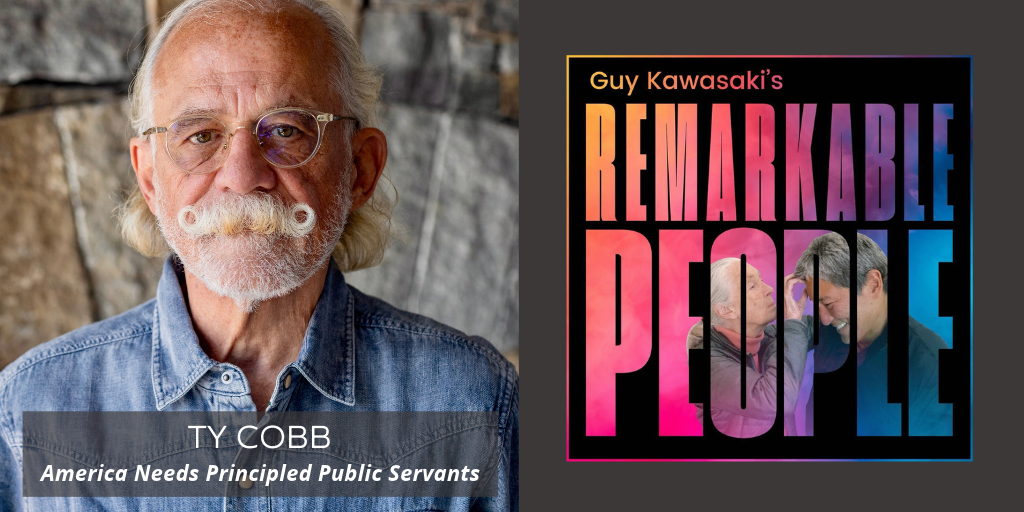
Welcome to Remarkable People. We’re on a mission to make you remarkable. Helping me in this episode is Ty Cobb.
Ty Cobb has spent decades at the center of America’s most consequential legal and political battles. A former federal prosecutor and longtime Washington attorney, he served as White House special counsel during the Mueller investigation, navigating the extraordinary challenges of advising a president while protecting the interests of the institution. His career has given him a front-row seat to the relationship between presidential power, the Department of Justice, and the Constitution.
In this conversation, Cobb pulls back the curtain on his time in the White House and explains why he believes the rule of law must stand above political loyalty. He discusses the erosion of trust in government institutions, the importance of an independent Justice Department, and the responsibility of public servants to uphold the Constitution even when doing so becomes uncomfortable. He also offers a thoughtful perspective on Supreme Court reform, congressional accountability, and the changes he believes could help safeguard American democracy.
Cobb’s most compelling message may be his belief that the country needs capable, principled people willing to serve, especially when institutions face their greatest challenges. He encourages people to educate themselves, understand how their government works, engage in their communities, and consider public service as a meaningful contribution to the country. His conversation with Guy is a frank reminder that democracy doesn’t sustain itself. It depends on people willing to defend its principles, protect its institutions, and put country ahead of personal ambition.
Please enjoy this remarkable episode, Inside the White House: Power, Principle, and Accountability with Ty Cobb.
If you enjoyed this episode of the Remarkable People podcast, please leave a rating, write a review, and subscribe. Thank you!
Transcript of Guy Kawasaki’s Remarkable People podcast: Inside the White House: Power, Principle, and Accountability with Ty Cobb.
Guy Kawasaki:
So, welcome everybody. Believe it or not, this is a historical moment for me, well, of course, because I have a guest named Ty Cobb, but also because this is my first Substack live conference where I'm the host.
So here we go. Ty, a lot of people are already reaching out to you, so let's get started here. Ty, it is an honor and a privilege for you to be not only on my first live Substack, but just in general to interview you. So we got to set a little base. So will you explain to people your checkered past? Because you have a very interesting history.
Ty Cobb:
Well, if I go through my past, it sounds like I'm somebody who just couldn't hold a job. I grew up in a small town in Western Kansas and ended up going to the East Coast to go to Harvard and sort of never made it all the way home.
After college, I rode my bicycle around the country for a while and wrote short stories and was in a rock and roll band in L.A. And being free of talent, I quickly realized I should probably do something else.
And so I ended up going to law school, after which I clerked for a federal judge, became a federal prosecutor, ended up heading the Mid-Atlantic region Organized Crime Drug Enforcement Task Force while I was there.
I went to private practice with a large firm in D.C. where I spent most of thirty years, although I took a couple of assignments. I was the senior trial counsel to Judge Adams, Arlin Adams, when he ran the independent counsel investigation into the HUD controversies. I prosecuted James Watt, former Secretary of Interior, in connection with that investigation.
And then, in 2017, I went into the White House because the then White House Counsel had recused himself and his office from the Mueller investigation and many related issues because they were witnesses and had not preserved executive privilege in the appropriate way. So they couldn't participate, and the White House had to have somebody to manage those duties.
So I took that job, and the rest is sort of history. I got through the Mueller investigation, have been on my own ever since and trying to share my perspective and opinions for what they're worth, which is not a lot, and it's just a little puzzling to me to be on a show called Remarkable People because I don't feel remarkable, but it's an honor to be here.
Guy Kawasaki:
Oh, you're remarkable. So Ty, pardon my ignorance, but just what exactly is White House Special Counsel? Are you, like, the President's lawyer or are you the institution's lawyer? Or what exactly does that mean?
Ty Cobb:
So historically, you are the institution's lawyer, so you swear an oath to the Constitution, unlike Todd Blanche and Pam Bondi who believed that their oath is to Trump personally at the Justice Department.
The reality is, all lawyers in the federal government, frankly, are supposed to serve the Constitution and not one person or one man or certainly no allegiance to a demented narcissist's revenge plans. So technically your duty is there.
And frankly, when I took the job, it was at a time where some very serious allegations of the President's campaign, perhaps colluding with Russia in connection with the 2016 election.
Bob Mueller and his staff weren’t able to substantiate that, not because of any failure on their part, but because the evidence just wasn't there. And they also pursued potential obstruction issues related to that investigation, although they did have a fundamental challenge in that regard, which is it's sort of hard to obstruct an investigation into something that you didn't do.
And at the end of the day, while they found a lot of Trump conduct that Trump had taken out of the Roy Cohn playbook, which is deny, demean, deceive, and destroy, that none of that was prosecutable. But in my role, so I was the functional White House Counsel for the matters that I undertook.
So I acted with the authority of the President. And of course he had to approve any strategic decisions, any consequential strategic decisions that I made.
The most important one of which was to cooperate fully in the Mueller investigation and to avoid the sort of constitutional crises that have eaten us up over the last two years, where you have constant battles over executive privilege, subpoenas, court fights.
We were able to work through it professionally. Bob and I were friends of thirty years and liked each other and respected each other. And we were able, notwithstanding some intense arm wrestling from time to time, to reach agreement on every issue, frankly, with the exception of one at the end of the day.
And in connection with that one, he was unable to get his way because legally he couldn't meet the standard necessary to interview the President, but we got through it in a cooperative way. That was a tough sell, obviously, to a President who likes to combat his adversaries, but it worked out.
Guy Kawasaki:
So I mean, clearly you are no longer White House Special Counsel, so did you have a change of heart, or did the thing just end so your job was done?
Ty Cobb:
One of the conditions, or one of the terms of my engagement was that the President would stop denigrating and demeaning Bob Mueller publicly, so that, A, it was not presidential and didn't help the office.
And B, it made it difficult in a circumstance where you're relying on the goodwill of your adversary to get through some of these challenges, to have the President belittling him persistently in the way that he does judges now and others who are his adversaries.
And after about ten months, we had produced all the documents and were about to finish the last of the interviews when Rudy Giuliani joined the President's personal team. And Rudy and the President took a much more rancorous tone with regard to Mueller, which was contrary to the circumstances that I had agreed to.
And at that point, I advised General Kelly that it was probably time for me to go, and I didn't get any resistance. Nobody begged me to stay in that capacity.
Although I was asked to stay on in other capacities, but I'd only gone for that job, and I didn't have any aspirations to be anything else, which gave me a freedom that didn't exist for other people there who were hoping to be promoted or go on to additional authority.
Guy Kawasaki:
Oh, you could be AG today.
Ty Cobb:
Well, not with this president.
Guy Kawasaki:
So I mean, I'm going to ask you a question that nobody has ever asked you before, which is, obviously I got to ask you, if you go back in time, would you do it again?
Ty Cobb:
Yes.
Guy Kawasaki:
And why?
Ty Cobb:
Because as I said, I grew up in a small town in western Kansas. I was the oldest of eight kids. My dad was a Navy fighter pilot. Bob Dole was a close personal family friend of my father's. My dad was one of his first campaign people in 1960. My first political activity ever was going door to door for Bob Dole when I was nine years old in 1960. And I believe in the country.
I believe in democracy. I believe that if the president asks you to do something and you can do it capably and honorably, that you should do it. And I've also come to believe and urge upon people that the worst presidents need the most help. So I would strongly prefer that there were honorable, capable people in the positions of power.
And I mean, I wish there was somebody decent as attorney general. I wish there was somebody without a worm in their head as Secretary of HHS. I wish somebody who didn't own Brylcreem stock was the Secretary of Defense. I just think, I mean, would the country be better off if we had the type of representatives that we had had historically?
Guy Kawasaki:
Oh my God, Ty, you're a freaking Barack Obama drop the mic. It's a fountain. I mean.
Ty Cobb:
Well, I love the way that, you know, Barack Obama's Cheesecake Factory quote has inhabited Trump's head. I mean, it's amazing. He even sent Scott Bessent to eat at Cheesecake Factory because of the Obama quote. It's amazing how much space Obama takes up in Trump's narcissistic visions.
Guy Kawasaki:
Well, Ty, if AG doesn't work out, I think, maybe you could be a host on Saturday Night Live.
Ty Cobb:
You say that, you know, one of my dear friends historically and a guy that I was very close to, particularly when we were both starving artists, he was a better artist than I was in L.A. Back in the day, it was Al Franken, and Al and his partner got the last writing job in 1975 for SNL. So, SNL has a dear place in my heart.
Guy Kawasaki:
Okay. You are just a fountain of connections here. So let me ask you, like, cutting to the chase, what the hell is the Department of Justice right now? I mean, it's kind of an oxymoron. They should rename that. I mean, what is the Department of Justice today?
Ty Cobb:
I'm glad you asked that question. Unfortunately, it just almost brings me to tears every time I have to address this because the Department of Justice was very dear to my heart. I really can't describe the feeling of pride that I had every time I walked into court and said, "Ty Cobb, on behalf of the United States," when I was a prosecutor.
And now, we have a Department of Justice where the Civil Rights Division has been gutted. They no longer protect people's civil rights. They're there to deny votes, deny voters their opportunities. They're there to send people out of the country, put people in cages.
It's just shocking. And you've got the national security side, which was always a very serious place with very intelligent, hardworking people who took the security of the country seriously. That's been gutted. We don't do those cases anymore, or the investigations that are necessary to protect us.
We're very vulnerable because of the loss of talent at the FBI and the Justice Department. And they've lost over 10,000 lawyers and FBI agents in the past two years. We are not safe because of that. The rule of law has suffered greatly. We used to have what was called the presumption of regularity, which is a court term.
But the reality is, it's a rule that federal judges have relied on for decades, where if the Justice Department says something in court, the judge takes them at their word. They no longer do that. They've sacrificed that just in the short time that Trump has been the president.
Now, judges, and we saw this most dramatically this week in California in connection with the 20,000 votes that the government sought to have sequestered, and in D.C. where the judge ruled on the lies that the Justice Department had told him about what they were doing at the golf course where Trump said that "We've got a plan, and we're starting tomorrow."
And the Justice Department said, "No, no, no. Don't worry about that. Nothing to see there." The reality is judges are now saying, "We don't believe you. We don't trust you. Prove it to me." And they don't hesitate now, although they did initially, they don't hesitate now to put that in writing and to make referrals for contempt against prosecutors.
We see grand juries, no true billing, meaning refusing to do what the government wants when the government seeks indictments against Cassidy Hutchinson, against Mark Kelly and elected representatives who gave the lawful urge to servicemen not to follow illegal orders.
They even got a no true bill against a guy who threw a ham sandwich countering years of Justice Department policy, which was a grand jury will indict a ham sandwich. Apparently not, but that's only because we have these people who are sycophants out there helping Trump in his revenge tour, and they've lost all credibility.
It will take us decades to restore that credibility, assuming we get the chance soon. And sadly, it will take at least that long to repopulate the government with the talented, experienced, highly intelligent, well-educated public servants that we had as short a while back as two years.
Guy Kawasaki:
But Ty, I mean, who goes to work for the DOJ today? Is it, like, the sons and daughters of GOP donors? I mean, I don't understand. So you graduate from law school, you theoretically took a course in constitutional law, you go to work for the DOJ, and all of a sudden, aren't you violating everything you learned in law school?
Ty Cobb:
It's not quite that bad, but I mean, any course you took in constitutional law would've been wasted because these people practice unconstitutional law. And I will say what I've seen, my experience is, with the young people who are going into these jobs, many of them are submissive acolytes of MAGA.
That's for sure. There's no question about that. But a substantial number, and that it can't be discounted, are people who believe in the country and have always wanted to serve, always wanted to advocate right over wrong and try to make a contribution. You can't make those kind of contributions other than in those types of positions.
So it still attracts people who love their country and who want to serve and want to do good, but at the same time, it also attracts, now, unqualified, inept, ambitious people with political connections on the right.
So it's declining, but it's not declining at every position. I mean, there's still people filling some positions who hopefully will assume leadership roles when we get the controls back.
Guy Kawasaki:
Okay. So continuing on my theme of Department of Justice for dummies, can you explain to me, when you read the paper that, oh, the Department of Justice is going after the state of Alaska because there's two Dan Sullivans, like, who's coming up with ideas like that?
And oh, let's cut all the trees in the golf course like do they have a Monday morning meeting and say, "Okay, everybody, float your ideas for what you should do." I mean, I don't understand how they come up with these ideas.
Ty Cobb:
That's an excellent question, and that touches on several dynamics that are operating simultaneously with this President and his advisors.
Let's take the Trump vanity projects like the golf course and the Arc de Trumpf, which is now going to fly drones in one of the busiest air spaces in the country one point six miles away from the Pentagon where you would think maybe they could control national security next door, that you probably don't need an arc in the middle of nowhere, difficult to resupply with a handful of drones.
So these vanity projects are really there as a distraction. And what you see is every time Trump does something treasonous, like cut off Starshield or buy Russian oil, the next day what you see is him taking a step in one of these vanity projects.
They'll do something that they're enjoined from not doing or they'll announce a project that everybody's up in arms about. And they do that basically to try to siphon off some of the attention that would otherwise go to the, you know, structural misdeeds of this administration.
So that's in part strategic, but it's also possible only because of the extent of this man's narcissism. He is probably the most malignant narcissist in history, certainly the most malignant narcissist in history to have that level of power. And this goes back to the Obama thing.
So for example, the Obama thing, any other politician would've either not responded or had a one-sentence response. Trump, it's lived in Trump's head for a week now. And he talks about the Cheesecake Factory, defends his gold.
In the middle of trying to help out a Mississippi Senate candidate, right-wing Mississippi Senate candidate who is the incumbent and shockingly is going to have a close race in Mississippi.
He goes ten minutes about the Cheesecake Factory quote and defending his decorations and how much we'll love it. It is really stunning, so you have that aspect. That's one of those dynamics.
But in terms of the other stuff, the policy stuff, the racist stuff, the putting people in cages, separating families, making three-year-olds go to detention hearings without a lawyer, the kind of atrocities that you would just never have associated with America, those things are not all Trumpian designed.
They're in part, large part, Stephen Miller, Russell Vought, Brendan Carr, the Trump advisors on the policy side, the people who contributed to Project 2025, trying to implement all those things as fast as they can.
They spent years analyzing the constitutional law, analyzing the Constitution, trying to pick the potential seams that might burst, and they're attacking every one of those seams, you know, almost simultaneously, from the First Amendment to due process to lying in court.
And in connection with the Alaskan case, trying to invent jurisdiction, just as they did in California, trying to invent jurisdiction in cases where they have no business because the Constitution clearly gives the states control of their own election. The federal government does not have a role.
They have a very minor role with regard to time, place, and manner but not a substantive role in terms of who can vote and how you count those votes and what you do with the ballots. Those are the kind of things that this President has tried to influence and confuse ever since his first day in office when he issued an executive order banning mail-in ballots. I'm sorry, Guy, you asked.
Guy Kawasaki:
So Ty, like, walk me through this. Your boss or your boss's boss decides to sue the BBC for defamation for ten billion dollars.
Now, does somebody point out, or do they know and they do it anyways, does somebody point out, “If we sue the BBC, they're going to ask for depositions. They're going to ask for all the financial information to prove we actually did ten billion in damage. So Donald, maybe we shouldn't sue the BBC."
Does anybody push back, or this is all a plan, and they got this all figured out in advance?
Ty Cobb:
So they don't have a plan. They haven't figured anything out. But keep in mind, these people are all drunk on the Kool-Aid, and they have some reason to be in connection with that lawsuit because keep in mind, the President sued a bunch of domestic news outlets. So on the BBC thing, he got settlements from ABC, he got settlements from other media outlets.
Here, he thought all he had to do was sue and they would just write a check. Now that's not going to happen with the BBC, and they've shown that had any of the domestic outlets contested Trump's fraudulent claims against them rather than paid him off, they're at a point where he's going to have to dismiss the case if he doesn't show up for a deposition.
I suspect he will continue to try to stall that. Even if he ultimately agrees to a deposition, I don't believe he'll show up, and if he shows up, I expect he'll walk out. And the case will, at some point, be dismissed, and then he'll appeal that and try to drag it out as long as possible before he finally surrenders.
Guy Kawasaki:
Okay. All right, so one last question about the Department of Justice, which is God help you, your grandson or your granddaughter graduates from Yale Law School and says to you, "Grandpa, I want to go work at the Department of Justice." What does Ty Cobb say?
Ty Cobb:
Do good.
Guy Kawasaki:
Which is a yes, go for it?
Ty Cobb:
Oh, yes. No, I mean, I would encourage anybody competent and intelligent, capable, and who wants to make a contribution to their country to take these government jobs. I mean, A, it keeps some right-wing lunatic out of that position, and B, the more competent people we have in these positions, the more likely we are to recover.
Guy Kawasaki:
Okay. My next area is you worked with John Roberts for about ten or eleven years, and in many people's minds, including mine, I must admit, he sort of took away women's rights, he took away voters' rights, he gave Trump unlimited rights, but you truly know him personally. So could you just give us some John Roberts for dummies information?
Ty Cobb:
I'll do my best. I mean, I don't want to inflate the relationship that I have with John. We were colleagues and friendly, and he's somebody that I have great respect for as a human being. He's a Midwesterner. He's got Midwestern values. He's family oriented.
He is among the smartest people I've ever met, certainly in the top five, I would guess. And he loves his country. Now, he's also very conservative, philosophically, but I don't say that in the sense of the same way that Alito is conservative or that Thomas is conservative.
I mean, Roberts is a critical legal thinker. And I think the important thing to understand about John Roberts is that he is as honest as the day is long. He is not corrupt. But we see in the media that the media has imbued the Supreme Court with powers that they don't really have.
Like, when you say he took away women's rights or he took away voting rights or did this, the reality is neither he nor the other judges who voted that way did that. What they did was say that there's not a statutory basis for this, or that the Constitution doesn't allow this.
On the constitutional side, the Constitution is a document that provides a lot, and certainly a lot, in terms of rights to Americans. First Amendment, Fifth Amendment, et cetera, et cetera. But it doesn't do it in a way that is dispositive when the adversary is somebody as evil as Trump.
The founders did not write the Constitution thinking that we would elect the Joker to be the mayor of Gotham. And sadly, their lack of creativity there left some holes. Now, they tried to plug those holes to the best they could identify them by empowering Congress to do things.
But we have a Congress that has been neutered by its cowardice. You've got little Mikey (Mike) Johnson up there who will send Congress out for two months in 2025 because he didn't want to vote on the Epstein files. He sent them out for two months in September because he didn't want to vote, oh, I know, on the Epstein files, and he didn't want to vote on the Hegseth impeachment.
That's not governance. That's capitulation. That's complicity. If this was post-World War II in Nuremberg, Mikey (Mike) Johnson would be in the box with Trump as far as I'm concerned. And they would be explaining things to Todd Blanche. The reality is the founders' attempt to protect us in the Constitution, the primary tools they left us were elections, which is paramount.
Elections is the most fundamental aspect of democracy, and hopefully next week we will exercise that right and start to heal. But the second tool they gave us was impeachment. Now, impeachment is not a well-used tool.
The way it's been used historically, it was pretty limited to, you know, the Andrew Johnson situation and then the Nixon situation before Clinton's perjury.
There, there was a strong debate as to whether you use it or not, and people thought, “Well, if you don't use it, it's going to die as a constitutional tool,” which is sort of the way I feel about what should happen if the Democrats take over the House because people say, "Let's not waste our time on accountability. Let's try to move forward and fix things."
I understand that issue, and frankly, I'm sympathetic to it. But I do think if we don't look to impeach people like Hegseth or RFK Jr. RFK Jr. and the policies that he has and the President's policies of cutting USAID funds, the estimates are that they've already killed several hundred thousand people around the world in doing that and that they will kill fourteen million people before 2030 if those policies are not fixed or corrected or supplemented.
So I mean that's well past Hitler territory and challenging Stalin. I think if you can't impeach somebody under circumstances like that, that tool is sort of useless. So I do believe that we need to look into Hegseth, RFK Jr., and the President.
We don't need to look into everything that the President's done, but we should certainly follow the money. The man is bragging and just last night I guess it was, or perhaps the night before, the President is bragging that, “My advisors don't want me to talk about how well we're doing with oil or with gasoline at four dollars and fifty cents a gallon, but we're freaking bringing it in.”
That's just shockingly tin-eared but it's also true and the President is unabashed about the success of his corrupt activities. He even reported two point two billion dollars in income last year.
Whether he's selling memes or Bibles or coins at the White House, whether his sons buy a drone company and then he puts a tariff on foreign drones, whether he takes 500 million dollars from the UAE and then gives them our most sensitive AI chips, these are the kind of things that people should be impeached for, historically would be impeached for.
So I believe that we need to have an accountability bias in the next Congress even though we do also need to sort of reinforce the structural damage that the President has done on immigration and civil rights and the First Amendment.
Guy Kawasaki:
Okay. Next subject. What is the Republican Party today? Because you are a Republican. As far as I know, you may be the only Republican who's ever been on my podcast. I say that with great pride. So what is the Republican Party today?
Ty Cobb:
So you’re playing field is still clear because I actually became an independent shortly after Trump came down the escalator. I'd been a Republican all my life, and as I said, I was a Bob Dole-style Republican, and I believe in small government, big safety net, national defense, the kinds of things that historically Republicans stood for.
But it's also the kind of things that, historically, Americans stood for. I mean, Republicans and Democrats were not always the Hatfields and the McCoys. I mean, they used to have principled disagreements but have a beer together.
Now there's just a huge divide, and Trump and his minions fuel that divide on a daily basis with hateful comments about Democrats, hateful comments about Muslims, hateful comments about Hispanics, hateful comments about Somalians. The kind of stuff that is just so undignified that dignity itself has been drained from the presidency and from the administration.
Guy Kawasaki:
Okay, so do you think that there's a day of reckoning coming for Mikey (Mike) Johnson and everybody else in the Republican Party? Or it's just, all right, Trump's gone, now business as usual.
Ty Cobb:
That's an important question, and I fear that it's, Trump's gone, business as usual. And I say that only because of the sad but recent historical example that we have of January Sixth. I mean, in the wake of January Sixth, many if not most Republicans on the Hill were condemnatory of what the President had done in terms of fomenting a violent insurrection.
They didn't impeach him. And Mitch McConnell, who actually had some of the most strident statements with regard to Trump's conduct and the evil that they represented, he and other conservatives quickly forgave Trump. And then the country had a brain cramp with zero memory and reelected it.
So I worry that we may not take the opportunity that we should to draw a line. I don't think we're going to be as successful as Germany was in the wake of Hitler, where they excised, virtually, everything that had to do with Hitler. They understood the serious damage that had been done to their culture.
They have right-wing problems and authoritarian problems creeping back into their politics now. But for seventy years, eighty years, they've been successful in trying to rebuild. I think we need to have that kind of a structural response to the evil and corruption that we've seen here and to the lack of humanitarian conduct that we've seen from this administration.
I think we need a strong response. I'm fearful that it won't happen.
Guy Kawasaki:
All right. So we are a few days from the election, and let's just suppose that the Democrats win control of both houses, but not by a landslide, just mathematically. First of all, do you think that the Clerk of the House, assuming he's not replaced, will actually convene Congress?
I mean, there's a few things that could happen even after the election, right? So what do you think is going to happen if the Democrats win the numerical advantage?
Ty Cobb:
So I believe that the current Clerk of the House, who's somebody that everybody respects on both sides of the aisle, would fulfill his perfunctory duties.
The rogue clerk scenario that my friend Judge Luttig identified recently and has gotten substantial circulation is a very real danger because of what we've seen in terms of Mike Johnson and his complicity with the President.
But legally it won't succeed. It could have some short-term implications if they attempted to do it, but it is a perfunctory duty. The law's pretty clear about that. And it's also interesting because the House is not a continuing body. So at the time that the Clerk is forced to read the roll, Mike Johnson technically is not in charge.
And if the Clerk failed to do so, if he failed to do his duties appropriately, I think there would be several Republicans who would join the Democrats in forcing him to do so. So I don't think it's as likely as some. I do think, however, and this is, I think, a point that people can understand, we are in danger of several misdeeds in the wake of the election.
Keep in mind, in 2020, when the President lost by only seven million votes and insisted that the election had been rigged, he went zero for sixty-three and fabricated voting fraud claims in the federal courts. And he asked Bill Barr to seize ballots and to seize voting machines, and Bill Barr said no. Unfortunately, we don't have Bill Barr. We have Todd Blanche.
Todd Blanche is, "How much more damage can I do for you, sir? What corrupt thing can I do for you today? I tried to get you one point two billion dollars, or one point eight billion dollars for your slush fund. I'm sorry we were thwarted there, at least briefly. I'll keep trying. But I'm happy to go seize ballots. I'm happy to go seize voting machines. I'm happy to arrest Republican candidates."
The reality is the rule of law, which has distinguished us throughout history from third world countries, is really under assault by these people, and they won't follow it.
So the likelihood of seized ballots, the likelihood of seized voting machines is very real. State secretaries of states, even in red states, the people that are in charge of certifying elections, they're sort of prepared for this kind of interference at this stage of the game.
Everybody's got lawyers on call. And I think we're going to see a lot of court action when they try to do these things. Now, there's not a lot that courts can do on their own without the assistance of the FBI or the authorities, and that'll be denied then by Patel and Blanche.
But I think as long as they can fashion remedies that preserve the evidence and don't let the President and the Republicans take the actual ballots without them being secured in a way that there are at least copies that we can really figure out who won.
I think the reality is we can withstand it with the courts alone, but we really need congressional leadership to prevent this, and at least at present, that's lacking.
Guy Kawasaki:
Ty, but I mean, I don't understand. The judiciary enforcement is marshals, and marshals work for the Department of Justice, and the Department of Justice works for Todd Blanche, as does Kash Patel.
Maybe we could schedule a special Summer Olympics in hockey, but like, walk me through how when a judge says, "Don't cut down the trees at the golf course," bada bing, bada bang, two days later, 500 trees bite the dust. I didn't see much enforcement power there.
Ty Cobb:
So I'm really glad you used that as an example because it's interesting.
One of the fault lines for the last several months has been what happens when Trump defies these court orders. And we're starting to see the defiance. Now, the defiance has been there all along. They have defied a few thousand of the immigration court orders.
They have, as we discussed earlier, repeatedly lied to judges in many cases, often in the immigration context, and in the Comey revenge case and other cases. But we haven't seen outright refusal to comply with some of the things.
Keep in mind, the Supreme Court rebuked the President on birthright citizenship, and that was resolved. Rebuked him on tariffs, that was resolved, and refunds are underway. And we'll see many more rulings against the administration for the unconstitutional things they're doing, like we had yesterday in the California ballot case.
We'll probably have tomorrow in the Alaska case. So the golf course case, though, is important for the symbolism that you actually just highlighted, which is he just outright defied a judge. His prosecutors lied through their teeth to a judge and the damage that she sought to prevent happened.
Now, you might think, well, it's just a golf course. But it's also just a voting machine, just a ballot. The reality is if he starts defying us in a constitutional sense, we're no longer a republic.
Guy Kawasaki:
Okay. I'm going to end this with a kind of a fantasy. So let's suppose that Ty Cobb, you are given a magic wand, or God has granted you several wishes. So now, what would you do about things like the Supreme Court, you know, number of justices, you know, lifetime appointment? What would you do about the Electoral College system, and what would you do about voter rights?
I mean, now, Ty Cobb, you have infinite power. You can fix all of this. You can do whatever. How does Ty Cobb design a better government for the United States?
Ty Cobb:
Well, I'd be humbled to have that authority. I'm not as agitated about the Electoral College as many people are.
In large part because I grew up in Kansas where it's nice to actually have some vote, which you wouldn't have if the Electoral College was abandoned. It would really be controlled totally by population centers. So I'm not as up in arms about that.
With the Supreme Court, I do think it's reasonable to have a time limit, maybe twenty years, maybe a limitation on the number of vacancies that a president could fill, whether it's two or three. Two would be preferable in my view to keep it a nonpartisan body.
I do think in terms of a Congress, Congress actually should have some triggers that are almost mandatory when it comes to the War Powers Act, when it comes to impeachment, when it comes to asserting the constitutional authority that they have to check an evil president because we've now had an evil president.
We now know what the carnage can be from a bad choice like that. We need to somehow figure out a way to rectify that. Now, there are tools there that exist that if exercised, would be helpful, but I think we have to help Congress and help the country by making those tools less discretionary and more obligatory.
Guy Kawasaki:
So if I'm listening to this and I'm saying, "All right, Ty, let's do this," what can an ordinary citizen do? Like, just sitting there in Kansas or sitting there in Santa Cruz, what do you want Joe and Jane Doe to do?
Ty Cobb:
Vote. I want them to go out on Tuesday and vote. I want them to call their congressman. The problem there is there are no silver bullets. The only tools that exist are well known to us all. Call your congressman. Write your congressman. Run for office. Go to city council meetings. Organize your neighbors. Alert your family to the issues.
Educate people because we have so many uneducated people on issues. We have people out there who think El-Sayed in Michigan is a foreigner. And notwithstanding hundreds of millions of dollars that have been spent on the campaigns, people are ignorant about so many things that are fundamental.
You really have to invest in your country. You have to educate yourself about what's going on. So I think civics would be nice, to bring back civics. It would be nice if people understood how the government worked, how it was intended to work.
I think public service, mandatory public service of some form at a young age would be good for the country in terms of trying to get people involved in their own futures.
So those are the kind of things that I think about, when I have time to think, which of course is rare as my answers have probably indicated, but I do think that there are things that we can do and that they're not mysterious. I mean, they're simple and they're time-honored.
Guy Kawasaki:
So fundamentally, Ty, are you still optimistic about the future? Or we're going off a cliff like, you know, Thelma And Louise?
Ty Cobb:
I hate to end it on a downer like this, but the reality is I think we're off the cliff. I think we're falling into the abyss at an accelerating rate. And only if we can find a way to pop the parachute, which we can start on Tuesday by retaking the House, at least the House, will we have a chance.
And I'm certainly not optimistic about the short-term future just because of the extent to which we've lost talented and experienced and purposeful government officials.
Guy Kawasaki:
Well, I got to wrap my mind around that. My God, Ty. Ty, it's been a pleasure. I hope I put you on the spot a few times. I hope that if I ever need a lawyer, it's going to be you and Mitch representing me.
This has been a most entertaining and educational episode of Remarkable People, and it's the first one we've done live. Ty Cobb, thank you so much for being here. Thank you so much for your insights, and oh my God, thank you so much for the one-liners. Man, you are a drop-the-mic Ty. All the best to you. Thank you very much.
Ty Cobb:
Well, thank you, Guy. Thank you for doing this, and thanks for all you do for the country. Appreciate it so much, and it's an honor to be here.
Guy Kawasaki:
All righty. Bye-bye.
Sign up to receive email updates
Enter your name and email address below and I'll send you periodic updates about the podcast.

Leave A Comment