
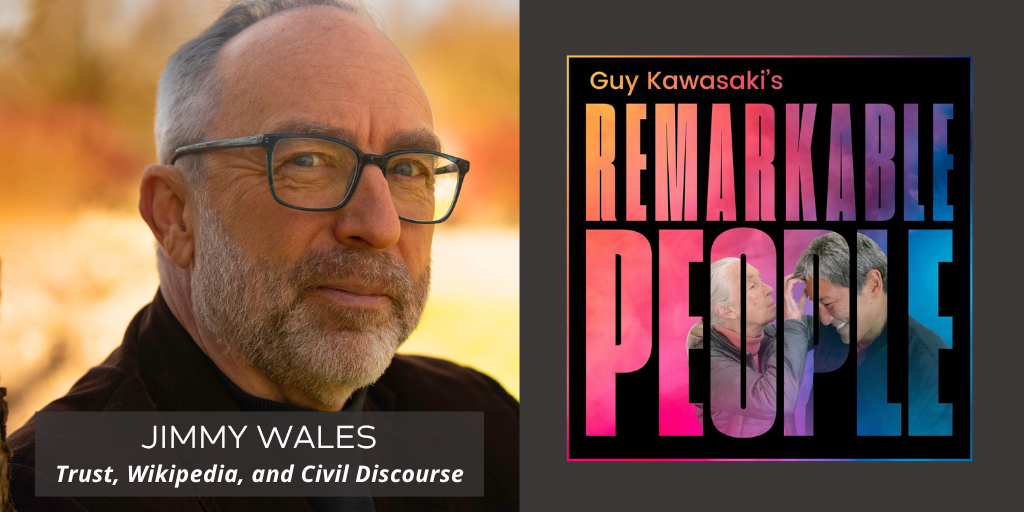
Welcome to Remarkable People. We’re on a mission to make you remarkable. Helping me in this episode is Jimmy Wales.
Jimmy is highly respected as the co-founder of Wikipedia, one of the most remarkable experiments in collaborative knowledge the internet has ever produced. But now he finds himself confronting a very different technological revolution as generative AI changes how people search, learn, and decide what to believe. Jimmy explains why Wikipedia’s human element still matters, why AI hallucinations are particularly dangerous when they sound plausible, and how artificial intelligence might actually help Wikipedians improve the encyclopedia.
Jimmy also shares the thinking behind his new book, The Seven Rules of Trust, which examines how individuals and organizations can rebuild trust at a time when confidence in institutions, journalism, business, and one another has declined. He describes trust as a combination of empathy, logic, and authenticity, and argues that transparency matters most when you have something to hide. His advice is surprisingly practical: make things personal, be willing to admit when you don’t know something, and remember that trust isn’t built by saying the right things when everything is going well.
Jimmy’s larger message reaches far beyond Wikipedia. He believes we can disagree without dehumanizing one another, collaborate without sharing every opinion, and use new technology without surrendering the human judgment that makes knowledge meaningful. As AI becomes more powerful, Jimmy isn’t arguing that we should reject it; he’s arguing that we should use it thoughtfully while protecting the values that make information worth trusting in the first place.
Please enjoy this remarkable episode, How Wikipedia Can Survive the Age of AI with Jimmy Wales.
If you enjoyed this episode of the Remarkable People podcast, please leave a rating, write a review, and subscribe. Thank you!
Transcript of Guy Kawasaki’s Remarkable People podcast: How Wikipedia Can Survive the Age of AI with Jimmy Wales.
Guy Kawasaki:
Jimmy Wales. Jimmy Wales. Man, one of my heroes. Welcome to the Remarkable People Podcast. You started one of the most amazing organizations in the world, Wikipedia, and I served on the board of trustees with you, and let’s just say those are very interesting times.
Jimmy Wales:
Yeah, exactly.
Guy Kawasaki:
So now you've written this book called The Seven Rules of Trust, and Jimmy, I'm not jerking your chain. I'm not bullshitting you. I had no idea you're such a good writer. It’s like succinct, it's clear, it's well organized. Your stories are great, and believe me, Jimmy, I have to read about one hundred books a year, and man, some of them is just pulling teeth.
Jimmy Wales:
Well, I have to give a lot of credit to Dan Gardner who helped me with the book, the writing process. You know, I write a lot, and I think I'm a clear writer and all of that, and I have a lot of stories, and I give a lot of talks to people, and I know the kinds of stories that helps things click in their mind and so forth.
So I started writing and I wrote down all my great stories, and then I realized I actually have no idea how to turn this into a coherent book and so raised the white flag to my publisher, said, "Oh, yeah, actually I think I do need some help here," and interviewed a few different people to help me, and Dan Gardner was fantastic.
He's written a few other great books, and we worked intimately together, loads and loads of phone calls and back and forth and so forth. I actually learned a lot about writing just working with him. So I'm going to give him most of the credit for the beautiful writing, but I’ll take a little bit of credit. I can tell a good story anyway, so yeah.
Guy Kawasaki:
You certainly can. So are you telling me, one writer to another, you started with the stories and then you figured out what they meant? Or you started with, "This is the seven principles I want to talk about, and I'll find stories that illustrate the principles." Which direction did you go?
Jimmy Wales:
I would say it was kind of a blend of both. It started with the concept of trust, and I knew that was really key. And at first I looked at The Five Pillars of Wikipedia, which then didn't map exactly into what I wanted to say about trust. And then at one point we had eight rules.
At one point we had eleven, and then we were saying, "Well, let’s rearrange it." The truth is, in the book there's the triangle diagram which comes from academic research into trust. And we use Frances Frei's exact nomenclature, but there's a lot of writings on trust that have the same kind of thing.
That's a theoretical construct that's actually in the literature. My seven rules, there wasn't like seven perfect, you know, this is the seven and I'm going to start from there and then I'm going to write the book around it. It was like, yeah, let's talk about what are the things that I've learned along the way, what are the things that I feel like are important, and that I have something useful to say about.
And yeah. And in fact, there's sort of a hidden eighth rule in the last chapter, which is basically you actually have to do all the things, right?
Guy Kawasaki:
Oh what a concept.
Jimmy Wales:
Yeah.
Guy Kawasaki:
All righty. Just bring us all up to speed. It's a whole different world of information and disinformation. How does Wikipedia work these days? It's still human authors, and they're writing subjects that they know about, and they have to cite sources that are respected and legitimate?
Jimmy Wales:
Yeah.
Guy Kawasaki:
Have we changed a lot?
Jimmy Wales:
No, it's all very quite classic and indeed part of the story of Wikipedia is we started with basically no rules, but with the vision of an encyclopedia, and most of the rules of Wikipedia about sourcing and things like that are actually just writing down best practice like they were always implicitly rules.
We just didn't write them down. Like we understood if you're going to write a good quality encyclopedia, you can't just randomly prattle on about whatever you want. You need to actually have evidence and so on and so forth and be clear.
And still, we've had twenty-five years now, which is an amazing number. And as part of the twenty-five year celebration, one of the things the foundation is saying a lot is, “Knowledge is human,” because obviously in the age of generative AI, there’s a lot going on out there in the world.
And that idea that, this is written by people, and the question of how are we going to potentially use AI or not use AI going forward is obviously a very hot topic and very interesting to me.
Guy Kawasaki:
So the controversy that many people have faced using Wikipedia and you talk about the initial Stephen Colbert.
Jimmy Wales:
Oh yeah.
Guy Kawasaki:
A concept that anybody can post anything, and is that more or less true? Has that changed a lot?
Jimmy Wales:
No, it's still pretty much the case. What I like to say about this is we were never as bad as they thought we were, and we aren't as good as they think we are. What I mean by that is even in the very earliest days, people were thoughtful and people were kind, and they were trying to do a good job, and of course there were mistakes, and there are still mistakes today.
But one of the great uplifting stories of Wikipedia is that the vast majority of people are actually quite nice, and that's something that's easy to forget in this era of toxic social media and toxic political discourse and so forth, is that most people are actually pretty willing to chew on ideas and really willing to give each other a break and to listen and so forth.
So a lot of it is the same. Obviously, as the work has gotten more and more filled in already, it's become harder in some ways to participate. Certainly in year one, you might be the first person to type, "Paris is a city in France," and hit Save, and it's like, "Look at my amazing encyclopedia article."
Obviously you wouldn't do that today because now if you go to the article on Paris, you might be hard-pressed to figure out what could I add, what could I correct, what can I make better about this because it's pretty comprehensive and it's pretty good. But there's always something fun and obscure.
When I do edit, because of my role in the whole process, I try not to get involved in directly editing things that are controversial. It's just better if I stay out of that. So I like to pick something fairly obscure and just add a little fact and learn a little something. So yeah.
Guy Kawasaki:
And now, please tell me the answer is no, but is it possible that a bot could register and act like a Wikipedia editor?
Jimmy Wales:
I think it would be very hard. I think it's a good thought experiment for the future, but it's so different from say social media. So for example, we know in general, there's loads of bots trolling on Twitter, for example X, because you write one sentence, it's kind of hard to tell if it's a bot or not, and so on and so forth.
But in Wikipedia, it's a discourse, it's a dialogue, and I think anybody who's used AI, today it's still pretty obvious. AI-written text looks like AI-written text. It's got a lot of cliches and bad writing stylistic habits and so forth. And also just to sort of engage with the community, it would be quite hard.
I think there are probably more people these days who are using AI a little bit in helping them write, and that can be good or bad depending on what they're doing. So a good example would be, okay, I want to write something in English Wikipedia, but I'm a native speaker of French, and I'm not so comfortable with my English.
I can speak English. I can read and write fluently, but I know I don't always get it exactly right, so I'm going to go to an AI and have it help me make sure my grammar's okay and that my stylistic phrasings. That's not a bad use, that's okay. You want to be careful and make sure that as you're doing it, it doesn't make stuff up and doesn't insert those sort of gross AI cliches and so forth.
But that's okay. A bad use case, and we do see this and the community has to deal with it, is somebody who says, “Oh, I just found this obscure person, doesn't have an entry in Wikipedia. I'll just go to ChatGPT and say, 'Oh, please write a Wikipedia entry about this,' and then I'll go and paste it in," because that's a disaster.
It doesn't work at all. The hallucination problem, even with the best models out there, is still pretty bad, particularly on obscure topics. And so we discourage people from doing that. We say, "Yeah, don't do that. That's not actually helpful."
Guy Kawasaki:
But even in that scenario, doesn't the person who's contributing have to cite what Wikipedia deems legitimate sources? Who would that person cite in that case?
Jimmy Wales:
Yeah. Well, here's the interesting thing. AI can often give you a source, and it'll give you a source even if it has to make one up, so that's a part of the problem, and there's actually a great story. So a German “Wikipedian,” Matthias, I've known him for twenty-plus years.
He's been around from the very early days. And he came to me and he said, "Oh, Jimmy, you're going to find this interesting. Let me show you what's happened." So he wrote a script to go through German Wikipedia looking at ISBN numbers.
So for listeners who don't know, every book has an ISBN number. It's a global standard. And he was checking against an official database. And when he finds one that wasn't in the database, typically it was a typo because a human was sitting with a book, and they were typing in, and they made a mistake.
Suddenly, he started finding books like that, they didn't exist. Like he couldn't find any evidence of the book, and several came from one user. So he went to the user, and he's like, "Hey, what's going on here? I can't find these books, and we try to assume good faith. Can you help me? What's going on?"
And the guy was absolutely mortified, and he said, "Oh, I'm really sorry. I'm new to Wikipedia. I just wanted to help. I thought, I don't know how to get started, but I'll do something easy. I'll just add some references. And so I went to ChatGPT and asked it for books about this subject.”
And actually, what is dangerous about AI in this context is it made up the author, the title, this is a made-up example, but it might be a book, you know, The History of Marketing at Apple by Guy Kawasaki, right?
And you would go, “That seems like a book you could write." You would probably be a qualified person to write a really interesting piece on that, but you didn't, and so it's plausible. And then the guy was like, "I had no idea it could make up an ISBN number," right? But oh, yes, it can and make up completely phony ISBN numbers.
And that's really interesting because if a human did that, like all of that, you're just like, that's actually malicious behavior. And certainly going to the level of actually making up an ISBN number, that's like even trying to cover your tracks and make yourself seem credible when you're not.
But of course, the model's not being malicious. It just doesn't work as well as it should. Now, that kind of problem is getting better with AI. They are beginning to improve the hallucination problem, but it's still pretty bad.
Guy Kawasaki:
Now, Jimmy, not that I believe this, but let me play devil's advocate or maybe just pure asshole.
But if somebody said to you, “Jimmy, why do I need Wikipedia anymore? I can just use LLMs. I can ask about anything in any language, and I'm not worried about some human generating a story with citations. Seconds later, I can get an answer to any question. And often, the citation based on, or you know, grounded by Wikipedia. So why do I need Wikipedia anymore?”
Jimmy Wales:
I think that's a completely valid question, and I think we are definitely seeing a drop in traffic, particularly for exactly that kind of use case, which is, I have a question in my mind, I just need an answer to my question. Like I do this all the time. Google has gotten quite good at this.
So twenty years ago, if you went to Google and you said, “What was the name of that movie that had Tom Hanks in it, and he was trapped in an airport?" And Google had no idea, or if it did know, it probably just linked to the Wikipedia entry, right? Now it just answers your question. It says, “Oh, that was, whatever it was,” I forgot. The Terminal, I think it was called.
And so we've seen a drop in traffic, we think mostly that quick hit traffic. Now, we still get the long form, like you come to read and learn about a subject in that longer way. So when the Queen died, for example, millions of people came because they're like, "Oh, the Queen died. I'm interested in the Queen. I'm going to read about her life story," and so forth, and they just come to Wikipedia because that's a good place.
And certainly, if you're a “Wikipedian,” right? You sort of do spot, like the AI still does give you a lot of mistakes and a lot of misinformation, and it's particularly true, as I've said already, the more obscure the question.
If you just want to know where was Taylor Swift born? Sure, yeah, get that from an AI. That's fine, but if you want to know some obscure detail about some person who's not that famous, you run a real risk the AI is just going to make something up.
Guy Kawasaki:
I think one of the beauties of Wikipedia is the human element where if you point out a mistake like this guy in Germany, there's a human there. So yeah, I screwed up, let me fix it. But with AI, if you find a hallucination, like what do you do? You send a message to, I don't know who, Sam Altman, "Dear Sam, your entry about Paris is wrong." I don't even know where you start with something like that, right?
Jimmy Wales:
Yeah. No, it's an acknowledged problem, I would say, in the AI industry that these models make mistakes and there's not much to it. And of course, if you call the model out on the mistake, it will generally apologize and, you know.
Well, thanks but the problem really is though that the errors, they aren't usually so obvious because of the way the technology works, which is take a whole string of text and then predict what's the most plausible next words from the list of plausible next things, it tends to make things up that are plausible. And so if I did ask, "Who is Guy Kawasaki?"
It's not going to say, "He was the first person to live on Mars," because if it said that, I would be like, "Yeah, I'm pretty sure nobody's lived on Mars yet," and I just don't think so. But if it said that you had a career at Apple and you were on the board of the Wikimedia Foundation, and you did a period on the board of Goldman Sachs and you moved on.
I just made that up, Goldman Sachs, right? Is that possible? It's plausible.
Guy Kawasaki:
No, it’s not possible.
Jimmy Wales:
Okay, you might know that, but most people wouldn't. And that's the kind of thing where it's like, yeah, actually, the hallucination problem is it's worse than just getting something wrong. It's getting something wrong that people might believe.
Guy Kawasaki:
Yeah. I didn't know about this study until I read your book. So this is in 2005, and Nature, the magazine, did a study of Wikipedia versus Encyclopedia Britannica, and it found out that both sources roughly had the same amount of errors for these forty-two topics or something. So my question is, why hasn't Nature done Wikipedia versus ChatGPT? Wouldn't that be a natural thing to do at this point?
Jimmy Wales:
I think it's a really interesting idea. Yeah, for sure. And I actually think there's something really interesting and that I think is a challenge for us and something that I've been playing around with because one of my questions is, okay, it’s easy enough to just criticize and say, "Oh yeah, it gets things wrong."
But we also know it's incredibly useful, and it could be very helpful to us. And I've been exploring what are some of the ways that AI might help us, so as a simple example, just a very simple claims checker, okay? So you go into an article, you take a sentence from Wikipedia, you look at the footnote, and you ask the question, does that footnote actually support what's said there?
And the answer could be yes, no, or something more nuanced. Like, well, actually Wikipedia introduces a biased term, or Wikipedia doesn't go as far as the source, whatever it might be. And it wouldn't have to be perfect, it's not just saying, "Oh, please tell me about this," where it does definitely hallucinate, but it would be a very simple mapping this to that, which you couldn't do. Technologically, you couldn't do.
And if a tool like that were useful to the community, that would be good. And then one of the thought experiments, I was just at Wikimania. You've been to one of our Wikimanias, and at least one, I can't remember. But at Wikimania, I was talking to one of our developers, and we were just discussing, “Okay, how far away are we from AI, like using an agentic harness?”
Not just a chatbot, but where you actually have a system that does multiple steps, checks its work. One step you say, “Write it,” next step you say, "Give me the sources." Then you go out and you check, are those sources actually real? Then you ask, is every sentence actually in this? Does that source actually support it?
Could we get to a point in the next few years where we are maybe in software development? So I think what most people in software development would say today is like the best AI in an agentic framework is probably somewhere equal to a junior developer. Doesn't have the same wisdom of a senior developer, can't really keep in mind the full context of an architecture, can't do everything that an experienced human could do.
As a junior developer, it can go and write some decent code. Well, could we have kind of the equivalent? Could an AI agent act as a junior “Wikipedian?” A newbie, a good newbie, right? And how far away from that? Now, the guy I was talking to thinks we're closer than most people realize.
I'm a little more skeptical, but I do think it's a legitimate question. And so for our community, that's something we're going to have to grapple with over the next few years, is to say first of all, if a lot of random people outside who don't necessarily share our values start doing this, do we have a struggle of dealing with people who are using an AI to pretend to be like a good junior “Wikipedian,” but actually have some agenda they're pushing?
I think we can catch that, but it's going to be something to think about. But also, maybe there's something really useful we could do. Maybe, the community through a WikiProject. So just to explain to people what a WikiProject is. A WikiProject is where people get together on a topic-based, kind of, idea.
So my favorite example is WikiProject Bridges. So this is a group of people who look at the articles about bridges in Wikipedia, suspension bridges, and they ask questions like, does it have all the basic facts? Does it have the length? Does it tell the architect? Does it tell the location?
All of these things. They have a checklist they go through. And they have a list of bridges that have been, you know, sort of here's bridge articles that are rated “C” out of an A, B, C scale.
Well, could they say, "Actually, we're going to use this AI agent who's going to work diligently twenty-four seven for a month improving the C-class articles, and then we're not going to let it just post them, but we're going to go through and in a month's time, the three of us working together, we could have done ten new articles. Can we do one hundred now?
Sounds interesting, right? And I don't think we should be too anti-AI that we won't consider that, but we also shouldn't just go, “Let the bots run free," because I think that's a danger as well.
Guy Kawasaki:
Well, it seems to me, Jimmy, that I don't know how, and I don't know how it scales, but in a perfect world, Wikipedia would be the fact checker on an LLM. If you told me that Sam Altman and Jimmy Wales got together, and Sam Altman said, "Yeah, we're going to open the kimono, and we're going to let “Wikipedians” check ChatGPT," I would have a lot more trust in ChatGPT than what it is today.
Or if you really want to push the model, I think Wikipedia should do its own LLM. Screw those other people. Just do your own LLM. Combine Wikipedia with trust and the power of AI.
Jimmy Wales:
Yeah, so there's pieces of that for sure. I mean, actually, checking an LLM is quite hard because whatever people might ask anything and then what it spits out is random. So there's no one answer. Actually I was testing some new local models.
There's new local models dropping. And one of the tests that they've traditionally failed, they're getting a little bit better at, I don't know if you've heard of this, the car wash test. So you ask an AI, you say, “I need to go to the car wash to wash my car. The car wash is two blocks away. Should I walk or should I drive?"
And as a human, even a five-year-old human would go, "Well, you obviously have to drive because you need to have your car there." A lot of the AIs get it wrong. Particularly some of them because they've been trained to be a little bit, I don't want to say woke, but a little bit.
And they say, "Oh, actually it's only two blocks to walk and so it's really better for the environment if you just walk. And plus it's actually good for your health to walk, so I actually think you should walk. It's only two blocks," and then you go, "But yeah, but wouldn't my car be at home?"
Then it goes, "Oh, wow. That's amazing. You're right. You're so clever." Okay, I forget why did I tell that story?
Guy Kawasaki:
It’s a great story. I don’t care why.
Jimmy Wales:
Yeah, but, oh, what were we saying? I remember now. It was the question about, could Wikipedia have an LLM?
And so one of the problems is right now when we see this kind of thing, one of the things that could erode our trust is if you go and ask Wikipedia a question and the AI just makes something up, and then you're like, “Whatever. I always had a little concern about Wikipedia because it's written by random people on the internet, but at least there were sources, and I know they try hard. If I get a bad answer, I'm like, ‘Oh, that's bad.’”
On the other hand, like one of my ideas, which I think we will do, I think it's just a technical question of how much it costs and so forth.
Okay, if you go to Wikipedia right now and you type in the search box, in our search box, "Why do ducks fly south for winter?" I haven't tried it this week, but a few weeks ago, I tried it and the first result was goose. The second result was a children's book. The search results were useless because our search engine at Wikipedia is just keyword-based.
It's really old-fashioned. It just looks at the words and it's just "I don't know what this means because I'm just a computer program, but here's some stuff that seems to match," right? Now, an LLM totally understands it. So in my experiment, I went to a couple of the big models and I just said, "Please tell me five Wikipedia articles that might answer this question: Why do ducks fly south for winter?"
And sure enough, the first one was maybe bird migration, the second one was ducks, and so forth. And so you can imagine what we could do is actually have our own internal model that it never shows you anything that it made up and wrote itself. It only shows you things that humans wrote, but it helps you find it.
So instead, it might say, "Oh, okay. So this person wants to know why ducks fly south for winter. It probably is going to be in this article, this article." Then it could go look through the article and go, "Oh, in ‘Bird migration,’ there's a paragraph that says, 'Ducks fly south for winter for this reason, or birds generally do.'"
And you could just quote those things back and say, "Here's the search results page. Here's some articles. Here's some quotes that might be helpful." It'd be much better than what we have now. And so that's where I'm excited about, okay, rather than just turn everything over to a chatbot to say actually, the technology's pretty powerful and there's stuff that we could do today that we couldn't do years ago.
Guy Kawasaki:
But Jimmy, believe it or not, there's such a thing as KawasakiGPT, and the only sources for KawasakiGPT are my videos, my speeches, my writing, the transcripts of this podcast. So literally when you go to KawasakiGPT, you are asking me and my guests the question, not anybody else. And so why can't there be WikipediaGPT where the only source of information is the existing Wikipedia entries?
Jimmy Wales:
It would be an interesting experiment. I think, one of the issues you would have is if you just started with a blank, no data, and the only data you fed in was Wikipedia, it probably isn't enough language to actually give it a good understanding. Like they train on literally trillions and trillions of tokens to understand how people talk and what kind of things they say and all of that.
So it would be kind of like they call it R.A.G., a Retrieval-Augmented Generation where you would say, "Okay, here's a general model that's been trained on Reddit and everything else, so you understand how humans talk, but then you only give answers from this corpus, but you're allowed to write it in your own words."
It might be interesting to try. I don't know. I would want to make sure it doesn't make stuff up. That's the biggest concern.
Guy Kawasaki:
How about this? With KawasakiGPT, I can't remember anymore because I set it up so long ago, but I could make the case. Well, you ask KawasakiGPT, “What are the essential slides of a venture capital pitch?” And then, the first answer is, “According to Guy blah, blah, blah.”
And then it could have a second part where it say, "Going outside of Guy's corpus, here are other answers." The main thing is Wikipedia, then you can go outside about why ducks fly south.
Jimmy Wales:
Yeah, and you could even go into the sources that Wikipedia uses and that sort of thing. So we have a machine learning group at the foundation, and they are looking into all this. But one of the issues right now is that, while inference, so actually using a model is pretty cheap, you can do that in a pretty straightforward way.
Actually training a model takes a huge amount of processing power. And so for us to do it, like I think it would be a huge risk for us to do it completely from scratch, we might need to spend, I'll just make up a number, one hundred million dollars training a GPT, and then we might find, oh, it actually doesn't really work that well.
I don't know. But I think there's stuff that needs to be explored, and I think we are very interested in seeing what is the next thing because in some ways, obviously it's completely different, so I want to make clear this is just a very loose analogy, but we had a big transition in technology from using only the web on the desktop to suddenly mobile devices.
And I remember when page views in Wikipedia became more than 50 percent mobile devices, that was a big shift because it suddenly meant the reader's experience of Wikipedia was now largely coming through mobile, while the editors are still largely on desktop because editing on your phone is a pain in the neck just because it's tiny screen and all that.
And so we had to think about, okay, what would that mobile experience look like? And I actually think we've gotten pretty good at it now. It's much better than it used to be. And so now I think it's a completely different kind of transition, but we also have to say, like, okay, AI is here.
It's not going away. Generative AI, large language models. What we want to do is preserve what's human about Wikipedia. We want to preserve the trust. We want to preserve that everything you see, it isn't all correct, right? Of course, we all know Wikipedia's got errors, and Wikipedia can be biased and all that, but people have tried.
And you want to have that sense, and not oh, this is just another commodity LLM just like anything else, and they're all using it, and basically they're much smarter anyway because I can ask about quantum mechanics, and I don't just get the Wikipedia entry. I can actually then ask for example problems, and I can actually do my homework with it and things like that. So I just think we want to be innovative but thoughtful.
Guy Kawasaki:
Yeah. I'm glad I'm not in your shoes, Jimmy.
Jimmy Wales:
Oh, it's fun shoes to be in.
Guy Kawasaki:
This is either the best thing or worst thing that ever happened.
Jimmy Wales:
Yeah.
Guy Kawasaki:
My last thought about Wikipedia is that I've been trained that Wikipedia is a very good starting point, right?
Jimmy Wales:
Yeah.
Guy Kawasaki:
So if you want to learn about Paris, you get the Paris Wikipedia entry, you look at the citations, and you can find better and better things. So Wikipedia version one is a starting point. I could make the case that Wikipedia is now the end point.
Jimmy Wales:
Oh, that's interesting.
Guy Kawasaki:
You ask your LLM about Paris, you ask ChatGPT, you ask Anthropic, whatever, you get the discussion of Paris, and the last step is you go to the Wikipedia entry for a reality check on what you just heard from the bullshit LLMs.
Jimmy Wales:
Yeah. I think there's some really interesting opportunities here. So one of the things I think a lot about is how I use LLMs and how I have used them. So obviously coding, so that's a very different use case from Wikipedia. That's not competitive at all. You use it for those quick questions, right?
To learn about something, when was the Eiffel Tower built? You use Google for that, and the Google AI summary is right there, so you don't need to click on Wikipedia anymore, but also, this is now some time ago. Year ago? More than a year ago? Can't remember.
But, so in Amsterdam, they had the largest exhibit of Vermeer paintings in one hundred years. They got almost every Vermeer in the world together. And so I went with my kids and my wife, and we went to Amsterdam to see the Vermeer exhibit, and we just had a mini break, a weekend in Amsterdam. And so I went to ChatGPT.
At that time, it was the best model. And I said, "Oh, here's who we are. Kids are this age. I'm the Wikipedia guy. Here's what we're all interested in. What should we do? Can you make an itinerary for us?"
And it was pretty good, and it felt honest and obviously one of the, I would say, negatives on the web these days is, and it's probably gotten worse because generative AI people are making a lot of crap websites these days, but you have these really bad listicle articles and things like that.
If you just start searching the web for what should I do in Amsterdam, you get a lot of nonsense. It felt really good, and it was very clear, and it gave me reasons why we might like this, that or the other. Now, as it turned out, a human friend of a friend sent us their list of best things to do in Amsterdam. So we used that instead because I'll still go with a human. But it was a good use case. And so I can imagine a product.
I don't think this is a blockbuster billion-dollar idea, but if I were somebody like TripAdvisor thinking about AI, I might do something like this to say like, you come and you chat to the TripAdvisor chatbot, and at the end, once it says, "Do you want to get a big PDF? And we'll include for all the sites you're going to see the Wikipedia article, and we'll just bundle that in, and we'll give you a thirty-page guide to Amsterdam for you and your kids."
That's cool, right? That would be really interesting. And it's better than just like an AI "Here's what you should do and why."
It's also, why do you take your kids to go see Vermeer, it's really accessible art. Even a kid who's not that into art. If you show a kid, I don't know, Jackson Pollock, they're going to go like, “This is just a bunch of scribbling," and explaining why that's actual art.
It’s hard for me to even get it myself. But Vermeer, you go like, "Wow, this is amazing. I couldn't make this." And you really feel it. So you want to learn about the history, so you want to teach your kids about history. This is an entree to like, "Oh, why don't you read the Wikipedia entry about Vermeer, about the different paintings and so on?" And they did, and that's great. So yeah, and that's more than you'll get from an AI.
Guy Kawasaki:
Oh, yeah, absolutely. So listen, the prompt for this podcast was your book.
Jimmy Wales:
Yeah.
Guy Kawasaki:
Enough about Wikipedia. Okay, let's talk about your book. And give us the gist, like what are these rules of building trust?
Jimmy Wales:
Yeah. The basic idea of the book is that we are in an era where in many ways there's a crisis of trust. So the Edelman Trust Barometer Survey is a survey that's been done for a couple decades now, and it's documented a decline in trust in journalism, in politics, to a lesser degree, a decline of trust in business, in each other to some extent.
And this is not universal, but it's pretty global. There's still some bright spots of high trust cultures and things like that, but it's a problem. And of course, this is leading to all kinds of problems. One of the things I feel is really problematic is if you point out to someone who is a Trump supporter that he lies a lot.
They often will acknowledge, “Yeah, of course, but they all lie. They're all a bunch of criminals," right? And so that decline in trust means people aren't valuing trustworthiness because they think, Everything is corrupt. The same with companies. If you just think every company's out to screw you over, then maybe you're not going to sufficiently punish the companies that screw you over and reward the companies that don't.
If you don't make it clear as a consumer, "Actually, I want a trustworthy brand where you're going to stand by your product and you're going to do all the classic old-fashioned business stuff." So we want to rebuild trust and so how do we do that, what are the steps you can take?
And obviously as individuals, you can't boil the ocean, as they say. We can only take action where we are, but people who are in leadership roles in organizations, and in your life and so forth, you can think about trust, and you can think about how to build trust.
So what are the things you can do? So we'll start with rule one. I always say to people, "Please don't ask me to rattle them off memorized in order," because I can't do that. My brain doesn't work that way. But I do remember a few of them in some order, but rule one is “Make It Personal.”
And there's some stories in the book about this, but it really makes a lot of sense to say a lot of companies, this is particularly true in the internet world, where there's a strong reliance on statistical A/B testing methodologies where you look and you say, “Look, only a tiny percentage of users is this going to impact."
But if you don't make it personal, if you don't think about, "Okay, but what is that impact going to feel like to that person, and how are they going to respond?" You're going to miss a whole dimension here. So there's the Airbnb story where early in the history of Airbnb they hadn't really thought much about trust.
I think, one of the main reasons, and this is just my opinion, is they were young men, tech bros, and they were like, "Yeah, people can come and crash at my house." And so what happened to them was a woman put her apartment on Airbnb, and then the tenants came and absolutely trashed the place. Literally destroyed the place.
It was really bad. And the company really badly handled it. They had a lot of bad advice, legal PR-type advice, saying, "Don't take responsibility. Just respond in a minimal way. It'll blow over in a few days." It did not blow over because the story, the personal story, this woman wrote a blog post about sobbing in the staircase of her building because she couldn't go back in.
It really resonated on that personal human level with people. So even if they were right of like, "Oh, it's going to be a tiny percentage that this is going to happen. Most people are trustworthy." But the impact was so huge, that they didn't really think of it on that personal level.
And to say "No, actually, you've got to think of that person, that business partner, that customer, that friend, how are they going to take this? How are they going to feel if you've done something to violate their trust?" And then, you've got to think about that, not just go like, most people are going to be fine." That's not good enough. So it's a lot of stuff like that and things like, be transparent.
And I love the subtitle of this chapter: “Be Transparent,” especially when you have something to hide. And the reason for that little expression is everybody loves to be transparent. It's great. Of course, we publish all our numbers, and we're really open about everything.
Yeah, it's really easy when things are going well. It gets harder when you're like, "Yeah, actually, we screwed this up. We kind of want to pretend that never happened." And so just to really think about, Okay, how does it help to actually be transparent, especially when you have something to hide, as a way of building trust?
Because it turns out, people appreciate it. People will say, "Okay, yeah, you didn't have to tell me that, but you did, and that's good. So now, we can work out the problem somehow."
Guy Kawasaki:
I got to tell you, going back about a minute here, you tell the story of Airbnb, but let's tell the positive story about the doctor who treated your daughter for meconium and then introduce the triangle here.
Jimmy Wales:
Yeah. The story is the opening story of the book, and it's a very personal story. When my daughter was born, it was my first child and my wife's first child, and so we didn't know anything, of course.
And when she was born, she had meconium aspiration syndrome, which is a condition where some of the fluids, you know, it gets down in the lungs during the birth process. And it's incredibly damaging and terrifying for us as parents because everything was going normal and all hell breaks loose in the delivery room and so on. And we were very lucky because the world-leading expert on this was there at the hospital in San Diego, California.
And they rang him, got him out of bed, and got him down to the hospital very quickly. And he had developed this experimental treatment. I'll tell you about it because it's so terrifying, which is basically they stop the breathing of the baby. They paralyze the baby's breathing, and they reroute the blood through a machine to oxygenate the blood, so that keeps you alive while your lungs are paralyzed.
And then they basically fill the baby up with this protein-based fluid he had invented and four times, and they dump the baby out. They basically rinse out the baby's lungs. It's unbelievable, right? And as it turned out, it worked. She's completely fine. It was like a miracle cure.
It was unbelievable. Whereas the traditional treatment, they just try and keep the baby alive because there was nothing they could do and so forth, and often people ended up with lifelong lung ailments and so on and so forth.
Okay, great. But there was that moment when the doctor came to us and said, basically, "We think your daughter is a good candidate for this. Let me describe this terrifying procedure to you." And what was great about this particular doctor is I asked a question. I asked a question about this, the machine, and what the numbers meant, and he drew me a graph about oxygen, like when they give the baby oxygen.
This is before they did the process. So they gave her oxygen because her lungs weren't working very well. They're like, "We can't give too much oxygen because this happens. Can't give too little or that happens. That's the number we're tracking about oxygen saturation in the blood." Turns out he invented the machine as well.
This guy's amazing. And he answered me with a graph. And so he very quickly had empathy for me and what type of person I am. He could tell, like I was interested in the science, and I'm not a scientist, but I'm a nerd, right? And that gave me assurance of like, okay, actually you aren't just being like, you know, doctors can sometimes just be a little patronizing or treat your emotions and not really be ready to explain the science to you.
And maybe that's good for some people. For some people, they don't really want to hear about the machines, right? They just want you to say it's going to be okay. Okay, fine. But that empathy, which is one of the triangle, is a piece of trust. He could see me, he understood me. That helped me to trust him. I'm like, "Okay, you get me. We're on the same wavelength." So the triangle of trust is empathy, logic, and authenticity.
And those are the three things that matter. And one of the great interviews in the book, and it's one of my favorite sections of the book as well, is our interview with Frances Frei, who is a Harvard academic who went into Uber when they were having a massive trust crisis.
And became, like interim CEO and ran the place in between Travis and what's his name? I know him but can't remember his name right now. The current CEO. And, she said, "Look, it's always one of these things. And when you've got one of these things wrong, then trust breaks down, and you really need all these pillars."
And so that was a big part of the thinking, in the book, is to think about, What are the things you can do to rebuild each of those? So it might be empathy, logic, authenticity, that sort of thing.
Guy Kawasaki:
All right. So I give you a choice of which question you can answer. This is a hypothetical situation. Either Sam Altman calls you up and tries to bring you in as Chief Trust Officer or C.T.O. of OpenAI. So Jimmy, your task is to build trust in ChatGPT. You can answer that question.
Or I don't think it's possible under this administration, but let's say the next administration calls you up and say, "Jimmy, I want you to be the Secretary of Trust for the United States."
Jimmy Wales:
Wow.
Guy Kawasaki:
What do you do for either of these organizations. You can answer both, actually. I’d like to hear both. What would you do if you’re the Chief Trust Officer of OpenAI or the Secretary of Trust of the United States?
Jimmy Wales:
Wow. That's actually super interesting. I thought you were going to ask me would I take the job, and I was like, "I hope he doesn't call me because he'll probably offer me so much money I'll kind of have to say yes." And it sounds like a miserable job, but I would do it.
Guy Kawasaki:
Just ask for a big signing bonus.
Jimmy Wales:
Right. Exactly. A few of my friends got really excited when Elon bought Twitter, and they said, "Jimmy, you need to talk to Elon. You need to go in and run Twitter." And I was like, it sounds important and interesting, but he's definitely going to fire me in three months, so I got to get all the cash up front." Obviously, that was never going to happen.
Guy Kawasaki:
It wouldn’t last. I hate to tell you.
Jimmy Wales:
But it wouldn't last three months. But so I think for an AI company, so it can be ChatGPT or whatever. There's a lot that needs to be done to improve the trust in the product, but I think it's a real challenge because in the case of ChatGPT, I think their business model, it's looking pretty tough for them going forward.
So like introducing advertising into the chat results, that's got to be done super-duper carefully. If they said, "Can you just come and advise us? We're going to put ads in ChatGPT. We know that's got trust implications. What do you think we should do about that?" I would definitely give some advice on that.
I think it has to be very similar to the way Google has kept the search results and the ad results completely firewalled from each other and separate. And you have to be transparent about how you're doing that to make sure people believe it.
Because the worst thing you want, and actually I think it was Anthropic Claude, they did their Super Bowl commercial was making fun of this idea because they had a chatbot, and it was actual like a human-shaped robot that was a personal trainer. And the person is talking to this obvious robot telling them, and it starts selling them supplements.
So if the results of the AI, if you say, "Hey, I'm taking my kids to Amsterdam, we want to see the Vermeer," and then it starts recommending hotels, and then I see the search results are sponsored by that hotel company, then suddenly the advice is very, very suspect. Suddenly you're not giving me legitimate advice based on analyzing everything every review has ever said about these different places.
You're basically selling me a product. I don't trust that. Same reason we don't trust used car salesmen. It's like, okay, you go in and you think, I didn't come here for objective advice. I know you're going to try to sell me the car. And we can deal with that, but it's not the same thing as getting a neutral advice.
So the ads have to be just maybe banner ads at the top, even though those aren't going to pay as well as integrated into the results. So that's a piece of advice I would give them if they're going to do that. For the U.S., for the trust thing, there's so many elements. I think that's really interesting.
So for governments, trusting government is at an all-time low and obviously this administration has a lot of trust issues and problems, putting it mildly. But I do think there are things like, you know, if you had the ability to actually get it done, there are things like the Supreme Court.
Which really in the past has had a very high level of trust, maybe less so these days. I personally have had a very high level of trust in the Supreme Court. Even when I disagree with the decision, I did feel like there's some really good things about the Supreme Court being independent, appointed for life.
They can't be fired by the president, thank goodness, and all of that. But they've got their own rules about conflict of interest, and apparently it's quite bad, taking money from people whose cases appear. This is not good at all, and I think they need to actually clean that up super incredibly tight.
Some of this has improved. It used to be, I remember this was an alarming state of affairs. It was many years ago, but the rules against insider trading did not apply to members of Congress.
Now, they do now, but I'm like, that's insane. And now whether they have the right auditing in place to make sure that this is happening, make sure they're not insider trading, I don't know.
But certainly there's a lot of elements like this where the revolving door between regulators and industry, that's a problem, and it's a complicated problem because although you want to be careful about that, you also would say, "Actually, I'd like to see people with expertise on highly technical subjects actually go into government."
That's a fine thing, but if it's just this revolving door, if your decision as a regulator might ruin your chances at a three million dollar a year job after you finish your stint in government. That's hard. I don't know, that's hard to deal with. So it's hard. But then, I think a lot of the principles for individual politicians, you know, be transparent, especially when you have something to hide.
Be willing to say, "I don't know the answer to that question," and it's hard for politicians to do that because the culture wars are so raging. I actually think one of the ways for the government to increase trust in the government is if they can find ways to build trust amongst each other.
We've just gone through one of the longest shutdowns in U.S. government history because they can't even get the basic job of government done of just pass the budget. Can we just move forward? How do you do that? They used to do it, right? They did it for one hundred years, more than one hundred years.
They did it for a long time. And part of it is, it's a little give and take. It's a little trust. It's a little say "Okay, look, I'm not going to get everything I want. You're not getting everything you want. I'm going to give you something. You're going to give me something. We're going to get through. We've got a bigger job to do for the people, which is keep the place running. And we can fight about this, that, and the other."
But basically, you have to have that kind of mutual respect and trust, whereas if you actually believe that the other side is, choose your poison, both sides can be quite extreme in their rhetoric.
Then it's like, yeah, actually, that's not helping at all. Now, part of the problem is there are a handful of them who are actual lunatics, so it's really hard to say what you do about that. But again, there's no one answer to restoring trust in general.
I think it's a lot of pieces voters need to really value. One of the things I've been saying a lot lately is I'd rather vote for someone who I feel like is honest and straightforward, even if I don't agree with their policies quite as much as somebody who I'm like, "Okay, I'll align with your policies, but I can tell you're not trustworthy,"
So if somebody says, "Yeah, Trump lies a lot, but at least he got this and that done, and I like that," I was like, "Really?” And that's actually one of the big surprises to me about his support from the evangelical right, who I think, the ability to overturn Roe v. Wade was so important to them that they were able to forgive what is clearly very, very un-Christian behavior and attitudes.
Guy Kawasaki:
Yeah.
Jimmy Wales:
I think that's problematic.
And I think they should have said, "Actually, there's more than just this one issue. And actually, having a decent human being in office is actually really important." So that's my roundabout way of saying.
Guy Kawasaki:
It's a tough problem.
Jimmy Wales:
It's a tough problem. And I remember when the U.S. reduced the corporate tax rate to 20 percent. This was a Trump thing, right? And I was like, "You know what? That is actually lowering it to be in line with France," It was 28 percent and France was 20 percent.
I'm like, that doesn't sound extremist to me, if you're putting your corporate tax rate in line with Europe. Now, they need to fix some other things in the tax policy as well and all that, but of course, I didn't want to come out publicly say, "Yes, this is fantastic what Trump has done," because he's so problematic. But I wouldn't advise people to vote for him because, “Oh, I like this aspect of his tax policy,” because I just think it's really problematic.
Guy Kawasaki:
You know, when I was on the board of trustees of Wikipedia, if you and I ever had a conversation and said, “By 2026, democracy will be completely threatened, and it'll be so messed up," and we would've said, “Guy, you're hallucinating. It could never be that.”
Jimmy Wales:
Yeah.
Guy Kawasaki:
Do you imagine it would ever be like this back then?
Jimmy Wales:
It's really hard. It's really hard to imagine, and it's not just a U.S. problem. I think it is a U.S. problem, but I would say more broadly, we've seen a rise of authoritarianism around the world. I live in the U.K. now, and the threats to freedom of expression here are mind-boggling.
The number of people who are arrested for social media posts that would be completely legal in the U.S. is quite large and surprising, and the Online Safety Act.
Guy Kawasaki:
Wait, this is happening now in the U.K.?
Jimmy Wales:
Yes. And usually it's somebody who's been a jerk on social media, there was a woman who got in massive trouble because she made some comment, there was some trouble with migrants in a hotel, and she's like, "We should just burn these hotels down."
Okay, that's a nasty remark. And it's completely out of line and should be heavily criticized, but it was clearly just an inflammatory, jerky thing to say on social media. She wasn't actually threatening anybody. It wasn't going to cause any unrest. In fact, probably almost no one saw it. She's had a massive legal case over it, and I'm like, "Really?" That doesn't seem like the right answer to making the world better.
So that's the kind of thing where it's like, again, the intensity of a lot of culture war debates are the two sides just completely dehumanize each other. They aren't able to see the other person.
Actually, one of the people, oh, now see, I've forgotten her name. She's in the book, and then I did an event with her in Seattle. Monica's her name. So it's in the book. Anyway, she wrote a book about conflict in society and people disagreeing with each other.
And really, I thought it was a very, very good book about how do you have hard conversations with family members where maybe they've just been red pilled, as they say, or whatever it might be, and sort of getting past that and remembering, this is basically a decent human being who's trying to take care of their kids.
And they want to go to work, and they want to have a good job, and they're basically decent people, and yeah, they believe some things that are quite terrible, but there must be a way to talk to them.
Because if we just treat each other as lunatics, that doesn't heal anything. It doesn't move us forward. And obviously, this comes from how the Wikipedia world works when it's working well, is to say, "Oh, actually, you and I might disagree on some political issue, but we can probably work together on the article."
You could say, “Jimmy, you're completely wrong about that tax thing, and lowering the tax is quite a radical move, and here's my reasons why." We would totally have that conversation, and we wouldn't walk away saying, "Oh, that guy's clearly a communist," right? And you're like, "Jimmy's a right-wing fascist."
No. We would go like, "Oh, actually, he's mistaken on tax policy, but he's a great guy." And actually, we wrote about it in a way we both think we've explained it and all of that. And that's really what we need, you need that kind of “Wikipedian” spirit of okay, even though I disagree with you, I recognize your humanity and that we can actually find ways to compromise, to collaborate.
We can get things done. We don't have to agree on everything. Just be decent people to each other.
Guy Kawasaki:
Yeah. Well, Jimmy, I want to thank you for being on my podcast. I truly, I am so impressed by your writing.
Jimmy Wales:
Oh, thank you. Or Dan's, right?
Guy Kawasaki:
Or Dan's. It was such a clear written book.
Jimmy Wales:
Yeah.
Guy Kawasaki:
And listen, seriously, I want to thank you for creating Wikipedia.
Jimmy Wales:
Oh, thank you. That's very kind.
Guy Kawasaki:
I think that in this day, the organizations that are considered essential for the survival of democracy is Wikipedia, Electronic Frontier Foundation.
Jimmy Wales:
Oh yeah.
Guy Kawasaki:
NPR, and maybe you don't know about this organization very much, but The Conversation. It publishes academic.
Jimmy Wales:
Oh yeah, I love The Conversation. Yeah.
Guy Kawasaki:
Yeah, so I think those four organizations are essential, and I thank you for creating one of the four.
Jimmy Wales:
Great.
Guy Kawasaki:
And for all the good that Wikipedia has done for the whole entire universe. I thank you.
Jimmy Wales:
Oh, that's very kind.
Guy Kawasaki:
And I bet a lot of listeners are thanking you, too.
Jimmy Wales:
Great. Thanks for having me on, and it's good to see you.
Guy Kawasaki:
All right. And just let me thank my staff. There is, of course, Madisun Nuismer, who is the ace co-producer. There's Jeff Sieh, also ace co-producer on the technical side. Shannon Hernandez, sound design engineer, and Tessa Nuismer for researching and transcription. So that's my team, Jimmy.
Jimmy Wales:
Thank you team.
Guy Kawasaki:
All the best to you when you get back to California. Please give me a ring.
Jimmy Wales:
I will. Very good.
Guy Kawasaki:
All the best to you. Thank you, Jimmy.
Jimmy Wales:
All right, cool. Yep. Bye.
Sign up to receive email updates
Enter your name and email address below and I'll send you periodic updates about the podcast.

Leave a Reply