
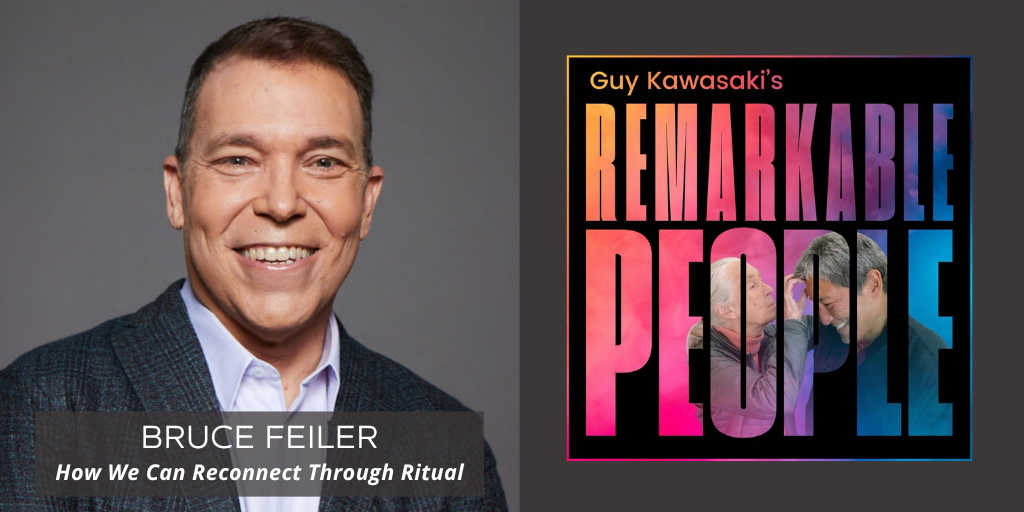
Welcome to Remarkable People. We’re on a mission to make you remarkable. Helping me in this episode is Bruce Feiler.
Bruce Feiler is a seven-time New York Times bestselling author who has spent decades writing about the experiences that shape our lives, from family and relationships to illness and major life transitions. His latest book, A Time to Gather, takes on something we rarely stop to examine: rituals. Bruce traveled to 16 countries across six continents to understand why people gather, how rituals evolve, and what happens when we lose the traditions that once gave our lives structure.
At the heart of Bruce’s argument is a simple but surprisingly powerful idea: a ritual is a shared, unnecessary act that makes us feel at home. We don’t need to get down on one knee to get engaged, circle a bride seven times to get married, or ring a bell after finishing chemotherapy. But when we attach meaning to these actions and share them with other people, they become something more. Bruce points to the rise of new rituals—from forest bathing and “Honor Walks” for organ donors to divorce parties and “bites of passage”—as evidence that people still crave ways to mark the moments that matter. The difference is that increasingly, we’re creating these rituals ourselves rather than waiting for institutions to tell us how.
Bruce also sees rituals as a response to a world that has become increasingly mediated by technology. We carry the “enemy” in our pockets, he says, while relationships that once happened naturally now compete with screens and algorithms. Yet he doesn’t think technology will necessarily win: he believes we’re already seeing a ritual renaissance as people search for ways to reconnect. His challenge is simple—don’t wait for a major milestone to gather the people you love; create small moments of connection now, the “bites of passage” that eventually become meals of connection.
Perhaps that’s the most remarkable idea Bruce leaves us with. We don’t have to wait for tradition, religion, or an institution to give us permission to celebrate, mourn, reconnect, or mark a transition. We can create the rituals our families and communities need right now. In a world that keeps pulling us toward the virtual, Bruce reminds us that gathering in person may be one of the oldest—and most important—ways we have to remain human.
Please enjoy this remarkable episode, Why Rituals Matter More Than Ever with Bruce Feiler.
If you enjoyed this episode of the Remarkable People podcast, please leave a rating, write a review, and subscribe. Thank you!
Transcript of Guy Kawasaki’s Remarkable People podcast: Why Rituals Matter More Than Ever with Bruce Feiler.
Guy Kawasaki:
Good morning, Bruce, and good morning, audience. This is Guy Kawasaki. This is the Remarkable People Podcast, and we have Bruce Feiler on today. And my God, you've been a New York Times bestseller seven times? Seven times. Wow.
Bruce Feiler:
But who’s counting. I like poetry and math, right? So yeah, sure, I'll take that. There's some poetry to that math.
Guy Kawasaki:
Huh. Seven times. And you don't strike me as the kind of guy that would stack the deck or somehow cheat The New York Times. So you're legitimate, so that's really impressive. My God.
Bruce Feiler:
No, I've never done that. I've never, like, bulk ordered. I've never gone through the machinations that people say. I'm afraid I did it the old-fashioned way, like one copy at a time.
Guy Kawasaki:
So listen, this seven-time New York bestseller is here to talk about his latest book. And this book, it really is a mind-expanding book. So it is called A Time to Gather, and it is about rituals, and I learned more about ritual. I had no idea there's so much to rituals, so thank you very much, Bruce.
Bruce Feiler:
Thank you for inviting me. I qualify as that old talk radio line of longtime listener and first-time caller. So I'm honored to be in this conversation, and I've just followed your own passions and your enthusiasms wherever they've led you and led all of us, and I'm just delighted and so much looking forward to this conversation.
Guy Kawasaki:
Yeah, you say that to all the podcasters.
Bruce Feiler:
Oh, is this a podcast? Oh, wait, I'm sorry. Let me change my script.
Guy Kawasaki:
So we got to start off with a very simple definition so we're all on the same page, so to speak. So you got to define “ritual,” and you say it's an act, and it's shared, and it's unnecessary.
Those three things wouldn't pop into my mind for a definition of a ritual. So what is a ritual in the eyes of Bruce Feiler?
Bruce Feiler:
So I'll answer the question directly and then I'll back up and tell you how I came to be asking this question. But yes, to me a ritual is a shared, unnecessary act that makes us feel at home. So it's an act here. This is a doing. This is not a talking, right? This is embodied storytelling.
Using bodies, using communities, using people getting together to mark a destabilizing life experience. So it's an act. It's shared. There's 500 academic studies holding these occasions, synchronize our heartbeats and align our sense of danger and help people navigate uncomfortable and uncertain situations.
They make our families and our neighborhoods and our communities and our classrooms and our teams and our office mates, they make us closer. So it's connecting. But it is unnecessary, and I think that's a strange word to hear, but I think it's essential, as you say, Guy, but it is essential to it because you don't need to get down on one knee to get engaged.
You don't need to wear black to mourn. You don't need to circle the bride seven times to get married or climb a mountain and see the sunrise in order to mark a graduation or a coming of age or whatever it might be. But these unnecessities become necessary because we assign them collective meaning, and that's really what we're talking about.
Sort of the essential act that makes us human is symbol. This was the thing that most distinguished us from our ancestors. And so these are ways that we find meaning, build story, chronicle our lives, and connect ourselves to those around us.
And it's the sheer act of doing the unnecessary thing that makes us feel at home, and that feels at home is actually the thing that perhaps is most new in my book, A Time to Gather, because it began, as with my kids.
So I don't know where your twenty-one year-old fits in your family structure, but my wife and I, we went from empty nest to full nest twenty-one years ago when we became parents of identical twin girls, and eighteen years later, we went from full nest to empty nest in thirty-two minutes when we dropped them off at the opposite ends of the same college campus.
And I walked through our front door, and I felt homesick in my own home, and I thought, You can't use this word. This is a cringey word that people use when their kids go away to sleepaway camp. But my dad had just died, and my mom was aging, and my kids were gone, and my marriage, which had been built around these kids, now needs to be redefined, and renewed in some way.
And I realized that in a lot of ways, the sense of homesickness is kind of the existential feeling of our time as we've all abdicated, as I don't have to tell you, you were there at the beginning, abdicated our relationships for our screens.
And so I think that feeling of home is what we're craving, which is why I think that there is this kind of outpouring and abundance of ritual that's going on as we all try to manifest what we're most missing.
Guy Kawasaki:
So the way you define ritual with this requirement of shared. To take an extreme example, I've interviewed Julia Cameron two or three times, and in her mind, I believe she has a ritual, and her ritual is writing these morning pages. Now, that's a solitary act. So semantically within your definition, that's not a ritual. That's a habit or it's a tradition.
Bruce Feiler:
I read that book when I was a young writer. Actually, she and I share a literary agent, and I think that's a great activity. I think, if it's the morning coffee, if it's the morning pages, if it's the morning gratitude journal, whatever it is, you want to call it.
And in some ways, as this is actually where I end my book with saying, "Okay, I love the definition at the beginning, and now I'm much more interested in kind of a ritual state of mind that we all put ourselves in a kind of state of mind where we are going to connect and reconnect with those around us."
But to answer your question, I think that there can be these private rituals. The Dalai Lama says that "I don't like teaching Westerners how to meditate because they're going to meditate for a higher test score and for a greater salary." And that's not exactly the point, that part of it is supposed to be for the state of the world and our larger role in kind of the human ecosystem.
That's what I think. If you're having a morning cup of coffee and a sit in your garden and it relaxes you and it prepares you for your day, that's great. I think if it's part of that is connecting with those around you and the larger human purpose, then I think that meets, in my conversation, really the full potential of what ritual can be.
Guy Kawasaki:
Huh. The other thought I had, an example in your book is you said that forest bathing is a ritual, but the people I know who love forest bathing do it alone. It's like them and the forest.
Bruce Feiler:
Right. So that's a perfect example. So let's dig into this for a second, so forest bathing begins in Japan in the 1980s. I happened to be living there in the 1980s, and it's a very mountainous place, 80 percent of the people live in 20 percent of the land, which means you have 150 million people living in an area the size of South Carolina.
When I first moved to Japan to teach junior high school and I got this little, tiny apartment, the old joke was the apartments are so small you can't change your mind in them.
So people were disconnecting from nature, which of course is a backbone and has been a backbone of Japanese culture for millennia. A lot of these rituals now, the new rituals as I call them, are bottom-up, but this was very top-down.
It's like the government decided we need to get people connected to nature, and so they invented this thing out of whole cloth, shinrin-yoku, and kind of forest bathing is the name that stuck, and then now it's in whatever 150 countries from the Rift Valley to the Himalayas and the Sierra Nevadas and everything in between.
And an essential part of forest bathing is that you are going in groups so that you are connecting not just to nature, but to other people. So there's a difference between taking a walk in the woods or going for a walk with your dog or having a personal encounter, and what forest bathing is, which is a collective activity where together you go, and I did it in the Andes Mountains in central Chile.
And it's a collective activity that is designed to both restore connection and restore intimacy with nature. Again, taking a walk in nature, incredibly powerful, but the full collective ritual experience really seems to be part of the appeal.
Again, back to the core idea here, is that we're carrying the enemy around in our pockets and we know that we are abdicating so many of our relationships to our phones, and it is the core story that I'm telling, which is that ritual works, so what happens is I come to my door, I feel homesick, and I want to do something about it.
And I then stumble into this story that I think of as maybe the most interesting story in four decades of writing books, professionally, as you alluded to at the beginning of this conversation.
And it's three prongs. Prong one, ritual works. We have evidence from 300,000 years ago, that's before we're anatomical humans, that the first thing that we do is gather to bury our dead, and we know this works. Five hundred academic studies all of these years. Every culture anywhere on the planet, they have these collective occasions of meaning making.
Until this century when we've turned our backs on them because the traditional rituals, essentially organized religion comes along and does a hostile takeover, to put it in business terms. And as religion has taken a step back from the center of life, most of the traditional rituals practiced around the world are in retreat.
Birth rituals, coming of age rituals. In 1960, 95 percent of Americans get married in the course of their lives. Now only half of us are married, and only a third of us are buried anymore. I was shocked by this. In 1970, 5 percent of Americans were cremated. Now it's 65 percent, going to 80 percent in the next ten years.
So we have abandoned the traditional funeral and the ground burial in a generation. So we are in the celebration recession, as I call it, but at the same time, there are all these new rituals that are popping up, like forest bathing, like NICU graduations, Daddy-daughter dances, mom proms, cancerversaries, soberversaries, all of these new rituals.
Because people are saying, “I'm going through twists and turns in my life, and I want to mark it with the people around me, and I don't really care if I get the vows," one designer told me, "if my parents or my religion or my community affirms it. I want it. I crave it, so I'm going to do it."
Guy Kawasaki:
So how does something become a ritual? When does it reach critical mass?
Bruce Feiler:
That's a great question, and I would say it has a number of elements. And a lot of what I'm trying to do in A Time to Gather is try to identify, okay, is there a kind of blueprint of human togetherness? I went to rituals in sixteen countries on six continents.
Is there a way we can understand what's a ritual? And for those of us who crave it, I'm almost inclined to do it. I don't want to violate any more HIPAA violations here, but if you wanted to have a you're turning twenty-one and you're getting two new hips, that's a lot of these.
A lot of these are around medical moments, double mastectomy rituals and organ donation rituals. The stories that I tell in my book, I think at its core, I think you need three things, okay? It's embodied storytelling, so you need a beginning, you need a middle, and you need an end.
So at the beginning, you want to create a sense of sacred space, a boundary, as I call it. Outside we were that, inside we're going to get in a circle. Circuses have rings, and trials have courtrooms, and games have fields and courts or whatever.
You want to say we're entering non-ordinary spaces where we can enter non-ordinary time, and we can have a special non-ordinary experience that will, whatever, if we're here to celebrate, if it's a graduation or a birth or a wedding, we're going to celebrate.
If there's a death, if there's the loss of a job, the loss of a loved one, the loss of a pet. Guy, pet funerals are a three billion dollar business now. This is an astonishing thing that we're doing.
So you need a beginning, okay? You need to set the sacred space, and this is why we're here. Then you need a middle because you and I are going to have a ritual, you and I are getting married. You want a big wedding. I want a small wedding. You and I are mourning a loved one, okay? You want to lie under the covers with a cat and feel sorry for yourself, and I want a big old Irish wake.
There's going to be conflict, and part of the ritual is to give you what you need and give me what I need. You need what I call a peace plan with these different elements that can work. And then you need to end with a moment of hope, Something that reaffirms the group. We're here with you.
If you lose your hips, if you lose your job, if you have a child, if you move, if you have a milestone in your work life, we're going to be here together to celebrate. We're going to reaffirm the importance of the group, in all of our lives.
Guy Kawasaki:
I think that one of the most interesting and illustrative stories in your book was that a person who lost a loved one decided that the way that the physician came in and said, "Do you want to donate parts of your loved one's body?" with no ritual, no empathy, no nothing. So she decided to create a ritual.
Can you just tell us that story? Because I feel like I was understanding the birth of a ritual, not something drawn on a cave wall 30,000 years ago.
Bruce Feiler:
It's an incredible story. It's an incredible story and a perfect illustration of this larger kind of movement, if you will, that we're talking about. So we're talking to a woman, her name is Missy Holliday. She's born in a small town in Ohio. Her father is the mayor and fire chief. Her mother teaches Sunday school at the local church, very mission-oriented family.
She grows up, becomes a nurse. She comes home, gets married, becomes a nurse, comes back home Super Bowl weekend, and her little sister says she's going to get engaged the next week. That would be in and of itself an occasion for ritual. She gets in her car the next morning to drive to work.
It snowed the night before. She wraps her car around a tree. Two brain death tests overnight. The next morning, as you perfectly capture, they just come in and say, "She's an organ donor. We're taking her away. Goodbye."
And Missy says, "I don't want this to happen to any other family." And she quits her job, moves back home, becomes an organ donation specialist, and finds incredible tension. So here's a great technological breakthrough, as I've said, you've been involved in so many of these, but it's missing a human element.
There's tension between and among the donor families, the medical support staff, and the donor support groups, and she turns on the TV one day and sees those incredible rituals we've all seen of a police officer who dies in the line of duty where everybody lines the streets.
And she says, "That's what I need." And she designs a ritual called an Honor Walk, and how it works is the deceased is in a gurney, okay? She takes her phone. She puts a Spotify account. She says to the family, "Pick a song." They pick "Annie's Song," which dates me, the first concert I ever saw was John Denver.
Which is the least cool thing I can say on this or any other podcast. They push the body into the hallway, and the entire hospital staff in blue scrubs is standing there in honor, paying deference, paying tribute to the gift that the deceased and the family is giving, holding flameless candles. They stop five feet from the operating room.
Of course, the body is technically dead, but you've got to get the organs. You've got to go for an operation. They say goodbye, and the body goes off to its final destination where it will give the gift of life. And she makes a rule, Missy, that nobody can take a picture, okay?
And she makes an exception for the widow, and the next morning her phone blows up and it's like, "I want to do this. How do I do this? How do I solve that problem?" The widow posts that picture on Facebook. It gets two million likes. And today there are fifty donor support groups in the country. They all do Honor Walks, dozens around the world.
And it's a perfect example of this is a kind of forgotten moment, but a very real moment of pain, confusion. It's all happening so quickly to these families that she's created a ritual. These rituals have 250 million views on YouTube. I personally went and tallied them up. It's an astonishing example of, “I need something in this moment that is otherwise invisible to other people.”
And when you create it, and this, we all know that the algorithms of hate on the internet are designed to divide us, but here's an example where the internet can create communities of connection that we didn't even know we needed.
Guy Kawasaki:
And I also believe that you told the story of, I think, a parent who didn't believe in organ donation and then went through this ritual and then changed his license to now, say, "Yeah, harvest my organs," right?
Bruce Feiler:
It was the dad, and the dad had said, “I didn't believe in this, but it was my child's choice," because that is where the agency lies in law in this country right now, and went up to Missy afterward and said, “I didn't want to do this. I was so moved. I'm now going to become an organ donor myself.”
Guy Kawasaki:
So this is an incredible story because she basically made a ritual out of thin air, right?
Bruce Feiler:
And so many of them are, maybe I shouldn't say this out loud, but my wife's favorite chapter in this book is “The Taylor Swift Divorce Party,” and it's another example of a homemade ritual that didn't exist, so it's a woman who grows up on Long Island.
Her parents and both sets of her grandparents were divorced. Her whole life goal was like, "I'm not going to get divorced." You can imagine what happens. She grows up, she gets married, has two children, she gets divorced. Her husband takes half her belongings. The other half she gives away.
She walks back home after this and she says, "Oh my God, I don't have towels to shower with or sheets to sleep on, and I have a toothbrush holder with four toothbrush holes, and I only have three toothbrushes in it. So every time I walk into the bathroom, I think I'm a loser. I got divorced."
And she says, "I need a registry." So she creates the world's first divorce registry. Within a matter of months, she gets half the people getting divorced because there's a need for this. And she says, "But I need more."
So she writes a blog post about hosting what she hosted, which was a Taylor Swift divorce party with “Shake It Off” cupcakes, and “We Are Never Ever Getting Back Together” napkins. And it goes crazy viral. And when I say why, and again, this comes back to this story that you've been so central to, Guy.
I say, "Why is this happening?" And she says, "Because I'm millennial. We grow up, we go into AOL chat rooms, we go into Facebook groups, and when we can be anonymous, I can say, 'Oh, my husband's doing this, and I feel gaslit,' or ‘is this happening to me? I have these feelings. Am I alone?'"
And other people, "No, no, we have that too." And then older women were like, "Yeah, I stayed in my marriage a little too long. You go sister." And there is this empowering thing. And so many of these rituals now, what's going away is the top-down, pre-scripted, institutionally mandated, patriarchal, hierarchical, dare I say it, rituals.
That's what's going away. People want to tell their own story of their own lives. My work on transitions in the last ten years we go through many more life transitions and whatever those are, people don't want to be alone. They want to have those shared. Back to your question about being shared.
They want to be with the people that they love in the most meaningful and difficult moments. And they're like, "I don't need permission." As the great spiritual designer Malidoma Patrice Somé said, "Just by being alive, you can design a ritual." And that's really the opportunity that people are craving because they're tired of feeling lonely and isolated.
Guy Kawasaki:
Do you know how the gender reveal ritual was created?
Bruce Feiler:
It's interesting, there's a lot of hostility in the ritual world toward the gender reveal because of the excesses of them. Do we really need the helicopter?
Guy Kawasaki:
And burning down the forest.
Bruce Feiler:
I was going to say, speaking of its forest burning, not forest bathing. When you set off the fireworks.
Guy Kawasaki:
All these Japanese people died in that forest fire because of your gender reveal.
Bruce Feiler:
Exactly. So I'm a sort of a bit of a defender of them, I think for a couple of reasons.
Number one, they mark an end to the kind of gender-based, "I'm having a child." Like the showers tended to isolate the dads and the moms, if you will, which is not consistent today in a world where dads are much more involved.
I wrote a whole book about this, two books about this actually, The Secrets of Happy Families and The Council of Dads, where dads are much more involved now. So I like the fact that it's shared, and we don't have to separate the women from the men, so I think that's great.
But the other thing about it, again, for better or for worse, is there's the thing that social media is doing, which is making these rituals more performative, where you want not only the people there, but all the broader people in your community, and that I think it's what's driving some of the excess of these things. I'll give you an example of the social media of it all.
So there's this chapter in my book where I go to six weddings in a day in Las Vegas. I also went to ten funerals in a week in Ireland, and when I was there, I was talking to people in the wedding business. So the biggest change since the pre-pandemic, as millennials are now most of the weddings, and now here come Gen Z, they're doing it differently.
They're getting married later, and they don't want their parents' weddings. In many cases, they don't even want their parents' money anymore. And so the biggest change is we're moving from large weddings, that now 80 percent of weddings in Las Vegas are what they call micro weddings with fewer than fifty people.
So I want to pay for it more, I want it done my way, I don't want my parents' friends to come, and don't want my parents' rules, so I'm not going to take their money because if I take their money, I have to take their rules. So she says a lot of the new thing now is what they call a unity ceremony, and the hottest one is the sand ceremony.
So again, you and I are getting married. You've got a container of colored sand, and I have a container of colored sand. We did this when I was in kindergarten. And we're going to pour them into a shared container, and we're going to make this pattern.
So this woman who runs one of the biggest officiant companies called Peachy Keen Unions, she tells me, "If they say thingy, I say no. ‘We want to do that sand ceremony thingy,’" because that means they just saw it on the internet. And she says, "I don't want that. Let's find out something. How did you meet, okay?” “Oh, you sent me a shot of apple brandy in an airport."
That was the example she gave me. "So let's do an apple brandy thing where we have two kinds of brandy. We'll pour it in the same glass and drink." So on that same trip, this is not in my book, bonus story. On that same trip where I went forest bathing, I was at an event in Santiago, the capital of Chile, and I was seated next to a guy who was going to get married.
And I said, "Okay, I'm writing a book about weddings, tell me about your wedding." He said, "We're going to do this, and my mother wants this, and my bride wants this, and we're going to do this. And of course, we're doing a sand ceremony."
So nobody knows where this came from. It's probably either some indigenous thing or something that was done in suburban kindergartens across America in the 1960s, as was my case. But this has become, because of social media, a sort of standard practice now in weddings around the world.
There are two sides to it, but I'm a sort of defender. I don't think we need to be burning down forests, but I kind of like the idea of a shared baby ritual.
Guy Kawasaki:
Since we're violating all privacy here when my other son was doing the gender reveal of his baby.
Bruce Feiler:
Your grandchild, I assume. Your first grandchild.
Guy Kawasaki:
He loves hockey, so his gender reveal was hitting a puck, and when the puck exploded, it was going to explode either blue or red smoke.
And it was blue smoke, so I have a grandson, so that was our gender reveal ritual.
Bruce Feiler:
Well, congratulations. The other odd thing I will say about gender reveal is that gender reveal rituals have become popular at exactly the moment that gender itself is in a state of, shall we say, flexibility.
And so I think is a sort of an odd historical coincidence that the tyranny of pink and blue at exactly the moment that pink doesn't mean what it used to mean, and blue doesn't mean what it used to mean.
And I know for the record that the U.S. Olympic hockey, they won the gold medal in both the men's and the women's. So even if it was pink, the pink child could've been a hockey star too.
Guy Kawasaki:
I got to ask you, so your book is filled with examples, but I want to know what rituals are in the Bruce Feiler Rituals Hall of Fame? Which one is the one you say, "Oh my God, I couldn't believe this," and please don't tell me it's Kim Kardashian eating placenta.
Bruce Feiler:
You read deep into this book, my friend. No, I mean, the placenta, that's a fascinating story because that's not that far from where you are on Easter Island. You know, it's interesting. You're talking to me from Hawaii.
I think the Ho'oponopono ritual is a very interesting example of traditional kind of forgiveness ritual in Indigenous cultures in Hawaii that were pushed aside as outside religions took over that is now resurfacing, but in very contemporary.
The beautiful story that I tell in my book about the Ho'oponopono ritual being done in prisons among family members where the people in prison are there in part for crimes they committed against family members, and they're bringing this ritual. So, I think that's, in and of itself, a powerful story.
I guess if I were to put ten rituals in the hall of fame, I would put jumping the broom. That is an incredibly interesting story. So jumping the broom is a white working class ritual of getting married in the British Isles, as early as the eighteenth century.
It jumps to British Isles, comes over to North America, and becomes incredibly popular among enslaved Africans in the American South, which of course is where I grew up.
And why are we jumping the broom? Because if you don't have organized religion and if you're outside law, you want a ritual way to mark this moment that's not a traditional ritual, and they didn't want to do Christian weddings in a lot of cases because that was the religion of the enslavers.
So 40 percent of slave narratives have accounts of jumping the broom. And after emancipation, jumping the broom disappears from human history basically because the formerly enslaved didn't want to do it because it was recognizing their time. In American law, you could not inherit if you had jumped the broom, so it goes away.
It reemerges one hundred years later because Alex Haley writes about jumping the broom in Roots. And I grew up in Savannah, Georgia, which is where the TV show Roots was filmed, and we went to the scene where they sold Kunta Kinte. We skipped school to go to watch it be filmed. And in episode two, Kunta and Bell jump the broom to mark their weddings.
That show was seen by 85 percent of American households with televisions, the highest TV show ever before or since. And one of the people watching it was a fourteen year-old teenager in Virginia named Danita Rountree Green, and she writes in her journal that she was moved by this.
She goes on. She goes to college, she marries someone, he's a wedding photographer, and she starts doing weddings because he's taking pictures and she's conducting the wedding and distracting the audience while her husband takes too long with the pictures. And she gets into an accident, a car accident. She's about to have surgery.
Second, by the way, second ritual, now that I think about it, invented from a car accident. And they come in and say, "We can't do surgery on you. You're pregnant." And so she has to sit there suffering, and she remembers that scene, and she writes a book about jumping the broom.
And an eighty-page book about how to do it. She publishes it. She expects it to sweep Black America. No such thing happens. No one pays attention. Then someone writes a newspaper article in The Richmond, it gets in The Wall Street Journal, in USA Today, it spreads. Again, “All Black couples are going to call me.”
That's not what happened. The first couple that calls her, a gay couple, then an interfaith couple, then an intergenerational couple. Outside the family norms, they want to do jumping broom. And eventually it takes over, becomes a symbol of heritage weddings in the Black community. Oprah does a story, The New York Times.
And so now you can buy 250 dollar vintage, bespoke handmade brooms symbolic of the time of enslavement to mark this. And she's telling me this story that she leads them now and her son, this is the son who was in the accident and in this case it's not violating HIPAA. But, she says to me, "You know, and my son is blah, blah."
She mumbles something. I was like, "Excuse me, I didn't hear you. Your son is what?" She says, "My son is gay." And I was like, "Of course. That's how the world works." So that's a ritual, and what it reminds us, Guy, and I think that what's interesting about this is that there is no pure ritual.
All rituals borrow and evolve and change over time. And so Japanese plunging rituals in cold waterfalls called misogi are now done by NBA teams and endorsed by Joe Rogan and have become part of the manosphere. There is this craving for connection. There's this craving for shared unnecessary acts.
There is a desire that we have, and I think that what's interesting here, to pull back and get serious for a second, you mentioned AI, right? And so much of our conversation is about AI, and you led your life being involved in some of the most cutting-edge technologies and communities ever created.
But we know that those communities have also sped up some of the big problems. And the way I look at this is no matter what the problem are, these ritual gatherings are the answer. So if it's loneliness, ritual is the answer. If it's polarization, ritual is the answer. If it's decivilization, ritual is the answer.
And I think that what we're seeing here is the under-discussed human reaction to technological change. It's not just that these algorithms are going to divide us. We're saying the original human algorithm is ritual, and we want to turn back to that.
And I think that's the powerful thing that's missing from the conversation about AI, is that we are going to have a say in how this unfolds, and the human reaction is going to push back in a lot of ways to many of the excesses that we see.
Guy Kawasaki:
But someone might say, and I'm playing devil's advocate here. Someone might say that “How do you make ritual scale? Scale to the extent that it could help society?”
Bruce Feiler:
So I think, here you now get to the double sword of the web, when you had children, when I had children, there were no gender reveal parties. That spread pretty quickly. I had chemo eighteen years ago. You know what there was not? There was no chemo bell when I had chemo as recently as eighteen years ago.
Okay, so what is the chemo bell? When someone gets to the end of chemo, there's a bell now on the floor in hospitals around the world where people ring it, so you have this shared unnecessary act that celebrates this moment. And I think that's what's interesting here. We don't need to teach ritual how to spread because ritual has been around for 300,000 years.
I'll just tell you a quick story. I was at a traditional bride price negotiation in a tiny village in South Africa, okay? Seventeen years where it ends with the ending of this negotiation with a traditional wedding and a white wedding or Western wedding in the same day. What did we do the first thing in the morning?
The family took a homemade brew, poured it at the base of the tree to summon the ancestors, okay? A year later, I'm on my forest bathing expedition in Chile, and I go to see a Mapuche healer, an indigenous tribe that's one of the most storied in South America because they pushed back against the colonizers, for centuries.
And before this Mapuche healer leads me on a ritual, he takes a brew, homemade brew, and pours it at the base of a tree to honor the ancestors. How does that happen? There's no land bridge, there's no internet, there's no library where they can go. The truth is that these things are coming from within us.
It is the initial thing that made us human. What did I say earlier? I quote Leslie White, this anthropologist, in the introduction of A Time to Gather, saying, “The greatest human invention is symbol.” These symbols are mechanisms of meaning. We are meaning-making machines. That's what we are.
So the craving is there, and so it spread long before there were means of spread, and now there are. And I think that what's interesting and what's happening now is that we no longer need the institutions that lie on top of civilization to do the spreading because religion was very good.
It was the greatest spread mechanism because it codified them, made rules, made scripts, and all you had to do was show up. Now what's going on is that they're coming from the bottom up, and the answer is if people see them, you can invent an Honor Walk twenty years ago and it can get 250 million views on YouTube.
The mechanisms of spread are there, but the mechanisms of spread would not matter if the craving for it weren't so universal and weren't so acute.
Guy Kawasaki:
So we're talking about the democratization of rituals basically.
Bruce Feiler:
Exactly. And that, of course, is one of the great promises of technology, right? It used to be, I'm going to a conference on AI and the future of humanity at Harvard next week as we tape this conversation. It used to be that we lived in a tiny microphone world, that not that many people had microphones, so to speak.
The ability and the authority and the stature and the standing to speak. We now live in a multi-microphone world where everybody has the microphone, okay? And that's the democratization. It's created upheaval, it's created change, but we know that trust in institutions is at its lowest. The ability of people to have authority is harder and harder.
And so what ironically that has allowed is it's created the collapse of traditional ways of gathering, but it has not eliminated the craving, the urge, the yearning, the necessity for it. So now it's coming from the bottom up. And so now Missy Holliday in a tiny town in Ohio, Danita Rountree Green in a tiny town in North Carolina, Olivia Dreizen Howell with her Taylor Swift divorce party.
It can come from anywhere, and the technological opportunities for distribution already have arrived, in the middle of civilization, so an idea from anywhere can become a ritual that's observed, reinvented, practiced, and makes meaning everywhere.
Guy Kawasaki:
So are you fundamentally an optimist that rituals are on the upswing, or are you a pessimist in saying rituals are declining?
Bruce Feiler:
I'm curious your response to that question. I'll ask you first. So what's your response to that question? Because you've lived around tech. You've been in the rooms where the algorithms were made, and we know that they've had positive benefits, but a heck of a lot of un-positive ones.
So do you believe that the tech infrastructure that's been laid over our lives is so powerful that it will squelch out being human, or that the human will then emerge in the midst and in the face and even louder than the tech?
Guy Kawasaki:
I will tell you, Bruce, until maybe two years ago, I was an optimist, and I said that Macintosh and internet and social media, I mean, you can focus on the negative and include AI in that list, are net positive and they are going to make the world a better place.
And then about two years ago, when I saw that all the billionaires were at the inauguration and donating money, and they were like, “Tim Cook is giving Donald Trump tours of the factory,” and all that, I said, "What happened to Silicon Valley?"
It's frightening to me what happened. So I guess I'm a little pessimistic about what the outcome of tech will be, but I am fundamentally optimistic about the human spirit, which is what attracted me to your book, which is it's all about the human spirit. It's not about why crypto is going to save the world.
Bruce Feiler:
I have in front of me here a copy of Think Remarkable by one Guy Kawasaki, and I pulled this up because I thought, this is going to come up at some point in this conversation.
So I'm going to read to you a quote from page 103, which is chapter six, the third of the three things that you advocate, and it's a quote from one John Lennon, “A dream you dream alone is only a dream. A dream you dream together is reality."
I go back in this conversation about where we are right now to what I think is perhaps, and I'm not alone in this, but perhaps the greatest parallel, which is what happened essentially 200 years ago in the height of the Industrial Revolution. And what happened from my point of view is that a third of Americans lost their jobs and moved from rural areas to urban areas.
That's twenty-five million people. Another twenty-five million people left Europe and came for a whole bunch of reasons that we all know and came largely to urban areas along the East Coast. That's fifty million people, okay?
And if you look at what we might think of as the modern ritual calendar, Mother's Day, Father's Day, Thanksgiving, wedding showers, baby showers, some of the things, 4-H clubs, bowling clubs, all the stuff that Robert Putnam said 100 years later left in Bowling Alone were invented in that period.
So what happened was there was this widespread dislocation, change, and just upheaval, and the human response was to create new ways of gathering and connecting where the people found themselves largely in cities, and to create a whole calendar that we now think of as the kind of bedrock of the American family.
So if it can happen in that time, I think it can also happen in this time. The question is, what will we do? So what do I think? There's three ways you can understand this, which is that the celebration recession is the big story, and these other things are just a side story.
There's what on Wall Street, as they call a dead cat bounce, which is there's this massive decline and you'd have got a little bit of an uptick, but it's still all the way down.
Or it's that we have these green shoots, as I call them, of a ritual renaissance, and I am 100 percent confident that it's the green shoots of a ritual renaissance. The question is, will we water the green shoots and will we do our part? Which is why where I end this book is basically saying we need to have this ritual state of mind.
We need to wake up every day and say, "I'm not just going to be passive and let these algorithms and these big tech companies and a lot of the leaders of these organizations who are interested in stock price and control and beating China and all of that. I'm going to do my part to connect and reconnect."
That means walking slower. That means saying, "I'm going to invite people over." I learned this from my kids, okay? They're twenty-one. They're heading into their final year of college. When they come home, I can't say, "Excuse me, according to a textbook written in Paris in 1909, we're not scheduled to have another rite of passage for another fifteen years."
I'm like, "Screw that. We need one now. How about we do it tonight? How about tonight?" My family's love language is Sondheim lyrics. We do it every summer, okay? We're going to see Shakespeare in the Park tonight. The rain looks like it's going to hold off, right? Because that's a ritual gathering around theater right there.
The two things have a lot of similarities. So forget rites of passage. We need bites of passage. We need these little nibbles of connection. And if we do that, I feel confident that humans have done that since before we were human, and that part at least of being human will prevail. Because the way I look at it, it's virtual or ritual. It's URL or IRL, and if we choose ritual, humanity will prevail.
Guy Kawasaki:
My God, Bruce. You're like evangelistic like one evangelist to another. My God, I wrote down bites of passage. I'm going to steal that from you. That is a brilliant three words there. Oh my God, Bruce.
Bruce Feiler:
I love the chuckle. And yeah, I'll take the evangelist name and try to own it because what is evangelism other than spreading the good news? But I'm not even a Christian.
But I will take that. And the thing about bites of passage is, I'm looking behind you and you're looking behind me, for those of you who might be listening, you have things from your travels, things from the cultures that you've been a part of. You probably have family photos in your office.
Why do we all do that? The social science term for that is social snacking. Like, when we're by ourselves, it's like we're connecting with the people who aren't there. We're remembering that trip that we took together. We're remembering that part of our heritage, or maybe it's been passed down intergenerationally.
And that's what we're talking about here. That's the nibbles. That's the bites. The data is discouraging. We walk faster in the streets. We don't talk to people. We don't talk to strangers. 50 percent of our calories now are consumed in solo snacking, not collective eating.
So we got our work cut out, but if we start with bites of passage, we can get to meals of connection. How about that?
Guy Kawasaki:
I would say maybe people might not agree with me, but whenever I see a group of people and they're taking a selfie, I think that is a beautiful bite of passage. They're preserving a shared experience. Taking a selfie is, arguably, unnecessary. I could make the case that taking a selfie is a ritual now, and it's a very good one, I think.
Bruce Feiler:
For sure, it is unnecessary. The one thing I'm grumpy about is you've just waited for two hours in the line to see the Mona Lisa, and when you get in front of the Mona Lisa, you don't look at the Mona Lisa. You turn your back to the Mona Lisa, put your phone to take the selfie of you with the painting in the background.
If you just want to look at the Mona Lisa through the screen, you can do that at home. So I discovered this actually at a grotto, and the first time I noticed this was I was in Lebanon, actually, of all places, and this old grotto, and I was like, "No one's looking at the stalactites and the stalagmites. Everybody's turning their backs to them because the selfie."
Yeah. So I like it. I like the spirit of this, like we're marking the moment, but at least spend a little bit of time looking at what you came to see.
Guy Kawasaki:
All right, so I'm going to give you a new title. You are a ritual evangelist, and that's the highest form of praise coming from Guy Kawasaki. You are a ritual evangelist. So I've enjoyed your book. We want you to be an eight-time New York Times bestseller. Becoming a New York Times bestseller is a new ritual for you.
Bruce Feiler:
There we go. If only. You know what? You are an evangelist of the power of finding the remarkable in everyday people. And I will go back to what I said at the beginning. I feel like I've learned and been inspired by you, and I'm honored to be a part of the unnecessary communities that you build to make us all feel inspired and at home.
Guy Kawasaki:
No, the community's absolutely necessary to my existence, so thank you very much. So let me thank my crew because a podcast is a shared experience. You might make the case that a podcast is unnecessary, too, but anyway. So it's Madisun Nuismer, who is a co-producer and the brains in the outfit.
There's Jeff Sieh, co-producer on the tech side. Shannon Hernandez, sound design engineer, and Tessa Nuismer, a researcher.
And I don't know if you know this, Bruce, but I'm deaf, and because I'm deaf, we have a great emphasis on the transcript of my podcast because it may only reach five people who are deaf and care about my podcast, but I want them to be able to read my transcript, so that's important to me.
All righty, I'm going to let you go so you can go and walk in a forest or eat some placenta or whatever you want to do.
Bruce Feiler:
Go see Shakespeare.
Guy Kawasaki:
Oh, go see Shakespeare. Even better. Thank you very much.
Sign up to receive email updates
Enter your name and email address below and I'll send you periodic updates about the podcast.

Leave a Reply