
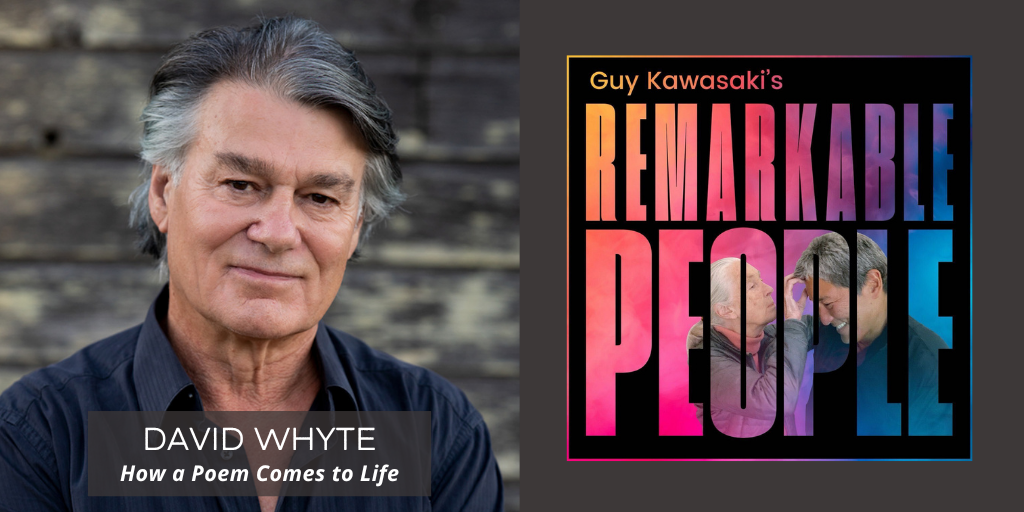
Welcome to Remarkable People. We’re on a mission to make you remarkable. Helping me in this episode is David Whyte.
David Whyte is a poet and philosopher whose work explores the places where language, emotion, imagination, and everyday life meet.
He began writing poetry as a child, but an encounter with Jacques Cousteau sent him in another direction, eventually leading him to study marine zoology and work in the Galápagos Islands. After achieving what he had set out to do in marine biology, Whyte returned to his first principles: poetry and speech. His work has since helped countless people see familiar words, experiences, and emotions from entirely different angles.
What makes this conversation so fascinating is Whyte’s belief that poetry isn’t an abstract art form but a way of speaking when we’re standing at the edge of what we can articulate. He explains how a poem can emerge from a question, an image, a moment of stillness, or something that has been quietly living inside us for years. He also takes Guy inside the creation of “A Seeming Stillness,” a poem that began beside a river in Granada and took years to fully develop. Along the way, Whyte talks about vulnerability, intimacy, writing anywhere, and why poetry is ultimately “language against which you have no defenses.”
Whyte also discusses his new book, Consolations II, and the way he takes seemingly ordinary words and uncovers what lies beneath them. Regret, anger, despair, mercy, and even the word “the” become opportunities to question the assumptions we carry around every day.
His larger message is both simple and challenging: don’t settle for the first meaning of a word, an experience, or even yourself. Sometimes the thing we are struggling to say is the very thing that can help us understand where we are—and where we need to go next.
Please enjoy this remarkable episode, How Poetry Changes the Way We See the World with David Whyte.
If you enjoyed this episode of the Remarkable People podcast, please leave a rating, write a review, and subscribe. Thank you!
Transcript of Guy Kawasaki’s Remarkable People podcast: How Poetry Changes the Way We See the World with David Whyte.
Guy Kawasaki:
Good morning, everybody. I'm Guy Kawasaki. This is the Remarkable People Podcast, and we have a remarkable poet today for you. And you could probably guess by just saying I have a remarkable poet that it is the David Whyte. And he's a poet, a philosopher, a performer.
Many of you may know him from his book here called Consolations, and he has version two of Consolations, which appropriately is called Consolations Two. Let's just dive straight into it, David. Welcome to Remarkable People.
David Whyte:
Very good to be here with you, Guy.
Guy Kawasaki:
So I got to tell you, David, that my wife has been to three or four of your Asilomar appearances, and she just raves about them. She loves it. She loves the poetry.
She loves just the drama and the passion and the emotion, but a funny story, she told me that, she really loves how you do this where you recite a poem, and I think she heard you forget a line, but the audience are such David Whyte evangelists that they know the whole poem, and so they recite the line for you when you forgot it.
And she thought that was just the cutest thing that you can laugh at yourself like that.
David Whyte:
Well, it takes a village. And it’s certainly true of my older poems. It might not be true of the more recent ones that I've written. But it used to be a big thing in Russia actually. Russian poets would do all of their readings from memory in the old days.
And Pasternak, who was known in Russia as a poet rather than the novelist of Doctor Zhivago. He had a bad memory by Russian standards.
And people would be continually shouting out his lines from the audience, and it's a really powerful reminder that poetry is often working with things that we already know metaphorically as well as literally, that we just need to be reminded about in a very, very physical way because you're actually being reintroduced to the physical experience.
Bad poetry is, in the abstract, bad prose. Yeah, bad speech. But good speech, good poetry is an invitation into the experience itself. It's not about something. So that's the whole feeling behind that dynamic.
And yeah, Asilomar it’s a group of beautiful wooden buildings on the side of Monterey Bay. You can hear the waves coming in from the stage actually. I have Irish musicians there. My daughter sings. There's a kind of family feeling about it, and it's just a remarkable place to catch up with yourself actually, and you could say that's the dynamic of poetry and good prose.
Guy Kawasaki:
My wife said that it used to be in January which is the perfect month because everybody's recovering from Christmas and the holidays, so now you can just replenish yourself in January.
David Whyte:
Yes, exactly.
Guy Kawasaki:
So I'm curious, you know, the arc of your life, how do you start as a marine zoologist and end up as a poet?
David Whyte:
Yes. I didn't begin as a marine zoologist actually, Guy. I've written and been drawn to poetry since I was seven years old or so, or perhaps even younger, with my mother sat at the bottom of my bed reciting poetry in Irish and English. So I grew up in the north of England, but I grew up with an Irish mother, a very Irish mother actually, and she had the magic of speech.
She had a magic singing voice too, actually. So I was enchanted and enchanted by this legacy and this sense of things being passed down. I remember once hearing in my mother's voice, she was telling a story about her grandmother, and I was only five years old or so, but I suddenly heard my mother's, mother's, mother's voice, yeah, in my mother.
And I remember that was a life-changing experience for me, that a voice could stay alive generation after generation. So in poetry, I recognized the art form really that carried that ability in human beings to hold something precious through all the difficulties and traumas and passing downs of human life.
So I started writing when I was seven. I wrote seriously from when I was twelve or thirteen, and I used to win the school poetry prize every year. But when I was fourteen or fifteen, I caught sight of the great French marine zoologist, Jacques Cousteau, sailing across our television set.
And he inspired me to give up all my art subjects and put myself into the salt mines of biology, chemistry, and physics. And then I emerged with a degree in marine zoology at the end of that, and then through sheer luck, got this incredible job in the Galapagos Islands where I lived and worked for a year or so.
And then slowly began to traverse back into poetry. And when I finished in Galapagos, I realized that I'd achieved all of my ambitions in marine zoology that I'd first set out on when I saw Jacques Cousteau. I'd actually lived that life, and what was I going to do for the rest of my existence after living in the Galapagos Islands for two years?
I really, really started to go back to first principles, and those first principles were poetry and speech.
Guy Kawasaki:
Do you know who Brenda Ueland is? She was a writing teacher for the University of Minnesota. She wrote a book called If You Want to Write.
David Whyte:
No.
Guy Kawasaki:
Oh, okay, you would love that book, I think. So the gist of that is if you want to write, write. And I'm just interested, if people want to be a poet, it's as simple as that. If you want to write poetry, write poetry. You don't need a degree, you don't need a course, you don't training. Just do it. So how does one become a poet?
David Whyte:
Well, just do it, but be prepared for a path of heartbreak because it's so difficult to write good poetry. And you're under the impression when you begin that you're just going to find this part of you that knows what to say and how to say it, but actually, you are going to find the part of you that doesn't know what to say or how to say it, and that's the part of you that's going to write good poetry.
It's through not being able to speak, not being able to say it, not being able to close the gaps of intimacy in human relationship. It's those things that people are desperate to understand and are desperate to have a vehicle to understand it and are desperate to hear it in speech, and in many ways. That's a good definition of poetry.
And that kind of intimacy in speech is spoken in a certain kind of rhythm, and if you get human beings together, if you're having to pass bad news to someone else about a diagnosis, about a death, about something tragic that's happened, you will fall into poetic rhythm actually as you're speaking, and you will often repeat things three times.
And you might even fall into iambic pentameter actually if you're given time, so poetry is not an abstract art form. It's actually how humans speak when they're on their intimate, emotional, intellectual, and imaginative edge, trying to say something that cannot be said. Yeah. And that might break your heart if you find it out, if you hear it.
Guy Kawasaki:
I read a definition of writing that is that you open a vein and you pour your blood out onto a page. Is that an accurate description of writing poems? Is writing poems painful?
David Whyte:
No, it's not. That's just how it feels when you're beginning. But it's not what's actually happening. Yeah. It's more of an intimate meeting with all the fears you have in intimacy in a relationship, but you're having a really profound conversation with something other than yourself, and somebody other than yourself, something other than yourself, the created world.
So you have the same fears that you have in opening up to another person in relationship and the ability to stand there and speak your vulnerabilities and say them in a way which can be heard by the other person. So it just feels like you are doing something by yourself when you're beginning, but it's actually this meeting, which is no meeting at all.
It's a kind of disappearance in which you start to make your identity in the meeting itself. It's like a coal face where you're working away at the vein that's going through, that kind of vein, not the vein in your own body, but the vein into the underground world that you might be exploring.
It's an edge. That's one metaphor. The coal face of, you know, a vein of coal is one metaphor, but it's not large enough because there's so many different forms of meeting that you're going to speak to and therefore, so many different forms of poetry. Yeah. But poetry is the speech that lasts.
We've got this film, Odysseus, at the moment, which is out, which I haven't seen, which is catching the imagination. That's written in, I think, is it a hexameter dactyls? It's ten syllables. I can't remember. Ten or twelve syllables, but it's written in a form that's meant to go straight through your defenses. Poetry is, as I often say, language against which you have no defenses.
Guy Kawasaki:
So you mentioned some structural things about iambic pentameters and stuff, but your poems do not rhyme. Why is that? Do you think that's like an artificial constraint where now you have to pick a word that rhymes as opposed to the word you really would like to use?
David Whyte:
Yes. Rhyming is very isolated, just a few centuries in the Western canon really, in the Western tradition. If you'd have gone back to Anglo-Saxon times, you would've been alliterating and sounding S's. The Saxons loved S's in Beowulf and the rest.
So it's just a recent artifact, so it's not an artifact that can carry the intimate speech of today, but it works if you're reading Robert Browning or some of Wordsworth. Not all of Wordsworth rhymes. He wrote in blank verse also. It's appropriate in Victorian poetry.
It's hardly ever appropriate today unless you're writing comic poetry, but I have one rhyming poem, which I felt broke through the tradition and speaks to today as well as it does. It's about the writing of poetry itself. I'm not sure I can remember it.
We'll see. You might have to help me if you know the poem already. Oh, there it is. I've got it now. I've got it, yeah. Just came to me. Yeah.
“The body in full presence holds its first creative essence in the pen that touches paper. Lifting the glass that holds the wine, this beckoning uncertainty is mine. I'll follow my line to an early death, feeling out rhythm in the spoken breath and startled by flame this arrogance shall be my moth, flying with his burning cloth.”
Yeah.
Guy Kawasaki:
Wow.
David Whyte:
That's the first part of it, and the last lines there. I've just dropped the lines in the middle.
“Wanting this presence, burnt by the past, I'll die in the first line – and become the last.”
That's the part of it. “The Body in Full Presence,” yeah, so that works with that very fierce bodily experience of writing poetry. Pablo Neruda caught it. He says, "Y algo golpeó en mi alma," “And something ignited in my soul, fever or unremembered wings, and I went my own way, deciphering that burning fire.”
“And I wrote the first bare line, pure foolishness, pure wisdom of one who knows nothing, and suddenly I saw the heavens unfastened and open.” "E vidi pronto, il cielo discernato e aperto."
Yeah, it's very, very, very fiery, very powerful. It's the body ablaze in a way. There's a wonderful line by William Blake where he says, “My fingers emit sparks of fire with expectation of my future labors."
That's the bodily state in which we break through, you know, even when Rilke is writing about the way the whole world just feels like a wall, and he just feels as if he's completely imprisoned, and he's able to write and call on this energy to break through the wall.
It's really speech seated in the body in such a fiery, fiery way that it starts to actually catch fire to the world, and the world catches fire to you at the same time. Yeah.
Guy Kawasaki:
You may have already answered this question, but I am curious, can you just take us through the birth of a poem? Does it start with an image, a phrase, a rhythm, a question, an experience? What is the act of insemination or conception of a poem?
David Whyte:
Well, there are lots of different ways. Some of them, you start in and it's a long process, word by word, line by line. But often if I've been working for a year or so and I'm starting to get into that period toward the end of a cycle of poetry where I'm writing for six, seven, eight hours a day, sometimes longer even, then whole poems start to be born.
And as you're in the rhythm, you're at the edge, you're in the particular cycle of articulation, and everything starts to flow. But I can give you a wonderful story about one particular poem which is called “A Seeming Stillness.” And I wrote it, started it in the city of Granada in Spain, where I've often gone to write.
Granada's a marvelous place to write. It's the place where the Alhambra, the famous Alhambra, the fortress palace, it's a fortress but it's also so beautiful. It's full of fountains and gardens and gorgeous rooms where people would recite poetry and feast.
But the Alhambra sits on the top of a narrow ridge, and then there's a cliff that drops down to a stream at the bottom, the Darro I think, that runs through Granada. But on the other side, facing the Alhambra, is this warren of houses and hidden gardens called the Albaicín.
And the Albaicín is a place where Christians, Jews, and Muslims lived together actually with various degrees of harmony and tension over centuries, yeah.
It's a very rich place, and it's still rich artistically to this day. And so it's alive and it brings you alive, so it's a great place to write. And you can also go out at any time of night and day and get a bite or a drink of coffee or wine or a tapas, yeah? And you'll hear flamenco music coming out of doors, so it just brings all your senses “a-tiptoe,” as Shakespeare would have said.
But one part of the day that's always very important to me is getting a really good coffee in the morning. So I would go down to the River Darro, and right by this little stone bridge was a place called Café Barista Durán, and their coffee was absolutely tremendous. So I'd be right there right before eight o’clock in the morning when they opened.
Well, I was down there one morning sitting on the bridge, and I was looking at this cold stream coming out of the mountains from thirty or forty miles away, and you could see the Sierra Nevada, as they're called in Spain. The ones in California are named after the ones in Spain. And so at 9,000 feet, you can see the snow, and you're here in this roasting heat at the bottom of this city.
But this cold water is bringing that coolness from the mountains, and you're looking at this glittering water passing through. But the air was so still above the moving water. But then I noticed at about a height of ten meters, thirty feet, that there was this ruffling line of leaves up in the trees.
And it was almost as if here's this current down below, and then there's stillness, and then there's another current above. And I was looking at the tessellation of leaves just ruffling as the air went down the valley.
And I was so stirred by it. It made me ask a really beautiful question, which is why is that so beautiful to human beings, yeah? Why is stillness out of quiet always enchanting to human beings?
Sorry, movement out of stillness. If you're looking at a lake at night with the moon reflecting in the stillness of the lake, and you can see the moon just as clearly in the lake as you can in the sky, and then suddenly there's a zephyr of air that moves across the surface, and it breaks into a thousand kaleidoscopic shards and then reassembles itself.
That's really stunning to human beings, and we get enchanted by it and entrained by it. And so immediately, when the door opened, I went in and got my notebook out, and I started writing on the subject. And it took me a while to get the first line, but the first line was really simple actually, which is just what I was saying.
"We love the movement in a seeming stillness." Yeah. "We love the movement in a seeming stillness." So once I had that simplicity of what had actually occurred to me in my body, which was this gorgeous question, then I could start to move along, and I was working with pen and ink actually in a leather-bound book.
“We love the movement in a seeming stillness, the breath in the body of the loved one sleeping. The highest leaves in the silent wood, a great migration in the sky above, the waters of the earth, the breath in the body, the first soft stir in the silence beneath a strident voice. The internal hands of the mind always looking for touch. Thoughts seeking other thoughts, seeking other minds. The great arrival of form through all our hidden themes.”
Yeah. So that was the first stanza, and I actually took about three days to get that first stanza going in my coffee hour. Actually I was working on a different book up in the room where I was working in the Albaicín.
But every morning I'd get this leather-bound book out. But it's right there, it's really simple, and yet it hits right home. “The breath in the body of the loved one sleeping.” If you're a parent, every parent has had that moment of terror when you feel as if your baby has stopped breathing.
You can't see them breathing. You go, "Oh my God," and you put your hand next to their mouth, and you feel this warmth, this imperceptible warmth, and you go, "Oh my God, they're still alive. Yes,” or even if you're sleeping next to one, someone who's so still, a loved one, yeah. There's something absolutely gorgeous about it.
And then there's also something remarkable about the way we hear a sudden softness emerging from a hardened voice. Someone who's angry about something but who breaks down at the edge of understanding and starts to become vulnerable, starts to speak from a different place.
“We love the movement in a seeming stillness, the breath in the body of the loved one sleeping. The highest leaves in the silent wood, a great migration in the sky above. The waters of the earth, the blood in the body. The first soft stir in the silence beneath a strident voice. The internal hands of the mind always looking for touch. Thoughts seeking other thoughts, seeking other minds. The great arrival of form through all our hidden themes.”
Yeah, so we're doing the same thing in talking here, Guy. It's, “Thoughts seeking other thoughts, seeking other minds.” Yeah. “The great arrival of form through all our hidden themes.” The themes hidden between us, but we're starting to uncover it, and it's that uncovering from the stillness beneath two people who aren't speaking as yet. That's really quite remarkable.
I could go on about the germination of that poem, so I worked all that week and got that first stanza actually, and then I went away and I forgot about the poem. And then I was back the next year, and I was sat outside Café Barista Durán with the smell of the coffee outside coming out the door, I had this Proustian memory, "Oh my God, the poem."
I'd forgotten about it, yeah. And so I went back and started to follow up on it. So the next step in that poem is that what's really hidden inside, where everything comes from in speech in a human being is the breath, yeah. So the next part of the poem goes into the breath.
"And this breath in this body able just for a moment to give and to take, to find and be found, to see and be seen. We're all a sunlit moment come from a long darkness. What moves us always comes from what is hidden. What seems to be said so suddenly has lived in the body for a long, long time."
Yeah. So I got that stanza in the second year, and then the third and fourth stanzas were got elsewhere afterwards. So that's the instance of a poem that took some excavation, some work. And in fact, I only just got the last three lines to my satisfaction just a few weeks ago. Although it's printed up in an earlier version, yeah.
Some poems are written in the moment and they're perfect just as they are, yeah. But a poem like “A Seeming Stillness,” that would take time.
Guy Kawasaki:
Man, there's a reason why you're David Whyte and I'm Guy Kawasaki because I write in Starbucks and you write in that kind of surrounding. My goodness.
David Whyte:
Oh, no, I write in Starbucks too. So I write anywhere. I write on the Tube in London with a manuscript on my knee. I write on mountainside. I write in hotel rooms. I write everywhere. I write on my phone. So yeah, so I'm with you. I'm with you on that one.
Guy Kawasaki:
Can I get really pedantic for a second here? I am just curious. You're writing in a leather-bound tablet. You're writing with a pen. I heard you say you sometimes walk, and you take notes with your iPhone, but generally, are you using a word processor? How do you actually work on this?
David Whyte:
Both. Yeah, I work with what is available. If all I had was a stick and the sand, I would write with a stick in the sand, so the earliest technology, yes. But there is something different that happens with a pen and a book, yeah. And it's a different physical embodiment.
But I did have a breakthrough many, many years ago, whereby suddenly there wasn't that much difference, and I could get the same magic out of the laptop, yeah. And then over the last, yeah, over the last ten years, I'm able to write in the phone.
Especially many of the essays in Constellations Two, I'll get lines or thoughts, I'll get them down right away, and different paragraphs, and then sew them together later on the laptop.
The essays were written on the laptop actually. Yeah, so just collating them and holding them together and keeping them in mind is a whole organizational. Coleridge would've given his eye teeth for a laptop.
Coleridge, friend of Wordsworth, oh my God, the amount of effort he put just into getting his word into print and then out to a circle of people who would subscribe to him, it was enormous. He would have given everything for a laptop and a printer, yeah.
Guy Kawasaki:
I've interviewed Julia Cameron about two or three times, and I asked her a similar question. And to my utter amazement, she said, "Yeah, my favorite pen is a Uni-ball Signo 207." I was like, "Okay. Thank you, Julia. That's all I need to know."
David Whyte:
No, it's the contact, you know, the contact is between the pen and the paper or your fingers and the keyboard, but it's actually happening at a different level. It's just a representation of another kind of contact that’s happening.
So we live, human beings live on so many different levels all at the same time. So it's bringing the levels together and speaking for all of them at once, the practical and the unspeakable, the mythic and the quotidian, the everyday.
And so speech that holds all those things together, the fingers on the laptop and on the keys, yeah, but also your mind, meeting other minds or your imaginative, emotional body meeting the created world, and the wind through the leaves or the cry of a bird. So that's the art form, is to bring them all together and not leave any layer.
Guy Kawasaki:
Have you by any chance ever tried a tablet, a writing tablet called a reMarkable? Because it's an electronic device, but the feel of the stylus on the surface is very close to a pen. It might be the best of both worlds for you. It's called a reMarkable.
David Whyte:
I have seen them, and I'm always, to begin with, a Luddite. But then I always go through this conversion where I then become the greatest evangelist for the latest technology.
But I grew up just a few hundred yards from where the Luddites used to meet, actually, in the fields of Yorkshire before they would march across the fields to break up the new weaving machinery that they thought was taking their work away. And so the Luddite sentiment is deep in my body, but I will look at that, actually, and try it out.
Guy Kawasaki:
I'll reach out to them for you and try to facilitate that for you, all right?
David Whyte:
Oh, you're very kind. Lovely, you've got a doorway in. Yeah.
Guy Kawasaki:
So speaking of Luddites, let’s just say in a moment of rare humility, I am a poetry Luddite, and I would like advice for other poetry Luddites who basically were into proselytizing and podcasting and profiteering. So, like, Poetry For Dummies, how does someone begin to appreciate poetry who is a poetry Luddite?
David Whyte:
Yes. Well, there is no good Poetry For Dummies. So you've got to get over the dummy ditch, yeah, gap yourself in a way. Poetry is very uncompromising, good poetry, but it will wait for you all your life.
And it's interesting that the hardest tech person, if they lose someone close to them and say there's a memorial service, they will instinctively look for something that's poetic or that is poetry itself to read.
We instinctively know that poetry carries something that's beyond our everyday articulation and brings all the different parts of us together at once. Poetry in a way is inside a person already. So it's not just waiting outside of you, it's actually waiting inside you. It's a different level of integral articulation that's very, very physical.
And that integral physical articulation waits for all of us, and it can be through the form of poetry, but it waits for all of us on our deathbeds where you're trying to bring together all the different aspects that you realize were present in this miraculous act of incarnation, which is suddenly going to be over.
And you're there just about to exit saying, "Oh my God, yeah, it's so much more astonishing than I ever gave words to." Yeah. And also I was just getting the hang of it too and I'm on my way out, so all of those things.
Poetry waits for you, and until you break down, until you need it, but it's not going to dumb itself down so that the part of you that can label it and put it into a box can think that you've understood what poetry's about. Yeah, so there is no Poetry For Dummies.
Guy Kawasaki:
But, you know, like give me a gateway drug here, including your work, is there like, "Okay, Guy, if you really want to start reading poetry, start with these three books, or start with this book," or, like, where do I start?
David Whyte:
I'd say listen to good poets, or listen to Judi Dench reading the sonnets, yeah. Oh my God, talk about language against which you have no defenses. Or David Suchet or any of the good contemporary poets that are speaking to this day. Or go to a reading with a good poet, and then you find you can then put their voice to the page.
Reading poetry right off the page, if you're not used to it, is a very difficult art. I grew up in a schooling where we all had poetry right from the beginning, and we were reciting it and memorizing it, and that classical education is over now in most parts of the world.
Although in Ireland, you're still memorizing lots of poetry, so the art form is really a spoken art form that just happens to be written down. So I'd go directly to speech, and the speech that you admire in other people, and often we'll have people who are well-spoken in a way that we'd love to be able to speak like them.
And it's not just a technique, it's because the voice and the articulation is bringing lots of things together at once, and suddenly you're in a richer environment. My friend, John O'Donohue, who passed away at the height of his powers, he had a bird of paradise vocabulary that was just incredible.
You'd be three sentences in, and you were in a different world. And in that listening, you'd start to feel this longing to be able to speak that way yourself. So that's the introduction to poetry.
Guy Kawasaki:
Ah, David, I'm having that feeling right now. I want to be able to speak like you.
David Whyte:
Go against yourself is I don't know who would say and just attempt it. Yeah. You just attempt, even in the kitchen with your wife. Yeah. You just start with your friends, you just start to push the edges of sentences to say something, and it's always this sense of discovery. It's not this ammunition inside you that you're firing at the world.
This vocabulary you're firing at the world. No, you are broadening your vocabulary, but you're doing it through discovery, and putting those words together suddenly creates a different invitation. You can talk about the conversational nature of reality, which I do a lot.
And conversation just means inside out, in Latin, but you could also talk about the invitational nature of reality. And in fact, there is no conversation without an invitation.
Guy Kawasaki:
Right.
David Whyte:
If you think about it, whenever the invitation stops, the conversation stops. Yeah.
Guy Kawasaki:
Yeah.
David Whyte:
So you can think about it in the sense of inviting language. Well, you have it already because you've invited me into this speech, you've got very short poetic sentences which are invitational to other people articulating themselves. So that's a start.
Yeah. So you start to broaden out, you start to deepen it from there. Yeah. It's not too late, Guy. You're still young. Young at heart.
Guy Kawasaki:
So I want to talk about Consolations. It is a form of a book I have never seen. I was very fascinated with both volumes, and so I have questions about those books. So the first question is, how did you pick the words to define?
David Whyte:
Well, the first word just came spontaneously. I was in Paris. I've done a lot of work with a big fashion company there in leadership as a poet actually. And often on my day off, I do this walk, I call it my Sunward Walk. I set off in the morning, and my hotel was always by the Louvre, and I follow the sun all day.
So sometimes it's behind the gray clouds, just a wan shining, but you can almost always see where the sun is. So I set off, and that takes me eastwards towards Le Marais in the morning, and then you get distracted by a little museum on Eighteenth century fans, or you see a nice bakery and a boulangerie.
And then you come out and you look for the sun again, and it's shining down a slightly different street than the last Sunward Walk you took, so I go the whole day walking through Paris, and it takes you across the river as the sun moves through the sky in this clockwise direction.
And then I was towards the end of the day, and I got a call from my assistant. She said, so this is what? Twelve, a dozen years ago, yeah. Ten years ago, "The Observer magazine in Britain wants you to write a little column, a philosophical column." I said, "Oh, that's marvelous." The Observer magazine goes out to millions of people on Sunday morning, at least it did in those days.
Who knows what the internet has done to it. But, she said, "There's just one catch." And I said, "What's that?" she said, "It has to be a single word title, and it can only be 300 words." And I said, "300 words?" I said, "It's barely time for an Irishman to catch his breath, never mind”
And the Irish part of me anyway. So anyway, I snapped the phone closed, or snapped it off, a little bit annoyed, not at my assistant, but at The Observer magazine. But then I thought, David, get over yourself. What if you can write something in 300 words? Yeah. And what if you can write it right now?
And I'd booked into a restaurant earlier in the day, so I went in, and I said to the waiter, "Do you have any paper?" Well, this being a French restaurant, they had this wonderful, watermarked gold edged paper.
And it was interesting, I wrote across the top of the paper the word “regret,” and then I wrote the piece there just in the time I was having the meal. And the regret was that I had put so many conditions upon my writing, that I had to have a specific place. I had to have this study.
And not only did I have to have this study, but I had to have quiet, and I not only had to have quiet, but I had to have a week around that quiet. And I needed to be here. I needed to be there. My subject needed to be this, or it needed to be that.
And the request had triggered this part of me, and I said, "Get over yourself." And from that moment on, as I said earlier in the interview, I could write anywhere. Perhaps I could read “Regret.” It's so short and written in that restaurant.
And so really all of the words are words that were troubling me in some way, or I felt were being used in shallow or pejorative ways by human beings. That the word carried much more weight, that we're afraid of certain words and what lies beneath them.
The essays are meant to be short and subversive, yeah. So for instance, the word “anger.” There's a radical line that starts that essay, which is, "Anger is the deepest form of care." Yeah. It's just care that has no articulation, that boils over in violence because you have no way of actually saying or sharing or having other people understand what's going on in your broken heart, yeah.
So this is “Regret.” "Regret is a short, evocative, and achingly beautiful word. An elegy to lost possibilities even in its brief enunciation. It's also a rarity, and almost never heard except where the speaker insists that they have none, that they are brave and forward-looking, and could not possibly imagine their life in any other way than the way it is.”
“To admit regret is to understand we are fallible, that there are powers in the world beyond us. To admit regret is to lose control not only of a difficult past, but of the very story we tell about our present. And yet strangely, to admit sincere and abiding regret is one of our greatest but unspoken contemporary sins."
The number of people I've met at cocktails or whatever where they say, "I have no regrets." And I often say to myself, "Where have you been all your life? You need to get out more. What's going on?”
“The rarity of honest regret may be due to our contemporary emphasis on the youthful perspective. It may be that a true, youthful regret is not a possibility or a province of youth. That it takes a hard-won maturity to experience the depths of regret in ways that do not overwhelm and debilitate us, but put us into a proper, more generous relationship with the future.”
“Except for brief senses of having missed a tide, having hurt another, having taken what is not ours, youth is not ready for the rich current of abiding regret that runs through and even emboldens a mature human life.”
“Sincere regret may be a faculty for paying attention to the future, for sensing a new tide where we missed a previous one. For experiencing timelessness with a grandchild where we neglected a boy of our own. To regret fully is to appreciate how high the stakes are in even the average human life. Fully experienced regret turns our eyes attentive and alert to a future possibly lived better than our past.”
Guy Kawasaki:
Well, for those of you listening to this podcast, that is just an example of why these two books are so interesting. And I read your essays about vanity and unhappiness and forgetfulness and death and anger and loneliness and regret and I was just amazed.
It was like you removing the scales from my eyes that all these words that were associated with negative things, you said just as you did, like, regret is usually a negative thing in people's minds, but it's quite positive in what it can do.
And it's like over and over and over you do those with words. And then sometimes you do the opposite, where you take a word that everybody thinks is so positive, like Zen, and you basically shred Zen as a concept. And that's what I loved about these two books. So can I make a request for Consolations Three?
David Whyte:
You can in a way. It's already underway. I've written I think nine or ten, but they're coming slowly, just one a month or so. And so it could be a couple of years, yeah. The last one was “Mercy,” actually, yeah. I just finished “Mercy” and, it’s a very merciless word actually, which I say in the first line.
Yeah. It's everything. Mercy always lies outside of the context of your present understanding. And so it was an invitation into giving over, submitting, yeah.
And I take the words very seriously in that I'm trying to understand what my physical inheritance of the word is, and at the same time my physical intuition of what lies beneath the word, what lies under it, why we're afraid of the word, what it holds.
And then there's a devilish part of me which is always trying to have the reader say, "Oh my God, could that be true?" Yeah. "Is that true? Could that be true?" Yeah.
Guy Kawasaki:
That happened time after time after I read this book, yeah.
David Whyte:
Yeah, that is something that I'm aiming for in every essay, yeah. Could that be true? One of my favorite lines is from “Despair,” and it was such a lovely moment when I just out of nowhere wrote, "Despair takes us in when we have nowhere else to go." Yeah. The hospitality of despair when we have to pretend to give up. I just ask for one word.
Guy Kawasaki:
Can I just ask for one word?
David Whyte:
Yeah.
Guy Kawasaki:
The listeners here, you have to understand that David goes on and writes an essay about the word “the” and the implications of “the.” Just so you understand what's going on here, I would like to see you define the word “I,” the pronoun “I.”
David Whyte:
My God. After I'd written “the,” I said, "You know what's lying in wait for you now, don't you?" And that was the word “I.” So That's lies down the road in Constellations Three. Yeah.
Guy Kawasaki:
So you're going to put “I” in?
David Whyte:
I could, yeah. It depends. I mean, I have to be able to write something that's both surprising, enlightening, and satisfying all at the same time, and subversive.
So if it hits the mark. Although I tend to worry every piece to death until it's done, so we'll see. Yeah. We'll see whether I can work with “I.”
Guy Kawasaki:
That's why it's easier to be the podcaster than the guest.
David Whyte:
It probably is the most illusory word in the English language actually. Yeah.
Guy Kawasaki:
You wrote a book called The Heart Aroused: Poetry and the Preservation of Soul in Corporate America.
David Whyte:
Yeah.
Guy Kawasaki:
I want you to pretend that you write another book, and the title of this book is The Heart Aroused: Poetry and the Preservation of the Soul in America.
Not corporate America, America. What would you say in that book?
David Whyte:
Oh my God, it's a very good question actually, yeah. Well, we can see the consequences of being afraid of the heart that we see in the present autocracy in Washington, D.C. And you can see it in the bullying and the over-masculinized approach to the future. It's the fear of vulnerability, of what was historically called the feminine.
And so I would think you'd have to work with the trauma, loneliness, and heartbreak of people who came to this country and who were isolated from their families back at home, who had to make their way in very difficult circumstances, had to fight, and had to do awful things also to take the land away from the people who were here already.
There are a lot of authors who worked with those. I would probably work with a body of American poetry actually that addressed it all along right from the beginning. I do think this is a passing fashion in a way.
And we will right the ship actually. We will actually come through the other side. And having gone through the reaction against the feminine, the language became awful that came out of academia, and the wokeness, and all the rest, yeah. So you can see where the reaction came from.
But I feel like the future has to be through the heart, just like the future of every human being has to be through the expression of the heart. It's the heart that's connected to good practical work in the world, but it's still the heart at the center of it all.
And the heart, like the soul, it's the faculty of belonging inside a human being. It's the part of you that's trying to belong to the world in the greatest way it can. My next Three Sundays Series, I do it every second month, and the Three Sundays in September, which is every Sunday morning for an hour and a bit, is called The Soul's Authority.
And looking at the star of navigation inside us in a way that can take us through the most difficult, restless times, was a phrase that was used by someone in Ireland this summer, and I just happened to be ripe for hearing that phrase, The Soul's Authority, the part of you that already knows where you are or that already lives at the center of the pattern.
And therefore, no matter how complex your surroundings are, or how restless, or how difficult, you have a place to stand, and a place from which to speak. So it's that Soul's Authority in the sense of authorship, of literally being able to speak from something original inside you. And of course, that's really needed in with all of our fears about artificial intelligence at the moment, so yeah.
Guy Kawasaki:
All righty.
David Whyte:
Thank you for that prompt. I don't think I'll write it, but it would be a great book to write, yes. I've got a few other fish to fry now.
Guy Kawasaki:
Yeah. Well, thank you so much, David. This has been a remarkable hour.
David Whyte:
Guy, it's been wonderful. Yeah, you're a great interlocutor. You're a wonderful interviewer. Yes. You brought it out of me.
Guy Kawasaki:
First of all, I don't think I brought anything out of you, it's all there. If you're ever in the Bay Area, or if you come back to Asilomar, I live about half an hour from Asilomar.
David Whyte:
Marvelous. Yeah. Lovely. Great part of the world. I love Monterey Bay.
Guy Kawasaki:
Yeah.
David Whyte:
The smell of the ocean and yeah, that's marvelous. Yeah. Very good. Lovely. Thank you, Guy.
Guy Kawasaki:
Thank you.
Sign up to receive email updates
Enter your name and email address below and I'll send you periodic updates about the podcast.

Leave a Reply