
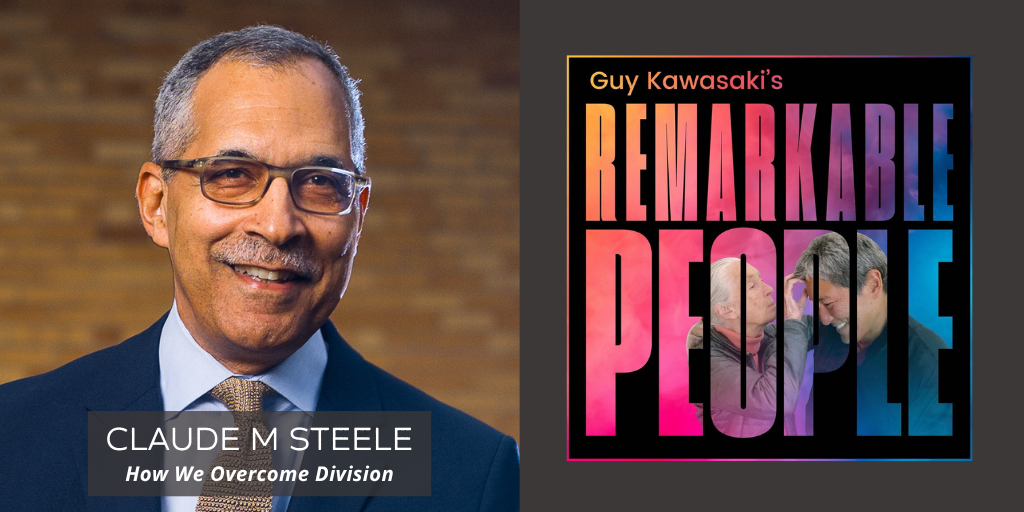
Welcome to Remarkable People. We’re on a mission to make you remarkable. Helping me in this episode is Claude M. Steele.
Claude is one of the world’s most influential social psychologists and a professor emeritus at Stanford University. His pioneering research on stereotype threat has reshaped how educators, leaders, and organizations think about performance, belonging, and human potential. In his new book, Churn: The Tension That Divides Us and How to Overcome It, he introduces a powerful framework for understanding the quiet anxiety that often appears when people worry they’ll be judged through the lens of stereotypes.
Our conversation explores why prejudice isn’t always the biggest obstacle to meaningful relationships. Claude argues that trust—not the complete elimination of bias—is what allows people to relax, connect, and perform at their best. He explains how churn affects nearly everyone, whether in a classroom, a workplace, a doctor’s office, or even a casual social gathering, and why recognizing that shared experience gives us a better path forward.
We also discuss what organizations can do differently. Claude shares remarkable examples from Georgia State University and UC Berkeley’s chemistry department, showing how reducing ambiguity, offering clear expectations, and creating environments built on respect dramatically improved student success. Rather than relying on sweeping policy changes, these institutions succeeded by paying close attention to the everyday experiences that either build or erode trust.
This episode isn’t just about psychology—it’s about becoming wiser leaders, coworkers, teachers, parents, and neighbors. Claude reminds us that true wisdom means seeing another person’s full humanity and potential before their labels or differences. If you’ve ever wondered how we can create stronger communities in an increasingly divided world, this conversation—and Churn—offers practical ideas worth carrying into your own life.
Please enjoy this remarkable episode, How We Create a Culture of Belonging with Claude M. Steele.
If you enjoyed this episode of the Remarkable People podcast, please leave a rating, write a review, and subscribe. Thank you!
Transcript of Guy Kawasaki’s Remarkable People podcast: How We Create a Culture of Belonging with Claude M. Steele.
Guy Kawasaki:
So hello, everybody. I'm Guy Kawasaki. This is the Remarkable People Podcast, and one of my favorite subjects in the world is social psychology, and we have a very influential and remarkable social psychologist today.
He's done such pioneering work on stereotypes and the threats that stereotypes present. He is a professor emeritus at Stanford. I majored at psychology at Stanford.
Claude Steele:
Oh, you did? Oh, how interesting. When did you graduate?
Guy Kawasaki:
I graduated in the class of 1976.
Claude Steele:
Oh, okay.
Guy Kawasaki:
Yeah, I worked for Phil Zimbardo and, yeah.
Claude Steele:
My friend. Yeah, Phil.
Guy Kawasaki:
I spent a lot of time in that building.
Claude Steele:
Yeah. Okay. You know the environment. Phil and I were good friends.
Guy Kawasaki:
Oh, yeah, he was truly a remarkable person. Yeah. And this is Claude's latest book. It's called Churn: The Tension That Divides Us and How to Overcome It, and I just read it, and this interview is going to be about this book. Welcome to the Remarkable People Podcast, Claude.
Claude Steele:
Great. My pleasure to be here. Been looking forward to it.
Guy Kawasaki:
I know probably every interview started like this, but we got to do it just so we get everybody on, I don't know if the same page, but a similar page. So let's just start with a definition of the word “churn.”
Claude Steele:
Yeah. Churn is the anxiety, the tension that we can feel when we're in a diverse setting in which we know that we could be judged, treated in terms of negative images or stereotypes of our group. It's the sort of psychological and physiological, but especially psychological feeling of discomfort.
"Boy, I don't know how they're going to think about me here. I'm in a situation where maybe my identity and how people view that identity could be problematic in this situation." So churn was a term that just came to mind as a way of capturing that emotion, that particular tension.
Guy Kawasaki:
As I was reading the book and reading about your work, I thought to myself, Guy, do you ever feel this churn? And I looked at it and I said, "You know what, I am old, I am Asian, I'm from Silicon Valley, and I'm male, and there are certain situation where I churn." So doesn't everybody churn to some extent?
Claude Steele:
Oh, yeah. Yeah, I think everybody does. That's one of the things that I liked about the term finally. My background research or research program before that was focused on stereotype threat, and that's the kind of threat that churn is a reaction to.
And most people had looked at that, studied that as a factor that could affect people's performance like their performance on standardized tests. Women taking a very difficult math test or African Americans taking a very challenging academic test, standardized test. They're doing something that's important to them.
But they're under this pressure of possibly confirming or being seen to confirm negative stereotypes in this society about their ability. So there's an added tension there. They're taking the test while they're in part in churn. And so most of the research over the years had focused on performance as the consequence of being in churn.
It's going to impair your performance, but what I wanted to pull out is that, oh, everybody experiences churn in situations where those stereotypes and images are relevant. The white male who's been invited to the third diversity training session and it's all women and minorities. He's likely to be in churn.
Guy Kawasaki:
As he should be.
Claude Steele:
Yeah. He's in a situation where he worries that, doesn't know for sure, but he worries that he could be seen in terms of negative stereotypes about his identity, and in very negative ways, as perhaps racist. Churn can be quite frightening sometimes.
Guy Kawasaki:
But, Claude, are there people who are either so egotistical or so, you know, narcissistic that they don't feel churn? At an extreme, do you think that JD Vance and Stephen Miller ever feel churn? Or like, they're on another planet?
Claude Steele:
Boy, both of those guys are extreme examples of human beings and to some degree. But no, I think everybody does under certain circumstances. I think some of their beliefs, in fact, are the product of churn.
Their antagonisms toward identities are fundamentally a defensiveness against feeling that they're under threat of being perceived in terms of these stereotypes of white guys, and they're sick and tired of it. All these woke people that keep inflicting that on them.
Guy Kawasaki:
Well, you know, Claude, I have a hard time thinking of JD Vance and Stephen Miller as victims who, you know, need our empathy. But anyway, that's a different discussion. Is there a fundamental difference between this feeling of churn versus maybe situational awareness or vigilance? Is there a positive side of churn?
Claude Steele:
Yeah. I mean, I do think churn is just our everyday adaptation to a situation. We walk into a situation, we're in school, we're in the workplace, we're in church, we're in the doctor's office, and for some reason in the back of our minds, we have a worry that maybe our identity may cause us to be treated or viewed in ways we wouldn't be happy with.
And so churn is the alert signal. It says, "Figure out how to cope with this." And it's just normal human social functioning at that point. "Is there something I should do or say that would help the situation or prevent me from being judged and treated in this way? Boy, I hope it isn't too important."
All those kinds of ruminations are a part of churn, and part of it is also that you don't know for sure that you are going to be seen and treated that way. That's part of the stress of it, is the ambiguity. And so that's part of what churn is wrestling with too, is this really a problem here or am I safe here in this environment?
Where do I stand? And you're reading cues. You're doing several things at the same time. You're multitasking. You're trying to read this social situation and what the threat of it is for you. At the same time, you're trying to directly cope with that situation or function within that situation.
So it's an extra load that I wanted to identify and pull into view as a feature of our experience in diverse settings. That it's just kind of an inherent feature of those things, especially the ones that are important to us. If we're just on a bus and it's very diverse or on a subway or something, we don't care.
We're not going to churn very much. We don't care about that. But if it's in a medical school class or in an important work environment, you can feel a lot of churn. I use the example of an Asian grandmother getting out her cloth bag to go to the farmers market in her town.
At the time all this violence is happening, somewhere in the back of her mind she's worried that, "Geez, could this happen to me? Could my identity on the public streets of this town that I've lived in forever, could that identity be problematic, and maybe attract violence or derision of some sort?"
And that can be quite a feeling. That can be quite a blanketing feeling. It's not something that's just, you know, you blow it off. You could possibly be under threat, and churn is the first psychological attempt to cope with that possibility.
Guy Kawasaki:
So the obvious cost of churn is just, it's frying your brain. You have other things of higher importance to do, and then you got to be concerned about all this garbage that's all the other thoughts, right?
Claude Steele:
Yeah, and it is something that is tied to diversity. I've been using the example of being a somewhat older gentleman, and I have a coffee group that meets at a Peach Cafe in the morning sometimes.
And, we're just a bunch of old guys talking and carrying on, and we're pretty relaxed and comfortable with each other because we're safe in that homogeneous group that we're not going to be seen in terms of ageist stereotypes, that our views are dated and our technological competence is inadequate.
Because there, we're all old, so we feel kind of safe, comfortable. But if some younger gentlemen or women joined that group, we'd lose some of that security. We'd start to churn more. What I just said, maybe that could get me stereotyped as an old, out-of-date guy, and oh my goodness, I don't want that to happen.
And so that's how diversifying a group, a social situation, can put us in this state of churn. Sometimes churn is pretty mild and modest as it would be in a coffee klatch like that, but sometimes it can be quite intense in a highly important situation. The patient to doctor, basketball player to coach. There are all kinds of diverse situations where churn can be quite a factor.
Guy Kawasaki:
You open your book with a brilliant example that any parent, well, not any parent, but many parents can relate to, which is a Black family is meeting with a white teacher, and the white teacher doesn't want to say anything that may be construed as racist, and the Black family doesn't know how the white teacher approaches a Black kid.
And this is a lot of stuff going on there in a simple teacher-parent meeting.
Claude Steele:
Yeah. And importantly, it's not about prejudice. We tend to think of diversity and bringing different identities together in terms of prejudice, with the idea that if we could get rid of that, then these kind of interactions would go smoothly, and we wouldn't have to churn very much if we got rid of prejudice.
But you can see that with that teacher and those parents, their churn really has nothing to do with their prejudice. It's the social situation. They know in that they could be seen in a way that would be upsetting to them, and that's what the stress of it is.
That's also why I wanted to pull this idea out of the sort of muck and dust it off and clarify that, no, it's a real phenomenon in its own right.
For example, would the teacher, reluctance to give good, valuable, but critical advice to the parents, would that be because she's prejudiced against them or because she's experiencing churn, and she just doesn't know what the consequences of doing that would be for her?
So that's it. The other thing is that churn is essentially at bottom, an inability to trust the situation, to trust my safety in the situation. And that, I argue in the book and try to bring as much research to bear on it as I can. I think that's a new road to how to handle diverse situations, is that if that's the problem, then maybe the thing to focus on is not so much on eliminating prejudices.
Although I don't want to be seen as somebody who's diminishing their importance. They are very important.
Guy Kawasaki:
Yeah.
Claude Steele:
But we know now how hard they are to change. But what might be a lot more accessible and easy to do is to focus on building trust between people, and that's something I think is more within our reach.
Guy Kawasaki:
So I think the point you're making is that the reduction or removal of prejudice is not the same thing as trust. It's completely different, right?
Claude Steele:
Completely different.
Guy Kawasaki:
Now, arguably someone could have prejudices, and I think we all do have prejudices.
Claude Steele:
We all do.
Guy Kawasaki:
But if you can overcome your prejudice with your trust, then, bada bing, bada bang, we're in a better situation right there, right?
Claude Steele:
Yeah. You are saying the heart of the book. That's the optimism of the book is that maybe there's a more optimistic way to look at this feature of our society than we've been allowing ourselves, and that if we focus on the sort of basic task of building trust between people because once I trust you, and I'm feeling that toward you, Guy.
Once I trust you, I'm not worried that you're going to see me in terms of the worst stereotypes of one or another of my identities. I feel comfortable, I relax. And so here we are now in a diverse situation where I feel comfortable, and I think we have underappreciated this route to getting along with each other and reducing those tensions that can exist between us.
And I think also a lot of us have had that experience in our lives, where we know people of different identities and we trust them, and we don't feel any churn. We're not in any tension at all. We love them, and we marry them. We do all kinds of things. So it speaks to how possible it is, and that's the basis of my optimism.
Guy Kawasaki:
So you know the famous story about the Ku Klux Klan Grand Wizard who was assigned to some kind of city committee or something with a Black woman who was from a school system, I think, in charge of diversity. And that was like the worst pairing in the world, like a Grand Wizard with a Black woman, and they became friends.
And I think he spoke at her funeral, or she spoke at his funeral, and there's like a whole story about that. And you could make the case that even at the end of their lives maybe their prejudices weren't removed, but they trusted each other, right?
Claude Steele:
Yes, that's the whole point of the book because we do know several things about prejudice, which I might just quickly mention. One is that they are sort of a virus in human relations, but they often don't drive behavior as much as they follow behavior.
We adopt a prejudice to justify the way we behave or the way we're forced to behave or structured to behave, more than having a prejudice taught to us by, let's say, our parents or somebody, actually drives our behavior.
That can sound a little abstract, but one thing I think is that once you do trust people, once that Grand Wizard trusts that Black woman and that Black woman sort of trusts that Grand Wizard then the prejudices melt a little bit.
In that extreme example, maybe they don't go away entirely, but they melt or they soften, and we connect with each other, and this basic social or psychological possibility is what the book is trying to put an emphasis on.
Guy Kawasaki:
Absolutely. And you're touching upon a subject that I just want to ask kind of straight out. So do you believe that our attitudes cause our behavior or our behavior cause our attitudes? Which comes first?
Claude Steele:
Yeah. I'm going to vote on the side following the data that I've seen over my career, our attitudes follow our behaviors more than they cause our behaviors. Whenever you look to see if people who hold a given attitude actually follow up on that, the data are very mixed. But once you get a person to behave in a certain way, they tend to adapt attitudes that fit or justify that behavior.
And that seems to be where they come from. So if I live in a segregated world, these two groups of people, let's say, are segregated from each other. I'm behaving in a segregated world. I adopt attitudes toward the other group that justify that segregation. But if I get to know them, I integrate, and we're in class together and so on and so forth, then I don't need that attitude as much.
And so I don't adopt a prejudicial attitude. So again, one of the hopes of the argument in the book is that as we build trust with each other, that may be the most effective way to actually reduce prejudice.
Guy Kawasaki:
Yeah, I love that point. I think so many people are, at least, paying lip service. Well, I mean, you go into a whole diatribe, which I'm going to ask you about right now, but this whole thing about, "Yeah, I am colorblind." Yeah, such bullshit. Nobody's colorblind. In a sense, colorblind is like saying, you're not prejudiced anymore, right?
Which is, that's different than trust. So what do you think of the term colorblind?
Claude Steele:
I'm old enough to remember when it was a very progressive idea in the 1960s.
Guy Kawasaki:
We're the same age.
Claude Steele:
Yeah. So all that legislation that basically removed the legal basis for Jim Crow and this deeply segregated society we'd had up to that point. The idea was we're going to solve this problem by being colorblind.
And so I think it had very good and honorable intentions. And there are certain parts of life that we have that have to be colorblind. Our law enforcement, our access to medical care, our access to opportunities, we want those to be colorblind, not mediated out on the basis of identity, for example.
So I think in some ways, having an integrated society commits us to colorblindness at a certain level. But at another level, we have to be wary of the fact that it can make us think that our identities have no significance at all, that they just don't matter even though in my life, in your life, a lot of what we've had to contend with has to do with our identities.
The way we function, the people we know, the worlds we were brought up in, the cultures we're exposed to, the opportunities we're exposed to, so many things are tied to that identity that to say, "Well, I'm just going to be colorblind," is to suggest that you're going to ignore all that about a person.
And if I said that, that would make me very untrustworthy. You couldn't trust me if I said, "I'm just going to as an act of will, ignore everything about your background and culture and significance, we're just going to treat you." You know that doesn't make sense.
So that's where it falters and can be taken too far into the realm of relationships between people and so on. It's not good to say, “I'm colorblind.” I try to use examples of famous intergroup friendships in the study. I have a hobby of collecting those.
And you can't be friends with somebody that says, “I'm just going to be colorblind. I'm not going to pay any attention to what your life has been like and what your identity has meant for that life." So that's the critique of it, I think. It's necessary in many of the laws and customs and practices in a society like ours that is diverse.
We're one of the most diverse societies on Earth, and in the history of the species, so that's part of our gift and our challenge is the diversity we have as a society, but to say that we're just going to treat each other as kind of brains on sticks, as my friend used to say, it doesn't make sense. That's the problem with that.
Guy Kawasaki:
So suppose that I'm listening to this podcast and I'm dean of freshmen or I'm like Julie Lythcott-Haims or something, and I'm listening to this Claude Steele, and I want to reduce these cues that might cause churn in entering freshmen or entering into Georgia State University or Cal Chemistry Department. So what are the cues that cause churn to happen?
Claude Steele:
Yeah. That's where the book, I guess maybe, takes up more pages than anything else are how do you do this? How do you reduce churn? And I think when you're talking about between people, between colleagues who work together or who are students who go to school together, or between a doctor and her patient, how do you reduce the churn that might be there?
I think it is very simple. That's why, again, a source of optimism, and that needs to be a signal of respect and recognition of the person's full humanity and their full human potential, that has to be signaled in some. It's an important feature of the thing I've been using lately, a metaphor.
It's not in the book, but it just came to me. The other night, I was watching an old movie, Robert Redford called The Horse Whisperer, and it's about this guy who's a real person. I subsequently saw the documentary on the real horse whisperer, and he's able to take these wild horses, these mustangs, and so to speak, break them, train them into being beautiful saddle horses and the like.
And so the documentary and the film show people trying to control these beasts and maybe as many as four or five people are throwing ropes around them to get them out of the trailer that they're on, and so on.
And so they're just trying to dominate this horse, and the horse is fighting back with all its might, kicking people, and eventually, they may or may not subdue the horse, but the people and the horse are often injured.
It's a dangerous game. But the horse whisperer, he recognizes that something different, and I think this is at the heart of how you deal with churn, that the horse is scared to death and is really worried that he's in a dangerous, threatening situation. And the horse whisperer recognizes the first thing that has to be accomplished is that the horse has to trust him.
So he does the thing. He just goes into the corral and stands there for maybe an hour with the horse and gets the horse to feel that he's safe with him. At one point, the horse runs away. This is in the movie, and the guy lets him run away.
And the horse goes, maybe, almost a half mile down the other side of the meadow, and the horse whisperer just stays there, visible to the horse, and doesn't try to pursue him. And after a long time, the horse comes back to him and there's an element, what the whisperer is doing, to put it in churn psychology terms, is just building trust with that horse.
That you can trust me. And so I think the first step that dean needs to understand is that often those students just need to trust the environment. They need to have evidence that they're going to be safe, that they're going to be recognized, their full humanity's going to be appreciated in that environment.
Things that celebrate their backgrounds and celebrate the different backgrounds of multiple groups begins to give that kid a sense that he can trust this environment. This is a place that sort of sees who he is and recognizes that he is a full human with full potential and the like.
You know, I like living in cities because there are so many identities in the city that I realize mine isn't going to be so problematic. But if I'm in a small town and I have a distinct identity, then I'm going to churn a lot.
But in the city, I'm not going to churn. I feel comfortable, I relax. So I think the dean has to work for that sort of an environment, that kind of a context, to give a little nod to a little celebration to that.
Also, I think, just between two individuals, that things as simple as rather than making big statements about who you are and so on. Just ask questions and have a genuine interest in another person. Take that person as an opportunity to learn about different perspectives, different points of view.
If you show that interest, you're showing respect, and you're showing that you see the value of this other person. So I think those things can be just as simple as that. There's a light in your eye which signals that you see that person and that you're interested in who they are.
That's a big change, and oftentimes we don't take that frame of mind. We think the appropriate way to treat that freshman is to, "Look to your left, look to your right. Some of you are going to make it, some of you are not. I don't know who you are. I don't even know if I can trust you at all."
Guy Kawasaki:
“But I'm colorblind.”
Claude Steele:
Yeah, “But I'm colorblind, so I'm not prejudiced,” but that kind of an attitude keeps me in churn. Now I'm constantly preoccupied with, am I going to really be treated fairly here? Will my abilities really be invested in this place? And so it keeps a lot of questions open that can be put to rest quite easily.
And so that's another feature of the book. I think one of the things in this research, you mentioned Berkeley Chemistry, and I describe their accomplishments, and also Georgia State, which these are academic institutions that have very successful experiences with diversity in the sense that all groups in those two places achieve at the same level.
That's how I identify them. Do women and men, do minorities and majorities get the same grades? Do they take the same difficult majors? And in those places, they do. So I was very curious about, how do they accomplish that? And what they both do, even though they're very different institutions.
Berkeley Chemistry is probably the first or second or third chemistry department in the whole world and Georgia State is a regional university in Atlanta that two-thirds of its students are low income.
But they both recognize that one of the challenges of bringing people into their institutions is the ambiguity that can become toxic to groups whose identities may be negatively stereotyped, that they're going to be in churn a lot, and that the mere ambiguity of the situation.
Berkeley Chemistry is a good example because it's such an elite program. Oftentimes the pedagogy that people would believe in is that we should make this a very unstructured place so that students can find their own interest. What's the flame that really excites them? And give them the opportunity to find that.
But if you do that for the women who are there under a stereotype about women maybe not being as good in the STEM fields, or if you're a Latinx student or an African American student maybe under similar kind of stereotypes, that ambiguity keeps you in churn. You have to constantly worry. Did he say that because of my identity?
Maybe not. Probably not. I don't want to think that, but maybe he did. Maybe he did. Can't forget that. Then you're going to talk to somebody else in your group and the sheer ambiguity of the situation for a person dealing with that kind of group identity and stereotypes about it, that ambiguity can be toxic.
It just weights them down, and it's not a passing easy thing to deflect. It's a worry because this is a very important situation for them in their lives and their careers. And to have that worry be always there like the Asian woman going to the farmer's market under the threat of violence, “Will I really be appreciated here? Will I be invested in here?"
So they do two things which really solve their problem. They orient the hell out of them. They bring them in early, weeks early, seven weeks early in the case of Georgia State, or three weeks early in the case of the graduate school of Chemistry at Berkeley.
And they socialize them, "Hey, this is what graduate school is about. You've been an undergraduate. You've been good at it. That's why we picked you, selected you. You're not a consumer of knowledge. You're a producer of knowledge.”
“So you're going to be in an environment with new norms where the task is to get involved in research, and we're going to help you get involved in that research. And you're going to talk to several professors and they're going to give you some ideas for your first year project. And here are the deadlines.”
“We want the proposal in by November, and the research done by March and the paper submitted," so all of a sudden they're in a very structured and a clear, unambiguous situation, and they know how to think about themselves, whether they're making appropriate progress or whether they're not.
They know, "If I met that deadline, I'm in good shape." And the faculty are telling them that. "Don't worry, just here's the structure that you need."
So that was another, something going into this research I didn't anticipate, but which became very clear, is that sometimes the mere ambiguity of an important situation can be a source of churn for people based on their identity and the stereotypes about them.
Guy Kawasaki:
Yeah. As I was reading the book, I was pondering the question whether this is a uniquely American phenomenon. So I came up with this hypothetical question for you, and I don't want you to think I know so much about education, so I actually had to use AI to figure this out, but I asked ChatGPT, "What is the Stanford or Harvard of Nigeria?"
And I was told it's the University of Ibadan, if I pronounced that right. So now let me ask you theoretically, for some reason, a white kid gets admitted to the University of Ibadan in Nigeria, and he or she goes to the freshman orientation in Nigeria. Is that person in a state of churn too?
I'm thinking, I'm the white guy. I'm the white gal. It's all Black here, and are they going to think that I'm a trust fund baby or that I'm a Ku Klux Klan grandson or granddaughter? Is churn going to happen in Africa if you're white?
Claude Steele:
I'm going to give a quick answer just to be clear. I recognize there may be flaws in the answer I'm about to give, but my answer is no. And the reason I say no is that in Nigerian society, there aren't negative stereotypes out there about white people's intellectual abilities.
So even though he's the only white person who enters Ibadan as he learns, he's not going to be prejudiced against as maybe not being up to snuff there because of a lack of intellectual abilities. So that form of threat won't be a big problem for that person.
Other forms may be. There may be other negative stereotypes about white identities that might be afoot in that environment. I just don't know. And they could be about anything. Maybe their honesty or maybe their kindness. Uh-oh, here's a person that's, you know, he's white, he's a colonialist, and probably has bad intentions for it.
So he might be very self-conscious when he's in situations where that stereotype would apply, but he's not going to be that worried about being seen as unintellectually promising, unworthy of investment.
Guy Kawasaki:
And he got in on the minority admissions program in Nigeria.
Claude Steele:
Yeah. He's not up to snuff. He won't worry too much about being seen that way because that view of that group is not seen that way in that society.
Guy Kawasaki:
I loved your example of Georgia State and Tim Renick. So what do we learn from what Georgia State did?
Claude Steele:
I think it's such a marvelous thing. I'd write another book about that if I had a chance so here we are, especially people of our age. We've been since the 1960s trying to figure out how to diversify these institutions that until that time were not diversified.
And we've tried affirmative action, we've tried this policy, that policy, and what they eventually did at Georgia State was no big major policy. Renick, this particular person, a religious studies professor, he came there and just paid a lot of attention to what students were actually dealing with in the environment.
What was it that was causing this huge dropout rate? At the time of his arrival, they had graduation rates in the twenties, 20 percent, or so. But for African American males, only 18 percent of those who enrolled actually graduated. Oof, they had to do better for all kinds of reasons.
And so led by Renick, set out on an agenda to change that. And that's where he, you know, interviewing students, getting to know students. And what he found is that it wasn't so much ability, it was too much bureaucracy.
So a student would fail to get in one particular form, and then he'd have to miss a quarter, and these were kids with not a lot of income, and they'd go off in the job market and never come back in, never be seen again.
And that was happening over and over again. So he streamlined bureaucracy. That enabled them to not have that friction, that frustration in their college experience, and that upped the graduation rate. Then the way in which financial aid was given was another problem. If they'd get a HOPE scholarship, which is a wonderful scholarship that the state of Georgia gives to kids.
But if you fall below a 2.75 grade point average, you lose it. And kids who were doing that would lose their scholarship, and then all of a sudden they'd have to pay to go to Georgia State. They'd put their tuition on their credit cards, and then their credit cards would come due, and they'd have to drop out of school in order to get a job and pay off their credit cards.
And so, he got a foundation to help support the kids who were in that situation, enough funds to continue without burdening their credit cards. So he was inch by inch redesigning the experience. He realized a lot of these students just didn't understand what colleges were about and how to function in them, how to prepare and study for college work, how to take college work on.
So each of those needs he tried to address. He put in a huge orientation program, seven weeks before school starts when you're a freshman, and you get financial literacy training so that you know when to use AI to determine when your family's going to have trouble paying tuition. They give financial aid not in a block grant to you, but to meet specific needs.
Your mother needs rent money, so you don't have to drop out of school in order to pay that rent money. That's when you get the financial aid. That's what it's for. Early intervention in class performance, so as soon as a kid blows a quiz, he's visited by the adults in the environment and he's either redirected and/or he's coached as to what it takes in order to get a good grade in this course.
So the sort of social capital, just the knowledge of how to cope with an institution like that, he provides it because he was finding those are the things that keep them out, that cause them to drop out, these little incidences. They don't know how to cope with a situation.
They don't turn in a form. Their mother needs rent. Their car won't work, and pretty soon they're out the door. So he fixed those things. And he improved the graduation rates, brought them all up in about an eight-year period of time from like 27 percent to 67 percent. So it was a transformation of the university.
No big policy changes, no big pedagogical changes. He just took care of what their actual needs were, and he enabled them to have a feeling that they could cope with that situation. He took the ambiguity out of it. He gave them the supports. So pretty soon, these kids, remarkably, they trust that institution.
They believe in it. That institution really helped them do something that, this was important in their lives, get a college education. And so they love the place. It's an inspiring thing. I think it's an inspiring life, Tim Renick’s experience in that university.
I can't believe somebody's not going to make a movie out of that at some point or another. At any rate, it was the work on the ground, that just helping these kids, that reduced their churn and enabled them to succeed.
Guy Kawasaki:
I love this point about it was the work on the ground and it was Tim actually seeing what's happening as opposed to some lofty committee and ad hoc and all this.
And I just want to verify this, I think that one of the points of all these like early orientation, seven-week orientation, this early intervention and all this kind of help, it was available and given to everybody, right? It wasn't just the minority students who needed this help?
Claude Steele:
Yes. That's a huge wisdom on his part because the more conventional thing that we've tried in higher education, again, as we integrated these institutions since the 1960s, is to admit minorities and low-income students into remediation programs on campus and on the well-intended idea that they need to be brought up to speed to function adequately in this institution, and blah, blah, blah.
But what that did was we found out, strong belief of mine at any rate, that we stigmatized them right there on the campus. So they're in this program, and everybody knows they need remediation. And so now you talk about being under threat, under stereotype threat, and being in churn all the time.
You can imagine being admitted to a college campus from a low-income background and put in a program that says, “We don't know about you. We're going to give you a chance," but you're operating under this possible view that people are seeing you as not a promising student. You're almost telling them that.
And, yes, occasionally some kids press through that and do okay, but a lot of kids don't. They're kind of defeated by that situation. And Renick is not doing any of that. He's saying, “I think you have the ability to succeed here. I'm just going to help you know how to do it. I'm going to give you the know-how to do that."
And I introduced that chapter with a description of my own college experience, which, in the early days was a lot like that. I came from a big south of Chicago high school. It was a good high school, but I was an athlete, and I just didn't connect. I was a reader. That was a good thing.
But I wasn't a great student, and when I got to college, I just didn't know how to do that. I can remember getting another C and thinking, How do you do that? I would do really stupid things like I took a French course, and I would study maybe, ten minutes a night but think that I was really working a little almost too hard at that.
I just didn't know what to do, and I got a roommate that did for me what Tim Renick did for the students at Georgia State, he was a good student, and I just realized, I got to do everything he does. Go to class and read the book and read the book way in advance. And grow up a little.
Guy Kawasaki:
But, Claude, in that part of the book, almost totally unrelated to churn and prejudice and trust, you go on for about a page and a half about the lesson you learned that I want to tap right now about how to read a textbook. So I want you to repeat the lesson that you learned in college about how to read a textbook, and this has nothing to do with race, right?
Claude Steele:
Yeah.
Guy Kawasaki:
This is studying for dummies.
Claude Steele:
Yeah, it's an example of a know-how that you could misinterpret as a matter of ability.
But the way I learned, again, this roommate of mine who, Pat Neal was his name, he was a good student, very nice guy, and I'd been in the dorm room reading my history book with a yellow marker and just be slowly marking everything and then I couldn't remember it all and getting a B minus or a C on the test.
And he said, "Look, you're doing it the wrong way. Just go take a chapter and skim it. Just go all the way to the end." And this is my language now, but you'll sort of implicitly get an outline of that chapter. Don't mark anything. Then, read it again maybe a little more thoroughly, but get the storyline of the chapter, what it's about and so on, and don't take forever.
Take maybe a half an hour to do that. Do that twice. And now you're going to have a really pretty good conception of what that chapter's about. And now read it. Just read it. And now you'll have this outline and the facts, and the ideas will have something to attach themselves to, and you'll be able to remember them.
As you remember the story, all of those things will come to mind, and you'll be able to do really well on a test about them because you got the whole logic of it. So all of a sudden it was so easy, so much easier than what I was doing. So as I say in the book, I still do that. I still use that strategy.
Then if you really want to be prepared for the test and so on, then yeah, read the chapter again. And maybe occasionally note check things that are going to be useful.
But don't over effort because you're just getting facts you have no outline to attach them to, and you can't remember them, and you don't know what point they're really making, and you're in the dark as you go fact by fact by fact by fact, so get the storyline.
Guy Kawasaki:
And you're sure it wasn't just because you stopped swimming?
Claude Steele:
I do think that was part of it because swimming took a lot of time.
Guy Kawasaki:
But you are breaking another stereotype there, right?
Claude Steele:
Yeah. It's not common for African Americans, certainly in those days, to be in competitive swimming programs. But I was a product of the Harvey YMCA, and so I learned to swim there, and I joined the swim team at the YMCA, and then I swam in high school, and when I went to college, at least that first year, I was a dedicated competitive swimmer.
Guy Kawasaki:
So now as we're talking about Tim at Georgia State and this was offered to everybody and all that, can I interpret this or is this like, just, "Guy, you're going astray here"?
Are you saying that the unintended consequence of DEI programs and minority admissions and all that kind of stuff, maybe it's well-intended, but it's having this negative effect of expectations of people, including of themselves, so maybe doing away with DEI is a good thing or a bad thing? Where do you stand on DEI and things like that?
Claude Steele:
Yeah. Again, I'm depressed by the turn in the current administration against that as a program. I see DEI as something that is an evolving wisdom coming out of the 1960s. What America's really trying to learn how to do is how do you have a successfully diverse society? That's the big experiment that we're in, and I see those efforts, and DEI is a pretty recent term.
It's probably only about four or five years old, maybe a little older than that. But it was an idea, an approach, and it has some advantages, and it has some real striking disadvantages. I would say the same is true for affirmative action. These were efforts to deal with our past and to create equal opportunity for all people in our society.
And I think we were on a good path to learning how to do them better and better. And I think you'd have to say affirmative action accomplished an awful lot for women in this society and their position in society and for minorities too.
It's responsible for a part of the middle class of minority life. It wasn't perfect. I don't think it really did have a lot of displacement of whites. I don't think the data on that seemed to be very modest. But it had a ring of unfairness.
And the current administration and the Supreme Court has ultimately decided we're not going to do that. So out goes that strategy, and part of the hope of the book is that it will usher in some new strategies that are focused on building trust and doing the kind of things that Tim Renick did at Georgia State and that Berkeley Chemistry does and get us to keep going and not abandon this.
So what I'm most worried about isn't so much the abandonment of the particular DEI programs as it is the commitment to dealing with the achievement of equal opportunity. That's very important to sustain. We do have such a complex, that's a euphemistic term, a complex history as a society.
You can't keep people out of the mainstream and segregated into the worst conditions in society, Native Americans, African Americans, Latinos, and just ignore that, take that away, and just assume it's just going to take care of itself. You have to, as I think a testament to our humanity as a society, you have to find ways of helping people get genuine equal opportunity.
So it's kind of a big personal mission for me in addition to being a scientist. I suppose that's a set of values that I have about America. I'm proud of America because we're taking this experiment on in the world. Most societies aren't. Ours is, and I don't mind the critiques of DEI, but I do mind giving up the mission that DEI was addressing itself to.
What we covered may be wearing you out at this point. I don't know.
Guy Kawasaki:
First of all, I want to go on the record that I got admitted to Stanford in the class that started in 1972, and there is no doubt in my mind that I got in because I am Japanese American. So affirmative action worked for me. There's no doubt in my mind. None at all.
Claude Steele:
Oh, yeah. I'm old enough that I didn't benefit from it going to college or even going to graduate school, but almost every job I've had that was almost an automatic. If you're African American, you'd be put on an affirmative action line so that the school would get credit for that.
So I too have benefited from that.
Guy Kawasaki:
You mean like Elizabeth Warren being Native American?
Claude Steele:
There you go.
Guy Kawasaki:
Proof that it works.
Claude Steele:
Yeah, proof. Proof for sure.
Guy Kawasaki:
All right, my last question for you. We have gone over churning, we have gone over removing prejudice versus building trust, and all of this rolls up into what I consider one big ball of wonderfulness in your book, which is your concept of wisdom. Because I can tell you something, there are a lot of people who I would say are smart, but there is a shortage of people who are wise.
And so I want you to end this podcast with your definition of wisdom and how to achieve wisdom.
Claude Steele:
Wow. That's so well put. It's a good thing to conclude with. It does come from work by a famous sociologist, Erving Goffman, who did an ethnography of gay life in San Francisco in the 1950s. So there's a group of people dealing with, at that time, an intense stigmatization.
And what he found is that gay men had a term for straight people who they trusted, and the term was "They're wise." "Yeah, he's wise, man.” Meaning essentially that person sees our full humanity. He sees that we're fully human. Yes, we're gay, but we're fully human, and he sees that.
African Americans have that, a lot of terms like that for whites who see their full humanity. "He's cool, man. He's cool." The tone is, “He's down," meaning you can trust him. That meaning of wiseness is, as you point out, a theme of the book, how to achieve it in our relationships, one on one, how to achieve it in bigger settings like classrooms or whole universities.
It kind of captures the spirit of the book that what we need in order to have a successfully diverse society is wiseness, is an ability to see full humanity and full potential, human potential, in difference.
That's the challenge, I think, at the core of American society in an important way, is that it's easy to see full humanity in our own groups, in our own identity groups, but to see it in different groups and to respond accordingly, that's wiseness.
And that's, I think, what the challenge for us as individuals is, and that's the challenge for our institutions is to have that capacity to see full humanity in that low-income, immigrant kid who shows up in my introductory psychology class at Stanford or at other universities that I've taught.
To see that kid's full humanity and promise, that's what wiseness is to understand that it's there, to recognize it, to respect it, to treat him in terms of it. We didn't get to go into a lot of detail, some of the specifics that are in the book about exactly how you would do that.
But that's what that term means, and that I think should be a chief ambition of our society.
Guy Kawasaki:
Claude, mea culpa that I didn't ask the questions about how to actually do all that. But then, I would look at this as a glass half full. So now, we've tickled everybody's interest, and now they say, "Oh, if only Guy were a better podcast interviewer, he would've covered that. But so now I got to buy the book." Yeah.
Claude Steele:
Yeah. Oh, there we go.
Guy Kawasaki:
I had a plan. That was all planned, Claude.
Claude Steele:
I'm grateful for that plan, let's put it that way.
Guy Kawasaki:
Claude, thank you very much. It's been a most enjoyable and informative and inspirational podcast interview. I truly enjoyed this. And, we have lots of friends in common, like Mary Murphy, Geoffrey Cohen, and Carol Dweck, and all those people.
Claude Steele:
Yeah. Oh my goodness.
Guy Kawasaki:
Yeah. I should call this Remarkable Stanford Professors instead of Remarkable People.
Claude Steele:
Yes, and Stanford is really blessed, I think, to have taken up this set of issues and this kind of work in these years.
Guy Kawasaki:
So just let me thank my staff, my team, which is Madisun Nismer, co-producer with Jeff Sieh, co-producer, Shannon Hernandez, the sound design engineer, and Tessa Nuismer, researcher. This is the team behind me.
And I love this thing about churn and trust and prejudice. It's very, very eye-opening for me. I enjoyed reading your book, and I hope everybody out there listening will also read this book.
Sign up to receive email updates
Enter your name and email address below and I'll send you periodic updates about the podcast.

Leave a Reply