
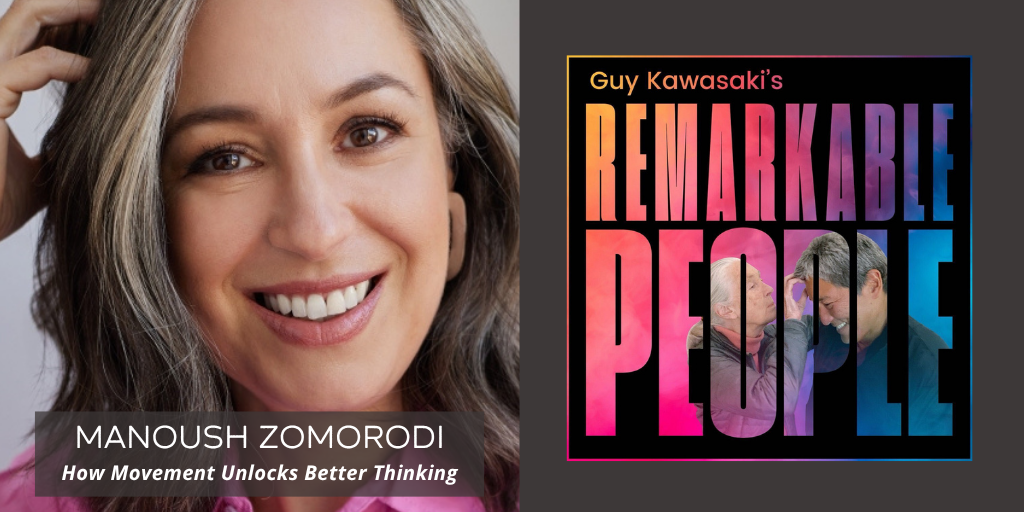
Welcome to Remarkable People. We’re on a mission to make you remarkable. Helping me in this episode is Manoush Zomorodi.
Manoush is an award-winning journalist, bestselling author, and one of the most respected voices exploring how technology shapes our lives. Millions of listeners know her from NPR’s TED Radio Hour and her groundbreaking work examining creativity, work, and digital culture. Her latest book, Body Electric, takes a closer look at the hidden costs of our increasingly sedentary lives and offers practical, science-backed ways to reclaim our energy, focus, and health.
During our conversation, we dig into one surprisingly simple idea: moving for just five minutes every half hour can make a measurable difference. Manoush explains how this habit improves concentration, lowers blood glucose, boosts mood, and helps our brains perform at a higher level throughout the day. We also discuss why exercise alone isn’t enough if you spend hours sitting, how movement fuels creativity, and why many of our workplace norms work against the way our bodies are designed to function.
One of my favorite parts of this discussion is that Manoush doesn’t argue we should abandon technology. Instead, she challenges us to use it more intentionally. We explore practical ideas for making movement part of Zoom meetings, reducing digital distractions, embracing boredom as a catalyst for creativity, and creating habits that help us think more clearly instead of simply staying busy. If you’ve ever finished a day feeling mentally drained despite accomplishing plenty, this episode offers a compelling explanation—and several solutions you can put into practice immediately.
Whether you’re leading a company, creating your next big idea, or simply trying to feel better at the end of the workday, you’ll find actionable insights throughout this conversation. Body Electric is more than a book about movement—it’s a reminder that our minds perform best when we stop treating our bodies like an afterthought. I think you’ll come away looking at your desk, your schedule, and your daily habits in a completely different way.
Please enjoy this remarkable episode, The Five-Minute Habit That Can Transform Your Day with Manoush Zomorodi.
If you enjoyed this episode of the Remarkable People podcast, please leave a rating, write a review, and subscribe. Thank you!
Transcript of Guy Kawasaki’s Remarkable People podcast: The Five-Minute Habit That Can Transform Your Day with Manoush Zomorodi.
Guy Kawasaki:
Hello, I'm Guy Kawasaki. This is the Remarkable People Podcast, and today's a big day because one of my heroes in podcasting is on today. Her name is Manoush Zomorodi, and it would take a while to introduce her. She's award-winning journalist, best-selling author, NPR goddess of NPR's TED Radio Hour.
Her latest book is called Body Electric. And we are going to talk about the effects of our digital habits on our bodies and life and health, right, Manoush?
Manoush Zomorodi:
That is what we are going to talk about. I am so happy to be here, and I don't think I've ever been referred to as a goddess before, not even by my husband. So I will take Guy. Thank you.
Guy Kawasaki:
You better get used to it.
Manoush Zomorodi:
Gladly.
Guy Kawasaki:
So Manoush, just to dive in here, in your book you mention how great a role model and inspiration your mother was, and then you drop this little sentence that nobody's going to notice but Guy, and it said, "My father tried the Body Electric experiment and he lasted one day." So I want to know more about that story.
Have you convinced him to embrace the Body Electric theory of movement every thirty minutes, or is he beyond hope?
Manoush Zomorodi:
So what you're referring to is my parents symbolize two different approaches to life. One is my mom is eighty-two, and she never stops moving, like ever. She swims in the morning, sometimes also in the afternoon. She's constantly taking walks. She belongs to a chorus, an orchestra, a chamber music group.
She babysits for my niece and nephew. She is just on the go, and it used to really annoy me, Guy, because you could not just hang with my mother, right? She would get twitchy and have to move, and I figured "Oh, I guess I got my dad's genes," because dad is more like a house cat. You know what I mean?
He kind of just slinks from room to room. He might come and talk to you, maybe not. He just wants people to be around, and particularly since he retired, there's a lot of lounging, right? He's a lounger, and that used to worry me a lot, and it still worries me, but part of it is like no one's ever going to tell my dad what to do.
He is a Middle Eastern man. He is in his mid-eighties. He is a retired psychiatrist. You will not be telling my dad what to do. However, I think the message of the book that it's not shaming you. It's not, like, throw away your laptop. Put your phone under your bed. Go on a digital Sabbath forever.
No, that is not the message. It's an understanding that these devices are extraordinary. They're amazing. They give us connection to our family, to information, to art, to amazing things. But we are biological human beings who need movement in our lives, and he went to medical school.
He knows that that's true, so I wouldn't be surprised that if you did have a little surveillance camera on my father, you would see him getting up more often from his online chess marathons that he partakes in, and sometimes backgammon.
Guy Kawasaki:
I think you should recruit his grandchildren to force him into moving. That might work, right?
Manoush Zomorodi:
That might work, yes. And from what I understand, recently my nephew who's just walking now, he grabs him by the hand and is like, "Come, come, come." So it's working. It's working, Guy.
Guy Kawasaki:
This podcast is about six years old now, and we've had obviously 300 guests. And I got to tell you that of all the guests, I felt the most convicted by your book because as I was reading your book, I'm an info maniac, news hound. I have an obsession to stay informed.
I read the news on my phone before I sleep, when I wake up in the middle of the night, as soon as I wake up in the morning, and then in the morning when my brain is freshest, according to your book, I of course do the worst thing, which is I answer email, which is not where I need to have my creativity. So I confess. Just give me fifty lashes.
Manoush Zomorodi:
To be fair, like, okay, so Guy, confession, twenty-five years ago I went to a conference that you were speaking at, and I was just blown away. I was like, "This Guy Kawasaki guy, he knows what he's talking about." So clearly, despite all your voraciousness when it comes to technology, you have been finding ways to make it work for you.
Do you feel like that's about putting boundaries and guidelines about how you use your tech, or is it because I know you love to surf, is that what keeps that balance there? I am curious.
Guy Kawasaki:
I think it's your podcast that makes my life balanced.
Manoush Zomorodi:
All right, fine. I'll take it. He's not going to tell us his secrets, folks.
Guy Kawasaki:
To my defense, Manoush, I would say, and you can ask Madisun if this is true, but my email and my messages are very creative. They're not mundane. I have a theory here, so I have a theory that an Apple Watch would be a very good tool in this quest for better health and limited digital impact.
Because if you think about it, you have kids, I have kids, part of the rationalization of why we always have our phone is for emergency, right? So with an Apple Watch, they can text you on the watch, they can call you on the watch, you can pay with Apple Wallet on the watch, and you can share your location of the watch.
So it can do almost everything the phone can do, but it's not nearly as distracting. So maybe Apple Watches will be a gateway device for the Body Electric.
Manoush Zomorodi:
That's interesting that you mention that. So what you're referring to is the fact that even if you work out in the morning, right? Even if you go for a jog at night after work, if you sit for long stretches, that is detrimental to your health. It will make your blood pressure rise. It will not be able to clear out the glucose in your blood.
You will not get oxygenation to the brain, and this has been proven to decrease focus and positivity and make you tired, all of these things. But what I have heard time and time again from people is that they love their Apple Watch, but they ignore it. So this idea that the Apple Watch is like, "You should stand up, you should stand up, you should stand up," and what happens?
They just say, “Shush,” or it just becomes background noise to them. So the key thing I would like to see put into the Apple Watch is, "Would you like to schedule a movement break?" It's that intention that we saw that worked for people that they were almost making like a contract with themselves.
"In one hour, I will take a five-minute movement break. I will walk around the block. I will go get the mail. I will collect the dirty laundry." Whatever it is, move for five minutes. But it's that idea that like they're planning ahead. It's internal. They've made a deal with themselves. So would that be lovely if the watch was like, "Would you like to schedule a movement break?"
And you can say no, but also I think it's that sort of having to say, "Yes, I would like to." Or "Would you like to see how you feel after a movement break?" Maybe an experiment, walk for five minutes, and how do you feel now? Not being a bossy technology, but supportive technology.
Guy Kawasaki:
Manoush, I think that you working with Claude could write that Apple Watch app in about fifteen minutes.
Manoush Zomorodi:
You're probably right, actually. That's a really good point. The question is, can I get it to Apple?
Guy Kawasaki:
Oh, I might be able to help you there.
Manoush Zomorodi:
Yeah. Because I did actually get a developer to use Claude to make an app. Okay, so we had 20,000 people join our scientific study, right? To see if they could get movement breaks into their lives. And one of the things, I think you're going to like this part, Guy.
One of the things, we didn't ask them this, but hundreds of people were like, "Can you make me an app?" And they gave me all the specs, and it was, like, nothing crazy. It was just like, "Keep it simple, keep it supportive, put in the hours," So I did actually make an app. I haven't told anyone about it, so that's a problem.
I just haven't had time to test it to see, like, how good it is and apps are like a whole thing. You have to update it and then troubleshoot it when things happen. I sound naive. So it does exist. The question is, it's a commitment, this software journey that people go on.
I don't know if that's something I want to do.
Guy Kawasaki:
I can't say I blame you. That is a very wise decision, Manoush. Yeah.
Manoush Zomorodi:
But I did make it. It does exist for myself. And you can use it too. It's called Move Break if you want. It's in the Apple Store.
Guy Kawasaki:
Oh, it is in the Apple Store, so you have done it.
Manoush Zomorodi:
Yeah. Yes. I've done it according to the specs of the 20,000 people, what they requested, so it's pretty basic, and anyone can use it. It's called Move Break. Yeah.
Guy Kawasaki:
Oh. Do you know who Katy Milkman is?
Manoush Zomorodi:
Yes, of course.
Guy Kawasaki:
Okay. So we could recruit Katy Milkman to help us figure out how to make people download it and use it. Make a public commitment that every thirty minutes I'm going to have this movement, and Katy's an expert in that, right?
Manoush Zomorodi:
I love that. Okay, so here's my other idea. I want it to be an app that you use it and then delete it. Counterintuitive, I know, but the purpose of the app is to get into a rhythm where you bring back something called interoception. So this is that conversation where your body tells your brain what you need.
And what we saw with people was that once they started to schedule the movement breaks, if they were consistent, that sort of conversation came back, and they started to be able to say, "I actually don't need to set a timer anymore. My back starts to hurt," or “I recognize when I lose my focus, and I know that I need to get up and take a break."
So wouldn't that be cool if we're like, "Download the app, and then we think you will delete it by week three"?
Guy Kawasaki:
Really? In three weeks?
Manoush Zomorodi:
I think so, yes.
Guy Kawasaki:
Then we got to talk to the tiny habits guy and ask him how we make this into a tiny habit. We'll get Katy. What’s the tiny habits guy?
Manoush Zomorodi:
That is great. You're talking about James Clear?
Guy Kawasaki:
Yeah.
Manoush Zomorodi:
We’re building a coalition right here on the podcast. I love it.
Guy Kawasaki:
And then we'll get Carol Dweck to say, “It's very conducive to a growth mindset to always stand up and move.”
Manoush Zomorodi:
Yes, and I know you had Angela Duckworth, on, so we could talk about, she has a new book coming out, too, right?
Guy Kawasaki:
And just to cover all our bases, maybe we could get Pete Hegseth to say that it increases your testosterone if you walk all the time. What do you think?
Manoush Zomorodi:
Sure, why not? I think that’s great. Yeah, let's do it.
Guy Kawasaki:
Oh, we know he's a big supporter of NPR, right?
Manoush Zomorodi:
Oh, huge, yes. He wants nothing but the best for public radio.
Guy Kawasaki:
Okay. More on the confession angle. Sometimes I sit down and to write a book or to do guest research, and I get into such a state of flow that two or three hours go by. Two or three hours go by, I can sit there, and just do it, right? So now I'm thinking, What is Mihaly Csikszentmihalyi going to say?
You want to be in a state of flow, and then along comes Manoush, and she says, "Every thirty minutes, break your flow, stand up and move." Now, is he going to say, “That is completely counter to what I'm telling you”? Or are you going to say to Mihaly that, "Yeah, if everybody would do this, they would get into a better state of flow"? So I see an inherent conflict possible here.
Manoush Zomorodi:
Yes, I think you're putting your finger on exactly the tension that there is, right? The guy who came up with the term “flow,” like, he says, and we've all felt it, like if you're in flow, it's the best thing ever. You just want to go, and I am all for that. God bless.
If you get into flow, do not get up and move. However, to your other point, that might be the end of all your thinking that day. I am knocked out if I am doing like a solid two to three hours. That's it. I am fried. Also, I've noticed that the last sort of hour of work, I might have been spinning my wheels more than I care to admit.
I found that, and I hear this from other people, that you come back to the work that you did at the end of a long session, and at the time you're like, "I'm just going to grind through. I'm in it."
And then you come back and you're like, "Wow, this needs a lot of revisions and changes." And so I think we trick ourselves into thinking like, If I can just power through, then I'll be done forever.
But we don't. It's not possible. So it's that constant like, it really is like being an athlete. It's like those moments where you catch like a wave or you hit the shot, just feels so good, perfect. But the other thing that athletes do is they have breaks.
They pace themselves. They train. And so I think a lot of us who deal with information really have to think of ourselves more as information athletes, but our tool is sadly Google Docs and we're using our muscle which is our brain essentially.
Guy Kawasaki:
And are you the person who coined the term “information athlete?”
Manoush Zomorodi:
I think so, but there may be other people who have talked about the concept. There's actually a new book out, I haven't read it yet, about pacing yourself, and I'm guessing that author probably talks about that somewhat similarly. I don't actually know.
I came up with it for myself, but I'm doubtful that I cornered the market on this.
Guy Kawasaki:
Well, Manoush, so if I were listening to this podcast and I wasn't up to speed with your work, I would be going, "What the hell are they talking about? Like five-minute breaks every thirty minutes?" So let's take a step back, and let's go back to Keith Diaz and his first study with these eleven middle-aged and older adults and what he found.
Manoush Zomorodi:
Yeah. Okay, so this is me. It's 2023. We're coming out of the pandemic. We all have that feeling. Remember during the pandemic where, you're on your laptop all day long, and then what else is there to do? You crawl over to the couch to watch Netflix and scroll on your phone. But even when we came out of the pandemic, I continued to have that drained exhausted feeling.
Everything was online. My job stayed remote. I was on Zoom all day, and everyone around me, we were all kind of walking zombies. And so I was having that feeling when I heard about a study done by a physiologist, Keith Diaz, who you mentioned, at Columbia University Medical Center.
And Keith's mission in life is to figure out what is the minimum amount of movement that the human body needs in order to not die an early death.
We're setting the bar pretty low here. But he really wanted to find, you know, we get these, sort of, vague notions from the government. Yes, you should move more. But he was like, "Well, how much? Exactly how much?" So what he found in his lab was that five minutes of gentle movement every half hour largely offset the harms of sitting.
And the results were pretty outsized, like up to 60 percent reduction in glucose. People rated their concentration better. They were able to focus. Their blood pressure dropped. It was pretty extraordinary. So when I called him, I was like, "Dude, you found the magic formula. Congratulations. Why aren't we all doing this?"
And Guy, he was kind of sad. He's like, “Nobody's going to do this. Like, we don't live in a culture where people think that taking breaks, it’s not culturally acceptable. Nobody's going to do this." And so that was where I was like, "Well, I think we should ask people." And he said to me, he's like, "Well, okay, hang on. You should come up to the lab and try it for yourself."
And I was a little bit like, "Is this just going to work for people who really are completely sedentary from morning to night? Or for someone like me who's relatively healthy, what sort of effect would it have?"
So I spent one day in the lab sitting on my butt on my laptop for eight hours. I had a lunch break. I could go to the bathroom. It was a typical day when I'm, like, really working hard, and then I fell asleep on the subway when I went home. And then another day, where I took these five-minute movement breaks.
I walked for two miles per hour on the treadmill every half hour. Two miles per hour, it's a stroll, and so my results were actually quite extraordinary. My glucose was cut in half. My blood pressure was cut by five points. My mood was better. I never had to put the sweater on that I'd been wearing the whole day the other day.
I was just alive, basically, and my back didn't hurt. So when I experienced that for myself, I was like, "We got to ask people if they're willing to try to do this, and if they can't do it, what are the sort of barriers, whether they're at work or in school or in their home? Is it a mental barrier? Is it that it's socially unacceptable in their office to move? And then let's see what they can manage."
So we had 20,000 people sign up. They could sign up to be in the half-hour group, the sort of gold standard. They could sign up to take breaks every hour or every two hours.
And we got them to do that for two weeks, after setting a week of baseline data, and the scientific study was just published last month actually, which was really exciting, in the British Journal for Sports Medicine.
Guy Kawasaki:
If I may push back a little bit on this study.
Manoush Zomorodi:
Bring it. Let’s do it.
Guy Kawasaki:
So as I read about this, don't get me wrong, I love the result, I love the implications, I love the practicality. But my OCD mind went to, "Well, it's not exactly a random sample. It's NPR listeners.”
Manoush Zomorodi:
100 percent.
Guy Kawasaki:
“There's no control and placebo. It's all self-reporting. There's no peer review." Do skeptics bring these things up?
Manoush Zomorodi:
So it is peer-reviewed. The study is peer-reviewed and published. However, those shortcomings are absolutely mentioned in the study itself. As you point out, these are people who obviously were noticing the effects, right? They heard me talking about inviting them to take the study. There's definitely bias in the data.
There is absolutely no doubt. But what I think this shows, from Keith's perspective, is that there is cause to believe that we should drill down, and this is a starting point. If you see that people are willing to try, that they see the effects, if they are given the right reasons, okay, so then let's do it next.
So my goal, I really want to take this into workplaces and set it up as an experiment where you can invite people to do it. Let's see how many people decide not to do it. We won't coerce them.
I think the key thing is to make it an experiment rather than a top-down wellness program that you must do so you get money taken off your insurance or a competition where I think a lot of people feel excluded.
Maybe I'm not athletic or whatever else there is. What if we just make this an experiment and the only person you're competing with is yourself to see if it can help, what difference it makes for you. And if it doesn't work, that's okay. So this sort of like approach to science that we want to bring people in, that they're part of finding the solutions, and then it can be really fun.
Let's figure it out together. That is what I would love to do next because you're absolutely right, there are limitations to our study.
Guy Kawasaki:
Yeah, but honestly Manoush, I would give a shit if I feel better. What do I care? Placebo or not.
Manoush Zomorodi:
Right? Totally agree with you.
Guy Kawasaki:
Tell that to my glucose monitor.
Manoush Zomorodi:
Look, like that's the thing is like this is a free intervention that we're talking about. And, if people rate their fatigue levels at up to 28 percent less by moving their bodies more, then like great, let's have more of that.
Guy Kawasaki:
Hallelujah. All right, so I just want to make some points clear for listeners. So first of all, it is movement. It is not taking a break. It is not defined as every thirty minutes you take five minutes off and you check your social media. We're talking physical movement, right?
Manoush Zomorodi:
That is correct, but we purposefully did not specify whether that meant getting off a screen or staying on a screen. So we said, “If you want to walk while you're on a Zoom, yes, fine, do it. If you decide that this is a mini sabbatical from Instagram, like when you go for your walks and you don't want to have anything, that's fine too.”
We wanted to see what people did, and what we saw was there were a lot of people who were like, "Well, getting off a screen is not possible. I have a job to do. I can't, but I could convert some of my Zoom calls to phone calls and just tell the person, 'Can we walk and talk?'" That is an option.
Or, we can make it culturally fine to say, "Hi" on a Zoom and then turn off your camera and say, "I'm just going to march in place for five minutes." Or whatever.
But there were a lot of people who were like, "I took my breaks, and for me, this was all about getting off my screen. It was about thinking about the project that I was working on. It was not about producing, it was about gestating and creative thinking and problem-solving," and feeling like when they got back to their desk, they knew exactly what they wanted to say, what they wanted to work on, what their next thing was that they wanted to do.
We did also see better results in people who did take their breaks outside. I mean, as you know, there's a lot of evidence that being out in nature is a boost for everyone's mental.
Guy Kawasaki:
Yeah, that’s a whole Japanese forest walk thing, right? Yeah.
Manoush Zomorodi:
100 percent, yeah. And I'll also add that we saw results in people who took four or five breaks a day, so really that's pretty doable. You walk the dog in the morning, you go for a stroll after lunch, maybe around three o’clock in the afternoon you take a lap around the parking lot with a friend, you come home, walk the dog again.
You can kind of make that work in some ways. It's not that big of a disruption.
Guy Kawasaki:
Okay. Now, I got to ask you questions that have shorter answers because I'm running out of time here.
Manoush Zomorodi:
Oh, this is so fun though. Okay, go.
Guy Kawasaki:
Standing desk, yes or no? Does it substitute?
Manoush Zomorodi:
No.
Guy Kawasaki:
Okay, standing desk is out.
Manoush Zomorodi:
I'm sorry. No. Unless it gets you to move, unless it's like an impetus to get you to move, but standing is not a substitute for movement.
Guy Kawasaki:
Okay. How about I can't do this every half hour thing, but once a day I get a really hard CrossFit workout, or I go surfing or running? Can I do one hour of exercise instead?
Manoush Zomorodi:
No, I’m sorry. Keep doing that. That's really good for you, but if you then sit for long stretches in the day, you will also have harms to your health, unfortunately. Not as bad, and maybe it won't take as long for those to add up, but they’re going to come and get you.
Guy Kawasaki:
Okay. I need power tips for Zoom. How can I make Zoom more effective knowing that I should be moving?
Manoush Zomorodi:
Okay, I love the Zoom question. Zoom has been shown to be cognitively overloading. We all feel it. We don't even know what it is, but having us looking at each other, there's an imperceptible difference, right? Time different lag, and our brain uses extra cognitive resources to make up that difference.
Also, like not being able to have eye contact, not being able to see somebody's body language. We're filling in all the blanks, which is cognitively taxing, and what do we do when we use our brain? We burn through oxygen and glucose. How do we replenish oxygen and glucose? We have to move. We have to stimulate our muscles to move it up to the brain.
So hot tips for Zoom. Say hello to each other with your cameras on and then turn them off and have your meeting. Move when you want to. Other ways you can do it, turn Zooms actually into phone calls, or make sure you set a timer and everybody agrees at the half-hour mark, we're either off this call or everybody can stand up and take a movement break.
We just have to make it normal, and like we are mammals who need movement. It's normal. Let's not demonize it.
Guy Kawasaki:
And didn't you also say you should turn off your own camera so you can't see yourself?
Manoush Zomorodi:
Yes. I don't do that because I like to know that don't have a booger coming out of my nose or something like that. But some people get so distracted, you're like, "Oh, wow, do I look that tired in real life? Huh. Wow, my hair is really weird," or whatever, right? If you find that you're constantly distracted by your own image, you are burning extra cognitive resources. Turn it off.
Guy Kawasaki:
Okay. So I have to ask you about the positive effects of boredom.
Manoush Zomorodi:
Oh, yes. This is a favorite. Did you know that boredom is trending on TikTok right now? It's true. Hilariously true. So my thing over the last decade has been these big public, sort of, civic engagement projects with trying to understand how we can live better with our technology.
And it all started over ten years ago with a project about explaining what happens in our brains when we get bored, and how being on our phones all the time makes it impossible to have any boredom in our lives because we just substitute all the mind wandering that we can have in these little moments in our day by checking the headlines or texting our friends or whatever else.
So boredom, it can be a gateway to something called positive constructive mind wandering. This is when a network in your brain, which I'm sure you've heard of the default mode, clicks in. It's like that thing where you drive somewhere and then you look up and you're like, "Wait, how did I get here?"
And you went on autopilot. Or you fold all the socks and you're like, "Wait, what did I do?" It's when your brain goes into problem-solving, coming up with solutions to problems, testing them out in their mind. It's where we do our most original thinking.
Creative thinking, taking one idea and another one and smashing them together in new ways, which I'm sure Steve Jobs was the master at, and it's where we do something called autobiographical planning.
This is my favorite. So this is looking back at your life, taking note of the highs and lows, and telling yourself the story, who you are, how you got to this moment, creating a narrative. "I am a person who did this." And then looking forward and imagining the future, picturing it.
And then working backwards to set up the steps in order to get that thing and make it possible. So if you think about being a young person, if you are constantly engaged externally on your screens, then you're not giving yourself those moments to do that deeper thinking.
And yes, some of it will make you feel uncomfortable, but that's where the harder work is, and that's where you get the sort of beautiful breakthroughs.
Guy Kawasaki:
Okay. We are now at thirty-three minutes and fifty-seven seconds. I'm going to thank you for this.
Manoush Zomorodi:
How are you going to take your break, Guy? What are you going to do?
Guy Kawasaki:
I'm going to go surf, I think.
Manoush Zomorodi:
Oh, that's a big break. Nice.
Guy Kawasaki:
This is Manoush's book, and I can tell you that it is very much worth reading if you want to lower your glucose level, and you want to increase your creativity, and you want to extend your life, and you don't need to spend two million a year.
So anyway, just read this book, Body Electric. Manoush, thank you very much. It's an honor to have you on my podcast.
Manoush Zomorodi:
Guy, back at you. You're one of my heroes. I really enjoyed being here. This a lot of fun. I’m going to go take my walk
Guy Kawasaki:
Alright, and let me thank Madisun Nuismer, our co-producer, Jeff Sieh, co-producer, Shannon Hernandez, digital sound engineer; and Tessa Nuismer. So that's my crew. Manoush, and we thank you very much.
And I got to say one last thing. All right. I love NPR, and I think NPR, and Wikipedia, and Signal, and The Conversation, and EFF are the five organizations necessary to preserve democracy, and I am just so thrilled to have you on my show. Thank you.
Manoush Zomorodi:
I'm thrilled to be part of that list. That means a lot. Yeah onward.
Guy Kawasaki:
Onward.
Sign up to receive email updates
Enter your name and email address below and I'll send you periodic updates about the podcast.

Leave a Reply