
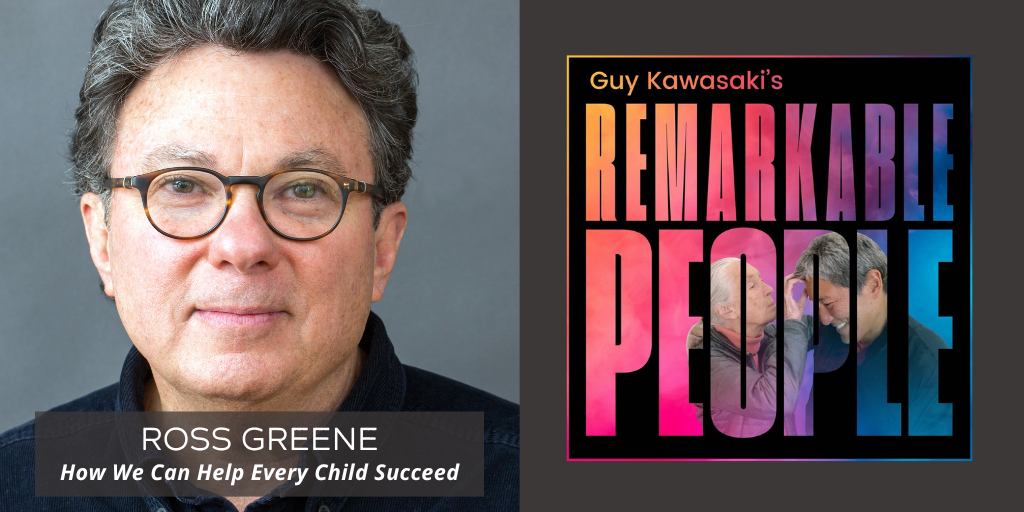
Welcome to Remarkable People. We’re on a mission to make you remarkable. Helping me in this episode is Ross Greene.
Ross is a clinical psychologist, educator, and bestselling author who has spent decades helping parents, teachers, and schools better understand why some children struggle. His work has reshaped how educators think about challenging behavior, and his latest book, The Kids Who Aren’t Okay, makes a compelling case that our education system needs to stop asking what’s wrong with kids and start asking what’s getting in their way.
In this episode, we explore why punishment so often fails, why “meeting kids where they’re at” is the foundation of effective teaching, and how schools can create environments where every student—not just the easiest ones to teach—has the opportunity to succeed.
One of the biggest takeaways from my conversation with Ross is how often adults mistake behavior for the problem itself. A child acting out, shutting down, or refusing to participate is usually communicating something much deeper. Instead of reacting with consequences, Ross argues that educators and parents should become investigators—working with children to uncover the obstacles preventing success. It’s a simple shift in perspective, but one with profound implications for classrooms and families alike.
Ross also challenges one of the most common assumptions in education: that fairness means treating every student exactly the same. He makes a convincing case that true fairness means giving each child what they need to succeed. That requires flexibility, collaboration, and the willingness to replace one-size-fits-all expectations with individualized support. It’s not about lowering standards—it’s about helping every student reach them through a path that fits their unique strengths and challenges.
Whether you’re a parent trying to better understand your child, a teacher balancing the needs of dozens of students, or a leader looking to build stronger teams, Ross’s ideas extend far beyond the classroom. His framework for collaborative problem solving reminds us that people perform their best when they’re understood rather than judged. If you’ve ever wondered how we can create healthier schools, stronger relationships, and better outcomes for everyone involved, this conversation is well worth your time.
Please enjoy this remarkable episode, How We Can Help Every Child Succeed with Ross Greene.
If you enjoyed this episode of the Remarkable People podcast, please leave a rating, write a review, and subscribe. Thank you!
Transcript of Guy Kawasaki’s Remarkable People podcast: How We Can Help Every Child Succeed with Ross Greene.
Guy Kawasaki:
Hello everybody. I'm Guy Kawasaki. This is the Remarkable People Podcast, and we have a remarkable guest today. His name is Ross Greene. And Ross Greene is a clinical psychologist. He's on the faculty of Virginia Tech, and he has this very, very interesting approach to education.
This is his latest book. It's called The Kids Who Aren't Okay. And that's what we're going to discuss today, the current state of the educational system in the United States. And Ross has a whole career of helping parents and educators and clinicians improve the educational system. Welcome to the show, Ross.
Ross Greene:
Thank you for having me.
Guy Kawasaki:
I got to say, let's start off with some basics, which is, what is your definition of good teaching?
Ross Greene:
Meeting every kid where they're at, which doesn't tend to get much pushback even from educators. It's just that it's hard to do. It's harder not to meet every kid where they're at, but it is hard to meet every kid where they're at.
Guy Kawasaki:
And how does one find out where a kid is at?
Ross Greene:
How do you find out where a kid is at? First, you notice that they're struggling, and then you ask them. And adults aren't that bad at noticing.
They're not that great at asking. And their interpretations of what's going on with a kid when they notice that a kid is struggling can get in the way, too.
Guy Kawasaki:
When I first read that definition in your book, my initial reaction is like, so suppose I'm a teacher, I'm getting fifty, seventy-five grand a year. I'm using my own money to buy school supplies.
The school board is picking the books I can use. The district is telling me to put the Ten Commandments up on the wall, incorporate the Bible into the curriculum, and I'm supposed to now meet students where they're at.
How can I possibly do that? So now I thought maybe I should do a reality check, and I ask a friend who is a high school teacher, and she told me that she has 140 students. She's teaching in the classroom twenty-six hours a week.
She has four hours to prep and grade and do all the paperwork that goes with having 140 students. So I guess this diatribe is leading up to the very simple question is: How can teachers possibly have the time and resources to do that?
Ross Greene:
First of all, you're right. It's a lousy setup. We don't pay teachers enough, not even close. Especially at the secondary level, we overload them with students. But here's what's interesting. Most kids are still doing okay, so it's not that hard to meet most kids where they're at.
The students who consume massive amounts of time, cost massive amounts of dollars, if we don't get it right are the kids who it's much more difficult to meet where they're at.
We haven't created structures or systems that permit educators to do that. We can. We've helped many schools create those structures and systems. It's actually not that hard to do, but let there be no doubt, it's a setup for teachers, under these circumstances is hard. That said, there are many who do it anyways.
Guy Kawasaki:
So if I were to walk into a school that is meeting students where they're at, what would I notice is different, or would I notice anything at all?
Ross Greene:
You'd notice that it's quiet. You'd notice that staff are collaborating with each other.
And if you would happen to be there at the right time, which would not be as a kid is getting upset because meeting kids where they're at doesn't mean waiting till the heat of the moment for them to demonstrate yet again that they're having difficulty completing the double-digit division problems on the worksheet in math.
Now you're really behind the eight ball. The good news is this isn't the first time the student has had difficulty with that. It's the hundred and ninety-seventh, so it shouldn't be a surprise. Now we have a kid who's getting upset over an expectation they can't meet. Now we're expecting that teacher, who has a hundred and forty other kids, to respond in some magical way.
Horrendous setup. Luckily, it's predictable. We knew the kid was going to have trouble with that before we placed the expectation on them. What are we doing ahead of time? What are we doing proactively so that we can meet that kid where they're at? Let there be no doubt, meeting a kid where they're at is much tougher in the heat of the moment than it is proactively.
Luckily, there aren't that many heat-of-the-moments when you're implementing this model if you're playing your cards right, and a lot of schools don't because they don't have structures in place that allow educators to play their cards right.
But if you were there at the right moment, you would see an educator and a student having a discussion about the difficulty the student is having completing the double-digit division problems on the worksheet in math.
And as I mentioned earlier, you'd see that educator is very interested in gathering information from the kid about what's hard about that, and you'd see kid and adult coming to a solution that works for both of them. And you would see folks who are saving a lot of time doing what I just said.
Guy Kawasaki:
And is there a Ross Greene Hall of Fame that you can say, “This school in Maine or this school in Florida or this school in Indiana exemplifies the spirit"?
Ross Greene:
No question about it. We have lots of school leaders, lots of classroom teachers, lots of special ed directors, lots of paraprofessionals and ed techs who fervently believe in doing things this way and who so wish that the structures and systems that get in their way would get out of their way so they could actually do their thing. Do you want me to name names?
Guy Kawasaki:
I want you to name names, yes.
Ross Greene:
I can't go through the whole list, but I'll name two of my favorites. Both are here in the state of Maine. One is a school called Yarmouth Elementary School. It's in Yarmouth, Maine. The principal is Ryan Gleason. And if you turned to the title page in The Kids Who Aren't Okay, you'd see that he is a co-author on the book.
Brilliant educator, and this is how he runs his school, and this is how he's run schools before the one he's in now. People should be listening to Ryan Gleason. He's a smart guy. He knows what schools need. About an hour south of Ryan's school is another one. It's called Central School in South Berwick, Maine.
The principal there is Nina D'Aran. I would say the exact same thing about her except that she wasn't a co-author on the book. But a lot of the way she thinks has guided my thinking. You walk into these two buildings, and here's what I say to myself anyways. I go, "Oh my, it is palpable walking into this building."
In Nina D'Aran's building, they wouldn't dream of suspending a kid, wouldn't dream of giving a kid a detention, wouldn't dream of restraining or secluding a kid. It is a vibe that is palpable, and you notice it the minute you walk in the door. What do I say to myself when I walk in her building? "I wish I could go back to the third grade."
Guy Kawasaki:
And how did these two people pull this off? What enabled them to do it versus the other schools who haven't?
Ross Greene:
They heard of it. They believed in it. They're both very strong leaders. They're both very persuasive with their staff, but they're also very good at organizing change in their buildings so that everyone is doing not only what's best for kids, but what's best for educators, too. And that's what people who learn about and get good at this model say.
"I had my doubts in the beginning," they all say, right? “Especially about when I was going to find the time to do this.” But the time to do this is a structural issue. The fact that educators don't have time to solve problems with their students, that's structural. That's systemic.
That's not educators doing that by choice. Educators have always been problem solvers with their students. The system that we've created as a good colleague of mine in Massachusetts, a school psychologist, likes to say, "The school schedule still looks the way it did fifty years ago, but what's walking in the door doesn't look the same as it did fifty years ago."
In all our meetings at the beginning of the school year, we think there aren't going to be any problems arising during the school year. We are that optimistic. We know that everything we're talking about on the day before the school year starts, as they say when people go into battle, the battle plan is obsolete the minute the battle starts.
Being an educator isn't a battle, we hope, but the game plan is going to be obsolete the minute the school year starts unless you have structures in place that allow educators time to solve problems with their students.
Guy Kawasaki:
And what perpetuates this structure that is so suboptimal?
Ross Greene:
Inertia. The way we've always done things. And the fact that a lot of the initiatives that have come down the pike over the last twenty to thirty years haven't changed the most important things about school structures and systems. A lot of those initiatives still have us focusing on a kid's concerning behavior, which as you read in the book, is just their frustration or distress response.
But boy, do we spend a lot of time trying to modify those frustration or distress response. It makes us late every time because by definition, if a kid is exhibiting a frustration response, they're frustrated about something, and that something already happened, and that something was also very predictable.
But in a lot of buildings, they don't know that stuff yet, so they don't even yet appreciate the need for giving classroom teachers time to solve problems with their students. What they're doing is they're sending behavior problems to somebody else, and what happens to the kid when it gets to that somebody else is something punitive.
And let there be no doubt, punishment is not a problem-solving strategy. So we are spending a lot of time shooting ourselves in the foot.
Guy Kawasaki:
So do you think that schools should have this sort of underlying assumption that we're creating the school for the students who are not having problems, and we'll figure out band-aids to fix the students who are having problems? Or we should have a system that is geared towards students who are having problems and everybody will benefit?
Ross Greene:
It sounds like you read chapter two in the book. It should be geared toward meeting every kid where they're at, but the kids who are at most risk of being lost are the ones who are struggling, and that's who the school day should be geared around, and that's going to go a whole lot better for everybody else.
Guy Kawasaki:
Okay, but when you say that and when I read that, I said, "Man, how can that possibly be that you're geared towards the kids who are having problems, but it's going to help the other kids?" Walk me through how that works in a school.
Ross Greene:
Here's what's interesting. The kids who are struggling now, the systems that are in place for them haven't worked, and in many cases make things worse. So if we are dropping into reality at this moment in time, we will see massive amounts of time being lost. We will see kids who still aren't getting the help they need.
Helping kids who are struggling isn't actually that hard if we're focused on the right thing, if we have the right systems in place, and if we know what we're doing. That's not actually the hardest part.
If you ask me, I'll ask your next question for you if that's okay. What is the hardest part? The inertia, the structures, the systems that we have in place already that are very familiar to us, we just keep going back to those systems even though you ask almost any educator, they know that's broken.
They know that isn't working. If we turned it around and said, "What would work for the kids who are struggling?" Instead of patching things up or sending them to somebody else, what would it look like for that kid who's struggling now to be a productive member of our classroom? Meeting kids where they're at is going to be a huge part of the equation.
The concept of developmental variability is going to be a huge part of the equation, which basically says every kid is different, and if every kid's different, meeting every kid is where they're at should be the definition of good teaching. And then there's one, one last piece, expectation management.
Here's what we have forced teachers to do. We've said to teachers, "You got to get every kid over the same line by the end of the school year." That is horrendous. I'm not saying we shouldn't have high standards, but our standards should be referenced by each individual kid. Now, you don't need a separate setup.
Now you're actually spending less money on patching things up. What does it look like for that kid to succeed in this classroom? If we answered the question for that kid, we've answered the question for every other kid.
Guy Kawasaki:
Okay, so the epiphany I just had is a shallow interpretation of your book is that meeting every student where he or she is at means different standards and dumbing down and, et cetera, et cetera. But you could also meet students who are really doing well where they're at, and then you would customize something for them too.
So it's the principle of meeting where you're at, whether it's high, low, or medium, right?
Ross Greene:
That is absolutely right. Why would we want to take a kid who can do even more, who's bored? And there's nothing dumbing down about meeting kids where they're at. You want to meet every kid where they're at, no matter where they're at, and that's actually doable, but not if we're trying to get every kid over the same line by the end of the school year. That's horrendous.
Guy Kawasaki:
And what if some tiger mom or tiger dad said, “If every teacher's trying to meet every student where they're at, then there won't be enough time and resources for my precious little jewel to get AP calculus, and if he doesn't take AP calculus, he won't get into an Ivy League, and if he doesn't get into an Ivy League, he cannot work for McKinsey. If he cannot work for McKinsey, he won't be happy in life. So because you're dumbing down my kid's classroom, you're ruining his life."
Ross Greene:
I guess we need to educate parents too about what it means to meet every kid where they're at, right? If their kid is ready for higher level math, their kid should be getting higher level math in the same classroom where a kid who is not ready for whatever math is the standard shouldn't be getting that because they're not quite ready for it.
So yes, there's parents who are going to think that meeting every kid where they're at means dumbing down. What the other concern is that people think you're selling kids short. These are interesting interpretations that people come to. They're not true. I'm not sure why meeting kids where they're at has such controversy attached to it.
It's the definition of good teaching. We should get used to it.
Guy Kawasaki:
Okay, but it seems to me that your definition of good teaching is as meeting students where they're at. It is the most woke education DEI philosophy possible, right? Isn't that contrary to everything that's going on right now at the federal level?
Ross Greene:
I don't want to hold up what's going on at the federal level as best practice for kids, but I got to tell you, I've never thought of what I'm saying as being particularly woke since this works for everybody, and I have an interesting definition of the word equity. Equity means meeting every kid where they're at, too.
Here's the interesting part. I really don't know any educators that would disagree with what I'm saying. So either all educators are woke or all educators are in classrooms in the year 2026, and they know what's walking in the door, and they know what happens when you don't meet every kid where they're at.
And they wish there were structures and systems in place. They wish they had permission to meet every kid where they're at. They wish they had permission to say, this is the controversial part, "I don't think that kid's meeting this expectation right now. I've been teaching for twenty-five years. I need to meet this kid where they're at and work their way up."
Doesn't mean I'm selling the kid short, doesn't mean I'm dumbing down anything. But if I throw expectations at that kid and I know the kid can't meet them, I've just shot myself and the kid in the foot. What am I doing?
Guy Kawasaki:
To further prove to you that I really read your book, what you are touching upon, and you might as well just knock it out of the park here, is that there is a difference between equity and equal.
Ross Greene:
Oh, let there be no doubt. Why would we shoot for equal if every kid is different? Why would we do that? I have two kids. They're completely different. Why would I shoot for equality with my own two kids? If I had a classroom full of twenty-six kids, I would no sooner want to treat all of them equally either.
We went off the rails at some point with this equality business, and even if the word equity has been politicized, at least right now, what I always say to educators is, "Y'all have always been about equity. You are educators. Let the politicians do what they will. That might affect your funding, but if you got a classroom full of twenty-six kids and you're shooting for equality, it is going to be a very long school year."
Guy Kawasaki:
But what if the counter is, well, striving for equality is making the thing fair? It's fairness.
Ross Greene:
You did read the book.
Guy Kawasaki:
How many times do I have to prove this to you?
Ross Greene:
You keep proving it over and over again. One of my favorite phrases is fair does not mean equal. Fair means meeting every kid where they're at. Fair means equity. And once again, just because equity has become politicized doesn't mean it's wrong. I don't care what color my child is.
I don't care what socioeconomic background my child comes from. I don't care how high level my kid is, how brilliant they are. And if I badly want them to work at McKinsey someday, I want my classroom teacher to be meeting my kid where they're at so they can get what they need. They're in a classroom in the United States of America where fair means equal.
That's what differentiated instruction is about. That's what special education law is about. In classrooms, fair never means equal. I have trouble finding places where fair does mean equal, but certainly not in classrooms.
Even here in the state of Maine, I shouldn't say this too loudly, if you have a Maine license plate and you're going eighty miles per hour in a sixty-five mile per hour zone, you are unlikely to get pulled over. But if you have Massachusetts or New York license plates, you are going to get pulled over. Fair doesn't even mean equal on the Maine Turnpike.
Guy Kawasaki:
Okay. I don't know if we want to go down this rat hole, but it seems that one of the great efforts to meet students where they're at is with the federal programs from the Department of Education where they hand out funding and they help low-income families. Student loans and student aid and all that, and adherence to civil rights laws.
But all of that is being thrown out of the system because the Department of Education is more or less being destroyed. So is that interpretation right of what's happening to the Department of Education?
Ross Greene:
The Department of Education is being dismantled. The funding parts of the Department of Education are being moved to other departments, especially those that are related to special ed law and services for kids with special ed.
So I'm not sure that funding is going to go away. I think that the biggest criticism of the Federal Department of Education and why there are those people who I actually know well who wanted to get rid of it is because they did feel like a lot of what was being disseminated by the U.S. DOE was woke, was not fair.
Yeah, I guess we could get into that rabbit hole if we wanted to, but it would be the rest of our conversation. Here's what's interesting, there are some students who do need more protections. Students who are struggling are among them because those are the kids who we are doling out bazillions of detentions every year and only pushing them out.
Millions and millions of suspensions, hundreds of thousands of expulsions, about 100,000 uses of corporal punishment every year in still seventeen of our fifty states. That's right. We're still hitting kids on the butt with a two-foot piece of plywood in seventeen of our states to help solve the problems that are causing their concerning behavior.
We're still restraining and secluding them, and of course, we're doing that disproportionately to kids with disabilities and to those with Black and brown skin. You know what? We have to face that. We have to say, "We need to come up with how to keep that from happening because that ain't right." The kids who need our help the most, get help, but it's often the wrong kind.
Whether the DOE played its cards right is another story. Whether it should be dismantled or not is for the politicians to decide. But there's no question, there are kids in our schools who badly need help, deserve to get it, and aren't necessarily getting the right kind of it.
Guy Kawasaki:
Ross, but let me ask you, why do you say it's for politicians to decide?
Ross Greene:
Because that's who decides those kind of things.
Guy Kawasaki:
That's a structural issue too, right?
Ross Greene:
That's who's deciding it right now. That's who decided it for the four years preceding that. Dr. Jill Biden had her doctorate in education, if I'm not mistaken, right? So she was a believer. There's people who aren't believers. Here's the bottom line. I hate to see our most vulnerable kids be played like a political football.
I think we can all agree those kids should get our best, those kids should not be disproportionately getting our worst, and we need to figure out how to do that together. Otherwise, by the way, and this is an issue that would make sense to both political parties, these kids are going to keep costing us a fortune.
Guy Kawasaki:
Just as an aside, would you say that running a professional wrestling association helps prepare you to run a Department of Education? I'm just curious. Don't spit up the coffee.
Ross Greene:
Depends on what you did before you held that job, I suppose, but on the surface of it, no, probably not.
Guy Kawasaki:
Okay. Back to the classroom now. So let's suppose this is all happening, right? And, what if students see that teachers are meeting their peers where they're at, and it's like, will they understand that this is still fair, that the standards are different, the operations, the methods are different for different students, but yet it is still fair? Will students understand that?
Ross Greene:
Students understand it more easily than adults do. Students get fair does not mean equal. It's right in front of them. They notice it every minute of every day. Students are sitting there thinking, Why are you yanking Tommy out of the classroom and suspending him again for three days?
That hasn't worked since I've known Tommy. Why don't y'all adults do something that works so I don't have to worry about Tommy being unsafe in my classroom? Can we help Tommy in some way that actually works? Will you adults finally get it?
Guy Kawasaki:
So is basically the gist of your message that kids do well when they can, and it's our job to help them do well?
Ross Greene:
It is our job to help them do well. The mantra of my life's work is kids do well if they can. And the only reason that's earth-shattering for a lot of people is because of a mantra that has been much more popular for a very long time, which is kids do well if they want to.
And adults who have kids do well if they want to lens on when a kid is struggling often come to the immediate conclusion that the kid is struggling because they don't want to do well, and then the adult immediately reverts to interventions that are aimed at making a kid want to do well, and now we're talking about consequences.
And consequences, I said this a little bit earlier, consequences aren't going to solve any of the problems that are making it difficult for this kid to do well because consequences are behavior modification strategies. Oops, we're talking about frustration responses again. We're late again. We're waiting for behavior to occur before we notice that this kid is struggling.
Why are we doing that? It's not working well for anybody. We have structures in place in schools, organizational structures, that I don't even think we need if we were way better at noticing and solving problems with kids before this got really bad.
Guy Kawasaki:
Yeah, I noticed that the word late is definitely a four-letter word in your book.
Ross Greene:
I'm allergic to it. And as you noticed in chapter three, which is called "Set Up to Be Late," I am passionate about it what a disservice to kids and educators that so many of the structures that exist in schools push them toward focusing on concerning behavior, push them toward interventions that are late.
What a waste of time. I am truly allergic to lateness. Mostly, by the way, because it's so counterproductive, but mostly because I've seen the harm done by being late.
All you got to do, and most people don't get to have this experience, most people wouldn't want to, I've had it hundreds of times, all you got to do is see a kid being restrained, all you got to do is see a kid being thrown into a locked seclusion room, and you know this ain't right and we got to do something about it.
And this is occurring at the very end of a very long sequence of events that began with an expectation that kid was having difficulty meeting, and an expectation that adults felt they had to put on the kid even though they knew the kid couldn't meet it. There it is in a synopsis.
You watch a kid being restrained, you watch a kid pounding the walls in a seclusion room, you look at the research which tells us about one hundred kids have died in the United States in the last thirty years being restrained or secluded, and you cannot turn away from that.
The rest is philosophical. We can't be late. The kids are difficult, we still can't be late, and the good part is there's lots of schools that are working with the same degree of difficulty of kid that aren't late. What are they doing instead? They're being early, and they're doing what's being described in that book.
Guy Kawasaki:
I feel like maybe we should end the interview right there. That is a very powerful statement. Wow.
Ross Greene:
This is a big deal. So here's what's interesting, yes, I'm about selling books, but mostly because I want to get the word out. This is my life's passion. We cannot keep doing things the way we're doing them now and have kids and educators continue to suffer. And by the way, it's not just the kids who suffer when you're restraining a kid, and death is only the most extreme outcome.
We're talking broken bones. We're talking broken noses. We're talking educators leaving the profession because they cannot bear to do this or live this way anymore.
Truth is the book could have been called Mentally Healthy Schools. This is my regret. I wish I had spent more time in the book talking about the mental health of educators because they're leaving the profession in droves, and it's because they ain't digging it no more.
And they're not digging it because of all the structures we've put in place that are neither good for kids nor for educators.
Guy Kawasaki:
I know a few educators, and for the life of me, I do not understand how they do it.
Ross Greene:
I don't either. They are very committed. They are very caring. Some of them, because of the mess that they're walking into every day that they can only do so much about, are jaded and demoralized. This book is about the things they can do something about. It is a book both that is practical and idealistic. Here's what you can do now. Here's what you're shooting for.
Guy Kawasaki:
Also tell us what can you do now? What is practical? If I'm a teacher listening to this episode.
Ross Greene:
The basics. If you're meeting kids where they're at, they are more likely to get over the line by the end of the school year than if you're trying really hard to not meet them where they're at to get them over the line by the end of the school year. It's just practical, right? If you're paying attention to developmental variability, if you know I got twenty-six different learners in here.
Because I work with educators a lot, I know that they don't leave the thinking behind when they leave the school at the end of the day. They lose sleep over the kids who are struggling. They care. They got into this profession not because it was going to make them rich, but because they cared about kids.
We've got to set them up to put that caring to work. Let them treat every kid as if fair does not mean equal. Let them treat every kid by meeting every kid where they're at. Let them adjust their expectations for each kid based on where that kid is at. Let's have guardrails in place so that they're not selling anybody short or dumbing anything down.
I like that a whole lot better. I'd like the educators to think about that when they go home at the end of the school day than continuing to mull over how am I going to make this work under my current circumstances given that I'm not even sure how to approach this kid? This book is all about how do you approach these kids who are struggling the most?
Guy Kawasaki:
Yeah. A lot of your book deals with expectations and when students don't meet the expectations for them, it leads to frustration. Frustration leads to behavior, behavior leads to punishment, and the cycle goes on and on again, right?
Ross Greene:
Correct.
Guy Kawasaki:
So I have a question about expectations because seems to me, if your expectations are too low, a student doesn't meet the potential.
If your expectations are too high, there's frustration. So what is the optimal amount of expectations? How do you figure that out?
Ross Greene:
I think educators are pretty good at figuring that out if they didn't have all kinds of pressures being placed upon them to not do that. I think educators are pretty good at that. Worst case scenario, you get it wrong and you put an expectation on a kid that's a little bit too low or a little bit too high, but at least you're trying to meet the kid where they're at.
The pressure is put the same expectations on just about every kid, do it differently for each kid, but it's basically the same expectation. That's not going to get you very far. Bottom line is it's a judgment call. Generally speaking, I trust the judgment of educators. This is what they do. They know where a kid is at.
If we want to, we can test the kid, we can try it out. But the bottom line is, if this is the 179th time that Tommy's had difficulty completing the double-digit division problems on the worksheet in math, we missed something 196 times ago.
Guy Kawasaki:
So I think one of the big issues that teachers would say with this concept of yours is that they have four hours of prep time per week. So address the issue, can AI help with this? You know what Khanmigo is? Yeah, so can Khanmigo help me design the curriculum for individual students? Can it leverage my four hours and enable me to meet more students where they're at?
Ross Greene:
AI can give you some ideas, but because what's baked into this way of doing things is the voice of the kid. AI might give you some ideas, but the person who's going to have the best ideas is the kid, and the person who's best equipped, many people, this blows them away. This is, like, unbelievable to many people who don't think this way yet.
Your number one source of information on what's making it hard for a kid to meet a particular expectation is the kid. So we don't want to have AI perpetuate what we're doing already. Here's what we're doing already. Adults are divining what's getting in the kid's way, and adults are divining what the solution should be.
We adjust, we accommodate, we support, we strategize. But if that is done without the involvement of the kid, we're still going to miss. As great as AI is, we're still going to miss if the kid is not part of the process.
Guy Kawasaki:
But let's assume the kid is part of the process. Can't a teacher use AI to then use the kid's input and create individual lesson plans?
Ross Greene:
Possibly. The kids' input is the most critical part. If we get the kids' input in there and the educators' input in there, and AI can help us come up with a solution that works for both of us, count me in if AI can do that.
Guy Kawasaki:
Okay. Now, when you just said adults are defining these things, are you referring to the teacher or to the politicians who are defining this?
Ross Greene:
Oh. I don't think most politicians know a whole lot about what goes on in a classroom.
Guy Kawasaki:
That doesn't stop them from making decisions.
Ross Greene:
That's exactly right. We may, while I would love and while one of the missions of Lives in the Balance, the nonprofit I founded, is to get legislation passed that protects our most vulnerable kids, we're all about that. Until that happens, we're on our own. Let's make it work, even though the politicians might be making it harder for us.
I don't want to wait for the politicians to figure it out before we make this work in a classroom. We're talking about individual kids and educators here. There are so many things in our society that would be nice if the politicians came around to it because it would be better for a whole lot of people.
Somehow we make it work despite our politicians. We need to keep trying, but somehow we got to make it work because I'm not putting money down that the politicians are going to come around all that fast.
Guy Kawasaki:
Yeah, so you discussed three plans, plan A, which is what we're doing right now, plan B, and plan C. So could you explain what plan A, plan B, and plan C are?
Ross Greene:
This is me having come up with a very simple algorithm for how to solve those problems that are getting in a kid's way. Our definition of an unsolved problem is any expectation that a student is having difficulty meeting. Plan A is where the adults divine what's getting in the kid's way, and the adults divine the solution and impose it on the kid.
Many people don't like to hear that, but that's mostly about power, and there's somebody very important missing from that equation. The kid. The kid's voice, the kid's input.
Plan C is where we are removing some expectations for now because practical guy that I am, I know that once we finally get around to identifying kids' unsolved problems, especially the kids who've been struggling the most, there's going to be a lot of them, and we're not going to be able to solve them all at once.
So we're going to have to put some on hold, at least for now, because if we try solving them all at once, we will solve none of them at all. That's plan C. Plan B is where you are engaging the kid in the process of solving the problem collaboratively, not unilaterally. Step number one, gather information from the kid about what's making it hard for them to meet a particular expectation.
Many people are now thinking, How am I going to do that in the heat of the moment? You're not going to do that in the heat of the moment. You're going to do that proactively because you put the thirty to forty-five minutes into identifying all the expectations this kid is having difficulty meeting that have piled up over the years because people never identified them and solved them.
That's why there's a lot of them. They never got solved. They never even got identified, and all those consequences we've been doling out didn't do that for us because consequences don't do that. Step number two, the adult is going to enter their thoughts about why it's important that the expectation be met.
Why should Tommy complete the double-digit division problems on the worksheet in math? Step number three, that's where we're collaborating on a solution that addresses the concerns of both parties. Talk about things politicians aren't that good at. Let's not do that to another generation. Let's get kids good at that as early as possible.
Let's eliminate all these horrible moments that kids and educators have to endure. Here's my motto: Solved problems don't cause concerning behaviors. Only unsolved problems do.
Guy Kawasaki:
Going off the rails a little bit, as I read your book, I asked myself, “Could employers and bosses meet employees where they're at?” Do you think this could apply outside of education? The concept of Elon Musk meeting an employee where they're at is nonsensical. But do you think this could be applied in corporations, too?
Ross Greene:
My brother is the former head of human resources at a Fortune 500 company. He knows this model. He knows that there is a book to be written about this model in the workplace. He knows how much money is spent in the hiring process. He knows that workplaces can be very plan A, and he knows that it's a whole lot less expensive to salvage an employee.
But he also knows that in a lot of workplaces, nobody's identifying the unsolved problems of an employee. Nobody's trying to figure out what's getting in the way for the employee with the involvement of the employee. Nobody's coming to collaborative solutions. That's very expensive. He knows that because he's the former head of human resources at a Fortune 500 company.
That's a book. He knows that that book is around number six or seven on the list of books I need to write before I'm gone because while I care deeply about adults in the workplace, we got a lot more work to do to get this helping kids, educators, and parents first.
Guy Kawasaki:
If that's number six, what's number one, two, and three then?
Ross Greene:
I don't like to talk about what's coming. Lots of people want to know what's coming next. There's more books about the model in the pipeline, for sure, in terms of different applications of the model, but the workplace is relatively low down the list. Boy does my brother have stories about Plan A in the boardroom, Plan A with employees. He's got stories.
Guy Kawasaki:
I think just my two cents is that I think a book about how parents can meet their kids where they're at would be the book I would want to see from you next. I have only four kids. I don't have 140, and I tell you, it's not easy to parent where your kids are at all.
Ross Greene:
And here's what's interesting. You know what, that book is in the pipeline, but the big question is what's making it hard for us to meet our kids where they're at? What are we thinking about instead, right? Because that's what we should be thinking about. Are we thinking about Mackenzie with our four-year-old?
I think that's the wrong thing to be thinking about. You know what I'm saying? Are we thinking about what this kid's going to look like when they're eighteen when they're struggling at the age of five? Wrong thing to be thinking about. Are we thinking about the Joneses and how that kid is doing?
That's not your kid. You want to meet your kid where they're at, so I think that many parents would buy this as well. Most parents want to see their kid be happy. Every parent wants to see their kid do well. The big question is, how come you're not thinking about that? What are you thinking about instead? That book's in there.
Guy Kawasaki:
Could you push it up for me?
Ross Greene:
You know what? You're persuading me. I've got a co-author on the next one who probably wouldn't be enthusiastic about seeing me push that one back, but I'm writing them as fast as I can crank them out these days because I'm getting old.
Guy Kawasaki:
Ross, it's been very, very entertaining and educational and informative interview with you. Thank you very much. This is the plan B of podcast interviews.
Ross Greene:
I appreciate it. You're a wonderful interviewer, and I'm glad we were able to do this.
Guy Kawasaki:
Oh, I'm going to go talk to my youngest son right now and meet him where he's at.
Ross Greene:
Fantastic. You're making progress.
Guy Kawasaki:
He's going to wonder, "What the hell just happened to you, Dad?" I also want to thank Madisun, co-producer. She's the brains in the outfit. There's also Jeff Sieh, who you have had no interaction with, but he's going to put his magic on it with his very capable design and sound engineer, Shannon Hernandez.
And there's also Tessa Nuismer, who's researcher, and we put a lot of energy into good transcripts because a lot of people might not be able to hear this interview, and of anybody, I can appreciate that. So thank you very much, Ross, for being on Remarkable People.
Sign up to receive email updates
Enter your name and email address below and I'll send you periodic updates about the podcast.



Leave a Reply