
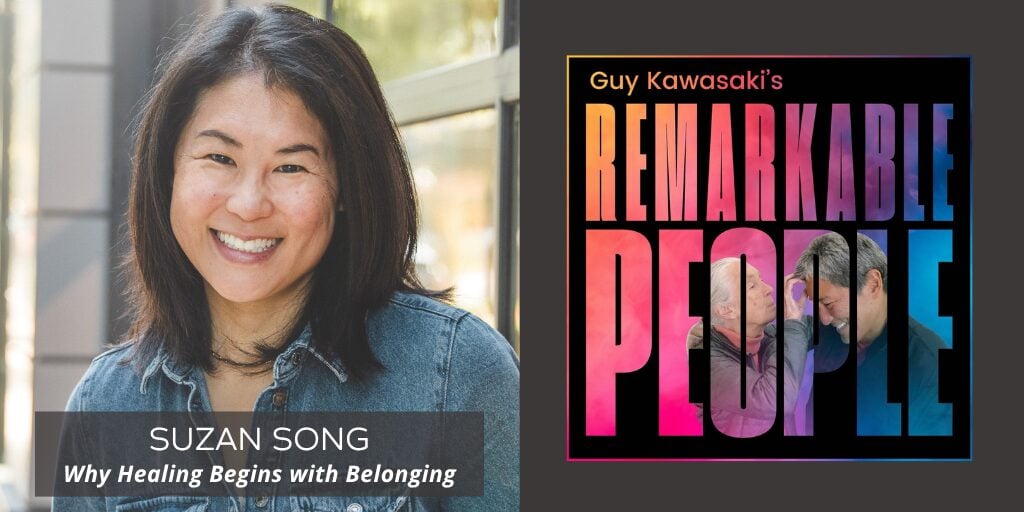
Welcome to Remarkable People. We’re on a mission to make you remarkable. Helping me in this episode is Suzan Song.
Suzan is a psychiatrist, anthropologist, and humanitarian who has spent decades working with survivors of war, trafficking, displacement, and profound personal loss. Her work spans refugee camps, conflict zones, Silicon Valley boardrooms, and psychiatric clinics. Along the way, she’s become fascinated by a simple question: Why do some people emerge from hardship stronger while others remain trapped by it?
In this episode, we explore the ideas behind her powerful new book, Why We Suffer and How We Heal. Suzan argues that resilience isn’t about grit, toughness, or pretending everything is fine. Instead, healing comes through what she calls the “Three Friends of Winter”—narrative, ritual, and purpose. These three forces help us make sense of our experiences, move through uncertainty, and reconnect with what matters most.
Our conversation challenges many assumptions about modern mental health and self-improvement. Suzan explains why suffering often grows from the stories we tell ourselves, why belonging is more important than self-optimization, and why community remains one of the most powerful healing forces available to us.
If you’ve ever faced loss, uncertainty, failure, or major life change—and who hasn’t?—this episode offers a thoughtful roadmap for navigating adversity with wisdom and purpose.
Please enjoy this remarkable episode, How We Grow Through Life’s Hardest Moments with Suzan Song.
If you enjoyed this episode of the Remarkable People podcast, please leave a rating, write a review, and subscribe. Thank you!
Transcript of Guy Kawasaki’s Remarkable People podcast: How We Grow Through Life’s Hardest Moments with Suzan Song.
Guy Kawasaki:
Hello, everybody. It's Guy Kawasaki. This is the Remarkable People Podcast, and we have found another remarkable person to inspire and inform you. Her name is Suzan, not Susan, Suzan Song, and she is a psychiatrist and anthropologist.
Which if you think about it, that is an interesting combination. And she has written this very interesting book, Why We Suffer and How We Heal. And she has seen a lot of suffering and a lot of healing. So welcome to the show, Suzan.
Suzan Song:
Thanks so much for having me.
Guy Kawasaki:
I would say it takes some focus and processing to understand your book. It is not like psychiatry or survival for dummies. This is a very, very sophisticated book. So let me just make sure I kind of got the big picture right before we proceed.
So it seems to me the major messages is that adversity is more or less inevitable and trying to cling to this concept of stability is rather futile, and that healing is really learning to live with instability, and it takes these three, what you call friends, called narrative, ritual, and purpose, and those three things produce resilience.
And resilience is not necessarily a return to an old and perfect self but is transformative in which you deal with uncertainty itself. And I think one of the major cases you make is that this cannot be done in isolation. It has to be done in a community.
Suzan Song:
You've got it. That's brilliant. Well done synopsis. Yeah.
Guy Kawasaki:
Maybe we should end the interview right here.
Suzan Song:
Yeah, I know, right.
Guy Kawasaki:
Yeah, just everybody go out and buy this book. End of discussion. Yeah, you can turn off your podcast right now. Yeah. I hate to get dark so fast, but I got to ask you this question. I just read this article that, you know, Homeland Security and ICE, they have incarcerated something like 500 babies and toddlers.
And when I read that, I said, “What is going to be the impact on those kids?” And you've dealt with a lot of things like that. So can you just explain what happens now?
Suzan Song:
Yeah. So as a psychiatrist and anthropologist, I also do policy in humanitarian settings. So I work across the spectrum with survivors of torture, trafficking, forced displacement, also forced separation from the U.S., but then also the other side with a lot of founders, CEOs, these high-profile politicians, a lot of these overachievers.
And what I find fascinating are those people who are able to thrive despite the odds. You meet someone like a child who's been separated from their family, or someone who's experienced trafficking or hostage, and you would assume that they would have these permanent lifelong scars. But there are so many people I've met, and I've worked with that have the opposite.
They have this sense of groundedness and mastery in life, and I find it so compelling. And so that's why this kind of framework came about.
And so when we talk about these kids who are separated, or right now there are a lot of kids also in wars and armed conflict, there are a lot of kids who are in current exploitation and human trafficking. There's no analogy. Those human rights violations really fracture any analogy. It has to stop.
The human rights violations have to stop because, of course, there is lifelong impact for some of those kids, but for the people who are not experiencing that level of trauma, that level of suffering, when I talk about instabilities, I think people think about those major traumas.
But they're also like the instabilities of what happens when your company isn't doing so well or when you seem to be doing fine, but unexpectedly you lose the love of your life or a child has a major diagnosis or illness, right?
These are all of these instabilities that really challenge our sense of self and who we know ourselves to be, and we get a little upended. We're like not sure what to do, and we all say, "I just want life to feel stable again." And unfortunately, that doesn't happen. There's no steady, stable point in life.
And instabilities are inevitable. So we can't try to avoid them. We have to learn how to live with them and find some tools and prepare ourselves when it comes.
Guy Kawasaki:
I'd be very interested to learn, in your research, what separates the people who don't succumb to this and the people who do? Have you seen any commonality or any environmental factors that fosters their stability or the fragility later?
Suzan Song:
So many people think that those who are most resilient are the ones who have grit, right? They're hardworking, they just barrel through. They've got a kind of laser-eye focus on the future, and they just get through everything, but that actually to me is just endurance.
And sometimes they're enduring a system that they shouldn't be. It's like an unjust system. So I don't see grit and barreling through as resilience. I think the people that I see that grow from their suffering or they don't get stuck in it are the ones that, one, have a different sort of narrative, but two, they actually have more support.
Because I think as Americans, we often think that our suffering, it's so individualized, it's all so privatized. Like you go through a hard time, you get a week off of work, you go deal with it, maybe talk one-on-one with a therapist, and you come back and you're supposed to be like done and healed and just go back to being productive.
And let me make a distinction. So there's pain, which is the actual event, and then there's suffering. So the pain is when the company fails or when you lose a loved one, that's pain. But the suffering is like the narratives we make around it.
So if my company does well, that means I'm successful. If my company doesn't do well, it means I'm a failure. Those are narratives that can create the suffering. I'm not a failure because my company failed, those are very different things. So our suffering oftentimes comes from these narratives that we create about what's happening in our lives.
Guy Kawasaki:
And is it truly learning and truly developing resilience? Or is it just that some people are better at hiding it?
Suzan Song:
There are so many people that are performing stability right now. Look, I'm based in D.C., many people around me are out of jobs and they've seen and experienced very firsthand kind of the collapse of major institutions and structures that they know.
I also work in the humanitarian sector, which is also going through its own, like USAID is essentially gutted. And people are really struggling, and yet a lot of the suffering is because they're trying to perform like everything's okay, I'm good. Like things are hard, but I'm good. And I'm finding that people are not okay.
I see this a lot because I also split time in the Bay Area too. So I'm in San Francisco and I work with a lot of founders and tech people.
And I find that culture very fascinating to kind of compare the two different cultures, both on the East Coast and the West Coast. Because in the tech community in particular, there's this culture around like disruption and taking risks and being really innovative.
So to me, I was like, okay, that culture, that community understands that stability is an illusion, that we need to take risks and we need to challenge. But actually, my experience is that underneath that culture is a lot of pressure to conform. Like also people in tech, they also need to be like productive and visionary and the risk taker.
And there's this really, really weird relentless optimism and this like focus on scaling that it becomes its own kind of stability in a way. And what I see is a lot of technical adaptability, but not so much emotional one.
And I don't know if this is because the communities, they know each other very well and when you have a community that the work and life balance is more porous, like the boundaries, you go on a bike ride, but you're also talking about work and things like that.
People don't feel as comfortable talking about, "Oh, I'm feeling burnt out," or "Oh, I'm worried about my company not doing well," or "I'm not sure which direction to take this," or "I'm really struggling in my marriage."
They're not as willing or open to talk about these things, and so they become performative, and their identity becomes, one, around being competent, like, "I'm a competent person."
And that fails because instabilities, by definition, are ones in which we don't know. We don't know how to deal with the unexpected loss of a loved one. It's just by nature.
Guy Kawasaki:
So wait, are you saying that there are some people who are not truly stable, they're just faking it or you said it's not just grit. Do you just like take your fears and put it in a little box and you hide it or you throw it away?
Or do you face it with your friend? I mean, what’s the best practice here?
Suzan Song:
What I see, and I'm talking mostly about like high performers because most of the people I work with are like very high-performing, high-achieving. In order to get there, like people aren't just born and they're high achieving.
There is a certain skill set that people have to learn over time, and most of it is like overriding fear or compartmentalizing really good or putting others' needs before your own, or almost like hiding yourself because especially if you have to take care of other people, if you've got kids or family or friends or companies, people relying on you.
So that skill set is actually exactly why high performers, I believe, are sometimes the most vulnerable when there is an instability because they haven't learned how to sit with it and be with it. They've done the exact opposite, right? They've said, "My identity is being competent, and so I know how to do that. I know how to get through, solve any problem that comes my way."
But when they're diagnosed with something like a cancer diagnosis or their child is, it really fractures that identity as being competent, and then they're not sure what's left. So they're upended a little bit. So my highest achievers are the ones who are the worst at knowing when they're struggling because they've been performing just so well.
Guy Kawasaki:
We've been focusing on the people who are suffering and instability and all that. But going back to my original question about the 500 babies that ICE and DHS has imprisoned, maybe you can shed some light on this for me, which is I just cannot understand how anybody, even just a modest amount of decency can possibly rationalize incarcerating babies and toddlers.
So what goes through their mind that says, "Yeah, we're protecting America. We're taking these babies away." I don't understand it. Explain this to my simple brain. I cannot relate to this at all.
Suzan Song:
And that is a huge source of strength for you that you can't rationalize because it makes no sense, right? There are some people who believe that some are more deserving of human rights, of basic human rights, than others.
And I work in genocides, as well, and the more that you see someone othering another and they dehumanize them. So it's the other, whether it's the other tribe, whether it's the other person of a different skin color, skin tone, whatever it is with xenophobia, when we other someone and we dehumanize them, then they're not a real person.
As an example, I work with former child soldiers in Sierra Leone, Liberia, Burundi. And I remember I was talking with one in Burundi, and I had asked him essentially, "How are you doing now given everything?”
And he had talked about he had assaulted many, and one of the initiations for being a child soldier in some countries is the armed force will make you, as a child, go back to your village and you sexually assault the women in your village or community, you maim the men and boys, you steal, so that you can't go back to that village.
The only home you have is that armed force, and so this one that I had been working with had talked about how he had committed a lot of atrocities amongst his village members, but he seemed relatively unfazed by it. And I asked, "How are you not affected by the past?" And he essentially said, "Because they deserved it.” Right? “They wronged me."
He had witnessed his uncle being murdered, and this is part of the indoctrination, right? So the armed force had told him essentially, “This is justice that you're doing. This is revenge. This is you creating a better world." Right? “You're creating a better place for your family."
And so that's what they believe. And so for him, he sleeps fine at night because he feels that he was actually doing God's work by eliminating people. And I think that's what you see in a lot of these kind of genocides, human rights violations. They're really dehumanizing people.
Guy Kawasaki:
So talk about a bifurcation of clients. You have child soldiers and people who have been victims of war and genocides and all that. On the other hand, you have a practice in Silicon Valley.
You can take the Fifth Amendment on this question, but I have to ask you, because as I was reading your book, I said, "Ah, I can't deal with this, such a separation between these two extremes of her clients.”
So I have to ask you, do you ever throw up a little bit when you meet with some of your Silicon Valley tech clients and, they're saying, "Oh my God, I can't find a good nanny. My income taxes are so high. My older kid is on the wait list for Dartmouth and Stanford. I don't know what to do. I feel so unstable." Do you ever, say to yourself, "What the fuck are you complaining about?"
Suzan Song:
It's so interesting because people ask me that a lot, and one, I don't compare suffering.
Guy Kawasaki:
You're a better person than me.
Suzan Song:
I actually love all the people that I work with, and I'm very fortunate to work with good people on all accounts, but I don't compare the suffering because the pain, the event might be different.
But the healing and the mechanism of suffering is actually very, very similar, which is why I wrote this book. I started writing it during the pandemic when my clinic had shut down and I was now seeing people on my Zoom screen, like hostage survivor, CEO, and they were very, very similar themes of suffering.
And what I really wanted to share for them was that there are different ways of healing across cultures and contexts that everyone can learn from each other. So I don't actually. Suffering is basically when our reality isn't matching with what we want, our wishes.
And sometimes that divide is a huge delta, sometimes it's smaller. But I have a lot of heart. I like working with people who are high achievers in large part because sometimes they're the ones who have the power to affect change in our world.
And to me, my work is supporting people. I support people and systems essentially. And so if I can support people, especially to have a stronger moral compass and to work from that space, and if one of the barriers to them being able to do that is that they're struggling with their kid or whatever, then fine, right?
I just want people to be their best selves so that they can make the world a better place.
Guy Kawasaki:
Like I said, Suzan, you are a better person than me because I cannot hold those two conflicting thoughts in my head at the same time. If I read this right, one of the things that you made fun of, if not criticized, is this kind of industry of influencers, and you have these quote graphics and you tell yourself you're worthy and they have these pictures and posters and motivational things.
And my interpretation is you weren't exactly positive on those things. So can you tell me, more accurately state, what is your attitude towards that kind of stuff?
Suzan Song:
Yeah, I think a lot of people are focused on self-optimization. And in our society, we are so focused on autonomy, our individual autonomy, and our introspection and optimization. So we want to optimize.
Everyone's wearing their Oura Rings or tracking their sleep or tracking their macronutrients or whatever and that's all fine. But it's such an insular focus, and I think it's so insular because that's what's easy to monetize.
There's a huge industry around self-help and wellness, and even this term mental health, which look, I'm a psychiatrist, but I can't stand this whole term of mental health and all this mental health talk that we're doing because it's almost this navel gazing.
Not everyone needs to know your feelings at every single moment, we don't have to be, like, talking about our thoughts. We're so obsessed with our thoughts. We can take them out of our head. We want to examine with a microscope and then do all this changes in our mindset and cognitive reframing and all that stuff.
Great. But in the rest of the world, people don't have therapists. They don't have all these positive affirmations and whatever. They heal in relationship. They heal when they are needed by someone, when they matter to someone, when they feel they belong in a community. And one reason why I'm really thankful that in my work, I started my training as a psychiatrist in the U.S.
At the same time, I had a parallel career doing policy in humanitarian settings, so I was working with child soldiers. And there was one early on that I met, and she was a sex slave. So many people think of child soldiers, and they think of the fighters. But a child soldier is anyone who's under eighteen who was a porter, a messenger, a cook, or a sex slave.
So she was a sex slave for about ten years. And as I was talking with her, I was thinking like, how she's functioning fine, she's got a good life, good family. How did she get through this? And she said it was one thing, and it wasn't talking to her loved ones about all the things she'd gone through.
It was that her village elder brought together the community and they did a body purification ritual, and that ritual made her feel like she now belongs to a community, and now they accepted her, and now she felt like she was atoned of her sins and whatever else she had experienced.
So it's really in the sense of belonging that I see oftentimes we're missing here. And so we focus so much on our bubble baths and our walks and if they work for you, great. But I find that it's like these temporary fixes.
What we actually need to do is step outside of ourselves. I see responsibility as a privilege. I feel very honored to take care of people, whether it's my loved ones, the people I work with, my kids. I find that is a privilege, and I think that leads to a sense of belonging and healing.
Guy Kawasaki:
Well, Suzan, I got to say that I'm a Silicon Valley kind of guy, and what you've just described is kind of a contradiction here. Everything here is about me, myself, and I, my efficacy, my self-reliance, my all this. And over and over on this podcast, we keep hearing people say, "It's community. It's community."
It is not your single-handed, heroic, kind of stance, so I appreciate the message. Could you opine on whether men and women deal with adversity differently and heal differently?
Suzan Song:
That's interesting, I think it's actually less of a gender issue and some of it is that I mean, this is a huge generalization, but society tends to allow women to have more relational experiences. Like they're closer, we're more open to talking about things, of course, but I wouldn't say it's so split by gender.
I think I see it more in the underlying drivers of why people do the things that they do. So for example, you're in Silicon Valley, so like I work with founders a lot. I know a lot of these founders, women founders too, and their methods of coping are very same.
Men and women founders, fine. And I don't know if people talk about it in Silicon Valley, but a lot of the founders that I see actually have significant traumatic experiences, or they have something they're trying to prove from childhood that is not talked about very much, but it is pushing them.
It allows them to push a lot. And I don't know that they have the social supports or maybe the cultural supports like we're talking about especially in the Bay Area, of actually deeply engaging with themselves and with others at large. Now, I know a lot of people will go to like they'll do meditation retreats and mindfulness retreats, and even that to me it's all like self-focused.
It's more navel gazing about what our thoughts are. Everyone knows we need more connection, Bay Area tech or not. Everyone knows that community is good for us, but there's this paradox of connecting. Like we know that, but no one knows how to do it.
And I think we have social media and that it gives us like false intimacy. And when we're sitting with people now, we're losing the friction of having to engage with people and sit with them through that engagement. I work with teenagers too, a lot of kids, and oftentimes they'll say, "Oh, this person's annoying. I just don't want to deal with them anymore."
I'm like, "Everybody's annoying. Find me one person. You're going to be annoying. We're all going to be annoying.” So we have to sit with that friction of yes, this person is annoying. Do we want to invest in that? Do we not? How do we pull out the best of them?
All of those softer skills, I think we're losing that in some of the communities that we're trying to engage with.
Guy Kawasaki:
So the irony of all of this is superficially you think, All right, to be a strong person, you have to be a strong individual. But really you cannot be strong and resilient without helping others. It's about the outward focus, right?
Suzan Song:
The people who are the most resilient are the ones who are able to embrace the adversity at hand. And they do so, of course, relationally, but it's this sense of like, I matter to someone else.
Or they think about who I want to matter to. I worked with this one hostage survivor. I think it was seven years deprivation, like total sensory deprivation hostage. And of course, you want to know, like, how did you get through it?
And he said, “It was really thinking about, if I ever get out of here, I want to make sure that all of the hostages around the world know that they're not going to be left behind. I will make it my point. It will be my life to make sure that I take care of them, or I try to release them.”
So that sense of mattering to another person is what carried him through all of that seven years deprivation. And I keep thinking to myself, if he can do that, then that's something that we can all learn a little bit from of who do I want to matter to?
Guy Kawasaki:
This is the Viktor Frankl story over and over again, right? Except my greatest fear is that the next Viktor Frankl is going to be like Victor Fuentes or something, right? That's what it's going to be. So you introduced this concept of the three friends of healing.
So we got to cover the three friends of healing. But before you explain the three friends of healing, I want to know why you call them friends instead of tools or techniques or best practices or something like that. Why do you call them friends of healing?
Suzan Song:
Yeah. So it's actually, the “Three Friends of Winter," and so my father passed away when I was very young, and I would sit in our living room and just kind of go through old photo albums.
So I'm Korean American, around me in the living room were these Asian art scrolls, and they all have the same, it's an Asian art motif called the “Three Friends of Winter," and they're bamboo, plum blossom, and pine.
And these are the three hardiest plants in the winter. They survive any winter, and they kind of flourish and grow through the harshest of weather. And so I thought about that a lot, just that Asian art motif. And when I was writing this book and thinking about, How do these people really flourish despite all the odds?
It just seemed like a very easy match. So narrative, ritual, and purpose map on very clearly because they are what I call a psychosocial vaccine. They are the ways we get through the instabilities to come.
Guy Kawasaki:
Now you got to define narrative, rituals, and purpose. You think I'm going to just let you off the hook like that? What is this a test?
Suzan Song:
Yeah. So narratives are the stories and explanations that we tell. And I think we all know that we all have a story. Sometimes we don't know our backstory, but the common example is if someone bumps you at the grocery store, like what's a story that you tell about that person? They're a jerk or, oh, maybe they're really busy or whatever.
So we all have these stories, but then I go a little bit deeper into saying, we have these underlying hidden motors that are driving everything that we do, how we perceive reality even, and we're so unaware of them, but they create these repetitive patterns in our lives, especially in relationships or in the workplace that we're relatively unaware of.
And because of our narratives, we often have commonly these porcupines. Like we all have these porcupine quills that come out every time we get close to something really vulnerable. And sometimes our quills can be like overworking or we might drink too much, or I know a lot of climbers, like rock climbers, are always like really obsessed with climbing, right?
Those can actually be quills, like they're hiding something, an underlying vulnerability. That's just a more prosocial way of dealing with it. So our narratives are basically our internal, like our logic, our operating model of how we relate to the world. But insight alone doesn't create change.
So we need something behaviorally. So rituals come into play because rituals then help us embody our insights and our values into action. So if we think about any culture, if someone loses a loved one, everyone has a ritual of how to get through that grief. And they're so important because they help you scaffold your emotions when we just can't think our way through it.
So narratives give insight, rituals give you, kind of, movement, and then purpose gives direction. So I see a lot of people who are top of their game, they sold their company, and they're like, "I feel so empty. I don't know what to do with my life. I'm not sure how to spend my resources and my energy."
And that's where purpose comes into play. And purpose is not something to find. We're already living out our purpose, so we just have to tap into where we are resonant in the world, coherent. And sometimes we're playing at our purpose because we're looking for a corrective experience of something from our past.
So the person who, let's say they grew up in relative poverty and now they want to, of course, help a disadvantage, right? That's a very clear example, but our purpose is actually also from what we just talked about before, is a sense of mattering to someone else. So when you ask, who do you want to matter to?
And that can help you direct your energies and purpose. And all of that, those “Three Friends of Winter” are friends because all of this is done in relation to others.
Guy Kawasaki:
I also found it very interesting, the order in which you explained this, right? So you talk about narrative, rituals, and purpose. I would've thought you would've started with purpose, no?
Suzan Song:
And it's fine to mix and match. I think I start with narrative because that's where so many people live. We all live in our heads, and we are so drawn by these narratives that we're really not aware of. And let's just think about relationships. It's pretty common if I have someone who grew up with an alcoholic father and they say, "Okay, I'm never going to marry someone with an alcohol addiction."
And they get married and the guy doesn't, but he's got a work addiction. And so it's the same type of feeling that they're experiencing, but just now, they're trying to overcome and trying to say, "Okay, I will win this person's love." But the problem is that never happens. It's just the cycles that kind of keep repeating themselves.
Guy Kawasaki:
This is the concept that you introduce called repetitive compulsion.
When I read that, I said, “On the surface how can you have repetitive compulsion?” But then when you explain this, I know people, I know myself, we have repetitive compulsion.
So would you please explain that concept?
Suzan Song:
Let me explain through a story. So I found myself, maybe a couple decades back, in hiding from former child soldiers in Burundi. And at the time, I was doing a PhD there on intergenerational stress, and one of my former child soldiers just went a little off the rails, and so my team pushed me into hiding, and I had to flee the country.
When I was in hiding, I was thinking, What am I doing? I was, like, a single Asian American woman in the middle of a country no one knows about in hiding for my life from child soldiers. Like, how did I get here?
And immediately I thought, "Oh, it's Dad." So my father, when I was fifteen years old, my father was assaulted outside of our liquor store, and he later died from his injuries.
I had essentially recreated a similar scene of violence from decades before, but this time around it was me that was experiencing the violence, and I would have the control in making sure I was safe. That is a repetitive compulsion. Repetition compulsion, where there's something that happened earlier.
My father passed away. I didn't have the skills or the awareness to know how to manage the fear and the helplessness and the anger and all of that. And at the time, I didn't go to therapy or anything. I worked three jobs, did all the schools, and so you just kind of work through it.
Literally work, I, like, worked a lot. I thought I was okay. I really did. I later on went to therapy because that's what you do as a psychiatrist. As part of your training, you engage in your own therapy. But it wasn't until my subconscious had repeated that same cycle, and now I'm in Burundi, "What the hell am I doing here?"
That I realized I had created that similar scene. And we all do this. It doesn't have to be as traumatic. I was just working with someone who she's corporate, and she always finds herself as what she calls second best. This is her third job where she's the second best, maybe the VP level.
And she's like, "I don't know why I can't make it to the very, very top. That's what I want." She's hungry. And I asked her, "Where have you felt this before?" And it was a pattern, and it started off when she was a kid. Her brother had addiction, and so the family was always focused on the brother, and so she always felt second best.
And so now her subconscious has somehow repeated the same cycle at every work situation where she feels the exact same way, so that's repetition compulsion. We all live through these cycles unknowingly.
Guy Kawasaki:
From the outside looking in, I would say you being caught in that life-threatening situation, couldn't you just make the case that you picked this career in psychiatry and helping people with trauma, and you went into the field to service them, and you got into a bad situation?
It's not repetitive compulsion. It's just bad luck. No?
Suzan Song:
It could have been except I always had a sense that I was being pulled by something that's larger than just myself. And I was upping the ante. I've been pushing from a young age. It's not just working with like children who are sexually assaulted. It's then working with child soldiers.
And at one point, actually, I was talking with law enforcement about going undercover in the trafficking world, so I kept pushing the boundary almost to see, am I trying to die or what? And I think that's where if we can pause and say, "What is going on? Why are we all doing the things that we're doing?"
I'm always very curious about why people work, what makes them do the jobs that they're doing or live the way that they do. And oftentimes it's some sort of corrective experience or it's something related to patterns of the past.
Guy Kawasaki:
This may be a kind of a non-sequitur, but it just popped into my brain. So having dealt with these people who have gone through these horrific experiences, do you think that the total release of the Epstein files and bringing those people to justice, does it really help the victims?
Suzan Song:
So this is hard. I've done a couple of interviews around the Epstein files because I work in trafficking. And the way that the whole case, how it was managed and the public nature of it and showing the survivors' names and even addresses and that's an extremely traumatic experience, re-traumatizing again.
And it's not just that their names were released and they're re-experiencing the traumatic event, it's also the anticipation of potentially something else happening because of that. It's like the other downstream effects from that. And the brain, when we are, let's say, quote, "triggered," when we're reminded of these past horrible things, our brains work in a very specific way.
Our threat center's activated, and the brain, it's a predictive machine. Our brain is just predictive. That's why we're always thinking about, Okay, if this happens, then what's going to happen? And we hate predictive errors, and so we're going to constantly be making up stories, and this is what anxiety is.
We're just creating stories and hypotheses about future things we have no idea if they're going to happen or not. And so our brains get narrow and they focus on threat and potential threat. So if there is justice, either with the Epstein files or truth and reconciliation committees and things, sometimes that can be healing because there is this ease of, well, justice has been served.
But a lot of times people try to focus on finding a sense of closure and healing on their own because it's too powerful to outsource that to someone else, and we don't know if justice will actually be served or not.
And so the more that people can find their own sense of healing and mastery over it, not through avoidance and not through just getting over it, but true resilience and healing, I think, is integration. It's the integration of what has happened, how has it affected me, and how do I want to intentionally move forward in my life?
Guy Kawasaki:
Thank you for that. Going back to your father for a second, I hope I got this right. You had a discussion about memory, and correct me if I'm wrong, but the way I interpreted is you said that you had a memory of your father getting shot in this robbery and dying from this attack, right?
But then you went back and you really discovered that he was released from the hospital. He was outside of the hospital for about a year, and then he died. It wasn't like he got shot. He died. There was like a whole year where he was out and back in society. And you made the point about how memories are so inaccurate. Did I get that story right? What's the lesson there?
Suzan Song:
Yeah, one reason why I'm really thankful both for this book and for my agent because as I was writing this book, I'm like middle-aged now, and my father died when I was fifteen years old. So I was writing this book, and I was writing about my father and this Burundi experience, and my agent said, "Tell me more about your father."
And I said, "I don't know anything more." Because what happens when you lose a parent during childhood, you don't form any new memories, and what I have access to is very limited. This is back in the day, almost pre-internet.
So I didn't have much information to go off of, and so I tried to Google and to see if there was any sort of documentation, and there was something in the Baltimore Sun, and it had mentioned just the dates of his assault and the dates of his death.
And the judge had mentioned something about how it was an attempted murder. And I thought, "It's not attempted. He actually died from his stabbings. I don't understand." And that's when I tried to piece together the dates, and I realized, oh, he actually had come home for a full year.
And I asked my mother, and she said, "Oh yeah, he did.” I was probably playing violin for him. I was making him dinner. I don't remember any of this.
And if she would tell me that, my memory is so suggestible that I might say, "Oh, maybe I remember that. I actually don't know." But this is the power of our memories because we all think that our brains are just recording information, especially our memories, and it's not like that.
Just to get into a little bit, just so we understand, memory formation is like a tennis match. So you have two players, and they're bouncing across these electrochemical impulses. You have two neurons bouncing across this impulse. So the more that these two play together, the stronger the signal's going to be.
The better players they're going to be, the stronger the memory is formed. Now, if you and I are playing and I am like not feeling good, I didn't eat well last night, I had an argument with my kid, something, I'm not going to play as well. So I'm going to show up on court, and I'm going to be groggy and irritated, and so I'm going to play, I'm going to mess up quite a bit.
The same thing happens with memory. So if I haven't had coffee in the morning, or it depends on who I'm talking to, or if I'm in a bad mood, it's going to change the way that I recall the memory and how I explain it. So if we all think about, everyone's had a first love, maybe a first love breakup, maybe people haven't.
But for those who have, you think about that person and what you said about that person right after the breakup, "I can't believe they did this to me," or “I'm never going to be anybody," or whatever. And now you think about them and how you feel about that whole breakup now. Hopefully, your story is different.
Hopefully, your narrative is different. It's the same experience, it's the same event, but how we process it is different. And so when I'm working with people or I'm seeing people, and their companies are having conflicts with each other around what actually happened, what we know is it doesn't matter as much because our memories are so dependent on external states.
And our memories are so suggestible that if we hear something later or if a colleague kind of tells us, "Oh, this actually happened," we are likely to absorb that into our memories. And so memories are reconstructions constantly, and I think we have to be honest about that in all of our relationships.
Guy Kawasaki:
Suzan, when I read that story, I was stunned. That is a stunning thing to think that your father was killed in this assault, but really he came home, he had a year, and then he died. He died of cancer, right?
Suzan Song:
Yeah.
Guy Kawasaki:
That is amazing, that is a really big difference between how you remembered it, right?
Suzan Song:
Yes. And that's almost the beauty of memories is that the brain was doing that in a way of protecting me, and it does this for all of us.
I work with so many people, or I see so many people who shut down large parts of their childhood or large parts of a relationship or something because it's like our brains only have so much capacity, and so we want to protect ourselves so that we can still move forward, and sometimes you just got to keep going.
Guy Kawasaki:
Maybe this is repetitious, but I want you to summarize if a listener is hearing all this and encounters adversity or challenges or whatever, like what's the Suzan Song this is what you should do? What's your recommendation here?
Suzan Song:
Well, first I would say it's okay to embrace the instability, meaning we don't avoid, we engage with the instability. And to know that healing happens in a sense of belonging. Healing is not this individual sport. It is through a sense of belonging and relationships and a sense of mattering to yourself and to other people.
And so we can use our narratives to help bring us some clarity. We can use our rituals to help us feel grounded when we just can't think our way through it. And then we use our purpose to give us a sense of direction on how to process so we can move forward.
Guy Kawasaki:
In a nutshell, you're saying you got to get out of yourself, right?
Suzan Song:
We have to understand ourselves, but also to really connect and engage in a meaningful way with the outside world. Yeah.
Guy Kawasaki:
So you might consider this heresy, or maybe it's already true, can you see a world where an LLM or AI in general could be this sense of community and help you get through this? Or is this always going to be people, it can never be technology?
Suzan Song:
Yeah. I'm open to AI, right? And I think where I see AI as being very helpful is in identifying the narrative parts, the cognitive distortions, and helping reframe, and especially if someone uses a lot, they can see the patterns in a person.
That's all really helpful, but I find it's temporary because what actually helps with healing is our mirror neurons, it goes back to being a primate.
We need to be able to see each other, and something different happens when it's these micro expressions, you can see me, you can tell maybe if I'm, like, struggling or I'm going through a hard time, or if you see my tear is about to happen for some reason, right?
That sense of being seen and being known, that is extremely important to the human experience. So I think it's useful as a tool, but I don't think it's a replacement for being seen and understood in a human way.
Guy Kawasaki:
All righty. I really appreciate this hour you've spent with us, and my listeners will surely, surely come away from this with some skills and some knowledge and insights. I thank you very much for doing this.
Suzan Song:
Oh, thank you for having me.
Guy Kawasaki:
Yeah. And let me thank my team. You've already been interacting with Madisun, so you know that she's a remarkable person too.
And there's other people on the team like Jeff Sieh, who's co-producer on the digital technology side with Shannon Hernandez. And we also have a researcher named Tessa Nuismer. So there is a team behind me that makes this Remarkable People Podcast remarkable. Thank you very much for doing this.
And, yeah, one more time, I'll give you as an author, you know, author to author. This is the book, Why We Suffer and How We Heal. She definitely answers those two questions in that. Thank you very much, Suzan. All the best to you.
Suzan Song:
Thank you.
Sign up to receive email updates
Enter your name and email address below and I'll send you periodic updates about the podcast.

Leave a Reply