
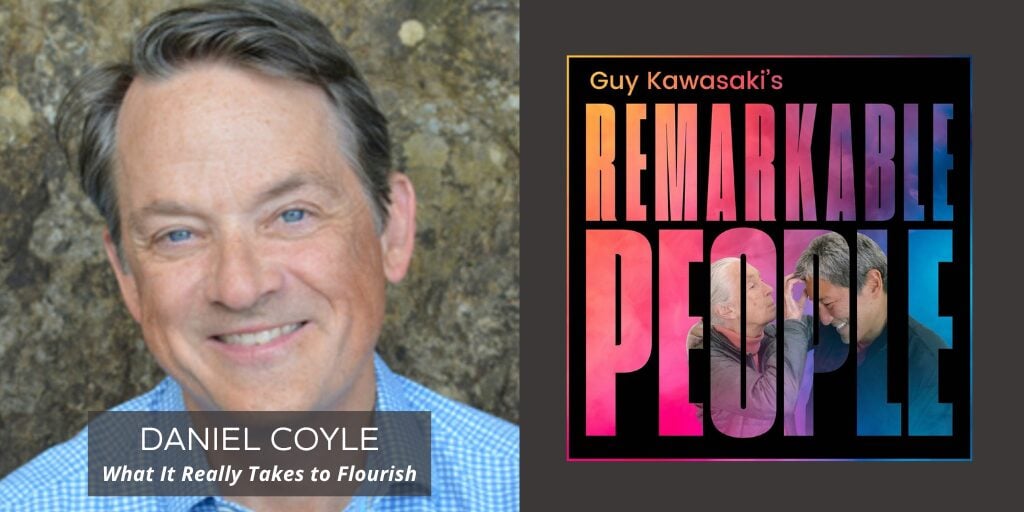
Welcome to Remarkable People. We’re on a mission to make you remarkable. Helping me in this episode is Daniel Coyle.
Daniel is one of the world’s most respected thinkers on performance, culture, and human potential. His bestselling books, including The Talent Code and The Culture Code, have shaped how leaders, teams, and organizations think about growth. His newest book, Flourish, explores a question that affects all of us: What does it actually mean to live well?
In this episode, we explore why flourishing is different from success, happiness, or achievement. Daniel argues that true flourishing is “joyful, meaningful growth shared” and that it can only happen through connection with other people. Drawing on decades of research inside elite organizations, from Navy SEAL teams to professional sports franchises, he explains why community remains one of the most powerful forces in human development.
We also discuss why modern life pushes us toward efficiency, optimization, and endless answers when what we really need are better questions. Daniel shares practical ideas like “connective pauses,” “friction boosting,” and creating space for reflection. Along the way, he explains why the strongest leaders don’t provide all the answers. They create the conditions for people to grow themselves.
Perhaps my favorite concept from the conversation is the “beautiful mess.” Whether it’s a sports team, a classroom, or a business, flourishing happens when people are given a shared vision, clear boundaries, and the freedom to experiment together.
If you’re looking for a richer way to think about leadership, relationships, community, and personal growth, Daniel’s insights, and his new book Flourish, offer an inspiring place to start.
Please enjoy this remarkable episode, Why Community Matters More Than Achievement with Daniel Coyle.
If you enjoyed this episode of the Remarkable People podcast, please leave a rating, write a review, and subscribe. Thank you!
Transcript of Guy Kawasaki’s Remarkable People podcast: Why Community Matters More Than Achievement with Daniel Coyle.
Guy Kawasaki:
Hello everybody. It's Guy Kawasaki. This is the Remarkable People Podcast, and we have found another remarkable person. His name is Dan Coyle, New York Times bestselling author, blah, blah, blah.
His books include The Talent Code, The Culture Code, and his latest book is called Flourish. So today you're going to learn how to flourish in less than an hour. So basically, he has spent, I want to say decades, but I don't want to date him, so decades inside of organizations like SEAL Team Six and the Cleveland Guardians.
Basically Dan is an expert in helping people and companies flourish, so that's what we're discussing today. Welcome, Dan.
Daniel Coyle:
Thanks for having me, Guy. It's such a delight to be here with you.
Guy Kawasaki:
Dan, we're going to go down a little bit of a rat hole right now, but as I'm reading your book, I got to tell you, so this is the overlap between your book and our podcast.
So we've had Dan Simons, we've had Ellen Langer, we've had Nick Epley, we've had Julia Cameron, we've had Alison Wood Brooks, and though you didn't name her, you talked about the growth mindset, so we've had Carol Dweck.
So it was like a whole deja vu preparing for this. It's like all these people I know. All these people, like telling the stories of Nick Epley meeting the woman on the train with the red hat and all that. So yeah, I loved it. So of course, the logical place for us to start is for you to define flourishing. So what is flourishing?
Daniel Coyle:
“Joyful, meaningful growth – shared.” And what's not in that definition? Success is not in that definition. Happiness is not actually in the definition either, right? Performance is not in the definition. But it's really a word and a concept that comes out of the biological, the ecological world.
Machines don't flourish. Machines can produce a result. They can be predictable. They can create an outcome. But to flourish, and it's a feeling and an experience that I think we've all had. And so it's that thing that we've all had and the thing we all want more of.
We want more joy. We want more meaning. We want more growth. And the keyword there that catches a lot of people by surprise and that I didn't really appreciate until I dug into this whole topic was that last word, shared. That you can't do it on your own. There's no little hermit in a mountain cave in Switzerland who is flourishing.
We need other people. We need interaction with people. It doesn't happen as individuals. It happens in these ecosystem, these relationships of people. We become our best selves in and through other people. Another synonym for flourishing would be the power of community.
It's all about creating community. That's how we're meant to flourish and how we're built to flourish, and if we go back in time, how human beings have always flourished, not alone, but together.
Guy Kawasaki:
See, you're telling me, I was going to come to this question, but since we're here, you literally mean that a hermit, I don't know, an extreme introvert, a loner, someone living alone cannot flourish by definition.
Daniel Coyle:
Correct. By definition cannot. We need other people. We're built to do that. Our brains light up. You can look at it through a scientific lens. If you and I were to have a contest right now and we were to compete individually, our brains would light up a certain amount.
If we were to be on the same team and compete together, they'd light up even more. Plato knew this. Socrates knew this. We are social beings. We require other people.
So you can achieve performance alone, you can achieve success alone, you can behave like a machine alone, but to really grow into your best self, to have joyful, meaningful growth, you've got to be with other people which is the challenge of this moment we're living in.
We're surrounded by screens and technologies that are built to keep us alone and ticked off and not disconnected, you might say. And we're all focused on optimizing and maximizing as if we're separate individuals, and we're sold to as if we're separate individuals.
And yet if we all were to close our eyes and think about the times in our life where we felt the most joy, the most meaning, the most growth, they wouldn't be when we're alone. They would be when we are connected to other people in community. And so the challenge we're facing is, like, how do we create that, how do we tap into that power of community in this age that we're living in?
Guy Kawasaki:
But Dan, let's say in terms of physical interaction, you're a hermit, but in terms of digital, you have a Substack newsletter that has a community, you have Reddit, people are responding to your posts, you're responding to them, and you, in your mind, think you have a digital community. Is that not what you're talking about? It has to be analog?
Daniel Coyle:
The digital piece can be supportive and can be like an extra nutrient, but at the core of it, it can't be the whole thing. Digital community is a contradiction in terms I think, you can have elements of your actual community that are digital, but to say that was one of the great kind of heists of, I think, the tech world is to steal the word community.
A digital community is not actually a community. A community is a complex set of interactions where I'm feeling the presence of someone. You cannot do that through words on a screen. Words on a screen are just words on a screen.
Followers are not friends, and I think we're starting to, as a society, learn that distinction, really understand that yes, you can have all the followers in the world and you're the most lonely person on the block.
You can be a super success on a screen and be hollow inside. We're learning that now. We didn't ten years ago. It's taken us a while to learn it, but I think we're learning that that analog piece is how we're built to thrive and flourish.
Guy Kawasaki:
I need to seek some clarity here in your definition. So you use the two words, meaningful growth. Now, one way of interpreting that meaningful growth would be like, in other words, your results are increasing. So OpenAI has had meaningful growth. Apple has had meaningful growth in sales.
But I think you really mean the growth of meaning, which is different than meaningful growth. So what is it?
Daniel Coyle:
I love that. Yeah, I think you're putting your handle on it. Meaningful growth is not results. It is interior change. It's change to yourself. It's an expansion of your capacities of what you can do in the world. It's not a result that you measure. All these companies have got growth, but that's not the kind of growth we're talking about.
The kind of growth we're talking about is the growth of anything that's alive, like a tree or a flower. It's growing from the inside. It's not just achieving a result. And so that is the kind of thing where you can look back on your previous version of yourself and say, "Oh, I've come a little distance from there. I'm different than I used to be. I have capacity for more. I've created an insight."
An insight. And that word is a word that turns up a lot in flourishing groups where they're always creating situations where they can achieve that kind of insight that lets them look at themselves and the world in a new and higher way.
Guy Kawasaki:
My favorite line from the book is a quote that you attributed to Ari Weinzweig of Zingerman, and this is the quote, "Growth for growth's sake is the model of the cancer cell." I just love that quote.
Daniel Coyle:
Isn't that a great one? You can't help once you hear that, talk about an insight. I had the same sort of feeling, and I think about that all the time. These words that we use in our world, we need to scale this, we need to scale that, we need to grow this unlimited. When you really look at those kinds of operations, there's certain things that absolutely should be scaled.
Yeah, clean water, right? Access to education. You need to scale all that stuff. But a much more healthy way to approach it is to look through the lens of community and say, “What do we need to grow that really matters here? How can we help the people that we're with?"
Guy Kawasaki:
Is flourishing a goal in and of itself, like being famous, or is it a byproduct of a life well-lived? For example, I would say Jane Goodall is an extremely good example of someone who flourished.
I don't think she ever had a conversation with her advisors, her friends, or even herself towards the end that, you know, "I want to flourish. What should I do?" You tell me, do people who flourish set off to flourish or they live a well-lived life and one of the byproducts of that is flourishing?
Daniel Coyle:
I think it's B, and there's all kinds of interesting studies that connect to this through the lens of happiness. When people set out to be happy, when they make happiness a target, they're less happy, right? They're less happy when they make happiness a target. But happiness is not something you pursue, it's something that ensues.
It is a byproduct of a well-lived life, and I would say flourishing is the same thing. It's much closer to a process than some ideal outcome. It's much closer to the walk up the mountain than it is to standing on the mountaintop and looking down. It is a process, and it's also not all seashells and balloons either, Guy.
It's not all happiness all the time. That's, I think, one mistake people make about flourishing is I think that they think, That means I should be just exuberant and happy and delighted all the time.
It's not so much about living at a higher pitch. It's about living more deeply and living more mindfully and growing relationships, treating life not like a game, but like a garden. And anybody who's ever gardened knows that the gardening itself is a lot of work and a lot of time and a lot of quiet attention. And I think that there's a level of attentiveness.
There's two big messages in the book. One is about how we pay attention, how we go through paying attention either narrowly or broadly. Flourishing people have a way of creating presence, building relationships that is not just treating people like a game piece they're manipulating, but more about an energy, a type of connection you want to build.
And the other lesson is about collective action. And when you combine these two pieces, that's what communities are made of, this sense of presence, this connective pause where we can stop and be together, and then doing stuff together, exploring, trying to make things better together.
Yeah, it's not like this peak moment of joy and delight all the time. That kind of is an offshoot of it. If you look at Jane Goodall's life, the kind of work she did, the kind of risks she took, the kind of creativity she brought to it, the kind of diligence and grit that she brought to all of that, it is a beautiful example of a flourishing life.
She didn't create her life like a game to win, like she was trying to advance through the game board of her career. She treated it like a garden of relationships that she was growing with the chimps, obviously, but also with her mentors and with her students and with the public at large. She was a guide and a teacher to all of us because she tended those relationships.
Guy Kawasaki:
I'm always searching for metaphors. Would you say that saying that the goal is to flourish is like saying you want to lose weight, and what you should be saying is, "I want to live healthy," and if you live healthy, one of the natural outcomes is probably that you'll lose weight and lower your BMI, right?
Daniel Coyle:
I think that's it. And then what does it take to live healthy? Then I got to change my relationships to food, my relationship to exercise, my relationship to sleep, and that's where flourishing happens in relationships. And the thing about relationships that I'd never understood clearly is that they're not about exchanging information, relationships are about moments, moments of insight.
And so if you want to live a healthy life, to chase your metaphor a little bit, changing your relationship to food isn't about getting more information about food, it's about changing what you see and how you feel about it and how you respond to food, about creating an insight that you have that, "Wait a minute, eating Sugar Smacks every morning, what is that doing to my body? Let me think about that. Let me really change my relationship with breakfast."
And that's what I see flourishing people as being capable of, which is turning off that narrow attention where you're just focused on the information, and turning on that broader attention, saying, "What does breakfast really mean to me? What do I want out of breakfast? What do I want out of my life?"
And questions, if there's one thing that distinguishes flourishing people, it's the ability to create, embed, and live into questions. We live in an age that is addicted to answers, that is building all this AI to give us answers all the time.
Answers are as cheap as tap water. "I got all the answers for you right here." Flourishing ain't about the answers. It's about living into the questions.
What do you want your surf session to mean today? You're going to go surfing. What do you want that to mean? What is that connected to in a deep way? Living into that question will give you those insights and will change your relationship to what you're doing.
And in flourishing groups, and especially the flourishing leaders that I've found, they were great at embedding those questions into the landscape, not so much providing people answers, but what are the questions that they want people to be wrestling with and living into? Then you're a real leader.
Guy Kawasaki:
Are you also saying therefore that you cannot flourish without struggle?
Daniel Coyle:
Oh yeah, right.
Guy Kawasaki:
Can flourishing be easy?
Daniel Coyle:
No, it's not. It's not because being human isn't easy and the world is changing. Like you're changing and the world is changing. So by structural definition, if it's easy, you're not doing it right I would say.
Going back to Plato and Aristotle and Christianity and Buddhism, all these depict a journey. They don't depict a light switch. They're not like, "Oh, just do this and it's easy." They all talk about a struggle.
And the reason they talk about a struggle is because we're human beings on a changing world, and we're changing and the world is changing, and the world is going to present these struggles.
It just will. We all were born, we're all going to die, we're all going to go through relationships that aren't perfect, we're all going to go through scarcity, we're all going to go through challenges.
And there's no opting out of that. And so flourishing is how do you live into those questions that can give you insights so that you can change your relationship as those changes happen to help you navigate it?
You're not going to solve it. Like you're not going to solve your life, but you can change your relationships to life and get insights to help you navigate it a little bit better. And getting community, and that's again, we go back to that word community.
The promise of the world right now in technology is, "We'll make everything perfect. If you just get this status, you just get this accomplishment, if you just get this performance level, if you just get this habit, if you just get this program, everything will be perfect." That's not true. That's a lie. Everything's not going to be perfect.
But the truth that community has is community's promise is nothing's going to be perfect. Everything's going to be imperfect, including you, and we'll make it better together. That's community's promise, and that's actually true.
That's actually a true promise as opposed to the false promises of technology and everything else. I'm sounding like a Luddite here, but there really is kind of a, if you're going to live in community with people, it's going to be imperfect, and that's actually the great thing about it.
Guy Kawasaki:
I'm going to ask you to be a little judgmental now, okay?
Daniel Coyle:
Excellent.
Guy Kawasaki:
So from the outside looking in, you look at Elon Musk, and you say, “He's got wealth, he's got power, he's got fame. He looks like the richest person on the earth, and he's flourishing and, blah, blah, blah, but he also appears restless and combative, and he doesn't seem to be at peace with himself.” So is Elon Musk flourishing?
Daniel Coyle:
Would you trade places with him?
Guy Kawasaki:
Not for a fricking nanosecond.
Daniel Coyle:
I guess that's the question for your listeners. I would respond the same way. I would never, never trade places with him. So that's interesting to explore that question, if questions are important. Like, why? He has the most success. He has the most status. He's the smartest, apparently.
He's got the most money. He's got the most power, and yet not for a nanosecond, and I'm the same way. So why is that? Why not? How would you answer that question? Why not, Guy?
Guy Kawasaki:
Because at the end of my life, I want people to say that I made the world a better place, and don't get me wrong, he single-handedly changed the car business, and Starlink is a great system. There are things he's done that has helped humanity. But on the other hand, he's done other things that have more than erased what he did, so I don't get him at all, to tell you the truth.
Daniel Coyle:
And I guess I'd add onto that, the relationships in his life seem not to go very well. I don't think he leaves behind people that are going to say, "Oh, I had a really great relationship with him."
To me, he's following a super predictable, well-trod path where he climbed all these mountains, and what he finds at the top is just more mountains and more loneliness and more isolation, and there's no oxygen up there, and so you stop thinking clearly.
And it's that sad success, right? That success and sadness go together often. And it'll be interesting to see how he evolves and if there is another chapter there for him.
Guy Kawasaki:
Okay, so I think I know what your answer's going to be, but another example is Mark Zuckerberg, richer than God, powerful, et cetera. And yet, I don't think anybody will debate that Facebook has caused a lot of harm to a lot of people. So can you flourish even though you've caused harm? Or do you have to have a clean record and et cetera?
Daniel Coyle:
No, I think you can. I think you can. There are second acts in American lives. I do think what the Zuckerberg thing speaks to me about is this kind of misconception of what it means to be a human being. There is a mindset and a philosophy in Silicon Valley that human beings are just sort of like meat computers.
That we're thinking machines. We make decisions, and we process, like it's the computer analogy, that we are processing machines. And it leaves out what actually makes us human, which is the ability to deeply connect, the ability to have heart, the ability to give, the ability to be illogical.
Most great decisions in people's lives are not logical. The decision to marry who you marry, the decision to give up things for your children, all those things are super illogical at many levels. And so all the beautiful things that make us human, he completely ignores. And I think a lot of the products that they build, especially AI, ignores that level of humanity and deep connection.
So ironically, this moment we're living in, as dystopian as it can seem sometime, is actually putting a spotlight on what actually is human. I think there is, I'd be curious if you've seen this, kind of a humanist revival happening.
I think people are realizing how bad it feels to be in an endless scroll of AI, how bad it feels to interact with machines all the time, and how good it feels to look in another person's eyes and have a real conversation with them and explore questions together, and to ask about meaning together.
AI is terrible at that. And I think there's a bit of a movement, I've seen it with young people, toward in-person gatherings, real messiness, just human connection, old-time community that's annoying and wonderful and transcendent. And AI is helping us get to there because it's showing us how precious it is.
Guy Kawasaki:
Now I got one more example, and it's not going to be another tech bro because it's kind of clear to me that net worth and flourishing are mutually exclusive. But anyway, so this is a completely different question.
Now, do you think that Zelensky is flourishing? He is under the most pressure. He's threatened, but he has a profound purpose, and is he flourishing through sacrifice? Can someone like Zelensky be flourishing in such a difficult role?
Daniel Coyle:
Yeah. Yeah, I think so. His whole story it's almost so familiar that how incredible it is, it gets overlooked sometimes. A comedian, he's a comedian, that's what his job was in the Ukraine, becomes the president. Talk about growth. Talk about meaningful growth. That is what that is.
He completely evolved to meet this moment in time. And that's one definition of kind of growth, like increasing your capacity to meet the big moments in life, and it's clear that he's doing that. And again, there's a tremendous amount of suffering.
It's taken an incredible toll. Is it fair that it's gone on for this long? Absolutely not. And yet, I think it's an example of the type of growth that happens when somebody steps into uncertainty alongside other people and says, "I will do whatever is necessary to help us. I will take on that role." The idea that a comedian would do that is just incredible.
Guy Kawasaki:
Alright. So we mentioned two kind of fails, one success, but I am generally interested so that people have something to hang their hat on and have a more guttural and literal understanding of flourishing. Who is in the Dan Coyle Hall of Fame of flourishing? Where you can say, "I want to be like him. I want to be like her"?
Daniel Coyle:
Oh, I love this question. It might be you. It might be you, Guy, based on what I'm seeing. Surfing and peanut butter sandwiches, that sounds pretty good. I think it's all around us. I could point to some people, and I point to a lot of them in the book. Ari Weinzweig, who you mentioned before, who had the quote.
Man, that dude is absolutely incredible. Anybody who ever wants to see it, go to Zingerman's Deli in Ann Arbor, Michigan. It's this incredible community of business that Ari and his partner started, and it is a grade A example of what it means to live in community and create something special together, and Ari is definitely living that.
Jane Goodall would be in the hall of fame, I think, for sure. There's some leaders in the Navy SEALs community, I think, that would be up there. I would encourage people to think about their own lives in that way because flourishing is not some exotic Mount Olympus, only accessible to a few.
It's a fundamental human experience. And so think in your life of, who you feel most alive with. That's a good question. So two questions. Who do you feel most alive with? Answer that. And the second question to answer is what are you helping to grow? What are you helping to grow? And that'll give you a sense, I think, of where it's happening in your own life.
I think we all have got these little zones, like little oases in our lives. Maybe it's our conversations with a neighbor or with our kids. Maybe it's some project we're doing with friends. Maybe it's some volunteer work we're doing. That's it. So the challenge we have is not like, “How do I become like Ari Weinzweig?" Or "How do I become like Jane Goodall?"
That's not realistic, and it's not healthy, but what it is, the challenge actually is like, okay, where in my life do I feel two minutes that where I feel super alive and I'm helping something to grow? The question is how do I get more of that? That's the real question.
Where's that happening? Go through your calendar. Look at those events. Who do you feel most alive with? Name those names. Write it down. What are you helping to grow? Write it down. Is there something in your community that you could help make happen? Is there something on your street? Is there something in your house?
So finding those things, naming them, and starting to pay attention to them, and if you pay attention to them, they'll grow.
Guy Kawasaki:
As I'm reading your book, I'm trying to think, and you cited Ari's market and, organization in Ann Arbor. But I was sitting there and thinking like, What well-known large companies, in my humble opinion, are flourishing? And Dan, for the life of me, I cannot think of one company that I would say is flourishing.
Daniel Coyle:
How about Patagonia?
Guy Kawasaki:
Okay, Patagonia, I grant you that. I don't know about this whole lawsuit about Pattie Gonia and that stuff, but I think that's an aberration. I grant you that. Patagonia. Okay, give me a second example then.
Daniel Coyle:
I'm going to say the Cleveland Guardians. I work for them. They're a baseball team. We've got the second lowest payroll in baseball, and we've won our division eight times in the last ten years, and everybody's happy, and people stick around, and people grow, not only players, but people in the front office. And it's not easy. It's not easy.
But that's in a very high-performance organization. I can think of some schools that are flourishing. That's not a business, but there are definitely flourishing schools, but it's hard, trying to flourish and run a successful business in this environment. That's a tall order.
Guy Kawasaki:
I'm completely conflicted here, but I would say Canva is a company that flourishes, and I am just beside myself. My brain is twisted like a pretzel. I wish I could say Apple is flourishing, but I just can't say that anymore after they bent the knee to the Trump administration to avoid tariffs. They really disappointed me there.
Daniel Coyle:
It's a long journey, and the other thing about flourishing is it's not a straight line. If you trace the story of any flourishing group, it's more like a jungle vine than it is like an arrow, so the fact that you'd have moments where it's not happening is to be expected. And it doesn't mean it can't happen. It doesn't close the door.
Guy Kawasaki:
So cutting to the chase here, maybe the way we've been discussing it proves that this is not a good question because the goal is not to flourish and flourishing is a side benefit, right, of living a well-lived life. But it's got to be occurring to people listening to this. Okay, I buy it, I buy all this kind of stuff. Now how do I start on this path to flourishing? What do I do?
Daniel Coyle:
I think starting with kind of identifying those two questions that we talked about. Those two questions. Who do I feel most alive with? Do an audit, right? Do an audit, see where it's already happening.
And then the challenge is to grow those relationships, to actually spend time with the people, places, projects that matter to you, creating those moments. And there's a tool to do that, and it's called the connective pause. It's when you stop. It's when you really surrender control and try to figure out why something matters to you.
Why does something matter to you? Answer that question. Figure that out. Why does surfing matter to you? Why does your neighbor down the street matter to you? And your goal isn't to answer it really neatly, but your goal is to create an awareness. Your goal is to figure out why. If you can answer that, if you can explore that, then you're creating a relationship there.
You're creating something you can give energy to. So spending time doing that ends up being really, really super useful. Another sort of tool that people can use is I call it friction boosting. Like the modern world, we're allergic to friction. Like we don't necessarily want to slow down.
We always want to be efficient. We want to check through our to-do lists. We want to get things done, but if you want to flourish, you got to kind of slow down and embrace the friction. There's a good story about the writer Kurt Vonnegut. He used to go to the drugstore where he lived every day, and he'd buy one envelope.
And one day he was walking there, and the person who worked behind the desk was like, “Mr. Vonnegut, every day I sell you one envelope. I've got a box of fifty. I can sell you this box of fifty right here. Like, why do you come and buy one?" He gave a great answer.
He said, “I don't come here for the envelope. I walk here, and on the walk I get to pat all the dogs that I meet. I get to make funny faces at the babies, and I get to give a thumbs up to the firetruck as it goes by. And I get to slow down and be in my community and be with them, not get things done, but to be with them." And I think that's a beautiful sort of metaphor for what community is.
It's this sort of presence that you're in. It's spending time in inefficient ways. Don't be efficient. Don't just try to exchange information and get things done. Just create ecosystems where you can just be and be seen and see others. That friction boosting is a great tool.
And the thing to keep in mind on that is a little saying that is, “Annoyance is the price of community.” If you're going to be in community, you're going to have some annoyances, as things aren't going to be perfect and friction-free, and that's the point.
That's actually the point, that you are experiencing these things together, that everything isn't a machine that's perfect, but that it's imperfect, and to embrace that imperfection. And I guess the other rule I would say to keep in mind is the 20 percent rule, which is keep things 20 percent messy.
There's this urge to make everything perfect if you're trying to bring flourishing into your life. "Oh, I'm just going to do A, B, C, and D. We're going to accomplish these things." And that's not it. It's more about doing messy experiments, doing projects with other people where you're making a bit of a mess, and through that mess, you're creating something new.
Nothing good was ever created without any mess. Everything takes a mess to create. And when we do projects with other people, we have to allow people to self-organize and experiment and make mistakes and make it better and make mistakes and make it better.
My favorite example of this is something called the spaghetti marshmallow contest, which some of you folks might be familiar with. But it was a contest organized by a guy named Peter Skillman, and the idea was to create teams.
Who can build the tallest tower with twenty pieces of raw spaghetti, a yard of Scotch tape? And the only rule was a single standard size marshmallow had to go on the top. But the interesting part were the teams that he chose. He chose four-person teams of CEOs, of lawyers, of MBA students, and of kindergartners.
If we all had to bet who would win, we'd probably bet on one of the adult teams because that's our model of performance. We think if you're smart, be smart, smart people succeed. In fact, what happens is the kindergartners win every time, and it's not close. The kindergartners keep winning.
And the reason why is that our mental model of performance is wrong and what matters is the ability to make a mess together because the adult groups all make a plan, and they follow that plan, and the kindergartners just start trying stuff, and it's messy, and they get shoulder to shoulder, and it starts tipping over, and they fix it, and it starts tipping over, and they fix it, and they make a mess.
And because they make a mess, they make a better tower.
Guy Kawasaki:
You were basically describing the beautiful mess. So what is a beautiful mess? These seems like oxymoronic.
Daniel Coyle:
Yeah, it does. It does. A beautiful mess. I kept seeing this in the places I visited that were flourishing, and I saw it really vividly with the All-Blacks New Zealand rugby team, the best rugby team in the world. And they have these moments where they have the players run practice for a week.
Players run practice, which is not normal, and it's kind of messy because players aren't as good at it as coaches are. It's kind of crazy. It's kind of chaotic. I saw it again at a drawing class.
There's a woman named Lynda Barry who teaches drawing, and she likes to pair a master student with a four-year-old to work on a project together, and it's not nice and clean and neat. It's kind of messy. You've got a four-year-old and a master student working together on a project. It's the same as having the players running practice.
And I saw it in schools where they would have instead of the teacher teaching in a very organized way, they would divide the kids up into groups, and each of them would take a segment of the lesson, and they would each, in small groups, messily learn that lesson.
In each case, in all those cases, the learning was way more, the performance was way more, the energy was way more. They designed situations, constraints, limits that helped the group self-organize, and that's what I saw in flourishing groups because you don't do growth to people.
You create conditions where they grow themselves, and that's what these people were doing in each of these cases. The leaders were creating conditions where there could be a beautiful mess. A beautiful mess is when people are growing themselves. It's belonging in motion.
We all belong to this project. We're all working on this project, and we're going to self-organize. You see it in nature all the time. Picture a flock of birds moving through a forest or maybe evading a predator.
They're not following some step-by-step, paint-by-the-numbers script, there is a constraint, there's a limit, and they're together, they're connected, and they're self-organizing into the space together, and that's what leadership actually is. It's not telling people what to do. It's not giving them the answer.
It's creating conditions where there is a vision of where they're going, and then you say, "It's up to you. It's up to you." If you think about the moments in your life where you felt the most connected to your teammates, it wasn't when you were all obeying some smart leader. It was when you were all aware of each other, self-organizing like a soccer team.
You move over here, I'm going to notice that, and I'm going to move here, and then they're going to notice that, and they're going to move here, and it's like a group brain in action. There's a great saying in the Dao De Jing where it says, "With good leaders, people always talk about what good leaders they are. With great leaders, the people say, 'We did it ourselves.'"
And that's what great leaders are doing. That's what the beautiful mess is. Great leaders create the beautiful mess because they create the conditions for people to self-organize toward a shared vision. So what are the main tasks of a leader? It's not to tell people what to do.
It's to create that shared vision. It's to create the clear constraints where the space in which they're going to navigate, the guardrails, like we're not going to go over here, but anything in this space is up to you guys.
And I think when you look back at great breakthroughs, at great moments, at fulfillment, but also at performance, what you always find is that beautiful mess, where it's like, was it perfect? No. Did we navigate it ourselves? Yes. Did we make mistakes? Yes. But every mistake taught us where we should go next.
And so messes aren't really messes, like when you do them right. I'm not saying every mess is good. You can't just have chaos, right? But if you are in a zone like a flock of birds, connected, moving toward a vision, that's where the beautiful mess happens, where people can self-organize to create something new.
Guy Kawasaki:
I'm glad you just said that because I'm sitting here thinking, You could make the case that Congress is a mess, but I cannot see that as a beautiful mess. I don't.
Daniel Coyle:
No, because there's not a clear guardrails. There's not things that are moving them together all the time, so yeah, that's a beautiful example of the opposite, an ugly mess.
Guy Kawasaki:
So you also have two more concepts that I have to get to because I just love them, and the two concepts are awakening and creating space. So tell us about these two concepts.
Daniel Coyle:
Yeah, I kept seeing these connective pauses in these groups that made a difference. I saw it when I studied the Chilean miners. We all know the story of the Chilean miners, We all know that story of how that group, 2010, they're 1,600 feet below the surface.
Things usually in history, those would not be the people you'd want to trade places with, like the odds of rescue are very long. And yet they survived and thrived together with very little food. And the thing that made it work was not moments where they provided answers, but where they had these connective pauses.
One of them was where the leader stepped to the center of the group and took off his white helmet and said, "There are no more bosses and no employees here. We're all leaders." That's not really an answer. That's more like asking a question, creating this pause. What is this all about?
And then the other one was where they realized there were thirty-three of them, which was the same age that Jesus was when he was crucified, and they all happened to be Catholic, and so this was a meaningful moment for them, too.
What if we're here for something bigger? And this moment of pausing and seeing a connection to something bigger than yourself, that's what I would call an awakening cue, where you're turning on a different attention system.
We normally walk through the world focused on what's in front of us and seeing it narrowly, and awakening cues are moments where we surrender that control and connect.
And it ends up being the places I visited that flourished used those awakening cues as a grounding practice where they would periodically move to them. Julia Cameron, one of your guests, does a grounding practice of morning pages. In morning pages, you're not trying to control anything.
You're not trying to see like this. You're trying to open. You're trying to be open to the world and writing down whatever comes to mind. That opens you, so that's an awakening cue.
That's a moment of a connective pause where you give up control and you see what's out there to connect with. And so almost like a calisthenic I saw in the flourishing places I visited, they would use these awakening cues as a calisthenic.
Every so often, they would circle up and explore a deep question together. Every so often, they would stop and do morning pages, or they would do what Ari Weinzweig calls S.B.A., which stands for stop, breathe, appreciate.
Stop what you're doing, take a breath, and appreciate one thing around you. So these end up being mindfulness practices essentially to bring us into connection with what's really going on.
Guy Kawasaki:
Oh, wait. We got to get creating space. We did awakening.
Daniel Coyle:
We did awakening, creating space. Creating space, that's a term that I was always allergic to as a journalist who studies science. I always thought that sounded kind of woo-woo, creating space, but I saw it with the same places, and it's connected to awakening because it's the step that immediately happens before that.
You cannot have those moments of awakening without sort of creating space for it to happen. Attentional space. Creating space is attentional space. It's not physical space. It is opening up your attention so that you can see it, and the best way to do it is through questions, through deep questions.
Why does this matter to you? That's a deep question. Like asking, what energizes you about that? That's another deep question, so creating space with a question so that people can stop and let go of control and stop chasing answers and actually inhabit that question.
That's what creating space is all about, and that's what I saw good leaders do. They would just embed those spaces in the landscape so that people were constantly trying to focus on what really mattered.
Guy Kawasaki:
Dan, I don't know how to break this to you, but basically your concept of awakening, your concept of creating space, and your concept of beautiful mess is contrary to everything about Silicon Valley. We want incubators, we want Y Combinator, we want all these people on the same page.
Daniel Coyle:
We want a machine.
Guy Kawasaki:
It is completely contradictory to Silicon Valley.
Daniel Coyle:
I know. I know, it really is and to modern life. And I think a lot of people are realizing that there is another path, and that there is another way, and we're craving that community, that power of community. A machine can do a lot of things. A machine is a good tool, but you shouldn't try to be a machine.
You shouldn't try to be a machine. You'll end up hollow and empty because machines don't grow and machines don't connect and so having an idea of what it means to be human that goes way beyond. It encompasses being a machine, but it's way more than that, too.
Guy Kawasaki:
I have two more things I want to discuss with you. The first thing is I am going to disagree with something you've said.
Daniel Coyle:
Excellent.
Guy Kawasaki:
Maybe it's the only thing I disagree with your book, and there's a part where you're talking about how the Guardians, the Cleveland Guardians baseball team, and how they spot undervalued players, and you talk about the pitcher and all these people who were prize recruits, but they weren't exactly the top of the pyramid.
And you have a sentence that says that the Guardians were very good at finding Ferraris hiding among the Corollas. And when I read that, I said, "Dan, you have to understand that a Toyota Corolla has sold fifty-four million, and a Ferrari has sold to 220,000 assholes." So I don't think that is a good car analogy.
Daniel Coyle:
You got me. I think you're right. It's terrible. I should have said, what was that Ford, the Dodge Dart? Maybe the Dodge Dart. Maybe I would do that instead of the Corolla. That's so good. Np, I think you’re right. I’m going to call my editor today.
Guy Kawasaki:
So my last question because I love the metaphors in this book. So we all know what a red door is. We know what a green door is. What is a yellow door?
Daniel Coyle:
Yeah, we go through life looking for green doors, it’s like go, go go, right. And red door, stop, stop, stop. And yellow doors are like a mixed signal. It’s kind of like, “Huh.” Like you could go, but it is a risk. It might be a little uncomfortable. They are opportunities that are neither positive nor negative.
That are an intriguing mix of both, and so to move through them you have to step through uncertainty. And I relate to that. I had a yellow door a few years ago. A friend of mine had gotten divorced, and he loved to rock climb, so he wanted to get together a group of guys to go climbing, indoor climbing.
I hate climbing. I don’t like heights, and I think indoor climbing is silly, all the little shoes you have to wear and all the knots and harnesses. Never appealed to me, right? It’s goofy. But I was like, “Ah, yellow door. I am going to try it.”
And I walked through it and showed up, and these guys were kind of a delight, and I didn’t like love it, but it was good enough, so I kept going, kept going, kept going. And jump to four or five years later, they are some of my best friends on the planet.
And we vacation together and play music together and have all kinds of fun together. And so, life is not a machine. Life is not complicated. Life is complex. And yellow doors speak to that complexity. Life changes as you interact with it and you change too, so if any of your viewers or your listeners were to draw a story of their life, they wouldn’t be drawing a straight line.
They’d be drawing a squiggly path, and that’s a path of complexity. Complexity you have to experiment into it and see what happens. That’s how you deal with complexity because it is changing and you are changing.
So this idea that we should have clarity and just go through life with like firm decisions, no, all the good stuff happens with yellow doors. It’s not green, red, green, red. It’s like explore the yellow and see what happens and learn from it and then explore again. And that is saying that all of life is a series of exploration from a secure base.
Guy Kawasaki:
Yeah, I would say that Carol Dweck would say that the growth mindset means that you go through the yellow doors, right?
Daniel Coyle:
That’s right. You can handle it. It’s scary.
Guy Kawasaki:
Yep. Dan Coyle, I really appreciate the hour you spent with us, and one author to another, this is the book. It's called Flourish, and I hope you've enjoyed this interview. If you want to learn more about flourishing, definitely read this book. But I'm telling you, aspire to be a Toyota Corolla, not a Ferrari.
Daniel Coyle:
Right. I love that. That is so deep and so good. Thank you, Guy. It has been a delight chatting with you. I hope we can do it again sometime soon.
Guy Kawasaki:
Oh, yes. Thank you. I got to thank Madisun, our producer, and also Jeff Sieh, our other producer, Shannon Hernandez, sound design engineer, Tessa Nuismer, who's researcher. So there's actually a team behind me.
Behind every flourishing person is probably a team. It's not just him or her, right? Let's give them credit. So Dan Coyle, it's been a pleasure. I hope people buy your book. I hope people flourish, and bada bing, bada bang, we're done. Thank you.
Daniel Coyle:
Thank you very much, Guy.
Guy Kawasaki:
Bye-bye.
Daniel Coyle:
Bye-bye.
Sign up to receive email updates
Enter your name and email address below and I'll send you periodic updates about the podcast.

Leave a Reply