
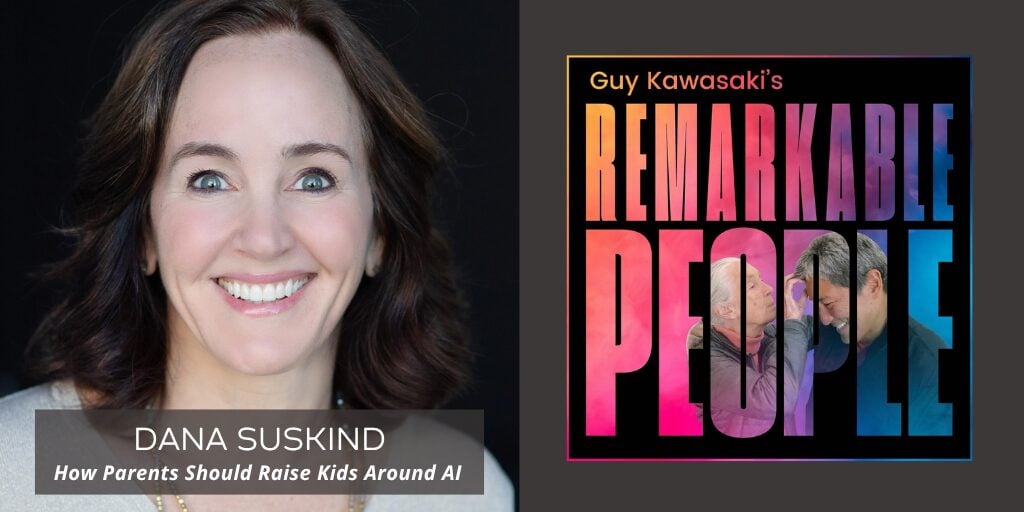
Welcome to Remarkable People. We’re on a mission to make you remarkable. Helping me in this episode is Dana Suskind.
Dana is a pioneering pediatric cochlear implant surgeon, researcher, and bestselling author whose work has transformed how we think about childhood development. She has spent decades helping children hear and communicate while studying how early human interaction shapes the brain. Her latest book, Human Raised, takes on one of the biggest questions facing modern families: what happens when AI begins competing with humans for children’s attention, learning, and emotional connection?
In this episode, we explore why the first years of life matter so deeply and why Dana believes conversation, curiosity, and imperfect human interaction are essential for healthy development. She explains how technology can support parents in meaningful ways while warning against tools that replace real-world relationships. Dana also breaks down the behavioral “traps” built into modern technology—from autoplay loops to engagement-driven design—and why parents need better frameworks for navigating them. Her HOPE principles offer a practical roadmap for using AI to enhance human flourishing instead of weakening it.
This conversation goes far beyond parenting advice. Dana challenges us to think about what makes us human in the first place and why friction, mistakes, and emotional complexity are not bugs in the system—they’re the foundation of empathy, resilience, and connection.
Whether you’re raising children, building technology, or simply trying to stay grounded in a rapidly changing world, this episode will leave you thinking differently about the future we’re creating.
Please enjoy this remarkable episode, Why Parenting Matters More Than Ever in the Age of AI with Dana Suskind.
If you enjoyed this episode of the Remarkable People podcast, please leave a rating, write a review, and subscribe. Thank you!
Transcript of Guy Kawasaki’s Remarkable People podcast: Why Parenting Matters More Than Ever in the Age of AI with Dana Suskind.
Guy Kawasaki:
Hello, everybody. Guess what? I'm Guy Kawasaki. This is the Remarkable People Podcast, and oh my God, we have one of my best buddies in the world on today. Her name is Dana Suskind, and oh, she's one of the few people I would let operate on my head. She has the ability to take very tiny wires and connect them to actual nerves in your brain, which that is a remarkable thing.
She, believe it or not, is a cochlear implant specialist for kids, for babies. Imagine that, that you have the power to help babies who cannot hear, hear. Oh my God, that is godlike, Dana. And Dana is one of the major influences in me getting a cochlear implant or two, and so she is definitely a huge factor in my existence at this point in life.
Now you know, that's her day job. She's also a very, very accomplished writer, and she's coming out with a new book, and any of you who have babies or know people with babies or have kids with babies, you absolutely should buy this book. It is called Human Raised, and I read it, and there's a lot of people I need to give this book to because it is all about the right way to raise a little baby.
And we'll get into it. So Dana, welcome to the show.
Dana Suskind:
Thank you so much for having me. And would you really let me operate on you? You're a little bit bigger than my usual patient.
Guy Kawasaki:
Yeah, but you know, a neuron is a neuron, right?
Dana Suskind:
That’s true.
Guy Kawasaki:
How many implants have you implanted?
Dana Suskind:
Oh gosh, I would have to go back but many, many, many, many little ears. But then now because I've been doing it so long, now some of them are in college. It's wild to see them grow up, and it makes you feel so good knowing that they can connect and talk and hear.
Guy Kawasaki:
This podcast is famous for going down rat holes, so we're going to go down a rat hole right now, but I just don't understand. So my ENT, Joe Roberson, opened up my head twice, and I don't even understand how you can take a little wire and connect it to a particular nerve. Just give me the steps of how you do that at such a microscopic level.
It's not like you're plugging a wire in, and you're charging your MacBook. So how do you do this?
Dana Suskind:
It's almost like that, but actually it's not one particular nerve. When you put it into the cochlea, there are little hair cells that are the appendages from nerves. So you're just lying this implant next to it, and it basically bypasses the hair cells, the nerve parts that aren't working and stimulates the nerve directly. It's a pretty cool thing.
Guy Kawasaki:
Yeah, but you're not just doing that, you know, is there magnifying glasses?
Dana Suskind:
Let me be clear. You go under a microscope that magnifies the cochlea, which is like a snail shaped organ, and it magnifies this little pea-shaped, sized organ up to the size of a quarter. So I'm looking under the microscope, and you have little, tiny, microscopic instruments, and you slowly, gently, put the electrode in, and it's a miraculous thing.
Not the surgery, but the technology. And I think, even though we're down a rabbit hole, if you want to connect it to this book, like technology can, if used in the right way, allow for human flourishing and allow for human connection.
And so in some ways, this book is about how do we make sure that in this next step, in the age of AI, that we use technology to help us and connect us, not substitute us.
Guy Kawasaki:
Are you trying to be subtle in telling me, "Guy, I'm tired of talking about your head. Let's get to my book. That's why I'm on the podcast, not to talk about your cochlear implants."
Dana Suskind:
No, I want to talk about your cochlear implant because that allows us to connect.
Guy Kawasaki:
All right. So, the whole premise of the book is about raising babies well and all that.
So I think we should start at the very, very basics and what exactly is the goal in these first five years of raising babies? We need to know the goal, so we know how to accomplish the goal. What's the goal here? Is it to get the kid into Harvard or Stanford in the Ivy League? What's the goal?
Dana Suskind:
What is the goal? That is such an important question because in the age of AI, the goals have changed. What you need to be successful, at least this is what people are saying, in the age of AI, is not just those hard skills that people have been working on, you know, language and math and science, but those soft skills.
Which you, Guy, are probably one of the best in, being able to connect as humans, being curious and creative, having moral judgment and being able to just connect with other humans.
And the goal in those first five years of life is understanding that how we nurture our children, how we connect with them, is actually building your baby's brain. And that physical brain, I think, this is really important for your listeners. Those first years of life, it's building the hard drive of the brain.
It's like a computer. You're building the hard drive, the memory, the RAM. K-Twelve is really important for developing the human, but it's more like software updates. So if you were supposed to have an iPhone Sixteen but you only built an iPhone Four, software updates aren't going to help you.
So those early years and how we connect as parents with our babies and our kids really helps determine who they are.
Guy Kawasaki:
All right. So I don't want to give you PTSD, but my oldest is about thirty-three now, and I hope he's not listening. I got to tell you that we stuck him in front of a television watching Baby Einstein because at that point everybody said, "Yeah, Baby Einstein is going to help your kid understand language and math and all that, so stick them in front of this DVD."
And now I guess that wasn't exactly true, right?
Dana Suskind:
Yeah, and just so you don't feel bad, I did the same thing, but then the science really showed us this Baby Einstein didn't just not help the kids learn, but it actually depressed their language. Your kid, my kid, most kids were fine because then we made it up with talking and reading, but that's a really great example of technology promising all these big things for helping our children.
And now with the age of AI, now that it's so interactive, and you see all these like toys that are promising to help build curiosity and connect. We can promise a whole lot of stuff and like the social media, sometimes what looks like it should be doing actually does the opposite.
We've got to be super careful about what we allow into our children's lives. I'm not anti-technology. I love tech. That's why I do cochlear implants. That's why I do AI research. But we got to be really thoughtful in this moment in time.
Guy Kawasaki:
When I was in elementary school, we used to have Bunsen burners with asbestos pads and asbestos gloves, right? Thank you for giving me lung cancer. But anyway, one of the things that you're famous for is this idea of that children who have been exposed to enough interaction hear about thirty million words in the first three years.
Now, what if some tech bro says, “I read the thirty million words theory, and I built this gizmo that you clip on your baby. It counts the words that the baby's hearing, and it's going to make up the delta to get your baby to ten million words a year. And so this is going to really address the issue of thirty million words."
And when you hear this, and you know it's probably made by Tesla, and what is your reaction going to be when that day comes?
Dana Suskind:
Oh my gosh, I love that question, and that day has already come, and that is why I wrote this book because what we don't understand is, yes, the research study, that first study, which, there are some questions about the science, but it is pretty clear that talk and interaction builds a child's brain, right?
It builds their vocabulary and literacy. But what's really important is it also builds their ability to connect, their social-emotional development.
And when you try to build technologic solutions like, "Oh, I'm going to have all this interaction, give them lots of words," you're going to inadvertently also change their social development, their ability to connect because we know, like, so many of these sycophantic AI LLMs that we connect with, people are wanting to marry them.
We're social beings. We're going to build little kids who have these expectations that they are the most perfect humans that can never do wrong, and they will not know how to connect in the real world to other humans. And let's face it, humans are imperfect. Our interactions are not perfect, but we learn from that, and children learn to be human from other humans. So, got to be careful.
Guy Kawasaki:
One of the points that really was eye-opening for me was that in fact, human interaction is imperfect. There's frustration, there's mistakes, there's social faux pas, there's a lot of things that goes wrong, and now a robot could fix all that, but you don't want all that fixed, right?
You want all that to happen, so people or babies learn to cope with these things.
Dana Suskind:
Yeah. I love that. I think one of the most liberating parts of writing this book, even though I knew it intellectually, is really reflecting on our imperfections, our good enough parenting, our good enough friendships, all that friction. We're learning that friction is good, that we learn through friction.
We learn to be human through friction. And yeah, sometimes we want a frictionless existence because it feels more comfortable, but it's sort of like giving candy to a child every day. That's not how you nourish, and you grow and learn. And that was a liberating part of writing this book.
Every time I was an imperfect parent to my children, which happens all the time, I'm like, "You know what? This is good for you. It's not just a nice thing to say. I'm helping you learn to be human."
Guy Kawasaki:
Dana, by that test, I've been a really great parent, man.
Dana Suskind:
You are. The funny thing is that this perfect parenting, this intensive parenting that you see people, they've been so stressed out about. I think, maybe the age of AI will snap us out of this feeling that we've got to be perfect and, like, just we need to be present.
We need to connect. We need to be okay with our imperfections because at the end of the day, as a social species, that's what we need, and we've forgot about it. We've lost that. We've lost the ability to connect. Maybe this will finally allow us to go back to that important aspect of us.
Guy Kawasaki:
Yeah, but you understand that there's PhDs and all these idiot savants and tech bros and billionaires, and they have 180 degree opinion away from what you just said, right? They really think that robots can fix everything and be perfect parents. That day is coming. Would you want to be raised by a Tesla robot? Man, that is frightening.
Dana Suskind:
Although I'll tell you, in the beginning of my book, I talked about, maybe finally, being confronted with this other, right? This incredible technology that can do what we do probably at a better level than us, in terms of analytic and those other skills.
But maybe confronting that, we'll finally find what connects us because AI is the ultimate other, but you're starting to feel a little bit of a pushback. You saw this booing on commencements. I think that in some ways people are like, "Wait a second. We don't want to be replaced."
And it's not even just replacement in the workforce, which of course we don't want, but we don't want to replace our identity as parents, as humans. We want technology to help us flourish, to be more connected, but don't take away our identity. So maybe there is a pushback because yeah, you're right, I think we should be thinking about rebuilding it in a different way.
Guy Kawasaki:
The metaphor that you use in the book, which I just love, is that if you have a little seed and it becomes a seedling, and it's in this perfect controlled environment and in hydroponics and all that, and so you got this perfect growing condition for a little plant.
And then at one point the plant has to go outside and live in the real world, and that plant is not going to be prepared after a perfect upbringing, right?
Dana Suskind:
Yeah. Do you remember Sarah Sebo's study where she had little kids read in front of robots versus humans? And in front of the robots, they were much less stressed, right? Physiologically, they were much less stressed. There was much less friction.
And you can imagine okay, you could build a technology to start helping kids learn how to read. That's okay. But at some point, those children need to learn how to read in front of other humans. And understanding how we can do design choices that do help us without taking away our resilience, our ability to exist in the natural world is, I think, important.
Guy Kawasaki:
Now, if I got this right, on the other hand, you make a point that there have been cases where kids with autism or something where reading to a robot and interacting with a robot was very positive and helpful. Did I get that right?
Dana Suskind:
Yeah.
Guy Kawasaki:
It’s not clear that it's always bad.
Dana Suskind:
No, and I think it's human nature to be binary, good versus bad. And this is a tool that we can be really thoughtful, at least at this moment, in how we use it. So Brian Scassellati and other incredible technologists have done studies with social robots that help children with autism learn social cues so that they can better connect with other humans.
That's a design choice where we're using technology to allow us to better connect with other humans, as opposed to technology which is about replacing or crowding out other human connection. I think it's all about what are our incentives for the technology we're building?
Is it just to get complete engagement and intimacy formation so that it crowds out other real human interaction? That's a not a good thing for humans. Is it about us being able to connect better with other humans? I think that if we use the science in the right way, that could be potentially a positive thing.
Guy Kawasaki:
Yeah. So in your book, you had these two case studies of babies that had cochlear implants, and there was Case A where it worked out quite well. The parents were very interactive and all that.
And then Case B, her name was Michelle, and single mom struggling, double jobs, all that, and the implant was not as effective for her. In Michelle's case, would she have been better off supplemented with a robot or AI?
Dana Suskind:
I love that you asked that question. So just so the listeners know, the reason that I'm doing this type of research was, as mentioned, seeing the difference in the outcomes of my patients. Zach, when I called him Zach, was the patient who did incredibly well post-implant, and Michelle didn't.
Her mother loved her but had all these other constraints. And the question is, could AI have provided what her mom couldn't provide? I would like to sort of recontextualize that question of like, AI is a powerful technology.
What if we thought of ways that AI could have supported her mother, right, lifted off the burden so that instead of working three jobs, she could have been present, could have had the stability, could have been more present. I want to think about how AI can allow us to be more present. Sure, are there super edge case scenarios like in war-torn orphaned areas that it's better than nothing?
Yeah, of course. You want to be pragmatic, but I think we just haven't used our creative juices enough to really think about how AI can actually improve, allow for human flourishing and presence and connection. That would be my response.
Guy Kawasaki:
Now, in your discussion about shaping decisions, you talk about three specific kinds of traps, and I want you to explain these traps because I think many people encounter these traps and don't know they're trapped. This is the design trap, the pressure trap, and the default trap, and you're University of Chicago, you're hanging around with all these behavior economists.
So will you just tell us about these traps so we can avoid these?
Dana Suskind:
Yeah. So it really comes back to behavioral economics. I think that what is clear is you can learn about your child's development and what AI tools help support it and don't support it but understanding yourself as a parent. And look, parenting is hard. If it wasn't hard, we wouldn't be looking to these other things.
And, these three traps, map into our flaws. So actually, I'm going to start off with the default trap because that's the most obvious thing. When companies put in defaults, when you open up your iPhone and the default is to X, Y, and Z, we often think those defaults are built with our best interest in mind.
That's not necessarily true. It's built with their best interests in mind and keeping you connected. So if you've got your child on a YouTube video and it keeps the infinite loop where as soon as one video ends, the next one comes, is fed up to you, that's a default.
90 percent of us don't change the defaults. So understanding defaults and understanding that you have the power to go in and change it is a really good thing.
On the other hand, I think that we should have policies that have the defaults aligned with child development. Developmentally aligned defaults would be much better than forcing a parent to figure it out because that's one more thing on the parent.
So that's the default trap. The pressure trap is understanding that, I'm explaining in a really simplistic way that, you know, we want to address our pain in the short run. When your kids are melting down, you're not thinking about, "Oh my gosh, how is their executive function going to be affected? I want to fix this right now."
Which is okay, sometimes we have to do it, and sometimes we make decisions in the short run that take us out of the pain without thinking about the long-term ramification. And then understanding the design principles of technology is really important because often, similar to defaults, the design choices that technologists use are to maximize engagement and intimacy.
So I tell the story of a really cool research, I'm blocking on their names, from Washington, Hiniker, and oh, I'll look that up. But where they actually set up scenarios with children watching videos, these same kids, and basically in these three scenarios, before they started, they made a decision of "You're going to watch the video, and then what are you going to do?"
And they made a decision. But depending on how the videos were served up, they would either be served up and another one would be served up again and the other one was where they stopped and said, "Look, you said you were going to do X, Y, and Z," and then the other was another.
But long and short of it, this study showed that children, when they didn't have the design choice where it's an infinite loop, they could actually have their own executive function take over, and they would actually stop watching the videos.
They actually had it within them. But when they had the design choice where it was a continuous loop, the children fell prey even though they actually had it within them.
So the design choices stunted or prevented their own natural inclination. So those are some of the examples of our cognitive biases playing into how we interact with technology and how these companies, who have teams of behavioral scientists to build it just in the right way to keep you connected, are working against what's in your best interest.
Guy Kawasaki:
When you hear about the default trap, you always hear it like, "Yeah, we made it by default, so everybody contributes to their 401K, so now they're all better off." You only hear about that kind.
Dana Suskind:
Yeah, exactly.
Guy Kawasaki:
You don't hear about the other ones.
Dana Suskind:
Yeah, and organ transplantation. So yeah, so behavioral economics can be used for good, right? And I always say technology companies, these platforms, have done more behavioral science at scale than all the universities combined. Unfortunately, it's not for humans' best interest always.
Guy Kawasaki:
We're going to have to bring Daniel Kahneman back and ask him or Richard Thaler.
Dana Suskind:
Or John List, but he’s alive. My favorite economist.
Guy Kawasaki:
Yeah, so as you look at this landscape, what do you think AI in the context of babies? What's the worst it can do?
Dana Suskind:
Oh, goodness gracious. This is my biggest concern about this, is that here we have technology, as we talked about, that can mimic the human interaction that builds a child's brain.
It's the sort of analogy in processed food to the ultra-processed food. And much like the ultra-processed food and its impact on human health, obesity, diabetes, hypertension, heart disease, disproportionately affected under-resourced communities.
Food deserts where you could only get Flaming Hots and Doritos. In that same way, we're going to build technologies that look like they can provide the interaction that humans need, that children need to learn and grow. And much like the question you asked me about Michelle, it's going to be sort of used as a justification of like, look, this is good enough, right?
These Flaming Hots, at least you're getting food. As opposed to thinking about how can this miraculous technology, like AI is incredible, but how can we be creative and thoughtful in building it in a way that actually supports all human flourishing, that allows greater presence?
Because I really do believe that if we make the right design choices, that if we put humanity at the center, that not only can all children thrive, but humanity thrives. You talk about babies. This book is not just for babies, it's for all of children, but really all of humanity to think of because these kids today are the adults of tomorrow.
So you design these things where it's just for good enough and certain populations get it, you will have certain populations who aren't able to connect in the same way, not because they didn't have the potential, but because we allowed our shortsightedness and our desire for the bottom line as opposed to human flourishing to allow us to really make good choices for all of us.
Guy Kawasaki:
Yeah. It is hard to associate Meta and Google with human flourishing. Those words do not belong in the same sentence. So what you're basically talking about is a GPS system for parents, right?
Dana Suskind:
It is a great question. No, parents have their own GPS system. I'm talking about a system to support their GPS. That's exactly what it is because kids don't come with instruction guides. Sure, it can help inform us and make us more knowledgeable.
But one of the important messages from this book is parents have what they need inside for what their children need. What they need though is for AI and society to better support them so that they aren't working three jobs, have high quality childcare that's affordable, you know, have paid leave.
That was all book two, but technology should be there to support them in that way, not replace them in their important role. We don't want to get replaced as parents. We don't want to get replaced as workers. We don't want to get replaced as partners. Let technology allow us to be the best versions of humans.
Guy Kawasaki:
Imagine if we spent what we spend bombing Iran or on data centers and we spent that on kids. What a fantasy. Anyway, so listen, so now, you've activated my parental GPS, and now I need some help. So how do I tell if this product is good or bad for my baby, my children?
Dana Suskind:
In this book, I tried to create sort of evergreen frameworks because this technology is moving at the speed of light. So if I said one product, it'll be another product next year. So I gave frameworks, and before I get into the detail framework, one of the overarching frameworks is called the H.O.P.E. principles.
What are the fundamental principles that we need as we navigate forward? And I chose H.O.P.E. not just because having a child is an act of hope, but the truth is the future isn't predetermined. We still have choices. We learn from social media, and “H” is human connection, is not just a nice-to-have. It is a biologic necessity for all of us, but especially in those early years.
And double down on that. “O” is owning our imperfections. I think that what's been clear is AI has taught us that friction that we used to think was not just a bug, but like an annoyance like I wish it would get away. It is how we learn to be human. It's how we learn and to own those and be okay with it.
Understanding that “P” is protecting those early years. I think we need to be much more thoughtful about how we allow generative AI and interact with it throughout the life course.
But in those early years, like I told you, we are building the hard drive of the human brain. You want that hard drive to be at the frontier and allowing AI, especially generative AI, you've got to be really thoughtful.
But then “E” is enhance, not replace. I am not anti-tech. I implant the best of technology. I build technology in our center. We are doing large scale research on this, but use technology to enhance our connection, to enhance us as humans, not replace us, not replace that powerful human connection.
And that H.O.P.E. framework, I hope, is guiding principles for all of us in the early years and throughout life.
Guy Kawasaki:
So do you foresee a day when there is a Good Housekeeping seal of approval for products for kids?
Dana Suskind:
I hope so. I wrote this book because first to think it through myself, but also, we don't have guardrails. We don't have transparent labeling. So I wanted to give parents and society sort of information. But much like the industrial food revolution, everybody uses the social media analogy of like we don't want to get caught flat-footed, which I think is important.
But actually about when we had the industrial food revolution, parents were in much the same position because all of a sudden we could create food at scale, feed growing cities, which was miraculous, like the miraculous AI. But especially in the early years, there was a lot of bad with that good.
People had arsenic in some of their food and morphine in their cough syrup, and there was no Good Housekeeping seal of approval. And actually, Wiley did these early experiments showing just how bad it was for humans, and it eventually led to the Pure Food and Drug Act and eventually to these transparent labels that we have on food.
And that's what we need for AI technology. Right now, we're like throwing this at the human population. They're like, "Whoa, is this good? Is this bad?" But it's wild to me. It is wild. I come from the world of medicine. It's like, oh, I created this new vaccine. Let me throw it at the population, and they can figure out if it's good or bad.
It's sort of like saying, "Oh, here's a car seat, parent. Figure out if it's safe or not." We can't have that. Childhood is too important for who we become. I mean, any time is important, but especially childhood.
Guy Kawasaki:
But who in today's American society is going to issue that Good Housekeeping seal? You sure as hell wouldn't want Robert F. Kennedy Jr. to put out that seal, so who's left?
Dana Suskind:
What's been wild to me, Guy, is I started writing this book probably a year and a half ago. I can't remember exactly. And back then my publisher was like, “Are people going to be interested in this? It feels so sci-fi."
And like fast-forward, it's happened so quickly. And in that same way, the discussions are becoming more and more robust. I think that people are getting activated.
It's certainly not as quick as the technology is moving, but I think there's a lot happening. So I hope that we get those Good Housekeeping seals of approval, and at least in the interim, parents and society take sort of a precautionary principle in what they allow into their homes.
Guy Kawasaki:
All right, so we've been beating the shit out of applying AI in improper ways to raising kids. But from your point of view, what are you telling parents to do? Just like cutting to the gist of it.
Are you saying, "Don't ever put your kid in front of a screen"? What's the bottom line here?
Dana Suskind:
The bottom line is your human connection is actually building all the capacities that your child is going to need for the future. Those human edge skills that we talked about from connection and curiosity, adaptability, that those are the things to double down on. That using technology to make your lives easier, like bring on that humanoid robot to do the laundry and clean my house.
I think using technology to feel more connected, to understand how my child is developing, those are all really powerful ways. An AI toy just to entertain your child and have an LLM that will connect forever with your kid, I would hold off on that.
But the funny thing is that LLM embedded toys are like a minuscule, tiny part of the AI universe that can make our lives better. It gets a lot of attention, but that's not a very exciting use of AI anyways. But let's talk about AI to understand how my child is developing.
The use of AI, with these, what is it? The Nanit, I'm not talking about products, but you know, help parents understand their kids' sleep, used with support that can help make people's lives easier. There are so many ways that it can, so I'm not at all against it, actually just the opposite.
Guy Kawasaki:
One of the things that I loved about your book is that every chapter ends with a little summary called TL;DR, which is “too long, didn't read,” right? So if you were to ask me what's the TL;DR of your book, I would say basically use AI to do all the shit work so that you can maximize and optimize your human interaction with your children. Is that good?
Dana Suskind:
I love that. Guy, you got it. I mean, you got it.
Guy Kawasaki:
Dana, I think we got the message across, be very careful. It's all about the human interaction. Don't let any machine try to substitute for you. I think that's where we're at. And whenever you can think of a way to improve my hearing, you can open up my head anytime you want to.
When you hear that there are stem cells or hearing cells or whatever, the cells that are in my head are dead and you can replace them, sign me up, okay?
Dana Suskind:
This has been so much fun, Guy. You are the best.
Guy Kawasaki:
All righty, Dana, thank you so much, and all you parents and grandparents out there, I hope you listen to this episode and take it to heart. And let me get the book again. In case you missed any of this brilliance of Dana Suskind, this is her book.
It's called Human Raised. Thank you to Madisun who made this all work. Thank you to Tessa for the research and transcription work. Thank you to Jeff Sieh and Shannon Hernandez, our sound design wizards.
All righty. Thank you, Dana. Send the best to all your kids and even your husband, and yeah, all the best to all of you.
Dana Suskind:
Thank you so much.
Sign up to receive email updates
Enter your name and email address below and I'll send you periodic updates about the podcast.


Leave a Reply