
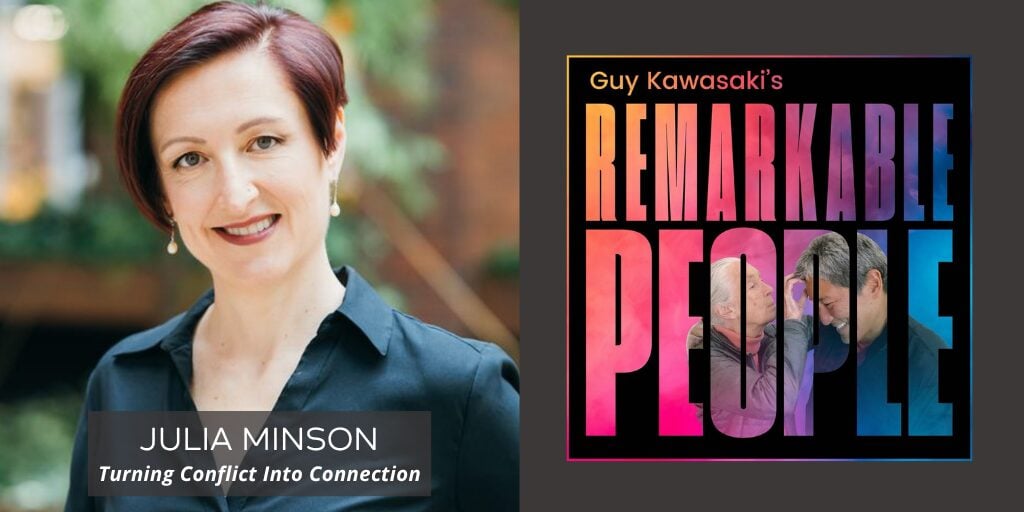
Welcome to Remarkable People. We’re on a mission to make you remarkable. Helping me in this episode is Julia Minson.
Julia is a behavioral scientist, professor at the Harvard Kennedy School, and one of the leading experts on conflict, negotiation, and communication. Her work focuses on a question that feels more urgent every year: how can people disagree without destroying relationships? In her new book, How to Disagree Better, she shares research-backed strategies for handling difficult conversations with more curiosity, receptiveness, and respect.
In this episode, we dive into why disagreement itself isn’t the problem—it’s how we handle it. Julia explains the concept of “constructive disagreement,” where the goal isn’t necessarily persuasion, but creating a bridge to future conversations. She also breaks down the “receptiveness mindset,” a way of approaching opposing views with curiosity instead of defensiveness. Along the way, we discuss why people overestimate their objectivity, why body language matters less than most people think, and why asking thoughtful questions often works better than trying to win arguments.
One of my favorite parts of this conversation is Julia’s practical HEAR framework: Hedge your claims, Emphasize agreement, Acknowledge the other perspective, and Reframe toward the positive. These small language shifts can completely change the tone of a disagreement without forcing you to abandon your beliefs. Whether you’re navigating political debates, workplace tension, or Thanksgiving dinner with family, Julia offers tools that make conversations more productive and far less combustible.
This episode challenged many of my assumptions about persuasion, influence, and communication. Julia reminds us that the best conversations aren’t the ones where somebody “wins”—they’re the ones where both people still want to keep talking afterward. And these days, that might be one of the most valuable skills anyone can learn.
Please enjoy this remarkable episode, The Science of Better Disagreement with Julia Minson.
If you enjoyed this episode of the Remarkable People podcast, please leave a rating, write a review, and subscribe. Thank you!
Transcript of Guy Kawasaki’s Remarkable People podcast: The Science of Better Disagreement with Julia Minson.
Guy Kawasaki:
Good morning, everybody. I'm Guy Kawasaki. This is the Remarkable People Podcast, and for the umpteenth time, I'm telling you that we scour the Earth for remarkable people so they can inform and inspire you. And of course, we found another remarkable person. Her name is Julia Minson, and she's a behavioral scientist.
She just wrote a new book. It is called How to Disagree Better. I got to tell you, I love titles that begin with “how” because there's no question about what it's about, right? You know these, like, esoteric titles and now we know. Well, guess what the book is about? Oh, it's how to disagree. Oh, yeah, it doesn't take a rocket scientist.
So more on her introduction, she's on the faculty of the Harvard Kennedy School, and she's a Professor of Public Policy. But basically, she's just an expert on disagreements and negotiations and stuff, and oh my God, we could kind of use that these days. Welcome to the show, Julia.
Julia Minson:
Thank you so much. It's great to be here.
Guy Kawasaki:
So Julia, can we start with a very interesting question? Because you being an expert in negotiation this might be a very weird question, but as I sit here and I think about it, what is the point of war? Whoever benefits from a war? I don't understand. Why do people go to war?
Julia Minson:
Oh, that's a great question. I think I would be a lot better off if I had the answer. I think like any kind of conflict, people desire what other people have, and they say, "Well, if I can't take it through persuasion, if I can't take it through negotiation, then I'm going to take it by force." And we see that certainly, like I say, in armed conflict. We also see that in other aspects of life.
Guy Kawasaki:
Yeah. I don't want to point out the obvious, but it seems to me that men believe this more than women, right? Am I missing something?
Julia Minson:
I am not an evolutionary biologist. That's not my field. But in almost every, not in every species, there's plenty of species where females are more aggressive than males, but the species that are the closest related to humans, all the great ape species, males tend to be more aggressive than females, or at least that's what I remember from college-level evolutionary biology.
Guy Kawasaki:
I'm going to introduce a piece of very irrelevant trivia here, but I read your book and your family, I think I got this right, comes from Yekaterinburg. Is that right?
Julia Minson:
I was born in Yekaterinburg, yes.
Guy Kawasaki:
So I want to tell you that I'm probably the only podcaster who's going to interview you who has been there. I have been to that city. I went for a big tech conference, and all I can remember is that there was this troupe of little old women dressed in Russian whatever, I don't know, Yekaterinburg attire, and these little old ladies, I loved them.
I had so much fun with them. So I just thought I'd mention that so I can build up my credibility and see if we can agree on even more. Can I just ask you a few more difficult questions, and I promise you we'll get to the book.
Julia Minson:
Let’s go for it. I love difficult questions.
Guy Kawasaki:
All right, so now, let's hypothetically say that Donald Trump called you up and said, "Julia, could you just coach Jared Kushner and Steve Witkoff a little bit? Can you give them a little help about how we can get some agreement in Iran and work this out?" First of all, would you take the job, and then what would you tell them?
Julia Minson:
I would take the job because I think that diplomacy is incredibly important, and I have great faith in the power of better conversations to lead to better results.
And actually, I wouldn't tell them things. I would start by asking them things, and that is trying to get a genuine understanding of what people's goals are because I think in international diplomacy, surprisingly, just like in family diplomacy, people have many complicated goals.
And sometimes the goal of looking good in front of the boss, actually resolving the conflict, making sure that you don't lose face with your constituency, making sure that the resolution you arrive at doesn't have great economic costs to your own side, there are many, many, many goals that people have.
And I think often people in dialogue, even very experienced and very seasoned people in dialogue, forget what their goals are or don't thoroughly untangle them before they start talking.
Guy Kawasaki:
It couldn't be any harder than negotiating with your daughter about her back, right? And back pain, right? This is an inside joke in her book. Julia explains a situation where her daughter was having back pain, and it was basically a slice of life.
It was sort of Iran on steroids in that manner. That was a great part. Listen, every parent, when they read that section, they'll say, "I've been there, done that." It was incredible. Yeah. So listen, there's so much disagreement. There must be some benefit to disagreement. So what is the benefit of disagreement when it is handled well?
Because people can disagree. It's what happens after the disagreement, right? So what could go right?
Julia Minson:
Absolutely. Disagreement could be super interesting and super fun, right? You could sit down to negotiation professors and talk about different ways that we would advise Jared Kushner, and we would all say slightly different things, or even very dramatically different things, and that could be a super interesting conversation.
You could imagine you are with your business partner, and one person says, "Look, we need to increase our marketing budget because we need to be reaching more customers." And your partner says, "No, we actually need to decrease our marketing budget because we don't have the current cash flow."
And having that conversation and really thoroughly exploring both perspectives could prevent some major errors in how you run your organization. You could have a conversation with a friend about, "This is what I think the ending of Stranger Things really meant." And they say, "No, that's not what I think it meant."
And that could just be like a fun debate. So disagreement comes up anytime different people have different beliefs and different information, and so it is often fun and useful and informative and can really prevent us from making some truly catastrophic errors. So there's a lot of good that can come from it if we do it right.
Guy Kawasaki:
And why don't we do it right more often?
Julia Minson:
I think because most of the time when people have an opinion, and this is going to sound completely obvious. They think that opinion is correct.
Guy Kawasaki:
No.
Julia Minson:
Like, why would you say a thing or why would you believe a thing if you thought it was wrong? And so you have two people who are convinced of the correctness of their own opinion, and then you get into this really strange sort of situation of like, "Well, why doesn't this person agree with me?"
And in trying to explain that to yourself, in trying to reconcile the strength of your own beliefs with the obvious fact that this other person doesn't agree, we often arrive at a conclusion that there's something wrong with the other person.
You're like, "Oh, that person just hasn't read the news," or "That person doesn't really understand how investment strategy works," or "That person hasn't actually thought hard about their approach to parenting, and so I'm going to inform them about the right way to think about this." And once you start down that path of fixing the other person, that's when we get in trouble.
Guy Kawasaki:
So instead of trying to fix the other person or prove the other person wrong, mentally, what should your goal be when you're in a disagreement?
Julia Minson:
It's not that there's a goal you have to have, it's more that you need to know what your goal is, and is your goal realistic, and is what you're doing serving that goal? And so quite often, the goal we fall into most kind of thoughtlessly is a completely unrealistic one, which is that I'm going to convince them that they're wrong and I'm right.
I'm going to show to them that their behavior is inappropriate or ill-suited to the situation. And then, once we're done, they're going to change their behavior, change their mind, like apologize to me, thank me, and then it's all going to be fine. And I think that is a super unrealistic goal because most of the time the other person is doing exactly the same thing.
And so you're in this tug of war, but you can have other goals. You can have the goal of, let me understand why they believe what they believe, or let me try to have this conversation in a way that doesn't damage our future relationship. Or let me try to have this conversation in a way that makes my boss who's looking on, believe that I'm really smart.
Or let me just pass the time because we're stuck here and I'm bored and it's half an hour to waste and let's just have fun. So you can have many goals in any conversation, and I think the issue is that most people fall into the goal of changing the other person's mind without thinking hard about what exactly they're doing and why they're doing it.
Guy Kawasaki:
So Julia, as I was reading your book, one thing that struck me was that there's no sort of reference to the old things about zero-sum games and win-win and all that kind of stuff. So are you just breaking from the past? Like, where does this, you know, Getting to Yes and all this kind of stuff fit into your theories?
Julia Minson:
That's a great question. Getting to Yes is a negotiations framework. It's a book that sets out kind of the negotiations framework that we have all been teaching for the last forty years. And negotiations often have no conflict.
If you're selling a bicycle and I'm buying a bicycle, we are actually getting along just fine because you have something I want and I have something you want, and we can have a perfectly pleasant interaction. And in the Getting to Yes framework, like we can come up with some win-win solution where, you know, in addition to the bicycle, you like throw in a lawnmower.
There's value to be created, but that's different than conflict. You could imagine a negotiation that has conflict in it, or you could also imagine a conflict where there's just nothing to negotiate.
So if we disagree about the death penalty, for example, we are not actually negotiating policy, you and I, and sort of like what we believe about it doesn't neatly fit into a let's reach a value-creating solution that expands the pie for both of us. So there are definitely negotiation concepts that sort of apply to conflict.
So for example, we talked about goals you have, and so if you think about goals, you can consider like persuasion as a zero-sum goal because the more one person feels like they're winning, the more the other person feels like they're losing.
And you can think of us learning from each other as a value-creating goal because both of us can learn without the other person learning any less. So I think there are negotiations frameworks that apply quite a lot to conflict, but negotiations and conflict are different ideas that just happen to often happen at the same time together.
Guy Kawasaki:
So in a sense, the bottom line is both people can be right, right? It's not the case that only one person is right and one person is wrong, right?
Julia Minson:
Yeah, exactly. And I would say that 99.9 percent of the time what it is, is that both people are wrong, right? They're somewhat wrong, right? Like none of us know all the things about any topic. And if you claim that you think you know what needs to happen in Iran, like you haven't done enough reading.
Nobody knows everything, and so usually when two people disagree, both of them are wrong to some extent.
Guy Kawasaki:
So you have introduced into my brain an oxymoron, and I want you to explain this oxymoron. The oxymoron is constructive disagreement. What in the world is constructive disagreement?
Julia Minson:
Everybody's searching for a term, right? People talk about productive conflict or, whatever, civil disagreement, all of these sort of inquiry, all of these different things that captures this idea that people can disagree and good things can come from it.
And I think it's important to have the word disagreement in there because I think, sometimes people talk about civil discourse, for example, or dialogue, and those two things, discourse and dialogue, both give up on the idea that I actually have an idea and that idea differs from your idea, and our ideas are at odds, and that's disagreement. It is what it is.
But what is a good disagreement, what are we driving towards? And I think that a good disagreement is a disagreement that leads us towards another conversation, that sort of increases the chances that we're going to have another conversation.
And so that's what I call a constructive disagreement because it's almost like, I have this metaphor in my mind of constructing a bridge into the future towards another conversation. We didn't destroy the relationship. We built on it so that we can have another conversation.
Guy Kawasaki:
Isn't that kind of a low bar? The goal of this conversation is just to have another conversation?
Julia Minson:
Sure, but also think about the number of times we've all failed at it, most disagreements I have don't inspire me to go back and say, “That was a really interesting conversation. I would like to clarify this one thing this person said. I'm going to go back and I'm going to talk to them again."
Or "This person is not as bad as I thought they were, and I would like to further explore where their beliefs come from." I think in important disagreements, that's an incredibly rare outcome.
Guy Kawasaki:
Yeah. If you think about it, there's not a lot of people in Islamabad right now, right? So obviously they're not continuing the conversation, which is part of the problem, right?
Yeah. Okay. Another term you introduce in my vernacular is naive realism. You're just the queen of oxymorons here. So can you be naive and realistic or realistic and naive? What is this term?
Julia Minson:
Yeah. So it's actually a term that was imported into psychology from philosophy by my PhD advisor, Lee Ross, so I'm not responsible for the contradictory words, but the idea is that people naively believe that their perception of the world around them is a reflection of an objective reality.
I see the world as it is. And so I see a reality and I think, Yep, that's what there's out there. I get it. I am a smart, reasonable, objective person. And of course, that view is naive. It's unsophisticated. It's like we all know that what we observe is mediated through our sensory organs and our life experience and our biases and our emotional states.
You see this most vividly with your sort of sensory inputs. If you are looking at the same object in different light, it can literally look like a different color, so it's not that you're a direct perceiver of even physical objects. And that's even more true when you're talking about complex interpersonal phenomena like disagreement.
So you see a person, and they're flying off the handle and you're like, "Oh, that person is angry and irrational and has a bad temper," and you just assume that's what it is, and that's the naive part is like the automatic assumption that you get it. Whereas of course, in reality, there's a million explanations for why a person is yelling and flying off the handle.
And we often don't question our beliefs to discover what the more complex story might be.
Guy Kawasaki:
All righty. So let's suppose that you sense a disagreement is coming, what should you do?
Julia Minson:
One, you should consider, what your goals are in this disagreement. Who are you disagreeing with? Do you need to have the disagreement?
If it's again, somebody you work with bringing up a different approach to a project or a different approach to a strategy, you might say like, "Yeah, I need to talk to this person. I need to have this disagreement because this could be valuable."
If it's your family member who expresses some political opinion that really rubs you the wrong way and you get upset and you get frustrated, you might say to yourself, "Look, I don't want to feel negative and resentful towards this person. I'm going to ask them about their beliefs so that I can better understand what's going on."
And if it's like a person at a cocktail party who says something crazy about your shoes, you're like, "I don't need to have this conversation, forget it. Like there's no point to this.”
Guy Kawasaki:
I think most people in the family situation take the attitude of the cocktail situation, which is this Thanksgiving we're not talking about vaccines, we're not talking about the war, we're not talking about Donald Trump. It's not optimal, but is that the way to at least avoid a problem, or is that just pushing the can down the road?
Julia Minson:
Yeah, I think it's pushing the can down the road, and it's not even necessarily down the road, it's more like under the rug because what happens is somebody in your family says something or a friend says something, and you often come up with an entire story to fill in all the stuff you don't know.
“That's just what he believes because he's a man, and he's always enjoyed all these privileges, and his generation, and remember how he was raised, and this is the thing that Grandma and Grandpa did to him, and that's why he is the way he is.”
And so you kind of spin up this whole story in your head around a comment that you probably don't fully understand, and then it lives rent-free in your mind, you have this now set of beliefs about this person that are maybe more negative than they deserve, and it has an impact on the relationship.
And then other topics that are adjacent, you have to like tiptoe around and avoid. And so I think it does exert a real cost, but my approach that I'm suggesting as an alternative, I think the reason people don't take it is because they've been burned before.
Because our default is so much about persuasion and about changing the other person's mind and telling them how wrong they are that we have accidentally ended up in conflict so many times that we are afraid to approach the topic for fear that we will end up yelling at each other again.
And there's many ways to avoid yelling at each other, and this is part of what I'm trying to remind people of.
Guy Kawasaki:
So what happens, Julia, if you and Bob Cialdini walk into a bar and the “father of influence” and the mother of better disagreement. In a sense you're saying that trying to influence and persuade someone is not the right thing because you're fundamentally just trying to change the person, and Bob Cialdini is all about influence and persuasion. So the two of you go in a bar and what happens?
Julia Minson:
We have an amazing conversation. I buy the man a drink because he is such a huge influence on my field. I was reading Bob Cialdini as a freshman in college, so I think that persuasion and receptive dialogue are solutions to different problems, so if I am talking to an objective, unbiased audience, and I want them to take a particular action, then every tool of persuasion is in my wheelhouse.
And I'm not saying that persuasion is wrong. I'm saying that when you have people who have explicitly opposing views, most of the time the attempt at persuasion happens before we understand what the other person's view is or often what our own view is. Like for example, Bob's most classic book, Influence, was about sales.
You walk into a situation as a salesperson where there's a customer, you're trying to persuade them to buy a particular thing. It's not like that customer is vehemently opposed to buying that thing because after all, they are in a store talking to a salesperson.
What we're talking about is situations where people are vehemently opposed to each other's positions, and so I think the bag of tricks needs to be different for that situation.
Guy Kawasaki:
Arguably, I could make the case that if you were an expert in disagreement, you in fact would improve your ability to influence and persuade, right?
Julia Minson:
Absolutely. In part because, this is back to this conversation about what a constructive disagreement is, and the idea of building a bridge to the next conversation. You cannot persuade a person if you burn the bridge. Most of the important topics in the world are not decided in one conversation.
Most of the really big meaty disagreements need multiple conversations. And so this skill set around disagreeing constructively in a way that makes people want to talk to you again is how you give yourself more chances at influence.
Guy Kawasaki:
Okay, so this is a good segue to the next concept, which is not an oxymoron, and this concept is the receptiveness mindset. I love mindsets. I love Carol Dweck with the growth mindset, who was probably at Stanford when you were. So what is the receptiveness mindset?
Julia Minson:
So the receptiveness mindset is a sort of mental habit of trying to treat information that opposes your beliefs in the same manner that you treat information that supports your beliefs. So most of the time when we think about, Okay, what do I want to read? What do I want to listen to?
We naturally gravitate towards information that is in line with our thinking, which is a little bit odd because, of course, we're minimizing learning. I'm consuming more and more of what I already knew, so it's unclear what exactly I'm getting from it, but people have a tendency to consume more and more information that they agree with and avoid information they disagree with.
This is what we call selective exposure. We also have a tendency to counter-argue in our minds with information we disagree with. So even if I am forced to listen to something that I disagree with, what I'm often doing is just poking holes in it the entire time. I'm like building my own argument even as I am listening.
And people are pretty good at that, so we are very aggressive, I would say, in finding flaws in opposing arguments, and then we are pretty loosey-goosey with the arguments for our own side. We don't really subject them to very much critical scrutiny. So the receptive mindset is the idea of treating information you disagree with in the same way that you treat information that you agree with.
So you seek it out, you think hard about it, and then you try to find merits in arguments you disagree with and flaws in arguments that you agree with. You're trying to be even-steven about information processing.
Guy Kawasaki:
So let's say I buy into this receptiveness mindset, and now I'm saying like, “How can I increase the crucial factors of curiosity and respect and tolerance? What do I do? I'm a believer.” Now how do I increase these factors?
Julia Minson:
I think any project of self-improvement usually fails when people go too far and too fast. And it's like when you want to exercise more. You don't want to start with, like, a major cardio and weightlifting program. You want to go for a walk and then, start taking the stairs instead of the elevator, that sort of thing.
I think receptiveness is similar, where I would say, if you are, for example, a liberal, you don't want to go on a steady diet of Fox News to really understand what the other side thinks.
That feels like it's a bridge too far, you do want to set aside maybe a few minutes a day to read something or listen to something from very high quality conservative sources so that you start understanding what the other side thinks but in small bites. And from sources you trust and maybe on topics that are not your most triggering topics. I would say consistency and baby steps.
Guy Kawasaki:
You're asking a lot of me, okay?
Julia Minson:
Sorry.
Guy Kawasaki:
One of the most interesting things that I read in your book, at least for me, was that words are more reliable than body language. I hope I got that right? That also was very counterintuitive because I was always believing the body language doesn't lie. People can spout out words, but the body language doesn't lie, and you make the opposite case. So can you explain that, please?
Julia Minson:
Yeah, body language lies all the time. Most people are actually really, really bad at reading body language, and it's sort of not surprising, like, recipients are bad at reading body language, right? Observers, but also the person trying to express themselves through body language is usually really bad.
So it's all just like very, very noisy. One of my favorite examples is people always talk about having a closed posture versus an open posture. And if you look around any room of people when you're speaking, half of them have their arms crossed. And it's not that they have a closed posture and they don't want to hear you, it's like half of them are cold.
If it's a woman with crossed arms, it's probably that she's cold in an overly air-conditioned office room, half of them just have bad posture, so I cross my arms because I have bad posture and I'm just like comfortable having a rounded back. There's so many things we do with our bodies that communication is like the last of it.
So words are the number one toolkit that every human society has developed for explicitly the purpose of communicating. Words are there for communication. And so we are quite good at expressing ourselves with words, and we're quite good at interpreting words. Now, can you lie?
Certainly, but disagreement is special because if I am listening to you and I am open to you, and then if I try to use words to fake openness and receptiveness, ironically, I have to be open and receptive because like I can't fake receptiveness without restating your perspective and asking you thoughtful questions and signaling some agreement and modifying my own claims.
So faking receptiveness starts looking a whole lot like real receptiveness and pretty much does the same thing.
Guy Kawasaki:
I have to say, Julia, like my head is exploding a little bit because every other schmuck in Silicon Valley, I think I'm very good at reading people's body language, and now I'm walking into this crowd and I see people with their arms crossed and I'm going to think, Oh, they're just cold. They really love me.
Julia Minson:
You don't know they love you. You have no idea, but they're probably cold.
Guy Kawasaki:
What if you're in Hawaii though? Okay, now can people fake receptiveness? You basically said even if they're faking receptiveness with their words, their words are encouraging them to be receptive. Did I get that right?
Julia Minson:
Yeah, I think so. This question of faking receptiveness is really interesting, and it's actually a lot of what I'm working on right now, in terms of research. Like certainly you can fake it, so I can teach you the right words to say to sound receptive, and you can fully do it.
But then the question becomes, what's the harm, like you are trying really hard to be a better person, and you're not doing it genuinely, like from the depth of your soul. You're doing it because you decided you want to try it and you're getting a little bit of a leg up, and I think that's okay.
The example I use in the book is, if you are learning to play music and you're not a composer, you are sitting in front of the piano and you're reading sheet music as you're playing, people don't judge you for being a fake musician. You're still playing the piano and it's still really hard.
And I think with receptiveness, there's this idea that it needs to somehow be authentic and deeply grounded, and I think that sets a standard that most people fail at, and so they don't even bother trying. I would much rather everybody be faking receptiveness than everybody be yelling at each other in a completely genuine manner.
Guy Kawasaki:
What are these magic words that will help me fake receptiveness and inadvertently make me more receptive because I want to put them at the top of my list of my vernacular?
Julia Minson:
We developed this toolkit using natural language processing, so literally analyzing thousands of transcripts. And so it's very bottom up. So we wrote an algorithm that pulled out words and phrases that make people feel heard, and then it ends up being a very, very long list.
But you can boil it down to the words and phrases that matter the most, and then you can make a cute acronym out of it so people can remember it better. The acronym is H.E.A.R., as in I hear you. So the “H” in H.E.A.R. stands for hedging your claims. It's phrases like maybe, sometimes, some people, perhaps.
I might want to say, "Look, the COVID vaccine is safe and effective," or I could say, "Most people tend to believe that the COVID vaccine is largely safe and effective." So I just shoved three hedges into one sentence, which is a lot. But ironically, I came up with a more accurate statement that sort of reflects the complexity of the world in a better way than the more absolute statement.
The “E” in H.E.A.R. stands for emphasizing agreement. So I like to remind folks that being receptive to somebody doesn't mean that you agree with them. It just means that you're interested in understanding their perspective, but any two people who disagree on anything have some stuff they agree on, so some set of values, some set of goals.
So emphasizing agreement can be done with words like, "I also want to," or "Both of us are interested in," or "I agree with some of what you're saying," so it could be something like, "I am also interested in coming up with a policy that treats all of our employees fairly."
And so just taking a few seconds to emphasize what you do agree on puts you on the same team. The “A” stands for acknowledgement. So acknowledgement is probably the one that people are the most familiar with. And it's just taking a little bit of time before you get into your spiel to show the other person with words that you were listening while they were talking.
So it's phrases like, "I understand that," or, "I hear you saying that," or "It seems important to you that," XYZ. The thing that's interesting about acknowledgement is I think a lot of people are aware of it, but we're also incredibly lazy. So lazy acknowledgement is "I hear you, but here's why we can't extend the project timeline."
And it's like, "You said you hear me, but you don't really hear me," or, "At least you haven't proven to me with your words that you hear me."
A better form of acknowledgement would be something like, "I hear that you're really concerned about delivering the product on time, and this client has changed the requirements multiple times, but here's why we can't extend the project timeline."
So the outcome is the same. I haven't agreed to the request, but I've shown with my words that I was listening when the other person was talking.
And finally, the “R” stands for reframing to the positive. So reframing means avoiding negative and contradictory words like no, can't, won't, don't, hate, terrible, and trying to replace them with more positively balanced words like great, terrific, appreciate.
So I might want to say, "I hated when people rush me into stressful decisions. Please don't." Or I could say, "I really appreciate it when people give me time to consider important decisions. Thank you so much for understanding."
So the idea with the H.E.A.R. framework is that you can say exactly what you want to say, but you can do it in a way that shows your counterpart that you've been listening to them when they were talking, and you are keeping their perspective in mind even as you're advocating for your own.
Guy Kawasaki:
And at the end of this use of this acronym, the real sort of acid test is can we have another conversation?
Julia Minson:
Exactly right. Because I think what often happens with the kind of conflict management advice that has been around for many years is that people say, “You should ask questions. You should be curious. You should listen better," right? And so let's say I do all of those things, and you got to talk, and then I'm like, “Guy got to talk, but what about me? When do I get to talk?"
And so then I take my turn, and I say all my stuff, and now you are annoyed and resentful because my argument completely overruled your argument. And so there's the end to the constructive dialogue. The H.E.A.R. framework gives you a chance to make your point while still showing the other person that you were listening.
So it's like I don't have to be your therapist, and I don't have to never say what I believe, but I can say what I believe without setting the conversation on fire.
Guy Kawasaki:
So the next time my family gets together, there's a particular person in this family, and I'm going to say, “I acknowledge your skepticism about the use of vaccine. Many people believe that vaccines are safe and useful, and I just want to emphasize that both of us are concerned about the health and welfare of our family. So we will have to just look at this different, like we're both trying to get the same goal. And I'll see you next Thanksgiving when we can discuss this again." How's that?
Julia Minson:
That's pretty good. And this is what I tell people is if you want to get good at the H.E.A.R. framework, it's fun to make fun of it. If you can come up with examples of it that border on ridiculous, that's how you hone the skill, so that when you do see the person at Thanksgiving, it just rolls off your tongue.
Guy Kawasaki:
It's April, so man, I got half a year to practice.
Julia Minson:
Yeah. Do one a day. You'll have 150 repetitions by the time it's Thanksgiving.
Guy Kawasaki:
I'm going to go look for situations where disagreement would tend to happen so I can have a lot of practice. You dove very deep into a topic that is very dear to my heart, which is the power of personal narratives and stories.
Julia Minson:
Yeah.
Guy Kawasaki:
So now, give us the gist of why personal narratives are so powerful.
Julia Minson:
I think personal narratives are just very humanizing, and in my research, we focus specifically on personal narratives that reveal something vulnerable. Imagine, so like I'm a first-generation immigrant, and imagine I was making a case for immigration.
Imagine I said, "Well, you know, I came to this country, and now I'm a Harvard professor, and I have this book, and because my life is so great, we should let more immigrants into the country." That doesn't sound very compelling. That sounds like me bragging.
Guy Kawasaki:
It does sound compelling to me, but okay.
Julia Minson:
If I said, "I'm a first-generation immigrant, and let me tell you about how hard my family worked and all the struggles we overcame and how hard it was to go to American public schools, speaking terrible English and wearing secondhand clothes."
People start relating to the story in part because I'm sharing something vulnerable and potentially a little embarrassing. And so when you do that, people say, “She must be telling the truth because why would you say this embarrassing thing unless you mean it?"
So part of what makes personal narratives powerful for building trust and disagreement is that it convinces your counterpart that you aren't just making up abstract numbers and trying to sound superior and win the argument. You are showing a little bit of your delicate emotional underbelly.
Guy Kawasaki:
And what if I ask the flip side of the question, which is how do you resist a personal narrative? Because a personal narrative is not exactly the scientific method. You could be the only person who did this, right?
So I smoke a pack a day for ninety years, still alive, I'm healthy. Smoking is not bad for you. That's a personal narrative. So how do I resist personal narratives when some very smooth person is using it on me?
Julia Minson:
This gets back to the question of, what is the goal? If you think of the goal as persuasion, then I need to resist, I'm worried that all of a sudden because your personal narrative was so compelling, I'm going to start smoking a pack a day. That seems a little silly because I'm probably not going to smoke a pack a day.
If we think of the goal as understanding, and your narrative seems like completely out of line with my experience and my expectations and what I know about public health, it becomes another opportunity to ask questions.
Like, "Well, why do you do that? And how do you think about the scientific evidence? And what does smoking do for you? And have you ever tried quitting? And what would quitting look like?"
There's a million questions you could ask, if we are in a conversation where we're trying to understand each other, not when we're in a conversation that's like a battle of wills where we're trying to persuade each other.
Guy Kawasaki:
Yeah, the personal narrative that I just abhor is when these successful people say, "I didn't go to college. College isn't necessary. You don't need to go to college." Maybe that's true for you, but it might not be true for most people, and that personal narrative is a very dangerous one to me.
My friend at the University of Chicago, Dan Simon, says, "Whenever you hear a story like that, ask what's missing," which is, yeah, you didn't go to college and you're successful. What about the people who didn't go to college and aren't successful? The people who went to college and are successful, like 500 of the Fortune 500 CEOs?
So, all right. I got one last question for you. I want to know who is in the Julia Minson Hall of Fame of someone who really knows how to disagree. Who's your hero here?
Julia Minson:
Somebody who really knows how to disagree. Can I go famous and not famous?
Guy Kawasaki:
You can do whatever you want.
Julia Minson:
I can do whatever I want. I would say famous and alive, I think Barack Obama is incredible at having conversations across disagreement, or at least what we see publicly. There's a lot in his sort of public speaking and in his writing that really reflects an understanding of what people who he strongly disagree with believe, and so I think that's very admirable.
Not famous, my business partner and co-founder of Disagreeing Better, Heather Sulejman, is an incredible disagreer. We disagree all the time, and every time I say, "Oh my God, I can't believe she just did this better than me." That's embarrassing on a daily basis.
Guy Kawasaki:
Madisun, do we disagree very often? Whenever we have a disagreement, I tend to believe that Madisun is right and I'm wrong because statistically.
Julia Minson:
There we go. When people pay attention to base rates, they often get things right.
Guy Kawasaki:
I believe that behind every successful man is an amazed and an amazing woman. All righty, I am going to let you go and proselytize disagreeing better in the world. Julia Minson, thank you very much. Everybody remember, this is her book. It is called, very, very self-explanatory, How to Disagree Better. And oh, we can send a Kindle copy to some members of the administration to help them.
Thank you very much. I enjoyed reading your book. I enjoyed interviewing you, and I am going to go practice for the upcoming Thanksgiving dinner where we can discuss vaccination in a very receptive manner.
Julia Minson:
There we go. Just a few minutes a day, you'll get there.
Guy Kawasaki:
It's like flossing.
Julia Minson:
It's just like flossing. Thank you so much. It was so nice to chat with you.
Guy Kawasaki:
Thank you. Let me thank the rest of my crew. So there's Madisun, there's Jeff Sieh, who's co-producer, and there's Shannon Hernandez, sound design engineer. And because I'm deaf, we put a lot of effort in our transcript and the background research.
That's why I know all the dirt about you and Yekaterinburg. And I hope your daughter’s back is better now. So that's Tessa Nuismer who's providing background research and transcription services. So that's it. That's the Remarkable People team. Thank you very much, Julia Minson.
Julia Minson:
Thank you.
Sign up to receive email updates
Enter your name and email address below and I'll send you periodic updates about the podcast.


Leave a Reply