
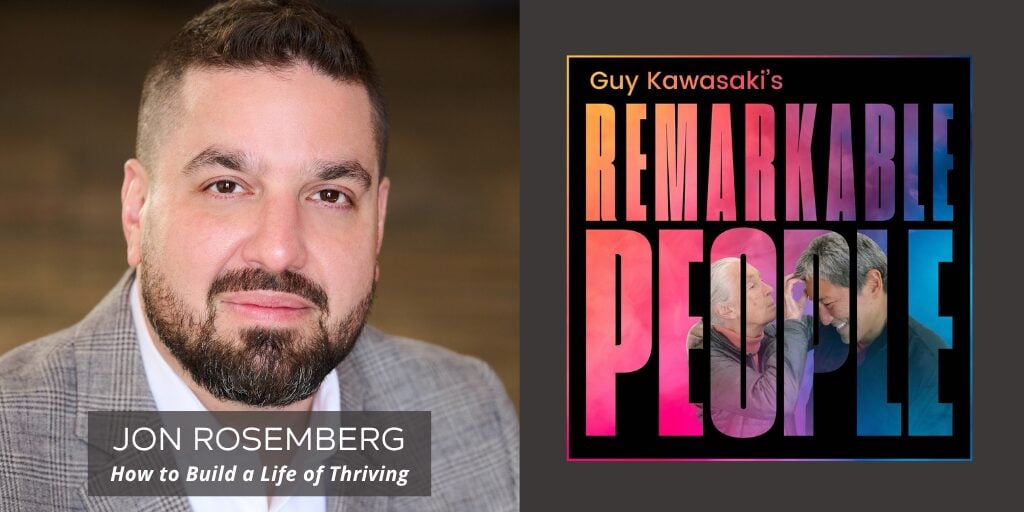
Welcome to Remarkable People. We’re on a mission to make you remarkable. Helping me in this episode is Jon Rosemberg.
Jon is an executive coach, entrepreneur, and expert in human thriving. After decades in the corporate world, including leadership roles at major global companies, he began questioning why so many outwardly successful people still felt anxious, disconnected, and stuck in survival mode. That journey eventually led him to write A Guide to Thriving, a book focused on reclaiming agency and building a more intentional life.
In this episode, we explore the hidden gap between success and fulfillment. Jon shares how his family’s history of fleeing political instability shaped his understanding of survival, and how a pivotal moment playing Lego with his sons forced him to reevaluate everything he thought achievement was supposed to provide. We also dive into his AIR framework—Awareness, Inquiry, and Reframing—and how people can use it to navigate stress, burnout, uncertainty, and difficult transitions. Along the way, we discuss neuroplasticity, mindfulness, Viktor Frankl, Hannah Gadsby, and why so many people confuse external accomplishments with genuine thriving.
What makes Jon’s perspective stand out is that it isn’t abstract theory. His ideas come from lived experience, years of coaching leaders, and a willingness to challenge the way modern culture defines success. This conversation is filled with practical insights for anyone who feels overwhelmed, burned out, or trapped in the constant pursuit of “more.” If you’ve ever wondered whether achievement alone is enough, this episode offers a thoughtful roadmap toward a more meaningful and connected life.
Please enjoy this remarkable episode, Break Old Patterns, Reclaim Your Agency, and Find Meaning with Jon Rosemberg
If you enjoyed this episode of the Remarkable People podcast, please leave a rating, write a review, and subscribe. Thank you!
Transcript of Guy Kawasaki’s Remarkable People podcast: Break Old Patterns, Reclaim Your Agency, and Find Meaning with Jon Rosemberg.
Guy Kawasaki:
Hello, everybody. It's Guy Kawasaki, and I hope you like my tan because I just got back from Hawaii and Surf Ranch, so I've been surfing a lot, so I'm nice and tan.
And I'm trying to get the remarkable tan because we have a remarkable guest. His name is Jon Rosemberg. It's an “E-M,” not “E-R-N,” Rosemberg. And what this remarkable person does is he helps people move from survival mode to thriving mode, which is really a remarkable thing to do.
He's the CEO. He's a coach. He's total package. He has an MBA from Cornell University and a Master’s of Applied Positive Psychology from the University of Pennsylvania. So today we're going to explore this process of going from surviving to thriving, right?
Jon Rosemberg:
Yes, and Guy, it's such an honor to be here with you, and I think it's interesting that we talk about this state of survival mode often. I've asked hundreds of people, "Have you ever felt like you're in survival mode?" And everybody I've asked, except for two people, and let's not get into the outliers, has said to me, "Yes, I've felt what being in survival mode is."
Guy Kawasaki:
And that's even true right now, whatever these people's conditions are. Like, are you saying these people were set and everything? They're starving or they're doing okay?
Jon Rosemberg:
Not necessarily. So let me ask you, Guy, have you ever felt like you're in survival mode?
Guy Kawasaki:
I'm going to ask you for the definition of survival mode, but to be honest, I cannot tell you that I've thought I was in survival mode for a very long time. And, you know, it's not like I'm a trust fund baby. I come from a lower middle-income family, and I've had a wonderful life.
I don't have one of these Horatio Alger, arrive at the Statue of Liberty with a suitcase and one underwear. Man, that kind of shoots down my credibility as a podcaster interviewing somebody about the survival mode if I cannot say. Maybe, yeah, I've been in a survival mode constantly, Jon.
I don't know how I'm still here. How's that?
Jon Rosemberg:
I love it. Let's define survival mode then. I think that would be really helpful. I think of course there's the survival mode that people who are in war zones or who are living in extreme poverty are experiencing, and that's one type of survival mode. And listen, growing up in Caracas, Venezuela, I knew what it was like to be in that state of survival mode.
Why? Because Venezuela became a very dangerous country. The year that I left the country, by some estimates there were 52,000 violent murders in Venezuela, which meant that when you left your house, it was a bit of a gamble. You didn't know if you were going to come back or not. So it was kind of like a war zone.
And so that's one type of survival mode. And by the way, living in Caracas during those times, being in survival mode saved my life. So survival mode is not necessarily a bad thing.
I think people try to look at it as this. There's this horrible thing that's happened to me, no, it's our bodies and our minds focusing on our survival. Now, the survival mode that I'm referring to is more kind of like a chronic state where we feel like our life is at risk.
I spent two and a half decades in the corporate world, Guy, and a lot of us who worked in offices or who work, we know what it's like to wake up in the middle of the night, sweating because we don't know if we're going to get fired the next day, or because suddenly were given a boss who's a micromanager and finds fault in every little thing that we do.
So it's this state where even though physically our life is not at risk, maybe we have food, and we have a home and a roof over our heads, and we have a family, and we have a lot of resources around us. Even though we have all of that, we still feel like as saber-toothed tiger is chasing us in the savanna.
And that can be very, very challenging. The thesis of my work is that over the past twenty-five years, there's been a lot of research around how we get out of survival mode and step a little bit more into thriving. And by the way, I'm framing them as a binary for the purposes of our conversation, but I don't know that there are many things in this world that are binaries and that simple.
I think there's a lot of complexity there. So the way I describe it is as a spiral, more like a spiral. Sometimes we're thriving more and surviving less, and then something happens. You lose your job or you get a diagnostic, and you get sent right back into survival mode.
So over the past twenty-five years, there's been a lot of research and a lot of work done on the science of thriving, of human flourishing, of positive emotions, of how do we get through life in a different way.
And my intention was to compile a lot of that stuff. That's the work that I've been doing because it served me, transformed my life. Now, that doesn't mean that I'm never in survival mode. I spend a lot of time there just like everybody else does, but I have been able to find more moments of thriving in my life, and I find that to be really, really powerful.
Guy Kawasaki:
I found when I started reading your book and God, I blew it. I forgot to mention your book early. So in case anybody's dropping off listening to this podcast, what a mistake that would be. But this is the book that he has written about thriving. It's called A Guide to Thriving.
What a descriptive title. I love descriptive titles. It's like naming a book, Everybody Has Something to Hide. What a great title. Anyway, besides the point.
So listen, when I started reading your book, I said to myself, "My God, I think it's your great-grandparents were Holocaust survivors and then your family moved to Cuba, and then they had to leave Cuba, and then they went to Venezuela, and then they had to leave Venezuela.”
And I thought, Man, surely, Jon, you have some connection to Ukraine because every country that's an issue today is mentioned in the beginning of your book. Your family has had to survive. That's clear, right?
Jon Rosemberg:
Yeah, it's coming from my grandparents. And as far back as I can track my history, we've moved places, whether it was because of the Holocaust or pogroms or because Fidel Castro came to power in Cuba or Hugo Chávez in Venezuela, and now Nicolás Maduro. So this has been part of the history of my life.
Now I live in Toronto, Canada, and we're very lucky to be here. This is a beautiful country, and we're blessed. And my wife and my two sons, we love this city, and we're very happy to be here. And I'm hoping that my kids will not have to move again. But this has been part of the story, so this is what got me so curious about survival mode.
And the interesting thing is that I spent two and a half decades in the corporate world chasing for that sense of safety, for that sense of thriving. I worked for Walmart and Procter & Gamble and a bunch of other corporations, I decided to jump to a startup, and you'll be familiar with this, Guy.
And we were hitting it on all cylinders. Three months after I joined, we raised a Series B round of 150 million dollars. For me, it was the dream job, the dream title. I had a big team, managing lots of people, and I'm like, "I've made it."
So you think I was thriving, but it turns out in December of 2021, I just flew back from Los Angeles, and I'm sitting in this same office that I'm sitting talking to you right now, and I'm on a call with the CTO of the company, and we're talking about this new acquisition of two facilitates.
Anyway, it doesn't matter. I won't get into the details. And the meeting starts escalating really, really, really fast. It just starts getting heated up. I'm sure you know what that feels like and what that looks like when a meeting just starts going off the rails.
Guy Kawasaki:
I worked for Steve Jobs. Believe me, I know.
Jon Rosemberg:
Exactly. And you know when the heat rises through your faces and you're clenching your jaw and your fists are pressed.
And so I was feeling all of that moment, and I basically just took my laptop, shut the lid down, actually probably slammed it down, turned off my phone, and I walked out of the office, and I hear my two sons, at the time they must have been nine and six, laughing in the basement.
So I walk downstairs. There's this nice little warm room with a beautiful carpet, and they're just sitting there playing with Legos. So I sit on the ground, and I start playing with them. And, at first my mind is still in the meeting, and I'm saying, "What's going to happen?" I was tempted to just run back up and say, "Oh, my internet dropped off," or make up some lame excuse.
But instead of doing that, I sit on the floor with my kids, and as I grab the first two Legos and they snap into each other, I'm like, for the first time in I don't know how many months, I'm present. So I'm sitting there with them on the floor playing, and I realize that for the past eight months, ten months, I was at home.
They saw me at breakfast, they saw me at dinner, but I wasn't present. I wasn't there. I was a shell. My mind was putting out fires, writing emails, replaying meetings in my head, doing all of those things. So I'm like, okay, so I finally accomplish all of the, quote-unquote, "successful things" that I wanted to do.
I'm in this place where I have the stock options. I have everything that I've been working so hard for as an immigrant coming into Canada, and this is probably the most empty I've ever felt. So that's when the realization came to me that success and thriving are two very different things, and we often confuse them.
We tend to confuse them very, very much. So I said, "Okay, let me explore and let me study this a little bit more." And what I found is that in our system, the Western world and some of the Eastern world, you could say it's one world now, but the way we've chosen to define success is by extrinsic metrics.
So if you have money, if you have status, so letters beside your name or title or whatever you want to call it, and if you have power, i.e. authority over people, then you're successful. And by the way, this is not a knock against success. I want success just as much as the next person. There's nothing wrong with wanting to be successful.
The problem for me is that I started to trade success or thriving, my thriving for success, and that was really challenging. So how do I define thriving? I define thriving as having agency in life, being able to make intentional choices, having meaning, understanding why we're here, and how do we make sense of all of it, and having connection.
And by connection, it's not just social connection, which is incredibly important, but connection to yourself, connection to nature. You were just mentioning that you're going surfing, connection to the transcendent, to God, or whatever it is that you believe in.
So I think the moment I started to separate those two things, it started to become obvious to me that they're not the same currency, and that when we're trading in success and trading in thriving, we're trading in two different things.
Guy Kawasaki:
So when you look at all these tech bros that are billionaires and all this stuff they're doing, and they seem to be obsessed with making crypto successful and lowering the long-term capital gains tax in the US. Now, clearly there are trillions of dollars beyond surviving, but would you say from the outside looking in that they are thriving?
Jon Rosemberg:
I don't know. I think it's person by person. I think some of them may. There are people who genuinely, after they've achieved success and they've gotten all the money and the titles and all that stuff, they take a step back and they say, "You know what? I'm just going to have the best life that I can live, and I'm going to take care of other people."
There are people who do that. I do think that for those people, and some of them are very visible in our society, right? Who, now I have hundreds of billions, now I want trillions. Or now I have this title, and I want the next title. I want the next accolade, the next best thing. For the people who are in that hamster wheel, I think thriving becomes a little bit more inaccessible.
Because the thing with those success metrics is that they're infinite. You can have infinite money. You can have infinite titles. You can always get another, whatever it is that you're wanting. You can have power over more and more people. But the challenge is that that doesn't necessarily help you thrive after a certain point.
I'm arguing, listen, if you don't have food over your table, of course you want money. But at some point, the relationship starts inversing itself, and sometimes we're not aware of that.
Guy Kawasaki:
So do you think that money may be the enemy of thriving?
Jon Rosemberg:
I wouldn't put it that way. Like I said, I think money can be incredibly helpful. Listen, if you're working two jobs and struggling to pay rent and to put food on your table, it's going to be very hard for you to access thriving. But once our basics needs are met, once we hit a certain threshold within our basic needs, then I think it becomes more of a game, of a race to the bottom kind of thing.
Guy Kawasaki:
God forbid this should happen, but do you think that now thriving could become competitive? Wouldn't that be the irony, right?
Jon Rosemberg:
Well, maybe it could. I don't know. What I will say is that because I see thriving as a much more intrinsic thing, I'm sure you could find a way to perform thriving on Instagram or TikTok, and I think many people do. I just don't know that it's as easy to perform it, right?
Guy Kawasaki:
Okay. So now, what does the role of ambition play? Because at some level you have to be ambitious to put food on the table and all that, right? So how do you cut it off, or how do you control it, or how do you stuff it back? Or what's your attitude towards ambition?
Jon Rosemberg:
So what I would say is I'm going to take it one step further beyond ambition. To me, the big question is around agency, and what I mean by agency is the capacity to make intentional choices supported by the belief that those choices matter and have an impact in the world.
So I don't know, Guy, have you ever had an experience in your life where you're like, "Oh, I got to do this. I don't have a choice here"?
Guy Kawasaki:
Yeah, sure. Everybody does. Only liars would say they didn't.
Jon Rosemberg:
Exactly. And in most situations, there is a choice. The problem is that we don't want to see it, or we can't see it because we're in this state of survival mode, which is what we were talking at the beginning of our conversation.
So imagine you see the world, you say, "I don't have a choice. I have to do this." We're talking about non-extreme examples, right? Let's say your boss offers you a promotion or a project, and you say to yourself, "I don't have a choice. I have to do this. I must do this." What's happening there is what I call agency compression.
You're not seeing all the available options, so you're seeing the world in either black or white. You're potentially saying, "I don't even have a choice here, because if I say no, I'm going to get fired, and then I'm going to be living under a bridge in two weeks," which is the way my brain worked at the time when I was in corporate.
I actually thought I could be living under a bridge within two weeks, and it was not real, right? Like, my brain was lying to me. So that would be very low agency, not seeing choices. Once you start seeing one more choice, which is what happened to me in the basement when I was playing with my kids, I said, “I can stay in this company, or I can leave."
So that evening, I was sitting in my favorite chair, and Adriana, my wife, walks in, and she says, "Jon, are you okay?" Because she noticed that something was going on. And I just put my hands over my eyes, and I said, "I think I'm done." And I ended up walking away from the job. So I saw black or white.
I had two choices now. I either stay or I go. So I would say there was a little bit more agency in that, but that's not full agency. I would say full agency is seeing a rainbow of choices in front of you. It's when you can actually engage, have enough distance from the issue to engage with it meaningfully.
So I could have said, “I'm burning out in this job, and my kids are really important, so I'm going to talk to the team and I'm going to try and figure out if I can find more time for myself. I'm going to try and see if I can hire more people. I'm going to see if I can redesign my job. I'm going to see if I can reduce my scope.”
There were thousands of options that I didn't see in which I could stay in the job, and there were thousands of options when I left. I decided to start my own consulting company, went back to school, wrote the book, all of that stuff. When I left, the first thing I said is, "I got to start making money."
So I started doing consulting, and it ended up working out really nicely. I was very lucky, but it ended up working out very well. But, I could have said, “Instead of just going back to work, maybe I could have taken some time off and go surfing with Guy in Hawaii or doing something else."
So the point that I'm trying to make is that, to me, the bridge, or maybe not the only one, but one of the most important bridges between survival mode and thriving is agency.
And I see agency as a skill we can develop, not as a gift of God. It's a skill we can develop. Now, there are systemic constraints on agency. Like we said at the beginning, if you live in a war zone, your agency's going to be impacted.
When I was living in Venezuela, no matter who I voted for in the election, my agency didn't matter because we knew who was going to win the election because it wasn't a real democracy.
So there are places where agency doesn't exist. But in most of our personal life choices, if we lean into our agency, we tend to see more choices and make better decisions.
Guy Kawasaki:
Can I just take us down a rat hole for a second?
Jon Rosemberg:
Let's do it. I love it.
Guy Kawasaki:
You’re the only person I know from Venezuela. So Venezuela today, you know, we kidnap Maduro, put the other person in power, and we're trying to develop their oil and all that. So today, is Venezuela better or worse than what you left?
Jon Rosemberg:
Oh, what a profound question that you're asking.
Guy Kawasaki:
That's not that profound. It's an obvious question.
Jon Rosemberg:
It depends on who you're asking.
Guy Kawasaki:
I'm asking you.
Jon Rosemberg:
For me, I left Venezuela fifteen, sixteen years ago, and I haven't felt safe enough to go back. For the people, my in-laws, live there. I have people who I love who live there, and it's kind of the same.
It's better than it was a few years ago because a lot of people, I think there was probably about thirty-three million people in Venezuela, and I think eight million have immigrated over the past decade and a half.
So there's less crime and your personal safety's not as much as at risk, but it's really hard to get basic products. It's really hard to access medicine. So what I would say is that certainly not better. There was hope when Maduro was taken prisoner. There was some hope that would be a catalyst for change.
But it turns out that it's just the same people in power right now, that we haven't really seen the change that we were hoping to see in the country, at least not yet.
Guy Kawasaki:
Sounds a little bit like Iran right now too, right?
Jon Rosemberg:
Yes. It sounds a little bit like it.
Guy Kawasaki:
It doesn’t seem like when American tries to play God and replace regimes and change everything, we do a very good job at it. We can barely handle our own. But anyway, let's just not get in that rat hole. But anyway, so now we built the case about surviving. We understand thriving.
So the obvious question is, Jon, what the hell do I do? Like, what are the steps here?
Jon Rosemberg:
So as I dug deep into the research and I wanted to learn how can I develop my agency to go from survival mode to thriving, and there were three things that kept coming up no matter where I looked that ended up becoming really helpful for me. And what I did is I summarized them in an acronym, and the acronym is A.I.R.
And A.I.R. stands for awareness, inquiry, and reframing. That's it. Awareness, inquiry, and reframing.
Guy Kawasaki:
I love tricolons as much as you do, so just so you know.
Jon Rosemberg:
They’re great mnemonic devices, right? If you need to keep something in mind, and for me, it became kind of like a ritual to come up for A.I.R.
Guy Kawasaki:
That's a very good acronym. Yeah.
Jon Rosemberg:
So how do I explain A.I.R.? So last year, about three days before going to summer camp, my oldest son broke his arm. And so he ended up going to summer camp, and while all his friends were jumping in the lake and having fun, I gave him a Rubik's Cube, and I said, "You can play with a Rubik's Cube."
Because he had a cast from his wrist all the way up to his shoulder, and he became really good at the Rubik's Cube. I don't know how useful that skill is, but he really enjoyed it. And he gave me this one that I have in my hands for the people who are listening and not watching.
And so I was trying to explain A.I.R., and I thought, Maybe we can use the Rubik's Cube. So when we're going through a difficult situation, think trying to solve a Rubik's Cube. What ends up happening when we're really emotional and really embedded in it is that the Rubik's Cube is actually right next to our face, like right next to our eye.
That's kind of how it feels. There's no distance between us and the situation. So you may see a red sticker, right? Like the red sticker, and that's it. You don't see anything else about the cube. What awareness does, and there's a lot of research on meditation that talks about this, on mindfulness.
I did my master's research on psychedelics. Psychedelics also serve as a form of self-distancing. So what awareness does is it gives us distance. It allows us to gain some space between the situation and our experience. So imagine the Rubik's Cube was first right next to your face, and as a result of this process of awareness, now it becomes an object.
There's like a twelve-inch separation or fifteen-inch, sixteen-inch separation. So now you can actually see it as an object. That's awareness. And by the way, that sounds super simple, and it's incredibly difficult. It requires a lot of practice. Once you have awareness, you can start inquiring and asking lots of questions.
Okay, what is this object, and how does it work, and how does it play? Oh, it is a cube, and it has six sides, and each side has nine stickers, and each sticker has different colors. And it moves. Oh, that's interesting. So we can get really curious. So inquiry is about asking a lot of open-ended, non-judgmental questions about what it is that's happening.
And that can be a really powerful way to get to know this object that just moments ago was right next to your face, and you couldn't even see what it was. So that's inquiry. And reframing is trying to figure out what is the combination of this Rubik's Cube that works for you in the moment. So that may be solving the Rubik's Cube, but it may be something completely different.
And that reframing allows you to move forward and continue growing and finding ways to finding your resilience, for finding your grit, your perseverance, and all of those beautiful words that we hear so much. So that's how A.I.R. works in a nutshell. Now let me give you an example of A.I.R. in real time because I had an experience.
Guy, as an author, you know this, writing a book and talking about a book are two very different things. Nobody told me that.
Guy Kawasaki:
You should have asked me. I could have told you the hard part of a book is the marketing and talking about it. It's not the writing.
Jon Rosemberg:
Oh goodness gracious. So I think it was, like, the third or fourth podcast that I was recording. It's with somebody who's had a podcast for a long time, and it's a popular podcast. And so we're having what I think is a great conversation. I was nervous, I was stressed, but we're having what I think it's a great conversation.
And at the end of the podcast, we stop the recording, and this person looks at me and he says, "Hey Jon, I've recorded 436 episodes of this podcast, and I have never done this before. I think we need to re-record."
Guy Kawasaki:
Why?
Jon Rosemberg:
My heart sank. I was like, "What?" And he's like, "Well, your message is just not getting across correctly, and I think our audience is going to get lost, and they're not going to follow you." And I could feel the heat rising to my face, and I could feel the shame taking over every single bone in my body.
Guy Kawasaki:
Wait, before you proceed, was he doing that in a constructive manner to optimize the podcast for you, or was he just being a dickhead? Because there's two very different things.
Jon Rosemberg:
He wanted a good podcast. My first interpretation was, "What an ass," you know? That was my first interpretation. But then I went through A.I.R. I'm like, "I wrote about this. I should be able to use it." So my awareness was, okay, heat's rising to my face. I'm feeling shame.
I have all of these thoughts going through my mind. "You suck. You're never going to get it right. You shouldn't be talking about a book. You shouldn't be recording podcasts." All kinds of things. “Hire somebody to talk about your book." That went through my mind.
This is all in, like, fractions of a second. All of that is going through my mind. I took a deep breath, and then I started inquiring and I said, “What is actually happening here?" Well, what's happening is that I haven't talked about this book that much. I haven't been on podcasts to talk about this book that much, and I'm learning a new skill.
And you know what? Learning a new skill is hard, and you suck at the beginning. And sucking is a way of knowing that you're making progress. So that was all the questions. And eventually the reframe for me is I'm going to take every podcast that I do as a practice. That's what's going to happen.
Even including you and I talking today. Before I went online, I said, "This is just more practice." To me, it's a big deal to be talking to you, Guy, but I still, in my mind, I was like, "This is just practice. It's just practice to talk about your ideas, to share them with the world, and to let them know, let people engage with them and challenge them and think about them.”
And hopefully it will help some people and give them a new perspective. But my reframe in the moment was, "This is just practice." So I took another deep breath, and I said to the host, this was on a Friday afternoon, and I said, "Okay, how's your Monday?" And he said, "I can do one o’clock in the afternoon."
And I said, "Okay, let's do it." So we hung up, and I spent the weekend prepping and practicing and getting talking points, and Adriana was helping me a lot. And on Monday, we recorded. And when we were done, he said, "That was great. That was awesome. Thank you." And that was it.
So if I hadn't done A.I.R., and I would've let that initial shame and those initial thoughts take over and run the show, I wouldn't have re-recorded it, and I might not be sitting with you today here. So it's important for us to step into our agency and to develop it so we can do things like this even in hard moments.
Guy Kawasaki:
Jon, I will tell you that you sound like a better person than I am. It's not clear to me that I could have taken a deep breath and go through the A.I.R. process, but that is a very good story.
Jon Rosemberg:
Well, do you want to give it a try?
Guy Kawasaki:
The next time I face a problem, I will do that.
Jon Rosemberg:
Okay.
Guy Kawasaki:
But I will also tell you that I believe as a podcaster that it is the host's responsibility to make the podcast good, not the guest's. The host is supposed to have done his or her homework, knows what to ask, knows where to push, where to pull.
That's why the host is supposed to be the host. It's not because the guest is supposed to cover it, make the host look good. It's the vice versa. I, as the host, I'm trying to make you look as remarkable as possible so that you make my podcast look remarkable, and you make yourself look remarkable.
I think the burden is on the host. So next time that happens, you say, "I think, you could improve as a host to make me have a better interview," and see what he says.
Jon Rosemberg:
Hopefully now I've gotten a little bit more comfortable with it, but if it does happen again, yes. Now, I will say this, Guy, I think a lot of times our initial reaction when we're struggling with a difficult situation is to try and figure out how we can fix the environment.
I had a fight with my friend, and then I go and I say, "Well, you know what? It's not nice for you to do X, Y, Z," or "It's not okay for..." you know? And I think that can be helpful because it can allow us to grow as a community, as a society.
That's how we grow, by pushing each other to be better. It can also be really painful because I think it was William James who said that the only things we can control are our effort and where we place our attention, right?
So the control that we have around what happens, I think we often overestimate how much control we have around our environment. So it's helpful to try and figure out, "Okay, there's a bad situation happening right now. What can I do differently? What's my role here?"
Guy Kawasaki:
Listen, I'm no William James, but I would say that the only thing you can control is how you frame what happened. That is in your control, right? So the podcaster should have given you that feedback, which he did apparently constructively, which is, kudos to him.
But then what would’ve really blown me away in this story if he said, “We may need to re-record this. You're not getting your point across," And then he should've said, "How can I be a better host to help you get your points across?" That would've been remarkable.
Jon Rosemberg:
Yes, I agree. When we take that accountability to see what we can do differently, we really change the whole story, and we change the dynamics. It can be really powerful, and that's what agency's all about. It's to see what our choices are and then making intentional choices.
Guy Kawasaki:
So in your book, you have a graph, and there's a lot of things on that graph. I want you to explain this concept of beliefs and thoughts and emotions and sensations and transcendence because those are the five qualities you talk about.
Jon Rosemberg:
Yes. So the map has overall nine elements, and the story is I grew up, my mom is a psychologist. She's a behaviorist, and she studied with Joseph Wolpe, who was one of the great minds of behaviorism, in the mid-twentieth century, mid-late. Let's put it that way.
So I grew up with this idea in my mind that behavior trumps everything, and we see a lot of that online. People who give advice, "If you change your behavior, if you're just disciplined, and if you just do, if you push harder then you'll break through, and eventually you'll be successful, and you'll have the car and the watch and all the other stuff."
So that story is very pervasive in our society, and there is some power to it. I think behavior is really important. But our actions, what we decide to do, is only one part of the whole picture. So I wanted to say, "Okay, what else is in this picture?" So the nine elements map has two parts, as you correctly pointed out.
One of them, the internal part of the map, has beliefs, which are at the center of the map. And the reason why beliefs are at the center of the map is because I believe based on the research that beliefs are kind of like this shades or this sunglasses that we wear that permeate or put a tint on the world based on our beliefs.
And some of those beliefs are conscious, some of them we're aware of, and some of them are subconscious, and we don't know them. But they're still putting a hue, a color, in the world. So that's beliefs. Then the four things around beliefs are thoughts, emotions, sensations, and actions. Those two I bundle together because that's the body.
Our body serves us in many different ways, but I wanted to be very reductionist to say one of them is what we feel inside our body and the other one is the actions, how we behave. And then transcendence, which is everything that's beyond ourselves. So that's the internal part of the map.
The external part of the map is really just time and space. For time, past, present, future, and space is the environments in which we navigate. So by no means is that comprehensive, and by the way, I was inspired by materials that I've seen elsewhere, including the medicine wheel in indigenous traditions when I came up with this.
I just wanted to bring a more integrative approach to how we look at our lives. That was the intention behind it.
Guy Kawasaki:
I found that very powerful and all your definitions and your explanations there were very useful. And I love the part where you talk about thoughts and how you say people have, I don't know, 6,000 thoughts every day. But you shouldn't pay that much attention to thoughts because they're just flying through your brain.
Don't make yourself crazy is the essence there, right?
Jon Rosemberg:
Yes, and I'm sure there are still people out there who feel this way. For forty years of my life, I thought my thoughts were absolute truths. I believed them completely. I thought I was a great mind reader, and there's a lot of research in the book, and one of the studies that I cite is that they took couples, and they asked them to see if they could guess how their partner was feeling.
And when they tracked to see how well they guessed. It was about 20 percent, which is no better than chance. So even with our partners, we are terrible at mind reading, so I was so identified with my thoughts, and then, at one point, and this is through meditation, I realize, wait, I am not my thoughts.
There's a separation between my thoughts and who I am. And so they call it fusing and defusing in some literature, but the moment you defuse yourself from your thoughts, suddenly you're not buying into that reality, and that can be such an empowering and destabilizing experience to have.
And I think for those of us who are catastrophizers or who think we are great mind readers or who fall in all of those thinking traps and all of those biases, defusing ourselves from our thoughts or disconnecting ourselves from our thoughts and saying, "Yeah, sometimes they can tell us important information."
By the way, many times they do, “But sometimes they can be lying to us,” and it's nice to have that relationship with our thoughts.
Guy Kawasaki:
I've never been told or read or heard any piece of advice like yours, which is basically, "Don't take your thoughts too seriously," right?
Jon Rosemberg:
Yes.
Guy Kawasaki:
It's a very powerful section of the book. This is another rat hole we're going to go down right now. You introduced me to someone named Hannah Gadsby because you watched her movie or whatever video, called Nanette, and all about reputation and all these obsessions.
I had never heard of Hannah, so of course in doing research for this podcast, I watched her videos. Oh my God, she is just great. Do you know her personally?
Jon Rosemberg:
I don't. The story that I tell in the book is that I was flying to Calgary from Toronto to visit a warehouse. I spent a lot of time in warehouses. It was the middle of the night, and so I was flying, and I opened my laptop, and I said, "I'm going to watch something on Netflix."
And there's this comedy special called Nanette, and Hannah Gadsby is a queer person. She's from Australia, if I'm getting it right, and in Nanette, she got me hooked from the beginning because she's so funny and so creative and original in terms of her thinking.
And then at one point in the stand-up special, there's like a break, and she starts going into her experience as a queer person and what that has meant for her. And I'm not going to try and repeat it here because I would screw it up anyway, and it's not my story to tell, and I would highly encourage people to watch it.
But it was life-transforming for me to suddenly, I felt this moment of, I would call it pure compassion, and it just moved me. And so I felt kind of my face shaking, and then I felt like one tear coming like, it sounds dramatic, but I hadn't cried in thirty years. My dad died when I was twenty-six.
I didn't cry. Like, crying was very hard for me, and I'm like, "What is happening here?" And something moved inside of me, and that's why I tell that story because it caught me completely out of the blue. And it wasn't like I was meditating with a guru. It happened watching a stand-up special on a plane at 30,000 feet.
And that was an important moment for me. And when I talk about transcendence in the book, I'm talking about this notion of seeing beyond ourselves. How do we connect to everything that's beyond ourselves?
And by the way, I don't know if you've had a chance to engage with Michael Pollan's new book on consciousness, which is fascinating, but science is starting to tell us very clearly right now that this idea that we had that we are all separate and that there's a barrier between us and the rest of the world is an illusion, it's not the case.
I talk about the microbiome, for example, which is like trillions of microbes and things that we hold in our body that we leave them on doorknobs every time we open a door, and we pick them up from doorknobs.
So this idea that we're separate that was the dualism that we've bought into is starting to get challenged. This belief is starting to get challenged in a very significant way. And I think my hope is that as that continues to get challenged, maybe, all these wars and all this pursuit of success regardless is going to start to give way to a little bit more thriving in the world.
Guy Kawasaki:
Imagine, John, if the first step when you’re thinking of declaring war is you go through A.I.R., right? You think, Let's increase our awareness. Let's ask more questions and then let's reframe what we do. Instead, we send over SEAL Team Six, and we try to destroy everybody and pick up the pieces later, right?
It's insane.
Jon Rosemberg:
I suspect, Guy, that now with AI and the impact that it's having in the world, agency is likely going to be one of the most relevant and powerful skills over the next decade.
The one thing that AI hasn't been able to do yet, maybe it will, but it hasn't been able to do it yet, is judgment, is to be able to judge and to make intelligent decisions, to understand contextually what is actually happening.
Because it doesn't have a body. It doesn't have a lived experience. Now, maybe I'm getting myself into deep waters here, but that's what I believe based on what I've read and what I've researched.
Guy Kawasaki:
Listen, if you think that gets you into deep water, I'll show you deep water. I would disagree with you. I think AI already has judgment. I really truly do. If you want to try an experiment, go to ChatGPT and ask, "Should we ever launch a nuclear war?" Or go ask, "Should American students learn about the history of slavery in America?"
And you read ChatGPT's answers, and you will say that ChatGPT has better judgment than most politicians. There is no doubt in my mind.
Jon Rosemberg:
So can I challenge that back?
Guy Kawasaki:
Sure.
Jon Rosemberg:
My challenge back is that I've worked a lot with AI over the past year and a half, more and more and more, like many of us are doing, let me ask you this, Guy. If ChatGPT was a person, what would it look like?
Guy Kawasaki:
You mean physically?
Jon Rosemberg:
Yeah.
Guy Kawasaki:
I would say at least sixty-year-old Black woman.
Jon Rosemberg:
Interesting. Fascinating.
Guy Kawasaki:
It would not look like Peter Thiel or Marc Andreessen or Elon Musk or Tim Cook. Not in my book anyway.
Jon Rosemberg:
And what led you to that conclusion?
Guy Kawasaki:
Because I've asked ChatGPT questions like that, and it gives such great answers that I believe that AI is sentient and has good judgment at this point.
Jon Rosemberg:
Okay. I'm going to do a little skip hop over this topic because I don't know enough about it to talk. But I think this is fascinating, and my initial reaction is, if ChatGPT is a sixty-year-old Black woman, right? Like if that's the kind of persona that we're attaching, some of the questions that I would ask, does everybody feel the same thing?
Or is it just pandering to our ideas and our thoughts and our beliefs, right? And I find that very sycophantic for one. So would somebody else think differently about it, right? And if it's just adapting to the user, does that mean that there's judgment, or does that mean that there's just an algorithm that allows it to pick up on the nuances and then replay them to us?
I don't know. Lots of big questions here.
Guy Kawasaki:
You are a deeper thinker than I am. I don't think about that, and I think that a sixty-year-old Black woman would know how to answer different people differently. So that's my answer to your question.
Jon Rosemberg:
I love it. It's so circular. We could get stuck in this loop for the next three days. It would be amazing. Yeah.
Guy Kawasaki:
At the end of this podcast, I'm not going to tell you, "You know, John, I think maybe we should re-record this because you really weren't getting your points.”
Jon Rosemberg:
I've been having so much fun. I'd be happy to re-record it anytime.
Guy Kawasaki:
So listen, couple more questions. As I was reading your book, I thought, God, you can move past survival, you can transcend to thriving. But then I thought, Oh my God, I'm seventy-two years old. Do I still have the neuroplasticity or is it too late for me, John?
Jon Rosemberg:
Listen, I'm not an expert on neuroplasticity. What we know so far is that yes, there is neuroplasticity throughout the lifespan. Neuroplasticity doesn't go away. Now, does it increase or decrease at different stages? It's possible. There is some really fascinating research on adult development, which is something that I hadn't learned about until only a few years ago from Harvard.
I don't know if you're familiar with their work, but Immunity to Change, Lisa Lahey and Robert Kegan. There's lots of research on adult development, which is fascinating. We used to believe that after twenty-five your brain stops developing. That's it. That's who you are. Go have a nice life.
We know now that people keep developing. And by the way, I have a mentor who's ninety-three, and he's probably one of the most brilliant people I've ever met, and his ability to rethink, rechange, reframe the way he sees the world never ceases to amaze me.
It is phenomenal. So I would say the science seems to indicate that yes, neuroplasticity continues, and my anecdotal life experience tells me that absolutely.
Guy Kawasaki:
Well, I took up surfing at sixty, so maybe I can take up thriving at seventy-two, right? So yeah.
Jon Rosemberg:
It seems from this conversation that you find a lot of thriving in your life, Guy.
Guy Kawasaki:
Okay, my very last question for you, and I think it's very useful to have role models or heroes or examples, right? So who is in the Jon Rosemberg Hall of Thriving Fame?
Jon Rosemberg:
I'm going to give a broad answer here.
Guy Kawasaki:
No, I want names. I want receipts. I don't want broad. I don't want bullshit broad.
Jon Rosemberg:
I won't give you receipts, but for confidentiality reasons.
So part of what I do is I coach founders of companies and CEOs, and my experience in coaching folks who are growing a business or who are struggling with that and are finding a way to create cultures of thriving within their organizations, and by the way, this is happening more and more because the younger generations entering the workforce right now are demanding it.
They are demanding it. And those for me are my all-time heroes because I see the change occurring in real time. Now, if you want a name, I would say one of the teachers that I admire most is Viktor Frankl because of his life experience.
Guy Kawasaki:
Sure.
Jon Rosemberg:
And I think he's one of the precursors of this idea of agency that we have in the modern world, which is also quite powerful.
Guy Kawasaki:
If you can have a sense of agency while you're in a prison camp, you can pretty much have agency anywhere, right?
Jon Rosemberg:
Exactly. Yes.
Guy Kawasaki:
Okay. Viktor Frankl.
Jon Rosemberg:
Yes. That was the answer that you were looking for.
Guy Kawasaki:
Wow, that's a pretty freaking high bar there, Jon Rosemberg. I was hoping you wouldn't say Tom Brady or, I don't know, Melania Trump. But yeah, Viktor Frankl is right up there. Yeah.
Jon Rosemberg:
And the idea that he could find his agency even in the direst, the most difficult, the most challenging of human environments, to me, that makes him a beacon of hope for humanity because it shows that we can find choices even in the darkest places.
Guy Kawasaki:
That's certainly true. All right, Mr. Rosemberg, this has been a wonderful episode. I am not suggesting we need to record this again. It's not necessary because you're a remarkable guest and I'm a remarkable host.
Jon Rosemberg:
Yes you are.
Guy Kawasaki:
This has been very good. Just let me thank my remarkable co-producer, Madisun Nuismer, and my remarkable other co-producer, Jeff Sieh - https://jeffsieh.com, his remarkable design engineer, Shannon Hernandez, and our remarkable researcher, Tessa Nuismer.
It takes a lot of great people behind me for me to be a host, now you know who the team is. And one more time, this is the book. It's called A Guide to Thriving, and per the author and this podcast, read the conclusion first and it'll make it even more remarkable. How's that?
Jon Rosemberg:
Love it. And I'm going to turn it into a TED Talk.
Guy Kawasaki:
Yeah, you should. It should be the Jon and Hannah show. And let me just hammer that point one more time. The person's name is Hannah Gadsby, G-A-D-S-B-Y. Go to YouTube and watch her videos. She's another remarkable person, and as soon as I saw the first one, I sent a message to Madisun.
I said, "Madisun, try to get her, man. She would be just a great guest."
Jon Rosemberg:
I love it.
Guy Kawasaki:
Yes.
Jon Rosemberg:
I'm looking forward to listening if she comes on the show.
Guy Kawasaki:
Madisun gets the job done, I assure you.
Jon Rosemberg:
Well, I wouldn’t be here if it wasn't for her. Thank you, Madisun.
Guy Kawasaki:
Hannah, if you're out there listening, we're coming for you. All right, Jon, thank you very much.
Sign up to receive email updates
Enter your name and email address below and I'll send you periodic updates about the podcast.

Leave a Reply