
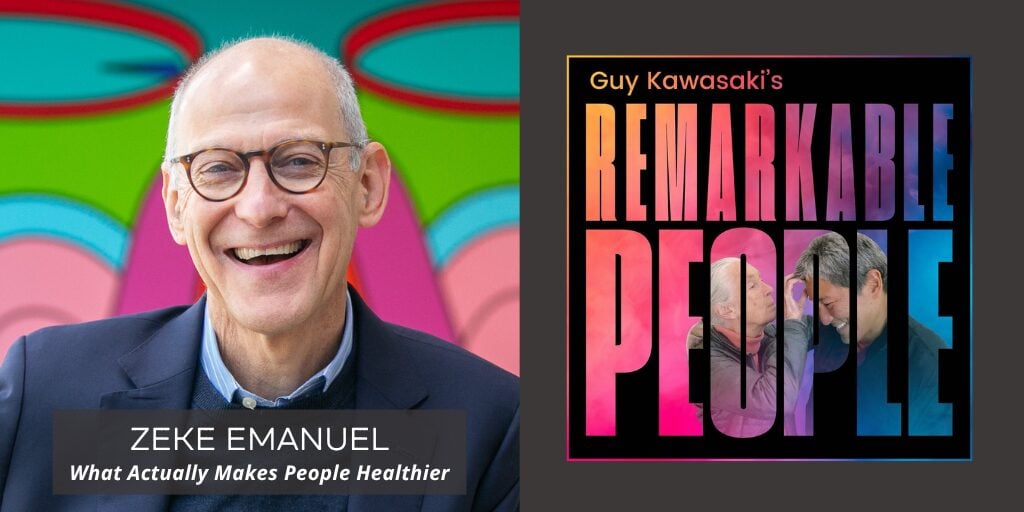
Welcome to Remarkable People. We’re on a mission to make you remarkable. Helping me in this episode is Zeke Emanuel.
Zeke is one of America’s most influential physicians, healthcare policy experts, and public intellectuals. As an oncologist, bioethicist, and advisor on healthcare reform, he’s spent decades helping shape conversations about how we care for ourselves and each other. He’s also the author of the provocative new book, Eat Your Ice Cream, which challenges many of the assumptions driving today’s wellness culture.
In this episode, we explore what actually helps people live healthier, more fulfilling lives. Zeke argues that wellness isn’t about expensive gadgets, miracle supplements, or the latest biohacking trend. Instead, he points to a handful of evidence-based habits: nurturing strong relationships, staying physically active, protecting your sleep, exercising your mind, and avoiding unnecessary risks. Along the way, he shares surprising insights about diet, social connection, vaccines, and the difference between extending life and improving it.
The conversation also ventures into bigger questions. Zeke reflects on healthcare reform, the future of the Affordable Care Act, public health, and the difficult decisions many people face as they age. Whether you agree with all of his conclusions or not, you’ll come away thinking more deeply about what it means to live well. If you’ve ever wondered how to cut through the noise and focus on the things that truly matter for your health, this episode is for you.
Please enjoy this remarkable episode, The Surprising Habits That Matter Most for Health with Zeke Emanuel.
If you enjoyed this episode of the Remarkable People podcast, please leave a rating, write a review, and subscribe. Thank you!
Transcript of Guy Kawasaki’s Remarkable People podcast: The Surprising Habits That Matter Most for Health with Zeke Emanuel.
Guy Kawasaki:
Hello, everyone. It's Guy Kawasaki. Welcome to today's episode of the Remarkable People Podcast, and we have the most remarkable of the three Emanuel brothers, I hope. And his name is Zeke Emanuel, and he's an oncologist, a bioethicist, an author. I think in sum, he's one of the most influential voices in the American healthcare policy, and is that all true so far?
Zeke Emanuel:
Well thank you. I hope so.
Guy Kawasaki:
Yeah, and you know what? He was a special advisor to President Barack Obama, and he's a big part of Obamacare.
And he has a great new book out, and it has one of the cleverest titles for a health book. It's called Eat Your Ice Cream. Now, when we got the pitch for this book, I told Madisun, "How can we not have a guy who has a book called Eat Your Ice Cream?"
Like, he doesn't hang around with Jeffrey Epstein. He's not tainted. He's not on 60 Minutes. He actually finished his residency. We got to have this guy. Oh my God. So welcome to the show, Zeke Emanuel.
Zeke Emanuel:
Great to be here.
Guy Kawasaki:
Let me explain. So he's one of three brothers. Correct me if I'm wrong. There are three brothers. So brother number one is a Hollywood producer, brother number two was the Chief of Staff for Barack Obama and Mayor of Chicago, and brother number three is our guest.
So if I were a parent listening to this podcast, what would be going through my head right now is, "What was the Emanuel family secret?" So was it Wheaties? Was it Baby Einstein? Did you guys have creatine in your formula? Did you take Kumon? Like describe growing up Emanuel.
Zeke Emanuel:
I can say all of that doesn't apply to us. Obviously the genes are the genes. We don't control them, and we know that at least in some cases, different brothers have different genes, so that's not going to be the major factor. I would say that there are two really important things, and then there's a lot of other things that are relevant.
One important thing is my parents were very, very committed to social justice issues. My mom was heavily involved in civil rights. For a white woman in the 1950s and early 1960s, that was very unusual. We would have a lot of civil rights organization meetings at the house, people planning protests. So we got a lot of that, as they say, in mother's milk.
My father was very heavily involved in getting lead paint removed from apartments because he was a pediatrician and he'd see kids who had the adverse, especially mental deficits, produced by lead paint, and got very active on that score as well. So the idea of doing good for others and trying to make the world a better place was something that we grew up with very much.
And my mom took us to a lot of protests. So we were at protests about civil rights. We were at protests about the Vietnam War, so that's one aspect. The other aspect that’s very important was my mom was the antithesis of the helicopter parent. She did not hover over us. She obviously wanted us to do well.
She pushed us, but like when I came home from school, "All right, go outside and play. Be back at five o’clock in the evening." And so we had to take our own initiative. We had to plan what we were going to do. We had to negotiate. We had to resolve conflicts. I distinctly remember we had a playground in the middle of a block that we lived on, and my mom would take us there.
She'd sit on the bench and not get involved, "You guys go figure out what you're doing in the playground. It's your responsibility." And when we got older, we would play football in the street or we would do whatever. And again, a lot of socialization, a lot of initiative, a lot of solving problems.
And that's really, really super important, and she wasn't there taking every barrier away or just ensuring our feelings weren't hurt, far from it. And we had to make do and push ourselves. So I think those are very important.
The other thing is, I would say, that our house was very much the center of a very, very constant collection of people, lots of socialization, lots of friends coming over, us going off with different people, so we were very comfortable talking and interacting with people. So all of that is critical.
Guy Kawasaki:
My God, I feel like I've doomed my kids.
Zeke Emanuel:
Not at all.
Guy Kawasaki:
And I read somewhere that your brothers concede that you're the smartest of the three.
Zeke Emanuel:
I don't know. They certainly refer me a lot of patients, let's just put it that way.
Guy Kawasaki:
Okay, next topic is Obamacare.
Zeke Emanuel:
Yeah.
Guy Kawasaki:
Let's face it, it has proven to be durable, and it's a structural achievement. No administration has been able to dismantle it. But it seems that it's getting eroded by budget cuts and subsidy expirations and regulatory changes and all that. Like, where do you think it is, and where is it going?
Zeke Emanuel:
So first let's talk about its achievements. Tens of millions of people have gotten health insurance. Our uninsured rate dropped to 8 percent, actually a little lower than 8 percent. That's a pretty big achievement as far as America goes. Could we do more? Absolutely. I think we need to get to universal coverage.
We also reduced costs when we passed it, and the few years after we passed it. A common criticism, especially from Republicans, was 90 percent about coverage, nothing about cost control. And the fact of the matter is that's just blatantly false. A large part of the bill is about cost control.
When we passed the bill, the Congressional Budget Office estimated that would reduce costs by one hundred billion dollars. In fact, about a year and a half ago, The New York Times wrote an article and said, "Look, Medicare costs per patient have been flat since slightly before the Affordable Care Act, saving the government four trillion dollars,” that didn't go to the deficit.
And there may be lots of things that contributed, but certainly probably over half of it has to do with the Affordable Care Act, the changes it put in place, the changes it caused others to adopt, so those are the achievements, and they're pretty substantial. Four trillion dollars is nothing to sneeze at.
I haven't seen the Republicans save four trillion dollars on anything. The second thing I would point out is no business, Guy, would pass a big plan and do a big initiative and not revisit it with changes and adjustments on a regular basis every few years. That's what we did with the Affordable Care Act.
So now I agree with you, it's getting a little long in the teeth, but the fact is we haven't really done any major healthcare fixes, and that's a problem. Almost everyone engaged in the healthcare system thinks that a lot of things have gone wrong, not necessarily because of the ACA at all, just because of the way the healthcare system's being run.
High administrative costs, high out-of-pocket costs, access problems. We have to address those things, and not being able to pass legislation has made the system actually perform less optimally than it could. I am a big believer it needs a comprehensive redo. It's actually the project I'm really working on now.
But, we're going to have to all come to the agreement first that we have a problem. I don't think that's an issue. Everyone does. They think the system's just not working. But we're also going to have to come to some agreement about what the fixes are. And I think there's a lot of agreement about multiple fixes. So I'm actually more optimistic than a lot of people about that.
Guy Kawasaki:
But Zeke, pardon my ignorance, but why is the Republican Party obsessed with repealing this? What's the sort of philosophical argument why we got to get rid of this?
Zeke Emanuel:
First of all, I think there's a real issue which is a budgetary issue. We can't just keep spending more and more money on healthcare, and frankly, with more people retiring, 11,000 Americans retiring every day, they're getting older. Healthcare costs tend to rise pretty high once you get older.
And so we have to address, again, more systematically our cost problem. So on that, I think there is an actually bipartisan agreement. I don't think that's a Democrat/Republican issue.
I think the Republicans don't have ideas, and I'm going to be really blunt here. They kept saying, "We're going to repeal and replace," and the point is they've never come up with a plan for replacement that makes any sense.
And that I think makes it really hard because they have to admit, “We're going to have to have government heavily involved." And by the way, behind the scenes, every one of them says that. Then how are you going to structure it? They haven't really thought that through. And so I think you get a situation where they don't really have ideas.
And I have to say, at the moment, the Democrats aren't really thinking about big picture reform either. What's interesting is that the public is really eager for it. How do I know that? When I go around and I say, “The book I'm working on now is about comprehensive healthcare reform," eyes light up and people, "Oh, tell us about that. Forget ice cream. We want to know about that."
And that's part of, I think, people like, "This system, it sucks. It's not working for me, so tell me how we're going to fix it, Dr. Emanuel." And that, I think, does say that the public's ready. What we need is more ideas, and what I find unfortunate is that we're getting little tweaks here and there.
And believe me, I'm contributing to those little tweaks too because I do think that there are a lot of little things we can do in the interim. But we're going to need a big, big reform. I don't know if it's 2028. I'm pretty sure if it's not 2028, it's going to be 2032 because the system's not going so well, and it's going to need reform.
Guy Kawasaki:
I can just shake my head. Okay, so one more dark subject here is, correct me if I'm wrong, Zeke, but it seems like the reaction of America to Ebola is let's just America first, America only. Even if you're American and you get Ebola, we're going to send you to an African country.
Let's just suppose magically that you replace RFK Jr., and now Zeke Emanuel is Secretary of DHS. What are you going to do?
Zeke Emanuel:
On Ebola?
Guy Kawasaki:
About Ebola, yeah.
Zeke Emanuel:
You're putting me behind the eight ball because the necessary components for a response, the CDC, USAID components, the contractors that work with them, our participation in international organizations that would help this response, we burned all those bridges, and so we're really in a bad fix because RFK Jr. did a lot, not just him, by the way.
It was Elon Musk that destroyed USAID not knowing what it did and I think, honestly, not caring about what would happen to those Black Africans who he doesn't have any time for. And the problem is we have to reconstitute some of that to really contain Ebola, and that's a really important step that we need to take.
We don't need USAID as it was. Most of us had long lists of problems that needed to be addressed. But I think the ability to rapidly respond to an emerging infection is absolutely important. Now, the idea of Americans, my suspicion is Trump would like them to stay in Kenya or wherever.
They're not going to be Kenya, obviously, but not the United States because he doesn't want the news media to cover it and to highlight the problem and the fact that infection with a deadly virus has come back to the United States. He was very, very, I think, upset that they flew the hantavirus, the people who had been exposed to hantavirus, to Nebraska.
He wanted them in Nebraska, not in Washington or somewhere on the East Coast where the press would get to them. You laugh, but Guy, I think this is absolutely critical to his thinking about how to respond to that. You're an American citizen. Our government should take care of you and should not say, "Oh, we want to keep you at arm's length."
I understand they have infection, but no place in the world has a better ability to respond to this infection than the United States. We have some experience with it because we had that guy come back in 2024 with Ebola. We have facilities that are ready for it. It does seem to me citizens are owed the right treatment and the best treatment our government can give.
And that is here in the United States. It's not, "Oh, we're going to keep you away." I think it's totally disrespectful of what it means to be an American citizen.
Guy Kawasaki:
I'm going to pitch you a softball. Why does it matter that USAID is helping people in another continent? Like why are we spending money over there? Let's just take care of our own country.
Zeke Emanuel:
First of all, we're a very rich country, and I think we should take care of other people. We have a moral obligation. We're part of a large global community. What happens over there doesn't stay over there. We've learned that, right? Over there, we had the experience with COVID.
Did we forget that? It's very important to monitor the infections that go around the world. Ebola is a terrible, terrible, infection. And we don't need it to spread, and we don't know if it gets much more common, the people that might be, where they might go, who they might in fact could be our friends, could be our fellow countrymen.
Second of all, these are people. We're a country that professes to care about people and want everyone in the world to have a good life. That's, I think, been one of the best signatures of American virtues that we talk about inalienable rights of all people, not just, you happen to be born between the Atlantic, Pacific, between Texas and the Canadian border.
And the last thing is, we're not talking about big money. All right? It's like, "Well, we save lots of money." We have 340 million Americans. A billion dollars is three dollars per American. What do you think, we could do, should do for people overseas?
Is fifty dollars an American the right amount of money? When you poll Americans, actually, we're more generous than our government is. So I think, that's really important. So I think from our own selfish global standing, it's really important. As a matter of a virtue, altruism, trying to help other people, it's also important.
And from an economic standpoint, it's not a lot of dough. And remember, I think, maybe what it's been twenty years, twenty-three or four years since PEPFAR came. The world was afflicted with HIV. President Bush, a Republican, began to fund a global response. That raised American stature throughout the world.
And, our stature, our moral credibility is something that, you know, there's no dollar amount, there's no defense budget amount, but the Defense Department will tell you that's really important to get people to collaborate with us, to get people to play ball with us, to want to participate and be our ally, so you can't say, “We're going to go it alone.” We live in an interconnected world.
Guy Kawasaki:
Yeah.
Zeke Emanuel:
And that's important. So whether it's a strategic issue, a moral issue, an infectious disease issue, or an economic issue, all of them come back to the same thing. We should be responding.
Guy Kawasaki:
And Zeke, if we would just stop bombing Iran for half a day, we could pay for USAID, right?
Zeke Emanuel:
I think that that is, yes, one of the big frustrations I think many, many people have with something like what happens with military conflict. We're willing to spend tons of money on military where that tons of money might have been better spent in other ways.
And we know, look, almost all of us know preventing a disaster is often a lot cheaper than coming in after the fact. Unfortunately, preventing a disaster is not front and center on the news media right in front of us all the time. When you prevent it, no one sees it, and so they don't see the value of prevention.
And that's a human psychological defect we have, but I think it's very important to be able to address it, and to be able to think, Oh, if we don't do this, it's going to actually cost us more money.
Guy Kawasaki:
So Zeke, I don't know if you look at it this way, but when I read your book, it kind of was an indictment of the entire wellness and influencer industry.
Zeke Emanuel:
Yes.
Guy Kawasaki:
I don't know if you intended it that way, but that's how I read it.
Zeke Emanuel:
Yes. No, it was written in response to what I call it the wellness industrial complex for a variety of reasons. One, I don't agree with their philosophy. The obsession with wellness, the quote-unquote, "maxing, hacking," all of that, just the wrong approach.
I also object to their conflicts of interest. All of them are trying to make money on selling you something. I got nothing to sell, Guy. You can't find a Zeke anything. Well, you can find a Zeke bar, but I don't make any of that money. It all goes to charity. I'm not making money on this. I'm trying to help people.
I'm trying to make it easy for them to live a healthy, well, long life, if they follow and outlining the simple rules and the simple practices and habits that will help them.
Guy Kawasaki:
Also, Zeke, I just want you to know that on this podcast we have had Francis Collins, we've had Vivek Murthy, and we've had Tony Fauci.
Zeke Emanuel:
I'm in an illustrious group. They're all great people.
Guy Kawasaki:
I was practicing with them till I got to you. They were like kind of opening acts for Zeke Emanuel. Oh. I'll tell you a funny thing, though. When Tony Fauci was on this podcast, he discussed the role of his mother and father, I think his father was a pharmacist, and how it influenced his entire career, just like what you said about your parents. It was a very similar story.
Zeke Emanuel:
Yeah. I’m having dinner with Tony in about a month.
Guy Kawasaki:
Oh, you are?
Zeke Emanuel:
Yeah. He’s a very good friend.
Guy Kawasaki:
Yeah, please say hello for me. Yeah. It took me three years to get him on my podcast.
Zeke Emanuel:
Hopefully I'm a lot easier.
Guy Kawasaki:
I got to say that one of the more interesting things that I found about your philosophies is that at some point you maybe should decline medical interventions, and it became a little controversial, right? People parsed it to once you're over seventy, give up and die. You didn't exactly say that.
So what is this thinking about when, as an oncologist, as a philosopher, or as a priest, when do you say, "Not for me. I'm going to just let it roll"?
Zeke Emanuel:
I have a pretty clear idea of how I don't want to live, and I've said this to lots of people, which is, look, I'm in pretty good shape. My heart's good. Normally my heart rate's around forty-two, forty-four. I got low blood pressure, no cholesterol problems, no heart problems.
Now, my body's doing great, everything's working fine, but my brain isn't working. I have either cognitive impairment or dementia. I don't want to be in that situation. And you know what? Most people I talk to, when you describe it like that, it's like, "No, I don't want to be in that situation either."
So that's really the start of my philosophy. I know what I don't want, and then you say, “What is the normal course of human evolution?" As you get older, the chances of mental impairment and cognitive decline increase such that by, it actually is pretty flat until you get to about seventy-five, and then it goes up pretty dramatically.
And at seventy-five, it's about 10 percent of people have frank Alzheimer's or some other kind of dementia, and about 20 percent have cognitive impairment.
By eighty, just five years later, we're up at 15 percent with dementia and 25 percent with cognitive impairment. And that's 40 percent of the population. I don't want to be there. And so when you look at, do I know that at eighty I'm going to have it?
No. But, there are odds, and that's not where I want to be, and I don't want to risk it where I get there and then, oh, now it's too late. So that's the sort of philosophy I have, and that's what informs my view of, look, if I needed a cataract operation or some operation on my ear so I could continue hearing, or I broke a bone and I needed it to be reset, absolutely, I'm all for that.
But I'm not for, oh, you've got cancer, or you've got some other serious illness, and we have to operate on you to save your life, plus chemo, plus whatever. I don't want to be there.
That is not the kind of life I want to have, and I don't want to sort of play roulette with, oh, we'll save your life, and then, one of the problems of lots of anesthesia at an old age or chemotherapy is it hastens that, the cognitive decline.
That's not for me. And now, as I said in that article, I'm challenging other people. What do you want? I want you to think about it. I want you to have a philosophy. What do you want to avoid? What do you want to embrace?
And again, most people I talk to, it's like, "Well, it's quality of life, including being mentally sharp, and I want to avoid being mentally confused and stuff." That's where I am.
Guy Kawasaki:
I understand that conceptually, but at a very tactical level, okay, let's say I agree. I don't want to be at that stage too, so are you saying euthanasia?
Zeke Emanuel:
No, I've written more articles than I can count on euthanasia. I'm against euthanasia. I'm not for ending my life. It creates all sorts of problems. I am for, "I'm going to refuse this treatment." You don't have to even go down that path, in my opinion.
Guy Kawasaki:
Wait but I still don't understand. So you don't want to live in a situation where you have dementia and reduced mental faculties, but okay, so let's agree with that. So now what do we do when we see that coming?
Zeke Emanuel:
You stop taking medical treatment. By that time, most people, they're on six or seven pills. Something goes wrong in their body. They're going to need an operation or something. I would think, No. Go back to family.
My father, who died about six years ago, he fell down and they did a head CT and found a lemon-sized brain tumor. And he was in the hospital. I flew in from Washington. We brothers converged and talked to my dad, and he said, "Enough is enough."
He'd lived a good life. He was ninety-two years old. And the morning after he fell down, already in the hospital, it was the neurosurgeon and the oncologist for the brain, the neuro-oncologist, about to operate on him, give him chemotherapy is what they were going to do at ninety-two. And my dad was like, "No, we're not doing that."
I'm like, "I'm a doctor, I'm an oncologist. We're not doing that. Bye, guys. You're not even going to see my father. He doesn't want it." And everyone came and said goodbye to him. He was very calm. And in ten days, he had no suffering. People all said goodbye. We talked about our memories with him and that was that.
That, I think, is a beautiful way to have your end of your life. And my memory of him is not, oh, he was feeble, he couldn't actually communicate because he wasn't all there, and I think that's the way he wanted it.
Guy Kawasaki:
Alrighty. It seems, and this is a subject you cover in the book, that people, they use two terms interchangeably, which is wellness and longevity, and the two are not the same, right?
Zeke Emanuel:
You're right, 100 percent, Guy. Longevity is you might say they're like quantity of life and quality of life. And I'm all for wellness, and I think everyone has to decide their view about how long they want to live. I would just say if you want to live to 150 years, go and meet people who are in their nineties and one hundred, and you might change your mind.
My mom's ninety-two going on ninety-three, and it's a problem. She can't move so easily. Most of the people who were her friends died. I just saw her a few weeks ago and she's like, "Oh, I'm so upset that Joni died," a very close friend of hers that she's known, I don't know, sixty, seventy years.
That's what happens. Your friend circle diminishes. Your ability to have people over or to go to people's houses diminishes. All of the enjoyable things of life diminish. So I think this idea of I'm going to live forever, just not likely, and even if you can, not like it's going to be, you're in your twenties, we're going to add another ten years to your twenties.
That's just not the way it's going to happen. And so I think, reconciling yourself and figuring out a life plan about death is kind of important, and most people pretend, and certainly the people investing in longevity pretend like it's not going to happen. Wellness, on the other hand, is I want to be vigorous, I want the body to work while I'm still cognitively intact.
I fully support that. I'm 100 percent. I'm in that ballpark. Absolutely, definitely should have wellness and I should integrate into my habits and daily routines those activities that are going to enhance the probability that I stay healthy, don't develop chronic diseases as I age.
Guy Kawasaki:
I believe it's a sign of intelligence that you can keep two conflicting thoughts in your brain at the same time. Now, so I understand and agree with everything you just said, and yet there are these blue zones in the world, in Okinawa and Sardinia.
Zeke Emanuel:
Yeah.
Guy Kawasaki:
And Loma Linda, California. That's the least desirable place to live if you ask me. But anyway, so those people seem to have threaded the needle and have wellness and longevity. So what's going on there?
Zeke Emanuel:
I think that's right. They live for decades following the six behaviors I've delineated, and that's critical to them being well and therefore not having the chronic illnesses, or it's not that they don't have it. Eventually everyone's going to get them, but they've postponed the time because they've lived so well.
They followed socialize with each other. They followed eat well. They followed exercise, not by going to the gym three times a week, but by walking around and doing lots of physical activities that increased their heart rate. They sleep well. They follow all those rules.
And they are well much longer than other people. And we know that in American society, not the only, but one of the chief problems with why people are not well is obesity and poor diet.
Guy Kawasaki:
And that you can really do something about, obviously, huh?
Zeke Emanuel:
100 percent.
Guy Kawasaki:
Okay, so this is a good segue to the six pillars of Zeke Emanuel. We want people to read your book to get more information and the total story, but can you give us the gist of those six things?
Zeke Emanuel:
Yeah, I think the first rule is, as I say, quoting my father, "Don't be a schmuck." Don't be an idiot and take unreasonable risks. So you know, you can figure, there are some things where the risks are really high. We know smoking, vaping, not taking your vaccines and preventative cancer tests. Those are things you should comply with.
Another one that may be one of the more controversial recommendations in the book is if you're worried about crime in your neighborhood, owning a gun is not a good solution because there's a big study in California looking at millions of people where in the same neighborhood, people who owned a gun and people who didn't own a gun because of the worry about crime, people who owned the gun were twice as likely to die by gunshot as opposed to the people who didn't.
Why? Because it's pretty rare to be shot by a total stranger. A lot of the murders and accidents that happen with a gun are a result of someone you know in the heat of the moment through an argument, picking up the gun and doing something terrible and tragic. And I think that's one of those, as I call them, schmucky moves.
One of the things I did in the book is, well, what's the schmuckiest thing an average person could do? It turns out that climbing Mount Everest tops the list because the chance of dying is one in one hundred, and if you're over fifty-nine, like some of us, it's one in twenty-five. You're going to pay 150,000 dollars to have a one in twenty-five chance of dying? That seems insane to me. Insane.
Guy Kawasaki:
Okay, that’s one.
Zeke Emanuel:
Number two is social relations. Now this is where I differ from almost all of the influencers that you talk about because they don't talk about social relations.
But we've known from lots of studies, over three million people have been involved in multiple studies about social relations and health, and it turns out that if you have more friends, you see them more often, and you have higher quality relationships, you're likely to live a lot longer.
It's not a guarantee, but we're social animals. We have a forebrain that is all about communication, interaction, collaboration. As a matter of fact, here Guy, right here on my desk there's an article, "Why We Crave Company." Being with other people, it's a hot area of research, and it turns out it's not just psychological.
The opening line is about how this is true not just of humans, it's also true of a lot of animals like mice. They like being with other people. Or monkeys, right? You look at primates and they're always cleaning the hair of other monkeys. That social interaction is very positive physiologically, and it decreases our inflammation, decreases our stress hormones.
It's really important, and if you're socially isolated, it's like smoking fifteen cigarettes a day. So you have to interact, and that's also with your deep, close personal intimate friends. It's also with casual friends who you happen to meet, or I often talk about when I talk to Uber drivers because I want to find out what their story is.
The third one is stay mentally sharp. Now a lot of the other activities for wellness, social relations, eating well, exercising, sleeping, help with staying mentally sharp, but there are also independent ones. For example, there are four, count them, four vaccines you can get that can decrease your risk of developing dementia.
Shingles vaccine. Yeah, you've got that quizzical look on your face, and you're 100 percent right. Most people don't think about vaccines in the brain, Shingles vaccine, the pneumococcal vaccine, the influenza vaccine, the flu shot every year, and DPT, diphtheria, pertussis, and tetanus shot. Go get those four.
They're free, and they reduce your risk of dementia. In addition, we now have a growing body of evidence, and there just was a study at the early part of this week about ultra-processed foods and cognitive impairment.
And again, the more you eat, the more calories are ultra-processed foods, the worse your chance, or the higher your chance of developing cognitive impairment and dementia. And the people who were in the worst category ate about two pounds a day of ultra-processed foods, whether packaged cakes, cookies, frozen burritos.
Guy Kawasaki:
Wait, but Zeke, your book says, “Eat the ice cream.”
Zeke Emanuel:
Yeah. Ice cream wasn't on that list because ice cream has cream, eggs, sugar, and flavoring. Just four. Don't take the ice cream that has the emulsifiers or the polysorbate eighties. And it turns out eating ice cream actually decreases your risk of type two diabetes, which probably plays a role between ultra-processed foods and dementia.
And one of the more interesting studies from my opinion is if you look at the people who drink Diet Coke, their weight is not less, their BMI is not less, and it's always been a perplexing thing, not taking in sugar.
And it turns out that those artificial sweeteners have two bad effects. One is they can continue to habituate you sweeter, sweeter, sweeter. And so you drink the Diet Coke, and then you still want sweet things, and so you want more sweet things. The second is it does appear that the artificial sweeteners are not good for a lot of your bacteria in your microbiome.
They decrease the diversity of your microbiome. And when they take the microbiome of people who've drunk a lot of Diet Cokes, and then they transplant it into mice, it turns out that the mice get fat, and it suggests that the decrease in microbiome is changing what bacteria you have in your stomach is related to increasing your weight from the diet sodas.
It's not ironclad proof, but it's very, very suggestive that's one of the two major causes of the fact that drinking diet sodas is not healthy, not part of your wellness diet. So I totally agree with you, and thank you for letting me elaborate that, Guy.
Guy Kawasaki:
Okay, so now we got two more. We got exercise and sleep, right?
Zeke Emanuel:
Yeah I think it's 78 percent of Americans, 72 percent of Americans, some number over 70 percent don't get enough exercise in America. We are too sedentary, in front of the computer, watching TV, playing video games.
We need to exercise. Going from the horizontal position to some walking around or running or jogging, hiking, riding a bike, whatever it is, really that's the biggest thing you can do from an exercise standpoint.
The CDC has recommendations about seventy-five minutes of vigorous exercise or 150 minutes of moderate exercise. All good. You've got to get your heart rate up, your breathing up, very important. But you also need to do strength training. And yes, if you're riding a bike or you're swimming, you are getting that strength training.
But after about fifty-five, sixty, we really rapidly lose muscle mass. So unless we consciously lift weights or get that strength training through other physical activity, we're going to become more and more frail. And frailty is very dangerous to living a well and happy life. So you need to lift weights. And the last thing is, for balance and flexibility, you need to do some yoga.
I do yoga twenty minutes every morning, and I love it, and it's sort of part of the day. I don't feel complete unless I've done my yoga. And the last one is sleep. This is kind of unique. As you well know, Guy, you get into bed, you cannot will yourself to sleep. That's actually counterproductive.
You'll just will yourself to staying awake. The other thing is that we become addicted. We want fast relief. It turns out that all those sleeping pills and potions don't work, and you shouldn't be taking them. So the melatonin, the Halcion, whatever, the Sonesta, whatever you're taking, not good for you.
And you know it. You wake up in the morning, you're a little groggy, but it was that little groggy state that you initially wanted to get a good night's sleep for, so the pills are not helping you in that way. I also, I find it, as you'll notice, I don't have any Oura Rings or a watch monitoring my sleep habits or any of it because I think the anxiety about it doesn't help.
And more importantly, I know whether I've had a good night's sleep. Do I have the energy? Do I feel good? I don't need a ring to tell me how I'm feeling. I can figure it out myself, and as I note on Wall Street Journal the CEO of Oura said, “People should stop obsessing about the numbers."
He himself actually tells you that. So why are you wearing the ring at all? I don't get it. Anyway, that's me. If the numbers help you, and there are some people where the numbers help, fine. But I think for most of us it adds obsession, adds anxiety, so it's not worth it.
Guy Kawasaki:
Okay, so this is just one data point, but I will tell you, Zeke, that I have been using a CPAP for about three or four months now. I swear my sleep is better with a CPAP.
Zeke Emanuel:
It could be. Now that's a different story because CPAP is about obstruction and getting enough oxygen to your body while you're sleeping. And, a lot of people, I know young people, I know old people, that use the CPAP and like you, Guy, swear by it. Think, Wow, I'm getting better sleep with it. That's a good thing.
Guy Kawasaki:
It's not that great for your sex life, but it sure helps you sleep. Okay, I got to revisit a point. Many people who are listening to this are going to find this completely irrelevant, and they're going to say, "Guy, why did you go down this rat hole?"
Zeke Emanuel:
All right. It's your podcast, man.
Guy Kawasaki:
Yeah, okay, so I have to give you a little bit of a back channel story. So when I was growing up and I got a first job, I worked for this jewelry manufacturer in downtown LA, and it was owned by a very nice Jewish family. So I became very, very familiar with the Jewish culture and traditions and language.
Zeke Emanuel:
Oh, really? Wow.
Guy Kawasaki:
Yeah, very much more so than Japanese, actually.
So anyway, so when I read your book and your first pillar is “Don't be a schmuck,” I said to myself, “Guy, when you learned the word schmuck, it was more negative. It was contemptible. It was someone self-important and someone oblivious to how they came across."
Now, you mean it in the sense of “Don't be a schmuck.” In other words, don't be stupid. But my understanding of schmuck is more negative and critical. So then I thought, All right, so now let's dig deep into my Jewish knowledge, and I would say that the way I was taught about this is the term closer to what you might mean is putz.
“Don't be a putz,” which is different than, “Don't be a schmuck,” and it is also different from, “Don't be a yutz,” because if you're a yutz, you're just a bumbling, dopey idiot. So I am giving you a chance now, Zeke, to recover your reputation. Do you mean schmuck, putz, or yutz?
Zeke Emanuel:
There's also schlemiel. Okay.
Guy Kawasaki:
There's also schlemiel, yes.
Zeke Emanuel:
I love this, Guy, because we're having a discussion about Yiddish, and there are probably, I don't know, a million people in out of a billion in the planet that know anything about Yiddish.
So honestly, in the book, when the editor at Norton read the book, he says, "Zeke, I think you're going to have to have a couple of passages here why you distinguish schmuck from schlemiel and putz and, all the others, and schmegegge."
And so I wrote it, and then he reread the book and he said, "Eh, we don't need that." But here you are, Guy, taking me to task. Yes. I believe you are technically right.
Guy Kawasaki:
Yay.
Zeke Emanuel:
That putz is just being like stupid, a jerk. You're being jerky here. Stop being jerky. My dad never used, "Don't be a putz." He always used, "Don't be a schmuck," by which he meant, "Don't do something stupid."
And you got the vignette in that first chapter about buying a used car and being a schmuck about it. It is one of those things where I think different people put a different valence, and as it's become more anglicized, schmuck's become more anglicized, its harshness has been attenuated, but I do believe you're probably, from a strict Yiddishism, correct.
Guy Kawasaki:
Your father is rolling over in his grave right now. He's saying, "This Sansei Japanese American guy is lecturing my son about the meaning of yutz and putz and schmuck."
Zeke Emanuel:
He would love it actually. My dad was global. Most of his practice was immigrants because he could speak six languages and he would take care of all the immigrants, so he would love it that a Japanese American was correcting his son, believe me.
Guy Kawasaki:
See, NPR could never have that discussion with you, and I will tell you that when I was working for that company, one of the books that I read that was the most useful was The Joys of Yiddish, right? And I think it's Leo Rosten or somebody wrote that.
Zeke Emanuel:
Exactly. You got it.
Guy Kawasaki:
What a great book. Ah, that book was so, so interesting to me. My God.
Zeke Emanuel:
One of the things you're pointing out, actually one of the great strengths of Yiddish, which I don't know very well but is the fact that it makes all these very fine distinctions which reflect life. It's like, yes, you could be, a sort of, thoughtless or a stupid or you could be this schlemiel that everything sort of goes wrong for you in life.
And it's not that you're thoughtless, it's like none of it works, and all these fine distinctions that you can see in the world, but Yiddish has a very, very different word for each one of them.
Guy Kawasaki:
Yeah. I'm the only Sansei who can appreciate the fine differences in Yiddish.
Zeke Emanuel:
Actually, I don't know about that. Let me tell you the following. I just heard a really fascinating story. I know we're getting way off topic.
There was a guy in Lithuania, I think I was told, who during World War Two, was working in the Japanese embassy, and he issued lots of visas to people to enter Japan.
Guy Kawasaki:
Yes, he saved hundreds of thousands of lives.
Zeke Emanuel:
Thousands, apparently 3,000 or something, of Jews.
Guy Kawasaki:
Oh, okay.
Zeke Emanuel:
And I met one of the granddaughters of one of the people he saved by giving him a visa so he could go across Russia and then go into Japan. And he ended up being a bit disparaged in Japan when he got back.
He was withdrawn from Lithuania, and he was quite poor. And when he got rediscovered by one of the Israelis who he had saved but didn't know, and they connected and they gave him a big award in Israel for his humanism and commitment, they asked him, "What can we do for you?"
And he said, “I can't afford college for my youngest son, so can he come to college in Israel?" And this Japanese kid came to Israel, learned Hebrew, got a degree, and the woman told me that apparently he's living in Amsterdam, but he's maybe a Japanese guy who might know a little Yiddish.
Guy Kawasaki:
Ah. The things you learn on the Remarkable People Podcast.
Zeke Emanuel:
It's why it's remarkable, right?
Guy Kawasaki:
And, you can obviously tell I enjoy doing this, and I'm sitting here and I'm thinking, Okay, so he just endorsed social life. Vivek Murthy did that, and he's talking about talking to strangers, and we just had Nick Epley on.
Zeke Emanuel:
Oh, Nick Epley's great. I always cite Nick Epley studies. Absolutely.
Guy Kawasaki:
Yeah. And then, you had a whole pitch for yoga, and when Gerry Lopez the surfer was on, he pitched yoga.
So it's all these forces of the universe are coming together with Zeke Emanuel. I want to ask you one last question. So I suppose that all your relatives, your friends, podcasters are always trying to squeeze you for free medical advice, right?
Zeke Emanuel:
It’s one of the reasons I wrote the book.
Guy Kawasaki:
Yeah, okay. And now most people don't have you on speed dial, so what are your sources for medical information? And please don't tell me the Trump CDC.
Zeke Emanuel:
I will tell you what I do. There is a medical website, an LLM for medicine that scours the medical literature called Open Evidence. And Open Evidence I find really good. It's not personable the way ChatGPT is, OpenAI's ChatGPT. It gives you the facts, and it gives you all the citations.
And like everything else, there's some mistakes in it once or twice, asking an expert. And then what I tend to do is find out what they recommend and look at the references and then easily run down the references and then read them to see if I agree with their interpretation.
They're going to put the emphasis on some things. I'm going to put the emphasis in a different place. One of the places in the book where I'm against probably the medical establishment trend is on PSA testing, prostate-specific antigen, for prostate cancer. I just don't agree. I look at the data, and I think they've interpreted the data incorrectly.
Similarly, there are experts out there, if you look, put in dairy. There are experts who are much more negative about eating dairy. I'm much more positive. I think dairy's gotten a bad rap, and I think especially things like yogurt and cottage cheese, really important, but I think that's the place to start.
Obviously not, you don't want to spend all your time going down rabbit holes. And for most people, the argument about dairy, not that important, but I think that that's the place I start.
You wanted to know what I do. That's the place I start. And I will tell you, a lot of people who can't get on it, they do call me and say, “Would you check Open Evidence for me and tell me what Open Evidence's conclusion is?" And so I find that maybe the most reliable source.
Guy Kawasaki:
Okay. That's very good to know. I thank you, Zeke. This has been a most entertaining and perhaps scatterbrained episode of Remarkable People.
Zeke Emanuel:
Well it’s good that both of us could go from yoga and Yiddish to bigger existential questions.
Guy Kawasaki:
Please tell your other two brothers if they keep at it, maybe someday they'll be as remarkable as you, and they can be on my podcast too.
Zeke Emanuel:
Thank you.
Guy Kawasaki:
Oh, all right. So let me thank Madisun Nuismer who made this happen, obviously, and Jeff Sieh who's going to turn it into digital magic with Shannon Hernandez, and Tessa Nuismer who's doing our great research.
Zeke Emanuel:
This has been the most enjoyable podcast. It's been great. Thank you very much.
Guy Kawasaki:
Can I quote you?
Zeke Emanuel:
Absolutely, you can quote me.
Guy Kawasaki:
Can I say, “He enjoyed being on my podcast more than any other podcast, not Joe Rogan's podcast, not Terry Gross's podcast, not,”? I don't know. What's that nutcase's name that is spending two million a year to live forever?
Zeke Emanuel:
Bryan Johnson.
Guy Kawasaki:
Yeah. Have you been on his podcast?
Zeke Emanuel:
No, I have not. I have met him and we had a long discussion, so I tell them why I don't agree with his philosophy, and I asked him, "Why do you want to live a long time? What's the why behind the quantity?" Which I think is the most important.
Guy Kawasaki:
And what did he say?
Zeke Emanuel:
He said nothing. He was silent. He didn't have an answer to that question, and I think that says it all.
Guy Kawasaki:
So he was a schmuck, putz, lutz, schlemiel. Let's just cover all the bases.
Zeke Emanuel:
One of them is right.
Guy Kawasaki:
As we say in Hawaii at the end of a fun time like this, the saying in Hawaii is Zei Gezunt.
Zeke Emanuel:
So in Hebrew, it's lehitra’ot. See you again.
Guy Kawasaki:
All the best to you.
Zeke Emanuel:
Great. This has been a blast.
Sign up to receive email updates
Enter your name and email address below and I'll send you periodic updates about the podcast.

Leave a Reply