
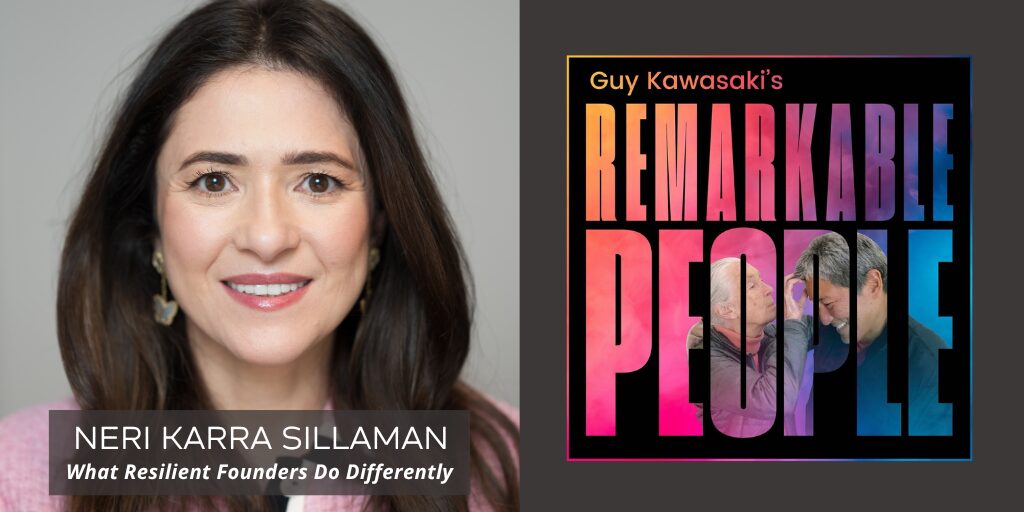
Welcome to Remarkable People. We’re on a mission to make you remarkable. Helping me in this episode is Neri Karra Sillaman.
Neri is an entrepreneur, Oxford expert, and author whose life story spans refugee camps, global business, and groundbreaking research on immigrant entrepreneurship. After fleeing communist Bulgaria with her family as a child, she rebuilt her life through education, eventually earning degrees from the University of Miami and Cambridge while helping grow her family’s leather goods company into an international business. Her new book, Pioneers, challenges many of the assumptions we’ve accepted about scaling companies, leadership, and success.
In this episode, we explore why immigrants and refugees often become exceptional entrepreneurs—not despite hardship, but because of it. Neri explains how navigating multiple cultures sharpens creativity, resilience, and opportunity recognition. She shares stories behind companies like Chobani, Duolingo, WhatsApp, and BioNTech, revealing how many iconic businesses began with founders solving deeply personal problems rather than chasing money. We also dive into one of the book’s most memorable principles: “fry in your own oil,” a philosophy centered on self-reliance, careful growth, and building businesses that can survive uncertainty.
The conversation goes far beyond entrepreneurship. Neri and I discuss the consequences of anti-immigration policies, the long-term risks of growth-at-all-costs thinking, and why healthy ecosystems matter just as much as profitable companies. She makes a compelling case that businesses thrive when communities thrive—and that sustainable leadership requires humility, patience, and human connection. If you’ve ever questioned whether bigger and faster always means better, this episode will give you a radically different perspective on what lasting success really looks like.
Please enjoy this remarkable episode, How Immigrant Resilience Builds Businesses That Last with Neri Karra Sillaman.
If you enjoyed this episode of the Remarkable People podcast, please leave a rating, write a review, and subscribe. Thank you!
Transcript of Guy Kawasaki’s Remarkable People podcast: How Immigrant Resilience Builds Businesses That Last with Neri Karra Sillaman.
Guy Kawasaki:
Hello everybody. It's Guy Kawasaki. This is the Remarkable People Podcast and we have a guest coming today from France and she is a remarkable person. Her name is Neri Karra Sillaman.
Now, she's an entrepreneur, she's an academic, and also she's an author. She's the author specifically of this book called Pioneers, and we're going to get into it later, but this book is in kind of direct juxtaposition against books like Good to Great and In Search of Excellence and many books that I've written too.
So we'll discuss why I was so wrong and Jim Collins was so wrong, and Tom Peters was so wrong, all of which are friends. You're still an instructor at the University of Oxford, right?
Neri Karra Sillaman:
I'm not an instructor. I work as an entrepreneurship expert at University of Oxford, so what that means is that I'm more of in a tutor consultant role for students who create businesses, and most of them come out of the university and they become real life companies. They become startups. So my role is to take their idea and guide them into reality.
Guy Kawasaki:
That sounds like an instructor to me. I hereby name you an instructor at the University of Oxford. Yeah, so first of all, you have a very interesting arc of your life, so can you just give us the quick story of how you came to where you are today?
Neri Karra Sillaman:
I guess I have to start where I was born, which is Bulgaria, and I was born into Turkish ethnic minority living in Bulgaria for many centuries, but when I was growing up in the 1980s, the communist government of Bulgaria decided to carry out an ethnic assimilation campaign against people of my ethnicity.
So that meant changing our names, not being able to have Turkish names, practice our culture, religion in any shape or form, and many people were imprisoned in camps basically, called Belene Camp. Many people died and for several years my family and I tried to run away to avoid our names being changed, but eventually they were.
And in June of 1989, we were forced to immigrate from Bulgaria to Turkey, and my parents took two suitcases, my nine-year-old brother and the eleven-year-old me, and we ended up at the border, and we were first put in a refugee camp at the border. And I remember looking at all the chaos around me thinking the only way out of this will be if I get a good education.
And I start with that because it has colored and shaped who I am. That very moment and everything I do goes back to that moment. Despite not speaking the Turkish language and not having any money and starting school with first in a refugee camp and then in a classroom of eighty-three students, I managed to get financial aid to come to University of Miami.
I graduated in two and a half years with a business degree, went back to Turkey, and started our family business, which is in leather products. So it's still in business today. It's been twenty-six years, and we produce for Prada, Miu Miu as well as our own brand.
I can tell you we have, as a business, been through many ups and downs, and I think when I was writing Pioneers, I talk about business longevity and now the company is not a hundred years old, but you go through so many ups and downs, particularly because we start with zero. We are in an emerging market selling to emerging markets, so you can imagine many ups and downs.
And I also have my academic side because I decided to pursue my PhD at Cambridge, and I used my company as a case study. My interest at the time was international entrepreneurship. How does a company become global without selling or becoming big in their own domestic market first?
And that's what our own company was because we didn't have any operations in Turkey, but we were a global company. So there are several companies like that, many of them in technology, but none of them in fashion or in retail at the time especially.
So that's basically in a nutshell as best as I can give the summary of the background of how I got here. And I wrote Pioneers because I am an immigrant or refugee myself.
Guy Kawasaki:
The arc of your life is not exactly similar to many of the listeners of this podcast and many of the people in Silicon Valley. I never lived in a refugee camp. I never had to go through that kind of hardship.
And yet it seems, and you cite example after example of people who are refugees or immigrants, and they succeeded to the point that I think you're making a very strong case that being in that kind of weak economic position, that kind of weak educational background is actually a feature.
It's not a bug, and it helped you accomplish what you did. So let's just get into that. What is this immigrants, this refugee mindset that seems to help people become good entrepreneurs?
Neri Karra Sillaman:
There's several. I think one interesting finding for me, I mean, we know the obvious one in the sense that I start with that, which is cross-cultural bridging. They come from different culture. They immigrate to a new culture. And because of that, they are able to spot opportunities that are not necessarily visible or obvious to local entrepreneurs.
And I give a lot of examples of that. For example, Chobani, Hamdi Ulukaya starting Chobani. At first, he starts his business by bringing feta cheese. Usually they start with import-export, but then quickly realizes this is not a good idea, it's not going to work here. But then he realizes there is not really a proper good yogurt being sold in the States.
And if he was someone who lived in United States born there, he will not have Chobani today. And then I give Dominique Ansel as an example, the creator of Cronut because he basically is a well-known pastry chef at the time. He starts his cafe with his fiancé, now wife, at the time fiancé. And she basically says to him.
They are doing everything together, but the business is struggling. And she says to him, “Why don't you combine doughnut and croissant? And I think that's a really interesting example of cross-cultural bridging.
But then another one is the fact that what was very interesting when immigrants start their business, usually what the business literature tells us, you need to spot an unmet need in the market.
You need to look out there, identify a need that's not being met. This is business or entrepreneurship 101. But what was interesting to me is that, and in fact, one of the entrepreneurs I interviewed, Reem Hassani, she's the founder of Numi Tea, and it's the world's largest fair trade tea company.
She said to me, “You need to look inside first, identify what lights you up. What's your passion? What is something that bothers you? It doesn't let you sleep well at night? And then look outside of yourself.”
So it starts by identifying, and I call it, it's not in the book, but I'm doing an executive education course at the moment, and I call it anchoring because at the moment we live in a very unstable world and instead of reacting to that unstable world, the leaders and business owners have to first anchor themselves, ask themselves the question of what is important to me.
What are my values? What is something that I can control? Even if everything around me changes, what is something in my business that will never change? And only you can answer that. That can be the quality of your product. That can be the community that you are a part of. That can be your employees.
For example, you can say, “No matter what, I'm not going to fire any employees.” So this level of clarity, anchoring in your own truth, in your own values, in your own passion.
I guess in your own why, to quote Simon Sinek, and then another aspect, I identified eight different principles that make immigrant entrepreneurs unique, but one of them is also the fact that they don't look at rejection or failure or so-called flux that happens out there the same way. They are very skilled at reframing.
Even if the business gets in trouble, even if the pitch that they made is rejected, instead of thinking, oh no, I failed. They have this ability to reframe the situation. Try again, try a different way.
But I think that's also their superpower because that's one chance that they have, and they know they are not going to get maybe a hundred chances, so they try very hard at the very first try to get it as right as possible.
That's why they place incredible attention to product, to the quality of the product, to the quality of the service. Even though I say they are very good at reframing failure, they will do everything, so that they don't fail at the same time. They need to get it right.
Guy Kawasaki:
I will tell you listeners that if you read Pioneers and you have read things like In Search of Excellence and Good to Great and those kinds of books, you'll see it is massively different. And, not that my books are as Good to Great or In Search of Excellence, but you'll see a big difference between what I have written and what Neri has written.
So give me the gist because my favorite part of your book is where you rip people like me who have written American business books. So just tell us, what is Guy and Tom and Jim missing about the way they write about entrepreneurship?
Neri Karra Sillaman:
I was going to ask you because I didn't think I was ripping you guys apart. Why did you feel that?
Guy Kawasaki:
Okay. Maybe that's a slight exaggeration, but you certainly didn't reinforce that everything we said was right.
Neri Karra Sillaman:
I didn't think it was that different, Guy, because at the end of the day, when you look at Bill, he also talks about, and I would say maybe mine is a bit of an updated version perhaps. And yes, I have a lot of respect for Jim Collins, but at the end of the day, I talk about profit the right way.
I think maybe in the book that can be a little bit unusual because yes, profit matters, but what I've seen is that the entrepreneurs who start these businesses, they are not necessarily driven by profit.
And I think at the end of the day, maybe we all argue the same thing because there is this focus on solving a problem, and I've interviewed the founder of Duolingo, and he was very much focused on solving a problem even when he had to invent the CAPTCHA, and he gave it away for free.
When he starts Duolingo, he never has this idea to become an entrepreneur one day but because he grew up in Guatemala, he wants to create something that will democratize education. And that's what drives him. Yes, they make a lot of money. They become billionaires.
Founder of WhatsApp, same story. He's very influenced by his own background of growing in Soviet communist Russia in Ukraine, and the fact that phone calls were monitored when he was growing up, and then he moves to U.S. It's very costly to call home. He creates WhatsApp, but the idea there is not, I'm going to make money.
It's more I'm going to solve a problem. So what was interesting to me is that many times the entrepreneurs, especially in my own study and in my research, were given opportunities to scale and to scale big and fast.
So Dominique Ansel, I will give him as an example, again, he has this opportunity to take Cronut to a massive scale, and he can make a lot of money, but he rejects that idea because he doesn't think it's the right way to grow.
So growing, but within your own means, which I detail in my chapter with frying your own oil, which is grow within your own means, do not go out there and start raising money immediately because now there's also research that proves my own point as well.
When you go out there to raise money very quickly, it can hinder your creativity and potentially the longevity of your company.
Guy Kawasaki:
Neri, I must say that, listen, I read a lot of business books because of this podcast, and I can't tell you I know of a business book that doesn't say, “You should scale as fast as you can and achieve worldwide domination.” Yours is the only book I've ever read that said that, so maybe you don't rip us, but you certainly provide a different perspective and I love that.
Your book is divided into eight parts, and there's these eight principles. You've already talked about the bridging across cultures and building from, kind of, your soul and stuff.
But I have to say that as I read the eight principles, I went down the list and I said, “My God. Every principle she's writing about and how all these companies became successful. It seems like today in America, we are 180 degrees against what she's saying.”
So you're saying, “Let's have this cross-cultural bridging across cultures and that in America we all want to be white, male, cis, older people.” And then, you're saying, “Forge connections based on identity. We want to remove all identities, so everybody's homogenous here.”
And then you say, “Generate profit the right way,” and all we're all about is grift and corruption and crypto and et cetera, et cetera. I'll stop pontificating for a second and I just want to ask you a hypothetical.
Let's say that you run the Communist Party in China and you want China to dominate the next century, and you say to yourself, “No, America has been dominating innovation and technology. What could they do that would help us achieve leadership?”
Because when I look at what America is doing now, you know a lot of the immigrants who came to America to do all the things you just mentioned from Guatemala or Ukraine or Bulgaria or anything, we would turn them away today.
We might turn them away and put them in a plane and send them to El Salvador. This is a long question. So basically I'm saying, am I imagining this? Or are we creating the most hostile environment for innovation and entrepreneurship with what we're doing in America now?
Neri Karra Sillaman:
We are absolutely, and I've written several op-eds on this. It's interesting when I started writing the book because it took me six months to write the book, but of course it's my twenty years of research that went into it.
However, at the time, there was a different government in U.S., but despite that, there was still such hostility, not only in U.S., in Europe where I live towards immigrants and immigration, and I mentioned that in the book.
Ironically, funnily enough, when I finished writing the book, the election in U.S. had just happened and I just submitted the timing of all of this. But to go back to your point, I feel very strongly about this, and unfortunately, I write op-eds to the point of I will be traveling to U.S. in next week, and I think to myself, I hope they let me in.
Even that thought should not be entering my mind. I am coming to a country that has been the beacon of democracy, of free speech, and I shouldn't be thinking like this. The conditions shouldn't allow such thinking to happen, but it does, and you are absolutely right.
There is a ban on forty-five countries, I can't remember exact number, but there is a visa ban that has been just made by the current administration. And many of the entrepreneurs, Tope Awotona from Calendly, the founder of Duolingo, or founder of Chobani, today they will not exist if those rules were in place at the time.
Today, forget that they also stopped the loan that you can take out, so for green card holders, that's the loan that Hamdi Ulukaya took in order to take over the defunct Kraft factory and start Chobani. So there is countless of examples of people, of entrepreneurs, of companies that will not exist today.
Also, it's such a hostile environment that even if you had visa, why will you come and start a company in U.S. as an immigrant? You can be taken tomorrow by I.C.E. even if you have a green card, which happens today, unfortunately. So it's very sad. It's very sad and I hope there is some change.
Another point came to my mind. It was in The Wall Street Journal or The Washington Post. There was an article on African students because of the ban again on visas from Sudan, from different African countries. And I did a post about it on my LinkedIn.
These students who are orphans in Africa, who have done the absolute impossible and have gotten scholarship at Duke, at some of the most amazing universities in the States, their visas have been revoked.
And scholarships, they can't come to U.S. anymore. This is just taking away someone's future, and to me it's just unthinkable. So I get very worked up on this, worked up in the sense that I'm very upset and I can't believe this is even happening on many levels, not just the immigration, but pure tailing of other people's futures, country's own prosperity. And you said something interesting. It is when I'm writing the book, I did think to myself, Everything I'm writing is the opposite of what we see today.
Guy Kawasaki:
It’s really true.
Neri Karra Sillaman:
But I have an argument and my book is about business longevity. My book is about longevity. My argument is this cannot continue.
We cannot continue to keep growing at the rate that we grow as businesses. That's one. We cannot continue with toxic leadership where you think you have all the answers and you act in a way that you are above everyone else and people work for you and you have corruption, this is simply not possible.
So it's not going to continue the way, and if you want to create this new earth and have a business that lasts, have a community that thrives. These are the principles that we have to follow. So in a way, that's my argument.
Guy Kawasaki:
Listen, I sign up to your argument. I am third generation Japanese American and under these conditions, maybe my great grandparents wouldn't have been allowed to come to Hawaii and pick sugarcane. And there's also this issue of selective immigration where we only want to take the best, the brightest, and the richest.
And it seems to me that the best, the brightest, and the richest might not have to immigrate. And also when they land, if you're like a billionaire's kid, it's not like you're going to start a yogurt company. You're just going to go live in New York of Miami. So let's talk about this issue of selective immigration and the impact of that.
Neri Karra Sillaman:
For sure. Absolutely, as you just said this, immediately, the example that comes to my mind is Noubar Afeyan. He's from Lebanon, Lebanese Armenian. He came to U.S. escaping the Civil War in Lebanon. He was eleven years old, if I remember correctly. And no, he doesn't come from a wealthy family. He didn't come on a golden visa with his family having unlimited resources.
In fact, Tope Awotona, same thing. When he came to U.S., he came with his mother, a single mother. Then BioNTech, founders of BioNTech come to my mind, they are Turkish German immigrants, and the person who developed the mRNA vaccine, Katalin, I am mispronouncing her name, but she's Hungarian immigrant who was in quite significant poverty as she was even working as a scientist.
None of the entrepreneurs, your point is a very good one, none of them came with a golden visa. None of them came from prosperity. They had hunger. And I think in entrepreneurship, whether you are developing the vaccine or whether you are developing the next yogurt company or solving a need a problem, you have to have problem.
You have to have hunger, and you have to have tenacity. You don't give up. And I'm not saying billionaire's kids will not have that, but certain conditions make you a little bit more easier in order to become the next immigrant entrepreneur that I talk about in the book.
But in terms of selective immigration, there's a lot of research on this where there are several professors at Harvard who looked into that, where you will look at someone's education, and yes, technically this will help the economy.
They argue about that. But there is also no guarantee. There is no guarantee, because the point is why would they want to also come to U.S.?
Guy Kawasaki:
Right?
Neri Karra Sillaman:
Especially when the environment is so hostile.
I work in academia. I have friends who are American but chose to come to European universities, and they did that in 2016. So the conditions, the prosperity of the company, the environment that you create, the entire ecosystem, the institutions.
This is also another incredibly important point. I think the institutions, the stronger they are, the better and more prosperous your country and your business will be.
I talk a lot about, in the book, the ecosystem, immigrant entrepreneurs are very much also aware of that fact because they come from countries where there are weak institutions. The ecosystem is not very healthy, and they know because of that, they can't have a strong or healthy or a prosperous company.
They're not even able to create that. And let's say they came up with an amazing business idea. The business is strong for several years, but then suddenly there is a coup, and you don't have a business anymore because of that.
That's a very important point. All the entrepreneurs I interviewed, Noubar Afeyan including, he says they are very much aware this business exists as part of this larger ecosystem.
The political environment, your community, your customers, your suppliers, your manufacturers, they all have to be healthy in order for your business to thrive. So instead of looking in a very egoistical way towards your business prospering, you have to be aware that this business can only be healthy and strong if your environment is strong. And that includes nature by the way.
That includes nature. So there is this very high level of awareness that I've seen among the immigrant entrepreneurs where they are very much aware of this fact and that's why profit, the right way, that's why growing at a healthy rate and making sure that the institutions are strong and there is less corruption, so we can go on and on, on this.
Guy Kawasaki:
When I was reading your book and I read this story of Andy Grove, although I knew the story of Andy Grove and let's just say that Andy Grove didn't come over on a golden visa, and I was thinking, If you were going to write this book in twenty years, it's probably going to be more something like Alejandro Gutierrez’s escape from D.H.S. and I.C.E. from America snuck into Canada and started the next Google and Apple.
It's going to be a very different story and that is so unfortunate. If I was running the Chinese Communist Party, man, I would be freaking celebrating every day about what's going on here.
Neri Karra Sillaman:
I say that too. I am like it's almost like self-sabotage, and yes, it's very frustrating. Or Russia.
Guy Kawasaki:
So you have a son, right?
Neri Karra Sillaman:
I do. He's seven years old.
Guy Kawasaki:
Okay. So now I would make the case that many of these success stories. Maybe the first generation, you come to America, you take any job you can, you run a liquor store, you work in a factory, you do whatever. You make all these sacrifices, your kids get an education, they're hungry, they're immigrants’ kids.
They create this success. So now generation two is successful. This is where it concerns me. Generation three is, “Oh, my dad is successful. I got into Harvard, Stanford, or Yale,” and pretty soon you lose the hunger and the fear and the deprivation that drove you as a first generation immigrant.
So now what do you do? How do you ensure that your children are as hungry as you were? Because your son is not going to grow up with the same conditions as you living in France and living in Oxford and all that. And same thing with me, I think about that all the time.
And yet my parental instinct is to protect them and make it easy for them and be a lawnmower, be a helicopter, or whatever metaphor you want to use. So I think about this all the time. So do you have any thoughts about the next generation after the generation of immigrants that really struggled?
Neri Karra Sillaman:
I am very much guilty of that too, Guy. Like you said, because I didn't have it easy and I have to watch myself with that, I have a tendency to give something I didn't have. And my parents, the grandparents of course, are the same way. They want to give and give and give, and that's something we are very much aware of, but like you said, you want to provide, you want to make it easier.
I think what we do, I mean I'm not a perfect parent in that sense, but what we do is to bring awareness to, you know, we are very fortunate. And just telling him this, even though he's still quite young and bringing awareness to the fact that we even have a home, we are incredibly lucky and incredibly fortunate.
So we will keep saying these things and volunteering or helping homeless people. So I can only talk about myself and what I try to do. So this is something that, especially in France, when we have homeless people, how can we help? How can we volunteer and bringing our son for him to see that?
I think it's a very good example, just bringing awareness to the fact that not everyone has the same conditions.
Guy Kawasaki:
Yeah, if you ever truly figure this out, please reach out to me and let me know.
Neri Karra Sillaman:
I am not going to have the answer if I try to read all the parenting advice.
Guy Kawasaki:
Reading your book, one thing I really thought to myself, this problem aside is we as America, we should let in people who are refugees and who are escaping political suppression and stuff, and the people who have no money, no education, that's the people we should let in and not people who can buy a five million dollar visa.
Neri Karra Sillaman:
For sure. We need to let in people with ambition, with dreams, you mentioned Andrew Grove. His story is exceptional. Exceptional. I start with that in my book. His aunt survived Auschwitz, and when he's living in Hungary, there is the Russian occupation. His aunt comes to him and says, “Andras, you have to go. You must go.”
And he makes the decision that moment, and that's why inflection points, later on in his work, he talks about inflection points, and I'm very sure it comes from his youth, from his childhood, and he escapes from Hungary to Austria by train, then on foot then he goes to United States.
They are basically having these meetings, they are going to take in refugees from Hungary, from Austria. The first time he's rejected and the second time he tries again. He comes to U.S. on a boat with hey, he knows some relatives in U.S., but he has no money.
He puts himself through schools and I don't remember his quote exactly, but he has been, he was, and his family was, his daughters were, his wife is big advocates for immigration and immigrants, and he has a beautiful quote about this, which I'm not going to remember right now, but it's a great tourism that America needs to welcome immigrants and immigration along these lines and people like that are going to make America great again.
Guy Kawasaki:
Which is the irony, right?
Neri Karra Sillaman:
Absolutely.
Guy Kawasaki:
Yeah. I loved reading your eight principles and one of your principles that when I first read it, I said, “What in the world is this?” And that principle, of course is your grandfather's principle of fry in your own oil. And I read that and first of all, I'll let you explain what he meant by fry in your own oil.
Neri Karra Sillaman:
Sure, it's a Turkish saying, “kendi yağında kavrulmak,” which directly translates into frying your own oil. And I don't think when I wrote it, that's my own translation, it means to be self-sufficient. And I think, in the beginning I talked about as a startup, not immediately going out there to raise money as a business, not immediately relying on outside investment, but frying in your own oils.
And that's what that talks about. Sometimes people, when they first hear it, it may sound like to be self-reliant, to be self-sufficient. Will that not clash with your other principle about community, about having other people? Those two reinforce each other because you are able to fry in your own oil, you are able to be self-sufficient with other people because of other peoples.
It can be because of people who support you people who are in your own orbit. And I guess I grew up with that because I do come from a very poor family in former communist country.
And we didn't have a lot. My grandfather, he himself was an orphan, lost his dad and then his mom. He was in charge of looking after his five brothers and sisters as a teenager himself.
And despite his very unfortunate background in a way, he will do everything himself. And I think he will grow his own vegetables and fruits and raise his own animals and do what he can with the very little resources that he had.
Guy Kawasaki:
I have done this a few times on this podcast where I read a book and I really like the book and because of the nature of my OCD mind, I'm always thinking about the book, and you know how the interview is going to go for the days before it.
So I've been thinking about this fry in your own oil for a few days now, and if I may be so bold and do not be offended and don't get pissed off with me. But I have to say, it's very difficult to wrap my mind around the metaphor.
I love what it says about self-reliance and doing what you can with your resources. I love the meaning of it, but the metaphor, every time I thought of frying your own oil, I think of myself as perishing in hot oil. It's like frying myself in oil is not something I would look forward to.
Neri Karra Sillaman:
I see.
Guy Kawasaki:
So I kept thinking about this, kept thinking about this, and I said, “What am I going to do? I'm going to violate all this Turkish heritage and I'm going to tell her that her grandfather was wrong.”
But so I've been thinking about this, I've been thinking about this for days Neri, and I thought, I want to suggest to you another way to put this. Okay, so I think a metaphor would be tend your own fire.
Neri Karra Sillaman:
Oh, I love that.
Guy Kawasaki:
Tending your own fire. Here's the implication. First of all, it is your fire. It is your problem. It is your opportunity. It is your responsibility. You have to give it oxygen. You have to give it fuel. You also can make it as big as you can.
But you could also lose control of it, which means that you scale too fast and you ruin your company. You can also not provide it with fuel and oxygen and heat, so you could kill your own fire. So basically, when you're in charge of a fire, it's your responsibility to control it and to feed it and to make it as brilliant and warming as possible.
Neri Karra Sillaman:
I agree with you, and I just wrote it down as you can see on the little Post-it, because I should have consulted you, but we didn't know each other then.
I like this more, by the way, as I said, I translate them directly and my poor husband who happens to be American has no idea what I'm even saying, because I'll say to him something that I'll just translate it directly and he will go, “Okay, what does that even mean?”
So it'll be similar to frying your own oils. I have a tendency to do that, but I think in Turkish, the direct translation comes actually from cooking because when you cook something and it's on oil. And that's the saying. That's exactly the direct translation. But I like yours much more. It just translates better.
Guy Kawasaki:
So when you make speeches about your book, you say, “My grandfather told me this ancient Turkish saying about frying your own oil. But then I talked to Guy Kawasaki, he said, ‘That's not a good metaphor. I think you should call it tend your own fire.’”
So anyway, I just loved the story, I hope I pronounce it right, of is it homophily? Is that the right?
Neri Karra Sillaman:
Yes, homophily.
Guy Kawasaki:
Okay. Homophily and the story of Vietnamese immigrants and how they came to dominate the nail salon business. You got to tell that story. That was a great story.
Neri Karra Sillaman:
Let's see if I can remember it. Basically it's the actress, what was her name? The actress from the Alfred Hitchcock movie, Tippi.
She's filming in Vietnam and they see her nails and they basically are very intrigued by them. She brings her own nail technician who teaches all the women how to do nails, manicures.
And from there, the nail industry grows, especially in Vietnam, so that's basically in a nutshell.
Guy Kawasaki:
But now, if you look all over the world, I don't know about all over the world, but if you look in America, it's a lot of Vietnamese nail salons, and it started from that one story.
Neri Karra Sillaman:
That's right. So the idea of homophilic ties is that it comes from sociology and it's about people who are of the same kin. People who are of the same background, from the same culture will stick together.
But the research shows us something very interesting, especially in my own research, and I've written papers about this as well, is that you can use the same idea of homophilic ties and apply that to a business.
And I've seen that among immigrant entrepreneurs especially, you don't have to come from the same culture, you don't have to come from the same background, but you can have the same vision towards something. For example, wanting to learn nails. And you can share a vision towards something, bring people together who share the same vision.
You can use strategic storytelling in order to keep those homophilic ties, get them even stronger. So just because you got together with someone and you created a business based on homophilic ties. Doesn't mean it's all done. You have to keep working at it. You have to keep strengthening those ties.
So in our own business, for example, I used that as well in my research. When we started our own company, we put up a sign, we started in a tiny little apartment. It wasn't even a proper store. And I was fifteen at the time. We put up a sign outside of the apartment. We were on the second floor and we said, “Please come in for a homeland cup of coffee.”
And the place that we opened, it was in the luggage trade area where a lot of the people from the former communist countries, the Berlin Wall just fell down. A lot of people from Russia, Ukraine, former communist countries were coming to Turkey in order to see if they can buy something, bring it back to their country and sell because entrepreneurship was not allowed during communism.
So now they can become entrepreneurs just like us. But we wrote it in different languages. In Russian, in Romanian, in Kazakh, in different languages. They will come in and say, “Do you speak Russian?” Or “Do you speak Romanian? Do you speak Bulgarian?” And that's how we started our own business by signaling that we are just like you.
We also want to build a business. We also come from nothing. And we use a similar logic, but we don't do it in this, oh, I'm going to trick you way. We use the same homophilic ties when we talk to our Italian partners. We want to understand them better.
So we will go to birthday dinners together. We will travel together with our own Italian partners, and there is this closeness that is being built that when the business gets into troubles, they can be there for you. And we have seen it again and again.
Guy Kawasaki:
People may be amazed because I'm a tech guy, but I think there's a lot you can learn from the nail salon business. Just don't think of crypto and tech and software. I mean, you look at some of those nail salon businesses, wow, these people truly are entrepreneurs.
And if you ever get to Istanbul, I'm not talking to you now, I'm talking to the listeners. If you ever get to Istanbul and you go through the bazaar, oh my God, that is the purest form of entrepreneurship I have ever seen in the world. I love that bazaar. Yeah.
Okay, my last question for you is that you make a great case how growth can become the enemy of longevity. So I want you to explain that concept.
Neri Karra Sillaman:
I think I touched on it a little bit when I gave the example of Dominique Ansel when he was given this opportunity to scale his business, to grow very big, and he could have. He says, “I could have made a lot of money. It was a great opportunity for growth, but I said no, because in the long term, this can hurt his business.”
So not all growth is good growth. That's one. Second, I will go back to, I will change the concept, Guy. Tend to your fire. So if you grow above your means, you may not have the capabilities that will allow you to sustain that growth. And that can also hurt the business. So not all growth. And yes, there's also the sustainability aspect that we can talk about in terms of nature.
Okay. That's a whole other discussion. But even the sustainability of the business itself, you have to grow within your own means. And we have seen it in our own business as well, where we thought it'll be a very good idea to enter into suits, to enter into a different industry, to grow faster.
And in the long run, it hurt our business. So we also had to learn this the hard way.
Guy Kawasaki:
So let me thank you for appearing on this, and I really enjoyed your book. I enjoyed learning about the role of immigration and refugees and how much they have made the world a better place, and I'm third generation Japanese American, so I can relate to that.
And I thank you very much for the work that you're doing, and let's just as you say that the current sort of atmosphere is not sustainable, and let's hope that it comes to an end soon and we have a more enlightened view of immigration in the near future.
Neri Karra Sillaman:
I really hope so, and this is why I do the work. I write op-eds, I do what I can. It's been truly an honor to be a guest on your podcast, to meet you finally.
I read many of your books, and for me it was a little bit of a, how do you say, like a celebrity shock when you see someone that you've known for many years to be talking to you. It was a little intimidating, but you made it very easy and enjoyable.
Guy Kawasaki:
Oh, you flatter me, so now I am going to go tell my son to attend his own fire in case. So again, this is the book Pioneers, and I want you to pick up this book and read it. You'll learn a lot of, should I say contrarian thoughts? So Neri, thank you very much.
I also want to thank the Remarkable People team, which of course starts with Jeff Sieh, co-producer and Madisun Nuismer, who I wouldn't be a podcaster without them. So there's Madisun Nuismer, Jeff Sieh - jeffsieh.com, Shannon Hernandez, sound design engineer, Tessa Nuismer, researcher.
So there's a whole team behind me. So thank you very much team and thank you listeners. And you know now you have one more information source and inspiration source to be remarkable. All the best to you.
Sign up to receive email updates
Enter your name and email address below and I'll send you periodic updates about the podcast.

Leave a Reply