
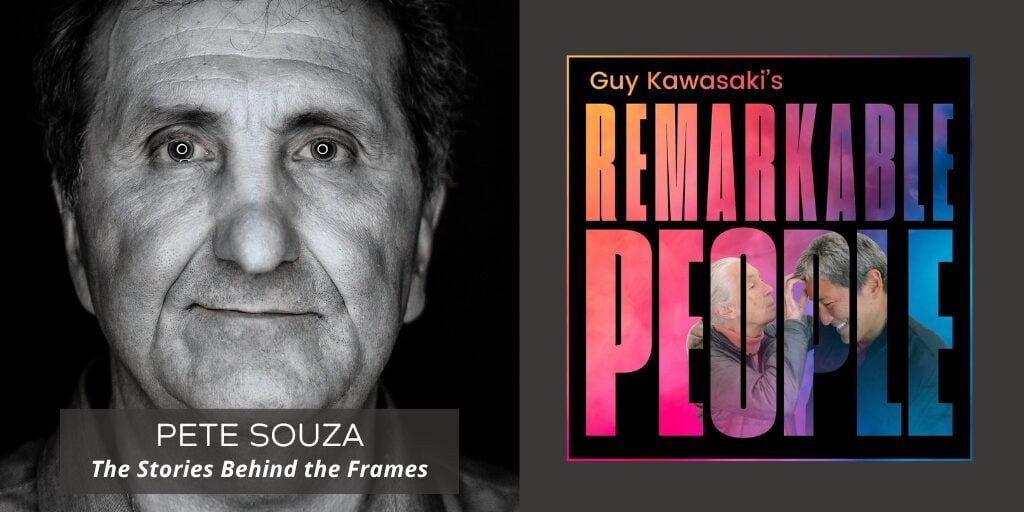
Welcome to Remarkable People. We’re on a mission to make you remarkable. Helping me in this episode is Pete Souza.
Pete is one of the most trusted photographers in modern American history. His images have documented presidents, pivotal decisions, and deeply human moments that rarely reach the public eye. But beyond the access and proximity, what sets him apart is his relentless focus on authenticity—capturing what’s real, not what’s staged.
In this episode, we explore what it takes to tell powerful stories through a single frame and how Pete built the kind of trust that let him work just feet away from history as it unfolded.
Pete didn’t land in the White House through a traditional path. His role came from years of proximity, consistency, and proving that he could be invisible when it mattered most. That trust allowed him to document not just historic milestones, but the quieter, human moments—fatigue, humor, doubt—that define leadership. Whether it was months-long deliberations on policy or split-second decisions, Pete saw how presidents balance urgency with responsibility.
We also dive into his philosophy on photography, which runs counter to how many people shoot today. Pete believes in slowing down, anticipating the moment, and pressing the shutter once—at exactly the right time. His most iconic images weren’t accidents or bursts of luck; they were the result of patience and presence. Even now, whether photographing world leaders or his grandchildren, that mindset hasn’t changed.
The conversation also pulls back the curtain on the mechanics of his work. From managing nearly two million archived images to maintaining strict photojournalistic integrity, Pete explains why restraint matters as much as skill. No heavy editing, no manipulation—just honest documentation. In a world saturated with images, that commitment to truth stands out even more.
At its core, this episode isn’t just about photography. It’s about seeing clearly—whether you’re looking through a lens or trying to understand leadership, history, or people. Pete reminds us that the most powerful stories aren’t manufactured. They’re observed, patiently, and captured when everything aligns for just a fraction of a second.
Please enjoy this remarkable episode, Inside the Lens of a White House Photographer with Pete Souza.
If you enjoyed this episode of the Remarkable People podcast, please leave a rating, write a review, and subscribe. Thank you!
Transcript of Guy Kawasaki’s Remarkable People podcast: Inside the Lens of a White House Photographer with Pete Souza.
Guy Kawasaki:
Good morning everybody. I'm Guy Kawasaki. This is the Remarkable People Podcast, and we scour the world looking for remarkable people. Today's remarkable guest, and we've been trying to get him for a very long time.
His name is Pete Souza. He's an American photojournalist, and he served as the official White House photographer for both presidents, Ronald Reagan and Barack Obama.
So to put it mildly, he was around when history was made. I don't know any photographer who has documented modern American leadership with such proximity, such behind the scenes. And his photos are so interesting. His comments are so interesting.
And, while he was doing that, he also authored, at least by my account, eight major photography books. And these books, they're so interesting. They're so beautiful. So welcome to Remarkable People, Pete Souza. That's a lot of p’s in there.
Pete Souza:
Yeah. Thanks for having me on, Guy. I appreciate it.
Guy Kawasaki:
Pete, you and I, we have this commonality called Rick Smolan, and Rick Smolan is the guy that did all A Day in the Life books. So I just want to call him out right at the very start, thanking him for introducing us. I've admire your work from afar for a long, long time.
So thank you for coming on. I got to ask you a question right off the bat. I love your work and I know you're going to be very opinionated about this, but I really want to know what you think of the Vanity Fair photoshoot as a photographer. What did you think when you saw that?
Pete Souza:
I mean, I know Chris Anderson. He calls himself a celebrity photographer now, but I knew him back when he was documenting as I was, capturing fly on the wall moments, and he also did a portrait session with President Obama when I was in the White House and used the same approach that he used with the Trump people, which meaning up close.
He gets close to his subjects, super close, and he records portraits now. I thought it was an accurate depiction of who those people are. I don't know why they complained about the portraits. There was no AI. There was no retouching. He showed them as they were, so I thought he did a remarkable job in capturing who those people are.
Guy Kawasaki:
I could read between the lines in what you just said, but I won't go there, I think. So, as I read about your past, the first question that came into mind besides the Vanity Fair photo shoot of course is, how exactly does one become an official White House photographer? You were a photojournalist on the other side. How do you get in-house to Ronald Reagan or Barack Obama?
Pete Souza:
In both cases it was just a matter of luck, in that with Reagan, the woman who was the White House photo editor at the time, Carol Greenawalt, was somebody that I knew when I worked at a newspaper in Kansas, and she was the director of photography at the Kansas City Star. I had aspired to work for that newspaper.
I was working for a small newspaper, and I interviewed with her, and she did not hire me, which pissed me off I have to admit. She hired somebody that had more experience than I did. She later became the White House photo editor and had been tracking my career.
And so when they had an opening in the middle of Reagan's first term, she called me up out of the blue one day and asked me to interview for this job, so that's how it went with Reagan.
With Obama, it was different. I was then the national photographer for the Chicago Tribune based in Washington D.C., and when Barack Obama was elected to the Senate, myself and a reporter decided to document his first year in the Senate.
For that I needed access, so I made this pitch to the Obama people. I was basically the hometown newspaper, and they gave me access that they didn't give to anybody else, and when you're in close proximity to a subject like that, they get to know you. You get to know them.
They get to see how you work, so I had established a professional relationship with Barack Obama early on, so when the time came for him to choose a White House photographer, I got the call.
Guy Kawasaki:
And was there like a job interview “per se” with Barack Obama or were you already known?
Pete Souza:
Yeah, this is kind of a fun story. He knew me. He had seen my pictures. He knew how I worked. He knew me enough that when he was elected to the presidency, I sent his top aide an email and all it said was, “I'm interested.” That was it. That was my application for the job.
I didn't need to show them a portfolio. They were familiar with my pictures. They were familiar with my personality. They knew how I worked. So that was it. I just sent an email and said, “I'm interested.” And in a couple weeks before the inauguration, I got a call from that top aide saying that the president-elect wanted me to be his Chief White House photographer.
Guy Kawasaki:
Oh that sounds a hell of a lot easier than I thought it would be.
Pete Souza:
I think if you're to ask any of us that have been in that position, we all have different ways of coming into the administration. Mine was that I had known the guy for four years, and he was familiar with me professionally. And I think he just thought I would be a good fit.
Guy Kawasaki:
Okay. So I don't know if you really want to answer this question, but from the outside looking in, can you just verify that the Obamas are as cool as they seem? You would really know if this is true. I suppose you won't say if it's not true, but I’m not asking you to burst the bubble. Just confirm the bubble, if the bubble is true.
Pete Souza:
You can't fake who he is. He is who he is. Especially with the kind of photographs that I made throughout his administration. I'm kind of the fly on the wall and you can't fake that. It is what it is. I actually just saw him, was it last week? I was in Hawaii on vacation and saw him, and he's as cool today as he was during his presidency. A little bit more relaxed, I think, these days.
Guy Kawasaki:
Does he still stay in Kailua, or is he on the south side of the island now?
Pete Souza:
I'll just say that he's in Oahu. I would rather not go beyond that.
Guy Kawasaki:
All right. I'm from Hawaii, so I'm pretty familiar here. So, I want to verify a story that Barack Obama used to read ten letters from citizens every day. Is that a true story?
Pete Souza:
It's a true story. I would say he did that five days a week. He didn't do it seven days a week, but every Monday through Friday, he would read ten letters. There was a White House Correspondence Office that received upwards of 10,000 letters a week, and they would sort the letters and categories and try to pick a sample, and they weren't all positive.
They were critical letters, issue oriented sometimes, very personal sometimes, and Fiona, who was the Head of the Correspondence Office, of course I'm forgetting her last name, would be the one responsible for choosing the final ten that he saw, and I can verify that actually did happen. A book came out by, I think, Jeanne Marie Laskas is her name, called To Obama.
And it's a book about those letters. Fascinating book.
Guy Kawasaki:
I suppose that Donald Trump gets ten letters a day from billionaires. The tradition continues, right? So you have a book along the lines of what you saw inside the presidency. So can you give us some insights into what you saw inside these presidencies?
Pete Souza:
I think what I saw more than just the historical aspect of documenting the presidency in both instances, I got to see the humanity of the human being that is the president. They’re human just like us, and it was a great privilege and honor to be able to see these two men up close and personal and see their humanity just as a human being.
And whether you agree or disagree with the politics of President Reagan or President Obama. I can say that both were genuinely decent human beings.
Guy Kawasaki:
And can you tell us a little bit about the decision making process? One of the culminations was the assassination of Osama bin Laden and you have that famous picture, but what proceeds in the decision making process like that?
Pete Souza:
I'll use a different example. I remember when one of the first things that Barack Obama had to decide when he took office was how to proceed regarding Afghanistan. Was it time to pull out completely? Was it time to put in more troops? What was the decision?
It went on for months. He had so many meetings with his National Security folks trying to really sort through what was the best approach, what was needed.
And there was not universal agreement amongst his aides on how to proceed, so a lot of whether he ended up adding, I forget how many troops it was, but it was a long, long process over the course of many months in making a decision that important. Then there's other times when decisions have to be made quickly.
Now I'm going to forget exactly the circumstance, but I remember one time with Reagan, and it was backstage at some event, where his National Security Advisor said, “Mr. President, this is going on. We want to do this.” And Reagan said, “Go ahead.” And it was that quick. It was because the decision had to be made right away.
And I think anybody who's in that office, well, let's say any normal person that's in that office, needs to know when it's time to make a quick decision or when it's time to really get as much information as possible in terms of a crucial decision especially in the National Security world.
Guy Kawasaki:
Well seeing as how you were there when those kind of decisions were made, I'd love to find out which like Netflix series would you say is the most true to life? We got Designated Survivor, we got Homeland, we got The West Wing, we got The Diplomat. And you could also make the case in the Trump administration, it's Saturday Night Live, but which of these series are most realistic?
Pete Souza:
They all have their flaws. Honestly, I haven't watched some of the series, I've watched, you know, The West Wing, which was I think pretty much a nineties show. I watched all of House of Cards, and I've watched the three seasons of The Diplomat.
There's some truth in all of them, and I remember The West Wing used to crack me up because President Bartlet would go into the situation room and it'd be like a two minute meeting and he'd make his decision on something that probably would've taken at least an hour and a half in real life. But for TV, it's one minute and he's out of there. That used to crack me up.
The Diplomat is more about relationships with the husband and the wife and yet there's a lot of, I think, truth in some of the substance of that series, so I would say probably The West Wing. One thing that was true to life about The West Wing is in the span of one episode, the President, Martin Sheen, may be dealing with four different issues, which is so true, you know, in the presidency.
Barack Obama would go from one National Security tense meeting to one domestic meeting to just one thing after another. And I think that was depicted pretty accurately in The West Wing.
Guy Kawasaki:
Can we geek out a little bit about photography now? I've talked enough about Reagan and Obama. I'm really interested in the photography of this. First of all, can I ask you, what is the workflow from, so now the pictures are on your SD card. How does it get from the SD card to what's actually being used? What is the workflow here?
Pete Souza:
The workflow was obviously different between Reagan and Obama. With Reagan, it was all film, and with Obama, it was all digital. Normally the workflow for me was I would be with him literally all day and maybe twice a day I would drop my cards from my cameras in my office and one of the photo editors would pick up my cards and download the pictures.
And one of the things that we did was make sure that every single photograph had a caption. I would start with a basic caption of whatever I had photographed, and then we would go back and add people's names in every picture.
So now, at the National Archives where all my pictures now reside, every single picture was saved, none was deleted, and every single picture has an AP style caption. And we try to identify every person in a photograph. We sort of arbitrarily decided if it's ten people or less in a photograph, we're going to identify everybody. If it's like a hundred people group photo or something like that, we wouldn't necessarily identify everybody.
I don’t know if that's what you're asking, but that's kind of the approach that we did. And then in terms of for the White House website, each day the digital team may come to me and say, “Hey, the president met with Angela Merkel. Today we're going to do a post. Can you send us a couple photos?”
And myself and one of the photo editors would choose what we thought were the best photos and send those to the digital team for the website. So that's kind of the way it went.
Guy Kawasaki:
And when the download from the SD card occurred, did you put it in Lightroom or what was the software to keep these millions of pictures?
Pete Souza:
So when I was working for the newspaper Chicago Tribune, I had started using Photo Mechanic, and so that would be the initial way we would download the photos and caption them is through Photo Mechanic. And then, in terms of once you chose an image in Photo Mechanic, it would be opened up in Photoshop, and we would go through a workflow there.
Basically, instructions to my staff was, “You can adjust color, balance, shadows, highlights.” That's about it. We didn't want to get into anything beyond photojournalistic practices in terms of use of Photoshop.
Guy Kawasaki:
And how many photos are in the National Archives from you?
Pete Souza:
So with Obama, it's just under two million, I think it was one point nine something million. And with Reagan, I'm not sure because we didn't really count individual frames, and we were shooting film and I don't even know how many rolls of film I shot over the five and a half years I was there.
But probably several hundred thousand is my guess. Maybe a million. I don't know.
Guy Kawasaki:
And the copyright for these photos, they belong to you or they belong to the government?
Pete Souza:
So anything that was made public would be public domain, and then there's a period, like for instance, all the Reagan pictures now are public domain. So every single picture, I think it's fifteen years after the president leaves office, all pictures are considered public domain.
Now there's an asterisk there in that if it's a personal, like for instance, Christmas morning I would go to the Obama's rental house in Hawaii where they spent Christmas and get him with the girls in their pajamas opening Christmas presents. Those pictures are considered personal, and the former president can decide to keep those personal for now.
My guess at some point Sasha and Malia can make a decision if they want to make those public. So there's an asterisk in terms of personal pictures versus non-official pictures. They're all in the national archives, but they can remain private for as long as the former president wants them to be.
Guy Kawasaki:
And maybe I'm being a little paranoid here, but is it conceivable that a current president would want to, shall I say, whitewash the past and remove those photos from the national archives?
Pete Souza:
I would say that that would be illegal. There's a Presidential Records Act that was passed after Watergate that makes that illegal for him to do. But he also stole a bunch of classified documents, so who knows what he'll do.
Guy Kawasaki:
Can I just geek out a little bit more on cameras and stuff because I just loved it.
Pete Souza:
Yeah, sure.
Guy Kawasaki:
Okay. How would you define the Pete Souza look? What is your look?
Pete Souza:
My look is authenticity. I'm kind of working on my archive. Especially pictures that people have never seen. And I'm not talking about from the presidencies, but from my earlier work, and there's a common thread, I think, throughout all the work that I've ever done both at the White House newspaper.
I worked for National Geographic for a little bit. I was always striving to capture a moment, a precise moment in time. Obviously want to get my framing and composition right, but more than anything, it was trying to click that shutter at the exact right time to capture an authentic moment.
And I think that is what I've strived to do throughout my career. I do it today with photographing my granddaughters. I'm still looking for those moments.
Guy Kawasaki:
I got to believe those great moments was Barack Obama and the hair, right? The little kid's hair.
Pete Souza:
One frame. I have one frame of that. I was pretty much a single frame guy, like in these cameras today, you can do twenty frames a second, but I would always try to do one click and wait for just the right precise second. I have one frame of that picture.
Guy Kawasaki:
Wow.
Pete Souza:
It's funny, not to drop names or anything, but I saw Steven Spielberg a few years ago and I had never really had a conversation with him, but I forget where I ran into him. And he's very interested in still photography, even though he's a filmmaker.
And he asked me the question that nobody had ever asked me, which was, talking about hair like mine, he said, “What's the frame right before that and what's the frame right after that?” And I had to go back and look, so the frame right before that picture of the kid touching his head is Barack Obama is bending over before Jacob, the little boy touches his head.
That's the frame right before is Barack Obama bent over. Then the picture that people are familiar with where he is touching his head. And then the very next frame after it is Barack Obama's touching Jacob's head, which I thought is sort of like a nice little sequence there.
Guy Kawasaki:
Yeah. Wow. So are you Canon, Nikon, or Sony?
Pete Souza:
I've been both Nikon and Canon. I used Nikon in the Reagan White House and Leica. Nikon and Leica in the Reagan White House, and the Obama White House, I used Canon mostly because at the time, the Canon digital cameras were much quieter than the Nikon. The Nikon digital camera, it was very loud, and the Canon was considerably quieter.
And that's why we went with Canon during the Obama administration. Nowadays, I don't think it matters with the mirrorless cameras. Nikon, Canon, Sony, they're all equally good. You can flip a coin in terms of its, I think, more of a personal preference.
I still use Canon today just because I've become familiar with their system.
Guy Kawasaki:
And when you were on these Barack Obama assignments, how many cameras were you carrying?
Pete Souza:
I usually carried two cameras, one with a wide angle lens and one with a short telephoto lens.
Guy Kawasaki:
Which leads me to my next question, which is if you could only have one lens, what lens would it be?
Pete Souza:
If in terms of a fixed lens, I would say a thirty-five millimeter lens. If it was a zoom lens, I would say the twenty-four to seventy.
Guy Kawasaki:
Okay. And are you always shooting RAW or you're shooting JPEG?
Pete Souza:
Always RAW.
Guy Kawasaki:
Okay. And are you set to auto, aperture, manual or shutter? What priority system do you use?
Pete Souza:
Yeah. I'm kind of old school. I do everything on manual.
Guy Kawasaki:
I love photography so you know when I have a chance to ask somebody like you these kind of questions, I got to jump for it. Alright, so now completely transitioning here. In your wildest nightmares, did you ever think that our political system could degrade to what it is right now?
Pete Souza:
Let's say this, okay. At the end of the Obama administration, after Trump was elected, I was worried for the country. Seriously worried, and the election is in November, inauguration is in January, so you got two months to process it all. Yeah, and throughout that time I had dual emotions playing out. I'm talking about the end of 2016, early 2017.
One, I was so worn out. I was physically worn out. I was mentally worn out doing this job for eight years. Just always on the clock. Never taking a sick day. I was ready and looking forward to the end. And yet at the same time I was really worried for the country because it was clear to me that this guy was going to fuck things up, to put it mildly.
And he did, it was clear, but we survived, Biden was elected. And after what happened on January Sixth, I was like, “We're finally done with this guy. That's it. His political career is over.” Then when he was reelected, I mean I was in shock and then I had the opinion that you know what, we survived him last time and really it will be okay.
Not really realizing how bad it was about to get, and I think it was the guardrails are off, at least during his first term, he had some people around him that did not let him do more damage than he could have done.
And now he's just surrounded by sycophants who will just do whatever he asked them to do, and somebody was asking me about this the other day and I said, “What I'm worried about the most is why would any of our allies ever trust us again?” He has done so much damage around the world. And you can see how other leaders are reacting.
If our country elected him twice, they got to be thinking, The American people are the one who elected this guy. So how can we trust the Americans anymore if they're going to elect somebody like him again? So that's what worries me the most is our friends in other countries never trusting us again. I think that's my biggest concern.
Guy Kawasaki:
And I don't mean to ask this in the sense of demanding anything, but this is purely a question of information and curiosity. Okay, there's no hidden agenda. What can Pete Souza do, who served for two presidents, knows all this stuff? What can you do in such an existential struggle?
Pete Souza:
One of the things that I've chosen to do is kind of remind people what a normal presidency is like, and so I don't have a Twitter account or X or whatever it's called. I actually kick myself off of there because it's just very toxic.
And so what I try to do is make my points on Instagram with photographs, throwback photographs, or I have documented some of the protests and rallies that take place locally or close by.
And just remind people the positive aspect of having an empathetic and decent human being as our president and especially for people who are just coming of age to pay attention to politics and the presidency.
I'm talking about like high school and college kids. They're now thinking, It's okay to bully somebody because the president does it. Or it's okay to lie constantly because the president does it. No, that's not okay.
And I'm trying to like show people, here's a better way is having somebody who is decent and empathetic towards our fellow human beings, and you don't have to talk that way. You don't have to talk down to people. You don't have to bully people. And hopefully, I know from the comments that I get on Instagram, I think people appreciate some of the throwback photos that I post.
Guy Kawasaki:
I would say, Pete, that your Instagram account is one of the few places in all of social media that's really worth watching and following. The photos you post and the things you say they're so powerful. They're so empathetic. It's just a beautiful post. My hat's off to you for your Instagram feed.
Pete Souza:
Yeah, thanks.
Guy Kawasaki:
I would like to know conceptually, I don't know how old they are, but what do you tell your grandchildren about this age? Because I have a grandchild who's a couple years old. I'm like, what am I going to tell him about this time?
Pete Souza:
My granddaughters are three and six, so obviously the three-year-old is too young. The six-year-old is starting to sense, you know, I think she overhears us talking to other adults and I think is kind of aware. I mean, she said to me the other day that, “Donald Trump is icky.”
And I was like, I didn't even know she knew who Donald Trump was. So I think that that is another concern is that the people that do support Trump, they're going to pass that support onto their kids and grandkids and that's a little scary too.
But as the granddaughters get older, I think I'll be able to talk to them in a more intelligent way about our political system. I said to the six-year-old the other day, I said, “We, the people, are the ones who decide who our leaders are going to be.”
And just try to make her understand that the way it's supposed to work is that we, the people, are in charge. And I'll take this as an opportunity to say I am so proud of people in Minneapolis for standing up. It's pretty incredible what they have done in terms of pushing back against these thug tactics that are taking place.
To be out there every day in sometimes below zero temperatures, it's been pretty incredible to watch the people of Minneapolis and St. Paul and elsewhere in Chicago but just an incredible response by we, the people.
Guy Kawasaki:
I wonder if a state could get a Nobel Peace Prize. They really merit that prize. Yeah.
Pete Souza:
They do. And I will give the same kind of kudos to my brotherhood of photojournalists in Minneapolis and Chicago and also a citizen photojournalists.
The, you know, two murders of Alex Pretti and Renée Good are because citizens film that, so kudos to them and to my photojournalist friends that are braving threats and tear gas and everything else to document what's taking place.
Guy Kawasaki:
Pete, I have one more question for you. So from the outside looking in and watching your work and looking at your books. I think you are just the absolute remarkable ninja warrior storyteller. So I want you to answer the question using a camera. How do you tell a story?
Pete Souza:
You know, in many ways I'm still trying to figure that out. I think I've always tried to do it through a singular image. And it's like what we talked about right in the beginning is like that precise moment, that picture of, you know, Jacob Philadelphia.
It's like that picture does not need that many words to describe. It's a universal picture, and everybody will look at it maybe, slightly different, but I think that pictures meant so much to so many people. That here's this young African American kid touching the head of the President of the United States that looks like him, and what that will mean forever, really.
And what that meant to the young people of color growing up during the Obama administration. So if you can do that with one picture, that's what I always try to do.
I'm working on a project where I'm trying to collect all my earlier work, and I did do what we would call photo stories, and it's trying to put together, maybe in some instances, five or ten pictures that are from the same project that collectively dive deeper into maybe the relationship between two people.
And it's a matter of artistic judgment, I guess, in terms of how you do that and show them in a variety of situations. And then hopefully collectively, those five or ten pictures together tell even a deeper story about a relationship between two people.
But I think a lot of it is subjective, photography is a subjective medium, and I think for me, it comes down to do you have that one image, singular image that really can hold the other pieces together. I mentioned Jacob Philadelphia, the before and the after picture.
You put those three pictures together and maybe it broadens what happened, but without that picture right in the middle where he is actually touching his head, it doesn't work. So I gravitate towards singular images that tell a story.
Guy Kawasaki:
On a real tactical level, are you saying that perhaps you advise turning off all our cameras that are on burst mode and we're shooting twenty-five frames and we're trying to pick one. Should we shoot one at a time, pressing the shutter one at a time?
Pete Souza:
You can shoot twenty-five frames and still miss the picture, so I think it is important to slow down. And I look at my earlier work in the days when I was shooting film.
The most you could shoot was maybe three frames a second, and there's something to be said for making you a better photographer when you're waiting and anticipating and trying to click the shutter at just the right time as opposed to the burst mode.
Now that may be different in terms of sports photography, where if there's a collision at home plate between a runner and the catcher, it probably helps to have the burst mode.
Or the Olympics is going on right now, and there was that great sequence of Lindsey Vonn tragically hitting the gate by this photographer, Jacquelyn Martin who is an AP photographer, and she had the whole sequence, so I think sometimes for sports, the burst mode is very helpful.
And the other thing is, I got to say, now, like I find myself, I mentioned I was just in Hawaii, and I was doing tourist kind of pictures, if you will, still trying to make good pictures, And I'm like, Why do I don't need to shoot ten frames of this scene.
It's like one frame and then one frame, and then one frame. What's the point of doing a burst of a wave crashing on those shores? Because who wants to go through all those pictures, right? Like just make your best frame and then move on.
Guy Kawasaki:
Pete, where was your favorite place to eat in Hawaii?
Pete Souza:
My wife and I, we would go there every Christmas because the Obamas went there every Christmas. So I was usually on duty, but then we would always try to go to Nobu. We didn't go to Nobu this time. This is our first time back in, what, nine years. And we didn't go to Nobu.
We went to some ramen place in Kailua a couple times. And the rest of the time I cooked dinner.
I used to have to stay in a hotel, so we'd always have to eat out, but it was nice to stay in an Airbnb and be able to cook, which is, I much prefer that.
Guy Kawasaki:
I thought you were going to say Zippy's, Pete.
Pete Souza:
I've never been to Zippy's.
Guy Kawasaki:
You've never been to Zippy’s?
Pete Souza:
I've never been to Zippy's. No.
Guy Kawasaki:
Oh my God. Pete, when are you going back?
Pete Souza:
Hopefully we'll go back next year. We didn't go to Buzz’s. We were going to go to Buzz’s, but I wouldn't say that's great food.
Guy Kawasaki:
Have you been to Roy’s?
Pete Souza:
Roy’s? I don’t think so.
Guy Kawasaki:
Oh my God, Pete.
Pete Souza:
There was a place I don't know if it's still there.
I'm trying to remember the name. There was a chef that I knew and he had a restaurant called Town, I believe it was. I don't know if it still exists or not. It was outside of Waikiki. And then of course I went, I'm of Portuguese descent, so I had to go to Leonard's to get some malasadas, right?
Guy Kawasaki:
So you stood in that line?
Pete Souza:
Yeah. We were staying in Kailua.
Guy Kawasaki:
Yeah.
Pete Souza:
And I didn't really want to go into Waikiki because there's traffic and I said to my wife, “We got to go to Leonard's.”
Guy Kawasaki:
Okay. Now I promise you, this is really the last question. When you go to Leonard's, do you get the plain malasada, or do you get the chocolate one or the haupia one? Or which malasada do you get?
Pete Souza:
So I grew up in Massachusetts and every Sunday my parents would take me to, I think it was Homlyke Bakery for just like the plain malasadas. And so when I went to Leonard's, I got a couple plain ones and a couple of cinnamon sugar ones. Yeah. And then I had one for breakfast four days in a row.
Guy Kawasaki:
Pete, I was born and raised in Hawaii, so many people know that. So many people go to Hawaii, they're always asking my advice. So I have created a document of all the best places to eat and shop and stay in Hawaii, so we will send you that.
Pete Souza:
Oh, yeah. I got one other funny thing to tell you about Leonard's. When I went there, they said, “It's 10 percent off, do you have a local ID?” And I go, “What?” And they're like, “It's 10 percent off for natives.” So they thought I was like a native Hawaiian, which I thought was pretty funny. I said, “I am Portuguese, so that should count, you know?”
Guy Kawasaki:
Well, I mean, Pete, if you want to convince people in Hawaii that you're native and you're Portuguese, you have to pronounce it “por-o-ghee.” It's more like P-O-R-O-G-E-E.
Pete Souza:
Yeah. I can't even speak any Portuguese at all. When I was growing up, my parents would speak Portuguese to each other when they didn't want us to hear what they were talking about.
Guy Kawasaki:
Yeah.
Pete Souza:
I picked up a few curse words here and there, but that was about it.
Guy Kawasaki:
Alright. Pete, I'm going to let you go. Thank you very much for spending this hour with us. We love your stories. We love the insights and what you can bring to this podcast. Thank you so much.
Pete Souza:
You bet, Guy. Thanks for having me on. I appreciate it.
Guy Kawasaki:
Just let me thank Madisun, co-producer, Jeff Sieh, co-producer, Tessa Nuismer, researcher, Shannon Hernandez, sound design engineer. We have a few people working here behind the scenes to make the Remarkable People Podcast, but of course, it all comes down to the guest. And today's guest was Pete Souza.
I highly recommend you follow his Instagram account, and I highly recommend you take a look at his eight books. So Pete, as we say in Hawaii, Mahalo and Aloha.
Sign up to receive email updates
Enter your name and email address below and I'll send you periodic updates about the podcast.

Leave a Reply