
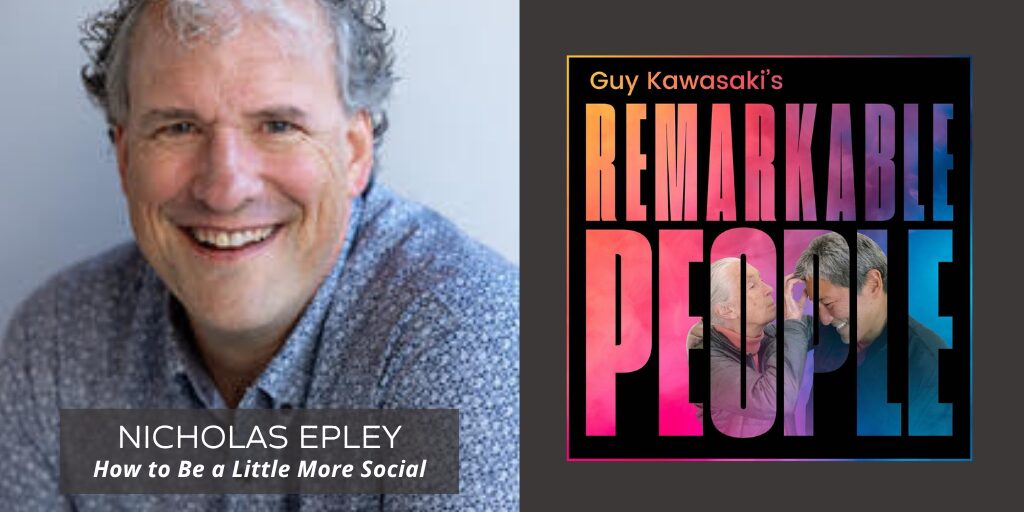
Welcome to Remarkable People. We’re on a mission to make you remarkable. Helping me in this episode is Nicholas Epley.
Nicholas Epley is one of the world’s leading experts on human connection and social judgment. As a professor at the University of Chicago Booth School of Business, his research has reshaped how we understand conversations, relationships, and the assumptions we make about others. But beyond academia, he’s on a mission to change something simple and profound: how often we choose to connect. His latest book, A Little More Social, challenges the quiet habits that keep us isolated. It argues that better lives are often just one conversation away.
In this episode, we explore why people consistently underestimate how positive social interactions will be. Epley explains how our fear of awkwardness, rejection, or inconvenience keeps us from engaging—even when the opportunity is right in front of us. He shares the science behind why warmth matters more than cleverness and why conversations are less like tennis and more like music. Along the way, we unpack the idea that connection isn’t something that just happens—it’s something we choose. And those small choices, repeated over time, shape the quality of our lives.
We also dive into practical ways to become “a little more social” without forcing yourself to become someone you’re not. From recognizing easy opportunities to shifting your mindset about others, Epley offers tools that are both simple and surprisingly powerful. He doesn’t suggest talking to everyone everywhere—but he does challenge you to act when you’re on the fence. The takeaway is clear: the moments we hesitate are often the moments that matter most. And choosing connection, even briefly, can change everything.
Please enjoy this remarkable episode, Why Small Conversations Create Big Happiness with Nicholas Epley.
If you enjoyed this episode of the Remarkable People podcast, please leave a rating, write a review, and subscribe. Thank you!
Transcript of Guy Kawasaki’s Remarkable People podcast: Why Small Conversations Create Big Happiness with Nicholas Epley.
Guy Kawasaki:
Hello everybody. It's Guy Kawasaki. This is the Remarkable People Podcast. And in some sense we consider our podcast just an arm of the University of Chicago, and whenever they send remarkable people, we take them all.
So today's guest is another remarkable University of Chicago person. His name is Nick Epley, and believe it or not, he is a professor of behavioral science, which is one of my favorite subjects. He's in the Booth School of Business at the University of Chicago, and he is one of the leading experts in human connection and social judgment.
This is his most recent book. It is called A Little More Social, and he basically is an evangelist for people to start talking to strangers and begin social relationships. And I got to say it, I was a little bit skeptical of what he said, and now I'm going to put it to test. But, wow, what a case he builds about building stronger relations.
And unfortunately, I don't ever catch a train, so I cannot test some of his theories, but here is the fabulous Nick Epley. Nick, welcome to the show.
Nick Epley:
Thank you so much for having me here, Guy. I feel among heroes on this one, so thank you for having me here.
Guy Kawasaki:
You could never go wrong with the University of Chicago.
Nick Epley:
I agree.
Guy Kawasaki:
And Dana and John List, if you're listening, you know I'm talking about you and Richard Thaler too, so I want to start with what I consider one of the most interesting stories in your book, which is the story of Jessica. So tell us the story of Jessica.
Nick Epley:
I believe you're referring to Jessica Pan, who was a journalist in the U.K. who sent me an email just to connect, and she had written about some of our research before, but she called me later, which what I thought was going to be more of a conversation about our research, it turned out she was needing a pep talk.
That's what it was. She had just gotten a book contract to spend a year of her life living as an extrovert, and she described herself as a “shintrovert,” as a shy introvert, she called me up in the summer. I'll never forget it. I was in a little cabin that we have in Wisconsin, and I was pacing across the room with her on the phone.
She was telling me how she was going to spend a year of her life living more extroverted, and she was terrified. She thought this was a disastrous mistake that she had committed herself to, and she basically was calling to have me tell her that she wasn't going to have the worst year of her life.
And over the course of about an hour, we talked through some of our research and talked about why people tend to underestimate how positively others will respond when you reach out to engage with or connect with them. And extroversion is a complicated phenomenon. Sociability is one of them.
And at the end of that hour, she left and launched her year of living as an extrovert, and by the end of that year she ended up writing a book called Sorry I'm Late, I Didn't Want to Come, which is fabulous, that described the year that she spent reaching out a little more often, and I don't have it here in my office.
It's at my home office, but one of my most prized possessions is a signed copy of that book from her that says something to the effect of, “Dear Nick, thank you so much for changing my life and that of many others,” it worked out well for her.
Guy Kawasaki:
So her story is, at least, anecdotal evidence that life gets better when you're more social. Is that the bottom line?
Nick Epley:
I think that's the way it is. Yeah. When you spot opportunities where it would be easy for you to reach out and engage with somebody, but you're choosing not to because you think now's not the right time, or not the right place, or this will be mediocre, or they don't want to talk to me because social connection, it turns out, isn't something that just happens to us.
It's a choice that we can make. It's a choice we make to reach out and engage with somebody or to hold back and keep to ourselves. And all too often we find in our research, we choose to hold back too often because we underestimate how positively reaching out will actually go.
Guy Kawasaki:
But can I back up for a second? And if you talk to her soon, I know what it takes to get a book contract because I've done it, I don’t know, umpteenth times and you got to write proposals and all this kind of stuff and pages and work and hours and hours. So my first question is, how the hell do you get a contract for something you do not want to do?
I don't understand. Like you woke up and said, “Ah, I'm a vegetarian. I'm going to write a book about eating paleo all year.”
Nick Epley:
Yeah, so I think, I won't tell you what her reasoning was because I'm not her and I can't tell you, but I will tell you that her reasoning wasn't all that different from mine when I started down this line of research a decade and a half ago. For my entire career, I've been studying mind reading for a living, essentially.
I study how we make inferences about each other's thoughts and beliefs and attitudes, and mostly how we screw that up and misunderstand each other in lots of ways.
And I remember just very vividly being on a train ride one morning into my office at the University of Chicago when I had this kind of eureka moment.
Guy Kawasaki:
The red hat lady.
Nick Epley:
The red hat lady, where I'm sitting in this train full of highly social people who are all choosing to ignore each other, and I too was a little nervous about reaching out to engage with the person who sat down next to me that morning.
And yet I also knew of the decades and decades of research that demonstrated that our moments are better when we're connecting with other people than when we're keeping to ourselves.
And yet here we weren't doing it, and here I wasn't doing it. And so I tried. And so I think Jessica came from a similar place where she knew all of this research suggesting that reaching out and connecting with other people might make her feel better, improve her life.
She'd also hit a rough patch in her life where she thought she had to try something different, and she thought, I think, What the hell? Let me give this a try, and while I'm at it, I'll tell people my story. And so that's what she did.
I decided though one morning, I just remember this with crystal clarity, to try something different and I had a woman sit down next to me. She was about fifteen to twenty years older than I was. I was about thirty-five at the time. I'm guessing she was around fifty. African American woman who was dressed in business attire ready for work, and she had this fabulous red hat.
And there's no reason necessarily to think we'd have a whole lot in common and so on, but I decided that morning to try something different to see just what would happen if I tried to have a conversation with her and just pay attention. And it's not like I haven't talked to people before.
Of course, I have talked to plenty of people before, talked to strangers before many times. But this morning I was paying close attention to what happened. And so I turned to her, after overcoming some anxiety about this and worked at my courage, and I said, “Hi, I am Nick. I love your hat. I have one just like it.”
And it's not a killer opening line, right? This is not all-star stuff for sure. But she laughed kind of like you did. The ridiculousness of it was clear and she turned to me laughing and then it just flowed really easily.
And the way conversation works is it's like finding things you have in common with a magnet. It tends to pull for things you have in common. So the conversation went pretty smoothly, pretty easily. We went from one topic to another, talking about our lives and our families and our jobs and our hope for the future.
It was pretty easy and the thirty minutes was just gone like that. It was just over quickly, and I got up to leave. And she held my wrist for a moment, as I was getting up to leave and she said, “Thank you so much for taking the time to talk with me this morning.” And there was a sincerity that was clear, like I appreciated not being ignored this morning. This was nice.
And my feeling wasn't just that this was nice. It was surprisingly nice that the contrast between my beliefs beforehand and my experience afterwards were big. And if that gap, if that experience wasn't unique to me, if that was common, I thought, well, this could be a big thing.
If that's something I generally do that I get wrong, I avoid people because I mistakenly think this isn't going to be okay then that is life changing. That's life changing. If it's not just me, if that's a general thing and that launched fifteen years of research is what it did.
Guy Kawasaki:
Maybe she's out there listening and she'll say, “I'm the lady in the red hat.”
Nick Epley:
Yeah. I never met her again. I never saw her again. I’d never seen her before, and if you ride a different train, you don't ever see each other. So I think that was probably it. But yeah, I haven't seen her since.
Guy Kawasaki:
Nick, can I confess to you? So this morning I'm sitting in this coffee shop and when I work in this coffee shop, I bring my own keyboard. I don't use the built-in keyboard on the laptop. So I have this mechanical keyboard and it's really “clacky,” right?
And I'm sitting there and I'm working and this guy walks in and he says, “I love your keyboard,” and I just smiled and I thanked him. And then later on, another guy sat down next to me, and he had the same keyboard.
Nick Epley:
Is that right?
Guy Kawasaki:
And yeah, and then I thought, Guy, you're such a stupid asshole. You're reading this book by Nick Epley about being a little more social, and you had the two easiest entrees to being more social because you could just discuss your mutual love of “clacky,” mechanical keyboards.
But no, you're such a dickhead. You're so focused on preparing for an interview about being a little more social that you weren't a little more social, and I've been feeling bad for three hours. I wanted to get that off my chest.
Nick Epley:
I tell you what, Guy. I think you'll have opportunity to redo that if you want. These opportunities keep coming up.
Guy Kawasaki:
Okay.
Nick Epley:
You'll be able to make it right someday.
Guy Kawasaki:
I'm going back to that coffee shop right after this interview.
Nick Epley:
Yeah.
Guy Kawasaki:
So listen, basically you're saying that we kind of suck as mind readers, right? You're trying to read the other person's mind, she doesn't want to be disturbed, et cetera, et cetera. So, is mind reading like a normal distribution?
There are people who are very good and people are not good, but it's a normal curve or do we just suck as a species right now in mind reading?
Nick Epley:
First off, I wouldn't say that we suck at it, that wouldn't be the right characterization. We're the most amazing species on the planet when it comes to this. There is not another species on the planet that thinks about the minds of others like we do, and that is as capable as we are.
But it's a really hard problem. It's a really, really hard problem, and when you deal with really, really hard problems, knowing what's on the mind of another person, we're imperfect. And so I think that's the right way to describe it. It's not that we're terrible, we're amazing, but we're imperfect and our imperfections aren't without consequence. They're consequential.
Guy Kawasaki:
But it seems to be that we are overly pessimistic. That we think that it's bad or more bad is going to happen if we are a little more social. So why are we so pessimistic then?
Nick Epley:
I think there are a couple of things that are going on. One, let's just take as a starting point, it's a hard thing to get exactly right, but there are a few things that get in the way. One is the perspective that we have on ourselves is different from the perspective that other people have on us.
And so we tend to focus on our competency and our capability and our agency. Other people tend to care about our warmth. Are we nice and friendly? So when I thought about having a conversation with the woman in the red hat that morning, I thought, Oh gosh, what are we going to talk about? We have nothing in common. We have no reason to engage with each other.
I was worried about whether I was going to be able to carry this out. What she cared about was I a friendly person, a kind person, someone who seemed honest and trustworthy and worth turning into a friend, even if just for a moment.
But if I am reaching out to somebody in a positive way and thinking that they're going to care about my competency when they really just care about my warmth, then I'm going to underestimate how well I'm going to be received when I reach out to other people with kindness.
And that could be kindness to start a conversation with somebody, just to see somebody and make a connection with them or send a gratitude letter to somebody or pass along a compliment or be honest with someone. That's going to happen routinely when we reach out to other people in positive ways.
Second thing is that social interaction has a magnetic quality to it. It tends to pull us together, and our expectations don't capture that. The dominant norm of social life is reciprocity. If I say, “Hi,” to you, what do you say back to me? You say, “Hi,” I smile at you. You smile back at me, right? I wave to you. You wave back to me.
Nobody waves, but everybody waves back to you. But what we find is that our expectations don't really appreciate the strength of that reciprocity, that dynamic process. And as a result, we think we'll reach out to other people in a kind way, and they could respond to us in any way. And that just tends not to be true.
They are tilted towards being kind back to us when we are kind to them first. And then the third thing is that it's hard to learn from these mistakes because pessimism is self-fulfilling. So you passed up conversations with not one, but two dudes this morning who you could have talked with. I'll give you grief for that for the rest of our conversation.
Two people, right? And because you missed those conversations. You don't know how well they could have turned out, right? And so optimism gets corrected, gets calibrated. If you believe that talking to me would be pleasant, you'll talk to me and find out. But if you believe that talking to me would be unpleasant, you wouldn't try it and you might not find out that you're wrong.
And so pessimism that can come from these other two sources tends to be self-fulfilling and not corrected because we avoid the data we need to get it right.
Guy Kawasaki:
But do we go back to Neanderthal days and we're not going to exactly have a little social interaction with the saber tooth tiger, or the guy from the other clan who's about to kill us. So has society changed so much that we got more upside than downside now?
Nick Epley:
So that's a good question. And many people ask me that, and my answer to that is, I don't know. I don't know because I can't go back and find out what the actual incentives were like and to find out whether those are actually what are keeping you from talking to the guy with a “clacky” keyboard this morning. Or whether that was just something else in your immediate environment.
What I know from our research is that we can explain a lot of what people do by looking at their thoughts and circumstances that they're in right now. So I can predict when you'd be willing to engage or talk with somebody and when you couldn't. We know what can move that around whether that's coming to us from some vestigial, evolve tendency or not is hard to test.
Guy Kawasaki:
So are you saying that in general we should just assume that it is okay to be a little more social or are there some definite signals like, Guy, do not do this. This is not the right circumstance, or can I just go blindly through life and try this with everybody?
Nick Epley:
Yeah. No. Our data do not suggest that. Our data suggests that you underestimate how positively things will turn out, but look, life does have its risk to it. There are dangerous environments and we have some sense of what those environments are.
Our data suggest that when you're on the fence, you'd like to reach out to somebody, it seems safe and easy, like in the coffee shop this morning. It is safe and easy to do, and it could just be a moment, right? It doesn't have to chew up your entire day. When we're on the fence, we'd like to reach out and engage with somebody, but we think other people aren't so interested in engaging with us.
Those are the moments where you can choose to enrich your life by reaching out a little more often. Those are the critical times, I think, where our mistakes can get in our way. I would never tell somebody to talk to some random stranger who comes up to you in a back alley, but the people who approach us in our lives are sometimes different from the people that we might approach.
They suggest that when you're on the fence, you'd like to, but you're nervous about how it will go. Those nerves and those moments are probably too strong, and those are the moments to try reaching out.
Guy Kawasaki:
Okay, so now Nick, let's suppose, you're a billionaire. This is a big supposition on my part because I'm not even close, but if you're a billionaire or politician or something, and I'll tell you a little side story. So I once spoke at an event where Sheryl Sandberg from Facebook, now Meta, was also speaking, and she pulls up.
She has an entourage, Nick I swear, of twenty people. She has a personal assistant. Her personal assistant has a personal assistant. Her bodyguard has a bodyguard. Her driver has a driver. It's twenty fricking people, right?
So now I'm thinking about your book. I'm thinking about this situation with billionaires and politicians and leaders and Tim Cook, and those people are not catching commuter trains. They're not saying hello to black women with red hats. So what does it mean when all those people are removed from all of this?
Nick Epley:
One of the things that we find is that people underestimate how much they're going to learn from other people in conversation, so that's another thing that we get out of interacting with other people.
Not only do we gain some emotional lift, but we also learn things, learn perspectives that we don't have, gain information that we wouldn't have guessed, learn things about other people that we might not have anticipated.
And so when you're isolated in this way, I'm not saying anything here that I think is not pretty clear to anyone who's paid attention out in the world to what happens to folks in these situations. It can be isolating, right? You don't actually connect with a lot of people. You don't actually have friends. It can be lonely at the top, but you also stop learning stuff.
You become disconnected from other people in ways that give you a distorted view of what reality can look like when you're too disconnected. I think those are the two big things.
Guy Kawasaki:
And I would make a case that if these people are shut off from learning things from other people and the leadership positions they have, this is a huge negative for society. It would seem to me that of all people, they should learn the most from other people, right? They're being isolated now.
Nick Epley:
Yeah, so look, some of the most famous, wonderful CEOs through history have been those who have reached out and connected with everybody in the organization. Herb Kelleher, the founder and CEO of Southwest, was notorious for going into the airplane hangar in the middle of the night and hanging out with the guys for a little bit and connecting with them, right?
Both kind of learning from them but also making it clear that he cared for them and those employees would do anything for Herb when the company needed it. And folks who are able to reach across and reach out and engage with other people, who establish those kinds of connections are often the ones who are really admired out there in the world.
Guy Kawasaki:
So can you tell us other benefits that people can derive? You already talked about learning other perspectives and getting a broader point of view. What else do you get by doing this?
Nick Epley:
So the big thing you get are connections, right? Relational connections, and those might just be momentary. So the woman in the red hat with me on the train that morning was a friend just for a minute, right?
But it made that minute better, and it turns out those minutes, those moments are the things that really define happy lives when you have those moments routinely over and over and over again.
And some of those, of course, moments then turn into relationships that are longer lasting or can be more meaningful in those moments. They can give you a sense of connection to other people, and those are among the most satisfying things that we get in our lives. It's not just that moment is better, is positive, that is a good thing, but it also establishes connections with people.
And so every friend you have now was at one time a stranger to you, was at one time somebody you didn't know, and sometimes they can lead us to do really big things in our lives, reach out and connect to other people.
Both you and I have adopted children, for instance, and that's a choice to reach out and engage and bring people into your life that enriches not just their lives but enriches your lives immeasurably. I mean changes our lives in ways that make them almost unrecognizable from what they were before, brings love into our lives in ways that you might not have imagined beforehand.
And so there are small things that it can bring, but also really big ones that come from relational connection, love in our lives, and it's hard to think of a bigger thing in our lives than that.
Guy Kawasaki:
Just as an aside, as you said, we both have adopted children and I have to tell you, I'm seventy-two years old. I've had a lot of beautiful and wonderful moments in my life, but I don't think anything can top the beauty of an adoption. That is a truly beautiful process and so rewarding, and so I get all choked up just thinking about adopting.
Nick Epley:
So psychologists will sometimes say that we are the most social species on the planet, and what they mean by that is a few things. But one thing that they mean is that we can care for non-kin. That is non biologically related kin, friendships, family members in ways that no other species really does.
Not to the same extent that we can. And that phenomena, I think, shows that better than any other is how you can make families so strong.
Guy Kawasaki:
I have to say, I've had this discussion with some men, and these men think that, Unless my child came from my loins, I can't love the child. And I said, “You're being so freaking stupid. Once they put that baby in your arms, everything changes.”
And Nick, let's just be honest, right. The involvement of most men in the birthing of a child, it lasts about thirty seconds, nine months before. And I don't know how we got on this topic of adoption, but it is truly a beautiful thing. If those guys with the “clacky” keyboards that said, “Hey, I heard you adopted kids.”
Nick Epley:
Maybe that would've come out if you'd said, “Hey, I love your keyboard too. Guess what?”
Guy Kawasaki:
Okay, so Nick, you convinced me, I'm going to be a little more social. I'm going to carry more keyboards and all that, but now you got to give us the Nick Epley best practices. What do I do? I've made the decision. I've crossed the chasm. I'm going to be a little more social. I'm looking for red hats and “clacky” keyboards. How do I start this? What do I do?
Nick Epley:
Yeah. So I think there's a common misunderstanding, not a total misunderstanding, but one that's off a little bit where the belief is that what you say is really what matters. That they're like some magic words. There's some great opening lines that you can use to get a conversation going.
But remember, what we care about ourselves is our competency, and so we're focused on those things. Other people care about our warmth. And in any given moment, what you say to somebody that might be kind, that might invite them or welcome them into a conversation with you is going to vary depending on the context that you're in.
I actually think the more important thing is to change your mindset when you're out in the world, not to focus on specific things to say, but to change your mind set about other people. Once you start taking an interest in other people, you start realizing other people are mostly pretty kind.
They're mostly pretty interesting. As Bill Nye, famous science guy once noted, “Everyone you ever meet knows something that you don't,” right? Everyone's got a story to tell you. Everyone is remarkable in their own way. Once you realize that and your job is to figure that out. You just approach people differently.
You just engage with them differently. I love to ask people when I sit down with them, because I've taken an interest in them, one of my favorite things to ask people is, “What's your story?” Everyone's got one. Everyone's got a story about how they got here doing whatever they're doing now, right?
And they understand. And they're not talking about how did you walk to wherever you are today. But that then opens up a lot. But I think the key first step is changing your mindset about other people, and you take an interest in them. And when you take an interest, you start noticing people.
You start noticing people where there might be opportunities to engage or talk. You have a kind thought about somebody. You notice somebody's keyboard and you comment on it or their hat and you pass along a kind thought to them, and I think that changes everything.
Guy Kawasaki:
So would you say that an introvert is an extrovert who has been wounded or something? If you and Susan Cain walked into a bar, right? And she's Miss. Introvert and you are Mr. Social, like what happens? Can't some people just be introverts and be happy and life goes on?
Nick Epley:
Oh yeah, of course, people can. What the data suggests though is that even introverts are uplifted when they're in conversation or engaging with other people to the same extent that extroverts are. In the same way that people benefit from exercise regardless of how much they typically exercise.
Our data don't suggest that everybody should change the way they live, but like Jessica, who found herself in kind of an unpleasant point in life and she wanted to make her life better. For all of us, if you want to make your life a little better, reaching out, taking easy opportunities to engage with other people, I think is a simple way to make your life better, regardless of how extroverted or introverted you are.
And my advice to anyone who's thinking about this is just to try it. Like just start testing it a little bit, right? You don't have to believe me. You don't have to believe our data. We've seen this in over 30,000 people now. We've run through over 120 published experiments and a bunch that we just haven't gotten around to publishing yet.
This is a robust tendency to underestimate how well things will go, and if you think you are holding yourself back too much from engaging with other people, you can go out and try it yourself and learn where you're holding yourself back unfairly in your own life.
Guy Kawasaki:
There is a part of a book where you discuss the cadence of conversations, and until I read that section of the book, as the metaphor you use, I used to always think of conversations as tennis, right? So, hit back, hit back. You're volleying, you're rallying, whatever, right? But I would like you to explain why conversation is not tennis.
Nick Epley:
Yeah. So I think an intuitive way to think about conversation is like this tennis match where one person says something, then it's the other person's turn to say something, then the other person, right? And so you're going back and forth. It's this very orderly back and forth dialogue. Real conversation though doesn't actually look like that.
When psychologists look at it with a microscope, they jot down every utterance that is made in a conversation, every piece of information that's exchanged. It's not a back and forth dialogue. It's like a constant exchange.
It's more like a band playing together with a lead singer taking the lead for a little bit and driving the song forward, but while the rhythm guitarist is still playing along in the background. And it goes back and forth in lightning speed, but there's constant interaction.
So when one person is speaking in conversation, the other person isn't just sitting there doing nothing. They're looking at the person and nodding like you are right now, or smiling, or they're laughing in the background, right?
Like you are now. Or they're giving a “Uh-huh,” or a “Hm, I'm not so sure about that,” or “Right, right, right.” They're putting things in the background. That's what psychologists call back channeling and back channeling can sound just like noise in a conversation. Like it's just irrelevant kind of junk.
It turns out it's essential for connection. That back channeling is where connection happens. It's what tells you as a speaker that the other person's paying attention to you, that they're caring about you, right? And when you cut that out, you're speaking and the other person just sits there dead face.
It's freakish, right? It's freakish. It's like the other person doesn't care about you. They're not really engaged with you, they're ignoring you. So all of that back channeling that's going on constantly while we're talking to each other is the magnet that pulls people together in conversation. And it is essential to feeling connected to the other person.
Guy Kawasaki:
Well, Nick, so here we come to the second conviction of Guy based on your book because not only did I ignore the two guys with the clacking keyboards, but as I'm reading this thing about conversation has back channels and it's not a tennis match, the part of the book where you list every, “Um,” and “Ah,” and “Yeah,” and all that stuff, right?
And I looked at that and I said, “Guy, when you record a podcast, Madisun and Jeff Sieh, the co-producers as they do the sound design, they take out a lot of filler words. So now I'm thinking, Shit, I'm ruining the content of my podcast because I am taking out all the filler words and the laughter and all that.
So now, Nick. Am I paranoid here or like, should I just record and not edit? I was having existential crisis in this coffee shop preparing for this.
Nick Epley:
It sounds to me, Guy, like you're like an experimentalist in disguise. You just haven't found your career path yet. What you just raised was a hypothesis, right? That it's possible anyway that people might enjoy a conversation a little more if you heard all of those things versus not.
Whereas Madisun and the sound engineers think it would be better to take that stuff out to the extent that it's distracting. I don't know what's right in terms of a podcast. I do know that in a conversation, if you were to remove all of that stuff, it would make it worse. Whether that's true in a podcast where you're trying to listen to what each side has to say.
I'm not sure. That's an interesting question that strikes me as I don't know, but I do know in a conversation that back channeling is what you want, and if you don't have it, it makes those interactions a little bit worse.
Guy Kawasaki:
Well, Nick, why don't you get a couple of postdocs and you say, “At the University of Chicago, we're going to study the effectiveness of podcasts with and without back channeling,” and then we truly know.
And then you can give some people five dollar Starbucks cards and some people twenty dollar Starbucks cards. And you can do it in the train station. And I would love to hear this.
Nick Epley:
We have experience with that for sure. Yeah, there's no end of questions. That's one thing, this research program just keeps going and going. Questions just keep coming up like this one, which I hadn't even thought about until five seconds ago when you mentioned it.
Guy Kawasaki:
This is why I like to talk to the University of Chicago because I'm in constant need of therapy and information. So, in a part of your book, you talk about these four key words, and I would like you to explain these four key words.
And, Nick, I'm an author too, so I know this happens because it happens to me quite often where I'm someplace and a person has read my book. They say, “I love the five steps you have to a much better evangelistic pitch.”
And I'm thinking, Shit, what did I say? What were those freaking five steps? I have no idea. I wrote that book two years ago. This person read it last night and he knows the book better than I do. So I'm going to tell you the four words, so you don't get embarrassed.
Nick Epley:
I think I have them. You're talking about recognize, easy, opportunities, routinely.
Guy Kawasaki:
I am.
Nick Epley:
Yes. Okay. Whew. Now I got lucky. Yeah, so I do end the book with some advice about how to put this into practice in your own life, because it's hard to take behavioral science research, which is about averages and variability around those averages, and think about how do I do this myself?
And so that's where I have this phrase that I hope folks will remember, which is to recognize easy opportunities routinely. And each of those words is important. The recognize part, there are a lot of opportunities to connect that we overlook. We just don't pay attention to. Your guys with the keyboards this morning, right?
We'll just keep harping on that. That's an easy one, right? And that's where starting to take an interest in other people, that will allow you to see things you might not have otherwise seen. Okay. Second, easy. There are hard ways to interact with other people, and there are easy ways, right? And it turns out that if you want to get things actually done.
Do you want to do things? You don't have to go to the really hard things. Just do the easy thing first, right? The guys in the coffee shop again, that was easy. That wasn't hard. They were right there, right? I'm walking from my train over here just to the east of me a few blocks right now to my office, right?
Somebody walks up next to me. That's an easy opportunity to connect. I get into my office in the morning. I've got about a hundred yard walk through the atrium out in the middle of our building up the elevator to my office. I pass all kinds of people. It's easy for me to smile and say, “Hello,” to folks.
Turn that into a habit, walking around and smiling and say, “Hello,” to people. That's easy, right? Sometimes you want to make things easy. So when I have a kind thought, a gratitude I want to express to somebody, it's hard to express gratitude if you don't have thank you notes around. So I just keep them, right?
I keep them here, right? So that it's easy to do. So that is behavioral science 101. If you want to get something done, make it easy and choose the easy one. So that's a key. Opportunity is the third important insight. And I think that one's important because a lot of times, we're too narrow in what we think about, and what we think an opportunity might be or what an event allows us to do.
So again, because this is a recurring theme, let's go back to your coffee shop this morning. You were there to get things done, right? You had work to do and sure, you had work to do.
Yes. But there was a moment that was also an opportunity where you could have gotten something done and you could just had a little conversation with somebody without really affecting, so two things could have happened there, right?
Like when I'm in my car, right, driving around, I've taken it on as a habit almost to turn those into talking opportunities. Driving is for driving, yes. But it can also allow me to call my son who's in Oregon, for instance.
I don't hear from him as much as I'd like, so I call my son at that time, or I go down to get coffee, right? I like coffee. It's a good thing, right? That little walk is an opportunity for me to ask a colleague, “Would you like to go with me?” So you can do two things at once, right? So to recognize that we have more opportunity than we might imagine to connect with other people.
And then the last one is routinely. Happiness really comes from the moments in our lives where we're doing things that lift us up. And so having things happen frequently and routinely to us is really the secret, I think, to a happy life. The way to have a good day is to have a bunch of happy moments that you string together.
The way to have a good week is to string happy days with happy moments together. The way to have a good month is to string those moments together. That's what leads to a good life. And when you do these things routinely, when you turn things into habits, that's when you do them over and over again in ways that keeps bringing that happiness.
Like when I get on the train, I'm automatically thinking about connecting with someone. I'm walking to the office, I'm smiling and saying, “Hello.” When I have a kind thought, I automatically think, how can I share that with that person?
They just become routine. And then that changes who you are. It just becomes part of your character and allows you to have these experiences over and over again because when it comes to happiness and wellbeing, it's the frequent moments that really mattered or not the intensity of them.
Guy Kawasaki:
Okay, Nick, so I'm going to be using that keyboard every day in that coffee shop. But then Nick, I'm telling you, I'm not a good mind reader.
Maybe I'm being pessimistic, but there are going to be some people who are going to say, “That's the asshole with that keyboard that makes so freaking much noise. I try to go to a coffee shop and read in peace, and all I hear is ‘click, click, click’ all day long because of that asshole.”
Nick Epley:
Look, people can think poorly of us. They can, but they tend not to when you're engaged with them. And years ago when I was in graduate school, some of the earliest research that we did found that our pessimism also extends to what other people are thinking of us in these moments.
So there might be one or two who are not so wild about your “clacky” keyboard, but my guess is it's not as many people as you imagine it to be.
Guy Kawasaki:
So I'm going to be sitting in that coffee shop, and people are going to say, “Guy, I heard your podcast and I really like your mechanical keyboard.”
Nick Epley:
Yeah. There you go. That's going to be your new thing.
Guy Kawasaki:
I am going to engage them in a conversation about “clacky” keyboards and stuff. Alright, so two more questions.
Question number one, social media and tech in this context is often painted negatively, right? So you're at a lunch and everybody's on their phones looking at text messages and instead of meeting with people, you're sending them emails and texts and blah, blah, blah. This digital divide is creating this distance between us.
But Nick, I would make the case that without social media and email and texting, I would have far less social interaction and far fewer friends. I think it has improved my social gain and my socialism. Am I like in self-justification mode? But I really think I have more relationships because of social media than if I did not have any social media.
Nick Epley:
Yeah. That certainly could be. And it's a tool. It depends how you're using it. So let me describe an experiment that Liz Dunn, who's a fabulous psychologist at the University of British Columbia, who you ought to have on your podcast someday. She's terrific.
Also a remarkable person, survived a shark attack of all things. Yeah. Anyway, she ran this experiment where people were together at dinner in a restaurant, right? And in one condition people were asked to put their phones in a box under the table. In another condition, they left their phones out on the table, okay?
And then at the end, asked them essentially, “How well did your dinner go?” And I don't think you'll be surprised to learn that the people who had their phones underneath the table reported having a better dinner than the people who had their phones out on the table. So the question isn't, what can your phone do for you?
It can do amazing things, right? We got the world's information at our fingertips. You can reach almost anybody on the planet at any given time, which is amazing, right?
It's not what can the phone do, it's what is the phone doing for you? And if your phone is keeping you, it is a crutch that, I think, it's going to be weird to talk to the person next to me, so I'm turning to my phone instead.
If it is keeping you from connecting with other people around you, if it's keeping you at dinner from connecting with your son, or your spouse or your daughter, right? Then it's not helping you in that moment. It's driving you away from other people. But if there are moments where you might not be doing anything and I can pick up my phone and call my son.
Or I can reach out and connect with somebody I might not have ever known before and have a meaningful interaction with them. Then it is creating opportunities for connection. I think the data, though, suggests that most of us probably aren't using our phones in the ways that you are or in the ways that might be bringing actual meaningful connection.
And that's where the data suggests it's causing some trouble for us. It also serves as a signal to other people that maybe you're not interested in talking with them and so you might have fewer people saying, “Hello,” to you than otherwise.
Guy Kawasaki:
Good point. Yeah, and you mentioned in your book about how it was somebody who was, like you said, he was an older gentleman. He was six feet five inches or so, and he had long gray hair.
Nick Epley:
A big, long beard.
Guy Kawasaki:
And he was just about to put the AirPods in his head, and you push through your pessimism and talk to him and lo and behold, it was a great conversation, right?
Nick Epley:
Yeah. He actually wasn't that old. He just looked old. He looked like an orthodox monk, like he had this big, long beard. Tebow is his name. Delightful guy turned out to be a professor here at the University of Chicago. He's since moved to Europe, but he was a professor here and yeah, he was putting his earbuds in.
But I'd seen him before. He just got off the train. I thought maybe I'd see him again. So I didn't demand a conversation. I invited one. I said, “Hello. Hi, I'm Nick.” Most powerful words you ever have, “Hi, I'm Nick.”
And, pulled out the earbud. What was interesting was his face just switched like I'd flipped a switch on his back from not paying attention to anybody, sort of this dead face to a huge smile. And we became good friends because I said, “Hello.”
Guy Kawasaki:
Wow. I love that story. Okay, my last question for you is, you have sold me on this. I'm going to carry my keyboard with me everywhere, so people feel free to attack me or address me because of my keyboard.
But I want to know who are some people, hopefully we would recognize, that are in the Nick Epley Hall of Fame for being social? Who do you hold up as a hero?
Nick Epley:
So that one's easy for me. His name is Harry Davis. I got two colleagues here at the University of Chicago who I hold up in that way, and I will by the way, not include my wife, who is an angel on all dimensions, but so two folks I'll tell you about. One is Harry Davis. Harry is in his mid-eighties now.
He was a professor at Booth for more than sixty years. He continues to teach here. He just retired recently and he is the biggest hearted, friendliest, most sociable person I know here at the Booth School of Business. We have four Nobel Prize winners in economics who basically share a floor with me or who are one floor up.
But every year the new incoming students come in, and they're assigned to different cohorts with names of famous faculty here, and one of those six is Davis, named after Harry Davis. Harry never did a whole lot of research. He was never going to win a Nobel Prize, but he cared more about our students than anybody that I have ever seen.
He ran fellowship programs. He had meaningful conversations with students. He has changed the way that I think about being a professor more than anyone else that I've ever come in contact with because I saw how much good a professor can do when they care about other people, our students, and are willing to reach out and pour what they have into them.
And I try to channel him when I'm in my classrooms as best I can. The other amazing person I have in terms of sociality is my colleague Linda Ginzel. Linda is one of our clinical faculty in behavioral science, which means she's primarily a teacher, but she is also the friendliest, most sociable person I know.
She cares about other people also as deeply as anyone that I have ever met. She and her husband, Boaz Keysar, who's a collaborator of mine, and he's lovely too, but even he will say he's no Linda Ginzel.
They lost their son Danny Keysar when he was two years old to a crib accident. They responded to that by starting a consumer product safety organization called Kids In Danger that they ran for decades to try to create safer consumer products for kids, enormously successful.
And Linda routinely shows up at my office here with a bag of goodies for me because when she is out, she thinks of people. When she travels, she has to bring an extra suitcase for all of the gifts that she brings back for folks who she loves. She's an amazing human being. So Harry and Linda, those are my two hall of famers.
Guy Kawasaki:
Oh, those are great examples. I just thought of one more question. Okay.
Nick Epley:
Okay, I got it.
Guy Kawasaki:
I promise you, this is the last one. So let's just suppose that I'm converted. I'm not worthy, Nick. I believe in this. I am going to engage in people, but in a hypothetical situation, what if I'm about to get on a conference call?
I really am under deadline. I really cannot discuss “clacky” keyboards right now. How can I tell the person this without ruining his expectation and making him a pessimist? I want to give positive feedback for what could have happened, but I just cannot do it. So how do I do that without ruining this potential great moment?
Nick Epley:
A lot of people worry about how they're going to end conversations or how they're going to respond when somebody isn't able to have a conversation.
And we haven't done systematic research on this, so I'm not speaking from data here, but my sense from looking at gazillions of conversations and people who occasionally get rejected when they reach out to say, “Hello,” to somebody is that it's not that bad and it's not that hard to end a conversation if you want. Just like it's not that hard to start a conversation if you want.
And the easy thing to do is to say, “I would so love to talk with you right now, but I got this conference call right now that I just have to attend to, and please forgive me for that.”
So sometimes I'm on a plane, right? And I got to get this manuscript review done, or I got to write this paper, and I'll have a short conversation, but then we'll say, “I'm so sorry, but I really have to get to this right now.”
And who doesn't understand that? Who doesn't understand that? And that's okay, right? That's okay. There are times when you can engage and times when you can't, and people are more forgiving than you might imagine them to be. It'll be okay.
Guy Kawasaki:
I could have told those two guys, “I would really love to talk to you, but I got to get ready for this interview about being social.”
Nick Epley:
Yeah. You're not going to believe what I'm stuck with doing right now. This guy tells me I'm supposed to talk with everybody, but I can't right now.
Guy Kawasaki:
All right, Nick, thank you so much for this and I really enjoyed your book. I'll hold your book up one more time so people can recognize it in the bookstore or on their digital bookstore or not. It's called A Little More Social, Nick Epley from the University of Chicago. This is the remarkable University of Chicago people podcast.
I want to thank you for listening. I want to thank Madison Nuismer, who is a very social person, Jeff Sieh, and also very social person. He has a long gray beard just like the guy in your book. There's Tessa Nuismer who's a researcher and makes sure all our transcripts are great. So there is a team behind me, and I want to thank them all and I do want to thank you Nick Epley.
Another great episode, Nick. Thank you very much and best of luck to you and we will try to get people to read your book for you.
Nick Epley:
Thank you so much, Guy. I really appreciate it. I think the work's important. I think it changes your life when you learn of it.
Sign up to receive email updates
Enter your name and email address below and I'll send you periodic updates about the podcast.


Leave a Reply