
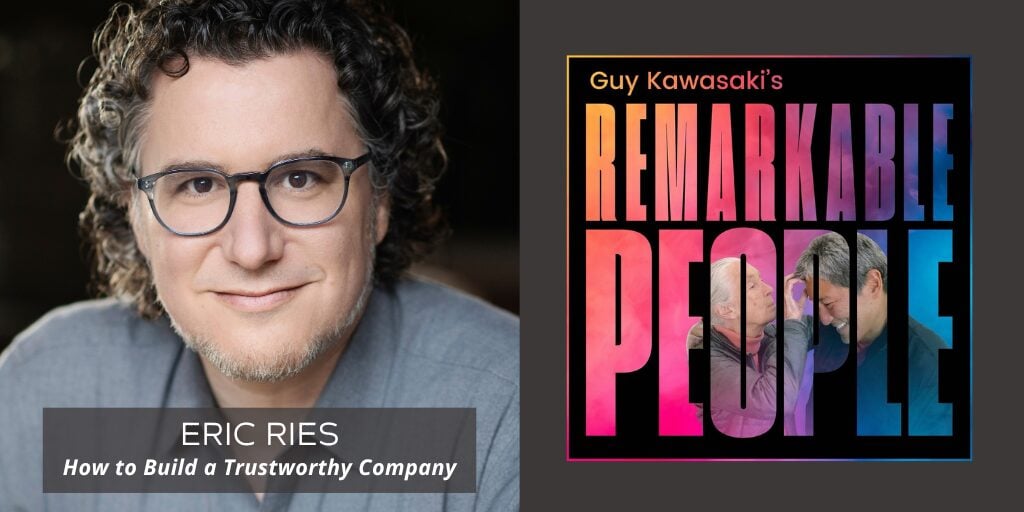
Welcome to Remarkable People. We’re on a mission to make you remarkable. Helping me in this episode is Eric Ries.
Eric is one of the most influential voices in modern entrepreneurship. He changed how startups operate through The Lean Startup and helped popularize concepts like the minimum viable product and rapid experimentation. But his newest work, Incorruptible, takes on a much bigger challenge: why so many successful companies eventually lose the values that made them great in the first place.
In this episode, we explore how corruption quietly spreads inside organizations—not just through fraud or scandal, but through the slow erosion of trust, mission, and long-term thinking. Eric explains why shareholder primacy has pushed companies toward short-term extraction instead of lasting value creation, and why even admired brands can drift away from their original purpose. He shares surprising lessons from companies like Costco, Novo Nordisk, and Anthropic, along with stories about Steve Jobs, venture capital, and the hidden incentives shaping Silicon Valley culture.
One of the most fascinating parts of this conversation is Eric’s argument that governance is not boring paperwork—it’s “organizational soulcraft.” He explains why founders should think about company structure as early as product design, and why protecting a mission matters just as much as building one. Instead of accepting “best practices” by default, Eric challenges entrepreneurs to ask a harder question: what kind of company are you actually creating?
This episode will push founders, investors, executives, and anyone building something meaningful to rethink what success really means. Eric Ries doesn’t just offer criticism—he lays out a blueprint for building organizations that can grow without becoming hollow, extractive, or disconnected from the people they serve. Whether you run a startup or simply care about the future of business, this conversation will stay with you long after it ends.
Please enjoy this remarkable episode, What Silicon Valley Gets Wrong About Success with Eric Ries.
If you enjoyed this episode of the Remarkable People podcast, please leave a rating, write a review, and subscribe. Thank you!
Transcript of Guy Kawasaki’s Remarkable People podcast: What Silicon Valley Gets Wrong About Success with Eric Ries.
Guy Kawasaki:
Hello, everybody. It's Guy Kawasaki. This is the Remarkable People Podcast, and we have the remarkable Eric Ries on today. And Eric, oh, if you're a tech entrepreneur, Eric is the man.
He wrote a book called The Lean Startup, and he is the guy who popularized the concept of MVP, Minimum Viable Product, and all of us in Silicon Valley has been spouting about MVPs for the last I don't know how many years.
So he is the man. Well, I can't say he's the father of MVP, but he certainly popularized it, right, Eric? Is that accurate?
Eric Ries:
That’s totally fair, yeah.
Guy Kawasaki:
Yeah. It's like sometimes people say to me, Eric, "Oh, you're the father and the originator of evangelism, Guy." I say, "No, there was a guy named Jesus before me."
Eric Ries:
Every good idea has a predecessor who did it first. Yeah.
Guy Kawasaki:
That's right. So this is a picture of his brand new book, and it is called Incorruptible, and the subtitle is Why Good Companies Go Bad and How Great Companies Stay Great.
And Eric, I have to say, please take this as a positive. When I read this book, I said, "My God, this is a long way from pivoting and creating a Minimal Viable Product and getting to market and, you know, like build, measure, learn."
This is a whole different ballgame. It really was eye-opening for me, so thank you for writing it.
Eric Ries:
Oh, thank you for saying that.
Guy Kawasaki:
So, you know, like everybody else in the world, I read The Lean Startup, and when I started writing books about entrepreneurship, I stole a lot of your ideas. I freely admit that. But one of the things I learned from Steve Jobs and Pablo Picasso is that great artists know what to steal.
Eric Ries:
That's right. You're the OG startup writer. You were writing about startups long before the rest of us. So there was a time, I don't know if people don't know this, there was a time when if you wanted to read about startups, Guy's book was all there was. That was it.
It was like you had a monopoly on the whole market. We all read that book because it was incredible. It was awesome. Thank you for paving the way for the rest of us.
Guy Kawasaki:
And then I got corrupted, and I got taken over. All right, so first question from The Lean Startup, is there anything you really want to change that you said in that book that you regret now?
Eric Ries:
Oh, yeah. So many things. It's interesting because I was one of those people when I was younger, when an author would come out with a new expanded, revised edition of the book, I hated it. I always was like, "Oh, now that the author is older and wiser, they're walking back all the stuff that made the book great. Like, don't chicken out."
I hate it when people do that, so I've had to resist the temptation. I really want to make some changes, but so far I've been able to resist the temptation. I will tell you one funny thing, though. The first thing I will change for sure if we do a new edition.
Have you ever seen that Reddit meme that's like Anakin and Padmé? It's four comic book frames. Anakin says, "I'm going to change the world." Padmé says, "For the better, right?" And then he doesn't say anything at all, and then she's like, "For the better, right?" I used to think that was the funniest joke on the internet.
And man, with what's happened to our poor tech industry, I don't feel that's funny anymore because we had so many companies that were going to change the world, and they forgot to specify for the better. So anyway, I was really thinking about this lot.
This is a couple years ago now, and I had this moment of panic where I was like, "Wait a minute. Wait a minute. Did I tell people to change the world for the better?" And I was like, "Sure. I'm sure I did." Surely that goes without saying, but I was like, "Did I think it was so obvious I didn't need to write it down?" So I checked the book.
In the book, if you check at the end of the introduction, there's a sentence in there that just says such and such stuff, "So that the next generation of entrepreneurs will have the tools they need to change the world," period. I forgot to specify for the better, so “mea culpa.”
Guy Kawasaki:
Well, that's plausible deniability. Oh, I wish Bill Campbell were alive. We could ask him.
Eric Ries:
Amen.
Guy Kawasaki:
Like, "Hey, Bill, did you tell Larry and Sergey do no harm forever or just until your IPO?" Just for a time.
Eric Ries:
Just for a time. I know. I mean, you, you saw the book I have a section called, "Don't Be Evil versus the Quarterly Report."
Guy Kawasaki:
Oh, yeah. I read that.
Eric Ries:
And what's interesting, I had a lot of test readers. You might have heard I like feedback. That's kind of my thing. So I had 600 test readers of this book.
They generated more than 10,000 comments, so I really went deep with a lot of readers. And people feel so tender about Google. It was like if I criticized Google, people would be like, "Oh, come on, are you really being fair?"
And they're like, "Oh, but.” And if you get underneath it, there's this really profound sense of disappointment because you remember, we all had such high hopes for what that company would become.
Guy Kawasaki:
Yeah, but I feel the same way about Apple.
Eric Ries:
Well, there you go. What's funny is certain other companies I won't name, I can criticize them as much as I want and nobody cares. They're like, "Oh yeah, those guys are villains, no problem." But really the pain they feel is for the companies that could have been something truly committed to human flourishing and failed.
Guy Kawasaki:
Does the company's name start with “M?”
Eric Ries:
You said it, not me.
Guy Kawasaki:
Okay. So now, I was reading your book, I think, "Okay, MVP, MVP. That is Minimum Viable Product. We got to come up with an MVP for this book." So I came up with it. It is make, validate, and protect. How's that?
Eric Ries:
Man, you should get a job in marketing. That's really good. Make, validate, and protect. No, that's exactly it because I say this in the book. I feel like we taught a whole generation of founders how to build something really beautiful, really incredible, really valuable, trustworthy to the core, and we didn't teach them how to protect it from these forces that will corrupt it, and I feel bad about it.
So yeah, make, validate, and protect. I like that.
Guy Kawasaki:
Oh, take it. It's yours. You can say that I gave you MVP two.
Eric Ries:
MVP two, yeah, exactly. Two point zero electro. What is it? MVP two, “Electric Boogaloo,” whatever.
Guy Kawasaki:
Okay, so now, the yarn in The Lean Startup was you build, you measure, and you learn. So I have a really important question here. So now that we added protect, is the order build, measure, learn, protect, or is it build, protect, measure, learn? Where does the protect come in?
Eric Ries:
Yeah, it's interesting because build, measure, learn is really fundamentally about the product. It's like the strategy that the elements of the startup that are under your control. And protection is really about the elements that are not entirely under your control.
So I think of them like almost parallel processes or parallel disciplines that are both really important. They're like two sides of the same coin. Most founders think that governance is something boring, which fair, I get it. You've been in a board meeting recently, like they're hella boring.
That's true. But unfortunately, like we forget that governance is the art of organizational soul craft. Like it is the thing that will determine what a company ultimately becomes. It's like writing the constitution for a new republic. That's what your corporate charter is. So the protection really has to be about the governance.
Now, today, operations, product strategy, business model, culture, that stuff is seen as totally separate from governance, boards, investors, legal protections, corporate charter, that stuff. But I actually think we should see them as one integrated system, two sides of the same coin.
And in the book, I call for what I call the new governance, in which we work just as hard to protect the trustworthiness of the company as we do in trying to build, scale, and grow the product.
Guy Kawasaki:
Eric, I would say as of today, which is May Fifth, 2026, there are only two people in Silicon Valley who believe in that, and both of us are on the podcast now.
Eric Ries:
No, I refuse to give in to that level of cynicism. Yeah. But I understand what you're saying. I felt it too.
Guy Kawasaki:
So as you look back, did it simply not occur to you that such a thing as corruption and protection is necessary or happening? Or is it just twenty years later, you figured something else out?
Eric Ries:
I really bought into the best practices like everybody did. You know this. When we teach leadership today is you innovate in the thing you know a lot about and you're really good at, so you make a really cool product, but then everything else, you just follow the best practices.
You don't want to be different in multiple dimensions. That's funny to me. I didn't pick up on this until much later in my career. You have all these bold contrarians in the venture community, and they all agree that you have to be non-consensus to make any money in venture. And then they're like, "But you don't want to be too different from everybody else."
It's like, well, I thought you were a bold contrarian. Wait a minute. I don't know, like we were all taught this is how it's supposed to be. So I thought, Okay, we innovate in product, but everything else we keep the same. We follow the best practices around boards and investors and investment rights and even around culture and leadership style and stuff like that.
It was very standard, and I only write books when I'm in extreme pain, okay? Like when I experience something very painful, then I try to fix it. I try to figure it out, and then if it's useful for me, I see if it's useful for other people, and if it is, then I write about it. So I don't crank them out.
Like I'm not a romance novelist cranking them out every year. That's impressive to me. This takes me a really long time to figure out. And for this one, I literally watched company after company after company get surgically deboned, get what made them really special be lost. And I just was like, “This can't be the best way."
I just refused to believe it, and so I went hunting for solutions, and I did eventually find them.
Guy Kawasaki:
Please take this positively, but as I was reading this book, it was a little bit shocking to me. “Oh my God, The Lean Startup, the guy's talking about pivoting and innovating, and all of a sudden he's talking about ethos and soul and maintaining empathy and humanity and all that good stuff.”
I thought somebody slipped some mushrooms into you or something.
Eric Ries:
Oh, if only there was a substance that could produce that level of knowledge. Yeah, really.
Guy Kawasaki:
Yeah. We would have to sell it at the Whole Foods in Mountain View and get a lot of people covered here.
Eric Ries:
Oh, goodness.
Guy Kawasaki:
We have, and we're going to throw away the C-word a lot, so maybe we should define the word corruption. What is corruption?
Eric Ries:
Yeah, unfortunately, our modern sense of the word corruption is very narrow by historical standards. Mostly today it means something like embezzlement or fraud, and even these things are practically halfway legalized now in our business culture.
It's sad. But our grandparents and great-grandparents, to them, corruption was much more like the modern word corrosion like a rust or a decay in the gears of the machine.
And this corruption, the Latin root of the word is to break completely. That's what it means, to break something. So what is being broken when someone engages in corruption? They are breaking trust, breaking faith with the moral logic of our economic system. Let me give you an example.
We've created so many ways in our modern economy to make money without creating any value at all or even by destroying value. We've all lived it. These companies that were so great and they lose that thing.
I've had multiple people now tell me stories where they go into a restaurant, they take one bite of the food, and they say, "Wait a minute, this food tastes weird. I bet this restaurant's been taken over by private equity." Private equity has a taste.
You can taste the capital structure of a company in the food. What are we doing here? Isn't that crazy? And when I tell that story, people now come up to me and they're always like, "I know what restaurant you're talking about."
And they've named like twelve different restaurants to me. It's like incredible how common this is, a favorite brand that gets ruined, a company that before it went public was amazing, and once it's public, you're just like, "This is lame." So that's what I mean by corruption. Things that break the moral logic of what's supposed to be a value-creating economic system.
Guy Kawasaki:
You came up with what I consider the most innovative definition of profit, so please tell us this. I never heard the F-word associated with the P-word, so please define profit for us.
Eric Ries:
I will do it, and I'm going to caution your listeners that it's going to sound a bit wild at first. But let me walk you through it step by step why I think this is right. So first of all, if you ask most normal people today, startup founders even, or people who have not steeped themselves in the world of corporate governance, like what does it mean to make a profit?
Everyone's like, "Duh, everyone knows that." Oh yeah? What is it? Revenue minus expenses. Okay. Whatever's left over. I take a fifty dollar piece of wood, I make a 200 dollar table, I have 150 dollars of profit. Okay, good. That's what I call the formal, the mental definition of profit. But we also have an intuitive definition of profit that most builders carry with them.
I call it the builder's intuition. It says, “Actually, making a profit is about creating more value than you capture.” They sound very similar at first. One's a financial thing. One is a question of value in the world.
And it's where the two things diverge that we run into trouble. So if you take an Econ 101 class, you will learn that there are some problems with the modern simple definition of profit.
For example, is a Ponzi scheme profitable? Everyone's like, "No, no, no, of course it's not." Why not? I have revenue minus expenses. What's the problem? But hold on, you're going to have to pay all this money out eventually, and you'll be bankrupt. It's like, "Oh, I see. So I have liabilities in the future that are not included in my current calculation?"
That's what I'm trying to say, “Aha,” so if I just move my expenses through time, that doesn't make them disappear. Some people say, "No, no, no. Okay, Ponzi scheme not profitable because of the deferred liabilities." That's the accounting term, deferred liabilities. Ah, I see. But then what if I create a toxic waste dump and I'm going to have to pay to clean it up?
Isn't that a deferred liability? Is that really profitable? Okay. Second example. Instead of creating a toxic waste dump in my city, what if I dump pollution in the river and the people downstream from me get sick and die? I never get caught, so I never have to pay for their healthcare costs. Is that profitable?
Most normal people will be like, "No," because just like before you moved the expense in time, now you've just moved the expense in space. You made it other people have to bear this expense instead of you. That's what's called a negative externality in the language of economics.
So you're like, "I see. So in order to account for my profits, I have to account for my deferred liabilities and my negative externalities. But you told me profit was simple, just revenue minus expenses." What about this, though?
Before I took a fifty dollar piece of wood and turned it into a 200 dollar table, right? What if I steal from you a 200 dollar piece of wood and turn it into a hundred dollar table? Is that profit? People say, "Well, that's illegal."
But yeah, but what if I get away with it? Is it profitable? Most people are like, "No, that's like a kid with a lemonade stand who takes 200 dollars of their parents' organic lemons and then makes ten dollars of lemonade and thinks they made ten dollars." No, you destroyed something really valuable and made something less value of it.
Economic transactions are supposed to be value-adding. That's why we joke about feces being value add, right? The idea is that a transaction is supposed to add value to the whole.
If you steal the inputs or don't account for the inputs properly, that's not profit. I say, "Okay, interesting. So the input factors of production must be fully accounted for in the expense in order for it to be profitable.” Everyone's like, "Yeah. Uh-huh.” Great. Here's my idea. You ready for my idea, Guy?
Guy Kawasaki:
I'm ready.
Eric Ries:
In my startup idea, new Web three point zero blockchain idea, we're going to have murder for hire. Murder coin. You pay me a murder coin. I'll kill whoever you want. I make money. Is that profitable? People get so agitated about this one because their heart is screaming, "No," but their brain is saying, "I guess it is."
So they try stuff like this. They're like, "No, it's profitable but unethical," or "It's profitable but illegal." I say, "But what if I made so much money with murder coin that I could lobby the government to have it made legal? Now is it profitable?" "No, it's unethical." "Okay, what if I make a new religion, and in my religion it is ethical? Now is it profitable?"
And if you push, people eventually will break down and say, "No." It's the same problem as the stolen wood. You've destroyed a human life to make one hundred dollars. You didn't account for your input factor of production. But the second you admit that this is not profitable, what about products that make their customers sick?
What about products that destroy the trust in people's communities? There's so many problems that we have in our modern world that are value-destroying economic engines, where somebody profits but others suffer.
So given that this definition of profit is completely useless as a practical guide to building anything useful, we should pick a better one, one that aligns the mental formal understanding of profit with what we already carry around intuitively.
Those who build things all already understand this. So I say the definition of profit should be about the maximization of human flourishing.
Guy Kawasaki:
There's the F-word, flourishing.
Eric Ries:
There's the F-word, flourishing. Because that is ultimately why we build products and why we build companies. We are trying to make the world a little bit better, and we think we'll profit if we create more value than we capture. And we will if we hold that as our high integrity long-term goal.
Guy Kawasaki:
Boy. Can I get some of those mushrooms, too?
Eric Ries:
Welcome to the other side. It's actually the water's fine. Don't worry. It's going to be okay.
Guy Kawasaki:
But let me ask you something. But we also have to include the time span.
Eric Ries:
Yes, of course.
Guy Kawasaki:
You could not flourish in the short term, but you could flourish in the long term. But it seems that the entire system of capitalism is geared towards ninety days or maybe 365 days.
Eric Ries:
If you're lucky.
Guy Kawasaki:
Yeah, certainly not ten or twenty years.
Eric Ries:
Yeah, this is a new occurrence, by the way. Capitalism has been getting shorter and shorter and shorter term over the course of the last 200 years, and I have a bunch of evidence for this in the book.
And the way you can tell is you can look at three graphs back to back to back. Look at the graph of average company lifespan of public companies, look at the graph of average executive tenure at such companies, and look at the graph of average stock holding periods by investors.
We live in an age of temporary companies being led by temporary managers for the benefit of temporary owners. And then we're like, "Why is trust also decreasing?" Like, why would you trust these companies? But this is a choice.
The biggest thing in this book that people really have to understand is the way it is now is not some pillar of capitalism going back to the eighteenth century or whatever.
Adam Smith would be like, "What the F are you guys doing? This is crazy." Joseph Schumpeter, if you read the endnotes, I try to put Easter eggs in the endnotes of my books, so people have an incentive to go there. Joseph Schumpeter predicted all this would happen in the 1930s.
He's like, "One day, the avatars of capitalism will forget the critical civil society supports that make capitalism work, and they'll start to turn their capitalistic energy on those very supports, consuming from within the thing that the society needs to defend rule of law and property rights and stuff like that, and you will enter an age of absentee owners and people so disinterested they'll just be seeking their own profits and will neglect rule of law."
It's just you're like, "Oh my God, how did he know?" We're living that exact thing right now, and if you read his books, You're like, "What? Joe, what am I supposed to do about it?" He's like, "I'm just telling you what's going to happen. That's not my job." So we are in uncharted territory. This collapse has been going on all around us.
It's on our generation to figure out what to do about it. This is my attempt to give that blueprint.
Guy Kawasaki:
Okay, Eric, so this may be the hardest question I'm going to ask you, So let's pretend that it's a month ago and Tim Cook has not yet retired or resigned or whatever you want to say he does.
And I just want to ask you, do you think that Tim Cook, because he went to the inauguration, because he donated a million dollars, because he gives factory tours to Donald Trump, because he pays for the destruction of the East Wing, because he's at Melania's movie opening after a guy was shot in Minnesota, would you say that Apple or Tim Cook is corrupted at this point?
Because it seems to me that the ethos of much of Apple, God forbid, is to avoid tariffs at any cost.
Eric Ries:
Yeah. That is a hard question. And listen, you know Apple a lot better than I do.
Guy Kawasaki:
Not anymore.
Eric Ries:
So like all I know about Apple is what I read in the story, but like I certainly was shocked by that behavior.
And it's easy to ask yourself, like you want to know about Apple, you just be like, "Well, what would Steve Jobs have done?" And would he have kissed the ring? I just find that very hard to believe. Now listen, the truth is, unless you're on the inside, you don't really know what the alternative was.
But what I will say, I think a lot of corporate leaders in this era have profoundly miscalculated because we've trained them, we've taught them not to view trustworthiness as an asset.
And so what happens is they get trapped in what I call the ROI trap, where when we're talking about doing the right thing, and we'll define what the right thing means in a second, generally speaking, the right thing is ROI negative by definition because the returns are intangible, but the costs are tangible.
And Steve, obviously, for better or for worse, he was the master of this. He would think about how many things he would do that would make everybody around him lives so difficult, and you'd be like, "For no reason."
You must have so many favorite Steve stories. My all-time favorite, I think, is the fight he got into the engineers with the Mac Plus over the configuration of the wires inside the case that he didn't want to allow customers to be allowed to open.
And they'd be like, "No one's ever going to see the wires in this part of the case. What do you care what it looks like?" And he's like, "But we'll know. We will see it, and this is what we're all about." So if you go to any of your favorite Steve Jobs stories or any great leader and you're like, imagine they had to justify by ROI, you couldn't do it.
It's like, well, we're just doing this because it's the right thing to do, and we trust that the long-term consequences will follow.
Again, when I was doing the research for this book, I unearthed this old interview with Steve when the iPhone had just launched, or maybe it was about to launch, and some snarky reporter is asking him, "RIM, BlackBerry has 90 percent market share. Do you really think you can take share from the market leader?"
And I'm expecting Steve to be like, "F you, dumb question. Oh yeah, of course we can," because people remember him as so brash. But he had a very particular ethos.
He said, and I just love this answer, he was like, "That's none of my business. Market share is up to the customer, okay? That's not for us to decide. All we can do is make a phone that we're really proud of, and then we let it go from there."
So if that's the standard, are people at Apple really proud at the way that their leadership has behaved in this era? They have to answer that question. I can't. I was certainly very surprised by it.
Guy Kawasaki:
And then, if you're a Google fan, if you're a Meta fan, if you're a Microsoft fan, if you're a NVIDIA fan, you have to keep asking the same question of yourself.
Eric Ries:
Certainly, on average it's been disappointing how people have responded. And you have these moments where every once in a while somebody bucks the trend and is disproportionately rewarded, which I think is also really interesting. and obviously people are thinking about Anthropic versus DoD.
That was, of course, a moment where Anthropic stood up for their own principles, turned down a bunch of money in a way that they couldn't possibly have known what the reward would be. But then, they did. Claude went to number one. I don't know if you saw this. Someone sent me a video of their headquarters the next day in San Francisco.
People had chalked up the sidewalk thanking them for doing the right thing. And I was like, man, if I tell you that a tech company in San Francisco's had their headquarters chalked, that's probably not the kind of message you're imagining the chalk says. It was very, very unusual. Like, you see the same thing with Costco.
Costco got attacked for DEI when DEI became suddenly unpopular. I was stunned how many companies' commitments to DEI were like paper thin. How pathetic. But anyway, Target and Costco proves this really natural example. Costco goes all in on anti-DEI, falling over themselves to hop on the hot new trend.
And Costco's like, “Look, we've been doing DEI since back when it was unpopular. Then we did it when it was popular. Now we're doing it, we do what we do. We don't really care. We're doing our thing.” So if you look at the performance of Target and Costco from that moment, it's like “pfft,” you could see the divergence.
But the thing I think is so interesting is Costco was forced by a bunch of activists to have a shareholder vote on their DEI program, and they got 98 percent support from their shareholders to keep their DEI program.
Now, Costco has millions upon millions of retail shareholders. Think about all the places in America that have a Costco store. You’re telling me that 98 percent of Costco shareholders are woke? Give me a break.
You obviously have people who are like, "Look, I don't even necessarily agree with DEI, but the question is not do I agree, the question is whose decision is this to make? And I trust Costco to make this decision.” And that trust is what leaders routinely break when they behave in these unprincipled ways.
And the negative consequences of loss of trust doesn't show up in that quarter, but you will feel it in the end.
Guy Kawasaki:
The point is, you're saying that Costco is a great example of maintaining their ethos, right?
Eric Ries:
Yes.
Guy Kawasaki:
All I can say is that the most fascinating story I found in your book, I'm sorry, Eric, is how long the hot dog has been a buck and a half. I had no idea It was like right after the birth of Jesus, the hot dog was a dollar half already.
Eric Ries:
This story is so crazy, and I had vaguely heard of it, but like it wasn't until I did the research for this book that I was like really dug into the prehistory of it. So for those that don't know, in 1986, Costco started selling a hot dog, soda combo outside their store in San Diego, where it originates.
And it cost a dollar-fifty. Now, in 1986, in California, average price of a Big Mac, for comparison, was about a dollar-sixty, so roughly the same. Today, in California, price of a Big Mac is coming up on seven dollars, and Costco hot dog and soda combo is still a dollar-fifty. So why on earth is this hot dog still a dollar-fifty?
People are so confused about this point. It's like very strange when you think about it because we live in an era of shrinkflation and just like companies raising prices whenever they can get away with it.
So the reason this hot dog is still a dollar-fifty is Jim Sinegal, the founder of Costco, was just adamant that this was a promise that they had made to customers, and they were not going to break that promise no matter what.
So there's this very famous story. This story is so famous, you can get the famous quote from this story on a T-shirt, okay? That's how famous it is. In 2008, the COO of Costco comes to the CEO, Jim Sinegal, and says, "Boss, we're getting our butts kicked on this hot dog. We got to raise the price."
And Jim says, "Well, okay. Yeah, you can raise the price, but you should know that if you do raise the price on this hot dog, I will effing kill you. So figure it out." And I love this story so much because when people hear it for the first time, their mind is blown because they can't imagine how much work Costco has done to defend this price point.
They literally vertically integrated their hot dog supply chain. They actually own and operate hot dog factories. They did these crazy biz dev deals playing the soda vendors off each other to make sure that no matter what, they will always be one dollar and fifty cents. And people ask me these funny questions.
They're like, "Oh, is it a loss leader?" No, they try to make money on the hot dog. “Do they use high-quality ingredients? Do they do this? Do they do that?" But the question nobody ever asks is why was the COO trying to raise the price? Because of course he was. We're so indoctrinated to the idea that you raise prices whenever you can.
We view that as natural and the keeping of the promise as unnatural. Jim Sinegal put it to me this way. He said, "Look, most companies fall into the business equivalent of taking heroin."
He literally said, "If we took a dollar bottle of ketchup and sold it for one dollar and three cents, nobody would ever notice. If we did that across the whole store, raise prices by 3 percent, we would literally double our net income." Costco's a big company. Doubling their net income would be a lot of money. So why don't they do it?
He said, "Well, if you do that once, you're going to have to do it again. It's like taking heroin, and next thing you know, you're not the low price leader. Next thing you know, you don't stand for anything."
And just when he said that to me, I was like, oh my God, so many modern companies are heroin addicts. That's why their behavior is so erratic and degrading. That's why we pity them. They're as addicted as the people whose products they use who are addicted to the products. They're addicts making other addicts. It's pathetic.
Guy Kawasaki:
Whenever I hear somebody say, "I did this because of my fiduciary responsibility to the shareholders," that is an addict talking, right?
Eric Ries:
Oh, it is.
Guy Kawasaki:
I donated a million dollars to the inauguration because I have a responsibility to the shareholders." You can kind of justify any dumbass thing, right?
Eric Ries:
You can justify anything that way. Yeah, no, it's sad and the thing that I think you have to understand about Costco is they see themselves as having a fiduciary duty to the customer. And Saul Price, the legendary father of modern retail that developed the Costco ethos, his story's in the book too.
He said that “The order of battle should be customers first, employees second, shareholders last.” The great Peter Drucker said, "No, that's wrong. It should be employees first, customers second, shareholders last." The famous Johnson & Johnson, “Our Credo is doctors, patients, and nurses first, employees second, communities third, shareholders last.”
Are you noticing a pattern? Yet we live in the era of shareholder primacy that says, "No, an organization is not a beautiful, living, vital thing trying to create a great product. No. Oh, no. Instead, it is merely a financial instrument to enrich its shareholders." This is one of the worst ideas in the world, and its time has definitely come and gone.
Guy Kawasaki:
I had no idea there's such a history that, in order to start a company, you had to get the legislature to agree to the product offering and I had no idea. But I have to tell you, though, one of the most interesting stories I read is that, often people say, “Of course our responsibility is to the shareholders because without their money, this company would not exist."
And then you brought up the very brilliant point that without the customer, this company wouldn't exist, so why isn't our fiduciary responsibility to the customer? Duh.
Eric Ries:
Duh, you got it. I actually go through all the arguments in favor of shareholder primacy in the book and walk through them one-on-one, because I wanted to take this idea really seriously. First of all, it's the idea that dominates our lives, so we needed to understand the history where it came from and why do people think it.
Like, people obviously thought this was a good idea at some time. We need to understand why. And I think in practice, it just hasn't worked out the way people thought it would. By elevating shareholders to the top, we create this tremendous incentive to just extract value from companies, and to think short term.
But that's not even really good for shareholders. So if you talk to long-term shareholders, they feel like they're trapped in this system that's like a prisoner's dilemma, where since they think everybody else is going to try to squeeze all the value out of a company, you got to get in there first and make sure you get your cut, too.
And so it's actually a self-fulfilling prophecy that extraction begets more extraction. The flip side is if we build organizations that are incorruptible, we say that we interrupt that dynamic. We say this company can never be forced to become extractive because it has the strength, the structural integrity to say no.
Guy Kawasaki:
Okay. So this is a very good segue, which is, what is a good structure? What is structural integrity?
Eric Ries:
So in order to have a good structure, we have to have two things. I call them ethos and integrity. Okay? That's the simple formula of the book is ethos plus integrity equals incorruptible. That's all you have to remember. Ethos is the inner alignment. I call it making something worth protecting in the first place.
This is like, I was talking about Saul Price. He built the company FedMart. That's like the predecessor company to Costco. He built it with fiduciary duty to the customer, capped margins at 14 percent above market wages, all the usual stuff.
But his own investors betrayed him, and after he'd built that company and taken it public and made it huge, after twenty years, they fired him. Just like what happened to Steve and happened to so many founders.
He was fired for no particularly good reason because they wanted to make the company conform to best practices. They did, and within seven years they had driven it bankrupt because once you acknowledge the superiority of investors, then any other value is subordinate, including quality, health, safety, any value.
Never mind the high concept values of misinformation, opposing misinformation, or of commitment to the truth, or environmental protection. Doesn't matter. If your aspiration's as simple as I want to build a high quality product, you are a business revolutionary whether you know it or not. So that betrayal we see over and over and over in our economy.
So we have to have the ethos that says that we're trying to do something good, something aligned with human flourishing, and then we have to find the structure to protect it.
The reason Costco is a 400 billion dollar public company today is because it is structurally protected from Wall Street who constantly tries to get it to abandon that ethos, and it constantly has to say, "No, thank you."
I quote in the book a Wall Street analyst who criticized Costco like this. He said, "Costco takes money that rightfully belongs to shareholders and invests it in improving the customer experience," as if that's a criticism. But it is. Under shareholder primacy, customers and employees are resources to be mined, not long-term partners. So what's the solution? Can I tell you another story?
Guy Kawasaki:
Of course you could tell. It's for you. It's your freaking episode.
Eric Ries:
All right because I think sometimes it's easier to see these things in a story than it is in an abstract concept. Okay, so I'm going to take you back to 1920. There's a woman named Marie Krogh. She was living in Denmark, one of the first female doctors in Denmark, actually. Really cool lady, advocate for women's medical education and a bunch of other cool stuff.
Guy Kawasaki:
Here comes Novo.
Eric Ries:
You know the Novo story is coming. Of course it is. How can we talk about this episode without talking about Novo Nordisk? So she's mostly famous today because her husband, August, won the Nobel Prize.
But it was really interesting. Around the time he won the Nobel Prize, she was diagnosed with diabetes, a fatal illness that had no known cure at that time. And I'll make a long story short. She agrees to accompany him to North America to go on a lecture tour despite her fatal illness. And while she's there, she meets a scientist who's working on the isolation of insulin.
She and August go to Canada, meet these scientists, they figure out the technology is going to work, and they ask them if they can license the technology and bring it back to Denmark.
Now, if you read their writing from that time, they had a real very particular concern. What if one day in the future, a Martin Shkreli-type character shows up and says, "Wait a minute. Why should I charge a fair price for a life-saving medicine when you owe me everything? I can charge you whatever I want," right?
So they anticipated this problem, and they created a structure that today is called the industrial foundation structure, where they created a nonprofit foundation which protects, it oversees a for-profit subsidiary.
The for-profit subsidiary has investors. Novo Nordisk is one of the world's largest companies. It is publicly traded. I think the New York Stock Exchange trades a million shares a day of Novo Nordisk. So it's not like some niche do-gooder company.
This is one of the biggest companies in the world. And I tell a story in the book of a time when the nonprofit trustees had to intervene to stop the for-profit board from doing something stupid.
And because they did this intervention, I'm not exaggerating. This is going to sound like an exaggeration, but I promise this is the God's own truth. You could read the book and see. They created by this act 500 billion dollars of shareholder value, even though they're the nonprofit trustees. So we have these structures that are old, like they're known.
Novo Nordisk's been around for more than one hundred years. The person who makes most of the optics lenses in the world, Zeiss, had this structure in the 1880s, and yet most founders, most leaders, most board members have never heard of this stuff.
And if you talk to most lawyers or most VCs and say, "Hey, I'm thinking about replicating the incredible success of Novo Nordisk," they'll be like, "Oh, that's nice, child, but no. That's not how we do things anymore. The modern way is Delaware C corp fiduciary duty to shareholders," blah, blah, blah. "That's the serious way of business."
And so part of what I want to do with this book is just be like, "Look, this is ridiculous. We have all this evidence and a lot of academic research to show that these so-called alternatives are better than the mainstream. Then why aren't we using them?"
Guy Kawasaki:
Eric, your book is going to be banned in Silicon Valley.
Eric Ries:
I don't know. I think a lot of Silicon Valley people are pretty sick and tired of how things have trended and are excited to be part of the backlash.
Guy Kawasaki:
With the Novo Nordisk example, I flash back to when OpenAI was a not-for-profit. Is that an opportunity loss? And now we see Sam and Elon fighting it out?
Eric Ries:
Oh, that's a crazy situation, yeah.
Guy Kawasaki:
Yeah.
Eric Ries:
I'm very hesitant. I always caution people not to take too many lessons from OpenAI because that's a crazy weird situation, very unprecedented in history. You got big ego people like Sam and Elon duking it out, so it's complicated. But this is a big source of confusion because superficially, OpenAI seems like it has the Novo Nordisk structure, but it never did.
The critical thing that makes the Novo structure work, and this is true not just for Novo Nordisk, but Patagonia, REI, Hershey, John Lewis Partnership in the U.K., Ikea. There's a lot of companies that have this multi-tier ownership structure where you have a second set of trustees who are overseeing the for-profit board.
In political science, this is not some like breakthrough new idea. The idea of having checks and balances has worked out pretty well, and whenever you lose your checks and balances, things go haywire. You do not believe me, read the newspaper like this is obviously a very poor idea, but unfortunately, OpenAI never had that.
OpenAI only ever had the one board that orbited around Sam. And so I actually don't think, I mean, obviously it is an opportunity lost, I think if they had adopted that two-tiered structure, they'd be in better shape today.
Guy Kawasaki:
Huh. And if I'm an entrepreneur, I'm a computer science student at Stanford, two guys, two gals in a garage, and I'm listening to this podcast, I'm thinking, "Yeah, man, this guy, Eric, he has it all right."
And so these two guys, they go to their law firm, they go to Orrick, and they tell Orrick, “I want you to do this. I want you to make this structure like Novo Nordisk and all." What does the Wilson Sonsini, Orrick partner say to them today?
Eric Ries:
I have a whole section in the book called "How to Talk to Your Lawyer About These Things." So yes, actually, I've been writing this book for years. So during the whole time I was writing it, I kept a running list of every objection, no matter how stupid, somebody said to one of the founders that I was coaching through this because I've helped a lot of people set this structure up now.
And I just wrote all the objections down there. Every single one of it's in the book and exactly how we answered it. And yes, it's true that some law firm partners are difficult with this. I actually started my own law firm because I got so sick and tired of it. You could check it out. It's called Virgil.
Mostly what it does is AI-powered back office, but it also does the legal side of things. And because I was involved, I was like, "You guys need to be up to speed on these things, so that when you talk to a founder, you don't just say, ‘Oh, that's nice, but honey, we got to do the best practices.’” No, enough of that condescending BS.
But listen, Wilson Sonsini, just to give them credit for a second, Wilson Sonsini worked on the Anthropic Long-Term Benefit Trust. So Anthropic has this two-tiered structure, and they used Wilson Sonsini to get it. And I think a lot of the problem is actually not the law firms themselves. What happens is the founder forgets that the lawyer works for you.
You're the client. And so I once had a founder who was really excited to do these things. They went and talked to their lawyer about it, and the lawyer talked them out of it, and they came back to me dejected and said, "My lawyer said I can't do it." I was like, "Really? They said you can't do it? Is that literally what they said?"
They're like, "No, but they were just saying there's all these issues and people might not like it and it's not worth it and whatever." I said, "Listen, just call your lawyer back. Do me a favor. Ask them to walk you through the pros and cons of this particular technique. Don't ask about the idea in general, but just say, 'I want to know the pros and cons of doing X.'"
"Okay," calls their lawyer, and the lawyer goes like this, "Oh, the pros are this might protect you. It might make you billions of dollars personally because you'll be protected in a situation where someone tries to steal the company from you. It might help you sleep better at night because your company stays true to its mission, and da, da, da, da, da."
And they're like, "Well, the cons are, though, it's a couple extra thousand dollars of legal work that you don't need to pay for and some investors might not like it." And the founder was like, “This pros and cons seems pretty lopsided in favor of the pros. Why did you try to talk me out of it before?"
And the lawyer was like, "I wasn't trying to talk you out of it. I was just trying to tell you the pros and cons. That's my job." So a lot of founders, forget who works for who. Just say, "What are the pros and cons?"
And then if the lawyer's like, "I really don't think this is a good idea," the other trick is ask your lawyer, "Are there other companies, are there precedents, are there other ways to achieve what I want to achieve that I don't know about?"
You'd be shocked how many times your lawyer's like, "Yeah, well, there's the Novo Nordisk precedent." And you're like, “Why didn't you mention that before?" "You didn't ask. You asked me what the best practice is. Nobody does it that way anymore." "But can I do it that way?" "Sure, if you want to. You're the client.”
You're the client. Do it the way you want. Build the company you want to have. That's my most important advice to any founder.
Guy Kawasaki:
Okay, so that's how to talk to a lawyer. But, you know, in Silicon Valley, we have the golden rule, which is he who has the gold makes the rules. So now you're telling your venture capitalist, "I want to be Novo Nordisk, and I want to do this," and your venture capitalist says, "No can do. My partners will never go for this." So now what do you do?
Eric Ries:
The funniest objection is, “I'll be embarrassed in front of my partner for being too different.” I'm like, "What? You and your bold contrarian partners really are going to be afraid of being too different? Give me a break.” Okay, I don't want to sugarcoat this. There are investors who will push back on these things.
But the good news, for better or for worse, is that most VCs actually have no opinion about this. They’ve just inherited this orthodoxy that they've been told to parrot. And I think it's actually kind of sad.
Like, a lot of VCs, when they're getting founders to raise money from them, are like very founder-friendly, very mission-oriented, very missionaries versus mercenaries is an old trope in the venture world, although I think we're going to have to come up with a new phrase for it because it's a little bit racist if you think about it too hard.
But even still, they’re really into that. They don't want mercenary companies. They want companies that have a vision, there's a long term, okay. But then as soon as they become board members, they are trained to treat mission like it's the dessert topping you get to do at the end after you've eaten your vegetables of running a serious business.
Wasn't that the reason you invested in the first place? So a lot of this is about educating investors and helping them realize that this way of working produces superior returns.
So the magic formula, I always tell founders to practice this in front of the mirror. Just practice this sentence, "It is my judgment as the founder of this company that in order to be successful, we need to be a trustworthy counterparty to blank."
It's like a Mad Lib. Fill it in with whoever you need to be trustworthy to. "And in order to do that, we need to adopt technique X." Okay? And what's amazing about this sentence is it forces the VC who's objecting to object to something specific.
Which is it? I'm not the leader. It's not my call to make. Trust is not important. This is not an essential part of our strategy. This technique doesn't work. Which is it? And then whichever thing it is, you can then address that thing.
And the reason this is so powerful is founders are so naive, frankly, about this. I was, too. We get seduced by the marketing and the sizzle and the excitement of VCs, and we forget to ask the hard questions.
This really comes into play. It's very important if you have multiple options. And most founders that raise venture capital, in order to raise venture capital, you have to have multiple bidders. Very few VCs are contrarian enough to be the only bidder into a company. It's actually takes real guts to do that.
Kudos to those firms that can do it. So if you have multiple bidders, if you have three different VCs that are all telling you they love you, they love your vision, they love you, whatever, this is a great way to figure out who's serious.
Because the person who's like, "I believe in your vision. I will back you to the hilt, but I do need the ability to fire you anytime I want on a moment's notice," is very different from the person who's like, "Listen, I believe in this mission so much, I want it to be structurally protected." Choose accordingly.
Guy Kawasaki:
Okay, I'll take your word for it that such VCs exist, all right?
Eric Ries:
I've done it. I've seen it. Listen, and people used to say to me all the time, "Companies won't be able to raise money if they have this structure," but Anthropic seems to have been able to raise a little money. Those investors have done pretty well.
Guy Kawasaki:
Can I just ask you a question about Anthropic? Because I know it's held up as they stood up to the Pentagon and, blah, blah, blah.
But it seems to me that, like why did Anthropic, based on the whole history of Donald Trump not paying contractors and screwing all these things up, and all these casinos going out of business and all that, like what got into their brain to think that, Yeah, we can enter a legal agreement with the Pentagon and everything will be fine, everything will be protected?
How could they have concluded that?
Eric Ries:
This is an example of elite brain damage that's not unique to Anthropic at all.
So many of our institutions, law firms, universities, all these big companies, I think if you want to be sympathetic to them, you have to understand that they are surrounded by a whole elite class of people, I call them the governance class of our society, that has immense group think, and that decides that certain things are the right thing to do or the wrong thing to do, and they exert tremendous pressure to conform to their ideas.
Did they get caught up in that? Probably. Although to be the record, I have no inside knowledge about it. And I think people are trying as hard as they can to pretend like everything's normal right now, that we live in a normal time, and do the things that under normal circumstances would be seen as patriotic.
And I think that it's actually very difficult for most people to reason about what's happening right now because they are not familiar with the historical precedents and they're not paying attention to history.
Guy Kawasaki:
Okay, so now my last two questions. First is, who is in the Eric Ries Hall of Fame of Incorruptibility?
Eric Ries:
There's kind of two categories of people that you want to put in the Hall of Fame. One is, of course, the historical legends who you have their whole life, so you can judge, right? People like Steve Jobs or people like Saul Price who I mentioned before.
The great Robert Owen. He's a nineteenth century example that is in the book. And then, of course, you have the modern examples where you've had a chance to be around them and see them personally operate. And of course, the modern examples are the dangerous ones because you don't know what will happen to them in the future.
You can only say what you've seen. In the book, I talk a lot about Todd Park, the founder of Devoted Health. He's someone I really admire as an entrepreneur. I talk about Matthew Prince at Cloudflare.
There's people who I've had the privilege to be around who I just really feel like their heart is in the right place, and they're trying to do the right thing, and that's what we should be, as entrepreneurs, that's what we should all aspire to.
Guy Kawasaki:
Okay. Now, this may be a slightly harder question, and it's going to be harder for most people to identify, but you really rip on boards.
Eric Ries:
Yeah, it's true. Boards are going to come in for a hard time, yeah.
Guy Kawasaki:
Yeah. So is there anybody, God forbid, Eric, that is in the Eric Ries Hall of Fame as a board member?
Eric Ries:
Oh, yeah. No, a lot.
Guy Kawasaki:
Not some scumbag private equity guy.
Eric Ries:
No. Yeah, of course. Look, I'm very critical of boards, but again, not because the people on boards are bad people, just because we've taught a very particular set of practices that they think it's their job to do this liquidation.
But like the great Charlie Munger, Warren Buffett's longtime partner, he was on the board of Costco for many years, for decades I think, and Costco's board sees its job very differently than other boards.
And actually, I think what we need to develop, like I've been thinking about a founder who read the book came to me and said, "Look, what we need to create is a white knight board member as a service."
Find the people who are irrationally committed to the company's mission and who don't see the board's responsibility as primarily gutting the mission, but rather protecting the mission, not as a breach of their fiduciary duty to investors, by the way, but as a fulfillment of it, because in the long run, this is the path of superior economic returns.
It's not some soft-hearted thing. It's going to cost them money.
Guy Kawasaki:
So Charlie Munger, that's it?
Eric Ries:
Yeah. I don't know who else to put in that category. You're getting me on the spot, but yeah, certainly there's people like him. And I think a lot of startups have board members who are true partners.
Guy Kawasaki:
Yeah.
Eric Ries:
I've had people in my life where just they've always had my back. They've always been there for me. They understand their job is to see that the mission of the company endures. That's the thing we should look for.
Guy Kawasaki:
Yeah.
Eric Ries:
And don’t be like the Enron board who, by the way, was named one of the five best boards in America right before the collapse.
Guy Kawasaki:
And then of course we have Theranos’ board.
Eric Ries:
Sure. Luminaries on board is always a big mistake. Get people who are going to roll up their sleeves and actually do the work.
Guy Kawasaki:
Yeah. And I want to issue one piece of clarification. I think that you made it very clear that you're not necessarily calling out all these people as immoral. You're saying the system is corrupted.
Eric Ries:
Yes. Thank you for that. That is one of the big problems with how we talk about this today. We tend to want the drama like it's a reality show, right, the drama. Who's up, who's down, who wins, who loses, and so the dramatics obscure the systems.
And in fact, I know a lot of founders, I'm sure you do too, have had this experience where they've been betrayed and screwed over and they've lost the thing that they created.
Like for a founder, this is a very profound loss. It's like someone took your child from you. It's very painful. And you talk to them about what happened, they've almost always blame themselves.
“If only I trusted better people,” I quote in the book. The founder of SAIC, he was betrayed by his board late in his life, and like it was practically his deathbed statement was that he trusted the wrong people.
You see the same thing with John Mackey in Whole Foods, just he blames himself. He should've been stronger, he should've been smarter, he should've been savvier.
Maybe, but when you're following all the best practices that everyone tells you are the very best, and then you get betrayed, as I say in the book, “If the actors change but the play remains the same, there's something deeper at work.” And so I think we have to start getting under the hood and looking at what are these fundamental forces that are causing this to happen.
Guy Kawasaki:
Eric, I got to tell you that from this point forward, every time I hear some McKinsey guy or McKinsey gal saying best practices, it's going to have a whole different meaning to me, man. Best practices is a bad concept, man. Oh my God.
Eric Ries:
That is very much the idea.
Guy Kawasaki:
Oh, Eric, for the umpteenth time, let me just say that, man, I never expected this book.
This book came out of left field, and I thought it's going to be another book about, "Yeah, look at all the innovation of Elon Musk, and look at all the value creation of Tim Cook, and look at blah, blah, blah. And Peter Thiel says you don't need a college education and all that.”
And then bada bing, bada bang, here comes Incorruptible by Eric Ries, and it is going to make your head explode if you're into best practices and Silicon Valley tradition. I highly recommend this book.
In fact, I will tell you, Eric, as soon as I read this book, I sent the link for Amazon to Melanie Perkins, Cliff Obrecht, and Cameron Adams. They are the three founders of Canva, and I said, "You got to read this book. This is required reading.”
Eric Ries:
Oh, thank you for saying that. I really appreciate it.
Guy Kawasaki:
That is the highest form of praise from me.
Eric Ries:
That is truly the very tip-top of praise. I appreciate what you're saying so much, and I feel so seen by you in this interview. I can't tell you how grateful I am. And you know, the great Dan Heath, I'm sure you know, the business author, he also sent out this like unsolicited, just unbelievable review of the book to his mailing list.
And, he said a lot of nice things, and I was really embarrassed, but the thing he said that really hit me like this, and it's just like what you're saying. He said, "I was expecting, frankly, Eric could eat out his whole life on The Lean Startup. You could just keep doing the same thing and the same thing and the same thing forever, but he chose the harder road.”
And I just thought of the people that I really admire, that's the thing I try to emulate, is to try to do new things, to break new ground, to have the courage to speak up about what's right. And you've done that too, and I just I wanted to say thank you to you for being an inspiration in that way.
Guy Kawasaki:
Just remember, make, validate, protect.
Eric Ries:
The MVP two point zero. I can't believe it. Oh, that's such a great idea.
Guy Kawasaki:
Eric, I want to thank you. I want to thank you for writing this book. I want to thank you for appearing on my podcast and making my head explode. And, just let me thank my team. There's of course Madisun Nuismer, co-producer, Jeff Sieh, co-producer, Shannon Hernandez, sound editor, Tessa Nuismer, researcher.
I have some pretty incorruptible people working with me, so they keep me on the straight and narrow, and they keep me on the harder road. There's not a lot of traffic on the harder road, so yeah. Eric, I wish you the greatest luck, and I hope that this book has as much impact as The Lean Startup.
Eric Ries:
Thank you for saying that Guy. I really appreciate. This is an incredible interview. I appreciate you and all that you do.
Guy Kawasaki:
This book literally could help save the world. No shit.
Eric Ries:
Wow. Oh, man.
Guy Kawasaki:
It could help save the world.
Eric Ries:
That’s what I’m talking about. That is my goal.
Guy Kawasaki:
First there was the Bible, and then there was Incorruptible. That's human history.
Eric Ries:
Now, you’re getting me in trouble. We were doing really good. We were on a roll, and now you're getting us into danger territory.
Guy Kawasaki:
Thank you, Eric. All the best to you.
Eric Ries:
Thanks so much everybody. Like and subscribe. You know the drill.
Sign up to receive email updates
Enter your name and email address below and I'll send you periodic updates about the podcast.

Wow! This interview truly nails down and lays out why so much in business culture and practice is broken. I hope these concepts catch fire in lots of essential places like corporate board rooms, business schools, VC offices and elsewhere. Thank you for opening doors and perhaps minds.