
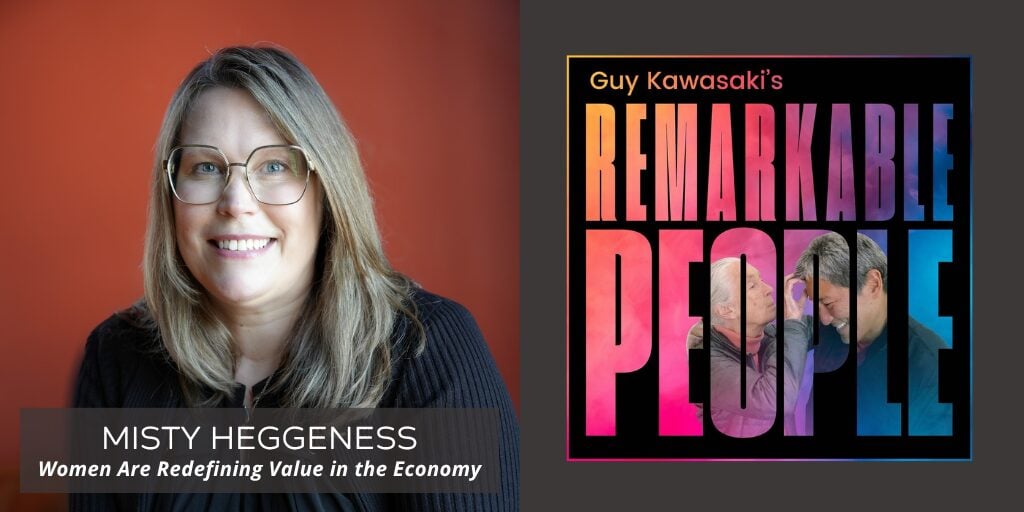
Welcome to Remarkable People. We’re on a mission to make you remarkable. Helping me in this episode is Misty Heggeness.
Misty challenges how we understand the very foundation of our economy. As a professor at the University of Kansas, she studies the systems we take for granted—and exposes the blind spots hiding in plain sight. Her work brings visibility to the unpaid, unmeasured, and often ignored contributions that keep society functioning. But what makes her perspective stand out is how she connects these ideas to culture, power, and real-world behavior. She doesn’t just critique the system—she shows how people are already rewriting it.
In this episode, we explore how women are quietly—and sometimes loudly—redesigning the economy by stepping outside systems that were never built for them. Misty breaks down concepts like “masterminding,” where barriers aren’t fought head-on but navigated around with strategy and persistence. We talk about reinvention as a normal, even necessary, part of modern careers, especially for women balancing shifting expectations. She also shares why authenticity isn’t just a buzzword—it’s a competitive advantage when used intentionally. Along the way, we discuss her new book, Swiftynomics: How Women Mastermind and Redefine Our Economy, which uses Taylor Swift as a lens to explain a much bigger movement.
What emerges is a bigger realization: the economy we measure isn’t the whole economy. Caregiving, emotional labor, and community-building don’t show up in GDP, but they shape everything from productivity to opportunity. Misty argues that ignoring these forces doesn’t just create inequality—it creates inefficiency. And when systems overlook half the population’s contributions, everyone loses. This conversation will make you rethink what counts, who counts, and what it really means to build a thriving economy.
Please enjoy this remarkable episode, Why Women Are Rewriting the Rules of the Economy with Misty Heggeness.
If you enjoyed this episode of the Remarkable People podcast, please leave a rating, write a review, and subscribe. Thank you!
Transcript of Guy Kawasaki’s Remarkable People podcast: Why Women Are Rewriting the Rules of the Economy with Misty Heggeness.
Guy Kawasaki:
Good morning everybody. It's Guy Kawasaki. This is the Remarkable People Podcast and we have found another remarkable person for you. Her name is Misty Heggeness, and we're going to talk about, of all things, Taylor Swift and her impact on economics and really I think her impact on society beyond the music sense.
So Misty is an economist and she's a professor at the University of Kansas. And I would've said, not that I know that much about Taylor Swift, but no, her book is fascinating. I'll hold her book up for you. This is the book, it's called Swiftynomics, and she has actually created a course called Swiftynomics 101, and then she created another course called The Economics of Taylor Swift.
Have you ever met her face to face and said, “I'm the professor that is like documenting your life.”
Misty Heggeness:
I haven't, but it's one of my goals in life.
Guy Kawasaki:
If she listens to this podcast, she'll be calling you right up and flying you out to wherever she is and all that. So this is her book and she has created this curriculum, and it is a very fascinating topic. So welcome to the show, Misty.
Misty Heggeness:
Thank you for having me. Excited to be here.
Guy Kawasaki:
So first of all, just as a basis, just tell us what is Swiftynomics?
Misty Heggeness:
Yeah. So Swiftynomics for me is really an effort to recognize and value all of the economic contributions that women make in society, including Taylor Swift. And it is about understanding the way in which those contributions impact economic growth and development, equity and the like.
Guy Kawasaki:
Yeah, and would you distinguish Swifynomics from The Swift Effect?
Misty Heggeness:
Yeah. There's a documentary called The Switch Effect. I participated in that, so I'm interviewed in that. It's on the Peacock Plus. And The Swift Effect really is focusing on the economic contributions of Taylor Swift, but without really focusing in on why she is unique based on her gender.
And Swiftynomics really at the core is our ability to understand the economic success of Taylor Swift and women throughout our economy that is specifically tied to their gender and how they maneuver in their careers given the fact that they're women.
Guy Kawasaki:
Yeah, I want to make it perfectly clear to the listeners that if they hear the word Swiftynomics, they may think, “Oh, this is about Taylor Swift and how she has a concert and she makes billions of dollars, and then she sells records and she sells t-shirts. And just the economic impact.”
But this book is way beyond that. It is about the sociological impact. It is about the mental impact, the psychological impact. This is way more than just, yeah, she's a multi-billion dollar business, so let's just make that clear to everybody so they buy the book.
Misty Heggeness:
I think the thing that's interesting about Taylor is the fact that she has done what she has done given the fact that she's a millennial woman.
Guy Kawasaki:
And is she kind of like in the words of Seth Godin, she's a Purple Cow, or she's a Black Swan, or is she indicative of an overall trend?
Misty Heggeness:
I think it's a really important question to ask, and I'll say a couple of things about that.
One is I think when we look at Taylor, there is a tendency to say, “Nobody could replicate that. She's the first one to do it,” just because her fame is so hard hitting and fast, but there are other women in the music industry who are prior generations of Taylor, before there was social media, before there was like this rampant, accelerated speed with which we get information out into the world.
You could look at Dolly Parton as an example. Madonna would be another example. I think what she does is replicable, but I think the thing that makes her really unique is that she grew up in an age where women were told they should go to college for career purposes instead of going to college to find a spouse.
Millennial women were delayed marriage, delayed having children, and so they spent their entire twenties in this economic independence space where they just became avid consumers of things that give them joy. And Taylor was on the cusp of that, ready to give it to them.
In that sense, she's unique. She really fell into a space where there was like a demand for content, and she really brought it to the table. But I do think that there are lessons to be learned from her that are replicable for other folks.
Guy Kawasaki:
So would you say that she is redefining the economic system that was really designed by and for men?
Misty Heggeness:
I would say that she has given up on that system and just designed her own system and in that sense, she's not alone. And I talk about this in the book and I talk about other women in other spaces who have done the same thing. And so it's very common today that you see women losing patience with the patriarchy in some sense.
Losing patience and trying to fit in how they want to fit in into systems that were built really for the ease of men, or at least that's how I describe it. And a lot of these women, again, because they have more economic agency than they ever have, are really saying, “I'm not going to play that game. I'm just going to play my own game here on a parallel path.”
That's what Taylor is doing. That's what Beyoncé is doing in some sense. That's what Reese Witherspoon did when she started up Hello Sunshine production companies and on and on. And so, that I think is a very unique and fun trend to watch in terms of what's happening with women's economic agency today.
Guy Kawasaki:
Would you say that Caitlin Clark is the Taylor Swift of basketball in that sense?
Misty Heggeness:
Oh, definitely, yes. And I love what's going on with women in sports today. It is so fun to watch.
Guy Kawasaki:
Sometimes I just lose hours, and I just go from one Caitlin Clark highlight to the next.
Misty Heggeness:
It's so fun. And I really love to see women who are deciding that they're not going to be told where their place belongs, and they're just going to live in the joy of the creativity and the talent that they have. It's so fun to watch.
Guy Kawasaki:
The teammate of Caitlin Clark, and I cannot remember her name, the blonde woman, the one that is like the enforcer for Caitlin. I love her even more. She just kicks ass. I just love her.
All right. So, do you think this is evidence of cultural power, not just economic power, which comes first? You get cultural power so you can achieve economic power, or you get economic power so you can achieve cultural power.
Misty Heggeness:
This is a fascinating question. What comes first, the chicken or the egg? The way that I think about this is really in a circular motion. Maybe think about a tornado. At the bottom of the tornado, it's really small and tight, and then it keeps on winding around and as it goes up, it gets wider and bigger meaning taking up more space, more influence.
And I think women don't get cultural clout and cultural equality without having economic power, but I also think women acquire more economic power the more and more they get social and structural clout. And so, it's like this two steps forward, one step back.
We see women advancing. We see challenges that look like we're being set back, and then women figure out an alternative way to get around those challenges. And women have been doing this the entire existence of humanity as far as I know. It's one of the ways in which women thrive economically.
And we don't document it in history books. We don't see it blatantly in dominant press and dominant media. But it's there. And it behooves people to pay attention to it because if not, you know, you might get a little bit shocked or surprised when something unexpected happens.
Guy Kawasaki:
Well, in your book you even point out that the contribution of women is not even really appreciated in your own field of economics.
Misty Heggeness:
Yeah, completely. So this book is generally about women and the economy and looking at the modern woman. One of the reasons why I wanted to write the book is because I feel like my field of economics really struggles to understand what's going on with women today.
And part of the reason why it struggles is because the field is dominated by men who have perceptions about women, but also even the women in my field have traditional perceptions about the roles that women play that blinds them from really understanding modern trends.
So it's an issue. And just like Taylor's in this music industry that's very male dominated and misogynistic, I would argue that economics tends to be the same as well.
Guy Kawasaki:
Well, I have to tell you that as I was reading your book, I came very close to rolling on the floor and laughing out loud when you told the story of Adam Smith and how Adam doesn't quite get the big picture with his mother. So anyway, before I butcher the story anymore, tell that great Adam Smith story.
Misty Heggeness:
Yeah. There's a book called Who Cooked Adam Smith's Dinner? So Adam Smith was an economist in England. He developed this theory that became very popular in modern economics, neoclassical economics called the “invisible hand.”
And the “invisible hand” theory is basically states that we don't need government intervention for the butcher to prepare the meat to sell. We don't need government intervention to make the baker bake bread. That these people, you know, independently out of selfish motivation will do these activities and sell their product because that'll give them resources and income to survive.
And so it was just this whole argument that the market in and of itself when it functions at efficient levels and doesn't really need a lot of intervention and we should not intervene with policy.
But the point that this book is making and the point that I bring up in Swiftynomics is that Adam Smith really never documented the economic activities of women.
So he only focused on what's the economic activities going on outside the home, downtown or where the boats are being made, or all of this activity outside of our homes that we can quantify because somebody pays a price for the product that you make. And he really just ignored the household.
And the problem with that is while Adam was off on his own motivation not forced by government to write these economic models, he was able to do that because there was somebody taking care of him.
There was somebody who was cooking his meals, washing his clothes, making his bed. And it turns out that was Adam's mom. And so Adam never married and didn't have kids, and he lived with his mom until she passed away.
And one of the things that I think is really interesting about this theory of the market's going to clear, people are going to be self-invested to do things that aren't motivating for them is that whether it's the state or whether it's your family, there's always somebody, there's always something that needs to be there to help make sure that humans don't die and have food and all of these things.
And it behooves us. It's really shortsighted not to really highlight those aspects of the economy when we're talking about the economy.
Guy Kawasaki:
Yeah. So listen, I love the example of Taylor Swift. I love the example of Caitlin Clark and Beyoncé and Dolly Parton and all that. And there's a line in your book where you say that you believe that the day of a woman being the President of the United States is inevitable.
I just want to revisit that because obviously Hillary didn't win. Kamala didn't win. Do you still think it's inevitable? When will it happen? Why hasn't it happened yet?
Misty Heggeness:
I'll answer the last question first is why it hasn't happened yet. I think as a society we are very uncomfortable with veering from traditional dynamics of power. And society, I think, both men and women are most comfortable when you have your typical, older man, usually white, at the head of making really important decisions that affect our economy and affect all of us.
You know, this will sidetrack us completely, but like, whether we go to war, all of these things and I think people just inherently, there's a subconscious, call it implicit bias, call it whatever you want, but there's a subconscious space where people are really uncomfortable with women leading.
And we don't like to talk about it. We don't like to admit it, but Hillary, she was one of the most qualified person like ever.
Guy Kawasaki:
Oh my God. It was the most qualified person against the least qualified person.
Misty Heggeness:
Yeah. And there you go. And that's where you see these gendered expectations we have in society. And one way that we keep this dynamic of power in place is that we start rumors about the people we’re threatened by. And so I think with Hillary, she faced a lot of people would say constantly, “I just don't like her. I don't know what it is. I just don't like her.”
And it's this idea that we're uncomfortable with competent women just generally. And the other example I like to use is Janet Yellen. So this is from my field of economics. She was Fed Chair and Jay's doing like fabulous.
I mean, he's been an amazing Chair of the Fed, but there was really no reason to take Janet out and replace her with her second in command because she was beyond competent. And she even had a better CV resume than Jay did at the time. And so it just always happens.
And at some point, and this is also why I wrote this book because I want us to get out of that trigger mode and this circular talk that we do with each other about feeling just something in our gut that makes us really concerned about having a female leader to the extent that we're willing to bring in one of probably the most unqualified or questionable resume ever to exist as a leader.
And I'm really hopeful, and I want us to focus on the positive, but also I want us to really start talking about some of these societal things that we do that really shoot all of us in the foot at the end of the day.
Guy Kawasaki:
If you were just objective, I think you'd have to say that we have given men the opportunity to run the world for about 2,000 years, and they’ve pretty much blown it. So why don't we just let women run everything for a while and see what happens? Literally, what is the downside of that? There is no downside.
Misty Heggeness:
Oh, just to follow up on that, I think if you look at women like Taylor, she's said, “I'm just going to run it myself anyway whether you want me to or not, I'm just going to create my own systems and be my own boss and do the things the way I want to do them.” It's been working for her so far.
Guy Kawasaki:
I would vote for her for president.
Misty Heggeness:
Yeah, I would too.
Guy Kawasaki:
Alright, so since we're dissing on men, let's just continue in that theme. What exactly is the “economic man?” What is this concept?
Misty Heggeness:
Yeah, and I'll just say I'm not dissing on men. I'm dissing on the patriarchy. It's the patriarchy which can travel through both men and women.
Guy Kawasaki:
Okay.
Misty Heggeness:
But yeah. What is this concept of “economic man?” So it is again, something that comes up in my field, and it started with wanting to describe just a very generic “economic agent,” who was traipsing around in the world and making economic decisions.
And that was just a general like way of trying to understand economics from a person perspective. And then that translated into people started calling this generic human agent. They started calling it “economic man.” And then that got, I think it was like in the nineties or something, like super criticized because there was an assumption that the agent would be a man.
And so I kind of riff on that a little bit in the book because it's, again, this idea that when we're not clear about what our subconscious is telling us, we kind of default to these certain assumptions. And it might not sound like a big deal to be in an economics class and have somebody talking about whether “economic man” is going to make widgets or coffee filters.
I don't know, but it does matter. And if you want to be in a more inclusive discipline, again, it behooves you to really think hard about the implicit stuff and make economics more attractive to other communities and talking about the “economic man” and his widgets just doesn't do it.
Guy Kawasaki:
So is the “economic man” as a concept, is it neutral and it's all about optimization and widgets and all that kind of stuff? Or has it now crossed over and it's negative that it's the “economic man” doesn't consider the contribution of women, the role of women? Is all of that loaded into this concept at this point?
Misty Heggeness:
I don't think so. If you were to ask the top economists in my field, which by the way are like mostly men, they would tell you that “economic man,” it's a neutral concept. It's not meant to be a man.
And they would dismiss any of the kind of complaints that, you know, whether or not this economic agent as a man or woman would mean that they would make different choices, but obviously they would make different choices.
We grow up, and this is, again, one of the critiques I have in my field is we grow up in an environment that is very structured towards the way that humans in that environment see themselves and the people around them and their families and their communities and their jobs and the expectations they have on all of those different entities and those expectations influence how we treat each other.
They influence what we expect of person A versus person B. And so it's really impossible to say that there's some economic agent A, who's just gender neutral that's living in a reality that's not reality. And I think when we do that with our economic models, it doesn't help anyone.
Guy Kawasaki:
I don't want to sound too negative and too pessimistic, but that's kind of like asking an alcoholic to run a liquor store. I don't see it as a neutral term.
Misty Heggeness:
Yeah, so agree, but in my book I talk about “economic man,” I criticize “economic man,” and then I talk about “economic woman” who clearly is superior. Just kidding.
Guy Kawasaki:
Come out of your shell, Misty. Come out, just let it rip. What's going to happen? You're already tenured.
Misty Heggeness:
I guess that's true. “Economic woman” really understands the invisible labor and the weight and the value and the necessity of community and social policy. And she understands it because if it's not there, she ends up being “worse off.” She ends up not getting as far as “economic man” gets because she is expected to pick up all of that invisible labor.
I think the concept, I'll just stop there, but I would vote for “economic women” in a presidential race, I can tell you that.
Guy Kawasaki:
Yeah. What I don't understand is based on my past in business, the gating item of most organizations is talent. And it would seem to me that it would be very stupid and suboptimal and against the arguments of an “economic man” that you would not treat women equally and hire purely on merit because it's so hard to find good people.
Why would you wipe off half of the candidates? I do not understand that.
Misty Heggeness:
I think that happens because choices are hard and humans, even though we think of ourselves as very complex, we're actually very simple beings.
And so if you've got a candidate pool of a hundred candidates and you're trying to figure out which ones are the most talented, maybe part of that, the talent, that you're looking for comes from characteristics that aren't really observable on the surface.
And maybe it's easier then to just say, “Okay, I'm going to shrink this pool by focusing on characteristics that I have experienced in the past who have had the talent.” And so maybe that's people who look like me, have my same gender, my same skin tone, my same hair color, whatever it is. And I think that is a part of the human brain when we don't stop and actually think.
And I think that's why that happens. But it's true. We shoot ourselves in the foot all the time because we don't figure out ways to really hire based on pure talent, and we don't figure out ways to believe in women's ability in the same way that we believe in men's ability.
Guy Kawasaki:
I swear if you took resumes and I don't know if you need to wipe out the name so you can't guess the gender, but I swear if you just put the resumes into an LLM and said, “Pick the candidates that I should interview.” The LLM would do a better job than most males. I swear to God. I bet you that all day long that they would make a better choice.
Maybe not Grok, but any other LLM.
Misty Heggeness:
I might tend to agree with you with the cautionary tale that LLM is also going to be based on information from the past where there was a larger tendency to hire off a male.
Guy Kawasaki:
Exactly. So take out the surname, take out the first name, whatever. But all right. Now, so you introduced two concepts that I want to get an explanation of. The first is mastermind. What is masterminding?
Misty Heggeness:
Yeah. Okay. So there are two concepts and at the end if you want to ask me whether what are the three characteristics that I think Taylor has that really give her a lot of success and the rest of us could do, I'm happy to tell you. Alright, mastermind is one of them. So masterminding, I love it.
I love it because it's a glass half full type of mentality and Taylor's full of glass half full. I don't know who bubble wrapped her as a child, but like she is so resilient. And masterminding is when you have a barrier in front of you. Okay, let's go back to the labor market again and talk about bosses and employees.
So I'm an employee and my boss really gives me evaluations that are just average. I really want to excel and become a leader and a manager and a boss in this space, but my current boss has shown no evidence that he or she thinks I have the talent to do that. And I'm not going to get to where I want to go, where I believe I should be able to go, if my boss is still my boss in the long run.
And because my boss doesn't believe in me. So what are your options? Get super grumpy and just become miserable and complain all the time at work, which I think we've all been in that space once or twice. But other options are recognize really quickly that your boss isn't going to be your path to where you want to get to go.
And then think about what are alternative paths that I can use to get to that leadership role I want. Maybe I look for a mentor, maybe I start applying for other jobs so that I do have a boss who believes in me and will invest in me and develop me. And it's through those other mechanisms that you're going to get to where you want to go.
And so masterminding is you have a long-term goal, you have some obstacles in front of you, and it's not about eliminating those obstacles, but it's about how you're going to work around those obstacles, so they don't hold you back. And I think Taylor's the queen of this.
I think, the whole episode with her first six albums being bought away from her and her doing rerecord of all, at least four of the six are out now rerecords. Supposedly debut is coming later this year, which would be really cool, but she rerecorded those and called them “Taylor's Version,” and she added in some songs “From The Vault” and she did some really interesting concepts there.
She got her fans to follow her with the “Taylor's Versions.” She got radio stations to play the songs from “Taylor's Versions.” Basically devaluing her initial catalog of her first six albums. And then she went on The Eras Tour and made a boatload of money. I'm happy to talk about the dynamics of the things she did there that were really unique.
But, after that she was able to go to the organization that owned her first six albums, which had been sold along the way. She sent her mom and her brother to ask, “What can we do here to make a deal?” And for Taylor, it wasn't about the money, it was about her legacy, and she wanted to be able to give that catalog to her kids.
The master of masterminds, right? She ends up buying back her first six albums from her catalog. Now she owns her entire catalog. And that happened over the span of probably at least a decade.
But if you would've asked her right when her first six albums were sold to Scooter Braun, “Oh, are you just going to sit here and sulk and be upset about it or are you going to put your best mastermind hat on and figure out a path?”
And she didn't know in that precise moment that she would be able to ever buy them back. But she worked really hard to set up pathways that would allow her to get closer to it until she finally did it. Queen of masterminding.
Guy Kawasaki:
Okay. All right.
Misty Heggeness:
And we all have that ability within us, right? I feel like I haven't convinced you, the mastermind.
Guy Kawasaki:
No. I'm trying to get all three.
Misty Heggeness:
Okay. Reinvention is in the moment, so I define reinvention as human existence.
Okay. And in my book, I'm focused on this really heavily for women because lots of times, again, the workplace and the society outside of our homes designed for the ease of men and people with lots of care privilege or people, able bodied adults, who have other people caring for them, taking care of the care needs.
Adam Smith, he had his mom, so he had care privilege. And so reinvention is essentially what we do when we have to hop from basically one era to another. I studied social work and Spanish, and then I ended up doing my PhD in economics. That's a reinvention.
Taylor moved from country music into pop with her album 1989, reinvention. And the thing that I think is important to know about reinvention is that everybody does it. So we did a survey at the University of Kansas, nationally representative, 90 percent of men and women reinvent in their career at least once.
So nine out of ten of us do it. The gender difference is that women reinvent more and they reinvent more because of family, motherhood, et cetera. So the point is, own your reinvention. Don't feel shame. Oh, I've failed, now I've got to go start this other thing. Just lean into it and own it.
Guy Kawasaki:
So part of your mastermind could be reinvention.
Misty Heggeness:
Yes, absolutely. In fact, it probably most likely always is. Yeah.
Guy Kawasaki:
Okay, and what's number three of Taylor Swift?
Misty Heggeness:
Authenticity. So I think lots of times we struggle to figure out what am I supposed to do when I become an adult? What am I supposed to do as I move forward in life? And I think the surprising thing that many of us don't realize is that it's in us all along.
When I think about do I want to do A or B, which of those is more exciting for me to think about, doing A or doing B? If it's A, then A is the path that you should take and that's being authentic with yourself.
Taylor has always been really authentic with herself. She's done things at high risk within the music industry that most people would probably advise her not to do, but she did it because that was what spoke to her in the moment.
And it has enormously paid off for her. She's also very authentic with her fans and connects deeply with them. And that's also been a very successful strategy for her.
Guy Kawasaki:
There's a lot of Silicon Valley bros and they're always talking about being open and transparent and authentic. And whenever I hear them say that I always want to ask them this question, which is, “What if you are an asshole?” So being authentic is being an asshole, then what do you do?
Misty Heggeness:
Listen, I think being an asshole is when you don't know where your authenticity resides. You haven't really sat down, or you haven't had support systems in your life growing up, and you're stuck in this kind of ego space of wanting what somebody else has.
Guy Kawasaki:
Okay. But still, if you're going to be authentic, you're going to be an asshole because you are an asshole, right?
Misty Heggeness:
Sure. But what I would say is if you've got somebody who is a creep and isn't very nice, first of all, I don't think they're being their authentic self. I'll just say that.
Guy Kawasaki:
So you think deep down inside Stephen Miller is a good person?
Misty Heggeness:
No, I think Stephen is very confused about his own authenticity.
Guy Kawasaki:
Okay.
Misty Heggeness:
I think he needs lots of hugs.
Guy Kawasaki:
Alright, yeah, exactly. So this is another story. I had not heard of it. It is a non-sequitur for where we are in the interview, but this story of Mueller v. Swift.
Misty Heggeness:
Oh, is this the Colorado DJ guy?
Guy Kawasaki:
Yeah, so let me just give the gist of this story. So Taylor Swift is on a tour. She goes to a radio station.
The DJ grabs her butt. She gets him fired for grabbing his butt. He sues her for getting him fired because he grabbed her butt. So she counter sues for a dollar and wins. And when I read that story, I said, “This cannot be. What kind of idiot would do that?” I do not understand that. So you're going to explain to me what that whole episode signifies in American society.
Misty Heggeness:
Yeah, I'd love to. I really love this story because I think that lots of times when women have these experiences of sexual assault or inappropriate behavior, we don't know what to do with it. We stay silent. Shame builds up when you do that.
And, again, this is another example of where I say, was Taylor wrapped in bubble wrap as a child and teenager and young adult? Because she doesn't seem to believe at all the kind of misogynistic expectations that are put on her for being who she is.
So she's very clear about swatting away the bad behavior and inappropriate behavior when it happens. And this is a perfect example. And I would correct one thing that you said in that story, so she told her team what happened and her team told his employer and his employer fired him.
So she didn't get him fired or she wasn't out to try to get him fired, but they said, “This happened, this isn't appropriate.” And I wasn't in the room, so I don't know, maybe they said, “What are you going to do about it,” whatever. I don't know how all that played out.
But yeah, it's so typical. It happens all the time. A man does a bad behavior to a woman. The woman calls him out on it and then he somehow blames her. It's somehow her fault, and he believes that in his head, and it's because we allow this behavior, we're silent about it.
We allow it to fester. We allow it to continue. We don't call it out. And it just gets normalized by a subset of men that it's okay to behave this way.
And this Colorado DJ, he sued her because he felt he was wronged. There's nothing in his head that is saying, “Gee, maybe I shouldn't have reached under the skirt and grabbed the butt cheek of the human standing next to me. Maybe that's not appropriate societal behavior.”
But my favorite thing about this story is that what an example that Taylor set for women everywhere and she had the power to do it because she's famous and she's got the resources and it was something that was important to her that she wanted to stand up not only for herself, but just for women everywhere to set this example of, you don't have to deal with it in silence, you don't have to let it shame you.
Turn that shame around back to the person that it belongs to. And just a fantastic role model in that.
Guy Kawasaki:
Yeah, but then Misty, I read that story. I wouldn't say I was amused, but I was delighted that she did this action. But then you fast forward to today, and we're going through the mother of all instances of DJs grabbing ass under skirts and getting away with it.
How do you put those two? Are we regressing?
Misty Heggeness:
So I would say we're not regressing because it's out in the town square or whatever. People are talking about it. It's not going away. We're continuing to talk about it. There will always be a subset of people who will, you know, including our current president, unfortunately, who will support this bad behavior and will try to not hold people, including himself, accountable.
But movement is happening. And ten, twenty years ago, maybe Epstein and all of those shenanigans would've never gotten out. But now, we're moving a little bit again, it's two steps forward, one step back. I'm an obnoxiously glass half full type of gal. There's lots of concern about the fact that Trump was voted in a second term and what are we thinking as a society or what's going on?
Or that Roe v. Wade was knocked down. And women are really worried because we're not living in a society that feels really safe for us right now. But I actually think that maybe we are, in the sense that the reason why some of these things are happening is because women are growing power, economic power, societal power. We are breaking down barriers.
And men who are used to being in power and controlling things are getting uncomfortable with it. And there's backlash. And that's the backlash that we're seeing. This is how I interpret the fact that Donald Trump got elected for a second term.
That, and whatever other shenanigans these Brads, dads, and Chads who work in Trump's little inner circle are cooking up. But the fact that some of this stuff is occurring, yes, it's a regression, but it's a regression that's hopeful because it means that people are scared.
People are nervous about the way in which women are coming into their economic power and even the discussions nowadays about, “Oh, boys and the struggles that boys are having, and, oh, we're so concerned about the boys now.” And all of that is tied in together.
Guy Kawasaki:
Yeah, there's these cases on colleges where that they want to make sure that when a boy is accused of rape, it gets due process and all that. And it's like the girl's fault. I just don't even know what to say. Anyway.
Misty Heggeness:
Yeah, so that happens a lot in my profession as well.
And again, it's one of the reasons why I really wanted to write this book. So a group of us a handful of years ago went to the annual economics conference and we made posters and brought buttons, and it was like a whole econ Me Too movement.
And we were trying to push against that silence because within the field of economics, a bad actor will pop up and the association's response and leaders in our profession's response is, “Oh, we need to be quiet. We don't want to get sued. That person deserves due diligence,” as though women make these things up.
That's a problem that we need to pick away at and work at. And I think it is improving.
Guy Kawasaki:
Okay. That is a half full interpretation for sure. I hope you are right. So, we are considering some of these voter ID laws. And the voter ID laws may make it more difficult to women to vote because they're single name and their marital name doesn't exactly match. And, if you were paranoid, you would say, “That is a plot to make women not be able to vote.”
If you're not paranoid, you'd say, “Well, they're just trying to enforce the identification to make sure the voter is legitimate.” What do you think the effect will be if these voter ID laws go into effect for women?
Misty Heggeness:
Well, I think that disproportionately women are going to have more trouble voting than men because of exactly that issue that when women marry, they tend to take their spouse's last name. I think the solution is just that women shouldn't change their name.
I'm kidding, but, yeah, it's a problem and quite honestly, I'm pretty sure that again, the two or three Brad, Chads, and dads who cooked up this policy probably didn't even think about how it would impact women.
And it wasn't until women started reading the policy and started talking about it out loud that it has this gendered effect. I don't know, maybe they said, “Oh, hey, even better.” Who knows?
Guy Kawasaki:
Yeah, exactly.
Misty Heggeness:
I'm going off the rails here. I think, it's a problem. All of these policies that restrict rights and freedoms of women are a problem.
And it's not just oh, they're a problem for society, or they're a problem for culture. They're a problem for our economy. So here's the deal, I love economics and what I love about it is that at its core, what it's really doing is you've got a human person or a business or a family or whatever it is, they've got resources, but they have limited resources.
Nobody has infinite resources. And what economics does is it tries to understand how people are making decisions with the resources they have based on their preferences.
So in an ideal world, you want people to be innovative, and you want to really tap into their talent, and you want to align the space of their creativity and passion with the work that's available, right? It's just a matching game. The job market, you're trying to match people's skillset with the jobs that are available.
And we should be doing that, and we should be thinking along those lines without restricting people based on gender, age, race, ethnicity. And when we do, we're not maximizing economic growth. We're not advancing our economy in a way that we could.
And so if we're putting these additional restrictions on women, whether it's voting, because when women can't vote, what happens is you do end up getting a lot of folks on the hill and in legislative bodies who have no idea about the realities of caregiving, who have no idea about the realities of propping up human society so that a portion of us can go out and work.
And so we need more women in office and women need to be able to equally vote just like men because of that. And when we can't do that, it's worrisome.
Guy Kawasaki:
So in a sense, you are making the case that if you are truly an “economic man,” you would want economic and cultural parody, right? That would be optimal, right?
Misty Heggeness:
100 percent. Yes. That would be optimal.
Guy Kawasaki:
Well, one can dream.
Misty Heggeness:
Sometimes I feel like my field of economics has just been like co-opted by a subset of people who have lots of privilege and want to keep it. And so they use the field to tell stories that they think makes sense in order to hoard privilege. That's my glass half empty by the way.
Guy Kawasaki:
All right.
We're coming to the end. So two magic bullet questions. So first of all, magic bullet or magic bullets. If you had to change national policy to make a better situation for women, what would you do to in terms of national policy changes?
Misty Heggeness:
I would pay caregivers.
Guy Kawasaki:
Huh?
Misty Heggeness:
Family caregivers.
Guy Kawasaki:
And why would that have such an impact?
Misty Heggeness:
One, it would bring invisible labor into visibility, and it would create an awareness and acknowledgement of how much value our mothers and grandmothers and the women and caregivers around us provide to the economy.
I think it's a social justice issue, and more than anything because of that fact that if we start paying our family caregivers for the care that they're providing within families, it's to our benefit as a community and a society.
By the way, this whole pull yourself up from the bootstraps is a crock of shit. That's an Adam Smith view of the world. I'm sure Adam Smith would tell you he pulled himself up by the bootstraps, but he would've died if his mom hadn't fed him and made sure he had warm clothes on when he was a kid.
So I just think there's lots of inefficiencies going on right now because we just ignore family caregiving and I think we could make our society better. And I think it's really important to do that because women today have more educational attainment than they ever have in the past.
Younger women coming up are more likely to have careers than jobs. It's more costly for women to have children today because of that, because having children usually means you got to back out of the labor market temporarily, at least for a little while, and your earnings trajectory sinks and you don't get that back.
We need to figure out a way to make having the next generation not be so costly on individuals, on individual choice. And one of the ways that we can do that is by formalizing in social policy.
Guy Kawasaki:
Okay. Now just for clarity here, when you say pay caregivers, is it the male of the house paying the female? Is it the company or who's paying? Who's cutting this check to the caregiver?
Misty Heggeness:
Yeah, that's really an interesting question and I actually don't care who does it, but somebody should. It's for some other policymaker to find out. But let me give you an example. So I live in Kansas City. My kids go to school in a school district where the school busing system sucks.
It's so horrific. And before my kids got their driver's license, I was having to drive them to and from school every day. And in the most horrific space of that, one kid was in middle school, the other kid was in high school. So I would have to do two drop-offs in the morning, two pickups in the afternoon.
My staff knew don't schedule a meeting with me between two and three because I will not show up or I'll show up in my car driving to and from school. And I was so furious when I was dealing with this that I calculated the amount of money that the state of Kansas owed me for being my children's taxi driver to and from school all year long.
And it was like 30,000 dollars. And that's two to three hours a day over nine months. So I just calculated it based on my salary, but how inefficient is that? Like the school bus line? Okay, let's not even talk about the pollution of cars, but you've got a whole bunch of parents who are sitting there idly in the school bus line in their cars waiting to pick up their kids.
It's so inefficient. People aren't working during that time. All of the pollution. It makes no sense, but we don't talk about it. Women just suck it up and do the work because that's what we're expected to do for our families. And luckily it didn't hurt me because I'm a university professor and so if I don't work between two and three, I'll just work between seven and eight at night.
My schedule of when and how I have to work is very flexible. Not everybody has that luxury, but I think society really doesn't fully understand the costs and what women give up to help get the next generation into adulthood.
Guy Kawasaki:
Misty, you didn't answer the question. Who is writing the check?
Misty Heggeness:
If it was up to me, I would say that it would be tax dollars redistributed. So I would say the government.
Guy Kawasaki:
And I would make the case that if the government had to start paying every mom who's picking up their kids 30,000 dollars a year, they would probably put in buses.
Misty Heggeness:
Exactly.
Guy Kawasaki:
Now there's a cost to it, right?
Misty Heggeness:
Exactly. And that means that those mothers and fathers, who's ever doing the pickup, can then be productive in other ways during that time and in more efficient ways, but that's the whole point. When women silently pick up the slack, inefficiency is we don't understand it and we waste resources and it's not good for anybody.
Guy Kawasaki:
You probably didn't see a lot of men in line picking up the kids either, right?
Misty Heggeness:
Yeah, no, it's mostly moms.
Guy Kawasaki:
Okay. My last question. So suppose that you are a young woman listening to this podcast and you're saying, “Yeah, go Misty. Go Taylor. Go Caitlin. Go.” So now they want some real tactical advice. A young woman listening to this wants some tactical advice. Maybe it's just masterminding and reinvention and authenticity.
But like from the author of Swiftynomics, we're getting firsthand knowledge about what to do in 2026.
Misty Heggeness:
Yep. Alright, I've got a good one for this. Get yourself some mentors or sponsors, whatever you want to call them, multiple. And intentionally create a strategy for building up your network of people who are going to support you and propel you to the next space that you want to be in.
So I say this because when I was in the federal government, I took this woman's leadership class and this woman came in from like the Navy or I don't know where it was from, and she was just amazing.
And she would tell us how she would go out into her car over lunchtime and take power naps. And so she had all this advice for us. And she's the one who said, “You need to be intentional about mentors and women especially need to have male and female mentors.”
And so I took that probably too much to heart, but for the next five years, I had two mentors every single year. I would run it for myself from September to May. I would cold email somebody who had a job that I think looked really cool, that I might want to do someday.
And I would say, “Hey, would you mentor me September through May, once a month, forty-five minutes, I will go to where you are. I will schedule it when you're available. I will come with the agenda. I just need you to show up, to be there in your office when I arrive.”
And I will tell you that my women mentors were really, really helpful for me in processing things that I was going through at the time. And my male mentors were really, really helpful in getting rid of barriers and saying, “What do we need to do to get you to this next step? What do we need to do to get you in this next job or this next promotion?”
So I think that's my advice. One of the reasons why I wanted to write this book too is because women don't exist without men. Men don't exist without women.
And I think we all really need to lean into each other and just to try to really be patient and understand others' perspectives and really try to pull the strengths from each of us to the best that we can to propel ourselves forward.
Guy Kawasaki:
Okay, off we go for mentors.
Misty Heggeness:
I see your eyes rolling.
Guy Kawasaki:
No, I was just thinking, I would argue that men need women more than women need men. If you just look biologically, right? A man's contribution to a pregnancy is about ten seconds, and a woman's contribution to pregnancy is about thirty years. Let's face it, right?
Misty Heggeness:
Yeah. So that's true, but if you look at society, you've got a bunch of really ambitious young women who are highly educated and want careers. And the way that they're going to excel in that system is by men letting them in because men dominate in the upper echelons. It's a give and take.
Guy Kawasaki:
In my next life, Misty, I want to come back as a woman because I would just kick ass as a woman. But anyway, that's a whole different subject.
Misty Heggeness:
And I would love to be there for that.
Guy Kawasaki:
So Misty Heggeness, thank you so much for being on the Remarkable People Podcast.
We really appreciate that. I want to thank the team behind me, which is Madisun Nuismer, co-producer, Jeff Sieh, co-producer, Shannon Hernandez. And there's also Tessa Nuismer, our researcher. So yeah, we have quite the crew behind me so that we're the Remarkable People team.
Sign up to receive email updates
Enter your name and email address below and I'll send you periodic updates about the podcast.

Leave a Reply