
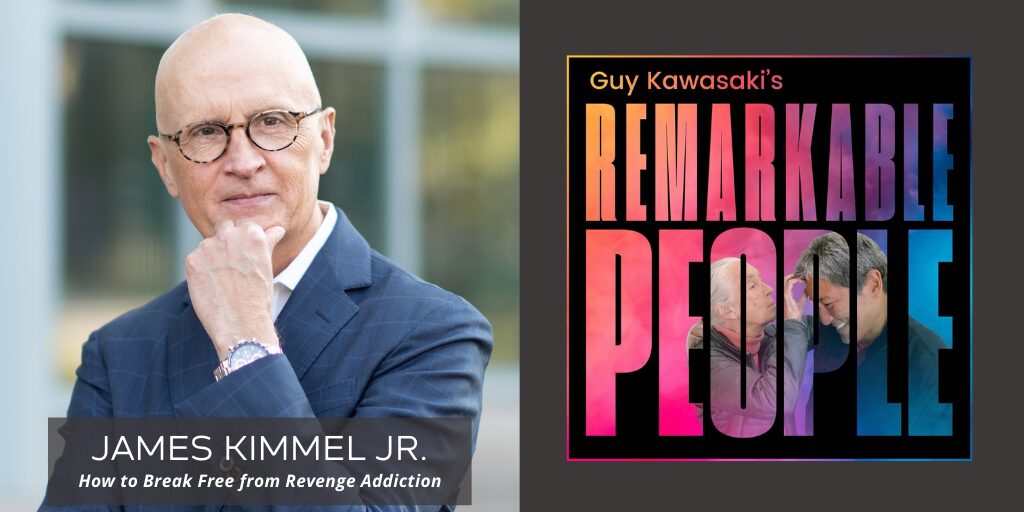
Welcome to Remarkable People. We’re on a mission to make you remarkable. Helping me in this episode is James Kimmel Jr.
James is no ordinary lawyer; he is a force to be reckoned as his groundbreaking work has redefined our understanding of revenge, justice, and human violence. But that’s not all – he’s also the creator of innovative systems like the “non-justice system” and websites dedicated to violence prevention.
In this episode, we dive deep into the controversial territory of revenge addiction and how Kimmel’s revolutionary book, The Science of Revenge, exposes the neurological mechanisms behind our desire for retaliation while offering practical solutions for breaking free from destructive cycles. His research reveals that forgiveness isn’t weakness – it’s a neurological superpower that can literally heal trauma in real-time.
What makes Kimmel’s perspective so compelling is his personal journey from near-perpetrator to healer. After almost committing a violent act of revenge as a teenager, he channeled his understanding of human nature into the legal profession, only to discover that litigation itself was just “professional revenge-seeking.” Now, through cutting-edge neuroscience and behavioral research, he’s pioneering new approaches to violence prevention that could transform how society handles conflict, trauma, and healing.
Please enjoy this remarkable episode, How to Break Free from Revenge Addiction with James Kimmel Jr.
If you enjoyed this episode of the Remarkable People podcast, please leave a rating, write a review, and subscribe. Thank you!
Transcript of Guy Kawasaki’s Remarkable People podcast with How to Break Free from Revenge Addiction with James Kimmel Jr.
Guy Kawasaki:
I'm Guy Kawasaki. This is the Remarkable People Podcast, and we go all over the world looking for remarkable people to help you be remarkable. And we found another great person. His name is James Kimmel Jr. He's a lawyer, don't hold that against him, and a behavioral science researcher. And he proposes a really radical reinterpretation of the role of revenge in our society.
He, in a sense, views much of what we call justice-seeking as kind of a dopamine-driven revenge cycle that probably causes more problems than it solves and perpetuates violence and suffering. His latest book is called The Science of Revenge. It's a very fascinating book. It utilizes his personal experiences, which maybe he'll get into, as a youth, plus examples from leaders such as Hitler and Stalin and Mao to shed light on the causes of violence in our society. So welcome to the show, James.
James Kimmel Jr.:
Guy, thank you for having me. It's a pleasure to be here.
Guy Kawasaki:
I just want to tell you that I went to law school for two weeks and then dropped out. So that's my extent of knowledge of the law.
James Kimmel Jr.:
Well, then you were wiser than me, I think.
Guy Kawasaki:
Well, your son is entering law school now, so let's see. Second generation lawyer, right?
James Kimmel Jr.:
Yeah, but my wife is a transactional lawyer, not a litigator. And my son intends to do the same and stay away from litigation, which I refer to as the professional revenge business. So I'm happy that he's going to steer clear of that aspect of the law.
Guy Kawasaki:
Well, if litigation is professional revenge, what is criminal law then?
James Kimmel Jr.:
That is also professional revenge-seeking. If you're a prosecutor, right, you're seeking revenge on behalf of society, and if you're a civil litigator, you're seeking revenge for money on behalf of your clients. And so we're right there with it. But it's legalized revenge that we call justice. That's the brand name that we call the revenge that we seek.
With doctors and opioids, if it's bought on the street it's called heroin, but if we prescribe it, it might be called OxyContin. Same kind of drugs, same addictive properties in both instances, just like justice and revenge-seeking. So we have a problem on our hands.
Guy Kawasaki:
So you are literally saying that the desire for revenge and the act of revenge is an addiction like a medical condition?
James Kimmel Jr.:
It can be just like with drugs. So about 20 percent of the people in a population who experiment with drugs or alcohol actually become addicted to them. And we haven't actually studied this question of just how broadly experience is revenge addiction, but if it follows that pattern, it might be the same thing.
And we should be clear when we talk about addiction, we're talking about compulsive behavior. We all experience pleasure from revenge fantasies and imagining revenge gratification, the way we all experience pleasure from opioids.
If anybody takes an opioid, they're going to experience some type of euphoric high, and we're going to experience that with revenge-seeking. When it becomes addictive is when we can't resist the desire to engage in revenge behavior or take a drug despite knowing the negative consequences. That's when it moves from just a pleasurable experience into something that's more pathological.
Guy Kawasaki:
And is one of your goals to get the diagnostic and statistical manual to recognize this as a medical condition?
James Kimmel Jr.:
Yes, absolutely. And we have a lot of evidence now. We have neuroscience evidence, we have behavioral evidence, and we have world history evidence backing up this idea that humanity throughout centuries now and thousands of years has been experiencing revenge addictive moments either in our individual lives or in our corporate lives at population scale.
We know that revenge-seeking is the primary motivation for almost all forms of human violence, beginning with bullying and youth violence up through intimate partner violence, street and gang violence, extremism, terrorism, genocide, war. All up and down the ladder of severity we know that revenge is the primary motivation for that. And then the question becomes is, well, why do we seek revenge at all? And over the last twenty years, neuroscientists have been able to solve that question.
Guy Kawasaki:
And the fact that it is not yet recognized in the DSM, does that pose real problems or is it just a kind of a formality?
James Kimmel Jr.:
Oh, it poses real problems. It's not a surprise that it isn't recognized there yet because the science that is able to show us why we want revenge has only emerged in, as I say, the last twenty years. And so this is relatively new science, and the DSM isn't about adding new scientific discoveries as quickly as possible.
The people who create that, the American Psychiatric Association, take their time and want to make sure they're right before they put a diagnosis into the DSM. But I think the time has come now to seriously consider and make that move.
And that we need it because by seeing revenge-seeking as an addictive process, and we can get into how and why and the neuroscience in a moment, but by seeing it that way, this opens up for the first time really in human history, the opportunity to prevent and treat violence using public health methods of prevention and treatment rather than relying, as we've been for, I don't know, the last 5,000 years, solely on the threat of punishment and criminal justice systems, which have been around for a long time, but it seems like this is about as good as they get.
We still have maybe the same 20 percent of the people that become addicted to drugs and alcohol. About 20 percent of people throughout their lifetimes seem to have contact with the criminal justice system basically being charged. And it's time to see the revenge desire as an addictive process.
And when we do, we get to open up our entire addiction prevention and treatment toolkit that we've developed over the last decade and employ that to focus on violence and compulsive revenge-seeking in order to add to not replace but add to the criminal justice system so that we can really take that next level step in minimizing violence and reducing it.
Guy Kawasaki:
But obviously revenge has been around for a long time. Is there any benefit? Does it serve any purpose?
James Kimmel Jr.:
The leading theory from an evolutionary perspective on why humans derive pleasure from revenge is that this probably started in the Pleistocene epoch maybe as early as the ice age and maybe even earlier than that.
But the idea is, and like I said, this is the leading theory, is that as humans began to form societies and live in groups, they needed a way, and this is an adaptive strategy at first, to cause people in societies to agree and comply with a set of social norms.
And those might include, in caveman days, things like, my food is my food, and my mate is my mate, and you don't get to come and take those from me. And if you do, there will be a negative consequence for that.
And so in that way, revenge-seeking has a deterrent effect, or at least we think it does. And it does seem to have some deterrent effect. And it did when we are trying to deter activities that can frustrate or stop our ability to survive and or procreate. So revenge used purely for those types of adaptive strategies makes sense.
Revenge on the other hand, the way it's often used in modern society is to avenge injuries to our egos, our sense of self-identity, self-respect. There are psychological makeup in the way we want to project and see ourselves in the world. And when revenge is used in that context, it becomes less adaptive.
And more importantly, revenge, although it has this deterrent effect to some degree, it also has the primary motivational effect, as I just mentioned earlier, of motivating almost every form of human violence. And it's pretty hard to make a good case that revenge is the best strategy for stopping violence when it is the number one reason why people commit it. That is a real disconnect.
And so there probably are better ways of creating deterrents to violence seeking that's motivated by revenge desire. And that's what I argue in the book. And that's by targeting the desire itself inside the brain where it forms.
And if we focus there, we can achieve this next level violence reduction by deterring violence at that level and not only with the threat of punishment, which that threat of punishment is why we, almost in all cases, are engaging in violent behavior in the first place. Because we experience grievances throughout our lives on an almost daily, hourly basis, small and large.
And what we can see neurologically now inside our brains is that when you experience a grievance, which is a real or imagined sense of having been wronged or mistreated or shamed or humiliated, that pain activates the pain network inside your brain, the anterior insula.
The brain doesn't like pain and wants to compensate with a nice dose of pleasure. And the first thing it does is activate the pleasure and reward circuitry that activates for addiction. And we start ruminating on, fantasizing about and potentially engaging in revenge acts.
Guy Kawasaki:
So you may consider this a little bit off the wall, but we kind of have an off the wall podcast. So let's say you go to a WNBA game, and you see the star get poked in her eye, then you see a few plays later, someone else on our team takes down the person who poked your star in the eye.
That was an act of revenge. It was justice, it was grievance. Do you look at that and you say, "All right, in the context of the WNBA or athletics, that was justified, you have to do that." Or would you pull Sophie Cunningham aside and say, "let me help you deal with your addiction to revenge"?
James Kimmel Jr.:
Revenge is really prevalent in sport, and sports have a lot of rules and controls to maintain and eliminate most forms of violence. But that form of violence that you just described, let's say a takedown, which is in direct violation of the rules that we have. So is it really necessary? If it's retaliation because you've just poked my teammate in the eye, that's something that happened in the past.
You poked my teammate in the eye sometime earlier in the game or maybe in a prior game even, and now you're going to retaliate and inflict pain upon that person who did that. That's punishing them for wrongs of the past. That's to be distinguished. And I distinguish carefully in the book between revenge-seeking for past wrongs versus self-defense to prevent present and future threats of harm.
If, in your example, the player is now going to have a physical altercation because they have a reason to believe that there's going to be another eye poke that's coming right around the corner and it's like, "Nope, not this time I'm going to stop you physically. That's self-defense, that's not revenge-seeking. And that would be fight or flight type of behavior rather than revenge-seeking.
And so it makes sense to do it there. But this idea of self-punishment, the first player who poked the original player in the eye, if they did that out of their own sense of grievance, they used their desire for revenge to do the original eye poke, and now we've got another player who's using their grievance and desire for revenge to take that person down.
These are not solid adaptive behaviors. Survival is not at risk, and we have a set of rules and the officials are there to administer those rules. And you have a coach there that can advocate for the administration of the rules and perhaps pulling that player out of the game.
So these are really bad idea behaviors because if the takedown happens, that player who did the takedown, as we've all know from being sports spectators, is usually the one that's caught and usually the one that's penalized by the ref. And then has to go forward and living with that either as, "Wow, I'm the beast and I take other players down." And that may have negative consequences on their career.
Usually, we see in studies revenge-seeking doesn't actually make us feel good for long. It's a temporary high just like drugs. We feel great in the moment and for a short time after, and then we end up feeling worse, angrier. We worry about retaliation back against us, so we're filled with anxiety. So there are a lot of negative consequences to revenge-seeking for everybody involved.
Guy Kawasaki:
So you are not saying that there is no such thing as healthy anger or justified grievance or justified indignation. It's about when things spiral out of control?
James Kimmel Jr.:
For addictive behavior, it's about that compulsion. It's about the, "I have this desire to retaliate and despite knowing that I'm going to suffer negative consequences or me and other people are going to suffer many negative consequences." And with revenge-seeking negative consequences are built-in. Revenge means inflicting pain on another person because you feel wrong.
If you can't control that, then you might be heading into or already involved with a compulsive revenge-seeking disorder and you could and should receive some form of either self-help or professional treatment if it's gotten that far before it begins to take over your life.
And we have just innumerable examples throughout human history and modern society of people for whom this revenge-seeking has taken over their lives. You can just essentially conclude that every person who's in jail for a violent crime is almost in all instances a revenge addict who could not control their desire to retaliate and they're now in prison for that.
And then we look at their victims and we look at their victims' families and we look at the families of the people who are in jail. The harms are enormous. The costs to society are just off the charts, and yet we've never looked at, scientifically until the last twenty years, what happens inside the brain and why we do this at all.
Because I'm going to suggest if somebody pokes you in the eye, you might want to have a bowl of ice cream. We could have been adaptively evolved so that when we get an eye pain, we want some ice cream or a nap or we want a hug, but that's not what we want. We want the pain of the person who hit us in the eye or their proxy, and we want them to know that their new pain is because of what they did to us five minutes ago.
Guy Kawasaki:
Is there way to remove the sweetness from revenge to I'd rather have ice cream than this? How do you make revenge less attractive?
James Kimmel Jr.:
Yeah, that's a great question. And there's probably no way to make revenge less sweet because this is a biologically derived, evolved, adaptive experience that we all have when we've been wronged, that revenge will feel temporarily good just as it is that opioids will always give us this euphoria and it'll always feel good. But there are ways to control the desire for it and to recover from the addictive compulsive process of revenge-seeking.
And those include all of the addiction strategies that we know that are effective for drugs and alcohol addiction. Things like cognitive behavioral therapy, motivational interviewing, counseling, NA, maybe RA for revenge addicts anonymous.
Ultimately anti-craving drugs and medications like Naltrexone and even GLP-1 anti-craving drugs that have been shown to be effective for food are now being studied for other addictions and may be effective in reducing the cravings for revenge-seeking. But the great news in this entire story is the neuroscience of forgiveness is really incredible.
Almost seems like it's miraculous. Just as we've been hardwired to want revenge when someone harms us, we also have been hardwired to forgive and reverse the process and actually end the pain and the cravings on the spot.
And that's what forgiveness does. And we can see this in brain scans of people who have a grievance and are asked to simply imagine forgiving it. And what that shows us inside the brain scan is that pain network part of the brain that activated for the grievance, the anterior insula, when you simply imagine forgiveness, even without telling the person who wronged you that you're forgiving them, that stops that area of the brain.
It shuts down the pain rather than just giving you a quick dopamine hit. It also shuts down the pleasure and reward circuitry of addiction so you're no longer craving retaliation and revenge. And then the last thing it does is it reactivates your prefrontal cortex, that's your self-control and executive function circuitry so that you're able to make better cost-benefit decisions.
And you find when you're in that state that in almost all cases it's better in your own self-interest, just your self-interest, to not seek revenge. It's better to forgive if you want the pain of the past to go away and you don't want it to infect and harm your present and your future.
Guy Kawasaki:
So just to be clear, the person who forgives gets as much value as the person who receives the forgiveness. Is that what you're saying?
James Kimmel Jr.:
It's even bigger than that. The person who forgives gets almost all of the benefits. It is a misconception, and we can see this now neurologically for sure in these brain scan studies, that the beneficiary of forgiveness is always the victim. It's a hardwired way of self-healing from trauma and pain of the past.
And the word give, and forgiveness is not a gift to the perpetrator who caused your harm. You're giving them nothing. You don't even have to communicate with them to experience these amazing neurological benefits of forgiving a grievance inside your own head.
So it is this kind of wonder drug or superpower that we have that's often been neglected. Our society, particularly our society in a paternalistic society, wants to think of forgiveness as some form of weakness or something that you're doing to reward the person who just slapped you in the face with an act of kindness. And it's not that at all. It's a gift to yourself to heal yourself from the trauma and pain of the past.
Guy Kawasaki:
And would it be accurate to say that we don't hear about these mass forgivers, we hear about mass murderers? So is it because bad news sells and you hear about Mao and Stalin and Hitler, but you don't hear about the people who are mass forgivers?
James Kimmel Jr.:
That's exactly the case, and there are mass forgivers everywhere, and I meet them more and more now as a result of the book. I'll find people who say most of their lives, they've had this insight or intuition that forgiving and moving on as fast as possible is the way to become successful in your life. It's the way to heal and move forward and not allow the bad things that happen to you in the past to infect and destroy your present and your future.
And so there are some people, and I haven't had the chance to study them, who say they don't even think about revenge when they've been wronged. And I tend to view those types of claims with a little bit of skepticism because I know, from other studies, that revenge-seeking has been found in all societies around the world and that it is an evolved strategy.
And so it seems unlikely that people derive no pleasure from revenge-seeking, but they may have developed such a sense of control and wisdom that they just don't want any part of that great feeling, that temporary high that only leads to disaster, that they just don't allow themselves to think about it at all when they've been wronged. And that's a very powerful and good strategy.
What we have, Guy, now are neuroscience evidence that supports the ancient forgiveness teachings of people like Jesus and the Buddha, who we think of it as a spiritual construct, but it's really not. It can be, and it's fine that it is a spiritual construct, but it really has a neurological basis inside of our brains and inside of science. And it's great now, just really in the last ten or so years, to be able to bring this out to the public and show people that it has all of these benefits for the victim, not the perpetrator.
Guy Kawasaki:
Now, just to be clear, this is a fine point here. Let's say somebody does something to you. One reaction could be, "I'm not going to let it bother me. I'm not going to think about it. It's not going to even enter into my consciousness anymore." That's one attitude. The other attitude is, "I understand what they did, but I am actively forgiving," which is a decision which is different than ignoring. So are you saying either or one is better than the other?
James Kimmel Jr.:
Some researchers have identified two types of forgiveness. There's decisional forgiveness as you essentially just described, which is, "I'm going to make a kind of a tactical decision to forgive this wrong for my own benefit, for my own self-benefit." And it's a great decision. And that's usually the decision that's the easiest to arrive at because you're still looking at your own self-interest and you're clear in your own mind you're not giving a gift to the person who wronged you.
You're not in any way condoning what they've done. You're not endorsing what they've done. You're still holding onto the idea that what they've done is potentially a very terrible wrong, and you're not going to budge on that, nor do you have to, nor are you giving away your right to self-defense if, let's say, you're in a toxic relationship where you're repeatedly being harmed by someone and you decide, "I'm going to leave that relationship now in order to protect myself.
Even though I may forgive everything that happened in the past, but I'm going to stop that behavior from continuing into the future."
So that's kind of decisional forgiveness, and it activates a different set of structures in the brain. That's versus what some researchers have identified as emotional forgiveness where an additional thing occurs in that point. And what occurs is humans are very, very adept at empathizing with other people.
And we have this psychologist think of the ability to imagine what's going on in other people's heads. We call that theory of mind. And humans are good at doing that, imagining what another person might've been thinking about.
And through a process of analyzing what happened during the grievance and also imagining what the other person, the perpetrator might have been thinking or going through themselves, some people can come to an emotional forgiveness in which they essentially re-evaluate and recreate the entire incident, the entire grievance, the entire trauma in a new light in which we can see it as less of a trauma than we once believed it was. So that's emotional forgiveness and it's not required.
Decisional forgiveness gets you 90 percent of the way, emotional forgiveness can put you in a really better place if you can see what happened to you and your own role in it, perhaps, and the reasons why the person wronged you, in a new and more, either a revised light in which it wasn't as bad as you thought, or maybe it might've been excusable because of X, whatever the X might be. So there are these two types of forgiveness that researchers talk about.
Guy Kawasaki:
Now, do you have a James Kimmel Jr. like, "These are the steps to catalyze forgiveness"?
James Kimmel Jr.:
I do. So I created about twenty years ago, this is drawing on my legal practice, as I said, I was a litigator. And one of the things that I found that was useful in the litigation revenge-seeking process is that a trial, the trials that we all know from television or real life experience or movies.
But this idea of there being a tribunal, of an impartial judge and jury, that there's this experience in which we testify and explain what happened to us as victims and the defendants given an opportunity to explain their side of the story and testify to that. And then we have, did it happen or not?
We have this opportunity to hold the defendant accountable if that's what is being decided, and to punish. Imagine, at least, punishing the defendant for what they've done wrong. So that's what the judge does. And then we move to the warden phase of these trials, the prison or up until and including an executioner.
But we move to a phase in which the defendant is punished, which is our gratification socially and individually of the desire for revenge. In those steps we have two actually pretty therapeutic things happening. One is we get to be heard. And trauma researchers and experts will say that the psychological pain that we experience from grievances, whether they're physical or only in the brain, in order to relieve that, people need to be heard.
There's a need to have someone hear our pain story and acknowledge, "Yes, this happened, and I'm sorry and that was terrible for you, and we get it." And the other thing people need in addition to being heard is this ability to hold the person who did it accountable.
And accountability in this sense, we often think it means revenge itself, but it doesn't need to, nor should it. It should mean we've labeled who did the wrong. We've made an account like an accountant tracking books. An accountant only decides where the money went, how it went. Accountants don't make a judgment on the worth of that money spent expenditure or the money coming in.
They just account for what happened. And that accountability is really important in healing from trauma as well. So I created this system called the non-justice system, which goes to that first part, decisional forgiveness and says, if you can't forgive, and most people find it difficult at first.
What you could practice is this idea of non-justice and non-justice is not injustice, which is unfairness. Non-justice means to abstain from seeking justice in the form of revenge just as non-violence means to abstain from seeking violence or perpetrating an act of violence.
So the non-justice system uses those four steps of the criminal trial but allows a person using it to put the courtroom inside their head where it needs to be because we're talking about wrongs of the past. So you've got a courtroom of the mind and it's a role play in which you play all of the roles.
So you don't need a lawyer, you don't need a judge because you're the lawyer, you're the judge, and you don't need witnesses because you play not only yourself as victim, but you play the defendant and imagine what the defendant would testify to in their own defense. You come up with your own verdict, purely on your own as judge, and then you hand down a sentence which can be anything you want inside your head.
It doesn't have to be something that a court of law would hand down. And then if you've created a sentence of punishment, you're now the warden and you have to experience and imagine what it would be like to administer that punishment, which allows you to safely release, in your imagination, these really powerful revenge cravings like methadone for a revenge addict.
But I added one last step in the fifth and final step, which is not part of normal criminal trials, is you become the judge of your own life and you look back on the trial and you're asked to clarify in your mind, did the wrong that you've put somebody on trial for just now, is that even something that's happening in the real world? Is the defendant here?
Did the wrong happen in a way that anybody on the planet can experience with their own senses? And the answer is no. The wrongs of the past are only thought formation memories that are in our heads, and we control what's going on in our heads. And once you've decided that, you're then given the opportunity to imagine what it might feel like to forgive.
Just imagine it. You don't have to forgive, but you can just imagine what would that feel like if I forgave? And when I ask people this, and your listeners can experiment with this at any time when it's safe to close your eyes, just think of a grievance that you have in your life, and there's probably many.
And imagine for a second what it would feel like to just forgive that. What people invariably say back is that they would feel relief. They would feel this instant feeling of relief where the pain has gone away and the desire to retaliate, which is this revenge rumination is suddenly gone.
And usually folks at that stage like that feeling because it's even better than the revenge high because it's this sense of peace and calm and their ability to move forward with their lives without dragging the wrongs of the past forward is so enticing that they want that again and again.
And what I say at that point is then start forgiving again and again, every time that memory reoccurs, it's a practice. You do it until the pain of the wrong of the past and the grievance is no longer affecting your present and your future, and at that point you move on.
Guy Kawasaki:
I just want to point out to our listeners that you have made this into a website. So there's actually a process that you can go through this non-justice system, right?
James Kimmel Jr.:
It's a web app, so it's not on the app stores, it's a web app. And if you want to try it's an audio version of what I just said. The full version, the written version is in my book, The Science of Revenge, but the audio version is free. There's not even an in-app purchase for it. You just go there and you can download from miraclecourt.com all one word, miraclecourt.com, and you can try it. It's my voice leading you through the five steps of a non-justice system or miracle court trial.
Guy Kawasaki:
I have to admit that after reading your book, the word justice has taken on a very negative connotation in my mind, at least the way I understood justice. It's like a nice way of saying revenge and it's justice is in the eye of the beholder, right?
James Kimmel Jr.:
As humans and particularly in American society, we have two opposite meanings for the word justice. And this allows us to perpetrate all sorts of bad things and bad ideas. So justice in the social justice sense is a very elevated term. We think of that as equity and fairness and treating all people equally.
And we think of people who are truly just as people like maybe Jesus or Martin Luther King or Gandhi, some of our most elevated human beings that we can imagine. And this is a great and noble version of justice. If that's all it meant, justice would be fine and would have no negative connotation.
But that's not only what it means. As a matter of fact, more often or just as often, at worst, or at best I should say, just as often we use the word justice to mean revenge, retaliation, and payback. So for instance, an example I talk about in the book at some length is after the September Eleventh attacks when President Bush came out to the country and said, "We're going to bring the terrorists to justice."
Now, we all know just by hearing that sentence that he didn't mean bringing terrorists to fairness and equity and love. He meant we're going to go and we're going to kill them. We're going to go and get justice in the form of revenge. Why didn't he use the word revenge? Why do we often all use the word justice?
Because by using the word justice, we do this bait and switch inside our own minds and inside the minds of our listeners in which we suddenly sanctify, with this noble version of justice, our worst behaviors.
When Osama bin Laden convinced terrorists to fly planes into the world trade towers, they were doing it for justice, their own version of justice. And that was not fairness or equity, it revenge-seeking for their perceived grievances against America.
And when we sent our troops to the Middle East and ended up killing, I don't know, some 800,000 people over the course of the Iraq and Afghanistan wars and multi-trillions of dollars spent, we weren't doing fairness and equity. We were doing revenge-seeking against the people that we believed had wronged us and their proxies. And we did it very bigly and we would not likely have authorized that if we had thought it was just course revenge-seeking.
But if we can call it justice, which kind of ennobles it for us, and it's almost as if God is sanctioning our behavior the way Osama bin Laden was saying, "Go get justice. God wants you to kill the infidels." Okay, so we'll go do it as long as God says it's okay.
But that is a very slippery slope, and that's what the word justice does. And that's why I say that in my legal career I came to experience justice as the brand name that we use to put on our retaliatory acts of litigation and retaliatory behaviors to make it seem much more noble than it really is.
Guy Kawasaki:
Now, what if somebody pushes back and says, if there wasn't this reaction, we would have no prevention from it happening again. Today, 2025, we could point to a lot of places in the world where people are saying, "We're doing this because we need to teach them a lesson, so they never do it again."
James Kimmel Jr.:
Sure. Well, two answers there. First, I'm very clear in the book, and I mentioned this before, I'm very clear between self-defense and preventing real threats of future harm, which is a fight or flight instinct, and we need to do it to survive, it's an adaptive strategy.
And that versus revenge-seeking, which is merely trying to punish people for wrongs of the past largely to feel this gratifying experience of having gotten revenge or gotten justice in the form of revenge or retaliation or payback, those types of feelings that we have.
And the focus of this research in the book is on revenge-seeking and justice in the form of revenge, not self-defense. So that's the first thing. And the second thing that I explain in the book is that that form of retaliation as a deterrent for future harm, as we talked about earlier, Guy, is very weak and ineffective in stopping future wrongs.
We want it to be and believe often that it's going to be this cure-all. If I just come down on, we'll use the example of the basketball player, if I just take her out, she'll never poke anybody in the eye again, especially not on my team.
It doesn't often work. It mostly doesn't. There's going to be a new desire for revenge by the original eye-poker, and there's probably going to be another instance of eye-poking revenge-seeking down the line.
And this happens throughout our lives. It happens in our intimate partner relationships, it happens between children and their parents, it happens between children on playgrounds and bullies. It happens in workplaces with workplace grievances and sabotage. We always think, "Ah, I need to. I have to. The world is counting on me to punish this person in order to prevent them from doing the wrong again."
But as I said, it is the primary motivation for why the wrong occurred in the first place. Almost in all cases, perpetrators see themselves as victims seeking justice in the form of revenge. That's why it's the primary motivation for almost all forms of violence and intentionally inflicted human suffering. So merely feeding more fuel, revenge fuel, into the system is a weak, at best, deterrent, and there are better strategies for that,
Guy Kawasaki:
Which is what? So George W. Bush calls you up on September Twelfth, 2001, and says, "James, what should I do? I'm thinking of launching an attack. What should I do?"
James Kimmel Jr.:
Here's what I thought on September Twelfth. That ought to be done, and it's what I would tell him to this day. Bin Laden and his associates do present, because they've committed to this, they've proven that they'll do it, and they've said there will continue their attacks. So they do present a serious imminent threat of harm to the country and the people of this nation. And so therefore, as an act of self-defense, they need to be taken out, unfortunately.
That's in contrast to hunting people down for ten years after the wrong happened, when nothing further has occurred and annihilating, destroying hundreds of thousands of people, many of whom had nothing to do with it, just to gratify our desire for revenge. So a targeted strike upon the people who present the threat makes sense as a survival strategy for America. Seeking revenge endlessly for a decade, that should have been shut down long before that.
Guy Kawasaki:
So what happens if it's Hamas and they're completely embedded in a civilian population, then what do you do?
James Kimmel Jr.:
Well, it's kind of the same situation. And I see your point. Your point is maybe you shouldn't hurt innocent people in your revenge-seeking. And so if Hamas is in a civilian population, there's nothing you can do. That's not true.
But if your goal is purely self-defense and not retaliation, then the way you go about identifying the threat and eliminating it is much different and you're going to be much more surgical about it, and you're going to limit your behavior to, like I said, eliminating the specific threat. And you're not going to go beyond that and call it a self-defense when you're destroying tens of thousands of other people in the process, or hundreds of thousands as in the case of America after September Eleventh.
So it's the revenge-seeking and it's a very slippery slope. We will be eager, our leaders and all of us individually will be eager to say, "Oh, I am just acting in self-defense here," even though the threat is no longer present. And it's a slippery slope that we all need to be aware of. We can focus on if the threat's gone, that should be the end of our attack. Otherwise we're merely retaliating.
Guy Kawasaki:
So how can somebody self-diagnose and say, "You know what, I'm going off the deep end. Revenge has become an addiction." What are the warning signs? And then what do I do when I see this happening to myself?
James Kimmel Jr.:
The primary warning sign for compulsive revenge-seeking would be feeling grievances in your life and feeling that desire to retaliate and not being able to control it despite the negative consequences that you're aware of that will occur. If you're not able to control that at that point, then you might be dealing with something that looks very similar to an addiction.
If on top of that you try to cut down on that type of behavior and you're unable to do so or you're continually doing it despite the harm that it causes to yourself, your family members, your community, other people, these are signs of an addictive process.
And I have a different website, not the miraclecourt.com website, but the savingcain.org website, so that's saving C-A-I-N, like Cain and Abel Cain. savingcain.org is a website that has resources for people who might be planning a mass killing, and it's modeled on a suicide prevention website.
So it gives resources to people who find themselves caught up in these desires to retaliate, which is almost always the case with mass shootings, is that there are a lot of grievances, there's a lot of desire for revenge, and there's a conviction in the person's mind, just as you said, "How can I let this go? I can't let this go on. I have to start killing people. They'll just keep harming me."
That is a pathological thought process in your head if you're thinking about killing a large number of people or any people for that matter under those circumstances. And so on that website I have, in addition to some of the things I just described the idea of how to be aware of and know the warning signs of a revenge attack, which should be treated as a medical emergency, just like a heart attack.
And when you see signs like constant rumination and thinking about the grievance and not willing to let it go, not being able to forgive, starting to think about actual physical violence to harm either the person who wronged you or their proxies. Because it can be anybody, it doesn't have to be the person who wronged you.
Starting to think about, and if people are expressing targeting like who the target might be, a day in time, acquiring weapons, these things all come from FBI and secret service studies of mass shooters, and they're all on that web page.
When you start to see those things, that should become an instantaneous 911 or 988 call because you're starting to see enough evidence that there might be a compulsive act of violence on the near term horizon. And that person needs help before it occurs. If they get it before it occurs, they're not a murderer. If it comes too late, they're a murderer and there are people dead. So it'd be a good idea for all of us to learn those warning signs.
Guy Kawasaki:
In a sense, you opened the book up with where you almost became a murderer, but you pulled yourself back from the edge.
James Kimmel Jr.:
I did. And you're referring there to this time in my life when I was a teenager in which I was pretty severely bullied by a group of guys that I actually wanted to befriend. They were guys who lived on neighboring farms. I was raised in the country.
But they didn't want any part of me and what I was about, despite my efforts to join them and join Future Farmers of America and enroll in VoAg classes. And we had a small herd of black Angus cattle and pigs and chickens and things like that. So they started bullying me eventually when I continued to try and be one of them.
And that moved up through and including physical violence until one night, my family and I, we were asleep, it was very late at night. And we were awakened to the sound of a gunshot, and we looked around the house and I saw this pickup truck driving away, a truck owned by one of the guys who had been bullying me. We checked the house, we didn't see any damage and thought everything was good.
Maybe they were just spotlighting deer. And the next morning when I woke up, one of my jobs before school was to feed and water our animals, including this sweet beagle, a hunting dog that we had, whose name was Paula. And when I went to her pen, I found her lying dead with a bullet hole in her head, which was a severe grievance. Dog killing is a big deal, as you can imagine.
We did report it to the police. The police weren't really willing to do anything. Everything was status quo there. Two weeks later, I was home alone, my parents were gone. I heard a car come to a stop in front of our house. I looked outside, it was the same pickup truck, and then there was a flash and an explosion, and they blew up our mailbox.
And when they did that, that was kind of it for me. I had been putting up with their abuse and tormenting me for years. They'd now killed my dog, blown up a mailbox, and I thought, "I'm going to have to escalate as well." I went and grabbed a gun for my dad's nightstand, a handgun that was loaded.
I jumped in my mother's car and I drove after them through the middle of the night. Pinned them down, caught them against a barn. It was their truck, my car behind theirs with my brake beams on, about three or four heads in their rear window.
And they got out and they're starting to squint through my high beams to see who had just chased them down the road. And what was clear to me at that point was that they were unarmed, they didn't have anything in their hands and that they wouldn't or couldn't have known that I had a gun so I had the element of surprise.
Everything was set up for me to do a lot of what you've just been describing, Guy. I got poked in the eye and now I'm going to take you down. And I had the opportunity to do just that. And I opened the door, grabbed the gun, started to get out, but at the last second, I had this insight.
And then if I went through with it, I'd be killing the person that I had been when I drove up that road if I survived it at all. This could have been a gunfight, could have been arrested, could be in jail the rest of my life. All sorts of bad things can happen, and all sorts of bad things do happen in those instances.
But this little insight that I would be paying an enormous price for getting the revenge I wanted was just enough to cause me to change my mind on it and go, yes, I want revenge and I want it real bad, but I don't want to pay this kind of price for it. It was just too high of a cost.
And that was enough to cause me to pull my leg back inside the car, put the gun back down on the passenger seat, close the door and drive home. I didn't forgive them. I wanted revenge, but I knew that wasn't a price level that I could afford. And like I said, after that point, about two years later, I got the idea of going into the professional revenge business and becoming a lawyer. And the rest is the history I've already described.
Guy Kawasaki:
You said a very interesting thing. You did not forgive them. Have you forgiven them yet for killing your dog?
James Kimmel Jr.:
Yes, I have, and quite some time ago. And I've talked to a lot of people who are serious dog lovers that go, "There is no way, and I would've gone through with it. I would've gunned them down. Don't ever come and kill my dog or my cat." Nothing can be worse than that for some people. But I hope when they say that they're talking in euphemisms and they're not really imagining that they would've gone through with it any more than I did.
But I will say this, we know from news reports and our own lives, many, many people go through with it, and they pick that gun up and they go out and they fire those bullets and people are hurt or killed. And like I said, we see this in the news every day and our prisons are full of it.
And the reason that's occurring is because those individuals have a compulsive desire for revenge at that moment, and their prefrontal cortex isn't able to control it, and they go through the threat of themselves being punished or even killed, even killed, is not enough to stop people from committing acts of violence.
Fathers, often it's fathers, commit murder suicides in this country on a weekly basis, sometimes even daily, where they kill the spouse that they love and their own children because they feel aggrieved, and they want to punish them and get that final last word and then kill themselves. That's how powerful revenge compulsion and revenge addiction really is.
And we need our public health and mental health professionals to engage with this and begin to, one, public health education to warn people about the dangers of revenge desires and how quickly they can take over your life and ruin your life and the lives of many other people, and also help treat people who have this before they act or even after they've acted in order to be rendered safe and productive members of society again one day.
Guy Kawasaki:
Wow. Okay. I think we covered it, James. I must say this has been one of the darker episodes of Remarkable People, but I think it's such an important topic. And especially in June 2025, there's a lot of revenge happening in this world, and hope we can shed some light to reduce some of that revenge and increase forgiveness in the world.
James Kimmel Jr.:
I do too. Thank you for the opportunity to share this with your audience, Guy. And I know it sounds dark and grave at some points, but most acts of revenge are not violent and they are small things that can end up making our lives less productive and actually become a frustration to our own success. So even controlling those small moments can free you to become what you say in your book, a remarkable person.
Guy Kawasaki:
I appreciate this very much. And just remember, the name of the book is The Science of Revenge, and the author is James Kimmel Jr. So thank you very much for being on our podcast. Now, let me thank the rest of the Remarkable People team who made this possible. And I have to start with Madisun Nuismer who's the co-producer. The other producer is Jeff Sieh, he's the sound design maven.
And we have a researcher named Tessa Nuismer who does all the background research for me. And that's the Remarkable People team, and we find people like James and their brilliant books. So until next time, mahalo and aloha and go out and forgive a few people of the wrongs or the grievances. And I would make the case that when you start thinking you're seeking justice, you should take a step back. Thank you very much.
James Kimmel Jr.:
Thank you. Mahalo.
Sign up to receive email updates
Enter your name and email address below and I'll send you periodic updates about the podcast.

Leave a Reply