
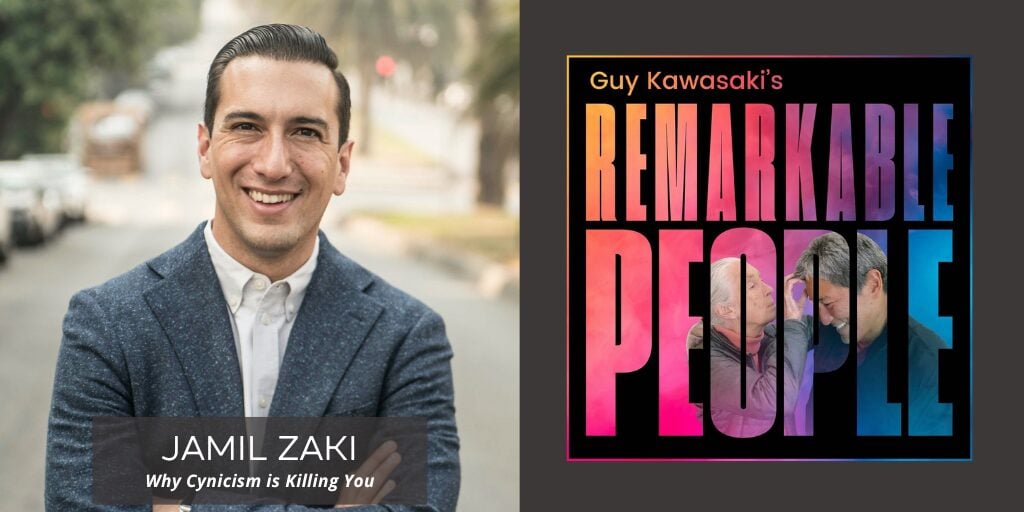
Welcome to Remarkable People. We’re on a mission to make you remarkable. Helping me in this episode is Jamil Zaki.
Jamil is no ordinary psychology professor; his groundbreaking work on empathy, trust, and cynicism has revolutionized our understanding of social psychology. But that’s not all – he’s also the author of multiple acclaimed books, including The War for Kindness and his latest book, Hope for Cynics.
In this episode, we explore the hidden dangers of cynicism and discover why this seemingly protective mindset is actually sabotaging our health, relationships, and success. Jamil’s research reveals that cynical people literally die younger than their more trusting counterparts, while empathetic leaders consistently outperform their harsh competitors. His concept of “hopeful skepticism” offers a revolutionary third path between naive idealism and destructive cynicism.
The conversation takes fascinating turns as Jamil shares practical techniques for rewiring our brains toward greater empathy, from loving-kindness meditation that physically grows empathy-related brain regions to the surprising power of “positive gossip” in countering our negativity bias. His insights from Hope for Cynics demonstrate that empathy isn’t just a soft skill – it’s a survival strategy for our fractured world, complete with a unique evidence-rating system that brings scientific rigor to popular psychology.
Jamil proves that our assumptions about human nature are often wrong, offering hope for cynics everywhere who want to reconnect with humanity without sacrificing their intelligence or discernment.
Please enjoy this remarkable episode, How to Transform from Cynic to Hopeful Skeptic with Stanford’s Jamil Zaki.
If you enjoyed this episode of the Remarkable People podcast, please leave a rating, write a review, and subscribe. Thank you!
Transcript of Guy Kawasaki’s Remarkable People podcast with How to Transform from Cynic to Hopeful Skeptic with Stanford’s Jamil Zaki.
Guy Kawasaki:
Hello, my name is Guy Kawasaki. This is the Remarkable People Podcast. And as you've heard for now, hundreds of times, we are on a mission to help you become remarkable. So we go all over the world and we find remarkable people and we try to pump everything we can out of their brain into this podcast.
Today, luckily, I didn't have to go too far. I'm in Santa Cruz and Dr. Jamil Zaki, no relation to Kawasaki, is a Stanford psychology professor. So he's only an hour away. He's one of the world's leading experts on empathy, trust, cynicism, skepticism, and social connection. He's the author of the book, The War for Kindness, and another book called Hope for Cynics.
That's what we're going to discuss today. He's going to give hope for cynics, and he argues that hopeful skepticism and not naive optimism is the antidote for much of our modern cynicism. Jamil helps us see that empathy isn't a soft skill, it is a survival strategy in this fractured world.
Welcome to Remarkable People, Jamil.
Dr. Jamil Zaki:
Thanks so much, Guy, I am thrilled to be here.
Guy Kawasaki:
Thank you very much for being with us. So I want to start at the end of your book because I saw something at the end of your book that I have never seen in a nonfiction book, much less a business book, which is the appendix.
And in this appendix, you and a colleague rank the strength of the evidence for the claims in the book, and you write how confident you are in these things, and you have this ranking scale from one to five. Although I don't think you put in anything under three. Tell me, how did that come to be, because I've never seen that? And if other business authors and nonfiction authors did that, man, there'd be a lot less writing in the world.
Dr. Jamil Zaki:
Look, I'm an author, but I'm also a scientist. I create knowledge about human connection and I try to share it as transparently and usefully as I can with as many people as possible. And to me, sharing knowledge means respecting your readers to understand that just because a study has been done doesn't mean that we've proved mathematically that something is true about human beings. Science is not a set of facts.
It is a living thing, a process where we hypothesize, we have a guess about the world, we go out and test it, we come up with a result, and then we iterate over and over again. There have been so many studies, including some of my own studies, where we run something, we think that we have an answer, and then we do it again, and we say, "Huh, the answer actually is changing the more that we study it."
So I think that it's important for readers to know when something that I'm saying about people is the result of one study, and then maybe, hey, let's slow down and understand that we need more research. Versus if something that I'm saying is based on a thousand studies, in which case, yeah, you can be pretty confident about it. So I try to meet my readers where they are.
Guy Kawasaki:
I think that some other authors and experts may say, "My God, you're impugning your own writing," because you're saying it's not a five. I'm not total certain. And it's more like a three. But I believe, and I just want to support your efforts here, that by rating it like that, you gain more credibility, not less credibility. But that's not to say that I have the balls to do that for my writing either. Just FYI.
Dr. Jamil Zaki:
Look, one of the reasons that you might not be confident in a conclusion is not at all because you're impugning the work and it's bad, but because it's brand new. The very first time that you discover something, you can be very excited, but you should also be cautious.
So to me, oftentimes if I'm saying, "Oh, this is a three, not a five," it's because it's something that we just did. And it's actually the work I'm most excited about, but I want to be transparent with my readers and with everybody about where we're at.
Guy Kawasaki:
Alrighty, so let's start with a very basic foundation. A lot of us throw the words around like idealist and cynicists and skeptic and all that, but let's start with a definition of cynic or cynicism.
Dr. Jamil Zaki:
So cynicism is a theory. It's a theory about people, not what people do, but who they are. A cynic believes that people in general are selfish, greedy and dishonest. Now, they might acknowledge that person donates to charity, but say, "Ah, they're just doing it for a tax break." They might acknowledge that the person helps out a friend, but say, "Oh, they probably just want payback, or they want to look good in front of others."
And I should say there are people who are more cynical than others, but we all have moments when we feel cynical or less cynical. But when we are in that cynical mindset, we tend to withdraw. If you believe that people are selfish and greedy and dishonest, you tend not to trust them. You tend not to invest as much in other people, and that can make it really difficult to connect with each other.
Guy Kawasaki:
And do you believe that a cynic is an idealist who's been bludgeoned? Or are people born cynical?
Dr. Jamil Zaki:
I think it's George Carlin who said, "Scratch a cynic and you'll find a disappointed idealist." And I think that in general, there's something to that. I don't think that people are cynical because they like to dislike people. I think at our core as a species, we are social. We want to be together, we want to be in community and communion with each other. Cynicism robs us of that, so why fall for it?
I think as you're saying, one reason is because we've been hurt in the past, and pain and betrayal are good teachers. In fact, one could argue they are too good a teacher. If you've been hurt by something you might withdraw, not just from that person who hurts you, from that situation, that hurts you, but from any situation that could hurt you.
It's like you decide that you need to wear a suit of armor in your interactions with people to protect yourself. And instead of protecting you, that suit of armor suffocates you and makes it harder to make new connections with friends or to find the love of your life or to find a great business partner.
Guy Kawasaki:
And would you say that this act that turned you into a cynic, if you were to have an equally powerful act of idealism, is it easier to be brought down into cynicism or taken up into idealism?
Dr. Jamil Zaki:
That's a great question and there's a pretty clear answer, which I think, I don't know if I'll say it's unfortunate, but it's definitely true that it's much easier to learn from negative events than it is to learn from positive events. And you can understand why evolutionarily that would be smart. If you're hurt, that's a life-threatening potentially situation, and you want to learn to never put yourself in that situation again.
If you find a stash of delicious food, that's great, but it's not as existential as the threat. So there's something that psychologists call negativity bias, which is the idea that we pay way more attention to harmful and threatening events than to the good stuff.
We remember harmful events more clearly. We make decisions more based on what we don't want to lose than what we do want to gain. And we learn, to your point, more from these big black swan cynical events than we do from black swan positive events.
Guy Kawasaki:
But just to be a little bit of a devil's advocate, how about if I say to you, "Okay, I understand when it was 50,000 years ago, and if you didn't learn that the saber-tooth is going to kill you, you better be a cynic about saber-tooths being friendly little animals. I understand that.
But now today, could you make the case that if you're a cynic, it is actually going to be a negative and hurt survival and hurt your chances of succeeding? Because if you go around always assuming the worst about everybody, you're going to be in this mindset and you're going to approach the world a different way. And can it not have gone full circle? And now it's anti-survival to be a cynic.
Dr. Jamil Zaki:
That's the fundamental argument of my book, in fact, Guy, is that what served us 50,000, 100,000, a million years ago doesn't serve us anymore. It's okay and maybe even useful to focus on threats when you are in a dangerous situation, but most of us, more than in decades or centuries past, are blessed to not be in actively dangerous situations. We are safer and more well-nourished, for instance, than we were 100,000 years ago.
And yet our minds have not caught up to that situation. And so we act as though we're under threat all the time. I know people who have great jobs as academics and live comfortably and have beautiful families and still feel like they're under threat all the time.
And that threat mentality, that cynical mentality, exactly as you're saying, in fact gets in the way, maybe not of survival, but over the long term of opportunity. Because if you're in a defensive position, assuming the worst about people, you're not going to pursue those opportunities for connection, for love, for collaboration. And actually let me push a little bit further and say, I just said, maybe not in terms of survival, it's not a risk, but actually it turns out cynicism is a risk to our long-term survival.
Cynical people, because they can't connect with others and because connection is so important to our health, end up with worse mental health and even worse physical health over time. In fact, cynical people die younger than non-cynical people. So maybe you're exactly right that cynicism has become the threat instead of keeping us safe.
Guy Kawasaki:
You probably don't want to get into this, but I could make the case that there is a particular political party that is extremely cynical and that every migrant is trying to live off our land and taking our jobs, et cetera. So I will spare you the pain of going into that. So now, tell me something. Is it three points on a line? Is it cynical, skeptical, and idealist? Are they on the same spectrum? And you're suggesting moving more towards idealism, but not completely?
Dr. Jamil Zaki:
No, actually. I think that's the way that you just laid it out is the way that I think most of us think it goes. And actually I would reverse the order. I would say that a lot of people have the belief that you're born a naive idealist. You have no idea how the world really works, so you think things are great.
Then are betrayed once or twice, you have a negative experience, you become skeptical. And then finally, when you're wise enough and have enough experience, you become a gimlet-eyed cynic, right? I think that's a story that a lot of us tell ourselves. We equate cynicism with wisdom.
But I think if you actually look at the data, you get a very different picture where cynics and gullible naive people, idealists, are actually quite similar to one another. Both of them have assumptions about the world and about humanity. A naive gullible person has the assumption that people are all great. A cynic has the assumption that people are all terrible.
And neither one does very much to test those assumptions. They just go with it. Whereas a skeptic is more like a scientist who doesn't have many assumptions and instead looks for evidence, tries to test all of their assumptions and realizes that, hey, just because I can't trust one person doesn't mean I can't trust people. They don't overgeneralize. And because of that, I think of skepticism as a healthier, more productive and more successful mindset.
Guy Kawasaki:
So basically the answer to the question, is there hope for cynics? The answer is yes and become a skeptic.
Dr. Jamil Zaki:
That's exactly right. And I think a lot of cynics think that they are skeptics, and there's a lot of confusion between those terms, and that's one of the things that I'm trying to help with now is to allow people to free themselves from this false dichotomy where they think they either have to believe that people are all great or that people are all terrible.
There are lots of cynics out there who don't want to be naive, who don't want to be taken advantage of, and that's a perfectly human desire. And my reaction to that is you don't have to be, you can take on a scientific skeptical mindset and get the best of both worlds.
Guy Kawasaki:
So are you saying that as a self-test, that if you find yourself believing that everybody is bad until proven good, you're too cynical, and if everybody is good until proven bad, you're too idealistic? It should be more like, let me gather some data and decide if you're good or bad?
Dr. Jamil Zaki:
I think so. I would add just a small point to that, which is that we've been talking about negativity bias, the idea that we tend to underestimate, for instance, how kind, how generous, how friendly, how open-minded other people are. So I think our baseline is probably a little bit too negative.
So rather than assuming nothing about people or not having any priors going into a situation, one thing that I argue for is what I would call hopeful skepticism. That is being open to evidence, but starting out by giving people a little bit of grace. Instead of having no assumptions, say, "Let me try to give this person a chance to show me who they are. As opposed to having no view on them. Let me start out with a little bit of a positive outlook on them and see what happens."
And this is not the same as being naive and giving them your car keys the first time that you meet, but it turns out that people are highly sensitive to our expectations of them. So if you treat somebody cynically as though they're a jerk, they're much more likely to become a jerk in your presence. If you treat somebody as though they are a good person, they're much more likely to step up and meet those expectations.
So starting out with a little bit of positive intent or assuming positive intent can actually go a long way, not just in helping you learn about people, but in having a positive impact on your relationships with them.
Guy Kawasaki:
If we could just back up for a tiny little bit, just like you defined cynics, let us now define skeptics so that people know exactly what it means to be a skeptic.
Dr. Jamil Zaki:
So you can think of cynics as lawyers in the prosecution against humanity. They're starting with an argument that they want to make and looking for evidence that fulfills that argument. So a cynical person, again, if they see somebody do something bad, they say, "Aha, I've learned all about that person." If they see somebody do something good, they say, "I don't really believe it."
A skeptic is not a lawyer trying to make a point. They're more like a scientist. They have maybe a hypothesis, a prediction about how a situation will go or what a person is like, but they're open to being wrong. I think that's really a huge part of skepticism is humility, the ability to know not just what you know, but to know what you don't know.
I think a lot of us have very strong assumptions, especially about people who are different from us, people who think different things, who look a different way than we do, who are from different places than we are. And one of the most powerful places that I think skepticism works is in connecting across difference because it taps into the humility of saying, "Wait a minute, I actually have no idea who this person is, and the best thing I can do is let them show me."
Guy Kawasaki:
To use your legal metaphor, how about this? How about I say that in a criminal case, the prosecution is a cynic that believes that everybody's guilty. The defense is an idealist, believes that everybody is not guilty. And the judge is the skeptic.
Dr. Jamil Zaki:
I love that. Can I steal that, Guy? I'm going to use that from now on.
Guy Kawasaki:
You can have it. God bless you. Although, I don't know, using a judicial criminal legal case these days, that metaphor is getting a little strained.
Dr. Jamil Zaki:
Maybe a bit on the nose given our current climate. That's fair.
Guy Kawasaki:
Well, why don't you say that the judge is not a Supreme Court justice, it's one level down?
Dr. Jamil Zaki:
It's a circuit justice. Yeah.
Guy Kawasaki:
Exactly. Appointed by Obama. Okay, so now we know what a skeptic is and a cynic is. How do you help people go from cynic to skeptic?
Dr. Jamil Zaki:
Okay. There's a bunch of steps that you can take here. One is to fact check your cynical assumptions. Again, I think that a lot of us have deep beliefs about other people, what they're like, and what they'll do. Is that you?
Guy Kawasaki:
Okay. I don't know if we're going to cut this or not, but this phone ringing. It's in a Faraday bag. It's not supposed to get a signal.
Dr. Jamil Zaki:
Oh, interesting.
Guy Kawasaki:
So one second here.
Dr. Jamil Zaki:
Yeah. Take your time.
Guy Kawasaki:
I think we should keep this in. Just, I believe in slice of life podcasting. So this is a real slice. I don't think we're going to edit this, but Jeff is going to see this section and he is going to say, "Oh, Guy, we're going to cut it or not. But let me move this further than the Faraday bag."
Dr. Jamil Zaki:
You got it.
Guy Kawasaki:
So much for Faraday.
Dr. Jamil Zaki:
Guy, are you feeling cynical about the technology now?
Guy Kawasaki:
I was a skeptic until just then. Actually I was an idealist. I said, "Never. I'm completely covered."
Dr. Jamil Zaki:
Incredible.
Guy Kawasaki:
Of course, now I forget the question.
Dr. Jamil Zaki:
You were asking how can we bring a cynic to a place of skepticism?
Guy Kawasaki:
Oh, yeah, transition. And you used to fact check, right?
Dr. Jamil Zaki:
Yes. I think that, again, to take this scientific mindset, a scientist would never take their hypothesis and just say, "Oh, I'm sure it's right." We fact check. We say, "Wait a minute, what evidence do I have to support this claim?" And I think a lot of times we have assumptions about people that if we tried to defend them, we would not be able to.
You meet somebody and they give you a bad vibe, so you decide not to trust them. And then you say, "Well, tell me why you don't trust them." "Oh, I don't know. I just have a weird feeling about them." That gut instinct is something that we probably trust way too much.
It's also true that people have negative gut instincts about others if that person is a different race than us. Or if you haven't eaten in a few hours, you have more negative gut instincts about people because your gut is empty. That's not something that we want to trust. We want to be skeptical of our cynicism and say, "Why am I thinking that way? Why am I feeling that way? And oftentimes what you might discover is that you don't have sufficient evidence for the claim that your mind is making.
And if you don't, then you can move on to the second step, which is taking leaps of faith on people, giving them little opportunities to again, display their character, to show their true colors so that you can gather more data. This is something that psychologists do all the time, and we find that people generally are pleasantly surprised when they take a chance on somebody else.
So my friend Nick Epley, at the University of Chicago, and lots of other psychologists do these experiments where they ask people, "Imagine that you were to strike up a conversation with a stranger or ask a friend for a favor or express gratitude to a teacher. How do you think that interaction would go?" And then they have a separate group of people who they actually forced to do that thing.
And what they find is that people vastly underestimate how these situations will go. They think that striking up a conversation with a stranger will be awkward. They think that if they ask their friend for a favor, they'll be turned down or that it will be a burden on them. And when they actually do it, they find that it's not awkward at all.
It's really pleasant to talk to people that when you ask people for help, they're thrilled to do it. In other words, when we go out and actually enter the world as opposed to staying in our minds, we discover, I think lots of reason for hope, and we are able to replace cynicism with more skepticism.
Guy Kawasaki:
Wow, okay. That was one super powerful way. Any more in these bag of tricks?
Dr. Jamil Zaki:
I would say one other thing is to not just change the way that we think and the way that we act, but to change the way that we talk. People love to give life and each other one star reviews on Yelp. We love to be negative in our gossip. In my lab, we found that people gossip three times more about the selfish things that other people do than about the kind and generous things that other people do.
And that's for a reason. We often gossip about other people to protect our communities. If somebody steals from us, we say, "Hey, don't do business with that person." And that's a well-intentioned, honorable thing to do. But it spreads cynicism because it gives people stories that are unbalanced, that more often represent the worst about humanity than its best.
So one thing that I try to do, and I do this with my family sometimes, is what we call positive gossip.
Guy Kawasaki:
It's an oxymoron, by the way.
Dr. Jamil Zaki:
It sounds that way, but it's not. Gossip is really just any conversation about other people. And so we say at the end of the day, we want each person to share one story of human goodness that you saw, somebody being kind or friendly or generous or forgiving. And we find that does a few things. One, it gives us each more positive data, so it counteracts our own cynicism through each other's stories.
But two, because we know we're going to need to come up with a story that evening, it pops up an antenna in your mind to see that. Guy, if I told you tonight at dinner you're going to have to tell your friends and family about all the red cars you saw, you would notice many more red cars that day. And likewise, if you know that you're going to be sharing stories of human goodness, you are more open to it and you start to see those stories everywhere. Wow.
Guy Kawasaki:
You could build the social media platform based on that thesis.
Dr. Jamil Zaki:
It's been pitched to me, but not really in the social media mood right now.
Guy Kawasaki:
Yeah, no, it would be very difficult to overcome the negative bias of social media.
All right, so now, just so we have good models to emulate and think about, who is in the Jamil Zaki hopeful skeptic hall of fame?
Dr. Jamil Zaki:
Oh wow. That's an excellent question. Look, the book, Hope for Cynics, has a protagonist. He's not somebody who's famous or world leader or anything like that.
Guy Kawasaki:
You mean Emile?
Dr. Jamil Zaki:
Emile, yeah. Yeah. My late friend and colleague, Emile Bruneau, is my number one hall of fame, hopeful skeptic. He was a neuroscientist who studied the neuroscience of peace, which a lot of people don't know is something you can do because he basically invented it. He studied why people come to hate each other and how we could stop that based on evidence from the brain. And he and I were in similar circles scientifically, our names rhyme. We were bound to be friends.
And he was just this wonderful guy. The thing about him is that we both studied human goodness in one way or another. But I myself and maybe, Guy, this can be a confession of sorts, even though I study kindness and empathy, I tend to be relatively cynical. I've been fighting this for a long time. This part of why I started working on this subject was to understand my own cynicism and see if I could counteract it.
I would sometimes feel like, wow, I study goodness, but I don't really see it in people all the time. And Emile was really different. He saw it. He really saw it in people. So much so that when we started working together, I thought, who is this guy? Why is he so positive all the time? Maybe he's naive, maybe he's too much of an idealist.
But I learned later that he had a very, very difficult childhood and that his decision to put faith in people, to be a hopeful skeptic was just that, it was a choice that he made a very intentional choice about how he wanted to live his life. And he lived that value for his entire life. And he lived it even when his life was cut short prematurely. He was diagnosed with an aggressive brain cancer in 2018, and he died in 2020, leaving behind a young family. And it's just this enormous tragedy.
But Emile himself never faced it that way. He was full of gratitude, and again, this just incredibly fierce determination to see the good in people and in life. I remember when he told me about his diagnosis, within ten minutes, he was consoling me. And it's just the power with which he reflected those values has always been a true inspiration to me, and that's why I feature him so heavily in the book and his story.
Guy Kawasaki:
I've been racking my brain, and this is about the 275th episode. And I would say the person who probably most represents hopeful skepticism on my show has been Neil deGrasse Tyson because Neil deGrasse Tyson, as an astrophysicist and scientist, he has to be based on scientific theory and evidence and not just gut feeling. But he's fundamentally a positive person and I think he might be a good example for you.
Dr. Jamil Zaki:
Absolutely. I think that there are many scientists who have this very, of course, skeptical mindset because that's really the heart of science, but also have a faith in humanity. I would also look to people who have championed social movements.
People like Václav Havel in what was Czechoslovakia or Nelson Mandela in South Africa. These are people who are facing immense oppression, who easily could have become cynical sitting in their jail cells and thinking, "Wow, the world is falling apart," and simply refuse to do so.
I think that hopeful skepticism takes courage, especially when things are not going the way that you want them to. It's much easier, much more instinctive to give into cynicism, to say, "Things are terrible and they're only going to get worse, and there's nothing I can do about it." Because when you decide that there's nothing that you can do about something, you actually free yourself to do nothing. You allow yourself to be complacent.
Hopeful skepticism does not give you that comfort. It does not give you that chance to retreat. And because of that, it's a challenging mindset, I think that's why it's oftentimes more popular to become cynical because it's frankly easier in terms of effort. It's not easy in terms of your health or well-being, or your ability to do anything in the world. It's highly destructive for all of those. But it's easy in terms of allowing you to sit back and do nothing.
Guy Kawasaki:
Yeah, I hear you. I think maybe Angela Duckworth is also a hopeful skeptic, something about social psychologists that fascinate me. If I had to do it all over again, I would study social psychology or behavioral economics. But anyway.
Dr. Jamil Zaki:
I think you are studying those themes through this podcast, aren't you?
Guy Kawasaki:
I am. I have had you, Carol Dweck, Mary Murphy, Angela Duckworth, Katy Milkman, Bob Cialdini, David Aaker. I have the social psychology hall of fame on my podcast.
Dr. Jamil Zaki:
It's like a PhD that you're doing here.
Guy Kawasaki:
And now I have you. So my life is complete.
Dr. Jamil Zaki:
You can retire now.
Guy Kawasaki:
I can. I should just go into Jordan Hall at Stanford, just go down the list, go down every door in Jordan and take care of it. And you know what? One of my very first guests was Phil Zimbardo, and I worked with Phil Zimbardo. He became a close friend. After I graduated, I ran his Psych One course. Anyway.
Dr. Jamil Zaki:
That's amazing. Phil was such an interesting man, and I actually now direct Psych One.
Guy Kawasaki:
You direct Psych one?
Dr. Jamil Zaki:
Yeah, at Stanford, which is a real honor to be in that position.
Guy Kawasaki:
So somewhere out there is a Guy Kawasaki, he's going to be your head proctor, and the rest is history.
Dr. Jamil Zaki:
I hope to be on his podcast someday as well.
Guy Kawasaki:
Okay. So now I want to shift gears from cynicism and skepticism to empathy. So first of all, let us define empathy.
Dr. Jamil Zaki:
I love how you start with definitions each time, Guy, that's really important. Empathy is a simple word, but people use it in all sorts of different ways. So the way that scientists understand it is that empathy is not one thing, but three things. Three different ways that we respond to other people's experiences and their emotions in particular.
So imagine that you run into a friend and you can immediately tell that he's not doing well. He's in anguish, maybe he's even crying. A bunch of things might happen in you when you see him. One, you might become upset yourself vicariously catching his negative emotion, which we call emotional empathy. Two, you might try to figure out what is my friend feeling and why? Trying to see the world as he sees it, which we would call cognitive empathy.
And then third, if you're a good friend, which I'm sure you are, Guy, you would say, "My gosh, what can I do to help him?" You would experience a desire to improve his well-being. And that's what we would call empathic concern or compassion. And these three pieces come together into the full range of human empathy.
Guy Kawasaki:
I saw a definition, tell me if you agree with this, that a cynic says, "What's that person's angle?" And an empathetic person says, "What is that person feeling? And why?" Would you say those are good differentiators between a cynic and an empathetic person?
Dr. Jamil Zaki:
I love that. Where did you hear? That quote sums up the last ten years of my work.
Guy Kawasaki:
ChatGPT. Seriously, I asked ChatGPT to contrast empathy and cynicism, and that's what it said.
Dr. Jamil Zaki:
Algorithmic at its finest.
Guy Kawasaki:
Who says AI has hallucinations?
Dr. Jamil Zaki:
I think that's a really interesting way to put it. And I do think that whereas the cynic kind of more focuses on themselves and asks, "How is this person trying to get one over on me? How is this person trying to harm me?"
Viewing the other person almost as a threat to the self as opposed to their own unique being? The empathic person does the opposite. They don't focus only on how is that person going to affect me? They focus on who is that person and what are they going through? I think that's very well put. Yeah.
Guy Kawasaki:
Okay. So now we got to ask the question, is empathy learnable and how?
Dr. Jamil Zaki:
Yes, this is a big one. I think a lot of people assume that empathy is a fixed trait, that you either have it or you don't. And it turns out that's not true at all. You had Carol Dweck on the show, she has known for a really long time when people assume that they can't change, they're actually less likely to change.
In my research with Carol, we find that about half of people think that empathy is a fixed trait, and those people don't try very hard or as hard to empathize, to connect with other people, especially during challenging situations like when you're trying to connect across difference, for instance. But it turns out that the science is pretty clear that in fact, empathy is less like a trait and more like a skill.
Now, that's not to say that everybody is the same, and we're all just blank slates waiting to become either empathic or not. I'm not saying that you're going to take Hannibal Lecter and turn them into Mother Teresa or anything like that. I am saying that we each have a starting point. Some people are born more empathic than others, but we can move an enormous amount around that starting point.
And there are many ways to cultivate empathy, and there are many ways to lose it as well. Saying that something is a skill doesn't just mean that we can get better at it. Saying that something is like a muscle doesn't just mean that it can get stronger. It can also atrophy. And so it's important for us to mind not only the experiences that are growing us, but also the experiences that are shrinking us.
Guy Kawasaki:
Okay, Jamil. But I asked the question, how, not if. I want how. I am listening to your answer. I'm not reading off a script here,
Dr. Jamil Zaki:
Nor am I. So what is the how? For growing empathy, you mean?
Guy Kawasaki:
Exactly.
Dr. Jamil Zaki:
Yeah. So there's a bunch of ways to do it. There are ancient techniques, certain meditation practices. One is “metta” or loving kindness. Not Meta the company.
Guy Kawasaki:
Not Mark Zuckerberg.
Dr. Jamil Zaki:
“Metta” with two T's. This is also known as loving-kindness meditation, right? This is where you focus goodwill on the people in your life, on strangers, and then on all living beings. There's a phenomenal study that was published a few years ago from the Max Planck Institute where they trained people in loving-kindness meditation or not. So there were two groups and one group got trained in this form of meditation. The other didn't.
Over months, they found that people who practiced this form of became better at understanding other people, at entering their world, they became more generous, and their brains changed. So these researchers scanned their brains before and after months of this type of practice.
And it turned out that for people who practiced loving-kindness, parts of their brain associated with empathy grew in volume, and that growth tracked how much they became better at empathy. So when you make choices like focusing on others through this type of meditation, you are rewiring yourself towards more connection.
So that's one way, but there are many others. For instance, engaging with the arts can build our empathy. In my lab, we've found that doing anything from reading novels to attending plays builds people's care for others. And then again, to get back to my work with Carol, it also matters what you believe about empathy. If you think you can't change, you don't try and so you don't. It's a self-fulfilling prophecy of stagnation.
What we found with Carol is that when people believed that empathy was a skill, they worked harder at it. And when we taught people that empathy was a skill, they also worked harder at it. And in follow-up work, we found that when we trained people who were just entering college and told them empathy is a skill, they worked harder it on it. And in their first year of college made a greater number of friends, they actually became better at connecting because they learned that they could.
Guy Kawasaki:
Now, just in the spirit of thoroughness, this Max Planck Institute study, is it a reliability of three, four, or five?
Dr. Jamil Zaki:
That's a great question. It's the first study of its kind. So the study itself I think is extremely well conducted, but no one study would get a ranking of five in my rating system. So I would say that when other labs do it again ten more times, I'll give it a five. For now, it would be a three. Again, not because the work is poor, it's excellent, but because it's new.
Guy Kawasaki:
Wow, you are a tough judgment, man. That's a three. Wow.
Dr. Jamil Zaki:
It's one study. It's a great study, but it's one study.
Guy Kawasaki:
I got to tell you something, that as a business book writer, we take one example, and we make it into a generalization. Steve Jobs didn't finish college. Nobody has to finish college. That would be like a negative five on your scale.
Dr. Jamil Zaki:
Guy let's talk about business a little bit because I actually think that stereotypes like that have hurt our ability to lead well when it comes to empathy.
Guy Kawasaki:
Oh, yeah.
Dr. Jamil Zaki:
Because the stereotype is good leaders are unempathetic, they're tough. And Steve Jobs didn't just not finish college. He was famous for being ruthless and sometimes cruel. And people often tell me, they say, "Huh, empathy sounds great if you want to be a good person or friend or parent, but it's not good for being a boss because look at Steve Jobs, look at XYZ other leader who's successful and famously cruel." And this is where I think anecdotes can actually be negative in terms of their evidentiary value.
Guy Kawasaki:
Oh, absolutely. Absolutely. Last in first out. There's this example that a previous guest gave to me. He's the one who did the gorilla walks in the middle of the study when they're tossing balls. Anyway, that guy. God, I'm having a senior moment.
Dr. Jamil Zaki:
Dan Simons and Chris Chabris were the two. Yeah.
Guy Kawasaki:
And he told me that the most important question you ask when you hear something like this is what's missing. So you hear that Steve Jobs didn't have a college degree and he was so successful. You have to ask how many people with college degrees were successful? How many people without college degrees were unsuccessful? And it's two-by-two matrix. You got to ask all the boxes.
Dr. Jamil Zaki:
Exactly. And for me, it's just when you can look at data instead of stories. And so you can tell me about people who are jerks and run successful companies, but I've run studies across many companies, and we find that CEOs who are more empathic have more engaged, productive workforces and lower levels of attrition.
And so I think that the evidence is just abundantly clear that empathic organizations and leaders far outperform unempathetic ones. So this is one place I think applying that skill is most important.
Guy Kawasaki:
Okay. Now I'm going to pose this as an either/or, but you can tell me. You don't need to be framed by my question. You can answer it. I don't think I'll be able to trap you even if I tried. But anyway. So do you think that empathy is more about listening or asking the right question?
Dr. Jamil Zaki:
Oh, that's a great question. I think that we undervalue questions when it comes to empathy. And oftentimes I think that we have this stereotype that the empathic person is supposed to be clairvoyant, that they're supposed to already know how other people feel. And that they're supposed to read minds and just be there already. But just like skepticism, empathy requires humility.
So to me, when I teach people empathy, one of the most powerful exercises that I try is what's known as perspective getting. Now you've probably heard of perspective taking. This is where you imagine how you would feel in somebody else's situation.
But it turns out, when we imagine how we would feel in somebody else's situation, we end up understanding how we would feel in their situation, not how they actually feel in their situation. It's like people say, "Oh, I've got to walk a mile in somebody else's shoes." But you would never do that, right? If we were in the same room, I wouldn't say, "Hey, Guy, I want to see how comfortable those shoes are. Can I borrow them? I'm going to go walk around a regulation track four times."
Because what we really need to do is not assume that this person feels the way that I would in their situation, but rather ask them, "Well, tell me more about what it's like to be in that situation?" I think once you ask the question, you show that you have genuine curiosity, then listening becomes more important.
But too often, I think listening is actually a proxy for just waiting our turn in conversation. I don't think that when people listen, they often do so well. So prompting with good questions, trying to treat deep conversations a little bit more like interviews and a little bit less like debates, I think is the behavioral shift that I argue for more than just active listening. I think active listening is a beautiful thing, but we need to prompt it and have it as a foundation by asking good questions.
Guy Kawasaki:
So just to make sure I got this clear, instead of trying to imagine what it would be like to be the person, you simply ask the person, what is it like to be you?
Dr. Jamil Zaki:
Exactly.
Guy Kawasaki:
I got it. I'm going to rip that off.
Now, I'm going to give you one more thing about empathy that was really powerful for me. I interviewed a guy named Martin Lindstrom, and he was having an executive off-site with his pharmaceutical team, and they wanted to get closer to the customer, which means hire McKinsey and pay him five million dollars. But in this case, it was Martin Lindstrom. I don't think he got paid five million. I hope he did. But anyway.
So he went in with this executive team of pharmaceutical people and he said, "You want to get closer to the customer. I'm passing out straws. I want you to all breathe through the straw for the next few minutes." And he did that, and he forced him to do that. I have subsequently embraced this.
So when I make keynote speeches, I bring straws and I make my audience do this. And at the end of this exercise, he says, "You want to be closer to the customer. I made you into the customer. That's what it's like to have asthma. It's like you're breathing through a straw." So is that, I hope you say yes because I'm doing it, is that a good way to teach empathy?
Dr. Jamil Zaki:
It's a very powerful technique for embodying empathy, right? There are many ways to be more empathic toward the customer. In this case, you could do that to give people the embodied experience of what it's like to have asthma. Or you could bring somebody with asthma into the room and say, "What questions do you have for this person?"
I'll say that trying to do this embodied empathy is really powerful, but Guy, it's not perfect. I'll give you an example. There was a study where sighted people were asked to put blindfolds on and try to do things like make a cup of coffee. And of course, they did a terrible job, and it was very difficult.
And the idea was, wow, now I know what it's like to be blind. Except they didn't, because blind people are incredibly adept at doing all of those things. They've adjusted to this change in their life and are quite able to do many things that a sighted person who's blind for the first time could never do. So having that embodied experience can be helpful, but it could also be a little bit limiting in some ways. Does that make sense?
Guy Kawasaki:
Yeah, it does. And as a deaf person, I can absolutely relate to that. To take a person with hearing and just put muffs on them and silence them, that's experiential empathy or whatever you call it, but then to know the full impact, it's not that simple of walking around with your ears plugged for a few hours or something.
Dr. Jamil Zaki:
Exactly, and you could say the same thing about asthma. I don't have asthma, but I would assume that maybe somebody who does would say, "Yeah, you, a person who breathes easily all the time just breathing through a straw for a few minutes, yes, you maybe have had a bodily experience that's different than your usual experience, and maybe it's closer to what I experienced, but for me, it's very different than it is for you."
Guy Kawasaki:
As I'm sitting here, I can tell you one thing that if you were to put earmuffs on people and let them hang out for an hour, that is a start. I'll give you an example of something that would never occur to most people, which is because I am deaf and I take off my cochlear implant when I sleep, you don't sleep with an implant on.
So I can tell you that when I travel and I stay in a hotel, one of my fears is that there will be a fire alarm and I will not hear the fire alarm and I will die. So that's why I asked for rooms on lower floors, so at least I don't have to jump out as far, but anyway. But that is something that is so subtle and it would be hard to pick up. That's kind of a fear that I have that you would not pick up just by breathing through a straw or being deaf for fifteen minutes.
Dr. Jamil Zaki:
See Guy, just hearing that makes me feel like I have more insight about that experience than probably if I would feel if I just put noise-canceling headphones on for an hour, and this is where I think that, again, giving people a dramatic experience of, "Hey, this is what it might be like," can be a nice way to open their eyes or to alert them that, hey, my experience is just one of many. But to really deeply empathize, I think that it's better or most powerful to go to the source to ask people what their lives are like.
Guy Kawasaki:
Yeah, okay. Maybe I'll stop passing out straws at my speeches. Although, I buy straws that are biodegradable. There's a lot going on in my brain as I make a speech. It's not just reading the teleprompter.
So I have one last question for you, and it is about empathy, and the question is, your opinion and your pluses and minus and do's and don'ts about how do you empathize with a group that you fundamentally do not agree with?
I fundamentally do not agree with people who want to take away LGBTQ+ rights or who want to, I don't know, rig elections or there's a lot of things, want to be a vaccine denier. I fundamentally disagree with that, but how am I supposed to empathize with people that I have complete and utter disagreement with?
Dr. Jamil Zaki:
This is the toughest uphill climb for empathy, and I think that there's a few things that we can do. The first is to, and to get back a little bit to cynicism, is to understand that oftentimes we are wrong about who those people are.
So in my lab and many others, we've asked both Democrats and Republicans, "What do you think the average person you disagree with, what do you think they believe? How do you think they feel? What do you think they want?" And we find that people are wrong about the other side in basically every way we can measure.
So if you ask people, "What's the fiftieth percentile of the other side," they think that person is as extreme as the true eightieth percentile. So we think that the other side is more extreme than they are. We think that the other side is twice as anti-democratic, twice as hateful, and four times as violent as they really are.
So a lot of our lack of empathy for the other side is based on a misconstrual of who they are. I'm not saying that there aren't extreme and dangerous people on the other side, by the way. They certainly are. But think about the representation that we have of people we disagree with. Where is it coming from? It's coming from the media. It's coming from media companies that profit by making us scared of that other side through negativity bias.
And so I think that number one is to just realize that, hey, there are people of course, who I disagree with. There are people who support policies maybe that I even find to be dangerous and destructive, but I probably am wrong about who they are. And then maybe being curious enough to actually talk with them.
In my lab, we brought Democrats and Republicans together to have conversations about gun control, climate change, and abortion. Easy stuff, right? No problem there. And we asked these people, "How do you think this conversation is going to go?"
And they thought it was going to go pretty poorly. After the conversation, we asked, "How did it go?" And they said it went extremely well to a person. They were surprised by how positive these conversations were because they were shocked that somebody they disagreed with wasn't some sort of incredible monster, but actually was a human being.
Guy Kawasaki:
Some baby killer, pro-abortion.
Dr. Jamil Zaki:
Exactly. And so what we find is that the closer that we get to people we disagree with, I'm not going to say that we agree with them, but the more that we're at least able to have some empathy.
Now, that might not be what people want right now. If somebody supports a policy that you think is actively threatening, you might not want to make nice with them. And if you don't, that's fine. But I do think that oftentimes compromise and even social progress are stopped when we start to demonize one another. And that when we have the courage, the bandwidth, the safety to do it, trying to reach out and actually connect as opposed to working off of media assumptions is a starting point.
Guy Kawasaki:
Now, just a point of clarity, when you say closer, I think you mean physically closer, right? You have to have physical contact. If you live in a neighborhood where Democrats and Republicans are living and your kids are on the same hockey or soccer team and you're physically in the stand together, that's the start, right?
Dr. Jamil Zaki:
I think physical closeness matters but is not necessary. The study that we did with Republicans and Democrats was over Zoom. I think what's more important is just live one-on-one interactions. Whether those are in-person or not. I think in-person is best, but I think that it's more the ability to humanize an individual as opposed to working off of stereotypes.
Guy Kawasaki:
Okay. I think we've covered a lot. I think we're going to add a lot of value to the people who listen to this about hopeful, skepticism and empathy. I thank you very much, Jamil. I've enjoyed this immensely and so much work to do.
Dr. Jamil Zaki:
Guy, first, let me just say thank you. This has been totally delightful. I really appreciate the conversation.
Guy Kawasaki:
Oh, thank you very much. I bet you say that to every podcaster, but okay.
So let me thank my team. My team is Madisun Nuismer, who is a co-producer with Jeff Sieh, the dynamic duo, I call them. There's Tessa Nuismer, who's a researcher, and there's also Shannon Hernandez, sound design engineer. So that's the Remarkable People team, and we have remarkable people like Jamil to come on and help you be remarkable. Thank you very much, Jamil.
Dr. Jamil Zaki:
Thank you, guy. It's been a pleasure.
Guy Kawasaki:
Oh, and promote your book.
Dr. Jamil Zaki:
Sure. My latest book is Hope for Cynics: The Surprising Science of Human Goodness. And it really gets into what we've been talking about today, but in much more detail. What is cynicism? Why is it so dangerous? Why do so many of us fall for it? And crucially, what can we all do to live a more hopeful and positive life?
Sign up to receive email updates
Enter your name and email address below and I'll send you periodic updates about the podcast.


Leave a Reply