
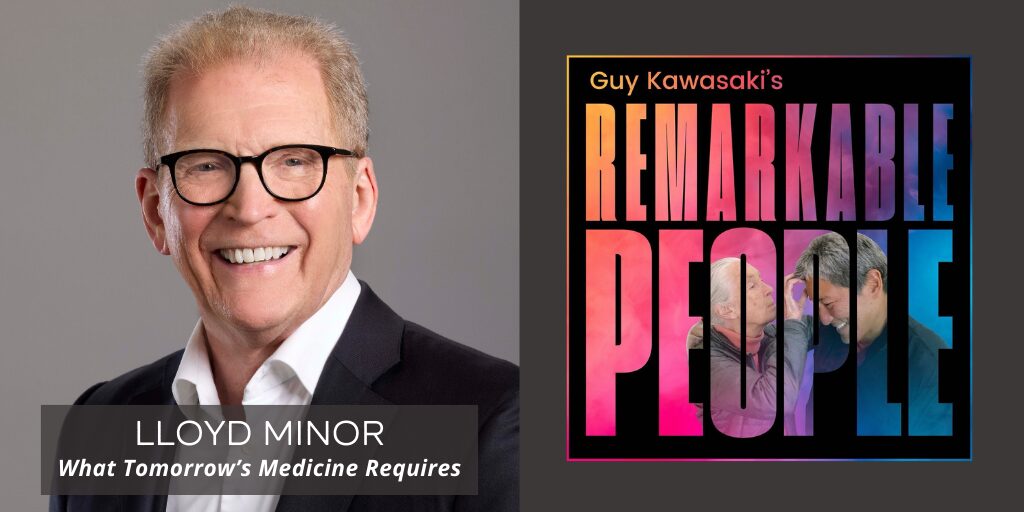
Welcome to Remarkable People. We’re on a mission to make you remarkable. Helping me in this episode is Lloyd Minor.
Lloyd Minor is a medical leader who operates at the intersection of science, strategy, and humanity. As Dean of the Stanford University School of Medicine, he oversees a vast ecosystem where research, education, and patient care converge. With decades of experience as a physician-scientist, Lloyd brings uncommon clarity to conversations about innovation and responsibility. His work challenges medicine to aim higher than treatment alone.
In this episode, we explore Lloyd’s vision for precision health—a shift from reacting to illness toward predicting and preventing disease. He explains how tools like genomics, data science, and artificial intelligence can help doctors intervene earlier and more effectively. Just as important, he makes the case that technology should strengthen human connection, not diminish it.
The conversation also tackles leadership at scale, medical education, and what it means to define health beyond the absence of sickness. From redesigning patient experiences to preparing future physicians, Lloyd offers a pragmatic, forward-looking perspective. It’s a discussion about medicine—but also about how systems evolve when people come first.
Please enjoy this remarkable episode, How AI Can Bring Humanity Back to Healthcare with Lloyd Minor.
If you enjoyed this episode of the Remarkable People podcast, please leave a rating, write a review, and subscribe. Thank you!
Transcript of Guy Kawasaki’s Remarkable People podcast: How AI Can Bring Humanity Back to Healthcare with Lloyd Minor.
Guy Kawasaki:
Good morning everybody. This is Guy Kawasaki. This is the Remarkable People Podcast. And as you know, we scour the world looking for remarkable people to inspire and inform us, and of course we found another one.
His name is Dr. Lloyd Minor, and I'm gonna tell you a story. He is the Dean of the Stanford University School of Medicine and he's also Vice President for Medical Affairs of Stanford. I went to Stanford, so I have a very funny story about that. He is actually a real doctor, and he has over 160 citations.
So he's the real deal. He is not some empty suit MBA who's just pushing paper around. And he has this concept called Precision Health, which is what we're gonna get into because it's a very interesting concept. So welcome to the show, Dr. Lloyd Minor.
Lloyd Minor:
Thank you Guy. It's wonderful to be with you today.
Guy Kawasaki:
I just for clarification when it says that you're the Dean of the School of Medicine. Does that mean you run the hospital and, you know, the teaching and the treatment? Like how does it work there? Does the buck stop with you for medicine at Stanford?
Lloyd Minor:
Everything we do of course depends upon collaboration and partnerships, and I have the privilege of working closely with two CEOs of our two health systems, the Stanford Healthcare, our Adult Hospital and Delivery System, and Stanford Medicine Children's Health, our Children's Hospital and Delivery System.
David Entwistle, the CEO of SHC, and Paul King, the CEO of Stanford Medicine Children's Health, and I work closely together on the overall enterprise.
We are an academic medical center, so we bring together research, teaching, and patient care. And that partnership that we have really is essential to its success. I'm responsible for, broadly speaking, overseeing strategy for the enterprise and making sure, most importantly, that we remain well aligned with Stanford University.
Which of course is the parrot for all that we do. And our greatest strength in Stanford Medicine is the fact that we're a part of Stanford University.
Guy Kawasaki:
Alrighty. So how many people work in this part of Stanford?
Lloyd Minor:
All in, if you look at the healthcare delivery enterprise plus the research, the teaching enterprise, all in. It's close to 40,000 people now.
Guy Kawasaki:
40,000 people? Wow.
Lloyd Minor:
It's a lot of people. And we have satellite facilities around the Bay Area. We have a hospital that's part of our system in Pleasanton, Tri-Valley Community Hospital.
So we have expanded in our region to provide outstanding services to people who are some distance from our home location in Palo Alto. And then of course we have a large research enterprise as well.
Guy Kawasaki:
So I went to Stanford in the seventies. I'm in the class of 1976, and I have to tell you that when I started at Stanford, like many other Asian Americans, we were given three choices by our parents. You can be a doctor, dentist, or lawyer, and so I happened to be in the Asian American dorm, so everybody wanted to be a doctor.
I started as a pre-med and I took this class, which involved walking on rounds with a doctor around the Stanford Hospital, and Lloyd, on the first day in that class, I fainted and that's when I decided I couldn't be a doctor, so that was the end of my medical career. I just want you to know.
Lloyd Minor:
Guy you have made, and you are making so many contributions, and I'm sorry you had that experience, but I'm glad that you've remained very interested in health and medicine, and you've brought a lot of knowledge and encouragement to a lot of people.
Guy Kawasaki:
Yeah. Just so I can get you on the record, if I ever need to go to the Stanford ER, can I just like ping you and say, “Will you tell that I'm coming? And don't make me wait.”
Lloyd Minor:
Anytime.
Guy Kawasaki:
Okay, we got that recorded now, Lloyd. So first of all, I am very interested in the concept of Precision Health. So can you define what is Precision Health.
Lloyd Minor:
Sure. I started at Stanford as Dean on December First, 2012. And, I had not been on the Stanford faculty before. I certainly had colleagues at Stanford. I moved here from Johns Hopkins, where I've been for nineteen years.
And so one of the things that I wanted to do first was to get to know people here, to find what their aspirations were, to find out from them what our opportunities for the future were.
This was around the time that in President Obama's administration, there was a focus on what was defined as precision medicine and precision medicine probably at that time was manifesting itself most in cancer care, where rather than one size fits all treatment, the notion is that you tailor the treatment to the individual, the cancer and the individual.
And by selecting the best treatment for the individual, you get a better outcome. Rather than saying, “Everyone with this type of cancer gets this type of treatment.” And, certainly we, every academic medical center, do precision medicine.
But in talking with our faculty, we decided that we should go further than that and really take the same enablers of precision medicine, areas like genomics and data science and apply those in a predictive and preventive way.
So we can think of precision medicine as about sick care, and goodness knows we need sick care when we're sick. And there's been great progress made in cardiovascular disease, cancer, and other areas. But the goal of Precision Health is to move beyond sick care and really focus on healthcare.
Stated succinctly, the goal of Precision Health is to predict, prevent, and cure disease precisely, but in that order, because if we're better at predicting and preventing disease, the need for ultra-specialized treatments for advanced disease should be less because we'll either be preventing diseases altogether, or we will be diagnosing them much earlier and therefore treating them more effectively.
So that's been our goal with Precision Health and there are a variety of components to it. Certainly, everything we're doing, and you talk about this a lot, Guy, on your podcast, everything we're doing today is being supercharged and empowered by AI. Also, our ability, each of us, our ability to get information about our health and wellbeing is being transformed.
It's already much better than it has been in the past, and I think in the future we're gonna be able to monitor our health, have much more real time information about our health than we've had in the past.
Guy Kawasaki:
To ask an even more fundamental, perhaps simplistic question. Do you define health as the lack of sickness, or is health beyond this kind of a sort of neutral stance of, I'm not sick, I'm not hurt, I must be healthy?
Lloyd Minor:
I sure hope it's far beyond the absence of disease. Health should also be composed of and should be focused on wellbeing.
One of the things we can talk about today, I've been working for a little bit less than four years with Alice Walton on the new medical school that was just opened in Bentonville, Arkansas, the Alice L. Walton School of Medicine, which is known by the acronym of A.W.S.O.M. and Alice's notion of “whole health,” which is how do we bring together behavioral factors, how do we focus on what it is to be healthy, highly functioning, a vital member of communities.
And that's all a part of health and wellbeing. It isn't necessarily a part of what we've traditionally focused on in biomedicine, but it definitely needs to be something we focus on more in the future and look at ways that we bring in and integrate our approach’s in understanding the mechanisms of disease, intervening earlier in those mechanisms, and really building a concept of whole health that stresses our overall wellbeing.
In addition to, of course, the absence of disease. But health should be far more than just the absence of sickness.
Guy Kawasaki:
Now Lloyd, I don't wanna cause you to lose funding, but I gotta ask you the obvious question, which is, I read these headlines where they're cutting back on mRNA research and anti-vaccination. That doesn't exactly sound like it's preventing disease. So what's happening in the last year? Are you pulling your hair out or it doesn't seem that the arc is going towards Precision Health?
Lloyd Minor:
I think Guy, there are multiple ways of looking at that. And, we've had the privilege of interacting with many leaders in the administration. And as Dr. Jay Bhattacharya, the director of the National Institutes of Health, is a former Stanford faculty member, a very distinguished scholar, a health economist, health policy expert.
There are others in the administration, who have spent time at Stanford, have contributed in many ways to our university. We certainly wanna keep an open mind. We want to interact. We want to have dialogue. We want to make sure that at this university and elsewhere, there's an open environment for debate and exchange of ideas.
We also have pioneering research going on in vaccine related matters in the human immune system, how that immune system can be used to effectively prevent disease or treat it more effectively. We've seen enormous advances in cancer immunotherapy. Therapies that are designed to enable each of our immune systems to fight off cancer more effectively.
We wanna be guided in terms of the research we do based upon where the very best science is. We also want to be objective and open-minded about different ideas, different approaches, and make sure that Stanford is a place where these ideas can be debated, considered, and ultimately where we focus on finding the truth and what's best for individuals and recognizing that individuals are going to make different decisions and they should have that ability and freedom to do so.
Guy Kawasaki:
So tell us about how AI will help us achieve Precision Health.
Lloyd Minor:
AI is transforming everything we do. My first encounter with Large Language Models came in the spring of 2023. Prior to moving to Stanford, I had a career as a surgeon scientist, physician scientist, and I'm probably best known for discovering, describing this inner ear disorder that we published the first paper on in 1998.
And there's a whole body of work that I did and that others have done related to this disorder. And one of my colleagues here asked me to deliver a talk at a conference he was hosting in the summer of 2023 on the work that I'd done on this inner ear disorder called Superior Canal Dehiscence Syndrome.
And it was good to be able to put together what I had done, what others have done since me. And the last thing I did as I was preparing that talk was go to ChatGPT. Now this was around maybe May of 2023, so you know ChatGPT was introduced to the public in, I think, November of 2022.
So I don't remember which edition we were on at that time, but I asked the Large Language Model, “What is Superior Canal Dehiscence syndrome?” And I got back two or three paragraphs that were well organized, well structured.
I recognized some of the things in the language that it was giving me because they're things that I had written in various papers, but it was organized and conceptually laid out in a way that was very thoughtful and very representative of the work that I had done and the work that had gone on since.
And that really was an epiphany to me in saying, “This is not just a small incremental advance, not a step along the ladder, this is a giant leap.” And of course, since 2023 was almost in prehistoric times when it comes to Generative AI and the advances have been remarkable since then.
Today, surveys have shown that 60 plus percent of practicing physicians are using some form of a Large Language Model to help assist them in getting information about their patients. And we're also seeing the impact of Generative AI on processes involved in the running of our healthcare systems.
Also in areas like drug discovery, there are enormous implications. So pretty much everything we do, including how we train the next generation of physician and scientists, is being and will be impacted by AI.
Now, how that impact manifests itself, how we can be thought leaders in that space is something that we really are trying to devote a lot of time and thoughtful attention to.
Guy Kawasaki:
So if I were to check into Stanford today, can you just give me some examples of how I would be interacting with AI in a real, practical, and tactical sense today?
Lloyd Minor:
There's several ways. First is that we have an electronic portal that most of our patients elect to use, now this is not Large Language Model AI necessarily. It's more information technology empowered in the background by AI.
But where you can schedule appointments, you can schedule lab tests, you can get in real time the information about your lab tests, you can get interpretive information about what those test results mean.
You can even get links to sites that tell you additional information about what diagnosis has been made, about what treatments you may be receiving. So there is a, what we hope, user-friendly portal that you interact with. Before you are concomitantly interacting with people in our system to be seen. So that's the patient facing aspect of AI.
The other thing that's going on today, and I think will become even more prominent in the future, prior to the introduction of Large Language Models, we had moved into the United States to being principally an electronic health record system over a decade ago, and that was a good move in that paper records get lost.
They're hard to find. And having a repository, a curated repository of information about our health. They can then be readily transported to other physicians, other delivery systems with the permission of the patient. That's an advantage. But what it had done is it had separated physicians and other providers from patients.
So oftentimes you would go in to see a doctor and the first thing the doctor would start to do is to type into the electronic medical record, to document the encounter, the discussion that they were having with you about your condition. And so how could they really be focused on communicating with you if they were really focused on typing and this was difficult for patients. It was certainly not desirable for physicians and other healthcare providers.
Now, with ambient AI, with the patient's permission, we're able to use ambient AI to prepare a note based upon a conversation that a physician and the patient are having, and at the end, there's a transcribed note organized in the form of a medical record note that both the physician and the patient can review and say, “Okay, this is accurate. No, this is not what I really said,” and corrected in real time, but during the encounter, during the visit, the patient and the physician are communicating with each other.
They're looking at each other in the eye, and what we've been able to do with ambient AI, and others are certainly doing this as well, is to restore the human to human interaction that's at the heart and core of healthcare.
No one goes to see a healthcare provider just to have a typed encounter note that becomes a part of a permanent medical record. So that's another example of how your care delivery experience is being affected today by the applications of AI.
Guy Kawasaki:
Now if I had a lab test or an x-ray. Can I assume that AI took a pass at it and looked at the x-ray, double checking the pathologist's interpretation or looked at the lab results? I mean, is it the frontline, is it the backup? What's the role of AI in lab tests and x-rays?
Lloyd Minor:
It's becoming more common. I wouldn't say that you can assume that the interpretation has been impacted by or even driven by AI today. In certain areas it is, areas where we have really, really validated the AI algorithm. Then the initial interpretation may be suggested by an AI reading of the imaging study.
And for example, cardiac imaging, where it's been deployed a lot and very successfully, but in every case, the images, the final interpretation is going to be reviewed and determined, and if you will, signed off on by a human, by an appropriately qualified expert.
In the future, there are scenarios where things become so routinized, and the Large Language Models have been so well trained that they actually outperform what humans can add to an interpretation. We're seeing some evidence that may be the case in certain specific areas. I don't think that AI in any way is going to supplant or displace the role that physicians have.
What I hope it will do, and what I think we're seeing evidence of it doing is restoring some of the human aspects of care delivery and also enabling a radiologist or a pathologist to really focus on those areas of their specialty where they uniquely can add value.
And there are many of those, such as interacting with other specialists, being able to interact directly with patients, for example, that in today's environment, there just isn't time to do because the amount of time that it takes to interpret the images.
But the areas you mentioned in radiology, pathology, areas that are dependent upon image analysis are ones that are ripe for transformation with AI, and that's going on today. But in no case has it supplanted or displaced the role that humans play in determining the final interpretation.
Guy Kawasaki:
Well, Lloyd, no one is more bullish about the potential of AI than me, but you know, it seems to me when I read these horror stories about there was a misdiagnosis or a hallucination, not just in medical, but in anything, the comparison is always like AI made this mistake. It's as if humans never make mistakes, right?
Lloyd Minor:
Yeah, right.
Guy Kawasaki:
So the accurate comparison is apples against apples, oranges against oranges, right? So it has to be like, how many times is AI false positive or false negative? How many times are humans false negative or false positive? It can't be that humans are perfect, and AI is imperfect, right? It's the relative amount, right?
Lloyd Minor:
Exactly right. And of course the advantage of AI is that when they are fully ruled out and when the models are trained, as we know they're capable of being trained, the models will have been trained on orders of magnitude, more images than any human being will ever see in their lifetime.
And that's particularly important when in pathology, for example, there are rare tumors that a pathology expert, a human expert pathologist may see a dozen or so in their career.
But if we're pooling images and training these models from a variety of different health systems, and those images have been carefully interpreted and curated, then the model has the advantage of seeing a lot more than any one human can see.
Guy Kawasaki:
Also Lloyd, it seems to me that you see multiple doctors, you have multiple prescriptions, is somebody saying, “All right, so his cardiologist recommended a statin, his ENT recommended a diuretic, and his psychiatrist recommended Lorazepam.”
It seems to me that their infinite number of drug interactions that no human could keep track of. Oh my God, these are all the things that could happen. Wouldn't AI be perfect to bring to light that, this is not a good combination?
Lloyd Minor:
Exactly, and that's going on today, looking for drug interactions, calculating the dosages of drugs. Guy, when I went to medical school, not only did we have to learn, meaning memorize, the names of drugs, their mechanisms of action, we had to memorize the dosing, the number of milligrams per kilogram that this particular drug was dosed.
That's not good. The human brain is not set to store arbitrary facts in any reliable manner. Now by and large, the dosages of drugs are calculated based upon the medical record, knows the patient's height and weight, also knows the other medicines their on as long as it's kept up to date.
And the medical record, the prescribing record will calculate the dose that's needed in that patient based upon other medications they're on and will also flag to the provider if the medicine they're trying to prescribe actually is contraindicated based upon other medications that the patient is on.
So this is going on today and we're beginning to see significant impact in terms of reducing the number of medication errors.
Guy Kawasaki:
So I'm gonna give you a real life case study and I just want your advice, not in the medical sense, but just as a practice. So I recently, I went to Kaiser, I got an x-ray. I read the results.
I took the results, and I pasted it into ChatGPT, and I said, “Tell me what the hell this means.” So I'm gonna read you the diagnosis and I'm gonna read you what ChatGPT told me and tell me, is doing something like this, “Guy, you're crazy? Don't do that. You don't know how to interpret this or Guy, it's okay.”
So let me read you the report and this is your specialty, so there's no excuses here, Lloyd.
Lloyd Minor:
Okay.
Guy Kawasaki:
So it says Grade One C-Three and C-Five retrolisthesis, whatever that is. Normal vertebral body height, no acute fracture, multilevel disc space narrowing.
Prevertebral soft tissues are normal. C-One and C-Two are normally aligned on frontal view. You have mild backwards slippage. Retrolisthesis of the C-Three and C-Five vertebrae relative to the ones below Grade One means normal movement, and the summary was in plain terms, mild degenerative changes in slight misalignment.
Not an emergency, but possibly a source of neck stiffness or pain, which is why I went in. And orthopedic or spine specialist can confirm a physical therapy or posture correction is advisable. Is that okay? I don't know what to believe.
Lloyd Minor:
It sounds okay to me, but I'm not an orthopedic spine surgeon or a neurosurgeon. But based upon the report that you read, it sounds reasonable to me.
I would certainly recommend and oftentimes asked this, and that is AI still is not, I think, it will be a long time if ever, that AI supplants the need for a human to human conversation about health but that sounds like a reasonable synopsis to me, but I would check it with someone who's a real expert in the area.
Guy Kawasaki:
I'm not particularly trying to get your medical advice as much as philosophically Guy, you can take a report from your doctor, stick it into ChatGPT, and more or less believe what ChatGPT says. Is that a wise thing or an unwise thing, what I just did?
Lloyd Minor:
I think the more information we get about our health, the better. Now, should we completely rely upon that? No, and that's why, as I said before, I don't think that supplants the need to have a conversation with, for example, whoever ordered the study, the MRI, that report that you just read, having a discussion with that provider, “Look, this is what I learned from ChatGPT, or is this accurate?”
And let me give another example. I mentioned earlier in our conversation that about this inner ear disorder that I described in 1998. For years, for many, many years after I described that, and I got referrals from around the country, around the world to do the surgery, to correct the disorder when it was severe.
Most of the patients I saw for years were patients who had made their diagnosis from doing a simple Google search based upon their symptoms, and the Google search pointed them to either our website or one of the myriad of other websites that described this disorder. And then they went to their doctor and said, “Huh, I think I have this.” And then they got referred.
The point being that being able to get information about our health helps us to have the type of conversations we should be having with healthcare providers.
So it's not saying that we do one or the other, it's saying that when we come informed with information, even if that information is not completely accurate, and it may not be coming from a Large Language Model that's still evolving, but having that conversation driven by that information will help to get to the right answer, the right solution more often than just coming in without having any background knowledge.
So that would be the approach when I'm asked for advice. Use the Large Language Models but don't use them instead of seeking appropriate medical advice from people that you trust and providers that are really interested in your wellbeing.
Guy Kawasaki:
Okay. So now let's look into your crystal ball and let's say Lloyd, in your wildest dreams ten years from now, I walk into the Stanford ER for treatment. I don't know, whatever, gunshot wound, I don't know, flu, COVID, whatever. I walk into the Stanford ER ten years from now. What is your wildest fantasy how this will go that's different from today?
Lloyd Minor:
I would say it starts even before you get into the ER that a wearable device that you have, you use has already transmitted information pertaining to your pulse rate, your blood pressure, other information about your vital signs to the ER. They have that information before you even walk in the door.
Your medical record has been assimilated even though you got care at several different places where you've lived over the course of a decade, but all that information is assimilated and available before you come into the ER.
You've had an opportunity to ping the ER, to let them know in advance what your symptoms are, so they're prepared when they see you to know, okay, Guy needs to be seen immediately by a physician because there's some concerning changes in his heart rate, or this is a set of symptoms that maybe we should see Guy in the urgent care area rather than the emergent care area in order to address the symptoms.
So a lot of background work will have been done before you walk in the door and then when you walk in the door, the treatment can already begin immediately. If there's signs that you need an EKG, then arrangements will have already been made for you to get that EKG.
The room you go to in the ER to get the EKG done, all of that will be set up in advance then the interpretation of that EKG, it's going to be informed by all the previous studies that you've had done in any health system because all that information will have been brought into your collated medical record.
And then the physician who sees you will have that information, but more importantly, they will have a synopsis of what that information means in the context of the symptoms you're experiencing at the time.
So that's how I hope and think encounters in the future will be driven by technology and by AI. It will then enable the providers who are taking care of you to really focus on your health and wellbeing, how your family's doing, much more than they've been able to in the past because a lot of the steps I just described, they're having to do manually today.
Guy Kawasaki:
It seems to me that you are essentially saying that AI is not necessarily going to replace people, it's gonna make healthcare better than what it is, right? Right now, you're reading these reports where UPS let 40,000 people go. IBM let 15,000. Salesforce, 4,000, and everybody's saying, “It's because of AI.”
I don't see AI driving the little brown trucks. But anyway, so if people are afraid of AI eliminating jobs at Stanford Hospital, what do you say to that?
Lloyd Minor:
I don't think AI is going to eliminate jobs in healthcare. I think if we look at technology, the application of technology over human history, it has changed the nature of work in many jobs and in many professions. And that will likely occur in healthcare too. Hopefully it will make the work that healthcare providers do more meaningful.
Hopefully it will get more of us back to interfacing, interacting directly with patients, and having the type of impact that drove us to be in healthcare for the first place. No, I don't think that AI is going to massively displace the need for healthcare providers. I do think it's going to improve access to care, and it's going to improve the efficiency and the effectiveness of care.
Guy Kawasaki:
So now let's say I'm a hardcore skeptic. And I'm listening to this and I'm saying, “Oh, these two Silicon Valley tech people that are just like painting this wonderful picture. But what about all the horror stories I read about hallucinations and all that? Comfort me Lloyd. Like why can I believe in this future?”
Lloyd Minor:
I think, first, the hallucinations are real and that's why we should never be, today, relying solely on AI. You mentioned you giving your radiology imaging report to ChatGPT and getting a synopsis. I would never rely upon any synopsis prepared by any Large Language Model today as being the absolute definitive truth, but it should drive a discussion between a patient and their provider.
I think the other analogy, Guy, is when smartphones were first introduced, early versions of the iPhone, for example, there was a lot of skepticism that there'd be anything other than niche for a few people who could afford what was a fairly expensive device.
And of course that was in prehistoric times in terms of the smartphones we have today. Now, a huge proportion of people on the planet are using some form of smart phone, and that's brought information and power to people who never had it before.
And I think what devices like the iPhone enabled, it's going to be even supercharged further based upon what AI can bring to transforming information into knowledge. And it's gonna be a really exciting decade ahead to see. It's not gonna be without some disruptions and some problems along the way for sure.
But I think the future is really bright in terms of what this technology offers all of us. To get back to what you referenced early on, and that is to really a focus on health and wellbeing and for health and wellbeing being seen as much more than just the absence of disease.
Guy Kawasaki:
So I want to get really specific here. Talk to me about the role of agents in medicine, like what's an agent AI going to do at Stanford?
Lloyd Minor:
Let me talk about where AI agents are being used today, early stages, but something that we're really excited about. We treat a lot of patients with cancer, and because we're an academic medical center, we're a referral center. We see a lot of patients with advanced cancer.
So let's take the example of a person who comes in with non-smoker lung cancer, for reasons we don't understand yet, there's been a dramatic increase in non-smoker lung cancer in this country and around the world. Oftentimes those cancers aren't identified until they are very advanced.
So patients come in. Each patient's a little different. The tumor pathology's a little different. The overall health of the patient is different. Now, we discuss those cases in what's called a tumor board. Tumor board will have medical oncologists. It'll have lung surgeons. We'll have radiation oncologists. It will have people who are interested in endocrinology.
All coming together to discuss the findings and the diagnosis in that patient, and collectively talk about what the best treatment approach is for the patient. Should the patient have surgery first, and then targeted therapy? Should there be targeted therapies followed by surgery or no surgery at all? Those discussions are based upon the medical literature.
Today, what faculty in our Department of Biomedical Data Science working with people in the thoracic or lung oncology group are doing is using agents in each of the areas impacting that patient's diagnosis and treatment.
For example, using agents that focus on the AI interpretation of the radiology images, using agents that are trained and focus on the pathology and an analysis of the slides taken from the tumor.
And these agents then roll up in a collaborative way to a Large Language Model that takes information furnished by the agents and coalesces those into a series of evidence-based recommendations that the experts at the tumor board can consider as they are discussing the case.
Now, the Large Language Model is not telling the experts what to do, but it is giving insights that they may not have seen just from their own individual expertise being pooled in one room at one moment in time.
So that's an example of each agent has been trained based upon, in this case, the images in that field, whether it's the MRI images or it's the pathology slide images, and then their findings roll up to a broader interpretation that considers the reports from a variety of different sources.
Guy Kawasaki:
And you're saying this is going to happen or it's happening right now?
Lloyd Minor:
This is happening right now in thoracic oncology in the early stages, but it's an area of focus right now for us and what we focused on. These non-smoker lung cancers because the incidence has been growing and because it's a very challenging disease to treat.
So we thought that the applications of AI could have perhaps the greatest impact in this area first, but it can be extended to any tumor type. But this is the area being initially focused on.
Guy Kawasaki:
So Lloyd, if I am a freshman in college and I didn't faint on my tour of the Stanford Hospital, so I decided to take organic chemistry and do the whole thing like what's your advice to someone who wants to be a doctor in this future world where it's Precision Health and it's AI and agents and all that? How do you prepare for this new kind of medical career?
Lloyd Minor:
Passion determines a lot in life, and what I tell students, and I do teach a section of our course on citizenship that's offered in the fall quarter to all Stanford freshmen.
And when people ask me for career advice, I say, “Use college to define your passion, explore different fields but choose an area of focus that you're really, really excited about because your excitement will drive your engagement, will enable you to work hard to overcome adversity. That's frequently determined more by the passion we have, or as much by the passion we have for a discipline as it is by whatever innate ability is, or other factors. So define your passion and then go after it and pursue all the resources you can to make sure that you're succeeding.”
That's the advice I give to students at all levels. When they ask me about careers, it certainly was the case in my career when I took a course as an undergraduate that looked at models, mathematical models, of how the inner ear balance system works, as being an example of how you can use what's called linear systems analysis to analyze systems in the body.
And I just thought, This is really cool stuff, and I wanna have impact in that area. I want to do that science and that guided me through my scientific and my clinical career. And then along the way picked up a desire to have an impact as a leader as well.
But in the end of the day, go with what you're passionate about and then pursue it with vigor and with valor, and you'll be happy, and you'll have impact by doing that.
Guy Kawasaki:
Are there already courses about the application of AI that are taught to medical students?
Lloyd Minor:
A lot. In fact, just this year an Associate Dean, a Stanford MD PhD, who is looking at how we roll out AI in our curriculum. We're certainly teaching our students about the basics of how foundation models work and because we are a scientifically focused medical school, we want to train physician scientists.
We have a cohort of students who have deep disciplinary expertise in AI and go on to get advanced degrees in fields related to AI, whether that be in our Department of Biomedical Data Science, or even our Department of Computer Science in the School of Engineering. And it's important to have a cohort of physicians who are, if you will, bilingual.
In other words, they really understand the deep components of foundation models, and they know what it is to be a practicing physician.
But for all physicians and all physicians in training, we should have an understanding of what the basis for these large language models is, how they are trained, how they can be helpful, but also what their limitations can be and how biases based upon the way they're trained can seep into the interpretations that they're giving us.
Guy Kawasaki:
Do you think that AI's impact in medicine is going to reduce the necessity for memorization? When we're talking about drug interactions, you talked about how much you have to memorize, right? So now, is that necessary anymore? Is that a wise use of school time and stuff because of all the amount of information at your fingertips at this point?
Lloyd Minor:
Yes. It already has, Guy, reduced the amount of memorization. No one memorizes the doses of drugs anymore. And there are other aspects where memorization’s being de-emphasized. I think what remains to be determined, there's still a lot of scientific medical education that's focused on understanding mechanisms.
Today, physician education, the closest analogy that I know of is it's not an exact analogy, but it's like learning a foreign language. What do you have to do to learn a foreign language? You have to know the vocabulary. You have to know the grammar, the way the words are connected in sentences and in structures.
And then you have to be able to use the vocabulary and the grammar to communicate. Well, that's a little bit what goes on in medical education. You have to know the vocabulary. You need to know the muscles, the bones. You need to know the biochemical mechanisms. You need to know the grammar, so how you know cells relate to each other, how cells interact to form organs.
And there's a scientific basis for all of that. What remains to be determined is, with Large Language Models that are statistical inferential in nature, how much mechanistic understanding do you need to have to be not only an excellent physician but also to be a researcher in the future?
Because if models are sufficiently well-trained and you know, there are approaches today, companies focused on enhancing drug discovery with AI where models are being trained with every piece of information that can be found about the chemical interactions in a cell, about the genetic makeup of a cell, how that genetic makeup changes over time.
And then armed with that information, the Large Language Models are able to statistically deduce what would happen if you did this, that, or the other. So there is potentially a world where the mechanistic education that forms the backbone of medical education today may need to be less intense than it is today.
We are being very cautious about not backing away from what has been, I think, a tried and true mechanism for ensuring that physicians have the background knowledge needed, not only to practice medicine today, but practice medicine in the future as knowledge changes.
But there conceivably could be some significant changes in the future to how we train the next generation of doctors and how all of us in practice, keep ourselves well informed and well trained in the future.
Guy Kawasaki:
So are you saying that House is out of business?
Lloyd Minor:
I sure hope not.
Guy Kawasaki:
If I'm listening to this and I'm thinking, Oh, this is all great, it's gonna be really promising, but Lloyd, Dr. Minor, what do I do if I wanna do research about some symptom I'm having or something like, do I just go to LLM? Do I go to Google?
Do I go to Gemini, or do I go to the Mayo Clinic site? What would you trust for medical information today? Including the CDC and the FDA, what do I trust anymore?
Lloyd Minor:
Exactly. I think it depends a little bit on the condition and for individual conditions, there are going to be sites approaches that are perhaps more informative than others. But one very important point, we touched on it before, get as much information as you can for sure, and there's so much information available out there.
Much of it, most of it at no charge at all. Get as much information as you can. Then use that information to have the conversation that you should be having with your physician, your healthcare provider.
I think at this stage, it's not a good idea just to rely upon Large Language Models, any source of information without consulting a human who's informed, who has your wellbeing at the heart and core of their interaction with you to have a conversation about it.
What I mentioned before with Superior Canal Dehiscence Syndrome, and patients coming to their doctor saying, “I think I may have this.” Many of them didn't, and that's okay, but they still had the conversation.
And those that did were able to get the treatment that they needed, which they might not have gotten because it takes a while for medical information to catch up with the way people are practicing. So use AI as an enabler, but don't use it instead of your interaction with healthcare providers.
Guy Kawasaki:
Let's say that take it as a given that Stanford and you are probably the leading edge of this kind of implementation, but if I'm a random doctor or I'm working for Kaiser or Palo Alto Medical Clinic, or Sutter Health or something.
And I'm listening to this, I say, “So you know, Dr. Lloyd. Tell me as a physician out there in the field, how can I prepare for this world? How can I optimize my knowledge and my practice to take advantage of this to provide the best healthcare possible to my patients? What do I do right now?”
Lloyd Minor:
I think explore all of the models and they're also now curated Large Language Models that have been trained on the medical literature that are available. Explore them, learn from them, and if you will, play around with them. That's the way you're going to become at ease both at what works and what doesn't work.
But never interpret that as being the final answer or as being the absolute truth until you are able to reconcile it, triangulate it with multiple sources of information, as well as with your own expertise, but use them as an extraordinarily valuable learning tool because they are.
Guy Kawasaki:
How about naming some names when you've just said, “There are Large Language Models that are specifically trained on medical information.” Can you name some names?
Lloyd Minor:
One that many people are using is a model, a company approach called Open Evidence, that has been trained and curated based upon the published medical literature as well as human, sort of, intervention in terms of reading responses to make sure that they're cogent as well as the fact that it gives references to the primary source literature when it's giving a response to your query.
That's helpful because you can simply click on or go to the reference and see, did this Large Language Model really interpret the study correctly? That's one. There are others out there that are using similar approaches that just happens to be the one that I'm most familiar with, but I'm not recommending Open Evidence over other things available.
There are also approaches today and models today that will allow you to take a PDF of a scientific paper. Give it to the Large Language Model and say, “Give me a synopsis of this paper.”
Or even better, you could take a half dozen papers on a particular topic that maybe have disparate conclusions and say, “Help me understand the differences in the interpretation of the data between these studies.”
Now there you have to be careful because sometimes it's valuable and sometimes it's not, but these are tools that are out there available for general use, and we should be taking advantage of them.
First of all, the more we use them, the more we give feedback on them, the better the models are going to be. And just having the experience of interacting with the model and really delving in deeply to what it's telling you and being skeptical, that helps us all to be better learners. So it's a win-win all around.
Guy Kawasaki:
I think that is the place to end this recording. This has been very interesting. The irony of me dropping outta med school and now talking to the person who runs the whole thing, there's some justice there or something. I thank you very much, Lloyd Minor.
Lloyd Minor:
Thank you Guy for all that you do.
Guy Kawasaki:
It's been a pleasure and I get up to the Bay Area all the time. Sometime maybe I'll stop over.
Lloyd Minor:
Please do. I'd love to get together with you.
Guy Kawasaki:
Yeah, we'll go have lunch in your cafeteria.
Lloyd Minor:
That's great. We have healthy food.
Guy Kawasaki:
All righty. Thank you very much. I'm gonna thank Madisun Nuismer, co-producer, Jeff Sieh, who has been listening all this time.
And Shannon Hernandez, sound design engineer, and Tessa Nuismer our researcher. So that's the team behind me and I thank you very much. And I hope I only ever see you socially. How's that?
Sign up to receive email updates
Enter your name and email address below and I'll send you periodic updates about the podcast.

Leave a Reply