
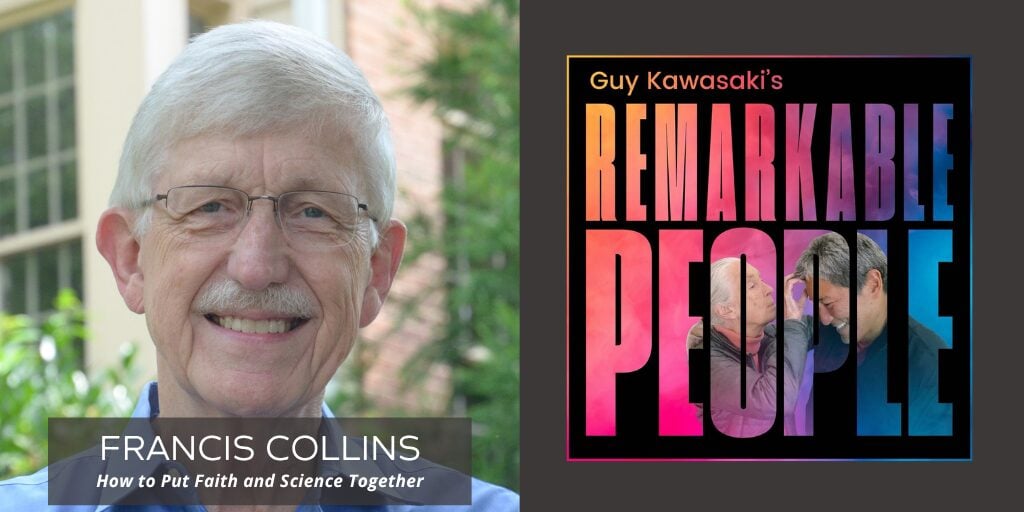
Welcome to Remarkable People. We’re on a mission to make you remarkable. Helping me in this episode is Francis Collins.
Francis is no ordinary scientist; he is a towering figure who has shaped modern medicine and genomics. His groundbreaking work includes leading the Human Genome Project, discovering the genetic causes of cystic fibrosis and Huntington’s disease, and serving as NIH Director under five presidents. But that’s not all – he’s also a man of deep faith who demonstrates how science and spirituality can work in harmony rather than conflict.
In this episode, we explore the incredible journey from finding three missing genetic letters among 3 billion to developing life-saving treatments that have transformed diseases once considered death sentences. Francis shares candid insights about presidential wisdom, reveals mistakes made during the COVID pandemic, and explains how his Christian faith actually enhances his scientific work. His book “The Road to Wisdom” offers profound guidance on navigating truth in an age of misinformation.
From the painstaking detective work of genetic discovery to the urgent race for COVID vaccines, Francis illustrates how true scientific progress requires not just intelligence but wisdom – the combination of knowledge, experience, moral framework, and humility. His prescription for healing our divided nation through genuine dialogue and shared commitment to truth offers hope in these polarized times. This conversation will challenge your assumptions about the relationship between faith and reason while inspiring you to seek wisdom in your own remarkable journey.
Please enjoy this remarkable episode, How to Put Faith and Science Together with Francis Collins.
If you enjoyed this episode of the Remarkable People podcast, please leave a rating, write a review, and subscribe. Thank you!
Transcript of Guy Kawasaki’s Remarkable People podcast with Why History Rewards Doers, Not Critics with Sharon McMahon.
Guy Kawasaki:
Hello everybody. This is Guy Kawasaki, and this is the Remarkable People Podcast. I happen to be in Hawaii right now, that's why I have an Aloha shirt on. And we have another remarkable guest for you. Truly remarkable. There's so much to ask him. His name is Francis Collins.
He's a physician, a geneticist. He led the Human Genome Project. He was the director of the National Institutes of Health. He worked for five presidents. Oh my God, five presidents. This was Clinton, George W., Obama, Trump, and Biden. How many people can say that? And he's also recognized not just for his management ability, but also his basic research.
And he was key in finding the cure for cystic fibrosis, Huntington Disease, and other disorders. So this is a real giant in medical science we have today. So Francis, welcome to Remarkable People Podcast.
Francis Collins:
Guy, thank you. That was a very generous introduction and I'm glad to spend a little time with you.
Guy Kawasaki:
Oh, thank you very much. Tony Fauci told me, yeah, for sure. You gotta get Francis Collins and whatever Tony tells me to do, I do. So here we go. I'd like to go backwards first because I and I bet a lot of people listening, we just don't understand when somebody says, “Yeah, we found the cure for cystic fibrosis.”
How does that happen? How do you figure out which gene you target, the therapy you test in models, you test in clinical trials? Just give us the gist of how something like that happens.
Francis Collins:
Yeah, I'd love to. Because I think people who haven't tracked this, maybe just have this idea that, it just happened. Something came along and bang, there it was. Boy, that's just not how it works. This was forty years, intense, difficult science carried out by lots and lots of groups.
Many places where things ended up in a blind alley and had to turn around and start a different approach. Just turn the clock back. Let's say it's 1985, forty years ago, cystic fibrosis, we knew it was inherited. We knew that it caused problems in your lungs and your pancreas. We knew that for some reason the elevation of salt in the sweat was found in kids with this.
That was a diagnostic finding, but we had no idea what the actual basis was or what to do about it other than just trying to treat the symptoms. So that was the point where in my lab we thought maybe we could actually find the genetic cause. But mind you, forty years ago, there was no Genome Project. There was no internet. The ability to sift through all of the human DNA, which is an instruction book of three billion letters.
You have that inside each one of your cells and find a tiny little misspelling, seemed almost beyond the range of possibility, and a lot of people said, “This is a really fruitless effort,” but we decided to try and over the course of several years and ultimately figuring out that our most impressive competitor maybe ought to be our collaborator.
We merged our labs together between Michigan and Toronto. I was at Michigan at the time. And we found it, and it was just three letters out of those three billion that were missing in people with this disease in a gene that had never been described before. And then we were off to the races. Now, we finally knew at a very fundamental level, what causes this disease and how could you try to compensate for it when that gene has a misspelling.
And you would think, oh, well that'll be quick. It's not, there's like years of really hard, hard effort to try to understand what does this gene normally do anyway and how would you compensate for it, when it's not functioning very well. There was a gene therapy approach, which at that point turned out to be pretty frustrating, and then there was a drug therapy approach.
Maybe you could find a drug that would tweak the system just enough so that even with that somewhat broken gene, you could still get a better outcome. And fast forward and all of a sudden things started to work with a drug therapy. And Guy now, as of about three or four years ago, 90 percent of people with cystic fibrosis have access to this drug called Trikafta.
Which pretty much takes their airway cells in the lung. That's the place you really need the help and converts them to behaving almost like normal.
Guy Kawasaki:
Wow. We just summed up forty years of research in three minutes. But you know that first step when you say there's three billion letters, and we found the three that were off, like, how do you find a typo? How do you find that mistake in the DNA?
Francis Collins:
Yeah, it's hard. Back in the day when I was trying to do this, and a lot of people were saying, “How hard is this?” I actually, because I was in Michigan, took a needle and I got my wife, who's a pretty good photographer to travel. We went to a haystack in, in a Michigan barn, and I sat in the haystack and held up the needle, said, “That's how hard this is. You're trying to find a very tiny thing in a very large pile of hay. That's kind of the right scale.”
So you have to have a strategy to search. And you start with families. Because you know that if this recurs in families, the people who are affected must be sharing that same misspelling, which means that if you look across all of their chromosomes, you're gonna find a place where they share more often than random chance, and that gets you in the neighborhood.
And then you gotta start going through tediously, letter by letter, looking for that strange little moment. And that in those days was incredibly difficult. It's a lot easier now, I'm glad to say. But this is sort of the first one where we showed it could work. And that's why it took so much time, but it was worth it.
Because then you cross the bridge into a new territory where you actually know something and then you can build that into a therapy. And now people with cystic fibrosis who used to be lucky if they made it to age twenty, are now planning for retirement.
Guy Kawasaki:
Wow.
Francis Collins:
It's that good.
Guy Kawasaki:
And if you were starting this research today with AI and whatever new technology we have, would it still take forty years, or can you just get the human genome from family members? Stick it in ChatGPT and three seconds later ChatGPT will tell you it's these three Francis. Go for it.
Francis Collins:
You still would have to do the lab work. You would have to actually sequence, that's the word we use, sequence the DNA, and see if you can collect all that data and then yeah, with some very appropriate AI search quickly and find what's missing. That part would go very quickly. The development of a therapy, on the other hand, that's a lot of things that don't necessarily situate themselves for rapid progress.
You still have to do a lot of hard bench work, to get there, but I'm glad you asked a question because it does occur to me that if something like this were to happen right now, we'd have the tools to go faster. But we're facing a time where we may have to go slower because the resources are being cut back. And maybe we're gonna talk about that Guy.
Guy Kawasaki:
Oh, we are for sure.
Francis Collins:
Oh, we are. Let's be clear, this success story for cystic fibrosis would never have happened without the taxpayer funded research carried out through NIH to work on this problem in a way long before there was a product that anybody could charge money for.
So the private sector was not interested until this went many years down the road. The success of cystic fibrosis is the success of federal support of medical research in the United States, which is the envy of the rest of the world because we have been so successful at it, so good at it, and now it's under serious threat.
Guy Kawasaki:
Well, Francis, between you and me and 25,000 of my closest friends, we're so fortunate to have a lawyer now in charge of this kind of thing. So yeah, I'm being sarcastic, Francis.
Francis Collins:
I kind of thought you were.
Guy Kawasaki:
Okay. So now that we cured cystic fibrosis, just give us the gist of the story of the Human Genome Project because, first of all, is it true that you took over for Jim Watson?
Francis Collins:
I did. That was a daunting thing.
Guy Kawasaki:
Yeah.
Francis Collins:
The very guy, Watson and Crick, who discovered the double helix back in 1953 was also the first director of the Human Genome Project in 1990. Yeah, the Genome Project, I was a big fan of it. This whole experience with cystic fibrosis, oh my gosh, it took five years.
And all of those people who had to throw their hearts and souls into this, and many of them got pretty burned out along the way. That's not something you could do for the thousands of other genetic disorders where you needed that same answer, you needed to have a better idea. What is the basic reference copy ff the human genome that you could build off of?
So it was sort of a no brainer to say we should do this, or at least I thought so. A lot of the scientific community did not think so and many were opposed to it. So Watson came along and was willing to be the first director, and he had rockstar status and convinced people in the Congress that this was worth doing.
But he also had an ability to say things without a whole lot of filter on what he was saying. And after he insulted his boss, Bernadine Healy, a few too many times, suddenly he was gone. Oh boy.
Guy Kawasaki:
Give us your favorite Jim Watson story.
Francis Collins:
Jim was violently opposed to the idea that DNA should be patented, that the letters of our own instruction book ought to be available to everybody and should not be owned by anybody. I think he was right by the way. And, a couple decades later, the Supreme Court agreed. And he thought that anybody who was trying to patent DNA was not just a little confused, but they were evil.
And that was something that he came to fight about, with Dr. Healy. And he called her a lunatic three times in front of an open microphone. And that was just too much.
He was, and still is a character. Jim is still alive in his late nineties. But he was gone. And then the Genome Project was in deep gloom because we'd just barely gotten started. It wasn't clear this was gonna work. A lot of promises had been made that this would result in this first copy of the human DNA sequence by 2005.
And there was no real path to get there. And then my phone rang, and it was a call from the NIH saying, “We want you.” What? Me? No, no, no, no, no. You're must be thinking of someone else. I turned it down at first because it just seemed like not the thing. I was having a good time running a research lab, teaching medical students, taking care of patients, all those things that I love doing.
But then I realized it was pretty hard to walk away from what might be the most significant project in biology ever. And I was gonna say it's not convenient really. So I agreed. I'll tell you a quick story Guy because this seems like a time to tell stories.
I was in the office of the NIH director. This is Dr. Healy, and she's the one who had fired Jim Watson and she was trying to recruit me and I was saying no. And I was kind of in the middle of saying no for the second time and she said, “Dammit, Francis, I don't think I'm getting through to you.”
And she said, “I have this image right now that it's a few decades from now, and I'm in this assisted living home.” This is Bernadine speaking, “And I'm walking down the hallway with my walker, and I look up ahead and down the hall. Who's that coming towards me? Oh my gosh, it's Francis Collins and he comes up along beside me with his walker and he turns and says to me, ‘Dammit, Bernadine, I should have taken that job.’”
It was the dumbest thing anybody ever said to me in a job interview, and it totally nailed me because it was exactly where the back of my mind was. Like, you're about to turn down something you're gonna regret for the rest of your life.
Guy Kawasaki:
Wow.
Francis Collins:
And I went home, and I thought about it, and I called her the next day and said, “Okay, I'm in.”
And it was that crazy thing that she said that kind of pushed me over. I've used that in recruiting other people since then.
Guy Kawasaki:
You know this reminds me of an apocryphal story of Steve Jobs telling John Sculley, “Do you wanna spend the rest of your life marketing sugared water, or do you wanna come to Apple?” And not that the Macintosh was quite the Human Genome Project, but, so let me just show my scientific ignorance.
And is it fair to say that the Human Genome Project kind of reinforces the overwhelming scientific consensus that humans originated from Africa and all people alive today are descended from this small ancestral population. Did the Genome Project confirm that?
Francis Collins:
It did. Absolutely. When you look at the data of how all of our DNA shows that evidence of having descended from a common set of ancestors, maybe ten or 20,000 of them, maybe 150 or 200,000 years ago in Africa, we are all one family. If somebody wants to try to be prejudiced or bigoted or try to say, those people are not like me, the science is going to disagree. We’re all connected.
Guy Kawasaki:
Wait, so are you telling me that you and I, Tucker Carlson, Steven Miller, LeBron James, Martin Luther King, we're all 99. 9 percent the same.
Francis Collins:
That's exactly right.
Guy Kawasaki:
Heads are exploding in Washington DC right now. Then someone might say, “How can you say that you and LeBron James are genetically almost identical? Our skin color is different, our build is different. Like, what happened? How did we divert so much?”
Francis Collins:
That was in part a response to our environments over those hundreds of thousands of years. So let's take skin color now. We were all once black. That is our ancestral state because you needed to have dark skin in equatorial Africa, or you're gonna end up with a terrible case of skin cancer and probably not be very successful in reproducing at all. So we were all black.
But then when people migrated to more northern climates, say up in Scandinavia, for instance, it was not an advantage to be dark skinned, in fact, because you need to be able to absorb vitamin D, and you need sunlight for that. You were much better off to have light skin because then you wouldn't develop a problem with your bones called rickets, which made it hard for women to have children.
So you can see the imprint of our environment on our genetics. And then there's all the other sort of interesting random differences. I mean, 99. 9 percent is a lot, but that means 0. 1 percent is different. And if we're talking about three billion letters, that's still plenty of room for variation that makes our species interesting.
Guy Kawasaki:
Huh. Wow. I bet that finding went over very well.
Francis Collins:
It did.
Guy Kawasaki:
So today if we were in the middle of the Human Genome Project, do you think funding would be cut and we would never figure this out?
Francis Collins:
I had be very worried about that Guy. If we were trying to start a project like this, I don't see how the United States would be able to rise up and say, “Yes, let's all do this together, but we'll take the lead.” That's what we did for the Genome Project. We had other partners and there were five other countries involved, but the United States was very much the one who was pulling it all together, encouraging the rest of the team to do what they could do.
That was my job as the field general of the Genome Project. Right now, I don't see how that would happen. China would probably be the one to take the lead. They have a lot of resources that are pointed at biotechnology and biomedical research. Ours on the other hand, are in serious trouble.
Guy Kawasaki:
So now how about we say that mRNA is kind of this next big deal, and mRNA certainly came through in the pandemic, but are we shutting down research on mRNA?
Francis Collins:
I am very puzzled about this and worried about this. After all. Let's do a quick little bit of molecular biology. The way in which the whole system works and all living things is you have DNA, which is the storehouse of information. But then in order for that storehouse to actually be used, it gets transcribed into, guess what?
RNA, in fact, it's called MRNA, Messenger RNA. That's what the M stands for. It's a message being sent from the DNA out into the cell cytoplasm to be turned into protein in a process called translation. I know we're getting into 101 here, so the idea that mRNA which is a fundamental aspect of all living things would become a political football.
It's just breathtaking. Now, obviously that happened because the COVID vaccine initially, designed at NIH and then produced by Moderna and Pfizer was based upon mRNA. The idea was what you want to immunize somebody is to create a protein that their immune system will react to, and they'll develop their immunity so that if the real virus comes along later, they're ready to go.
So the mRNA coded for that spike protein and worked extremely well. If historians look back at this time and say, what were the significant aspects of scientific achievement? I think the development of that COVID-Nineteen vaccine in eleven months will stand up as potentially the most significant scientific achievement that saved lives ever probably saved somewhere between fourteen and twenty million lives around the world.
Three million of them here in the U.S. Those are the facts. And yet somehow, building upon a lot of anti-vax considerations that are not based on science, mRNA has now become a favorite target of people who think this is dangerous science. That is heartbreaking, both for infectious disease, but you know, cancer.
It's enjoying a particularly exciting time here in terms of developing new ideas about how to help people, even people with stage four cancer. And a lot of it is about activating the immune system. And the most exciting way to activate the immune system for cancer now is an mRNA vaccine. And yet we have a circumstance where the United States may stop working on this for entirely political reasons.
This is unbelievable to be happening in a country that is supposedly so advanced in its technology.
Guy Kawasaki:
Francis, I want you to come outta your shell and tell us what you really think. I mean, stop hedging your bet. You're retired. Let it rip Francis. You know, if it were me and the COVID-Nineteen vaccine happened in eleven months under my watch, I would be bragging about that every single day.
I would hold that up as the greatest accomplishment of my career. I wouldn't be shutting it down, but maybe that's just me. Wow. Okay. So now let us shift from your past. Let us talk about your book because your book is very, very stimulating and I think it forces people to question their belief structure.
So let's get into wisdom, and first of all, what is wisdom in your definition?
Francis Collins:
Ah, it's not easily, I think, encapsulated in three or four words. Wisdom depends on knowledge. Of course, you need to have the facts and you need to have them correct. So having evidence, but it's more than that. It builds upon that with such things as experience, insights, understanding, and very importantly, some kind of moral framework.
When you talk about wisdom, you can't get very far away from, is it right or is it wrong for me as a Christian? Certainly there's a lot about wisdom in the Bible. There's a verse in Book of James about if any of you lack wisdom, ask God who gives to all generously and without reproach. Well, I'd love to have that all the time.
And I do ask, I think also. Wisdom does depend upon experience. There's an apocryphal story about a young man who was trying to find the source of wisdom, and he asked a lot of people, “Do you know how can I find wisdom?” And they all said, “Well, I'm not sure, but there's this guru up in the mountains who seems to have the answer, go and find him.”
So he climbs up into the mountain and he finds the master, and he said, “Master, I'm so glad I finally found you. Please tell me what is the source of wisdom?” And the master says, “Oh, that's not so difficult. You simply get wisdom on the basis of judgment. Good judgment.” Okay, that sounds promising, but how do I get good judgment?
Oh, you need experience. Oh, okay. Well, how do I get that experience? Oh, very simple, bad judgment. Kind of fits. Kind of reminds us that when you make a mistake or you make a bad judgment, that's a chance for some wisdom too. And we all need to remember that when we've screwed up.
Guy Kawasaki:
So clearly wisdom and intelligence are not the same thing.
Francis Collins:
They are not. Intelligence, certainly the ability to sift through a complicated situation and figure out what's true, but doesn't necessarily carry with it that judgment, that understanding, that moral component, which wisdom ought to bring along.
Guy Kawasaki:
Okay, this is the first question I'm gonna ask you that you may decline to answer.
Francis Collins:
Oh boy. Here we go.
Guy Kawasaki:
Okay. So who was the wisest Clinton, George W., Obama, Trump, or Biden? Now what I really wanna ask you is, which was the dumbest, but I know you won't answer that. So I'm gonna let you make one person really happy and the other four presidents can assume they were the second wisest. So who's the number one wisest president you work for?
Francis Collins:
Well, I was fortunate to have a chance to work with all five of those characters. And certainly for Obama and Trump and Biden, when I was the NIH director, I had a lot of time, to interact with them about anything that had to do with science or medicine.
And I will say quite frankly, Obama, was the person that I had the most interesting experiences with that revealed how he sorts through a problem and certainly reflects, his own brand of wisdom, which would be quite impressive. He was intensely curious and I think that's part of wisdom as well, is never being satisfied that you already understand an issue with what you have right now. You wanna know more about it.
And so he would invite me to come and give him a tutorial about something, about what was going on in medical research.
And for that half hour, even though there was probably an international crisis of some sort happening every day, he would be totally focused on that. And his curiosity was just so obvious, and he'd ask the best questions that I almost ever got asked by somebody who really didn't have much in the way of scientific training but was wanting to understand an issue and then reflect on what it might mean for society going forward in the future.
Those were really wonderful experiences and outta that came some new projects. He was the one who encouraged me to go forward with a project on the brain to really try to understand how the human brain with its eighty-six billion neurons does what it does, which we're in the middle of right now. And that took leadership and that kind of wise combination of what will it take and what will it mean to push that forward.
Guy Kawasaki:
All righty. I fully expected you not to answer that question, so okay.
Francis Collins:
Okay. Maybe I made a mistake then.
Guy Kawasaki:
Yeah. It might have been wiser not too, but that's okay.
Francis Collins:
Yes. Oh, that's good. We're talking about, and I just blew the test.
Guy Kawasaki:
That was bad judgment and an opportunity to learn.
Now let's zoom out from presidents and I wanna know who is in the Francis Collins Wisdom Hall of Fame. Who do you hold up as man, these were wise people, or these are wise people?
Francis Collins:
Let's go to Solomon as Exhibit one. So read the whole book of Proverbs, which we believe mostly written by Solomon. It's pretty much a whole book about wisdom and how a wise person can succeed and becoming wiser by following certain kinds of principles.
I think in more modern times, again, we think of people who are wise because they put this all together. In that case, because I am a person of faith, I often will turn to examples of people who had that aspect of wisdom so clearly represented.
A very important wise mentor for me, although I never met him, is C. S. Lewis, who was the author of the Mere Christianity and a variety of other books and writings that greatly touched me and helped me understand what wisdom really meant when applied across the board to science, to the humanities, and to faith.
Guy Kawasaki:
Okay, so now you brought up the F word. Let's shift to faith. So first of all, I want your definition of faith in particular. Faith in what? Is it faith is completely tied to Christianity, or can you be faithful to Buddhism or other things? What is faith?
Francis Collins:
Absolutely. Faith is the part of our belief system that extends beyond pure materialism, pure naturalism, into the spiritual realm. And there are many, many different varieties of that to be sure. And I was an atheist as a graduate student studying chemistry, and I became a person of interest in faith as a medical student and ultimately after considering lots of other options, found the person of Jesus Christ to be so compelling that I became a Christian.
So that's my version of faith, but not the only one.
Guy Kawasaki:
And you being like the scientist, you figure out the cure for cystic fibrosis. You know map three billion things and now you're after eighty-six billion things. Can you say that the existence of God can be scientifically proven with the scientific method, the null hypothesis, control of variables, all that? Like how do you quote unquote, prove the existence of God?
Francis Collins:
Oh, you can't. And anybody who tries to say they have an airtight proof, I would have to have a serious disagreement with. But I do think there are signs, my book that I wrote twenty years ago called The Language of God, which is about how I think science and faith speak to each other in positive ways.
The subtitle of that is A Scientist Presents Evidence for Belief. Not proof, but evidence. Book of Hebrews talks about faith is the evidence of things not seen. I kind of go along with that. After all, when you look at what we have learned through science about nature, there's some things about it that are pretty hard to explain without invoking something outside of nature.
Like why is there something instead of nothing. How did our universe come into being at the moment of the Big Bang, where apparently out of nothingness, something amazing happened? And we have no ability with our tools of science to really answer how that happened. Nature has not been observed to create itself.
So it kind of forces you to consider the possibility that there's a creator of some sort that's outside of nature and can't be limited themselves in space and time, or you haven't really solved the problem. And then Guy, you have these other things about our universe and ourselves that are pretty amazing and hard to understand, like why should matter and energy follow these beautiful mathematical laws.
And for a mathematician or a physicist, they really are beautiful. They're simple. Gravity is an inverse square law. Why should that be? And then even more compelling in my view is all of those laws have constants in them. The gravitational constant, you can't actually deduce by theory what it should be.
You have to measure it. If it was off by just a tiny one part in a billion, the whole universe doesn't work anymore. You don't end up with anything interesting. Either it's too small and nothing ever comes together into stars and planets or it's too big and the Big Bang is followed by a big crunch before anything interesting happens.
Somebody set the dials here, it looks like some intelligence. Okay, even Einstein, even Stephen Hawking would say, “There's too much here to be a coincidence.” Then the next question of course is, okay, let's accept there's a creator, but does that creator care about me? And then we come back to wisdom and we come back to morality and we come back to that question about why do we humans think that good and evil actually matter?
Because if we were all purely selfish, and didn't have to pay attention to those things, we might somehow be even more successful in spreading our DNA around, but we don't feel that way. We care about things like altruism and benevolence.
I would say while there's some evolutionary arguments for that, they don't quite cut it when it comes to explaining a Mother Theresa or an Oskar Schindler or somebody who's basically put their entire life in jeopardy for people they didn't even know.
And we admire that, don't we? Maybe that's a signpost to what we're supposed to be, a signpost to God who's by this analysis also a subject of infinite holiness. So you can reason yourself right to the edge, but then you gotta decide whether to take the leap. And I resisted that for a couple of years and then I couldn't resist anymore.
And I became a Christian at age twenty-seven.
Guy Kawasaki:
Francis, I think that it's such a deep philosophical question, and it is a most fascinating topic, and I think one of the most fascinating parts of this talking to you is how do you put faith and science together? Are you saying that science is in the business of figuring out what God has done?
As opposed to, figuring out that there is no God and I don't know, it just all happened at random or something.
Francis Collins:
I think you're right on it. There was a scientist, three or 400 years ago, Francis Bacon, who had this rather memorable phrase that God didn't give us just one book. God gave us two books. One book is the Book of God's Words, which is the Bible, but the other is the Book of God's works, which is nature.
But they're both God's books, so they probably have things to say to each other. And if you could read both of them, you'd get a lot out of it. I see it that way. Yeah. When I'm as a scientist able to discover something that nobody knew before. God knew that. I got a little glimpse of God's mind in the science lab.
Maybe the lab's not that different than a cathedral. Maybe science isn't that different than worship if you connect it all with a source outside of nature, which is God himself. That appeals to me a lot and it's heartbreaking to me in many ways that a lot of people see the scientific and the spiritual worlds as in conflict.
Because I don't feel that way at all and I don't feel like I have to wall them off from each other. I started a foundation, a guy called BioLogos, B-I-O-L-O-G-O-S, sixteen years ago which is now flourishing as a place where lots of people who are interested in this kind of conversation can go and encounter interesting observations and essays and commentaries and head to meetings and look at other curricular material.
There's a whole movement there about trying to push back on the idea that somehow science and faith can't get along. They can not just get along. They can really inform and enhance each other.
Guy Kawasaki:
Francis, you, you may find that. What I'm about to say is facetious, but I swear to God, I believe it. I believe in God, and I think we are living in a simulation that God has controlled and is making and clearly based on the last seven months, God has a sense of humor because there is no other explanation for what's going on than God has a sense of humor.
But I digress. One of the components that you say of wisdom is trust. Now. Just for the record, I want you to know that I am not barrat dressed up as an Asian American. I'm not barrat. I'm not trying to trap you. I read that in your book. So what are the criteria of trust?
Francis Collins:
Yeah, I'm glad we're talking about it. Because it's one of the problems I think right now in our society with all the divisiveness and the polarization, we lost our usual anchors about how to decide who and what to trust. Traditionally, I think we made decisions about trust based on three things.
One is this source a source of integrity? Do they have a history of being honest? You kinda like to see that. Secondly, do they have competence? Have they done the work? Do they know what they're talking about or are they just parroting something they heard on social media? And third is humility.
Is this a source that may have a lot of expertise but is not gonna claim beyond what they do know? They will admit their limits. That would be good.
Because we are off in these polarized tribal alliances, what sometimes wins over those three is just, is this a source that's in my bubble? And if so, whether it's a media source that I tend to watch a lot, I'll tend to believe it, even if it doesn't fit the other criteria. And if it's not in my bubble, I'm not gonna believe it.
Because those people are bad and evil. So we've lost our ability to really filter information for its truthfulness, and that gets us in a lot of trouble. We're just laden with conspiracies everywhere you go that people are very attached to. And that's push the real truth out of the way. And a society that's lost its anchor to truth is in real trouble and we are in real trouble in that regard.
Guy Kawasaki:
In the history of people who interviewed you, I am gonna give you one of the best softball questions. Nobody has given you a question like this because I believe that one of the ways you establish trust is by admitting what you did wrong, not by bragging about what you did.
Right.
Francis Collins:
Yep.
Guy Kawasaki:
So my next question is, what mistakes did the CDC, you, and Tony Fauci make during the pandemic?
Francis Collins:
Yeah, we certainly made some for sure. CDC, right off the bat, got in trouble trying to design the test to figure out who had COVID, and it didn't work. And we lost a couple of months there before they finally admitted that, and it got outsourced and we ended up with tests.
But it was, we were way behind at that point. In terms of public recommendations, CDC was the main source of those things. Tony gets blamed for a lot of the recommendations that he was asked to be the communicator, but they weren't his decisions. A lot of that was done as part of the White House team that I was occasionally part of also.
What I think we did wrong, and this is on me too, is during the first few months of COVID when we really didn't know what we were up against, we didn't know what this virus could do. We were forced to make some kind of recommendation. So it was closing businesses and schools and flattening the curve and hoping that would work, and asking people to wear masks and stay six feet apart.
A lot of that was just conjecture on what you think might have helped. I wish we had said that a little more clearly. That we're giving you the best information we can about how to keep yourself safe, but it might not be right, and we might have to change it in another month when we have more information.
This is gonna get more accurate as we go along. We didn't usually say that. And so when we did change the recommendations, people began to ask, “Do these people know what they're talking about? They said this yesterday, and now they're saying that.” And they started to become doubtful and maybe even to begin to imagine that these folks have some other agenda to jerk us around.
And we lost the confidence of a lot of people. And that, of course was whipped up by social media statements oftentimes lies frankly, and by some politicians who weren't helping either. I think it's interesting to note that the apologies about the public communication from people like Tony and me and the CDC have been forthcoming.
I've seen no apologies from the people who spread lies on social media that we know were not true, that I think did a lot more harm. Probably, I would say 80 percent of the way in which confidence got lost in public health was because of all of these other distributors of miss and disinformation, and they don't seem regretful.
Guy Kawasaki:
Was that not a great question?
Francis Collins:
It was a great question. Yes. Thank you for that. Giving a chance to do a little bit of mea culpa as well as a little bit of finger pointing at social media.
Guy Kawasaki:
I hope Tony listens to this podcast.
Francis Collins:
I know you had him on before.
Guy Kawasaki:
How, at this point, do you decide to accept new findings or theories or thoughts as true?
Francis Collins:
Ah, yeah, there's a whole chapter in my book about truth. First of all, let's all admit there is such a thing as objective truth. I'm not gonna be happy with people who will try to pretend that's not the case. The earth is not flat and the earth is round. That's an established fact. And yet there's a flatter of society that doesn't wanna accept that and thousands of people belong to it.
What is that about? So let's try to accept the idea there is such a thing as truth. And then how do we establish it? Society has a pretty well-trodden path for this. Jonathan Rauch's book, The Constitution of Knowledge, is a great place to start for what that tradition has been all about.
People collect information, they test it, they decide whether it needs more support before you believe it, and ultimately we arrive at this core set of established facts. Call it the constitution of knowledge, and that then ought to be something that cannot be contested and cannot be basically dealt with by saying, “That might be true for you, but it's not true for me unless you've got really good evidence.”
That's where things are breaking down. Things that are established facts are now being contested by people who just don't like the answer. Facts don't care how you feel. And for somebody who's trying to use their own feelings as a reason to believe something that's a fact, that's a big problem.
And yet it's infected our society right now. Now outside of that circle of established facts is a whole bunch of other places where there is uncertainty. That's okay. Those are the places we should be having debate. And where you could say, I think I accept that, and the other person's saying, I don't yet because of this.
That's how we make progress. And then outside that, it's just plain old opinion where there is no right answer and that doesn't threaten society that those things are out there. Where we get into trouble, I think Guy, is when people start debating a topic without considering which category it's in. And if it's an opinion, well debate all you want.
If it's an established fact, you gotta have some really strong reasons to say that “I don't accept that.” Childhood vaccines have saved millions of lives. For you to say, “I think we should stop giving childhood vaccines,” is not acceptable unless you have evidence to support that, and you don't. So this is where our current situation causes me a great deal of distress about certainly medical things, but about pretty much everything.
Guy Kawasaki:
So if I'm listening to this. 2025 August, and I'm saying to myself, who do I believe anymore? Do I believe when the CDC says something? And then I realized, oh my God, the person running NIH today is the co-author of “The Great Barrington Declaration.” Where do I go for, should I get a vaccine or not?
Do I listen to the Canadian version of the CDC, the WHO? What do I believe anymore?
Francis Collins:
That's a tough question you're asking because I think traditionally we would wanna say just go to the sources that have the expertise, the integrity, and the humility that's all gotten kind of blurred. I still believe that the government agencies that are responsible for these kinds of factual statements are gonna survive.
But right now, there's certainly opportunities for trouble to happen where politics has inserted itself into science. And you know what happens when you mix politics and science? You get politics.
Guy Kawasaki:
People die.
Francis Collins:
Yeah. And science is nowhere to be seen, so I get it. This is an issue. So then maybe you need to look at other sources of expertise that aren't quite so contaminated.
If it's about vaccines, talk to your doctor or look at what the various societies of public health or of medicine have come down. They all have statements that are, I think, very clear and very uncontaminated by some of the various misinformation that's become so prominent in the political realm.
Guy Kawasaki:
Francis, I need you to name names. If I'm listening to this, like what site am I going to Francis? Give me some names. Is it the Mayo Clinic? Is it the WHO? What is it like if your daughter asked you, dad, where should I check about the MMR impact? What are you gonna tell her?
Francis Collins:
For the most part, CDC is still okay. I would certainly go there. I would go to places like the American Society for Public Health. They're extremely credible. I would go to places like the NIH website on medical issues. That's still up there and unfortunately not quite being maintained as much as it was, and certainly places like Mayo Clinic and WHO is a highly credible organization even though we apparently don't belong to it anymore.
There's plenty of things out there, but again, do the check. Is this a place of integrity? Do they have expertise? Do they have humility? Those big three will save you from a lot of mistakes.
Guy Kawasaki:
Francis, I don't wanna be an asshole, but I gotta push back on you because I learned from somebody else I interviewed for this podcast like if you go to any website and it ends with .org, it doesn't mean that's a not-for-profit and has a high and great calling. And if you read any websites about page, every about page says, “We're honest, we're science-based, we're blah, blah, blah.”
Everybody says, “You can believe us.” Nobody says, “We're a bunch of kooks who believe that the earth is flat. Don't get an MMR vaccine,” so that's why I'm pressing you for names.
Francis Collins:
I hear you. And sometimes it's not so easy to figure out the credibility of a source. It's easy to see when you've got something you really shouldn't pay attention to, like a random posting on social media from somebody who has never done anything to indicate they had serious work done in that space.
But otherwise, yeah, you look for those institutions. I named a few WHO, certainly, places like the Mayo Clini, where you can be pretty sure those people are not out to be political leaders. They're trying to save lives.
Guy Kawasaki:
August 2025. Where do you think COVID started? Was it the live animal market in China, or is it this plot from the lab in Wuhan? To the best of your knowledge at this point, where did COVID originate from?
Francis Collins:
To the best of my knowledge based on the evidence we have now, but without absolute confident proof, this was an entirely natural event, a virus that probably started in a bat. Traveled through an intermediate host, I would guess most likely a raccoon dog, and then ended up in the Wuhan wet market where animals were being butchered.
And at that time, the virus jumped into humans. We have swabs from that space that have the virus and DNA from animals like a raccoon dog in the same swab, which is hard to look at and not assume that there was some passage there through that animal to humans. And when you look at the epidemiology, the first cases from that one corner of the Wuhan market, that's where it all started.
That's the simplest explanation. Can I rule out the possibility that this virus was secretly understudy at the Wuhan Institute of Virology and an accident happened? There's no, zero data to support that, but I can't rule it out. What I can rule out is that NIH had anything to do with that. Let's be clear about that.
So I'm sort of 70 percent entirely natural, 30 percent maybe there was a lab accident and let nobody tell you that it's been resolved, even though the American public now for the most part thinks it was a lab leak, sorry, that does not have the evidence behind it to deserve that kind of acceptance on such a broad scale.
Guy Kawasaki:
So you're telling me that we should believe you, the person who did the Human Genome Project, cure cystic fibrosis, or we can believe an ex wrestling coach from Ohio State who didn't know what was happening in the shower stall next to the locker room, but he knows what happened in the Wuhan lab. I mean, just like to put it in perspective.
Okay. The last question is, and dead serious. Francis, how do we heal this nation?
Francis Collins:
We have to heal it ourselves from our own intrinsic goodness, which I think is still there. Our own intrinsic feelings that we ought to love our neighbors and even try to love our enemies as we're called to do.
Tapping back into that, it's not gonna be healed by our politicians or our media. We, the people have always been the ones to hold this nation together, and we're called upon again, and I especially think about the exhausted middle of the country that's disgusted with all the animosity and the outrage Olympics.
We are the ones that if we can put away the animosity, start talking to people who don't agree with you. Listen to them, try to understand them. Form those bonds again, get out of our own little bubbles and then start to make a movement to let our politicians know that we really don't want this kind of polarization.
We wanna be a country that has the ability to flourish. And we only really do that if we work together. It's up to us.
Guy Kawasaki:
That is the way to end. I gotta thank Madisun. I gotta thank Tessa, I gotta thank Jeff Sieh. I gotta thank Shannon Hernandez and the Remarkable People team. But Francis, I know you gotta go. It's probably Barack Obama wants to understand something.
Francis Collins:
Not this time.
Guy Kawasaki:
By the way, if you ever talk to Barack and you know you're saying, “God, I just had this great interview for a podcast. I've never been asked questions like that; you really should go on his podcast.” Feel free to recommend that Barack Obama come on my podcast. Okay.
Francis Collins:
All right. If I get the chance, I'll do it.
Guy Kawasaki:
Oh, that's 80 percent of the value right there. Just hearing that. That's good enough.
Sign up to receive email updates
Enter your name and email address below and I'll send you periodic updates about the podcast.

Leave a Reply