
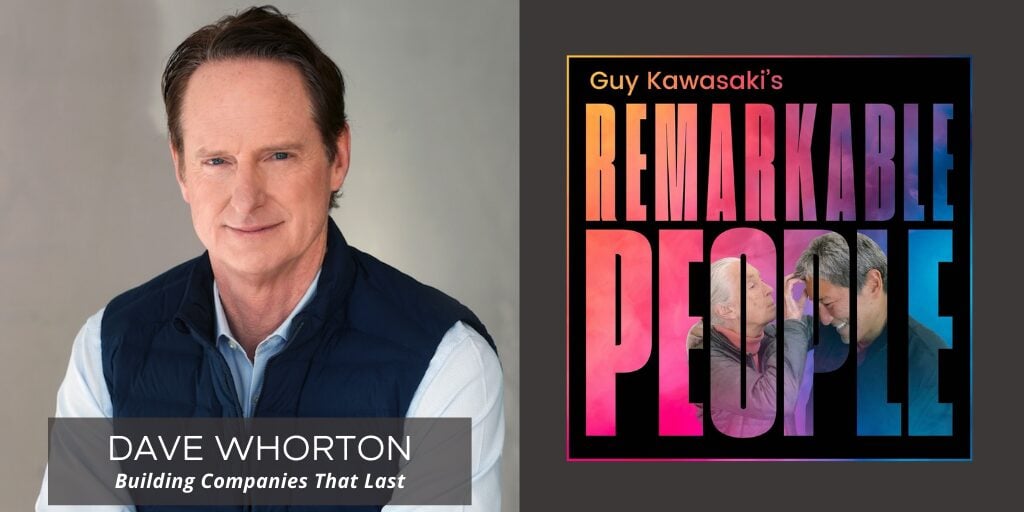
Welcome to Remarkable People. We’re on a mission to make you remarkable. Helping me in this episode is Dave Whorton.
Dave is no ordinary venture capitalist; he’s a reformed Silicon Valley insider who dared to question the system. His journey took him from Hewlett Packard’s foundational culture through the venture capital world, where he witnessed the 1995 Netscape IPO fundamentally reshape startup culture. But that transformation left him troubled by what the industry had become. Rather than accept the new normal of “grow fast or die,” Dave pioneered a different path entirely.
Today, Dave champions what he calls “evergreen companies”—businesses built for endurance, profitability, and purpose rather than quick exits. Through his Tugboat Institute, he’s gathered hundreds of CEOs who’ve chosen sustainable growth over venture capital’s relentless pace. His book Another Way reveals the seven principles that guide these remarkable organizations. Companies like See’s Candies, Enterprise Rent-A-Car, and In-N-Out Burger prove that patient capital and long-term thinking can create extraordinary value.
In this conversation, Dave exposes the hidden costs of Silicon Valley’s growth-at-all-costs mentality and shows entrepreneurs there’s another way to build something meaningful. His insights challenge everything we’ve been taught about startup success. For founders tired of the fundraising treadmill and investors seeking sustainable returns, Dave’s approach offers a refreshing alternative to the venture capital hamster wheel.
Please enjoy this remarkable episode, Why “Evergreen Companies” Beat Venture Capital at Its Own Game with Dave Whorton.
If you enjoyed this episode of the Remarkable People podcast, please leave a rating, write a review, and subscribe. Thank you!
Transcript of Guy Kawasaki’s Remarkable People podcast with Why “Evergreen Companies” Beat Venture Capital at Its Own Game with Dave Whorton.
Guy Kawasaki:
Hello everybody. I'm Guy Kawasaki. This is the Remarkable People Podcast, and we go all over the world finding remarkable people to inform and inspire you, and we found a remarkable person in Sun Valley, Idaho. His name is Dave Wharton, and he started his career at a great company, Hewlett Packard. I love Hewlett Packard.
Their calculator changed my life. After Hewlett Packard, he became a venture capitalist. And if you're gonna be a venture capitalist, why not go to work for Kleiner Perkins and John Doerr? If you gotta do it, you might as well go big.
And I've gotta say that he had a very interesting kind of epiphany about the way venture capital was working and, you know, grow fast, grow big or die, go public and all that. So he kind of reversed himself and he started creating what he calls Evergreen companies. And he had an institute called the Tugboat Institute as opposed to the Bentley Institute or the S-Class Institute or the G-Class Institute.
And these are companies that strive for profitability and purpose driven and to endure generations. And he wrote a whole book about this called Another Way in which he shares stories, good and bad, and the principles of building Evergreen companies. So welcome to the show, Dave Wharton.
Dave Wharton:
Thanks Guy. I appreciate being here.
Guy Kawasaki:
Oh, I appreciate you taking the time.
So let's just dive in and let's say we start the clock with the IPO of Netscape. So what did that IPO mean? What did it change in Silicon Valley?
Dave Wharton:
Yeah, you picked a really important event because in my mind that is what really changed Silicon Valley. So Netscape went public in 1995. It had been incorporated eighteen months earlier with the web browser and the web server, which you may remember well from those times. It was a very early pioneer in the internet world, and John Doerr was the investor in that company through Kleiner Perkins.
The day it went public, its price rose dramatically. It closed the day at about three billion dollars. And I call this a shot heard around the world as far as for investors because this has never been done before in history in such a short amount of time so much stock value creation. And suddenly it really started putting in question the entire model of taking companies public.
Because prior to that you had have eight quarters of profitability. You had visibility in four quarters going forward to strong management team, a good board of director, a really stable foundation for the business. And suddenly this one had just been cobbled together extremely quickly, but it become really viable.
And this is when John started talking about the greatest wealth creation in the world will happen with this rise of the internet, which today has been proven to be true. But at the time it was kind of the wild, wild west. And so people were off to stake their claim in the internet and they weren't gonna use the old model.
They get the profitability early to grow at a sustained level, have increasing profits over time. It was let's just get big fast. Let's stick out the claim and we'll become valuable like Netscape or more valuable.
And so the model shifted quickly. All of the venture capital started adopting this, and pretty soon it was about raising more capital, hiring more people, getting a world class C in the top seat, hiring senior executives, staffing out teams quickly and going for it.
And if it worked, you might be tremendously wealthy as a founder, a venture capitalist or senior team member, or you'd just go away and go do something else. And so that really became the model. But what was interesting is then we had the dotcom crash, and I thought for a moment they would probably revert back to the old model.
The model I originally learned at Kleiner Perkins when I joined their 1997. So people were still practicing some of the old model. It didn't, and then it started, the get big fast, got stronger in 2007, 2008, we had the Great Recession, so it slowed down again. Then it roared back with growth at all costs, and that was really driven by the low interest rate environment the Fed put on us.
They drove interest rates basically to zero, so you can no longer invest in fixed income if you're an institutional investor. So what do you need to do? You need to invest further out on the risk curve to get the yield targets you're going after, and that meant venture capital. And other alternative assets.
So a tremendous amount of capital flowed into the venture capital industry with an understanding there'll be a power law dynamic, which we see very much today in these venture portfolios. We're trying to get big fast, or grow at all costs, and that is one or two companies will drive the total returns of the fund.
You might invest in fifty or maybe a hundred, but one or two are gonna do it and they're gonna be the next Google or Amazon or Facebook, you name it. And that will make up for all of the losses many times over. So in a portfolio of a hundred companies, you might lose fifty to sixty of them. You might have a modest return on another twenty or thirty.
Might have some that do five-ten x and you need that one that does a hundred or 200. If you're really lucky, a thousand x of the original investment. And so that really became the model. And it was a very different model. It's a very high risk, high return type of model. And then, what we started seeing I think over time was that, the amount of capital that came in was just, if you look at historically, almost unfathomable.
So the first forty years of venture capital, twenty-five billion dollars was raised and deployed. That included Amazon and Google in that twenty-five billion. In recent years, the entire industry has raised 250 billion in a single year, ten x more than the entire industry in the first forty years in a year, and that happened year after year after year.
But does raise the question, was there something really wrong with that original model if it led to things like Amazon and Google, and Netscape and Genentech and FedEx and Microsoft and Starbucks and all these wonderful companies that were under that first twenty-five billion dollars?
Guy Kawasaki:
So I get your diatribe about this whole model, but do you think if you and John Doerr got together, 2025, you'd be sitting around saying, “Man, companies are not the same. Remember back in 1995, we took Netscape public, and we had visibility into profitability.
We knew we had a world class team; we were conservative about our revenue projections. And now in 2025. If you just work for Open AI for two weeks and you quit, you get a five billion dollar valuation, you raise a billion dollars. What happened to the good old days, Dave?” Is it all relative?
Dave Wharton:
It is all relative. And I would say I don't wanna be overly critical of venture capital. I think venture capital plays a really important role, but I think this idea that you apply the get big fast model, or the growth at all cost model into all situations isn't appropriate.
And I think a number of venture capitalists who are friends of mine would agree that we're getting companies to do something that would be better served just perhaps bootstrapping and taking a longer time horizon to develop the company without the pressures of being public or being sold someday.
So I think it's just that it was too much application of a model too broadly.
Guy Kawasaki:
If I would make the case of 1995, and you fast forward to 2025, if anything, it's worse today. AI is making the internet look like a local, television program. And now we're in the big top and now everything's going crazy. So what are the downsides of this crazy model?
Dave Wharton:
I think the downsides are if people get pulled into the model with businesses that really can't meet those expectations, reasonably can't meet them, the companies will fail.
And so all of that time and energy spent, and it can be incredibly hard on the founding team and the executives to try to make it work for the model, whereas that business might have been a beautiful, independent, smaller, profitable, purpose-driven business if it hadn't taken that path.
And I think one of the challenges that we have today is founders we're told that is the path. If you're gonna build something of significance, you have to raise angel capital that leads you to venture capital, that leads you eventually to an IPO if you're really lucky, and if not so much, hopefully a sale into a firm in which will continue developing your business.
Whereas what I'd love for founders to hear is, hey, look, think about this business. What could it be over time? Would it make sense to instead think about being an Evergreen company, you might run for the rest of your career someday hand to your employees and your children who continue to grow and sustain this over time.
Or you could consider the venture capital path, but that's the high risk power law path where one out of two are really gonna move the needle. Ten out of a hundred are gonna be of some significance and the rest are really not gonna matter and go away. So just to know that, to be aware, there's more than one way of doing it this other way.
Guy Kawasaki:
Let me just push back on that. Why would an investor invest in an Evergreen company when you know that company's not gonna go public? Not in the short term. It might not be acquired in the short terms, so like how many venture capitalists and professional investors are sitting around saying, “Oh, if only I could build a company that would last a hundred years.”
And the flip side of that is also for the employees. So how do you take someone who's getting recruiting letters? Mark Zuckerberg says, “We pay interns ten million a year.” And how are you gonna get top talent when you're saying, “We're building a company to be Evergreen.”
Dave Wharton:
So you raised two really, really good points, Guy. And this is funny because when I was in my early learning journey around Evergreen, these are ones I had to explore myself. So I think I have a reasonable answer to these. So first on the investor side, they are not investors out there that wanna invest in Evergreen companies.
So you're really taking a bootstrapping path and perhaps friends and family. Maybe you have an uncle, parents, friends who put some capital in. But you have to really lean on the old principle that we had before Netscape, which is get to profit early, get to profitable growth early, and then grow from there.
And that was what we did when capital was scarce. So capital is scarce for Evergreen companies today. That's the truth. I went out and met with a lot of family offices where I've talked to them and they like the idea conceptually, but they say, “Well, at the end of the day, we do need to see an exit too.”
I think this will change over time. I think there will be sources of permanent capital where this makes sense. But today, if you're a founder and you're going on this path, you're basically going alone with friends and family and then with the friends and family, you have to be really clear with them, look, I'm not selling this.
I'm not going public, but guess what? If I actually achieve my vision for this, I'll generate quite a bit of cash. And your dividends could be very attractive. I know companies that issue dividends that are two to three times the original investment every single year. So your returns can be off the charts over long periods of time.
Guy Kawasaki:
So in your book you discuss this, I have never seen this particular company used as an example in any book about venture capital or entrepreneurship or innovation, and the company's name is See’s Candies. I can't tell you that, oh, all my friends are saying, “God, if I could only start See’s Candies.”
So tell us how See’s Candies has defied all of this Silicon Valley craziness.
Dave Wharton:
Yeah, See’s goes back a long way from its origins in California, and as you may know, Warren Buffet approached them to purchase them. And I think at the time they were doing about twenty, mid twenties in revenue, and I think he felt that a fair deal would be about twenty million dollars. The family wanted thirty million dollars and there were an impasse and Warren was ready to walk away.
But this is the famous moment in the history of Berkshire Hathaway where Charlie Munger said, “I think you're making a mistake. I think this is a very high quality business at a fair price, and I'd rather have a very high quality business at a fair price than a fair company at a high quality price or a low price.”
And so Warren ended up taking that guidance. I think they did the deal at twenty-five million dollars. He purchased the firm. They've never had to put additional capital into the firm. A hundred percent owned by Berkshire. And it's argued that it's distributed something like four billion dollars of excess cash back to Warren to reinvest in other wonderful companies.
And so if the See’s family themselves were able to govern the firm as Warren had, maybe they couldn't have done. That would've been their family's rewards. Four billion in excess cash while continuing to grow, while still doing hundreds of billions in revenue, having a great brand, great products, great workforce.
So it's a really special company. And it took Warren and to your other question, he's a former of permanent capital to say, “I'm gonna own this underneath our umbrella, let them, operate autonomously. I do want their excess cash, but outside of that, they could do what they wanna do.” And that's what they've done.
Guy Kawasaki:
Okay, so the second question is not that this situation is realistic, but if I am a potential manager and I say, “Okay, I got this offer from OpenAI to manage something at OpenAI. I got this offer from See’s Candies.” How are you gonna get the guy or gal to go to See’s Candies instead of OpenAI?
Dave Wharton:
So I think that's a great challenge and I think that'd be a very difficult one to overcome because if you're in your early twenties, you're being offered a million dollar base salary. That's excessive compensation by any measure, but that's what's being paid. I think you're gonna have a very difficult time competing for that individual.
But let's say that you're See’s Candies, you're going into a new region, and you are trying to recruit somebody that's been working at Burger King under multiple private equity owners. I think you would have a very easy time recruiting that person.
You could say “It's owned by a patient capital investor. We grow at a pace level. We pay way more in base salary than Burger King did. We'll pay you much higher bonuses than you got. If you're wise, you'll buy some of the Berkshire stock yourself that, of the parent company that owns us, and you can have an incredible career here.” And that's why people go to In-N-Out over McDonald's.
Same thing. They can make twice the base compensation plus bonuses on top of that. So if you think about the pool of individuals you're competing with See’s and In-N-Out and Chick-fil-A and Panda Express are not competing with people going to OpenAI. They're competing with people that go to these other concepts.
And by far all of those Evergreen companies I just cited; they can win that recruiting battle any day. Quality of the job, purpose of the firm, compensation, culture, all of those things.
Guy Kawasaki:
Part of the problem is that I live so long in the bubble that my approach to everything is through this high tech filter.
Dave Wharton:
Me too. I had to rewire my brain. People literally had to hit me with a two by four on some of this stuff and say, “Dave, get out of the valley and see the rest of the world.”
Guy Kawasaki:
Yeah, I know. So what other companies would be in the Evergreen Hall of Fame so people can say, “Yeah, I didn't realize that company is so successful.”
Dave Wharton:
Enterprise Rent-A-Car would be an example. That's a wonderful Evergreen company. I've become very close to Andy Taylor. We took all of our CEOs down there for a two day visit, deep dive on the company, and I was just blown away. The culture, the growth, the mistakes they've made, they fixing the mistakes.
They made a big mistake going internationally in the UK initially. They pulled back, figured out what they did wrong, fixed it. They acquired National and Alamo. People, sometimes they've forgotten that in modern days, but when they acquired it, they did something very smart. Most acquisitions out Silicon Valley, if you acquired another company, you basically throw your executive team on top of it.
You change all the information systems, you make it really your company. And Andy Taylor had the good judgment saying, “National is actually a bit different. It serves a different customer than we serve. It's a business traveler who doesn't care about customer service. They just want the car ready to go, the keys in it so they can get the heck out of there.”
And he was smart enough when he acquired it to put just a couple of executives in the business. So anyway, that's a wonderful one. Panda Express would be in that, In-N-Out. Din Tai Fung would be another. Cargill would be another wonderful. Edward Jones, Radio Flyer, Spikeball. We thought about some of the smaller companies.
Spikeball would be in that category. Awesome, the company that owns both SmugMug and Flickr, that's an Evergreen company. So there's a good list of just wonderful companies out there. That're evergreen companies.
Guy Kawasaki:
What if some big swaggering dickhead from Stanford is now saying, “He just described a bunch of companies that are in the living dead. They're not Evergreen companies, they're living dead companies.” So how do you push back on that schmuck?
Dave Wharton:
So what I would say to that schmuck is that venture capitalists, and I know that term well, you do too, living dead is a company, to define it for your audience, that is unfortunately making just enough money, it'll stay in business. It's not making enough money or growing enough that it'll ever get sold or public for anything attractive.
And so this sits in a venture portfolio and the portfolio starts getting older, ten, twelve, fourteen years. And you don't know what to do with this company. You just want it to go away. And sometimes you'll just ask them to shut it down or you'll sell it on a cheap to another portfolio company. You just gotta get rid of it.
And that might be a company that'd say, hypothetically growing at 15 percent a year and profitable. If you grow at 15 percent a year and you're profitable and you stretch out the time horizons well beyond venture capitalist time horizons now put it at thirty years and forty years. That company can grow sixty to a hundred times larger than it's today.
So what you saw as living dead is actually the beginning of a great Evergreen company if it didn't have you as an investor, the venture capitalist. So time allows for compounding. As you know, compounding is the eighth wonder of the world, and it's a thing that Warren Buffet espouses in all of his investments.
So unless you think Warren Buffet and the work he's done at Berkshire Hathaway is living dead, you don't understand investing because compounding at 15 percent a year for forty or fifty years leads to massive companies. That leads to Enterprise Rent-A-Car. For example, being about sixty, seventy million in revenue. And Andy Taylor took over from his dad and now it's doing about thirty-five billion in revenue during his lifetime.
So I wouldn't call that living dead. I wouldn't say that about Edward Jones, that in 1960 was ten partners, and today it's 55,000 employees doing over ten billion in revenue.
Guy Kawasaki:
I can guarantee you that Enterprise is not trying to dump a bunch of Teslas that they bought either, right?
Dave Wharton:
I don't know, is that Hertz that did?
Guy Kawasaki:
Madisun is from Nebraska, so every time you say Charlie Munger and Warren Buffet, her heart skips a beat.
Dave Wharton:
Yeah. So in, in some ways the values of Evergreen companies are very much akin with how Warren and Charlie look at business themselves. They're not looking for things that grow at a hundred percent a year, and they do realize that they made some mistakes. They should have invested in Amazon.
They should have invested in Google. They knew that. They knew it because of the personal relationship with Jeff, and they also knew it because Google was getting a lot of business, or, Geico was spending a lot of money on advertising on Google, so they knew Google was a great company. On the other hand, it hasn't hurt their performance at all, investing in a ton of Evergreen like companies that's done extremely well for them.
Guy Kawasaki:
I bet a lot of people are confused.
Dave Wharton:
I love that they are confused. I was confused.
Guy Kawasaki:
So can you imagine anybody, or should anybody pitch an Evergreen concept to Kleiner Perkins and Sequoia or Andreessen Horowitz? Should they just stay out of that madness on Sandhill Road?
Dave Wharton:
I don't think they'll take the meeting because if you say that “I'm not intending on going public or being sold and I'm not planning on growing at hyper growth rates, just at a pace level year after year.” It doesn't meet their expectations to achieve a return based on the power law. Those companies, by definition, will not fall into those. Very few that will have power law dynamics because it's happening too slowly.
Now, they could do that over a thirty or forty year period, but that's way outside the timeframe in which these firms operate. So no, I wouldn't recommend that. What you really have to do as a founder of this kind of company, you gotta be really thoughtful about your business model upfront.
You gotta figure out, how do I design a business model that's not cash flow absorptive, it's low CapEx, high cash flow. And so you're not buying assets, you're not doing a bunch of CapEx. You want to be Airbnb, not Marriott. You want a business model that leverages very few physical assets, because that is what its ends up absorbing a lot of cash.
Inventory also absorbs a lot of cash. You gotta be a little careful about your business model, so you'll see early Evergreen companies are like D to C, E-commerce companies with products. They'll actually just do D to C only. They won't go through distribution because they can't build the inventories required for traditional distribution.
So they'll start D to C and then as they get scale and generate cashflow, then they'll go into things that have distribution networks. I guess the idea of being asset light is the point I’m trying to make. That's very helpful.
You can become more asset and asset intensive over time, but in the beginning, as a founder, you have to be really thoughtful about how you get early cash flow or you maintain your current job until that business is like a side project generate, like Spikeball is a good example of that.
Chris Ruder kept working in his consulting firm until he was selling enough Spikeball sets. His wife finally tapped him on the shoulder and said, “Honey. You don't need to keep working. Let's make this, let's just go with Spikeball.” And that was a wise decision by both of them.
Guy Kawasaki:
Now I'm gonna ask you to back up a few minutes because I want you to define the Evergreen Performance Incentive Program, which is the name of the program to incentivize employees in an Evergreen company.
Dave Wharton:
Yeah, and you did ask this question before, which I really appreciate, and frankly, to give credit to a friend of mine, Pat O’Dea, who at the time was the CEO of Peet's Coffee, he asked a similar question. He said, “How will firms compete for talent if they don't have stock options and you can't offer them because you're not going public or being sold?”
And so that I thought was maybe a fatal flaw of this idea. Ended up talking to a guy named James Kim at the time at FW Cook. And I posed the question to him. He was a compensation consultant. He said, “Dave, interestingly enough, multi-generational family businesses solved this problem years ago because they don't go public and are not sold.
And they create something which we ended up adapting as you called correctly, the EPIP, which is the Evergreen Performance Incentive Plan, and the idea is to share in an uncapped bonus program with key members of the team. It could be all employees, but at least key members of the team in the upside of the business.
And the idea being is you measure economic profit and that's your profit. Let's say your EBIT, less your cost of capital. And so you're actually bringing into consideration cost of capital and then what is created above that economic profit, you share an uncapped amount of that forever. It could be 15 percent, 20 percent, 25 percent, and then in any one year, you just measure the amount of economic profit.
You take, let's say 20 percent of it, you put it in a bonus bank, and you pay it out over a three year period, you take three years of incentive compensation for the individual. So they start seeing this bow wave of if you're increasing economic profit, the bonus pools getting bigger, the payouts are getting bigger.
And a really well executed Evergreen company often the payouts on that EPIP end up being as much as the base salary itself. So this becomes a very competitive compensation. And then on top of that, there are some Evergreen companies that allow employees to own shares in the company with an internal marketplace. So you buy in under some formula and you sell back under some formula, and usually and wisely it should be the same formula.
But let's say you buy in at five times cash flow. You buy the shares priced at five times cash flow, and then twenty years later you sell them back to the company at five times cash flow. And if you've developed a lot of additional cash flow during that period, let's say ten times more cash flow, then the value of the underlying stock is ten times more.
And so let's say they bought half a million dollars of stock, then they're selling out and getting five million dollars. But very predictably because an Evergreen company, these have very high durations relative to venture capital backed companies.
And so the fact that're profitable and growing and maintaining that profitability through good and bad times is a really important part of making sure that underlying business is still there, but also this promise of both payouts under the EPIP, as well as in the shares you might own directly could be fairly significant. So we see very often people retiring from these Evergreen companies very comfortably.
And then there's another model, which I was not familiar with until I got into this, and that's the ESOP model. And so you have companies that are everything from 5 percent owned by employees to an ESOP structure, which is governed by the Department of Labor up to a hundred percent owned ESOP.
For the hundred percent owned ESOP, the selling founder gets no taxes on the sale of the company to the employees, doesn't pay any taxes at all if it's a hundred percent. So it's a very beneficial thing for the founder who's selling it to the employees. Then the employees accrue value within the company through this ESOP program such that when they retire, they get a piece of the company paid back to them.
And we have one company in our group called Torch Technologies down in Huntsville, Alabama. They have over 300 people that are multimillionaires underneath their ESOP and some of the ones that have been there the longest, I think it's up to about ten million dollars of value.
So there's a tremendous value to be shared with employees of Evergreen companies. It just doesn't happen in a single moment of time through a sale or a public offering. It's done over years and years and years.
Guy Kawasaki:
I think part of the core problem here is that business writers like me as well as journalists, all we ever cover is the tech companies. As I said, nobody ever writes a book The See’s Way or the Enterprise Way.
And if you think about it, I get asked this so often about, “Can you review my pitch? I'm gonna pitch it to venture capitalist.” And I ask him, “What do you do?” And the guy says, “I make a special kind of wax for surf boards.” And I said, “I hate to tell you pal, venture capitalists are looking for the next Google, not a surf wax company.”
Dave Wharton:
Guy, send that guy to my book, and I think he's gonna see it, which would be great.
Guy Kawasaki:
Because his wax really is better. Yeah. So now I wanna ask you a question. I think people conflate the concept of whether a company is fundable and whether it's viable.
Dave Wharton:
Oh, for sure. That is conflated. And that's not right. That is not right because whether a company's fundable or not. By the perception of venture capitalist does not mean a wonderful company cannot be built.
Because I'd say most Evergreen companies, if not the vast majority, at least in the early stages, would never be funded by venture capitalist because of the commitment that we're never selling or going public and we're gonna pace our growth and we're gonna get to early profitability.
Those could be incredible companies built over somebody's lifetime. That wax company guy. He could build a fifty-hundred million dollars revenue company, I bet by getting global distribution of his products, he could probably generate 30 percent margins on.
That is my guess. He'll generate thirty millions of income every year after year, and then he's gonna go into other products and other services, and it could be the beginning of something that someday does a billion in revenue with hundreds of millions of profitability, and he owns a hundred percent.
Or maybe he owns 90 percent and sold 10 percent to the employees. So I wouldn't discourage that person at all.
Guy Kawasaki:
For those of you listening and are interested in surfboard wax, the company's name is Treeswax.
Dave Wharton:
There you go.
Guy Kawasaki:
I swear to God it is a far superior wax, any kinda wax that you're getting for your surfboard, but that's kind of a niche market. Yeah.
Dave Wharton:
These niches when you look at it on a global level, are not as nichey as you think. And that's another really cool thing about Evergreen companies. It's something that maybe in one small company would be too small. But if they take that single product, they clearly understand who that single customers are trying to serve like you with wax and go global, they can build something quite significant.
Guy Kawasaki:
Okay, so I'm gonna ask you a question I guarantee you no one has ever asked you before, which is this, could you not apply this principle of Evergreen company's purpose-driven, trying to make a profit, sustain itself for hundreds of years? Wouldn't it be a good thing if we could apply this to government and politicians to have Evergreen governments and Evergreen politicians?
Dave Wharton:
A hundred percent.
Guy Kawasaki:
What's holding us back every politician maximum has a four year time horizon, right? And 435 people in Congress have two year of timeframes.
Dave Wharton:
Which really is less than two years because they have to start fundraising for the next cycle, probably within months of winning the current one. So yeah, I don't have an answer because you're right, I've never been asked that question. A similar question I have been asked and I've thought about is nonprofits, could a nonprofit be very Evergreen like?
And absolutely, particularly if the nonprofit develops a product or service that actually makes it self-sustaining without having to raise money every year. The challenge of nonprofits is you're always got your hand out trying to raise more money to stay in business for the following year.
And if your primary funder, let's say it's the Gates Foundation, changes their point of view on what's important, either adapt to that point of view, or you lose your future check and then you're out of business. So the really cool nonprofits are the ones that've actually found a way to sell a product or service.
So while they're a nonprofit and they can't distribute profits or owners, they can sustain themselves. And so the thing I encourage nonprofits leaders to think about is, can you come up with a model of what you can get away from having to raise capital every year? And an example of that is our community library here in Sun Valley, Idaho.
The women who founded that about forty years ago were smart enough to create a secondhand store called the Gold Mine. That Gold Mine underwrites a good chunk of their annual budget just by having people drop stuff off, sell it to other people, and then all the proceeds go to support this community library, which requires no state or federal or city funding.
It's completely independent.
Guy Kawasaki:
I know people at the highest levels of Signal and Wikipedia and NPR, and I keep telling them, “You have got to get out of this model of always having your hand out.” And arguably if you are NPR and you didn't have your hand out right now, you could tell Donald Trump to go stick it.
Dave Wharton:
That's true. You could do it as you wish. That's very true. And so I think that's a really good encouragement Guy. Whether they could do it or not, they should do a strategy outside retreat for a few days with some really smart minds like yours and say, “Let's just brainstorm a completely model.”
Guy Kawasaki:
Let not get carried away. Have you heard about this Cloudflare idea that the content hosted on Cloudflare that they can charge AI models to scrape the content they're hosting and then pay that revenue back to the content creator? I would do that in a second if I were NPR.
Dave Wharton:
Oh, interesting. Yeah. There you go. See, you're thinking out of the box here.
Guy Kawasaki:
That's why I am a little shitty little podcaster sitting in my kitchen here doing this podcast, and I'm not Joe Rogan.
Dave Wharton:
Guy, you've influenced people for decades positively, so I'm not gonna let you be too humble here.
Guy Kawasaki:
No, I've been accused of many things, Dave, but never of being too humble. So, is there any politician or is there any government entity that you say, “They really have embraced the sort of Evergreen model. They're thinking for the long term. They're viable.”
Dave Wharton:
Boy. I do not have an answer off the top of my head. If you think about some of these other governments, I guess it would move beyond the US government, but you look at what Norway has done with their sovereign wealth fund. You look at what Singapore's done. I think in some ways that's maybe there's an element of that where they're willing to be a Canadian Pension Fund.
They're incredibly patient, long-term investors. They're willing to hold assets for decades, if not a hundred years. And so they would be in the category of people who I think in those time, but they're not a government agency per se.
Do you have any that you can think of? I bounce around in my head and most agencies lose a lot of money if you really look at it. The postal service loses money. Amtrak loses money. I don't know of any government agency that generates, kind of does it with interest rates, but that's playing the game, I think.
Guy Kawasaki:
Maybe the California DMV.
Dave Wharton:
Oh my God.
Guy Kawasaki:
Hey. Hey, don’t laugh.
Dave Wharton:
That's a contrarian thought.
Guy Kawasaki:
The California DMV is an extremely well run organization. I interviewed the person who runs a California DMV.
Dave Wharton:
They do charge pretty high registration fees, so there is a chance they could actually operate within that budget because that is a service they're offering that they people pay a price for.
Guy Kawasaki:
And they have a monopoly.
Dave Wharton:
Yeah. Okay. But I do think there is an opportunity for agencies, and it reminds me, there's a company called SRC Holdings and it has an idea called The Great Game of Business.
And it's about teaching your employees how to read an income statement, balance sheet. Teaching them kind of how the game is played, like how you get rewarded, and then sharing in the upside.
And I believe government agencies in Missouri have actually adopted that, both in the city of Springfield and others saying, “Look, let's move to that. Let's teach our employees how to think about this like a business. Let's make sure they understand what levers you can pull that create more profitable agency. And then let's, bonus them around achieving those objectives.”
Guy Kawasaki:
But I used to really love the concept of let's run government like a business until the last two or three years. Because now, quote unquote, DOGE is running the US government as a business. And it's not clear to me that by shutting the Department of Education or just ripping up NIH or taking away all the vaccine studies and okay, they're running it as a business, but it's not clear to me that they're doing best for society here.
Dave Wharton:
Yeah, I don't know. But one thing that came out of that, which I really appreciate, is there's a lot of really good people that work in our government, really talented, purpose driven. They care.
And so the weird silver lining of some of that has been that I think it's actually highlighted for us that we've got a lot of very committed civil servants who are doing a great job. And we should know that. We should know that, and we should respect them for that, and we should appreciate them serving in those jobs.
Guy Kawasaki:
Yeah, but then we have a twenty-two year-old guy named Big Balls who is now making these decisions. I do not understand that. Okay. Maybe you can explain this because you run in this circle with, you know, John Doerr and Mike Moritz and all these ballers. And so what happened to these people like Marc Andreessen and Mark Zuckerberg and Peter Thiel.
They turned into this, something I never would've predicted. The Valley used to be all optimistic and we're gonna make the world a better place and democratize everything and all that. And now it appears they have the exact opposite attitude. What happened to them?
Dave Wharton:
So I don't know, Guy, I don't, I can speak more societal versus individual, but when I was in Silicon Valley, there is a lot of envy there. There's a lot of wow, that guy down the street, company just went public, made a killing, bought a house in Atherton, moved outta Menlo Park.
Guy Kawasaki:
Wait, back off there buddy. I had a house in Atherton. Me and Willie Mays were the only two non-white people in Atherton for decades.
Dave Wharton:
Oh my gosh. But so I would say that there's a lot of envy, there's probably more greed than there should be as far as people feeling they need more than they have because, when did a hundred million dollars become not enough to do anything you ever would've wanted to do in life besides buy things, you know, you could rent almost everything.
And that was one of the refreshing things about moving to Sun Valley was I didn't go to parties and feel like I was playing status games all day long. Where people trying to figure out what your net worth was, what you'd been involved in, what you'd funded. It was just more “Hey, where'd you go hiking and do you have a dog? And what do you find interesting and what's your favorite band?”
And not that I get some of that because I do have very good friends at Silicon Valley that I really admire and care about, but I just think the natural cadence is of stress and looking over the other neighbor's fence and being a little jealous for their success.
Schools themselves are very competitive. And that I think can be really tough on kids. We haven't given them an opportunity to grow up in Silicon Valley because they gotta learn Mandarin when they're three years old and they gotta be doing Kumon Math and they've gotta, it's just, when kids start jumping in front of trains at Gunn High School, something's wrong.
And it's not getting repaired. So I don't know what happened with those three individually. I would hope they're still optimists. I would hope that they still think that what they're doing with their intelligence and experience and money is really for the good of society. I hope so. I don't know what the alternative would be.
They've got plenty of everything, I just, I'm not in touch with those folks anymore, unfortunately.
Guy Kawasaki:
If I ever had more money than God like they do, I would take the high road and I would dedicate my life to making the world a better place. Not trying to reduce long-term capital gains or ensuring that crypto was successful.
Dave Wharton:
Yeah. So you probably admire MacKenzie Scott, right? What she's done because like it's incredible, and I think Laurene Powell Jobs has tried that too. But MacKenzie, to me is the ultimate, the fact she's willing to write a check of significant size without forcing a hundred page, grant request document and then say, “Just do your jobs well guys, and I'll be happy.”
That's the way it should be done.
Guy Kawasaki:
I can tell you a great story about this. So one of my favorite charities is called Digital NEST, and they help Hispanic children have a career other than picking strawberries for white people. Okay? And the guy told me, “Yeah, one day out of the blue, we got an inquiry from MacKenzie Scott's organization. They knew all we were doing. They liked what we're doing, so they wanted to give us a grant.”
I said, “Did you have to fill out a hundred page document?” “No.” “Are they telling you, you have to meet milestones and if you report to them?” “No, they just have faith in, they're telling us to take the money and do it.” Like, oh, I never heard of anything that came like that with no strings attached. That is truly amazing.
Dave Wharton:
Yeah. I got to know her when Jeff and her were together. In fact, we had a really fun time going golfing together where she just was razzing Jeff like crazy. This is the old Jeff, the nerdy Jeff, not the current Jeff, Superman Jeff. And she's an author, she's a mother, she's very grounded.
But, given the gift of these tremendous financial resources, I think she's doing it right. And I think, and you sparked the idea from how you position it. But Guy, that's the way I'd like to do it. It's the way you would like to do it. So I wish you the best and hope you have the opportunity.
Guy Kawasaki:
So now the next question is based on all these people that you know who are very wealthy and successful, what do you believe is the coefficient of correlation between wealth and intelligence? And it can go negative.
Dave Wharton:
So I think luck plays a huge role in this and timing. But I do believe intelligence is important, but I think what's important as intelligence is character. And I think, we've heard this said many different ways, but really intelligent, low character person can do a lot of damage and probably steal your money if you're an investor.
A low intelligence, high character person you'll have a good time with, but they will lose all your money too, because they're not gonna figure things out. So the magic balance is probably high intelligence, high character, and probably a good dose of energy. And there's some luck and those things working together I think can lead to a lot of wealth.
But there are some very wealthy people who I think don't give luck enough credit. I think there's some other people who have not generated wealth, but they're remarkable human beings. They had all the elements of it. They gave it the good run, but they had bad luck. That happens too. And you can't prevent that in our capitalist system.
But my heart goes out to those folks. I've had a few people in my network who found luck very late because they never gave up and they've had tremendous success later in their careers. But, got knocked to the ground three or four times but did not give up. And then it happened. And I think that's really cool too.
There's an important lesson in that.
Guy Kawasaki:
I'm gonna try to pin you down one last time. What do you believe is the coefficient of correlation between wealth and wisdom as opposed to intelligence?
Dave Wharton:
Oh God, that's much higher because wisdom means that there's been learning from that experience. And there's been an ability to look back and see the bigger picture and see how all the different things had come into play and to be able to articulate that both in your actions as well as how you influence others.
Wisdom is a much more powerful thing towards wealth. But I think sometimes when people find true wisdom, they realize they aren't really pursuing wealth. Wisdom makes them realize that wealth really wasn't the end game. The end game was relationships with your family, your friends, with other people you admire.
Because when people are on their deathbed, as we know, and I'm sure you talk to older people all the time, they're not reflecting on how much money's in their bank account outside of enough to be comfortable, but what they reflect on is what was the impact they had with other people? How are people impactful to them?
What kind of legacy did they leave in that dimension?
And Naval talks about this, right? He does that whole podcast, which I think is brilliant, about how to get rich, and then he says, then you're gonna get rich and realize that isn't what the game was all about in the first place.
That's wisdom.
Guy Kawasaki:
I'm telling you that there are a lot of people in Silicon Valley that on their deathbed, they're gonna say, “My greatest accomplishment was ensuring lower tax rate for long-term capital gains and ensuring that crypto was successful. That's what I wanna be remembered for.” Because they certainly seem to be obsessed with those two things.
Dave Wharton:
Yeah, I guess they determine that's the purpose of their life, and that's you know that wouldn't be where I would put value. I'd put value in building a wonderful Evergreen company that you were able to pass to your children and your employees and continue impacting your communities really positively.
I think that would be a heck of a legacy if you're gonna build a company.
Guy Kawasaki:
Starting from this moment, my goal in life is to build an Evergreen podcast that can go on forever. So Madisun is gonna be the next Guy, or better.
Dave Wharton:
Fantastic. Yeah.
Guy Kawasaki:
My last comment or question is I just want you to review the concept of an Evergreen company. So if people have listened to this far in the podcast and have heard this term over and over, I want you to explain the Evergreen concept and also give a plug for your book because your book does an extremely good job explaining this.
Dave Wharton:
Oh, thank you Guy. That's the plug right there. Evergreen companies, as you said, are really being built to endure. And we came up with a framework we call the Evergreen SevenPs to really help you understand what are the core principles of those Evergreen companies. And there's seven, and it's purpose, perseverance, people first, private, profit, paced growth, and pragmatic innovation.
The idea being is you wanna mature your company on all seven of those dimensions over time, as well as understand it's a system. There are trade-offs between those Ps that you have to make a decision as the owner and CEO at different parts.
You may go for lower profits for a period of time to make more investments in long-term products and services, or you may do lower profits in a period of time to be more generous with your employees during a difficult economic period.
But knowing over long periods of time. Ten, twenty, thirty, forty. If you're profitable, you're pacing your growth, you're continuing to innovate, you're treating your people well, you're being purpose driven, you've got low debt so you can persevere.
Guess what? There's a good chance you're going to be a significant company over your lifetime and maybe small today, but by the time you pass the reins to the next owner and next leaders, it could be a twenty-five billion dollar company.
Incredible things can be done building an Evergreen company and the book itself, I try to explain this, I try to explain my learning journey coming from Silicon Valley, like you getting confused and having people ask really tough questions and being, oh man, maybe there's a fatal flaw here. So I just explain how I learned.
So I bring you through my learning journey, and then I dive into case studies of a bunch of Evergreen companies that I respect, and I think others can respect. The good news is I think there's a lot of Evergreen companies out there. They're just not well recognized. I don't think they're as respected as well as they should be, and they're probably underserved.
So my hope is not only to get people excited about the idea of Evergreen companies but go work for them. Go be a customer of them, be a supplier to them. Help flourish because they're really good for our society.
Guy Kawasaki:
All righty. After we end this podcast, I'm gonna drive over to See’s Candies, and I'm gonna go buy some See’s candies to support an Evergreen company.
Dave Wharton:
Where's your local See’s Candies?
Guy Kawasaki:
I live in Santa Cruz, so it's across the street from the Capitol Mall.
Dave Wharton:
Okay. Oh great. Yeah. There's one at Stanford Mall I used to go to.
Guy Kawasaki:
I gotta excuse. I've been trying to hold back a sneeze for an hour now, and I almost made it. So anyway. Yeah. And so one plug for the See’s Candies.
Dave Wharton:
See’s Candies. Your wax friend.
Guy Kawasaki:
My wax friend.
Dave Wharton:
I’ll make a plug for all Evergreen companies. Please support them.
Guy Kawasaki:
All righty.
Dave Wharton:
And please buy the book.
Guy Kawasaki:
Yeah, please buy the book. It's called Another Way and let me sign off here. I wanna thank Madisun Nuismer, who is gonna be my Evergreen podcaster, heir apparent. Tessa Nuismer, who does our research, Jeff Sieh is the co-producer. Probably also part of the Evergreen podcast. And Shannon Hernandez, this is the Remarkable People team.
And Dave, thank you very much.
Dave Wharton:
Thank you, Guy.
Sign up to receive email updates
Enter your name and email address below and I'll send you periodic updates about the podcast.


Loved the alternative to venture and/or going public perspective. From my days in Silicon Valley’s tech market, one of the companies that seems to have followed Dave’s ideas, (remaining private, not chasing Wall St. money, growing organically, continually innovating over the long haul) is Dolby Labs in San Francisco.