
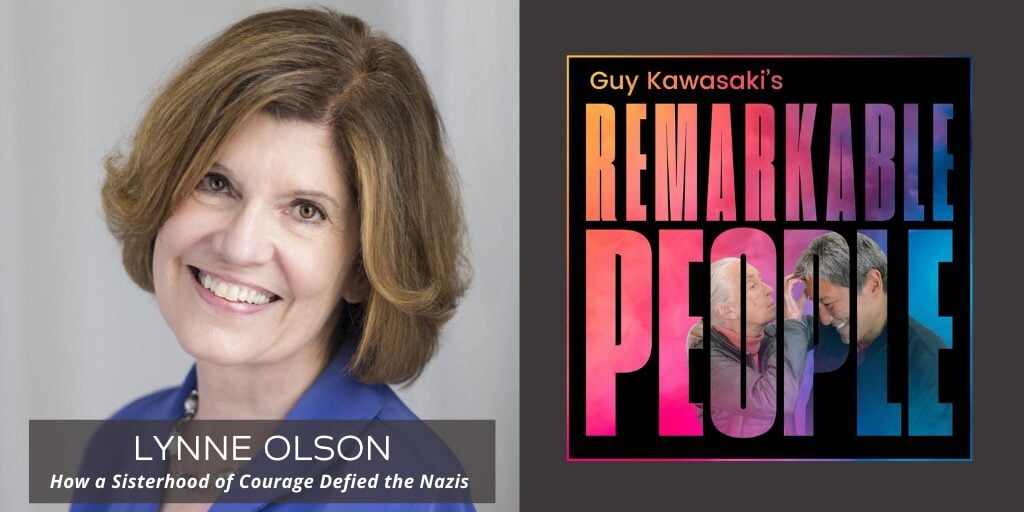
Welcome to Remarkable People. We’re on a mission to make you remarkable. Helping me in this episode is Lynne Olson.
A master of overlooked history, Lynne uncovers the truth behind The Sisterhood of Ravensbrück—a powerful account of French women imprisoned in Hitler’s largest concentration camp for women. There, amid starvation and brutality, they formed a sisterhood that defied despair. Through her work, Lynne restores dignity to lives nearly erased by time, reminding us that history’s moral lessons often rest in its quietest corners.
In this episode, we confront the question of courage: What allows ordinary individuals to resist evil? Lynne shares the resilience of women who forged strength through shared suffering, proving that solidarity can outlast even tyranny. Their story is not one of surrender but of spiritual resistance—a kind of courage that transcends generations.
As we face our own fractured world, their legacy demands that we remember, reflect, and resist apathy. Their courage invites us to see remembrance not as nostalgia, but as a responsibility—to each other, and to the truth.
Please enjoy this remarkable episode, How a Sisterhood of Courage Defied the Nazis.
If you enjoyed this episode of the Remarkable People podcast, please leave a rating, write a review, and subscribe. Thank you!
Transcript of Guy Kawasaki’s Remarkable People podcast: How a Sisterhood of Courage Defied the Nazis.
Guy Kawasaki:
Hello everybody. I'm Guy Kawasaki. This is the Remarkable People podcast.
And as you know, we scour the globe for remarkable people, and today we have what's called a twofer because we have a remarkable guest and she's written, well, multiple books, but in particular, she's written a book about some remarkable French women during World War II, so it's the inspiration and information both from our guest and the subject of her book.
Her name, of course, is Lynne Olson, and she is a bestselling author and historian, and she's really celebrated for uncovering untold stories of World War II.
And the main focus of today's interview is her book called The Sisterhood of Ravensbrück, and it chronicles this extraordinary band of French women who defied the Nazis from inside Hitler's only all-female concentration camp. So welcome to the show, Lynne.
Lynne Olson:
Thank you Guy. Delighted to be here.
Guy Kawasaki:
First of all, just so people have a kind of grounding here, do you now consider yourself a historian or an author? Not that those two things are mutually exclusive.
Lynne Olson:
I think of myself as both. I didn't start out to be a historian. I didn't get a PhD in history. I'm not an academic historian. My background is in journalism, and that's really where I learned to write. I worked as a correspondent for ten years, first for the Associated Press and then for the Baltimore Sun in the White House at the Washington Bureau.
And so I spent ten years doing that and then just got really tired of it. I was given some wonderful assignments. I was in Moscow for two years. I covered politics in the White House. And I really enjoyed all of it. But then I got really tired of it too because as a journalist, you're writing one story a day or several stories a week and they're published.
Or in my case, they were published because I'm a print reporter. And then they're gone. And you really can't dig deeply into the subject. And I got really tired of that. I'm a really good researcher. I love to research, and I wanted to be able to really do an in depth subject and spend some time.
So after ten years, I quit daily journalism and became a magazine writer and then decided, okay, it's time for me to try my hand at writing books. And that's when I became a historian. I'm a popular historian, again, not an academic historian, but I found I really loved it.
And what's great about being a historian and an author is that you can choose your own subjects, and you can work at your own pace. And that to me is just the greatest job ever. And so that's what I've been doing for the last almost thirty years. And it's been great fun.
But I did not intend to focus on World War II. That is my focus. I've written ten books. Nine of them have been about World War II. But I didn't mean to do that. It just happened. My first book dealt with the early days of World War II in London, in England, and I just fell in love with that period.
It was so dramatic. London was standing alone against Hitler. Winston Churchill becomes Prime Minister. It is just great stuff. And I just thought, oh God, this is for me. And that's really what got me into it.
Guy Kawasaki:
So can you give us the gist of The Sisterhood of Ravensbrück? Because I don't consider myself a World War II historian, but I have never heard of this story, and I asked my wife, my wife never heard of this story. So give us the gist of this story.
Lynne Olson:
Okay. Yeah, you're right, very few people have heard of it. The book is really about a group of women who were in the French resistance who were captured by the Gestapo during World War II and were sent to Ravensbrück, as you said, the only all-female concentration camp in Germany.
And that's interesting in itself. But what's incredible is that they banded together, hence the title, The Sisterhood of Ravensbrück. They banded together once they got into this horrific camp. Not only to survive themselves, but also to help each other survive and even more to resist the Germans in the camp.
And it isn't known, but you know what I've discovered? And this has really surprised me even since the book came out, I've discovered that most Americans have no idea, they've never heard of Ravensbrück. I think generally, I would say many, if not most Americans know about some of the German concentration camps like Dachau and Buchenwald.
And the reason we know about them and what happened there is because they were liberated at the end of the war by American troops. And those American troops were accompanied by American journalists who were covering them. And so when they came to these camps and went in, this was a huge shock to most people in the world.
They had no idea what was going on in these camps until the time for liberation came. And so these troops were shocked, obviously, by what they saw. And it's because of them and because of those American journalists who were with them that we got the photographs, the horrific photographs, and the newsreel footage of stacks and stacks of bodies, dead bodies, and of skeleton-like survivors.
And most of us I think do know about that. I certainly learned that in school. But in the case of Ravensbrück, Ravensbrück was not liberated by American troops.
It was liberated by Soviet troops and there were no journalists with those troops and what's more, after the war was over, Ravensbrück was in the Soviet zone of Germany, of post-war Germany. So there again, the Soviets did not allow Westerners in, so Ravensbrück really was forgotten after the war, and so were the women who were jailed there.
So the whole thing is a forgotten story. But it's an amazing story. And that's really why I decided to write the book. I like to specialize in stories that have been overlooked.
People who really helped change their country and the world, but for whatever reason, have fallen into the crux of history. And I think that was true of these women at Ravensbrück.
Guy Kawasaki:
You mentioned the simple logistical fact that the Soviets liberated this camp as opposed to the Americans, but isn't the fact that it was an all-women’s camp, do you think that contributed to the lack of awareness of this situation?
Lynne Olson:
Yeah, no, definitely. I think the fact that it was an all-female camp did contribute to it. And also the fact that I think so much of the attention, quite rightly in terms of camps, has been paid to the death camps, to extermination camps like Auschwitz, and the other extermination camps.
Most of them were in Poland, not in Germany. And certainly, that's absolutely correct. But in a way, these labor camps, these camps like Ravensbrück, Ravensbrück was supposedly a labor camp. And in fact that's what the women who went there were used as slave labor during their time there.
But it was a death camp too. It was just a slow death camp. The Germans had no intention of letting anybody go who were inmates in these camps. They expected them all to die. They would just die more slowly. They would be worked to death. These women had hardly any food.
The place was a Petri dish of disease. They were executed. They could be executed for the smallest transgressions, not working hard enough. So the idea was that all these women would eventually die, but meanwhile they would get as much work out of them as they could. So in that way, I think too that these camps didn't get as much attention, as I said, the extermination camps.
But you wouldn't be killed immediately, the intention was for you to die, and Ravensbrück was a horrific, horrific place. But yes, I do think the fact that it was all women.
Guy Kawasaki:
Wasn't the order of magnitude that 140,000 women went there and 10,000 or 15,000 were executed?
Lynne Olson:
It's actually more than that. Yes, the estimate is 140,000, but actually nobody really knows how many there were at the end of the war. Since it was the only all-female camp, a number of other camps were closed before the war was over. The ones in Poland, actually, the extermination camps, because the Soviets were coming toward Germany from the east, and so they hit Poland before they got to Germany.
And so the Germans closed Auschwitz, and several others. And the survivors, the people who were still there, were marched out of the camp and there were a lot of women there.
Several thousand women were marched to Ravensbrück. And by that time, Ravensbrück, everything had broken down, the administration had broken down, so we really don't know how many people, I think it was much, much bigger than 140,000 and at least 40,000 of those died.
And again, we don't know how many because, again, a lot of these women came in and weren't even registered because of the breakdown of authority in the camp. But it was a major camp. By the end of the war, there were at least probably 15,000, 20,000 in this camp that was designed for maybe 5,000.
So it really was a huge operation.
Guy Kawasaki:
As an author myself when I read a book like this, and obviously you weren't at the camp, how do you conduct research for something like this? Is it interviews with the people who survived? Is there records kept by the Nazis? There's some journals, there's some drawings.
One woman was recording all this surreptitiously. So how does research occur for a book like this?
Lynne Olson:
It's all the things you mentioned. I was very fortunate with this book because for a number of reasons, I focus really on four women. It was a much larger group than that, but I tend to, in my books, focus on just a few people because I think it makes it more human.
If you learn a lot about certain people, then you really care about them as you're reading the book and as you're following their story, whatever the story is. So you really care. And so I focused on four of them. Those four, all with the exception of one person, wrote memoirs themselves.
Memoirs are a fantastic source of information. The group of women who survived Ravensbrück, the French women, also created their own organization after the war, and all the records of that organization and the women are in a library at a university right outside Paris.
So that is a huge source. They also created this organization, created a newsletter, that came out every couple of months. And it wasn't just your normal newsletter. It was just filled with memories and with what was going on. And so again, a huge source.
They’ve all died. All these women have died, but they have relatives that are still alive. And so I interviewed them, but I must tell you, I think the best source I had was it came from an American filmmaker who made a documentary about these women, I think, it came out in 1990.
She was a young American journalist who had met one of the four women that I write about and just fell in love with her, fell in love with the story, and she decided she was gonna make a documentary about her.
And she wasn't a documentary filmmaker, so she actually learned how to do it in order to make this documentary. Why that is so important for somebody writing about this is that she, over the course of about four years, did dozens of interviews with these women separately and together, and I think altogether there's twenty-eight hours of interviews that she did, again, over a course of four years.
And the transcripts of those are available. And I used them, and it was gold. It was pure gold. These interviews were conducted when most of them were in their seventies and eighties, these four. But they all were very much with it.
And they talked about their life, their early life, their families, what they did during the resistance, their lives at Ravensbrück, how they managed to cope with the horror of it all. And most important, the sisterhood they had created with not only the four of them but other French women.
So I quote from those transcripts hugely in this book. And they're what gives it the warmth and the human touch. You really find out about them, and you really realize that in fact, it was a sisterhood. They felt like they were sisters.
And they acted like that throughout the rest of their lives until they died. They all were old when they died, but whenever anybody had a trauma in their lives, like several people, one woman in particular lost her husband, one lost her young daughter. Those other women were there like a shot.
So it made everything human. It's this great story, really fascinating story, but they brought out the humanity in it. And, so that was, by far, the most important source for me.
Guy Kawasaki:
Now, obviously the title is The Sisterhood, was there a different kind of relationship between the women at that camp than there typically was between the men at the other camps? Is it's a different kind of relationship that formed?
Lynne Olson:
That's a really good question, and I think the answer is yes. I think, for a number of reasons, I think women are basically raised with the idea of taking care of other people.
I was, my daughter was, and that's the way these women were brought up and it was exacerbated a bit, I think, by the fact that France was, and to some extent still is, a very conservative, traditional society in which women, they were meant to believe that's really all that they should want to do is to take care of their husbands and children.
And these women were not your typical demure young French women, they were very bold. They had minds of their own. They didn't want people telling them what to do, but they were all raised with that idea.
Many of these women had been arrested and spent time in jails mostly in Paris before they were sent to Ravensbrück. And in these jails, these were big, huge prisons and most of the women were in one cell, maybe a couple of people in one cell.
So they weren't together like they were at Ravensbrück, but they still managed to form a community there through water pipes. And they would do morse code on the walls. They found a way to communicate and actually created a sisterhood there.
They were already familiar with being in touch with other people when they got to Ravensbrück, and it was very natural. Men, and I think there have been studies of men at some of the concentration camps that wasn't the way men are raised, and so it was much more individualistic.
There was cooperation, there's no question, in some of these camps, but it was very much, you're on your own. But that was not at all true at Ravensbrück, and I think another reason, besides the fact that we women are raised to be very caring of other people, it is that it was really drummed into the newcomers who came to Ravensbrück.
They were basically told by other French women who had been there longer that the only way they could survive is if they banded together. And that by themselves they were gonna die. If they cooperated, if they thought about each other, if they got food for other people, that would increase their very slim chances of surviving.
And it proved to be true.
Guy Kawasaki:
It seems to me that there's been many stories about concentration camps and things like this, and your book added to the body of that knowledge, but it doesn't appear that governments learn the lesson, right? You keep seeing concentration camps being built.
Now, I'm not saying Manzanar was a concentration camp like this, but you know, “Alligator Alcatraz,” Manzanar, you would think people would say, “Why, God, that's such an atrocity. We can't even come close to doing anything like this.” But it doesn't appear to be the reasoning.
Lynne Olson:
Yeah, unfortunately I do think history does repeat itself and you have to be aware of it, so many things that are happening today really do remind me of what happened before and during World War II. That's the bad part.
One of the things that's the good part is that why I think the story of these women at Ravensbrück is so timely is they show, I think, the incredible power that people have, ordinary citizens have, even in the worst of time if they come together, if they band together, to fight against evil.
And, maybe I'm an optimist, but I do see a bit of that now, that you know that by yourself, there's really nothing you can do. But if you form a collective that there are things you can do and you can change history and people have changed history.
And one of the things, being a scholar, being a historian of this war, World War II and the resistance, I've done a lot of work on resistance, not only in France, but in Poland as well and other places, is that it takes a while, sometimes a long time for it to gather momentum.
With the French, the resistance movement was very weak until basically three years after the war began, two and a half years after the war. But then it began gathering momentum. And by the time the war was over, by the time of D-Day when the allied troops invaded France, the resistance became, at that point, was a real force.
It had not been before. And I think when you compare it to today, I think one should remember that, that it takes a while for the momentum to build up. And again, maybe I'm an optimist, but I think that there's a possibility that will happen here.
Guy Kawasaki:
You could make the case that with France and Poland, it was an external enemy trying to conquer your country. But as a scholar of World War II, you could also say that what happened in Germany where it wasn't an external enemy, it was an internal development. So do you have any insights about resisting an internal enemy?
Lynne Olson:
I think the same things we've been talking about hold true. The problem with Germany is very different than the us. Back then Germany was a country after World War I that was in horrific economic and social shape. And along came this guy who said he was gonna make everything great again.
Guy Kawasaki:
Oh, that is a slip right there, Lynne.
Lynne Olson:
No, I mean, Hitler basically started his march toward war fairly early, and so the economy recovered and there were a lot of jobs and so many people's lives got better as a result of him.
And I think there's a big difference. This country is a rich country and has many more institutions that hopefully will protect democracy, whereas Germany really didn't have that. I mean Germany was just prostrate after World War I. Yes, we're talking about internal, rather than external force, an internal force.
But I think some of the same things hold true. Again, my husband accuses me of being an optimistic, and I am, but there are many things that are similar to what happened in the thirties and forties. But I also think that there are things that can happen that may not mean that it's gonna be as bad as we think.
We'll see.
Guy Kawasaki:
I am fundamentally an optimist, but I have to say that let's just discuss the similarities here. So first of all, there's this authoritarian tendencies. There's attacks on the independent medias, attack on the judiciary, attacks on the elections. So that's one similarity.
Another one is the polarization and scapegoating, right? It was the Jews and the Communists in Germany, and now it's the immigrants and minorities and left wingers in America. There's a similarity of charismatic populous leaders, and there's a similarity with the erosion of norms of society.
So those are the similarities. Now, as you point out today in America, the institutions are stronger, at least I used to think the Supreme Court was, and we have a very strong civil society with ACLU and all these kind of foundations and organizations that's gonna resist. And I think the U.S. is a bigger country.
It has much more decentralization. But if you look at all of that, you remain optimistic that we have enough differences?
Lynne Olson:
I'm hoping, I do, I really do. Maybe because I've written so much about these people who nobody expected anything from and regardless, depending on what book I was writing, that's true of a lot of the books I've written. People that, you know, who would've thought that they would've had such an impact on their society, their country, but they did.
And so I haven't lost hope, I do think what's going on now, I think it has taken time and I think at the moment you and I are talking, there are a lot of developments that I think seem to me to be pretty hopeful that people are standing up and for example, on just first Amendment rights, the freedom to say whatever you want to say.
And I think people are beginning to fight back. And I'm talking about just ordinary people. We've had so many institutions give in to demands of this current administration and the people really haven't made their voices heard I don't think as much as they should, to put them mildly, but I'm hoping that is beginning to change.
Who knows? It's so interesting too. We are now in the middle of it an enormous historical change, you and I and the rest of this country. And it's really interesting as a historian to actually be in that because as a historian, one of the things I like is you're writing about a time period that's already happened, so you know what happened as a result, what happened after World War II.
But we have no idea now, you should realize that you have to have a certain amount of sympathy for how complex everything is, and the time you're going through it.
I think a number of historians, just to give you an example, a number of historians, particularly British and American historians, have been incredibly critical of the French for capitulating and then most of them not standing up against the Germans during World War II. Most of the French, the vast majority of French, neither really actively collaborated, nor certainly didn't resist. And there's been criticism of that.
Okay, so here we are, we're in a similar situation. What are we doing? What are each one of us doing? And so I think being in the middle for all of us in the middle of this crazy time we're in, it calls for a bit of humility and how each of us are reacting to this. As I said, I find it fascinating as a historian to think about how I'm reacting and how my family or my friends are.
And then compare it to what I've been writing about.
Guy Kawasaki:
Yeah. Around 2016 I was in Berlin, and I had dinner with some German friends, and they said, “To this day we ask our parents and grandparents, there's sixty-six million Germans, how did Hitler come to power?”
Like how can that be? Sixty-six million people didn't all become Nazis. And then they told me, “Guy, it's kind of like 1930 in America right now. You better think about what your grandkids are gonna ask you.” And that was a very powerful moment in my life. Yeah.
Lynne Olson:
Absolutely, and it should be, and people should think about that now. I certainly think about it a lot.
One thing that I have realized just in the last few months is, again, how important community is, whether or not you're banding together and you're resisting, but how important community is, and especially in this society that we are in which is, as you mentioned, so fragmented that the more community, the better. I think it's so important.
Guy Kawasaki:
So it seems to me that you are an expert in resistance, so can you just discuss some like ways that people can resist today?
Lynne Olson:
I think we're seeing it. I'm in Washington. And, as I'm sure you probably know, the National Guard was sent to Washington where it should not be. And people I know, I haven't done it myself, but people I know have gone out wherever they are, and they have pots and pans and they're banging and they're just showing up.
They're just showing up. There are people in this town who have banded together in their various neighborhoods to protect Hispanics, Latinos who are being taken into custody by ICE. There are people who are escorting neighborhoods where they're escorting little kids to school, so people are coming together a bit.
It's not widespread. I don't think, it's not that terribly widespread now, but they are. They really are. And I think that needs to happen. I think as more and more people are actually affected personally by it, that's when it really will take off.
The resistance really will take off, and that's what happened in France. It wasn't until 1943 when the Germans imposed forced labor. They basically announced that all young French, mostly men, had to go to Germany to work in factories.
And that just transformed the resistance movement because tens of thousands young men left their home. I mean, virtually every family in France was affected by it. So they left their homes, and they went to the countryside, or they went into the mountains, and they became Maquis, M-A-Q-U-I-S, Maquis.
And they became underground. They became members of the resistance. Things like that where you were really affected, for example, I think now certainly, I know people whose husbands and sons have been stopped by ICE just for driving down a main street in Washington because they are Hispanic, and these people are citizens.
And it's affecting me and more and more it's affecting other people. And I really do think, again, I think that will have an effect.
Guy Kawasaki:
Do you think that doing things like canceling your Disney subscription or not shopping at Target, is that a form of resistance? Does that have any impact?
Lynne Olson:
Absolutely. And I think we're seeing that now. Again, we're speaking at a time when Disney is under great pressure. Who knows how that's gonna turn out, but they are under great pressure. Their stock is dropping, and people are canceling. And this is really important.
And you have major Hollywood people saying they're not gonna work for Disney. This, again, as we were talking about, to be in the middle of it and not know how it's gonna turn out. It's really fascinating because I think this is a kind of a watershed moment right now.
And yes, to answer your question, yes, I think it does have an effect and I think it is a form of resistance. It's a very powerful form of resistance.
Guy Kawasaki:
If you are Lynne Olson or Heather Cox Richardson, you don't need to do research. You just need to record what's happening, right? You're in the middle of it right now in real time. You're not digging up archives, you're not interviewing old people and their relatives.
Lynne Olson:
Yeah. And that's why I admire Heather Cox Richardson, because she's out there connecting the dots, connecting history to what's going on. And she's really doing God's work. Absolutely. It's hard to write about something when you're in the middle of it because you have, again, have absolutely no idea how it's gonna turn out.
But she and others have done a really spectacular job of keeping the spotlight on what's happening and connecting it to history. That's really important.
Guy Kawasaki:
There was a story in your book, and I thought maybe you can offer some insights. Do you have any ways to help identify double agents? Because there was a double agent in the lives of these people in your book, and he turned people in, right, after trying to be a supporter of the resistance. So how do you figure out who's a double agent?
Lynne Olson:
Oh, that's really hard. That is really hard because the Germans were really skillful at doing that. The problem is when the people I write about, the groups that I write about, they became quite big. And in the beginning, if you have a very small group of resistors, then you know everybody.
But then as it gets bigger and bigger and bigger, then people come in who are not really all that well known to anybody. And that was really part of the problem. And also, again, I'm speaking about the French. They didn't know how to do this. The French are not exactly the kind of people that are really good resistors.
They're very social. They like to be with everybody. They talk. They have a good time. And they were not trained. They were amateurs when they started out. They all were amateurs. And so it's not surprising that people were able to worm their way into it.
The only really tough, at least in the beginning, tough resistors were communists. The communists who had that background of secrecy of cells, the very small groups, and that you didn't trust anybody that you kept moving. You didn't spend four nights in the same place.
You certainly didn't get to get together in a café or bistro. And which is what the French, that's what they do. So the communists were very well organized but even they, the Germans, infiltrated them too, but I think it was incredibly difficult to realize, to figure out, who was a double agent.
Because when we talk about double agents, we're talking about Frenchmen, French people. We're not talking about Germans. They were French people who were. for whatever reason, were pro-German, and many of them were paid.
Guy Kawasaki:
It seems to be that one of the lessons to be learned from your book is that these women who became heroes, they were quite ordinary people, right? They were ordinary people who ended up doing extraordinary things.
So are heroes born or made? How do you explain ordinary people becoming such leaders? And the only person with name recognition upfront was Charles de Gaulle's niece. Other than that.
Lynne Olson:
Yeah. She came from quite a well-known family, but they were ordinary people. But in the sense they weren't ordinary. Again, these are all women in a society that very much made women second class citizens.
And yet, I think the one thing in common that almost all of them had was they had very strong mothers. And so they came from a family where women were valued and they all were, as I mentioned before, they were very bold. They were independent. They refused to allow men to tell them what to do, which is very unusual back then.
The four I write about come from upper middle class backgrounds. They had gone to college, which again was very unusual for women. So they did have that sense of standing up for themselves and for others.
And I think that that's what propelled them into resistance work. But they also had a tremendous love for their country. They were tremendous patriots. And again, there were women, and there's a wonderful quote from one of them, and I can't do it justice.
I can't really, but she said, “We were prepared to die for a country that was not giving us our basic human freedoms, but it was our country.” And they felt very, very strongly about that.
Guy Kawasaki:
So are you saying that I am wrong? And these were not ordinary people? They were already extraordinary or you're saying that?
Lynne Olson:
They were ordinary people in the sense that they didn't come from wealth, they didn't come from families or a background that you would think they would do it, but they were ordinary people. They're women.
They didn't become generals. But they had an extraordinary commonality that they were very independent, and that was unusual. But, I say that and then, I'm talking about four people, but there were tens of thousands of French women who were ordinary, but yet extraordinary.
They were teachers. They were shopkeepers. They were mothers. But they all had this kind of strong sense of we have to fight for our country. So I would say they're both ordinary and extraordinary. Ordinary backgrounds, extraordinary personalities.
Guy Kawasaki:
I wanna backtrack a little and ask you a question that has been bugging me since I did the research for this episode. And there's this award, I think it's the highest award that France gave to people who participated and resisted, and it's called the Companion of Liberation.
And apparently there were about 1,038 of these awards given, but only six were women. I could count four in your book, the main characters right there. And you know that would be four-sixth of it right now. Like how can it be only six?
Lynne Olson:
It was just ridiculous. The Companions of Liberation was set up by de Gaulle in the free French. And it was, as you said, it was the highest honor that could be bestowed on somebody who had been involved in the war, whether they were in the resistance or whether they were fighting, actual fighting.
And 1,038 were judged worthy of the honor and only six women. I mean, that is just absolutely crazy because women were the lifeblood of the resistance. Without women, there would've been no French resistance. They helped create resistance organizations. They spied. They ran escape networks.
They were so important. And yet men when the war came to an end, they basically said, “No. It was men who were responsible for the resistance and for everything else.”
And they push the women into the background, into the cracks of history, which continued once the history started being written after the war, that same theme continued, the women, yeah, they were kind of involved, but it was really men who were responsible for the resistance.
And it's just unfair, it's just totally unfair and just really in the last three decades, I think, that has started to change. There have been many more books about women. And finally giving them the credit they are due, but that story about the Companions of Liberation is so infuriating.
Every time I think about it, I think, oh God, how could this be? But it's the way the French were, the resistance and the whole war machine was as sexist as the rest of French society.
Guy Kawasaki:
You could make the case that you know the movie about the black women who were the math experts. So you didn't hear that story, right? You thought it was all male engineers who developed all that.
Lynne Olson:
Right, absolutely. I know.
Guy Kawasaki:
You never hear about these things.
Lynne Olson:
It really is fascinating in the last, I'd say, ten, twenty years, how it's true.
All these stories are cropping up, whether it's women during the war, whether it's women at NASA where it's women astronomers, whether it's women physicists, you're finding out that actually women, in many cases, we're responsible for achievements that men got all the credit for.
I'm delighted that it's happening, but it's really sad that it's taken so long.
Guy Kawasaki:
May I go on the record and say that I think that if women ran the world, it would be a better world.
Lynne Olson:
I agree with you. Totally
Guy Kawasaki:
So I have two last questions for you. This first question is gonna lead to a second question. So I really have two and a half questions left for you.
So first question is an easy yes or no. Have you sold the movie rights for this book?
Lynne Olson:
No.
Guy Kawasaki:
That kind of shoots the second question because I was gonna ask you who you wanted to play Germaine.
Lynne Olson:
Oh God.
Guy Kawasaki:
So let's pretend you did sell the movie rights. Who would you want to play Germaine?
Lynne Olson:
My goodness. I think I'd want a French woman to play, Marion Cotillard. Maybe, Juliette Binoche. Those two.
Guy Kawasaki:
Okay. Maybe Jon M. Chu is listening to this, and he'll pick it up or something.
Okay, so my very last question is with all that you know about World War II resistance and this book, can you just sum up what kind of message you would like to give people in America concerned about what's happening in this country about resistance and ordinary and extraordinary people stepping up, and what's the lessons we should learn that you have learned?
Lynne Olson:
The lesson I think is don't count on other people to do it. That if you are really concerned about what's going on, you have to find a way to get involved yourself. And in doing that, I think as I have said several times, the important thing is to do it with others. It just seems impossible to do anything by yourself.
And you have to find a way to do that, whether it's in your neighborhood or an association that you belong to or whatever, you have to seek out those who feel the same way. And the more that happens, I think the more you know will have an impact.
Guy Kawasaki:
All righty, Lynne Olson, thank you so much for doing this.
Lynne Olson:
Oh it’s been my pleasure.
Guy Kawasaki:
Thank you very much for writing that book. That book is really an eye-opening book. I had no idea. And if you're listening and you're interested in World War II history or resistance in general, this is an absolute must read.
So I am just gonna thank the Remarkable People staff, which would be Madisun Nuismer, our co-producer and my ears, Tessa Nuismer, researcher, Jeff Sieh, co-producer, also sound design engineer, Shannon Hernandez.
So we have a small team and we're trying to make a remarkable podcast. So thank you very much for being our guest Lynne.
Lynne Olson:
Well you have succeeded. Thank you. Thanks very much, Guy.
Sign up to receive email updates
Enter your name and email address below and I'll send you periodic updates about the podcast.


Leave a Reply