
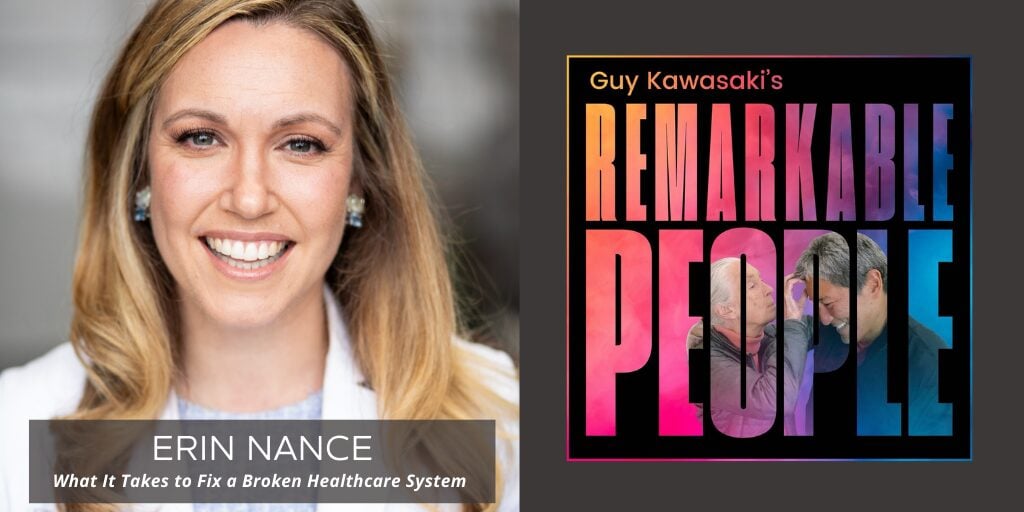
Welcome to Remarkable People. We’re on a mission to make you remarkable. Helping me in this episode is Erin Nance.
Erin Nance is no ordinary orthopedic surgeon. She’s treated elite athletes, musicians with million-dollar hands, and everyday patients whose pain was ignored for years. But beyond the operating room, Erin has become a leading voice for patients—especially women—who are misdiagnosed, dismissed, or told their symptoms are imaginary.
In this episode, Erin shares why curiosity and humility matter more than medical hierarchy, and how “the eyes only see what the mind knows” explains so many diagnostic failures. She walks through real cases—from rare infections to chronic conditions—showing how listening carefully can change outcomes. She also explains why women are far more likely to be misdiagnosed, and how gaps in research continue to shape care today.
Guy and Erin also explore how artificial intelligence is already outperforming humans in certain diagnostic scenarios, and why doctors—not patients—should be leading its responsible use. Erin argues that AI doesn’t replace physicians; it makes good ones better by expanding what the mind can see.
Throughout the conversation, Erin draws on lessons from her book Little Miss Diagnosed, a deeply personal look at medicine from both sides of the exam table. Her message is clear: better care starts with believing patients, asking better questions, and remembering that medicine is ultimately about people—not protocols.
Please enjoy this remarkable episode, What It Takes to Fix a Broken Healthcare System with Erin Nance.
If you enjoyed this episode of the Remarkable People podcast, please leave a rating, write a review, and subscribe. Thank you!
Transcript of Guy Kawasaki’s Remarkable People podcast: What It Takes to Fix a Broken Healthcare System with Erin Nance.
Guy Kawasaki:
Hello everybody. It's Guy Kawasaki. This is the Remarkable People podcast, and this is the first episode I'm recording from Hawaii in an apartment we just took. You may hear a little bit of echo because I haven't quite figured out the acoustics of this room, but I couldn't wait to interview our remarkable person today.
Her name is Erin Nance, and she is a remarkable orthopedic surgeon from New York. And to put it mildly, she is literally the person you want when you need a hand, shall I say. She is like world class orthopedic skill. She's a writer. I loved her book, and if any of you are considering the medical profession, you have to read her book, it's called Little Miss Diagnosed, and we'll get into that.
And she's also championing women in medicine and women healthcare. So welcome to the show, Erin Nance.
Erin Nance:
Oh, thank you so much, Guy. And I have a confession. I am feeling extra remarkable because I am wearing the socks that you sent me, so I really feel extra remarkable today.
Guy Kawasaki:
We'll send you more. You can feel remarkable every day.
Erin Nance:
You sent one for my husband as well, which is much appreciated.
Guy Kawasaki:
Don't you have kids too?
Erin Nance:
And I have a little one.
Guy Kawasaki:
How old?
Erin Nance:
She's ten, not so little anymore.
Guy Kawasaki:
Oh yeah. People told me this when I first had kids and I said, “Nah, you're making stuff up.” And they said, “You're gonna have your first kid, you're gonna blink and he's gonna be going to college.” And it's absolutely true. It's absolutely true. Yeah. So first I have dug into your dark past and I have figured out that you are zero for four with Stanford.
So Stanford is so stupid. They rejected you four times.
Erin Nance:
Yes, I self-proclaim, have the highest rejection rate from Stanford. I hold the world record for being rejected from Stanford. I was rejected for college, for medical school, for residency, for fellowship. Stanford really doesn't want me, but I really wanted to go to Stanford my whole life.
When I was a little girl, I was a very big swimmer, and at the time, all of the Olympic swimmers went to Stanford, right?
Summer Sanders, Janet Evans, Jenny Thompson. They were the gold standard. So I said, “I wanna go to Stanford.” And my whole life, it wasn't as if I thought I was this so smart and everything would go my way.
But I just never considered any other school. And I'll never forget that when I was in high school, the admissions counselor from Stanford came to New York City and did a talk for all of the prospective parents and the applicants.
And I remember at the end of the talk, these four girls from Chapin, which is another school in New York City, them and their parents went up to the counselor and they were all giving each other hugs and kisses. And for the first time I thought, maybe this isn't going to go my way. And lo and behold, I was rejected.
I was so in shock. I called them to make sure that it wasn't a mistake because it had to have been a mistake, right? There had to have been some grave mistake. And I said, “Oh, I guess I'm on the wait list.” And they go, “No, you're not even on the wait list. You're just rejected.”
So yeah, Stanford really was my first heartbreak, but it taught me that a heartbreak is there for a reason, right? It wouldn't hurt if it didn't matter so much. And really that was laid the foundation for me building this resilient path. And when you zig, you gotta zag.
Guy Kawasaki:
I am slightly better with Stanford. I'm one for two. I got in as an undergrad. I got rejected by their business school. And lo and behold, when I was an undergrad, I thought I wanted to be a doctor. So I was pre-med, and I enrolled in this class that you go on rounds at the medical center. And the first day of that class I fainted and that's when I decided I'm not gonna be a doctor.
So I wasted your bullet. I wasted your silver bullet. I feel terrible to this day, Erin. Oh my God.
Erin Nance:
No, there's a reason why I like people who have that experience to know that they're not supposed to be doctors, right? It's part of the pathway. And I think anyone who has really any advanced exposure to healthcare is so helpful because you can be a champion for healthcare in so many ways besides being a doctor.
Guy Kawasaki:
I just wanna express my empathy. I read your book and I've seen your videos, and you know the story you tell about the first day that your residency started, and you get this call from your mom and your brother that your other brother dove into a pool and got paralyzed.
Wow, what a story. So how is Kevin now?
Erin Nance:
Kevin is doing absolutely incredible. He is married, he has a beautiful daughter, he works for a bank. He is a fully functioning member of society. And I will say this about Kevin is that he is a better person as a result of his accident.
And again, the resiliency and the determination and grit that he shows, he's an inspiration to everyone in the family and certainly for anyone who has newly been injured.
His incident was he dove into a pool that had that kind of slant between deep and shallow, and he hid it straight on, instantly paralyzed. Although I just got off the phone with him a couple of days ago because we had a speaker from Johns Hopkins come to the New York Society for Surgery of the Hand.
We have a quarterly meeting, and we invite all the latest researchers. And he was talking about the latest research for nerve transfers for quadriplegics, and there has not been any innovation for quadriplegics in decades. Neuralink, what Elon Musk is doing, is something totally separate.
But in terms of things that are actively, you can actively get this intervention. And so we spent all night reading the papers from this doctor and trying to see because he has never given up hope that he will recover 100 percent.
Guy Kawasaki:
I don't know if you've heard of him, but one of our past guests was a doctor named Jerry Silver. And, he unfortunately passed away, but Jerry Silver has pioneered this work in using peptides. And the company is called NerveGen out of Vancouver, Canada. And right now, you don't inject these peptides into the spinal cord.
You inject it subcutaneously and it inhibits, and I gotta read this, so I get this right. It inhibits the protein tyrosine phosphatase sigma. I don't know what any of that means, but so yeah, we've had a guest talk about the recovery of people with spinal injuries.
Erin Nance:
Yes. And to be honest, even myself as an orthopedic surgeon, I was unaware of what the potential recovery could even be. And I learned so much. I write in the book that Kevin became my first patient. And I remember clear as day and I write about this.
We were just sitting outside. He was in his wheelchair, and I could have sworn I saw his toe flicker and I said, “Kev,” I go, “Did you see that? Did you feel that?” And he hesitated, and he said, “I didn't wanna admit it to myself if it was true, because if it wasn't, I would be so devastated.” And that was the beginning of some recovery for him.
He's able to even walk. I wouldn't say it's functional walking, but it's enough so that he is able to at least relieve some pressure and get a little bit more, kind of, exercise. But yeah, I did not know what was possible. I just thought you were completely paralyzed and that was it.
Guy Kawasaki:
I'm gonna jump around to all kinds of different subjects. This is not a linear NPR kind of podcast, okay? We go all over the place. So now I want to ask you a very deep and personal question. When you broke your arm as a little girl, or actually you didn’t even break your arm, you bent your arm and your father's friend shows up in the ER to treat you, and he is wearing a tux.
So is that the moment you decided to simply become a doctor or to become an orthopedic doctor?
Erin Nance:
I wanted to be him. I think on the end of second grade you had to draw a picture of what you wanted to be, and I wrote, “I want to be an orthopedic surgeon.” Not doctor, I wanted to be an orthopedic surgeon. In my eighth grade yearbook, I wrote, “I want to be the orthopedic surgeon that takes care of the Mets, the Knicks, and the Rangers.”
And I ended up achieving that. I did my fellowship at Hospital for Special Surgery. I took care of; we were the team doctor for the Mets. I treated many different players from the NFL or from the NBA. Every sport you name it, we took care of them. So yeah, it is a bit rare that so specifically at such a young age, what you wanna do.
And I tell people when they ask, “How did you do that?” I say, “It's a mix of determination and stubbornness, right?” I had already put it out there that I was going to be this orthopedic surgeon and it would be pretty embarrassing if I came up short since I just kept saying over and over and over again.
But yeah, it's a little bit of manifesting, but it's a little bit of just staying the course.
Guy Kawasaki:
So you're saying that you are an orthopedic surgeon for all these professional sports and stuff. So if we are not violating HIPAA, can you tell us who's the most valuable hand you ever worked on?
Erin Nance:
Oh, that is a great question. I will say I have worked with many different categories of people whose hands are super valuable. So I have worked on musicians whose hands are insured for millions of dollars. I have worked on NFL wide receivers who are in the Hall of Fame. I have worked on NYFD firefighters who their hands are their livelihood.
I have worked on politicians, who use that pen to write orders. So yes, I will say working at HSS is probably if you were a paparazzi, don't waste your time on Hollywood Boulevard. Go stand outside of the waiting room at HSS. That is the hottest ticket in town.
Guy Kawasaki:
I have, I think, what's called digital mucous cyst. So if I'm ever in New York, could you just remove it for me? Oh, I know what we can do when you're in Hawaii, bring your scalpel and you can just cut it. I'll take you out to dinner. How's that?
Erin Nance:
Mucous cysts. So here's an interesting topic. This is something that is probably a hand surgeon's least favorite topic to treat.
Guy Kawasaki:
Why?
Erin Nance:
Because the mucous cyst itself is not a problem. It's really a sign of underlying arthritis. So the issue is that the mucous cyst isn't an issue except that it is ugly. It is, it's ugly looking.
And so the patients come in and they say, “Hey,” especially listen, I'm New York City, we have our Park Avenue ladies. They don't like how that looks, but the issue is that the skin is so delicate that when we do a procedure to remove it, you're at great risk for infection, for developing wound healing issues.
So the only time we recommend removing it is when there is an underlying infection. We don't remove it for purely cosmetic reasons, which gets everybody in a tizzy because that's why they came for in the first place.
But yes, I would say that is probably a difference from my background being an orthopedic hand surgeon versus a plastic hand surgeon who may be willing to do things for different reasons.
Guy Kawasaki:
You know what, when I knew I was gonna interview you, I started reading about orthopedic hand surgery and all this kind of stuff, and I said, “I wonder what this thing is on my finger.” And then I did that. And then it says, “The first thing they recommend is never drain it, never try to take it off,” which I have done multiple times of course.
Yeah, I am convicted. Now we're gonna jump back to your book. And again, I just wanna say if anybody out there is thinking of being a doctor or know somebody who's thinking of being, you have got to read this book. Just the first chapter alone when you describe what you have to go through to be a doctor.
My God. So as I was reading your book, I asked, “You know, is all the crap starting from your college degree to residency to all this stuff that they put you through, do you, with hindsight, look back and say, ‘That is good, that it was so hard, it was so challenging. It really separates the people who really want to be doctors from those who are pretenders.’”
Or do you say, “That was needlessly traumatic, and we would have just as good doctors if we didn't try to beat the crap out of them to get their MD.”
Erin Nance:
I'll answer it this way. When I was a PGY-Three, the eighty-hour work week went into effect. Now, if you know a little bit about the history of what the eighty-hour work week is or what it entails, it was started because there was a reporter, I believe he was from like The New York Times or a prominent New York magazine.
His daughter died in a New York City hospital, because he felt that she had a medical error made by a resident who was overworked, right? They had been working thirty-six hours straight or whatnot, so they pushed to make a law that no resident could work more than eighty hours a week. Now, that was technically in place, but it was never enforced.
So when I was the PGY-Two, the junior resident, I was working thirty-six hours straight. I was working one hundred plus hours a week. I was always known for having this iron bladder because I could go an entire shift without going to the bathroom. and people would say, “How could you do that?” And I go, “If you don't drink any water for the whole day, you don't have to go to the bathroom.”
Now, I would come home after that shift and my lips would be cracked and bloody, and I would pass out on that bed and not wake up. No one could possibly wake me up. Do I wish for my junior residents to go through that? Absolutely not. Do I think there is a difference in the level of accountability for patients between my era of trainees and today's era of trainees? Absolutely.
Guy Kawasaki:
Wait, so the conclusion is that the system winnows out the people who really should not, or do not wanna be doctors. So you're saying the system works as it is, or we should change the system to be more humane?
Erin Nance:
I think it has to change to be more humane. Just even getting a good sense of what it's like being an up and coming doctor, a resident today, they will not stand for being overworked. They will not stand for not being able to eat or go to the bathroom. They will not stand for no attention to their mental health and their personal wellbeing.
I had no personal wellbeing there. Just that was how the system worked. In my Lennox Hill residency, we only had two residents per year. Okay? Which means there were only four junior residents, so that meant for 365 days, right? Twenty-four seven the four of us were, at least one of us was always working.
You can imagine that, now they'll have a PA take a shift or they'll bring in another resident from a different subspecialty to help cover. So I do think it did train me. You know what was funny? We were talking about trying to coordinate this podcast and you were, our original time was gonna be four thirty in the morning Hawaii time.
And I thought that's really cruel to make you work doctor's hours, but for me that is not so out of the ordinary and it's because of that training. I wouldn't even blink if you said, “Hey, we're gonna do the podcast at four thirty.” I'd be like, cool.
Guy Kawasaki:
It's four thirty my time, and it's ten thirty your time.
Erin Nance:
Exactly.
Guy Kawasaki:
In your book you described this very funny scene. I guess it's funny now, but maybe it wasn't funny then. But it seems to me that in House and, whatever ER and all these TV series, there's always this moment where the surgeon or the doctor in charge is saying, “I want you to name the ileal lumbar vessels.”
And it says, “Alright Erin, what are the three vessels there?” And of course, most people don't drop their glasses on the patient, but that's a different story. Now do those kind of moments really happened, where the doctors just say, “Okay, what are these three vessels? What are these three thing,” whatever.
So that's question number one. Does that really happen in life? And secondly, does it really matter if you didn't know what those three vessels were at that particular moment, would that make you a bad doctor?
Erin Nance:
So that process is called pimping. Okay. The attending pimps the resident, or the resident pimps the med student, and it's both a process of trying to see if they did their homework, if they prepared.
Make sure that they are prepared for the case. But it also establishes this pecking order, right? The attending is the one pimping the juniors, and most of the times it some esoteric fact that only the attending would ever know the answer.
And it just establishes that hierarchy, who is the alpha dog and who isn’t. In some instances, it's used really to create a culture of intimidation. A culture of fear, a culture of anxiety over getting these questions wrong because no one's pimping you in private. Okay, you are being pimped in public.
That is the point of pimping. So I do think it does make sure that you are going to these cases prepared. And I'll tell you a story that it actually did not make the cut because it was accidentally left out of the book, but there was a day where I was on the joint replacement service.
I talk about Dr. Rodriguez in the book. He is one of my most revered mentors. He's just an absolutely phenomenal surgeon and person. And I'm on his service doing total hip replacements. And he has a system where it's like a hundred point checklist of, okay, put the scalpel at ten centimeters this way, then take the Bovie and grab this vessel, then take the clamp and at this angle.
And the day before the OR day, my mom called me in, we had a family emergency. I called my chief resident. I said, “I am not coming into work today.” And I went home, and I spent the entire day just with my family, making sure everything was okay. And then the next day I showed up in the OR, and I wasn't holding the scalpel right. I clamped the wrong vessel.
I didn't do the Mets the right way. And Dr. Rodriguez took the instruments outta my hand. He said, “Get out of my OR, you are not prepared.” And that was it. And I left absolutely embarrassed, ashamed. There was no excuse. He was totally right. I was not prepared for this case, and it didn't matter that I had this family emergency, and there was a good reason why it wasn't prepared.
His job was to protect the patient at all costs. And that's part of when you're a resident, you don't even realize how many things the attending is juggling at the same time.
But of paramount is the safety of the patient above the learning and educational experience of the resident. I like to think that these systems of pimping and all of the grand rounds and the M&M, it is all in the greater good of preparing us for being as prepared as possible for our patients.
But it was a good reminder so early on in my career that the patient safety always comes first.
Guy Kawasaki:
So now I want you, with your hindsight and your superior communication skills, can you just tell us what makes a good doctor? Is it the memorization of the vessels of the ileal lumbar? Is it empathy? Is it communication skills? When push comes to shove, once you're out of med school, once you're outta residency, once you're out of the eighty-hour weeks, what makes a good doctor?
Erin Nance:
Number one is lifelong curiosity. That is by far the most important trait that a doctor can have.
And why I say that is because many doctors, right, we learn the most intense period is when we're in medical school and when we're residents, but medicine evolves constantly, and it really takes a dedication to continued lifelong learning to make sure that you are delivering the best care for the patient that's sitting right in front of you today.
So I think number one is curiosity. Number two is you have to have the technical goods, right? I know there's a joke that, what do you call the person who had the lowest grade in med school? Doctor. And that technically, yes, there are levels to our knowledge base and our skillset.
But when you are looking for a doctor, if you're getting your knee replaced, you wanna see someone who's doing ten knee replacements a week, right? When you are getting evaluated for lung cancer. You wanna see the doctor who they're seeing lung cancer like all day long.
So technical expertise. And then the third thing is actually something that Dr. Collins mentioned on your podcast not too long ago, but humility. And I think it's something that not many doctors are actively thinking about how can I be a more humble person? I think it comes across in our empathy for our patients when we can acknowledge to our patients, we don't know everything.
When we can acknowledge that, you know what, I'm gonna have to do a little bit more research and get back to you. But right now we have an epidemic of patients who are not getting the care they need from their physicians.
And I believe it's because if a physician does not know what is wrong with the patient within the first thirty seconds, that physician most likely is not going to be the one to help you.
Guy Kawasaki:
What? Say that again.
Erin Nance:
Correct. If you are a physician, and this goes back to a mantra from Dr. Chit Ranawat, who's a very, very famous orthopedic surgeon, but one of his mantras is the eyes only see what the mind knows, right?
And each doctor has a limited set of what they are really experts in, right? I'm a hand surgeon, but I'm really just treating Carpal Tunnel, Trigger Finger, Basal Joint, wrist fractures.
I'm not really seeing kids with congenital hand deformities, right? And so if someone comes to me and has a radial club hand, honestly, I am not gonna be the right person to help you.
And that's when the humility comes in to say, “Listen, I may not be the right person to help you, but I know that Dr. Scott Kozin at Children's Hospital of Philadelphia is the right person to help you,” and to really guide them to that person who is going to be the best person to help them.
Guy Kawasaki:
Oh, it's good to notice. Right there, that's the mic drop moment of this podcast that if the doctor you're seeing doesn't know what's wrong in thirty seconds, keep looking. Okay. So speaking of that, now, this is a perfect segue. It seems to me you talked about a case where this person had gone to multiple doctors, and no one could figure out what was wrong with his hand and multiple operations.
And you too could not figure it out. And then as he's walking out of the office, you come up with this idea, you ask him, “Have you been on vacation?” He says, “Yes.” You say, “Where?” He says, “I went to Florida to go fishing.”
And then you have this brilliant idea that, “We're gonna do a Lowenstein-Jensen culture on you.” And that was a House moment. Now I have a question here.
So if today, if you took all the reports and all the analysis and the lab stuff and all that, and you stuck it into AI, would AI have said, “You should try a Lowenstein-Jensen culture?” Because in a sense it was just lucky that he saw you and you came up with that idea, right?
And so can AI help in this problem because there's too much data and who knows? Maybe you never study the Lowenstein-Jensen culture because you were sick that day in medical school. What happens?
Erin Nance:
So I will tell you that I am the host of a podcast called The Medical Detectives, and we interview patients who have had medical mysteries and misdiagnosis for upwards of twenty years.
Forty years, actually, it was our last guest and they have seen hundreds of doctors and they have had hundreds of tests, and we know what their eventual diagnosis is by the end of the show. We have put every guest of ours, all of their symptoms, all of their tests into ChatGPT, and ChatGPT gets the diagnosis every single time.
Guy Kawasaki:
What, literally?
Erin Nance:
Correct. Now, I will say that we are seeing the patient at the end of their journey, right? So we have the benefit of all of the tests and all of the symptoms over time.
If that patient who came to see me who had, spoiler alert, they had a bacterial called Mycobacterium marinum, his first symptom was just hand pain. If I just put hand pain into ChatGPT, they're gonna gimme a differential that's 500 diagnoses long.
ChatGPT is only as good as the input that you give it, and that's why physicians are really the best suited to using ChatGPT to help solving a patient's diagnosis because I tell people all the time who are having issues with misdiagnosis and being undiagnosed, I go, “Put your symptoms into ChatGPT and ask it for three differential diagnoses.
And then you're gonna go to your doctor and say, ‘Hey, do you think I could have X, Y, and Z?’” Because if you don't put Mycobacterium marinum into the mouth of that doctor, you're never gonna get diagnosed with Mycobacterium marinum.
And yes, it was, I would say, total luck that patient did come and see me. And I had remembered that one time in med school. And to be honest, to be fair, it's always a question on our boards.
It's the patient with the treatment resistant hand infection. They went on a trip where they had an aquarium, they owned an aquarium, or they did a fishing trip. And it's always this exposure to salt water. So it's about using the right input to then get the benefit of the real power of AI for diagnosis.
Guy Kawasaki:
Wow. Second mic drop moment of a podcast. Most of our podcasts only have one, so you're just an overachiever.
Erin Nance:
Racking them up.
Guy Kawasaki:
Yeah. Freaking people at Stanford, they're kicking themselves right now. Okay. So now to go back to your famous quote here, the eyes only see what the mind knows. Can't you make the case that ChatGPT or AI is infinite and omnipotent and omniscient and all that?
So its mind is pretty much everything, so it knows everything so it can see everything. I am stunned that you said that ChatGPT gets it right every time.
Erin Nance:
When it comes to ChatGPT, the output is only as good as the input and where I see the biggest issue is that if ChatGPT is only drawing from data on research studies in which women were not included before 1993, then it is vastly underpowered to capture symptoms that are unique to women, and that is why women are three to four times more likely to be misdiagnosed than men.
So ChatGPT really is limited, right? It's taking the information from the studies that already exist and unfortunately the studies that exist are extremely flawed.
Guy Kawasaki:
Erin, I mean it's almost like I gave you the questions in advance because you provide one perfect segue to the next. So my next question was going to be what are the most misdiagnosed diseases of women?
Erin Nance:
It's interesting because there are diseases that are misdiagnosed and then diseases that are underdiagnosed. So for example, endometriosis is a disease that we believe affects one in ten women, which is astronomical numbers. Yet not one in ten women are being diagnosed with endometriosis.
And I remember speaking to a follower of mine actually, who had undiagnosed endometriosis for a very long time, and I told her I have never once had pain with my period. And she almost fell out of her chair. She goes, “I didn't even know that was even possible.”
And so these young girls who are told by the school nurse, “This is what happens to everyone, right? Suck it up. Go back to class. Put a heating pad on it for five minutes, go back to work, to school.” And we have normalized not taking women's pain seriously. And this has led to an epidemic of undiagnosed endometriosis, fibroids, PCOS, adenomyosis.
The list goes on and on. But those are just I would say like the GYN specific conditions. Autoimmune disorders, which are magnitudes more likely to occur in women than men, are probably the next largest category of undiagnosed and misdiagnosed conditions. And probably the biggest spotlight that I could put right now is a disease triad and we call it the unholy trinity.
And it was actually a follower of mine who educated me on that term, and I use it quite frequently, but it is the conditions of Ehlers-Danlos Syndrome, which is something called a connective tissue disorder, POTS, which is short for postural orthostatic tachycardia and MCAS, mast cell activation syndrome.
It sounds like alphabet soup. but what it is, is that there is typically an underlying genetic defect in the collagen of your body. And when I was in medical school, we learned that Ehlers-Danlos was for people who had stretchy skin and hyper flexible joints. These were the people who could do the party tricks with their shoulders and whatnot.
But what we didn't realize was that, if your skin is stretchy, what happens when your aorta is stretchy? What happens when your intestine is stretchy? And so all of these women who were diagnosed with IBS, which is a made up diagnosis. There is no like medical, actual reason what IBS is. That really we are finding is the underlying genetic problem.
Then you have an environmental trigger. The reason why POTS and MCAS have just exploded in terms of young women, particularly who've been diagnosed, is because there is very commonly a viral trigger and what was the largest viral trigger that we just experienced five years ago, but the COVID pandemic.
So we have hundreds of thousands, if not millions of young women who are in serious trouble right now.
Guy Kawasaki:
So now to flip to the other side, Erin, in your experience, what percentage of people are truly hypochondriacs and they're making stuff up? Is it like smaller than you would think, or is it larger than you would think?
When people tell you to suck it up in your hypochondriac, how often is that actually, right?
Erin Nance:
I think it's almost never, I think we for too long have told women that these symptoms are all in your head, that it's anxiety.
Very often, and I have learned this from the guests on our podcast, they will have gone through multiple rheumatologists and orthopedic surgeons and infectious disease doctors, and when they can't find anything, they are told to go see a psychiatrist and then they are put on psychiatric meds.
And when those psychiatric meds don't have any effect, I tell women, “It's not that you don't have anything, it's that they have not figured out what is wrong with you yet.” And again, this is another epidemic of women not being believed, especially their pain, but also their symptoms.
And I tell this all the time, if you are a fifty-year-old woman and you present to the ER and you say that you have some pain here and it's difficult to breathe and you don't feel well, they're gonna tell you're having a panic attack and send you home. Whereas if you are a man and you show up to the ER and you say, “It hurts here, I'm having difficulty breathing.”
You're getting an EKG. You're getting troponins drawn and they're gonna make sure that you're not having a heart attack. Now, that's not to say that hundreds of thousands of people have panic attacks, and those are real symptoms, but we have been conditioned, right?
If you close your eyes and you think of who is someone who's having a heart attack, it's Mr. Big on the Peloton, right? It's a man. But in reality, more women die of heart attacks than men.
Guy Kawasaki:
Wait just a second. Are you telling me this is actually true today? 2025? You know, somebody should do a study where they have random men fake these things and see what happens and random women and do a real scientific test that proves that with the same symptoms, with the same everything, women are told you're having a panic attack and men are being told you gotta get an EKG.
That would be a very interesting study.
Erin Nance:
Part of the problem, and this goes back to the women not being included in the research, is that often women present with symptoms that are different from men, right? So women may report feeling shoulder pain, they may report feeling just more fatigue.
Whereas men, it may be more, they feel the classic, the jaw pain and the chest tightening feels like an elephant sitting on their chest. But if we were more attuned to these more subtle findings, then we'd be able to really broaden that differential.
And I will tell you, I had a couple of interns last summer. What they did was they went through; I have a series on TikTok called the Thirty-One for Thirty-One – Most Commonly Misdiagnosed Conditions in women.
It was super viral, hundreds of thousands of comments. And what we did is we analyzed all of the comments, self-reported comments from people who said, “Yes, I have psoriasis, and this is what my symptoms were.” And we took those symptoms and then we compared them with what is, I would say, the nationally recognized source, which is the Mayo Clinic website, and WebMD.
And what we found is that over a third of the time, there were symptoms that were self-reported on my channel that are missing from what's published on WebMD and Mayo Clinic. And I think part of that has to do with when we describe a disease, we are describing it in a vacuum. This is what psoriasis is, right?
These are the symptoms of skin and whatnot. But for many people, if you have one problem, you probably have five, right? They're all connected. And so you may not realize getting back to that Ehlers-Danlos example. Okay? Yes, they have orthopedic manifestations. They have a lot of subluxations and dislocations with their joints, but they also have bowel dysmotility, right?
They have problems with going to the bathroom. They're at higher risk for aortic aneurysm. So you have to look at the person as a whole, and right now how the medical system is set up, we are not designed to be treating whole body patients.
Guy Kawasaki:
Wow. In a sense, going back to the discussion of the necessity of humility, in a sense what you're saying is if you're trying to be a great doctor, you have to have the humility to admit that ChatGPT might know better than you how to diagnose somebody. And I don't know how many men can say ChatGPT is smarter than me.
Erin Nance:
I will tell you because this is, I don't know if it's like a worst kept secret, or it's just not, I would say, publicly known. But there is an AI platform called OpenEvidence, and it is an AI app or website.
Right now, it's only accessible to clinicians. So you have to have an NPI number, a license to access the app, but what it is doing is I may ask a question and say, “What is the most current treatment option for women who are diagnosed with small cell lung cancer?”
And it will give me an answer that is based off of all of the studies that were published in PubMed and JAMA, so these reputable sources. So I think it's something like over half of physicians are already on Open AI, which is an insane adoption rate and number, but it is just far superior than, to us, just trying to individually look up papers on PubMed and trying to find these things.
Similarly, Dr. Fajgenbaum from Every Cure, if you've ever heard his story, but they are using AI to help find ways to repurpose generic drugs for rare disease. And the only way to do that is to utilize the power and the scale of AI to capture all those data points.
Guy Kawasaki:
I just wanna be very careful here. What was the name of this service again?
Erin Nance:
It's called OpenEvidence.
Guy Kawasaki:
Now, once again, you have provided me a segue because you mentioned TikTok, and I saw a TikTok or a YouTube Short where you talked about how great it is and the people can express themselves and get advice and peer counseling and peer advice and all that.
But I wanna seek clarity on that. It's kinda disconcerting to me like, so you're supposed to go to TikTok and okay, I can understand believing Erin N's TikTok account, but how do I know if some nutcase influencer is saying, “Drink Clorox to cure your COVID.” And that's on TikTok.
What do I believe? What don't I believe on TikTok and YouTube Shorts.
Erin Nance:
The short answer is that you can't tell the difference and the issue, right, with these platforms, they're where everyone lives. So everyone is there, but unfortunately they are also the source of the misinformation.
And there have been many studies that have shown that misinformation spreads six times faster than accurate and credible information because those platforms were never designed for spreading accurate health information.
Guy Kawasaki:
To put it mildly, yes.
Erin Nance:
TikTok was originally Musically, right? It was about how can we get the number one pop song to go viral. It wasn't about what is the latest treatment for psoriasis.
So part of that is why I started this brand new platform called FeelBetr because I love when you had Dr. Collins on your show you asked him point blank, “Where should patients go for credible information?” And he was hedging, and he could not give you a clear answer.
And I wanted to raise my hand and say, “Pick me. Pick me. I know the answer,” because that is what I'm building. And what FeelBetr is really the home base for credible medical education because it's getting harder and harder to differentiate who is a credible source.
And to be honest, there are some videos with AI and doctors, and I'm not even positive that they're human. So it is getting harder and harder and similar to an OpenEvidence standpoint, we want to make sure that you know where the source is coming from, that source is credible.
So that is what I have been building for the past year as really just, I would say, the go-to source for credible medical information.
Guy Kawasaki:
And are you saying that your source is more credible than OpenEvidence or is it competitive?
Erin Nance:
My source is different. So our source are actual physicians creating video educational content. So where OpenEvidence is aggregating published research and data. On FeelBetr, we have the Tal group out of MIT talking about their latest research on long COVID.
Guy Kawasaki:
And so hopefully, ChatGPT is scraping your site, and all that information is getting into ChatGPT, and it'll cite you, and send people to you. Fingers crossed.
Erin Nance:
I mean that's how you win the algorithm game and the Google page game. But what really we want to be an intentional place for people to get credible health information on our site. There are no view counts, there are no like counts. For us, the measure of success of a video is how well did we get the right information to the right person at the right time.
Guy Kawasaki:
So may I just point out that you did not mention the CDC as a source of credible information. Now, is that like a six month development or, you know, if Kamala Harris had been elected, would you be saying go to CDC to check the latest vaccination, but she didn't get elected? So now you know, is CDC off the list?
Erin Nance:
I think the issue is right now we have a dissonance between our national recommendations and our individual medical society recommendations. The hottest of hot topic is obviously vaccines, but there are other, I mean, the CDC scraped the website of pretty much anything that had to do with female-centric research.
Anything to do with trans care. Anything that was considered a political medical topic. So I think it is difficult to tell people to use that as a trusted source when we have, again, differing opinions between our largest medical societies, the American Medical Association, which I believe is the largest medical association we have.
Their president just went on social media to say we disagree with the CDC.
Guy Kawasaki:
Wow.
Erin Nance:
It doesn't get any clearer than that.
Guy Kawasaki:
Dare I ask, what's your opinion of what RF Kennedy Junior is doing?
Erin Nance:
I like to first acknowledge that the system that we have been operating in is failing millions of people. You cannot understate that. And there has been a lot of money that has been put into this system, which has not produced, say, the best results certainly for women, for rare disease.
For which, by the way, rare disease when taken as a group is one-tenth of the country. So it is not rare to have a rare disease. But to replace these systems with no systems and with no funding is not the answer.
So I think it's good to have new eyes, new ears, new voices, new opinions. But for like “bedrock systems” of the American healthcare system, you don't throw the baby out with the bath water, right?
And unfortunately, I think that is what is going on. Misinformation is probably the hottest of hot topic in medicine right now, but unfortunately, misinformation seems to be in the eye of the beholder, and we have lost sense of what are the medical truths? What are the medical facts?
When it comes to, for example, we'll dive into it near the COVID vaccine, there were a lot of people who were injured by that vaccine.
There were a lot of people who had side effects from that vaccine. There were people who died because of that vaccine. That same vaccine saved millions of lives, and it is estimated that because of misinformation about the vaccine, there were over 300 people who died unnecessarily, because of vaccine misinformation.
So I think part of the issue, and again Dr. Collins mentioned this, is that we have to be more transparent about both the good and the bad, right?
Guy Kawasaki:
Yeah.
Erin Nance:
Medicine is about weighing risks and benefits. When I have a conversation with the patient that's having surgery, I spend more time talking about the risks, the potential risks, than even the benefits of this, of the surgery.
And I think some of the mistakes that were made were just to say, this is what we're going to do. Everyone's doing this and this is going to save millions of lives. And what we should have been focusing on are, who are the subgroups that this could actually be dangerous for and protect them?
For the flu vaccine, we know that there is a subset of the population who has an allergy to eggs. They do not get the flu vaccine. We know that they have adverse reactions. No one is forcing people who have egg allergies to still get the flu vaccine.
Alright, now, in the case of the COVID vaccine, we did not have that long-term data to understand who were those small pockets of populations who it was probably not in the best interest for those people to get the vaccine.
And in that case, the vaccine was used as an example to do like a utilitarianism principle where you do the most to help the most amount of people.
Guy Kawasaki:
Oh, this is easy. You may have already answered this. So if the US healthcare system was your patient, what would your diagnosis be? Would this patient be in the ICU, the operating room, outpatient? Like where would you send the US healthcare system right now?
Erin Nance:
Oof. The US healthcare system, I would say we're at inpatient level. Okay. We are not in the ICU, but we are not just show up at your doctor's office for the next six month visit and for a check-in. And I say this because I am very close with the community of people who have chronic illness in particular.
And not only do they feel like they are not seen, and they're not heard, but they feel like no one even cares about them, that no one is acknowledging them. And that's one thing that RFK Junior is getting right. He is bringing awareness to these patients who the healthcare system has been failing them.
So I do applaud him for bringing awareness. Unfortunately, I think it's a case where the messenger is more the problem than the message at times, but I really feel like this subset and it is a massive subset of people who have long COVID, who have autoimmune disorders, who have young people with cancer, right?
We are currently failing them.
Guy Kawasaki:
How do you be a good patient?
Erin Nance:
The best patient is an educated patient. That's number one. Number two is the best patient is a patient patient, which is difficult to do when all the rest of our lives are optimized for efficiency and answers right away. And I would say a good patient is a patient who is interested in a partnership with their physician.
Guy Kawasaki:
Okay, and I'm gonna end this on comparatively light topic. Okay. So I just wanna know, what is your favorite medical TV series?
Erin Nance:
It has to be The Pitt. It's like a doctor's doctor show, the nuance that they could write. There was not enough discourse about this episode and this scene in particular, but I write about it very personally in my book.
The moment when the senior resident has a miscarriage in the bathroom stall, and she takes two minutes to cry and break down, and then she throws away the pad and goes right back to work. I have been that person.
So many women in medicine have been that person, and we give up so much of ourselves. We sacrifice so much of ourselves in the greater good to serve the public. But as The Pitt has brought great attention, we are not adequately supporting the people who are trying to support us.
Guy Kawasaki:
Okay. If the producers of The Pitt asked you to write one episode based on your career, what would that episode be?
Erin Nance:
I think probably the best episode would be the episode where I got it wrong, and I missed the diagnosis. Because again, it goes all the way back towards, I want more patients to see doctors as humans, right? And see that we do make mistakes at times.
Those mistakes are what keeps us humble. And for patients to see that patient who died has stayed with me every day of my life.
And you didn't ask this question, but I was prepared in case you did ask it about why I wrote my book. And when I think of great books that I have read, I can't tell you the plot line. I can't remember where it took place. I don't even remember the names of the characters, but I can remember how that book made me feel.
And I wrote Little Miss Diagnosed for people to feel there's a doctor who gives a shit about them, and I want the public to know that there are doctors who do really care about you and that you're not alone.
Guy Kawasaki:
I would say that my experience with the medical profession is they all care. I haven't exactly met anybody who doesn't care. Considering what they went through to become a doctor, they either care or they're nuts. And I try not to go to doctors who are nuts. Erin Nance, this has surely been a pleasure.
It's been informative and inspirational, and I think our audience learned a lot about medical care and how they can be more responsible and better patients. So thank you very much. I appreciate this very much. And I'm serious. When you come to Hawaii, I'll be in Hawaii. We will definitely get together and you can look at my mucous.
What's the name of that thing? My mucous, whatever it is.
Erin Nance:
We'll barter services and you can give me a surfing lesson.
Guy Kawasaki:
Okay.
Erin Nance:
And I can give you a curbside consult on your mucous cyst. I’ll give you a wave side consult.
Guy Kawasaki:
Okay, deal. That's a deal. Alright, let me thank the staff of the Remarkable People podcast. Of course we have to start with Madisun Nuismer, who's the co-producer, and then there's Jeff Sieh, co-producer, and Shannon Hernandez. And finally Tessa Nuismer, researcher. So this has been Remarkable People podcast.
I'm sure you agree that Erin is a remarkable person. And man, if anything ever goes wrong in my hand, you are the first person that I'm gonna come see. Maybe just for general medical issues.
Erin Nance:
I tell you, my role within my family and friends is I am the Chief Reassurance Officer, so all calls are welcome.
Guy Kawasaki:
Yeah. Everybody needs a doctor in their life. Yeah. All righty, Erin, thank you so much.
Sign up to receive email updates
Enter your name and email address below and I'll send you periodic updates about the podcast.

Leave a Reply