
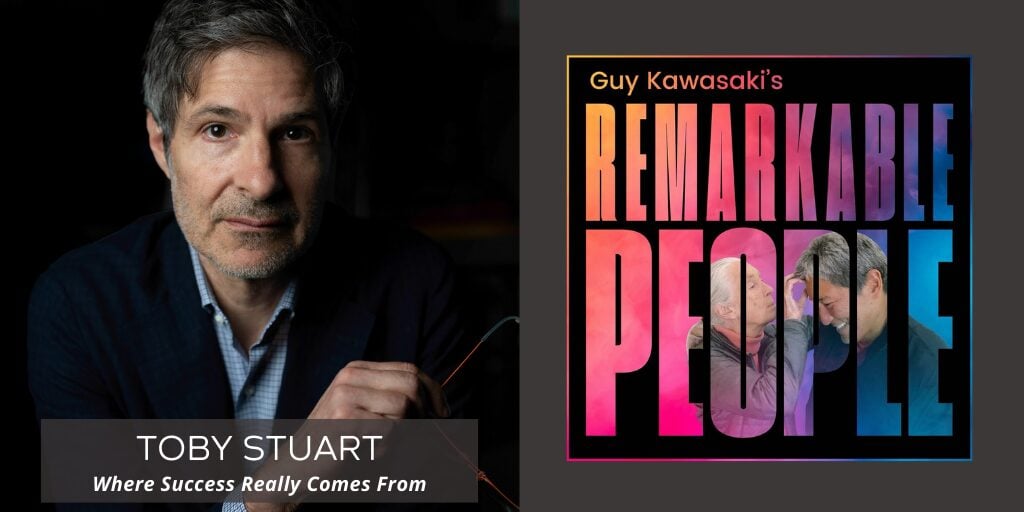
Welcome to Remarkable People. We’re on a mission to make you remarkable. Helping me in this episode is Toby Stuart.
Toby is a leading authority on innovation, entrepreneurship, and the hidden status systems that shape opportunity. His research challenges the comforting fiction that success is purely merit-based, revealing how pedigree, networks, and institutional choices quietly tilt the playing field. His new book, Anointed, examines how status is transferred and amplified in ways we rarely acknowledge. In this conversation, Toby shares stories — including his daughter’s admissions journey — that illuminate how inequality is reproduced even in places that claim meritocracy. He and Guy unpack how these dynamics show up in education, careers, and Silicon Valley mythology.
They also explore AI’s surprising impact on fairness: how it might eliminate bias in one area while intensifying it in another by making human output harder to evaluate. Toby explains why AI could inadvertently push us to rely even more on pedigree and branding, simply because we can no longer distinguish genuine skill from machine-polished work.
His message is not pessimistic — it’s clarifying. Understanding these forces enables smarter decisions, more equitable leadership, and a more realistic view of achievement. This is an essential episode for anyone who wants to see success with clearer eyes.
Please enjoy this remarkable episode, Anointment, Merit, and the Myth of the Self-Made Story with Toby Stuart.
If you enjoyed this episode of the Remarkable People podcast, please leave a rating, write a review, and subscribe. Thank you!
Transcript of Guy Kawasaki’s Remarkable People podcast: Anointment, Merit, and the Myth of the Self-Made Story with Toby Stuart.
Guy Kawasaki:
Good morning everybody. It's Guy Kawasaki. This is the Remarkable People podcast, and we have found another remarkable person to inform you and inspire you. His name is Toby Stuart. He's a professor at UC Berkeley's Haas School of Business, and quite frankly, he's one of the world's leading experts on innovation, entrepreneurship, and social networks.
His latest book is called Anointed, and I read it. I loved it. He's quite critical about, shall I say, some of the decision making process of Silicon Valley. So his work challenges the myth of self-made founders and reveals what it really takes to rise in today's innovation and digital economy.
Welcome to the show, Toby.
Toby Stuart:
Thanks, Guy. Thrilled to be here with you.
Guy Kawasaki:
Ah, Toby. Here we go. First of all, just out of curiosity, what school did your daughter end up going because you mentioned her in the book?
Toby Stuart:
Yeah, she went to Barnard College affiliated with Columbia in New York City.
Guy Kawasaki:
Wow. So you know what's 300,000, 400,000, right?
Toby Stuart:
Yeah. Give or take, but that's about right.
Guy Kawasaki:
I know Haas professors make a shit load of money.
Toby Stuart:
Oh, good. So we can say shit. I'm glad we got that out of the way.
Guy Kawasaki:
Just to give people more of a context here, the book is called Anointed, and most of it is talking about the positive effects. At least the advantages of being anointed. But you mentioned a very interesting case with your daughter, which was kind of reverse anointment, right?
The college admissions advisor says she's got five strikes against her. She's white. She's from a prominent academic family. She went to a private school, like five things working against her and so it wouldn't be easy to get her into a school. So can you just tell us that story?
Because we're gonna start with the reverse of anointment.
Toby Stuart:
Yeah, it was a funny story in my life. I'm a career academic and I'm the kid of academics. I've been around universities all my life, and so let's just say it's a family that really values education, and my daughter, she's an only child, and she had spent her life in the private, the independent schools, throughout her whole childhood.
I bounced around between a number of different universities, so we moved between places anyway. She ended up graduating from high school at a private school in Oakland.
And there's this moment when, like most any parents of kids this age have, many, many of them have been through it where you go meet the guidance counselor and you're given sort of the state of the state with respect to what's gonna happen with college.
And the school my daughter went is actually called College Prep, so a very original name. And so that meeting is kind of like if you go in and you feel like you're about to hear your kids' future, and I mean, we'll come back to why that is because the book is about why that is so, so important for one's future.
But I went into this meeting, and I had sort of had a sense of how well she was doing in high school, but I wasn't anticipating what he said, which is he described her as a five striker and those were the five strikes. The five strikes were she's female. She attends a high school or lives in the Bay Area. In New York, Boston, Chicago, LA I think, those five areas were the five listed.
She's from well educated, upper middle class family, and she went to a private school, and kinda what he said is at this moment, and so this would've been, it'd be different probably this year, but this was six, seven, eight. This would've been, I'm trying to do the math in my head, but eight, nine years ago, and at that point college admissions were looking to create a little bit more equality.
So there was something of a hesitation about what looked like overprivileged kids from affluent families, but maybe not affluent enough to name the buildings. Let's be clear like there's a range of affluence, which is still good, still works for you.
And so that was gonna make admissions difficult. Now the two surprises to me at the time were, one, that she was a girl, and the reason for that is because girls consistently have better grades and better test scores than boys do at this age. So if you were to use those two dimensions to make admissions, you'd end up with heavily gender skewed classes.
And most every place is trying for a roughly fifty-fifty mix. So actually makes it harder for girls to get in. They need higher scores. And then private schools because there was a little bit of a backlash against these elite private schools in admissions decisions.
Guy Kawasaki:
First of all, I would debate like, what's so wrong if girls were overrepresented in college, it's like why don't we flip it for a while and give them the advantage? But let's not go down that hole. So let's back up here. Will you just define anointment beyond the biblical sense of putting oil on somebody's head?
What do you mean by anointment?
Toby Stuart:
Yeah, so the book is a quite broad treatment of social status and status dynamics across economic markets, workplaces, social context, Silicon Valley art. So it's a quite broad book. And anointment refers to the act of transferring status, and it is biblical, and I couldn't tell you exactly why the title popped into my head one day, but it did on a COVID walk on a beach in Southern California.
I thought of the title and actually that's what cinched it. That's when I decided I'm gonna do the book, is when I thought of the title. And probably hearkens back to my Catholic school upbringing. But anointment is the act of transferring status from one party to another party. And it happens in small ways and large ways all of the time, so in our world, I wanna take you to Silicon Valley.
The ex-Apple guy, the ex-VC, the ex, you know, the longtime Silicon Valley marketer, and veteran of nearly everything. Anointment is when Sequoia Capital decides to invest in a company, or when Y Combinator decides to admit founders, right? These are acts of anointment or when UC Berkeley, or Stanford graduates a new class and prints a whole bunch of degrees.
It is the act of changing somebody's status through a transfer from party A to B. So the party might be YC, and the recipient might be a budding founder. And there you go. And it happens every day, everywhere, every place.
Guy Kawasaki:
I have to admit that as I was reading your book, I was simultaneously disgusted with how anointment works, but I was also convicted because I worked for Apple. I went to Stanford. I started a company that was funded by Sequoia. I know Jane Goodall. I had a lot of anointment going on in my life.
And so I was conflicted and the first thing I thought of, pardon my French, do you think anybody would give a shit about RFK Jr. if his last name wasn't Kennedy?
Toby Stuart:
Yeah, that's so right. There's been politics I've been trying to stay away from, but the answer is probably not a lot of shits. And we've been living in dynastic worlds, look at the Trump family and what the kids are up to and look at the Bushes, and look at the Clintons. We live in a family, in a dynastic world.
Now there's a quote in the book about this which I just love. I found it in the course of writing the book, and it's by Thomas Payne, or at least that's the attribution. And the quote goes, “If Homer's kid wrote a novel, I'm not really sure I'd wanna read it.” I thought, That's so good.
Guy Kawasaki:
On the other hand, there must be a reason why anointment and the transfer of social status works or what's the upside of it?
Toby Stuart:
That's a super nuanced question. Eventually we'll come to the fact that a world without social status is a much more complicated world. That is, we rely on status cues all of the time to curate the world for us and to get us from like options to decisions.
Like always, all day long, always, we rely on social status. Like we don't even think about it. And that's why I think folks should read the book. And why it's important is because there is this kind of force that operates in the background. And most of us we're not cognizant of it, but it operates on us.
It does in myriad ways all the time, but then behind that a sort of set of social mechanisms. So let's take you're a Stanford graduate and you're an alumni of Apple and you're a veteran Sequoia founder. And the sort of core economic logic of it is that Stanford doesn't admit just anybody.
And Sequoia doesn't just choose anybody to finance. And Apple doesn't just hire anyone. So these are in our world, yours and mine, and in the world, these are three very prestigious institutions. And when they make a choice to hire, to admit, to finance, we interpret that as evidence of quality.
They're super smart, they're super successful. They chose you because you're amazing. And the thing that misses is there's a set of reasons why they chose you and not somebody else that maybe aren't a hundred percent merit based. And the second is in academia, we call this selection versus treatment.
So these very distinguished institutions not only choose you, but they treat you. When by treatment we mean they give you a huge boost in status and then that helps you with everything that you do subsequently, right? So then it looks like they made wise choices, right?
Apple may be ashamed of a few things over its career, but hiring you isn't one of them.
Guy Kawasaki:
I don't know about that. Or I guess I'm living proof of the “Matthew Principle,” and like I should have been more successful now that you mention it that way. Just to set the record straight, Toby, the way I got into Apple is nepotism. My college roommate hired me.
The way I got Sequoia investment is that back then in the ‘.com’ days, Sequoia funded anybody if you had a room temperature IQ and a PowerPoint pitch. And then Stanford, I am so old, Toby, that as a Japanese American, when I applied to Stanford, I was considered an oppressed minority, so there's nothing about anointment.
There's mostly dumb shit luck in my anointment. Just to set the record straight, all right.
Toby Stuart:
I love the modesty, but I think also Stanford when you went was mostly Stanford. Sequoia when they financed your company wasn't Sequoia and Apple maybe wasn't quite Apple yet, right? So these institutions themselves have gained a great deal of prestige over the years.
But you know what you said as an intro into that. I actually, and it was funny, so thank you. But I also know it's quite serious, which is with nepotism, social networks that are elite contacts and contacts that get you into places that other people don't have these are all the ways in which opportunities are distributed.
Guy Kawasaki:
Yeah, let me just say that if Apple did not recover and become the two trillion dollar most successful company in the world. I would not exactly hold myself out as the former Chief Evangelist of Apple, right?
Toby Stuart:
And you clearly didn't hold your stock because we're up to three trillion now.
Guy Kawasaki:
Okay, I don't want to get into it, but I don't have any Apple stock. I think I have four shares. But anyway, so as I was reading your book about this anointment, and I kept coming back to like, I find it very difficult to find an example where an offspring is anointed and really lives up to the name and the potential.
You wouldn't say that Paris Hilton has outdone Conrad Hilton. You wouldn't say that Eric Trump is somebody you say that really took advantage and did something. Hunter Biden, I don't know if I'm pushing back on your concept, but I find it difficult to convince myself that anointment has really guaranteed success for people.
Toby Stuart:
If you take those three people, Hunter is a complicated one because for all the sort of legal accusations, the criminal accusations, in that case. But so take Paris Hilton, she may not have outdone Conrad Hilton. She had a career in which she probably earned hundreds of millions of dollars and became a global celebrity.
And so whether you outdo your parent who's like dynastic is one thing. The anointment dynamic is like the way that I think about it, and I'm always thinking about these things with my academics hat on it.
But the way that I think about it is, suppose you could take Paris Hilton and assign her at birth to some random family. And then you had two Paris Hiltons, one was Conrad's daughter and the other was the same human being, identical, everything the same, but just a sign to an average lower income family in America.
Like is the second Paris Hilton going to make hundreds of millions of dollars and become a global celebrity?
Guy Kawasaki:
Nope.
Toby Stuart:
And so that's the thought experiment. The thought experiment isn't do you outdo your parents? It's that, did you succeed far beyond you would have, had you not have been anointed with the Hilton name?
Guy Kawasaki:
Wow. When you put it that way, you know you're absolutely right.
Toby Stuart:
Let me take you back to our world, right? So let's take Y Combinator because that's always a fun one to think about. Each time Y Combinator admits a class, these days it's only AI, but in the past it was blockchain companies, and it was SaaS companies, and it was consumer companies.
And it was Healthtech companies, and it was whatever companies. They were looking across the spectrum. Okay, so they're gonna admit a class and let's say there are a hundred startups in a class, and it doesn't matter what the number is, but there's a hundred seats, right?
And so if you think about the selection process, what you're doing is you're comparing apples to oranges to begin with because you're comparing some Fintech founder to some PhD in biochemistry who's got a molecular target that they're working on. So already you're in a very apples to oranges comparison when you're looking at startups.
And so imagine, you could run this experiment where you have the hundred company, you take the hundred companies that Y Combinator admitted, and you find the one that was the last one. Okay. So it was the last slot they allocated. And then you find the founder who started the company that we'll call it the hundred and first company.
Like it was the closest to make the cut that didn't actually make it. Now what I would argue is that there's no quality difference between those two companies. Like on a different day, the hundred and first company would've been admitted, or there was some meeting dynamic. But it's random. It's effectively random. Like these are very hard decisions to make.
Like I don't admire the YC admissions committee, but if you then compare the fate, the future of the hundred and first founder to the hundredth founder that was admitted, I think you're gonna see super different outcomes, but you had the same quality to begin with.
And that's a status dynamic that then unfolds because the hundredth company was anointed and the hundred and first company was not.
Guy Kawasaki:
And so are you saying that this is inherently an unfair or at least random process, and we should fix it? Or you're just describing the phenomena and say, “This is how it is boys and girls. You should work at being anointed even if it doesn't necessarily reflect your merit.”
Toby Stuart:
This is how it is boys and girls. The book’s a lot about how the world works and not strongly a moral judgment. I'm much more concerned that people understand how things happen, and if you wanna then reverse engineer about how to acquire more status, you can certainly do that based on the information that's in the book.
But it's really about, this is how the world functions, and we should all understand that. And I think it's part of the cultural heritage of the United States. And look, if you take 2025 America and you compare it to almost any place at any time besides 2023 America, I think that you find that this is like a more merit-based society than we've seen nearly all places, all times, all of history.
But that doesn't make it merit-based. So we're doing better than I think we've seen historically. But there's lots of things that distort the connection between merit and achievement, or outcomes and social status is one of the biggest things that does that.
Guy Kawasaki:
Wait, let me make sure I understood that. You're saying that even today where someone ran a wrestling entertainment company is now Secretary of Education. You're saying even today, 2025 because your last name is Kennedy, you're running health. You're saying even today we are more merit based than most societies ever.
Toby Stuart:
Yes, than most societies in the history of the world. Remember, the history of the world is casted systems and monarchies and feudalist societies and by history of the world, I mean the broad spectrum of the history of the world. And there's still a large part of the sort of inhabitants of the world today live in somewhat oppressive societies.
In the broad sweep of history, 2025 America is certainly there's more opportunity to get ahead through merit and hard work than there is historically. But that isn't all, or in my view, really most of the story.
Guy Kawasaki:
Why do I not feel any better?
Toby Stuart:
I don't wanna bring you down.
Guy Kawasaki:
Theoretically, do you have ways that one can recognize and discern genuine expertise from the assumption of expertise?
Toby Stuart:
Yeah, that's a really interesting and really challenging question. So generally, I don't know that we work that hard to do that, right? Because we're ready to conflate achievement and merit, rather than going back and trying to explain how achievement happened.
So I think we all could do better with that than we do. And we all could think more about status dynamics and how people get to where they are. And we could all also think about some reflexive responses that we have to status cues. And I think collectively if we did that, we would have a less status based system.
But the benefit of status that we should talk about is that it really does help you come to evaluations. It makes it much easier to make choices about things, and it in fact really quite dramatically even curates the choices in front of you in most contexts.
And that's super helpful because we live in a world that's got just an overabundance of options for nearly everything and we need to make a constant set of choices.
Guy Kawasaki:
But basically Toby, are you not refuting the concept of the wisdom of the crowd? Are you saying, you know, it's the stupidity of the crowd?
Toby Stuart:
So the crowd has wisdom about certain things, so if you have what I think of as the classic wisdom of the crowd problem, which is, if you have an urn and it's filled with red and blue balls and you wanna know how many red and blue balls are in the urn, a good way to get there is to ask 10,000 people and take the mean or the expected value of those guesses.
And the evidence shows you're probably gonna get pretty close to how many the actual urn is, so people will be too high. People will be too low. Some people get it right on. But the crowd has wisdom that the individual does not. And prediction markets work the same way.
So there are many examples, in which crowds have wisdom. I'm just not sure that crowds are wise with respect to status processes.
Guy Kawasaki:
So are you saying that if you see a big line of people in front of a restaurant, that is a reasonable way to estimate the quality of the restaurant because of the wisdom of the palette of the crowd?
Toby Stuart:
That's so funny because this is one of the classic quality signals about restaurants. We're all told like you're in a city and you've never been in that city and you're walking down the street and you wanna know where to eat. And there are four restaurants on the block and one of them's full and two of them are half filled and one of them's empty.
And from that information, we are to deduce the full restaurant is probably right. And I actually am totally on board with that one. I think that's probably generally true. Like particularly if you're in a place where there's lots of locals, but the line out the door is a different thing, right?
The line out the door is typically manufactured, so I love lines out the door. It's like there's this ice cream shop, I forget what it's called, in South Berkeley. There's always fifty people waiting for ice cream.
And of course I wait in the line because I had a kid at the time, and she saw the line and then wanted to wait in the line. And so I wait in the line, and I get there, and I realize when I get into the store that the line's intentional. Either it's like the laziest staff ever, or they've been told to take their time to make like the perfect round scoop or whatever.
Because the line out the door makes it seem like it's the ‘it’ place. And that gets to like, I think one of the central mechanisms about anointment, which is that it's reflective. Is the hot restaurant hot because it's amazing? Or is the hot restaurant hot because the fashionable, the cool, the high status, the people you admire go to that restaurant and then you wanna go because they wanna go?
And then more people wanna go because the restaurant's hot. So you end up just in a circle, right? This reflective circle where the restaurant's hot because the in-crowd's there and the in-crowd goes because the restaurant's hot, but the restaurant's hot because the in-crowd goes, but the in-crowd goes because the restaurant's hot.
And that tends to be less a quality signal and more a status signal, and the reason people go to those places, all of us can imagine the place I just described, like wherever you live, whatever you do, we all can imagine that place.
People don't tend to go to these because they think it's the most amazing, culinary experience, right? They go precisely because it's the hot place.
Guy Kawasaki:
I'm trying to wrap my mind around this. So Marilyn Monroe is sitting in the front row of my performance for two weeks and because Marilyn Monroe is there because she's so famous, I must be a good singer or I don't know LeBron James endorses a car, or I don't think Matthew McConaughey really drives the Lincoln Navigator.
I could understand if Matthew McConaughey was recommending something he really knew a lot about, or LeBron James was recommending a basketball shoe or something. But why do people think that Marilyn Monroe is now my music expert? What transference does that occur?
Toby Stuart:
That's such a good question and I'm like looking at you and I almost wanna turn that one around because you're the marketer and I'm not, so you know way more about whatever decision the Ford Motor Company made to hire Matthew McConaughey to represent the Lincoln brand.
Like that was the marketing department who made that decision, but let's take those apart. The Marilyn Monroe stories in the book, I have always loved that one. So I think a lot of cultural tastes are also status processes.
Most of us don't know the difference. If we do blind tests and bottles of wine, we're not gonna do well in terms of identifying which one's expensive, which one's high quality according to the experts, like we're poor at making judgements in cultural markets.
And that's probably to a lesser degree true in music. We understand what we like and what our own preferences are, but the Ella Fitzgerald story, and I like it because she's arguably like the greatest female vocalist ever in my mind, but I love jazz.
I think she has one of the greatest voices I've ever heard. But to build her career, Marilyn Monroe turned out to be a huge fan of hers when she was young, and she got a sort of breakthrough gig at an LA nightclub because Marilyn Monroe agreed, who was already a mega star.
Marilyn Monroe agreed to go every night Ella played and sit in the front row. And the club owner was like, that's a deal I'll take. And then Ella got a couple weeks of performances at this club, and that is one of many things in addition to an amazing voice that led to the stardom that she eventually had.
But what you're getting at is it's just central in the marketing world, right? Which is think about the products that celebrities and athletes endorse, and the big spenders are Adidas and Nike and Babolat and Titleist, right?
They're the brands that are sports relevant, but those athletes or celebrities then become spokespersons for Lincolns and for Mercedes and for Rolexes and for all the brands that you can think of and ask yourself, like, why would you care? Do you wanna wear a Rolex? Because Roger Federer wears a Rolex, obviously. It was expensive for Rolex to hire Roger Federer.
And they paid a lot of money for that, and they did it with a whole bunch of math on, and I'm looking at you like when you go pitch like the Roger Federer endorsement at the Macintosh and you show up in Jobs’ office, you damn well better have ROI math to show him that's the best f-ing investment that he's looked at in a long time.
And this happens because the status actually successfully transfers. It's somebody we hold in high regard. And when we associate them with a product, not all of us, maybe not you, maybe not me, but many of us, accept that as an endorsement of the product. And it elevates the brand and our willingness to pay in our minds.
Now, I think, it's important to say that there’re breaks on this process, right? So if Matthew McConaughey endorsed every brand you've ever heard of, you'd be like, yeah, forget it. So there needs to be some selectivity in representation. And if there isn't, you're gonna end up dissipating your credibility as an endorser.
Guy Kawasaki:
Alright, so now let's get out of the discussion of celebrities and stuff, and let's flip it and say now, I could make the case that artificial intelligence has the ability to truly judge the genuine quality of something. And so AI could be the ultimate meritocracy when you wanna do searches about what's the best minivan to buy, what's the best basketball shoe to buy.
On the other hand, the corpus and the data that goes into large language models reflects whatever the large language model has read. So now, do I trust AI or not? Is AI just reflecting what all these influencers said or is AI thinking for itself?
Toby Stuart:
Yeah, that's the fifty trillion dollar question. Now we're way past Apple's market cap. But I love the question, and this is what I think about all day, every day. If we get started on AI, then I won't stop because I'm AI obsessed, and that's a terrific question.
So take like one of the classic cases where there's status dynamics, which is like in the job market and the job market is also where a great deal of kind of merit inequality unfolds because work is how we earn income and create wealth. And compensation in the job market determines like economic outcomes in this country.
At least, non-inherited wealth is often created through that. Which then, of course, is where if you make money investing, you earned in the first place to be able to invest it.
The book dives into this a little bit. Like it's not the central topic in the book, but if you take for example, like the classic audit studies, what they did, which was super clever, is there's this classic study that takes a whole bunch of resumes.
Imagine this experiment like you take 10,000 resumes, but you create pairs, so you create two of the identical resume. And by identical, literally identical. Like every job is the same. Every job description is the same. Every degree is the same. Every word is the same. Every font is the same.
The paper is the same quality, like everything's identical. But there's just one change, and that is we're gonna take the first resume and we're gonna call it John Smith's resume. And we're gonna take the second resume and we're gonna call it Tyrone Washington's resume. Okay, so there is no other difference besides the name on top of the resume.
And it turns out when you do this, like this experiment was like, okay, so we create these resumes that are paired and then we send them out to actual hirers, like we send them out to companies that have posted jobs.
And it turns out that the resume with the white sounding name gets called back something like 50 percent more than the resume with the black sounding names, but they're the identical resume.
And so that's the experiment. And so what does that tell you? That tells you that there is some kind of bias in how people are thinking about this. Like people aren't evaluating just the skills and qualifications of the person because there is literally no difference in terms of the documented skills and qualifications at this stage of the process.
They're making an assumption about the candidate's ability or their reliability or their merit, or the likelihood that they'll fit in, or something based on the identity cue of their name and that's the core thought experiment that you want to think about. That's the core status dynamic.
You can imagine it with brands where you take the same product and you call one, like literally the identical product, and you call one a logo that's prominent and one a logo you've never heard of. And it has a very different value even though it's the identical product.
So in principle, we can build AI systems that don't give a shit what the name is. All they do is they read the skills and qualifications and make inferences about that and that system which, and without getting into the technical aspects of this, there's been a ton of super interesting, very clever work on how to de-bias AI systems because you're absolutely right.
If you train an AI to make decisions, what it will do is it will mirror the decisions that humans have made. That's exactly what the system does in supervised learning models. It learns from the past decisions that humans have made about what the right choice should be.
But if those are biased choices, like we often see in labor markets, there are lots of different ways people have thought about to create AI systems that are, one, auditable, so you can actually look a little bit under the hood and see how their decisions are made and that second are de-bias.
So if we gave a bunch of decisions to de-bias AI systems, I would make the argument that they will make more fair choices. So on the one hand there's a theoretical possibility that AI could lead to a lot more equality and outcomes if we used audited de-bias, carefully constructed systems, that made choices without factoring in things like age and race and gender.
And whether you're a Japanese American or just an American, or a French American or Hispanic or anything. So we could have systems that do this.
On the other hand, I've been thinking a lot about this recently and AI creates a second problem, which I think is at the moment just a giant problem that we're just starting to talk about, which is that it suppresses the amount of information that's available to us when we're trying to evaluate human beings.
Okay, so now imagine like it's 2027, you're the admissions officer at Stanford University or the University of California at Berkeley at 2027, and you're reading college essays. What's gonna happen?
Guy Kawasaki:
Did I get 500 million from the Department of Education or not? I need to know. How much am I dependent on federal funding?
Toby Stuart:
I don't think there is a Department of Education anymore. Hasn't that been? Didn't we close that?
Guy Kawasaki:
Good point.
Toby Stuart:
What I'm getting at is like it, there used to be a ton of variation in the essays that high school students wrote, and the reason that, and to go back to where we started off, when you asked me about my daughter. My daughter was very likely to apply to college with a very good college essay.
And she actually, my kid turned out to be a comparative literature major and just fought with me when I wanted to make like minor modifications to her essay because she's probably right, but she thinks she's a better writer than me and she probably is. But if she were not that, I'm a career writer because my job is to write scientific journal articles.
So I've spent my whole life writing, so I'm probably gonna help my kid. So there are these advantages that kids coming outta families, like my daughters have, which is that I've spent my whole life in universities, in very good universities.
Like teaching, working there, writing, thinking, so I understand what looks like a good application package and that in theory is gonna be very helpful to my child.
But now everybody understands that because it's just a prompt to GPT-Five Point Zero or Gemini-Two Point Five or Claude-Four Point One or Grok or DeepSeek or Quinn, you know, on and on and on and on and on and on. And those systems today are beautiful writers if you prompt them well. And if you prompt them poorly, they're very good writers.
And that means that everybody shows up with a high quality essay, which makes it much harder to evaluate the person's contribution. So in most work now, the use of AI systems is incredible, and that's because they are absolutely incredible. But they make it very difficult to decouple human work from outcomes or output.
So I'm teaching a PhD course now. When I read submissions, essay submissions, each week, it is very hard in the modern world to know whether a student like really understands, is really thoughtful and has done really good work because the thing is if you give the papers to Gemini, it does the work in about half a second.
It's incredibly thoughtful in topic modeling the concepts of paper. So it's incredibly thoughtful at understanding papers and it's incredibly good at writing down ideas for novel extensions or for criticisms or something like that.
It's amazing. It's extraordinary. But what that means is when you have a student write something. How do you know whether it was the student or the machine? And that's a writ large problem right now. And to take it back to status, I've been editorializing on this, but the argument that I would make is, what it's gonna do is it's gonna make us rely even more on pedigree?
Because I have to give up and say, “I can't evaluate the work product, but that kid went to this high school and this college and did this and that.” And I know that like I can see those signals, but I can't make a decision based on the output.
So I'm gonna rely more heavily on the signals than I would if I could just read the essay and decide whether the student's good or not.
Guy Kawasaki:
Holy shit. Talk about unintended consequence, right?
Toby Stuart:
That's a huge, I think, and AI, it's a world of unintended consequences. This is the most important technical development ever. It's going to affect most things about most things, and it is going to have endless unintended consequences.
Guy Kawasaki:
Wow. But if you think about it for a second, so if it depends on pedigree and pedigree in the first generation depended on something, not exactly necessarily causative, it just perpetuates the whole flawed system.
Toby Stuart:
It's the system, and we need a system. And the short answer to your question is perfect. Yes. Thank you. You described the world. You know that's a good description of how the world works. I wanna not be so quick to jump to it's all just dog shit and everything's a problem.
Because the truth is, true meritocracy is a little bit of a myth. I don't think we're ever gonna get there. We need some kind of system for allocating resources and for making decisions. And right now, this data system is how we do those two things.
And we are going to need some way to do that. And so the book does point out like the inequities that are associated with making the choices these ways. But it also makes the argument, which I think is the overriding one, which is we need a system, whatever system we have is likely to not be a hundred percent fair, but a system is far better than none.
Guy Kawasaki:
Wow. I must say that this is one of the rare episodes of my podcast where I end up thinking I know less than when I say started that. That is a rare distinction, Toby. You've really scrambled my brain here.
Toby Stuart:
Oh now, I'm speechless. For what it's worth, I didn't intend to do that.
Guy Kawasaki:
On a very tactical level, let's say that you needed a tree trimmer to cut down the eucalyptus trees in your property, so do you go to ChatGPT and depend on what ChatGPT says when you say, “I need the best eucalyptus tree tremor in the hills of Berkeley.”
Or do you go only to Yelp or Google? What does Toby do?
Toby Stuart:
If only I had property in California on the peninsula with eucalyptus trees, if only, but I'll tell you like, the one that I had that's my version of that, is I don't ever shave. I have this little beard like clipper thing that I just like I'm looking at your nicely shaven face.
So I stopped doing this. I have this little clipper thing and I needed a new one a couple weeks ago. And so I normally have this process for doing that. Like it's probably the same as you, like I read Wirecutter.
Guy Kawasaki:
Exactly. I was just gonna say that.
Toby Stuart:
Which is, despite being in the New York Times is 95 percent paid affiliations, right?
Guy Kawasaki:
No.
Toby Stuart:
So, yeah. It is.
Guy Kawasaki:
So how decisions did I make wrong then?
Toby Stuart:
Right. I mean, so you think that it's New York Times and it's Wirecutter and therefore it's reliable information. But I think if you look more carefully, there are affiliate links behind nearly all of the Wirecutter recommendations and that can't be a coincidence.
But you can go do that and then you go onto Amazon, and one costs like ninety bucks, and one costs sixty bucks. And that's a big difference. So then you spend, I don't know how much time thinking about whether you need the nighty dollar one or the sixty dollar one and there's 7,000 pages of the damn things for some reason.
Like they just go on forever and ever and ever. So I have this decision to make, I hate making decisions like this. I find them confounding, and I waste like an inordinate amount of time doing this. And so try this because I've confused you and now I wanna unconfuse you.
So I went the other day and I'm gonna stop like, I mean, I love three of the AI systems equally. Like I switch between them all the time.
But I went to one of them, I'm not gonna say which name it is, and I said, “I need to be a clipper. I don't give a shit about what the brand is. I don't care about any features besides that it works. I don't wanna get mangled, so don't make it like dirt cheap. Recommend one.”
Guy Kawasaki:
And.
Toby Stuart:
It recommended the Wall Peanut. I bought it and I loved it, and I spent zero time thinking about it because I asked it for one recommendation. I didn't look for anymore. But the question is a great one. So already they're somewhere between five and 500. I can't tell startups that are building shopping agents.
You're a marketer, so you are trained in all of the psychological quirks and all of the heuristics that lead to consumer decision making. So when you're a marketer or you're thinking forever about how a customer makes choices and you're trying to reverse engineer those choices and then present your product and brand in the way that appeals to the customer, right?
But we are gonna move into a world where we all have the choice if we wish to have our who have agents represent us that aren't subject to those heuristics and biases and that have the capability of literally reading every review ever written, looking at every price, mapping out the history of prices.
And telling you like, “You should buy this, but you should wait three weeks because it's gonna cost 25 percent less on these three websites.” Like all of that already exists, commerce is about to enter a new phase. Now, of course, on the other side of that, companies that sell things are gonna try not to cut prices, because they're up against a bunch of bots.
But the way in which consumers make choices and the way in which we shop for machines to cut down beautiful eucalyptus trees in your backyard and Guy, just leave the trees. They're amazing, eucalyptus trees. But that’s all in the process of changing. So I think most people don't see this now but give it twelve to twenty-four months and they are going to see a radical change.
And that's all AI, right? Because now there's a new way to find information that isn't your typical Google search or Instagram ad which are, of course, all about producers selling things who are paying to be recognized or trying to manipulate the algorithms to appear up top.
Guy Kawasaki:
Well Toby, if I ever meet Matthew McConaughey, I'm gonna ask him what beard clipper he recommends. Just for you, Toby.
Toby Stuart:
That's amazing.
Guy Kawasaki:
My very last question for you, it's maybe the hardest question I'm asking you. So let's say by just some magical touch that now you're in charge of creating a new status system for society. So this is the Toby Stuart status system. How would this work?
Toby Stuart:
God. Yeah, that's quite a question to end on because not only do I need to answer that question, but I need to somehow unconfuse you in the last minute of this. What I would probably say is so I'm not smart enough to know how to replace the status system. The argument that I would make in the book is that it's something of an obligation if you have it.
And you do, you have it Guy. And I feel like I do. I feel like I've had tremendous, good fortune in my career, and I've had the opportunity to be at five of the ten most amazing universities in the world and have had brilliant students and had tons of resources. And I believe I'm super lucky for that to have happened.
But what I don't think is I earned at all like I never think I'm the smartest person in the room when I'm with my colleagues. I don't think that way. I think I got super lucky at various points and that then led to this sort of accelerating, call it, a status advantage, that was a benefit to me.
And if people just recognize that, or to go to probably my favorite quote in the book, which people usually attribute to Barry Switzer, and you've probably heard this one where he says, “The guy was born on third base, but he thinks he hit a triple.”
So I'm gonna answer that way, which is, if you were born on third base, or if a bunch of things happened in life that were just good fortune to get you to third base, that wasn't all you're doing.
You shouldn't think you hit a triple, right? You should understand like what led you there. And then that understanding tends to lead us to think and behave a little bit differently. And to pay a lot more attention to fairness and merit and how we distribute opportunities. And I think that's the important message in the book.
Guy Kawasaki:
Yeah, but Toby, I would make the case that the further you are on the base path, the less likely you will have the self-awareness to realize how you got to that base.
Toby Stuart:
And therein is the problem.
Guy Kawasaki:
Yeah.
Toby Stuart:
But we can all think, and we can all reflect on things. As I learned these concepts, which started in graduate school, it really radically changed how I think about and see the world. There was one paper I read in my first or second year of graduate school that just like, it was transformation.
It's about the “Matthew Effect.” It's where this line of research began for me, and it completely changed the way I understand the world.
Guy Kawasaki:
Wow. I feel like the world shifted under me today, Toby.
Toby Stuart:
If you're still confused, then I think we just have to find a time and place and we're gonna have to do part two.
Guy Kawasaki:
For you listeners, just understand that because I work for Apple and I went to Stanford and I was funded by Sequoia, don't necessarily attribute any skill or intelligence to me. Don't think I'm stupid either, but don't make that leap. I would not say you should be pessimistic.
I'd say you should be skeptical.
Toby Stuart:
That's a great way to put it, and just my response would be yes, but it's not that there's a correlation, it's just not a perfect correlation. So Sequoia doesn't randomly choose founders, Apple doesn't randomly choose employees, and Stanford definitely doesn't randomly choose the 3 percent of the kids that apply that it admits.
It's just that merit is a little bit hard to detect, and that the anointment dynamic is self-propelling, right? So on average, the anointed people are very good at what they do, but they're often less good than their status would imply.
And that's really the message.
It's not that anybody could do what you've done in your career, but it's that you got a lot of boosts along the way from these prominent affiliations and from other things that led to the status that you have today. And that combines with your work, your work ethic, and your merit to create your life outcomes.
Guy Kawasaki:
Toby, I think I'm gonna go to my LinkedIn profile and wipe out all those references right now. All righty. Let's wrap this up before my head explodes. Toby, thank you very much.
For you listeners, the name of the book is called Anointed, and if you wanna read about how people think and then how the status system works, is very, very interesting book, but it's gonna make you question a lot of the things you've decided in your lives.
Toby, thank you very much for appearing. I'd like to thank my staff, the Remarkable People team, which would be Madisun Nuismer, producer, Tessa Nuismer, researcher, Jeff Sieh, co-producer, and Shannon Hernandez.
And Matthew McConaughey for endorsing the Lincoln Navigator. And luckily I don't need to shave, so I don't need a beard clipper. There's gonna be a lot of people in the Pentagon who now need beard clippers, but I digress.
Sign up to receive email updates
Enter your name and email address below and I'll send you periodic updates about the podcast.

Leave a Reply