
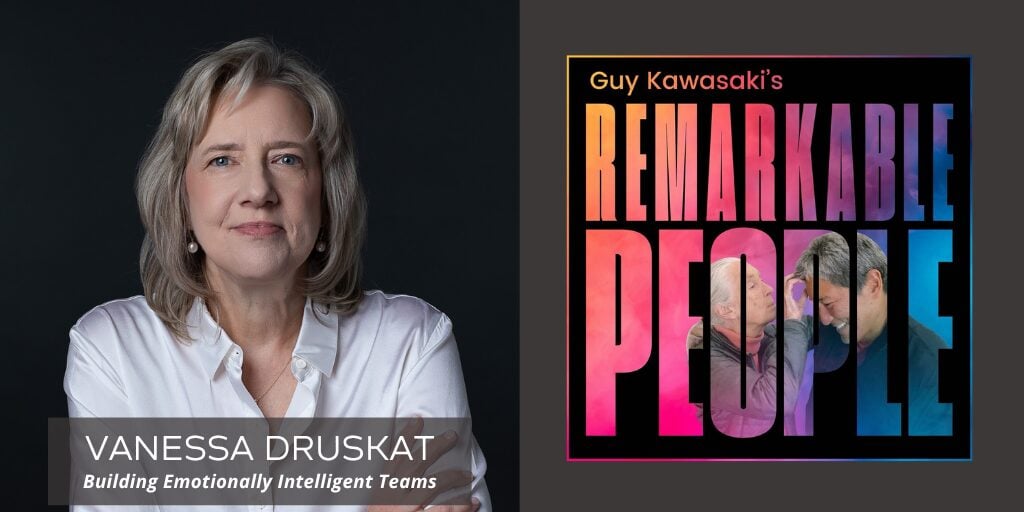
Welcome to Remarkable People. We’re on a mission to make you remarkable. Helping me in this episode is Vanessa Druskat.
Vanessa is no ordinary researcher; she is the “Jane Goodall of teams”—a pioneering scientist who spent 30 years observing team cultures in their natural habitats. Her work has influenced hundreds of thousands of people across thousands of organizations worldwide. As an associate professor at the University of New Hampshire, she has infiltrated boardrooms, manufacturing floors, and Johnson & Johnson’s drug development labs, revealing the hidden patterns that separate championship teams from the also-rans. Her groundbreaking research co-developed the entire foundational concept of emotionally intelligent teams.
In this episode, we uncover how emotionally intelligent teams create environments of trust and psychological safety that drive superior performance. Vanessa’s detective work identifies nine specific behavioral norms clustered into three game-changing categories: understanding individuals, continuous learning and adaptation, and reaching outside the team for fresh perspectives. These discoveries shatter the conventional wisdom that simply hiring emotionally intelligent people creates emotionally intelligent teams. Instead, it’s the invisible environment and established norms that determine whether team members will unleash their best collaborative behaviors or retreat into self-preservation mode.
Through riveting examples from the Boston Bruins’ locker room revolution to high-stakes crisis simulations between the FBI and CIA, Vanessa demonstrates how team norms shape behavior more powerfully than individual personality traits or MBA credentials. She reveals why even the most empathetic person becomes a selfish actor in toxic team environments, and how simple changes like eliminating rookie hazing can unlock championship performance. Her book “The Emotionally Intelligent Team” provides battle-tested tools for leaders ready to transform their teams through intentional culture building.
Whether you’re leading a skeptical startup in Silicon Valley or managing remote teams across continents, Vanessa’s insights offer a proven roadmap for creating the conditions where every team member contributes their best work while fostering innovation and resilience. The most powerful revelation? Great teams aren’t born from great hiring—they’re forged through great norms that make everyone feel valued enough to share their wildest ideas without fear of ridicule or retaliation.
Please enjoy this remarkable episode, How to Build Emotionally Intelligent Teams: Vanessa Druskat’s 9-Norm Framework.
If you enjoyed this episode of the Remarkable People podcast, please leave a rating, write a review, and subscribe. Thank you!
Transcript of Guy Kawasaki’s Remarkable People podcast with How to Build Emotionally Intelligent Teams: Vanessa Druskat’s 9-Norm Framework.
Guy Kawasaki:
Hello. I'm Guy Kawasaki. This is the Remarkable People Podcast. We're on a mission to make you remarkable, and we found another person in New Hampshire. Her name is Vanessa Druskat, and she's an organizational psychologist and associate professor at the University of New Hampshire. And believe it or not, she co-developed this whole foundational concept of an emotionally intelligent team.
And that's what we're going to discuss today about trust and collaboration and performance. And I dare say her research has influenced hundreds of thousands of people in teams and thousands of organizations. So welcome to Remarkable People, Vanessa.
Vanessa Druskat:
Thank you Guy. I'm really happy to be here with you.
Guy Kawasaki:
I've been on companies that had innovative teams. I've had companies that had well-performing teams or whatever, but nobody ever, Guy, that is an emotionally intelligent team. You're on. So just as a basis, can you tell us what is an emotionally intelligent team? I know what an emotionally intelligent person is, not that I am one, but I don't understand the concept of a team like that.
Vanessa Druskat:
You bet. To do that, I'm going to have to back up a little bit and tell you that when I was in graduate school interested in studying teams, I didn't hear anything about emotion at all. This was pre-emotional intelligence time, 1990s, early-1990s.
And one of the things I learned when I reached out to learn outside of academia is that if you read the emotion in the room, it tells you everything you need to know about a team. So I took this two-year course at the National Training Laboratories on how to facilitate teams and that's what they taught me. And so I learned quite early that emotion is an indicator in teams.
So later on when EI came out and the focus was on developing emotionally intelligent people, I knew enough about teams to know that just because you stack a team with emotionally intelligent people doesn't mean you get emotionally intelligent behavior. And the reason for that is that the environment in a team makes a huge difference.
For example, it doesn't matter how empathetic you are or how much self-control you have, if you walk into a team and no one else is being empathetic or people are being disrespectful, you're not going to be very emotionally intelligent. Does that make sense? Your empathy is just going to go out the window.
And so skills and personality and attitudes tend not to be a great predictor of behavior and complex teams. A far better predictor is the environment that you're in and the norms and routines and the way people behave around you. And so emotionally intelligent teams build environments that lead to trust and psychological safety and they build relationships. And the positive constructive emotion leads to higher performance, and there's much more in that which we can peel apart.
Guy Kawasaki:
Now as I understand it, aren't there nine norms that define an EI team?
Vanessa Druskat:
Yes.
Guy Kawasaki:
I'm not going to ask you to explain all nine, but I know that they cluster into three different groups. So can you just explain the clusters, so people have an idea about what makes up a team?
Vanessa Druskat:
Sure. So first, let me again back up for a second and tell you how I came up with those three clusters. So I went on this quest to figure out what differentiated the truly highest performing teams from average performing teams. My mentor in my doctoral program was the first person to talk about competencies in jobs. And so competencies were defined as the behaviors that lead to performance, the behaviors that differentiate the greatest performance.
So I asked him to do that with me with teams. So I went into many organizations, the first one was a manufacturing organization. Another one that I can talk a lot about is the drug development teams at Johnson & Johnson. And we singled out the top 10 percent performing teams.
For example, Johnson & Johnson was heavily invested in figuring out why is it that some of their drug development teams are so much better than their average performers than others? And so we identified those top 10 percent, and we interviewed them, and we surveyed them. And in other organizations, I've videotaped teams, et cetera.
Anyway, what I've found in thirty years of doing this work is that there are three categories of behavior that differentiate the top 10 percent from average. And these fall into the three categories. The first category is about focusing on individuals. How we help one another succeed. But it's really about getting to know one another, giving one another feedback, figuring out what distinctive capabilities you bring to the team and valuing those.
So the first cluster is about the individuals and about relationship development. The second cluster is something that I think you're going to like because heard you talk about the growth mindset quite a bit. The second cluster is really all about learning and adapting and changing. And so in the second cluster, it's how you assess yourself. And again, these are norms. So this is part of the team's culture. So they're routines, habits.
And so in the great teams, they periodically, routinely step back and say, "What could we be doing better? What's going well? What do we need to change? What's coming down the pike? Have we heard from everyone?" They make sure that everyone has a sense of control over this conversation and input into the conversation. So that's the second cluster. I can talk more about that if you're interested.
But the third cluster is about reaching outside the team for new ideas. This involves talking to your boss's boss, to your clients, your customers, to people in other industries who have information that can help you.
It's used by the high performers because the high performers recognize they don't have all the information they need and that there's a lot of information out there that can make them better. And again, they're interested in that growth mindset. They're interested in continuous improvement. But it all begins with the first cluster, which is about understanding one another.
Guy Kawasaki:
So as I'm listening to this, I'm in Silicon Valley, and let's just say we're not the center of the humility in the world. I think that people, when they hear about the first cluster, their first reaction is, I don't want some touchy-feely exercise about people explaining their background and where they're coming from.
I just want to be in this meeting. Let's figure out how to get sales higher. Let's figure out how to get rid of the low performers. Why are we doing all this touchy-feely getting to know each other? So maybe you can shoot down that skepticism.
Vanessa Druskat:
Yeah. I can shoot that down in two ways. First, we now know that there are a set of social needs that are activated when people enter groups. And the need that rules them all is one that we're unaware that we have, and it's the need to belong. So let me define belonging for you. It means that first we're genuinely accepted, known, understood, valued, and supported.
That rises above needs like a need for control, the need to feel valued, the need for information, the need to be on the in. It drives things like gossip because we want to be on the in. We want to know what's really going on around here because we want to maintain our status. Status essentially means you belong. It means that you're secure.
Now, this is a need we don't know we have, but we certainly know when we don't have it. And that's when we're ignored or feel like we're invisible, treated like we're relevant. And that's the behavior that will reduce participation and keep a team from being as creative as it could be. So that's one piece. One piece is that we've got these social needs that they are involuntary Guy.
This is not a need that we can negotiate where you can tell me that I have it or I don't. I actually have an interesting list here if I can find it of how the need to belong or our reaction to feeling invisible affects everyone regardless of your attachment to your mother, regardless of your personality, regardless of your social anxiety, regardless of any proclivity that you have we all have it.
And we know this through neuroscience, and we know this through all kinds of things. So anyway, that's the first thing. I always want to plop that there. Hopefully I've convinced you slightly that that matters. I also want to draw your attention to a book that was written about the Silicon Valley. It was about Bill Campbell. Are you familiar with Bill Campbell?
Guy Kawasaki:
We overlapped at Apple and yeah, I knew him well.
Vanessa Druskat:
Okay. I read with great interest the book that Eric Schmidt and colleagues wrote about Bill Campbell's philosophy. And one of the things, at least you can tell me whether this is true or not, I love that, that Eric talked about how at the beginning of meetings he would do something called trip reports, where people would check in about where they'd been, what was on their mind, this thing. Trip report is how we get to know one another. That's basically what it is.
I get to see how Guy thinks, what he's noticing. I want you to think of a sports team or team of musicians where you wouldn't know enough about the other person to know how to pass the ball, how to kick the soccer ball, or how to play in a way that would catch the attention of your teammate or that would complement what your teammate did. It's the same thing that we see in the very best teams. We see that they do that they get to know what one another's proclivities are, if you will.
Guy Kawasaki:
I loved your example in the book about, I can never pronounce his first name, Chára is his last name, the Boston Bruins defenseman.
Vanessa Druskat:
Oh, sure.
Guy Kawasaki:
And so you tell the story about how he stopped the rookie hazing and all that, because basically he illustrates your concept of he wanted rookies to feel like they belong, right?
Vanessa Druskat:
Yeah. He wanted everyone's energy to come out in that locker room. He wanted everyone to feel like him, and he didn't use the word belonging. Again. There are a lot of organizations where, I won't use that word because it sounds so touchy-feely. But he wanted everyone in. He didn't want status or experience to override the way the rookies felt. They needed their energy.
Guy Kawasaki:
You use the word norm so frequently in your writing. Could you just back up and define what norm means?
Vanessa Druskat:
Yes. Absolutely. It's a tough one because so many people have asked me to use a different word. I also try to use the word habits or routines, but norm's define normal behavior in this environment. So this is how we do it here. So one example is when you walk into a meeting, do people greet one another?
Another norm is do you acknowledge people when you pass them in the hallway? Do you look people in the eye? Do you pick up your phone during meetings and answer things? And here's more importantly, when do you pick up your phone? You certainly don't pick it up when the boss is talking, but who are you allowed to pick up the phone during their speech while they're talking? Those are norms.
And you're either going to like this or not like this, but I've been called the Jane Goodall of teams. I know Jane's a friend of yours, so I don't mean to insult her in any way. But it's because I've spent so much time observing team cultures. Okay. I go from team to team to team, teams doing the same task, and I look at the different ways they interact.
What's normal? Teamwork is about interactions. It's not about my interaction with the boss, it's about our interactions together. And the way team members treat one another and interact together determines the level of motivation, how much people will speak, the kinds of things they're going to say.
And if you don't feel like you belong, then you have to do things that are going to get you in, which basically means conform. And already we know that when you're about to disagree with someone, if you're going to disagree with the boss or someone with status in the team, your brain sends you an error message.
Yes. So we used to think people just conformed. They would just say, "I think I'm just going to go along with the group." That's not how it works. And we can talk about evolution if you're interested. I'm fascinated by how we've evolved to live in tribes and clans and evolve to collaborate. It's the collaborative clans that survive longer.
But anyway, we also learn to fit in. Kids learn that in high school. They have hormones that kick in so that they're interested in fitting in. They build those skills that they use for the rest of their lives. You don't want people in your teams behaving in ways to fit in. You want to check that box, move it to the side, let them know their value, and then encourage them to share their crazy ideas. Does that make sense?
Guy Kawasaki:
Yeah. That makes terrific sense now. Can you tell me how are these norms formed? Is it top down from the leader? Did Bill Campbell say, "Okay, everybody, we're starting every meeting with an update about a trip report." So now when you guys conduct meetings, you also start with updates. So was it Bill Campbell in leadership or is it more organic and from the bottoms and the middles of a team?
Vanessa Druskat:
First of all, there's norms in every team. There's no such thing as a team without norms. The question is whether or not they're effective, whether or not they suit the environment and the objectives of the team. Typically, we watch the formal and informal leaders, people with status in the team. And I got to tell you from what I read about Bill Campbell. I never met him.
He was instrumental in creating these relational high-performance norms. So it's not just about relationships and getting to know one another. It's about giving your best, putting the team first and performing well. He would ask, what's getting in your way? Talk about a way of growth mindset. So anyway, those norms come from the people who are in charge.
Let me tell you a story, a great story about norms in high schools. This is the thing that captures my attention these days because I'm constantly trying to figure out how to explain the power of norms to people. Anyway, wonderful researcher named Elizabeth Paluck at Princeton decided to study bullying in middle schools and high schools in New York state.
So she went to fifty-six schools. And most schools, when they're trying to stop bullying, what they do is they try to teach empathy to kids. So in my kid's school, they brought in these speakers, they made them sign things that said they were going to be empathetic. Unfortunately, teaching people empathy and putting them into a system that doesn't value empathy, where the norms don't support being empathetic, doesn't change behavior.
So what Elizabeth Paluck did was she identified who were the influencers, who were the popular kids. She pulled them out. She did some workshops with them around whether they wanted bullying and if they didn't to come up with messages that could change the norms. She put them back in the school. These popular kids shared anti-bullying messages that changed the acceptability of mean behavior in the school systems. It reduced by 30 percent.
So this is exactly what we see in organizations. And I can tell you more research done in organizations including my own, that it's the norms that predict how much grit is shown. I know you're a fan of grit. How much empathy is demonstrated.
Whether the growth mindset is in place. It's how we do it here. We are social animals, we look to the left, we look to the right, we figure out what people with status are doing, and we do that too unless we're encouraged to be ourselves. And add, if that's the norm, that's what we'll do.
Guy Kawasaki:
I'm not sure I got the answer. So are you saying it's the Bill Campbells of the world?
Vanessa Druskat:
Team leaders.
Guy Kawasaki:
It's the leaders.
Vanessa Druskat:
It's team leaders or the people with status. And Bill Campbell was given that power. Who's got the power? Informal leaders, formal leaders are who we look to.
Guy Kawasaki:
Okay. So I'm sitting here, I'm listening and I'm thinking, can you give me some quick diagnostic tips so that I can assess whether my team is emotionally intelligent or not? It seems to me that should be pretty obvious, but just in case.
Vanessa Druskat:
Sure. The first thing I would ask is what's the emotional context like in your team? Are people leaning in or are they leaning out? In terms of emotion we tend to lean in or tend to lean out. But then what I would do is I would assess your team. What's working? What's not working? But the way we're working together right now in the book, I give a quick survey that I use with a lot of team leaders. But we have an assessment that we use when we were studying teams and organizations that ask about the norms.
So are you listened to when you speak? Do we respect everyone equally in this team? Do we stop and reflect on our performance and talk about what we could be doing better? So we ask about the nine norms in our model, and we look at the level that's currently being displayed. We don't just look at the mean, we look at the range.
Because typically what we find is that if you've got status, you think everything's golden. If you don't, then you're at a lower level of whether or not people are actually heard and respected and understood and supported in this team. And that's like a canary in the mind.
There's two questions I get asked all the time from leaders. One is, how do I fix my problem people? And the second one is, how do I compose the perfect team? I can answer both of those for you, but first of all, you can't compose the perfect team. Everyone who's ever studied that basically finds that you can't compose it because it depends on the norms that emerge.
Anyone who's treated like they don't matter behaves badly at some level. And so that links to the second thing, how do you stop that bad behavior? Turns out that we are funky people. It's easy to be emotionally intelligent and control our emotions when we have some level of status, or we feel like we matter, and we're valued in a team.
When we don't, we lose our ability to self-control. It's fascinating. There have been meta-analyses on this. People like myself who studied this stuff are flabbergasted about how badly people behave when they feel disrespected, when they don't feel like they're in.
And these are your outliers, and it's your outliers that you need to investigate to figure out how to improve. Innovation comes from the outliers. Improvement comes from hearing from the outliers. I have helped more leaders turn around their teams by paying attention to outliers.
Let me give you an example. We had one team that we worked with. This was a team, actually, it was the British Football Association, Wembley Stadium folks, I don't know how much you follow soccer. It was a leadership team in their organization. And the leader had a team that she knew wasn't meeting its potential. And so she put them through all this training.
They had individual coaches, they had emotional intelligence training, nothing helped improve the team effectiveness, the way they were working together. So she brought us in and the first thing we noticed was there was this one guy, the bad guy. We used to call him the knee scratcher because he would scratch his knee before he would do something that was outrageous. As soon as we got in there with him.
And we evaluated the norms, and he had an opportunity to share that he didn't think things were going well and that he wasn't getting listened to and shaping new norms and help create new norms. Six months later after that workshop, he met me at the door when I was arriving and gave me a big hug and was going, team EI. That's a pretty extreme example. But there are people in teams that want to give more that can't because they don't have the opportunity to assess the norms and change the norms.
And we know that human beings are unique in the sense that we are capable of building the environment we want. Animals are born with instincts, they're stuck with environments. But Lisa Feldman Barrett, who's a neuroscientist, says this is our superpower as human beings, is that we can define the environment we want, and we can create it if we want it.
And so what I'm asking for in the emotional intelligence team is you to look at the model we've got, use it as a starting point and adapt it to your own team. It's a best practice model. We can learn from the best. And if they're building relationships, if they're figuring out the time, full collaboration doesn't happen unless you have everyone in.
Guy Kawasaki:
Is there a real world limit on the size of a team that can be emotionally intelligent? Are you telling me that you could take an IBM with 150,000 people and make it to an intelligent team or are we only talking about small pockets within large companies?
Vanessa Druskat:
Yeah. It's a good question. When a team gets beyond the size of say, twelve, thirteen people, you have to subgroup it a lot. And so I've worked with teams that are bigger than that. We've changed the norms and it's improved a little. But once you to the size of about twenty, it becomes unwieldy because people are in subgroups and they subgroup off.
And so you pretty much need to create subgroups in those groups. So then I talk about let's build norms in those subgroups and then build some vague norms about how we're going to work together when we come together. But I can give you another example if you're interested but let me let you ask questions.
Guy Kawasaki:
Vanessa, if I wasn't interested in your examples, you wouldn't be on this podcast so fire away.
Vanessa Druskat:
Okay. So let me give you a couple of other examples. I want to give you though an example of my mentor who was Richard Hackman. He's passed away, but he was a professor at Harvard. Whenever I mention his name, I get a little distracted because he was such a big influence on my life. But anyway, after Nine/Eleven, the FBI and the CIA came to him and said, "We need to work together better. We can't get along."
The CIA is a bunch of PhDs and IT things like that. And the FBI, I has a bunch of cops on the beat culture mentality and they just could not work together well, and they knew that they could. So Richard, with all of his wisdom and a lot of his research was on norms. He basically ran leaders through all kinds of leadership development programs, did all kinds of things, but what really helped the team beat out simulations of terrorists.
So what they did was they got a group of MIT PhDs to play the terrorists, and they ran simulations with these folks. Was building norms where they could actually get along and share their information. And this is the problem with subgroups is that you have to link them together somehow because they will compete. They won't share their knowledge with one another unless you create norms.
Guy Kawasaki:
Wow. Encourage it. Okay, so we answered that question. So now let's cross your fingers hope to die. We read your book and we achieve this. We achieve a state of success as it were. Now how do you maintain this? Is this a different skill set than achieving it?
Vanessa Druskat:
Yeah. It's built into the model. The model tells you what to do. Each norm is quite actionable. And that middle bundle where it's all about how we're going to learn and advance together is about continuous assessment and continuously tweaking the culture and checking in what's working well, what's not working well. You and I both know that there's no such thing as the perfect team. Team's wax and wane, right?
And there's no such thing as a team without problems. And so the best way to alleviate that is to build in to your routines, into your norms, a continuous assessment process. So we worked with one team that started off, everyone was competing because they were all wanting to replace the boss. It's a very high level team. And we help bring them together and we help align them around their goals by helping them learn how each person could contribute.
We built these norms essentially on the team. And they continue those norms through several different iterations of leaders. That leader left. Another one came in and they said, "Hey, we're an emotion intelligent team. We want to keep up this assessment. We want to keep up this spending time better understanding one another, giving one another feedback, helping one another succeed." Which is that first bucket.
And so I think we went through three different leaders that we're replaced with this same team until we basically burned out and moved on and stopped doing that work. But yeah. You can keep doing it and once you learn it, you pass it on.
Guy Kawasaki:
So are there any teams that you can highlight for us that's in the Vanessa Druskat Hall, Hall of Fame of Emotional Intelligence. You hold them up as these great examples besides the Boston Bruins.
Vanessa Druskat:
I want to talk about one team that's one of my favorite teams that I write about. I can't tell you the company that it's in, but it was a team of engineers. They came to us because their performance was tanking and they were starting to lose market share. Their competitors were beating them out.
And their boss got fired and they were angry, and they were blaming one another, and they were behaving really selfishly. And so when we walked in there to help them, their new boss hired us, my colleague and I, we came in and they immediately started screaming at us. What makes you think you can help group of engineers?
Guy Kawasaki:
Wait, they screamed at you? They screamed at you.
Vanessa Druskat:
Yes. They were so angry. They were so angry with one another. So of course we had to break. What do you do when is happening? We have to break, take a deep breath, come back, start over. And we realized that they were too angry to do anything but get out of their own heads and start to talk about what their future could hold what they wanted from their team.
Guy Kawasaki:
Was this the Tesla Cybertruck team by any chance?
Vanessa Druskat:
Yeah. It could have been. Could have been.
Guy Kawasaki:
What happened?
Vanessa Druskat:
We spent, I would say at least three hours getting them out of their heads and talking about what they wanted from a team. We got them talking about what they wanted from one another, and they started getting to know one another. This was an international team, by the way, people from all over the world.
One guy said, "I don't talk on the phone. I hate phones. I do texting but no phones." And one other guy said, "Oh. No wonder you're not answering my phone calls because now I know. I thought it was something about me you didn't like." And so this is the thing that happens, right, that we interpret people's behavior. So they got this all out and they finally selected some norms they wanted to develop.
One of the norms was they wanted to build up more respect, more optimism, more proactive strategic thinking amongst the members. And let me tell you how they decided they were going to demonstrate respect. Because one of the things we do is we say, "Okay. What does respect look like here? What does it mean?"
They decided that they were going to put down their phones and they were going to look one another in the eye, and they were going to nod their heads when someone was talking. And it was funny. Yeah, it was hilarious. A bunch of these guys, these engineers, many of whom had PhDs, they were kings of the world of their worlds.
But guess what happened when they started listening to one another, they started sharing more, more. They started helping one another. They had similar challenges and they started sharing, and it was a huge breakthrough.
All of a sudden the communication improved. And they took one guy who was the curmudgeon of the group and they made him the ambassador of optimism. And he was the one that opened every meeting talking about what he was hopeful for in the team. And hope is a motivator, as you may or may not know. And we're wired to need a little bit of optimism periodically so that we can realize why we're moving forward, why we're engaging in this grit together.
And anyway, they started getting more proactive and they really turned themselves around. This team was so great. And we went on to work with their bosses, their bosses team, and they kept shuffling us up to higher and higher levels. And it was a beautiful thing, especially when you can shift those norms down. It affects everyone.
Guy Kawasaki:
Vanessa, is there any such thing as too much emotional intelligence? Can we overshoot the optimal level?
Vanessa Druskat:
Yes. Absolutely. So in the book, for every of the nine norms, I have a table that shows if you're doing this too much, are you doing it the right amount, are you not doing it well enough. You could spend too much time getting to know one another, and it gets in the way of the task at hand. It's one thing if you're going on trips, Bill Campbell's in the room, and he's helping facilitate you to get to the point.
But I think the important thing is that people take the leap of faith like you, like all your friends that you talked about, people don't think this stuff is important. They just don't. And yet there's so many bad teams out there. If we can't look to the greats and say what's going on in the greats that we can replicate, who can we look to? We have to learn from them.
I sat out on a quest. I was in so many bad teams myself that I said I need to help. The book is basically a roadmap that helps people learn how to do that. And I would also be remiss if I didn't remind you that there's a foundation to all this, which is that you got to have a clear purpose and people need to know what their roles are. And so there's a foundation of your typical stuff. But what we don't talk about often enough is the environment that brings out the best in people.
Guy Kawasaki:
Can I ask a very theoretical question, which is, if a company or a team is doing well in terms of revenue, can it not be that they think we're a well-functioning team, we're emotionally intelligent, blah, blah, blah, and that's because everything is going well, but really they aren't.
And as soon as things don't go well, everything falls apart. So which came first? An emotionally intelligent team begat success or success begat at least a belief in emotional intelligence? Which comes first, which is the chicken, and which is the egg?
Vanessa Druskat:
Emotion is the motivator. There's no motivation without emotion. And so you can have an awful lot of fear or you can have a bad guy in the wings. The cheapest way to motivate a team is to have a bad team that they're fighting against, but it can burn people out. The question is whether or not you want to build a resilient team that's capable of adapting constantly to the next thing coming around the pike. And that's an emotionally intelligent team.
And that's a team where everyone's in, or at least they're in most of the time. So let me just tell you that I embrace this concept that Stephen Covey came up with, which is what he called the emotional bank account, which is that I need to treat you Guy like you belong and value you and listen to you and nod my head when you talk most of the time, or at least enough so that I care about you.
That I really genuinely want you to succeed and I'm supportive of you. But there are going to be times when I'm going to have to say, "Guy, that's enough. Move on. We're getting out of here." And so you need to deposit into this bank account often enough.
And so this is what you need to do in order to build an emotionally intelligent team, which is put things in people's bank accounts that let them know you want to hear from them. I want to give you another quick example of a norm that's in our model that is quite useful. You can't have an emotionally intelligent team that doesn't have people wanting to participate.
So I can go in and I can observe a team, back to me observing team cultures. And I can see, I tell you a lot. Like I told you earlier, what I learned when I was twenty-five is that you can look at the emotion in the room and tell a lot. How exhausted are they? How supported do they feel in here? What emotion are they feeling? But what you're aiming to build is an environment where people know that their contribution is something that people want to hear.
So here comes back to the norm I was going to tell you about. We have a norm that's called support expression. And again, we learn this from our best teams. All of these norms are from what the great teams did. It falls in that middle bucket of how we learn in advanced. But the way one of the leaders supported expression was he had a hat, a construction cap that he put on the table where the teams met in his boardroom on that long table.
And he said, "Anytime you don't feel like you're getting heard or that there's an elephant in the room that's not getting talked about, I want you to put that hat on your head and flip the lights on." Because it was one of these things that had these light bulbs. Okay. That's support expression. And that's a reminder when it sits there that people's voices need to be heard.
Okay. So that's an emotionally intelligent team. And this is a resilient team. This is the team where you're going to have new ideas coming up. You're going to be learning from one another constantly. Everybody's in, everybody's going to catch you when you fall. That's an emotionally intelligent team.
Guy Kawasaki:
Madisun tells me when I'm wrong all the times.
Vanessa Druskat:
Excellent. She knows you want to hear it. She knows. I see that in you Guy. You have that openness, you have that growth mindset. Not everyone has.
Guy Kawasaki:
Speaking of Madisun, so is a team that's led by a woman more likely to be emotionally intelligent?
Vanessa Druskat:
I have to say that honestly, I haven't worked with a lot of teams that are led by women, unfortunately. Well, I can tell you something that I've learned that a lot of these norms are somewhat feminine, relational. And if you don't have a leader who embraces that feminine piece, the relational piece, then you're not going to build some of this.
I have to talk a lot of team leaders into taking that leap of faith because I hear it all the time. These are not babies, these are adults. They don't want to do this. And yet they come to me because their team's not meeting their potential. Teams are people. They're human. They're human. And we have social needs that have to be met.
Guy Kawasaki:
I suspect that I'm going to get a similar answer to this question, which is are teams that are more diverse, more likely to be emotionally intelligent?
Vanessa Druskat:
Teams that are more diverse are more likely to be higher performing. That's what the research tells us. The biggest problem with diverse teams is not hearing from everyone. Diverse teams need emotional intelligence more than other teams. They're not necessarily, but they need it. This is a hot topic these days.
Guy Kawasaki:
I don't want you to lose all the federal funding for the University of New Hampshire.
Vanessa Druskat:
Right. Without a doubt you want to have a more innovative team. People always tell me, how big does my team need to be? And I always tell, well, if you've got two people with the same background in your team that think the same way, you've got redundancy, you need the smallest team possible. You need a diverse team so you can come up with different ideas.
We've known that for a long time. The problem is that in diverse teams, not everyone gets heard all the time. Not everyone has the influence they need. So the biggest issue has been creating an environment where everybody's in and people aren't holding back.
Guy Kawasaki:
But certainly you're not saying don't create a diverse team because there's not enough time for everybody to be heard. You're saying create the diverse team and let everybody be heard.
Vanessa Druskat:
That's exactly what I'm saying.
Guy Kawasaki:
Okay.
Vanessa Druskat:
I am saying you need a diverse team, and you need all those perspectives on the table. We know that even perspectives that are off, that are outrageous have an impact on how other people think. We know this. Team researchers have known this for a long time. That the more ideas you come up with, even the outrageous ones impact the way other people think.
Again, it's the outliers that create innovation. If people are all thinking the same, you're not going to have that innovation. I want to add something that's similar to your question. I think that the more diverse your team, the more you got to have emotional intelligent norms. But also if your team is working remotely, you got to have clear norms.
So the teams that we worked with that had emotional intelligent norms during the pandemic we're set up. They had that middle bucket of norms, which is that we're going to talk. What's going on here? They learned about one another's situations quickly. They got up moving again faster, and they set new norms for how they were going to work together when they weren't face-to-face.
Guy Kawasaki:
My next question was going to be what is the impact of the virtual team and are there special techniques? But I think you've already answered that question.
Vanessa Druskat:
Yeah. Let me say just a couple of things about that. Yeah. I've answered the question, but I also want to say some interesting research on eye contact shows that eye contact matters more in virtual teams than it does in face-to-face teams. Now, what does eye contact mean? Does it mean you got to look right at the camera, which is hard for all of us? I think it means that you're showing we see each other so clearly. So are you paying attention?
We can tell very easily whether or not people are attending to us. When people make eye contact when they attend to us, it's a gift. It's a way of saying I accept you, I value you. It's a small act with a big consequence. There's so many small acts like that that make a difference.
I have a friend that used to work in a team where everybody would be typing the whole time on their computers, and it was like the norm was that if you weren't typing, you didn't have enough work to do. Come on. I've been in meetings like that before.
Guy Kawasaki:
As a podcaster. I think maybe I conduct one interview a year in person, and every one of them is virtual like this. And I have the SquadCast window behind a teleprompter because if I didn't have a teleprompter and I was looking in your eyes, I would not be looking at the camera.
So this is just technology that I have a teleprompter, and right now I'm looking right into your eye, but I can also see your face. So I'm looking in the camera and I'm looking in your eye because your eye is in front of the camera on the teleprompter.
Vanessa Druskat:
Sure. Interesting. Yeah. It's powerful.
Guy Kawasaki:
It's worth every penny.
Vanessa Druskat:
It is. Yeah. So what's it like for you to be online all the time? Is it exhausting for you?
Guy Kawasaki:
I have to say that because we are trying to incorporate more and more videos being a virtual interviewer is easier because there's a camera on you, there's a camera on me. If we were in person, we would have to have two cameras, we'd have to have a crew changing who's live and all that. It's much harder. And the other thing, believe it or not, is I am deaf.
And as a deaf person, an in-person interview is much harder because being deaf, I can have the audio feed come directly into my cochlear implant. If I were just sitting in an office with you, I would have to depend on the implant microphone picking up your speech. But in this case, your microphone is coming directly into my head, which is much better for me.
Vanessa Druskat:
Wow. That's powerful. Yeah.
Guy Kawasaki:
So that's my story.
Vanessa Druskat:
That's great.
Guy Kawasaki:
What about return to office? People say return to office now we can hang around the water cooler, we can interact, we can learn more about your trip report, whatever. But there's a lot of pushback on return to the office. So where are you on that?
Vanessa Druskat:
That's such a tough one. Yeah. One of the things you have to realize is that I've been working with a lot of remote teams. And so for the last twenty years, I think that my colleagues and I were the first of the Zoom contract because we worked with so many remote teams, and so I know you can do this remotely, but I know you have to get together periodically. And when you do get together, you got to spend a lot of time interacting.
You got to spend a lot of time getting to know one another, breaking bread together. So I should fall on getting people back into the office, but I don't. I fall on thinking that you can build relationships. I've seen it happen. I've seen high-performing teams, I've interviewed high-performing teams.
I've been doing team-building exercises online, on phones for twenty-five years. You can do it. It's harder. You have to be more intentional. You have to have your cameras on. What I can't stand are teams that meet, that people don't put their cameras on. That's my thing.
Guy Kawasaki:
Vanessa, can I point out something to you? You don't use a teleprompter, right?
Vanessa Druskat:
No.
Guy Kawasaki:
But I am telling you, you make excellent eye contact. You are really disciplined, and you are always looking at the camera.
Vanessa Druskat:
That's good to know.
Guy Kawasaki:
Nobody does it this good. You may be the best person I've ever interviewed at looking at the camera.
Vanessa Druskat:
Oh my gosh. It's so interesting. Thank you for that feedback. Well, part of it is I think I'm a good listener. I'm so curious. Actually, what I would love to do is start asking you questions, both of you. Your team experiences.
Guy Kawasaki:
I'm telling you. Okay. So I'm not imagining it because Madisun would know as much as I would, you win the contest for the best eye contact in the history of Remarkable People podcast.
Vanessa Druskat:
Wow, that's great to know. Thank you for that feedback.
Guy Kawasaki:
That and a quarter will get you a cup of coffee.
Vanessa Druskat:
I know. I need a sip of water.
Guy Kawasaki:
A few quick questions, then I'm going to drop a bomb on you. So the quick questions are how do your findings impact recruiting? Do you change how you recruit based on wanting to build the emotionally intelligent team?
Vanessa Druskat:
I still think you need to hire people with interpersonal skills. I think that those skills are irreplaceable. I think they're really important in teams. I also think you need to hire for the skills that you need. So I would lean toward getting the talent, the skills you need ahead of the interpersonal skills. If there's a trade-off.
Guy Kawasaki:
Wait, that's the opposite of what I expected you to say.
Vanessa Druskat:
Yeah. Because I think you create can bring the best out of people. It's the environment. What I see happening far too often is the waste of talent. Some of those people with the great interpersonal skills you hire, can't get a word in on your teams.
Guy Kawasaki:
Wait, you threw me for a loop here. So you're saying hire the best talent and you can fix their interpersonal skills or you're saying hire interpersonal skills, and you can fix the talent?
Vanessa Druskat:
I wouldn't ignore interpersonal skills. Let me take a back step. I believe hiring is the most important thing you do. You should prioritize interpersonal skills, but you should not prioritize them over the skills you need. That's what I think. I think you can create an environment. So let's just say that you hire somebody who never shuts up, they dominate conversations. You can get rid of that in your team by managing it.
Guy Kawasaki:
Okay.
Vanessa Druskat:
I have helped teams do that. That's a team norm.
Guy Kawasaki:
Next quick question. How do your findings affect onboarding of new employees? What's special about onboarding for an emotionally intelligent team?
Vanessa Druskat:
So much easier to onboard. Okay. So let me tell you why. You have a set of norms that define your culture. All right. This is how we behave in this team. This is what makes us unique. And something about one another. Something about one another's roles. Some of the things I haven't talked to you about are some of these interventions that we use to build these norms.
One of them is sharing information about one another's roles, sharing information about one another's personalities or proclivities. Ways they like to work. And what I recommend is putting that in a charter that you pass on to new people that are being hired. And I've seen teams do it. I've helped teams do it that I've worked with. So emotionally intelligent teams.
One of the things that I recommend is that if you're going to build a new norm, you need to have a couple of team members get in charge of that norm. And so let's say that one of the norms is that you're going to get to know one another better. The classic way to get to know one another is to take surveys, personality surveys, work style surveys.
Guy Kawasaki:
Really?
Vanessa Druskat:
You pick it. Oh, yeah. You've never done that in a team? Oh my god. That's a riot. That's what everybody does.
Guy Kawasaki:
And that works.
Vanessa Druskat:
It only works if it's one of many things you do.
Guy Kawasaki:
Are you talking like Myers-Briggs and that stuff?
Vanessa Druskat:
Yeah. That kind of stuff. Yeah. Are you an introvert or an extrovert?
Guy Kawasaki:
I'm a no-vert.
Vanessa Druskat:
Yeah. Well, if you're probably like I am, which is an ambivert, you can be either.
Guy Kawasaki:
Whatever it takes vert.
Vanessa Druskat:
This is why personality doesn't predict behavior in teams. It's because we adapt to what's going on around us, but it impacts the way we like to work. And the people who are in charge of that get to know you norm put this section into the team charter that's handed on to people who are onboarded.
I'm not making this up. I didn't even come up with the idea. This is what teams I've worked with have done. And the new members are up to speed fast. They know what the norms are. They know how you run your meetings. They know what your goals are because the goals are on there too, by the way. And it's beautiful.
Guy Kawasaki:
Okay. The last quick question is how do your findings and your research affect methods of compensation?
Vanessa Druskat:
Yes. People ask me that all the time. Was that the bomb you were going to drop on me?
Guy Kawasaki:
No. The bomb is coming.
Vanessa Druskat:
Oh, there's another bomb. Okay. The bomb's coming.
Guy Kawasaki:
It's circling right now.
Vanessa Druskat:
Okay. Good. I'm looking forward to the bomb. People are not dumb. We're all compensated differently. Some of us have more experience or less experience. Some of us have been negotiated higher salaries when we came in. I'm not talking about having equal compensation amongst your team members. And I'm not talking about getting rid of individual performance plans.
But what I am talking about is building an environment that supports the people in the team. It supports the I, it supports the individual, and it supports the we. Can't only be about the I. And I got to tell you, in environments where we support one another, people do better.
I've seen people get promoted out of these teams because of the feedback and the support they get from their team members. Trying to guess what you're really thinking or asking about compensation. People are going to be compensated differently. They're going to be promoted differently.
And that one team that was a pretty high-level leadership team, the person who was promoted out of it, people were thrilled for that guy. And the guy basically, I saw the guy a couple of years later and he said to me, Vanessa, I'm at a loss in this new role because nobody gives me any feedback here.
I don't know what I'm doing well and what I'm not doing well. In that emotionally intelligent team, people would tell me what they wanted to see more of from me. We had that environment. They wanted that environment. I gave them the building blocks and they wanted it. They created it. That's what you do.
Guy Kawasaki:
Okay. Now I'm going to drop the bomb on you. Oh, good. Okay.
Vanessa Druskat:
I love it.
Guy Kawasaki:
So let's say your phone rings and it's area code 202.
Vanessa Druskat:
Okay.
Guy Kawasaki:
And you get to pick how big a bomb you want to bite off. It's either Hakeem Jeffries, Mike Johnson or Donald Trump, and they're saying, "My team is dysfunctional. I want you to come on board and make my team emotionally intelligent." First of all, are you interested in the job? And second of all, can it be done? And third of all, what would you do?
Vanessa Druskat:
I love that question. So let me say, I've worked with a lot of teams and there have been a couple of teams that I have not succeeded with. And those are teams where the leaders won't let go. And by the way, I'm the one that's left because I've said I can't help you anymore. They'll be like, "Can we redo the contract?" And I remember with one leader, I said, "Your team members are afraid of you. They need you to let go of some control."
And he said, "There's nobody who's afraid of me. Why would they be afraid of me?" And so back to this original question you asked me, which is who's in control of the norms? It's the leader. It's the people with status. And to build an emotionally intelligent team, you have to let go of some control. Now, I would be willing to work with Mike Johnson. I would not be willing to work with Donald Trump.
Guy Kawasaki:
And how about Hakeem Jeffries?
Vanessa Druskat:
Sure.
Guy Kawasaki:
Okay. That's the bomb. And I like how you answered that question. That was a very good answer. I appreciate that very much.
Vanessa Druskat:
Well, thanks. I keep thinking I need to write something on it, but there's been so much written about it because you want people to share their truth in a team, and that's not what Donald Trump wants. It would be hard to convince them to do that.
Guy Kawasaki:
Careful. I don't want your university to lose all federal funding.
Vanessa Druskat:
Thank you. Save me from myself.
Guy Kawasaki:
I want to tell you something. I told you that you are the best eye contact person in the history of Remarkable People. I will also tell you one more thing. I cannot be as definitive in what I'm about to say, but I'm pretty sure you may lead the pack here. I read roughly fifty-two books a year because just about every podcast involves reading somebody who's remarkable has a new book coming out. You have a new book coming out.
And I will tell you that your book is one of the best laid out and the best headings and the best subheadings of the books I have read. I constantly tell Madisun, oh my god, this guy's book, this gal's book, it's pages and pages and pages of paragraphs. There's no headings, there's no subheadings. It's like reading Tolstoy or something. And this is a business book. There's no subheadings, no breaks, no nothing.
And I picked up your book and it was like, oh my God. Thank you God for sending me this book. It's so much easier to read. And I noticed in your acknowledgments in the back about Harvard Business Review Press, and you thank your editor, and you thank your team, and you thank your designer, tell her that Guy Kawasaki says he really likes the design of your book.
Vanessa Druskat:
Thank you. It means a lot. It really does. I think you and I like books that are similar.
Guy Kawasaki:
When I write a book, I use Microsoft Word and I have a template for everything, and every section is a style. And I can shift between text and outline so I can see all my heading threes and it's completely organized, so I know exactly where the heads and subheads are. So I'm a little bit OCD that way. But your book is beautiful, so I congratulate you.
Vanessa Druskat:
Thank you so much. Yeah. I'm OCD that way to myself, so I get it.
Guy Kawasaki:
If you ever want a Microsoft Word template that's completely laid out for every paragraph, every bullet, everything that has a style, I'll be happy to send you my word.
Vanessa Druskat:
Cool. I love it.
Guy Kawasaki:
All right, Madisun, we're going to let Vanessa off the hook so that you can tell me what I did wrong today.
Vanessa Druskat:
Tell me what I did wrong too. I hope I answered your questions. I hope I didn't go off too much.
Guy Kawasaki:
You absolutely did it.
Vanessa Druskat:
Good.
Guy Kawasaki:
This was a master class in looking at the camera. As part of your practice, you could say, from now on to improve the emotional intelligence of your team, I want you to buy every member of your team a teleprompter. And for 200 dollars, I guarantee you, you will get the value out of that.
Vanessa Druskat:
I am going to tell them. That's going to be in my next book, and I'm going to cite you on it. Well, listen, Guy, I just want to say you're such a positive force in the world. I really appreciate what you do.
Guy Kawasaki:
Well, I can honestly tell you I could not do it without Madisun. All right, Vanessa, we're going to let you go. Thank you very much.
Vanessa Druskat:
Thank you.
Guy Kawasaki:
I want to thank the rest of the Remarkable People team, and of course I'm going to thank Madisun and also Tessa Nuismer, who's a researcher who helps me with all the background research. And we have a co-producer named Jeff Sieh. And finally we have Shannon Hernandez, who is our sound design engineer. So that's the Remarkable People team.
Sign up to receive email updates
Enter your name and email address below and I'll send you periodic updates about the podcast.



Leave a Reply