
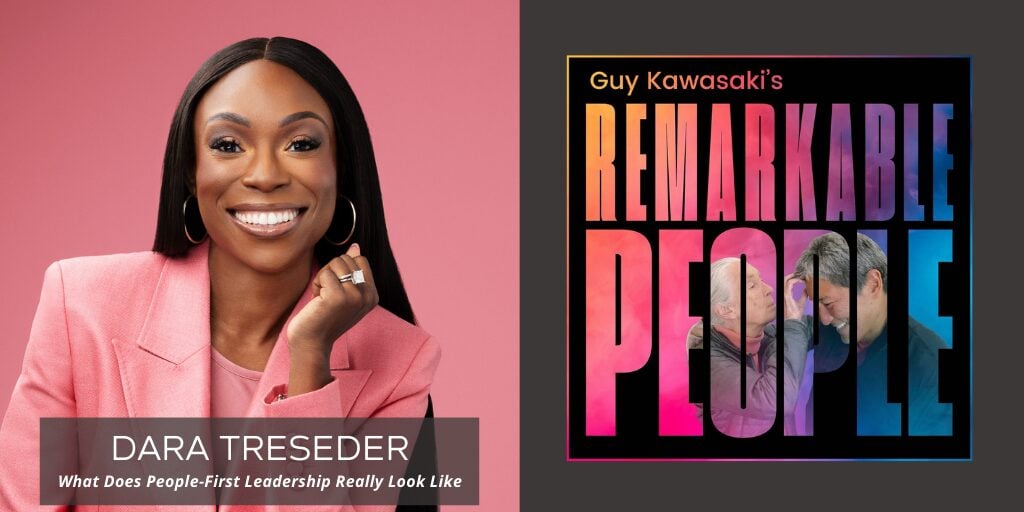
Welcome to Remarkable People. We’re on a mission to make you remarkable. Helping me in this episode is Dara Treseder.
Dara is a standout leader who navigates fast-moving environments with clarity and conviction. As the Chief Marketing Officer of Autodesk, she leads teams across industries with a people-first mindset. Dara believes leadership begins with understanding who will feel the impact of every decision. Her approach blends empathy with preparation to stay grounded when the world accelerates around her.
In this episode, we explore how Autodesk’s design-and-make platform supports everything from skyscrapers to Oscar-winning films. Dara explains why focusing on what you can control—communication, consistency, and intention—matters more than predicting uncertainty. She describes Autodesk’s bold partnership with the LA28 Olympics and how calculated decisions move big ideas forward. Her leadership shows that courage comes from steady, thoughtful actions rather than dramatic moments.
Dara also shares candid insights about navigating bias, managing imposter syndrome, and being “the only” in many rooms. Despite those pressures, she relies on preparation, authenticity, and resilience to stay centered. Her story is a reminder that your greatest strength lies in how you choose to show up—especially when things feel unpredictable.
Please enjoy this remarkable episode, How to Lead People First in Uncertain Times with Dara Treseder.
If you enjoyed this episode of the Remarkable People podcast, please leave a rating, write a review, and subscribe. Thank you!
Transcript of Guy Kawasaki’s Remarkable People podcast:How to Lead People First in Uncertain Times with Dara Treseder.
Guy Kawasaki: Good morning. First of all, let me explain. I'm Guy Kawasaki. I'm not Robert Kiyosaki. I didn't write Rich Dad, Poor Dad. All right? And this is the Remarkable People Podcast, and the whole point is to find remarkable people to inspire and inform people. And so we're blessed to find people like you. So thank you very much for being on the show.
Dara Treseder: I am honored to be here. Thank you so much for having me. I am a fan of your work
Guy Kawasaki: You say that to everybody?
Dara Treseder: I really don't. You could ask my team. I really don't. I try to keep it 100 percent. I keep it authentic.
Guy Kawasaki: So Dara, first of all, for the longest time, I thought your name was Tresidder. I thought, “Oh, they named the food hall in Stanford after her. I can understand why they would do that.” But it's Treseder, right?
Dara Treseder: It’s a different family. We are a different Treseder. Still a great one, but our names are not yet on buildings.
Guy Kawasaki: You're the chief marketing officer of Autodesk, right?
Dara Treseder: Yeah.
Guy Kawasaki: That is a very high position here in Silicon Valley and tech, and basically, I looked at it, I said, “She's young, she's female, she's black, and she's known for all these great things.” And I really appreciate all the advances that you've made and all the work they've done, all your accomplishments, and when I die, I want to come back like somebody like you.
Dara Treseder: My gosh, guy. Wow. It is really an honor, honestly, to be here having this conversation with you. Thank you so much for having me.
Guy Kawasaki: I gotta tell you a funny story, so I know Luvvie. You know Luvvie?
Dara Treseder: Yes. I do know Luvvie.
Guy Kawasaki: I also know this doctor from Canada named Chika Stacy Oriuwa,
Dara Treseder: Uhhuh.
Guy Kawasaki: And she's this really outstanding young doctor from Canada, and Mattel made a Barbie doll after her. I just wanna tell you that I've had three Nigerian women on my podcast, and so in my mind, every Nigerian woman that I know is remarkable.
Dara Treseder: That is very generous of you to say, and I'm glad to continue the tradition. Three for three.
Guy Kawasaki: And then, I'm not hitting on you. Okay…I found out that you're already married. And I'll tell you why I'm disappointed that you're already married, because, before I die, I want to go to a Nigerian wedding because Luvvie told me it’s like four days of celebration. Did you have one of those?
Dara Treseder: I did have one of those. Guy you are in luck because, when you go to a Nigerian wedding, there will be people who have known the bride and the groom for 20 years, and people whose parents met the week before at the market. So the chances of getting invited to a Nigerian wedding are very high. Okay? Because now you know three of us, so if it's not Luvvie or me, one of us might bring you with us to a Nigerian wedding of a friend or family member. So we're gonna have that conversation going.
Guy Kawasaki: Going to a Nigerian wedding is on my bucket list.
Dara Treseder: All right, we gotta make it happen. So I've got a lot of cousins who are. gonna get married at some point. So I'm gonna make sure you get on that invite list. It's not quite Taylor Swift's wedding, but we can make that happen.
Guy Kawasaki: So first of all, what companies are in your marketing hall of fame? Who do you look up to and say, Wow, they really do it?
Dara Treseder: Apple. I think Apple really does it right. First of all, the core brand attribute that Apple has, I think, doubled down on for the last two decades, and I think it's serving them well even today, is privacy and trust. I think they're a really great brand. They're also great when it comes to design and user experience and that customer experience, and they really get the power of the ecosystem. Cause at the end of the day, what is a brand? A brand is the sum of the promises you make and the experiences you deliver. Apple makes really great promises, and they deliver incredible experiences. And I think as a customer, as a consumer, it's a brand that we can trust.
Guy Kawasaki: So you just talked about Apple and privacy as a key selling feature, right? I understand that. But what happens when you see Tim Cook at the inauguration gives a million dollars, gives a glass and gold trophy? That's not exactly on brand. So, as a marketing person, what do you do with that?
Dara Treseder: You know, we're in unprecedented times.
Guy Kawasaki: No shit.
Dara Treseder: We are in unprecedented times. I think the role that government is playing in business, in how brands are expressing themselves, is unprecedented. So I like to extend a little bit of grace to leaders. I like to extend a little bit of grace before I jump to judgment, because I think these are unprecedented times, and I think a lot of people are trying to figure out how to navigate these uncharted waters.
Guy Kawasaki: You are never gonna have an interview like this again? I gotta talk about all the things. Okay. What exactly does A CMO do in 2025?
Dara Treseder: What does an A CMO not do in 2025? I think that would really be the question. It was interesting, my daughter was talking to me. She was like, “Mommy, you care about everything from putting on these events to help explain the technology to making sure we're driving growth on the Autodesk store .” There's a lot. At the end of the day, we are responsible for driving growth for the business. We are responsible for helping make sure the company can articulate what the future is gonna be and how we're gonna help our customers get there closer and faster. AI think it's an exciting time to be A CMO in 2025. It is also a time to be A CMO in 2025 because I think the pace of change has never been faster than it is, and it's only going to continue to speed up. So it means we all have to buckle in and just keep on going.
Guy Kawasaki: Are you primarily a B2B company? So how has that changed?
Dara Treseder: We are primarily a B2B company. Our software is used by businesses and professionals to design and make anything right, whether it is buildings we live and work in, products we use and love, or movies, games, and shows that entertain us. Autodesk is used to design and make anything. And, as a B2B company, the game has changed because I think it's really important to help our customers navigate these unprecedented times and uncharted waters. We have to be the trusted partner for our customers, and showing up in a human way that our customers can connect to has never been more important.
Guy Kawasaki: You discuss that people use AutoCAD to build everything or anything, right? So why not go B2C? Why not democratize it? Why don't you do to? You know this B2B orientation, like what Canva did to Photoshop.
Dara Treseder: We actually do. So we have a lot of individuals who buy Autodesk software. They come to our Autodesk store, they buy our software, whether it's AutoCAD or Revit or Maya, or Civil 3D, we have a lot of different products that individuals use. So our products are used by individuals. In fact, we actually make our software available for free. To students and educators all around the world. We have over a hundred million students and educators in over 160,000 schools around the world using Autodesk software for free today. So we are certainly already walking the walk when it comes to democratizing and increasing access to our software.
Guy Kawasaki: So I would say you're more B2C than B2B, a little bit of both.
Dara Treseder: We're a little bit of both. I think the bulk of our business and our revenue comes from our business customers, so that is why I would primarily describe us as a B2B company. But yes, absolutely. Individuals every day wake up, and they use Autodesk software to design and make a better world for all of us.
Guy Kawasaki: You are a walking PR machine, man.
You make a distinction between purpose and product. So are you saying that Autodesk is a purpose-driven company or a product-driven company?
Dara Treseder: We're both, Autodesk is a product-driven company and a purpose-driven company. We're a product-driven company in the sense that we're a technology-first business, so it's all about how our tech. Technology helps our customers and makes our customers' lives better. But when you talk to me or any Autodesk or what gets us up every day, why we show up is because we are proud to work for a company that is designing and making a better world for all. That is why we exist.
Guy Kawasaki: And in your case, you came to a company that was already decades old. I mean, AutoCAD existed before you, right? And so when you come into this kind of situation, do you take this product and then wrap it in a purpose?
In your case, the product was already there. So, what's the process of putting purpose and product together?
Dara Treseder: So I was very fortunate because Autodesk already had incredible products and offerings, and actually already had a phenomenal purpose. So my job was really to package it all together and elevate the storytelling, start to really communicate that on the biggest stages in the most exciting ways. So that was what the job was to be done.
How do we make sure that we get this message out there? Because people knew us primarily as a design company, they knew us primarily for AutoCAD. We do so much more than that. We are a leading designer make platform, right? We have products that span everything from architecture to engineering, construction, product design, manufacturing, media, and entertainment. And so my job was to make sure anybody anywhere is trying to design or make anything, and we ask “What could Autodesk do?”, and make sure that we insert ourselves into that initial consideration.
Guy Kawasaki: Dara, you need to learn how to come outta your shell and really become evangelistic.
Dara Treseder: Right here there's an evangelist who taught me a little bit about that.
Guy Kawasaki: So I saw in your first few years at Autodesk, you had promotions and advertising with Game of Thrones and the Oscars, and then the reconstruction of Notre Dame, which that one I understood because that's a building, right? So, how do you link Game of Thrones and the Oscars to a CAD program?
Dara Treseder: Our software is used to design and make anything. We talked about how it's used with buildings we live and work in, right? Notre Dame, too. Products we use and love, like our phones or our cars, but also movies and games that entertain us. Autodesk software is also used to bring those to life, and so what we've been focused on is telling those real customers. Stories in exciting ways. So our software has been used in bringing, whether it's Game of Thrones or Walking Dead or Severance, the award winning show that's been collecting all the awards. This season, our software was used to design and make it. And so what we have focused on is telling and celebrating those stories so that we can connect the dots and help our customers understand this convergence that's happening.
Guy Kawasaki: How does an Autodesk product help make a movie?
Dara Treseder: It's used with the visual effects. So all of the visual effects are done using Autodesk software. So, whether it's Autodesk, Maya, Autodesk Flow Studio, which is our visual effects AI offering that is being used to help with essentially bringing these stories to life in a very believable way on the screen.
Guy Kawasaki: Clearly you have done it, but what have you learned about making something that used to be a tech product into something that people feel an emotional attachment to?
Dara Treseder: Honestly, it's been telling these real stories in big ways because the stories always existed. Let's just take media and entertainment, for example. Autodesk software has been used in almost every Oscar-winning animated movie since 1997.
Guy Kawasaki: That's a big secret.
Dara Treseder: It's a secret. Nobody knew we weren't talking about it, and it was like, “Hey, let's just not make that a secret anymore. Let's start to talk about it. Let us start to celebrate our phenomenal customers.” And this is not about centering Autodesk. This is about centering our customers, showing the amazing work that they're doing, and who they are. Making it possible using our software. Of course, we are marketers. But the people that are the heroes here, it's not Autodesk. The heroes of our stories are always our customers.
Guy Kawasaki: So, if the heroes of your stories are the people, clearly you have an orientation of being a people-first leader, right?
Dara Treseder: I do.
Guy Kawasaki: First of all, please define what a People First leader is.
Dara Treseder: I think a people-first leader is a leader who puts the needs of the people front and center when making decisions. So it's not to say you're not gonna make hard decisions or difficult decisions, but you're going to make sure that you understand the people impact and that you plan for it.
Guy Kawasaki: And when you say people impact, you mean your employees or the customers?
Dara Treseder: it's employees, it's customers, it's stakeholders. You need to understand when I make this change, how is this gonna be experienced by the humans and the businesses. What is the impact going to be on them, and how can I make sure that I plan and prepare for it? So we always try to be thoughtful and always make sure that we're putting our customers at the center.
Guy Kawasaki: And not that I truly believe this, but what if I call bullshit on you and I say, “Listen, I can name you some people who are not people first. Elon Musk, Mark Zuckerberg, Steve Jobs, Steve Ballmer. There are some of these people that I would not exactly call people first, and yet they're so successful. So are they the four or five or ten people who are not people first who have excelled, the 490 of 500 Fortune 500 CEOs are people first, are these the outliers, or because people look at these heroes and they say, “I wanna be like Elon.” That's hard to translate into saying, “I wanna be people first, like Elon.”
Dara Treseder: You know what I think is, I wanna be the best version of me. I don't wanna be like anybody else but me, but I wanna make sure that I am being the best version of who I am in every context. And I think for me that means thinking about the humans and the people. My first job was being a waitress in Nigeria, and I learned a lot about listening to customers. And whenever I put my customers first, it was a little waitress, a little canteen. But when I put them first, not only were they happy, but I got better tips. So I learned a lot in that process, and that's something that I carry with me today. I think when you always do what's right for the people that are gonna be impacted, you always get the right results. That's been my experience. Now, not to say they're not other ways of doing things. Yes, there are other ways, and I can't speak for anyone or why anyone makes the decisions that they make, but I can tell you that when I make decisions, I try to make sure that I'm doing the right thing by the people around me. Now, I'm not saying I don't make hard decisions. I would be disingenuous to say that every leader has to make tough decisions. And I think you can make tough decisions in a way that centers on the people and does right by them.
Guy Kawasaki: I really wanna come back as a Nigerian, and then I can have my own wedding.
Alright, on another parameter, let's talk about if it's a dichotomy. ..data-driven versus insight-driven. Are you either one or are you both?
Dara Treseder: I’m both. And the way I actually think about it is I think about it as data-informed and insight-informed, because at the end of the day, the data isn't actually driving. It's informative. But there are also other types of input, and I think I bring all of these things together, and I try to make the best decision that I can. And not only am I bringing in the data and the insights, but I'm also bringing in the perspectives. Because I think often when we're making decisions, there's the perspective of the person who's impacted most, and usually that person is not in the room. I often like to think about who is being impacted most by this decision? If they're not in the room, how can I make sure I have the perspective or their perspective brought to the table so that we can make the best decisions? And we always make the best decisions when we bring data, we bring insights, and we bring perspectives together.
Guy Kawasaki: Okay, so it's 2025. How do you do test marketing and data research today?
Dara Treseder: So we do a couple of things. First of all, we obviously do a lot of quantitative research and testing. We do qualitative, so focus groups. Those are still very, very important. And then on top of that, we do pilots because I don't care how many quantitative tests you run and how many qualitative tests you run, when you release it into the wild, that's when you're actually gonna get the real results. So I often tell my team, no matter what it is, we're gonna pilot it. And then we're gonna actually put it out in the real world, and we're gonna see the response we get from the real world. And we are going to have scenarios. There is gonna be scenario A, B, C, or D based on what happens in the real world. We'll be able to pivot and adjust accordingly, and honestly, because of the unprecedented times we're living in, and just the division and the polarization in the world today, someone could just say, “can”, and all of a sudden, wow, can was so divisive. I just said the word can. I meant can on a shelf. And two different people can see that exact thing from two different perspectives. So I do think pilots and putting things out in the wild, that's a huge part of how we test today, too.
Guy Kawasaki: For people who are not in marketing, can you just explain the nitty-gritty and tactics of a pilot?
Dara Treseder: At Autodesk, when we are trying to take the voice of the customer to the product teams, we actually have an expert elite community. So what are expert elites? They are power users of Autodesk Software, and they're a broad group. So they cut across all our industries, they use almost all of our different products. They are located in almost every country that we're in. So it's a really great sample set of people who love and use Autodesk, and we work with them to make sure that we're able to take that data and insights, and perspectives and actually go deeper with that group. And then our expert elites engage with our product teams. And our product teams love to hear from our expert elites, because these are the people who use products a lot. What do you think makes a product than someone who uses it and is a fan of their product? Nothing brings more joy to our product teams than connecting with our expert elites and getting some of those insights. So I think part of what we do is not just take the data and the insights, and the perspectives that we have, our community and the voice of our community represented, and that community can engage with our product teams.
Guy Kawasaki: So, can you discuss some courageous marketing decisions you've had to make?
Dara Treseder: Yeah. When I joined Autodesk, I was very fortunate. I am very fortunate because our CEO, Andrew, before he became CEO, was the chief marketing officer. So he ran all of marketing in addition to running product strategy. So I'm very fortunate in that our CEO understands marketing. It's not often that happens, so it's really wonderful. I joke with him because we both went to Stanford, but he has a PhD. And just have a little MBA over here, so not the same thing. But he's someone who I learn a lot from and somebody who, I think, really respects the craft of marketing. Now I say that to say it makes it easier to be courageous in that environment, in an environment where you have a CEO who's like, “What’s marketing again? Why do you exist?” Still, it takes courage. I would say one of the most courageous things that my team and I give a lot of credit to my team, all the credit to my team, is becoming the official designer make platform for the LA 28. Olympic and Paralympic games and Team USA, because that was not something we had ever done before at Autodesk. We hadn't done a sports partnership of that scale before. So why did we do it? We did it because we had already earned the right to be in this story. Autodesk software had already been a part of designing and making the Olympic Games for many years. Different seasons, but we just hadn't ever told the story. And so by becoming the official design on a platform of the LA 28 games, we are finally telling the story, but we've earned the right to tell the story. The second thing that was so compelling is LA 28 is trying to make this the most sustainable games ever. This will be the first games with no new permanent venues. So we will be retrofitting over 40 venues across the Los Angeles area, leaving LA in a better place than before the games. And so to be a part of that sustainability journey, which is core to the Autodesk brand, was huge for us. And third, but certainly by no means least, was the commercial opportunity. A $7 billion opportunity. That's great for Autodesk, but not just for us. It's great for our partners, it's great for our customers, it's great for our ecosystem. And it's not even 2028, and we are already seeing the ROI of that. So it was difficult because we were gonna do something we had never done before. Right? They had to explain why we're going to do something we've never done before. Something of a significant magnitude. But I'm really proud of the team because boy, is it paying off, right? We're not even in 2028 yet. And, we have already started to see the incredible return on investment. And more than anything, our why we exist is to design and make a better world for all. So, to be a part of designing and making better games for everyone. The most sustainable games ever. I mean.
Guy Kawasaki: So now I wanna get a little personal with you. Since I started by asking if you're married, which is probably not the first question you face in most parts.
Dara Treseder: You know what? It's okay. We can go anywhere you wanna go.
Guy Kawasaki: I bet in your career, in many circumstances, you were, “The only woman, the only young person, the only black person.” And in your case, you’re the trifecta. You're young, black, and female, right? So, seriously, so what is your world like?
Dara Treseder: It's tough. I'm not gonna sugarcoat it. I think very often, my husband and I we've been married for 12 years. He's one of the most incredible human beings I've ever met, and he's seen my journey, and we were talking about it, and it's like when he walks into the room, people assume he deserves to be there. So he starts from a place of, “Oh, welcome. Have a seat.” When I walk into a room, the first thing is, “Why is she here?”
Guy Kawasaki: Just to get the full impact of this, is he white?
Dara Treseder: My husband is white,
Guy Kawasaki: Okay.
Dara Treseder: So walks into a room and the first thing is, “Oh, welcome. Take a seat. Of course, you deserve to be here.” He has to do something to make people question why he's there.
Whereas I walk into a room and people are like, “Why is she here?” And in today's world, “Is she DEI?” No, I'm not. Okay. I'm excellence. And I start from a place of doubt. I start from a state of uncertainty. So I have to prove myself and reprove myself, and I’d better be walking around with my bag of receipts because no matter who I am, no matter how successful I become, I walk into a room. I'm a young black woman, so I’d better have my receipts.
Guy Kawasaki: Even in 2025?
Dara Treseder: Especially in 2025.
Guy Kawasaki: Why? Why “Especially”?
Dara Treseder: I think now people feel emboldened, I think to say some of the quiet things they were saying that I think are, in some cases, racist. In some cases, offensive. People feel like they can now say it out loud, and that can be very jarring. It's been my story, it's been my journey. I'm not a pity party person, so I don't like pity parties, and I don't go to them. I don't host them. So in my mind, I'm like, this is my journey. This is my experience. I wish it weren't, but it is what it is. And so I just focus on how I can be the best I can be in every scenario, but it would be disingenuous not to say that being a young black woman is not a disadvantage. It absolutely is.
Guy Kawasaki: Okay. So now, my podcast is about six years old, which means 300 people about. I would say 200 are women. I've often thought, “Why don't I just call my podcast Remarkable Women instead of People?”
Dara Treseder: Well, thanks Guy. Thanks for giving us a voice.
Guy Kawasaki: And I will tell you something I noticed is that almost every woman talks about imposter syndrome, and no men ever talk about imposter syndrome. So, have you dealt with imposter syndrome?
Dara Treseder: Absolutely. I think that when people question you every time you start to question yourself. If people are doubting you constantly and you're having to always reprove yourself and then reprove yourself and then reprove yourself, it's impossible not to at least have a day where you wake up, and you're like, “Ohhhhh!”…I've certainly dealt with it.
But I think what I try to focus on is controlling what I can control, and that is what I want. Look, there's only so much energy and time that any human has in this world. And I wanna make sure that I'm using my energy and I'm using my time to live a positive impact on the world around me, the people that I love, and the teams that I have the privilege to lead. So I put all my energy into there. When I'm feeling imposter syndrome, what I tell myself is Dara. Let it go. So focus on what you can control and try to be the best version of yourself that you can be in this moment. And don't worry about “Are you’re good enough?” Do your very best. Work hard. And I put in the work. I put in the work. I'm always prepared. And I'm not afraid to fail. I'm not afraid to try new things. I'm not afraid to also admit what? I don't know. I don't believe in fake it till you make it. I never fake it. I don't wanna fake it. I just wanna make it so I'm willing to learn and try and do the hard work to make sure that I deliver.
Guy Kawasaki: Okay, so now we are in October 2025. You are the CMO of Autodesk. Are you telling me you still have pangs of imposter syndrome?
Dara Treseder: Absolutely. To this day.
Guy Kawasaki: I mean, you got Stanford, Harvard, you got Peloton, got Autodesk. How can you have pos impostor syndrome today?
Dara Treseder: I still do. And part of that is that, just being me, right? Even with all of my success, and I say this with all humility, I still have to constantly prove myself and reprove myself because of who I am and what I look like. And so that's just the reality of being a black woman in corporate America.
Guy Kawasaki: Makes no sense to me, but okay.
Dara Treseder: It's the reality now. I don't let it bring me down, I'm still filled with hope. I'm filled with optimism. I love being an American. I'm proud to be an American. My husband is a Marine. I love this country. I'm proud to be a part of this country. And it's actually because I love this country that I'm able to say, “Hey, there are still things we gotta work on, but that doesn't mean this is not, you know, I think the greatest country on earth.” Team, USA.
Guy Kawasaki: So what if there are young black women listening or watching this podcast, and you know they want advice from you because, imposter syndrome or not, you are a hero to them.
Dara Treseder: First of I would tell them to control what they can control. Don't worry about the things you cannot control, right? You can't control what other people say. You can't control how they think. You can't control how they feel. But you control what you say. Control what you do. You can control how you respond to whatever is thrown at you. And there is so much power in that. And there is no limit. The only limit is the one you place on yourself.
Guy Kawasaki: But if society in 2025 is still trying to tell these young black women to step back and dim your fire and whatever, what do you say to them?
Dara Treseder: Tune that noise down and tune up the support, because yes, society might be saying all that, but there're gonna be people in your life who are gonna tell you you're amazing. There're gonna be people in your life who believe in you. Turn the volume up there and turn the volume down on the
Guy Kawasaki: And how do you find those people?
Dara Treseder: You find those people by actively seeking them? For most people, like me, it's our family, it's our friends, it's our close friends. It's the mentors who actually care. They have time for you. People ask me, “How do I find a mentor?” A person who cares and has time for you, right? If you've emailed someone's EA and told them they can't meet with you until that person is not your mentor, right? Your mentor is the person who is just that natural connection, right? They look at you, and they're like, “Wow, I wanna invest in this person. I believe in this person.” So when you find those people, follow up. And the power of follow-up, that is one thing I will say. I think that there's so much power in the follow-up. A lot of people ask for something once. Not a lot of people come back to say thank you. Be the person who comes back to say thank you.
Guy Kawasaki: I think my experience is not only that they do not come back and say thank you, but most people never even make the ask. They don't do anything like these things at all. Even in my emails, I put my cell phone number in every signature. I tell people my email. My phone's not ringing. It's weird. People want to get your contact info, but they never follow up.
Dara Treseder: Isn't that incredible? They don't do anything with it. That's what I mean. It's the power of the follow-up.
Guy Kawasaki Yeah, I would say 90% of the people don't follow up. And then 90% of the people who follow up don't say thank you.
Dara Treseder: Exactly. So imagine being that rock star who not only follows up, but also says, thank you. Those are the people that you are gonna move heaven and earth for because those are the rare gems. Thank you so much for having me. This is a real treat.
Guy Kawasaki: So this has been the Remarkable People podcast. I wanna thank Dara, I wanna thank all the staff who told me not to ask those questions. And I wanna thank Madisun Nuismer our co-producer, Jeff Sieh, our other co-producer, and of course Shannon Hernandez, sound design engineer, and Tessa Nuismer, researcher. So it's a whole team behind me that makes this so fun and so successful. But thank you very much.
Dara Treseder: Thank you so much, guy. Thanks for having me.
Sign up to receive email updates
Enter your name and email address below and I'll send you periodic updates about the podcast.

Leave a Reply