
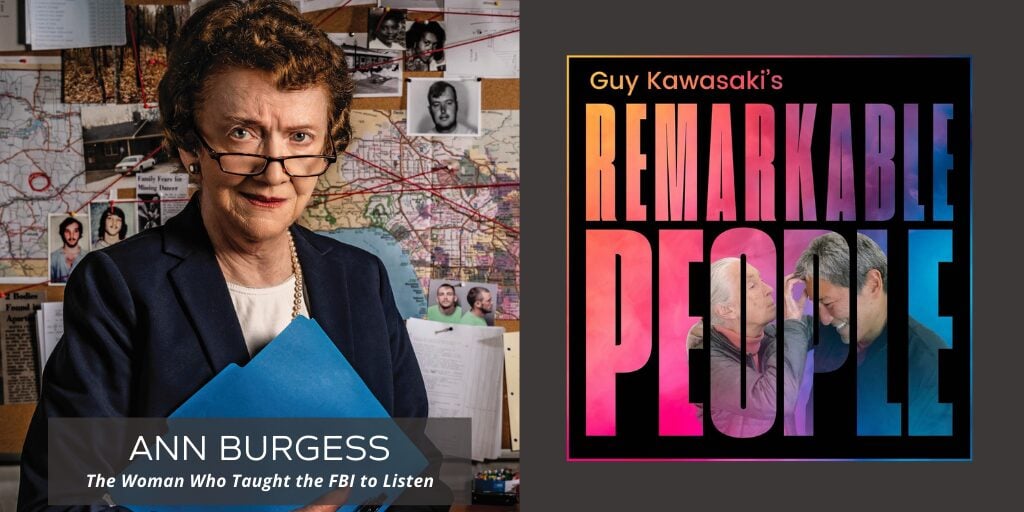
Welcome to Remarkable People. We’re on a mission to make you remarkable. Helping me in this episode is Ann Wolbert Burgess.
Ann is no ordinary researcher; she is a trailblazer in the world of forensic nursing and criminal profiling. Her work with the FBI helped develop the behavioral science unit, which forever changed the way investigators understand violent offenders. Over the years, she has stood alongside victims of trauma, bringing their voices into the courtroom. She has also guided juries and judges through the complex psychological realities behind high-profile cases.
In this episode, Ann opens up about her experiences with the Menendez brothers trial, the Duke lacrosse case, and countless others where media narratives often obscured the truth. Her insights reveal not only how justice is pursued but also how it can be denied when institutions or the press fail to recognize deeper realities. She also reflects on the ethical dilemmas of serving as an expert witness in an adversarial legal system. These lessons are as unsettling as they are essential.
Her new book, Expert Witness, provides a rare inside look at what it means to testify in court and advocate for victims while under the harshest scrutiny. It shows us why compassion, science, and persistence are crucial in the pursuit of justice. Ann reminds us that every case has another side, and ignoring it risks both truth and fairness. This conversation will leave you with a new perspective on crime, trauma, and the resilience of those who dare to speak up.
Please enjoy this remarkable episode, The Woman Who Taught the FBI to Listen.
If you enjoyed this episode of the Remarkable People podcast, please leave a rating, write a review, and subscribe. Thank you!
Transcript of Guy Kawasaki’s Remarkable People podcast: The Woman Who Taught the FBI to Listen.
Guy Kawasaki:
Good morning. I am Guy Kawasaki. This is the Remarkable People Podcast. And for the umpteenth time, let me tell you, we're searching all over the world for remarkable people to inform and inspire you. And today's guest is Ann Burgess. I must admit, Ann Burgess has one of the most interesting backgrounds that I've ever encountered for this podcast.
She's been instrumental in some of the worst criminal cases you've ever heard of, and I'll let her explain that. She's basically a nurse and a researcher, and she has done absolutely groundbreaking work to help, for example, the FBI understand and profile serial killers.
She has also worked very actively in helping people deal with rape crisis, and she has devoted much of her career to supporting victims of trauma. She has a book out about expert witnesses, which we'll cover, and I think you'll find this to be one of the more fascinating episodes of Remarkable People.
So welcome to Remarkable People, Ann Burgess.
Ann Burgess:
Thank you so much, Guy. I'm happy to be here and talk with your audience.
Guy Kawasaki:
First of all, I gotta ask you, I was reading all the background bio material about you, and I read someplace that says you're helping your granddaughter do research about mass shootings. Did I get that right?
Ann Burgess:
Yes, yes. Alexandra is my granddaughter and she's very interested in math and numbers. Always has been. And she took a specialized course to understand AI and writing algorithms and things like that. We brought her on to help us.
We took twenty-three manifestos written by people that had committed horrendous killings, and we now have a database so that when we get a new case, if there's writings or whatever, we can now compare them to this database.
And the reason we're doing this is for a long time as you read in my background, we looked at, after the fact, we looked at people who had killed after the fact and we realized that's not the way to catch them. You gotta catch them before they act. And the best thing we thought is what are they thinking about?
Whether we can identify those red flags. So that's why we wanna back up into getting them ahead of time. So that's where the process is. There's a sixth level kind of model that has been already developed, and one of them is have a grievance. And then they do some research on it.
In other words, it doesn't just come in and come out of their mind. So they start researching it. That develops into planning something, the whole fantasy of, I'm gonna kill a group kind of thing. Sometimes they even identify the date that they're going to do this, and then they act. So if we could identify these steps earlier, I think we'd have a better chance.
Now I know that people, of course, are trying to, but rare is the case where they don't leave some social media information that they're going to act. And obviously we can't monitor every single social media. But if we get people that will look at things and when they see something, call it into a centralized place, that's one of our goals.
Now, we aren't there yet, but that's one of the goals.
Guy Kawasaki:
All right. So first of all, I wanna get a kind of grounding about this criminal justice system, and it seems to me that you could either have an adversarial criminal justice system where there's one team and the other team, and they're both going at it with the judge as the referee in the middle, and then the jury decides.
So that's adversarial, but there's also inquisitorial where the judge is listening to various experts and decides, and clearly we have the adversarial system here. So do you have any thoughts about which is a better system, having gone through so many of these trials and been so familiar with the criminals?
Ann Burgess:
Sure. Well, you know, the UK has even a different part with experts. The experts from each side have to get together and come up with a decision that, again, goes to the judge. I always found that very interesting. I'd love to try that. I don't know if it would work here in the States, but that's one.
The other is one I've done some cases where the judge has said, “I don't want two adversarial experts. I'm going to just to appoint one that can handle both sides kind of thing.” So I've done cases like that where it's been very controversial. They usually involve multiple victims. So those are some alternatives.
But you're right, it really is hard in our system because each one has their own point of view, obviously, and it's up to the jury, and I think that's a hard task for a jury to have to, in a short period of time, separate out which side they're going to go on.
Guy Kawasaki:
So basically we have these two teams. They're each making their own case as opposed to seeking the truth, and the jury is supposed to decide what the truth is based on this adversary. Wow.
Ann Burgess:
Yeah, it's hard. Absolutely hard. Now when you get into a homicide case, that I think is a little different because you're gonna have evidence, you're gonna have other kinds of things. But in cases where you have a surviving victim, like I get into, it's very hard I think for a jury.
I have read one book from a juror on the Menendez case, which was fascinating, her perspective of it, on the first trial. So every now and then you will get a juror that will publish something that they've set, and they've written.
Guy Kawasaki:
Since you opened the door with the Menendez Brothers trial, I have to say that when I read your interview and how you encourage, was it Erik or Lyle? Erik, right?
Ann Burgess:
Yes, Erik, I was on his team.
Guy Kawasaki:
We were interviewing Erik and you asked him to draw pictures, and he started drawing all these pictures of what happened to him.
Does the jury ever hear that? Did they ever see those pictures? it explains a lot.
Ann Burgess:
It does, and I have done those pictures in some of my cases, and the jury does see them, and it makes a big difference. I was sorry that we weren't able to introduce those drawings that Erik did.
And the reason I think it's very interesting, the lawyers on the team felt that the prosecution would make fun of them because he does what would be called a juvenile type drawing. But he certainly wasn't an artist, but the whole point was that's how he saw things back.
And when he was a kid, even though he was twenty-one or two, by the time I got the drawings, don't forget, it was two years later, which I found remarkable that he had the amount of detail to that week leading up to the shootings, and that's what I was interested in is exactly what was going through his mind and how that decision came about to do the shooting.
I think anybody looking at it would get a very different view of that testimony when they could see it from his eyes.
Guy Kawasaki:
How does it make you feel that in the second trial they had a life sentence? Because your facts weren't ever available to the jury, so now they have a life sentence. Do you believe that life sentence was fair and just and the right thing to do?
Ann Burgess:
No, I don't. I feel that everybody has the right to explain why they did something and it's up to the jury or the judge, whoever is judging the case to make that determination. And I felt that was very unfair. And other people, especially in the media have commented on that. But I thought it was a very unfair.
Guy Kawasaki:
I don't think I need to ask, but I'm gonna ask anyway. How do you feel about their parole being turned down now?
Ann Burgess:
I again felt that was unfair. Also, I feel it certainly perhaps had a real political aspect to it. The case was so politicized in the last couple of years and so it satisfied from the prosecution standpoint, if you will. And I have heard people say, “It's rare for anybody ever to get a parole approval the first time in.”
So it kind of has a little protocol itself. You have to go through it several times or they have to keep making you suffer, if you will, more and more. So though all of those things could have played into it. I think that having to judge the case on previous rural discrepancies when the case was felt that they would never get out.
And some of the rural discrepancies I didn't think were very serious, phone calls and so forth to their family. I think that's very, very hard. And when you learn that any of the approved phone calls could be listened into and that information could be leaked and then paid for by a media output, and that's the way we get information, I think that's unfair too.
So I don't know what the answer is, but it'll be interesting because if they make no rule problems, discrepancies, will they let them out? That's the criteria that they use for this particular one.
I always think, are they gonna make what I call a 1990s decision based on really that case versus a 2025 decision, which has, in many ways, opened up the area of parricide behavior to being family conflict, real family problems.
We'll see. Obviously we have to wait and see.
Guy Kawasaki:
I bet most people listening to this episode, they probably don't realize, I certainly didn't realize it that Erik Menendez’s father was sexually assaulting him beginning at the age six.
Ann Burgess:
Right, six. Yes.
Guy Kawasaki:
Did anybody in the mainstream media report that? Because it seems to me as soon as it happened, the story was these two rich, spoiled brat kids murdered their wonderful parents and they were spoiled and, blah, blah, blah.
They were hung immediately in the press.
Ann Burgess:
Yes, they were. and that's the way the parricide cases, where a child kills a parent seem to go, it always goes in favor of the parent. Interestingly enough, and I think we've opened the door to more of the abuse that can go on in a home that is never reported. From that standpoint, the victimology aspect, I think hopefully has made a difference in people's view of the case.
Not all. I know that there are still many people that will just view these brothers as greedy. The other point I wanna make is, they keep saying, “Why didn't Erik just leave? Or Lyle?”
Point is they had planned to, they had planned that week, they were going back to college. Lyle was gonna go back to the East coast and Erik thought he was gonna go to UCSF and that day, that Tuesday, is the day he found out that he wasn't, the father said, “He can go to UCLA,” which is right near, they were living in the Los Angeles area and the father would buy him a moped, so he could go back and forth.
And I found that amazing that nobody saw that as he's getting away. He thought he was getting away. Obviously, he wasn't going to get away. And that started on a Tuesday, and of course the shootings were on a Sunday.
Guy Kawasaki:
It seems to me when I read your description of this entire case that I mean, there's no question that they actually committed the murder, and it seems to me that your findings, your interview, the drawings, all of that, it had nothing to do with proving their guilt or innocence. It more a factor in sentencing then judgment. So do you think the emphasis should be on sentencing or judgment?
Ann Burgess:
Oh, I do. I felt that was where it was important at the parole. Absolutely. And now some people don't forget all the women. And when you had juries with gender, a bias, if you will, there was gender bias, and they found that out. Hazel Thornton wrote a whole book. She was juror number eight, and she wrote a book every day after court.
And she said, “The worst thing they did was the day that they went into the jury room, they took a visual vote. How many for murder? Put your hand up. How many for manslaughter? Put your hand up and it went right down gender lines, and they never moved from that position.”
Guy Kawasaki:
You opened up another subject here. So in reading your book, it's not like you discussed any case where the perpetrator was female. Now, is that just coincidence or should I draw some conclusion from that? You talk about Menendez, Bill Cosby, Larry Nassar, these other mass murders from Louisiana and all that.
Every one of them was a man. What am I seeing here?
Ann Burgess:
You don't have a lot of females to pick from. And we were writing on cases that we had actually been involved in. In the first book on A Killer By Design. We do put in a case where it's two high school students. And it's a female killing a female. We do have that one case, but you're absolutely correct.
We don't put in cases where the mother kills the children, which there are a number of them. They just don't, from my perspective, get into the court system that I would deal with. So you're correct. It's just very different for female offenders. They do different things to kill than males also.
Guy Kawasaki:
Okay, can we back up a second? My exposure prior to reading your book to expert witnesses is probably Las Vegas CSI, Special Crime Victim Unit. I don't know all those things and maybe a movie or two, but can you explain how expert witnessing truly works? First of all, what makes an expert witness an expert?
Ann Burgess:
The judge has to determine that. You have to present your background and whatever side you're on has to go before the judge and say, “I present this person,” and then the other side is able to cross examine the witness. So from that standpoint, I think it's very fair.
But to get to the nitty gritty of what does make it, generally, there's what's called a no-bert hearing, and they have to answer those questions, like the content area has to be well in the range of other people in the field.
You know, certainly published, they have to have the error rate, the methodology has to be looked at. Those kinds of things. Which is interesting because if you look at what the description, it is just someone that has more knowledge of a particular issue at hand than the jury does, so that you're supposed to be giving the jury, I believe, basis of science.
In that whatever your area is, and of course in mine it would be sexual abuse, or it might be trauma, there's several areas I've been qualified in as an expert.
Guy Kawasaki:
On the other hand, in an adversarial position, you are on one side or the other, right? So now, in a deeply hypothetical question. If the prosecution for the Menendez trial contacted you first and said, “We want you to be our expert witness in the prosecution of the brothers,” would you or could you have done it?
Ann Burgess:
I have actually been in that situation where it was a very high profile case and both sides contacted me. So what did I do? I felt I was obligated to take the first person. So it wasn't based on whether they were prosecution or defense. I felt I was only fair to take the first person that had reached out.
I don't know if that's what other people do, but I don't think that's unusual that an expert could be contact. Now I get contacted because of the one paper that my partner and I did called “Rape Trauma Syndrome.”
So I would, certainly on the cases that I've been called on both sides, usually they would want to use rape trauma syndrome to boost their side, whichever way they were going with that, and one of the cases was the Duke lacrosse case.
The defense wanted me to opine on the issue of did this happen, whereas the prosecution wanted to have me opine on why the so-called victim was changing her story or had various versions of what happened and using rape trauma syndrome in that respect.
Guy Kawasaki:
But what I fundamentally don't understand is, is there a case, Ann, where you look at it and you say, “What that person did is so reprehensible. I will not be an expert witness for that side.”
Ann Burgess:
Oh, yeah, I've turned not many, but I certainly have turned cases down because either of that or I really didn't feel that I would be able to help that particular side, and then I would not take the other side, so I would just remove myself from the whole case.
Guy Kawasaki:
So can you give us the gist of the ethical guidelines for expert witnesses?
Ann Burgess:
I can give you the guidelines for my discipline. The criteria for expert, it goes to the judge. But in nursing we have specific ethical guidelines about what we're obliged to do. And those are all written up. Every ten years they review them.
And I think each discipline does, whether it's nursing or whether it's social work or psychology or psychiatry, we all have our own rules and technically you can be called before an ethical committee if you violate them, so they’re very serious.
Guy Kawasaki:
It seems to me that everybody who's convicted of a crime, or I use the term everybody loosely, but let's just say generally speaking, you can find some abuse, some neglect, some trauma in their background. And wouldn't that be true for almost every criminal? So when is that a mitigating circumstance that should be used in sentencing and when should it just be ignored, and you did the crime, you do the time?
Ann Burgess:
And you're absolutely correct, everybody, and certainly any criminal or defendant has much in their background, unless they're really young, you know I've had some cases, they're teenagers, so at least you don't have to go back all the way, but you have to address that.
It's not how high a level, but you have to give the circumstances. And that is one of the areas that if I'm on one side, the other side is gonna bring up, “Why did you consider X, Y, and Z? All these other horrible things happen as a child to her.” And I usually have to give a reason for why.
Not that I ignored them, but that I considered them. But they didn't rise to the level of having an influence, if you will, on the particular crime that was committed. And I think that's where it divides into you have to argue that case hopefully successfully in front of a jury.
Guy Kawasaki:
A few minutes ago you mentioned the Duke lacrosse case, and again, reading your book was eye-opening for me, I'm just getting over the fact that Erik Menendez has been sexually assaulted since six. And then I read the chapter about Duke lacrosse and, you go through the timeline and it's like impossible for those three players, two have raped that woman in that small bathroom in the timing.
And you have the ATM report, you have the cell phone reports, you have all these reports, and I don't think any of that was obvious to me. And again, the press said, “These rich white boys from Duke lacrosse raped this black woman and they're guilty.”
And I bet most people to this day still believe that's the case and these white guys got off because maybe they had better lawyers or something. Right?
Ann Burgess:
But in that case, Crystal Mangum, which was a victim's name, has admitted she lied, and I think it took fourteen years. But you don't always get that, of course. But I think in this case she did come forward and said she lied. And what it actually turned out to be, we had figured that out early on.
Because I took the case on from a defense standpoint, and I did not feel it happened the way she described it, that there was another reason for her to come forward. And there was. But I think that, the dilemma that I had if we had gone to trial was how to present that. You can't go in and say, “I think she's lying.”
Because I couldn't prove it right per se, but I could bring all the arguments that something else might've happened in her life that pushed her to the point where she said these three young men had raped her. And we were prepared to do that because the attorney that I was working with was absolutely brilliant anyway, and I thought so highly of him, and he agreed that we could go in with that particular perspective.
Guy Kawasaki:
From your book, I have to say that I don't have a very good impression of mass media. They're jumping to conclusions about Duke lacrosse. They don't tell the whole back channel story of the Menendez brothers. Like if I'm just listening to this podcast, what is my takeaway about the reports in mainstream media about these heinous crimes?
What do I believe anymore?
Ann Burgess:
That's the problem is the citizenry will run with the media. The media is so powerful and to try to fight it, they don't wanna hear it. Even if you try to say there's another side, they just don't wanna hear it. And I think they should be called out on it because people should see it as a why it's in court is because there's conflict.
You don't go to court if there's no conflict. So they should be saying, “What does the other side have to say? How do they explain what happened?” The other is where's the science? I'm gonna be publishing a paper hopefully with some of these drawings in which we say that the Menendez, they avoided anything that would have made a difference, if you will.
And it was a double parricide case. If you wanna officially classify it, there's very little literature or let alone any research on double parricide. There is some on single parricide. That's where one child will kill a parent. But where two children would kill both parents they're probably no more than a hundred cases internationally.
We did get some research from UK. England has done some work on it in Wales. But we didn't do a full search, but that's where I say the research committee isn't doing their work either. They should be doing more research on some of these very small, esoteric kinds of cases because I think that would help the media if they would publish it.
They should publish research.
Guy Kawasaki:
Let's switch topics to profiling. And once again, my entire data set on profiling is Special Victims Unit, whatever. And so first of all, can you take us back in time and talk about how you and John Douglas and Robert Ressler created this Behavioral Science Unit of the FBI?
Ann Burgess:
Well, the BSU came into existence in 1972, and it was on the basis of Howard Teten and Patrick Mullaney, two agents that were in teaching at the academy. And what they would do is they would meet with the agents after classes and they'd just sit around informally and talk about cases that hadn't been solved.
And they got so good that people began to bring in cases for them of these unsolved cases. And what it was looking at a crime scene, and from the crime scene, finding characteristics not names. Everybody gets all upset over that. You're gonna be saying, “Joe Smith did something.”
No, it's characteristics. And then put those characteristics together and see if you can come up with a suspect profile on these characteristics. And that's what it started. A person most interested in this was Bob Ressler. And so he really interned with these two senior agents.
And the first case was a fascinating, horrible case, but it was an eight-year-old that was kidnapped from a tent the Meirhofer case where the parents were in one tent camping and the kids, the children, there was more than just one child, were in another.
And this Meirhofer, they didn't know who it was, but anyway, he had cut a slice into the tent, was able to duck, kidnapped this young, she was seven or eight years old and that was a hard one to solve.
But they did. They did. And not only did they solve it, but they even got the suspect, Meirhofer, to come forward. What was unfortunate in that case is he suicided once he was in jail. So they never got to get any more information, but of course he had a criminal background, but that really started them.
And then Bob Ressler needed a partner. And so John Douglas was added to the equation and now that was the seventies, late seventies, early eighties. And they really hit well on several cases. And they made the congressional record, they did the Nebraska Newsboy case was a big one where they did get the offender.
And the Atlanta case, down in Atlanta, Georgia, with all of those killings and John Gacy, of course, with his thirty-three. So they were able to solve a number of cases and that made them.
Guy Kawasaki:
So are we at the point where you can take all the case reports, all the background, shove it into an LLM and it'll instantly give you a profile? Are we gonna get there?
Ann Burgess:
You're gonna get there. You bet you're gonna get there. Yeah. You can put that in machine learning and it will print out the topics that are important, and then you've got something to work with. Not only do you get the topics, but you get the supporting statements.
That's the part I really like because here before, you had to read everything, make notes and things like that. This machine does it all, it's absolutely amazing in a very short time, absolutely amazing. We did the Ted Kaczynski manifesto, 137,000 pages. I think they did that in five minutes. We've already done that one. We've already published on that one.
It's amazing how fast the machine is.
Guy Kawasaki:
Wait, so you stuck in 37,000 pages about Ted Kaczynski?
Ann Burgess:
137,000 pages. Ted Kaczynski. Yeah. Do you remember him?
Guy Kawasaki:
Yeah. And, okay, so were you pretending that we don't know who did it. We put in his manifesto, and you found out if it pointed to a person like Ted.
Ann Burgess:
No, it was Ted, so we could say it was Ted.
Guy Kawasaki:
Yeah.
Ann Burgess:
So we didn't have to identify him, but we have that in our database. I'll tell you; you know, all of these shooters have their own quote heroes. And there is the one who shot and killed the United Healthcare, Brian Thompson was the victim.
And Luigi Mangione, I think it is. Ted Kaczynski was his kind of hero. So if he had any writings, they haven't released anything, of course, but if they did, we could measure that against Ted Kaczynski and see whether there's some similarity or differences. It isn't just similarities.
It gives you both similarities and differences.
Guy Kawasaki:
And do you think it's gonna get so good that it'll be predictive and preventative?
Ann Burgess:
I believe it will be a tool, it will be a hybrid tool in which you will get the machine learning topics, but you still have to interpret it. You will always need the human piece. So it's just that it's such a fast tool to give you certain kind of information. And that's where I think we're gonna see a hybrid type.
Guy Kawasaki:
Okay, so this next question you don't have to answer, and we can cut this, but I am so curious. So do you think that this kind of research and science can now go on in the FBI, in the Trump administration run by Kash Patel? Because like I see pictures of FBI agents, walking around D.C. not exactly doing high level forensics and science.
So what do you think is going on in the FBI right now?
Ann Burgess:
Well, I'm gonna be giving a talk to them next week, so maybe I'll be able to answer you better afterwards. But I will tell you about back in the eighties when AI, artificial intelligence, was just starting up, I had proposed a grant, a research grant, and they told me that was Star Wars, that they weren't interested in all that predictive stuff.
That was not going to be a thing of the future. So I say to you, “Where are we? What now? Forty years later.” Your question is so why they weren't with it back in the eighties. They didn't wanna do it. My point is it a large system like that takes a long time to make any change. So you're asking can they make a change in the way that they profile or the way they look for suspects.
You'd have to have trainers come in and get the agents trained. Let alone get it down to the officer, the police officer level. Whether they could do it now. I'd like to think, let me put it that way, I'd like to think that they would entertain a small pilot project to test whether it's a possible point and then they could make a better determination rather to give us a blanket no, to give us a maybe, prove it, kind of thing.
Proof of concept, you have to do proof of concept. And we did proof of concept with our first paper on threat assessment, with the twenty-three manifestos. So we have that published and, it isn't in a very high level journal. So that's my answer.
Guy Kawasaki:
Listen, I thought the CDC had decades of history and, you can't change the CDC that fast, but clearly you can change the CDC very fast. So why can't you change the FBI very fast, and I could easily see where there would be some kind of top-down decision that says all your profiling, all your magic, your science is always coming up that it's a white male perpetrator and that is woke.
So we're banning profiling in the future.
Ann Burgess:
I would hope not, but at least we have some history with it. It isn't all white, but I think that in itself is important. If it is, that's important. That the other races aren't involved in this kind of horrific killing.
Guy Kawasaki:
Okay. Enough about that. My last topic, you do a lot of work with rape trauma, and I wanna talk about that. First of all, is E. Jean Carroll a big hero for you?
Ann Burgess:
No.
Guy Kawasaki:
Why not?
Ann Burgess:
I don't know enough of the case. I've seen what's been written about her, but not knowing background information. I like to work from science. I just don't know enough about the case, quite frankly, only what I've read in the media, and we've already talked about the media.
Guy Kawasaki:
True? Okay. That is a great answer actually. I think you can tell a lot about a person by what they say they don't know, because most bullshitters will not say they don't know something and that never stops them from opining.
Ann Burgess:
I sure can tell you what I don’t know. I know I don’t know a lot.
Guy Kawasaki:
It takes a certain kind of intelligence to know what you don't know, which many people do not have that intelligence. So my hat's off to you. So let's talk about, with all your involvement in rape trauma, what is your advice to a rape victim? Do you report, what do you do? What's your actions?
Ann Burgess:
That's really hard because we haven't changed the numbers very much in terms of who reports to authorities. I may clarify. They may report to a friend, they may report to other people, but they don't report to authorities such as police, in any numbers that I'm happy with.
But what I do say is they have to make their own decision because it's a very personal thing and the minute you tell somebody, other people now know and that you can't control that information.
Whereas when you have it as a kind of private secret, you can control it as long as whoever you're telling you can trust. So given that aside, they have to make the decision. But I always add a caveat. You decide whether you wanna go forward but try to get somebody that you can talk to about this. In other words, get into counseling or get into therapy because they are supposed to keep private any conversation.
And I really hand it to the military now has a technique that you can report anonymously and get services. That is good because in the military it's very different. They're usually gonna know who the defendant is, and it can be in their own unit, and it can be a higher rank and it can really ruin a career when that kind of thing comes out.
Because you have to get into all the bias that's out there. But at any rate, you can now do an anonymous report and I think that is good. Because they will get the services, they can have the rape exam. They can talk with someone, and it can get recorded as an anonymous report so that you're not losing data, if you will, or numbers if you will.
But for those that are obviously not in the military, they have a bigger question. But we have a lot of good rape crisis centers now, and they will keep a very private, they won't even go into court if one of their clients, victims, is reporting. So my answer to you is that as long as they can get some counseling and get someone to talk to about it, and many of them will report the name because they're now concerned about serial.
I think we finally have enough information out about serial offenders, and rapists are notorious for being serial offenders. So if you can get into the DNA, you know, and if you have DNA that's very useful to go into the CODIS National Database.
Guy Kawasaki:
Okay, so now let's say that your friend or your relative is a rape victim. What are the best ways to support the victim?
Ann Burgess:
There are a lot of good techniques that have been utilized. Talking therapy still is number one, but they are expanding it. I'm a great believer in having multi approach. Activity is very good because action is a good antidote for depression. And so get into something, whether it's walking or playing some sport or something, do it because that will get your whole body moving.
Yoga, any of those kinds of things. And when able to have a support person so you can get back if you're working, whatever the lifestyle was before, you want to get them back as soon as they can. I just take a multidisciplinary approach, get a number of things going if you can for the victim.
Guy Kawasaki:
Now, based on what I've read in mainstream media, again, is my foundation for this. So I want to ask an expert like this, and I hope it doesn't have an unintended consequence, but will you describe, if you go forth and you report and it becomes a reported crime and you know it's one of the few that come to trial, what is going to happen to you?
What is the defense going to do to the person who reports a rape?
Ann Burgess:
Unfortunately, they have to try to discredit you. They have to try to not only discredit you, the victim, but they have to discredit anybody that's supporting you. I go into court, that's what I know the defense is gonna be. They'll try to in some way. And in fact, they used to do it. I was gonna write a chapter in my book on, you're just a nurse.
They would try to diminish my profession to you're only a nurse. You're not a psychiatrist, you're not a psychologist. How can you do this? So for your victim, now Andrea Constand, who was the victim of Bill Cosby, has done something very, I think, innovative and important up in Canada.
She did get a money award and so she established a foundation, and she helps women that are doing exactly what you say, they are going to have to go to court and she prepares them because she's gone through the gauntlet, if you will, with that case.
And so she helps prepare them for what they're going to do. One of my early cases, I wasn't there as an expert, but I was there to help.
And what I did is I took my whole class to court, and they sat in that front row and were supportive of the victim because the victim in those days had to sit right in the same row with the offender and they were hissing at her and saying, “How can you do this to my son?”
Making her feel terrible, let alone what she had been gang raped by these three young men, and it was a horrible situation. So there are other things that you can do to show support for the victim, and that's where I think good friends come in or family come in.
Guy Kawasaki:
So this is now 2025, and my question for you is, is the degree to which men can treat women however they want, is it increasing or decreasing? Is the world getting better or worse this way?
Ann Burgess:
There's still a lot of cases. What can I say? It hasn't gone down. The numbers have only gone up. Even homicide is taking a different twist now with mass shooting that's moved from single shooting, and that's very scary to people. Good grief. You saw on the TV this week where just riding the subway in wherever it was, a young woman was killed.
I think it's a very scary time that we're living in, and we have to get a handle on it, and there has to be more involvement than just police, that citizenry has to get involved and that's where I think programs like yours are very important to get hopefully out some information on the problem.
I wish I had a better report card for you, but I don't.
Guy Kawasaki:
Knowing how deep the problem is step number one, right? It's better than saying it doesn't exist, so we don't need to do anything.
Ann Burgess:
You are right. I think that you're putting a spotlight on it is gonna help. Yes. Very much.
Guy Kawasaki:
All right, so I'll let you have the floor now, and I just want you to explain what you want people to get from reading your book about Expert Witness. And I'll tell you what I got. I got to learn a side of the story of the Menendez brothers, Bill Cosby, the Duke lacrosse team. I never knew the other side.
So that's what I got and it opened my eyes. So would you just say, you know, what people will get out of reading your book.
Ann Burgess:
I would just say exactly what you got out of it is the other side. I hope that on these controversial cases that at least people will know there is another side. Even the Larry Nassar case, he had over 500 victims. And how those victims felt, I think I wanna emphasize that of how awful the victims feel when they've been tricked, if you will.
In that case, don't forget, he was a doctor of osteopathy. But they all thought they were getting a bonafide medical exam and it wasn't. I remember one of the victims saying, “I just felt so foolish and stupid that I thought he was doing the right thing,” and so it reflects on them.
My point is it reflects badly on them and they feel awful, and that's one of the reasons they don't talk about it. It's not the type of an experience that men or women can talk about. And since we've done the Menendez case, and nobody could believe that this doesn't happen to men.
Wrong. It does. I've written on one case out of the Midwest where it was a rogue physician that gave examinations to all of the athletes in this one particular university. And it took forty years for it to finally come out, even though the institution knew about it.
And that's a point I wanna make about institutional betrayal is that when it is known, and it has tried to cover up. That's wrong. The institution has to come forward and say, “We've got a rogue professional here. We've gotta get rid of them.”
And otherwise it empowers the offender. They get away with it. It just empowers them. It's like serial rapists. We need to stop them. They can't stop themselves.
Even serial killers will tell you, “I couldn't stop myself.” So you're doing them a service. I always say, “The police did you a service to stop you.” So I think all of those things I hope people can get from reading Expert Witness. And it also gets into, courtrooms are very formidable.
They're such a formality about it that, it's scary for many and to be a witness can be very frightening. So I want that to hopefully open that up a little bit about the courtroom, and if you're going to be involved in any way, that there are people out there that can help you navigate it.
Guy Kawasaki:
Okay. Ann Burgess. Wow. It was a very eye-opening and disturbing read. So I thank you for that. You definitely push me out of my comfort zone, so thank you for that. And I wish you all the best and you and your granddaughter, Alex from MIT will just revolutionize all this kind of stuff.
Ann Burgess:
I hope so. She deserves it. Thank you.
Guy Kawasaki:
Alrighty. I'm just gonna wrap up and thank Madisun Nuismer, co-producer, Jeff Sieh, co-producer, Shannon Hernandez, sound design engineer, and Tessa Nuismer, our ace researcher.
This is the Remarkable People team, Ann Burgess, and that's a whole team trying to bring out your remarkable perspective, your remarkable insights and your remarkable recommendations. So thank you Ann for being a guest on the Remarkable People Podcast.
Sign up to receive email updates
Enter your name and email address below and I'll send you periodic updates about the podcast.


Leave a Reply