
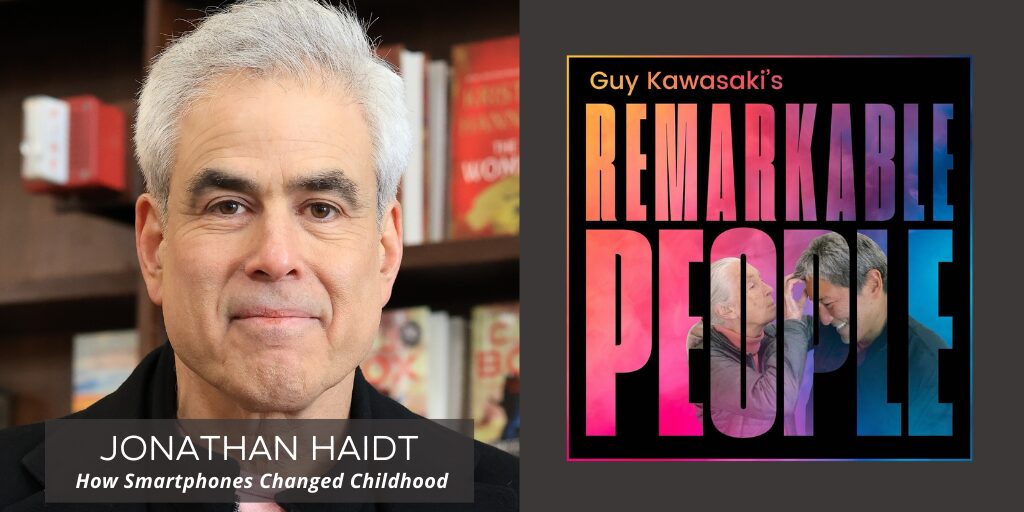
Welcome to Remarkable People. We’re on a mission to make you remarkable. Helping me in this episode is Jonathan Haidt.
Jonathan is a social psychologist who has spent years studying morality, culture, and the unseen forces shaping human behavior. His latest work focuses on a crisis unfolding in real time: the sudden rise of anxiety and fragility among young people. In The Anxious Generation, he explains how smartphones and social media rewired childhood in less than a decade. This episode uncovers what happened during those pivotal years — and why the impact has been so profound.
We explore how face-to-face play and independence were replaced by scrolling, comparison, and algorithmic pressure. Jonathan breaks down why girls were hit hardest, why these patterns repeated across multiple countries, and why this shift didn’t happen gradually — it happened abruptly. The result is a generation struggling with attention, confidence, and emotional resilience. His clear explanation of how puberty collided with technology makes the crisis far easier to understand. By the end, the scale of the change becomes unmistakable.
Jonathan also offers a path forward rooted in collective action rather than blame. He highlights four norms that can help families and schools reclaim a healthier childhood: delaying smartphones, delaying social media, making schools phone-free, and restoring real-world independence. These aren’t theories — they’re changes already gaining traction worldwide. And with The Anxious Generation expanding on these ideas, this episode doubles as a warning and a roadmap for anyone who cares about young people.
Please enjoy this remarkable episode, The Anxious Generation: Jonathan Haidt on How Smartphones Rewired Childhood.
If you enjoyed this episode of the Remarkable People podcast, please leave a rating, write a review, and subscribe. Thank you!
Transcript of Guy Kawasaki’s Remarkable People podcast: The Anxious Generation: Jonathan Haidt on How Smartphones Rewired Childhood.
Guy Kawasaki:
Good morning everybody. I'm Guy Kawasaki. This is the Remarkable People podcast, and we're coming from our far west studio in Waikiki on Oahu in Hawaii. And I'm particularly relaxed today and I have a great guest. But honestly, this topic is not that relaxing.
His name is Jonathan Haidt. He is a social psychologist. He's a bestselling author, and he explores things like morality and culture and social media and psychology of division. His latest book is called, of all things in Hawaii, The Anxious Generation: How the Great Rewiring of Children Is Causing an Epidemic of Mental Illness.
It's quite the subtitle, Jonathan, and let us just say that his book and what we're gonna discuss today is gonna help you understand the impact of social media and other things on society. Did I get all that right, Jonathan?
Jonathan Haidt:
Yep. That is all correct. And are you suggesting that in Hawaii people don't even know what anxiety is because life is so lovely and wonderful?
Guy Kawasaki:
Hawaii is supposed to be the happiest state I think. I read that someplace. Yeah. So first of all, I gotta tell you, I saw a video of you on Neil deGrasse Tyson's podcast, and he started off by saying that he was really offended and hurt that you didn't ask for his blurb for your second book.
I thought that was the funniest damn thing.
Jonathan Haidt:
Yeah. Well, yeah because he blurbed in the previous book.
Guy Kawasaki:
Yeah.
Jonathan Haidt:
But we smoothed it all out in the course of the discussion.
Guy Kawasaki:
I'm glad you did. First of all, before we get into this social media stuff, I wanna go back to your work in 2005 where you came up with this concept of the moral foundations theory. And, first of all, I'll let you explain it, but I found that very interesting. So will you please explain the six kind of factors or foundations in your moral foundations theory?
Jonathan Haidt:
So first I should give listeners a sense of who I am, which is I'm a social psychologist, which means I study how we influence each other. And early on in my career while I was in grad school, I picked morality as my topic. Why do we care so much what other people are doing?
How do we judge them? And then I also quickly picked cultural variation in morality as my topic because you will not find a human society that doesn't care what people do, that isn't gossiping and judging and criticizing. That's part of human nature. But yet, morality varies across cultures.
And so that's what I began to study in the nineties in graduate school, and then in my first faculty position as a professor at the University of Virginia.
And as I began to look at how morality bears across cultures, I began to notice, this is the late nineties, early two thousands, that the American culture war, like left and right, they're beginning to be like separate countries, like totally different frames of reality, different views of economics, of American history, of the Constitution, of everything.
So the culture war was beginning to be like literally two different separating cultures. Now it's kind of obvious that we're separate cultures, but it wasn't so obvious back then. And so in the process of trying to understand, you know we've all got it, but it varies. And a lot of people said, “Oh, well it's like language. Everyone has language. It's part of human nature.”
But our languages differ. That's a common analogy. But because I was studying, I began to see that moral judgment is really much more based in the emotions and in quick intuitive reactions than it is in like reasoning. And so I use the metaphor of the tongue.
All of our tongues have the same five taste receptors on them. That's sweet, sour, salty, bitter, and umami or kind of a meat flavor. We all have the same five, but our cuisines are different, but we can like each other's cuisines. And so from looking at all kinds of moral traditions and cultures, my colleagues and I came up with the view that there's at least five foundations that are like the taste buds of the moral sense.
They are care, fairness, loyalty, authority, sanctity, and then later we added liberty. There are more. There are other things, but with those six, you can really understand the coherent worldview of the left and the coherent worldview of the right and why each side thinks the other is wrong and why libertarians are different from all of them.
And you can look at how American culture has changed, and you can look at how America versus Iran versus Russia. The idea was to give people a vocabulary to say, “Oh, okay, this is what they say. I see how it's based in these three taste buds, not in these other three.” So that's what the theory is about.
Guy Kawasaki:
And that's twenty years ago. So has the theory proven to be more correct or less correct? If anything, we're more separate and divided.
Jonathan Haidt:
Yeah, so the theory in terms of what are the universal taste buds of the moral sense, the theory is held up very well. There are critics in psychology, there are people of alternate models. But the one revision that we made, and this work more recently, so I should say the original work was done especially with professors Jesse Graham, Brian Nosek, Pete Ditto, Spassena Koleva, Ravi Iyer. That was the original team that created the first version.
And then more recently, Mohammad Atari, who's now at the University of Massachusetts at Amherst, has really been leading. He did an incredible job online, serving like more than a dozen different cultures, giving a lot of new questions, doing factor analysis to figure out what's the factor structure in all these cultures.
And the only revisions we had to make are that we broke fairness into sort of equality, which is what the left cares about. And proportionality like The Law of Karma. Do the crime, do the time. Proportionality is what the right cares about. So even on fairness, there's a left-right difference.
That was the main change that we made. So the theory has, I think, held up very, very well in terms of what are the foundations. What's changed is that when I wrote my book, The Righteous Mind, that was 2012, based on all this work. When I wrote The Righteous Mind, the left was still visibly liberal, and the right was still visibly conservative.
And what's happened since 2012 is that the left is split. There's a far left that is really illiberal and pushing for things that are contrary to the liberal tradition. And on the right there's a far right that is really radical reactionary that is not recognizably conservative.
There's no connection between the far right or the MAGA right and the conservative intellectual tradition for which I have a great deal of respect going all the way back to Edmund Burke. So American politics has gotten much more extreme. I believe one of the main factors is because of social media. And so we don't have liberals and conservatives anymore.
They're at central left, center right. We still have some, but our politics is driven by the extremes. And that is terrible for a large, diverse, secular liberal democracy like the United States. It is terrible for us to be pulled apart like this. We're in big trouble, I believe.
Guy Kawasaki:
So correct me if I'm wrong, but when I read this theory, my reaction was if you are a liberal, you think conservators are bad, they're evil, blah, blah, blah, and vice versa. But if you look at your six factors, all of your six factors are kind of positive things, right? Like, you know, sanctity and liberty and all this kind of stuff.
So it's not that they believe in the opposite of you. It's just which flavor is most important to them, but it's all on sort of six more or less, at the very least neutral, but perhaps even positive features, right?
Jonathan Haidt:
That's right because our morality is not just like a taste. It's not just like good, bad. Like our morality, or at least political morality, is a set of ideas and metaphors and beliefs and facts that are built up over many decades or even generations on certain foundations.
So on the left there's been much longer a tradition of focus on victims, on those at who are oppressed, those at the bottom. And that was incredibly powerful in bringing about the rights revolution. So the civil rights, gay rights, animal rights, women's rights, you know, the rights revolutions were driven much more by the left.
And so what you do is over time you construct a narrative about groups. And some groups have power and some groups are oppressed. And sometimes that's right. And that was true at times and it's still true at times, but that view became so hardened on the left, I believe, and this is just my analysis of how we got so extreme, became so hardened on the left that they kind of took it into everything.
Everything is victim oppressor. And this went across universities in 2015 causing, I think, catastrophic results, which I wrote about in a book called The Coddling of the American Mind with my friend Greg Lukianoff. So the left kinda gets hardened.
These are not the moral foundations themselves, but these make sense if your main moral foundations are care for victims and equality in a country that has a lot of inequality, that is not a crazy way to think. Okay? So that kinda gets hardened and it was very helpful in the fifties, sixties, and seventies. I'm not sure it's been so helpful in the two thousand tens when we even got gay rights and trans rights have been instantiated by the Supreme Court.
So that's on the left. On the right, they care more than the left does about loyalty like group loyalty and authority and respect for authority and sanctity. And some of your listeners might be saying, “Really, they care for authority? Look what they're doing to the Constitution and American traditions.”
I think what happens there on the right, you've long had this idea going back many decades that the left is attacking moral order. The left, they hate everything about America's past and they wanna tear it all down. And our job is to preserve it. And that's a visibly conservative sentiment. And what I say in the anxious mind is that a healthy society has a liberal wing that's like pushing for change and a conservative wing.
So whoa, slow down. Let's have a gas pedal and a break. You don't want a country without both of those. But on the right, I think they've hardened into the left is always trying to destroy America. They hate America. And we are the real Americans who are guarding American traditions.
Now one of the greatest American traditions is the Constitution that's all about dividing powers and limiting the power of the presidency. That's what the founding fathers were afraid of, that you'd have a tyrant who would take over and assume all power. So you might say, “Come on, conservatives. This is what you should be offended by.”
But again, if you take that view that the left is the enemy and they've been trying to destroy America for decades and decades, and then you get modern social media and you get everybody more extreme, now you can have the view on the right that our enemy isn't Russia or China or Iran, it's the left and we've gotta fight the left.
And it's very scary when the executive power of the country it's harnessed on, I don't wanna get too political on you. I just wanna say for whatever, whether your listeners are on the left or the right, your worldview makes full sense. I totally grant that.
And the other side, they believe that theirs makes full sense. And the further we get apart, the more we hate the other side. We become incapable of believing that they really believe that, and this is where we are in the culture war, and this is a very dangerous place.
Guy Kawasaki:
This is a really brilliant lens and a brilliant way to look at what's happening right now, because it's not right or wrong, it's different. And so you gotta be able to hold it in your head that both sides can believe they're right. And both sides have an argument to be made that they are right.
Jonathan Haidt:
I fully agree with that. I'll say something a little bit more controversial, which is I actually think that you can sometimes say where the other side is wrong. Now, you can't just do that in a vacuum, you have to have a frame of reference.
But from a vibrant liberal democracy and the United States was the world's premier liberal democracy for so long, I can say, and I have said, and I get a lot of flack for this, that some things on the left, like cancel culture is deeply illiberal and they are wrong.
They're wrong to create climate of fear where people can't speak up. So I've said even though I respect both sides, like I think this is contrary to liberal principles and the same thing on the right where I think we can see that power with no checks on it is really dangerous.
And to see all the checks going away and to see Congress doing nothing and to see the Supreme Court seeming to bless the power grab. So I'm willing to say that we're all ethical creatures. We all want what's best for the country, for our families, for the world. But man, the two sides are both kind of suffering at the extremes.
At least are suffering from some delusions in pursuing some policies that I think betray their own traditions. Okay. Now onto more positive stuff or social media?
Guy Kawasaki:
Yeah.
Jonathan Haidt:
Because yeah, we didn't think this was gonna be about politics primarily. You got us into it. You asked.
Guy Kawasaki:
Talk about a timely concept about this. It's a very useful framework. I found it very useful to learn about this framework. And Jonathan, may I just say, I am not worthy. I am not worthy because Jonathan, seriously. If somebody said to me, “Guy, twenty years ago, you wrote a book and you had six concepts, can you explain them to me?”
I can honestly tell you I would be sitting here saying, “What the hell is he talking about?”
I cannot remember six principles in the book I wrote six months ago, and you just went back twenty years and ripped them off. You don't have notes in front of your computer, right?
Jonathan Haidt:
Well, it's one thing if you spend fifteen years of your life as a researcher, as a scholar, and you live and breathe it, and you create this thing and you send it out into the world, and then you find out the world is coming apart along exactly the lines that you wrote about.
And even though everything I've been thinking and talking about for the last year or two has been about The Anxious Generation, social media, kids, mental health, but in the last six months, wow I took The Righteous Mind off my shelf the other day.
I was flipping through it because I'm gonna try to write something saying, “Okay, what's happening now is really insane and scary, but let's go through it. Okay, what are the three principles of moral psychology? How are they operating today? If we're gonna go over a cliff, let's at least understand how we're going over this cliff and what might happen at the bottom.”
Guy Kawasaki:
If I were someone who worked for The Atlantic and listening to this podcast, I would be calling you up in the next five minutes and saying, “Jonathan, we need an article for The Atlantic.”
Jonathan Haidt:
We're already there. So I love The Atlantic. Most of my most influential pieces have been in The Atlantic, and I am now officially a contributor to The Atlantic. I think The Atlantic is doing the most amazing work to bring in diverse viewpoints on the right. People think it's on the left, but it really is politically diverse and committed to saving the country.
So I love writing there. And I'm actually writing the paper that I mentioned. I'm writing that for The Atlantic, so we're already there.
Guy Kawasaki:
Ah, see, great minds think alike. Yeah.
Jonathan Haidt:
Or actually great minds often don't think alike, but okay, alright.
Guy Kawasaki:
Alright, so let's get out of the past here and let's get into this current work of yours. So first of all explain the fundamental harms that social media can cause in kids.
Jonathan Haidt:
So, something weird happened beginning around 2013, 2014. All of a sudden teenagers were much more depressed, anxious, suicidal, self-harming. It seemed to come outta nowhere. It wasn't like this in 2010, even 2011, there was no sign of this. And so since 2015 when this became apparent on college campuses, but then it turned out it was everywhere.
It wasn't just on college campuses. I've been focused on what happened to Gen Z? What happens that people born in 1996 and later? That is Gen Z. Why are they so different from the millennials who were born 1981 to 1995? Why are they so different? And everything comes back to what happened to them during puberty.
And the millennials, let's say you're born in 1990, you go through puberty from roughly 2002 to 2006, so four or five years, there was crucial years in which your brain is rewiring.
Your brain is literally changing, you know, huge change in the connections among dendrites and axons because as you go through puberty, the brain is shifting from the child form, which is very open and plastic and flexible, to the adult form, which is kind of locked down in an effective pattern for your culture.
You become enculturated, especially during puberty. There's a sensitive period where you learn your culture. And my argument in the book, in The Anxious Generation, is that the millennials, their mental health is fine because they got through puberty before 2012. And so they're okay.
But Gen Z went through puberty in the early two thousand tens or later. And what happened is that in 2010, everyone has a flip phone. The iPhone exists, but teens don't have one in 2010. They're texting each other. There are no apps, not a lot of high speed internet. So the technology is just that it connects them. They talk, they text. That's it.
But by 2015, all the teens have a smartphone. 2012 is the flip year. That's where it goes to majority. So it's that short period, 2010 to 2015. Everything changes in the technology environment. By 2015, the amount of time kids are spending with other kids is plummeting. They're not spending as much time anymore.
The amount of exercise they get is dropping. The amount of sunlight they get is dropping. The number of books they read is dropping because this takes up everything.
And if the phone is taking up six to ten hours a day, depending on the subgroup you're talking about, and that's not counting school and schoolwork and other stuff, if the phone for many kids is taking up literally half of their waking hours, that interferes with everything about development.
So in the book, I especially focus on what it's done to their mental health and why this new phone-based childhood creates anxious, fragile young adults. Whereas the older play-based childhood where you go out, you're playing, you take risks, you get into arguments, you settle the arguments, everything's not mediated by an adult.
Why that's a healthy way to develop. That's why the millennials' mental health is fine. So that's the basic argument of the book. There are a lot of other harms we can go into, but that's the core idea about the great rewiring of childhood, 2010 to 2015.
Guy Kawasaki:
And is there any issue that someone pushing back on, you would say, Jonathan post hoc, propter hoc, is not necessarily true. Just because we see these changes in them and it happened after smartphones doesn't mean necessarily the smartphone caused it. So do you have like proof that it was the smartphone, nothing else?
Jonathan Haidt:
Yes. So first, I certainly grant that if all I were to say, and in the first chapter of the book I say, “Look what happened to mental health, over and over again in multiple countries, same thing in the U.K., Canada, Australia, New Zealand, Scandinavia.” So if I say that, and then I say, “What changed? Oh, you know, technology changed.”
Okay. That's just a correlation, a historical correlation, that does not prove causation. It could be anything else. And so I'm surprised how little pushback there is actually. I expected a lot of stuff to be written. There was one article written in Nature that was very critical, and that's really the only one, and everybody cites that to say, “Oh, it's totally controversial. There's a big fight.”
There's really that one article. There are a couple of other negative reviews, but the reviews have been overwhelmingly positive. And there's actually a small group of researchers that think I've misinterpreted this, and we have a normal academic argument.
And so what you're asking is, how can I show its causality? It's not just a historical correlation. And so the answer is we're just about to come out with an essay on my Substack After Babel, where we show there are seven different lines of evidence, seven different lines. Think about it this way.
Imagine if a woman is mugged by three men and she knows the three men, and they punch her and they take her wallet and they take her car. How do we know they did it? So it goes to trial, she reports them, they're arrested. It goes to trial. How do we know they did it?
Line one. She says so, like she saw them, she knows it. And with social media, the kids say it. So in this article, we showed the seven, line number one surveys of Gen Z. They're not grateful to these apps and program. They say, “This is the major reason we're depressed.”
Huge amounts of regret. Whereas with prior moral concerns, like over television, kids weren't saying, “Oh God, television ruined our lives. God, if only we could stop watching television, but we can't. Please help us stop watching television.” So the first thing is the apparent victims actually point to the perpetrator, say they did it. Next, they're eyewitnesses.
So the kids could be wrong. But they're eyewitnesses. So surveys of parents show the same thing. The parents believe this is hurting them. And it's the combination of smartphones and social media. It's not just the phone. And teachers believe it is happening. And we have all kinds of surveys of that.
And then there are confessions. Suppose that the prosecutor was able to say, “Look, here are screenshots of the text messages between these three guys.” And they say, “Let's go mug someone Thursday at three. Yeah, let's do it.” And then they say, “Wow, that was fun. Mugging this woman at three.” Okay. Guy, would you consider that to be evidence that these guys are guilty if you had screenshots of their texts?
Guy Kawasaki:
Yeah, so this is Mark Zuckerberg talking to his direct report saying, making the thing that sucks you in the most. Right?
Jonathan Haidt:
Exactly. That's right. Because so many parents and attorneys general are suing these companies because there's so many dead kids and there are so many huge expenditures by the states for teen mental health emergency services. So huge numbers of lawsuits. In the lawsuits, there's a process of discovery and the lawyers have brought out all kinds of internal reports and documents, and they quote those in their briefs that they put up online.
And my team, we analyzed all these briefs, and we took out just the quotes from their own employees. Over and over again the goal is to addict them that they know what they're doing. Heavy use of TikTok seems to correlate with loss of ability to pay attention and damage to relation.
I mean, it's unbelievable. So if listeners go to AfterBabel.com or just search industrial scale harms, you'll find our posts on TikTok and Snapchat. So that's the third line of evidence, so like their own reports say that they're hurting kids. Okay. Then the fourth line is the correlational studies.
Now, correlational studies can't prove causality, but there's an argument over whether the correlations are so low that they don't matter or whether they're much larger. And so I believe we're gonna win that argument, but we lay it all out, like, how do you interpret all these.
Then the experiments, which we generally do think establish causality and we can't run the real experiment, which is let's take a thousand kids and not give them iPhones and social media and let them go through puberty.
That would determine it. If we could do that would totally set, but we'll never do that, of course. So instead we have these little toy problems. And a toy problem is let's try to get 500 college students. We'll randomly assign half of them to reduce their social media use for a week, two weeks, three weeks, and let's see if they get less depressed.
And the answer is yes, they do compared to the control condition. Now that's only if you wait a week or longer. Some studies go one day, and if you blend in the one day studies, if you're addicted to something and then they take it away from you, are you happy? No. It takes a while to overcome it, to get back to normal, for your dopamine system to reset.
So the experiments, there are quasi experiments, there are longitudinal studies. So we'll be posting this in the next couple of weeks at AfterBabel.com. Sorry, that was a very long answer to your question, but I'm in the middle of this debate right now with other researchers.
So yes, there is a debate, but I believe that the debate focuses very narrowly on how to interpret correlational studies in a small class of experimental studies. But in fact, there are seven different lines of evidence. And so if you're a parent or a legislator, are you gonna say, “Let's wait until the researchers have reached consensus.”
Okay, that's gonna take thirty years. On media effects, we can't reach consensus in a decade or two. It takes a long time, but legislators and parents have to make a decision today. Does it look like this is hurting kids? Does it look like it's good for kids? So that's where we are.
Guy Kawasaki:
My mother used to tell me, “If four people tell you you're drunk, you catch a cab. You don't say they're all wrong.”
Jonathan Haidt:
That's right. No, they're all wrong. I know better. Yeah.
Guy Kawasaki:
And is the evidence that social media is especially harmful to girls?
Jonathan Haidt:
Yes. To be clear, what we're talking about here isn't social media overall. It's a single variable, which is what we study because we don't know what the kids are doing online. Only the companies know, they know, they see the damage. We don't know. All we know is there are a lot of surveys where you ask a thousand kids, “How many hours a day do you spend on social media?”
It's often not defined. Does it include texting? So you say, “How many hours a day? Zero, zero to one, one to three.” So we get like a five point scale of just the amount of time. And it's not even that accurate, but it's correlated with the reality of how much time. That's all we have.
So we look at that and then we look at, how often were you anxious in the last month? So we have a variable on mental health. So if you just look at that correlation, then girls have a bigger correlation repeatedly. Girls are more harmed by spending time on social media if you're just looking at that relationship. That I'm very confident about.
But what I've come to see is that even though girls use it more, they care about it more. They're more drawn in, they're more addicted to getting social information than boys are. When we look at very serious harms like who actually dies because they bought drugs that were laced with fentanyl on Snapchat.
Super easy to buy drugs. You can do it within ten seconds of opening an account, he was able to find drug dealers. So who is dying because they bought Percocet that turned out to have fentanyl in it? Who is getting sextorted? That is who is being tricked into sharing a naked photo of themselves, showing their genitals?
And then is revealed, oh, I thought I was talking with a sexy girl, but it turns out it's a sextortion ring operating somewhere in Asia or Africa, and they're going to destroy my reputation and send this photo to everyone I know unless I paid them 500 dollars and then another 500 and then another 500.
And so we know of about forty cases. We know the names of boys who killed themselves that day or the next day. So when we look at the very serious harms, sextortion, driven to suicide, fentanyl, now I'm not sure there's a sex difference. Oh, cyber bullying that caused a lot of suicides. And there it's also a lot of girls.
So in terms of very serious harms, there may not be a sex difference or it might even tilt towards boys in terms of actual death. But I don't have those hard numbers.
Guy Kawasaki:
And I think you already said this, but I just wanna reiterate that this is not a uniquely American phenomenon, right?
Jonathan Haidt:
Right.
Guy Kawasaki:
Is it everywhere that has smartphones and social media like this?
Jonathan Haidt:
Not quite. Not yet for an interesting reason. So a couple of amazing things about this, and this is what convinced me. So to go back to your question, okay, you got this correlation, does that prove causation? The correlation doesn't prove causation, but the fact that very much the same pattern happened in Canada, the U.K., Australia and New Zealand.
So the Anglo countries at the same time, usually whatever happens in America gets to Australia, New Zealand, three to five years later. But this was the same, okay? And in all countries, the girl's curve is steeper than the boys. So that tells you that this has nothing to do with Obamacare redefining mental illness.
This has nothing to do with the Newtown shooting. That's what some of my critics say. Like, “Oh, well, yeah, 2012, that was the Newtown shooting. And kids have had these lockdown drills, these shooter drills. Of course, they're anxious.” Really? Why did that cause girls in New Zealand and Iceland to suddenly cut themselves?
So once you see that this is happening in many other countries now the causal hypothesis becomes more plausible because nobody has even proposed an alternative. Some people say, “Oh, it was the great financial crisis.” No, that was 2008. By 2012, 2013 we're already on the mend. Some people say, “It's not too simple to blame it on technology. Depression's caused by poverty and racism and, you know, fears of climate change.” Really?
So why was it like totally steady from the nineties? Those were not changing? Then all of a sudden in 2012, everything changes all over the world. Like everyone, there's more poverty, there's more racism suddenly in 2013, like so I think when we look at what's happening around the world, but now to get to your specific question, so we have really good data from the Anglo countries, and there's a couple of good studies in Europe.
When you look at the developing world, there's the Gallup World poll, which has a question about wellbeing, but it doesn't have any questions about depression. There's one question about worried, which is like anxiety, so there's not very good data. But they actually do cover the world, but we don't really have good data to map it up.
But to the extent that we can, that we've tried, and this is work done by Zach Raus, who's my lead researcher, what we're learning is that the effect seems to be bigger in the Anglo countries than in Europe. Although within Europe, it's actually pretty big in Scandinavia and it's a little less in Southern Europe.
And we're not seeing so much in Eastern Europe. Now, Eastern Europe used to be poor and communist, and life is getting better there over the last few decades. So there's two things. Is the economy improving? Is life improving in places where it is? And that's true in a lot of the developing world.
I'm not sure what we're gonna find out. We're working with the Gallup people and the World Happiness Report people. So I can't say it's happening in the developing world and it's happening less in Eastern Europe and Southern Europe than in northern Europe and the Anglo countries.
And our hypothesis there is that in places that had a lot of freedom, where kids were very free, not bound in by obligations and traditions, traditions have been actually generally good for mental health, but it's in those countries that the kids got just washed away into this bizarre, crazy world of influencers and social media and extremists and addiction.
I should add, we also don't see this big trend in families that are religious or conservative. Everyone's doing worse off. But the increase is much smaller in those that are religious or conservative. And as I said in The Righteous Mind, when the big difference is conservative moralities are more binding.
Like you have to do your duty, you have to do your chores, you have to go to church, you have to go see your grandmother. Conservatives, you've more strict parenting, which traditionally is not better than other kinds of parenting. But if you have strict parenting and you're embedded in webs of adult relationships and obligations, now everyone's getting on Instagram.
But you don't get swept away because you still have to go see your grandmother and you still have to go to church and you still have to clean the dishes and you're still deep in contact with adults. Whereas in more secular, progressive families, lot of freedom, not a lot of obligation or tradition.
Those kids were most vulnerable. They're the ones who are worse off. So that's my best guess as to what's happening with the cultural variation.
Guy Kawasaki:
And this is even true in, I don't know, every year you come out and you see a study that Denmark or Norway is the world's happiest country and all that. It's true there too.
Jonathan Haidt:
Yeah, so that's very interesting, because it's true that Scandinavian countries have long been rated as the happiest along with Switzerland, Israel. So especially small countries tend to do better. So that's been true for a long, long time. But really interesting work. There's a guy named Danny Blanchflower, an economist at Dartmouth.
He showed, as many others, this has been long known. For a long time there's been a u-shaped curve of happiness where if you graph how happy life, whatever, you find the highest levels are actually in the elderly. People in their sixties and seventies are actually the happiest.
And then in middle aged, they're less happy. And young people, young adults are the second happiest. It's like you start off pretty happy and then you get less happy in midlife and you got kids, you got a job, you gotta take care of the parents. Like you gotta, it's hard. But then, your kids are out and you're retiring.
And so there's long been a u-shaped curve of happiness. Okay? And that was true not just in a couple of rich countries. That was generally true around the world until 2015. What Blanchflower finds is that once kids are getting on or whatever it is, my hypothesis is that it's once kids leave behind a play-based child, they take a phone-based child.
As soon as that happens, the ‘u’ goes away because the young adults are much less happy. Older people haven't changed. Older people today are the same happiness level as older people were twenty years ago. But young people today used to be the second happiest group, and now they're either flat like the same as people in midlife or in some countries they're actually the least happy group.
And that's true in Scandinavia too. So Scandinavia is still generally where you find the happiest populations, but their young people are no longer so happy.
Guy Kawasaki:
But by definition because it's only been ten or fifteen years, but we don't know the long-term impact. So when Gen Z becomes the old people, could they recover and become happy again?
Jonathan Haidt:
They might become happier, but I believe at this point, the damage has been going on for so long. And, some people thought, Oh, they'll grow out of it. Like these college students that are so fragile or that are complaining about a book. They won't be able to do this at Google. They won't be able to act like this, and they're gonna have to grow up and join the real world.
That's what we thought ten years ago. But it turns out that a lot of these companies are accommodating to this. Now, part of it is, of course, you need to accommodate to levels of mental illness. That's the law, and that's the ethical thing to do.
So young workers today have much higher levels of anxiety, depression, and other internalizing disorders. So you have to accommodate to it, but they don't seem to be growing out of it. So people in their twenties are much less happy than people in their twenties used to be. It's not just a teen thing.
And again, if you go through puberty is when your brain is changing and assuming adult position, if you're not socialized by your culture, by the elders in your culture, by your older siblings, by books and movies that your culture thinks are good. If instead it's just ten million little snippets of nothing on TikTok, if that's what's wiring up your brain during puberty, there's a good chance that it's gonna be permanent.
And by permanent, I don't mean, look, anyone who improves their habits can improve their outcomes. I'm not saying fatalist like you're locked in, but when we look at a whole generation, we're looking at averages and the odds that the average, or that all of these people in their twenties are going to quit social media, try to regain control of their attention, try to develop some discipline, like that's not gonna happen.
So I think we're gonna see an echo of where Gen Z all the way through their life course is gonna look different and diminished compared to the millennials or Gen X before them.
Guy Kawasaki:
Okay, so let's assume that you're right. You got seven pieces of evidence, so the next question for everybody listening is, okay, so now what do we do at this point? What's the collective response we should be making?
Jonathan Haidt:
That's a good way to put the collective response. I think that's what I brought to this topic. I haven't been studying this my whole life. I've just been studying it for about eight years, but intensively for six years. What I brought was the sensibility of a social psychologist.
And so I think the people were researching it before they didn't seem to fully grasp the degree to which what everyone was doing was kind of forced by what everyone else was doing. It was a collective action problem. The kids all had to be on Instagram back in 2012 because everyone else was getting on Instagram, and they had to have a smartphone.
Nowadays, you have to have a smartphone in sixth grade in a lot of places because everyone else has a smartphone in sixth grade. So what I did in The Anxious Generation was at the end I said, “Okay, let's understand that this is a collective action trap. The kids are in it, the parents are in it, even the companies are in it.”
Because if Instagram or if Meta was to do the right thing and not let on people under thirteen years old, which is what the law is supposed to be, if they actually kicked off people under thirteen, they'd all just go to TikTok. So the companies themselves are trapped in a collective action problem. They're competing viciously to get younger and younger and younger users.
So the way outta a collective action trap is with collective action. So what I laid out in the book is four norms. And if we do these four norms, then we'll save Gen Alpha, we'll save the kids. Gen Alpha birth year 2011, 2012. We don't really know yet, but roughly in there.
So the kids who are just beginning puberty now, that generation. If we can do these four norms, we can make a big impact on their mental health and their strength and their competence and their confidence. Here they are. No smartphone before high school. You can give a phone watch, you can give a flip phone, but don't give them a supercomputer with an app store and push notifications.
Don't give them all that stuff, which is gonna take over their lives. Wait until they're in high school for that. Ideally we'd wait longer. The world is making kids have a smartphone, so let's just clear it out in middle school. Second norm, no social media before sixteen. This should be a law.
The current law says thirteen with zero enforcement, the companies have no obligation to check ages. Australia has raised the age to sixteen, in part because the wife of one of the politicians there read The Anxious Generation, said to her husband in South Australia, said, “Peter, you gotta read this book. You gotta do something about it.”
And so they developed first in South Australia, then the whole country, a law. It'll take effect in December, that kids are gonna have to be sixteen to open an account or to maintain their account. And that would be huge because there's really no way to use these things safely once you're on these algorithm driven engagement based business models.
Even if they could take away all the bad content, you still would get addicted. Huge social comparison. You wouldn't sleep as much. All these problems would still be there. So raise the age of sixteen, be done with it. Treat it like drinking, driving, gambling. There's all sorts of things that are appropriate for adults, not appropriate for children to be talking with strange men who are gonna sextort them.
The third norm is phone free schools. And this has been the most spectacular success because the teachers can't stay on the phones. Can you imagine standing in front of a classroom and trying to teach anything while half the kids are on social media, especially TikTok and Instagram?
They're watching short videos, a quarter are playing video games, and a quarter are watching porn. Okay? It's not a quarter watching porn, but sometimes it is. The point is that the teachers have long hated the phones. There's no reason why kids should have phones while they're in school. If there's a smartphone buzzing in your pocket and you're addicted to it and everyone else is texting, you've gotta check.
And so test scores are literally dropping around the world and across the country. Our kids literally know less than kids did fifteen years ago because they're so distracted, they're not able to pay attention in school.
Once we propose here are the four norms, one of them is phone, three schools, teachers, parents, people jumped into action saying, “Yes, we wanted to do this for so long, but we were afraid of the number of parents that would complain, the parents that would say, ‘No, I have to be able to text my son. What if he's anxious? I need to text with him.’”
No, you don't. This is part of the problem. If you think that you do, the kid needs to learn to separate and learn how to deal with the people in school. You need eight hours apart, is good for your kid. Good for you. So this is just an amazing success.
A number of countries have done it. Brazil, within ten months of the book coming up, Brazil had banned all phones in school. And nineteen American states have done that. If you're listening to this and your state is one of the nineteen or so that only banned it during class time, I'm really sorry for you, but your legislators made a mistake because while that will help a little bit during class, you don't get any of the benefits from an all day ban.
When schools ban phones for the whole day, we always hear the same thing. There's laughter in the hallway. We haven't heard that in ten years. The lunchroom is loud. We haven't heard that in a long time. Kids are playing games with each other. They're playing soccer at lunch rather than sitting on their phones for the lunch period.
So only a phone free school, a distraction free school, the whole school day that brings miraculous results. Oh, discipline problems drop. Many schools are some ballpark of 50 percent. These are not small drops in one of the most important outcome variables. Are kids getting in fights? Are they destroying the bathroom?
All that. If they can't take a video of it, why would you do it? Why would you trick someone into coming into the bathroom so you can beat the hell out of them if you can't take a video and post it? So once you go phone free for the school day, discipline problems plummet. And then the fourth norm is far more independence, free play, and responsibility in the real world.
Because the point isn't just take away the devices and hope that they play with each other. It's rearranged life so that they're actually allowed to walk out the front door without you. They're allowed to go over to a friend's house who lives three blocks away when you're nine or ten years old.
Everyone used to walk around by the age of eight. You and I grew up during a huge crime wave. Maybe not in Hawaii, but in most of the country. There was a huge crime wave in the seventies and eighties, but kids still played outside now. Crime is way, way, way down. Drunk driving is way, way, way down. Child deaths are way, way, way down.
The world is so much safer than it was when you and I were growing up. But parents are afraid. We've lost trust in each other and we're freaked out by things we see on social media and television. So we've gotta overcome that. We gotta find ways to let our kids out to play and develop a sense of independence and learn that if there's a setback, they can handle it.
They don't need to call for reinforcements by phone or text. So those are the four norms if we do that, we change childhood, we roll back the phone-based childhood, we restore the play-based childhood. And Gen Alpha's gonna come out a lot better.
Guy Kawasaki:
But, just to play devil's advocate a little bit, isn't one of the interpretations of that to protect privacy and stuff like that, you have to invade privacy? How do you actually enforce something in Australia that you have to be over sixteen, and kids are gonna figure out a way around that they're gonna find a site that doesn't participate in that?
There's so many loopholes. How do you make this work in practical terms?
Jonathan Haidt:
So if your question is how do you make it work perfectly, the answer is you can't. Same thing with alcohol. We have laws against drinking, but kids are gonna find a way around. We have laws against heroin and marijuana, but kids are gonna find a way around. So perfection is impossible here.
I grant that, but we as a society, we have a hundred years of experience age gating the physical world. We know what's dangerous. You have to have a fence around a swimming pool. You have to be eighteen or twenty-one to gamble. We've had fences in the real world, but with the virtual world, we just said, “Oh, whatever.”
It's hard to do. It's hard to age gate. It's true. It's harder than, in the real world, you show a driver's license to buy beer, it's harder. So how about we give up? How about we just say, “Eh, it's hard. So let the companies have the kids. We don't need the kids anyway. Let them take a second generation.”
And what Australia's done, I think is really brilliant. They didn't try to legislate how to do this because governments aren't good at that. What they said is, for the first time, “You guys are making the money from this. You guys are hurting the kids. You figure it out.” And look, there are a lot of industries that already age gate.
You can buy alcohol, you can buy all sorts of things online, but you have to age gate, you can gamble online. There's age gate. So age gating exists. Often it uses a government ID. And what the Australia bill says is you can't only ask for a government ID, so Instagram, TikTok, Snapchat, YouTube, it's up to them.
You do it how you want. And probably what I'm hoping will happen, I imagine will happen. If you wanna open an account on TikTok, let's say, you put in your age as you currently have to do. And then rather than just accepting that you were born eighteen years ago, which is what they often do with the default on Snapchat, if you sign up for an account, it helpfully suggests that you were born exactly eighteen years ago.
So every eleven-year-old opens a Snapchat account. A lot of them just say they're eighteen and then there's no restrictions. That's gotta stop. So instead of just putting in whatever you want, it'll take you another page that will say, “Okay, here's five ways that you can verify your age.” And one will be you can show us a photo of your driver's license or passport or whatever.
That will be one. Another so I have CLEAR, do you have CLEAR where you go to airports, and you have a quick line? So if you have a CLEAR account, boom, you're done. You're in like because all that happens would be like Meta or TikTok. They would just send over a call. You'd type in your CLEAR password or whatever it is on the way.
But they would send over a call to CLEAR or there's so many different companies that will age gate, so they can pick the five or ten companies that they want to make as options. And CLEAR would just send back yes or no because the query would come, is this person thirteen or in this case, sixteen?
Is this person sixteen? And CLEAR doesn't need to even know what it is you're doing. Just they got a query about you. And then they just say yes or no. And so that's one way.
There are so many other ways to do it. And so I understand people's concerns about privacy because if it was TikTok taking your driver's license or TikTok taking all your info, well, look, they already do take your information, but all these companies get hacked at some point.
So I do appreciate the concern about privacy, but to say there could be a risk of privacy, so let's just condemn all future generations to exploitation and diminished cognitive capacity. No, I don't think we should do that.
Guy Kawasaki:
And what about the concern that you know, so now you're sixteen and we have been overprotecting you up to sixteen and at sixteen, the flood gates open, wide open.
Jonathan Haidt:
Sure. That's good because one of the themes in my book is that we've been overprotecting our kids in the real world. We need to back off, let them out, and we've been under protecting them online. We need to do something. We need to begin doing something. We can't just let the companies rip them to shreds with zero liability, zero accountability.
So far, not a single company has lost a lawsuit. They've paid nothing for the millions of kids that they've harmed and the thousands that are dead. It'd be one thing if we were keeping them hermetically sealed from the internet, and then at sixteen we say, “Here you go. Porn, gambling, everything.”
No one is hermetically sealed from the internet. They've been Googling things since they were five or seven. They will have been on all kinds of sites. They will have watched all kinds of YouTube videos because the law isn't that you can't watch YouTube.
That would be crazy. We rely on YouTube. A lot of us, we all do. The law says you can't open an account, meaning you can't sign a contract with a company that is known to hurt kids, that will exploit you, that will take your data without your parents' knowledge or your parents' consent. You have to be sixteen to do that.
So it's not that they're not gonna know what the internet is. They'll know all about it. They just won't be able to have an account where an algorithm is now hooked up to them to hook them with whatever is most engaging for them. That we will delay. Algorithm manipulation will be delayed until sixteen and at that point, their brain is most of the way through puberty.
It's through the intense period of puberty. So there are all kinds of proposals to make the internet safer. Let's try to cut this pro-suicide content by 90 percent. Let's try to remove more beheading so that kids only see a beheading every now and then. Not so often.
So we could try to make it better, but as far as I'm concerned, you can put all those reforms in one bucket and then put age gating in the other. I'll take the age gating. That's gonna transform kids' lives.
Guy Kawasaki:
And what if I am Mark Zuckerberg listening to this and either my belief or my rationalization is my fiduciary responsibility is to the shareholders. It's not to kids. So it's not that I'm a bad person. I'm fulfilling my fiduciary responsibilities. It seems that a lot is being done in terms of fiduciary responsibility to shareholders.
Jonathan Haidt:
So first, the idea that an executive as a fiduciary duty to the shareholders is disputed. Some economists interpret the law that way. Your fiduciary duty is to the company, not to the shareholders. You have a duty of the shareholders. You need to repay them. You need to help them earn a profit.
But it's not certain, in legal circles, that is literally a fiduciary duty. It has some things in common with it, but some things are different. Secondly, the fact that you have a duty to your shareholders does not mean you have zero duty to the planet or the people. It does not mean that you should exploit children up to the point where you might lose lawsuits.
And since so far they've never lost any lawsuits, that means there is no stopping point. And Mark Zuckerberg has made that clear. When you know now, six months ago we weren't thinking about chatbots. We didn't know about all the deaths, all the boys who've been urged to kill themselves by their chatbots.
We didn't know about all the sex talk that kids are doing with chatbots. We didn't know that Mark Zuckerberg said when they were trying to make the safety guidelines for Meta's AI, some were concerned that these AIs are gonna do sexual fantasies with anyone.
There's no age gating. So anyone can do sexual fantasies. How about we put some guards? So if we think it's a child, how about we don't do that? And we know from reporting The Wall Street Journal, I think it was, Jeff Horowitz, that Zuckerberg specifically gave the instruction, “No, make it as engaging as possible.”
He weakened the guardrails for children because he wants it as engaging as possible. I've met him twice. I've talked with him. I've read a lot about him. I know he doesn't wanna hurt children, but everyone says he's a very, very competitive person. Nick Clegg said in his recent book, he's the most competitive person he's ever met, so I don't even know that Zuckerberg is trying to give a return to his shareholders.
I think Zuckerberg, he just wants to win. He's very competitive and channeled in the right way. That is great for free market society, but that is only if you have functioning markets where there are constraints on the externalities that you can impose on innocent people.
And Meta has such a long history of telling us they're gonna reform, telling us they care about kids, but there's just insult after insult, injury after injury, and specifically saying that chatbots can talk about sex with kids is unbelievable.
Oh, and it wasn't just this one thing that he said in an interview. A little later a document came out. It was their internal company policy that said they can have sensual conversations, and they gave examples of what's permissible. It's disgusting. Absolutely disgusting. The chatbot talking to a thirteen-year-old saying, “Oh, I would bring you to the bed and I would rip off your shirt.”
This is completely disgusting. And this document was signed by the Chief Legal Officer, by the Chief Ethics Officer, by all the top brass. This is official Meta policy. We're putting out a product that will do sexual fantasy with any nine-year-old who says she's thirteen.
Guy Kawasaki:
I'm sorry. But, the fact that Mark Zuckerberg is very competitive doesn't mean shit to me. I don't give a shit how competitive you think you are. It's still not right.
Jonathan Haidt:
Yeah, that's right. Ethics. And this is the eternal problem in a free market society. And we get all the benefits. You've been right there in Silicon Valley. The benefits from the tech sector are beyond calculation. I love tech. And I used to think it was making the world better.
And in many ways it still is. But we now have some technologies. First, social media, and now AI, where the trajectory looks incredibly dark.
Guy Kawasaki:
Yeah. What do you think of a concept that, to use the metaphor, it's kind of like the process of getting a driver's license that you know, there's a certain minimum age you get a learner's permit, you might have to take a driving class before you get a full license.
Because right now, isn't it the day you're sixteen and can prove it, bada bing, bada bang, you're in. What about the day you're sixteen, you cannot just jump in a car and drive?
Jonathan Haidt:
You have to pass a written test, but I'm gonna challenge that metaphor and apply a different one because I recognize that the internet is different from driving because of free speech issues and especially the United States with the First Amendment, which I love.
I'm a big fan of the First Amendment compared to other countries. And so I would never say, “The internet, so many dangers. Kids need a driver's license before they can use the internet. We'll make a kid's license so that if you're a kid, you can go to these sites.” Okay. No, I would not wanna see that.
That would be a clear violation of the First Amendment. No, that's outta the question. But here's a better analogy using cars. When cars first came out, there were no safety features. It was really just, can we get this thing to go? And if you crash into a tree, the glass breaks and punctures you because it's window glass, and there are no seat belts and et cetera, et cetera.
So over time they get a little better, but not much better. And in the sixties, Ralph Nader writes a book called Unsafe at Any Speed, pointing out that we're putting people in these vehicles that are beautiful.
Guy Kawasaki:
Pinto is not beautiful.
Jonathan Haidt:
That's true because the seventies after the gas crisis, you're right.
They get small and stupid. But when Nader was writing, he was showing these companies, they're all competing on looks, okay, they're competing on style. Great. We have stylish cars. That's nice. But they see safety as a cost. Like why would we put in seat belts and safety glass if it's gonna raise our production cost?
And consumers aren't asking for it, so let's not do it. So Nader writes this book, Unsafe at Any Speed, and I forget where he says it in the book or later. He says, he imagined that someday he hopes companies will compete on safety.
And it only happened because government mandated, they said, “Okay, wow, here are some minimum safety standards. If you're gonna put people in cars, you have to have seat belts and eventually you have to have airbags. You have to have all these things.” And cars got so much safer. That I think is the right analogy here. Right now, the tech company, the social media companies are competing viciously, passionately for engagement.
That's it. It's all engagement. Can we grab this kid before another company grabs him? It's for adults too, but I'm focusing on the kids. They're all competing on engagement. And now with AI slop, now it's, “Oh, let's have AI. Our users weren't making weird enough stuff. Let's have AI make even weirder stuff that'll hook people because it's so weird and interesting.”
So how about if government says, “Here's some minimum safety stint. This is not about speech. If you are gonna have children on your site, if you are going to have millions of children on your site. You can't be connecting them to strange men who have a history of sextortion on your site. You have to have ways to block contact with strangers perhaps in one setting.”
Or to reduce, you know, if Snapchat were to remove the quick add feature, that's the way drug dealers and sextortionists get to kids that they don't know. You have to have features that protect kids.
You have to set defaults to private. If government were to say, “Here's some minimum safety standards that would have no political ramifications, doesn't help the left or the right.” It would work. Everyone in the world doesn't depend on content moderation. Content moderation is bad news, hard to make it work, always gonna overcorrect, the left or the right's gonna hate it.
So I never talk or think about content moderation. I'm totally focused on design. We designed cars dangerously before the sixties. Now we design them safe and they're so much safer. We need to do the same for social media platforms, which are the companies that own our kids' lives.
Guy Kawasaki:
Jonathan, I understand what you're saying, but then when all these tech billionaire bros are showing up at the inauguration and donating a million dollars and being on stage and promising 500 billion dollars in U.S. investments and giving you a glass and gold trophy, I don't think you can expect the government to reign them in.
Jonathan Haidt:
I do not expect the US government to reign them in for the very reasons that you just said. It seems very clear to me that Meta has unlimited influence over Congress because they have unlimited money, and they spend it. They spent it to block the Kids Online Safety Act. So I am not putting any faith or hope in Congress.
But guess what? There are a lot of other governments in the world, so the state governments are acting really fast. It turns out Republican governors and legislators have kids and they see it and they're acting. And it turns out that Democratic governors and legislators have kids, and they see the problem and they're acting.
So there's been huge action at the state level, especially on phone free schools. That was done in a flash. A lot of states. My state New York governor, Kathy Hochul, has been great. Regulations on the use of algorithms, so there are things you can do at the state level, and guess what?
There are a lot of other countries in the world. And the EU and the U.K. have both enacted some laws that are a little complicated, but we'll see how they work out. Australia's done something very simple and powerful. We'll see how that works out. So there are governments that can act, and I wrote the book as an American.
Meaning we don't have a functioning legislature in our country. We have a thing that sits in Washington and I don't know what they do, but they don't respond to the needs of the country. So I wrote the book assuming we'll never get any help from legislators, I wasn't even thinking about state and international.
I wrote the book saying, “We're on our own here. We have to solve this ourselves without any help from government. How are we gonna do that?”
How about if we come together? How about if groups of families come together in a neighborhood and say, “We're all gonna wait to give our kids a smartphone and our kids can go to each other's houses and play without us walking them three blocks.
We can take collective action on our own as families, as groups and neighborhoods, as schools, and as towns. And that's happening all over the country.
Guy Kawasaki:
Okay. My last question for you is, what do you say to a parent who says, “It's too late, my kids already hooked. What can I do?”
Jonathan Haidt:
If your kids are eighteen and out of the house, it is very hard. You don't have much influence over them. I hope you would maybe get them the audio book of The Anxious Generation. Gen Z has difficulty reading books, but they're fine on audio books. But, I hope you would talk to them. But if they're out of the house, it's very hard.
Now, even then, it's not too late. I teach a course here at NYU called ‘Flourishing’ in the Business School here. And it's all sophomores. Mostly sophomores. They're about nineteen years old and they make amazing progress regaining their attention, getting time back, being able to talk more deeply because they're not always checking their phone and always being interrupted.
So even in your early twenties, it's not too late to change. It's just hard to make someone change. And if your kids are, say, ten to twelve and they already have a phone or an iPad and they're already on these things, you can change things. You can take it away. It's gonna be a lot less painful if you do it with the parents of their friends.
The kids are not terrified of losing the iPad or iPhone. They're terrified of being the only one who loses it because then you'll be an outcast, and you'll be not in the mix. So try to be like a social psychologist about that. Like, I understand that this is how you communicate with your friends, I know you opened an Instagram account three months ago.
But you're just gonna have to close it down and so are your friends. So if you do it together, you can do it. A very important rule that anyone can do, you don't even need your friends, is you just say, “No devices in the bedroom overnight.” So everything comes outta the bedroom at nine-thirty or ten o'clock.
Learn to go to sleep with a book, learn to wake up with an alarm clock because the really bad stuff especially happens when a kid is talking to strangers overnight. That's the main thing. You definitely wanna stop that. There's still a lot you can do, and I guess I'll just close by saying, you're not alone.
All of us are facing this. Even if your kids are five, six, seven, there's a good chance they're already hooked on an iPad. You've seen them play video games that create compulsions and addictions and irritability when they're separated. So we're all seeing this. We're all in this together.
For help, for advice, for resources, please go to AnxiousGeneration.com. We have all kinds of resources for parents, for teachers, for legislators. Also go to LetGrow.org, which I started with Lenore Skenazy, who wrote a book called Free-Range Kids. A lot of advice for schools and parents about how to be a more free-range parent.
How to let your kid have the kinds of experiences that will make them healthy and confident and capable out in the world. And also, please subscribe to my Substack, which is AfterBabel.com. It's free. You don't have to pay anything. And that's where we put out our research. That's where we'll be putting out the document with the seven different lines of evidence.
So there's a lot of information and there are like a hundred other organizations. We have those all listed at AnxiousGeneration. Like a couple of mothers got together, they share the concern. They start an organization. They're doing great work on phone free schools, on there's Wait Until Eighth, there's MAMA, the Mothers Against Media Addiction.
So there are a lot of organizations that you can join that you can get information from. Yeah, we're all in this together and we've got to win. There isn't an alternative.
Guy Kawasaki:
Wow. Jonathan, thank you very much for all this information and inspiration. I recently became a grandfather, so my kids are all you know. I am gonna insist that my son and daughter-in-law listen to this episode, and I'll get them a copy of your books and thank you very much.
Jonathan Haidt:
Congratulations. Wonderful. Your grandchild is a little too young now, but we're coming out with a children's version of the book on December Thirtieth. It's called The Amazing Generation. It's written for kids eight to twelve years old.
Guy Kawasaki:
Jonathan, thank you so much. Let me thank Madisun Nuismer, the co-producer, Jeff Sieh, co-producer, Tessa Nuismer, researcher, and Shannon Hernandez, sound design engineer, because there's a whole team of people trying to help you be remarkable.
Thank you so much Jonathan. All the best to you.
Jonathan Haidt:
Oh, thank you. What fun to talk with you. You radiate positivity and I had a lot of fun.
Sign up to receive email updates
Enter your name and email address below and I'll send you periodic updates about the podcast.


Leave a Reply