
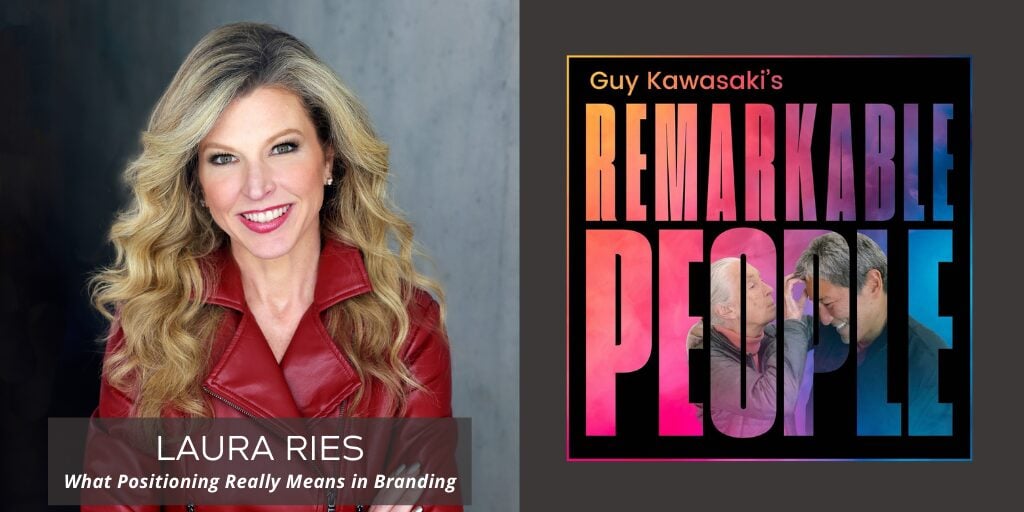
Welcome to Remarkable People. We’re on a mission to make you remarkable. Helping me in this episode is Laura Ries.
Laura is no ordinary positioning strategist; she is the president of Ries & Ries and one of the world’s sharpest minds in branding. From co-authoring The 22 Immutable Laws of Branding to advising Fortune 500 companies, Laura has built a career on showing organizations how to win the battle for the mind. Her new book, The Strategic Enemy, challenges businesses to stop chasing “better” and instead embrace the power of defining a rival.
In this conversation, Laura shares the lessons she learned from her father, the late Al Ries, widely regarded as the “father of positioning.” She recalls growing up surrounded by marketing debates at the dinner table and how those experiences shaped her approach to branding. Her insights reveal why positioning isn’t what you say—it’s the space you claim in the minds of your customers.
We also explore examples that prove her point. From Volvo’s failed attempts to escape the safety category to Apple’s success in creating new categories, Laura shows that brands succeed when they sharpen focus, not when they spread thin. She explains how Liquid Death, Dude Wipes, and even Chick-fil-A used enemies and narrow positioning to build explosive growth.
The result is a masterclass in branding that is both practical and inspiring. If you want your company—or your personal brand—
Please enjoy this remarkable episode, Why Better Isn’t Enough: Laura Ries on Building Unforgettable Brands.
If you enjoyed this episode of the Remarkable People podcast, please leave a rating, write a review, and subscribe. Thank you!
Transcript of Guy Kawasaki’s Remarkable People podcast with Why Better Isn’t Enough: Laura Ries on Building Unforgettable Brands.
Guy Kawasaki:
It's Guy Kawasaki. This is the Remarkable People Podcast, and we go all over looking for remarkable people to help you become remarkable too. And today is a guest that will help you not only be a remarkable person, but remarkable company, remarkable product, remarkable service.
She is Laura Ries, and she is, I would say, one of the sharpest minds in marketing and branding. She's the president of a firm called Ries & Ries, she's co-author of The Twenty-Two Immutable Laws of Branding, which I read, and I loved. And she's a trusted advisor to Fortune 500 companies all over the world.
Basically, if you wanna understand how brands work and win and lose, today's episode is the episode for you. How's that for an introduction Laura?
Laura Ries:
I am impressed. Fantastic. I can't wait to meet her.
Guy Kawasaki:
And as you can see, she's covered in red because red is her branded color. Yeah.
Laura Ries:
That's right. You gotta live the brand. I try to practice what I preach, walk the talk, talk the walk, which is it?
Guy Kawasaki:
Okay. So I am gonna start this interview with a quote from your new book. Your new book is about strategic enemies, which I loved and everybody should read. So I'm gonna quote you a sentence from this book. This book starts with a sentence like this quote, “If you are like me, you grew up with positioning.”
And I read that, and I said, “Oh my God, Laura. No one is like you growing up with positioning because your father was the Al Ries and Al Ries and Jack Trout are basically like Bob Cialdini has influence. David Aaker has branding. Philip Kotler has the five Ps of marketing. Carol Dweck, I guess Carol Dweck's kid, if they ever came on my podcast is like, ‘If you're like me, you grew up with the growth mindset.’”
Can you just take us back and explain this progression? Take us from your college to where you are today, and you know how you grew up with positioning because you are from marketing royalty in my humble opinion.
Laura Ries:
Yeah, the princess of positioning perhaps because yeah, Al was the king, and he created positioning, and I grew up with it. And believe me, it starts way before college because as you mentioned, I grew up with it from the dinner table. We talked about marketing. My father was a running commentator on everything branding.
And he would yell at my mom and me. He would watch the commercial, consider what they're doing wrong, and then yell at my mom and myself as if we were the CEOs of the companies. And we could actually fix this. We could change Coors, or we could change IBM and we couldn't. But it was an excellent introduction.
My 101 to marketing started very early on but like most kids, I put it to the side and didn't think my dad was cool, as most kids are like that. But in middle school, I picked up the Positioning book and I read it, and I was blown away.
I connected to my dad in a new way and to the material which, if you've read the book, you should, it's so well written. It's funny, it's entertaining, but it's very purposeful and it gives you, and it brings new light to everything you see around you. And we love branding. I love branding.
I love talking about marketing, what companies are doing, what their ads are, what their strategy is, what their website is. And Positioning was a way to talk about communication in a new way, in that it isn't what you're communicating out. Most people are so consumed with themselves, what I wanna say, what I wanna do, and, no, no, no. Positioning flipped the script, if you will.
It started with the mind is willing to accept. And that's a very important difference because you can't just jam something in, no one's gonna accept it. You have to look for that open hole, that open opportunity, a way to position yourself, so that it's clear, it's oversimplified and the communication, but it's also will be instantly accepted into the mind, an indisputable truth.
If you connect it with that, it made it more powerful. Of course I connected with that, my dad would help me on projects at school. We connected and, I had slide presentations in fifth grade Guy, this was what was going on and I loved it. But it was teaching me how to communicate ideas.
And that is a great practice because listen, you don't get to be a guru at eighteen or twenty-one or twenty-five. It takes a lot of years, a lot of practice, 5,000 hours or whatever they say. And so I started early and after college, I went to Northwestern, and I studied Radio/TV/Film and the School of Communication and got a great degree.
Studied a lot of psychology and lots of things, but my dream was always to do positioning just like my dad. And I worked a year at an advertising agency in New York City and I said, “What am I doing? Why am I wasting my time? I wanna sit next to the master.” And I was the ultimate apprentice, and I didn't have to win the game show.
I just got right in there. And he was so terrific and willing to teach me. Let me tag along, if you will, and I did my time. I spent a lot of time working with him, learning from him. And then, we were almost three decades together.
My dad passed in 2022 at almost ninety-six, which is an amazing history, amazing mark he's left on the world, and particularly in me. And I'm so excited to continue that legacy with new ideas and continuing to help and preach about the principles of positioning itself.
Guy Kawasaki:
Wow. I must admit, Laura, that at our family dinners, it's not like I sit around and review company's evangelism efforts.
Laura Ries:
Maybe you should.
Guy Kawasaki:
It's too late. They don't believe me anymore.
Laura Ries:
Listen, the key is repetition. It's funny because my dad would repeat the same stories of, he told Coors to do this and they didn't do it, and he would tell it over and over. My husband would predict the ending to the story. But he didn't say it because he forgot he had told us before, he enjoyed telling us, and he just figured if he told it one more time, it would change things and it would teach someone not to make the same mistake again.
Guy Kawasaki:
Laura, I can tell you that my kids will tell you that I do repeat my stories. That part I have emulated your father here. So you blew past what I consider a very important point when you gave us that little explanation of your life, which is that I think many people believe that they control positioning of their product or service, and they can just whiteboard it and pick a place and they'll do whatever's necessary to position it.
But you just said that it's about more what space can it occupy in people's brains. It's not what you want. It's more or less what they will accept. It's very different.
Laura Ries:
Absolutely. It is very different. And it does get lost because today positioning is a word used by everyone. And most companies have a positioning statement stuck in a brand book on some shelf. Most of them go something like this, where we wanna be a great company, with lots of services and lots of areas, a great price with great people and great value.
Oh, that's not a positioning. That's a pipe dream. But in the positioning idea, as you say, it's about what hole is in there. And if someone has a position, you're not gonna be able to knock it out and you're not gonna be able to force an idea. The hardest thing is to change a mind once it's made up.
So if your brand stands for something very strong trying to tell the person they're wrong, it means something else. Not gonna end very well. And we see lots of examples of that.
Guy Kawasaki:
But what happens if your brand stands for something already and you want it to stand for something else? And I guess, very good example of that. What if the CMO of Volvo decided, ah, safety's boring. Let's be sexy like Ferrari. Let's introduce a red convertible Volvo. What would happen?
Laura Ries:
They have tried this Guy, did you know this? They had Volvo convertibles, they had Volvo racing teams. Total disaster. You can't change the perception of Volvo. And here's the thing, that's their anchor. Don't lose sight of it. Way too many companies take for granted that one thing they own.
Look at Target, a mess, and the new CEO comes in. And what does he say? “We got to go back to Targé. We gotta go back to fashion and cheap chic.” Brilliant. How hard is that? Did you have to go to B-School to learn that? I don't think so. It's a little bit of common sense is when you stand for something so strong, when you dominate it like Volvo and safety or Target and Targé, cheap chic, you double down on it.
You continue to pedal to the metal, and too often they get distracted. They're chasing shiny new objects when the real success is strengthening your category, becoming dominant and expanding interest in that category itself.
Guy Kawasaki:
But then Apple was known as the computer company, it's moved on from computers to phones, to pads.
Laura Ries:
That’s right.
Guy Kawasaki:
To glasses maybe someday. And Amazon was where you bought books and DVDs and now it's Amazon Web Services. So are those just outliers and we shouldn't use them as examples because they just happen to succeed. It's two out of two million that pulled it off.
Laura Ries:
Oh boy. Let's get into it. Apple. I love it. These are great examples because Apple, first of all, dominant, brilliant, enemy strategy from the beginning, they were home computer, right? The Apple home computer, I had one, the Apple Two, the Apple Two-e, fantastic.
But while everyone else was going after the techie type names and the trash eighties and everything, a simple name, a simple visual, so perfectly delivered and executed. But here, when they went in for, was it the sixteen-bit computer and the Mac? It wasn't an Apple Three, it was a Macintosh.
They had a new brand for the new category. That was a brilliant approach and they've done it time and time again. When Steve Jobs came back to clean up the mess of all the line extensions and brands all over the place. He came back to simplicity. And not only that, he started launching and pioneering new brands and new categories.
The power is being the first mover in the mind. They weren't the first in the hard drive digital music player. Creative Technology in Singapore was, they were the first in the mind because they combine that innovation and technology with excellent branding. The perfect name, the iPod, the thousand songs in your pocket.
The simple over communicated way to simplify it and communicate it. And against the enemy, which was at the time the dominant, those cheap Rio, and the flash drive players. And again, they went in the first smartphone, one of the most brilliant strategies of repositioning the enemy and at the time, Nokia the leading, dumb phone brand in the world.
Again, by being first in those new categories. Apple didn't become Apple today on day one. That's important to remember because today, if you wanna start Apple, you gotta go back to do what they did at the very beginning, by starting small in one category, with one brand, and then expand over time.
That's exactly what Amazon did. They didn't become the world's biggest internet store on day one. No. They started with books. Right? And one enemy, the bookstore has only a few titles. We have all the titles, a great name, it distinguished it. And they went from books to CDs and eventually expanded.
And then AWS is really a second brand because that's the strategy for big companies. Once you're a dominant in one thing that second brand can stand for something and dominate in another category. The successful companies today are not single brand. It's not the IBM, it's not the GE brand name on everything like it was last century.
It is brands, companies that own multiple brands.
Guy Kawasaki:
So if I am the CMO of Volvo, and I'm thinking, but we did what you just suggested. We have Polestar, we created a sub-brand, but I don't know anybody who owns a Polestar. You know what separates Volvo from Apple?
Laura Ries:
When they launched Polestar, it wasn't at the height of their success. Now was it? That is a problem. And who was first in electric vehicles? It wasn't Polestar. What's the brand name that dominates the mind when it comes to electric test?
Guy Kawasaki:
Tesla.
Laura Ries:
Tesla because they were first, not only that, they've got Elon Musk, love him or hate him, one of the greatest spokespersons for a company in the history right up there with Jobs and Richard Branson and others.
But they were first, and they were early on when the category itself was very small, but they were building the mind share of that category. The big companies, they put it to the side. They waited way too long to jump in on EV and when they did, most of them have line extended.
We got the regular Mercedes, and we got the electric, we got the Porsche regular, and we got the electric. But when you do that, they fight against each other because where's the opportunity for Porsche to go out and say, “Hey, forget the electric. You wanna drive a real, sports car, you want the growl of the engine, you want all of those things.”
It puts you in a difficult position when you got the same brand name on two diverging categories.
Guy Kawasaki:
Okay, so since you said the M word, I'm gonna go down a little rat hole right now. The M word is Musk. I grant you, Tesla created a new category of electric car, no question, but with Elon Musk now, I don't know, going off the rails, what do you think of the Tesla brand today? I will never buy a Tesla.
I know people will never buy a Tesla simply because of Elon.
Laura Ries:
I know. It's a tragedy in many respects because he was doing so well. He had things going so great, and then he is jumping into Twitter and killing the bird. He is going into politics. He's taking his eye off the ball overall and he is saying crazy things in addition, which is really a distraction.
He is getting back to it. I think he has realized some of the danger, but how much has been done? And I think there definitely has been reputation damage to the brand. Have you seen the new Teslas, the back? It doesn't even have the logo, or you can barely see the name on the back.
Which, you know, doesn't make any sense at all. The badge on a car is one of the most powerful, effective, branding devices out there. People putting those bumper stickers on, “I bought the Tesla before Elon went crazy,” was getting into their head I think.
Guy Kawasaki:
So now let's say that I buy your concept that we have to fit into the brain of the consumer, not change the brain of the consumer to what we want. But then how do you get into the mind of the consumer to know where the space is?
Laura Ries:
The first and most important thing is what is the category? Because here the mind thinks in categories, not brands. You always make category decisions. The confusing part is you speak in brands, so you know when someone asks you, “What do you drive?”
You say, “A Tesla.” The mind thinks in categories. When you think to buy a car, what's the first question you want? What brand? Not really. Most people think of what type of car, right? Do I want an electric? Do I want a truck? Do I want a small? Do I want a SUV? And then they think, what brands do I most closely associate with that category?
So the strength in the category is the ultimate power in branding. Understanding your category, where you lie in that category, and perhaps if you can stand for and dominate a new category. And if you have the willingness and patience encouraged to do that, it's a very long-term effective strategy.
Guy Kawasaki:
Do you believe that for most organizations, creating a new category is too hard and you should create a subcategory? Like for example, I would say with Tesla, Tesla did not in my mind, create a new category of electric car. It created a subcategory of cars, which is electric. So which way would you say did it?
Laura Ries:
Well, I think that sounds like what a marketing professor would say. I don't think that's how people think. A subcategory, nobody thinks like that. Electric car is a thing, right? Either it's electric or it's not. It's a very simple, binary thing.
And one of the powerful things is narrowing the focus, because when you are a focus, when you are a specialist, when you can say and dominate that category, it also allows you to, you know, say the old category is bad, not doing it right, that's what you're fighting against.
It gives you that power to rally against it. And there's no better way to get people excited for your cause then by getting them to fight against something else.
Guy Kawasaki:
Okay, so now, I would really like to know who is in the Laura Ries Branding Hall of Fame, so we can say, “Wow, that's who we should emulate.”
Laura Ries:
When it comes to my personal hall of fame, there's just one name. My father was everything. He was my hero, my mentor, my dad, my friend, my partner for almost thirty years. I've read lots of other books, but he was always my Bible. And it's so many of the lessons, and in those books are so incredibly powerful and I only truly realize it now, going over my fifty years in life.
The power of history and of understanding how things work because yeah, you look at Amazon today and it's a behemoth, right? But that's not how they started. Truly understanding what, the history of how brands came up, of which ones succeeded, which ones failed, that really will teach you a lot.
Because it's about what you do today that will set you up for the future. And listen, things can change if you do it early enough and you do it decisively enough. Look how the switch Netflix did, going from DVDs in the mail to the dominant streaming platform because they didn't chase the trend, they set the trend.
And they made that pivot early on and they led in that direction. And so it is possible to do that. But there's only a very few cases of companies that are able to make that dramatic a pivot.
Guy Kawasaki:
So if two guys, or two gals or a gal in a garage come to you and they say, “We have a million dollars of seed capital, Laura, and we wanna create a new category,” do you say to them, “You are nuts?” Or do you say to them, “Go for it?”
Laura Ries:
Here's the thing, you don't build a brand, or a business by being better. You do it by being different. And at the end of the day, you gotta think of what can we focus on so that we can distinguish and differentiate ourselves so that contrast is more easily understood by the mind.
And listen, some of these new categories, these are not technologically brilliant ideas. You got Red Bull in a small can, and you had Monster in a big can. That was a simple difference, but very effective in building what today is the number two energy drink brand in the world.
Hundreds of competitors, including ones from Coke and top companies around the world, try to compete with Red Bull by being better. They were all in the same can. They all had energy-ish names, but Monster did it different, and they did it with a better strategy and also a visual difference because when you can visualize that, it becomes even more memorable and understandable and relatable.
Guy Kawasaki:
Since we're now on the topic of beverages, one of the examples that you cite is one of my favorite things, which is Liquid Death. I love Liquid Death. I have loved Liquid Death from the first time I heard of the concept. And so in a sense this company has pulled off branding water a can. It's not a lot of AI there.
Laura Ries:
No.
Guy Kawasaki:
So how did they do this?
Laura Ries:
They saw an opportunity, actually in multiple ways. So they saw that people were going to concerts and bars and actually not drinking alcohol. Who knew? But this is happening. But they didn't wanna hold a plastic water bottle. That's totally uncool.
They wanted something that had branding that spoke to them but had a beverage that they were wanting to enjoy. And that was part of it, but also really going hard. And initially, critical to the company's success, I think is the strong stance against plastic water bottles, death to plastics.
That was a critical part of the message. And it had true backing. It wasn't just a crazy water in a can, it was the can is gonna save the environment. Aluminum is infinitely recyclable yet, we're killing the earth with these plastic bottles that are, even though they can be, most are not being recycled and they're killing landfills.
So there was a powerful message behind it, and I think that's truly important, but also connecting with the culture of what's happening and giving people a brand that met their needs in that respect. And that differentiated from all the other brands that were, try to be water, try to be fancy. This was obviously the exact opposite of that.
Guy Kawasaki:
So do you think that the key to Liquid Death is the aluminum can or that you can look like you're drinking a beer without drinking a beer and getting in trouble and getting drunk?
Laura Ries:
Yeah, it's both because beer is in an aluminum can, so it goes together of putting the water in that can, the can is better for the environment. The can is better for making it look cool. And listen, they started narrow because it was those occasions of social occasions where everyone's holding a beverage.
People maybe they don't wanna drink, but they don't wanna stand out. They want something that fits in with everyone. But it's also cool, and it just connected immediately because it was really a problem out there that they identified and had the perfect brand solution for.
Guy Kawasaki:
All righty. So now there are, let's say, four or five LLMs. So there's Perplexity and Claude and OpenAI and all that right now. So suppose one of them calls you up and says, “Listen, we're competing with ChatGPT, Google is putting AI in Gemini. We're spending trillions of dollars to create an LLM.”
How would you brand an LLM to differentiate from the other LLMs? Because I tell you in actual use, I could not explain when you should use Claude versus Perplexity versus Gemini versus ChatGPT in my mind.
Laura Ries:
It's an opportunity. I think it's a little bit like when we saw the rise of the search engines. Google wasn't first. There were many before, but they were the first to focus in on it. They spent as enormously tremendous to get better at search, but they had the clean page, and they were all search.
Listen, I'm no AI expert, but I certainly have used a lot of them too. ChatGPT was first. That's an enormous advantage. And you can see the success as a result of that. How do you compete against the leader? So you gotta look at them, and there's a weakness in every leader. Amazon was big, merchants go on there, but it's not a great experience for them.
Shopify is the merchant hero. They found the weakness in Amazon strategy. For ChatGPT, I mean, again Claude, they talk about we don't share the data. That's a very specific pain point and differentiator that they can hang their hat on. And I think for all of them, thinking about, what is that narrow focus?
What is that one idea or concept that can be easily understood and differentiate us from the leaders? When you have a dominant brand, it's always better to narrow the focus to something so that you can own it.
Guy Kawasaki:
All right, so if you're Sam Altman, what would you narrow the focus of ChatGPT to?
Laura Ries:
I think, they need to be the dominant leader. They need to own AI in terms of, you Google it, you ChatGPT it, now it's a little bit of a mouthful, that's one problem. But because they're first, they have tremendous advantage. The ones that come later, they better use good branding because it's a little like you had Uber. They were first, they also have a great name.
Lyft, oh, that's a problem. That's not a good name. It's that the alternative spelling of a generic word, they sound the same in the mind. You have to analyze brand names, not just how they look. Although, the spelling in that is important, but how they sound in the mind and being too generic is always a big detriment to a brand.
Guy Kawasaki:
I'm gonna push you one more time. Sam Altman says, “Yeah, okay, I understand that. Now what do I do? Tell me what to do. Charge me five million dollars and tell me what to do, Laura.”
Laura Ries:
I think I need the five million dollars before I spill the beans. No, I’m just kidding. It is about dominating the category. And here's the other thing. At some point, you build brands with PR and that is a tremendous part of the success of any big brand from Red Bull to Starbucks to Google.
It was primarily a PR that established the credentials, the third party endorsement. Then you need to defend it with advertising. And I think we're getting pretty close to ChatGPT, meaning to just blast it out there to remind us that they're the leader that's gonna be their defense mechanism.
That's your defense budget to keep the others at bay. So you're constantly reinforcing your brand, your leadership, your dominance in the market.
Guy Kawasaki:
So I think you said something very important there. You are a fricking fountain of wisdom. So I just wanna highlight this, that you said, “You start with PR and then you move to advertising.” That is a key concept because I think many people think that positioning and branding is built with advertising, not PR.
Laura Ries:
And honestly, that early on, the Positioning book, it all talked about advertising. It also talked all about words in the mind, but what happened is we wrote a book in 2002 called The Fall of Advertising and the Rise of PR.
And in that book it was the dot com boom. A lot of companies were doing just that. They were taking all their seed money and running fifty million dollars of advertising thinking that's how they're gonna build the brand. Most of those like pets.com went bust because you gotta build it in the mind.
And that takes word of mouth as the ultimate driver. But that's best done and driven by PR, the media, the news outlets, the internet, giving third party endorsement and credentials. And that also requires a spokesperson. So back to ChatGPT, we need to get to know Sam Altman, right?
He's gotta get out there talking about the brand being that spokesperson, being like the Bill Gates or the Steve Jobs. Think about the most iconic companies also have CEOs that are known by everybody. Jensen and NVIDIA, for example. And not only that, you like Jobs, he's got the signature outfit.
He is got the black leather jacket. You know him and you see him, and you know him immediately.
Guy Kawasaki:
Yeah, I think, Elizabeth Holmes blew it a little, but yeah, she tried in a sense.
Laura Ries:
Well that's a great story. So she said, “Yes, Steve Jobs wears the black turtleneck and I'm going to put on that same turtleneck and people will think I'm as smart as Steve Jobs.” News break. It was not the turtleneck that made Steve Jobs innovative.
It was the fact that Steve Jobs became known as an innovator, built the Apple Company, came back and made it more powerful than ever that when he made that turtleneck stand for that and be identified with him and his innovation.
No, you can't just slap on someone else's iconic, visual hammer uniform and expect people that you think that you are them. It's actually the reverse. You have to do something, accomplish something, stand for something first, and then by wearing that same outfit, Jensen's wearing a black leather jacket for twenty years, it then becomes visually representative of you and your pioneering exciting idea.
Guy Kawasaki:
Laura, if there's one thing that I wish people or hope people pick up from this podcast is that the Steve Jobs, the Jensens, the Elon Musk of the world, their brand and positioning was established by doing something great, not by executive coaches and not by all this kind of white papers and getting speeches at TEDx. They really did something and everything else follows. Jane Goodall doesn't spend a lot of time thinking about branding Jane Goodall.
Laura Ries:
No, but she has a very specific focus. She's very passionate about it. And she has done it over and over again for years and years. And, that is what it takes. There are many great company leaders that are doing things, but unless we know about them, it does take time to do the media interviews, to do the speeches, to do the television shows, to become known for what you have accomplished. And not all leaders take the time to do that.
Guy Kawasaki:
I don't want to put words in your mouth, but I get the impression that you think brand extension is largely flawed. Is that an accurate assessment of what I read?
Laura Ries:
That is very accurate. If there is an enemy today of positioning, I think it truly is brand extension, particularly when it goes across categories. And you've got many examples. We love to talk them over the decades. Think about, when a brand like Coca-Cola stands for something, what is Coca-Cola?
It is the real thing, right? And they come out with a brand called Coca-Cola Life in a green package, green cans and bottles. It messes with the mind. What do you mean this is Coca-Cola Life.
What does the person think of instantly that repositions the original, the real thing is, I think, Coca-Cola death because what's the opposite of life? And it's not too far of a stretch because as people are making the connection with too much sugar and obesity and all these things, or even artificial sweeteners are bad. And so you've gone directly against yourself by using one name.
And not only that, using the green and the life on top of it. And it was discontinued. It was a miserable failure, as you may well have guessed. And was it a category? Were people not interested in that? It was a mid-calories cola if you will. So it had cane sugar and it had stevia, a natural sweetener.
Today, in fact that's the hottest category, but it's not hot because it was from line extension companies from Pepsi or Coke. No, it's new brands. It's Olipop and Poppi that are paving the way. It's those new categories that people get excited about and the brands that represent it. Those are the real thing in the prebiotic soda, which is a nice way of creating category for healthy sodas that both brands are doing well.
I think one is gonna succeed over the other. A time will tell which one that is.
Guy Kawasaki:
I drink a lot of stuff and I have to tell you.
Laura Ries:
Me too.
Guy Kawasaki:
Obviously in my mind, if I had to choose between these new Liquid Death little Colas versus Olipop, it's a pretty close decision there. I love that Olipop has cream soda and cola and, watermelon but now Liquid Death is not just water. It's cola-ish, right?
Laura Ries:
It's still in the can, thank goodness. But they are also positioning it as flavored water. So it is so much of a cola, but it is still in the water category, which I think is good for them. But they do have to be careful because the more you expand, the more you weaken the brand.
Strength doesn't come from putting your brand name on more things and more categories. It comes by dominating a category and potentially launching new brands for new categories. Think about the Gap. What's one of the best things the Gap ever did? Launch Old Navy, right? That second brand has made more money for the company.
And unfortunately, companies fall in love with their brand. If you worked at Kodak, how could we launch anything that doesn't have Kodak on the package? Kodak was seen as one of the most, it was one of the most powerful brands in the world. They thought it meant trust.
Uh-huh, didn't mean trust. It meant film photography. And when you try to put that same name on a different category for digital, it was a loser. And a second brand could have been very effective in that case. And for many companies that opportunity, take advantage if you have it, if you have that new idea to put a new category.
What did Mike's Hard Lemonade do you know this was a booming brand as kids were turning away, or young people or turning away from beer, and this was a hard lemonade, right? Sweet, delicious, lovely. People loved it. In the two thousands we also got pretty carb conscious. No sugar, no carbs, no this, what did they do?
They saw that as, this was a problem with their own brand, and they launched a new brand that actually became their own enemy, if you will, which is White Claw in that category of hard seltzers has taken the world by storm, and these things don't even taste good.
But as a hard seltzer, that category, it doesn't need to be, it has low calories, no carbs, purely positioned against the enemy, which were beer has carbs, all the hard teas, hard lemonades have way too many sugar and calories.
And a very strong positioning with a second brand to really take advantage of it. It's more about with line extension, the opportunities missed, and then of course the disasters like launching a Bayer Non Aspirin. It's insanity. How could smart companies do this? Who's deciding these things? Bayer equals aspirin. It's an oxymoron to come out. But they have, we've got lots of examples.
Guy Kawasaki:
Wow. We shouldn't wait for Tesla to introduce a V-Eight, but anyway, let me ask you something. So let's suppose that, I know what your answer is, but I just want to hear you explode when I give you this question.
Laura Ries:
I love telling the stories over and over. So tee it up.
Guy Kawasaki:
It runs in your family, right?
Laura Ries:
It does. It’s in my genes.
Guy Kawasaki:
So suppose that Mike Cessario from Liquid Death calls you up and says, “Strategically we're thinking that the brand Liquid Death stands for killing bad things. It kills your thirst, it kills plastic. So we're into killing bad things. So now we're gonna introduce a line of mildew killer and ant killer and Roach Killer and, things to kill your hunger. So now there's gonna be Liquid Death Spam in an aluminum can.”
Try to keep a straight face there. Laura, what are you gonna tell Mike when he gives up with this brilliant brand extension idea that he just paid McKinsey five million dollars for?
Laura Ries:
Mike don't do it. Mike, don't. Just say no. I've got a good example though. These things happen. So you also know this brand, DUDE Wipes, I hope.
Guy Kawasaki:
Yes.
Laura Ries:
Yes. And no one wants to talk about it or admit it, but listen, we all poop and these things are fantastic. And started by an entrepreneur who took on toilet paper as wetter is better.
And did it with also strong branding. This, again, he didn't revolutionize the idea. Cottonelle and Charmin had moist toilet paper products, but they weren't strongly positioned because they couldn't take out their enemy, which was themselves. They were all line extensions. And so DUDE Wipes with a great brand, strong positioning, went against the enemy and got us all to get hooked on these things.
But in about 2017, a couple hundred million, you get thinking you are really smart, you're really killing it. And your customers, they really tell you too, that we love DUDE Wipes. You need more DUDE stuff. We wanna have. And he thought of this: a DUDE nation. We're gonna take over the bathroom.
We started with a toilet paper. We're gonna go to soap and deodorant. They did, they launched soap and deodorant.
Can you believe it? They sold a few. And then, I talked to Sean Riley, the co-founder and he said he happened to read a book, maybe you know it, The Twenty-Two Immutable Laws of Marketing, Al Ries and Jack Trout.
And he got to the law, the Law of Line extension, and he said, and I quote, “Oh shit. What am I doing? I am violating this law, and I haven't dominated the toilet paper category and I'm fighting the biggest companies in the world on toilet paper. What am I gonna? Go fight all the soap companies and Dove and Dr. Squatch and all these other things.
I got enough on my plate, and he got out of that and just so happens it also the pandemic hit when the only thing we needed was toilet paper and paper towels for some reason. And they greatly benefited from that. And this is so important for entrepreneurs because of course money is important, but nothing is important as your time.
That is the most important resource. And these line extensions, they will distract you because you're so worried. How am I gonna sell more soap? How am I gonna tell people, they should use deodorant with the same brand that they wipe their butt with? You're focused on the problems instead.
He focused on the solution and the brand that had the biggest potential at the biggest moment of history in the world, and he killed it. And he ramped up production, he ramped up marketing. And that's where you see that the true skyrocketing success of companies that are able to take advantage of those moments and have the focus and attention and all their resources focused in on one thing.
It's like having one kid, right? You got all that in there.
Guy Kawasaki:
And what if the CEO of TOTO calls you up and we dominate the bidet business and we're interested in extending our brand by buying DUDE Wipes because we decided we stand for clean asses. So we gotta not just sell hardware, we wanna sell toilet tissue too.
Laura Ries:
No. That's the thing. You gotta think of what does a consumer think? How do they position those brands? What's funny is, we do a lot of global work. I've got clients all over, but you talk to someone and China or Japan, and I say, “DUDE Wipes, these wet toilet wipes.”
They're like, what are you talking about? We have TOTO toilets, you know, we are way more advanced than you. And if you've ever used one of these things, they are amazing. But not everyone can afford like a 10,000 dollar toilet. So I still think there's plenty of room for DUDE Wipes, to continue to wipe out the market.
Guy Kawasaki:
It is a horizontal market. So now let's specifically get into your book. You talk about the benefits of having an enemy.
And as I read your book, the first example that popped into my brain, and I hope you'll reinforce what popped into my brain and give us your analysis of it, is that I'm old enough to remember when Toyota introduced Lexus and Lexus picked BMW and Mercedes as the strategic enemy, and basically said, “Our car is just as good as a Mercedes or BMW, but half the price.”
And they didn't say “It's Toyota XL.” They said, “It's Lexus.” So now what's your analysis of what Toyota did with Lexus?
Laura Ries:
It is one of my favorite examples. I am sure my kids have heard it a million times. And my dad told it a million more. Toyota, biggest car maker in the world. And what a powerful position. And it was very well known in the mind as what? Reliable and affordable, a powerful combination.
But if they wanted to go upscale, the mind was going to reject. Paying twice as much for a Toyota, nobody's gonna pay twice as much for a Toyota. Same thing happened with Volkswagen. Remember they launched the Phaeton, the hundred thousand dollars Volkswagen. And that was a miserable failure, but Toyota didn't do that.
They had a totally separate brand, while people at the back of their mind and the industry knew that Toyota made it, people bought a Lexus despite the fact that they may know or remember that Toyota made it. It was separate dealers, separate advertising, separate brand in the mind of the consumer.
And that's what allowed them to go against the enemy of the European cars and saying, “Absolutely we can make luxury from Japan.” And it was tremendous success that they couldn't have done it with the same brand. That's the lesson to take away from it.
Guy Kawasaki:
So would you say that one of the most important qualities of a strategic enemy is that everybody knows who the enemy is so that you don't have to explain who you are and who your enemy is?
Laura Ries:
The exercise really needs to start at the company themselves so that you can be clear, and then, to the consumer, sometimes absolutely you go out and scream and show off who your enemy is. Look at what Chick-fil-A does. Chick-fil-A, the first chicken sandwich.
And they have no hamburgers. And so thirty years ago, the ad agency said, “Hey, we've got an idea. We're gonna use cows in our advertising and have signs that tell people to eat more chicken because the enemy is the burger chains and chicken even though it's fried, a healthier type halo,” and because they have the narrow focus, they could go strongly against that enemy.
And they have used that for thirty years making it very memorable. And, hammering in not just their position, but what the enemy is. Now not everyone has to go out and do it that way, you'll have to set up what your strategy is. You have to have a focus that's narrow enough so that the enemy is clear.
Guy Kawasaki:
Now what if your enemy truly is better than you?
Laura Ries:
Listen, better is so relative. Between Monster and Red Bull, how can you perceive the various differences? Certainly in some categories, and there's Reddit posts and there's information and there's all those specs and things, but the consumer is overwhelmed.
They need ultra-simplicity. You need to give them a reason to feel good about buying your brand. There was a famous research study that looked at the attention of what people pay to television advertising of automobiles. And you would think, that's a no-brainer.
The people that are about to buy a car will pay the most attention to those ads. It turned out to be not true. In fact, the people that paid the most attention to the ads were those that had just bought the car. Why? Because they wanna reinforce themselves. They made the right decision, I made the right decision.
I'm eating chicken, I'm going to Chick-fil-A, I want an EV. I went with a Tesla. I feel good about it. I'm proud about it. And it stands for something. And that's the same with your brand. You wanna constantly reinforce why they've made the right decision. As you remind people at the start of your podcast, I'm gonna talk about Remarkable People.
Now you probably get very tired of saying that, but it is very important that you say it every time.
Guy Kawasaki:
Okay. Madisun, did you hear that? Because Madison has often said to me, “Guy, you say that every time people are tired of hearing you talk about Remarkable People and how we're gonna make people remarkable.”
Laura Ries:
The more you say it. And also in you look at psychology, the more believable it becomes. And so the more you say it, the more it's oh my God, that's true. Why does it feel true? Because you've heard it before. And so the repetition of that, and again, if you can combine that with a visual, it becomes even more effective.
You think about Coca-Cola and the contour bottle, what I call a visual hammer that symbolizes and makes you distinctive in the world. But not only that is it beautiful and stands out. It communicates an idea, meaning that it's the real thing that iconic original bottle, and brands that can do that become very successful.
Guy Kawasaki:
So walk me through the advantages and disadvantages of enemies that are organizations i.e. Lexus versus Mercedes. But what if your strategic enemy is an intellectual thing or a practice, it's not an organization, it's not Lexus versus Mercedes. It's you against pollution or something like that.
Laura Ries:
It absolutely doesn't have to be another company. It can be another category. When you launch a new category instantly, usually that old category is the enemy. You don't wanna do that the old way. We got the new way. And so it can be that, or it can be a convention or a concept, or even for nonprofits.
But when you focus in on something specific, it's gonna make it much more powerful. If you think about MD Anderson, what have they done? Their focus on cancer and they're ending cancer, and they also visualize it. They write the word cancer and they put a red line through it. What a powerfully effective way to demonstrate who the enemy is.
Most hospitals cover a range of things and help lots of different diseases and things, but they focus on cancer because they do that. They can have a very strong message, or I volunteer with the Young Men's Service League, and this is an organization that helps moms with their teenage sons during the four years of high school.
They set up opportunities to do community service. What a great idea, the problem is how do you get people to sign up for this? Busy kids, busy moms, very difficult. But understanding what the enemy is can make the positives more clear. And what we identified as the enemy is time itself.
The fast four years of high school, you make it very specific, so they understand because unfortunately, when you're a mom in eighth grade and they're asking you to sign up for this thing and you say, “You gotta do twenty hours of service and you gotta help us with this and that,” they're like, “Oh, I don't wanna do that.”
But if you say, “Listen, you got four years left with your little boy and he's gonna grow up in the blink of an eye and be off to college, off to work, off to the service, what time do you wanna spend with him? What kind of things and do you wanna instill in him? What experiences do you want him to have?
How do you wanna feel at that high school graduation? Did you spend the right time? Did you show him the right things? Did you open his eyes to the world?” And listen, I give myself goosebumps with my own marketing, but it's a very effective way to set up what that problem is because in many cases, it's the problem that is the enemy.
And if you could show them the problem, it makes you know what your brand, what your solution is. And with the contrast between doing it and not doing it. And that's a lot with the nonprofits. If you're gonna support it, you're gonna do it or you're not gonna do it. Or even Tunnel to Towers.
Listen, lots of nonprofits, we wanna raise money and do a lot of great things for veterans. Lovely. That sounds very nice, but that's not gonna make you memorable. They took one key idea, mortgage free homes for heroes. And their family's left behind. What a powerful idea of a narrow focus.
And that's very clear what the enemy is, you know, saddling with a mortgage when you're in catastrophically injured or your family is left without their loved one having the freedom of a mortgage free home. That brings it home. Just saying you're gonna do good.
You gotta be specific and focused, and that's what's gonna give people goosebumps and get them excited to rally for whatever cause you have.
Guy Kawasaki:
So there's a concept that I surely want you to cover because I found it so interesting, and it is the concept of a visual hammer. So please explain what a visual hammer is.
Laura Ries:
Listen, positioning was all about words, and at the end of the day, the end goal is to own a word in the mind or to dominate the category. Be leader in that category. It's about words, but very hard to get words in the mind. So what we found and develop, for many years ago, is using the power of a visual.
Why? Because a visual is much more emotional. You have a picture of the word baby versus a picture of a baby. You have a much more emotional reaction when you see that baby. Now it's not just about having an attractive logo or a visual connected to it. It's about having something that has emotional power and reinforces what your positioning is.
Even if that visual is just a way to visualize your name itself and why names that lend themselves to visual hammers can be very powerful. So Target, they have the image of a target that reinforces it or even have things like the green jacket of the Master's golf tournament. It's one of the four majors, but one of the most powerful and memorable.
Why? Because the golf course is beautiful, but that green jacket. Now I don't know about you, but it's not very attractive. But it's different. And believe me, that is the shot every media guy wants or girl wants to get is that the old winner putting the jacket on the new winner, and you see the new jacket. That's very effective.
That use of something strikingly different using it for years and years and years that visual becomes representative of the concept itself. And it's the same thing with the Nike Swoosh. Sometimes you create a visual hammer, Corona has the lime in the top of the beer.
What does a lime communicate? It's authentic Mexican, because Mexico has limes. The United States has lemon, right? We do lemons on everything, they do limes on everything, newsflash. So that was a true identifier of Mexico and the beach and all those great things. But sometimes, the leadership itself, if you give yourself a simple visual that becomes representative of it, it's like the black turtleneck for Steve Jobs.
Nothing about the turtleneck but because Steve wore it and Steve stood for innovation, that became symbolic of it. Nike and the swoosh, Nike's leadership and athletic footwear for decades has made that swoosh representative of leadership.
Or the blue box for Tiffany's, representative of Tiffany's leadership in high-end jewelry. And not only that, many people don't study enough history. What made Tiffany's so fabulously successful? It was the first raised prong engagement ring. All the rings before were bezel, meaning the diamond was stuck into the setting.
That was safer, right? You wouldn't lose it. But they had the technology to raise it up, so it made it more sparkly, more brilliant. But that was the key idea. But they also put it in a blue box over a hundred years ago, and that box connected with the idea of being the pioneer in this new type of ring. Always so exciting to look back at these things.
Guy Kawasaki:
Laura, if David Ogilvy has a daughter and she hears this, she's thinking, oh my God, we just got slaughtered with advertising. And it's all about positioning and branding and PR not advertising.
Laura Ries:
It's so funny you bring him up. My dad was a big fan.
Guy Kawasaki:
Oh really?
Laura Ries:
Well, and for many things, of course. The way he approached simplicity, he was an introvert like my dad, the way he communicated with those memos and just fantastic. But here's the thing.
Back in the day actually, when Positioning launched, my dad was a nobody. He ran a tiny B-Two-B advertising agency that wasn't very well known. And to become well known, they did focus on this concept and of establishing positioning as a way to differentiate their agency of how they approach their clients and how they did the work for them.
And what they did was take a very strong stance against Ogilvy and creative advertising saying, “It's not just the creativity of the ad, it's the positioning that is going to establish it.” And not because he hated creativity. He doesn't, I don't. But the positioning has to happen first, and then you could be creative.
One of the greatest Volvo ads ever is showing the car totally squished as if in an accident, that's powerfully creative, but it stems from a strong positioning idea. And it's not just having a guy with a patch on his eye for your shirt. It's about having something about the shirt itself.
Guy Kawasaki:
If you were to give the president of Signal advice, Meredith Whittaker, what would your advice be about positioning and branding Signal? Is the competition messages or WhatsApp, or is it privacy?
Is it lack of security? Like what would be the law Ries gist of advice to Meredith Whitaker to make signal successful or even more successful?
Laura Ries:
Listen, these things are not easy. You really have to study the situation. I'm not sure I'm totally up on that.
Guy Kawasaki:
That's why you're my guest. If it was easy, I could have anybody on my show.
Laura Ries:
The thing is, the best ideas sound easy when you hear them, and that's what makes them brilliant. And it becomes very challenging to find those ideas and whatever the words may be, the way you verbalize it, the way you can visualize it.
And the visual, what's their visual? I can't think of what it is. And Signal as a name also, it's pretty generic. Think about one of the greatest companies, Twitter, what a brilliant name with the bird and the blue and the 140 characters being simple, specific, and differentiated.
You gotta find a way to connect all of those things together, that will truly make it memorable. So we would have to work on all those things, and she can call me anytime I'm available.
Guy Kawasaki:
Let us now say that Gavin Newsom calls you up and says, “Laura, I'd like advice about positioning and branding myself. Should I troll Trump? Should I go after Trump? Should I take the high road and talk about democracy?”
What's your advice for Gavin Newsom?
Laura Ries:
I love politics. I think it's interesting because the ultimate battle right, of two sides, the two parties that we have, and he's got to find his focus. He can't try to outtrump Trump he's trying to have his own kind of hat style.
Forget that. You've gotta find your own voice. And not only that, find what your focus is. One of the problems of the Democrats is trying to have too many messages for too many people, not focusing on one thing. What got Trump into office the first time? Build the wall, specific.
What got Obama into office? Beating Hillary Clinton, who was thought to be a shoo-in, change, change you can believe in. She had all sorts of messages. What got Bill Clinton? It's the economies, he's gotta find that one core idea.
Now exactly what it is, I'm not exactly sure, but he's gotta find it. And he is gotta hammer in on it and constantly reinforce that, to go against Trump and reposition Trump in a way that we can fight for him, against whatever the other side.
Guy Kawasaki:
Okay, I will send that little snippet to Gavin.
Laura Ries:
And I, listen, I find both sides super important. But I think he is doing something in the right direction of making it personal because we've come with Trump, the constant tweeting and he was on every sort of television show, every media event.
We truly got to know him. The way we get to know CEOs these days, or all people, it is the willingness to go in there and to talk to people. Even if you have a gaff or two, that does happen, but I think he's in that right direction. He's just gotta find his true personality, and make it his own and make it authentic and relatable.
Follow in, not a copycat of Obama because that will never work, but he is gotta find his own vision and his own way and stand for his own thing.
Guy Kawasaki:
Okay.
Laura Ries:
But those red hats are hard to beat. Trump has done in terms of just pure strategy, of the narrow focus and that hat visual, has been very effective.
Guy Kawasaki:
I'm gonna give one last plug for your book. And I love that your books cover really walks the talk because on the cover of your book basically is a red Liquid Death can.
Laura Ries:
Liquid Death-ish inspired by perhaps. The book covers are so important. You've written a lot of books. The cover has to communicate in a visual and emotional way the concept of the book. And this wasn't my idea. The publisher had this fantastic idea, but I know a good idea when I see it.
And I was like, hooray, that's fantastic. I was gonna put a little Pac-Man enemy icon on the cover. And they ixnayed that but communicating that the can is squishing the plastic bottles, and that's what you have to think about.
What are we gonna contrast ourselves from? And listen, one of my favorite examples is Halo Top. Remember this, the light ice cream? They just didn't talk about it. They put the whole number of calories. If you ate the whole pint, it’s going to be 300 calories, and that was the biggest thing in on the package. You wanna hammer whatever is your position, hammer away at it. Be bold, be brave, be courageous, and make your brand worth fighting for.
Guy Kawasaki:
Laura. It has been truly a pleasure and I gotta believe Al is up there and he's just cracking up and he is thinking, oh my God, my daughter's kicking ass down there.
Laura Ries:
Oh, that's so sweet. Yes. I certainly hope he is. And I'm doing my best here and listen, I love what I do. I've grown up with positioning and I look forward to taking it into the next fifty years.
Guy Kawasaki:
All right, so I want everybody listening to go out there and look for the cover with the Liquid Death-ish red can on it. Hold up the cover one more time.
Laura Ries:
Yeah. It's destroying the plastic bottles, knowing who that enemy is, it's just a stronger way to make your brand more powerful.
Guy Kawasaki:
Alright Laura, I wanna thank you. I wanna thank Madisun Nuismer, co-producer, Jeff Sieh, co-producer, Shannon Hernandez, sound design, and that's the Remarkable People Team, and with guests like Laura. How can we not help you be remarkable?
Sign up to receive email updates
Enter your name and email address below and I'll send you periodic updates about the podcast.

Leave a Reply