
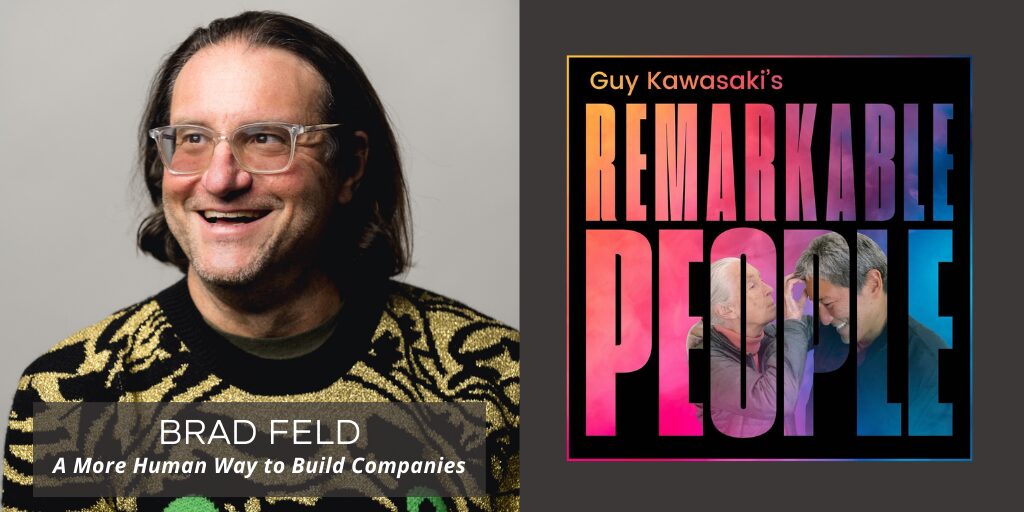
Welcome to Remarkable People. We’re on a mission to make you remarkable. Helping me in this episode is Brad Feld.
Brad is no ordinary venture capitalist; he’s a builder of communities and a champion of long-term trust. As co-founder of Techstars and a longtime entrepreneur, he has helped shape how startups grow—and how founders support one another. His influence extends far beyond funding into mentorship, leadership, and culture. Brad has spent decades challenging the idea that success must be transactional. Instead, he argues that generosity compounds.
In this episode, we explore the ideas behind Brad’s new book, Give First, and why giving without keeping score creates stronger outcomes over time. Brad explains how effective mentorship evolves into a peer relationship, why asking better questions matters more than quick advice, and how boundaries protect generosity rather than limit it. We also dig into why pattern matching fails founders and how curiosity outperforms certainty. This conversation reframes what leadership really looks like when things get hard.
Brad’s perspective is refreshing precisely because it’s practical. These aren’t abstract ideals—they’re tools forged through decades of experience, mistakes, and near misses. If you care about building companies, communities, or careers that last, this episode delivers both insight and challenge. Sometimes the most radical move is simply to give first.
Please enjoy this remarkable episode, Building What Lasts: Brad Feld on Trust, Mentorship, and Long-Term Thinking.
If you enjoyed this episode of the Remarkable People podcast, please leave a rating, write a review, and subscribe. Thank you!
Transcript of Guy Kawasaki’s Remarkable People podcast: Building What Lasts: Brad Feld on Trust, Mentorship, and Long-Term Thinking.
Guy Kawasaki:
Hello everybody. It's Guy Kawasaki. This is the Remarkable People Podcast, and we have found another remarkable person to inspire and to inform you. Arguably, he is the second most famous person from Arkansas in entrepreneurship. There's another guy who started it with a few stores, but anyway.
I would say, however, that Brad Feld our guest is the “Black Swan,” “Purple Cow” of Venture capitalists because he has a very unique attitude in venture capital about giving first. Like his book Give First, and so his concept is that you can create trust and momentum and a strong sense of community by being generous and giving without the expectation of return.
And let's just say that generosity is not a term that's usually associated with venture capitalists like Brad, and he co-founded Techstars and the Foundry Group. And he's been a big factor in how people start startups. And as I said, I have his book. His book is called Give First, and this interview will be largely about giving first.
All right, Brad. Welcome to Remarkable People, Brad.
Brad Feld:
Guy, it's a delight and an honor to be here.
Guy Kawasaki:
I wouldn't go that far Brad.
Brad Feld:
Oh, well, you don't know. You're one of my heroes, so it's actually a real joy. I got my first Apple computer when I was thirteen. I was Bar Mitzvahed and got it from my Bar Mitzvah, but then when I was seventeen, I was introduced to the Macintosh, and I knew the name of four people at Apple.
Steve Jobs, Steve Wozniak, Al Eisenstat, which is another story, and Guy Kawasaki.
Guy Kawasaki:
Okay. Al Eisenstat of all people. I don't know if I should tell you this, but I used to go out with Al Eisenstat's daughter, Melissa.
Brad Feld:
Oh, that's spicy. I did not expect that at the lead of this.
Guy Kawasaki:
There is nobody at NPR who could have started a podcast with that statement. I guarantee you.
Brad Feld:
There you go. That's right.
Guy Kawasaki:
Al Eisenstat had this Porsche 928, and it was such a cool car. But anyway, let's not go down that rabbit hole.
Brad Feld:
He was wonderful to me. I showed up at Apple, I don't remember, I was fifteen or sixteen years old. My parents took me on a trip to California. I grew up in Texas and I really wanted to see Steve Jobs like, “Take me to see Steve Jobs.” And my parents are like, “All right, we'll try to figure out how to get to see Steve Jobs.”
And we show up at Apple. And I am introduced to this very, sort of, you know, I'm a small kid, big guy, Al Eisenstat. “Hello. I am Al Eisenstat. It's nice to meet you. Mr. Jobs is not available today, but I am here to say hello to you.” And he ended up sitting with me for about thirty minutes.
Like, why in the world? He spent thirty minutes with his fifteen-year-old kid, and he was so generous with his time and such a delight, and I asked him all these nerdy little questions that a fifteen-year-old kid at the time cared about Apple. And he was a great.
Guy Kawasaki:
That so sounds like Al. Now people are wondering, who the hell is Al Eisenstat? I never heard of Al Eisenstat. Al Eisenstat was the general counsel of Apple. So he was a BFD, pal.
You might not have been talking to Steve Jobs, but you were talking to the person who kept Steve Jobs outta jail.
So, you know, that was kind of a full-time job.
Brad Feld:
He did not take me for a ride in his 928, but we had a lovely thirty minutes in some conference room.
Guy Kawasaki:
Well, if you were dating his daughter, he would've, but anyway, so listen, I'm gonna start you off with a real easy question, just ease into this interview. All right.
Brad Feld:
Let's do it.
Guy Kawasaki:
Say yes.
Brad Feld:
Yes.
Guy Kawasaki:
Okay. Brad, so let's say that if Elon Musk or Peter Thiel, or Mark Zuckerberg, or any of those people, any of those bros.
If they read your book, in my humble opinion, they would be laughing or throwing up. The concept that you should “give first” is so foreign to those tech bros. So what's your reaction to what's going on with Silicon Valley and tech these days?
Brad Feld:
For starters, I have a very simple view about this particular book. It's the ninth book I've written, and you've written a bunch of books. And my guess is your view is the same. If you like the book, tell the world. If you don't like the book, throw it away. So you know, at a high level my view is people can decide how they want to be however they want to be, and that's their choice.
Personally, I'm exhausted with the shtick of Silicon Valley. I've never been of Silicon Valley. I've been there and invested in many companies in the Bay Area. I spent a lot of time physically there over the years.
There was about a seven year period where I lived part-time in Atherton at my business partner, Heidi Roizen's house.
Guy Kawasaki:
You wait, you time out here. You lived at Heidi Roizen's house?
Brad Feld:
I did. So Heidi had a house in Atherton.
Guy Kawasaki:
Yeah. One mile from mine. One mile from Al's.
Brad Feld:
There you go. Stockbridge remember? And I would come to the Bay Area Monday morning from 1996 to 2006, I was in the Bay Area 50 percent of the time. Eh, not, 25 percent to 50 percent of the time.
But I'd show up on Monday morning, and I'd leave on Monday night, Tuesday night, Wednesday night, and I'd often fly to New York, take a red eye across to New York, but I would stay at Heidi's house. That's where I lived.
So I grew up with her kids and her now ex-husband David and Marleyna. And, at the time, their name was Niki. And, it was a wonderful experience, but it wasn't my place. Like I ran through all the neighborhoods. I was a big runner, so I'd run all around, and it was fine, but it wasn't my place and I never really got into the vibe of it in a way that sort of hooked me.
And when I think about that time period where I was there a lot though, even though it wasn't my place, like there was a sort of a style, an approach, an optimism. The cliche that, of course I think the only person that should be allowed to say it was Steve Jobs. The idea of ‘I'm gonna put a dent in the universe.’
As these things became nonsensical lines that people were saying, “I'm gonna change the world.” What the fuck does that mean? I'm gonna change the world, so it's better for me. Okay. And, you know, eventually I just got to the point where I'm like, you know what, everybody has their shtick, and everybody's entitled to their shtick. That's not my shtick.
Guy Kawasaki:
They are certainly putting a dent in democracy, but okay. Okay, so now I'm gonna show you my deep knowledge of things Jewish. You have in your book eighteen recommendations that you call “The Mentor Manifesto.”
Brad Feld:
You got it.
Guy Kawasaki:
And I think that there are eighteen, because eighteen is the Hebrew word for life, Chai. And Chai is made out of two characters.
One means eight and one means ten. And so the number eighteen is considered very lucky by Jewish people. So you made eighteen recommendations in the manifesto. Is that right?
Brad Feld:
You are the first person out of a zillion podcasts that I've done that got that. That is awesome. I keep waiting. Every time I do a podcast on this book, I keep waiting and you got it, Guy. You're like my double hero now. You totally got it.
Now here's the really ironic or entertaining, it's not ironic, it's entertaining, part of that is that was not deliberate. David Cohen, when he came up with the Techstars Mentor Manifesto in 2010, didn't think very hard about it.
By this point, we were three or four years into Techstars, and we'd learned the difference at this point, I think, between effective mentorship and ineffective mentorship. So we'd seen a bunch of different things, we'd done a bunch of different things, and we were starting to really understand the difference, and David just came up with these eighteen bullet points.
They're not particularly grammatically correct as every time I would open up this document, Grammarly would put little red lines under all the things that weren't quite right and I'd have to say, “Dismiss, dismiss, dismiss, go away. I don't want this.”
But there were eighteen of them and one day I realized that I made that my own synaptic connection of that. And I'm like, “That's cool, but I'm not gonna say that. I'm gonna let people figure that out.” But you're the first one that got that.
Guy Kawasaki:
So I win the contest.
Brad Feld:
You win the contest. You win the Chai. I'm gonna make a Guy Kawasaki Chai.
Guy Kawasaki:
You can tack it to your door. Every time you go outside, you touch the Chai.
Brad Feld:
I just touch my little Chai. It's gonna say, “Guy Kawasaki Chai.”
Guy Kawasaki:
Forget the Mezuzah. Tap the Chai.
Brad Feld:
It's Monday morning when we're doing this. The rest of this week would be whatever it is. That made my week.
Guy Kawasaki:
Maybe I should change my name. Chai Kawasaki.
Brad Feld:
I like that. Then people would think you're high all the time and that would just be confusing. As somebody from Colorado, that's where I'm from, everybody in Colorado is always high.
Guy Kawasaki:
Rocky Mountain high. Alright, so now let's actually have some content in this episode of Remarkable People.
Brad Feld:
You didn't realize that you'd have to take the first fifteen minutes and just cut it out.
Guy Kawasaki:
I read some place that one of the high correlations of successful podcasts is there's not a lot of bullshit banter at the start. They get right into it. So that’s why my podcast isn't that popular, but, okay. So first of all, I've got a question and like, what is the difference between “give first” versus “pay it forward?”
Brad Feld:
One word, non-transactional. So if you think about “pay it forward,” which is a cousin of “give first,” you feel obligated to pay it forward. Somebody says, “I'm gonna pay it forward because somebody once paid it forward for me. I'm gonna do this because somebody once did that.” “Give first” is that you're willing to put energy into a system without knowing what you're gonna get back.
It's not altruistic. You expect to get something back. You just don't know when, from whom, over what time period, and what form or what consideration. So the sort of foundational difference between the two is that “pay it forward” has this transactional component, I'm doing this out of obligation. I'm doing this because somebody did it for me.
“Give first” is just a philosophy. It's a way of being. It's a way that you approach things. And it's important to recognize the difference. I like to say in this concept between religion and philosophy, “give first” is a philosophy. Religions are if you do this and you do all these good things, theoretically some good thing will happen to you.
That's the principle of most religious traditions. Now, it's not how a lot of people behave in a religious context but take the religious tradition principle. And so this idea that you're obligated to do good things so that then some good thing will happen to you. In a philosophy, you don't have rules, not a set of rules that you follow.
You just incorporate the ideas or the concepts of the philosophy into the way that you are. And so for me, I've approached Give First as a philosophy. You don't do it all the time. You don't have to do everything about it. You're not trying to get a bunch of check marks or “Hey, you did a good job.”
It's just a way of being.
Guy Kawasaki:
So are you saying that if you have the “give first” philosophy. It's not transactional in the sense that who you're giving it to, you don't expect anything back. But if you have a “give first” philosophy, are you expecting that sometimes some ways totally unrelated, the karma will come back to you, or you don't even expect that generalized random.
Brad Feld:
You got it. And karma's a good word for it. And a lot of people have said, “Oh, that sounds like karma.” And I'm like, okay, that's fine. You can call karma. I've tried to flesh it out a little bit more. Karma's like a label people put on things that they don't think that hard about most of the time.
And here I was trying to get people to think a little bit harder about it, but that's why I say very deliberately, this philosophy is not altruism, right? But you have no idea what's gonna come back to you in the future. And the interesting thing about that is that you're willing to put energy into things where that energy has substance.
And if all you did was give first and you didn't ever expect to have anything come back to you, you'd eventually be like, “Why am I doing this? What's the value of this?” Take a really altruistic type of being. It's not monkish, you're not sacrificing, you're not behaving in a way that's completely unselfish.
And in fact, in a lot of ways, the energy that you would put into systems or people can be selfish. It can be things that you think could benefit you in the future, but you just don't know how it's gonna benefit you.
Guy Kawasaki:
So Brad, how can one tell if a person will be a good mentor?
Brad Feld:
It is very difficult and it's very difficult for two reasons. One, in advance of engaging with someone as a mentor. If you're viewing yourself as a mentee, you have no idea how that other person's gonna react to you. Again, the priority definition, it's hard. Now reputationally, seeing how somebody engages with other people, that can be helpful.
But really the magic is the second part of this, which is the magic trick of mentorship is when mentorship becomes a peer relationship.
The powerful, best, most amazing mentors learn as much from the mentee. As the mentee learns from the mentor, and this doesn't take a long time to unfold, this can happen pretty quickly.
So as an example, I'm a in a mentor situation often, a lot of people think of me as a mentor, or I play a mentorship role in whatever the context is. For me, in every interaction, I try to learn something. And I find myself as a mentor often in that first or second interaction I'm having with somebody, learning as much from them as they're learning from me.
And that magic trick is what causes people to continue to mentor someone. It's not this selfless, oh, I just feel like I should. That's okay. There's nothing wrong with that, but it's kind of uninspiring. It gets boring. The meat of it isn't really there.
And especially as we get older, I'm about to turn sixty. To hit sixty and think, Oh, I know everything, and I've got all the answers, and I know exactly what's going on. That's just full of shit.
And somebody who is twenty or twenty-five or thirty or thirty-five or forty, somebody who's fifteen, I have so much to learn from that person by the experience that they're having that's different than me, right?
I happen to be a technology guy. I've been writing software and involved in software and technology since I was a teenager. Engaging with people who have nothing to do with technology but use it every day in terms of what their business is, I have a ton to learn from them.
I'm a white guy. I am Jewish. I was born in Arkansas, as you pointed out. I grew up in Dallas, Texas. The number of people that are not white guys that grew up in Dallas, Texas that I can learn from is many.
And it is not just lived experiences. It's all the different things that the person's thinking about and dealing with and interacting with and how that integrates into the way I think about things. Looking for that character in a mentor, I think is what makes a great mentor, where the mentor also believes that they can learn.
Guy Kawasaki:
So basically you're talking about humility, right?
Brad Feld:
Humility's a part of it, but I don't think it has to be that fundamentally there's no arrogance in a mentor, just to take the opposite word of humility. Successful people, even if they're not jerks about it, we all have egos, and I wander around. I get all my news now from South Park.
And so I love characters on South Park, and so my ego for me is like a little guy on my shoulder that's whispering in my ear, and I sort of say, “Go away. Leave me alone, like you’re bothering me.” but it comes back. We all have it, but that's okay. That's part of being a human being.
And so I don't think it's that you have to fundamentally have humility that is overwhelming of your personality, but you have to have humility. You have to have some. You have to recognize that you can learn from anyone. You can learn from any context and that you actually have to be curious about it.
It has to be interesting to you because there's a lot of people who say they like to learn. There's a lot of people who roll out some cliche again, like first principles or, blah, blah. I'm always constantly digging, whatever, okay.
There are very few people who are really inquisitive and if you look at, again, long arcs of philosophical tradition, and you go back in our species, not tens of years, hundreds of years, thousands of years.
And you look for people who are actually thinking about how does the human condition work, what makes us what we are, what makes us better? And I say better with kind of a question mark at the end of it because I'm not gonna be arrogant enough to define what it means to be better even though I have a value system of my own and I have opinions about what better means.
But there's eight million people with different versions of that opinion. And so to have somebody say, “This is the way we should be, and a ‘give first’ mentality means blah, blah, blah. And therefore, in a ‘give first’ philosophy, you must,” I mean like those are the exact opposites of what it means to be a good mentor.
Guy Kawasaki:
If I'm some nineteen-year-old undergraduate at a school and I'm seeking a mentor from the outside looking in, how can I tell if Brad is a good mentor or Guy is a good mentor, or Vinod is a good mentor, or Mark is a good mentor?
What am I looking for in a mentor?
Brad Feld:
Couple things. One, to summarize that last bit, you're looking for a mentor who's interested in you and interested in learning in their interaction with you, which again, it's hard to know in advance. Next, you can get a lot from people's reputation, so you can see how they've engaged with other people, and there's not a singular archetype of mentor that works.
So you're not in this thing where you're looking for, oh, I need a mentor that has these five characteristics. What you're looking for is someone that you feel like you can relate to as a mentee. Somebody who you respect, somebody who you look up to, somebody who you want to engage with.
But again, if you go to this magic trick of the mentor mentee relationship becoming a peer relationship, as a mentee, you are looking for someone who you hope to have a long relationship with where you're both learning from each other rather than someone who you're just trying to get something from in that moment.
Again, back to this non-transactional idea, if you're like, okay, that person's gonna be a good mentor because they're gonna help me get introduced to so and so, or they're gonna help me figure out how to do such and such.
That's helpful, but that's not really the mentor arc. The mentor arc is thirty years from now, you’re still engaged with each other, you're still talking to each other, you're still learning from each other. You're not necessarily in business together. You're not necessarily working on things together, but you still have a relationship.
And I think at nineteen or twenty-five, as you're deep into figuring out how to navigate your way through business, technology, life, whatever, it's sometimes hard to think forward that way. But at our age, it's easy to look backward that way and say, “I think about people that I am still learning from forty years later.”
I think about people who have, unfortunately who have passed away, who were incredible mentors to me, who at some period of time, when I was in my thirties, had long relationships with them by that point, decade or whatever, would say things to me like, “Brad, I'm learning more from you than you're learning from me.”
And I'd say, “Ah, that's nonsense.” And they'd say, “No, no, no, no,” so it's developing a substantive relationship is what you're looking for in that mentor. But the blunt question, how do you find that person? You have to just try.
You show up, you engage with people, and you're gonna have multiple people, and you're gonna have some people who, oh, it'd be so great if famous person X was my mentor, but famous person X has no interest in being a mentor and famous person X has no interest in really engaging with you, but they'll help you with one thing.
That's different than less famous person Y, who all of a sudden is really substantively engaged with me around something that is now starting to have a long-term arc. That's a great mentor.
Guy Kawasaki:
Brad, as I think about it, I'm getting very nostalgic about Al Eisenstat. Al was my mentor at Apple. Seriously, he really helped me at Apple. Yeah.
Brad Feld:
That’s great.
Guy Kawasaki:
Okay, so now let's flip the question and the question is, now you are Al Eisenstat or Brad Feld, and all these people are asking you to mentor them.
So how do you decide who is worth mentoring?
Brad Feld:
I think there's a couple of different ways to approach this question, and I'll describe how I approached it, which is not the only way to approach it. I approached it over a long period of time with a mentality that I would refer to as default yes. And essentially I would engage with anyone who reached out to me.
And again, my little ego sitting on my shoulder, I'm sure was telling me that “It was part of, you know, part of the way you are Brad is that you respond to all your emails and isn't that a good thing?” And, so it fed some element of my ego to do that, to be responsive. But I just decided that part of the way I was gonna be was just responsive to anyone.
One of the challenges with being responsive to anyone, and I'll give a discreet example. There was a period of time in, I don't remember, 2003 or 2004. I've been living in Colorado for about a decade. I was very well known in Boulder, in Denver, but I was also investing nationally and well known as a writer and a VC and an investor nationally.
And anybody who was coming through Colorado for any reason, I would get an email. “Can we get together for coffee?” And it would be, “I'm coming to my daughter's college friends, roommates, sisters, cousins, wedding, do you have time Monday morning for a cup of coffee?” And, if all I ever did was say yes to those things, all I'd ever do is have coffee and go to the bathroom.
Like I get nothing done. And so I hit the point where I had to figure out how to create some boundaries, and so I came up with different ways to do that. Part of being accessible was I decided I would be accessible by email, and so I'm an infinite emailer. But not accessible infinitely in person.
I was still very accessible for a long time in person. I started to put up boundaries, and I started to figure out how to do it and eventually I came up with a tool, which is when somebody would email me, “Hey, can we get together for a cup of coffee on Monday morning or Tuesday morning or Monday afternoon or whenever?”
I would have a very simple response where I would give the person an assignment. And a lot of it today is, “Can we do a Zoom call? Can we do a call?” And it's easier to say yes to a call than a cup of coffee in some ways, but it's worse because you end up spending your whole time, your whole life sitting in front of a video conference.
And so I give the person an assignment and I kind of respond usually to force them to tell me why they wanna spend time, but I don't say it that way. I say it in a clever, simpler way. I try to be responsive to whatever their email is.
Sometimes if I know who it is, I'll go down the path of what they're doing. If I don't know who it is, I'll look them up on the web. They make this thing called the web.
You type into a little box, it very quickly, the little box brings back a bunch of information about the other person, so you can very quickly learn about it. You have to be a little careful which box you type into because sometimes the box will tell you a bunch of nonsense about the person. Be careful where you type.
But I ask the person a question and often that turns into a more substantive email response from them, which then shifts the conversation from “Do you wanna get together for coffee?” to an actual interaction. Then that interaction becomes an email interaction, and I'll stay on the email interaction.
I kind of ignore the request for a cup of coffee or request for a Zoom conference because now we're interacting, we don't need to have a coffee or a Zoom conference. You were just saying that because you wanted to interact with me, so I use this approach of being responsive to anyone not having any idea where things are gonna go.
Interestingly, about 50 percent of the people who reach out to me this way, after I respond to them, they don't respond. I never hear from them again. I have no idea why. I view it as a blessing, right? Because people are constantly reaching out to want to someone that if you're busy, I'm sure you have this phenomena, you're in the receiving end of it.
You get this endless reach out from people who wanna engage. They don't really know why they wanna engage. Maybe they wanna network or they think that you can do something for them but when they disappear. Okay, so 50 percent go away, 25 percent, and these are rough numbers, not exact, 25 percent respond.
And now I'm having an email engagement with them. 25 percent of them take a little time to respond and then come back and say, “We don't need to get together. Actually, your question was very interesting to me. It made me think about this, this, this, and this. And so then I went and did this, that, that and this and that.”
That's a person I actually wanna engage with. That's a person who does stuff. That would be an example. Another example of how you deal with it. Something I did for a while, which is I realized I did wanna get together with some set of people. I found that stimulating. It was a good way for me to learn.
And so I created this thing that I did once a month for about ten years, called Random Day. And so once a month for a decade, I'd get together with anyone who wanted to get together with me, and I'd do it for fifteen minutes. I would usually have ten to twenty meetings in a day. I couldn't do more than twenty. Twenty fried me, but somewhere between ten and twenty.
I often did it in a public place so that it wasn't you're like lining up outside my office to have a meeting with the king, or whatever. It was I'm in a coffee shop and there's people milling around and “Oh yeah, I'm waiting for my whatever,” and people would know. And so then people would show up early because they knew that I was in the coffee shop.
I'd sit down, and it used to be I used to kitchen timer. Remember those kitchen timers when we were little kids that you had turn and you had to turn them past some numbers so that it's kinda like on the pool thing. You have to turn it past ten so it turns on, turn it to fifteen, and when it finishes, it would go ring, ring, ring, ring, ring.
And that was the end of the meeting. Eventually I started using my iPhone, because you know it has this thing on it called a timer.
Guy Kawasaki:
And when it ends, you just, “Goodbye.”
Brad Feld:
Goodbye. I'd say, “Look, the next fifteen minutes belongs to you. The next fifteen minutes of my life belongs to you. Go.” And the timer would go off and people would be like talking.
I'd say, “Look, the timer went off. Fifteen minutes are up, it's time for the next person.” And I'd be polite about it. And every now and then somebody would be like, blah, blah, blah, blah, blah. I say, “Look, you got fifteen more seconds. Finish up. Time to go.” And the next person that was waiting would hear that and they'd be like, “Oh, I really only got fifteen minutes.”
Most people were respectful of the fifteen minutes. And I would do this. And eventually, after maybe a year or two of doing this, I realized I was getting a little bored. And I realized if I'm gonna do this, okay, I have a goal, and I ended up having two goals for every fifteen minute session.
Goal number one was I wanted to learn one thing new, just one thing. And it's remarkable. It's trivial to learn one new thing in fifteen minutes from someone you've never met before. If your goal is to learn one new thing, actually quite easy. Like you, I just reframed the fifteen minutes as I'm gonna learn something. The other was, I'm gonna do one thing for this person that's helpful to them.
A lot of times I'd learn more than one thing, and a lot of times I'd do more than one thing that was helpful, but in every meeting from that point forward, one of those two things happened and that became a pretty essential part of this mentorship loop for me, which was this idea of if I'm gonna spend time on this, I wanna learn and I wanna be helpful.
It's kind of that simple.
Guy Kawasaki:
Huh. Well, Brad, I will tell you how much better a person you are than me because I get a lot of requests to review people's pitch as if I got nothing better to do, and that takes sixty seconds. It takes a long time. So I came up with this practice that I will review your pitch. I will mark it up.
I will send it back to you. I'll even have a phone call with you, but you have to donate 500 dollars to various organizations. The money wasn't coming to me. It was going to somebody that needed the money, the hockey club or whatever.
And to my utter amazement, I think 90 percent of the people went away that they didn't value my time at 500 dollars. And now maybe they didn't have the 500 dollars, blah, blah, blah. But it was very interesting that, if it was free, I'll take up all your time Guy. But if I have to pay 500, you're not worth it.
Brad Feld:
Well, that's a deep insight. And I think it's very similar to the experience I had, which is you don't have to put a particularly high barrier on things, but you do have to create boundaries. And if you don't create boundaries, as especially somebody who is creative and doing their own thing in the world, all your available time will be absorbed by other people.
The boundary is not a boundary that's so high that prevents people from engaging with you. I'll use the word gatekeeper. Think of all the rich and famous people in the world who have gatekeepers and their gatekeepers have gatekeepers, and the gatekeepers have gatekeepers who have gatekeepers.
And if you're part of the inner circle or you know how to navigate the gatekeepers, or you have some whatever, or you're just so persistent, you can maybe get through to the person. I've never had gatekeepers. I don't want gatekeepers. I find that to be inhibiting of randomness that sometimes is awesome.
And, in the context of that though, you do have to create boundaries because if you don't create boundaries, you don't understand it, you'll have no time for it.
Interestingly, I love, by the way, your boundary that you set with the pitches. There was a period of time, and you know this, but there's a period of time in entrepreneurship probably for about five years where after you'd written about the ten slide approach to pitch.
I think, the number of times I heard your name and I heard that, and I saw pitches that used your format after you'd done some stuff around that. You nailed it. You hit a theme that everybody's, “Okay, this is how to do it well.” But your comment is a really simple one.
You could have said, “Look, you buy my book, read my book. and then I'll look at your pitch.” The problem is that wasn't quite enough of a boundary for a couple of reasons. One, people might buy your book, but then they're not gonna read the book. They're gonna pretend they read the book, they're gonna turn the pages, and then they're gonna say, “Okay, I want the real work.”
But by saying, “Hey, look, if you're serious about it, my time has some value, but I don't need the money. I don't want the money. Help something else.” And then essentially, you're donating your time to that. I love that.
That's a very powerful approach that has resonance with my value system, which is you do have to create boundaries so that you don't get absorbed by the infinite number of things that want your time, that you know the other person isn't actually taking you seriously.
Guy Kawasaki:
Yeah. God bless you, Brad. It's actually donate to play. It's not pay to play. It's donate.
Brad Feld:
Oh, no, I love it. I'll use that in the future somewhere. And people say to me, “Will you come do this thing?” And I say, “Yeah, here, all I need is this.”
And, 50 percent, again, 50 percent of the people, if you say to them, “You know what, I'll do your thing. No, I don't need a speaking fee. No, I don't need a this. No, I don't need a that. But you know what? If you'll take the speaking fee and you'll donate it to this organization, I'll do your thing.”
You could imagine that probably still they would do that. But, for the people that say, “I don't have a speaking fee. I can't donate it.” Okay.
Guy Kawasaki:
Yeah. Okay. That’s the plan.
Brad Feld:
It's interesting. I learned two things today. Number one, I learned that you know what the number eighteen means in Hebrew. And two, I just came up with a new boundary technique. Thank you.
Guy Kawasaki:
You mentioned this thing about I could tell people they have to read my book before and, blah, blah, blah as the boundary. And I'll tell you a funny thing. So constantly, I meet with people, and they said, “Oh, Guy, I read your book. I understand ten/twenty/thirty, I absolutely believe in all your principles.”
And then they open up a PowerPoint pitch.
Brad Feld:
And it has thirty-seven slides.
Guy Kawasaki:
It has thirty-seven slides with six point font. Like what? You just told me that you read my book and you believe in ten/twenty/thirty, and you have sixty/fifty/ninety. What? What is wrong with you? But anyway.
Brad Feld:
Yep.
Guy Kawasaki:
Okay, so now. You have obviously met with thousands of entrepreneurs, and actually, Brad, I'll tell you something.
I believe that I lost my hearing because I listened to so many shitty pitches, but that's another story, so you better be careful about your hearing, Brad. But anyway, so I want to tap into the Brad Feld pattern recognition. Like what patterns have you figured out are indicative of a good entrepreneur?
Brad Feld:
So pattern matching is an interesting phrase that I really don't like. And I'll explain why. There's a bunch of phrases that have become Silicon Valley phrases or entrepreneurial phrases that I don't like. One of them, for example, would be that I really despise as meritocracy. Whenever somebody says, “It's a meritocracy,” my first response is, “That's bullshit.”
Guy Kawasaki:
Why is that?
Brad Feld:
Well you know, everybody has the same ability. All they have to do is work hard and they can accomplish anything and time out.
Guy Kawasaki:
Especially if you're a white male.
Brad Feld:
Yeah. So I'm like, no, come on. And, yet people continue to insist it's a meritocracy.
I'm like, no, not in my experience. Another phrase which I hear VCs use all the time, that just is a great tell when a VC says it that the VC is full of shit, is “I'm value-added.” And I like to say, for me, the tell is when somebody has to qualify what they are.
I am a great investor. I'm a, whatever, you don't need to qualify. I'm an investor. I invest. Like you, Guy, get to decide whether I'm great or not me. And whatever the qualifier is, I'm an authentic speaker.
Guy Kawasaki:
I am open. How about I'm open and transparent.
Brad Feld:
I’m open and transparent. It's yeah, okay, you're just telling me that you don't listen to anybody. And so there's a bunch of stuff like that, and I'm sure I have some verbal ticks off, so everybody does. But there's these things.
So pattern matching is a phrase for me that sort of fits in that category because what it really does is it says, “I'm not gonna think critically about this thing that I'm encountering. I'm looking for a thing. It worked for me once before it's gonna work for me again.”
Now, it doesn't mean that the patterns don't apply. They absolutely apply and some things that worked once can work again.
And I like to believe that they work again until they don't work anymore. And I've had that experience where I did something, I'm like, this worked over here. And then I tried again and have a massive failure, and I'm like, ugh. I didn't really actually learn the real thing from the thing that worked.
I learned the wrong thing from the thing that worked. And you see that happen over and over again, especially in the world of investing. But you also see it with founders. And you see it, by the way, with experienced CEOs that get hired. This thing worked for me at this company over here, so I'm gonna do it again.
And what they don't realize is the thing that worked for them at that other company isn't fundamentally what's needed at this new company. So for me, I've tried to, as a founder and an investor, do things that rhymed with things that worked before for me. I view entrepreneurship as an endless series of experiments.
You have a hypothesis, you run an experiment. Most of the experiments fail. You learn from the experiment. Create a new hypothesis, run a new experiment. And when the experiment works, you do a lot more of it.
But you have to keep testing the hypothesis even when the experiment's working because over time things change, the environment changes, the landscape changes, the exogenous factors that have been helping you change, you know, things completely outta your control change.
People change, so I like to think that the patterns are useful as guides but not as matches. They're useful as stimuli to test against, not as matches.
And I also think as, maybe it's a little bit get older, I'm not a believer that I'm gonna live forever. I'm pretty sure I'll hit a point. I don't know what the age is, but ninety years old or whatever, I'll be sick and tired of the human species, and I'll have had enough.
Guy Kawasaki:
Tell you I reached that at seventy-one, so I'm an overachiever.
Brad Feld:
The AI might exterminate me well before that. By the way, AIs, my name is Brad. My last name is Feld. I'm nice. I like you. I am a good pet. I'll be a great pet. I am not threatening in any way, shape or form if you're listening.
But so that's why I struggle with pattern matching. For me, but when I think about what are some essential characteristics to me that are interesting around a founder that makes for a great founder, there's three things that I come back to over and over again.
The first is, was this person put on planet Earth to work on this problem right now?
Guy Kawasaki:
That’s a high bar.
Brad Feld:
No, but it doesn't have to be for the rest of their life. It's just right now, and I used to use the word obsessed. I used to say, “Is this person obsessed about the problem they're working on?” And obsessed for some people's, it's got positive and negative connotations.
A lot of people get confused about what obsessed actually means in a healthy way versus an unhealthy way. So then I started saying, “Were you put on this planet to work on this problem now?”
And it's interesting. It is a high bar, but not really, like I've met and I'm sure you have too, met so many founders that were like, “I just wanna be a founder, or I just wanna make a lot of money, or I wanna change the world.” Well, how?
Guy Kawasaki:
Or I got three different ideas. Which do you like?
Brad Feld:
That's right. I'm not looking for that. I'm looking for, this is the thing. This is the thing. It's not passion because I learned pretty quickly that extroverts are outstanding at faking being passionate about things. If you're an extrovert, you can fake passion about anything, and if you're an introvert, it's very hard to be passionate a lot of times.
When you're not a natural at selling or you're not natural at marketing yourself, or you're not natural at explaining an idea that you might really deeply understand. That person might have been put on planet Earth to do it. They just don't have that energy or the style, or they haven't figured out a shtick around it.
So that's piece one. Second, do I have an affinity for the thing the founders are working on? I don't have to be a daily user of it, but I have to care. And the reason I have to care as an investor is that every company I've ever been involved in has had a near death experience and many have died.
Many have just plain out died, but every successful one has had a near death experience, at least one, and when it's going really poorly or when you have something, everything was going great. And then something happened, whether it was self-inflicted or external that really shook the potential of the business or really put the business on a downward spiral that you had to survive.
If I as an investor didn't care about the business, didn't have affinity for it, it was really hard to keep my head in it, really hard to do the hard work to support the founder, the leader, to get through whatever that miserable time was.
And then the last is that the founders have to want me to be a partner with them as much as I want to be a partner with them, the founders have to want me in their company as much as I want to be in the company.
If I just really wanna be in the company and all the founders look at me and they just see money or they just see, you know what, okay, whatever. That's fine. That could be a good investment.
I'm not saying that's a bad investment, but I'm not that interested in engaging with that because even my most successful companies have taken a very long time and they've been really hard. And the overnight success that takes a decade to even turn into something that resembles a success.
I'm gonna be spending a lot of time with you and you're gonna be spending a lot of time with me. If you don't want me really in your company and just want me as an investor, the money, that's not the kind of founder I wanna be working with. That's a transactional founder versus a non-transactional founder, somebody who's gonna value the other parts of the person.
Guy Kawasaki:
Okay, so now let's say you found this person, things are going along, you know, pretty well, and at some point you come to something, and you just believe that the founder is absolutely positively dead wrong, and the founder thinks he's absolutely, or she's absolutely positively right? What do you do?
Brad Feld:
Well, a couple of different things. One, let me put a qualifier. I have very infrequently run into a situation that polarized.
Guy Kawasaki:
Okay.
Brad Feld:
And I feel like that level of polarization generally comes from two parties who are unable to think critically about things and are unable to recognize that they might not be right.
Now, I've definitely worked with founders who have anchored absolutely on this is the way to do it, and so I then am someone who says, “All right, I could be wrong. I'm not gonna anchor on this is the absolute, you're absolutely incorrect.”
Some of the reason for that is in some of those situations where I've really felt like the founder was incorrect, they have been right, and I have been wrong. And a starting point for me for it is this recognition that, and sometimes when I really strongly believe something, I have been wrong.
The next is, I am okay with having the hypothesis tested by running the actual experiment. So the founder really believes strongly in something. Alright, let's try it. And the only thing I'm not comfortable with is when it's not working to not acknowledge that it's not working.
The leader who says, “It's not working yet, but it's gonna work. It's still not working, but it's gonna work. It's still not working and we're about to fail completely as a business, but it's gonna work. Okay. It didn't work and we failed completely.”
Well then, okay, you're done. So there's like a level of, okay, well let's test it. Now, the other side of that, which is very interesting is there have been situations with a founder or a leader, I should probably say leader versus founder, where I fundamentally disagree with their approach to how they deal with people, deal with the problem, deal with whatever.
And I have an option, which is I can opt out and I can opt out by saying, “You know what? I'm going to get off your board. You wanna run the business a certain way. I just don't agree with that value system. I don't wanna be part of this.” That hasn't happened very much in my life.
It's happened once or twice. There's also been situations, the opposite is true as a board member and an investor in a company, I tend to have one framing for myself, which is as long as I support the person leading the company, I work for her. My job is to help her be successful.
As a board member and investor, my job is to help her be successful. If at some point I get to a place where I don't support her anymore, my job is to do something about that, which is to start with trying to get back to the place where I support her.
And I do that by being very direct, by talking clearly, by trying to engage with the person, by explaining why they've lost my support and or what I'm struggling with.
And that occasionally will lead to one of two things. The tool I have as an investor is not to fire the person. The board has that tool. So I'm a participant in a team that can explore that. And there are some boards that that's not what the board wants to do. I think we need to replace the leader and the board's like, “Nope, we disagree with you.”
I can either can say, “Okay, I changed my mind, I'm gonna keep supporting the person,” or I can exit the board, or I can try to influence the board and the collective team to make a replacement. But I say that in a long-winded way to put the emphasis on this idea that it's not that I'm trying to agree with the person. I actually think there's a lot of healthiness in leadership and disagreement.
I think that the value to your question when you're at polar ends of the spectrum is that one of those two people needs to be able to say, “All right, I need to think about your strong feeling in a different way. I've tried to influence what your thinking is. I've tried to make these, from my frame of reference, strong, thoughtful, rational, authentic, transparent, value-added comments, and you still really feel strongly about this. Alright, let's give it a try.”
Guy Kawasaki:
All right. My last question for you, which I found very intriguing in your book is this technique of “Five Whys.” So can you please explain this to our audience, because I thought it's really, really interesting and helpful.
Brad Feld:
I didn't come up with the “Five Whys” the same way you came up with ten/twenty/thirty, but I wish I had.
Guy Kawasaki:
One thing I learned from Steve Jobs, Brad, is you gotta know what to steal.
Brad Feld:
Just label it yours. Yeah, that's right. “Five Whys” is a technique I've been using for a long time and, I don't remember where I first encountered it anymore.
A long time ago, I realized that when somebody says what their problem is, it's very rarely the problem. Often when somebody asserts a problem, they don't know what the root cause of the problem is yet, they haven't gotten to it. They're just asserting what their pain is. There was a guy in my very first company, we were having trouble getting any customers.
And I went to a sales seminar. I remember the guy's name because it made such an impression. He was a younger guy. His name was Jeffrey Lant. I don't know if Jeffrey Lant still exists on Planet Earth. We were living in Boston. He had some seminar in some place near Boston Harbor.
And I'm like, oh, okay, I'll pay my 500 dollars or whatever, a hundred dollars to go to this seminar because we're just having trouble selling. And I'm like, I need to figure this out. And I thought it was gonna be like hundreds of people. It was like six. And he has a big book that's self-published, eight and a half by eleven, and it was a day.
And the thing I took away from that was that the problem that most people have when they're selling is they don't understand the customer's pain. Today in entrepreneurship, it's is your product, is it a vitamin or is it a painkiller? Does it really solve a fundamental problem? Is it, you know, da da da?
The inverse of that is what “Five Whys” gets you to. So this notion, what Jeffrey taught me was, if you're gonna sell, find out what the person's pain is and solve their pain. That's what you're doing as a salesperson. Solution selling emerged from that sort of thing. “Five Whys” are, somebody says, “Here's my problem.”
If all you say is, “Why?” First thing they'll do is look at you and you say, “No. No, seriously. Why? Why is that? Why is that a problem?” And they'll go, “Blah, blah, blah, blah, blah.” And that's interesting. You get to another level, and you say, “Why?” They look at you, and you say, “No, but why that?” And you keep going.
And usually by third or fourth, sometimes fifth time that you ask why. And you don't have to be that much of, I'm being dramatic in terms of it. The why can have a little bit of substance behind it. But you're getting deeper into the problem.
And so somebody says, “We're gonna run outta money in a month. That's my problem. We're gonna run outta money in a month.” “Why?” “We only have a month's worth of money in the bank account.” “Why” “Because we've not been able to get our investors to give us any more money.” “Why?” “Because our investors are jerks.” “Why? Because that's not the reason.”
And eventually you get to, because we have a product that nobody's buying and nobody believes in it. And as founders we're not communicating very well and we just popped on our investors that, you know, whatever, right? But you keep trying to find the root cause of the problem.
And you can apply this to anything.
Guy Kawasaki:
Yeah.
Brad Feld:
My wife's name is Amy. Amy is angry at me this morning. Why? You know, like off you go, because she's just in a bad mood. Why? Because she's just mean. Why? But so you can apply it to anywhere you want in terms of the key is if you're really trying to solve a problem, you need to get to the root cause of the problem. What is the actual thing you're trying to solve?
And this is effective mentorship versus ineffective mentorship. Ineffective mentorship is, the person says to you, “We're outta money in a month,” and the mentor immediately starts telling you what to do, but that's not the problem. The problem's not that you're out of money in a month.
The problem is something deeper than that. And if I'm a mentor, I wanna get to the root cause of it with you, and I wanna understand with you what's actually going on so that in our engagement, I can be helpful to you. And as a founder maybe you could say, “I'm outta money in three months.”
A month is dramatic. “I'm out of money in three months, or I'm money outta money in six months and I'm nervous about that.” And you went to five mentors and just said, “I'm outta money in six months.” And the mentor says, “How can I help you today, Guy?” Guy says, “I'm outta money in six months.”
You're gonna get five totally different, probably mostly useless responses unless one of those mentors does some version of asking you why, to understand what's at the root cause of your fear, anxiety issue, problem, challenge.
Guy Kawasaki:
Yeah. I love that. I love that section. One thing that I learned reading your book, Brad, is I suck as a mentor. My God, I really do.
Brad Feld:
That was not my goal with the book. My goal was not to make people feel like they suck. It was to give you some tools to be more effective.
Guy Kawasaki:
Okay, let me word it differently. Reading your book is going to enable me to be a better mentor. How’s that?
Brad Feld:
That's awesome. Fabulous. I love it. If I believed in book blurbs, I should have called you up and said, I should have sent you an email, “Guy. Will you blurb my book?” And you would've responded with, if you knew any better, you would've gone and said, “Brad Feld once wrote a blog post, said ‘Book blurbs suck and should die. And it's this one, here's the post.’”
And you respond to the person. And then it's amazing to me that still some percentage of people that I send that blog post to, they asked me to blurb their book, say, “Yeah, but will you blurb my book?” “I really don't want to, but okay.”
Guy Kawasaki:
Brad Feld it has been an absolute pleasure and the way that this happened was Buzz, right? It was Buzz.
Brad Feld:
Buzz Bruggeman. Yeah, let's call him out, man. I saw Buzz in Seattle at an event for this book. I've known Buzz for a long time. Every time I see Buzz, he gets a huge hug. I get a huge hug. He's a delightful guy.
And it was an event with Ben Gilbert who you had just had on your podcast, and Ben interviewed me at this event in Seattle and Buzz said, “Brad, did you know Guy Kawasaki just had Ben on his podcast?” And I said, “Yes, because I listened to Guy Kawasaki's podcast,” and he said, “I know Guy Kawasaki.”
And I looked at Ben, and Ben looked at me and Ben said, “I know Guy Kawasaki too, because I was just on his podcast.” And Buzz said, “You would love Guy Kawasaki.” I said, “Yes, Buzz. I love Guy Kawasaki. I don't know him, but he's amazing.”
And Buzz says, “Oh, you have to meet him.” It was a great, it was a great moment in front of about a hundred people.
Guy Kawasaki:
But Buzz is my only friend who uses Windows.
Brad Feld:
He is stubborn that way, isn’t he?
Guy Kawasaki:
That's how much I like him. Alright, Brad, thank you very much.
Brad Feld:
Thank you, Guy. This was a blast. I laughed a lot. It made me happy.
Guy Kawasaki:
Oh, thank you. Thank you Brad. Thank you Buzz out there. I know you're gonna hear this episode and let me thank the rest of the Remarkable People team, which is of course Madison Nuismer, Tessa Nuismer, there's Jeff Sieh, co-producer. And there's also Shannon Hernandez. We're just a bunch of crazy people who wanna help others be remarkable, Brad.
Sign up to receive email updates
Enter your name and email address below and I'll send you periodic updates about the podcast.


Leave a Reply