
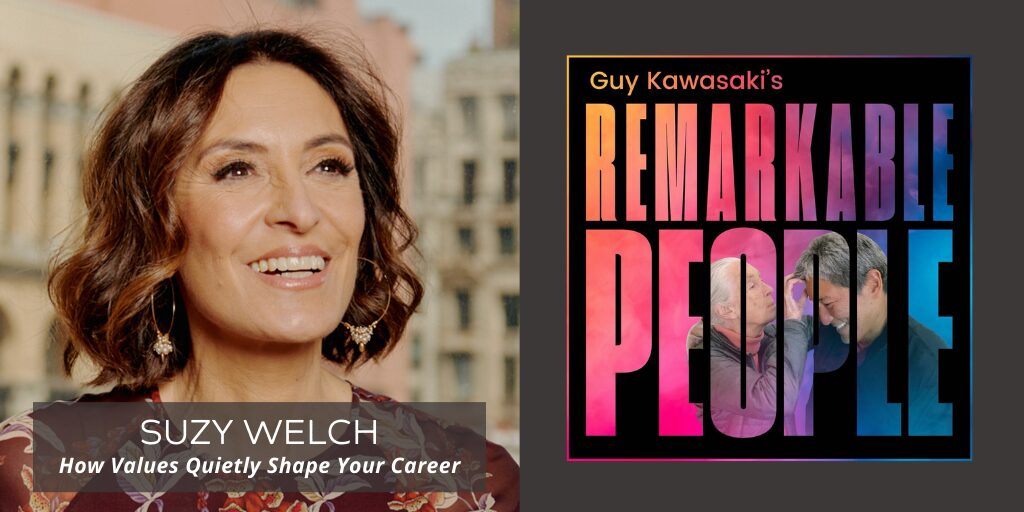
Welcome to Remarkable People. We’re on a mission to make you remarkable. Helping me in this episode is Suzy Welch.
Suzy Welch is a defining voice in how we understand work, leadership, and purpose. A professor at NYU Stern, former editor-in-chief of Harvard Business Review, and longtime observer of how careers really unfold, Suzy has spent decades studying why so many successful people feel stuck. Her work bridges rigorous research with deeply human questions about identity, values, and meaning.
In this episode, we explore what happens when grit isn’t enough, why forgiveness is a hidden engine of resilience, and how misunderstood ideas—like Jack Welch’s approach to management—have shaped modern workplaces. Suzy challenges the myths of work-life balance, explains why values often conflict rather than align neatly, and shares how people end up living lives driven by expectations instead of intention.
We also dig into ideas from her latest book, Becoming You, which offers a practical framework for uncovering who you are beneath the roles you play. Rather than asking abstract questions about purpose, Suzy provides tools to identify your values, aptitudes, and economically viable interests—and then test them against reality.
If you’ve ever wondered whether the life you’re building truly fits you, this conversation will give you language, structure, and courage to rethink the answer.
Please enjoy this remarkable episode, How Values Quietly Shape Your Career with Suzy Welch.
If you enjoyed this episode of the Remarkable People podcast, please leave a rating, write a review, and subscribe. Thank you!
Transcript of Guy Kawasaki’s Remarkable People podcast: How Values Quietly Shape Your Career with Suzy Welch.
Guy Kawasaki:
Hello everybody. I'm Guy Kawasaki and this is the Remarkable People podcast. We're on this quest to help you become remarkable, and today we have a remarkable and inspiring guest. Her name is Suzy Welch. And Suzy, I read her books, and she was a real hero to me. She was the Editor in Chief of Harvard Business Review, and I once got in the Harvard Business Review.
So, that kind of made my life right there. So she's an author, she's a professor, she's a journalist. You name it, she's in it. And now she's a professor at the NYU Stern School of Business. Right Suzy? I got that right?
Suzy Welch:
That's what I do. That's my day job.
Guy Kawasaki:
Yeah. And this is her new book. I gotta hit that pose. So this is her new book.
Suzy Welch:
Do you know how many hours it took to hit that pose? I was exhausted of posing and finally we got one that worked for them. Not natural.
Guy Kawasaki:
Looks like an Annie Leibovitz kind of portrait.
Suzy Welch:
Thank you.
Guy Kawasaki:
So anyway, so you know, this is her new book. We're gonna be talking about Becoming You. All right.
So Suzy, I wanna go back into your past to your book called Winning that you co-authored with Jack Welch and oh my God, some people are probably so young, they don't know who Jack Welch is.
Suzy Welch:
My students don't know.
Guy Kawasaki:
Yeah, so Jack Welch was the CEO of General Electric, and he took that company from like twelve billion to 400 billion, right? Yeah.
So you had this book called Winning, and one of the key concepts was this “Twenty-Seventy-Ten.” That the employees of the company, 20 person are these like highly motivated, highly effective people. They're in the top 20 percent, and those people you reward. There's 70 percent where you actually are developing them because they're promising.
And the last 10 percent you're supposed to let go. So my question here is from the outside looking in, you hear a lot of references about, “Oh, Jack Welch was ruthless. Suzy Welch was ruthless there. Every year they cull out 10 percent of the herd.” So what is the theory with what you do with the 10 percent?
Suzy Welch:
Thank you for giving me the opportunity to talk about Jack. It's been almost six years since he died, and so I love to still talk about him. I think that one of the hard parts of Jack's life was the misunderstanding of this idea of differentiation.
If you've managed anybody, you know that you have your top performers and you reward and you love them, and you encourage them, and you congratulate them, and you thank them.
And then you've got the very valuable 70 percent who are solid performers, and you try to make them find ways to get better and better. And then you've got people who should be working somewhere else. Of course, the first step is that you try to help them get better at their job, either to buy in more to the values or to amp up their performance for the good of the whole organization.
But sometimes people are not in the right place for them. They don't buy into the values of the organization, and they don't have the actual skills or aptitudes, and the idea is to love them out the door. This is not like somebody gets a phone call in the middle of the night saying, “You're dead to us.”
Of course this was the wonderful, popularized way of putting it. It's like, this is not how it happened. Nobody ever was surprised when they were let go. Jack used to say, “If somebody's surprised when you let them go, it's on you. It's your bad. You made a terrible mistake. You were a horrible manager.”
You have a year of trying to help people be better at their work. And if not, then I have a friend who works at Sony who says, “At that point, you invite them to become a customer,” and I think that this was the idea is that if somebody should be very, very successful someplace else which is a better match for their skills and aptitudes, then help them find that place.
There were no sort of, you know, the kind of cartoonish interpretation of differentiation was always agonizing to Jack. He was like, “You know, I guess maybe it's just a subtle point and people don't want subtle points,” and it's easy to kind of make it look like this horrible, draconian thing.
It wasn't that, and he wouldn't have been able to grow that company and have so many people love him if that's the way he had been operating.
Guy Kawasaki:
The Silicon Valley interpretation or misinterpretation of that is, every year you take the bottom 10 percent out and you shoot them in the head.
Suzy Welch:
Yeah. No, that's gross. That's just gross. And I think that again, the ideal situation is when you've had enough conversations with an employee that they know what's coming and they think, Yep, that's right. They've been told and talked through it a couple of times. And then together you say, “Okay, what's the package? How many weeks is it? How many months is it?”
And then you work out a way for them to go with dignity. That's the ideal way. Silicon Valley, it has its own way of interpreting everything, doesn't it? But GE was a big industrial company, and they didn't do it that way because they lived in communities, and they didn't do it that way.
Guy Kawasaki:
So I'm gonna ask you a difficult question that might reduce your federal funding and stuff, but I gotta know.
If Jack Welch were alive today and running General Electric, would he be donating money to the inauguration?
Would he be on the inauguration stage? Would GE be giving Donald Trump a gold and glass trophy? Would you be paying for the destruction of the East Wing? Like where would Jack Welch be today?
Suzy Welch:
Well there's no GE for Jack to run anymore, but when Donald Trump started running, Jack had never really liked him personally. Like, we were invited to his wedding to Melania, and he refused to go because he thought that Donald Trump was not his favorite person.
And so we didn't go. I was like, “Come on, it's gonna be a fun party.” And I was no fan either, but I thought it would be a fun party to go to and everyone was going, we didn't go. When he got nominated, he was kind of amazed. He didn't support him in that process much to Donald Trump's frustration.
But then when he was elected the first time, Jack, like many leaders, said, “Okay, maybe he'll surprise us. Maybe he'll be okay. This is the first time.” And he joined that commission in DC, business leaders. And then the administration unfolded. And Jack sort of six months in, went on CNBC and he said, “I'd give Donald Trump,” I think he gave him like a D minus in managing people.
And Trump called Jack and totally renounced him. He just said to him like, “How dare you, you know, I respected you.” And they had a falling out that was very unpleasant. I was in the room when it happened and then when Jack died, Donald Trump called me, and he reminded me of that incident.
He said, “Your husband was great till he gave me a D minus in managing people.” And he actually said it like, it was during, I had sort of two days where people came to the house after Jack died. It wasn't an Irish wake, but it was kind of an Irish wake.
And it was during the wake, somebody came and got me and said, “The president's on the phone for you.” And I went in, and he said, “Your husband was great, but you'll never forget that he went on to CNBC.” And I was like, “Look, my husband just died, and this is not actually, you know, what I'm gonna be talking about.”
So actually, I don't know what Jack would be doing. He did what was best for the company, and if that meant that he would've kept one foot in to keep the company and the good graces of the president. Maybe he would've, I don't know.
But I do know that he had a lot of courage in going on CNBC and saying like, “The way he's managing people in the White House is not the way you manage people. You can't have a revolving door like this.” And it kind of lost to history that that happened, but it certainly had fallout for us personally.
Guy Kawasaki:
Well, you are the only person I know that got invited to that wedding.
Suzy Welch:
Oh no, but everybody got invited to that wedding. You do because look, this was before he had his eye on politics, and he was just like a Palm Beach Bon Vivant, and there were a lot of people there who just went because they were curious to know what Mar-a-Lago looked like.
Guy Kawasaki:
Yeah.
Suzy Welch:
He was apolitical then. I just wanted to go because I thought it'd be fun to see what everyone was wearing. Nobody in those days could have ever guessed where he was gonna go.
Guy Kawasaki:
Deep in your book. I'm gonna jump around a little bit. Deep in your book, you came up with this thought that you have to combine grit with forgiveness, and I would never have put those two things together. So why are you combining grit with forgiveness in order to optimize?
Suzy Welch:
Okay. The book, I'm just gonna step back for a second and just say this, the book is about a methodology that I teach that helps you determine your purpose, which there's a point to where I'm going with this, which I posit lies at the intersection of your values, your deeply held beliefs which no one knows, your aptitudes which no one actually knows either and your economically viable interests which most people have a fraction of understanding.
And so the book is about excavating those three data sets, if you will. It’s part of knowing who you are. I have a tool called the Career Traits Compass, which helps you determine where you fall in the continuum from individual contributor to leader, and one of the traits that I think you should have if you wanna go into a leadership position which not everybody wants to do.
Some people are perfectly happy being individual contributors and power to them. Okay? But if you have your eyes on leadership, then you need to have resilience because you're gonna get the you know beat outta you every single day. And so then this begs the question of what is resilience?
And I happen to hate the common definition of resilience. I hate it because I think it's dumb. I think it's dumb because when you need resilience, everyone just says, “Resilience is perseverance. It's grit, it's get up and do it againedness,” and all these other things.
But the facts are that's fine when you're healthy and strong, but the time you really need your resilience is when you're on your back and somebody's on top of you and you've been pushed over and you're getting pummeled.
When you need resilience is when you're absolutely your weakest and you're terrified and yeah sure, grit will help you overcome that and stand up. But I've actually thought that there's something else going on from everybody that I've ever observed that got up and kept fighting and kept living was that they also were able to forgive, and you have to really forgive to access your grit.
I think it's grit, sure, but first forgiveness. And so you either have to forgive yourself because you effed up. Okay? A lot of times you have to forgive yourself. I screwed up, that's why I'm on my back. That's why I've been fired. That's why I got divorced. Whatever, you have to forgive yourself or you have to forgive the person who put you on your back or both.
And I just think to say to people, “Just get up,” is so simplistic. It's like there's some mental and emotional work that has to happen first, and the number of times I've had to draw on my resilience is many because I've screwed up so many times in my life, and I have.
And I've had to say, “Okay, stop re-litigating how you screwed up and just forgive yourself. You screwed up, say sorry to everybody you have to say sorry to, and then you can start to access what you need to access.” But to assume you can do any of that without letting go first is, to me, nonsensical. That's how I coupled them, Guy.
Guy Kawasaki:
Have you ever had this discussion with Angela Duckworth, who is kind of the mother of grit?
Suzy Welch:
I love her and revere her and teach her to my students. I've not actually had this direct conversation with her. She is so smart, and her research is so good. I don't know how you do, if somebody wants to ask me if I wanted to do some research on this, and now that I have the whole research of Becoming You Labs at NYU at my fingertips, which is such a treat in life.
I don't know how you do research on forgiveness because it's something that people are very poor at self-reporting. Everyone says they forgive, but very few people actually do. It's a little like self-awareness. We are very blind to how self-aware we are by definition.
Guy Kawasaki:
All right, well. I think if we could start a whole series with Angela Duckworth and Carol Dweck and Suzy Welch walk into a bar.
Suzy Welch:
And I think Kim, we should throw Kim Scott in there also, if you don't mind if we wanna have a real night. Okay?
Guy Kawasaki:
All right. I had a drop the mic moment when reading your book because I came on that part about “Non Sibi” and I said, “That is me, that's how I wanna define my life.”
Suzy Welch:
Hmm.
Guy Kawasaki:
I should get license plates to say, “Non Sibi.”
Suzy Welch:
I don't know if you're “Non Sibi” or “Radius,” to tell you the truth, I think there's two values that are very similar. Have you taken the Values Bridge so we could find out exactly what you are? So this is my test that I developed in my lab to rank order people's values and we would find out if you were “Non Sibi” or not. Can I do an analytic on you?
Guy Kawasaki:
It's a little scary, but yeah, why not?
Suzy Welch:
Okay. So these are two values that I wanna unpick here. So my work, my academic work, my PhD thesis, all that is about values expression, which values we have and how much we live them, which is not always the same thing.
So, there is a value for helping people, and that's like this impulse to help people one-on-one in a very personal way to tutor somebody, to mentor somebody, to reach up to the top shelf and get somebody what they can't reach, to build your life around the act of helping people in a personal way. And that's called “Non Sibi,” that's a Latin for “not for oneself.”
But there's a second value that's aligned but can be very different, which is we call “Radius,” which is the desire to change the world. And sometimes those track together.
Sometimes somebody can be very “Non Sibi” and very high “Radius,” but sometimes people who wanna change the world are kind of snarky and dreadful to people on an individual level because they've got bigger battles to fight.
So if a student presents to me says, “I'm a social justice warrior.” I always think to myself, I can't wait to see her test results because I know that “Radius” is gonna come up at the top. So which one of those resonates with you more Guy?
Guy Kawasaki:
Oh, “Non Sibi” for sure not even a question.
Suzy Welch:
Okay. All right. You nailed it.
Guy Kawasaki:
As I was reading your book, I said, “Guy, what really gives you great pleasure is helping people.” Now, don't get me wrong, if Joe the Ragman or Jane the Rag woman calls me up and says, “Will you be my mentor?” The answer is usually no because in addition to “Non Sibi,” my family is the most important to me.
I will not sacrifice my family to help others necessarily, but you know, maybe it's not mentoring one on a day-to-day kind of living. I hope to kind of absolutely stand for “Non Sibi,” that would be my life goal there.
Suzy Welch:
Well, I think that from what you're saying, that probably family centrism is your top goal, which is the desire to make your decisions and behaviors with family as a life organizing principle, and then maybe “Non Sibi” would be next. And sometimes those two values are in conflict with each other because both are people asking you to be available.
Guy Kawasaki:
Yes they do. And I have a natural tension in my life where my predisposition is always to default to yes. But that gets in the way of my family, so I often have to pick some. Anyway, I didn't mean to turn this.
Suzy Welch:
But every conversation with me turns into what's your values? So you are falling prey to my values work. So I will, I'll stop asking the questions.
Guy Kawasaki:
So you have this concept about the Venn diagram where you take the intersection of your values, your aptitudes, and what's economically viable. So my question is, it sounds a lot like the western interpretation of the Japanese concept of Ikigai.
Suzy Welch:
Of course. I have a slide in my deck and when I present to my students, I say, “There's people who wanna raise their hand right now and ask, ‘Is this the Western interpretation of Ikigai?’” It happens every single semester. I think that, of course, I bow deeply to it. I think that Ikigai is conceptual, whereas Becoming You is tactical.
And we are kind of ruthlessly tactical. What are your values? Let's rank order them. What are your intellectual and emotional aptitudes? Let's get them sorted out and ranked, and then let's find your economically viable interest based on like literally we play a game called Industry Bingo, where I call out the CAGRs for industries as I teach them.
And then we look at that data and we find out what's at the center where as Ikigai asks you a lot of very meaningful philosophical questions. And it's a very good way to ponder things. I'm there to get people to their purpose as rapidly as possible.
I'm less woo-woo. I'm like relentlessly unwoo-woo, and look, Ikigai is a beautiful thing. It just has too many questions that people don't know how to answer. Like most people can't answer what their personal mission is. But Ikigai asks you to do that.
Guy Kawasaki:
I can.
Suzy Welch:
Yes, you can. But Guy, I'm just gonna say you're in a 5 percent group of people. So I'm dealing with people who are kind of either students or who are mid-career pivoters or people who are fifty years old and saying to themselves, “This cannot possibly be all there is.” And all the pondering in the world is only gonna make them ponder more, and they need a roadmap.
Guy Kawasaki:
Yeah. Well, between this Western interpretation of Ikigai and your discussion of Kintsugi, man, you had me.
Suzy Welch:
I know.
Guy Kawasaki:
Madisun and I are surfers, so we always damage our boards. And I went through this Wabi-sabi Kintsugi stage where I would repair my boards, and as I repaired the boards, I would mix in gold dust so I could have surfboards with Kintsugi looking like Japanese pottery.
Suzy Welch:
With the pot, like your life does not depend on you like staying afloat with it. So I'm not sure, did this actually fix the board in a way that made it safe to ride on?
Guy Kawasaki:
It's okay.
Suzy Welch:
The point of it was so beautiful, you decided to go with it. Okay.
Guy Kawasaki:
So now, I understand the intersection of these three things, but surely there are cases where it's the empty set when you try to draw those three parts of the Venn diagram. It cannot always be that people have an intersection.
Suzy Welch:
So rare. I've probably taught Becoming You to now tens of thousands of people because I teach it in a class at NYU that’s open enrollment, so people come from around the world. I teach it around the world. I teach it at NYU.
But I can't think of an empty set situation when it's an empty set situation, something's going on. It's like either we're talking serious burnout or serious anxiety or serious trauma. I've not ever found an empty set. Now, I will say this, sometimes what people come up with requires them to blow up their fricking lives.
Okay? And so sometimes they don't go do it, because, okay, if I'm gonna go do that, I've got to say goodbye to my identity. I've gotta tell people who I love that we're not going on three vacations this year. So it's very rarely empty set, but sometimes the results are hard for people to then walk into. That does happen.
But we have a Becoming You reunion each year and people come back, and they tell their stories of taking that leap into what they've discovered and there’s never a dry eye in the house because it takes a lot of courage to go live your purpose. It really does.
Guy Kawasaki:
Well, how about if I give you a perverted view of your Venn diagram, which would be that if your values and your aptitudes align and you're doing something that fits in with both and you love it, but it's not economically valuable or viable.
I could make the case that if you're doing something that you're good at and you love it, but you cannot make money, that is a true test that you love it.
Because anybody can love something that's very lucrative. But if you love something that doesn't make you money, like podcasting. I love podcasting. I make no money. It costs me money to do podcasting, but I still do it because I love it. Isn't that proof that it aligns with my values and aptitudes because I cannot make money doing it?
Suzy Welch:
I think what it proves is that you don't have a very high value of affluence. I think that's what it proves. If you're just doing what you love and what you're good at and you can't make money at it, all I know is if you're still doing it, that affluence is not your number one or two, three, four value.
Affluence is probably number fifteen for you. You're proven my case, not yours. You've proven that you've already made the decision on how much affluence matters because it's economically viable interest. With the way we describe that, the way we define that is the work that calls you emotionally and/or intellectually that is aligned with your value of affluence.
So the higher your value of affluence, the smaller that circle gets. But if you don't value affluence very much. And affluence, believe it or not, is only a top five value for 25 percent of the population. Okay? And it's mainly older people, by the way. But for the younger generations, affluence is down in the moderate or peripheral areas.
And therefore, they can do a lot more things. They can. They just focus on what they're good at and what they love.
Guy Kawasaki:
Ah, Suzy, I feel much better now. So values, aptitude and economically viable influence. So question number one is how do you truly determine your values?
Suzy Welch:
It's brutal, so I had to develop a test for it. When I started teaching Becoming You, I developed seven different assessment tools to determine your values and try as I might, even though we did all seven exercises. And they're all pretty good ones, excellent ones.
At the end of the semester, students would default and say, “My values are family and financial security, an equal measure.”
And I would say, “Well, that's just simply not true. That's not how it works. There's many more than two values,” and I relied for a while on the two very, highly accepted kind of gold standard academic surveys that assess values, but I couldn't get comfortable with them for two reasons.
One was they made it so that if you had values that were in conflict in each other, they canceled each other out. Whereas, in fact, the reality of life is we all walk around with values that are in conflict with each other, and that's how life goes, okay? They don't magically cancel each other out.
And the second is they didn't test how much you had of a value and how much you were actually living it. For many people, that's the source of their happiness or unhappiness. We call that the authenticity gap.
And so I ended up, really after kind of a year of deep frustration, developing this tool, I didn't, I developed it with a fantastic team in my lab of psychometricians and data scientists, called the Values Bridge.
And we finally validated it seven times, and we made it available to the public May Sixth, and since then, a hundred thousand people have taken it, which is very exciting. And I think it does a marvelous job in separating people from their identity, which is what gets in the way or gets in the way of our talking about what our real values are.
And it rank orders your values from one to sixteen. It has 94 percent efficacy. So I'm super proud about that because I'm not woo-woo as I said earlier. And I wanted a really good test. I've seen so many different reactions to the test where people will say, “This can't possibly be my values.”
And I would say, “Good. Okay. Why don't you go join the support group for people who say this can't be your values because they really are your values.” And then they come around and they say, “Okay, these are my values. I'm not living them, or I don't like them.” So that's a long answer. Just how do you find out your values?
You have to be expertly tested on them because self-reporting does not work. Because I literally, one of my biggest problems was I would ask my students, I have sixteen values in my inventory. Allport, Strang has nineteen, and Schwartz has seventeen, but I have sixteen. So I say, “Here are your values.”
And I'd literally would have my students kind of rank order them based on the exercises. And then I would see them manually move the values around because, oh God, I couldn't possibly have family centrism at eleven. What an ass I am. But the facts are, it was at eleven, and so, you kind of have to trick yourself into understanding what your true values are.
That's the answer.
Guy Kawasaki:
And what if you do a frank and honest analysis and you find out that your values suck? There are people who have values that suck, so then what?
Suzy Welch:
Well, they suck in what way? The thing is, I'm a values agnostic. If your values are not hurting anybody, your values are your values. We're not talking about virtues here. Everyone should have virtues. Everyone should have more fairness, kindness, goodness, decency, courage. Those are virtues.
I'm not in that business, okay? I have an esteemed colleague, John. He's in the business of virtues. I don't do research into virtues, and I don't talk about them.
Everyone should have more of the virtues. I'm talking about values, which are choices about how you organize your life. And if you're not hurting anybody, you should have exactly the values you want, and we should all be able to talk with.
So let's take the value of work centrism, which is how much you'll use work to organize your life, okay? And so I happen to have very high work centrism. I like work for work's sake. I have very low eudemonia, which is self-care. I don't give a damn how I feel or look whatever. And so, I don't wanna pick on people who have lower work centrism.
If I did that, I wouldn't talk to any of my own children. And I don't wanna be picked on for having high work centrism. This is a value. I want work to organize my life. It's not better or worse. This is not the 1800s where like how industrious you were was a virtue. And so, your values only suck if you're hurting somebody with them.
Okay? So you could have very low belovedness. That's the value for how much a partnered relationship matters to you. By the way, since you're a man, I can tell you right now you have much higher value of belovedness than most women do because that's what the data is showing us. But let's take the value of belovedness.
That's the value you place. That's how much you wanna organize your life around an intimate, partnered relationship. If you're in a partnered relationship with somebody, if you have low belovedness and your partner is high belovedness, they're probably feeling a lot of pain, okay? But if you're not in a partnered relationship, by all means have low belovedness.
It doesn't affect anybody. You can live your life the way you want it to be. James Bond, travel around the world, whatever. I think you've gotta think about your values in the ecosystem. If you're not hurting anyone with your values, who are we to judge?
Guy Kawasaki:
Well, yeah, but, well, first of all, just for clarity, you said that men have a higher degree of belovedness?
Suzy Welch:
I can't believe it.
Guy Kawasaki:
Well, yeah. I can't believe it either.
Suzy Welch:
No, I know. And some of the data is shocking around belovedness. We're just replicating it right now to make sure we're right because, and I think we are. And we cut it by profession and by gender, and we're finding out some very interesting things.
Guy Kawasaki:
And what if your values are hurting people, then what? I mean, you know if you're a fascist dictator, your values are hurting people.
Suzy Welch:
Well, those aren't values. I don't think those would be around a fascist dictator. Those are politics. I mean, values are things like, how big a life do you want? That would be scope. What value do you place on a personal relationship? That's belovedness. How much do you want work to organize your life?
The one thing about the Values Bridge is it's for normal healthy people. It doesn't take into account people who have psychoses or psychological issues. So if a fascist dictator took it, that's not what we're talking about here. We're talking about people who are trying to figure out how to balance a lot of things that they want all at the same time.
Guy Kawasaki:
They need Suzy Welch volume two, which is Unbecoming You.
Suzy Welch:
Yeah. Right. Oh, don't suggest that to my publisher, please. But I think that people definitely look at their values and sometimes say, “Oh my God, look at my values. I don't wanna be this person.” Then the conversation is, “Well, why not? That's the person you are. How did it happen?”
And so that's its separate conversation. Most people look at their values and they say, “Oh my God, this is so me.” And then the next thing I ask them to look at is the data that shows how close or far they are from living their values. And a lot of times they find they're very far away and that hurts.
Guy Kawasaki:
Okay. Enough about values. I'm exhausted.
Suzy Welch:
I know. I tell you. I have that effect on people.
Guy Kawasaki:
So now, let's talk about aptitude. First of all, define an aptitude for me.
Suzy Welch:
There's two different kinds of aptitudes.
The first, aptitude is pretty easy to understand. It's cognitive. It's your wiring. It's pretty set. By the time you're fifteen, are you a generalist or a specialist? Are you a diagnostic problem solver or a fact checker? This is our intellectual proclivities about how we do work, organize information, think.
And there's fifty aptitudes that could be tested. I focus on six big ones like are we 3D visualizers or abstract thinkers? Because it's very painful to be a person who is a future focuser, which is one of the aptitudes, in a job that rewards people who are present focusers. People who like to do lists and tasks.
And if you're in a job that need you to be focused on the big, hairy, audacious goal and you're a to-do list person, that's painful. So aptitudes are your inborn cognitive proclivities, and you can lean into them, or you can lean away from them. But just like it's much more comfortable to write with your dominant hand your whole life, isn't it?
If you wanna sign your name with your dominant hand, your cognitive aptitudes are like the dominant hand of your brain. You're either a specialist or a generalist. You're either a brainstormer or an idea contributor, and so there's just a bunch of different pillars of your brain. You should be aware of what comes most naturally to you.
It doesn't mean you're perfect at it, it just means you get better at them more easily.
Guy Kawasaki:
But can't aptitudes develop? To take a surfing analogy, ten years ago I sucked as a surfer. Today I suck a lot less. I would not say I have a natural aptitude for surfing, but by sheer determination I have made progress.
Suzy Welch:
I'm not saying that there's any reason not to lean into the stuff you're not as good at and work relentlessly to get better at it. But you're not a professional surfer, are you? No. I wouldn't say you'll make your career in the stuff that you have to relentlessly work on.
Okay. So look, I have worked for thirty years to be a better golfer. Okay? I started off mediocre and now I'm slightly better than mediocre. I love the game. I played as much as I can. I love it, but for me, it's hard work to be good at golf. Okay? Like when I make a putt, this is a reason to like cry softly into my hands.
Okay. Because it's such an achievement of hard work. Okay? One of my four children was born a professional golfer. He picked up a club and we just looked at him and he was doing things like at six years old that the pro at the club said to us, “We can't teach what your kid has.”
Okay? Which one of us, Guy, should become a professional golfer? Him or me, alright? So I'm not saying, don't do anything that you don't have an aptitude in. I'm just saying it's a hobby, alright, if you're not good at it. And I'd say like if you wanna build a thriving, successful career, play to your strengths.
But of course, when you start to lead, you gotta use all of your aptitudes and you've gotta work on the ones you're not as good at. But you're better off and it's a lot less painful. I mean, the number of times I've had students or people come to me and say, “I just found out for the past fifteen years I've been a specialist in a generalist job. No wonder I can't get ahead.”
This is data we need to know about ourselves. And yet a lot of times we back into it or we find out the hard way when we get fired. You know what I mean? It's good to know what you're good at.
Guy Kawasaki:
All right, so now backing up a little bit, let's talk about the roadblocks to finding this intersection of values, aptitude and economic viability. What stands in our way from getting to it?
Suzy Welch:
Well, I think there's four big, I call them the four horsemen of purpose destruction. I think there's four big dynamics that get in the way, get between us and our purpose. And the first one is expectations. We build a life around what's expected of us and that can be expected of us by our parents, our society, our culture, our time, our generation, our partner or ourselves.
Sometimes we're our worst enemies saying like, I had a student one time who just every single time she did the methodology, it came out she should be a rumba teacher. And she did it three times. And I kept on saying rumba teacher. And finally she came to my office hours, she was in complete tears, and she said, “Why does it keep telling me this?”
And I said, “I don't know. You keep putting the data in and that's where it comes out.” She said, “I can't be a rumba teacher. I have an MBA.” And I was like, “Well, I'm not sure there's legislation that actually prevents that, but okay.” But these were her own expectations about what she was gonna do with her MBA.
She went off to be a consultant. Okay. So I'll hear from her in a few years. So there's expectations and they're real, and people live their whole lives for other people. And then it's like the great Talking Head song. You wake up and you say, “What is this beautiful house? What is this beautiful life? My God, what have I done?”
And I play that song for my students, and they have no idea who the Talking Heads are, and I feel old. So there's expectations, then there's expedience. And a lot of times we don't live our purpose because it's so hard. It's just easier, it's easier not to live your values sometimes because they create friction or they create change, or they piss off people who love you.
They don't want you living your “Non Sibi” so much because it gets in the way of how much time you spend with the family or whatever. So there's expedience and reduction of friction. Then there's life events.
Where you get fired or you have a baby, or somebody gets sick, or you get sick, and it just floats you away from the life you were supposed to live because you were just trying to get by, and you had your head down just getting through one day at a time.
And, I had that for decades because I had four young children. I was working full time. I wasn't thinking about my purpose, I was thinking about survival. And I'm a lucky person. I'm a privileged person, and I was still thinking about just getting through the days.
And then there's finally economic security and behavioral economics as well as I do, which basically boils down to the fact that we make decisions based on a number, even if we don't care about wealth. So we'll say, “I'm gonna take this job because it pays more.” Even though the job that pays less is absolutely immediately upon a purpose.
And we'll do it even if affluence just doesn't matter to us because we're wired to prefer hard data. And numbers are hard data. So virtually everything gets in the way of us living our purpose. You know what I mean? It's like life is set up or the world's coming for our purpose. You have to fight, to paraphrase the Beastie Boys, you have to fight for your right to live your purpose. It's hard.
Guy Kawasaki:
Yeah. One of the things that I noticed reading your book is you sure seem to have a negative attitude towards becoming a consultant. Like over and over. Over and over, you said, “Yeah. He became a consultant. I knew that wouldn't last.”
Suzy Welch:
That's right. Okay, so let me explain myself. You're not wrong. Look, here's my problem.
Guy Kawasaki:
McKinsey's never gonna sponsor my podcast.
Suzy Welch:
No they're not. No, but look, I have so many friends of McKinsey, but there's a conveyor belt into consulting from business school, and you've got some of the brightest, shiniest minds.
And then the consulting firms come, and they paint this picture of like Nirvana of like the holy land. And oh, they offer more money than kids have ever seen, and they've got a lot of debt, and they get on the conveyor belt.
Consulting is great for some people, but it shouldn't be taking 80 percent of a class of MBAs because there's other wonderful things they could and should be doing if they just got off that conveyor belt.
So look, I worked at Bain for seven years. I loved it there. I still have good friends there, and it is a great firm, which I would recommend if you needed consulting, but I would just say a lot of people go into consulting because it's the path of least resistance.
It's got the most money and there's a conveyor belt right into it. I do have a little bit of a problem with people being consultants before they've actually lived life. Like I always had like a little uh-oh that like we had twenty-four year-old consultants telling fifty-five year-old plant managers what to do.
I was like, “Yeah, you've never had a bead of sweat on your forehead. And so this is making me uncomfortable.” So you're right. I'm not consulting's biggest friend. I see the place for it and so forth, but I think there's other things if we just open our eyes.
Guy Kawasaki:
Well, I would say that the way you feel about consultants is how I feel about venture capitalists that people wanna go into, become venture capitalists and they've never started a company, they've never run a company. They've just been cranking Excel spreadsheets their whole life.
Suzy Welch:
That's right. They like the identity stuff around it, they like saying they're a VC.
Guy Kawasaki:
Yeah.
Suzy Welch:
Like a lot of people love saying they wanna be an entrepreneur. I get a lot of students who say to me, “Professor Welch, I just wanna be an entrepreneur.” And I say, “That's fantastic. What's your idea?”
They'll say this, they'll say, “Something in tech,” and I say, “Anything beyond that?” And they say, “No.” And I say, “Okay, well I can't wait till you have your idea.” But they love the identity of being an entrepreneur and they don't understand that part of that identity is not sleeping at all for years on end.
Guy Kawasaki:
You should tell those people to be consultants.
Suzy Welch:
But they don't sleep either, but yeah.
Guy Kawasaki:
So, we talked about this conveyor belt to consulting. So if I'm a college graduate, recent college graduate, or about to graduate from college, what is your advice about your first few jobs out of college?
Suzy Welch:
Well, number one, you gotta go into them with a grain of salt knowing that they'll be a fantastic story down the road. I do think that I wouldn't take a first job without knowing what my values and aptitudes were because you can just waste so much time.
That's where the most boneheaded detours occur at the beginning of your career because you use your first few jobs to figure out your values and aptitudes when you don't have to.
There's tests that exist and you can do it and find out. So like I had a student one time who after the semester's over got office hours. That's unusual after because the grading's done.
So she got office hours and she said, “Look, I'm going into investment banking. I don’t know if you remember this, but my top value was family centrism. My second value was belonging,” and then she listed off her aptitudes and I said, “What are you doing?”
And she said, “Yeah, it doesn't really make sense, does it?” And I said, “No, not really.” And, she said, “Well, I'm just gonna make some money and then in a few years I'm gonna start having my family.”
And I was like, “Why? Because those are really good years that you didn't have to blow at a place that you were never gonna like or even love or even like.” And so, I think if you're about to graduate from college, you can't know anything about the world coming for you, but you can know about yourself.
You've gotta paint a portrait, a self-portrait of yourself standing still before you start running, so you know what to run towards instead of being all willy-nilly, like your father's coworkers uncle has a job at St. Louis in a small consulting firm, and you're like, “There's a job. I'm going.” And I get it, but I would not advise that.
Guy Kawasaki:
Yeah. It's better to reconcile with her father and go into the appliance business. Right? Yeah.
Suzy Welch:
Yes. As a story from my book proves, it absolutely does. Sometimes you have to do that hard work, but he couldn't have done it unless he had actually done the work of understanding who he truly was.
Guy Kawasaki:
Alright, so now more advice. What do you say when people say that “Achieving work-life balance is very important to me?”
Suzy Welch:
It is to them, but you can't make the assumption it is to the person you're talking to.
Guy Kawasaki:
Twenty to thirty-year-old person.
Suzy Welch:
I say, “Okay, I just hope affluence isn't a very high value of yours.” I think that work-life balance has consequences, and if you are willing to accept those consequences, then that's great.
I think you've gotta understand two things, number one is everybody does not have the same definition of balance. There's a great video going around of Jensen Huang being asked about his work-life balance and he said, “I love my balance. I work all the time,” and the audience laughed.
But that's his work-life balance. And I would say, my work-life balance is probably pretty close to that sort of ninety-nine to one. At 99 percent work, 1 percent balance. And I feel perfectly balanced. I don't have any negativity about my balance, but you might look at it and say, “Ugh. I want it to be exactly the opposite. 99 percent surfing, 1 percent working.”
And I would say, “Power to you. That's your balance.” I think the one thing we have to understand about is whatever balance we settle into. We just have to be understanding that there's no perfect solution. Every single one of them has consequences.
My students often take the Values Bridge, the test, and they'll come out with their number one value being what we call eudemonia, which is self-care. Okay. Self-care, pleasure, leisure, personal flourishing, and their second value will be affluence, money being rich. That happens all the time.
And then they'll come down to the front of the room after class and they'll say to me, very sheepishly, “Professor Welch, my number one value is eudemonia, self-care. And two affluence. Is that problem?” I'll say, “Do you promise not to shoot the messenger?” And they say, “Well, what?”
And I'll say, “Look, I didn't make the rules, okay, but I'm gonna tell you what the rules are because I'm old. And the rules are, unless you're spectacularly good at what you do. Having a huge amount of fun and taking care of yourself and putting yourself in your pleasure and leisure first and making a huge boatload of money is actually quite difficult for mere mortals. You may be the one person who does it, but I don't go into it thinking you were gonna be that person.”
Guy Kawasaki:
Who is in the Suzy Welch Hall of Fame for becoming themselves?
Suzy Welch:
Who's fully living in their area of transcendence? I would say I can list a couple of people. I think Jamie Dimon is, and one time I was giving a speech at J.P. Morgan, and he was giving the speech after me, and he was standing in the back of the room. And after I was done sort of explaining the whole thing and took questions from the audience.
He went up next, and the person who was interviewing him said, “Jamie, you just heard Suzy Welch. Describe area of transcendence. Are you in yours?” And he said, “Damn straight, or hell yes, I am.” And so I would say that he is, and I'm lucky enough to know him personally as well.
And I think he's a person who's fully living his purpose. He's living his values, his aptitudes, and his interests full on, a hundred percent. I would say another example would be a woman named Kitty Block. She's the CEO of Humane World for Animals that's formerly Humane Society. And she's a person who is living every value and every aptitude and every interest completely, fully.
So I bump into them. We call these people transcendence. I think I am right now too.
Guy Kawasaki:
If somebody asked me that question, I would've said Jane Goodall and Neil deGrasse Tyson.
Suzy Welch:
Yeah, I would say they both are. You could feel it. You could feel it off of people. They're doing the work they should be doing and the work they wanna be doing, and they're so darn good at it. I'd put them there too.
Guy Kawasaki:
Yeah. And my last question is, it's actually stolen from you, but you know, part of what I learned from Steve Jobs is it's a talent to know what to steal from people. So I'm giving you that caveat. I'm stealing this question from you. Who, Suzy Welch, would you trade lives with?
Suzy Welch:
Well, the good thing about that exercise in the book is that it allows you to name four or five people so you don't have to come down to just one. We also allow you to throw out something. But I really admire, I admire Hoda Kotb.
I love what she's does with her life. I think she does so much good for people, and I love her joyous energy. I think Mary Erdoes, who's the Vice Chairman of J.P. Morgan, is a huge idol of mine. She is a great leader. I think I admire tremendously Martha Stewart and her resilience and the company that she's built.
The growth and jobs she's created for people by remaining completely true to herself. I've always been a huge admirer of Oriana Fallaci, who is no longer with us, who was an Italian journalist who lived completely according to her own values and aptitudes and interests long before it was okay for a woman to do that.
So, I have that collection of people, but honestly I kind of love my life and so I'm sticking with it.
Guy Kawasaki:
I didn't exactly hear you mention any of the tech bros from Silicon Valley there.
Suzy Welch:
Yeah. No, I actually did not throw their names in there. That's true. I'm not of Silicon Valley the way you are, and so they are not the first people that come to my mind kind of out here in New York. And so maybe, I'm gonna use that as my excuse.
Guy Kawasaki:
Suzy, believe me, they are not the first people who come to my mind when that question is asked, don't worry about it. Alright, Suzy Welch, thank you so much. Let me get your book again.
Suzy Welch:
Hold it up.
Guy Kawasaki:
Here, this is Suzy Welch's book Becoming You, and the next book is gonna be Unbecoming You, you know, I look forward to that book.
Suzy Welch:
That is an interesting idea.
Guy Kawasaki:
That might have a bigger market.
Suzy Welch:
Oh man, it might, that's scary to think of.
Guy Kawasaki:
Oh, Suzy Welch, thank you very much for being on my podcast.
Suzy Welch:
Well, you're great and thank you for having me on. It's so fun to talk to you.
Guy Kawasaki:
So I would need to thank the Remarkable People team, which is Madisun Nuismer. There's Tessa Nuismer who does the research for us. There's Jeff Sieh, who's co-producer, and Shannon Hernandez, who's our sound design engineer. So that's it. And that's the Remarkable People team, and we all wanna reach out. And thank you, Suzy, for being on our podcast.
Suzy Welch:
Thank you for having me.
Sign up to receive email updates
Enter your name and email address below and I'll send you periodic updates about the podcast.


Leave a Reply