
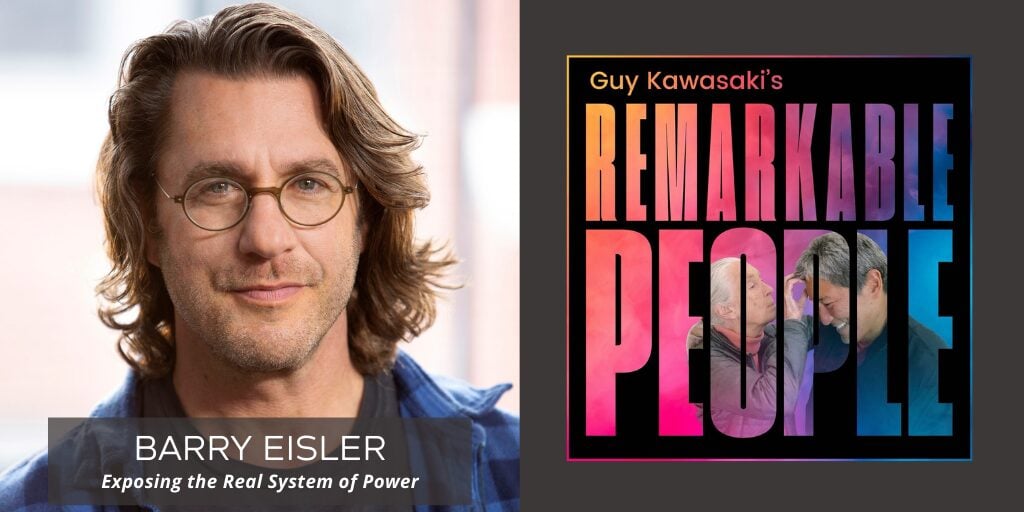
Welcome to Remarkable People. We’re on a mission to make you remarkable. Helping me in this episode is Barry Eisler.
Barry is no ordinary storyteller; his path from CIA operative to acclaimed novelist has given him a rare perspective on power, secrecy, and justice. His bestselling thrillers, infused with real-world authenticity, have captivated millions of readers around the globe. But that’s not all – Barry’s insights into surveillance, politics, and the machinery of government are as compelling as his fiction.
In this episode, we navigate the intersections of fact and fiction. Barry explains how his years in intelligence inform his characters and plots, and why truth often hides in the shadows of storytelling. His latest book, The System, peels back the layers of political and legal structures, revealing how they shape – and sometimes distort – justice.
Barry also reflects on the moral complexities of espionage and the delicate balance between security and liberty. His candid take on these issues offers a masterclass in weaving reality into narrative. Whether you’re a reader, a writer, or simply someone curious about the human side of covert work, his perspective is both enlightening and unsettling.
This conversation is a reminder that stories can be both entertainment and revelation. Through Barry’s lens, we see that the power of fiction lies in its ability to reveal truths that facts alone cannot.
Please enjoy this remarkable episode, Exposing the Real System of Power with Barry Eisler.
If you enjoyed this episode of the Remarkable People podcast, please leave a rating, write a review, and subscribe. Thank you!
Transcript of Guy Kawasaki’s Remarkable People podcast with Exposing the Real System of Power with Barry Eisler.
Guy Kawasaki:
I'm Guy Kawasaki. This is the Remarkable People Podcast. And you know we're on a quest to find remarkable people all over the world who can inspire you and inform you. And this one was easy. This is Barry Eisler, and he lives in Menlo Park, and we used to hang out together at Kepler's Bookstore and Cafe Borrone and all that.
And one day in a real act of chutzpah, I asked him to name a character in his next novel Kawasaki, and he did it. Yeah, that's the day I arrived. I don't care about MacArthur Awards and all that kind of stuff. And being a Barry Eisler, John Rain book is the height of my career. So he is a bestselling novelist, and one of my favorite books of his is called A Clean Kill in Tokyo.
And his hero is this, he's hapa, right? John Rain is hapa, right? And he's a judo guy and he just goes around kicking ass all over the world. And now before he became this literary novelist, he spent three years as a covert operations officer in the CIA, which kind of sounds like my tour of duty at Apple.
And, his latest book is called The System, and it's kind of about the trials and tribulations of a newly elected Latina congresswoman. I guess my first question for you Barry is, is that based on AOC?
Barry Eisler:
So a lot of people ask me that. And, I would say the character is inspired by AOC. There are some superficial similarities. Valeria Velez when she's elected in the book, she's going to be the youngest woman in Congress. AOC is older now, she's been in Congress, what six or eight years.
And she's a Latina. She was a bartender. She's not from New York. She's from California, from Pacoima. And she represents California's Twenty-Seventh. And that's about where the similarities end.
And it's funny, I have a friend who advised me, he's like, “Don't make the character seem at all even superficially similar to AOC because people either love AOC or they hate her, and you're just gonna get these really strong reactions and people won't be able to see the character clearly.”
That's proven to be less of a concern than my friend articulated. But it's definitely making its presence known. Some people just seem not to be able to get past it as my friend predicted. But really what the book is about is the way power affects the ideals and the priorities, the outlook of the people who enter into the American system of power, acquire power, and then start trying to use it.
The sorts of compromises and rationalizations they have to engage in when they meet and try to treat with the real power in America, which is not to me, Democrats and Republicans, that sort of thing. It has much more to do with the military-industrial complex, Wall Street, Silicon Valley, the energy industry, that sort of thing, lobbying that sort of thing. Much more than it does with what we think of as politics, as sort of politics that are laid out in the Constitution.
This, at this point, I think is much more of a veneer when compared to the way real power is exercised in America.
Guy Kawasaki:
Well, I have to say that I don't know any congress women or men personally, or not very closely anyway, but your depiction of the high tech entrepreneurs and VCs are spot on from what I know.
Barry Eisler:
That's good to hear. Thank you. I always try to get these things right and I'm not trying to make any caricatures. It doesn't interest me to do a two dimensional character. I'm always interested in why people approach things, the way they approach them, why they make the decisions they make.
Even some of the characters in the book that you might think of as being the villainous characters, that sort of thing. They've got a coherent worldview and a set of formative experiences that led them to where they are right now. They don't look in the mirror and see a villain looking back.
They see someone who's doing heroic things, good things, and that's how I try to approach all my characters. And if I'm getting them right, including the VCs, then I'm really glad.
Guy Kawasaki:
So when you create a character, do you ever give it, like, let's say there's this VC Helios in your book, right? Do you ever give it to John Doerr or Michael Moritz or Doug Leone and say, “Hey, is this an accurate depiction of you and your business?”
Barry Eisler:
When I can. And I have gotten some feedback from a VC friend on some of the characters in the book. Sometimes you just have to take your best shot. I don't have that many friends who I would say are actual Congress people, who've achieved that level of elected office.
But for any writers out there, what I would recommend, if you're trying to get anything right, it could be characters, a setting, dialogue, anything. I think in terms of three levels of writing fiction, generally, if you're trying to get anything as accurate to make anything as accurate as you can, first there's your own experience in the world.
Like if I had been a Congress person, a ten term Congress person or something like that, I would know that milieu from my own experience. I wouldn't have to do a lot of research. I'd lived it. So if you have that, great, but if you don't have that then the next best thing is to start with the internet.
And I know the internet gets a bad rap because people are, oh it's just internet knowledge, but the internet is a tool. You just have to use tools appropriately. Like you wouldn't use a hammer to try to saw a piece of wood.
It's no good for that. It's good for nails, not for sawing, and the internet is a great way to a base, the starting point, a foundation to learn what questions you need to ask, what areas of further inquiry. The internet is just genius for that. Like if you had a medical concern, it would be good to get on the internet, try to learn about whatever your symptoms are, whatever you heard from a doctor to learn more.
You wouldn't wanna perform surgery based on that knowledge, but you could learn a lot of good questions to ask. So that's the first thing. The internet, then books where you get deeper into the knowledge. And then if you are fortunate enough to know actual experts who you can put your questions, now you're informed questions built on a solid foundation of internet knowledge, book knowledge, reading knowledge, then that is the best.
It's great and it's actually one of the most joyous parts of my job is being able to interview actual experts. Sometimes with weird questions like if we're talking doctors or police homicide detectives, and getting to ask them, “How would you kill someone and get away with it? How would you make it look natural?”
That sort of stuff. You'd be amazed, by the way, how much doctors and cops love to talk about this stuff after they get over the initial discomfort. It's wonderful. Everybody's got a dark side, so that's what I would do.
If you're trying to get things right, whether it's a VC character or I'm American, but some of my characters are Japanese or half Japanese or whatever, and there I've got some actual life experience of having lived in Japan and I speak some Japanese, that sort of thing.
But still, it's great if you can ask the real people.
Guy Kawasaki:
Barry, you're gonna love this story. So early on in this podcast, I interviewed Margaret Atwood.
Barry Eisler:
Yeah.
Guy Kawasaki:
And Margaret Atwood, believe it or not, is the first person to drop an F-bomb in my podcast and that is second only to being a character in one of your books in my life. It was kind of a similar question to Margaret Atwood, “How do you write your books?”
How do you test your characters? And she said, “Well, when I have a character in my book, I find somebody in real life who's similar to that. And once I had this young professional in my book, and I gave my draft to this young professional friend, and he came back and he said, ‘Margaret, the term is not what in fuck. It's what the fuck Margaret.’”
And so she had to change her draft and he also told her, “And Margaret, let me explain to you how to roll a joint. You did not get it right in your book.”
Barry Eisler:
Guy, what you just mentioned is actually what I think of as a kind of fourth level of research. Once you've written the scene or the book, I've learned this the hard way. That's a time. If you know someone who's a real expert, show them the passage in question. Maybe ideally the whole book, but even with all the research and interviews in the world and onsite visits, you can sometimes, or at least I can sometimes screw something up, and that's that final check.
You show it to an actual person who really knows, like you've never rolled a joint, or maybe you've only rolled one or something, and you just make sure you show it to Cheech & Chong or somebody like that, so they can tell you, “No, that's not how it's done.”
Guy Kawasaki:
One of my friends was a big time editor in New York and he sent me this book, a novel to read, and it started off with something like, the character landed in Honolulu International Airport. They said, “Yeah, I was in the airport, and I saw the lights of Diamond Head in the airport.”
And I told my editor friend, “That's bullshit from the Honolulu International Airport, you cannot see the lights in Diamond Head.” So I hope he edited that.
Barry Eisler:
That's exactly what I'm talking about, by the way. And I've learned this lesson the hard way I've been corrected. One of the great feelings when a book gets published is if I hear from actual experts or people who really live there and they're like, “Damn, dude, do you play baccarat?”
I'm like, “Never in my life. But thank you very much.”
Guy Kawasaki:
Okay. So, a year ago, Barry, if I told you that Tulsi Gabbard would be the Director of National Intelligence running eighteen agencies, what would you have said to me?
Barry Eisler:
I certainly wouldn't have predicted it. And honestly, I would've been hopeful that it would happen. That said, Tulsi has been a disappointment to me. The good news is that most politicians are, so I struggle not to become cynical, but it might not be very well remembered now, but Tulsi Gabbard, when she was a Democratic congressperson, a co-chair at the DNC, her tweet game against Trump and the endless wars was passionate, consistent.
And I was, I don't wanna say a fan, I think it's a mistake to become fans of politicians or powerful people generally, but she made a lot of sense to me. And what I didn't realize was that is so often the case, what she was articulating as principles, anti-war principles in this case were not really principles.
They were more just matters of convenience and maneuvering. And she's now adopting really the largely the opposite types of positions now that she's part of the Trump administration. Again, not an uncommon thing, but still a disappointing one.
Guy Kawasaki:
So, you're the only person I know that has CIA experience. That I know of anyway.
Barry Eisler:
I was gonna say the only one you know of who you think you know of.
Guy Kawasaki:
So what do you think is going on in the CIA now? Do you think people are saying, “Oh man, we got this great leader, Tulsi Gabbard, and she's leading us into the next century?” And all that? Or are they fighting her? Are they saying, “We do what we wanna do anyway?”
How does it work in an agency like that?
Barry Eisler:
So that's a super interesting question, and I think it applies not just to whoever is in charge of the whole intelligence apparatus, which by the way, usually gets called intelligence community. And I hate that kind of propaganda. “Why don't just call it an intelligence neighborhood?” That's actually a line from The System, just call it whatever it is.
We have a lot like this, by the way, the Defense Department. Like we spend a trillion dollars a year defending against who. There's a notion on either side friendly or at least reasonably friendly relations with countries north and south. Why are we spending ten times more than the next country on earth?
To what is the defense? It's military spending, that's a neutral term. Anyway, this is true with regard to not just the leader of the intelligence apparatus, but even the president and the leader of any big governmental organization. Guy, you probably know this from experience that I haven't had.
To some extent, it's probably true of the CEOs of big corporations too. You get problems where the left hand doesn't know what the right hand is doing, and certain things are hidden from the leader. So when you're talking about an organization like the CIA, which the stock and trade of which is deception. You have people, the rank and file, at least in the operations branch.
These are people who are trained in deception. They practice deception for a living. I'm not saying that's a good thing or a bad thing, that's a separate question, but it's indisputably true that the craft and art of intelligence can't be conducted without deception to be very good at deception if you wanna be a good case officer.
So this by definition, the CIA is full of people with the natural inclination for experience in and training in being good at deception. So whoever's the head of the whole intelligence apparatus, how much of a handle can that person really have on what goes on in all the different intelligence operations around the world?
And you've got rationalizations among the rank and file. And this is again the same with regard to the heads of the various branches of the military intelligence, et cetera, with regard to what they might tell the president. Doesn't matter whether the president is Trump or Biden or whoever, that's not the point.
The point is sometimes they'll think, I think the president would be happy if we had this outcome, but it's better if he doesn't know about it because then he has guilty knowledge and he might get questioned by the press and he might have to tell a lie, we’ll just take care of this. And then if the president gets asked, he can legitimately say, “I didn't know anything about it.”
So these sorts of things go on and they really complicate things, not just within organizations but in geopolitical situations generally. What was I just listening to? I can't remember. Oh, it's Annie Jacobsen's book, Area Fifty-One. Who would be a great guest, by the way, nonfiction writer.
She was talking about the U-Two incident. For anyone who doesn't remember this is during the Eisenhower administration when the Russians shot down an American spy plane that the Americans didn't think could be shot down, and Eisenhower was so sure that the pilot would've been killed, Francis Gary Powers.
That he said, he lied, when asked about this. He's like, “No, it was just a weather plane. We're just tracking the weather in the upper atmosphere.” But actually then Khrushchev turned out, “Hey, who's this, this pilot we've got?” So Eisenhower got caught in a lie, but Eisenhower had a dilemma.
That's a real world dilemma for leaders, again, of intelligence. Maybe for CEOs too. Certainly Presidents, how much does, let's say, the president really know about these sorts of things, and how much of this stuff is done by people who don't agree with the presidential policy, and they've got the means to do what they think is the better policy?
The ship of state in America is a vast, complicated machine. How much can any one person really have a solid grip on all the levers of control of that machine? Not as much as any of us might like. And again, this is some of what gets depicted in the system.
Guy Kawasaki:
I gotta say, after that discussion, I would actually prefer that the rank and file career CIA person do what they think is right as opposed to what they may hear from up upon high.
Barry Eisler:
I get it. And I think that's a complicated topic. On the one hand, the US military code not just allows, but requires soldiers to disobey unlawful, unconstitutional orders. So in that sense, if the leader orders something that's unconstitutional, it's right, it's legal, in fact, it's required that you disobey that order.
But when it comes to whatever we want to call it, the deep state, the administrative state, the bureaucratic state, the blob, I don't care what we call it, that’s secondary, but when it comes to people in the rank and file thinking, I don't like where the president's taking us or where the Director of National Intelligence is directing us.
I'm not gonna do that just because I don't like it. It's not that it's unconstitutional or unlawful, I just don't like it. That's extreme stuff.
And I know in the short term, if you disagree with what the leadership is trying to do and so often right now, that's certainly the case for me, but the solution of, yeah, what we need to do is have a kind of quiet rebellion in the rank and file that is the kind of thing that creates serious long-term problems that might be an instance of where the proposed cure is worse even than the actual disease.
Guy Kawasaki:
Huh. Yeah, I kind of have a hard time believing that every FBI employee is just lining up behind Kash Patel somehow. So Barry, back in the days when you were in the CIA, if you included the editor of The Atlantic in a group chat, what would've happened to you?
Barry Eisler:
So this is another question that really interests me, which is an application of different sets of principles depending on the outcome we want. So, and that by the way, is just a completely human thing.
If we're being honest with ourselves, we all do it. The only defense is to be aware that humans do this. I'm human, probably I do it too. You try to become conscious of it and you try to test yourself to make sure that you're applying your principles evenly without regard to who is the subject of those principles where they're being applied.
So, yes, in this case. If we're talking about Pete Hegseth or the other planners of that bombing mission when for whatever reason we don't even know how many countries are bombing. Do you know that we're bombing Somalia now? It's not even in the news. We can't keep track. There's just too many.
But yeah, some what was it, six months ago or so when the Pentagon was bombing the Houthis for the latest Houthis bombing, and somehow somebody included Jeff Goldberg, The Atlantic, monthly editor, and heads didn't roll, and excuses were made. Eventually, I think Trump did get rid of his national security guard, his national security advisor.
What was his name again?
Guy Kawasaki:
Mike Waltz.
Barry Eisler:
Mike Waltz. That's right. But waited for a kind of decent interval so he didn't have to look weak or like he was bowing to public pressure. But yeah, this is the kind of thing where, how do you screw up something like that? There's no real reason. Waltz said, “That magically Signal inserted an address that wasn't even in his address.”
But it was as bad as Joy-Ann Reid talking about the time traveler who went back and did homophobic posts for her years earlier, it's like, if I were a crisis communications advisor, I would just say, “Just come clean on this stuff. It'll save you a lot of time. The story will move on.”
Instead, you're gonna come up with something crazy and everybody's gonna pick it over and the embarrassment will never end. Maybe Mike Waltz could've survived it if he'd come up with a different story or not come up with any story at all. Just owned it.
So, yeah, what would've happened if I had included Jeff Goldberg or the editor of a prominent magazine? Well, first of all, I don't mean to go on and on about this, but I'm just gonna say secrecy metastasis in America is a huge problem.
Anyone paying attention knows it. Even former NSA director Keith Alexander acknowledged, Jesus ridiculous I can't send a Christmas card without it being stamped top secret. It's really a problem. So I'm not one of these people who thinks that, and by the way, I used to have a top secret clearance. I've seen what is top secret information. Some stuff should be top secret, fine. That's probably 1 percent of really what actually gets classified.
It's out of control. So I'm not one of these people who says, “Oh, if it's stamped top secret, it's somehow sacred writ. It has to be worshiped and protected, like Holy Scrolls or something like that.”
That said, if you do try to avoid government protocols for communications, avoid the government implemented and managed secure networks in favor of a commercial app like Signal, even though Signal, as I understand it, is supposed to be reasonably secure, something else is going on.
Why are you guys trying to avoid FOIA requirements, reporting requirements? Why are you setting up this sort of back channel? Which by the way, was the thing that Hillary Clinton got crucified for. That's the real problem here. And if those normal channels are too burdensome or there's too much secrecy, do something about that.
But don't try to evade it by setting up a Signal chat, and adding people to it who shouldn't be on it.
Guy Kawasaki:
I actually think, Barry, you're giving them too much credit. I think it was just boys with their toys and they wanna brag about how they're bombing the Houthis. It's kind of like I have a group of surfers I hang out with, and we shoot the shit and talk about stuff and that seems to me what was going on in that chat.
Barry Eisler:
Guy, this is the novelist in you. You're doing the human element. And sometimes it really is that ordinary and banal. People think like, well, it was the Secretary of Defense. It must have been this or that. I'm like, no, I don't really think so. They're just excited about it. And this is a worrisome thing when it comes to intelligence.
People will sometimes do things just because they can, because they think it's cool. Did we really need to be spying during the Obama administration on Angela Merkel's cell phone conversations? What did that get us in terms of refining or improving our policy towards Germany or anywhere else?
Nothing. It was nothing. But it was cool. And some guys basically overgrown kids, they're like, you know what I can do? You wanna listen? Do you speak German? Check it out. It's just because it's cool. That creates a lot of problems. It's a real thing. So anyway, I agree with you.
Guy Kawasaki:
Huh. But who makes decision that, I'm stamping top secret on this? Like, how does it get decided? What is top secret and what isn't?
Barry Eisler:
That is a super interesting question, and I don't really know the answer. There are laws on what can legitimately be stamped top secret, and what you're not allowed to classify at any level is something that you would be classifying just because it's embarrassing or it's criminal, that sort of thing.
So I know that there are laws that create parameters for what can and can't be classified, and those laws are utterly ignored. I also know that the president does have the formal power to declassify anything he wants, and that led to this situation where Trump claimed to have mentally declassified some documents.
And again, I really do try to apply, I'm not a Trump fan, but I try to apply principles.
Guy Kawasaki:
Really?
Barry Eisler:
I know I try to, but I can think of maybe three politicians who I think are, and two of them are former politicians, who I think are impressive and the rest are disappointments at best.
But, yeah, it can't be the case that the president can retroactively claim to have mentally declassified something? There has to be a process by which it is formally declassified such that other people know it's declassified.
As much as I hate secrecy metastasis, as improper as most classification in America is, it is ridiculous to suggest that the president can just say, “You know what? I decided that was declassified a year ago, and that's why I didn't breach any secrecy protocols in revealing it today.” That's ridiculous.
Guy Kawasaki:
I would rather submit stuff to ChatGPT and say, “Is this classified or not?” And see what ChatGPT says, but I digress. So just everybody go read The System. Whether it's based on AOC or not, just go read it. It's very interesting, give you great insights into Silicon Valley and I guess Washington, DC because I don't really know that scene.
But now I really wanna discuss this other book of yours, Barry. And it has the world's most interesting title, I would say probably exceeds the title Everything You Wanted to Know About Sex * But Were Afraid To Ask. And the title of Barry's book is “The Ass Is A Poor Receptacle For The Head.” Oh. And I saw that.
I said, “What the hell? How did he come up with that title?” My God, and it's not a novel. Right? So just tell us the history of that book.
Barry Eisler:
Well, it's an eBook. It's only about 10,000 words. So I think of it as more a long essay, and over time, I should say, by the way, I'm not a Democrat. I'm not a Republican. I try to keep my identity as small as I can. And just because I mentioned that I think that's a really good practice if anyone's curious.
There's a guy, you might know him or know of Paul Graham. He's one of the founders of Y Combinator. I know Paul from college way back in the day, and he writes some of the best essays I know of, just terrific essays. One of them is called “Keep Your Identity Small.” It's a good habit if you want to try to approach and understand the world as accurately as possible.
Anyway, so I should start by saying that I don't identify with either wing of the party. I try to call these things as accurately and dispassionately as I can, but it has struck me that, over the years that the Republican wing has better communication skills than the Democratic wing. And I find that frustrating because there are certain things that I think the Democratic wing claims to care about.
At least their brand still involves those things. Actual practice might be different. And it would occur to me that like, if you guys wanna do this, why can't you just talk about it in a more effective way? And so I wrote this essay called “The Ass Is A Poor Receptacle For The Head: Why Democrats Suck At Communication, And How They Could Improve.”
And my awesome cover design artist, Yaron ten Barge. He did a stylized version of a donkey, the Democratic wing of the party slogan animal, with its head all the way reaching around and going up its butt, which is how democrats often communicate.
And I'll give just one example because I wrote this book during the Obama administration, and so here's the thing again, like, I'm not coming at this from a partisan political perspective, but I do believe that my vision for what would be a good society involves universal health insurance.
Anyone can disagree with that. It's fine. I'm always happy to have these sorts of conversations, with the minimum heat and the maximum light. So I could certainly be wrong. It may be that universal health insurance is a terrible idea. I'm open to that. I personally think it would be a good idea and I could talk about that at length.
But that's not the point here. The point is this, at the time, so this would've been 2008, Obama was running on the notion of what they were calling healthcare reform. And immediately, I thought to myself, why are you calling it healthcare reform? That's not, in fact what it is, it's health insurance reform.
Why would you call it something inaccurate that's unhelpful to you? Because I know very few people who like their health insurance, they're out there. Some people are fortunate to have great health insurance. Most people hate their health insurance. They pay ridiculously high premiums.
Something happens. The thing isn't covered or only a percentage of it is covered. You gotta fill out volumes of paperwork. Most people hate their health insurance. And so if someone comes to you and says, “Would you be interested in better health insurance?”
Your defense response will be relatively low. You'll say, “Yeah, man, I hate my health insurance. Tell me about what you're selling.” Whereas if someone comes to you and says, “Hey, I'm thinking about reforming your healthcare, you in?” People have very personal relationships with their doctors and their bodies, their health, you're gonna get a much stronger defensive reaction if you're trying to sell health care reform.
And so I wondered immediately it's not healthcare reform. And people are not going to like what you're trying to sell if you call it that. It's inaccurate and unhelpful. Why? I don't understand. And then the other aspect of it was they started calling it single payer, which is this wonky term that you have to really be reasonably well versed in what is going on here to even understand what that means.
Like if you ask someone who doesn't know, “Hey, they're gonna reform your healthcare, and it's gonna be single payer. Do you like that? Do you not like it?” I don't think I like it. Who's the single payer? There's gonna be one. Is that me? It's like if I go to a restaurant with five friends and there's gonna be a single payer, it might be good, but maybe. It's terrible to the extent you have any sense of what it means in the first place.
It’s extraordinary how ineffective this communication is if the goal is to actually pass some kind of health insurance reform that will result in more ordinary Americans having health insurance to cover their medical needs, particularly their medical emergencies. And so I wrote this whole chapter about why is this so terrible?
What's funny about this is, I don't remember when I published this essay, maybe 2011 or something, and what I said is, “Why are they not calling it Medicare for All?” And eventually, as we know, Democratic politicians like Bernie Sanders did eventually, and I think AOC did start referring to Medicare for All.
I don't think it's because they read the book. I think just if you wait long enough and people make enough mistakes, they'll eventually happen upon something that's more sensible. But here's the thing. All learning in some way is the process of attaching the new and unfamiliar to the existing and the familiar, if you think about it, that's always going on with learning.
And it's even where clichés come from. Like, it tastes like chicken. Where did that come from? It's because if someone says like, “Wow, I was in Arizona and I ate a barbecued rattlesnake,” and someone says, “Well, I never had rattlesnake. What does that taste like?” You might say, “Ah, it's like chicken, kind of, but like tangier.” We instinctively reach for the thing that the person already knows and then try to build in the differences.
So I'm like, everybody knows what Medicare is. Basically. They're even, I think this is probably apocryphal, but apparently there were signs that rallies like anti-Republican rallies and they would say stuff like, “Government hands off my Medicare,” which is funny. People don't know it's from the government, but the point is they know what it is, and they love it.
Why don't you start with that and just tell people, “Hey, you know that program that you know and love. We're just gonna expand it,” so who's gonna say no to that?
Guy Kawasaki:
Yeah.
Barry Eisler:
But it took Democrats, I don't know what, another decade or longer to figure out that if you really do wanna sell this thing, that's how to do it.
So that's one of the case studies in the book. It's quite obvious to me that for at least for the most part, maybe some of the Democratic politicians did read the chapters on the Affordable Care Act and learn from it. But for the most part, it's obvious to me that the essay has been largely ignored by the people who I think could benefit from it.
Guy Kawasaki:
Well, I would say that is the understatement of the Remarkable People podcast history that, when I first read it and I thought, oh, there's gonna be a lot of great examples about how Barack Obama did everything right, and you just started ripping Obama. And I said, “Wow, this is really interesting. This is really great stuff.”
And so let me ask you something. So I think the point that is the most powerful is that you have to control the narrative, right? And Democrats are always reacting to the other side's narrative. They never push their own narrative. So can you explain why the key is the narrative?
Barry Eisler:
Yeah. And here what we're talking about is something, it's why we're talking about narrative. And so if you don't understand narrative and you're trying to be a novelist, it's probably gonna be a tough slog, although it's iterative. As you write books, you learn more about the craft. As with any other skill or craft or anything else, as you practice, you learn more.
But here, in terms of narrative, we're talking about a really important tool of all novelists or screenwriters. If you're writing dialogue, you've gotta understand the difference between text and subtext. Text is what's being said. Subtext is what's meant. And again, for anyone who's interested in fiction or screenwriting or whatever, just quickly, if you're curious, go read whatever you consider to be great dialogue.
Go read that passage or fire up a YouTube clip of some of the best dialogue in a movie that you love. And watch for what I just talked about. What are the characters saying? What do they really mean? The wider the gulf between what's being said and what's being meant, the better the dialogue.
Text and subtext are two quite different things. And when Democrats are in reactive mode, as they ordinarily as they customarily are, they don't like something that's been said and they say, “That's not what we meant. We meant this or we meant that.” They sound defensive. The subtext is we're reactive.
I once heard Mitch McConnell say this, but it was exceptional. I was surprised to hear a Republican say, it's much more democratic line. “We will not be bullied.” What's the subtext of that? We get bullied and I think it's almost genetic in humans to, if I had to choose between being led by a bully and being led by someone who gets bullied, probably choose the bully.
Now, I personally think that even this narrative framework that I just articulated and we're talking about narratives again, is misleading because it falsely suggests a binary choice really.
Ideally, what I would wanna work with is a person who knows what it's like to be bullied, who hates being bullied, who understands that being bullied is unjust and it's a bad way to order the world and has created enough strength, power, whatever, to prevent other people from bullying.
That's a wise and compassionate person. That's the kind of leader I would want. It's not this false binary choice that Democrats often buy into. And so that's another aspect of narrative. Watch out for the false binary. Don't allow the other side to create that narrative structure, that narrative prison, and then buy into it.
You'll already have lost. I'll give you a quick example from back in the day. And this was during the Bush administration. By the way, I was quite hard on Obama in that book, but it's not personal animus. I had high hopes for Obama. He was one of my many disappointments.
But, back to Bush Junior and the War on Terror, when America started torturing prisoners, we called them detainees. It sounds so much friendlier. And we say enhanced interrogation techniques because that's just bleeds all the emotion out of it. But we were torturing prisoners and the narrative, the false narrative binary that I saw again and again, was this like, you don't want to torture them. What are we supposed to do? Give them tea and crumpets?
That was the cliché that I was pretty active against torture and lobbying with Congress against torture with an organization called Human Rights First at the time. So I became quite familiar with the usual narrative structure that torture proponents wanted me to buy into, which is, hey, you can either torture them or give them tea and crumpets. Barry, which is it.
And I'm like, are those the only two choices? That's the response. Do you have a good imagination? You do? That's wonderful. In all your imagination, can you think of anything else you can do with someone who's been captured because they're suspected of a crime. Could be terrorism, could be a more ordinary crime, like the police have a suspect in custody.
And are you saying that the only thing the police can do is either torture the suspect or give the suspect whatever tea, crumpet, I don't even know what a crumpet is. Tea and crumpets, treat them with undue gentleness is what that means. And then hopefully I can get people thinking. See, it isn't just torture them on the one hand and give them a featherbed on the other.
There's all sorts of things that we can do instead of that. And when people set up that false binary narrative, it's because they want a certain result. So they create a false framework that will steer things to the result they want. And the first approach to dealing with that sort of narrative strategy is to reject the narrative foundation right up front.
Don't let the person fight the fight he wants to fight. Like Livia Lone, one of my characters, Livia’s pretty awesome martial artist. Her primary grounding is in grappling arts, particularly jujitsu. And if Livia has to have a scrap with someone, particularly someone who's bigger or stronger than she is, someone who, let's say is a boxer, she doesn't wanna box that person.
That's his game. Livia wants to force the other person to play her game. That's the first thing. If you're having any sort of a debate, I know you've had Mehdi Hasan on the show, and I'm a little mixed on Mehdi. He's a really smart guy and he always preps well for an interview. But sometimes I feel like his goal is to win.
That's not really my way. I'm much more interested in discussion than I am debate. I think you get discussion leads to more truth than debate does, but debate is more interesting because it's a contest. But Mehdi will definitely tell you that if you wanna win the debate, you've gotta make sure you're fighting on your ground.
You've gotta impose the narrative structure that gets you to the result you want. And that means you can't let the other person do that to you. So this is a lot of what “The Ass Is A Poor Receptacle For The Head” is about.
And yeah, I wish people with good policy goals, who keep buying into false narrative structures and they don't understand the difference between text and subtext, I wouldn't mind if they'd pick up a copy and maybe considered some of what I point out.
Guy Kawasaki:
Well, Barry, I am trying to ensure that a copy of that book gets to a potential presidential candidate. Let me just say that.
Barry Eisler:
I hope he or she will benefit from it and use the lessons in that book to good ends.
Guy Kawasaki:
So Barry, let's pretend that magically Guy is now the CMO of the Democratic Party. And I just read your book and I said to myself, “Barry's absolutely right. We gotta change the narrative.” So grade me on this narrative. So I wanna change the narrative to the Republicans are the war party.
They are on wars. And so there's a war on truth. When the Bureau of Labor statistics report something we don't like, we fire her. There's a war on decency. We separate families at the border. There's a war on women. We're telling women what they can do with their body. There's a war on voting. We are gerrymandering.
The Republicans are the war party. How's that for a narrative?
Barry Eisler:
As you articulate it, Guy. It honestly makes me really sad. And the reason is because it's something that I call true but misleading. And what true but misleading means to me. I was not a Dianne Feinstein fan, but I remember, I think it was Michael Hayden, then head of the CIA or maybe it was the NSA because he was both, I forget what he was at the time.
And he said, “She was very upset by torture revelations of CIA torture.” And he said, “Oh, she's upset because women are very emotional.” He said that, and that to me was a classic true but misleading statement. Women are emotional. Why? Because they're human. Humans are emotional. So to suggest that women are emotional misleads people into thinking that men are somehow Vulcans or computers or logical or whatever, which is completely untrue.
Humans are emotional. And it is true that the Republican wing of the party is pro-war. But it's misleading to say that because it ignores the fact that the Democratic wing of the party is also pro-war.
In fact, I think if you really wanna understand partisan politics in America, you have to understand that people resist this notion, I'm just gonna say it, even though I know people will resist. If you wanna understand partisan politics in America, it's much more accurate to think in terms of one party with two wings than it is to think in terms of two parties. And there's a lot of propaganda that feeds into this.
Like how many times does someone said, “We really need in America as a third party.” This is text and subtext. What slides right by you when someone says we need a third party. It suggests, it implies, it requires that we already have two. I don't think we do. I'll settle for a second party. I'm ready for a second party.
By the way, I know you've had Andrew Yang on the show. He's all for a UBI. Very thoughtful guy. He's an interesting guy. He talks about a third party, but I think if I were to talk to Andrew Yang, he would probably say, “Yeah, I get what you're saying, Barry, about how we need a second party, and the forward party would be a great second party.”
Anyway, if you just look at behavior, ignore brands, the late great novelist Andrew Vachss used to say, “Behavior is the truth.” And that's what I try to look at. I don't try to think, oh, it's a Democrat doing this. It's a Republican doing this, and grade them accordingly. If you just look at what do Democrats and Republicans vote for in terms of military spending, it's virtually lockstep.
Sometimes Republicans will want to spend even more on the military than Democrats, but not always. Trump requested a military budget, I think this was during his first term, and Democrats exceeded it. So is it fair to say that Republicans are the war party and Democrats aren't, I don't know.
Every time we send another tranche of ten billion dollars to fund the war in Ukraine, or what Israel's doing in Gaza in the West Bank, it is utterly bipartisan. So when you look at these things, Biden was bombing the Houthis. Biden was doing really, in many ways, the Trump foreign policy, tariffs aside, Trump's approach to war and military spending is virtually indistinguishable from Biden's.
I know this upsets people in both directions, and which seems like a complete loss. I can't even please one tribe or the other, but I'm just trying to be as accurate as I can. So what I would recommend to either party, if you want to appeal to ordinary voters, Guy, I know you might not agree with this, and that's wonderful.
Because I love having good discussions about these things, not debates. Probably the most consistent anti-war congress person that I know of right now. Well, maybe Thomas Massie. Massie who's Republican, but really best understandable as a libertarian. Rand Paul's pretty good too, also a Republican and libertarian. Marjorie Taylor Green, extremely consistent on spending money on ordinary Americans and against war.
I know she says some things that are out there and she's the bête noire of Democrats and it's fine. I'm not really interested in tribal wars, but she seems to sense that there is an appetite among ordinary Americans for less military spending, certainly less spending less American taxpayer dollars on foreign wars and spending some of that money on home.
I would like to think that whoever adopts a platform like that will make it into a winning platform. I'm pretty sure that ordinary Americans don't wanna keep sending so much money to foreign countries to fund foreign wars. I'm pretty sure that ordinary Americans don't get outta bed and think, geez, I hope we're gonna spend another trillion dollars on the military because that's really gonna improve my life.
I feel so safe now knowing that we're gonna spend a trillion dollars over the next ten years to modernize America's five or 6,000 nuclear warheads. Wow. I couldn't sleep last night thinking that the triad was aging, but I'm better now. You don't have to conduct a poll to know that ordinary Americans don't care about these sorts of things.
Whatever they care about, it's not these things. So somebody, I would like to think could turn this into a winning platform. The problem, the challenge is exactly what thematically I'm laying out in the system, which is that real power in America is not exercised by voters. The choice we're presented with at the end of an election cycle is like a magician forcing a card.
It's not real choice. And I could go on and on about this and it would be somewhat of a separate topic. There are some solutions to the problem. One of them is ranked choice voting, which, New York City just did in its mayoral campaign, which is great. Maine's got ranked choice voting.
What ranked choice voting means very briefly, it's just this, you don't have to choose between the lesser of two evils. And I know we're largely encouraged. I personally do not vote for the lesser of two evils. I vote for whoever I think is gonna be the best candidate. If that's from a third party and as it happens, it typically is.
That's the way I vote. Otherwise, I feel like a slave being presented, you can have the shit sandwich on rye. You can have the shit sandwich on whole wheat. Which do you prefer? I'm like, how about if I don't eat a shit sandwich?
There's a nice sandwich right over there, it's like turkey or whatever. I'm gonna eat that sandwich instead. But all that said, the lesser of two evils is a coherent, defensive, defensible approach to voting. I don't look down on it, I don't sneer at it. I understand it.
I don't share it, and I don't personally wish to engage in it, but it is completely sensible to say, “I know these are now our choices, and they're both very bad. And I'm just trying to choose the less bad one.” That's not crazy.
One way away from this is rank choice of voting, where if you vote for a candidate who doesn't make the top two that you rank it so that, okay, my preferred candidate didn't win, but my vote will now go to whoever's left. So you don't have to worry about, well, people tell me like, “Barry, you voted for third party candidate, so you threw away your vote.”
And I could dispute that nomenclature, that framing, but I'll just say that rank choice voting is a way you never have to worry about throwing away your vote. Vote for who you want to it. It won't be thrown away if it doesn't work out the way you hope.
Guy Kawasaki:
I think from a marketing standpoint, the problem with rank choice voting is, it's so hard to explain and it's like a black box, right? But Barry backing up here.
Barry Eisler:
Please.
Guy Kawasaki:
Guy as CMO of the Democratic Party just got fired and now they call up Barry Eisler and say, “Barry, we read The System. We read your book about “The Ass Is A Poor Receptacle For The Head. We wanna make you CMO of the Democratic Party. What is our narrative, Barry?” So what would your narrative be?
Barry Eisler:
You know what? I've never done this, so it's not gonna be quite as boiled down as it should be. I actually think Zoran Mondani has done a pretty good job of this in New York City. So you could learn from worse than him. We'll see how he handles actual power if/when he's elected.
Well, as usual, I have my hopes up and, as usual, they'll probably be dashed, so pocket bushing, pocketbook issues, building an economy that's based on hope rather than fear, that would be a huge change in America right now. I think for the most part what makes people go to work is fear. If I don't go to work, then I won't be able to have a house, could be a medical catastrophe and I don't have health insurance and I have very little savings, these sorts of things.
So I would immediately say, “We're gonna cut military spending in half, in which case we'll only be spending five times as much as the next biggest military spender on earth. But hopefully we'll find a way to survive and we're gonna divert that money into infrastructure issues, better routes, better bridges, schools, hospitals, education. We're going to have health insurance for everyone so that no one has to worry about this stuff anymore. You don't have to stay with a horrible job because you need the health insurance.”
It'll create more mobility. We'll create a more dynamic economy this way. And really what I just did is substantively, I think it's not bad, but in terms of boiling it down into kind of a soundbite that, almost like a book title that captures the essence of the whole idea and amplifies it in a way that really sticks in people's brains that I haven't worked on.
And so I don't have something that's really pithy in response to your question, but issues like this, you know what I'd really love to see, and this expresses itself in the book and, it's funny, there's been some criticism for this in Amazon customer reviews. Most of them have been very positive, I'm glad to say.
But Valeria is a big proponent of a Universal Basic Income. And Andrew Yang, if you're watching, you should really promote this book because it's the first Universal Basic Income thriller. As far as I know. I actually think a UBI is a great idea, but this is something again, rather than I would love to see the Democrat or the Republican wing.
I would love someone, take this idea. Andrew Yang's doing a good job with that, and Ro Khanna has occasionally talked about it. Somebody needs to make this their mantra because AI and self-driving vehicles, particularly trucks, are going to make a UBI essential. We should manage this transition rather than having it happen abruptly and out of our control.
So I think I would love to see Guy, you as the CMO of the Democratic wing of the party, start talking about a UBI. Talk to Rutger Bregman. He wrote a book called Utopia for Realists. Great book. His recent book is also great, Moral Ambition, and a lot of people are against the UBI because they immediately, here, this is back to narrative.
Immediately they think, wait, people are gonna get paid to not work. We're just gonna give them money and they don't work. And it's offensive. It's emotionally offensive. And I get that. I understand it, but I don't wanna stop there with this emotional approach to policy. I want to think about what would be the benefits if we changed the income redistribution?
People have to talk about, this is propaganda, this is a false narrative, “Oh, the Democrats, they wanna have income redistribution.” My response to that is we already have income redistribution. What do you think like what we have now is ordained by God or the laws of physics and the evil Democrats wanna redistribute, they wanna change God's own ordained laws?
That's crazy. These are human made distribution systems, they may be good, or they may be bad or whatever, but they're constantly getting tweaked. Why is the tax code 10,000 pages long? Because we're constantly complifying the tax code. Every administration does it, and it just gets more and more complex.
So this is already a human design solution or a problem, whatever you want to call it. We're not doing income redistribution, we're just changing the current distribution, which is a change over the previous distribution, et cetera. Okay. What would happen if all Americans had money to spend, how much it is, 30,000 dollars a year, something like that? And they could spend it any way they wanted.
There's the theory of it. Here's another thing that interests me. There's tons of empirical evidence to answer this question, and it's a thing I've noticed about humans or what my character Monte Cranston in the book calls the humans. The thing I've noticed about the humans is that when they're attached to an idea, they'll often ignore empirical evidence in favor of theory.
The theory is great, and theory is important. If it's something that's never been tried before and we don't have any actual data or evidence to know one way or the other, then we have no choice but to operate as best as we can at the level of theory. But there's a ton of empirical evidence showing the massive benefits you get when you put some amount of living, money, wages, income, whatever, in ordinary people's pockets.
First of all, it gets put back into the economy. It doesn't get stuffed under a mattress. It makes the economy run faster. People spend it for quite interesting things. Today, Guy, you come from Silicon Valley, and I live in Silicon Valley. Silicon Valley is rightly celebrated as this innovation center in America and the world.
Incredible inventions and progress and economic drivers have come out of Silicon Valley. But if you wanna start a company, it's scary. You gotta have some kind of a safety net or at least it's very helpful. And you know look, I'm gonna try and if I try mightily and fail mightily, thank God I've got parents who can help me out, back me up, provide some sort of a safety net, and then if it's good enough, maybe I can even try again.
And then I'll learn from my failures. And eventually I'm gonna start this world beating company, which comes up this fantastic innovation that drives the economy and benefits tens of millions of people.
The people who are best positioned to do these sorts of things are people who already have some sort of safety net. What if everybody had a safety net like that? How much more innovation would there be? How much would that fuel the economy?
Well, the evidence suggests quite a bit. This is a great idea and to stop and to fail, to refuse to implement it because it's like, oh, I don't think we should give people money unless they work for it, or something like that.
I'm like, you're hurting yourself. You're hurting all of society so much because you've gotten enslaved to this notion, which I do understand, but it's hardly the whole story. So I'll be talking about a UBI, cutting military spending, building an economy based on hope rather than fear. I guess that's what I would do.
Maybe three things. Three has power.
Guy Kawasaki:
I suspect that Peter Thiel and Mark Zuckerberg might not agree with you.
Barry Eisler:
Since you mentioned it, I find this very interesting. It's reasonably short. Jeff Bezos is the example I've thought of, but it applies to all these guys who I can, I think you can think of them as oligarchs. I know that's a word we tend to, it's only Russia that can have oligarchs.
Define oligarch. I don't know. It's someone with an incredible amount of money and disproportionate media power, influence in the councils of government by virtue of the money. That's gotta be an oligarch. So, look, don't take it from me. The former chief economist of the International Monetary Fund, Simon Johnson wrote an article, called “The Quiet Coup” in The Atlantic in 2009, and it's all about America having the best oligarchy on earth.
So anyway, but I was thinking of Bezos in particular, and here's why. So Bezos has a company that is the book called The Everything Store. You can buy anything on Amazon. And we all know, everyone spends a lot of money at Amazon, or most people do.
During the pandemic, when people had to order even more stuff than usual from Amazon, Amazon did very well during the pandemic and Bezos's fortunes increased from I don't even keep track, like what, like a hundred billion to 200 billion or some inconceivable numbers like this. But factory warehouse rather conditions in Amazon are notoriously bad. Inhuman. The workers are treated very badly.
I can go on and on about this, but The Seattle Times has done a number of exposes over the years. Let's just say like, there may be advantages, or you may have no choice. You may be desperate. You may be living in an economy run on fear rather than hope.
And so you'll take one of these jobs even though you have to urinate into a bottle because you have no time to take a break and there are actual trackers on your fingers knowing where you are and how you're moving at all times.
But you'll take the job. What's the biggest threat to Amazon? And I'm Jeff Bezos, I'm like, this is my company, this is my baby. I built this from nothing. I had the vision and all this stuff. What's the only real, at least near term threat? Government action. That's pretty much it. If the government were to break up Amazon, that would be a big blow. I think it's fair to say, it's not something that Jeff Bezos wants.
So if I were advising Bezos, if I were his friend or his brother or something, I would say, “Is there something you could do for PR that would head this possibility off? It won't cost you very much. How about if you create a stock fund like they do in Silicon Valley? Like, but for all your employees, not just the white collar ones, everyone in the warehouses. They all get stock and maybe it has to vest over a certain period of years, but whatever, collectively this stock will be worth billions, tens, even a hundred billion dollars. Which would leave you, Jeff, with only 100 billion dollars and you would absolutely change the narrative about Amazon. You'd suddenly become the company to work for. You'd have people wanting to work in the warehouses. They'd be motivated because they could make more money with their stock options or whatever. You'd look great.”
This makes so much sense to me. What would keep a guy like Jeff Bezos from doing what I just said, and I think the answer is control. Control. Humans have a deep seated, innate need for control. It's how we're wired. We just really like to have control. And Guy, I'm sorry, I'm gonna talk about one more thing, but this one really is short.
If you wanna know the secret to American foreign policy, all our motives, all our pathologies, they come down to one word, domination. I promise you once you have the skeleton key to US foreign policy since World War Two, you will see it everywhere. It leaks through, in text, not just subtext.
And one of the longest end notes I have in the system is all the times that US leaders, business leaders, political leaders, continually, repeatedly refer to the criticality of American domination. I don't know of any other country on earth that's constantly talking about dominating the way America does. It's wild. And even what gets framed as we want stability, and we want peace. Those things make no sense at all if you measure them based on our behavior.
But if you look at stability and pieces, terms of art that really mean domination, then suddenly the behavior of the blob, the establishment, the power structure, whatever, the statements of Peter Thiel and Alex Karp and other leaders of the military, especially the new military-industrial complex, it all makes perfect sense.
These people don't actually want peace and stability. What they want is domination, and then their behavior and their goals and their rhetoric, it all suddenly makes perfect sense. Sorry for ranting so much. You know exactly what buttons to press.
Guy Kawasaki:
So people came to this episode saying, “Oh, that's a really interesting novelist. I love John Rain. I love that hapa, judo guy who was kicking ass all over. And oh my God, it turned into a whole political discussion and he's telling us that MTG is a good person and oh my God. What happened?”
Barry Eisler:
Well, so just to be clear, like again, I'm not opining about MTGs goodness as a person or anything else, or anybody else's, Democrat, Republican or whatever. I really try to do the Andrew Vachss thing, which is ‘Behavior is the Truth.’ And if MTG takes a position that I agree with, I'll say, “That's a good position. I agree with it.” And likewise if Kamala Harris, same thing, same standard.
Guy Kawasaki:
So if you're listening to this podcast still and you're just like, scratching your head, I wanna give you one more insight into this book. Okay. Barry, I don't know if he's come to grips with this, but Barry is a frustrated social psychologist and marketing person, and there are passages in The System as a marketer, as an entrepreneur, you will learn so much.
He has a few pages about there where he's talking about the power of alliteration and the power of imagery in a novel that applies so well to business and entrepreneurship. It is really a quite practical marketing book, in my humble opinion.
Barry Eisler:
Guy, I am really honored. Thank you. I've been reading you since Rules for Revolutionaries. Thank you. I really appreciate that.
Guy Kawasaki:
Well, I wanna pay the psychological debt I feel to you that you named one of your characters Kawasaki because man.
Barry Eisler:
He's Gai Kawasaki. I had to change the spelling a little bit because he's a Japanese guy and you know they wouldn't spell it G-U-Y.
Guy Kawasaki:
G-A-I, right?
Barry Eisler:
Exactly. G-A-I. That's right.
Guy Kawasaki:
There's no Jeff Beezos or Bezi.
Barry Eisler:
There's no Jeff Bezos in my books. Only by implication.
Guy Kawasaki:
Alright. I'm gonna let you go, and I am gonna go work on my narratives right now.
Barry Eisler:
I really appreciate it, and this was so much fun. I hope it wasn't too much politics for anybody who's more interested in fiction.
Guy Kawasaki:
I'm gonna go pull my head outta my ass.
Barry Eisler:
Yeah. You don't need to but the Democratic leadership, yeah, maybe a little bit.
Guy Kawasaki:
Let me thank the Remarkable People team that's Madisun Nuismer who's trying to keep a straight face and she is muted right now. Tessa Nuismer who did the research and there’s co-producer Jeff Sieh and sound design engineer Shannon Hernandez, and that's the Remarkable People team.
And again, I just wanna reiterate whatever you feel like politically, the lessons of The System in terms of marketing are first rate and also I would say this book about “The Ass Is A Poor Receptacle For The Head” is also a very good book to read. As a company, you also want to control the narrative and not let your competition control the narrative. There is a lot to learn in that book.
Sign up to receive email updates
Enter your name and email address below and I'll send you periodic updates about the podcast.

Leave a Reply