
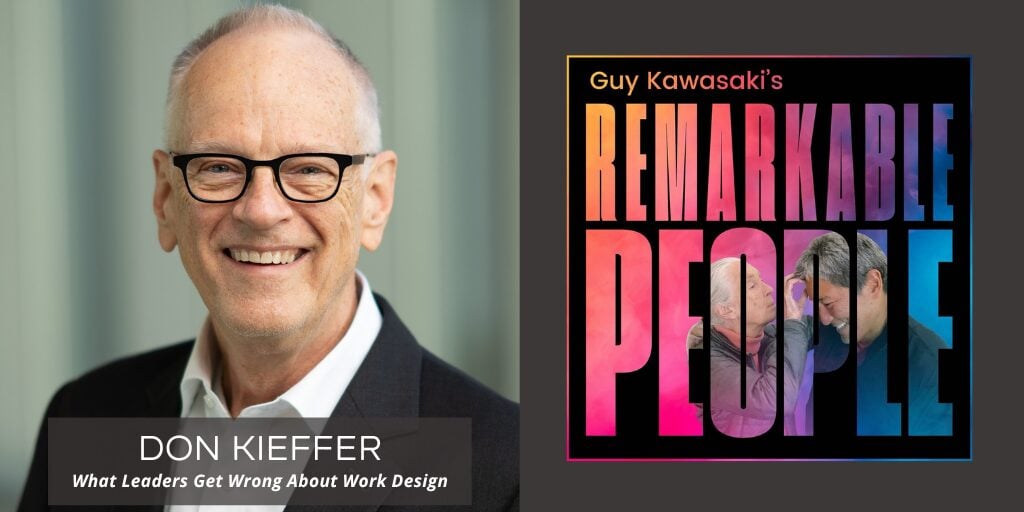
Welcome to Remarkable People. We’re on a mission to make you remarkable. Helping me in this episode is Don Kieffer.
Don is no ordinary executive; he’s a seasoned leader who rose from the shop floor to the C-suite at Harley-Davidson and now teaches future leaders as a senior lecturer at MIT Sloan. His track record in manufacturing and organizational transformation makes him a rare voice who has lived both theory and practice. In addition, he’s the co-author of There’s Got to Be a Better Way, a book that dismantles management fads and offers practical alternatives. Don’s approach challenges the status quo and redefines what sustainable improvement looks like.
In this episode, Don explains the five principles of Dynamic Work Design: solve the right problem the right way, structure for discovery, connect the human chain, regulate for flow, and visualize the work. Through vivid stories, he illustrates how organizations slip into the “firefighting trap” — a culture that rewards quick fixes over long-term solutions. His insights prove that preventing problems is more powerful than constantly putting out fires. It’s a framework rooted in experimentation and discovery rather than flashy programs.
Don’s wisdom isn’t just theoretical. From corrugated box factories in Latin America to biotech labs in Boston, he shows how small steps yield massive results. His message is simple yet profound: leaders need to slow down, go see the work, and empower people to solve real problems. By adopting these practices, organizations can evolve from chaotic firefighting to steady, innovative growth. If you’ve ever wondered why big programs fail and small experiments succeed, this conversation will shift your perspective.
Please enjoy this remarkable episode, What Leaders Get Wrong About Work Design with Don Kieffer.
If you enjoyed this episode of the Remarkable People podcast, please leave a rating, write a review, and subscribe. Thank you!
Transcript of Guy Kawasaki’s Remarkable People podcast with What Leaders Get Wrong About Work Design with Don Kieffer.
Guy Kawasaki:
Hello. It's Guy Kawasaki. This is the Remarkable People Podcast, and we go all over the world looking for remarkable people to inform and inspire you, and we found another gem. His name is Don Kieffer. He's a senior lecturer at the MIT Sloan School of Management. Frankly, he's a leading authority on manufacturing and organizational transformation.
He's the co-author of this really interesting book. I highly recommend that you read that, especially if you work for a large company who's always going from fad to fad. The title of this book is called There's Got to Be a Better Way. Truly what more accurate title do you want? And basically, this book challenges the culture of constant firefighting and offers really practical ways to sustain improvement and build a better organization.
Now, good ole Don has a background in manufacturing, this is not just an academic exercise. He was a senior executive at Harley-Davidson. So yeah, that's pretty credible to me, even though my name is Kawasaki, but that's a different discussion. So Don, welcome to the show.
Don Kieffer:
Thank you Guy. Thanks for having me.
Guy Kawasaki:
Yes. But I enjoyed your book and one of the first things I want to ask you is, are you offering any two day senior management seminars at the Ritz Carlton, or I don't know, Halekulani Hotel in Hawaii? And can we get Madisun and I some conference water bottles and t-shirts?
Don Kieffer:
Do you mean the ones with the big, thick conference workbooks that you go home with and never use? No, we're not.
Guy Kawasaki:
That’s the ones.
Don Kieffer:
We don't do any of those. No, we don't do those.
Guy Kawasaki:
And why don't you do such things?
Don Kieffer:
A pretty basic reason. Most of the time they don't work.
Guy Kawasaki:
So all people have to do is read your book and that's like going to one of these 5,000 dollars a day conference, right? It's better actually.
Don Kieffer:
Yeah, it's actually better.
Guy Kawasaki:
I went off on this tangent already, so maybe you can explain why these management tools and fads pretty much always fail in the long run.
Don Kieffer:
The basic premise is that the higher managers get in the organization, the farther away they get from how the work really gets done. It's a rare manager that actually knows, and a good manager who actually knows what people are doing to get the work done, be it physical or intellectual. I grew up in factories, but for the last twenty years I've been working all office work.
So research, finance, biotech, startups, and when you don't really know how the work gets done and you're working from a spreadsheet, you read a book that says these books that have one word titles, like Faster and you're reading it on an airplane. You come back, you're like, everyone's gotta read this book.
Gotta get this author in to give us the lecture and give us the secret mix of how all this stuff happens. And there is no secret mix. And usually what happens is, every eighteen months, these things come around with a lot of fanfare, a lot of money, a lot of consultants, and they fade away. At Harley, we used to call them AFPs, another fine program, although fine was not the actual word we used.
Guy Kawasaki:
Oh wait, so are you saying that things like Lean and Six Sigma and Kaizen and all that, are they all just bullshit? Is that what you're saying?
Don Kieffer:
No, not bullshit at all. In fact, they actually work. The problem is, I'll give you an example. A guy had me on his podcast and he was actually also a consultant. And I said, “Most people don't even know what the word Kaizen means,” and he goes, “I teach Kaizen and Kanban boards.”
I said, “Do you know what the word Kanban means?” He says, “No, actually I don't.” It means ordering. Kaizen just means improvement. So get down to the basics.
So once people figure out how to make stuff work, and then they put this structure to it and then they teach the structure and they turn it into rules, tools, and rituals for people to follow instead of understanding the idea and getting a sense of, I wanna see this idea in my own unique environment, discover a better way.
It's about the discovery, not following some formula from a book. So when they turn it into one of these big programs, that's where it goes off the rails. Because now it's follow these rules, you'll be fine. And that's never the case.
Guy Kawasaki:
But if I may be an asshole and push back for a second. How do I know that the dynamic work design of Don Kieffer isn't the next one of these things that's an AFP?
Don Kieffer:
Don't make it an AFP first then you would be an A-hole. But I think the way we structured this was very particular around principles, not practices. There are certain practices that work, and we've tried all of them. My co-author and I over the past thirty years have been working together, an MIT professor of a real Ph.D., social scientists.
We've tried all this stuff, we've worked with them. So I think when we get to the idea behind them, that's what we struggle to do. What are the driving principles? Not about people, like customer first and quality first. Let's talk about how to design work. What are the principles to design work?
And then we wanna show people how to find those principles in their own unique environment, and then take incremental steps to prove it out. Small, incremental steps and build up like the old flywheel of innovation you get going. So this is all about experimentation and discovery. Guided by five principles that have been deeply researched and practiced.
Guy Kawasaki:
Don don't hold yourself back. Give us the five principles. My God unless I gotta go to a seminar for that.
Don Kieffer:
No, you don't. I'll send you a cup. I do have a cup. If you want a cup, I'll send you a cup. Five simple ideas. One, solve the right problem and solve it the right way. Most managers because they're so experienced, they have such a huge library of solutions, they jump right to the solution.
They don't really go investigate what's really wrong, not closely in any way. So one is solve the right problem and solve it the right way using the scientific method. The second one is structure for discovery. So when you have a plan, don't just track the execution of the plan. Treat every step in the plan as an experiment that's testing your underlying assumption.
We think if we take this action, we'll get this result. So let's see if that happens. And if it doesn't happen, actually we have a crack in the system, in a window into something new that can lead to innovation. So everything should be about discovering and testing, not just do what I say. That's the second one.
So we structure the plan for discovery, not just execution. For example, we don't do big implementations of programs. Everything's a small project that builds on itself with discovery. The third one is connect the human chain. In this framework, there are no departments, there are no technologies, there are no suppliers that do the work.
It's only individual people. Our contention is the only way work happens is by people doing the work, either intellectual or physical work. It's not the machines, the computers. And so we see the organization as a network of hundreds or thousands of people wired together in sometimes very complex ways, and the work passes through them.
So we see that network and then we take a piece or two of the work and watch it actually go through and map those connections and we fix them. Usually they're broken, convoluted, have a lot of problems with them, and we just fix the connections so the work can flow freely. There’s another chain, that's the work chain.
The other chain is the management chain, which connects the management to the front line. So like the old Andon cord that Toyota uses, I pull the cord, stop the line. So that action actually brings the management system in terms of the team leader to the source of a problem immediately.
So think about someone doing a project. Hey, I'm a week behind. Don't worry. It's a six month project, I'll catch up. What if I pulled the cord after three days and said, “Hey, I'm good. I know what I'm doing, but I'm three days behind. I don't wanna lose any more time.” And a management system jumped into help instead of blame.
More likely what happens is a month from being done with a six month project. I report, I'm three months behind when everything up to there was good. So that's the third one is connect the human chain. The fourth one is regulate for flow. This one's simple. If you put too many cars on the highway Guy, what happens?
Guy Kawasaki:
You stop.
Don Kieffer:
You stop. So when you put too much work in the system, everything stops, people switch, they switch priorities. We switch from this job to that job, this priority to that priority. Productivity drops. People get mad. The time it takes to get one simple thing done, takes really long. So when you regulate the float, don't put work in the system until someone's actually ready to get it done.
And the fifth one, and this one was probably the most powerful one that we use when we work in the field, is visualize the work. So in factories, it's easy to see when the assembly line stops and everyone goes running. But when that work stops in project management or in research, or in coding, or in finance, or in innovation, who sees it and how do they report it?
We deal with it in meetings, we tell stories. We say, “Oh, I'm behind. I'm close, but I'm just there.” But when we can visualize the work on the wall and get everyone looking at the same picture of the work, not just the metrics Guy, but actually where the actual work is, if it's moving or not, then all the bickering and storytelling stops.
Everyone's looking at the same thing and everyone jumps in to solve the problem. It's like putting a collaboration drug in the coffee. HR comes in, drops the collaboration drug in the coffee. But so visualizing intellectual and invisible work. That's the fifth principle is if we can see it, we're natural born problem solvers, then we can more easily solve it.
None of these ideas are that hard, but getting them done in the right mix, it's hard work.
Guy Kawasaki:
I wanna dive into some of these principles a little bit, and the first one is, of course, solving the right problem. Now when you hear something like that, duh, of course I'm gonna solve the right problem, but how do you know what the right problem is?
Don Kieffer:
That's a good question. A lot of people, when they go on these programs to solve Kaizen programs and they have to solve problems. They'll start, let's find more spaces in the parking lot or make the cafeteria line go faster or put flowers in the hallway or, whatever.
Our advice is pick a small piece of an important problem. So don't pick around the edges. Go pick an important problem. If you're doing shipping, go pick the shipping problem. If you're doing research, what's at the core of the research, the speed of the research, the accuracy? Pick a small piece of that important problem.
And then, so it's important. Then can you quantify what the problem is? Can you quantify ahead or behind, better or worse, higher, lower cost, where you are now and where you need to be? Can you quantify a gap so we have something to measure? And the third thing we say is, can you get a small enough piece of it that you can go discover and experiment, not a big piece that you're just gonna make a policy change and implement something.
I want to go understand it. So I wanna boil a thimble full of water, not try to boil the ocean. I wanna boil a thimble full of water so I can understand the boiling point. Once I understand that I can move forward. Get to the right problem. Don't put in solutions or attributions, just a clear quantified statement and then go discover.
Guy Kawasaki:
This sounds like the antithesis of what managers as heroes wanna do, which is they wanna play the firefighter, right? And they wanna just drop in and open up their holes and put out the fire, right?
Don Kieffer:
Yeah, you think?
Guy Kawasaki:
So yeah. So you call this the firefighting trap. So would you please explain the firefighting trap?
Don Kieffer:
Yeah. So when an organization gets behind, so you're chugging along, get a successful business, everything's running smoothly, and all of a sudden you get on the Guy Kawasaki podcast and all of a sudden you get two and three times the number of orders. Now you're in trouble, but you've got some very important customers, so you want to protect them.
So when the system gets really clogged, like all those cars get on the highway and the highway slows down, you wanna make sure that your important customers keep getting through. So you create a hot list, a super priority, and you go in and you manually pull those customers through. What happens when you do that?
And sometimes you have to do that because you've had a problem in the field or a problem in the factory and you need to go just get some priorities to get things moving. But when you put ten people ahead of everyone else, first of all, everyone else takes longer for them to get through. And second of all, your productivity drops because you stop people from running the system and they begin to switch.
So things slow down and your productivity drops. That means you're gonna get more friends who call you and say, “I need priority.” So now we have a hot list, a double hot list, triple hot list, and pretty soon everyone knows that the only way to get through is to get on the hot list. So now the firefighting arsonists are the ones that come in and say, “I'm the hero I can get the most important people through.”
And sometimes you need those people. But whenever they do that, if they don't solve the underlying problem that's causing the slowdown, then it just builds an engine of firefighting. And then those people objectively, maybe not intentionally, become firefighting arsonists, the heroes that can save the day.
But what they're doing is just throwing the entire system into chaos.
Guy Kawasaki:
So basically to continue the firefighting analogy, you're saying it would be better to prevent forest fires than put them out right.
Don Kieffer:
Yeah, but actually, you know what always happens that the things happen, and people have to jump in to keep things moving. The trick is, can I solve the underlying problem? So if the problem is we have three times the orders, can I somehow find the extra capacity so the customers aren't waiting an extraordinarily long amount of time?
Can I solve the underlying problem, why I'm fighting the fire? So the system gets stronger instead of just going in and being the hero. People used to come to me and say, “Oh, Don, I went and solved that problem. What's next?” And I would say, “I'll give you the next one when you show me that you've reduced the probability of that problem happening again by 50 percent after you solved it.”
We wanna heal the system and keep that underlying capability getting stronger. So build another lane on the highway while you're rerouting traffic.
Guy Kawasaki:
Are you in essence saying that the problems that arise because of, quote unquote, normal workflow instead of emergency fires? It's the baseline. It's the standard operating procedures. It's not these crises that happen.
Don Kieffer:
Usually it's not. It's a thing that builds slowly. So it's a habit of people that you start rewarding the people that go solve a big problem for you. And pretty soon everyone wants to be that person. So everyone starts to ignore their regular work and look for those big problems to solve.
Or they wait for Guy Kawasaki to get in trouble. Then they say, “Boss, I'll go help Guy.” And the people who are plugging along making things happen don't get rewarded as much. So it becomes a culture. When Harley almost went out of business in 1985, it was an emergency and everyone jumped. Everyone jumped in to make it work, including the union.
They did everything they could to save the company. So it became the cultures, like someone said there was something to be done, it got done like right now. That hero thinks saved the company, but it turned around and became this objective firefighting arsonist because they got the business crew and they just depended on this firefighting muscle instead of the muscle of continually building the system behind it.
Guy Kawasaki:
And can people who have been good firefighters, can they morph into people who are good fire preventers and builders of safe systems, or is a firefighter like that's just the way you are, and a firefighter needs a fire? What happens if there's no fires?
Don Kieffer:
Right. Actually I'm one of the best crisis managers you ever met because I've done so many of them. That's actually how I made my career, was solving problems. And they'd say, “Oh, get Don. He'll go fix it.” And then once it was running smoothly, I'd move along.
But actually there's something at the core of a crisis that's line-on-line with dynamic work design because dynamic work design is about understanding and organizing the work that people do. Human work.
And when you get into a crisis, you do all the stuff that we ask for naturally. You get the most important people in a room. You start with a whiteboard like are we sure we know what the problem is? Do you have our numbers? How do we know? Who can help?
And then you decide quickly on what are the first things we're gonna do. You don't put up fifty things if you can only do three. Okay, what are the first three things we could do? You do them. You get immediate feedback and you come back and say, “Okay, what did we learn? What are we gonna do next?” It's the automatic focusing of priorities.
Getting the human conversation in the room face to face, the quick iteration, the quick learning. That happens in a well-run crisis. And when we understood that, we said, “That's what we need to do all day, but not at such intensity. So can we structure this, so it feels like the same way?” We get a lot of human interface.
We're iterating quickly, experimenting small at the work face on anything to make it better, making it like a small crisis so we can learn better. And then that's how we got to a framework that can be run on a day-to-day basis that people actually like but involves those very human ways of how we like to work best and how we like to learn and accomplish things.
Guy Kawasaki:
As I was reading your book and doing research on you, it struck me that I've never heard like a management expert. That's a sarcastic term.
But anyway, I've never heard a management expert say, “Slow down. Start small, and don't start saying, ‘We need, ten million dollars for a new computer system. We need to revamp everything. We need to change everything.’ Just slow down, make sure you understand what the problem is, and fix a small part of the problem.” And I've never heard anybody say that.
Don Kieffer:
I noticed you talked a little irreverently about management, but I know you were one.
Guy Kawasaki:
That’s why I know they're full of shit.
Don Kieffer:
The same with me. I hated them and then I became one. But you're absolutely right. One of the hardest lessons I had to learn because I started on the shop floor and ended up as a vice president and later had four or 5,000 people under me, responsible for around the world.
The hardest thing for me to get in my head was start small because as you get promoted, you get paid to think big at these big programs. I know people in the big organizations, they all had a consultant sidekick because they wanted to get this consultant with the big ideas and get them in there, they don't wanna do the work.
And when I would explain to them, like one group had, I won't say the industry, you'll know who it is right away, but they had thirty-five facilities around the world that they had to fix. And I said to the person, “What you need to do is go spend one month at one of them. And start implementing all these ideas that you have and see how they work. See what's really happening.”
And once you see how they all fit together, because they're all coming in like from separate places. We call it horizontal rain. Separate managers throwing ideas at these facility managers. Go in there and help that manager sort out, make it all work, then you'll be smart and then you can take it across the company.
And he walked away muttering under his breath and he told my colleague, “Don doesn't understand I have to change thirty-five, not one.” But no, they don't understand this idea of you first have to learn what you're talking about and understand and figure it out and then you can begin to leverage it. But it's all this big talk about programs and fancy words and buzzwords.
It's all bullshit.
Guy Kawasaki:
Now let me ask you something, I hope it doesn't burn any bridges for you, but are you telling me, or can you tell me that a company like McKinsey will come in and say, “Slow down, let's look for a small thing to fix.” Or are the McKinseys of the world always coming in with the big, multimillion dollar revamping of the big picture?
Don Kieffer:
I don't know McKinsey, except they tried to hire me once. I'll tell you this story and I'll tell you why I didn't take the job, but I think they do. They get paid a million bucks to bring in a strategy book, which now sometimes that's helpful. I don't do that, but a guy from McKinsey saw me speak at a conference, this is maybe fifteen years ago.
He said, “Don, I'd like to hire you.” I said, “Great.” I had my own little consulting business, two people. But I said, “Okay, I'm tired of chasing jobs, maybe this would be a good thing.”
So he set up a first phone interview with a bunch of people listening on the phone to say, “Here's the problem. A guy in X, Y, Z industry has this big machine. It's old technology, and he wants to see if he's got enough, if it'll pay to reinvest and buy the new technology. So whether she should buy the machine or not, what would you do?”
I said, “The first thing I'm gonna do is go take a look at that machine, get it running right, and figure out the flows material and get 30, 40 percent more production out of it with what he's got because I guarantee you the machinery is not getting all the inputs it needs. There's things wrong with it. The operators don't know how to optimize. We'll go fix what it got. It gets 30 percent faster.
And then see what he feels,” and they go, “Oh no, Don, the right answer is we do the math, and it says it pays off in five years, so he should buy a new one.” And I said, “I don't think I wanna work for you guys.” So yeah, I mean there are people in McKinsey, I'm sure, and other consulting groups that do this stuff, but by and large, their role is to embed themselves in these organizations for a long time and sell these big programs.
We, on the other hand, say, “We do a light touch if we're here more than a year and a half, two years, something's wrong.” And we come in like maybe a week or two to kick off. And then we're there once a month for three days. And I'd say, “If we're here more than two years, something's wrong.” So yeah.
Guy Kawasaki:
I gotta tell you that, one of my favorite stories in your book is the story of the company, I don't know what it was, that shut off the machine every day at lunch, because in the past, the utility company couldn't handle the electricity drain at lunchtime. So they shut the machine down to help the utility company, but the utility company no longer has that need.
But it became just part of standard operating procedure to always shut down the machine. So you could go in there and say, “You don't have to shut the machine anymore. You increase productivity 20 percent.” You're a hero in the first five minutes, right?
Don Kieffer:
Right. The funny part of the story was one, it was in, I think it was in Latin America, but two, the infrastructure problem was twenty years ago. And the CEO, who was an EMBA student of ours at Sloan, went and who used to work on the floor thought he knew the business, and didn't know the business.
It was a corrugated box company.
Guy Kawasaki:
Oh, yeah.
Don Kieffer:
And we forced him to go on the shop floor. He goes like what? I'm the big boss. I don't have to go. So we said, “It's our class. You have to go on the shelf floor.” So we did, and like within five minutes, eleven-thirty o’clock, the machine stops said, “Where are you going?” Just like you said, “We're going to lunch boss.”
Twenty years. That just became the habit. No one questioned it, and the other part of this story was the year before he had invested about 300,000 dollars I think. I'll have to check the number in the book, but he invested a lot of money in new equipment and new machinery and his costs went up, not down.
Guy Kawasaki:
Yeah. It went from 8 percent or 13 percent something. Yeah.
Don Kieffer:
Paper losses went up, not down. And by him spending a week walking the floor, looking at the forks on the fork trucks and all this other kind of stupid stuff that was happening, he saved fifty or eighty. As my colleague Nelson Repenning says, “He saved more than paid for his Sloan, EMBA.”
Guy Kawasaki:
I can see why McKinsey didn't hire you, but anyway, alright, so let's move to step two. And step two is to structure for discovery. Now, we've had people with a lot of mindsets on this show, including the mother of all mindsets, Carol Dweck, the growth mindset. But you have a different mindset and it's called the discovery mindset.
So what is the discovery mindset?
Don Kieffer:
This has to do, for the most part, targeted at the way managers manage. So they have a program or they decide what they're gonna do. They have goals for the year, and then they tell people, just go get the cost or get the margin or get the market share, whatever it is. And then if you don't get it, then you know, you get punished.
If you do get it, you're rewarded, but they don't actually look at the activities. So this is go figure it out. And if you don't, you're the problem. Or it's do this, do what I told you. What we do is we say, “We wanna question all the assumptions that everyone has about how we're gonna get this done.” So we write the target on the wall, and we say, “Okay, get some post-it notes here and write what the steps are you're gonna do to meet that goal.”
And people go, “Don't worry Don, I know how to do it.” Okay, great. You know how to do it. Just write it down. It'll take you a few minutes. Sometimes they just prove that they don't know how to do it because they don't have anything to write down. And sometimes they can actually write down. Okay, so go away for three days and think about it.
Come back with the six post-it notes that says how you're gonna accomplish this. And we're gonna put those on the wall and we're gonna look at them every week or whatever the time period is. And when you do one, you cross it off. And then we're gonna ask you, “Guy, did that activity produce the result that you thought it was gonna produce?”
If yes, great, how can we do more? What did we learn? If not, what did we learn? There's four different cases that happen and it's really surprises people. Sometimes they're so busy they can't do the activity and we get the improvement anyway. We go like, why’d that happen?
Of course there's something you don't know about the business that let's figure it out. The best case is I did the activity and I forgot about the result I had. Okay, great. Or I did the activity, and I didn't, again, what did you learn?
So now we're questioning all the assumptions we have about the ways that we do the work and what we think we're gonna do because it's about the human activity. We want the least amount of human activity to meet the goal. So what is that human activity? Let's look at it together, decide it's the best we know and let's execute it.
And if it's a month long, every week gonna look and say, “What'd we do? What'd we learn? What do we need to change to go forward?” So now we're discovering new ways and we're discovering insights like an old one that was broken. I didn't break this one, but just for example. Oh, cost and quality are not opposites.
We can get both low cost and high quality at the same time, which took fifteen years for people or maybe longer for people to break that mold. So make everything a test, everything an experiment. Always question your assumptions. Look for those little cracks of light in the work. That's where the innovation and the new methods are hiding.
Guy Kawasaki:
And you know this principle it's called structure for discovery. So is there like a particular management structure? What's the structure part?
Don Kieffer:
We wanted the structure in because I think this is a chip off my shoulder from the old days of empowerment. Old people know what to do. Just let them go. Just empower them to go do. Try telling 800 people, go run the factory however you want. It doesn't work. So people need structure, they need feedback, they need a plan.
So we build structures on the walls. A certain structure of visual management tools. They're actually two basic ones that we use. But we want a structure. We want the management engaged with the people doing the work. The management has the power and the resource. Hopefully the expertise.
The people know the work and they're gonna do the work and learn. The management has the broader perspective and knows what the business needs and the people know options how to get there. We want those two things together in a structure. I had a guy who told me, he was a manager and I said, “Your people need you. They want to hear from you.”
He says, “Don, my people do not want to hear from me.” I said, “That's probably because you just keep telling them what's wrong with them and what they should do. But if you actually listen to them, your best people will be coming to you and saying, ‘Hey Guy, look what I did. What do you think? I got this result? What do you think?’ They want the feedback because they're hungry to learn, but you're just being a boss to them. You're not helping them.”
So I think we turn that whole thing around from the boss telling people what to do, to everyone's running an experiment and the boss actually provides resources and coaching guidance.
Guy Kawasaki:
And so did we just transform ourselves to talking about the connection of the human chain? Is that the principle we're now on?
Don Kieffer:
That's three. Yeah. We can go there.
Guy Kawasaki:
Because we're connecting people?
Don Kieffer:
Yeah.
Guy Kawasaki:
I gotta tell you, you tell this story and for me it was the mic drop moment of reading your book. You tell the story about how the senior management. They had this practice of everybody had to write down three questions. And you didn't say who you were, right?
Everybody just had to write three questions and submit it, and you didn't say who you were. And so the person who's leading the meeting really found out what people were wondering, right? Because nobody's gonna hold up their hand and say, “Look at me. I'm the dumb asshole. I'm gonna ask you a dumb asshole question.” I love that.
Don Kieffer:
Don't get me talking on a blue streak. I worked in factories all my life, so don't encourage me by cursing, but that technique is called barbecue the boss.
Guy Kawasaki:
Right.
Don Kieffer:
The story was we got called in to help with this project. It was six months in and they were three months behind.
It was building a new facility because they had to expand. They called me in, and I spent a day on site talking to the project leaders, some of the executives, and some of the people in the project. And I went back and said, “I'm gonna recommend that you stop this project and restart it.” And they go, “What? What do you mean?” And I talked to the CEO, and I told him short story is I talked to the CEO and explained why.
He said, “Okay, we're gonna do it, Don.” Okay. So the first thing is we're gonna get your staff on the room and have a very short meeting. And I said, “Okay, everyone write down what you think the goals of this project are and hang them on the wall. No talking.” And they hung them on the wall.
And then they went and looked at them and they were all different, including the CFO who had a secret goal of productivity that he didn't tell. No one knew about. And I go, “You guys have a secret goal. No wonder you can imagine how the fifty people running the project have different ideas of what's going on if you guys aren't on the same page.”
So the CEO said, “Okay, Don got it. What do you want me to do?” I want you to prepare one slide that you can talk about in ten minutes, no more, about the key, the top three deliverables you want out of this project and why it's important to the company. So we get his team on the side and the whole project team in the room.
And we get the boss up there. And before he started, I said, “The boss is gonna explain this to you again. And at the end he is, instead of saying, “Does everyone understand that you're all gonna go?” Yeah. I want you to write that. Take post-it notes. I love the post-it notes. Take post notes. Everyone has to write three questions. You have to write three questions.
Okay. If you don't have a question, start with can we have every Friday off? The answer will be no. But at least you're writing.” So the guy who was actually a really good leader and good communicator, and he couldn't understand what was going wrong. So he gave a really clear ten minute thing with the three points.
Then I said, “Okay, we're gonna go outta the room, put your ideas and questions up on the wall without, we don't care who it is, just be respectful.” And, we came back, then we organized them all while they had a coffee break, and they came back and we answered every single question.
Some were yes or no, some were about the business, some were about the markets. When it was done, I asked the CEO, “What'd you learn from this?” He goes, “First of all. I thought we had communicated this to everyone so many times. It was crystal clear in my mind, obviously not with some of the questions like, what? You didn't understand this.”
He said, “The second thing was half the questions were about why we were doing this. So what about the market share? What about the competitors? What about the cost of it? I had no idea my employees were thinking about this, and a lot of issues get resolved in the room.” For example, he got one and said, “You know what? I don't know the answer to this.”
And he gets his CFO and his HR manager in a heated discussion in front of fifty employees. I said, “Time out. Did you guys ever see this happen before?” Employees are going, no. What they're doing is actually a hard job. You've never seen it before, but if you want an answer from these guys, you have to ask a clear question.
But they got to see how the hard work of management really happens. The next day, that project team went, they had a Microsoft Project thing. They added 200 tasks to that project because now they knew what the boss wanted, not just what he said. It was an eighteen month project. They were three months late, six months in.
They finished three months early and on top of building the new facility, they added a facility in China, which they had not been part of the original scope. They started going super fast. It's called barbecue the boss and what it does gets this human conversation going. It's tell us what you want and why, and we're gonna tell you the barriers and then you can help us resolve it.
That's the long story. Barbecue the boss. Yeah.
Guy Kawasaki:
I love that, and I'm afraid to ask you this question, but could you imagine if Donald Trump did that in a cabinet meeting? Oh my God.
Don Kieffer:
Yeah. Or a town hall. Just go to a town hall, whatever. Yeah. Forget the cabinet meeting. Yeah. No, don't go there. Yeah. That's obviously, this is not a book that he's gonna read.
Guy Kawasaki:
No. I actually think in a town hall right now, it is barbecue the boss.
Don Kieffer:
That's true. It is. People are angry. Yeah.
Guy Kawasaki:
Especially in Nebraska where Madisun is from.
Don Kieffer:
I saw that, yeah.
Guy Kawasaki:
Now you advocate in this connection of the human chain that you have huddles, as opposed to meetings, you have huddles. And I love the concept of a huddle where it's like a short thing, you get twelve people or eleven people in football on the same page and you know what you're doing and a short thing, but as I got my impression, the huddle is usually in person. Now, can you have huddles that are effective on Zoom?
Don Kieffer:
You can. The key intent is that you get all the people, both the people with power and the people with knowledge and understanding. Usually they're different people. So you get, people who are paid to make decisions in the absence of data, and you get people who know the data and so you get the right mix of people in the room.
They need to be in conversation Guy. It's not gonna happen by email. You don't know what's gonna happen. If you have a problem to solve or a decision to make, you don't know which way that conversation's gonna go. Someone's gonna add a piece of information, everyone's gonna react to it in real time, so you can't do it in Zoom.
The key thing is are we live talking to each other? If you're in the same room, it's better because obviously you can see the body language and pick up a lot more information about, hey Guy, what's wrong? You're not speaking up. What do you think? But it is possible to get close, especially if it's an attack team or used to dealing with each other.
You can't get close doing it virtually.
Guy Kawasaki:
All right. Next topic is about the workflow. Now, it seems to me that the higher you go in the organization, the smoother the person thinks the workflow is, and the lower your go, the more they think the workflow is all effed up. So now what are the signs of a bad workflow? What are the signs of a good workflow?
Don Kieffer:
We can measure it. You don't even have to know what it is to know if it's good or bad. So let's just take my favorite example, processing an invoice. Okay, so just in a big company, you worked at Apple, I know you worked at Apple. So process, if I went to work for Apple, just theoretically, if I was a consultant there for a week and I sent them an invoice, how long do you think it would take them to pay me?
Guy Kawasaki:
I would hope that they could pay you net ten.
Don Kieffer:
Wow, that's fast. I would hope so too. That's not what happens, but, okay. Let's say it's ten days. So if we're sitting in a room with all the people that have to look at that invoice and approve it, we're all sitting around a table, and I hand them that invoice and they pass it from one person to the other.
How long do you think it takes them to approve that invoice if they have all the information they need?
Guy Kawasaki:
Oh, I see.
Don Kieffer:
Just pass it from one to the other. And they all have the power to say yes or no or ask a question to get it through.
Guy Kawasaki:
A couple minutes.
Don Kieffer:
A couple minutes. So even with all the computers, we have a couple minutes. Let's say a couple hours, two hours of actual human attention to this invoice. Yet it takes ten days to pay it.
So if you compare any product, intellectual or physical, the amount of human effort it takes to build it, if there was no gap. If went one step, two step right through like driving to the airport with down the 101 with no traffic versus traffic and say, “Compare that number to what it actually takes.”
You're gonna get some idea of their bureaucracy, the issues, the workarounds, the piles of work people are reprioritizing, jumbling around, just think of that work moving through that morass. Now say it takes two weeks or ten days, okay, if it's only two hours worth of work, I know I can cut that in half.
Now maybe you don't want to pay that fast because of finances or whatever, but we can cut that in half easily by going and seeing exactly what the problems are.
Guy Kawasaki:
As a speaker, I often have to bill companies for my speeches. And I gotta tell you, getting added as a vendor for making one speech, you gotta fill out these forms, you gotta send them your 1099, and then the height of this is they want to see a copy of a canceled check because they don't think I can read my bank routing number and account and sometimes this is just to get reimbursed for 200 dollars in Lyft fares.
And I just like amazing to me that it probably cost them more than 200 dollars to pay the 200 dollars.
Don Kieffer:
Exactly.
Guy Kawasaki:
Yeah.
Don Kieffer:
Now, people say these techniques, which the base of these techniques really comes out of Toyota. Lean, comes out of Toyota, Six Sigma. All these things come from Deming and Toyota at the base. It all comes from manufacturing where Toyota figured out the pull and all these kind of techniques because they could see physical work.
And when they tried to move this stuff to the office, people would say, “Oh, that works in the factory, but my work is creative and blah, blah, blah, blah, blah.” Actually, my experience, because I made the pivot from factory work to intellectual work in 2001 or 2002, Nelson and I, my co-author, my experience is that this is way more powerful in intellectual work.
There's only so much reduction you can get in a stamping press because you still gotta stamp the metal in a car factory. But intellectually work is almost infinitely compressible, especially with AI coming into automate pieces of almost infinitely compressible. It's not technology. It's wiring together the work along these human chains and the management chain to support it.
That's where the big gains come from my experience.
Guy Kawasaki:
I have read so many management books and I swear I read about fifty a year for this podcast, and at some point, everybody almost references some Japanese word from Toyota. So is Toyota really this magic kingdom?
Are there people inside Toyota who's saying, “Oh, all these hakujins, they fell for this bullshit called Kaizen. We don't know what we're doing building a Camry either, we're as screwed up as they are, but they think that we're managing by walking around and we have just in time delivery and zero fault tolerance and all this.”
And the Japanese people are saying, “Oh my God, all these hakujins, we got them over a barrel. And good thing they don't put a tariff on us.” So are you, can you burst the myth of Toyota? Is Toyota as magical as we all hear?
Don Kieffer:
Toyota is both that magical and not at the same time. Their history is, I dunno if you know the history of the loom. They started making looms and the problem with looms is they have all these threads and one thread would break and you didn't catch it and it would create a bunch of scrap cough. So they had this idea if when the thread breaks, the machine would automatically stop and then we could fix it.
Then we save all the money and we see the problem right away. The machine's actually calling the person. That's the idea that Andon cord, let's stop when we have a problem, fix it. That idea permeated for decades. Everything that Toyota did, and then Taiichi Ohno went in with the pull system and they're tremendously disciplined after World War Two and built up.
So actually they are that efficient. They are that low cost, but they also are terrible at some things. I worked with a guy from Japan. He taught me visual management. He actually taught it to Toyota, and I was working with him in the US, and I said to him his name was Takashi Tanaka.
I said, “Takashi, is it really true about in Japan you can't lift your head up because you get hammered down?” Because that was a lot of the culture. Even in Toyota. He is “No Don, that's not right.” He says, “If you lift your head up, you have to lift it way up high.” He said, “There are like ten people at Toyota that are figuring out what to do. And then everyone else, they're teaching, and you do as they follow.”
I think they've changed a lot, but they get very rote and very mechanical and sometimes very autocratic. Whereas in the US, we historically have had more educated people, and our culture is more no, I do what I want. So it's just been more creative. But Toyota actually did innovate, create low cost, high quality, and change manufacturing around the world.
But they have their own branding problems still.
Guy Kawasaki:
And why didn't Deming just go to American car manufacturers? Why did he have to go to Japan?
Don Kieffer:
I don't know the exact story. The story I tell is in 1945, he raised his hand and said, “Hey guys, I know how to help the US industry and government by taking variation out of everything we do.” And because he was a mathematician, statistician and an industrialist. And he said, “No, go away. Can't you see we're busy rebuilding Europe and Japan. Go away.”
And then I think it was MacArthur asked him, “Come to Japan.” And that's where he went to help Japan. And still to this day, I think the highest quality award in the country of Japan is the Deming Award. He didn't come back here till he was in his seventies or eighties and taught till he was ninety-five. But somehow they pulled him to Japan to help rebuild Japan.
And they actually listened to him.
Guy Kawasaki:
Okay, so now let's say that someone has been listening to your five principles and says, “Man, I'm a believer. This is really interesting and useful stuff. How do they get started with the dynamic work design?”
Don Kieffer:
I don't think these ideas are rocket science. They might not even be the best ones. It's just the best articulation of what we've been doing that we could think of based on our work working for twenty-five, thirty years fixing stuff and studying it. So I would say the best thing to do is go find an important problem, a really important, a big problem, then go work on a small piece of it.
Find one place that's happening, put your walking shoes on. Go see what's happening. And by the way, on your walk to go see the people doing the work, leave behind the idea that your employees are all dumb, stupid, and trying to screw you. And try to just imagine that they're trying to earn a living.
They're trying to learn something. They're trying to do what you ask them. And they’re actually in this profession, because they like it, but they're grumpy because for twenty years they've had to put up with all the bull crap, bureaucracy, workarounds, and problems. Shifting priorities, changing bosses, and all the other barriers that the management has put in their way.
So they're grumpy. So go listen to them. Figure out what their problems are. Ask them what their ideas are, and you know what, solve one or two of their problems and watch the work start moving faster. They still might be grumpy, but they this might have a small smile turn up when they see you coming.
Get the work moving faster and get them engaged in making it faster so they can learn and be part of the game instead of the enemy of the game. And see what happens. And based on that, other employees will begin to come and ask you, “Hey, come over and visit my place.” Then you're on your way.
Guy Kawasaki:
Okay. Now, let's say that you were asked to help redesign MBA programs. How would you do that?
Don Kieffer:
Actually, my co-author Nelson runs the academic part of the Executive MBA, and he teaches in the MBA, under the regular MBA program. So I think we are already doing that. One of his goals in life as an academic is to change the way business leaders are trained.
Instead of just teaching them how to make deals and run spreadsheets, we wanna teach them how to actually understand the work, how to design it so the work moves, so we get good throughput, high quality, and engaged employees to run organizations.
And the way we do it is we actually teach this book, and they all have to do a project. And Guy, you won't believe, when we tell them they have to go do a small project way down in the organization, like five layers below the responsibility.
It's oh, I did that years ago. I'm a big executive now. Trust me. Go do it. And we tell them, “If you don't find something that you're embarrassed by even in your own area, then you're not looking hard enough.” And they come back with the most amazing results. We find doctors who are increasing survival rates of cancer patients, people saving tens of millions of dollars, increasing market share, cutting the time to drug delivery.
You can't believe that big stuff they do by starting with those small projects. And the motto of MIT is hand and mind. So for the first year, they study all the theory and the second year they start doing stuff. So they get to us, it's called Organization lab.
And we actually make them go to their home organization, try to see these five principles show up in unique ways in their unique organization and try to make a change. And it's just astounding what they come back with.
Guy Kawasaki:
Now when you say go find a small project or a small problem or big problem, but a small part of the big problem, just give us some examples, like what kind of problems did they look at?
Don Kieffer:
Anything. Let's talk about sales. Our sales are at 45 percent. They should be at 70 percent. Okay, what's the size of your sales force? Oh, it's huge. You have forty-five offices. You know what? Go to one office, work with five or six salesmen, watch what they're doing. Or go to a place that's doing well and a place that's not doing well.
Go see the work, understand what those people are facing and try to help them see what's in their barriers, see what ideas they have, and just make a 30 percent improvement. That's what they do. The same thing with drug development. Drugs are taking too long to develop. Okay, pick one spot that's really bad and they come back and they go look at, just like the thing about the invoice.
It's like there's only two weeks of human work in here, but it's taking us eight months. And they cut it. They don't cut it all, but they'll cut it in half. Almost any type of industry, banking, military, guys in the military that were developing some of these high tech projects, they cut the time in half, saved billions of dollars. So from every industry you can think of Guy, homeless shelters, nonprofits, drug companies, startups, big companies, they just go take us.
And once they see that insight of what it takes to make the change and how easy, what all the small things they can do to get a 30 percent improvement. Then they start thinking like the executive they are, but now they know what the change is, and they start thinking about how can I begin to scale this knowing what I know?
Guy Kawasaki:
But Don, what if it's the Hawthorne effect, then it's just because they started looking at this area that it improved, they didn't really fix anything?
Don Kieffer:
No they have to show us what they fix. And I'll tell you, I was doing this for a long time. I'm the factory rat excitable guy. My co-author is a MIT social scientist. He's younger than me, but he acts like the wise old man. He sits back, “Don, why don't you read a book once in a while?” And I would bring him back some of the stuff I was doing and seeing, and I would tell him the number, the percent improvement and he was go like, “Nah, I don't believe it.”
And I'll tell you from a rigorous academic. You can see in the book the experiments that he's convinced it's there. And we make the students show us the way the design is now and show us the way the design of work is what you did, what you changed, and correlate the activity with the change.
So that's part of the process. Yeah.
Guy Kawasaki:
I promise you we're coming to the end, but I cannot leave this story unsaid and let me paraphrase the story that this has to do with the treatment of newborns in hospitals and that sometimes, when newborns are born with low birth weight, they get designated as ELBW, which is elevated low birth weight.
But the staff downstream saw elbow and they thought, oh, this little baby has an elbow problem, not an elevated low birth weight. And they didn't give that baby priority because they thought the baby had a problem with their elbow, not their birth weight, which is a much more serious thing than their elbow.
Is that a true story? When I read that, I said, “That cannot be.”
Don Kieffer:
If you're not embarrassed by what you find, you're not looking deep enough. I can just tell you it's true. Just think about busy people in the hospital. They never connect the dots Guy. They never connect the dots until someone went and said, “Oh my God, this is why the doctors are always late.”
They get there. They don't realize that. They just don't articulate. They just come up and say, “Oh, that's what you want. Okay, I'll fix it.” So you cannot believe the crazy things people find that are sitting in front of your eyes because no one ever looked. The dropdown menu doesn't have the things I need, so I have to hand write.
We had one that was doctors were prescribing drugs for people that caused all this work of insurance companies because the drugs weren't on the list. And she said, “I wanna cut that work in half.”
This one of the students, she called me up, I was a coach, and she said, “Don, I figured out if I just write down what drugs the insurance companies have okayed and post that in the room with the doctors so they could just prescribe that drug from there. And if that's adequate that that will eliminate, totally eliminate the problems, but that seems too easy.”
I was like, “Why is it too easy? Your project's over. It's a great insight.” But for years I've been doing like putting through all this paperwork. The doctors had no clue it was causing all this effort. They were just prescribing the drug, their favorite drug, but didn't really tie together the idea that I know the right drug versus what is the allowed drug.
No one connected the dots Guy happens time and time again. It's just crazy. You don't need an app, just go talk to people. Really, it's a human system we work in.
Guy Kawasaki:
Oh darn.
Your book is, I have to say, is very entertaining for a book about work, design and workflow. My God. Some of those stories I just could not believe. And you read them, and you say, “How could they be so stupid?” That, it's happening, and we have all done stupid things like that too like elbow is not elevated low birth weight. It's not a joint. It's a real problem.
Don Kieffer:
I have one more stupid one. I had a guy from England, and we were talking about this, and he said, “My dad told a story about he was managing buildings in the late fifties, he was managing the maintenance, and he took over this one building and he was taken over from an older guy.
And the guy said, ‘Here's the form we fill out every day and mail it in.’ And he said, ‘There's this little box, ARW at the top.’ He says, ‘Every day, put a zero in that box.’ He said, ‘Why?’ He says, ‘I don't know.’ It's just like everyone says, ‘Just put a zero in that box has to be a zero in that box.’ It's 1958 or something like that.
So he started doing it when he took over the job. I think he was like, what is that ARW? Why am I doing that? Because he asked people, I don't know. He researches it. It actually means air raid warning. It's left over from the forties from World War Two. Was still in there. It just became Pavlov's dog. We have to do this.”
No one knows why. No one knows why.
Guy Kawasaki:
So that box was started during the war to record how many warnings you had.
Don Kieffer:
Right.
Guy Kawasaki:
This is twenty years.
Don Kieffer:
For some reason, like why would they, let's, because we couldn't do maintenance that day or something. Who knows? But somebody had a problem. Here's a fix. Put the number of air raid warnings in there. No one knows why, but it was still there twenty years later, ten years later.
Guy Kawasaki:
Don, thank you so much. It's been most entertaining and not only the podcast, but the book and, for those of you who are listening who are frustrated and wanna learn how to make your organization better, highly recommend. There is a better way.
That's for sure. And it's written by Don Kieffer. So Don, thank you very much for being on our show.
Don Kieffer:
Thank you Guy. Happy to be here.
Guy Kawasaki:
And let me thank Madisun, co-producer, Jeff Sieh, co-producer, Tessa Nuismer, who is a researcher, and Shannon Hernandez. That's our team. Maybe I should have a barbecue the boss session with my Remarkable People team.
Sign up to receive email updates
Enter your name and email address below and I'll send you periodic updates about the podcast.



Leave a Reply