
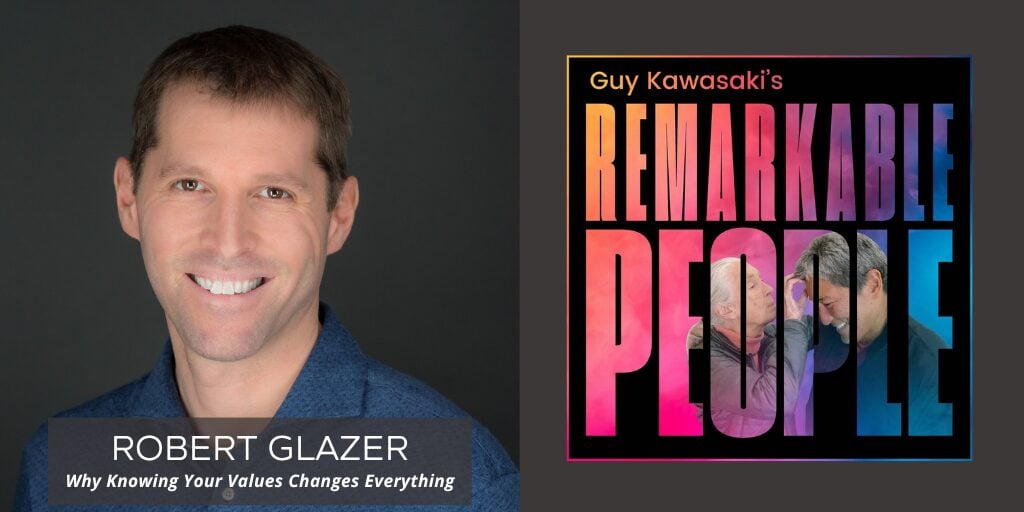
Welcome to Remarkable People.
We’re on a mission to make you remarkable. Helping me in this episode is Robert Glazer.
Robert isn’t just another leadership expert — he’s a guide to rediscovering your “magnetic north.” As the bestselling author of The Compass Within, Robert explores how childhood experiences shape our values, how those values drive our decisions, and how alignment between the two can transform both work and life.
In this conversation, we explore the power of self-awareness — why it’s not just about knowing yourself, but understanding the patterns behind your choices. Robert shares practical exercises from his new book to help you identify your own core values and use them as a daily decision-making framework.
We also unpack how organizations can (and often fail to) live their stated values — and why authenticity, when modeled from the top, creates cultures that thrive. Whether you’re leading a team, a company, or your own life, this episode will inspire you to look inward before moving forward.
The Compass Within is a small book with a big purpose: helping you live and lead with clarity, courage, and conviction.
Please enjoy this remarkable episode, Why Core Values Are Your True North with Robert Glazer.
If you enjoyed this episode of the Remarkable People podcast, please leave a rating, write a review, and subscribe. Thank you!
Transcript of Guy Kawasaki’s Remarkable People podcast with Why Core Values Are Your True North with Robert Glazer.
Guy Kawasaki:
Good morning everybody. I'm Guy Kawasaki. It's a Monday morning in Santa Cruz, California, and we have another remarkable guest for you.
His name is Robert Glazer, and he is a leadership expert. He's an entrepreneur and he's a bestselling author, it's like an all-around winner to me. And so he's known for helping people and organizations reach their full potential. And his latest book, which I have right here, is called The Compass Within, and he lays out a framework for aligning your personal values with professional goals and the organizations you work for.
So it's full of practical insights and real world examples. It's kind of written, a nonfiction novelist kind of way. It's quite an interesting, so it'll help you make your decisions and make your path more clear.
So welcome to the show, Robert Glazer.
Robert Glazer:
Guy, thanks for having me. First slot on a Monday morning. We wanna make sure you have your coffee.
Guy Kawasaki:
Yeah I do have my coffee, or I did have my coffee.
Robert Glazer:
Because you're a little bit earlier than I am. So we got eight o'clock here.
Guy Kawasaki:
Yeah. I must confess that I had coffee, but I did not have milk or cream in the house, so I was looking all over, and I said, “Well, why don't we try this experiment?” And I put whipping cream.
Robert Glazer:
Butter is the big thing that everyone does too.
Guy Kawasaki:
You can put butter in your coffee?
Robert Glazer:
Yeah. There's a whole thing with Bulletproof coffee where it actually, apparently there's something about butter that neutralizes the acid. There's a whole group that does this intentionally to neutralize the acid in coffee.
Guy Kawasaki:
Well, there you go. See another great reason to listen to the Remarkable People Podcast. Now you're gonna have Remarkable Coffee. As soon as this ends, Robert, I'm gonna go up there and try that. No more whipping cream. Going to butter. Yeah.
Alright, so let us dive into The Compass Within and I have to say that my first reaction was that in the world of like analog, physical compasses, there is a north magnetic pole, right? And everybody can agree that the needle is pointing north. But what is magnetic north for people's values? What if your values are messed up?
Robert Glazer:
Yeah, I'm not sure anyone can agree on anything these days, including north and south. But I think this is one of the things, I think we each actually have our own magnetic north and we've gone through life and for a lot of us, making decisions around that, or as I like to say, “Maybe hitting the electric fence and then being like, oh, shouldn't go there.”
So a lot of us know our values when they're violated, but if I ask people to articulate what it was, they'd struggle with some words or dance around it or otherwise. So I think there's a real difference between hey, I don't like this. And being like, look, my value is respectful authenticity.
So I try to put myself in places where that is rewarded, and I try to stay away from environments where that is not. And we talk more about this, I think, what do core values give you, and especially in the context of this book and the big three, it's the ultimate decision making rubric.
What are my kind of warning places to stay away from? Because when values are violated, they feel pretty bad. And then what's my center lane and where should I try to stay?
Guy Kawasaki:
So I understand what you're saying about the electric fence and your center lane and you're like full service driving if you're a Tesla owner. I understand that. But what values the values? I'll give you an extreme example.
What if you're Steven Miller and you have what you think are core values, many people would disagree with your core values, so should you be true to a core value that most people in society would not accept?
Robert Glazer:
So core values are non-negotiable principles that guide our behavior and decisions. I think they're intrinsic. They're not aspirational. They reflect probably who you are and who you've been. They're consistent in showing up in all areas of life, work and relationships, and they're clarifying.
They should help you make better choices. The problem when you get into politics is you get into sort of power and people will do a lot of things and they'll compromise their own values for power. And in fact, there's people on both sides of the political spectrum these days that are making decisions that don't make sense by one set of core values, if you would say, “I respect treating people well, except those people,” so, I think it's hard when you kind of mix in politics.
But there could be some value for which some of those politics are built on whether we don't like it, but the vast majority of in working with thousands of people now. And Guy, if we were to talk about what's something that really drive you nuts or get into that sort of where they come from, which is really childhood and formative life experiences.
Most of us are trying to double down on something that was super important to us, or we are trying to go 180 degrees opposite of something that was painful or doesn't resonate. Ironically, a lot of the painful ones, there's a lot of purpose that lies near pain.
Someone who grew up feeling lonely or in an environment that had isolation ends up being someone driven to create communities. Every time I see someone with a sort of core value of community, and I'll ask them, it's like either you probably grew up on a kibbutz or in a like religious kind of community, or you felt super lonely and more often than not, they were really lonely, and they learned to build community as a survival mechanism, and it came really important to them.
Guy Kawasaki:
So how do people develop their core values? You talked about these youthful experiences, but is it generally caused by youthful experience that you maintain for your life?
Robert Glazer:
When you figure them out and when the character in the book figures it out, I actually find that there's this epiphany where suddenly it's like someone handed you the stencil and you go back and look you're like, this is why I loved Apple and I hated this, and this is why this relationship. And that they've been pretty consistent.
They can evolve. Priorities can change, particularly if something really important happens to you later in life. I've seen people where health moves to the priority because of something that happened to them. Or sometimes it's not the health. Maybe someone had a health issue and living for the day moves to the priority.
But for the vast majority of people, you can trace most of these from five to sixteen or seventeen years old. Because look, you grow up in a culture, you grow up in a family unit and that's when these stuff it's kind of forged with iron. And it's not aspirational when you figure it out, you're like, oh, like this is why this is in fourth grade.
If I go back and look at my report card, which I've done, Miss Mary is, “Hey, Guy does not wanna color in. He will just not do any of the assignments that we give him. He likes to forge his own path.” Or something that literally aligns to one of your values.
Guy Kawasaki:
So in a sense you're saying that your childhood hardships can actually be a positive force later in your life.
Robert Glazer:
Yeah, I've had a lot of super vulnerable discussions with leaders, people doing this work, podcast hosts about this work, and I am not a therapist. And one of the things I say that are a little bit different is, I think it's important to go back and notice what that was because you're showing up as a thirty or forty or fifty.
We don't have to litigate it, and it may have led to something that's really positive. I've seen a lot of leaders who have a core value of trust or something about trust. They build small, high trust teams. When I've asked them, most of them had some massive violation of trust.
I don't ask them what it was, but I say, “Let me ask you with a trust thing. Did you have a violation of trust earlier in your life?” Again, it doesn't matter what it is, just know that that's really meaningful to you. You've developed a protection mechanism that's about figuring out whether people could be trusted.
And you probably have a small group of friends, and it's a long time to work their selves into that. And by the way, if someone violates that trust, they're never coming back. But that impacts how they show up as a leader. That can be a great thing, or it can be a problematic thing. The difference is self-awareness.
Are you able to communicate that to your team or, as I've seen with some trust leaders, are you sorting people into trust and not trust and throwing the key and putting them in jail and they have no idea they're in jail because they were five minutes late to a meeting and now you've kind of put them on the do not trust list?
So I think it's really instructive to make those connections and understand that yeah, these things show up for us as thirty, forty, fifty year olds, in the workplace.
Guy Kawasaki:
So you're touching on my next question, which is, how does one uncover one's core values?
Let's say you're just sitting fat, dumb, and happy. You're not thinking about what you value in life, and you listen to this podcast, you buy your book and say, “Okay, now I gotta figure out what my core values are.”
Robert Glazer:
The book is a parable in which you watch the character go through the process. So for people who like storytelling or case studies, you'll actually watch it happen live to a character through the mentor, and then at the end it gives you that explicit process.
So I have six questions that I think people can answer, and then from those questions, they start to build themes, and then they run it through a filter for what I call kind of actionable core values. We can talk through some of those questions, but people are always trying to write them down.
And I was like, look if you go to robertglazer.com/six, there's the six questions right there and a video of me answering them. So take six pieces of paper, spend a half hour, answer those questions as a start. You might be like, oh, this is stupid, or, oh, interesting. There was the word respect came up in every answer and I would not have guessed that.
And so something is going on in my life where respect is really important. It's cool. I've seen people post them. I'm on LinkedIn or they've done these answers. But basically that it starts with these six questions. You group the answers into theme and the questions are all a little bit different.
Some of them are kind of negatives like when were you disengaged in a personal or professional setting? Like when did the work just feel long and hard and difficult? Because that gets into probably maybe violating a value. And then it flips to like, hey, what help, advice, or qualities do others come to you for?
And each of these questions is designed to elicit sort of behavioral based answers that start to let you see some themes but the point of getting to actionable is they're not one word, and these values are word in a way that you can know if you're doing it and make a decision based on it.
Guy Kawasaki:
So now people are listening to this and they're like, what are the six questions? Do you want me to read the six questions, or do you want to just rip them?
Robert Glazer:
I'll read them, but again, if you don't wanna write them down, you're in the car, just remember my name, robertglazer.com/six. So the six questions are in what work environments are you highly engaged? And I encourage people not to just say, “While working for Guy.”
Guy Kawasaki:
Right, Madisun?
Robert Glazer:
Be more specific like small team, big company. What kind, like what was it about the work? I loved working for Guy because he gives me a ton of autonomy or whatever. In what professional roles or jobs did you do your best work? What help, advice, or qualities do others come to you by? This is the big one for a lot of people.
What would you want said about you in your eulogy? If people came to your funeral, they were delivering a eulogy, what words would you want them to describe the impact you made on their life? That is usually a direct connection to something that you value. And then these are the negative ones that goes for the inverse.
And we can play with this Guy. I'd be curious to ask you one of these. When were you disengaged in a personal, professional settings? And then this last one is always interesting with hosts. So what qualities in other people drive you crazy or do you struggle with the most? So just answer that for me.
If you think about this avatar of someone who's at a party who you're like, I can't even talk to this person. They just make my blood boil. What is it that they're doing or saying or whatever that causes that reaction for you?
Guy Kawasaki:
Wait if I understand this right, you are actually asking me that question?
Robert Glazer:
I am actually asking you this one because it's a super interesting one for people to hear how it plays out.
Guy Kawasaki:
I cannot stand it when someone is trying to prove that they are the big dog in the room because they have a bigger house, a bigger car because they have more money. They have a Rolex watch instead of my SEIKO or my Ultra Apple.
I cannot stand people who are always trying to one up everybody else.
Robert Glazer:
So. It's interesting that you said that. I had a similar thing. So you'll notice, first of all, that Guy was very, you can't, maybe you can see his face, but it got tight. He was probably envisioning someone he doesn't want to tell me about at a party recently. And it was not like, it bothers me when it was like, I really, he didn't wanna say hate.
So I had someone very similar last week who told me the same thing, and it turns out his core value was no one is better than anyone else. And he distinctively and I could see you nod when I, maybe that's not the wording for you, but no one's better than anyone else.
That was a core principle for him. And he remembers being like ten years old and his neighbor was talking shit about a contractor to his son and saying, “Look, if you don't work hard, you're gonna end up like, you know that.” So, it had all of those things.
He understood it. And by the way, this is a guy who had an entirely non-hierarchical organization, like totally flat. He was like, “I just don't believe in hierarchy. I don't, people believe who think they're better than anyone else.” And so it's just so telling as a test for something you value when the opposite really triggers you.
Guy Kawasaki:
Well, Robert, on this related topic, I have come to believe that everybody you meet in your life can do something much better than you. So, you may think, oh, that guy is just a waiter, but he can surf better than you. Or this person is a flight attendant, she can write better than you.
And everybody you meet can do something better than you. So you should stop feeling superior to everybody because in some area they can wipe the floor with you.
Robert Glazer:
Right, and so your value is probably, you're not better than anyone else, or everyone else has a gift. It's then not a surprise for me that your show's called Remarkable People, right? It's about highlighting the things that people do well. Like I said, these things are deep.
When you actually realize like all these dots connect, reminds me when Steve talked about in his biography, studying the calligraphy and then find like these things all connect and this guy was like, last week, he was like, “Holy crap, I have no hierarchy in my life. And I didn't realize it just bothers me so much when people think that they're better than other people.”
So his value may be a little different than yours, but they're cousins a little bit.
Guy Kawasaki:
In a sense, you kind of judge me, and I don't mean that in a negative way, but so how does somebody determine the core values of other people without being fooled?
Robert Glazer:
So interestingly, the book even came from a course that I built, and I've had a lot of people take that course. But I thought it was hard to present the idea to people without a book. So I thought the teams do it together because they kind of think of it as one of these ultimate assessments.
So if I understand my core values as a leader, I would share it. People who went through the core value training at our organization would actually go back to their teams. And they're like, “Look, team, hey, I actually just figured out my five core values. Here's what they are. Here's how you can manage yourself up to me.”
And it's helpful to know this stuff. If you know someone's DiSC profile or you know this, that you know it's communication. Look, if I knew someone on my team had a core value of include all perspectives. If I needed someone to go talk to our customers, figure out what features they want, build a consensus and do that, I'd be like, this is totally the person for this job.
If I needed someone to go make a unilateral decision without talking to anyone, I would be like, Sarah, I know Sarah is an include all perspectives person. She doesn't want to do that. In fact, we've been doing this work for a long time in our organization. I have seen a lot of adult leadership team people at odds over each other for something I know is a fundamental like childhood issue in values.
So someone arguing about a budget, someone who does not feel like they're being heard and for whom that's really important with them. Arguing with someone who's deciding on the money who feels like it is really important not to waste. And they think this person is being wasteful and they think this person is being dismissive and actually has nothing to do about the budget.
And they don't know it about each other in some cases, but I having been in both of the sessions, know it about them. So I think that if you can figure this stuff out and share it, it can only help you, right? You're kind of saying to people, “Look, this is what I like and don't, if I'm Guy, I am not gonna put Guy in a position where he needs to feel like he's better than someone or in a hierarchy.”
That's just not gonna work, if I'm a good leader. If I'm a bad leader, I don't give a crap about any of that.
Guy Kawasaki:
So in this case you just mentioned, how do you make those two divisive or diversive values meet in the middle or work together?
Robert Glazer:
So let's pretend they both knew that, or I was meeting, and they'd say, “Look you just need to really hear her out.” And then maybe you could explain some places where you think we could be more efficient or otherwise. One of the best stories I heard on this was on a podcast between one of the players on the US Soccer team.
And I think it was Megan Rapinoe and her wife. And they were actually, without talking about this, they were talking about something similar and one of them grew up in a household where there was tons of brothers. And when you got to the dinner table, like there was often not enough food, right?
And so if you didn't move quickly, you got food. And the other grew up in a similar but different environment similar to the story where it was just, you do not waste. And so their marriage was at an impasse over ordering food for dinner because one would want to have a ton and the other would not wanna waste.
And this was a core value thing. And they basically talked it out. They talked about the reason why and they made a deal, you can order whatever you want but we will eat it as leftovers for the next two days. And that's actually how they resolved that.
These are the sort of things that don't seem like big issues, but what sits behind them is pretty deep stuff, right?
Guy Kawasaki:
Okay, so now we've discussed analyzing the core values of others, but now how do you figure out the core value of an organization? And in the parable that you mentioned several times about walking through the lobby and seeing the sign with the values, and then in actuality, those values didn't exist in the company, so they were just assigned in the lobby.
So we know the answer is not look at the signs in the lobby or on the website. So how do you determine the core value of an organization?
Robert Glazer:
So it's a great question and personal core values of an individual and of an organization are different, but they overlap. You obviously want to have some concentric circles there. The core values of an organization are not what's on the wall, it's what they reward. Both implicitly or explicitly.
So at the time that Enron spectacularly went out of business, their core values were respect, integrity, and honesty or whatever. This is in Patty McCord's Culture Deck, truthfully, what they were rewarding was probably like, be aggressive, take oversize risk, don't ask for permission, so that was actually the behavior that was getting rewarded.
So I've had people interviewing for a company and they say, “Well, how do I know the company lives its values?” And I say, “Well, this is super simple. Ask the interviewer, first of all, can you tell me what the company core values are? And if they look for mnemonic or stumble around or whatever, you know that they're not really discussed.” At our company, 98 percent of the people would've told you, own it, embrace relationships and excel and improve.
And they would've told you that because they were hearing about it every day, or they just got an award for it, like in the book or it was on their performance review. So it was top of mind. But ask them say, “Hey, look, you have this core value of excellence. Tell me, how did the leadership team react the last time that someone showed excellence?”
Or ask them for an example of how that played out. And if they can't come up with anything, then you know, it's wall art. And by the way, if you wanna play the odds, 98 percent of the time it's wall art.
I've come to really believe in core values for companies and great cultures, but it is such a small percentage where those are actioned on, where you would say, “Oh, they're behavioral based questions in hiring. It's in our performance reviews. There's a shout out each week for the core values. There's the core value awards.”
My friend's company for whom some of the story was modeled on in the book, they have that baton that someone gives each month to the next core value winner. They have a parking space in front of the building that is orange, that the person who got the baton and won that month.
So everyone knows what they are because that's what the culture is rewarding.
Guy Kawasaki:
Now what is the role of the CEO? Does the CEO set the tone for the entire company or is it organic from the bottom up?
Robert Glazer:
It is a hundred percent top down and I have spoken on values in the past, and I'll be at a keynote, and someone will come over to me to the side, “Can I ask you a question?” Kind of off to the side. And they'll say, “Well, I love what you're talking about and the core values and culture and all this stuff, but I want to do this and I'm doing this with my team, but the company and the leadership team will never do this. What should I do?”
And I'm like, “Look. Get a new job. I know you don't wanna hear that, but you can run a little counterculture in your team if you wanna do that. And you can certainly do that. But if it's not real from the top down, it's not support from the top down, it's not gonna change. And if that's really bothering you, then you need a new job.”
The hardest conversation with me when someone came was that his dad was a CEO, and it was a family business. And he was like, “I believe in all this stuff deeply, but my dad still runs it, and he will never do this stuff or get serious about it.”
And I was like, “That's hard.” I have really never seen, in fact, there's only a real change in values in a company when there's been a bunch of mergers, and someone decides it needs to be re-upped and it's gotten a little lost intentionally. Or there's a new leader who comes to this from another company with a deep belief in this and we need to overhaul this.
Most companies just don't one day decide to fix and figure their core values because either leaders believe in it, and they wanna operationalize it. I say the best email. I had done a consulting project with a large hospital on their business core values, and I said, “How's it going?”
And the best email I got all year, they sent me an email that said, “It's going great. We've implemented it in our interview process. We actually got it approved by the department to be in the performance reviews. We have this newsletter with the shout outs now. We actually have our first awards coming up,” that is an organization where people are gonna actually live the values.
And this was a teaching hospital and they realized they didn't have any value. I can't remember how they worded it, but it was kind of like lift as you rise, you have to be in the business of getting better yourself and pulling people with you, and that was entirely missing from a teaching hospital.
Guy Kawasaki:
Okay, Robert. In my checkered past, I worked for Apple twice, and when I joined Apple the first time in particular, it was the Macintosh division. This is back in the eighties, the 1980s, not the 1880s. And so when I joined Apple, we were trying to prevent Nineteen Eighty-Four. We were trying to prevent Orwell. We were trying to prevent the control of information and freedom of thought.
And maybe we were just young and naive, but we really thought that Macintosh would keep freedom and democracy and all that good stuff going, right? So suppose you fast forward to 2025 and you turn on CNN and Tim Cook and Elon Musk and Mark Zuckerberg and Google.
They all donated a million dollars to the inauguration. They're all sitting on the inauguration stage, and then a few months later, Tim Cook, your CEO is bringing in a glass and gold trophy to Donald Trump. What am I supposed to think as an Apple employee who joined Apple to make freedom ring and keep the world a beautiful place and my boss is bending a knee to Donald Trump?
What does that say about the value of the company I work in?
Robert Glazer:
Yeah. So that may not be the value anymore. You might make an argument that some people might think that or have evidence that companies that, and I'm not saying this is good or bad, just understand, I don't wanna get into political, but that companies that have started wars with Donald Trump have ended up with less freedom or problems.
And maybe looking at that way. But maybe it's not exactly a focus anymore. I will say one thing that I think Apple has, probably is a core value now that is very different from those other diamonds, is that your data is your data. I think Apple has been the only company, in fact, people's it can't be true.
And I was like, well, actually we did some work years ago and we couldn't even like use people's own songs that they did. So, they have held that as a resolute while some of these other things will sell your information to anyone who will buy it.
So it evolves. I'm not sure that a hundred thousand employee company maybe has the same values as a 5,000 person company, thirty years later. But it's complicated. And the answer may be sometimes that people are violating their values and they're doing it for tactical reasons.
And you can do that in the short run. It gets real messy in the long run.
Guy Kawasaki:
Yeah. As you can tell, this really bothers me.
Robert Glazer:
Because it violates a value of yours.
Guy Kawasaki:
It absolutely violates a value of mine.
Robert Glazer:
Which is probably authenticity or being consistent or something like that. Again, you're proving to me that's deep, that is the antithesis of a value, right, when you get in there?
Guy Kawasaki:
Yeah.
Robert Glazer:
If you don't like when people don't do what they say and say what they do.
Guy Kawasaki:
Well, Robert, that's why when I need something from Apple, I play full retail in the Apple store. They're not exactly sending me free stuff anymore.
Robert Glazer:
But you're not on a PC yet we determined.
Guy Kawasaki:
That is true. Macintosh is one of my core values, that's for sure.
Robert Glazer:
Simplicity. Maybe it's simplicity. Yeah.
Guy Kawasaki:
Is there a Robert Glazer Hall of Fame of these are organizations that live up to their core values?
Robert Glazer:
Yeah, so there was a story about Southwest and one of their core values is kind of wow our customer and show the warrior spirit. They're just ones that don't sound like platitudes. And they had a customer who found out that as she was about to take off someone called the gate that her son had been in a car crash and was in a coma and they went and got the plane.
Her name was Peggy Uhle. They pulled her off the plane. They brought her in her room. They told her this. They rebooked her flight; they moved her luggage. Someone made her sandwich. They put her on the new flight.
They got her car, and they sent her to the hospital in the new city. There was nothing in the Southwest manual that would've told them to do that. It was just that Southwest had really operationalized this wow our customers, and that it was expected that if you did that, no one was ever gonna come back to you and say, “Why did you spend that money? Or why did you do that?”
You're supposed to do that. There's another great example where the CEO, and this is personal core values too, where the CEO of Dick's Sporting Goods found out years ago that the shooter of a high school had purchased some ammunition from his store and while it wasn't used in the shooting they decided that week that they were going to raise the rate, stop selling certain things and clear it out from the store.
And the estimate was it would cost them 250 million dollars. And he was like, “Look. My dad brought me up to say, ‘You take care of the community that you live in.’ That was a personal core value and we're gonna do this.” And a month later the stock was up 750 million dollars in market cap.
And this is the thing, these core value decisions, they might cost you a little more upfront sometimes, but it's almost always better in the end. Inverse is true too. When the mob's coming out there and everyone's running in the building, it's really easy to just run in, even if you wanna be running out. But then that gets sorted out in a year or two anyway, where it says, “Oh, you just did what everyone else did.”
Whereas the people who kind of stood on their principle when it was hard, they tend to be rewarded more in the long term.
Guy Kawasaki:
Well, you could certainly cite Jimmy Kimmel as a recent example of that.
Robert Glazer:
Yeah. And I think there were some initial reactions and then you kind of see where is everyone coming down on this side of it? And yeah it sorts itself out. The base camp guys similarly had a similar thing where they decided in 2022, kind of at the height of political activism in the workplace, that we are not doing politics at work.
We're a software company. We love our company. We think politics is divisive. We're about bringing people together, and we don't want it on our Slack channels. You're welcome to be as political as you want. We just don't want it in the workplace. The mob came after them everyone said, “You'll be on the wrong side of history.”
It turns out after two rough weeks, they're on the right side of history. They got tens of thousands of applications of people who wanted to work at a company where politics wasn't gonna dominate the topics. They've have the best team they've ever had, record profits. And other people who wade into a lot of companies wade into politics performatively, I would say it wasn't really core to their mission or they believed in it.
They've kind of made a mess. So, this was not anything they were doing for anyone else. This was true to them. We believe in not having division and getting along and doing the opposite, and we don't think we should be taking opinions on things that have nothing to do with our project management software.
Whether you agree with that or not, they kind of laid their lanes and everyone got to decide whether they agreed with that or not agreed with that.
Guy Kawasaki:
I am definitely dating myself, but when I was in my forties and fifties and stuff, and the company that was held out over and over again for value was Nordstrom. And I can tell you from firsthand experience I once went to Nordstrom to buy a tuxedo and I had bought my wife a diamond pendant, and I swear that during the fitting I had it on me, and afterwards I never had it again.
So I went to Nordstrom. I said, “I have to have lost it in the fitting. And I'm not saying you're tailor stole it from me or anything, but somehow I had it before the fitting. I didn't after.” And Nordstrom paid for that pendant. I will never forget that. They paid for that pendant. But wait, the story gets better.
It actually gets quite flattering for me, which is months later I found the pendant and I went back to Nordstrom, and I gave them back the money. Or at least I tried. I didn't wanna have my cake and eat it too. They were really quite honorable, and I thought I should be honorable too.
Robert Glazer:
That says about their values, and that says about your values, in terms of that. They have some values of live by The Golden Rule and act like an owner. Don't take yourself too seriously. Think about Southwest, the essence of that, right?
That's how they hire. They hire people who are funny, and they teach them how to be flight attendants.
Guy Kawasaki:
And you know the apocryphal story of the person who went back to Nordstrom and tried to return tires, but Nordstrom doesn't sell tires. But it happened that the Nordstrom was in the shop where the tire place was before Nordstrom. So the guy bought this tire, he went back to the same shop.
Now it's Nordstrom and tried to return the tire. That is a true story.
Robert Glazer:
And look at the PR value out of it over the tire. So they probably have a value, I don't know whether it's expressed like this, but they probably have a value of service beyond all else. And as they're hiring, you can interview for people who have, we all know what these people who are service orientation.
And as you're telling lore and stories in the country, you tell about the person who dealt with the tire or gave Guy the thing, and then he brought it back, and so everyone's oh, this is the behavior that gets rewarded, sometimes that matches the words on the wall. For a lot of organizations, there's a different thing going on that's not on the wall.
There's a thing that going on that said work a ton of hours. We reward the people who are sitting in their seat the longest. So this is watch for what's rewarded and what's celebrated rather than what's on the wall.
Guy Kawasaki:
Okay, so now if I'm an employee and I'm listening to this and I'm thinking, how can I rank and file employee, change the values of my company? Are you saying that you know when the fish gets rotten, the head stinks first. So if it doesn't come from the CEO, you just gotta leave.
Robert Glazer:
Yeah. So here's what you can do as an employee. If you aren't in a workplace that does not align with your values, one of two things will happen. You'll be going against them and every day, and you'll feel pretty crappy about yourself, or you'll subjugate them and pretend that they don't matter, and then it'll kind of rear its ugly head, usually in a big blow up.
But it's not all or nothing. So first of all, you can't do any of this unless you can understand your value. So I hope you'll read the book. You'll answer the questions, you'll do that work. The course comes with the book if you order it right now, like before launch. So my goal is for a million people to figure this out more than anything.
Then once you're clear on what's important to you, now we go for our alignment exercise and you're like, look, actually, this company is the opposite. Okay, problem. Maybe you decide to start looking for a new company and you'll have some relief because you're making a decision. You don't need to have your Jerry McGuire moment, but you could say, “Look, I realize that this company doesn't align with it.”
Also, maybe you change what you're doing or your relationship to it. You realize you have that value of include all perspectives. And you say, “Actually, maybe I'm gonna switch to the marketing research team, and I wanna be the person out there constantly asking people for their opinion and collecting it.”
So I think there's things you can change within your work or in your leader to align or ask your boss. If your boss goes, “Hell no, just do what I tell you to do.” Then again, probably not a great boss and you may wanna have that discussion, but I think for anyone to have this clarity on the type of work that they will feel more fulfilled and engaged doing is ultimately helpful.
Whether you decide to leave the company or maybe augment your work.
Guy Kawasaki:
So Robert, do you know who Daniel Pink is?
Robert Glazer:
I do.
Guy Kawasaki:
Okay. So do you know about his Regrets Project?
Robert Glazer:
I know about his Regrets Project. Yes.
Guy Kawasaki:
So I think you should do the Robert Glazer equivalent of the Regrets Project and call it the Values Project. And you get people from all over the world submitting their values. So you can do this really great statistical map of these are the three most common values in the world.
Robert Glazer:
We are in the process. Yeah.
I get asked about this a lot and after the book launches and the thousands of people take this course and send them in, we're gonna do a map. We've already seen sort of twenty themes and while they're personal, I think there's themes we talked about one that comes up a lot, this like people are all the same.
I think there's themes about gratitude, there's themes about constant never ending improvement. So I'm with you on that. Dan's biggest, the biggest regret in life, he said he could have started a travel agency for people who didn't go abroad because their biggest regret generally in life was not going abroad in college.
Guy Kawasaki:
Yeah. I regret that too. I was so Asian. All I did was study in college. What can I say?
Robert Glazer:
But we will have that map, I would guess, by early next year. And I'm excited to share that because I think it'll give some direction to people. And I think any sort of rubric I think helps you a little bit.
Guy Kawasaki:
Well, yeah, because the effect of Daniel Pink's Regret Project was like, I can't name all three, but one of the top three was not the regret that you tried and took a risk, but the regret was that you didn't take the risk you thought you could have. So they regretted not rolling the dice as opposed to rolling the dice too much.
Robert Glazer:
Yeah, almost every regret was something they didn't do. Do you remember the most common regret of something that people did do was?
There was only one around what did I do that I regretted?
Guy Kawasaki:
Oh, it was the social breaking up your social relationships.
Robert Glazer:
Or bullying. Bullying, like being a bully in high school or something like that.
But my friend Philip McKernan says a lot that, “Pain and purpose lie close together.” And I think that is inherently true.
Guy Kawasaki:
Yeah. Okay, so now we have this insight about values and how they're formed and all this kind of stuff. Now how do we do the validation process? Let's talk about your validator.
Robert Glazer:
Yeah. So there's four questions as you try to tease out whether a theme is a core value, and it's important to get the theme right? People like to work on the label, but if you're labeling the wrong theme, it doesn't really matter. So the first is, can you use it to make a decision past or present?
Because if you're gonna want this core value to be a decision making rubric. So if I'm doing this and I have this whole thing about long term or thinking long term or whatever. Yeah, I can use that to make a decision. And then the one second question is what we talked about when you imagine the opposite of it, we went in the other order.
But if I take the positive, so I'm a self-reliant core value person. When I think about people that are super dependent and act that way, I get very frustrated. It strikes a nerve, like so I know that's for me. And then when I'm trying to word it, is it a phrase rather than just one word and could I objectively rate myself on it? So to one of my core values, self-reliance, I can use that to make a decision.
I could be like, “Look, I'm being way too dependent on external factors. I need to take the bull by the horns and bet on myself.” The opposite of it, super dependency, drives me nuts, and people only waiting for the world the universe, and not doing anything themselves.
It's a phrase. And I could be like, “Yeah, I'm doing a good job at that, or I'm not doing.” So that sort of passes all a validator test. And if you run it through that filter, you won't end up with something like integrity or family, which isn't super helpful as a decision making rubric.
Guy Kawasaki:
So will you dig a little deeper? What have you got against one word values?
Robert Glazer:
They're not enough to know what you mean. I've heard ten different definitions of integrity. I want one more because Guy, if you said, “Integrity,” I'd be like, “What do you mean?” And you might mean to tell the truth. And the next person that will say, “To make my actions and my words matter,” and the next person will say, “To live to the best of my ability.”
And that's the value, right? Integrity is not am I doing integrity or am I not doing integrity? It fails that, can I make this decision based on integrity? So that's the problem. Family's another common one, and I would say I don't think family is a core value, it's a priority.
Because how does family show up for you and work? And when I ask people what is it about family for you? Again, I get this tree, I get family is a small group of people I can trust. Oh, so it's about trust. And a family is you always show up then that's also helpful because I can think about that's probably how you show up as a friend and how you show up as a colleague.
And I would say to you like if you're a friend and your core value is not really family, but it's always be there, always show up and you're running around like crazy and your friend's father died and you're trying to decide whether you should go to the funeral, you should go to the funeral because as someone who focuses on always show up.
You're gonna be really mad at yourself if you don't, and I was giving this example to someone, and they remembered a childhood story of a funeral dating go-to and their core value. I was telling this hypothetically and they were telling me like a real example where twenty years later, they still regretted it.
Guy Kawasaki:
I may regret explaining this, but I seldom attend funerals, and this is my rationalization, you can condemn me if you want, my rationalization is, well, it's too late for the person who died. So rather than going to this funeral, I should spend more time with my family who is alive.
Robert Glazer:
Yeah.
Guy Kawasaki:
Is that a great rationalization or what?
Robert Glazer:
No. Look I have a similar thing, and not necessarily the funeral, but there's bad things happening all the time in the world. And rather than fill my mind with those and fill it about sorrow and regret or whatever, I agree, I go call my daughter and realize that like I should spend more time with her, so I don't think that's a bad thing but it's just that that means your value is a little bit different, right?
And so you'll live that a little bit differently. Look, we are who we are. I don't think it's about being a good person or a bad person. So that without, I hate the word trigger, but that triggers you towards a different conclusion.
Or maybe being like, look, I'm gonna reach out to that friend and I'm gonna support him. Tactically I've learned over the years because I always forget and I always thought texting people was just a little whatever, but a lot of time they don't wanna talk. But I had someone explain to me, I do now text when I found out that someone.
And I said, “Look, I'm thinking of you. I saw this, no need to reply.” And it is meaningful for people I've learned, but for me, that was actually my core value is find a better way. And I actually learned that means something to people. So I was excited to figure that out.
Guy Kawasaki:
Wow. Okay, so my last question for you is what, Robert Glazer, do you want your eulogy to say?
Robert Glazer:
I don't think I got away without telling you my values in this. So my dominant core value is find a better way and share it. And then it's self-reliance, respectful authenticity, health and vitality. And I mentioned long-term orientation, but to find a better way and the better thing is just a dominant for me.
So the first time I did that exercise, not in the context of this as somewhere else was telling, it was all about, I want them to say I did something that helped made their life better. And that is and when I actually did the value stuff years later, it all came full circle.
So that was always my answer when I did that exercise. It's about kind of making it a little better. That's kind of always been my thing. So I'd love to hear yours.
Guy Kawasaki:
So we are very similar because, I really have this thing about mission statements, and the mission statement is also in the lobby of the buildings right next to the value statement, right? And I think that most mission statements are made at an offsite, at a Ritz Carlton over two days with a meeting facilitator and there's forty people in the room, and they each said, “I just wasted two days of my life, so I should at least get one word in the mission statement.”
And so now you have a mission statement that says, “We endeavor to exceed the expectations of our customers while providing a meaningful return to our shareholders and enabling our employees to self-actualizing their goals while killing as few dolphins as possible.”
Robert Glazer:
Brilliant.
Guy Kawasaki:
And that's for a fast food restaurant, right? So now. So I figured out, instead of a mission statement, we should make a mantra, which is I hate to tell you, Robert, mantra can be one word. I know how you hate one.
Robert Glazer:
It works. Yeah.
Guy Kawasaki:
So this is a long story to tell you that when I die, I want people to just say three words about me, which is, “Guy empowered people.” I want to empower people with my writing, my speaking, my podcasting, my investing, my advising. I wanna go down as someone who empowered people. That's my eulogy.
Robert Glazer:
So I would say your dominant core value then is probably to empower people to be better or something like that. So that makes sense to me. And it's three words. So if it just said empower, right? It would be a little too amorphous. So I like the wording and I fully accept it.
And we're in similar circles.
Guy Kawasaki:
Well that's the way to end this podcast where Robert and I are empowering you to do things.
Robert Glazer:
We want you to go do this work, figure out what you value, make better decisions, and ultimately your ability to do that has the more ability to impact other people. I think that's the vicarious flywheel at the end of the day.
Guy Kawasaki:
Yeah. All righty, Robert, listen, I wanna thank you for being on this podcast. Most instrumental, and again, wait, let me get the book here. I dropped it. This is what the book looks like.
Robert Glazer:
Little book. It's sixty to seventy minutes to read, compass-within.com. It's an easy read. It's a parable. If you like Patrick Lencioni, he read it and then is the key blurb on it.
Guy Kawasaki:
Wow. That's great. So, I wanna thank the people who are of such value to me, which is Madisun Nuismer, co-producer, Jeff Sieh, co-producer, Tessa Nuismer, researcher, Shannon Hernandez. And that's the team behind me, Robert, who makes the Remarkable People Podcast, and I try to empower them.
Anyway, so thank you Robert, and all the best wishes for success with your book. And let's stay in touch and, we'll go to Ritz Carlton one day and Half Moon Bay and talk about our core values.
Robert Glazer:
I'll be there speaking in an event in three weeks, so maybe I'll see you there.
Guy Kawasaki:
Oh, maybe I'll come just for that.
Robert Glazer:
Great.
Guy Kawasaki:
Alright. Take care.
Sign up to receive email updates
Enter your name and email address below and I'll send you periodic updates about the podcast.

Leave a Reply