
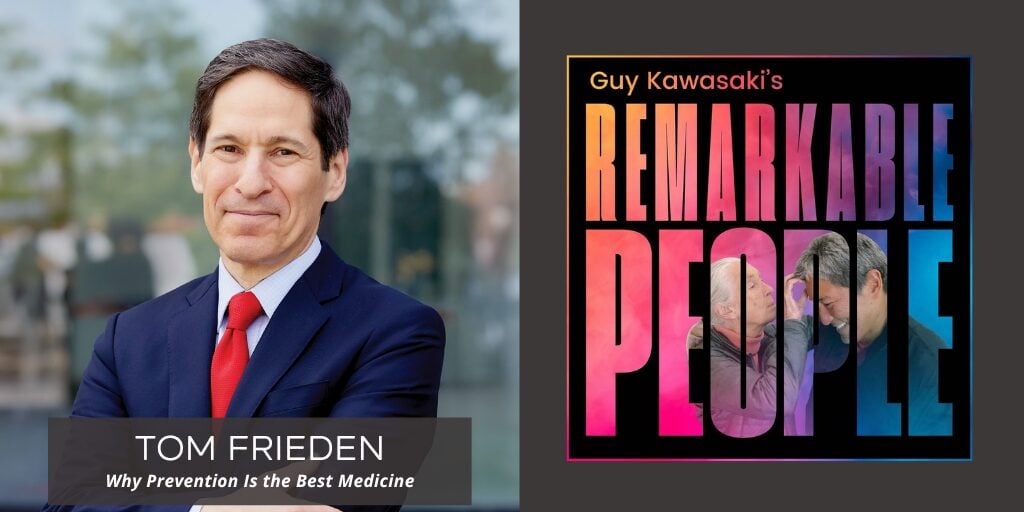
Welcome to Remarkable People. We’re on a mission to make you remarkable. Helping me in this episode is Tom Frieden.
Tom is a global leader who has shaped the way nations confront health crises. As former Director of the CDC and NYC Health Commissioner, he’s been at the center of responses to Ebola, influenza, and tuberculosis. But that’s not all—he now leads Resolve to Save Lives, a global initiative tackling cardiovascular disease and epidemics.
In this conversation, Tom outlines the philosophy behind his book The Formula for Better Health. He explains how the principles of “see, believe, create” apply not only to medicine, but to leadership, communities, and even personal decisions. With stories from his years in public service, he shows how small adjustments—like controlling blood pressure or getting daily physical activity—can prevent millions of premature deaths.
We also talk about what it means to rebuild trust in science, why communication is the lifeblood of public health, and how coalitions can overcome even the most powerful industries. Whether you’re a policymaker, an entrepreneur, or simply someone who wants to live longer and healthier, this episode provides both inspiration and practical tools for making change.
Please enjoy this remarkable episode, What the Former CDC Director Wants You to Know About Health.
If you enjoyed this episode of the Remarkable People podcast, please leave a rating, write a review, and subscribe. Thank you!
Transcript of Guy Kawasaki’s Remarkable People podcast with What the Former CDC Director Wants You to Know About Health.
Guy Kawasaki:
Good morning. I'm Guy Kawasaki. This is the Remarkable People Podcast, and we have a remarkable guest today. His name is Tom Frieden. He was the New York City Health Commissioner from 2002 to 2009.
Then he was the director of the CDC, the Centers for Disease Control, from 2009 to 2017. Basically, he has guided responses to smoking, tuberculosis, H-One-N-One, influenza, Ebola, and opioids. He's been around and today he leads the Resolve to Save Lives. This is a global initiative to reduce cardiovascular disease and epidemics around the world.
He has a new book out. The book is called The Formula for Better Health: How to Save Millions of Lives- Including Your Own. Welcome to Remarkable People, Tom.
Tom Frieden:
Thank you Guy. I am so much looking forward to our conversation.
Guy Kawasaki:
So first I wanna tell you that on my podcast I have had Vivek Murthy, Tony Fauci, Francis Collins, and now you, so basically, I think I should rename my podcast Remarkable Doctors instead of Remarkable People. And you can tell from my selection of guests where I probably fall on the spectrum of believing in science and not Clorox and stuff like that. So my first very simple question for you is, when did you turn the manuscript in for your new book?
Tom Frieden:
Oh, that manuscript got turned in a little over a year ago. And then of course, editing got done and copy editing. And so we did add a little bit about the current Trump administration, but most of it is really about the basics. How do we see our way forward to be healthier as individuals and healthier as communities?
Guy Kawasaki:
When I read your book, I said, “Man, I don't think this manuscript was submitted with the full impact of the Trump administration.” And believe me, I'm an author too, I know. Man if I could just have had another six months. But, just cutting to the chase, in your worst nightmare, did you ever think we would be where we are right now?
Tom Frieden:
First I have to say, I did consider updating the book in the final stages, but things are changing so quickly from one day to the next or one week to the next. I thought, let me focus on the basic principles and get the principles right because they will apply whatever happens. And I think that's the case.
But in answer to your question, no, there are many things that have happened that I never imagined would happen. There are many things that we thought were solid legal guardrails that aren't, even something a little nitty gritty about if Congress appropriates money, we were always told, when I was the CDC director, that you are responsible for spending that money because Congress is basically your board of directors.
The current administration decided that's not the law. And so when they don't want to do something, even if Congress appropriates the money, they don't do it. And that looks like it's going to, may well, stand up in court.
Guy Kawasaki:
We're gonna get to the point where we're gonna talk about your principles, I promise. But when I read your book, it's like every other page is about the CDC and how Ebola and all these tuberculosis and the role of the CDC and all these things. And meanwhile, I'm watching the news and like CDC’s being ripped apart, and I just, uh. What's your assessment of where the CDC is today? Today's September 1st, 2025.
Tom Frieden:
I don't think there's ever been a time like this. There has never been a CDC director fired before. Half of the CDC centers have been disbanded. More than 2,000 staff have been let go for the first time. As far as I know that for the first time in CDC’s eighty year history, a state asked for help and CDC had to say, “Sorry, we can't.”
They asked for help. Milwaukee, Wisconsin asked for help with a lead poisoning problem, but the current administration had eliminated the CDC Lead Poisoning Prevention Program. This is really unprecedented and very, very problematic in terms of the safety of Americans. I think one of the areas that's of greatest concern has to do with vaccine policy.
We have sixty years of progress with vaccine policy in the US and these have been largely reversed in six months of really problematic actions. And I think what you have to do is look beyond what's being said to what is being done. What's being said is, “Oh, we want to protect from conflict of interest.”
What's being done is the really unprecedented insertion of conflicts of interest into vaccine policy. What's being said is we want to address chronic disease. What's being done is the elimination of chronic disease prevention programs from the CDC and the US government.
I think if you look particularly at the current health secretary, RFK Jr., it's a playbook of deny, distract, and destroy. Deny basic facts, distract from the damage they're doing, and destroy our health protections.
And Guy, I'll tell you, there's a reason driving this and it's really clear and it's important that more people hear about it. It has everything to do with economic interests, his economic interest. He makes money suing pharmaceutical companies for things that they don't cause. Now I'm not a big fan of pharmaceutical companies. I've never taken any money from pharma, nor has my organization, nor will I or my organization ever.
But it is absolutely the case that what he's doing is kind of unwinding protections that allow our vaccine program to continue, that allow us to say, “Okay, this does cause a one in a million adverse reaction, and so we need some way of compensating people for that.”
And replace that with his ability to say, “Hey, every parent with autism in the United States, that's a potential multimillion dollar lawsuit to the vaccine manufacturers.” That's his game. That's what he's doing.
And it so abuses the people that follow him and trust him because you know how lawsuits like that work, you might do ten or one-hundred and nine or ninety-nine don't work out. But if one works out, that works out great for the lawyers because they make a lot of money, doesn't work out great for the other ninety-nine people. The families are dragged through the mud, they're stressed out.
And so what we're seeing really is the infusion of lots of conflict of interest in the name of avoiding conflict of interest.
Guy Kawasaki:
There is some hypocrisy and irony there, right? But is it that simple? I have to tell you, Tom, I'm on the outside looking in. I'm not in the business, right? And I look at it, I was like, what the hell are they thinking? What is the end game?
How do you live with yourself at one level, but how do you figure that this is gonna perpetuate your administration or your party or anything? Basically you're killing people. You're unemploying people. What am I missing? I swear, Tom. The only explanation is we're living in a simulation and God has a sense of humor.
Tom Frieden:
I can't speculate on what other people's motivations are, but I can say that one of the things that he is really taking advantage of is there is a real feeling that people are not in control. There's a real feeling that there are economic forces that are undermining us more and more Americans are working harder and harder and can't keep up.
Our healthcare system is fragmented, inefficient. There's way too much economic interest in what happens so that many people don't know what to expect, who to believe. And I think he preys on that. He makes it such that, it looks like what he's saying is, you know, real deal.
When he cries conflict then he stacks the deck, he pushes out independent experts. He puts in people who are loyalists. These are basically the conflicts that he attacks and, that's what's happening. But I think the frustrations he picks up on those are real. And the drivers of those need to be addressed.
Guy Kawasaki:
So how hard is it gonna be to reverse the reversal?
Tom Frieden:
I think we have to start with the fact that no organization is perfect. The CDC wasn't perfect before. And so yes, there are problems with CDC. I ran the agency for eight years. I think we made progress on some of the things that I thought were the biggest problems. I thought sometimes it was too slow, too impractical.
I thought the laboratories had needed to be modernized more. We made progress on all of that in my time there, but not enough. So yeah, we need to go back to a CDC that is really tightly linked with state and local health departments. A CDC that works twenty-four/seven to keep Americans safe from threats.
Whether those threats are infectious or otherwise manmade or naturally occurring from the US or anywhere in the world, that's what we need. That's what we deserve from our health protection agency. So I think the CDC can be rebuilt, but it is going to be a rebuilding issue. And there are some things that the current administration is talking about that if they do, would be good things. But we have to see what they do, not what they say.
Guy Kawasaki:
Okay. Give us some examples of good things.
Tom Frieden:
One policy change that they have implemented or in the are in the process of implementing it that I agree with is there's a program called the Supplemental Nutrition Assistance Program, or SNAP. It used to be called Food Stamps. When I was New York City Health Commissioner, we petitioned the Department of Agriculture to let us get soda and other junk food potentially, but at least soda, out of SNAP.
And that was rejected. This administration has opened the door for those waivers, and multiple states have applied for waivers. They're not yet implemented, but I think that's a good thing. There's a lot of debate about nutrition, but there is no debate that sugar sweetened soda is really bad for you.
In fact, when I was at CDC, we analyzed the data and we showed that, if you look at Americans, how much we exercise, how much we eat, our physical activity hasn't changed that much in recent decades. What we eat has, we've added about 300 calories a day of which about half is from sugary drinks. So it's the leading single driver of increased calories.
And if the government is paying for your food, it shouldn't pay for food that makes you sick and then we're gonna have to pay to treat you when you get that illness. So I really agree with that change.
Unfortunately, it may go along with a big cut in the amount of money people get for the Supplemental Nutrition Program. And that I don't agree with at all. It's more, make sure that if we're providing resources for people to get food, it's food, not something that's packaged, that's food that is gonna make you sick.
Guy Kawasaki:
But isn't it as simple as you promise to build another factory in the United States? You go to the White House, you give Donald Trump a trophy that's made out of gold and glass, and you suck up to him and all of a sudden Coca-Cola's back on the SNAP list. Am I being too cynical?
Is that how it works now?
Tom Frieden:
Let’s see what happens. That may well happen. I tell the story in my book Guy about a corruption challenge in India, and I worked with a wonderful doctor there who was very, very honest. In fact, he was brought back in when there was a corruption scandal.
And a few years later, after I had left India, I was there for five years, he called me and he said, “Dr. Frieden,” he was depressed about another corruption problem in India. He said, “Is there corruption in your country?” And I said, “Dr. Khatri, in my country, if a company gives money to a politician and a politician passes the law that helps the company make a lot more money, that's legal.”
Guy Kawasaki:
Huh. You cannot make this shit up. You really cannot. One more question about the CDC. So now based on what's happening there, it's not clear that you should trust their recommendations or anything.
Where do you get your medical information anymore? The CDC might say, “If you're not over sixty-five, there's no reason to get a COVID vaccination.” Who do you believe in all of this?
Tom Frieden:
Yeah, I think you need to go to the general professional societies that don't have any financial interest in the recommendations they're making. The American Academy of Pediatrics for kids, the American College of Obstetrics and Gynecology for pregnant women, the American Academy of Family Practice for general adult family practice.
I will say Guy, one positive thing is some of the artificial intelligence programs are getting really good. There's at least one that's only available to doctors. It's called Open Evidence. I'm not paid by them, but I am a huge fan of them.
And we are exploring whether they'll make their product available for some of the lower income countries where we work, but I'm really, really impressed with their work. It's not gonna be necessarily the latest cutting edge, but in months of using it, I haven't seen even a single hallucination from it, and it very reliably tells you this is what the evidence shows.
So that's not gonna replace CDC, but I'm afraid to say that given what's happened over the recent weeks, I don't think it's okay to trust what's on the CDC website because we don't know how it got there or what the basis is. And it's so ironic because here RFK Jr. came in claiming or saying he's gonna have radical transparency.
What has he done? He's fired seventeen vaccine experts who did not have conflicts of interest. He's put on seven or nine handpicked people who do have conflicts of interest and who haven't disclosed them. And he's basically trying to rewrite the way our vaccine indemnification laws work so he can cash in.
Guy Kawasaki:
I can tell you, Tom, that if I had to choose between listen to medical advice from RFK Jr. or ChatGPT, I will pick ChatGPT. I'm willing to deal with their hallucinations.
Tom Frieden:
Yeah, ChatGPT is good, but not great when it gets to these things, I have to say. And you have to be really careful about what you ask and how you ask. That's why I think some of the more specialist, it will be better, but I would stick with the specialty societies, your own doctor. And it's good for people to be skeptical about what's out there.
What's not good is when we're not really looking carefully at the evidence and Guy, I go into this in the book some, because there's a lot of misunderstandings, even among scientists, about the right way to look at evidence. How do you get to proof? For example, there are people who believe that randomized controlled trials are always the best form of evidence, the gold standard.
They're really great tools. I've done them, I use them. They're not necessarily the best tools for all questions. You really need technical rigor to understand what's the best evidence for each situation. And I provide some tools for technical rigor that people can use for community health and for personal health in the book.
Guy Kawasaki:
So let's switch to the book now and let's start off with these six factors that you list because I think it's important that people understand what they're up against. So can you just rip through the six factors for us?
Tom Frieden:
You're talking about the six keys for healthy living?
Guy Kawasaki:
The prevention paradox, economic incentives, those.
Tom Frieden:
To me, this is one of the things that I learned most from writing the book that there's something called the Cassandra Curse. That Cassandra, this priestess from Greek mythology, could see the future, but she was cursed.
No one would believe her predictions. And so the tragedies that she foresaw came to pass anyway. Public health was like Cassandra, we foresaw these terrible tragedies. We told people about them, and nothing happened. But that can change now because we have better diagnosis, better treatment, better communication, better vaccination.
But I got to thinking, alright, why do we ignore the warnings? And when it comes right down to it, what I realized is it's really about perceptions. We have perceptions that are not accurate. Perceptions of ourselves, perceptions of our world, and perceptions of our future. And, when you go through each of those things in particular about ourselves, we think, for example, oh, we decide exactly what we do. It's all what we do.
Guy Kawasaki:
Free will.
Tom Frieden:
It’s free will. We are masters of our own fate. And actually there's a lot of ways in which we're not. Our activities are determined by things that industry does, by our social norms. The second is we don't really understand about our world. We may not see that false alarms are driving so much of what we do.
We may not recognize that there are economic factors that are determining things and about the future, this fancy term hyperbolic discounting where we may not actually value the future enough. We may not see that, oh, a year, five years, ten years into the future, we're gonna have this condition, good or bad.
And so it's worth investing something in trying to be healthier so that inaccurate perception of ourselves, our world, our future. That drives the Cassandra Curse. And if you break those things just by becoming aware of them, seeing what it is that is making your perceptions not as accurate as they could be. That empowers us to think more accurately, to act more accurately.
I use the example in hyperbolic discounting, it's a fancy term, shortchanging the future. I apply this to my schedule. I used to find that I would find myself doing events that I agreed to six months earlier and I said, “Oh, why am I doing this event? I like don't want to be doing this.”
And then now when someone makes an invitation, I say, “Would I wanna do it tomorrow?” And if I wouldn't want to do it tomorrow, I don't do it if I can. And that's similar to health, if you think like, I've taken care of patients with horrible, painful conditions, would they want that condition?
If they could put themselves in the mind of having that tomorrow, they probably wouldn't do the thing that's gonna make it more likely that they have that condition.
I think of a patient I had. A really sweet older woman who had smoked all of her life and she had emphysema and I tried everything, and she had a horrible death. Emphysema is probably the worst death. You're gasping for every breath. And she so wished she had never smoked, and yet if she had been able to see that future, she would've quit.
Guy Kawasaki:
And why couldn't she see it?
Tom Frieden:
Too late. This is what doctors do. Doctors can try to make real what that future is going to look like to people. And this is what the formula can do. The formula is see, believe, create. Part of what we're seeing is what are the risks that are harming us, whether your blood pressure or your cholesterol or your blood sugar, it may be in the normal range, but it may be creeping toward the abnormal range.
And that may be abnormal for you and good enough warning for you to change your behavior and avoid with some relatively small adjustments, something that would be really miserable for you later on.
Guy Kawasaki:
I take a statin every day. So you blew by the key concept of your book with the see, believe, and create. We gotta give that more bandwidth. So let's talk about these three steps. I love tricolons, by the way.
Tom Frieden:
So see, this is a formula. See, believe, create, that I'm really discussing in the book for the first time. But it's a formula that's proven. It has been used to prevent millions of deaths in the past. It can prevent millions more deaths in the future, and it can help you live a longer, healthier life.
See has to do with see trends that may not be apparent. See the invisible, there are lots of things that may seem invisible. Your cholesterol, your blood pressure, your blood sugar, or the rise in opiate deaths or the rise in obesity or the rise in other problems in this country. But also see the drivers and why we're blind to those drivers, what we just discussed with the Cassandra Curse.
And also see how programs are doing, be brutally honest about whether your program is succeeding or failing because that's the only way to make more progress. And also use that technical rigor we talked about earlier to see the actual pathway to progress. So that's about seeing the invisible forces, trends, progress or failure and path to progress.
Then comes believe because it's great to see what's happening, but you gotta believe you can change it because a lot of times we have the illusion of inevitability. We think that the way things are now is the way they've always been and the way they will always be. That's not necessarily the case and it's something that's important to break this concept that, oh, I can't change anything.
One thing you can realize is that difficult as things may be over recent years, if you look at ten, twenty, thirty, forty years ago, we are so much better off. We've got better technology, we've got cures for cancer, we've got better vaccines, we've got better ways to communicate with one another. So you can show past progress.
You can make more progress systematically, and you can cultivate optimism. So that's the see the invisible, believe the impossible then comes the really hard part, which is create a healthier future. And that means getting organized, keeping it simple, communicating well, and overcoming those economic, social, and other barriers that get in our way of having a healthier future as communities with millions fewer deaths.
And that's really possible. And as individuals where we can live longer and healthier lives.
Guy Kawasaki:
I could make the case that you could apply that, seek, believe, and create to business. It could be just life philosophy. It doesn't have to be just for health, right?
Tom Frieden:
I think that's right. I think it's really important for public health organizations, but I think it's relevant for many organizations. What is see about? It's about measuring what matters, seeing how you make progress. What is belief about? It's about hey, being ambitious, not crazy ambition, right? Not ambition that's gonna fail, but ambitious but real.
You want something that's a stretch goal. You might reach it or not, but it's not tilting at windmills. And then create is you've gotta be organized. You gotta keep it simple or it's not gonna scale. You've gotta overcome barriers and communicate well. Yeah, I do think this is a life lesson for individuals and for organizations beyond public health.
Guy Kawasaki:
In your role as a commissioner or the director of the CDC, you certainly learned about good messaging. So could you give us your insights into good messaging? Because you have some very, very powerful messages and it literally is a matter of life or death.
Tom Frieden:
Communication is about listening as well as speaking and to communicate well, one of the chapters in the book, you really have to focus on getting the message right, getting the messenger right, being appropriate for the audience you're dealing with, getting the timing right and some people think of communication when it comes to a public health program as like it's about the program.
No, communication is the program. It's part of the program. What you say, how you say it, to whom you say it, when you say it. I'll give you an example. During my time leading the CDC, there was a really big Ebola epidemic in West Africa. It was spreading widely. And one of the things that had to change were burial practices, where people would wash the body.
And people with Ebola who've died from Ebola have massive numbers of Ebola particles, after death. And so that had to change. But these were centuries old traditions, and an outsider going in and saying, “Change the way you do this, wasn't going to work.”
It didn't get turned around until the community leaders themselves understood what the risks were, why they had to change, how they did that, and they themselves then were the messengers of the community. So I think finding the right message, the right messengers is really important.
And I'll tell you Guy, during the height of the Ebola pandemic, I was in a focus group that Frank Luntz and the De Beaumont Foundation organized with fifteen or twenty people who were very skeptical about vaccines.
And we spent two or three hours with them. And I was really impressed that these folks had totally legitimate questions and they felt that they were being vilified just for asking those questions. And not only had no one answered those questions, they hadn't even addressed them. So when we had that conversation, we really listened to what they had to say.
We actually could convince most of them that they should go and get a vaccine. But it took a long time to listen.
Guy Kawasaki:
So I'm very curious. So what would you consider some of these legitimate questions that came up in this meeting?
Tom Frieden:
They wanted to know, “Hey, how is it that mRNA vaccines got released so quickly?” That's a normal question. The answer is they didn't. People have been working on for twenty years.
We just got lucky that they're ready by this time. Another question was, “Hey, were there shortcuts taken on safety?” Totally legitimate question. Answer, no. Actually, some of the largest vaccine trials ever done were done on COVID. So these are reasonable questions.
Guy Kawasaki:
Now when we look back, you cite Ebola in your book as, to the extent possible, a positive story. I think you also, in my opinion, you refer to the anti-smoking as a positive story. So now looking back, why did anti-smoking succeed?
Because there was economic interest behind smoking? There were social norms behind smoking? There all six factors were going for smoking, and yet who smokes today? Or not as many people smoke today? So how did anti-smoking work?
Tom Frieden:
It's a great question. And yes, it's still a big problem. It's still our leading, preventable cause of death in this country. Close to half a million deaths a year from smoking in the US and globally eight million a year. So it's not as if this problem is vanquished, but there has been huge progress.
Teen smoking is down to 4 percent, the lowest ever measured, and most Americans who've ever smoked have already quit. I think this gets to what I outline in the book of how do you identify winners and losers? How do you get advocates? And advocates were so important here, and coalitions were so important here.
So let's take advocates. There's a statement attributed to Margaret Mead, never doubt that a group, a small group, of committed people can change the world. In fact, it's the only thing that ever has. And you have these wonderful advocates. I tell the story in the book of Matt Meyers, who for more than twenty, thirty years, maybe forty years, took on the tobacco industry, and usually won.
At one point they were proposing a Smoke-Free Air Act in Vermont, and one state legislature was the swing vote. And so Matt went into the legislature's office, and he put on the desk two full page ads. In one of them, the people of Vermont thank this legislature for protecting their children from cancer and addiction.
In the other, they hold them responsible for getting their kids hooked, causing cancer, and increasing healthcare costs. And Matt said to the poor guy, “Assemblyman, one of these two ads is definitely running tomorrow. You get to choose by how you vote, which one it is.” So you had really good advocates there and you had coalitions.
Look, you mentioned Coke and Pepsi. They hate each other, but they get together to fight against soda taxes and healthy policies. I think all of us need to think about coalitions. So doctors got together with lawyers, got together with community activists, got together with families of people who had been affected by tobacco.
You had the Marlboro Man coming out against smoking as he was dying from his tobacco associated disease. Facts are stubborn things and ultimately we can overcome the kind of fictions that are harming people with a focus on those facts. But only if we're strategic. Only if we look at who are the winners and losers, who are the advocates and partnerships, how do we message right?
How do we keep it simple to just tie together two of those things? One of the big fights I had when I was New York City Health Commissioner was making all restaurants and bars smoke free. And, the framing of that was really simple. Secondhand smoke kills. Just those words.
Secondhand smoke kills. With that message, it was very hard for the tobacco industry. They tried, but very hard for them to overcome the work. And with the leadership of Mike Bloomberg and the support of the city council, we were able to do it. And after that, many places around the US and the around the world have become smoke free.
Guy Kawasaki:
That is definitely a source of inspiration and hope. I'm gonna go down a little bit of a rat hole right now and it's actually gonna show you how unsophisticated, and maybe ill-informed I am, but I think this is a marketing issue.
I was reading your book, and your book has a whole like diatribe and discussion about hypertension and heart disease, right. And how it's so preventable. And I have a marketing suggestion, which again, I'm gonna fall on my sword and tell you, it shows my ignorance and naivety.
But I think that the medical profession should stop using the term hypertension because, and now I know, but I literally looked this up last night, and I know that hypertension refers to heart disease, but when I, until last night, literally when I heard the term hypertension, I thought it meant that someone was hyper and tense.
So they're like, this guy is like hypertense. He's always tense, he's always worried. And I learned last night, it has nothing to do with that. It's like hyperactive, hypertense, and it's about heart disease. It's not about tension. And so I think you, the medical profession is doing a disservice when they say, “You gotta worry about hypertension.”
And people are hearing that. They're saying, “I'm not tense, I don't have to worry about that.” But you're really talking about heart disease. So can you make that change to the medical profession?
Tom Frieden:
Guy, I think that's a great point. I had never thought of it that way before. We often define it as high blood pressure, but ultimately this is an example of something that's invisible. Right. See the invisible. One of the things I learned reading this book was there was a doctor, Riva-Rocci, who in 1896 invented the blood pressure monitor.
It's called a sphygmomanometer. He used a bicycle inner tire. He used a mercury gauge. And some ready to use stuff and he refused to patent his invention because he thought it would be important. But until 1896, no one had ever measured the blood pressure because you can't feel it. And one of the biggest misconceptions we deal with in people is they say, “I know my pressure's not up because I don't have a headache. I feel fine.”
Well, hypertension, high blood pressure is called the silent killer because the first symptom is often a heart attack or stroke, and one out of three of those is gonna be fatal. As an epidemiologist, someone who studies disease, it's so obvious to seeing the invisible, one out of every three deaths in the world is from heart disease and most of those are from an abnormal blood pressure.
And I put it in the book that, think of it this way, when your pressure is too high, the blood is like a battering ram ramming against your brain, your heart, your kidneys, every second of every day doing damage.
And it's now clear that lower is better, down to a blood pressure of 120 over eighty. We used to say 140, 150 was okay. It's okay if you don't mind having a heart attack or stroke, getting dementia early. But in consultation with your doctor, it's really important to try to get things like your blood pressure and your cholesterol down to really healthy levels, makes a really big difference.
Guy Kawasaki:
Tom, I will bet you that if you ask most people if hypertension refers to high blood pressure, hardly anybody is gonna say, “That's the same thing.” They're gonna think like ignorant Guy who didn't know until last night that hypertension is about high blood pressure. I really thought it was about being hyper and tense.
Tom Frieden:
That's a good point. And it makes the point about communication that you have to listen to what people are hearing. You have to be effective with your messaging and what we've tried to say, increasingly, what I try to say in the book is, “Hey, this is not about telling you how to live. This is telling you if you wanna live healthy for longer so that you can do what you wanna do for longer. Here's the real deal.”
I'm not making any money on this. In fact, if there are any proceeds from the book, they're gonna go to organizations that Resolve to Save Lives provides grants for work and health, but really I wanted to get past the self-dealing, past the economic interest and past, frankly, the sloppy thinking because there's a lot of sloppy thinking about health.
And I try to define, to be really upfront. There's certain things we are certain this will be good for you. There are others that these will probably be good for you. There are others that like these might be good for you. And there are others that are like maybe not.
But they're wild guesses, they're hunches that don't have any data associated with them for a longer, healthier life. So if you run and really understand what does the facts show? If you say, “I wanna live longer, healthier”, and the people who say, “Oh, you do all those things, your life is not gonna be fun.”
I don't buy that at all. You can do things that you enjoy more of, so you'll be happier and you'll live longer. It's not like you have to deny yourself all the pleasures in order to live a long, healthier life.
Guy Kawasaki:
Okay, Tom, I mean with that preamble, you gotta tell us what are the certainties like for sure? What should we do?
Tom Frieden:
It starts with the if you smoke, you really have to quit. And if you smoke heavily, it'll be real important to get medications, which can double or triple your chances of quitting and comprehensive support. For a smoker, nothing even comes close to the health benefits of quitting. If you smoke, the odds are you'll die ten years younger and feel ten years older.
The second is to keep your blood pressure low, ideally under 120 over eighty. The data is super clear on this Guy that starting at 115 over seventy-five for every twenty point increase in blood pressure, your risk of having a stroke or a heart attack or dying between age twenty-nine and seventy doubles. Doubles.
So every little bit increasing is really bad for you. The third is to control your cholesterol. This is a little more complicated because the way we measure cholesterol is going to change a lot in the next ten, twenty years. The way we measure now what's called low density and high density, it's okay, but it's not very accurate.
And as we learn more about cholesterols, we'll get better on that. But the best evidence now is that you should keep your LDL-C and your ApoB below seventy or eighty. That's pretty low. The third is to be physically active for at least thirty minutes, at least four days a week. That's really important. And it can be as simple as taking a brisk walk outdoors, thirty minutes, four days a week.
There's some evidence that increasing physical strength and endurance will also help, but what we're certain is that minimum of thirty minutes, four days a week. The fourth really has to do with getting enough sleep because, it's underemphasized or underrecognized that sleep is really important.
And the more we get good sleep, the less likely we are to have depression, to have all sorts of hypertension, high blood pressure, for that matter. So I think, these six things, blood pressure, cholesterol, sleep, physical activity, avoid toxins, and then healthy nutrition.
That's the most complicated because, there's a lot of debates about nutrition and we're not really sure about a lot. What we are sure about with nutrition is, have less sodium and more potassium and avoid too much free sugar because free sugar is really problematic and that's why sodas are so unhealthy.
It's really interesting. We consume way too little potassium. We basically, most of us have a potassium deficiency, and you can get a low sodium salt that's 25 or even 50 percent potassium, so that if you're cooking with salt or using it for something else.
I use hardly any in my cooking, but sometimes when you're seasoning something, you need some. If you use the low sodium salt, you're getting a lot of potassium. In fact, people are counting calories. You'd be better off counting sodium and potassium because the ratio should actually flip.
You should ideally consume more potassium than sodium. Most of us consume five times more sodium than potassium. But the studies suggest that the strongest predictor of heart health is consuming more potassium than sodium. What's interesting about nutrition is that foods that are high in potassium, like sweet potatoes, salmon, spinach, white beans, avocados, and bananas, plus yogurt, pistachios, tomatoes and mushrooms.
Not only are they high in potassium, but within reason, the more of them you eat the better. And that's what I meant when I said, it's not like you have to deny yourself pleasures. Now, I can't address your sleep problem as a clinician, I will say for most people it's really hard, it's easy to say, “Get a good night's sleep.” Hard to do that.
A dark and cool bedroom is really important. So I personally like absolute blackout shades, avoiding caffeine or nicotine close to bedtime. That's been proven to increase the likelihood of getting a good night's sleep. There's some evidence that managing stress through relaxation and limiting screen exposure before bedtime make for better sleep duration and quality.
I assume you do all that already.
Guy Kawasaki:
No, that's not a good assumption. The screen time, guilty as charged. I take the fifth on that man.
Tom Frieden:
We're not gonna get into medical advice here. I will say there are some new medications available that are non-addictive and that help with sleep, but it's better to avoid medications if you can.
Guy Kawasaki:
Okay. This is a deeply hypothetical question, but if you could convince every eighteen-year-old about one medical behavior, what would that be?
Tom Frieden:
Physical activity. Physical activity is the closest thing there is to a wonder drug. If you get regular physical activity, you are less likely to get cancer, you're less likely to get depression, insomnia, dementia, diabetes, high blood pressure, arthritis. You're more likely to live independent for longer.
So find things you love doing and keep doing them. Things that you can do for life. We see a lot of times kids are really active in school and they get outta school and they've been doing something that was only doable at school, so they don't keep it up. So I would say a lot of things that determine whether people are healthy or not.
These are societally determined. Are you surrounded by unhealthy foods? Are you surrounded by people using toxic substances? Are you given foods that have massive amounts of sodium and sugar in them? Yes to all those questions, but one thing that, it's easier if there're bicycle lanes and walking paths.
But really physical activity, nobody's gonna do that for you. You gotta do that for yourself. And it's hard, harder for some people than others. Again, don't try denying yourself things. If I want to sit on a couch and watch TV for a while, you're gonna do that right? But also find something you love doing that's physically active because you'll stick with it.
Guy Kawasaki:
So I can tell my family that surfing is medical treatment.
Tom Frieden:
Absolutely, absolutely. Do you know Guy, two studies just came out that are amazing, really in the last couple of months, and they're both very well done studies. Not everything published is well done. Some of them are junk science, but they get published anyway.
What one of them showed that if you've got cancer and you get regular physical activity, you live longer, you're less likely to get recurrent cancer, you're less likely for your cancer to come back.
Another one just published last week showed that if you're regularly physically active, you're way less likely to have a heart attack or stroke.
Guy Kawasaki:
I'm gonna live forever. Except for the sleep part. Okay, so same question. If you could convince every politician of one medical behavior, what would it be?
Tom Frieden:
Hard to choose just one. From the prevention side, I would say tax tobacco, alcohol, sugary drinks, and unhealthy food. That tax is gonna make you revenue that you can use for good things. It's gonna reduce your healthcare costs. It's gonna save a lot of lives. If I was talking healthcare, I would say invest in primary healthcare.
Give people their own clinician, their own doctor. Right now in the US we spend over four trillion dollars on healthcare, and a hundred million Americans don't have a primary care doctor. Most people around the world don't have a primary care doctor. What does that mean? Somebody who takes care of most of your healthcare needs who can be like your interpreter.
You asked me who should you go for advice? The best is your own doctor who knows you, who knows your family, someone you choose and you trust, and who maybe you don't believe everything they say. You take it with a grain of salt, but at least it's someone who can be your interpreter of the scientific evidence and apply it to you.
Primary care is so undervalued. If you're a primary care doctor in this country and you work twenty years doing really great work, you will make less than half as much as a surgeon who graduates tomorrow. Just to give you one more stat here, Medicare, which is the major source of pay for older medical insurance for older Americans, spends less than 5 percent of its total dollars on primary care.
And there are good studies that suggest that if we tripled that and we did it in the right way, we would actually reduce healthcare costs and help people live longer, healthier lives. So again, it gets back to economic drivers, primary care doctors, powerless, hospitals and specialists, powerful.
Guy Kawasaki:
Tom, I may rise even higher in your book now because I'm a believer in Kaiser. I have a Kaiser primary care doctor.
Tom Frieden:
Yeah, that is actually exactly what the data shows. I talk about it in the book, and I give the reason as well. If you look at the rankings of US healthcare systems, guess what the top five are? Kaiser, because they have different regions with different activities. All five of the top are Kaiser, and they're top, not by a little bit, they're top by a lot.
There are other integrated systems like Geisinger, Mayo Clinic, that provide that kind of comprehensive care. But Kaiser is so special for a structural reason. The folks who pay for the care, and the folks who give the care are the same. In most of our healthcare system, it's different.
So if I'm the insurer and I'm the provider, we're fighting. In Kaiser, they're the same. They're the insurer and the provider. So instead of like patient, provider, insurer, all fighting with each other, more care, less care, different care, they're all on the same table.
Years ago, Kaiser realized that if they helped their members reduce their blood pressure, their members would have fewer heart attacks and strokes, would live longer, they'd get more money and their members would be healthier when they realized that their control rate, the proportion of all people who had their blood pressure controlled was only 40 percent.
Today it's 90 percent. The rest of the country, 45 percent, they do twice as well as the rest of the country. And they do it because the incentives are aligned. And that gets back to politicians. We need to change the incentives so we're not incentivizing sick care, we're incentivizing healthcare and that's one of the reasons that primary healthcare is a theme throughout this book, there are ways to stay healthy as individuals.
There are ways to stay healthy from public policies like taxes on tobacco and smoke free places, and there are ways to stay healthy by making our healthcare system work better for people.
Guy Kawasaki:
Tom, as soon as I stop recording this episode, I'm gonna go have a glass of water with a banana and I already surfed today, so I did my exercise.
Tom Frieden:
I envy you surfing two hours every day. That's fantastic.
Guy Kawasaki:
I am gonna go buy some sweet potatoes too.
I'm gonna let you close this by just summarizing your book, summarizing your philosophy, giving your advice because I think that you could change lives by doing that.
Tom Frieden:
Most of the illness that we see can be prevented today. It can be prevented if we as a community get together and do what's proven to work regardless of what people who are peddling cures that don't work and economic interests that are selling food and tobacco and other things that'll make us sick, we can overcome them as we have largely overcome the tobacco industry.
That means working together, it means supporting public health. It means understanding what really works rather than the hype of what people may be claiming works. We have to see what's making us sick, really have confidence, believe that we can stop it because we can, and then we have to work together to create a healthier future.
And it's possible. It's not just a theory. That's why we're living longer as it is, and what's worked in the past can work in the future for our communities, for the country, for the world, for individuals, and for organizations.
Guy Kawasaki:
So I just wanna thank the people who made this show possible, it's Madison Nuismer, who is the co-producer, Jeff Sieh, also co-producer and sound design whiz. And then Shannon Hernandez, Tessa Nuismer's also our researcher and helps make great transcripts.
So we're trying to help people be remarkable, Tom. We're doing whatever we can. And people like you coming on our show are very, very powerful. So thank you very much.
Tom Frieden:
Thank you. It's been my pleasure.
Sign up to receive email updates
Enter your name and email address below and I'll send you periodic updates about the podcast.

Leave a Reply