
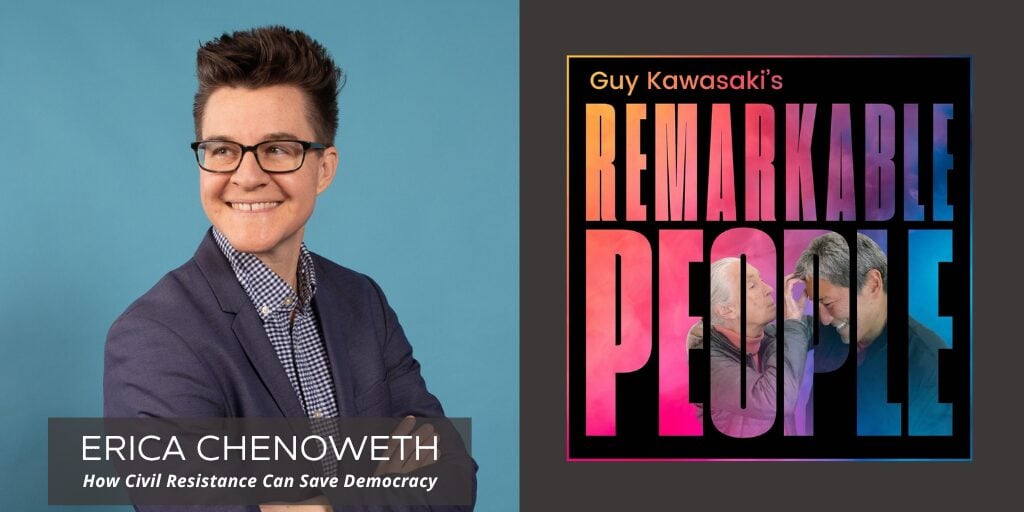
Welcome to Remarkable People. We’re on a mission to make you remarkable. Helping me in this episode is Erica Chenoweth.
Erica Chenoweth is no ordinary scholar; they are one of the world’s foremost experts on nonviolent resistance and democratic resilience. As a professor at Harvard Kennedy School and co-director of the Nonviolent Action Lab, Erica’s research has shaped how we understand the moral and strategic power of civil movements.
In this conversation, we unpack the lessons from decades of social change—from the Civil Rights Movement to today’s global protests—and explore why nonviolent resistance is not only more ethical but also more effective. Erica explains how movements maintain discipline, inspire defections from authoritarian regimes, and turn ordinary people into catalysts for transformation.
Ultimately, this discussion is about more than political science; it’s about hope. Erica reminds us that democracy isn’t a guarantee—it’s a practice that must be renewed by every generation. When people unite peacefully around shared values, they hold the power to protect what matters most.
Please enjoy this remarkable episode, How Civil Resistance Can Save Democracy with Erica Chenoweth.
If you enjoyed this episode of the Remarkable People podcast, please leave a rating, write a review, and subscribe. Thank you!
Transcript of Guy Kawasaki’s Remarkable People podcast with How Civil Resistance Can Save Democracy with Erica Chenoweth.
Guy Kawasaki:
Good morning, I’m Guy Kawasaki. This is the Remarkable People podcast. And as you know, we scour the world looking for remarkable people to inform and inspire you, and we found another great remarkable person. Their name is Erica Chenoweth, and I have been pursuing Erica for a long time because I read all these references with their names.
Erica is a political scientist and a leading expert in civil resistance and nonviolent movements. Erica is a professor at the Harvard Kennedy School and co-directs the Nonviolent Action Lab. Erica's groundbreaking research shows that nonviolent campaigns are more effective, more morally compelling, and strategically superior. Welcome to Remarkable People, Erica.
Erica Chenoweth:
Thank you so much, Guy. Delighted to be here.
Guy Kawasaki:
Well, you know, through the genius of Madisun's scheduling for this interview, it's now a few days after the No Kings Saturday, so I suppose I'm the first person to ask you this question, just like no one's ever asked me what it was like to work for Steve Jobs, but anyways, so give us your analysis of the No Kings Day, the number of people, the activity, the reaction, all that kind of stuff.
What is Erica's analysis of No Kings Day?
Erica Chenoweth:
Thank you. Great question. I will say my team at the Crowd Counting Consortium is still tallying our own count of how many people turned out on October Eighteenth around the country.
But what seems clear is that there were thousands of locations where people gathered to engage in this coordinated single day of protest against Donald Trump's administration and its many policies. And that the crowds were massive in most major cities, and extremely impressive even in very small towns all around the country.
So we are talking about a massive day of protests around the country. Possibly one of the largest ever in a single day in U.S. history. Incredibly geographically diffused on perhaps record breaking ways as well. And what I really wanna point out, is two notable aspects of that because a single day of protest, even with very large numbers on its own, can be an impressive show of people's opinions about something.
But what's really distinctive about what we're seeing today in the United States is that October Eighteenth came on the heels of multiple prior days of mass mobilization associated with the same movement and a growing volume in number of protests happening since Trump was inaugurated.
So far more protests than had taken place by this point in the first Trump administration with far more people, according to our own tallies. The second thing that's really notable is that this movement has been overwhelmingly nonviolent.
And by that what I mean is that people are taking very seriously in preparing their communities to engage in what many people in my field refer to as nonviolent discipline which means even when armed counter protestors come, or when the government decides to say that it's a group of criminals and violent people who hate the country and whatever.
People are, nevertheless, turning out using peaceful methods of assembly that are lawful, that are protected under the First Amendment, and they were reflecting very positive messages in many respects. Almost a joyful kind of spirit of seeing others gathering and knowing that they weren't alone and standing up for the basic values and principles that they want the country to uphold.
I just think that if you think about it, having that many millions of people doing something at the same time and for it to be overwhelmingly nonviolent is itself a remarkable fact like that doesn't happen too often in world history, where you see millions upon millions of people across an enormous expanse of land engaging in a coordinated action nonviolently like we just don't see that much, and I think it's worth noting that is what we saw on Saturday.
Guy Kawasaki:
Now, if it had gone violent, what would be the ramifications?
This is like Kent State without the violence, what is the meaning of violence?
Erica Chenoweth:
I think that the field that I'm in really tries to study the observable aspects of this and how the politics changes when people use physical violence toward other people, whether they're bystanders, protesters, police, or other security forces, or whether there's even just violent rhetoric like dehumanizing rhetoric and things along those lines, or more radical ideologies, which is not violent, but can sometimes cue in people's minds a more threatening political movement.
And then there's also cases where we can see instances of property damage, sometimes deliberate and very controlled, and other times looking more chaotic. And all of those different forms of tactics and sort of contentious politics have different effects.
But I think that the main thing to know is that once people who are engaged in oppositional protest of any kind are seen to engage in violence of sort cross a wide range, direct violence against people or property is generally the way that this is measured in my field.
It becomes much more difficult to control the trajectory of the movement. Among other things, it often alienates people within the movement. So the movement fractures along the lines of disagreement around tactics.
It often repels people who are drawn to the movement but are not willing to engage in that type of behavior and don't wanna be associated with a movement that does. It repels potential third parties that might be persuaded ultimately by the movement but become very close-minded to it as soon as they witness that type of activity.
And then there's also the difficult issue that elite behavior often changes quite dramatically toward a movement if it engages in violent activity. So that means that most kind of even political opposition leaders, business leaders, even faith leaders and things like that become much more tepid in their support or even shun the movement entirely.
And that cuts off possibilities of influence around the politics as well. So there's just a lot of reasons why engaging in violence can be counterproductive for the type of political power that movements are trying to build. And it becomes more difficult for movements to control that or recover from it.
The other possibility is that violence is directed at the movement. And the movement is maintaining nonviolent discipline and so that is a situation and a circumstance that many nonviolent movements, especially those that are actually getting traction and becoming more powerful, eventually encounter.
And in those circumstances, there has been in the past a sort of generalized pattern around the world and in the United States that when movements maintain nonviolent discipline. When they are faced with repression, violent repression, that the movements are more likely to elicit sympathy and support.
If they are met with repression and respond with kind of disarray or chaos or whatever, they are less likely to elicit sympathy and support. So that's just a general pattern. There's some caveats of course, but that's a process we call backfire, which is that state repression against unarmed protestors tends to backfire for the state.
Whereas state repression toward armed or those who are perceived to be using violence as they're protesting tends not to backfire.
Guy Kawasaki:
I would make the case that if you think about it, there is no single like leader or there's no centralized controlling organization.
So basically, I don't know, seven million or ten million, or whatever the number is, people came to the own conclusion kind of separately and independently. It wasn't like there was some charismatic revolutionary leader telling everybody to behave or lay down their arms or anything like that, right?
Erica Chenoweth:
I do think that there has been a growing infrastructure supporting and preparing communities to engage in mass mobilization and doing so in part by training them about the theory of nonviolent action, methods for deescalation, the importance of nonviolent discipline, and certainly those who organized, at least the nationwide organizers, around No Kings have very clearly channeled that this is a peaceful protest, and that people should come and protest if they want to.
And here are the parameters for what we expect people to do. And they were very clear, for example, on their website and in their public communications not to bring weapons and to walk away from provocateurs and basically don't take the bait, don't give the administration the headline they want.
And again, the fact that happened that the millions of people were able to coordinate whether they were directly engaged in the sort of local chapters of these organizations or not is a remarkable feat in and of itself.
Guy Kawasaki:
Wow. I've seen Super Bowl celebrations that are more violent than that. Yeah.
Let's back up and I would like you to explain why Guy is so interested in having you and it's this cross you're gonna have to bear. Erica, I hate to tell you, but you gotta explain your findings about the three and a half percent. I don't know if we should call it a rule because that implies that it is prescriptive, not descriptive, but like whatever you want to call it. Talk about the 3.5 percent Erika Chenoweth phenomenon.
Erica Chenoweth:
Sure.
Okay. So to do that, let me back up and first talk about my collaboration with Maria Stephan which you mentioned at the top when you talked about our book, Why Civil Resistance Works. Maria and I teamed up to do this study where what we did is we gathered data on 323 mass movements from 1900 to 2006.
The 2006 end date is simply because that's when we paired up and started collecting the data. It's an arbitrary cutoff date. That's the reason why it's that time period. And what we did is we looked at every country in the world in that time period and looked at every mass movement that had mobilized at least a thousand observed participants and over a duration of time demanding the removal of the incumbent national leader.
So usually the overthrow, evicted dictator, or territorial independence through anti-colonial action, self-determination, or an independence movement of some kind. And the reason we looked at those campaigns is because we were gonna try to compare the effectiveness of people power, unarmed resistance movements with armed insurgencies, and to do a comparison, that was sort of a hard test of whether nonviolent resistance was really up to the task.
We decided to limit the sample to those very challenging kind of revolutionary cases, right? Cases like Poland during the Solidarity Movement and East Timor and the East Timor-Leste Liberation Movement and the Burmese Pro-Democracy Movement, compared to the Algerian Revolution or the Chinese Revolution, et cetera.
And what Maria and I did was we basically compared side by side the outcomes of these movements that relied primarily on unarmed people power, nonviolent resistance, and armed insurrection. And we found that the nonviolent campaigns were more likely to have succeeded than the armed campaigns.
Part of the reason for that was related to our observation that the nonviolent campaigns just got bigger, meaning they got more people in them for a variety of reasons than the average armed campaign. And that then supplied the movement with all kinds of different political, economic, social, and cultural levers, that weren't available to the armed campaigns.
And that led to defections within the elites that were upholding the regime, et cetera. So after we published that book, Maria and I sometimes together, and sometimes separately, we're talking a lot with activists about the findings. And in one case I was at a workshop and an activist asked me, “If participation is important, is there a particular critical threshold that is kind of guaranteed to lead to success?”
And I said, “I actually don't know, but let me open up the data set literally right now while we're talking, and I'll look.” And I opened my computer and looked at the data, said, “I'll be, there's a pretty low kind of threshold. It's three and a half percent.” That when one of these campaigns at its peak participation rate is mobilized, that many people, it looks like none of the campaigns above that threshold failed.
And you know what's really important to know about that is exactly what you said, Guy, which is that it's a descriptive, historical observation. It's something that was particular to that sample of data over that time period.
And that means that it's neither predictive of what happens outside that sample. Neither is it prescriptive about, say, what movements might aim for as a magic number or a guarantee of success going forward. So how can these things all be true at the same time?
They can be true because there is learning that goes on right on the autocrats side and they learn that, you know, one of the things movements will do is to assemble very large numbers of people and try to generate mass and generate the political pressure that comes from that. And that if they wait that out, they might in fact be able to withstand very large but brief challenges.
The other thing is that the reason why those movements tended to succeed is not just because they got those numbers. It's because they'd maybe done years of organizing, planning, strategic leadership development, building the capacity to really shift the sort of political power away from the autocrat.
And ultimately they were able to get defections from the security forces, from the inner entourage, from the civil service, from labor, from lots of different pillars, that is what led to their success.
Not just that they put a lot of feet in the streets and that automatically resulted in something changing. And then, it's not prescriptive in the sense that if movements are aiming for that number, we don't actually know how that changes the threshold because in the historical observation, what we saw was movements that didn't know there was a threshold to cross, they just happened to hit it and succeeded after that.
Whereas if movements are informed about it and deliberately aim for it without doing the other things that movements need to do to build power, we just don't know about the impacts of it going forward.
So this is all to say, the thing to know about the 3.5 percent rule is that it's a historical observation that speaks to the fact that it's rarely the case that a mass movement for democracy needs to actually mobilize, like huge, huge, huge numbers of people.
So it's within reach for most countries, most of the time, to mobilize a movement that can create significant political, social, economic, and cultural leverage with a surprisingly small proportion of the population. So that's what I would take from it. But I wouldn't necessarily use it as a guidepost or a sort of silver bullet or magic number going forward.
Guy Kawasaki:
Just for clarity sake, I have two simple questions.
So when you say three and a half percent, three and a half percent of what? Is it the total population, the adult population, the voting population?
Erica Chenoweth:
The total population. Yeah, it is like basically based on whatever the census or the UN population statistic was for that country in that peak year.
Guy Kawasaki:
And what qualifies you for being in the 3.5 percent?
What kind of action do you have to take?
Erica Chenoweth:
Yeah.
So that's another really important point Guy because in our study we were looking at peak mobilization, which usually meant observed participation in a mass street demonstration throughout the country. So like a single day demonstration that was nationwide would be an example of that. But that of course doesn't speak to how many people might be sympathetic to a movement, right?
So it may be that in places where three and a half percent of the population historically were participating actively in kind of frontline protest, like 70 percent of the population was on side, and we can't observe that. So we just don't know like what the sort of latent level of popular support for the movements were or whether there's a lot of variation across the cases in that figure, et cetera.
Guy Kawasaki:
So now, let's say I'm the sitting guy or gal that the three and a half percent or more are protesting.
So I'm watching this on Fox and I'm saying, “All right, so three and a half percent of 350 million. That's eleven million people. That probably means 339 million people still love me. Why should I step aside? I mean it like, it's only three and a half percent. The rest of the people love me.” Obviously I'm being a little bit simplistic, why would it bother me so much that I would step aside for a mere 3.5 percent?
Erica Chenoweth:
Yeah, I think you're onto something, which is to say if somebody feels like it's genuinely a tiny minority in opposition to them, they feel like they can absorb that challenge.
The issue is that opposition is usually a way bigger figure than the number of people actively participating in protests, right? So protest participation is a signal of a pretty high commitment and resolve, to speak one's mind in opposition. It's even more of a powerful signal if opposition is dangerous.
That is to say that people will pay a price for it, whether that's a political price or whether they're put in prison or facing violent repression or something like that. Like the more costly protest becomes, the more powerful the signal it is when people participate. And all of those signals are information about the proportion of the population that might actually be opposing the government.
The other thing that comes into play is that 3.5 percent sounds like a small number usually speaks to a much larger body of discontent in a country. And you can look at things like popular approval ratings or other things like that as examples of the moving target there.
But the biggest threat comes when the autocrats can no longer rely on their pillars of support because they start to become affected by the obvious growing discontent and wonder if it's in their own interests to continue supporting, or maybe they should either oppose or just stand out of the way and watch those things unfold.
You what a lot of people who look at how these movements unfold are paying attention to is what we call defections, but really just means shifts in behavior by people who are in influential positions. For example, the U.S. Chamber of Commerce which has been, I'd say, largely on the sidelines, last week, filed suit against the Trump administration for its H-One B policy.
And what was interesting about the suit wasn't just that it said this will have material harms on all kinds of industries, small business, large corporations, you name it. But also that suit that they filed said that “The president doesn't have the right to do this.”
That it's actually congress, that we that makes the laws around this. And congressional oversight and review is required for a change like this. So they were actually saying, “This is unconstitutional.”
And even though they were coming at it from a relatively non-adversarial stance in the suit. They were basically saying, “We wanna be able to to make Congress responsive to us. And we want Congress to exercise its constitutional authority in this issue.”
To me, that is an example of a pillar business, the Chamber of Commerce, basically taking a stand on a particular issue in a way that does trouble the administration's plans around immigration, right? And its attempts to do these things unilaterally, which is the main concern for many who are worried about rule of law issues, et cetera.
The CEO of Salesforce had to back off and backtrack, right, last week. And apologize for inviting the National Guard to San Francisco, because of public resignations from his board. There are airports that were refusing to share Kristi Noem's statement that, you know, that the shutdown was because of Democrats and that they owned it.
And so a bunch of airports were simply showing the video on mute with no captions or we're literally putting up signs that said, “This airport does not endorse this video. And that we're a nonpartisan airport.” And so these are really important indicators of opposition within institutions that the administration basically needs to go along with what's happening in order to pull it off.
And that is why protest is so important because it gives permission to people in those pillars and buoys them sort of like there are still lots of people in this country that will come to your aid beyond your side, et cetera, if you stand up to, if you do the right thing, if you follow the oath of office, if uphold the law.
And so that is why these movements work. It's because they begin to interfere with the autocrats ability to get his way even if he only thinks it's a minority.
Guy Kawasaki:
Do you think that the newfound attitudes of Marjorie Taylor Greene qualify as a defection?
Erica Chenoweth:
She's certainly defecting around a couple of key policy domains, but I also think that she has such strong anti-left credentials that she can afford that.
I think the ones that are more vulnerable are people like Representative Massey, who is a relative newcomer to Congress, hasn't yet proved the sort of anti-left credentials. And so is staking out a very particular position around the Epstein files and calling out impunitive behavior from the president for this.
But the Congress right now is not particularly filled with GOP representatives who are defecting from the party. I think the defections that we're seeing are more coming from prominent institutions within civil society and less so within business, but increasingly so in business that demonstrate that they are willing to stand up and even pay a price for standing up to the president so that they can maintain their independence, et cetera.
Guy Kawasaki:
So let's say, not that I'm obsessed with her, but let's say that Marjorie Taylor Greene continues on this, anti-Big, Beautiful Bill because of the impact on healthcare costs, right? Which is clearly not exactly the party line. So now if she gets reelected, you could interpret that as you can defy the party. If she doesn't get reelected, it means you cannot defy the party.
So I don't know what I'm hoping for anymore. Should I be hoping that she gets reelected now because it shows you can defy the party. It's a defection, it's a crack in the dam.
Erica Chenoweth:
Yeah.
I'm not sure where I come down on that. To me, as somebody who's mostly just interested in the health and wellbeing of our democracy, the outcome that I'm interested in is representatives being responsive to their constituents and actually just being responsive to their constituents rather than to the head of their party necessarily. I think that that's an important indicator of a healthy democracy.
It is natural to have policy differences. It's important and expected to have them in a democracy. And the best thing to have is healthy parties that have candidates and representatives who are more interested in what their constituents are interested in than what a particular extreme party leader is interested in them doing and saying.
Guy Kawasaki:
Okay, if we could go back in history a little bit. So to help me understand what you mean by nonviolent, would you say that the American Civil Rights Movement in the fifties and sixties, would you call that nonviolent? Or when the Black Panthers who did a lot of nonviolent kind of things like daycare and stuff, but there was some violence.
So would you call the American Civil Rights Movement nonviolent or violent?
Erica Chenoweth:
Yeah, I think the standard way of answering this in my field is that it was a primarily nonviolent movement.
And there were certainly some radical elements associated with it over its long duration, it's kind of generations long duration. And nevertheless, the primary method of resistance when it came to policy change and the end of Jim Crow was definitely like civil resistance, nonviolent action, and a very important legal and political strategy on top of it, right? So it was not just sit-ins and things.
It was also litigation. It was winning very consequential lawsuits, including in the Supreme Court, and it was dealing, in the sort of inside game sense, with the White House and using federal power to basically leverage over Southern segregationists power. I think that there was really a multi-pronged approach to this one.
But certainly if you talk about the campaign to desegregate Nashville, for example, or the Montgomery Bus Boycott, or the Freedom Rides, these were definitely campaigns that were rooted in the theory and strategy of nonviolent action very self-consciously.
Guy Kawasaki:
Ah, so for someone like you, Erica, it's like you're living in the best time.
That's a double edged sword, but you are living in the best time for the research and expertise you have, right? You don't need to go and look up old copies of the Nashville daily news. You're living it right now, right? Maybe you wish you weren't living it right now.
Erica Chenoweth:
I think since Maria and I first published our book and then she and I have published other things later and I've worked with lots of other collaborators over the years, building on lots of different aspects of the dynamics of nonviolent action and trying to update our knowledge about this. I've been able to really interact with so many activists from around the world and in the United States.
And I just think that really we're all living through what is a global experience. What the U.S. is going through now is something that's deeply familiar to many other places around the world right now, and I'm having old conversations with activists kind of flooding back into my memory about things that they've noticed and said about their own struggles that are so deeply applicable here.
I just think that we are living through a very interesting moment in world history and the United States is certainly not immune to the sort of broader global trends that we've witnessed and that have accelerated really in the last fifteen years around the rise of far right populism, a strong anti incumbent orientation to many different parties and movements and just the way that's upended a lot of kind of liberal democracies around the world.
Guy Kawasaki:
From your academic and historical perspective, do you believe that today, which is, let's call it November 2025, do you believe that the US is now a fascist state or a performative democracy with a constitution, separation of powers, et cetera, as theories, but we're really not that anymore?
How deep is the shit, is what I'm asking you?
Erica Chenoweth:
I think that we are in an acute backsliding episode for sure.
So there are lots of independent observatories that try to classify whether countries are democratic or non-democratic or somewhere in between. And among those that I follow, I've seen the sort of project leaders of these institutes kind of go on record to say that they expect to downgrade the United States into a non-democracy in their next updates.
And part of the reason is just because the institutions that are the minimal defining characteristic of whether a country is a democracy or not.
For example, separation of powers, judicial independence, freedom of the press, different civil rights in liberties being respected and applied equally, rule of law, and the free and fair elections happening on a predictable and routine basis are all being challenged really significantly right now. And a major reason for that is because the person that was elected to office as the president views them as not constraints.
So, his approach to it is that he's gonna do what he wants and expects legal challenges and is willing to have things challenged legally. And as far as I can tell, the strategy is basically to allow some to be won and some to be lost.
But if a couple of really consequential ones are successes, then that can completely reshape the sort of social contract between the government and the population. And that's sort of like the political project underway. One of my colleagues, Steve Levitsky, wrote a book with Dan Ziblatt called How Democracies Die.
And in it what they said is that the most important thing for a country to remain a democracy is that we elect people who are small “D” Democrats, right? Like people who actually respect the rule of law, the institutions, they're willing to step aside if they're not reelected. They respect the Constitution. They understand things like term limits if they're there and they're not gonna challenge those.
And they just don't try to break everything. They basically allow themselves to be restrained and that their argument is that many countries are just actually pretty lucky that they manage to elect people who are not trying to break the institutions.
But if you happen to elect somebody who's very happy to break the institutions like democracy is fragile, right? And can be very vulnerable to those characters. And I'd argue that we're in a moment right now that looks a lot like what they warned about in their book.
And as I said, a lot of different observatories have already said they're gonna downgrade the U.S. to a non-democracy. And that was before National Guard troops were deployed to numerous cities around the country.
Guy Kawasaki:
It's very hard to wrap my mind around the fact that the United States could be declared not a democracy.
If you had told me this five or ten years ago, I would've told you you've been reading too many Margaret Atwood books. Like how did we get to this point?
Erica Chenoweth:
We've been here before in different respects.
There are a lot of people in my field actually who say that the United States couldn't even really be considered a full liberal democracy until 1965, because that's when we had the Voting Rights Act and the Civil Rights Act together that we're actually finally ending segregation legally and enforcing it, the legal end of segregation.
And genuinely extending the franchise and equal rights to people regardless of race. And I just think that if you think about it that way, we, along with every other country that's been a democracy on this planet of ours, we're always in a sort of constant experiment of moving farther toward democracy or further away from it.
And it's not like a project that completes itself. Every generation has to live up to and improve the values that are expressed in our own constitution and renew them and make sure that they're still working. I think that it's easy to take them for granted. But in fact, there's no destination.
It's just always a process that's underway and being perfected and improved by every generation. So that also suggests it can be regressed by different actors too. And so we're in one of those periods of a pendulum swing. It's also the case that in the Twentieth century. There have been many cases of close call backsliding episodes and things along those lines.
And there are a couple political scientists named Bob Kaufman and Steph Haggard, who wrote a book called Dictators and Democrats, and they looked at a lot of these close call episodes where the backsliding had started.
There was, you know, in a lot of cases an elected authoritarian who was beginning to dismantle rule of law and democratic institutions and norms. And then what happened is that civil society mobilized, and they mobilized to defend democracy and defend the institutions.
And in some cases, persuaded these autocrats to resign. And again, it's not like they just woke up one day and thought you know what that movement is, right? I should resign. It was more that the movement just made it impossible for them to continue getting the collaboration of their own inner entourage who basically abandoned them. And so if the inner entourage abandons and elected autocrat, that's how the resignations take place.
There are a handful of countries around the world in which this happened in the Twentieth century and into the Twenty-first. And what's really in a more recent study by Jonathan Pinckney and one of his collaborators, they found that in backsliding episodes more recently, so like in the last twenty-five years or so, that in about half of them, whereas civil resistance movement mobilized to try to defend democracy, those movements won.
So they were able to defend democracy and even improve the quality of the democracy and the aftermath of the movement. In cases where there wasn't a civil resistance movement that mobilized, they found that only 7 percent of those cases were able to survive as democracies.
And so this just speaks to the fact that a mobilized civil society and a well-organized civil society is the beachhead for democracy. Because once the institutions are challenged in the way that our institutions are being challenged, they can't hold it up on their own, they need help from the population to do that.
Guy Kawasaki:
You mentioned several times that there have been recent historical examples of backsliding and close calls. So could you actually name names and tell us about them in case people are not familiar with what actually happened in these recent close calls.
Erica Chenoweth:
Sure.
So in the Kaufman and Haggard book, they talk specifically as an example about Peru where in the nineties there was a self coup attempt by Fujimori, who was the president at the time. And he tried to become the president for life and civil society mobilized and demanded that he resigned, and he ultimately did depart office. More recently, there was a coup attempt in South Korea just this past December.
The incumbent president tried to declare martial law and install himself with emergency powers, and civil society mobilized in your immediate response to that declaration of martial law even though it happened in the middle of the night. And within twenty-four hours or so, he called off martial law.
And the coordinated union efforts and other civil society groups basically said, “It's too late. You've already showed that you wanna be a dictator. You cannot stay in office as our president.” And they impeached him, and he was removed from office.
In Brazil several years ago, there was a broad anti-authoritarian movement to try to prevent Jair Bolsonaro from being reelected after he made quite plain that his aspirations were to become a dictator in the country. And that movement elevated Lula to an electoral victory.
Even though it was a quite narrow one, they were able to pull that off. And right now, Bolsonaro is facing conviction for crimes related to that coup attempt. I think there are lots of cases around the world where we can see the fragility of democratic institutions, but also the ways in which an empowered and mobilized and well organized civil society response can really protect those institutions when they're having trouble defending themselves.
Guy Kawasaki:
I hesitate to ask you to do this, but can you explain to us what goes through those people's minds when they decide I think I'll be president for life? I'll just have a coup like, what's the line of reasoning that makes you believe you can pull that off?
Erica Chenoweth:
To be honest, I just don't know it.
I don't have that orientation myself, but I would say, there's some political scientists who a couple of years ago published a book called The Dictator's Handbook. This is Alastair Smith and Bruce Bueno de Mesquita, and their starting assumption was that basically people once they're in power wanna stay in power.
And that's just their starting point. And then the question is like how to organize the inter entourage, engage in purges and other things to stay and grow one's power. And if that's the orientation, then that's the orientation.
But like I said, I don't know what goes through their minds. I think in our case, Donald Trump is quite plain in public about the things that go through his mind. And I think he often says, “I alone can fix it,” right? As one of the famous lines. And he just views it as his destiny to be the President of the United States and to stay the President of the United States.
Guy Kawasaki:
In these close calls for these Bolsonaro and South Korea and Peru, Fujimori and stuff, did the Kristi Noem and the Stephen Millers of those organizations, how did they come out? Because in the United States, apparently Donald Trump has absolute immunity. But does this apply to everybody else inside that tent? Is it gonna be bad for them if this happens?
Erica Chenoweth:
It's interesting.
My guess is that would be something that they would use to defend themselves is the fact that presidential immunity also should mean immunity for the people who are just following orders, et cetera, et cetera. And I'm sure that there would be many different attempts to use that as a legal defense for any kind of accountability that was brought against them in the future. I simply don't know.
I don't know the kind of legal landscape that we're gonna inherit after this, what the precedents are gonna be. I just literally have no idea. I'm not sure how deep it goes in terms of the levels of accountability that are being sought, but one thing is clear that in other country, including just today in France, Nicolas Sarkozy is starting a five year sentence for breaking the law.
And as I saw somebody post about this like democracies do survive when people who were in positions of power have to account for gross violations of the law, and in fact, one of the things that is true about democracies is that they only really survive when no one is above the law, right? If there's a particular political class, there are sort of dual legal systems where there's one group of people that constantly benefit.
And one group of people who are constantly disadvantaged in the way that the law treats them. It's very hard to argue that is a system that is going to persist as a qualitative democracy.
And in fact, this is part of the reason why so few political scientists who study kind of democratic regime type would call the United States a democracy until 1965 is because of the incredible differences in the way that the legal system would operate depending on one's race, and we should say that's still true in a lot of respects.
But there are more safeguards, at least on paper, for those types of things than there were earlier in our country's history for sure. The main point I'm trying to make is that for countries to be sustainable democracies, they need to deal with the inequities and the way that the rule of law is applied over time.
It needs to get better and better, not worse and worse where there's increased stratification around to whom the law applies and who is immune from it.
Guy Kawasaki:
All righty.
My last question for you is, let's just suppose that magically you are now empowered to preserve democracy in America, right? So Erica. You are on the hot seat. You can pull all the levers, you can do whatever you could do. You can give advice to people.
If you're chartered with the goal of preserving democracy, what does Erica do? What does Erica recommend?
Erica Chenoweth:
I would wanna start by trying to draw together all of the non-violent elements of our civil society and pulling them into the broadest formation we could possibly create and articulate a few minimal points of agreement that binds that group together.
And then move ahead with a confidence that a group that is committed to making American democracy work for everyone and is committed to a couple of core principles about what that means and what's required in terms of our institutions to do that. That we could take comfort in knowing that we constitute the vast majority of Americans, represent the vast majority of Americans.
And begin to build a strategy with that kind of a group that could begin to articulate a new future for the country that is irresistible and that attracts a new energy and a new enthusiasm for engaging in our democracy. And that makes people understand that the things that they care about the most are directly linked to whether or not we get to live in a democracy.
And so that's what I would do. I would try to really boost participation and engagement in the Democratic experiment in the United States across all corners of the country with the confidence sort of formation like that, like a United Alliance, like that would be like one of the most powerful coalitions that could ever be built here and would basically be unstoppable.
Guy Kawasaki:
Can I say that what you just said is it's not to align the Democrats or the Republicans behind a particular political philosophy, but to align everybody behind the philosophy of participating in a democracy, which is different, right?
Erica Chenoweth:
That’s right. It's totally different.
I think that my interest right now is along the lines of is not partisan because can think about our typical approach to politics as being you're this party or that party. I'm more like you are a small “D” Democrat or not. Right? You believe in democracy and you believe in the things that democracy can deliver in terms of prosperity and quality of life. And everybody getting their fair shot and being treated fairly.
And like all of the good things that people want in life can come through their participation in our democracy. And it can be messy and it can involve compromise. But the most important thing is democracy is a function of government that allows us to live at peace with our neighbors.
And that's the future I wanna engage people in. Realigning our politics along the lines of those that believe in that democratic experiment and wanna see it fulfilled versus those that don't. That's an overpowering majority in this country.
It would be an unstoppable force.
Guy Kawasaki:
I thank you for being on the Remarkable People podcast and you know we discussed some depressing, frankly, and heavy issues, but I think that you have offered some really tactical and practical things and really a lot of hope, actually.
I think that's my takeaway from your message. There's a lot of hope here and you know there's a lot of work to do, but there is hope here, so I thank you, Erica, and yeah. Wow. I wanna thank my team too. So that's Madison Nuismer, who's the co-producer with Jeff Sieh and Tessa Nuismer, who is doing our research.
And Shannon Hernandez on sound design, but so just quite a few people behind me. Erica, who's making this podcast, but right up front, you're the star of this episode. Thank you very much for the information and hope that you provided.
Erica Chenoweth:
Thank you so much, Guy, and thanks so much to everyone on your great team.
Sign up to receive email updates
Enter your name and email address below and I'll send you periodic updates about the podcast.


Leave a Reply