
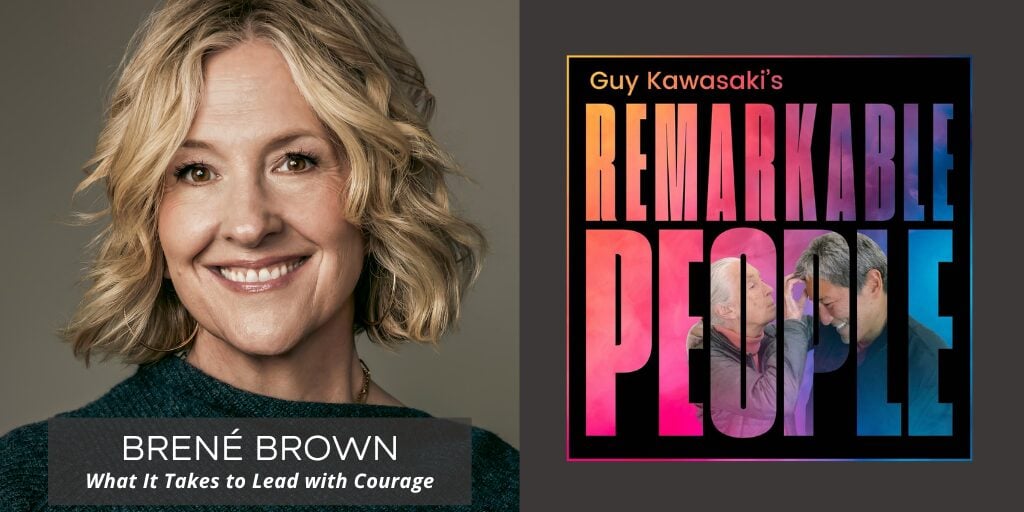
Welcome to Remarkable People. We’re on a mission to make you remarkable. Helping me in this episode is Brené Brown.
Brené is a cultural force reshaping how we talk about leadership, courage, and vulnerability. Her groundbreaking work has inspired millions to trade perfection for authenticity and fear for grounded confidence. With her new book Strong Ground, she invites us to rethink what it means to lead when the world itself feels unstable.
In our conversation, Brené and I explore how a pickleball injury turned into a leadership metaphor, why America hasn’t yet reached its pain threshold, and what it means to “not build on dysfunction.” She explains that true leadership isn’t about power or polish—it’s about learning to find your footing, own your values, and move forward with clarity.
We also discuss the fascinating intersection between physics and leadership—from the “tush push” in football to the grounded stance of sumo wrestlers. It’s all about balance, connection, and force rooted in integrity. Whether you’re a CEO, teacher, or student, Brené’s message is clear: courage isn’t found in avoiding risk—it’s born from standing firm when everything else shakes.
Listen to Brené Brown on Remarkable People—and rediscover what it means to lead, live, and love from solid ground.
Please enjoy this remarkable episode, Brené Brown on Grounded Confidence and Courageous Leadership.
If you enjoyed this episode of the Remarkable People podcast, please leave a rating, write a review, and subscribe. Thank you!
Transcript of Guy Kawasaki’s Remarkable People podcast with Brené Brown on Grounded Confidence and Courageous Leadership.
Guy Kawasaki:
So listen, my podcast is called the Remarkable People podcast. Well, that’s why you’re on it. All right.
Brené Brown:
Wow. Right off the bat. I’m flattered thank you.
Guy Kawasaki:
Oh, Brené. Don’t be so modest. Brené. On my podcast, I’ve had Bob Cialdini, David Aaker, Angela Duckworth, Carol Dweck, Richard Thaler and now, Brené Brown.
Brené Brown:
That’s the lineup right there.
Guy Kawasaki:
I have arrived. This is a big moment. Now I could die tomorrow, and I’ll die happy now.
Brené Brown:
I’m excited to be here. I have followed your work for so long.
Guy Kawasaki:
No.
Brené Brown:
Oh, no I have for sure.
Guy Kawasaki:
You say that to everybody.
Brené Brown:
No, I actually don’t. Despite my Texas upbringing, I’m not a flatterer, but I followed your work and probably been shaped by the role of beauty and excellence, passion, engagement. That’s probably shaped how I think about my work. Maybe you invented it. I was introduced to the idea of evangelism. Brand evangelism.
Guy Kawasaki:
But it was Jesus before me.
Brené Brown:
I mean, he was the OG evangelist, I guess, right?
Guy Kawasaki:
It was 2,000 year gap.
Brené Brown:
But I was introduced to the idea that if you don’t love what you’re doing and you’re not excited about it, don’t expect other people to be.
Guy Kawasaki:
Yeah. All right, so, oh yeah, we have an audience. Shit, I forgot that. You know.
Brené Brown:
Hey y’all.
Guy Kawasaki:
So this is an audience quiz. Okay?
Brené Brown:
Okay. Let’s do it.
Guy Kawasaki:
This is Brené’s latest book, and I just read it.
Brené Brown:
Strong Ground.
Guy Kawasaki:
Yeah, put it on all the cameras. All right. So now this is a quiz for the audience. So which story do you think this book would open up with? And I’ll give you some choices.
Brené Brown:
Okay.
Guy Kawasaki:
I’m not asking you; I’m asking them.
Brené Brown:
Right the audience.
Guy Kawasaki:
Yeah, I know you. Yeah. So a story of Steve Jobs and the iPhone. A story of the reinvention of Microsoft. A story of the impact of Elon Musk going Nazi on Tesla. A story about helping our kids use artificial intelligence or a story of playing pickleball. Now, which story do you think would open up a tome like this? A serious academic work? It’s pickleball.
Brené Brown:
It’s pickleball. All day baby.
Guy Kawasaki:
And why is that Brené?
Brené Brown:
Because this metaphor just unfolded in front of me, so I got hurt playing pickleball. I go to a great trainer, and he uses the term ‘compensatory injury.’ He tells me I’m hurt because I don’t have a core, and I’m using insufficient muscle groups to do the work of big muscles that I should be using.
And he keeps talking. He says, “We’re gonna go slow. We’re gonna be intentional. We’re going to not build on dysfunction.” And the whole time I’m working with him, I’m thinking, he’s working with me on what I’m working on with CEOs and leaders. Not building on dysfunction. Yeah, building core muscles and skills.
Yeah, it just made sense. So I loved it, and I am a very serious pickleball player.
Guy Kawasaki:
Yeah. I noticed.
Brené Brown:
I’m very competitive.
Guy Kawasaki:
I noticed. I’m not playing pickleball with you. So in this pickleball story, you talk about the word writhing, right? Because you were in pain. Would you say that America is writhing right now?
Brené Brown:
No, but I hope we get there soon.
Guy Kawasaki:
You want to writhe?
Brené Brown:
Yes.
Guy Kawasaki:
Why?
Brené Brown:
Because we are clearly not at our pain threshold yet, so we’re tolerating a lot of stuff. We are being injured, but the pain doesn’t match the level of injury yet. And so I think at the time where the pain matches the injury, that’s usually when people say, “Enough, I’ve gotta do something different.”
Guy Kawasaki:
Are we close?
Brené Brown:
I hope so because I don’t know how much more injury we can sustain to be honest with you.
Guy Kawasaki:
Yeah. All right. I’m gonna just go dark for a little bit.
Brené Brown:
Okay. I mean, we’re not there already. It feels pretty dark already just like saying. Alright, I’m gearing up.
Guy Kawasaki:
Yeah, so seriously, so you know, you’ve read my writing, I’ve read your writing, and you know, we’re all about empowerment and empathy and vulnerability and all that kind of good stuff, but I gotta tell you, there are days right now that I look at this and I say, “Well, it seems like the path is you focus on crypto. You focus on long-term capital gains. You work at Fox to become a high ranking government official.”
Do you ever like just get disgusted and give up? And say, “You know, the world is topsy-turvy. We’re living in a simulation. God has a sense of humor.”
Brené Brown:
Yes like three or four times a day. Yeah. I think if you are not questioning that, you need to probably go outside and take a look at what’s happening, but I think that two things can be true. I think the call to courage has never been more important, and I think that these are really, very difficult times.
And I think right now we’re not good in uncertainty and I think a lot of people feel disconnected and distrusting and are in pain. And if you can deliver certainty, whether it’s real or not, and you can give people someone to blame for their pain, hopefully someone that doesn’t look like them. I think in the short term you can gain a lot of advantage.
I just don’t think that’s a long-term play because I do believe the moral arc bends towards justice, and I do think people are inherently good. I think people in fear are inherently dangerous. I’m not giving up on all the things that we write about. I’m not going to.
Guy Kawasaki:
Yeah. I don’t even know if I dare ask this question, but you know, I was reading your book and I said, “Oh my God, what does Brené think of the Quantico Ritz Carlton offsite for generals?” I mean, I didn’t see a lot of vulnerability. I didn’t see a lot of leading from the ground. I didn’t see anything like that.
What do you think to yourself about the leadership?
Brené Brown:
I don’t look toward those folks as models of leaders, and so I don’t think much about it at all actually. I look toward the leaders that I work with every day who are waking up. They’re committed to understanding themselves. They’re committed to accountability and discipline and courage. They’re committed to understanding that the role of a leader is to serve the people they lead, not be served by them.
And so I’m looking in a vastly different direction for models of courageous leadership. And I’m not gonna be distracted. I’m just not gonna be distracted.
Guy Kawasaki:
I don’t know what day he’s here, but have you ever interacted with Stanley McChrystal?
Brené Brown:
No, I know his work on character, and I know about his military career, but I’ve never worked with him. No.
Guy Kawasaki:
I hope you can meet him here. He’s a remarkable person. His book about leadership, I think is the best book I’ve ever read about leadership. And I would rank Peter Drucker’s work number one, and I would rank Stanley McChrystal’s work on leadership number two.
Brené Brown:
There are some tremendous leaders coming out of organizations, military, non-military, but I’ve done a lot of work with the military and been able to work with a lot of the most, kind of, outstanding humility driven leaders that I’ve met in my career who are all really struggling right now.
Guy Kawasaki:
Yeah. I truly enjoy your book, but could you just for the listeners talk about what does finding your ground mean?
Brené Brown:
I think it comes out of that injury metaphor where part of strength and stability is finding our ground. And the ground is such an interesting metaphor, and it’s actually a metaphor, but it’s also real that the ground is the only thing in our lives that can both stabilize us and give us a springboard for action.
And I think that’s what we’re looking for right now. I don’t think very many people feel tethered right now, and they’re looking for external things to tether them. And you’re not going to find that. What you’re gonna find is your own ground, your own values, your own clarity about who you are, how you’re gonna show up, emotional awareness and self-awareness.
And that stability is also the springboard for change. And so I think it’s time to find our athletic stance.
Guy Kawasaki:
Yeah. You know, and I have to say that I have never heard of the tush push until your book. See, you have got to explain the tush push.
Brené Brown:
Yeah the tush push, so there’s a lot of sports metaphors in the book.
Guy Kawasaki:
Yeah there are.
Brené Brown:
Yeah, and I think it’s because I really believe that sports is leadership theater. Like I can be with a supply chain group of, you know, senior managers for a year and slowly roll out some of the learnings. Or you can watch center court at Wimbledon and see how discipline and strategy and work and training play out.
And so the tush push is an American football play. It’s a short yardage play where the team, the offense, needs to move the ball like a yard or less. And the way they do it is they literally ground into the ground. They push their feet into the turf, and they shove the quarterback forward for that one exclusive yard that they need.
And I like it because it’s all physics. It’s all physics, but I think it’s the physics of great leadership and great teamwork. Imagine a team. Let’s just take it into an organization. Imagine a marketing team of eight people.
Each of them firmly grounded in their own values. Each of them firmly grounded in the mission of the brand that they’re working for, all pushing together, being very mindful that they have a split second advantage in the market, moving together. They can do anything.
Guy Kawasaki:
But when I read about the tush, the first question that entered my brain was, how the hell does Brené Brown come up with a metaphor from professional football about pushing the quarterback’s ass forward. I don’t understand that.
Brené Brown:
I’m a huge sports fan because what’s interesting to me about the tush push is Newtonian physics, again, like force is mass times acceleration. Right? And so why no one else does it? Well, besides the Eagles. Go Birds.
They think that there’s gonna be an advantage when they send a player over the top of the scrum, but the minute that you lose your footing in the ground, you get pushed back because then your force is only your weight, not your weight times the ground. And that’s why if we can stay tethered, I mean like, let’s just take it to an organizational example of AI strategy.
If you were gonna put a team, a corporate team, on a field and watch them with AI strategy, you’ve got five of the people airborne, not tethered it all into business strategy, not tethered at all into what it takes for the humans who are gonna be using AI to be trained and onboard. And that’s why it’s not working. That’s why when the NFL is like, we’re gonna ban it, why?
Guy Kawasaki:
Yeah.
Brené Brown:
Why you gonna ban physics? Gonna ban stars?
Guy Kawasaki:
I must admit, I have never seen Brené Brown tush push and Neil deGrasse Tyson in one context together.
Brené Brown:
One of my favorite questions I’ve been asked on the book tour was, it actually started with a call from my editor who said, “I cannot put a chapter on John Keats, the poet, next to a chapter called the tush push about the Philadelphia Eagles.” And it was so crazy to me. It was like why, who doesn’t love poetry and who doesn’t love football? We can do it.
Guy Kawasaki:
So you put David White instead.
Brené Brown:
Well, I put them all like poetry and sports. I love it. We need both right now.
Guy Kawasaki:
I can offer you an idea of if you ever go to Japan.
Brené Brown:
Yes, that’s like number one on my wish list.
Guy Kawasaki:
Yeah, so if you go to Japan.
Brené Brown:
When I go to Japan.
Guy Kawasaki:
You can go to the sumo schools, you can watch how sumo wrestlers train, and if there is a sport where you need to be grounded, it’s sumo, right? If you’re a sumo wrestler, you’re in the air. You’re gonna just push out. It’s all about grounding.
Brené Brown:
Okay, so I have to ask you this question. I watched sumo videos when I was writing it, but I was really scared to take it on as a sports example because there’s so much culture behind it. But they take big hard steps into the ground to get ready. Like they have such an intimate relationship with the ground. Yeah, the wrestlers do.
Guy Kawasaki:
The only problem with using sumo as a metaphor for what you wanna do is that it’s not a team sport. They’re not pushing the quarterback’s ass. They’re pushing their own ass.
Brené Brown:
But their relationship with the ground. Like you can tell in the middle, is it a match? Is it called a match? What is it called?
Guy Kawasaki:
I don’t know. Match.
Brené Brown:
I think in a match, in the middle of a match, if you’re watching the video, you can actually see them repositioning their body so they can get back to the ground. Don’t think I didn’t look up sumo wrestling. I did, and I’m going to Japan. I cannot wait.
Guy Kawasaki:
Oh, that’s better than a tush.
Brené Brown:
It’s probably that, but I think we need the team capability. I’m into it. I’m gonna go to sumo school.
Guy Kawasaki:
Well, that’s why you’re Brené Brown and I’m not.
Brené Brown:
I do love a good metaphor.
Guy Kawasaki:
Okay. So, you know, I encounter people who read my book and they come up to me and they ask me questions and I wanna say to them, “You know, you are thinking way too much.” So I’m gonna ask you a question that you can just say, “Guy, you’re thinking way too much.” Okay?
Brené Brown:
Okay. I’m so excited. I don’t know.
Guy Kawasaki:
Alright. So you have this concept where you made it into math with it’s ‘S()R,’ right?
So stimulus response, and there’s the parentheses and you say, “You gotta put space so that there’s space between the stimulus and the response,” and you know, so you think, and you ground yourself. See, I really read the book.
Brené Brown:
You really did. I’m loving this so far.
Guy Kawasaki:
I really read the book. This is not NPR. I really read the book. It’s not like some producer just gave me a Wikipedia entry. I read the fricking book.
Brené Brown:
I mean I love it. That’s clear so far.
Guy Kawasaki:
Okay, so now here comes a part where you tell me, “Guy, you’re thinking way too much.” Okay, so I read that ‘S()R’, and then I read your acknowledgements, and your acknowledgements is probably the most complete acknowledgements I’ve ever read in my life.
You list your colleagues. You list your peers. You list your team. You list everybody. And then at the end, you list your dog, Lucy, and I looked at that. I said, “That is an example of she put space between the stimulus of writing the acknowledgement and the R of actually writing it, and she filled all that space because she’s so grounded and she’s so intellectual and she’s so empathetic. She got everybody in that space.” How’s that? I’m full of shit.
Brené Brown:
You know what? I’ll tell you what I’m doing right now. I forgot two people that were really important in that acknowledgement. And I’m gonna tell you why I forgot them. There was not enough space between stimulus and response, so I don’t think you’re reading too much into it at all. I’ll tell you what happened. Random House crashed this book.
Guy Kawasaki:
Say that again?
Brené Brown:
Random House, my publisher crashed this book.
Guy Kawasaki:
You mean the file?
Brené Brown:
No, a publication crash is a book that they speed through the process of publish. So I turned that book in like eight weeks or ten weeks before it was published.
Guy Kawasaki:
Really?
Brené Brown:
It was one of the fastest crashes in publishing history.
So I was so rushed to do the acknowledgement that I did not stick my foot into that closing elevator door, and I didn’t do right by a couple of people who were really important.
Guy Kawasaki:
Well call them out now.
Brené Brown:
Yeah, no, and now I’m so afraid that I’ve missed more than two, but I wanna say to Tina James for sure.
She had already left our team, but she was instrumental in this work and so I definitely wanna say to Tina James, she should have been in there and she’ll be in the next publishing run. We’ve already added it, but I do think that, you know what? I don’t think you’re overthinking, and I think it’s such a Guy Kawasaki question.
All of your work, I’m thinking about the books I’ve read by you, all of your work happens in the space between stimulus and response.
Guy Kawasaki:
I thought it happened between, you know, getting on the plane and getting off the plane, but okay.
Brené Brown:
You know because you put a lot of our thinking into slow motion.
Guy Kawasaki:
I do?
Brené Brown:
Yeah. You do. Yeah. I don’t think you’re thinking too much. I just think you’re thinking like you, which is a different way of thinking.
Guy Kawasaki:
Whoa. Wow. Let’s just end the interview now.
Brené Brown:
But it’s true. Because it’s like, I think beauty and excellence is one of our organizational values. I don’t think it would’ve been had I not read your work, because I think I would’ve assumed that I don’t know. I think about my work and our brand very differently because you introduced the idea of love.
Guy Kawasaki:
You know, I’m gonna have a very hard time getting out of the door after because my head is gonna explode because it’s so big now.
Brené Brown:
Well, I don’t know because I think a lot of us think that way now, but I think it was really weird when you started writing about it. Do you not think that’s true that we were surprised?
Guy Kawasaki:
This interview is not going how I planned Brené.
Brené Brown:
Excellent. Here he is going back in the driver’s seat. I see you shifting gears.
Guy Kawasaki:
This is what happens when you get two podcasts hosts together, right?
Brené Brown:
Isn’t that right. Whose interview is it? Right? But do you not think it’s true that the way we think about brands and business today has been changed by the idea that we have to create space between stimulus and response and make sure love exists in that space and excitement and enthusiasm.
Guy Kawasaki:
Wow.
Brené Brown:
Do you not think you introduced those ideas?
Guy Kawasaki:
This is a beautiful, I mean, I’m not as cerebral as you Brené.
Brené Brown:
Bullshit, I mean, that’s like nice. That’s like, yeah. You’re uncomfortable right now, but you are cerebral, so okay. I think it’s true.
Guy Kawasaki:
In the last interview I did in these chairs, the guest forced me to sing with her.
Brené Brown:
That you don’t ever have to worry about happening unless we’re gonna sing like some kind of University of Texas fight song or the Liverpool, “You’ll Never Walk Alone.”
Guy Kawasaki:
Hook ’em Horns. Oh, sorry. This is a shaka.
Brené Brown:
Oh yeah. Let’s go.
Guy Kawasaki:
It’s Hawaiian Hook ‘em Horns.
Brené Brown:
Right? Let go here and let’s look directly at the camera and say, “Hook ’em horns. OU sucks.” Okay, good.
Guy Kawasaki:
Okay. So now the next part of the book that I read, I said, “Oh my God, that is Steve Jobs,” which is someone who combines plumbing and poetry.
Brené Brown:
Oh, James March’s quote.
Guy Kawasaki:
Steve Jobs truly combined plumbing and poetry. He is in the nitty gritty and he was in the big vision and the romance too. He was real. I love that. Well, first of all, I love alliteration, so poetry and plumbing is already a winner.
Brené Brown:
It’s good isn’t it already? Yeah. That’s James March from Stanford. I have to say, I would love, we don’t even have to do a podcast, but we could take a walk one day. I would love for you to read March’s book on leadership. It’s a very difficult read, and I don’t have the balls to say I’ve read it.
I just have interacted with it for long periods of time because it’s complicated. But he’s the one who said leadership is plumbing and poetry. We have to be poetic enough to cast a vision that people wanna follow and then care enough about operational excellence to build the systems that deliver upon that vision. That’s Steve Jobs, right?
Guy Kawasaki:
Yeah, it really was. You think that those qualities are learned, or you’re just born with them? Because there’s not been too many Steve Jobs.
Brené Brown:
No, I think what’s interesting is, and I was actually talking to Reed about this just an hour ago. I’m better at poetry than I am at plumbing.
Guy Kawasaki:
Yeah.
Brené Brown:
Maybe you find both in founders more than anything else.
Guy Kawasaki:
By necessity.
Brené Brown:
By necessity, because I think I can’t decide whether I’m good at plumbing or I’m an anxious micromanager.
I do know I’m good at the poetry play part because I love language and I can cast a vision and I’m creative in problem solving, but operationally, I just want that shit to work, no pun intended on the plumbing, but like I just want that to work. And I don’t wanna talk about like time fences and critical paths. But I’m gonna insert myself in conversations about font choices.
Guy Kawasaki:
Alright, now, next topic is vulnerability. Tell me about vulnerability.
Brené Brown:
You know all about vulnerability, but I’ll tell you all about it.
Guy Kawasaki:
I’m the host. You’re the guest.
Brené Brown:
Well, definition that emerged from the data probably fifteen years ago, that has held up through the test of much more data that vulnerability is the emotion that we experience when we feel uncertain, at risk, or emotionally exposed.
So vulnerability is the emotion. My kids would call it the cringe feeling or the awkward feeling. And so we know that the mythology around vulnerability is that vulnerability is weakness. But the truth of vulnerability is there’s no courage without vulnerability. Because if you think you’re being brave, but there’s no uncertainty and no risk and no exposure, if you already know how it’s going to end, it doesn’t require very much bravery.
And so every act of courage is at its heart an act of vulnerability.
Guy Kawasaki:
So when you see that Elon Musk and Mark Zuckerberg are challenging each other to wrestling or a, you know, MMA fight, that’s not exactly vulnerability? You think that’s just pseudo macho bullshit.
Brené Brown:
I mean, those would be the first terms that came to mind, but yes.
Guy Kawasaki:
Who do you see in the Brené Brown Hall of Fame of vulnerability?
Brené Brown:
I work with leaders every day, possibly whose names you wouldn’t know. Let me define it in a way that who can face uncertainty and fear and risk and not be an asshole.
Guy Kawasaki:
That’s a short list.
Brené Brown:
Right? But who can, in the midst of those really hard emotions, stay self-aware, dignity, accountability? I think we’ve got a lot of leaders. I just don’t think they’re really famous because I think when you get to politicians. I don’t know that we’re talking at least today about leadership.
Guy Kawasaki:
On either party.
Brené Brown:
No, I think we’re talking about power and control, and that’s different than leadership, I mean, like one of the things that I think you’ll find really interesting is for people who wanna do our work.
So we’ve taken 150,000 leaders through our work, forty-five countries the last six years. About 30 percent of the people who are interested in doing the work with us make it through the assessment in the beginning. Because we ask really hard questions.
Guy Kawasaki:
They drop out.
Brené Brown:
They do or we say it’s not a good fit because one of the things we’ll say right off the bat is we’re gonna wanna have really honest conversations about power and how it’s used in your organization. We need people who are not armored up every day. So we’re gonna ask a lot of people here, why is armor required to come to work here every day? Or why is it rewarded?
And there’s a whole group of leaders that say, “You’re not gonna ask that around my company.” But then there’s a whole bunch of leaders that say, “Ask away. I wanna know. I care more about doing good work than I do protecting my reputation. And if there’s things I need to learn or unlearn, I’m all in.”
Guy Kawasaki:
And that eliminates 30 percent?
Brené Brown:
That eliminates 70 percent. Yeah. And not just those questions, but you know this, the readiness for transformation. Transformation’s hard. You’re gonna break some shit, right?
Guy Kawasaki:
By definition.
Brené Brown:
By definition, and you’re gonna break some of the things that are even off limits to talk about, much less interrogate and break.
Guy Kawasaki:
Yeah.
Brené Brown:
So you gotta be ready for transformation.
It’s a hard walk and if you quit transformation early because it gets too hard, you don’t have healthy incremental change, you just have broken transformation.
Guy Kawasaki:
Which arguably is regression.
Brené Brown:
Which is regression. Yeah.
Guy Kawasaki:
Wow. So I have to ask you, so if magically God, she, put you in charge and said, “Okay, Brené, you can redesign the electoral system. You can design congress. You can design separation of powers.”
What does Brené Brown do with her magical powers?
Brené Brown:
Damn. I take God up on the offer for sure.
Guy Kawasaki:
You what? Say that again.
Brené Brown:
I would definitely take God up on the offer for sure.
Guy Kawasaki:
Well, yeah, so you’re in the 30 percent.
Brené Brown:
Yeah. I would take God up on the offer and then I would surround myself with people who are much smarter than me, whose integrity and character I trust. And then I would go back because I actually am a big believer of democracy.
And I’m not sure actually that extremists on either side actually want democracy. Democracy is very difficult and very messy, and you can’t control what it’s going to deliver. But I’m a real big believer in multicultural democracy, I think it’s beautiful. So I’d probably go back to the founding fathers and mothers, because there were as many founding mothers as fathers for sure.
Guy Kawasaki:
We just didn’t hear about them.
Brené Brown:
They didn’t get the credit. And I’d go back to the original kind of, I got to interview Ken Burns about the American Revolution, and one of the things that struck me when watching that is that the hallmarks of democracy are virtue and education and whatever I built would examine virtue and education, income equality, and I would build a country where our ability to take care of the most vulnerable people was an exact reflection of our character.
Guy Kawasaki:
You are exactly 180 degrees from what’s happening right now. Right?
Brené Brown:
I might be 180 degrees different than what’s happening in some places. But am I 180 degrees different from the American public? I doubt it.
Guy Kawasaki:
Yeah, that’s true.
Brené Brown:
I doubt it. Yeah. Am I different from the people who hold a lot of power right now? Mercifully, yes.
Guy Kawasaki:
Yeah. Wow. Okay, so now I’m really gonna go off the track here.
Brené Brown:
Oh my God.
Guy Kawasaki:
As you know, because you heard me discuss your acknowledgements as a space between the S and the R. I read in your acknowledgements a name Noli Novak. Noli Novak is the person who did the head, what do you call it?
Brené Brown:
Noli?
Guy Kawasaki:
Oh, Noli.
Brené Brown:
Noli Novak?
Guy Kawasaki:
Yeah, Noli Novak. Yeah. She does the head, what do you call?
Brené Brown:
Head cuts, like the Wall Street Journal, like pen and ink. Yeah.
Guy Kawasaki:
So I read that. I was like, so this is how it’s done. So today I went to her site and I sent an inquiry in, but I really wanna know, how does it work?
Do you just send them a picture and then they send you the art? And does it take months and months and thousands of dollars or no?
Brené Brown:
So first of all, to get those kind of those classic Wall Street Journal head cuts, they’ve tried to introduce some AI that could just take a picture and do it. Not even close to the artists. And first of all, even if you could make it look like that, you could never make it feel like that.
Yeah. The head cut artists are so amazing and Noli is incredible. So you send a picture and it’s gotta be a certain quality of image because they’re really using that. It’s almost like engraving. And then we just got him back and we were like, holy shit, this is how it works. Like we had the same question you did.
Like, how does it work? But I wanted those in there because I thought they were beautiful.
Guy Kawasaki:
They are beautiful.
Brené Brown:
Yeah, they’re beautiful.
Guy Kawasaki:
Yeah. Your book is beautiful and even like the cover is beautiful.
Brené Brown:
Do you wanna hear about the cover? Do you want the cover story?
Guy Kawasaki:
The cover is beautiful. Yes. Yeah, of course.
Brené Brown:
The subtitle had the word pattern recognition in it in the beginning because I think pattern recognition skills are gonna be very important moving into the future. And so I thought, I want a beautiful pattern on the cover, and that’s my wallpaper in my room in Austin.
Guy Kawasaki:
It is?
Brené Brown:
Yeah. And so I literally called the creators of that wallpaper who own the company, Mind the Gap. They’re Romanian. They’re located in Transylvania. And I said, “Can I use that wallpaper for the cover of my book?” And you know what they said, “Let’s go.” And so, yes.
Guy Kawasaki:
Wow. Okay.
Brené Brown:
I love art and creativity. We have that in common.
Guy Kawasaki:
Yeah.
Brené Brown:
I mean, creators are resistors.
Guy Kawasaki:
I really love this book. Yeah. And you know what else is proof about how we’re on the same bandwidth? We dress alike. We got black and jeans.
Brené Brown:
I mean where are your cowboy boots?
Guy Kawasaki:
But I don’t have my cowboy boots.
Brené Brown:
Do you have cowboy boots?
Guy Kawasaki:
Like ten pairs.
All right, so let’s end up here. So let’s have this scenario that you know, I am a high school senior or an incoming freshman. I’m listening and watching this, and besides my education in you know, tush pushes and sumo, I would like to ask Brené, knowing what you know, seeing what you see, well, how should I prepare myself to be a leader if I’m just entering college?
Brené Brown:
I thought about this a lot when I was writing the book because there’s a chapter on grounded confidence that kind of drills down into what are the skills and mindsets for grounded confidence. And it took me six weeks to write that one chapter. It was so hairy. When I stood back from it, I thought I was gonna think about the leaders that I work with every day.
But the first thing that came to mind were my kids who are twenty and twenty-six. And I think what I would tell someone going into college right now is we’re unwittingly, and some people wittingly, building a world where there are going to be thinkers and consumers, creators and consumers.
And we wanna be on the thinking, creating side. Your attention, your thinking and your focus are commodities that algorithms are desperate to get ahold of. Protect them at all costs. Read, don’t let anyone talk you outta liberal arts classes. Take them. Be mindful of how much time you spend consuming versus creating.
Guy Kawasaki:
And getting real tactical. When you write a book, are you sitting down with Microsoft Word, or do you have some like eighteen Carat Montblanc pen and you’re writing on Parchment? How do you write a book like this?
Brené Brown:
Microsoft Word, but missing WordPerfect every day. I was a WordPerfect fan. Yeah. Yeah. But I mean, I’m just a word writer.
Guy Kawasaki:
Huh?
Brené Brown:
Yeah. Microsoft Word.
Guy Kawasaki:
Do you start in an outline format, or you just dive in?
Brené Brown:
Oh. Do you wanna hear about? It’s a massacre. It’s a Post-it note massacre.
Like hundreds and hundreds of Post-it notes I take over, I commandeer the entire house. There are hundreds and hundreds of Post-it notes.
Guy Kawasaki:
And what? You post all the notes and then you type them in.
Brené Brown:
I post them on windows and doors and refrigerators. Because as a grounded theory researcher, I’m trying to understand categories, big fat, qualitative categories and the properties that support those categories. And so I’m coding data that I’m writing it out, that I’m looking at it. It looks like a crime scene.
Guy Kawasaki:
Now we can get sponsored by ThreeM.
Brené Brown:
I mean, it’s not rare for them to send me things because I use so much Post-it note. I mean like, yeah, crazy.
Guy Kawasaki:
I hate to bring this to an end, but I must, yeah. So thank you Brené for being here. Oh man.
Brené Brown:
It was so fun. Thank you for all your great work.
Guy Kawasaki:
Okay. So I wanna thank you. I wanna thank Madisun Nuismer, my producer, Jeff Sieh, producer, Shannon Hernandez, sound design, Tessa Nuismer, researcher, all my friends here. We have a great team, Brené, and no shit, it is an honor to have you on my podcast.
Brené Brown:
Thank you. It’s an honor to be here. It’s fun.
Sign up to receive email updates
Enter your name and email address below and I'll send you periodic updates about the podcast.

Leave a Reply