
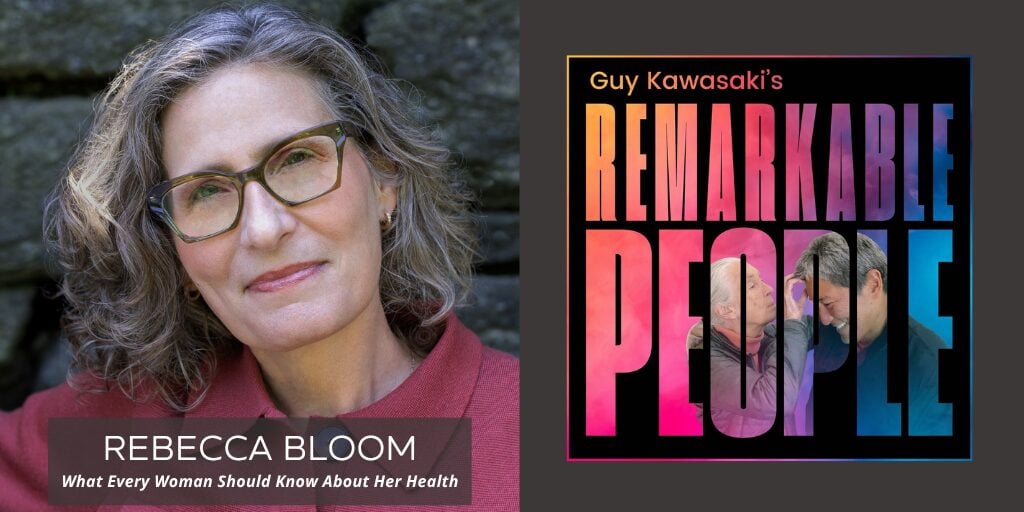
Welcome to Remarkable People.
We’re on a mission to make you remarkable. Helping me in this episode is Rebecca Bloom.
Rebecca is a force for fairness in a healthcare system that too often fails women. A former attorney and longtime advisor to patients, she’s seen firsthand how bureaucracy, bias, and burnout shape the care we receive—and the care we deserve. Her new book, When Women Get Sick, blends stories and strategies to help women navigate the complexity with confidence.
In this conversation, Rebecca reveals why women’s diagnoses lag years behind men’s, how pain is routinely dismissed, and what practical steps anyone can take to change that. From forming a “healthcare team” to understanding insurance appeals, she explains how empowerment begins with preparation—and persistence.
She also explores how hope, storytelling, and community can be powerful medicine. Because while the system may be imperfect, Rebecca believes that connection and knowledge can transform every woman’s health journey into one of strength, not struggle.
If you’ve ever felt lost in the maze of modern medicine, this episode will guide you toward clarity, courage, and care that truly heals.
Please enjoy this remarkable episode, How Rebecca Bloom Is Helping Women Take Back Their Health.
If you enjoyed this episode of the Remarkable People podcast, please leave a rating, write a review, and subscribe. Thank you!
Transcript of Guy Kawasaki’s Remarkable People podcast: How Rebecca Bloom Is Helping Women Take Back Their Health.
Guy Kawasaki:
Good morning everybody. I'm Guy Kawasaki. This is the Remarkable People podcast, and we are on this never ending quest for finding information and inspiration to help you be remarkable.
And we have a remarkable healthcare and medical care advocate today. Her name is Rebecca Bloom. You're gonna learn more about healthcare in the next hour than is possible in almost any other way because she's all about equity and education and empowerment.
Now she's working to bridge the gap between patients and providers and communities, so that care is not just available, but it's accessible and fair. Her latest book is called When Women Get Sick, and I read it last night and I must say Rebecca, there's a lot of parts of that book that really shook me up.
So welcome to Remarkable People, Rebecca.
Rebecca Bloom:
Thank you so much, Guy. It's truly an honor to be here and to meet you.
Guy Kawasaki:
I gotta start with this mind blowing little fact that I learned in your book, which is that the diagnosis of women lags two and a half to four years behind the diagnosis of men in things like heart disease and autism and ADHD and autoimmune disease, and like why in the world would that be true?
Rebecca Bloom:
Isn't that incredible? And by the way, that's not just in the U.S., that was part of an international study. So why is it true? I think it goes back to the fact that women have been so endemically under researched. Before 1993, women weren't really even in clinical trials and big research projects, so you could see how something like that lags that doesn't get fixed overnight when we go, “Oh gee, that's a bad thing. Let's fix it.”
It takes time. So that's the reason for that. And I agree. That's one of the most shocking things I learned when working on my book.
Guy Kawasaki:
Don't you also think that doctors, primarily male doctors, they would be more dismissive when women say, “I don't feel well,” or “I'm not sleeping well,” or whatever, and it's like, “Yeah, it's perimenopause, you're imagining it, you're psychosomatic.” Don't you think there's some dismissiveness here?
Rebecca Bloom:
Oh, absolutely there is. I wouldn't even just blame male doctors. I think it's baked in. I think it goes back in time. There's a hysteria problem. The word hysteria, the etymology of it comes from the Greek, right? And dismissal of women's pain is something that it's actually ossified.
There's a really great podcast called The Retrievals. Have you heard of that podcast?
Guy Kawasaki:
No I haven’t.
Rebecca Bloom:
It's a really great podcast that truly shows how even when people think that they have the best of intentions, there is this bias towards dismissing women's pain. In that first season of that podcast, it took place at Yale New Haven Hospital.
This crazy thing happened where there was a nurse who was stealing the fentanyl for women who were having retrievals done as part of reproductive endocrinology, as part of IVF. And they were saying, “Wow, that really hurt. That was terrible.”
And even people who are trained to listen and are trained to care for these people said, “Oh, no, no, no. This procedure is just pressure.” And it was something that, it took finding a pile of empty vials to understand what was really happening there.
Guy Kawasaki:
Wow. Meanwhile, if a man's escalator or teleprompter stops working, it's freaking congressional investigation. But I digress.
Rebecca Bloom:
Right. Have you ever heard about the whole, the “man cold?” There's a really funny British video about a guy who has a cold and literally acts like he's dying, and the ambulance comes, and the wife goes, “What?” There is some evidence that men and women do process viruses differently, but nonetheless, yeah.
Guy Kawasaki:
All right, so now this may seem like an NPR-ish softball question, but I do not mean it that way. And this is the question, why is your book even necessary?
Rebecca Bloom:
I wish it weren't, I wish we lived in a society where questions of women's health were elevated, such that it wasn't necessary. I have some talking points on this. Why women? Why do I have to write this book just about women? And frankly, some of the agents were like, “Well, a lot of this stuff is applicable to men too.”
And I said, “Yeah, I agree.” But there is something specific about the way there are biases in our system that are both visible and not so visible. And one of them, we already talked about, that research lag, it really makes it so that women are behind the eight ball in the way that you illustrated in terms of the lag in diagnosis.
That's a result of the research lag. And there is that pain dismissal that we talked about. But there are other things too. Women are unemployed and underemployed at higher rates than men. That affects their access to insurance. It affects their access to care. It affects their social capital and their confidence and their ability to get into doctor's offices and have the conversations that they need.
Women also tend to put kids and parents and other dependents first. So for all of those reasons, this book is necessary.
Guy Kawasaki:
And is this book necessary for most developed countries or are there countries where you say, “Yeah, they're doing it right.”
Rebecca Bloom:
Yeah, that's a great question. And I've recently talked with folks in the UK and other places. I was just in Spain, and I had a conversation with some Spanish women about this. It's true that our system in America has some very specific idiosyncrasies around the third party payer system and the lack of universal healthcare, et cetera.
That's unquestionably true. And there are chapters in my book that talk about taming the insurance beast. And yeah, that is very U.S. based. That said, I have found that a lot of the themes of this book nonetheless resonate outside of the U.S., and I think, if you talk to people in the UK, NHS is in some trouble.
There are layers of care and coverage that are happening outside of that. Canada, the same, there are lines, there are real barriers for women getting into the system, getting care quickly, et cetera. So all of these things create incentives for people to create layers in the healthcare system.
And yeah, a lot of this stuff does resonate outside the U.S. for that reason.
Guy Kawasaki:
Okay, but is there any country in the world that you know they're doing it right?
Rebecca Bloom:
It's so hard to say, right? I think we always pick apart our own and idealize the other. So yeah. On a simple basis, I would say universal healthcare feels like it's the right floor, even if it isn't the right ceiling. And I wish that we had the political will to start there.
I still think there are always going to be wealthy and privileged people who want more, but it would be lovely if we raised the floor so that those who are less privileged could at least have something basic.
Guy Kawasaki:
And why don't our politicians have the political will to do this?
Rebecca Bloom:
I think it's so complicated by all the layers of stakeholders who are making money. The system is running on dollars. How do you unpack that? There are economists that argue that we could afford this, and it might even be better than what we have in terms of GDP and whatnot.
But that said, it's so hard to pull it apart. It's like, could we undo Prop 13 in California? No because it would crash the real estate market even if it doesn't really work. We still can't because it's built in now.
Guy Kawasaki:
So is the overall message of, why we have this predicament, it's basically that greed trumps everything else?
Rebecca Bloom:
I think that's right. But that said, I have a lot of hope and a lot of optimism here, and that's because our system wasn't built for women. There's no question about it. Yet, we have what we need to make these health journeys better. Even with all of these kind of doom and gloom things that we've just talked about, we really do have what we need.
We're wired as women to sit around a campfire and share stories and share learnings and lift each other up. And honestly, that's what it takes.
Guy Kawasaki:
Okay, so let's get practical for a second. So what can you do in advance before you get sick?
Rebecca Bloom:
I love this question because sometimes people say to me, “How can you be proactive about something when you don't know what's gonna happen?” But you can. And what do you do? You take a survey of what your options and benefits actually are. Become a little bit of an expert in what your coverage is.
Understand what your personal and professional safety net looks like. Think about it in advance. You don't hesitate as a woman to be there for everybody else. Take stock of who's there for you, and also take stock of what you actually have that's concrete and practical as you say. What is my health insurance plan?
What does it cover? What does it look like? What are my copayments? What are my out of pocket minimums, maximums? All those things, that's information you have access to easily that you can know about in advance, so you don't get caught by surprise.
Guy Kawasaki:
As I was reading your book, I was thinking, there could be an industry for healthcare doulas where you just say, “I'm gonna hire you. Figure this out for me.” Now, that's kind of related to your concept of building a team, but it is so freaking complicated. I don't know how anybody would do it.
Rebecca Bloom:
Absolutely. It is so complicated, Guy. I have helped women who are professors at Stanford Law School, who you would think would have minds so at home with complexity that this would be a piece of cake for them. It's not a piece of cake for anybody. You wouldn't let a surgeon do surgery on you if they didn't do it every day.
Right? So don't be guided by anybody but somebody who does this every day because it is that complicated.
Guy Kawasaki:
How do you find a person like you who's the healthcare doula?
Rebecca Bloom:
That's why I wrote this book. By the way, I love that. Can I borrow the healthcare doula?
Guy Kawasaki:
You got it.
Rebecca Bloom:
Thank you. Thank you so much. You're so generous. It's true that my background is so esoteric and bespoke and well mapped to this work. That is true, but that's exactly why I wrote this book because it doesn't have to be this scary.
If you break it down, you saw in the book, I literally map a health journey and all the aspects of it, and it's not just what happens inside the system, it's the workplace. It's different pieces of the health space. It's your community. It's what is available and what is out there in a very 360 holistic way.
So I wrote this book because I think women can both empower themselves and the people in their lives to not be so freaked out by all of this bureaucracy and scary complexity and actually find the tools, they're right there, to get through the mess and get through the noise. Really? We're all trying to get through the noise, aren't we?
Guy Kawasaki:
No kidding.
Rebecca Bloom:
That's what we're all doing. And this is my lane in trying to empower folks to do just that.
Guy Kawasaki:
All right, so we're gonna get really tactical now. So let's suppose that you are a woman, and you just got a diagnosis that you have breast cancer. Now walk us through the steps that this woman should immediately take.
Rebecca Bloom:
Okay. Absolutely number one, you build your team that day, that minute, who in your life can fill the lanes? I know there's a lot of sports metaphors here, but who can fill the lanes for you?
Who's the best project manager? Who's the person who is the strongest communicator? Who's the person who cooks food and drives carpools, and loves to have a clipboard and a whistle and get things done? Figure out who are those people that you can truly count on, and it may not be your partner if you're lucky to have one. That's something I always tell people.
That person is going through their own journey here and they have their own fears and their own concerns. If it's a type A person who loves control, maybe your partner is the right person, but have grace about the fact that maybe you need a team around not just yourself, but your partner too. So that's the first thing to do, for sure.
Guy Kawasaki:
So you form this team, you have what you call a chief of staff. You assembled these experts. I also found it very interesting that you said that “When people find out that you're sick, there's lots of people who are willing to cook for you, but there may be other things that are more valuable than people bringing you food,” right?
Rebecca Bloom:
Yeah, no, it's true. No hate to the ubiquitous lasagna. We all love a great lasagna as long as it's well prepared. I once wrote a cookbook. I like it to be well prepared. But that said, yes, there are some other things that you can do and offering specific useful things, not just saying, “Hey, I'm here if you need me.”
That's lovely, what's better? Hey, I bought a notebook and a three hole punch, and I wanna take all the paperwork that you get mailed to you off your plate. I wanna keep it organized. I wanna stay on top of it. I wanna look at any deadlines you have. I wanna check for bills that don't seem quite right.
I wanna handle that for you. That is a gift if you do that.
Guy Kawasaki:
Yeah, no kidding. You need a bridesmaid in a sense, right?
Rebecca Bloom:
Yeah, that's definitely one way of looking at it.
Guy Kawasaki:
Yeah. You can borrow that too.
Rebecca Bloom:
Yeah. And I love the idea of infusing a health journey with the joy of a wedding. Because there is often a whole life ahead after the journey, a survivorship journey. And if you can think of it as an event that is opening the door to a new future in that way, that's fantastic.
Guy Kawasaki:
All right, so you got any key best practices for this team?
Rebecca Bloom:
Yeah. Number one, guard the patient with real mindfulness, there's a lot of people who say things that are really hard to hear. There's a lot of toxic positivity in our culture. There's a lot of you attracted such and such by manifesting such and such. These things are popular, but they're not really useful when someone's on a health journey.
They feel locked out when they have to deal with too much of that kind of messaging, so guard the person that's really one best practice I know. The second thing is do practical things like have somebody in charge of checking the electronic health records because scans come in before the doctor looks at them and somebody's gotta look at that.
But when it's you and it's your body that just got scanned, and you're reading these words out of context, like the word lesion is a great example. A lesion can be a lot of things. It can be totally benign, but you see that word and you think that's inside your body, and you flip out. So let somebody else do the reading and the scanning and be the filter.
Be the filter for this person. That's a really important thing that this team can do.
Guy Kawasaki:
And on this team, should you try to get a lawyer? Is the legal remedies like the first thing or the last thing you try?
Rebecca Bloom:
Oh, I think it's the last thing. First of all, nobody sues their employer or a healthcare provider. That almost never happens, and I think starting out with that kind of adversarial energy is not a great idea. You don't need a lawyer. You need somebody whose brain is comfortable with bureaucracy and complexity and paperwork.
Sometimes that can be a lawyer. I'm a good person for that, and my legal training certainly doesn't hurt, but my attitude is productive and collaborative and cooperative to start.
Guy Kawasaki:
All righty. Now, I think that one thing this team might immediately hit is the fact that it's controlled who can see your medical records. So do you just pass around your user ID and password and what do you do when you give other people access?
Rebecca Bloom:
No. Really only one person other than you should have your credentials for logging in. You don't have a team meeting where everybody is talking about what the doctor's notes said. Definitely not. HIPAA is a very complicated law, but it is designed to protect patient privacy.
Privacy is a very important thing, and I don't think every single person who's helping your cause when you're on a health journey needs to be that involved with the minutiae like that. But it's a good question. I see what you mean. I think you're thinking of like a conference room table and the sharing of that information.
I often tell women. You have the right to keep what's going on with you private, let's say with your employer, but there may be times when showing a little bit of vulnerability by expressing your truth is actually helpful. It might actually help you get where you're going.
Guy Kawasaki:
The reason why I asked this question is because of your example of the woman whose daughter was homeless and drug addiction and all that, and she couldn't really step in and help her. She was limited by HIPAA, right?
Rebecca Bloom:
Yes. That is such a good point. And that's a story that is so close to my heart, because that's an example of a law that was designed for one thing, but because of the way it was written and the way it ends up being executed, it really backfired because Diary who was the trans woman that we're talking about who was homeless, was of age right? Over twenty-one.
People in the shelter where she was staying had discretion under HIPAA as to whether or not they needed to communicate with anybody else and whether or not they would reveal what was going on with her. And the discretion was exercised in a really regrettable and unfortunate way.
And I think that that's something that I'm actually working with Diary's mom on, and we're talking about strategies for how can we change the way this law is executed or even change the law if need be? So that the discretion is a little bit more informed around what is the mental health condition of this person?
Are there some bright lines about when you really should answer a frantic mother who has questions? We feel like there should be, but thanks for bringing that up because that story is so important and it shows how even with good intentions, the law on itself is not the answer.
It's excellent human communication that is the answer.
Guy Kawasaki:
I would never do this, but I guarantee you that there are parents who have their kids user ID and password, and they're accessing healthcare systems to try to figure it out and help them get prescriptions and appointments, and they're telling their kids, “I just signed in as you, you're gonna get a code. Send me the code within ten minutes.” I guarantee you that is happening all over the place.
Rebecca Bloom:
I am so sure that you're correct. I live in Silicon Valley. I'm very familiar with the momager culture. And it's not that big of a jump from checking your kids' grades day in, day out all the time to getting into your kids' health stuff. And look, sometimes kids probably ask adult kids, right?
Probably ask their parents to do that for them. I've seen parents stay up late to register their kids for classes, do things like that for them. There's some kind of protracted adolescence in the younger generation, so it's sometimes, I think, collaborative on the part of parents and kids.
But other times I think, parents have trouble letting go, but if you look at this story of Diary, this was an extreme situation involving all kinds of physical illness and mental illness and Diary did not get the best care because HIPAA blocked her mom from really being as involved as she could have been.
Guy Kawasaki:
Speaking for all the moms out there, these HMOs do not make it easy, such that you could say, “Yeah, my 18-year-old kid can navigate. This is no problem.” There is no way that is true also.
Rebecca Bloom:
I don't think anybody's great at navigating these things. They're so complicated. I think sure, we have people who are minors and then we have seniors. I am blessed to have two living parents. My dad's ninety-one, my mom's eighty-seven. On both ends of those spectrums, you can't expect these folks to be able to navigate this much complexity and technology on top of it, right?
But I think the people in the middle, the yous and the mes, it's not easy for any of us. I've had problems myself with bills that come, and I've communicated over and over and over again, and I'm assured that it's gonna go away and it doesn't go away, and it goes to collections and all these things.
And I am a professional and this has happened to me. So imagine somebody who doesn't do this all day, what this must feel like, and that's why people pay so many bills they probably shouldn't pay because they just want it over.
Guy Kawasaki:
And it's not like the system has any incentives to necessarily fix that, right?
Rebecca Bloom:
It seems like not. As long as the stakeholders are making the profits that they seek to make, it's hard to see why it would change, but you do see change. There's a relatively new law that was passed called the No Surprises Act. And why was this law passed? Because people would go in for, let's say, a procedure or a surgery, and they would be told that their surgeon was in network.
And then all of a sudden, out of nowhere, you'd have, let's say, an interventional radiologist or an anesthesiologist who was put on the case because of scheduling. Oh, but guess what? That person wasn't in network, and nobody was told. You're on the table, right? You're not having that conversation and then all of a sudden you get a giant bill.
At least legislators had the wisdom to go, “No. We need to have a system where there are no surprises.” That's why it's called the No Surprises Act. Now, is it perfectly followed to the letter the way we hope it will be? Always? No, you probably have to fight about it sometimes. New laws are always like that.
Laws don't really change society quickly. It takes time. You pass them, and then they have to be interpreted. And stakeholders push against them if they don't like them and other stakeholders go, “No, this is my new right. I wanna fight about this.” That's why there's so many lawyers in this country.
If it was as simple as just passing a law and then boom, everything changes the next day, that'd be great. But you can't really legislate attitudes and behaviors immediately. So you could see how that goes.
Guy Kawasaki:
I have had cases where my kid dislocated her shoulder surfing and she takes an ambulance two miles to the emergency room, And then you get a bill for, I dunno, 2,500 dollars to go two miles. And now imagine if she had a heart attack and she caught a helicopter to Stanford and is the helicopter covered? Is the ambulance covered?
Rebecca Bloom:
The helicopter is better covered than the ambulance. And it's because of what you said before, this is all so complex. There are so many layers of different entities who are trying to take their piece of the healthcare pie and ambulances are an amazing example of how it goes wrong.
So many times there's a local ambulance company that jumps in and they're not covered by this provider who's over there in the different city, and boom, there's the bill. And it happens so, so often. The ambulance is a big thing. I think I've had fifty or more people come to me about ambulance charges that they didn't expect.
Guy Kawasaki:
Wow. So one thing you learned listening to this podcast is if you can drive yourself or drive the patient to the hospital safely, you probably should do that.
Rebecca Bloom:
Yeah, that's all great until you have a need for oxygen or something that you don't have in your car.
Guy Kawasaki:
Well, that’s true to, yeah. Now, we're both in Silicon Valley and I gotta believe that AR can be part of the team where you, let's say, you're covered by Blue Shield and you just ask ChatGPT, “Does Blue Shield cover the ambulance costs and the helicopter costs?”
Don't you think it would give you an answer that would be much easier and faster than trying to go through your policy and figure all this out?
Rebecca Bloom:
I would love to say that I have total confidence in those answers. I've asked them. But I think it's only as good as how it's trained, right? That's gonna be true of all of this AI and it will develop over time. And I hope it will cut out a lot of the friction of let me call, let me wait on the phone.
But the problem I see is usually most of the information that they get is what's getable out there on the internet. They just bring it together. So I myself have argued with ChatGPT, not in a spicy way, but I've said it'll give me an answer and I'll go, “Really? Because I read something that said this,” or, “Oh, I just got off the phone with someone who said that.”
And ChatGPT is trained to be so polite, really makes you feel like it likes you. No question. But what it says when I say that is, “Hey, thanks a lot for that. Yeah, I'll put that in my information for next time.” It keeps learning, which is great, but it also makes you go, “Oh, then I'm not so sure the answer I got is the answer I needed.”
Guy Kawasaki:
But just to play a little bit of a devil's advocate here, yes, ChatGPT can hallucinate and give you the wrong answer, but so could your buddy. Right?
Rebecca Bloom:
Right. Oh yeah. It's true. But so could my buddy. But I hope if I called a health system and said, “Are you going to accept my Cigna PPO for this? And can you help me navigate the pre-authorization process?” I would hope I would get a better answer from that human being.
Guy Kawasaki:
Rebecca, if you can get to a human being, I would agree to you, the first thing you get when you call an HMO is if this is an emergency, dial nine-one-one. Don't call us. And then, one to speak to your doctor. Two to speak to the pharmacy.
Rebecca Bloom:
No, it's true. I wish I had a dollar for every time I had to re-listen to the options because I'm always multitasking when I'm trying to help somebody or help myself. I’m doing something else. And then I go, “Oh God, what did they say? I gotta listen again.”
Guy Kawasaki:
I wish every CEO of every HMO and PPO would call their own 800 number and try to get to a human.
Rebecca Bloom:
I wish they would too. That's one of the reasons that I always tell women when they're on a health journey, call your health insurance company and ask for a specific case manager. They'll never give you one if you don't ask, but if you ask, they might. And then all of a sudden you've got somebody's email and direct line, and you don't have to wait on hold like that.
That's a big tip I give people a lot.
Guy Kawasaki:
Okay. Now Rebecca, why don't you create BloomGPT and BloomGTP's corpus is only information that you put in so that it's much less likely to create a hallucination.
Rebecca Bloom:
That's a great question. I never really thought about it. You're such an innovator. That's why I wrote the book. I guess that's an old school way of doing it, but that's what the book is meant to be. And, yeah, I guess I have to talk to somebody who knows how to build that.
Guy Kawasaki:
You are talking to somebody who knows how to build that.
Rebecca Bloom:
Lucky me. Really? I can't believe my good fortune.
Guy Kawasaki:
And I have built KawasakiGPT, and KawasakiGPT is all my writing, all my video, all my books, all my speaking and all my transcripts, and it's limited to that. Now I can let it go outside or I can just keep it narrowly focused, but that is imminently doable today.
Rebecca Bloom:
So it's a searchable app of everything you've ever written? Is that what it is?
Guy Kawasaki:
More or less. Yeah. And I can tell you that KawasakiGPT is better at being me than me. I ask myself questions.
Rebecca Bloom:
Does that scare you?
Guy Kawasaki:
Not at all.
Rebecca Bloom:
That's awesome.
Guy Kawasaki:
It's the closest thing I'm gonna get to immortality.
Rebecca Bloom:
Yeah. That's cool.
Guy Kawasaki:
We can discuss this offline.
Rebecca Bloom:
Let’s do it.
Guy Kawasaki:
I would love to have, I think people listening would love to have, I use air quotes, but BloomGPT where, yeah, I really can trust this. It's not a generic LLM. This is someone who really knows their stuff. Also things that struck me in the book were like these are benefits from Medicare and Medicaid that you probably don't even realize you can get.
Rebecca Bloom:
Yeah.
Guy Kawasaki:
So can you just mention a few, and then I'm gonna tell you, I asked ChatGPT about this, and it gave me a list. So what's some of the things that people just don't know that they can get from Medicare or Medicaid?
Rebecca Bloom:
So Medicare or Medicaid, first of all, it's so complicated because it depends what state you're in. It depends. Even though it's called Medicare, you still have a carrier like United Healthcare, sells the one through AARP, for example.
But people are surprised to learn that things like hearing aids, things like walkers, often therapy. There's mental health coverage. There's things that people think you would never be able to get. So those are some, but I'd love to hear what you got when you did a search.
Guy Kawasaki:
Okay, so I'll read you a very quick list. So for Medicare ChatGPT told me annual wellness visit, preventive screenings and vaccinations, mental health services, home health care, durable medical equipment, telehealth visits.
For Medicaid, it told me dental and vision care, transportation to and from medical appointments, home and community-based services, prescription drug coverage and long-term care nursing home and in-home assistance are fully covered. I don't think most people knew that list.
Rebecca Bloom:
I think they don't, and I also think there's a lot of fear around, even if that's the case today, is it getting cut? There's so much talk about what's gonna get cut, where it's gonna get cut. A couple years ago I was at my college reunion, and I was at a health forum with folks from Yale New Haven Hospital, and they were talking about how Medicaid and Medicare are gonna cover health advocacy.
I don't see that anymore today. Do you? You asked me before; how do you find somebody like me? For a hot minute there, it looked like that was gonna be something where there was gonna be a push for more training and there were gonna be people provided within these coverage systems. Not sure that's totally true right now.
Guy Kawasaki:
Let me tell you a personal story. I have no trouble falling asleep. I have trouble staying asleep. Okay. And so I've been asking my doctor and stuff, and the first round of suggestion was something, an antidepressant, that is used for this off label. So I asked ChatGPT, what do you think of this drug versus there's something called, I gotta read it, it's a class of drugs called dual orexin receptor antagonists.
And this Dora the Explorer, this DORA class of drugs was targeted specifically for insomnia as opposed to off the label antidepressant. So now, I was told that this wasn't covered, so I am going to ask for a, I learned a new word in your book, formulary exception. Yeah, I love that word.
Rebecca Bloom:
Formulary exception. Do they cover your drug? That's what that is. Yeah.
Guy Kawasaki:
So right there, I said, “Wow, this book opened my eyes.” I bet you most people think that if your HMO says, “that drug is not covered,” you say, “Oh, guess I'll use whatever. I guess I can't get it,” right?
Rebecca Bloom:
Yeah. In general, the system is trained to say, “No,” and so often it's about persistence and strategic communication to get to the yes.
Guy Kawasaki:
So another practical question. How does one be a good patient?
Rebecca Bloom:
So for me it's about respect. It's about viewing the relationship with your doctor or doctors as a true partnership. So what can you bring to the table? You're gonna do your research. We've talked a lot already about ChatGPT. Dare I say Google too, because people still Google a lot of stuff.
You're gonna read all about your condition. You're gonna maybe even freak out a little when you do that. I always tell people, I'm not gonna tell you not to do it. I'm gonna tell you not to do it at two o'clock in the morning. Because that's not a good time for you to have even temper or solid, stable judgment.
So you're gonna do it, that's fine. Be prepared, but then take another step when you go into your doctor's office, have a totally thoughtful, curated list of questions, and run them by your team. That doctor has a lot going on behind the scenes. That doctor has fifteen minutes to talk to you and they're being managed from above.
There's a whole system superimposed on that doctor. So just be aware of that. Be thoughtful about that. Be cordial, be kind, be efficient, be reasonable. These things go a long way towards being a good patient, but also be vulnerable and be honest.
An example of that is, I had a doctor who I interviewed tell me, “I wish a patient would just let me know if a copayment for medication of fifty dollars a month is gonna be a burden. That might affect which medication I prescribe. I would rather know than not know.”
Guy Kawasaki:
Yeah, I read that in the book, and I thought, my god, how can the richest country in the world be telling people that you know, you're gonna pick your medication or not because of fifty dollars a month?
Rebecca Bloom:
It shouldn't be. Again, if you asked me do I believe we could do better if we started over? The answer is absolutely I do. But I'm a realist and I want to be able to find paths to the better inside of the system we now have because I live in the today.
Guy Kawasaki:
Yeah. Okay. So now what does a person do if they're told that their coverage is denied?
Rebecca Bloom:
So the appeal process is so underutilized that it truly shocks me. You can win an appeal probably almost half the time, and maybe even more than that. Those are great odds when you think about it, right? And yet people don't do it because they're stymied by the burden of it when they've got other more important things to worry about.
You're worrying about a healing process. Do you really wanna sit around and write fake lawyer letters about things? Do you really wanna bug your doctor to support that? Which by the way, you should do, because they do it all the time and they're good at it.
There's just this fatigue around the bureaucracy of it all that stops people from doing that. So that's number one. Number two, if you really need something and your current plan isn't giving it to you, it might be time to talk about alternative plans, or it might be time to say to your employer who provides that coverage, “Hey, you're the one with this contract. Can you help me out here?”
There are things you could do that stop you from just taking no for an answer. But again, it's that growth mindset thing, right? If you accept defeat, then you're gonna start with the Charlie Brown walk, or you can look at what's possible. And there are a lot of possibilities like the ones I mentioned.
Guy Kawasaki:
I have to say that I am very happy with my HMO but let me ask you if this is a possible scenario that my doctor is saying, “You gotta try this generic medicine first and then we can see if we can try other things.” And if you say to the doctor that, “I did my own research, that thing is not being used for its intent or purpose. It's off-label.” So I wanna file a, what was that term again?
Rebecca Bloom:
A formulary.
Guy Kawasaki:
Yeah. “I wanna file a formulary thing.” And do you think that maybe the doctor who I love, my doctor, my doctor can say, “Guys, this guy has done his research. He's gonna file this formulary or whatever. I think we should just take care of him.”
Can you give your doctor some way to go up the chain and say, “I think this is a better way to do this.”
Rebecca Bloom:
Yeah, I know a lot of doctors, women doctors, with women patients in particular, who go to bat with insurance companies all the time. They do it all the time. Are they frustrated sometimes? Absolutely. But are they better situated to make some of these arguments than a patient? Yes.
Generally they are. So yeah, I think arm your doctor with the information, they do their own research, they read all the articles. Doctors are incredible. The stuff that they're responsible for taking care of and doing in a day and the way they're supposed to give you perfect care in fifteen minutes and take notes on it all at once, is really something.
But they are better situated to make those arguments. And some of them are really successful. Like I said, do they get frustrated and stymied too? Do they get angry about the ways that sometimes insurance companies will stonewall even in the face of reason? Yeah, they are, but they'll try, and they can be very successful.
Guy Kawasaki:
Yeah, like I said, I've been very happy with my healthcare.
Rebecca Bloom:
I'm so glad.
Guy Kawasaki:
So now, let's talk about the ACA.
Rebecca Bloom:
Okay.
Guy Kawasaki:
I know, first of all, it seems to me that the ACA, it expanded healthcare for millions of people. It reduced costs for people, it protected pre-existing conditions, and it enabled kids to stay on until they're twenty-six years old.
And you know what, like, why do some politicians want to get rid of the ACA? I do not understand it.
Rebecca Bloom:
It's not a simple thing because politics have become so partisan that I feel like people are fighting for things that they don't even understand. They're fighting just because their opponent liked it often because the fact of the matter is the ACA covered many more millions of Americans, particularly the kids that you mentioned up to age twenty-six and people with preexisting conditions.
I've been doing this so long that I did it before the ACA, so I know what used to happen to people with preexisting conditions and it was horrible. They would have to do crazy backflips to get health insurance.
Let's form a company around our knitting circle because we sometimes sell the stuff we knit and then we can be a group and then we can get a group health insurance plan and then we can get out of this craziness around individual health insurance, preexisting conditions that make it impossible to get coverage.
We get denied or we get put in these major risk medical pools and we have to wait on a waiting list, et cetera, et cetera. Really. It's a better world because more people can be covered. The state marketplace systems make policies available. They streamline that whole process. Anybody can buy a policy. That said, with the loss of the mandate that everybody buy in the marketplace has changed.
And there's an argument that the ‘a’ in Affordable should be crossed out. It's way less affordable. And with subsidies, expiring this year, we're gonna see the fallout of that. We're gonna see how yes, you can buy a policy, but yes, it's gonna cost you.
Guy Kawasaki:
Wasn't part of the anti ACA, like a matter of personal freedom and government overreach?
Rebecca Bloom:
Yes, it was. The idea being, okay, let's articulate it even if we don't believe it. The idea being, don't tread on me, don't tell me what I have to buy. That's it. You know how risk works. The more you spread the risk and the more healthy people that buy in, the less expensive it is for all.
Guy Kawasaki:
On the other hand, we wanna tell Jimmy Kimmel what he can say, but I digress. I digress.
Rebecca Bloom:
You do. But it got a laugh, so it's okay.
Guy Kawasaki:
I hope I'm not violating HIPAA, but you put it in your book, so I gotta ask you, so now you had IVF to get pregnant, right?
Rebecca Bloom:
You can’t violate HIPAA, by the way, because you have to be a healthcare person and you're not, so you're good.
Guy Kawasaki:
Oh, really? Oh, that's good. I cannot violate the First Amendment because I'm not a government, right. So I can tell you to shut up and that's not a violation of First Amendment.
Rebecca Bloom:
Exactly. Same concept.
Guy Kawasaki:
Okay. So I feel empowered now. So now everybody in the world, you now know that Rebecca had IVF. And she had leftover embryos, and some people define an embryo as life. And so what do you do these days with a leftover embryo?
Rebecca Bloom:
Yeah. It's interesting because it's possible to feel emotional about embryos made of your own and your partner's DNA, which I did. But to also recognize that they could be helpful to others since we weren't going to use them to try to create another pregnancy. So we donated them to Stanford, to the labs there, to the medical school, so that hopefully researchers could learn something that would improve other people's lives.
That's what we did. We were lucky to do it in a climate where that felt almost universally welcome. I didn't really think about how political that was gonna become because in the moment that we did it, it was before more recent vitriol occurred.
I think that, from my perspective, Roe versus Wade was a complicated legal decision in that it talked about viability and when life begins, and that's an inherently fraught political, religious kind of lightning rod conversation to have.
From my side of things, I prefer to think of it as privacy, that was our DNA, and we chose to donate it to a research facility, like I said, hopefully to improve the lives of others. That's good enough for me.
Guy Kawasaki:
And today. Could you still do that?
Rebecca Bloom:
I'm not sure. I think probably in California. Yeah. I'm not sure about other parts of the country.
Guy Kawasaki:
Wow. Okay. Where do you, Rebecca Bloom, get your medical information online? Who do you trust online?
Rebecca Bloom:
I like WebMD. I like the Mayo Clinic. I think Stanford has some really excellent information. I'm always careful though, because what I have come to understand is that all of this information by nature is one to many. One to many communication is gonna be generalized no matter what. It's never gonna map exactly to anyone's perfectly specific set of facts.
And because I'm a lawyer, I think I'm particularly sensitized to that. I don't wholesale take anything I read as automatically applicable. There is no substitute for a conversation with an expert who has read it all, including stuff you can't find on the internet necessarily. And who is taking into account the specifics of the individual who is seeking the information.
Guy Kawasaki:
Okay, and can I specifically ask you if in September of 2025 you would rely on information on the CDC website?
Rebecca Bloom:
It's not my first place to go. No.
Guy Kawasaki:
That's a lawyer's answer. Okay. So my last question is just suppose that a miracle occurs, and it would be a miracle, and you are now replacing RFK Jr., what would you do?
Rebecca Bloom:
The first thing I would do is invest in science and expertise all across the country. I think what we have a wealth of brilliance in this country. We have people who truly understand health and disease, and I would empower them to pursue all of the research that they can dream up to really progress in human health.
Guy Kawasaki:
That's a good answer. I take it you wouldn't shut down mRNA research.
Rebecca Bloom:
No, I would not.
Guy Kawasaki:
Yeah. That is gonna bite us in the ass someday. Yeah. I kinda hate to end on a bummer question like that.
How about you summarize your book and tell people why they should read it? Because I think every woman should read this book.
Rebecca Bloom:
Okay, so the reason I think every woman should read my book, even though I'm not about shoulds, I think I would say will want to read my book, is because I bring together incredible stories of women who have been on health journeys with hard won through experience, details, facts, tips, takeaways that truly can make women's health journeys better.
I believe that women's health journeys can be better even under current conditions. I do believe that.
Guy Kawasaki:
That's good. And I would concur with that. I thank you, Rebecca Bloom. I hope that people listening to this podcast take away this knowledge and empowerment and growth mindset since you used the term. Carol Dweck would be very happy about this. So thank you very much for being on our podcast. I hope you know people listening to this will read your book and take your knowledge and go forth here.
I wanna thank the rest of the Remarkable People team, that of course is Madison Nuismer, co-producer, Jeff Sieh, co-producer, Shannon Hernandez, sound design engineer, and Tessa Nuismer, she's doing all our research. Thank you very much for being on our podcast, and I am sure that you are inspiring and helping many women, and so good luck to you. All the best to you.
Rebecca Bloom:
Thank you so much, Guy. This has been truly a pleasure and an honor.
Sign up to receive email updates
Enter your name and email address below and I'll send you periodic updates about the podcast.

Leave a Reply